Why Proof is the Only Way to Acquire Mathematical Knowledge Marc Lange University of North Carolina at Chapel Hill 1. Introduction 1. Introduction 2. Knowledge requires more than justified high confidence in a truth 1. Introduction 2.
"Why Proof is the Only Way to Acquire Mathematical" is the property of its rightful owner. Permission is granted to
download and print the materials on this website for personal, non-commercial use only, and to display it
on your personal computer provided you do not modify the materials and that you retain all copyright
notices contained in the materials. By downloading content from our website, you accept the terms of this
agreement.
Presentation Transcript
01
Why Proof is the Only Way to Acquire Mathematical Knowledge Marc Lange
University of North Carolina at Chapel Hill<br>
02
1. Introduction<br>
03
1. Introduction 2. Knowledge requires more than justified high confidence in a truth<br>
04
1. Introduction 2. Knowledge requires more than justified high confidence in a truth 3. Explanations in mathematics<br>
05
There are sixteen ”calculator numbers”: 123321, 159951, 789987, 147741,…
“A Calculator Coincidence?”, Mathematical Gazette 70(454, December 1986): p. 283.<br>
06
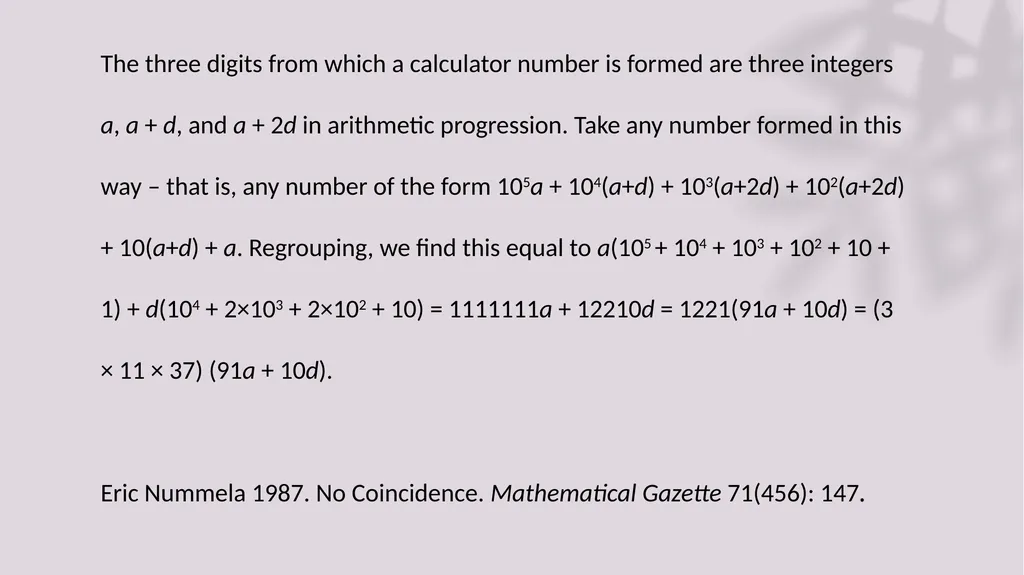
The three digits from which a calculator number is formed are three integers a, a + d, and a + 2d in arithmetic progression. Take any number formed in this way – that is, any number of the form 105a + 104(a+d) + 103(a+2d) + 102(a+2d) + 10(a+d) + a. Regrouping, we find this equal to a(105 + 104 + 103 + 102 + 10 + 1) + d(104 + 2×10³ + 2×10² + 10) = 1111111a + 12210d = 1221(91a + 10d) = (3 × 11 × 37) (91a + 10d).
Eric Nummela 1987. No Coincidence. Mathematical Gazette 71(456): 147.<br>
07
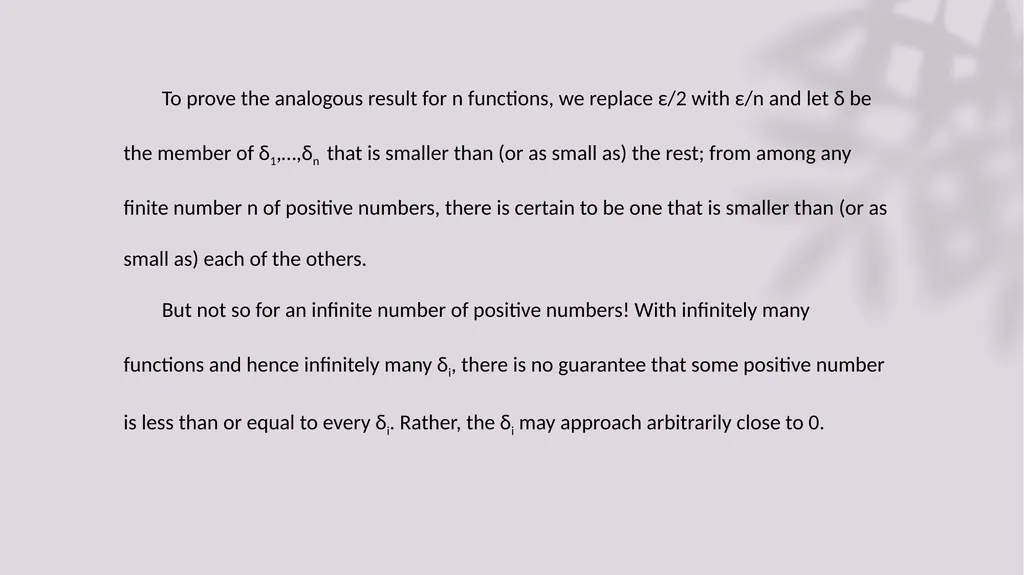
To prove the analogous result for n functions, we replace ε/2 with ε/n and let δ be the member of δ1,…,δn that is smaller than (or as small as) the rest; from among any finite number n of positive numbers, there is certain to be one that is smaller than (or as small as) each of the others.
But not so for an infinite number of positive numbers! With infinitely many functions and hence infinitely many δi, there is no guarantee that some positive number is less than or equal to every δi. Rather, the δi may approach arbitrarily close to 0.<br>
08
1. Introduction 2. Knowledge requires more than justified high confidence in a truth 3. Explanations in mathematics 4. My proposal<br>
09
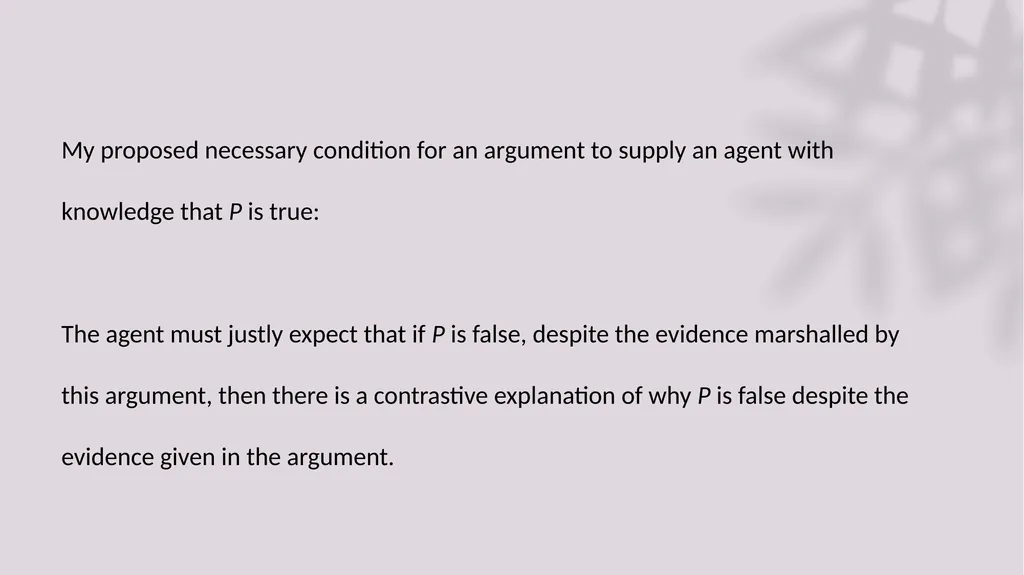
My proposed necessary condition for an argument to supply an agent with knowledge that P is true:
The agent must justly expect that if P is false, despite the evidence marshalled by this argument, then there is a contrastive explanation of why P is false despite the evidence given in the argument.<br>
10
1. Introduction 2. Knowledge requires more than justified high confidence in a truth 3. Explanations in mathematics 4. My proposal 5. Conclusion<br>
11
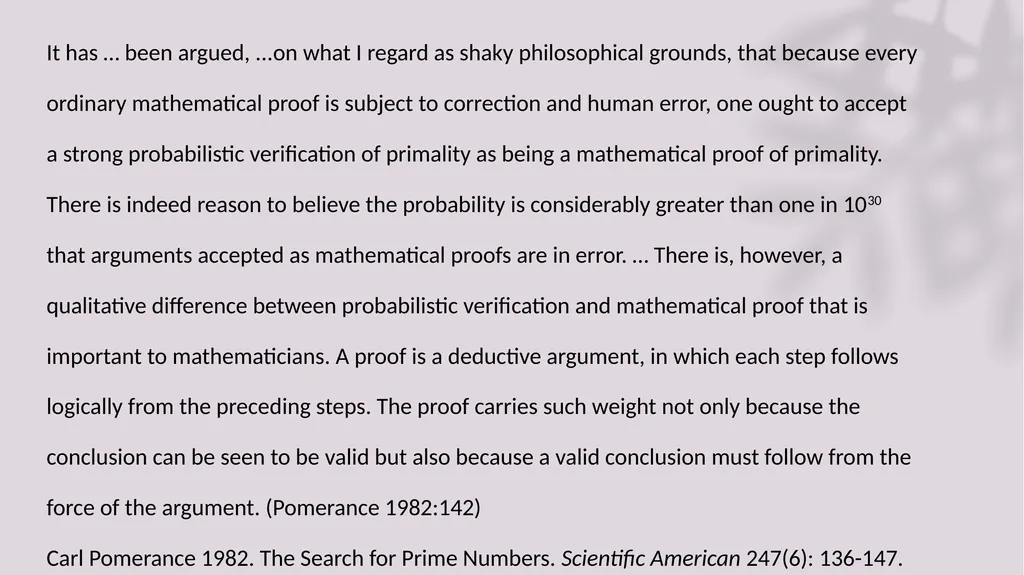
It has … been argued, ...on what I regard as shaky philosophical grounds, that because every ordinary mathematical proof is subject to correction and human error, one ought to accept a strong probabilistic verification of primality as being a mathematical proof of primality. There is indeed reason to believe the probability is considerably greater than one in 1030 that arguments accepted as mathematical proofs are in error. … There is, however, a qualitative difference between probabilistic verification and mathematical proof that is important to mathematicians. A proof is a deductive argument, in which each step follows logically from the preceding steps. The proof carries such weight not only because the conclusion can be seen to be valid but also because a valid conclusion must follow from the force of the argument. (Pomerance 1982:142) Carl Pomerance 1982. The Search for Prime Numbers. Scientific American 247(6): 136-147.<br>
12
See also: Marc Lange, Because Without Cause: Non-Causal Explanations in Science and Mathematics, New York: Oxford University Press, 2017. Marc Lange, Why Proof is the Only Way to Acquire Mathematical Knowledge, Australasian Journal of Philosophy, forthcoming.<br>