
Why study thermodynamics? Thermodynamics is
T
Published · 60 slides · 0 views
1 / 1

Description
Why study thermodynamics? Thermodynamics is essentially the study of the internal motions of many body systems (e.g., solids, liquids, gases, and light). Therefore, thermodynamics is a discipline with an exceptionally wide range of
Related Topics
Share
Embed code
Download this presentation From Below
"Why study thermodynamics? Thermodynamics is" is the property of its rightful owner. Permission is granted to download and print the materials on this website for personal, non-commercial use only, and to display it on your personal computer provided you do not modify the materials and that you retain all copyright notices contained in the materials. By downloading content from our website, you accept the terms of this agreement.
Presentation Transcript
01
Why study thermodynamics?
Thermodynamics is essentially the study of the internal motions of many body systems (e.g., solids, liquids, gases, and light). Therefore, thermodynamics is a discipline with an exceptionally wide range of applicability. Thermodynamics is certainly the most ubiquitous subfield of Physics outside Physics Departments. Engineers, Chemists, and Material Scientists do not study relatively or particle physics, but thermodynamics is an integral, and very important, part of their degree courses. Many people are drawn to Physics because they want to understand why the world around us is like it is. For instance, why the sky is blue, why raindrops are spherical, why we do not fall through the floor, etc.
It turns out that statistical thermodynamics can explain more things about the world around us than all of the other physical theories studied in the undergraduate Physics curriculum put together. For instance, in this course we shall explain why heat flows from hot to cold bodies, why the air becomes thinner and colder at higher altitudes, why the Sun appears yellow whereas colder stars appear red and hotter stars appear bluish-white, why it is impossible to measure a temperature below -273 centigrade, why there is a maximum theoretical efficiency of a power generation unit which can never be exceeded no matter what the design, why high mass stars must ultimately collapse to form black-holes, and much more!<br>
02
Lecture 1
What the ultimate things student should know at the end of this course
: Students will be able to:
1. Describe the terms, classical thermodynamics, quantum mechanics, statistical mechanics.
2. Define the terms “intensive” and “extensive” variables.
3. Identify different notational conventions.
4. Derive the Gibbs phase rule.
5. Define the four laws of thermodynamics.
1<br>
03
1. Classical thermodynamics:
This is the observational science dealing with heat and work. It was developed based on empirical observations without assumptions about the make up of matter. It describes macroscopic quantities, such as heat, work, internal energy, enthalpy, entropy, Gibbs free energy, etc. It does not contain any information about the state or even existence of molecules! Classical thermodynamics tacitly assumes that the world is made up of a continuum.<br>
04
2. Quantum mechanics:
It deals with nanoscopic properties, i.e., length scales on the order of 10−9 m. Quantum mechanics gives rise to concepts such as the particle-wave duality, which states that all energy and all matter behaves both like a wave and like a particle. It tells us that energy and other quantities are not continuous, but discrete.Quantum chemistry typically deals with solving the Schrodinger equation for single molecules, giving Therefore, quantum mechanics is limited to isolated molecules or perfect crystals, usually at absolute zero temperature. Hence, quantum mechanics does not tell us anything about the thermodynamics of a macroscopic system.<br>
05
3. Statistical mechanics The basic idea is that one can take the properties, energy levels, probabilities of individual molecules from quantum mechanics and average these in an appropriate way to obtain the properties of a macroscopic collection of molecules<br>
06
For example, if you know the probable states of a single isolated polymer then you can predict the thermodynamic properties of 10 kg of the polymer in an extruder by applying the techniques of statistical mechanics.
An example of the liquid-liquid phase equilibrium between a polymer and a model protein calculated from statistical mechanics<br>
An example of the liquid-liquid phase equilibrium between a polymer and a model protein calculated from statistical mechanics<br>
07
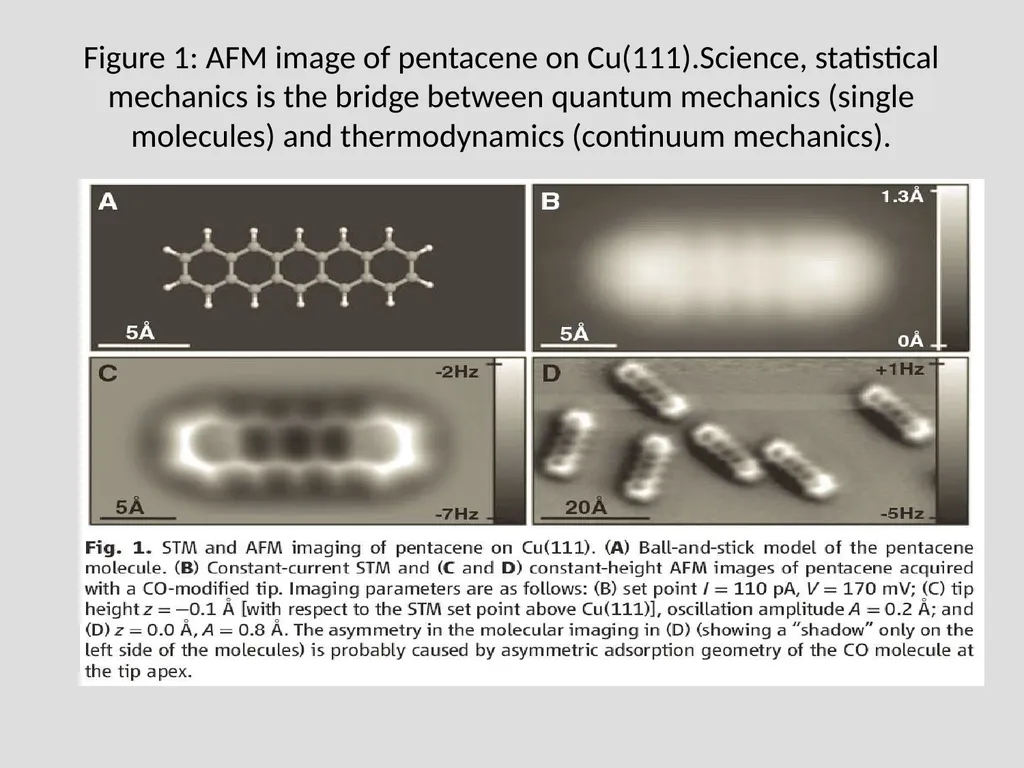
Figure 1: AFM image of pentacene on Cu(111).Science, statistical mechanics is the bridge between quantum mechanics (single molecules) and thermodynamics (continuum mechanics).<br>
08
2. Basics of Thermodynamics The difference between intensive and extensive properties is like the difference between “quality” and “quantity”.
Note that any extensive property can be made into an intensive property by dividing by another extensive property. Example: V = V/N.<br>
Note that any extensive property can be made into an intensive property by dividing by another extensive property. Example: V = V/N.<br>
09
Basic Concepts Thermodynamics is the science deals with the relationships and inter-conversion between energy and work
The most important item here is energy. So, what is energy really? In fact it is very hard to put a clear and exact definition of energy. It is a term refers to some kind of power, force or whatever<br>
The most important item here is energy. So, what is energy really? In fact it is very hard to put a clear and exact definition of energy. It is a term refers to some kind of power, force or whatever<br>
10
Energy We always confused about the definition of energy because we know nothing about its nature
A better definition of energy from the viewpoint of thermodynamics would be "the capacity to induce a change in which inherently
The units which used to express energy are calorie or joule. resists change<br>
A better definition of energy from the viewpoint of thermodynamics would be "the capacity to induce a change in which inherently
The units which used to express energy are calorie or joule. resists change<br>
11
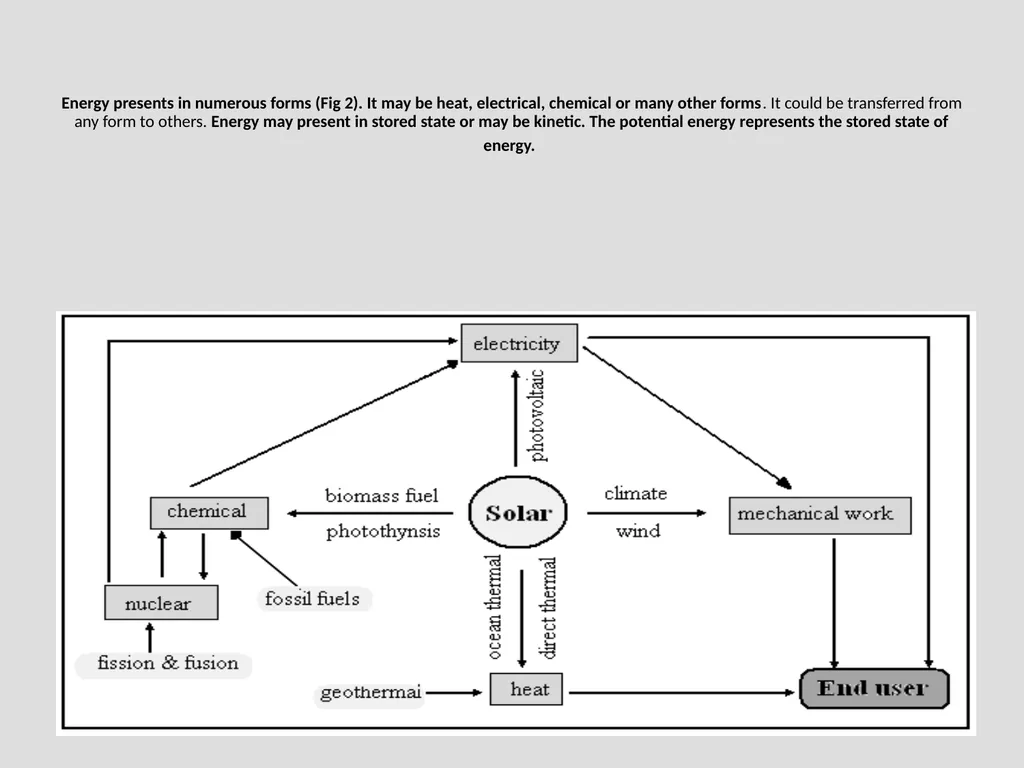
Energy presents in numerous forms (Fig 2). It may be heat, electrical, chemical or many other forms. It could be transferred from any form to others. Energy may present in stored state or may be kinetic. The potential energy represents the stored state of energy.<br>
12
Potential Energy This kind of energy is related directly with the gravity, and hence known as gravitational energy. This energy is due to the action of gravity (g) on the body of mass (m). Indeed, such action is related to the distance separates between the two attracted bodies (such as a body and earth or electron and nucleus in an atom). In this example the distance is the height of the body above the earth (h). Therefore, the potential energy of such body is represented by (mgh).<br>
13
Kinetic Energy Suppose that a body is leaved to fall down, freely, from its position toward earth. Thus, it loses its stored potential energy during its falling, as its kinetic energy increases. The kinetic energy is related to the motion of the body and equals to ½ mv2. It is of interest to mention here that temperature (T) is the measure of kinetic energy of any system<br>
14
Different forms of Energy If you knock the brick off the ledge, the potential energy is converted to kinetic energy as the brick accelerates toward the ground. Then when the brick hits the ground the kinetic energy is converted to light energy (sparks), sound energy (a bang), and chemical energy (the brick breaks). Shortly, potential energy is the external energy possessed by a body because of its position, while kinetic energy is the external energy possessed by a body because of its motion.<br>
15
External and internal energies energy may be external or internal. The external energy represents the energies of motion and potential of the whole system in the field (energy on the macroscopic scale).<br>
16
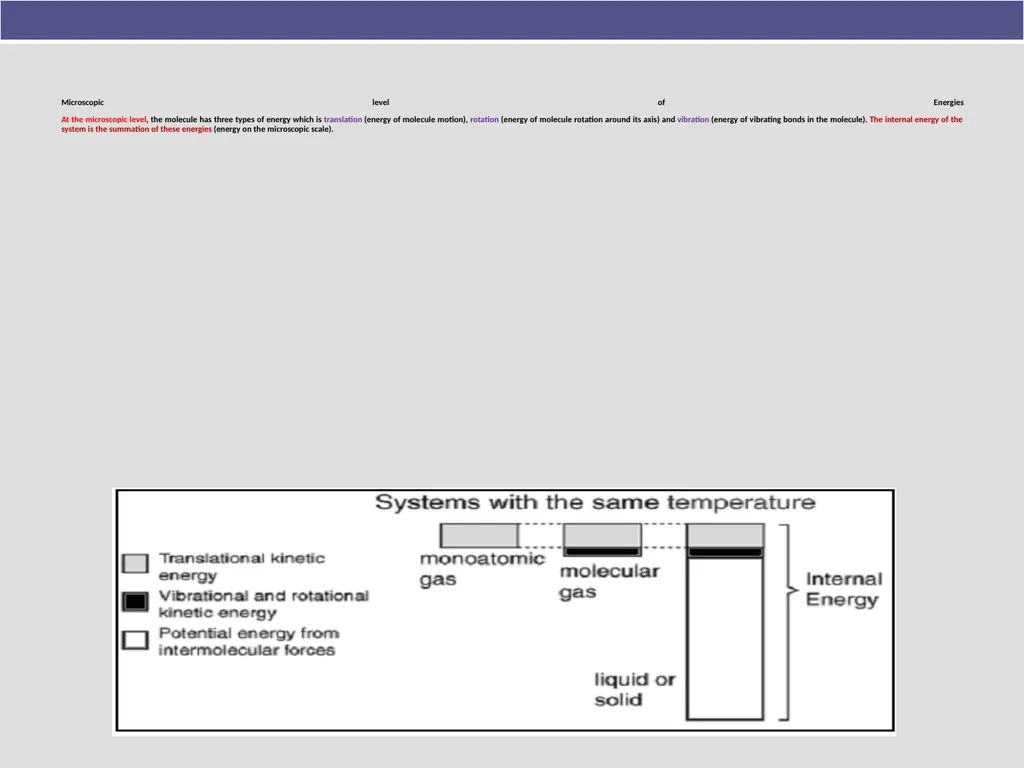
Microscopic level of Energies
At the microscopic level, the molecule has three types of energy which is translation (energy of molecule motion), rotation (energy of molecule rotation around its axis) and vibration (energy of vibrating bonds in the molecule). The internal energy of the system is the summation of these energies (energy on the microscopic scale).<br>
17
System and Surroundings The system is a thermodynamic term refers to any part of the physical universe completely enclosed within a well defined boundary
Every thing outside the system (rest of universe) is known as surroundings. The exchange of energy and work takes place between the system and its surroundings.
Therefore, one can say that the part of universe which can affect or affected by the system represented its surroundings<br>
Every thing outside the system (rest of universe) is known as surroundings. The exchange of energy and work takes place between the system and its surroundings.
Therefore, one can say that the part of universe which can affect or affected by the system represented its surroundings<br>
18
What can exchange between system and surroundings (1) energy exchange (heat, work, friction, radiation, etc.) and (2) matter exchange (movement of molecules across the boundary of the system and surroundings).
The properties of the boundary around the system define the type of such exchange. The type of the system is defined according to the type of exchange takes place during the thermodynamic process.<br>
The properties of the boundary around the system define the type of such exchange. The type of the system is defined according to the type of exchange takes place during the thermodynamic process.<br>
19
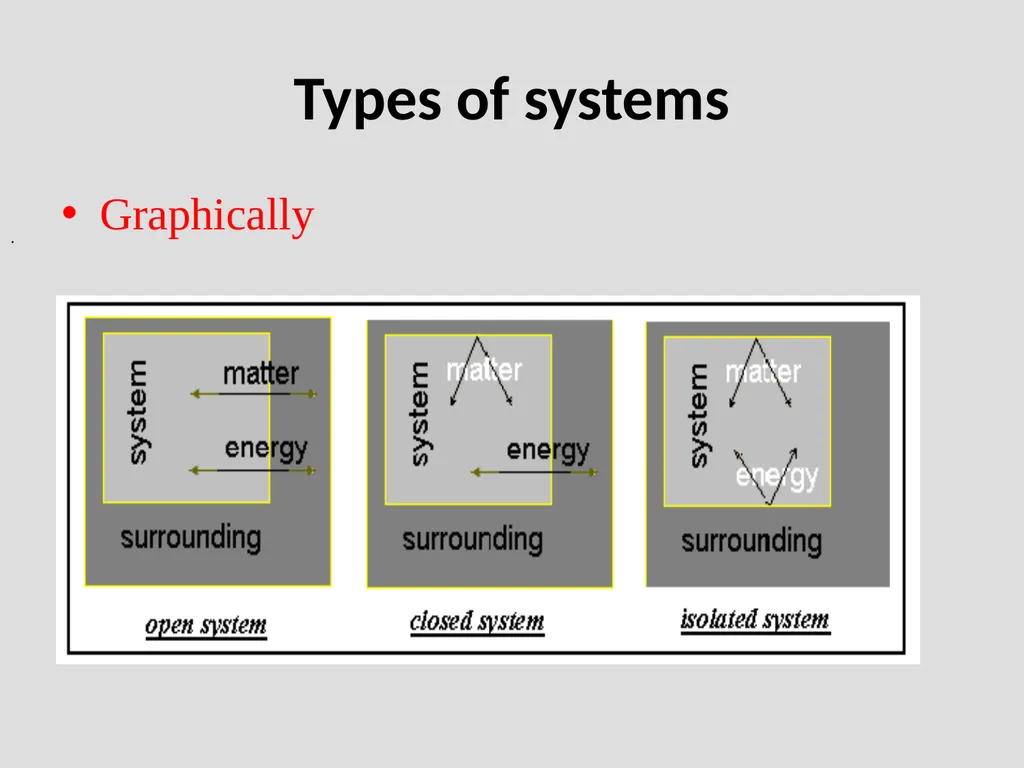
Types of systems There are three types of systems, namely, open, closed and isolated. An open system is one where both matter and energy can freely cross from the system to the surroundings and back. e.g. an open test tube. The boundary of such system is permeable for both energy and mass.
A closed system is one where energy can cross the boundary, but matter cannot. e.g. a sealed test tube. It is obvious that the boundary of closed system is permeable for energy rather than mass.<br>
A closed system is one where energy can cross the boundary, but matter cannot. e.g. a sealed test tube. It is obvious that the boundary of closed system is permeable for energy rather than mass.<br>
20
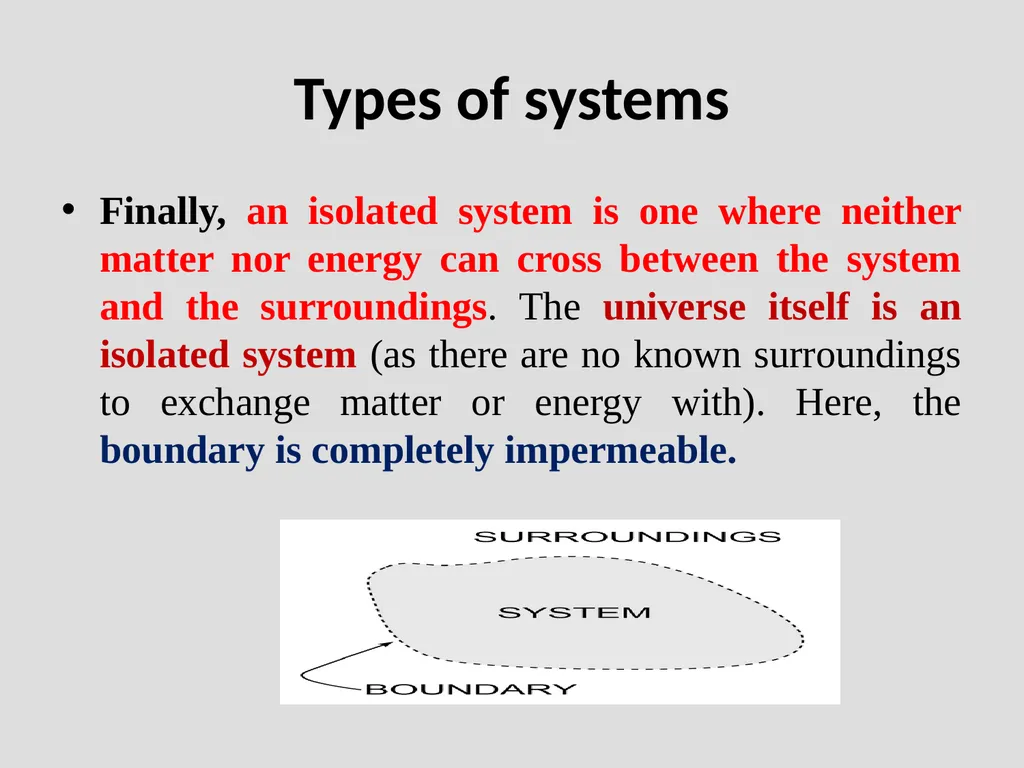
Types of systems Finally, an isolated system is one where neither matter nor energy can cross between the system and the surroundings. The universe itself is an isolated system (as there are no known surroundings to exchange matter or energy with). Here, the boundary is completely impermeable.<br>
21
Types of systems Graphically .<br>
22
Work Work is a mechanical concept. It describes the action of a specific force on a mass to move it to a definite distance.
work involves two elements; the first is the force (intensity factor) and the other is the distance (capacity factor). Therefore, one can write that:
Work (W) = force (F) x distance (h)
And for small changes:
dW = F dh
The units of work are the same as those of energy<br>
work involves two elements; the first is the force (intensity factor) and the other is the distance (capacity factor). Therefore, one can write that:
Work (W) = force (F) x distance (h)
And for small changes:
dW = F dh
The units of work are the same as those of energy<br>
23
Sign of work We can imagine that we are in the system, so if work is done on the system by the surroundings that will mean there is positive work i.e. the energy in the system increased. By the same token, if work is done by the system on the surroundings that will mean there is negative work i.e. the energy in the system decreased.
It is of interest to mention here that, others like engineers and physicists usually use the surroundings as reference. So, the sign of work is opposite to that used by chemists.<br>
It is of interest to mention here that, others like engineers and physicists usually use the surroundings as reference. So, the sign of work is opposite to that used by chemists.<br>
24
Thermodynamics variables Any property of the system which changed as a result of a thermodynamic process is called thermodynamic variable or state variable. This includes the physical properties of the system such as number of moles (n), temperature (T), pressure (P), volume (V), concentration (C), internal energy (E)...etc. such state variables are usually interrelated with each other for a definite system. For example, the well known equation of state of an ideal gas: PV = nRT<br>
25
State Variables The state variable may be classified into two types. The first type includes the properties which are additive; such as V, E, n...etc. These properties are known as extensive properties. The extensive property is directly proportional to the system size or the amount of material in the system. Thus, if a system is divided to number of subsystems, every subsystem has its own new value. On the other hand, there intensive properties which do not affected by partitioning or multiplication of the system.<br>
26
State Variables The intensive property is a physical property of the system that does not depend on the system size or the amount of material in the system. This includes for examples C, P, T…etc.
For a sufficiently simple system, only two independent intensive variables are needed to fully specify the entire state of a system (state postulate). Other intensive properties can be derived from the two known values using the state equation.<br>
For a sufficiently simple system, only two independent intensive variables are needed to fully specify the entire state of a system (state postulate). Other intensive properties can be derived from the two known values using the state equation.<br>
27
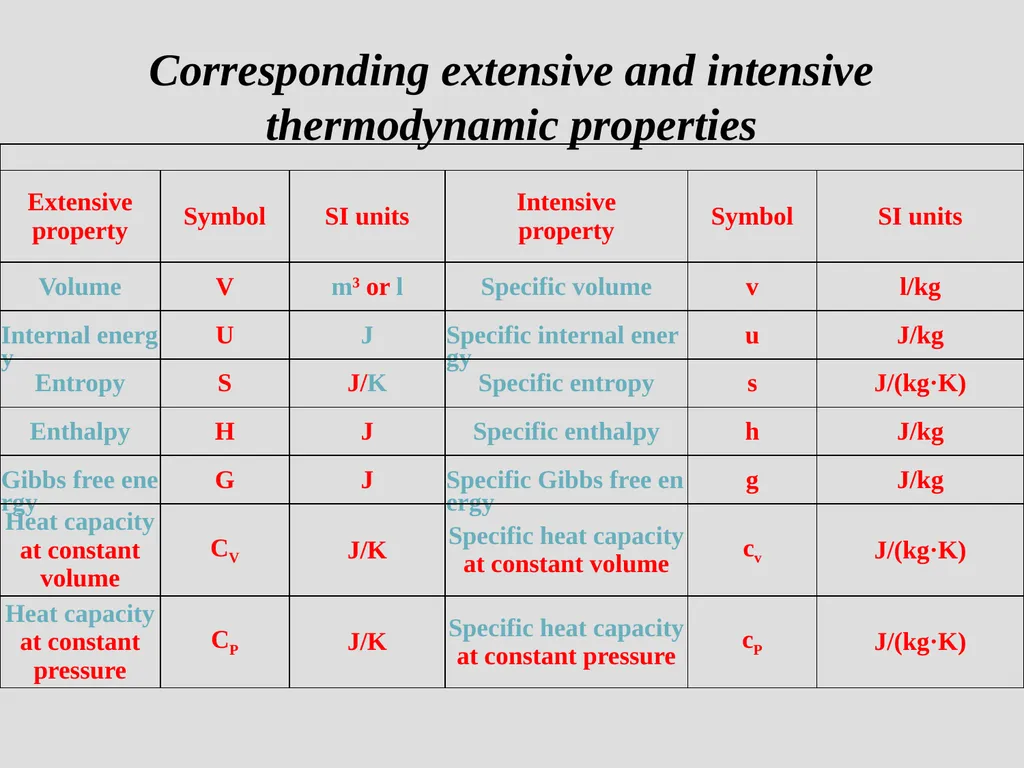
Transformation of Extensive into Intensive Property An extensive property may be made intensive by dividing the particular property by the total mass or volume of the system. The number of moles (n), which is extensive property, can be changed to concentration (molarity, M) which is intensive property by dividing by the volume (V) of the system. The next table explains the interrelation between the two types<br>
28
Corresponding extensive and intensive thermodynamic properties<br>
29
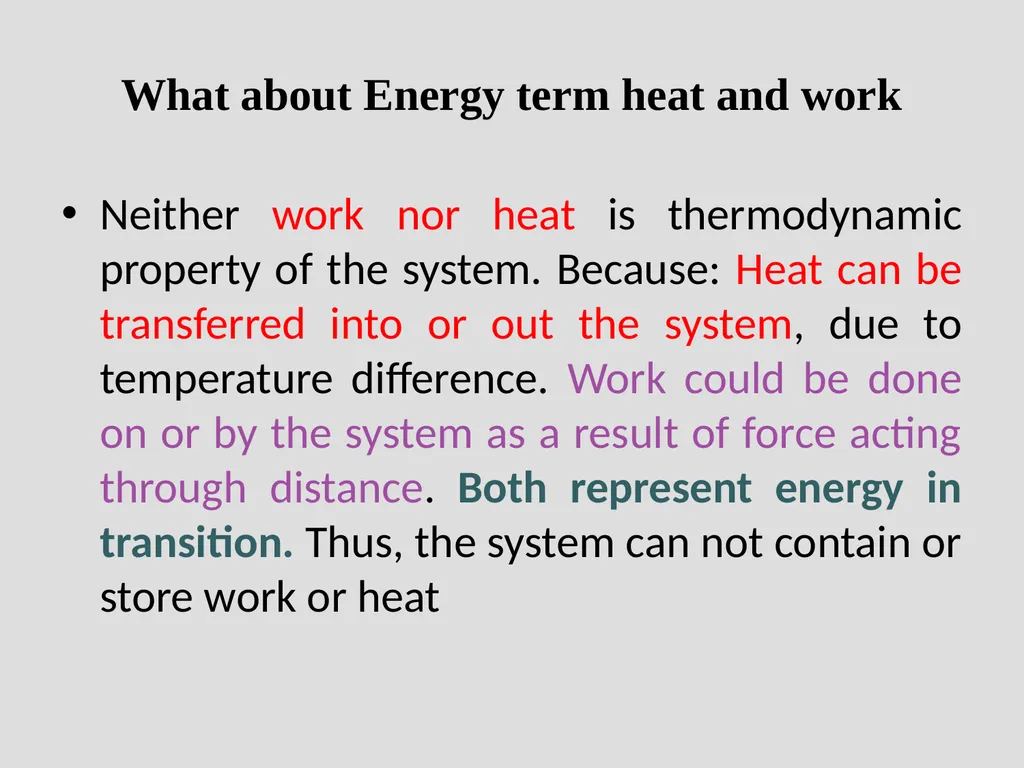
What about Energy term heat and work Neither work nor heat is thermodynamic property of the system. Because: Heat can be transferred into or out the system, due to temperature difference. Work could be done on or by the system as a result of force acting through distance. Both represent energy in transition. Thus, the system can not contain or store work or heat<br>
30
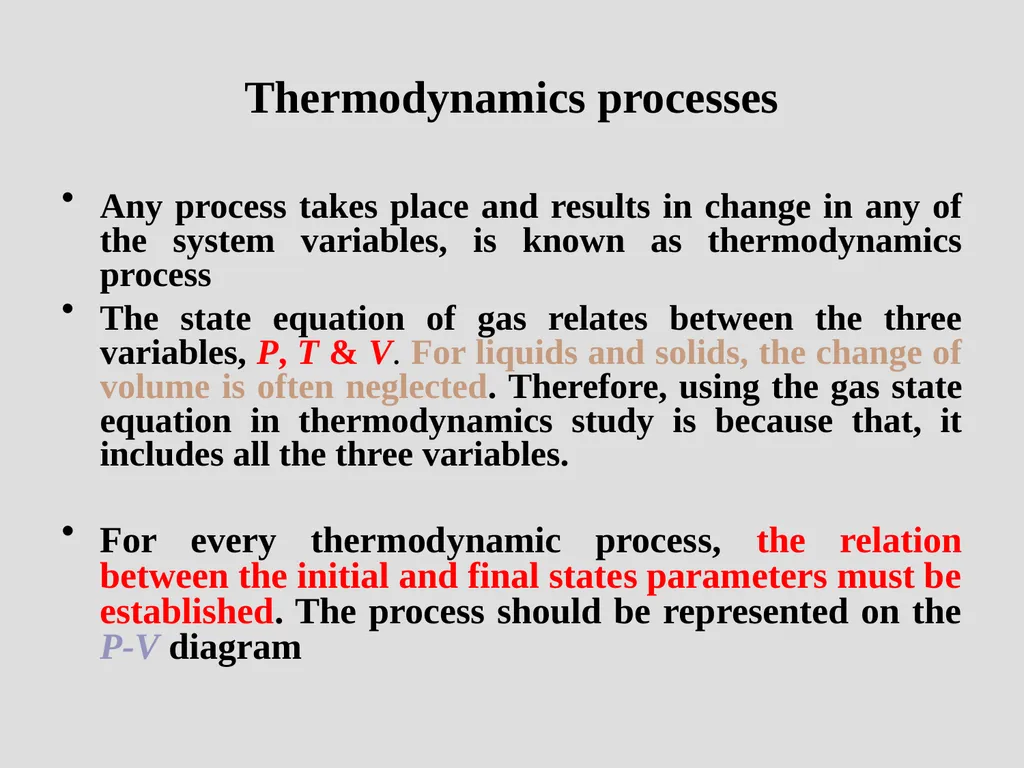
Thermodynamics processes Any process takes place and results in change in any of the system variables, is known as thermodynamics process
The state equation of gas relates between the three variables, P, T & V. For liquids and solids, the change of volume is often neglected. Therefore, using the gas state equation in thermodynamics study is because that, it includes all the three variables.
For every thermodynamic process, the relation between the initial and final states parameters must be established. The process should be represented on the P-V diagram<br>
31
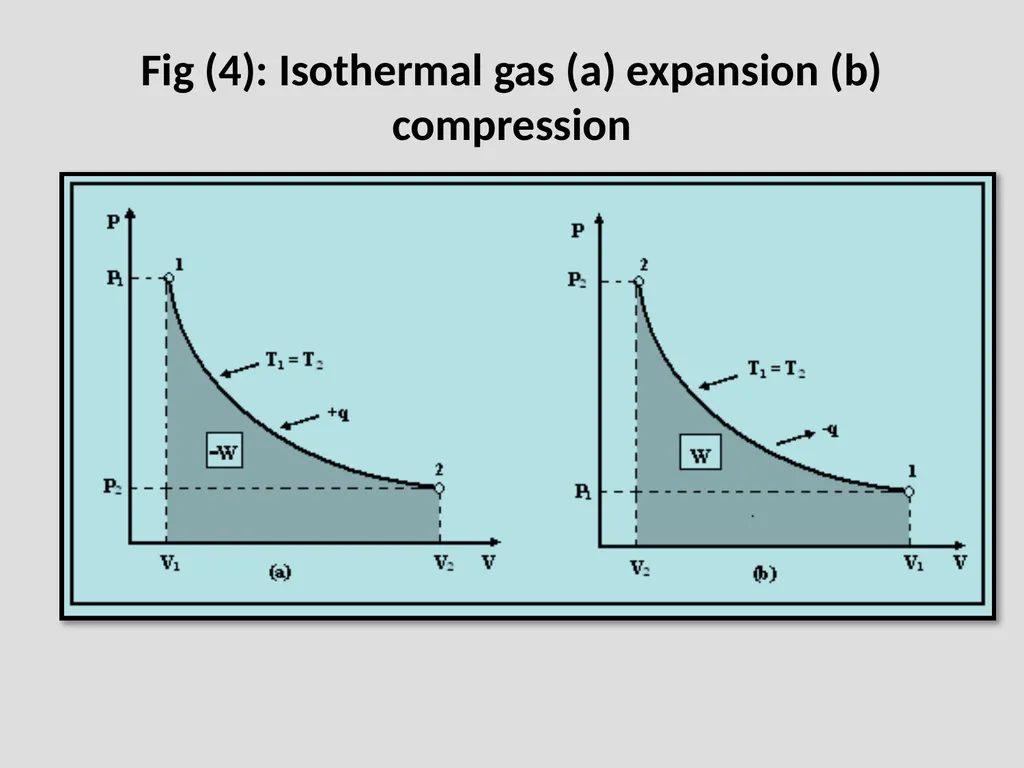
Types of the process according to thermodynamic variables Isothermal process: it’s the process at which the initial and final temperatures of the system are the same (dT = 0) i.e the process takes place at constant internal energy(ΔE = 0).
For example, expansion or compression of a gas. To expand a gas heat should be supplied to it. On the contrary, heat should be removed from the gas during its compression. To keep the temperature of the gas constant, gas performs useful work during its expansion while the work is done on it during its compression. Therefore, the ideal gas equation for an isothermal process will be: PV = constant.<br>
For example, expansion or compression of a gas. To expand a gas heat should be supplied to it. On the contrary, heat should be removed from the gas during its compression. To keep the temperature of the gas constant, gas performs useful work during its expansion while the work is done on it during its compression. Therefore, the ideal gas equation for an isothermal process will be: PV = constant.<br>
32
Fig (4): Isothermal gas (a) expansion (b) compression<br>
33
Adiabatic process The process takes place without heat transfer i.e. dq = 0. The temperature of the system varies during the process. Since no external heat is applied to the system, the work of expansion is done on expense of the internal energy of the gas.<br>
34
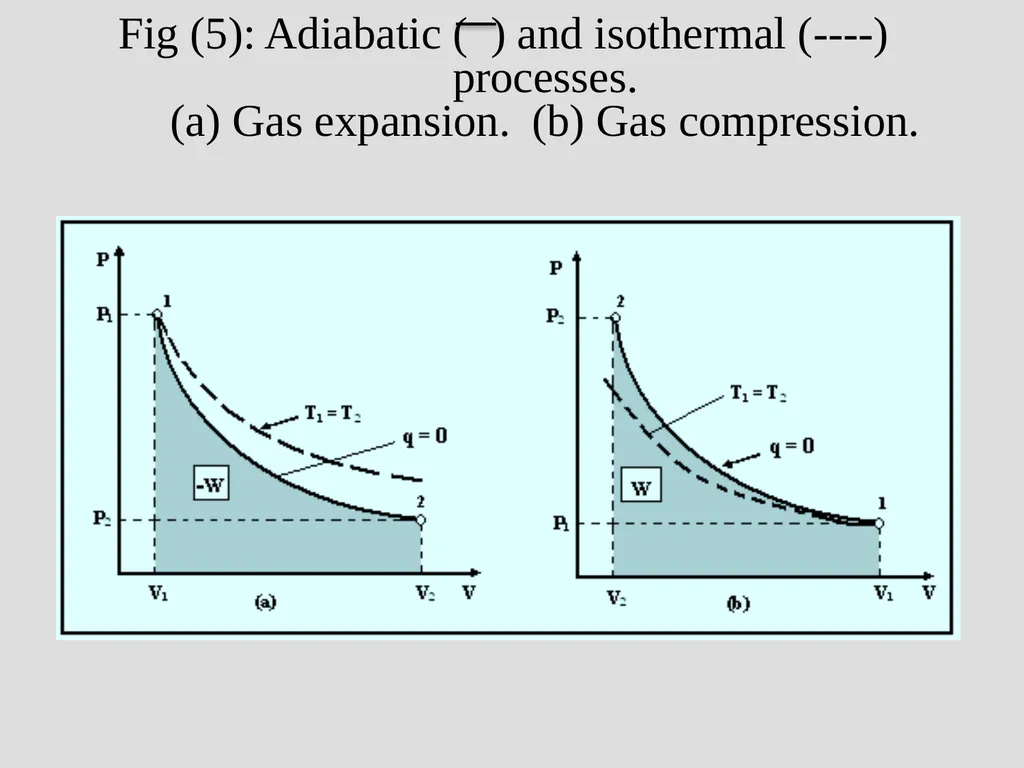
Fig (5): Adiabatic ( ) and isothermal (----) processes.
(a) Gas expansion. (b) Gas compression.<br>
35
Isobaric process The process takes place at constant pressure i.e. dP = 0. It occurs during heating or cooling a gas under a constant pressure
Consider a cylinder with a movable piston and a constant load is applied to it. The volume and temperature of the gas increase when the heat is supplied and decrease when the heat is removed from the gas.
The change of the gas volume is proportional to the change of its absolute temperature, according to Charles’ law.<br>
36
Isochoric process The process takes place at constant volume i.e. dV = 0. The system can be a gas in cylinder with fixed piston. The relation between pressure and temperature is given by the Gay-Lussac’c law for ideal gases; P1T2 = P2T1. The isochoric process is represented on the p-v diagram as a straight line parallel to the axis of pressure.<br>
37
Cyclic process When a system returns to its original state after completing a series of changes, then it is known that a cycle is completed.
The net work done during the cyclic process is the summation of the values of work of every individual process. The net work is the area of the circle of p-v diagram.<br>
The net work done during the cyclic process is the summation of the values of work of every individual process. The net work is the area of the circle of p-v diagram.<br>
38
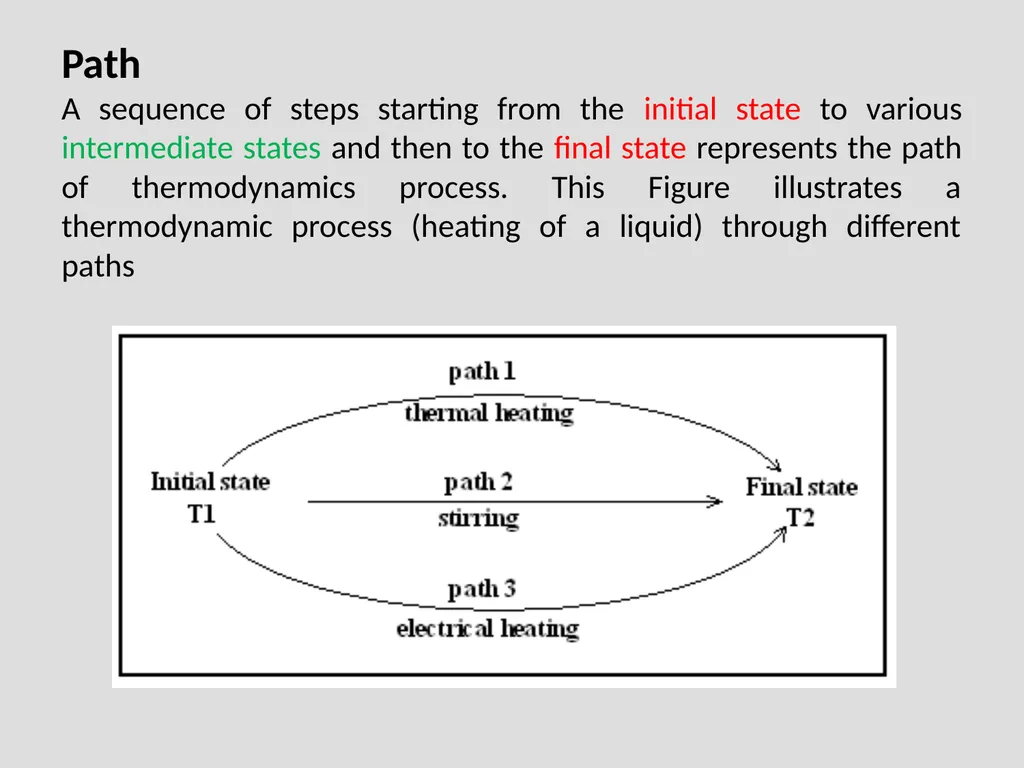
Path
A sequence of steps starting from the initial state to various intermediate states and then to the final state represents the path of thermodynamics process. This Figure illustrates a thermodynamic process (heating of a liquid) through different paths<br>
39
Thermodynamics functions The thermodynamics properties which changed due to thermodynamics process are known as thermodynamics functions.
The variation of the thermodynamic functions may be independent or dependent on the path of the process.
If the function is dependent on the path of the process, then it called path function.
On the other hand, the function which is independent on the path is called state function.
Thus, the change of state function depends only on the initial and final states regardless the different paths may be present between them.<br>
40
Illustration of state function Consider an ideal gas. The volume of gas depends on both temperature and pressure. Thus, volume is a function of temperature and pressure and we can write: V = f (T, P)
Volume is known as dependent variable, while both T and P are independent ones.
Now, the value of V could be estimated if its rate of change with respect to both T & P (derivative) is known.
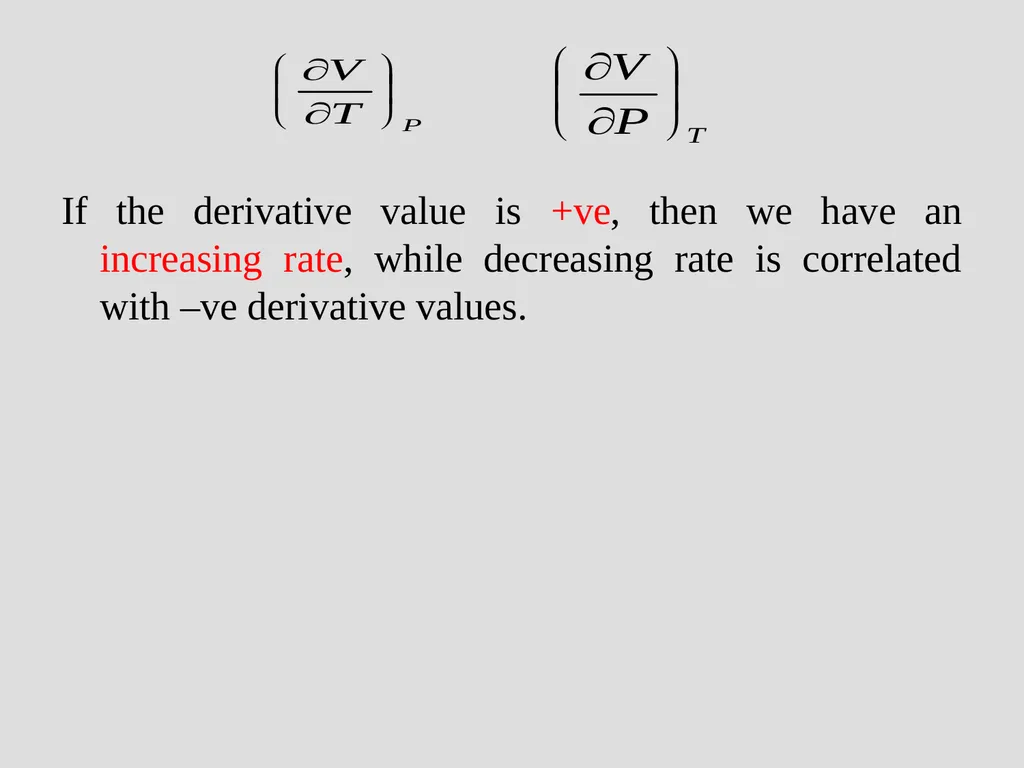
It should be noticed that, the derivative of V with respect to an independent variable must be determined while the other independent variable is kept constant. Thus, the derivatives of V with respect to T and P are:<br>
41
If the derivative value is +ve, then we have an increasing rate, while decreasing rate is correlated with –ve derivative values.<br>
42
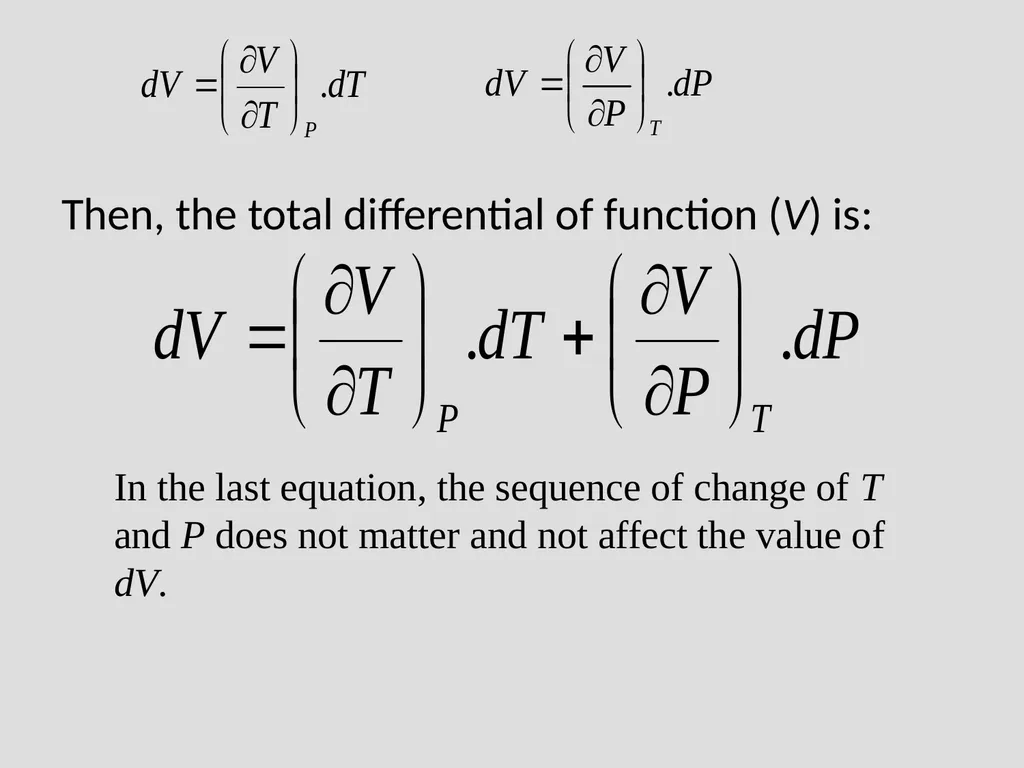
Then, the total differential of function (V) is: In the last equation, the sequence of change of T and P does not matter and not affect the value of dV.<br>
43
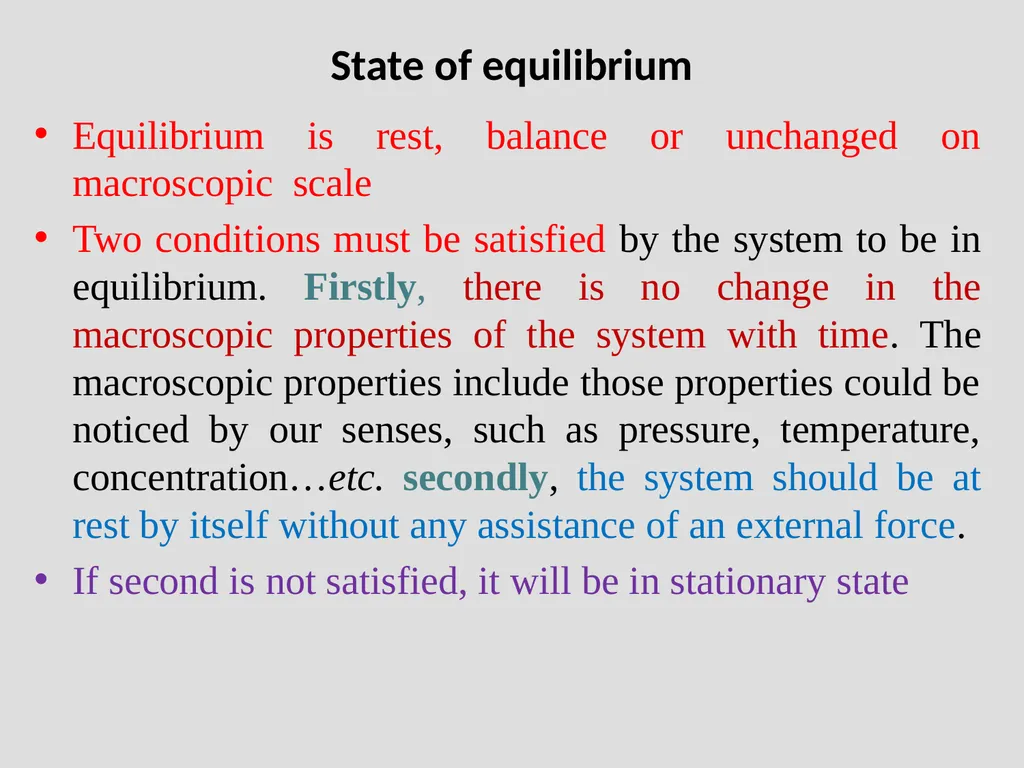
State of equilibrium Equilibrium is rest, balance or unchanged on macroscopic scale
Two conditions must be satisfied by the system to be in equilibrium. Firstly, there is no change in the macroscopic properties of the system with time. The macroscopic properties include those properties could be noticed by our senses, such as pressure, temperature, concentration…etc. secondly, the system should be at rest by itself without any assistance of an external force.
If second is not satisfied, it will be in stationary state<br>
44
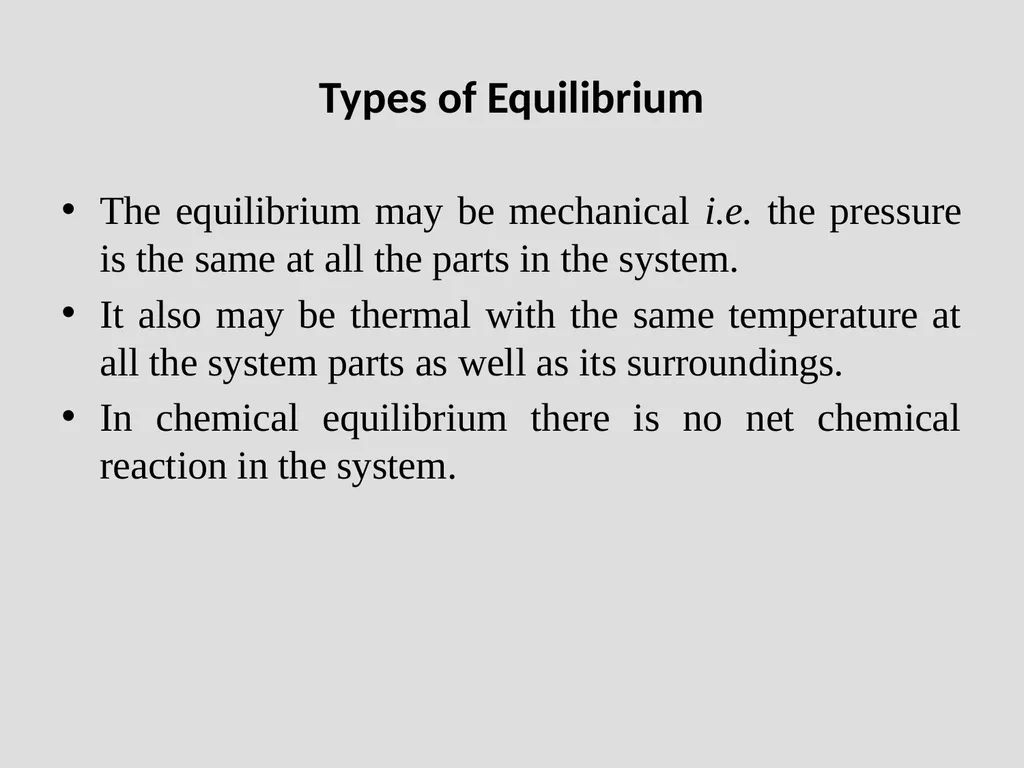
Types of Equilibrium The equilibrium may be mechanical i.e. the pressure is the same at all the parts in the system.
It also may be thermal with the same temperature at all the system parts as well as its surroundings.
In chemical equilibrium there is no net chemical reaction in the system.<br>
It also may be thermal with the same temperature at all the system parts as well as its surroundings.
In chemical equilibrium there is no net chemical reaction in the system.<br>
45
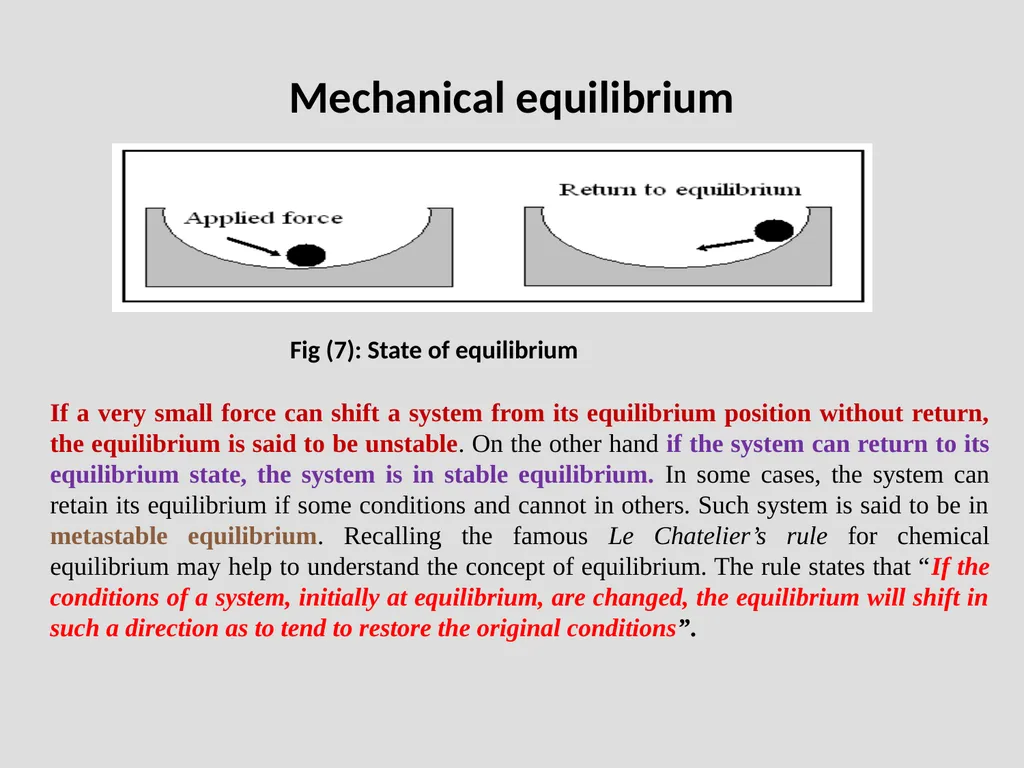
Mechanical equilibrium Fig (7): State of equilibrium If a very small force can shift a system from its equilibrium position without return, the equilibrium is said to be unstable. On the other hand if the system can return to its equilibrium state, the system is in stable equilibrium. In some cases, the system can retain its equilibrium if some conditions and cannot in others. Such system is said to be in metastable equilibrium. Recalling the famous Le Chatelier’s rule for chemical equilibrium may help to understand the concept of equilibrium. The rule states that “If the conditions of a system, initially at equilibrium, are changed, the equilibrium will shift in such a direction as to tend to restore the original conditions”.<br>
46
Reversible and irreversible processes It is the process when proceeds, the properties of the system at every instant of the process remain uniform
On the other hand, the irreversible process is the one which perform in definite direction and results in a particular change.<br>
On the other hand, the irreversible process is the one which perform in definite direction and results in a particular change.<br>
47
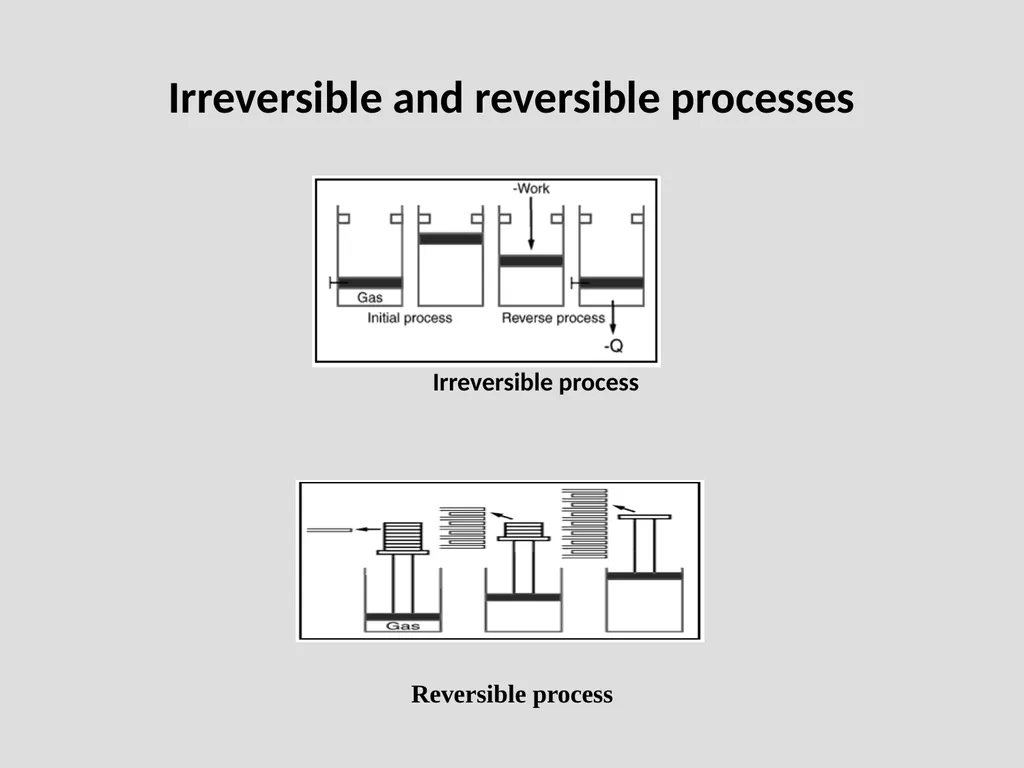
reversible systems occur in situations when the system is essentially in equilibrium during the transition and at each step, and only an infinitesimal amount of work would be necessary to truly restore equilibrium<br>
48
Irreversible and reversible processes Reversible process Irreversible process<br>
49
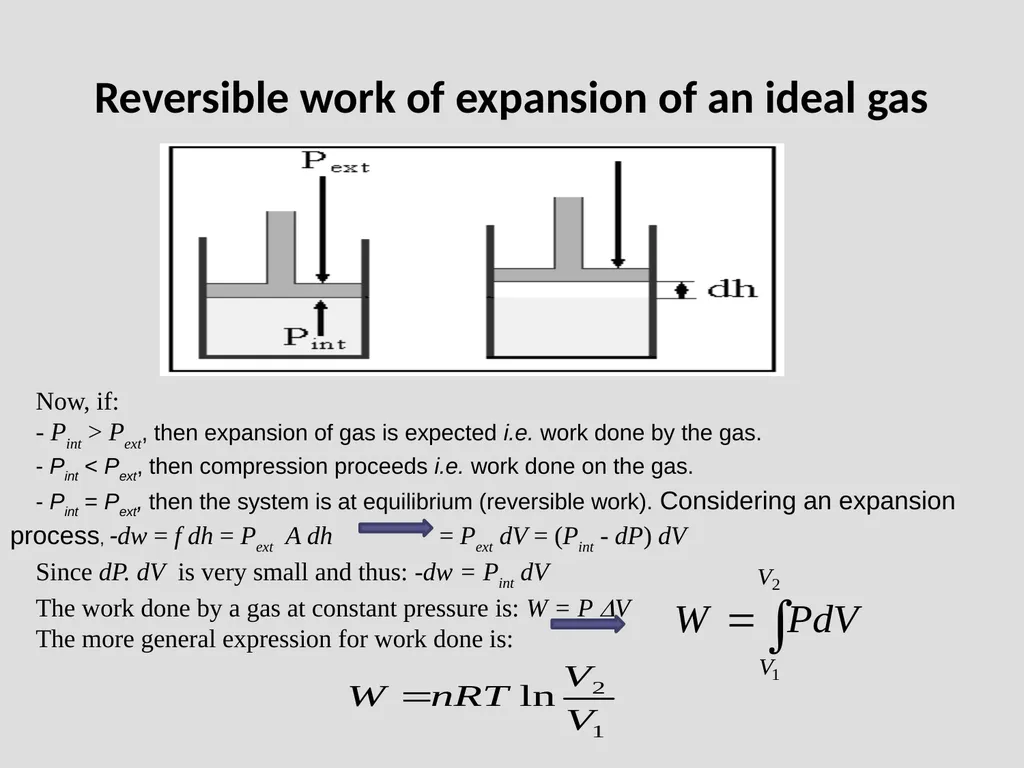
Reversible work of expansion of an ideal gas Now, if:
- Pint > Pext, then expansion of gas is expected i.e. work done by the gas.
- Pint < Pext, then compression proceeds i.e. work done on the gas.
- Pint = Pext, then the system is at equilibrium (reversible work). Considering an expansion process, -dw = f dh = Pext A dh = Pext dV = (Pint - dP) dV
Since dP. dV is very small and thus: -dw = Pint dV
The work done by a gas at constant pressure is: W = P V
The more general expression for work done is:<br>
50
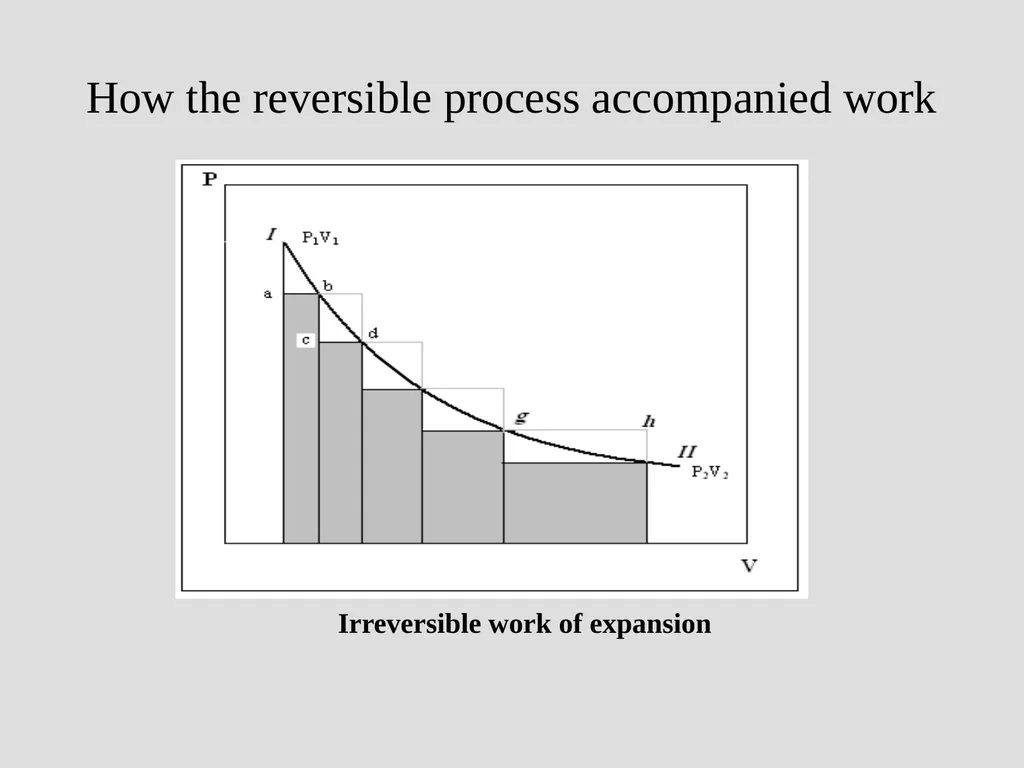
How the reversible process accompanied work Irreversible work of expansion<br>
51
Zeroth law of thermodynamics states that if two systems are each in thermal equilibrium with a third system, they are also in thermal equilibrium with each other.
If A and C are in thermal equilibrium with B, then A is in thermal equilibrium with C. Practically this means that all three are at the same temperature<br>
If A and C are in thermal equilibrium with B, then A is in thermal equilibrium with C. Practically this means that all three are at the same temperature<br>
52
First law of thermodynamic
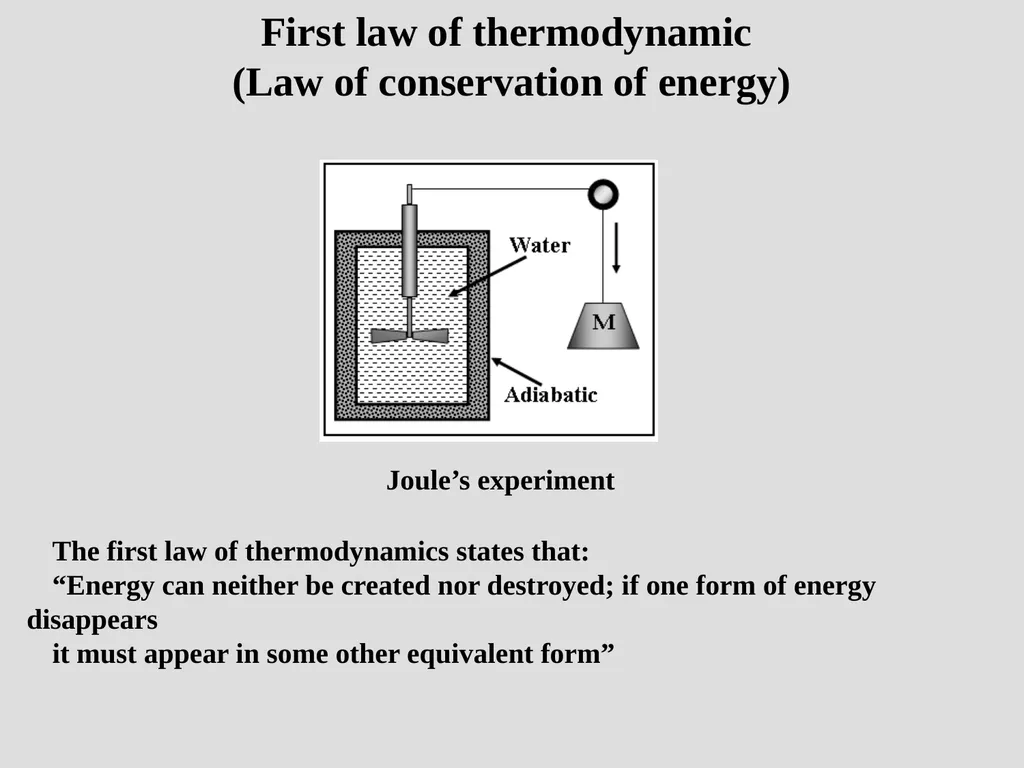
(Law of conservation of energy) Joule’s experiment The first law of thermodynamics states that:
“Energy can neither be created nor destroyed; if one form of energy disappears
it must appear in some other equivalent form”<br>
“Energy can neither be created nor destroyed; if one form of energy disappears
it must appear in some other equivalent form”<br>
53
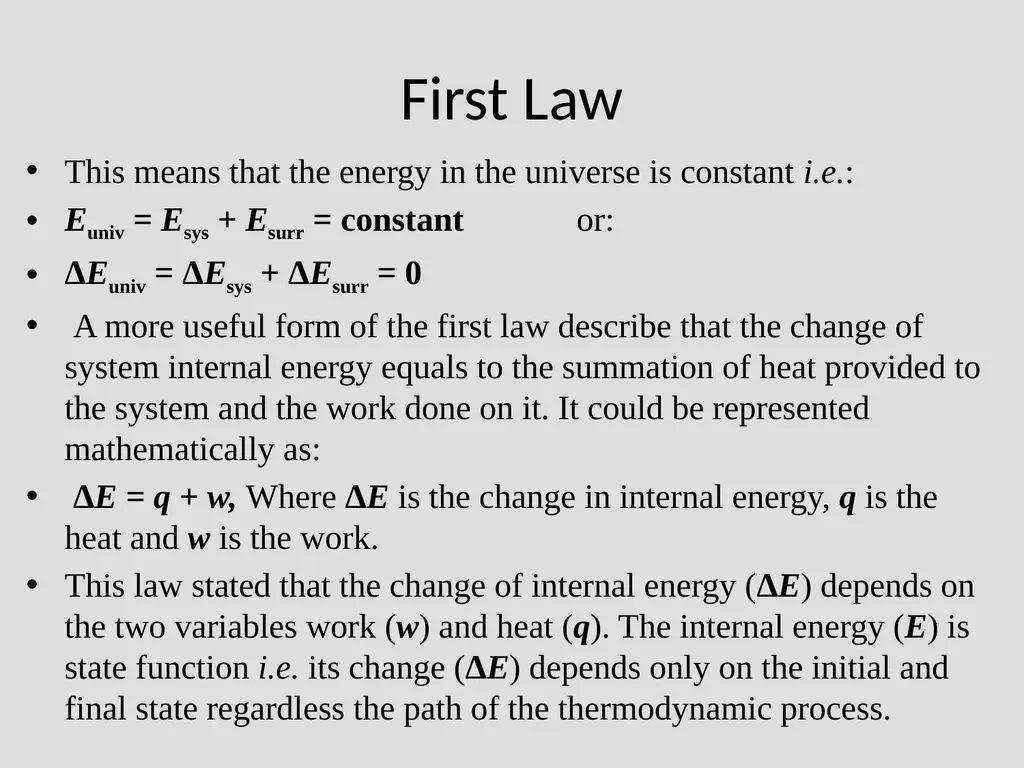
First Law This means that the energy in the universe is constant i.e.:
Euniv = Esys + Esurr = constant or:
ΔEuniv = ΔEsys + ΔEsurr = 0
A more useful form of the first law describe that the change of system internal energy equals to the summation of heat provided to the system and the work done on it. It could be represented mathematically as:
ΔE = q + w, Where ΔE is the change in internal energy, q is the heat and w is the work.
This law stated that the change of internal energy (ΔE) depends on the two variables work (w) and heat (q). The internal energy (E) is state function i.e. its change (ΔE) depends only on the initial and final state regardless the path of the thermodynamic process.<br>
54
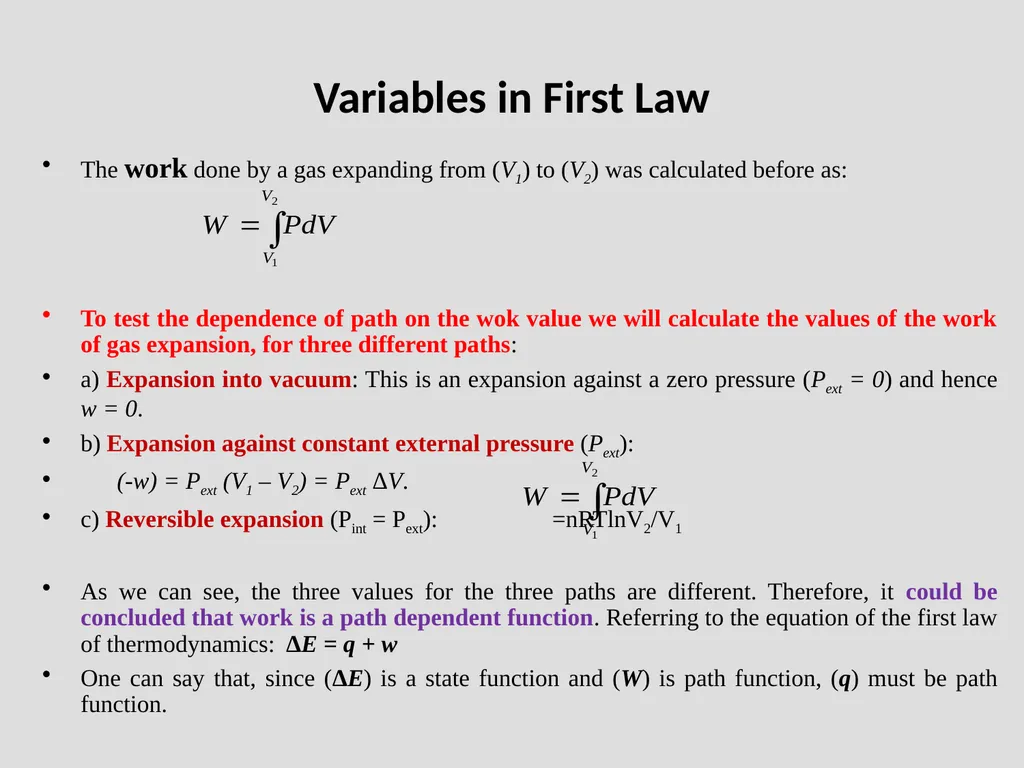
Variables in First Law The work done by a gas expanding from (V1) to (V2) was calculated before as:
To test the dependence of path on the wok value we will calculate the values of the work of gas expansion, for three different paths:
a) Expansion into vacuum: This is an expansion against a zero pressure (Pext = 0) and hence w = 0.
b) Expansion against constant external pressure (Pext):
(-w) = Pext (V1 – V2) = Pext ΔV.
c) Reversible expansion (Pint = Pext): =nRTlnV2/V1
As we can see, the three values for the three paths are different. Therefore, it could be concluded that work is a path dependent function. Referring to the equation of the first law of thermodynamics: ΔE = q + w
One can say that, since (ΔE) is a state function and (W) is path function, (q) must be path function.<br>
55
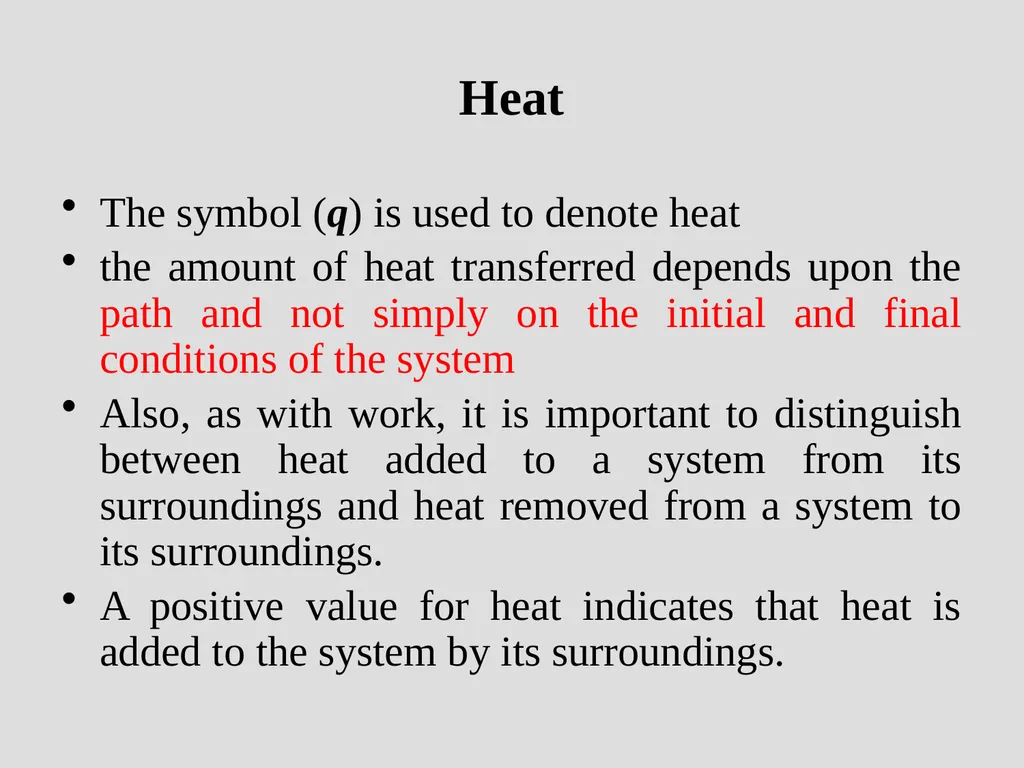
Heat The symbol (q) is used to denote heat
the amount of heat transferred depends upon the path and not simply on the initial and final conditions of the system
Also, as with work, it is important to distinguish between heat added to a system from its surroundings and heat removed from a system to its surroundings.
A positive value for heat indicates that heat is added to the system by its surroundings.<br>
56
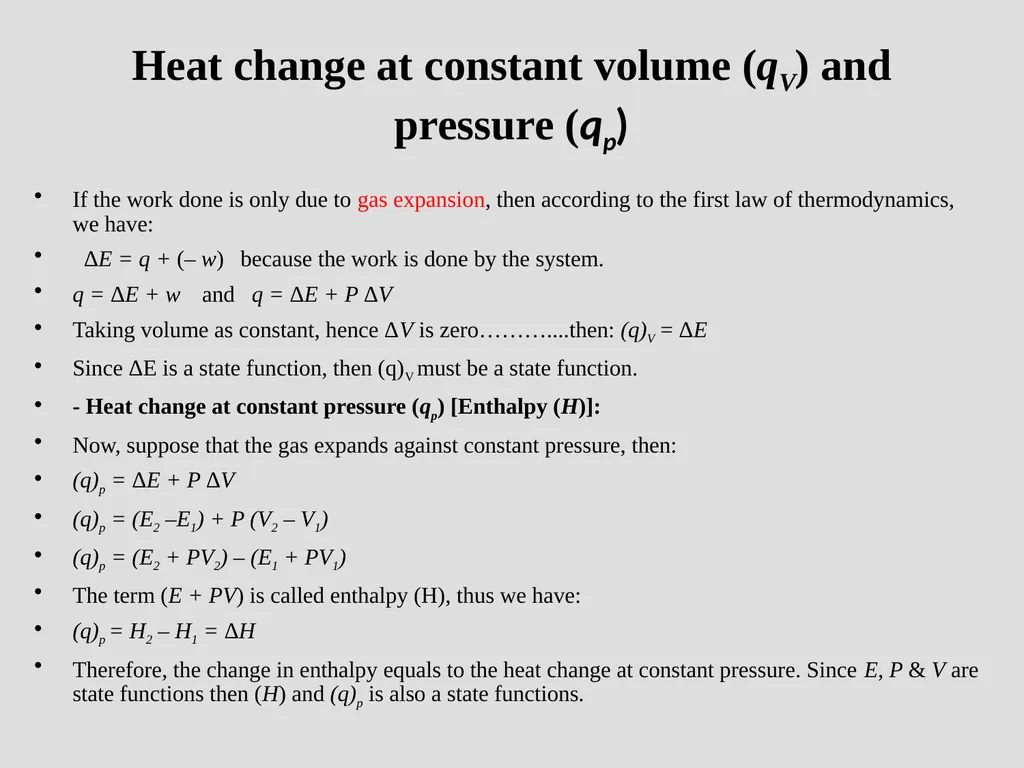
Heat change at constant volume (qV) and pressure (qp) If the work done is only due to gas expansion, then according to the first law of thermodynamics, we have:
ΔE = q + (– w) because the work is done by the system.
q = ΔE + w and q = ΔE + P ΔV
Taking volume as constant, hence ΔV is zero………....then: (q)V = ΔE
Since ΔE is a state function, then (q)V must be a state function.
- Heat change at constant pressure (qp) [Enthalpy (H)]:
Now, suppose that the gas expands against constant pressure, then:
(q)p = ΔE + P ΔV
(q)p = (E2 –E1) + P (V2 – V1)
(q)p = (E2 + PV2) – (E1 + PV1)
The term (E + PV) is called enthalpy (H), thus we have:
(q)p = H2 – H1 = ΔH
Therefore, the change in enthalpy equals to the heat change at constant pressure. Since E, P & V are state functions then (H) and (q)p is also a state functions.<br>
57
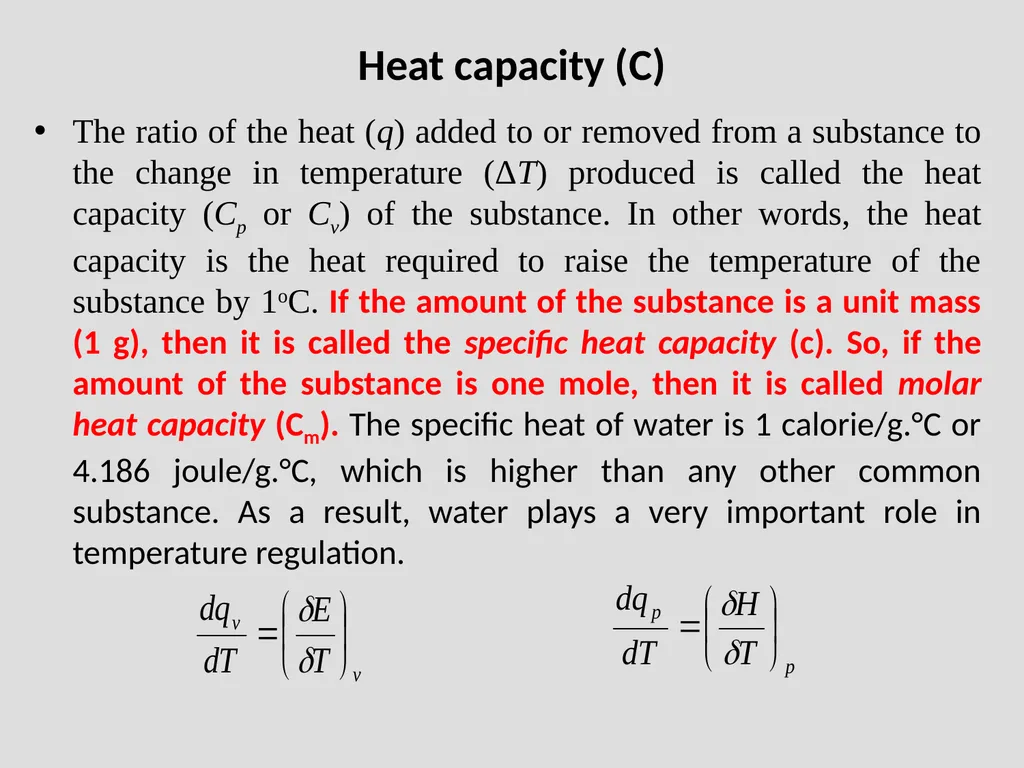
Heat capacity (C) The ratio of the heat (q) added to or removed from a substance to the change in temperature (ΔT) produced is called the heat capacity (Cp or Cv) of the substance. In other words, the heat capacity is the heat required to raise the temperature of the substance by 1oC. If the amount of the substance is a unit mass (1 g), then it is called the specific heat capacity (c). So, if the amount of the substance is one mole, then it is called molar heat capacity (Cm). The specific heat of water is 1 calorie/g.°C or 4.186 joule/g.°C, which is higher than any other common substance. As a result, water plays a very important role in temperature regulation.<br>
58
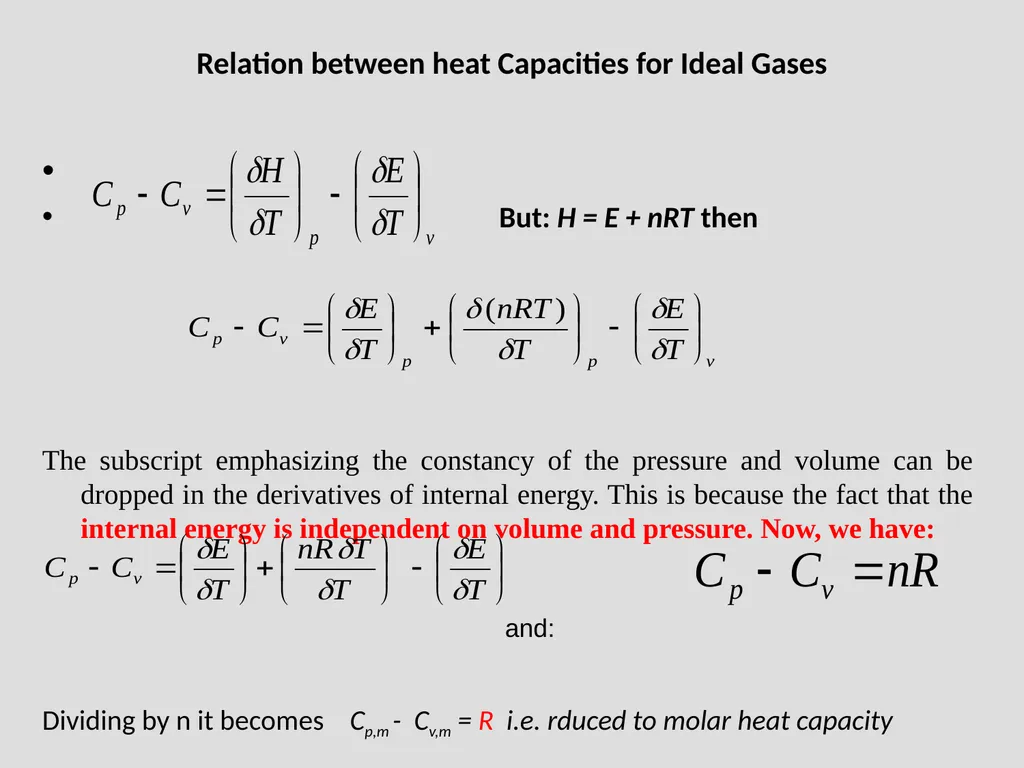
Relation between heat Capacities for Ideal Gases But: H = E + nRT then
The subscript emphasizing the constancy of the pressure and volume can be dropped in the derivatives of internal energy. This is because the fact that the internal energy is independent on volume and pressure. Now, we have:
and:
Dividing by n it becomes Cp,m - Cv,m = R i.e. rduced to molar heat capacity<br>
59
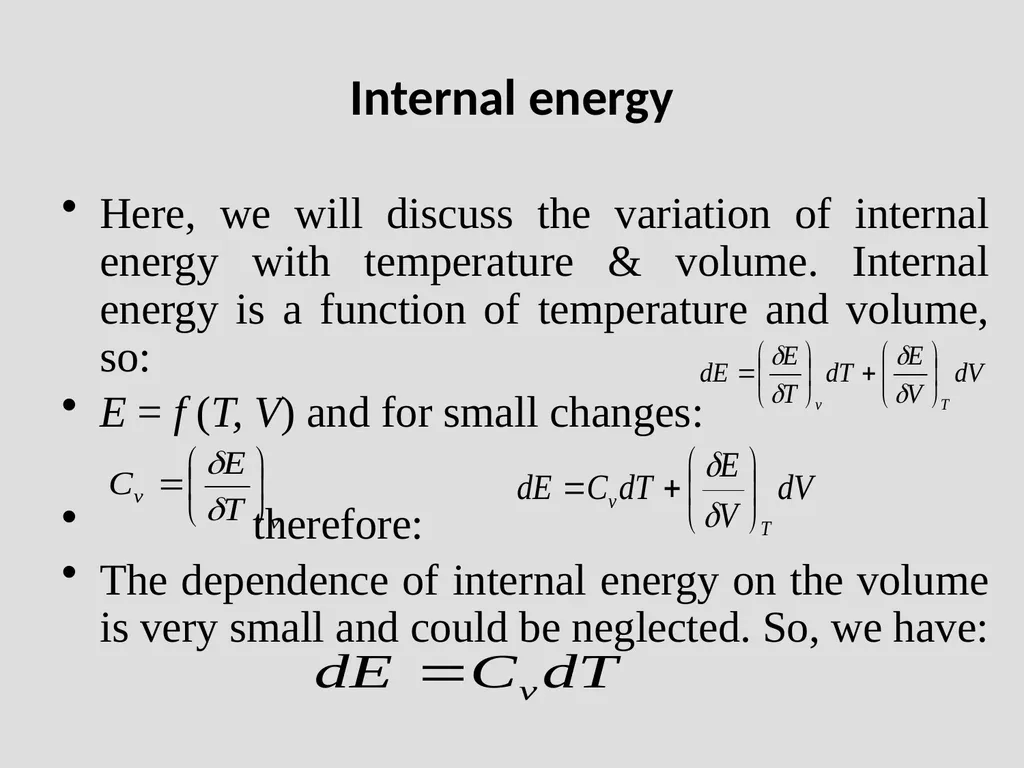
Internal energy Here, we will discuss the variation of internal energy with temperature & volume. Internal energy is a function of temperature and volume, so:
E = f (T, V) and for small changes:
therefore:
The dependence of internal energy on the volume is very small and could be neglected. So, we have:<br>
E = f (T, V) and for small changes:
therefore:
The dependence of internal energy on the volume is very small and could be neglected. So, we have:<br>
60
Physical significance of internal energy q must be equal to the work done to keep ΔE equal to zero. This work may be external physical work or it may be internal work such as transport through the circulatory system, internal movement of the heart and stomach etc.
The basal metabolic rate of energy consumption is found to be 300 kJ per hour
The rate of energy loss is increased and (dq – dw) is negative so that the internal energy is again lost. The living body survives at cost of internal energy and loses weight about 1 kg per day if complete break down of assimilation process occurs.<br>