
Words and word-formation processes People really
PC
Published · 19 slides · 0 views

1 / 1
Description
Words and word-formation processes People really have no difficulty dealing with the new words. They can very quickly understand a new word in their language (a neologism) and accept the use of different forms of that new word. A neologism
Related Topics
Share
Embed code
Download this presentation From Below
"Words and word-formation processes People really" is the property of its rightful owner. Permission is granted to download and print the materials on this website for personal, non-commercial use only, and to display it on your personal computer provided you do not modify the materials and that you retain all copyright notices contained in the materials. By downloading content from our website, you accept the terms of this agreement.
Presentation Transcript
01
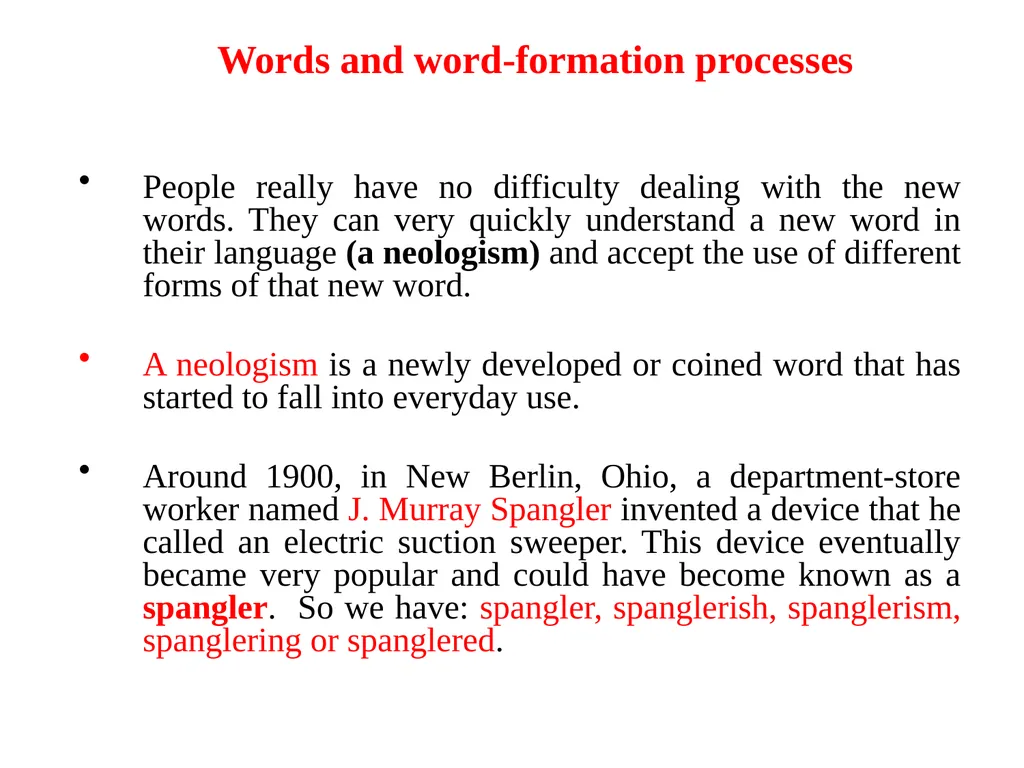
Words and word-formation processes People really have no difficulty dealing with the new words. They can very quickly understand a new word in their language (a neologism) and accept the use of different forms of that new word.
A neologism is a newly developed or coined word that has started to fall into everyday use.
Around 1900, in New Berlin, Ohio, a department-store worker named J. Murray Spangler invented a device that he called an electric suction sweeper. This device eventually became very popular and could have become known as a spangler. So we have: spangler, spanglerish, spanglerism, spanglering or spanglered.<br>
A neologism is a newly developed or coined word that has started to fall into everyday use.
Around 1900, in New Berlin, Ohio, a department-store worker named J. Murray Spangler invented a device that he called an electric suction sweeper. This device eventually became very popular and could have become known as a spangler. So we have: spangler, spanglerish, spanglerism, spanglering or spanglered.<br>
02
Words and word-formation processes Etymology: the study of the origin and history of a word.
There are many ways in which new words can enter a language such as Coinage, borrowing, compounding, Clipping, Blending, etc.<br>
There are many ways in which new words can enter a language such as Coinage, borrowing, compounding, Clipping, Blending, etc.<br>
03
Words and word-formation processes Many new words can cause objections as they come into use today, that is, people do not easily accept the use of new words at first and reject them.
It is better to see the ongoing evolution of new words and new uses of old words as a sign of vitality and creativeness in the way a language is shaped by the needs of its users.<br>
It is better to see the ongoing evolution of new words and new uses of old words as a sign of vitality and creativeness in the way a language is shaped by the needs of its users.<br>
04
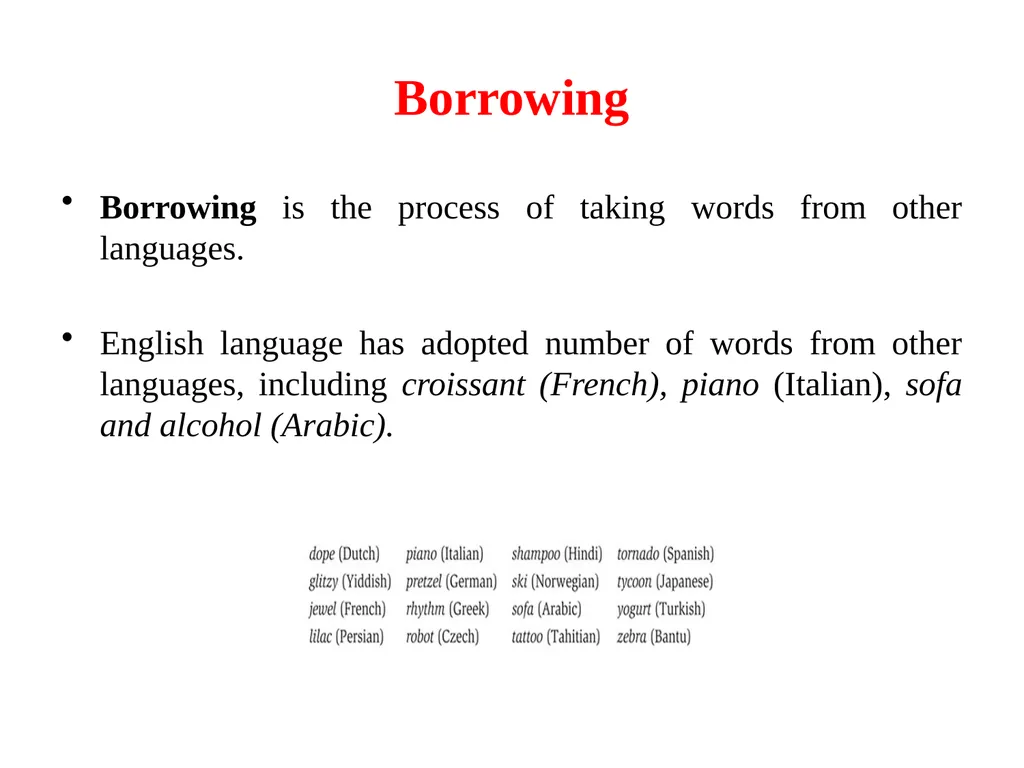
Borrowing Borrowing is the process of taking words from other languages.
English language has adopted number of words from other languages, including croissant (French), piano (Italian), sofa and alcohol (Arabic).<br>
English language has adopted number of words from other languages, including croissant (French), piano (Italian), sofa and alcohol (Arabic).<br>
05
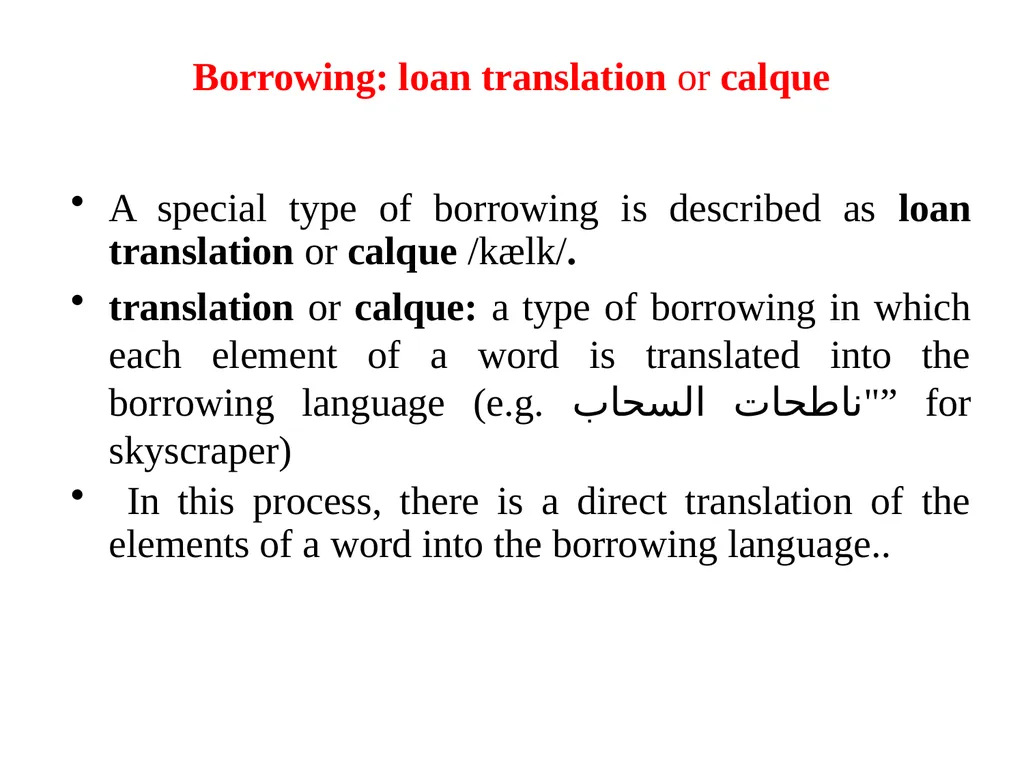
Borrowing: loan translation or calque A special type of borrowing is described as loan translation or calque /kælk/.
translation or calque: a type of borrowing in which each element of a word is translated into the borrowing language (e.g. ناطحات السحاب"” for skyscraper)
In this process, there is a direct translation of the elements of a word into the borrowing language..<br>
translation or calque: a type of borrowing in which each element of a word is translated into the borrowing language (e.g. ناطحات السحاب"” for skyscraper)
In this process, there is a direct translation of the elements of a word into the borrowing language..<br>
06
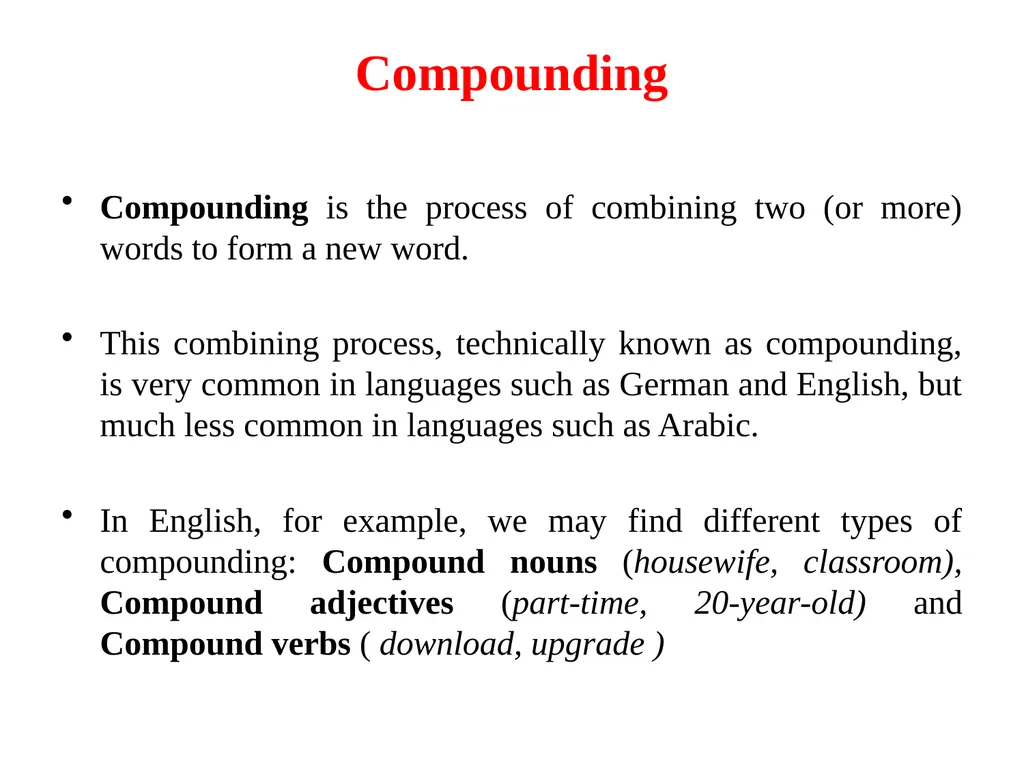
Compounding Compounding is the process of combining two (or more) words to form a new word.
This combining process, technically known as compounding, is very common in languages such as German and English, but much less common in languages such as Arabic.
In English, for example, we may find different types of compounding: Compound nouns (housewife, classroom), Compound adjectives (part-time, 20-year-old) and Compound verbs ( download, upgrade )<br>
This combining process, technically known as compounding, is very common in languages such as German and English, but much less common in languages such as Arabic.
In English, for example, we may find different types of compounding: Compound nouns (housewife, classroom), Compound adjectives (part-time, 20-year-old) and Compound verbs ( download, upgrade )<br>
07
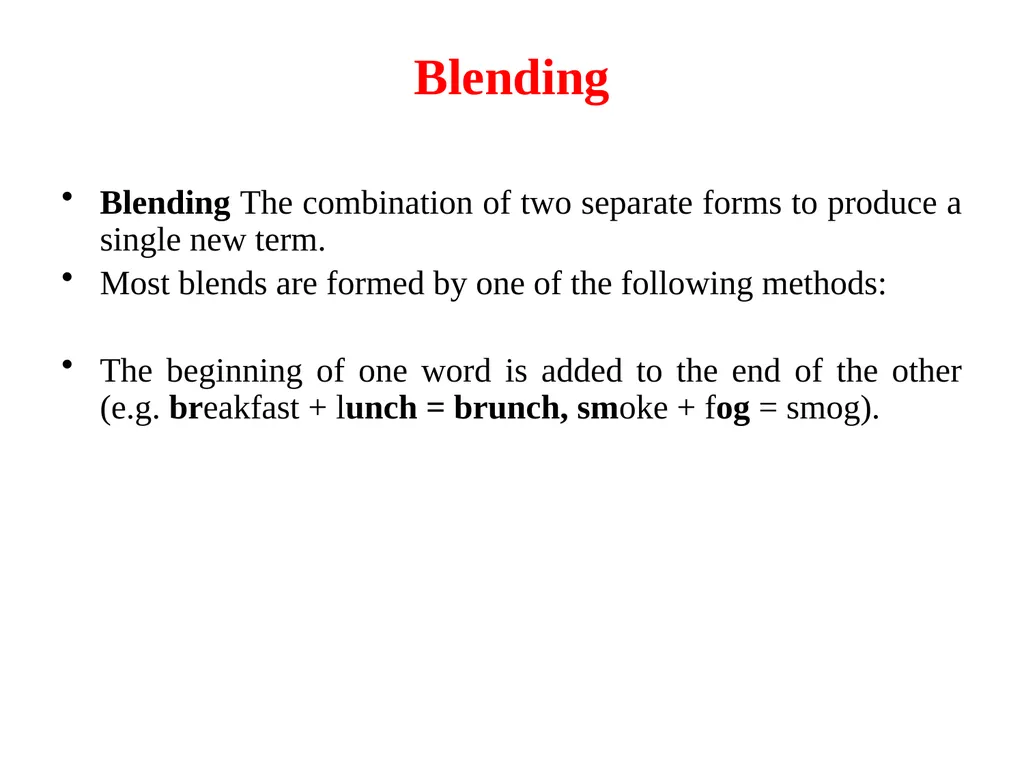
Blending Blending The combination of two separate forms to produce a single new term.
Most blends are formed by one of the following methods:
The beginning of one word is added to the end of the other (e.g. breakfast + lunch = brunch, smoke + fog = smog).<br>
Most blends are formed by one of the following methods:
The beginning of one word is added to the end of the other (e.g. breakfast + lunch = brunch, smoke + fog = smog).<br>
08
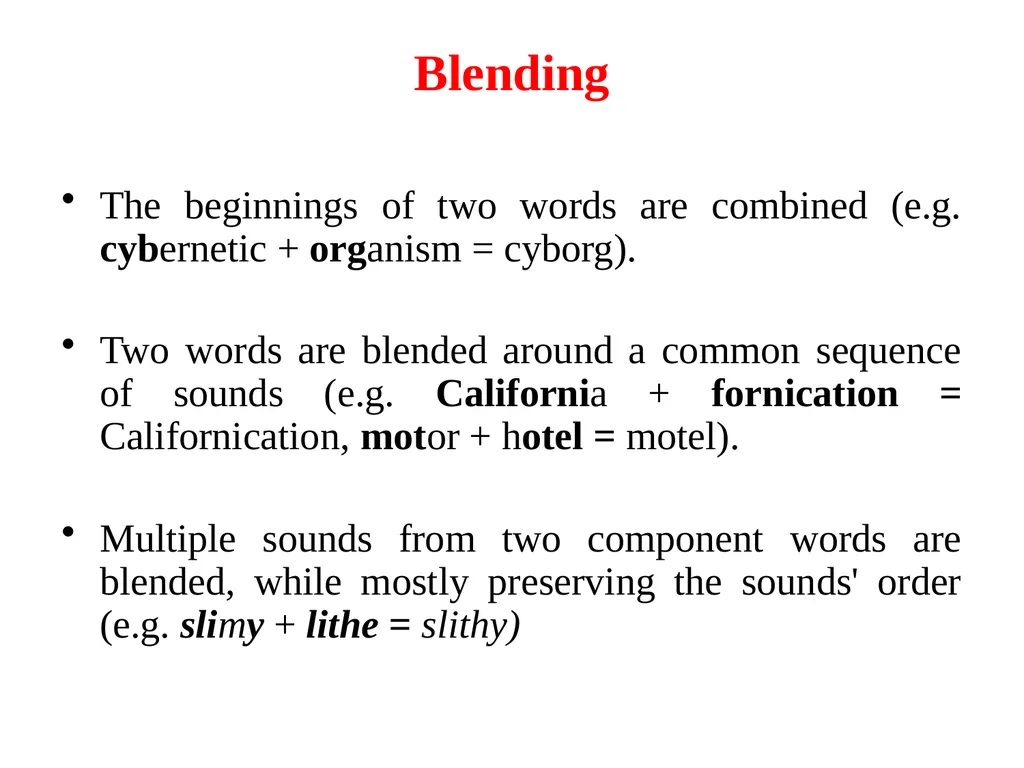
Blending The beginnings of two words are combined (e.g. cybernetic + organism = cyborg).
Two words are blended around a common sequence of sounds (e.g. California + fornication = Californication, motor + hotel = motel).
Multiple sounds from two component words are blended, while mostly preserving the sounds' order (e.g. slimy + lithe = slithy)<br>
Two words are blended around a common sequence of sounds (e.g. California + fornication = Californication, motor + hotel = motel).
Multiple sounds from two component words are blended, while mostly preserving the sounds' order (e.g. slimy + lithe = slithy)<br>
09
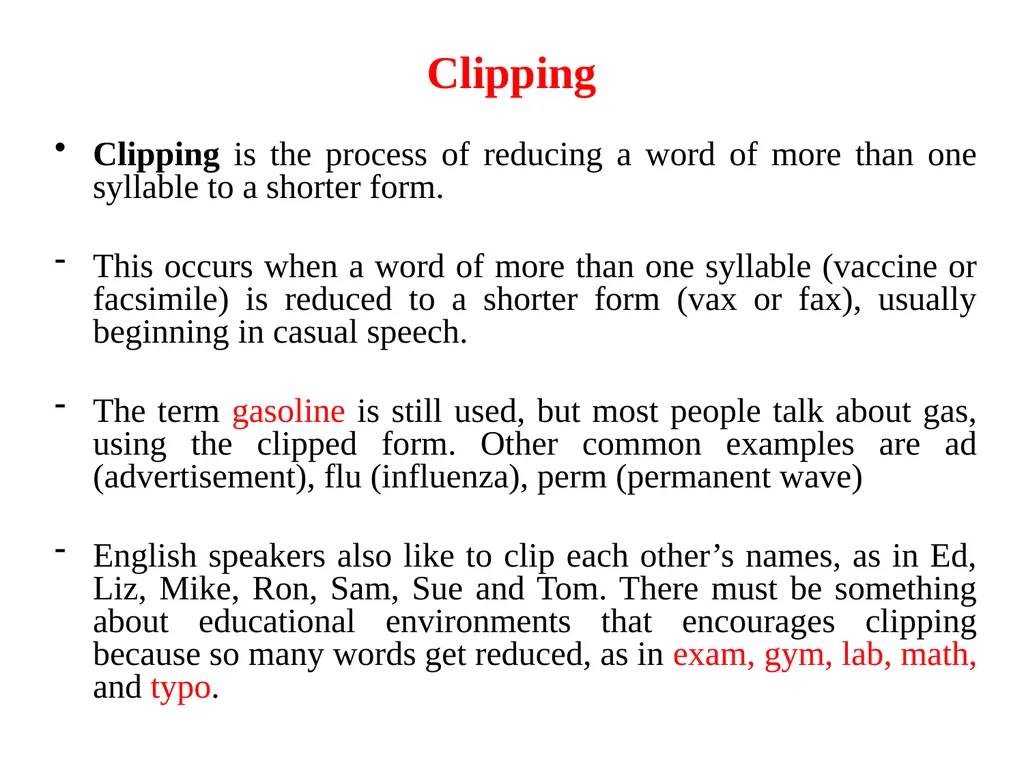
Clipping Clipping is the process of reducing a word of more than one syllable to a shorter form.
This occurs when a word of more than one syllable (vaccine or facsimile) is reduced to a shorter form (vax or fax), usually beginning in casual speech.
The term gasoline is still used, but most people talk about gas, using the clipped form. Other common examples are ad (advertisement), flu (influenza), perm (permanent wave)
English speakers also like to clip each other’s names, as in Ed, Liz, Mike, Ron, Sam, Sue and Tom. There must be something about educational environments that encourages clipping because so many words get reduced, as in exam, gym, lab, math, and typo.<br>
This occurs when a word of more than one syllable (vaccine or facsimile) is reduced to a shorter form (vax or fax), usually beginning in casual speech.
The term gasoline is still used, but most people talk about gas, using the clipped form. Other common examples are ad (advertisement), flu (influenza), perm (permanent wave)
English speakers also like to clip each other’s names, as in Ed, Liz, Mike, Ron, Sam, Sue and Tom. There must be something about educational environments that encourages clipping because so many words get reduced, as in exam, gym, lab, math, and typo.<br>
10
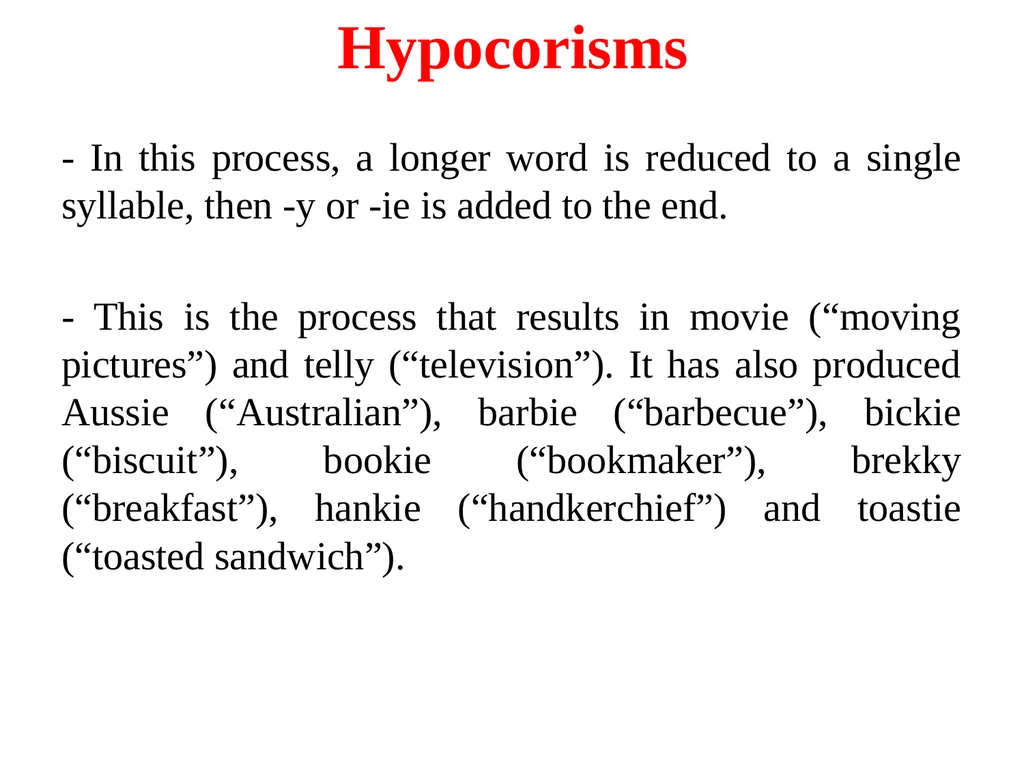
Hypocorisms - In this process, a longer word is reduced to a single syllable, then -y or -ie is added to the end.
- This is the process that results in movie (“moving pictures”) and telly (“television”). It has also produced Aussie (“Australian”), barbie (“barbecue”), bickie (“biscuit”), bookie (“bookmaker”), brekky (“breakfast”), hankie (“handkerchief”) and toastie (“toasted sandwich”).<br>
- This is the process that results in movie (“moving pictures”) and telly (“television”). It has also produced Aussie (“Australian”), barbie (“barbecue”), bickie (“biscuit”), bookie (“bookmaker”), brekky (“breakfast”), hankie (“handkerchief”) and toastie (“toasted sandwich”).<br>
11
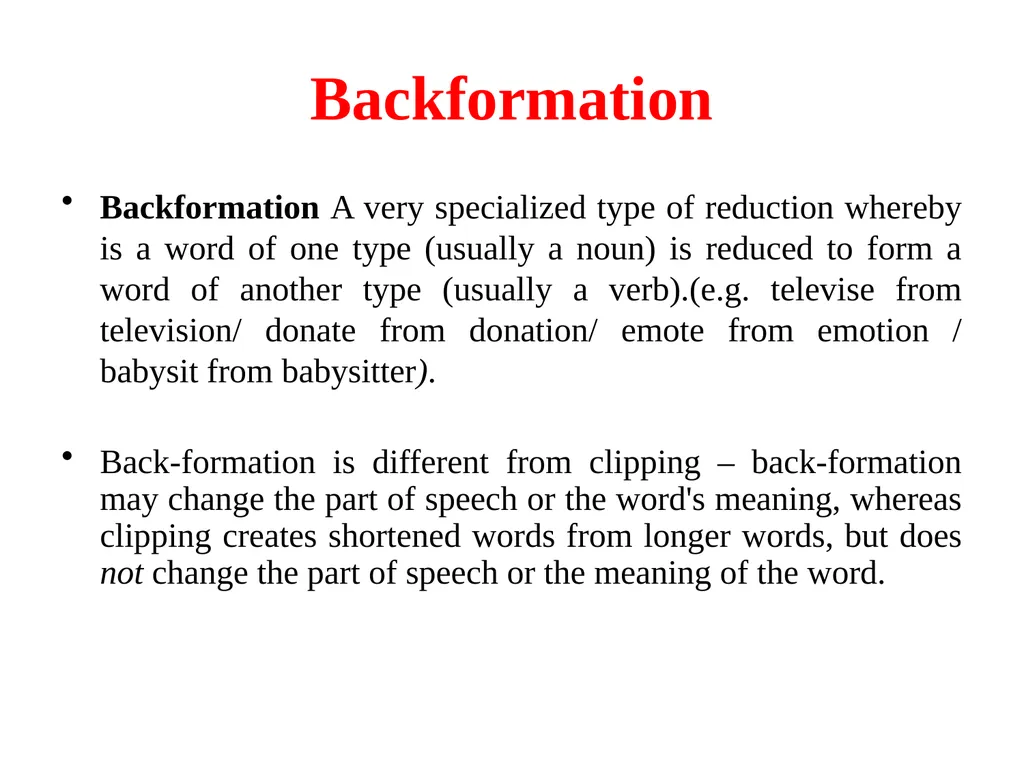
Backformation Backformation A very specialized type of reduction whereby is a word of one type (usually a noun) is reduced to form a word of another type (usually a verb).(e.g. televise from television/ donate from donation/ emote from emotion / babysit from babysitter).
Back-formation is different from clipping – back-formation may change the part of speech or the word's meaning, whereas clipping creates shortened words from longer words, but does not change the part of speech or the meaning of the word.<br>
Back-formation is different from clipping – back-formation may change the part of speech or the word's meaning, whereas clipping creates shortened words from longer words, but does not change the part of speech or the meaning of the word.<br>
12
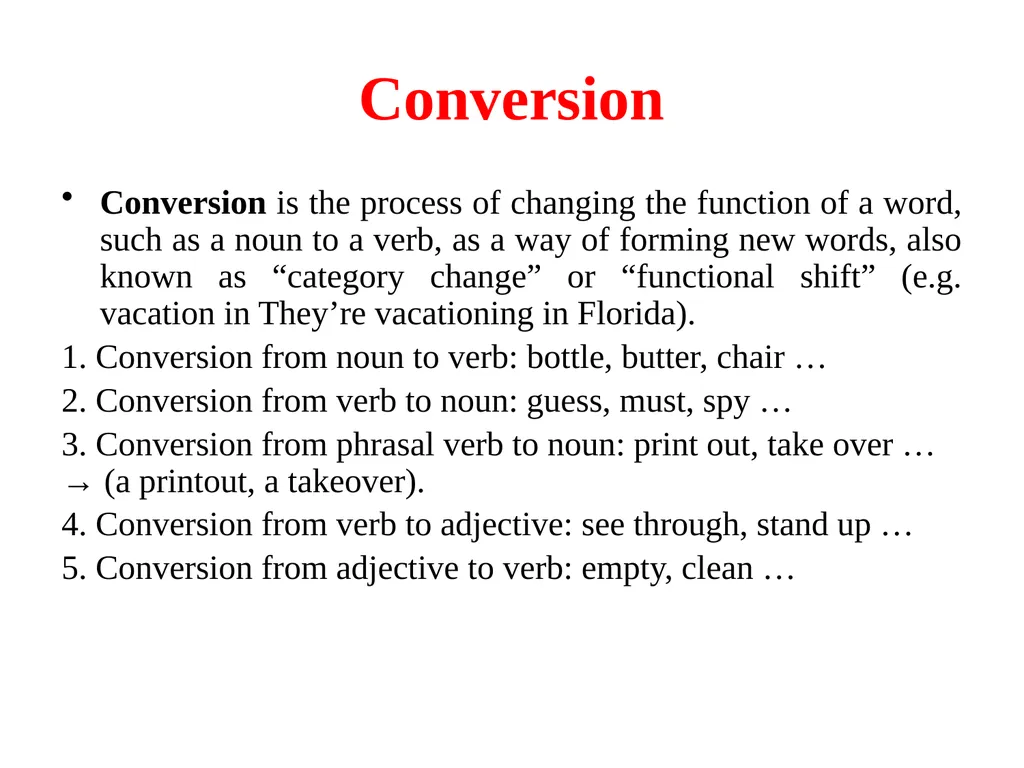
Conversion Conversion is the process of changing the function of a word, such as a noun to a verb, as a way of forming new words, also known as “category change” or “functional shift” (e.g. vacation in They’re vacationing in Florida).
1. Conversion from noun to verb: bottle, butter, chair …
2. Conversion from verb to noun: guess, must, spy …
3. Conversion from phrasal verb to noun: print out, take over … → (a printout, a takeover).
4. Conversion from verb to adjective: see through, stand up …
5. Conversion from adjective to verb: empty, clean …<br>
1. Conversion from noun to verb: bottle, butter, chair …
2. Conversion from verb to noun: guess, must, spy …
3. Conversion from phrasal verb to noun: print out, take over … → (a printout, a takeover).
4. Conversion from verb to adjective: see through, stand up …
5. Conversion from adjective to verb: empty, clean …<br>
13
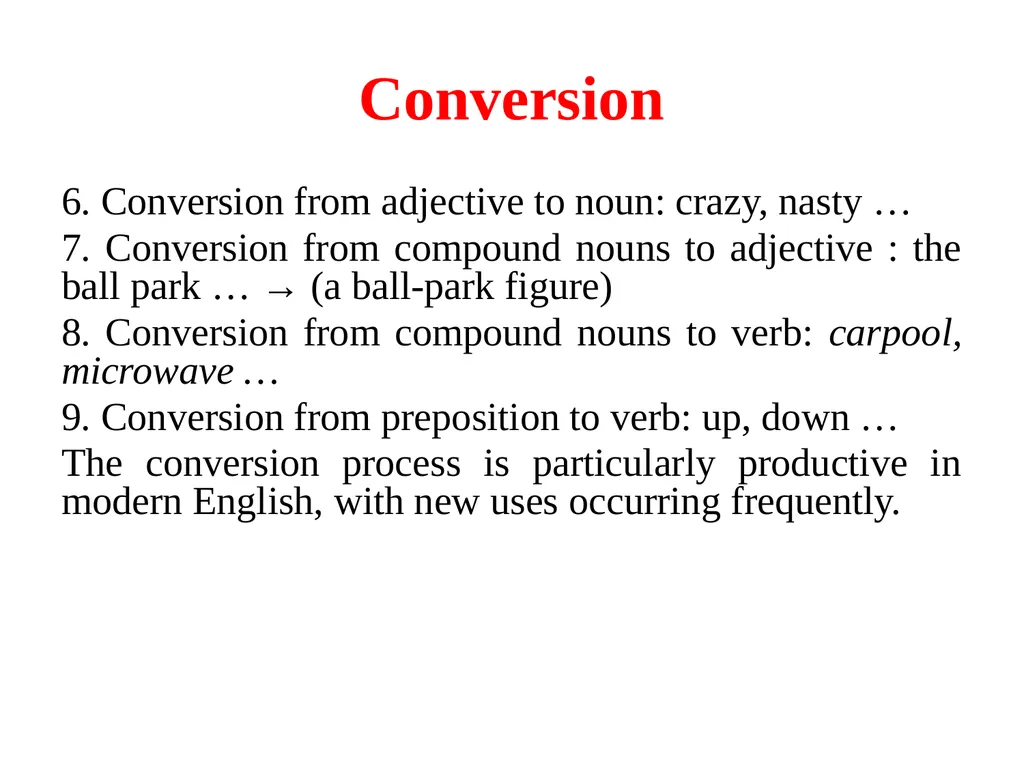
Conversion 6. Conversion from adjective to noun: crazy, nasty …
7. Conversion from compound nouns to adjective : the ball park … → (a ball-park figure)
8. Conversion from compound nouns to verb: carpool, microwave …
9. Conversion from preposition to verb: up, down …
The conversion process is particularly productive in modern English, with new uses occurring frequently.<br>
7. Conversion from compound nouns to adjective : the ball park … → (a ball-park figure)
8. Conversion from compound nouns to verb: carpool, microwave …
9. Conversion from preposition to verb: up, down …
The conversion process is particularly productive in modern English, with new uses occurring frequently.<br>
14
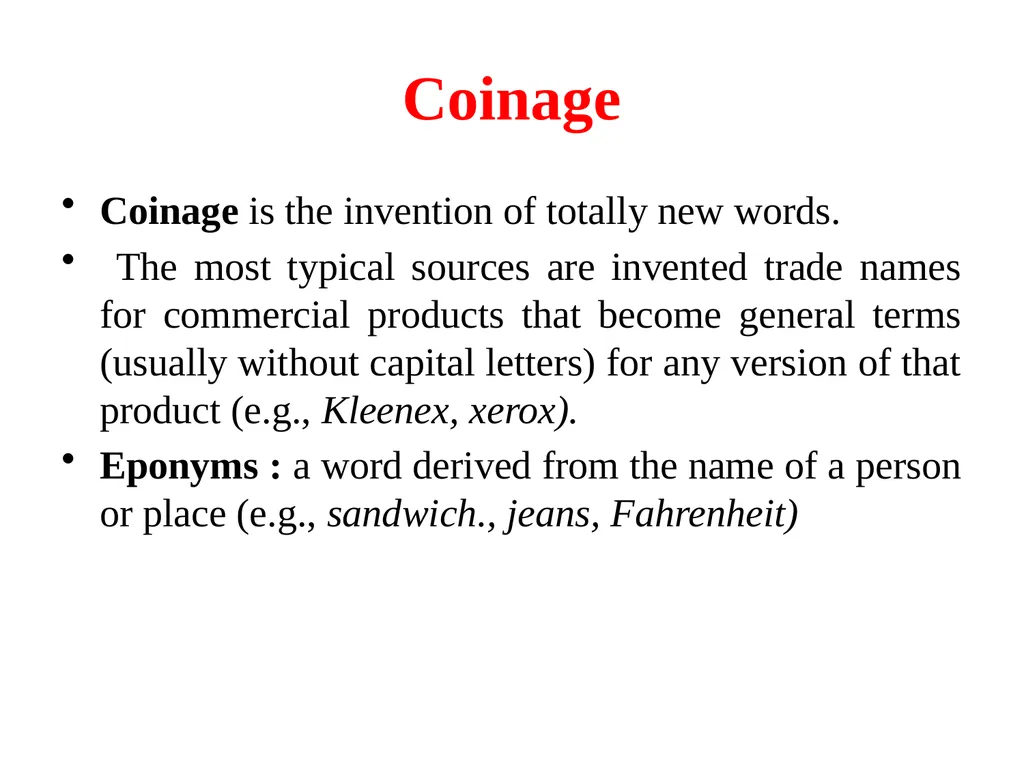
Coinage Coinage is the invention of totally new words.
The most typical sources are invented trade names for commercial products that become general terms (usually without capital letters) for any version of that product (e.g., Kleenex, xerox).
Eponyms : a word derived from the name of a person or place (e.g., sandwich., jeans, Fahrenheit)<br>
The most typical sources are invented trade names for commercial products that become general terms (usually without capital letters) for any version of that product (e.g., Kleenex, xerox).
Eponyms : a word derived from the name of a person or place (e.g., sandwich., jeans, Fahrenheit)<br>
15
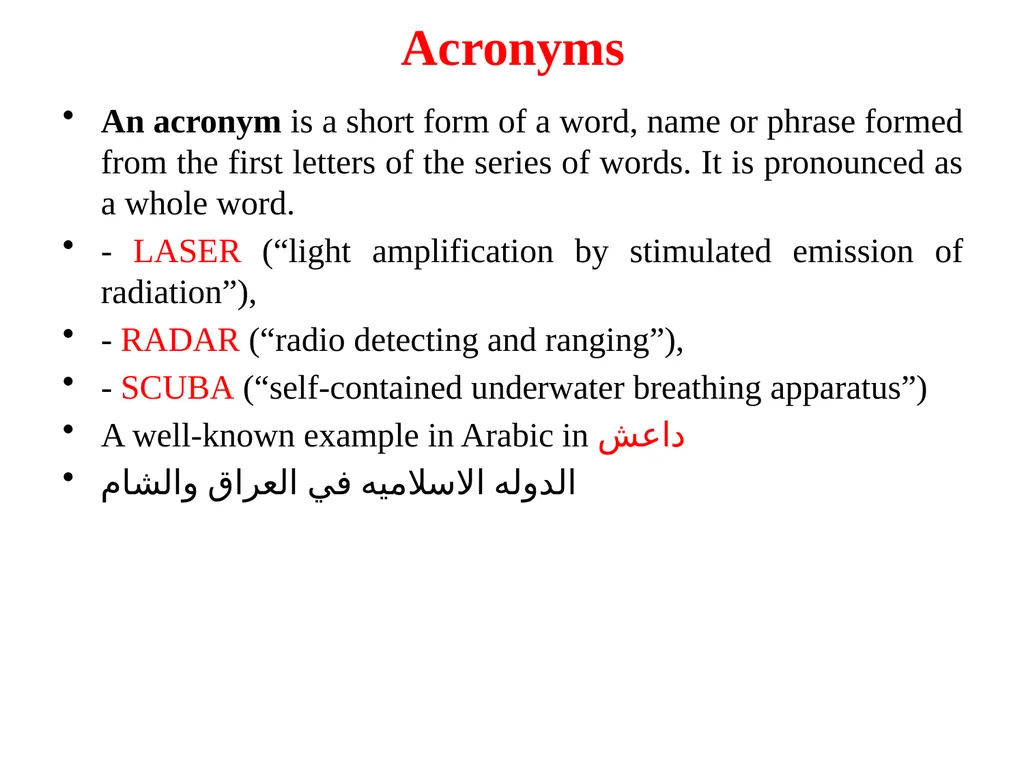
Acronyms An acronym is a short form of a word, name or phrase formed from the first letters of the series of words. It is pronounced as a whole word.
- LASER (“light amplification by stimulated emission of radiation”),
- RADAR (“radio detecting and ranging”),
- SCUBA (“self-contained underwater breathing apparatus”)
A well-known example in Arabic in داعش
الدوله الاسلاميه في العراق والشام<br>
- LASER (“light amplification by stimulated emission of radiation”),
- RADAR (“radio detecting and ranging”),
- SCUBA (“self-contained underwater breathing apparatus”)
A well-known example in Arabic in داعش
الدوله الاسلاميه في العراق والشام<br>
16
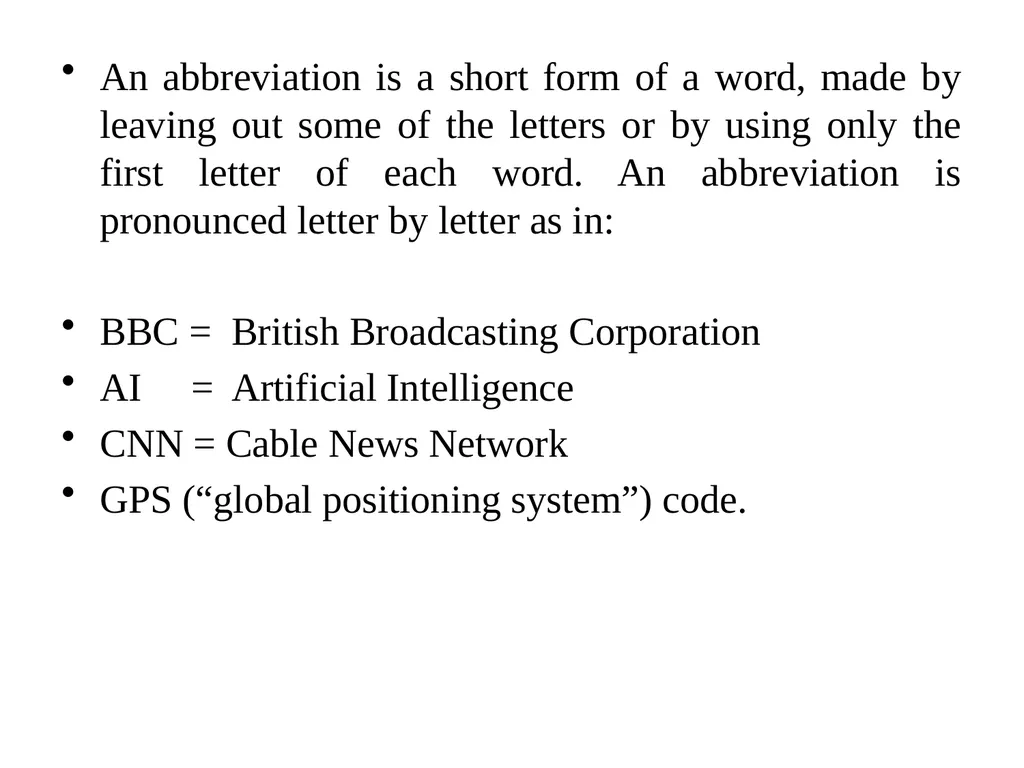
An abbreviation is a short form of a word, made by leaving out some of the letters or by using only the first letter of each word. An abbreviation is pronounced letter by letter as in:
BBC = British Broadcasting Corporation
AI = Artificial Intelligence
CNN = Cable News Network
GPS (“global positioning system”) code.<br>
BBC = British Broadcasting Corporation
AI = Artificial Intelligence
CNN = Cable News Network
GPS (“global positioning system”) code.<br>
17
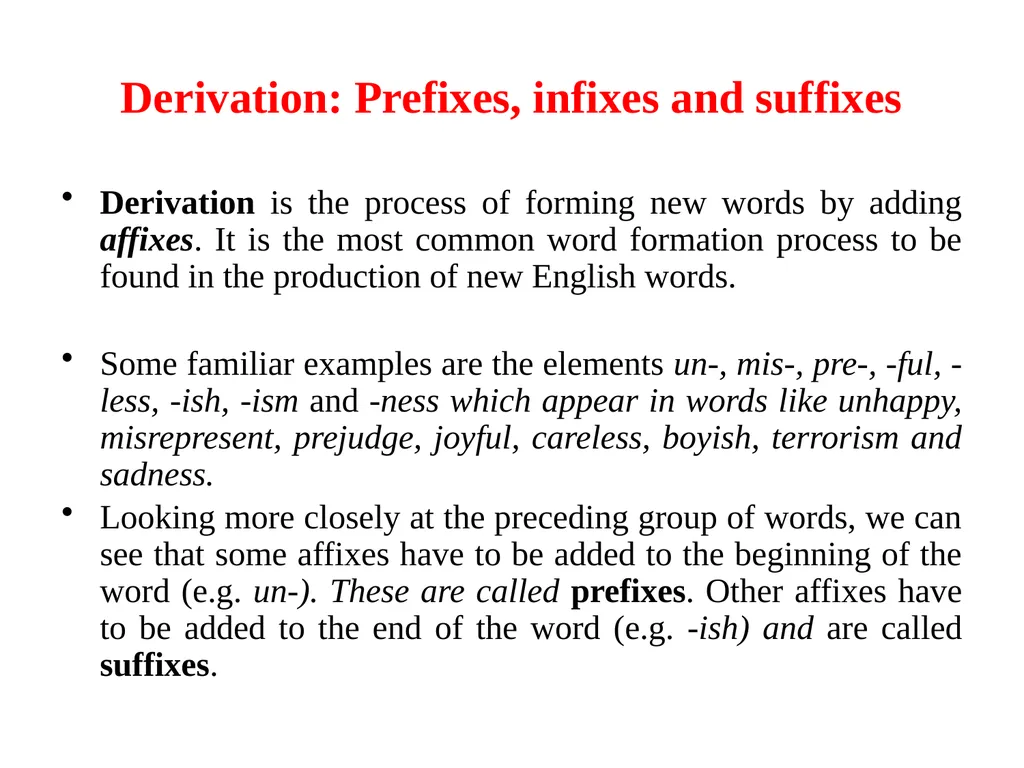
Derivation: Prefixes, infixes and suffixes Derivation is the process of forming new words by adding affixes. It is the most common word formation process to be found in the production of new English words.
Some familiar examples are the elements un-, mis-, pre-, -ful, -less, -ish, -ism and -ness which appear in words like unhappy, misrepresent, prejudge, joyful, careless, boyish, terrorism and sadness.
Looking more closely at the preceding group of words, we can see that some affixes have to be added to the beginning of the word (e.g. un-). These are called prefixes. Other affixes have to be added to the end of the word (e.g. -ish) and are called suffixes.<br>
Some familiar examples are the elements un-, mis-, pre-, -ful, -less, -ish, -ism and -ness which appear in words like unhappy, misrepresent, prejudge, joyful, careless, boyish, terrorism and sadness.
Looking more closely at the preceding group of words, we can see that some affixes have to be added to the beginning of the word (e.g. un-). These are called prefixes. Other affixes have to be added to the end of the word (e.g. -ish) and are called suffixes.<br>
18
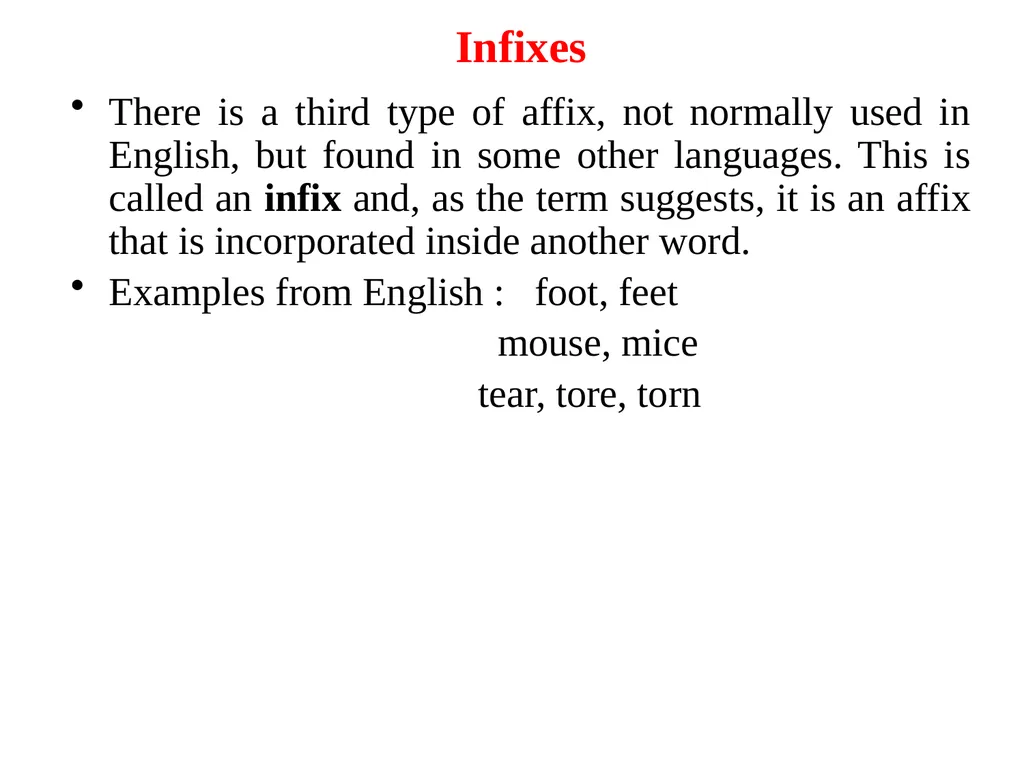
Infixes There is a third type of affix, not normally used in English, but found in some other languages. This is called an infix and, as the term suggests, it is an affix that is incorporated inside another word.
Examples from English : foot, feet
mouse, mice
tear, tore, torn<br>
Examples from English : foot, feet
mouse, mice
tear, tore, torn<br>
19
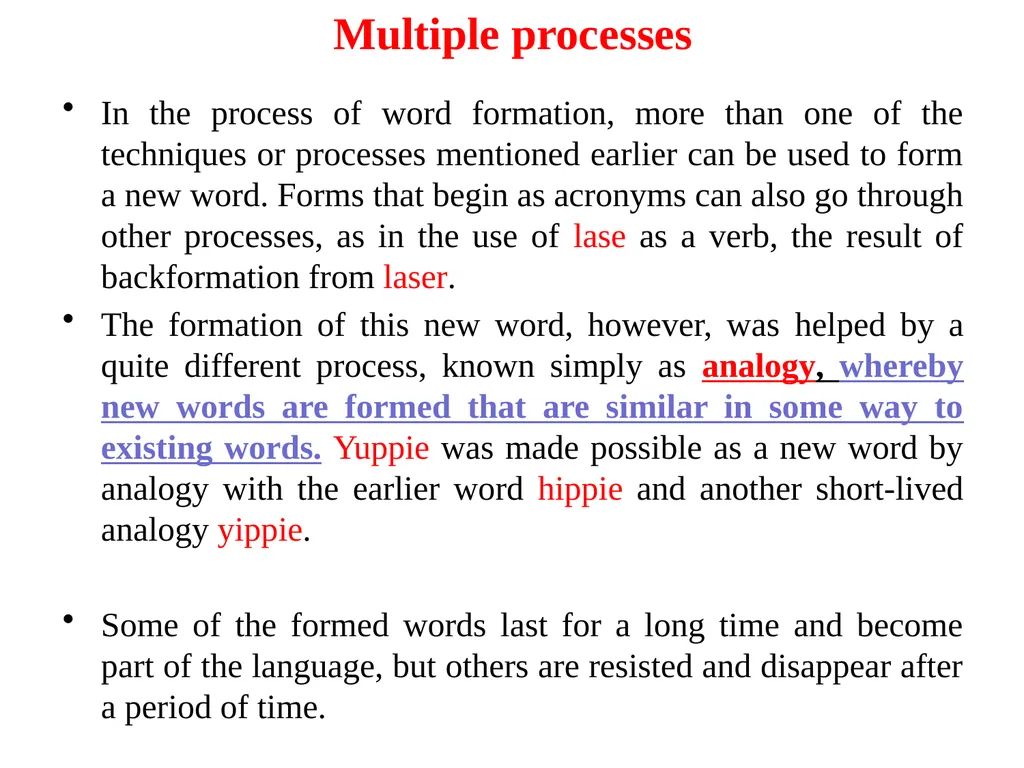
Multiple processes In the process of word formation, more than one of the techniques or processes mentioned earlier can be used to form a new word. Forms that begin as acronyms can also go through other processes, as in the use of lase as a verb, the result of backformation from laser.
The formation of this new word, however, was helped by a quite different process, known simply as analogy, whereby new words are formed that are similar in some way to existing words. Yuppie was made possible as a new word by analogy with the earlier word hippie and another short-lived analogy yippie.
Some of the formed words last for a long time and become part of the language, but others are resisted and disappear after a period of time.<br>
The formation of this new word, however, was helped by a quite different process, known simply as analogy, whereby new words are formed that are similar in some way to existing words. Yuppie was made possible as a new word by analogy with the earlier word hippie and another short-lived analogy yippie.
Some of the formed words last for a long time and become part of the language, but others are resisted and disappear after a period of time.<br>