
Workforce Safety and Wellness CHAPTER 2
MJ
Published · 62 slides · 0 views
1 / 1
Description
Workforce Safety and Wellness CHAPTER 2 Introduction (1 of 2) A paramedics job is very gratifying but also very demanding. The most important factor is your personal wellness and safety. Scene safety issues Do not compromise your safety.
Related Topics
Share
Embed code
Download this presentation From Below
"Workforce Safety and Wellness CHAPTER 2" is the property of its rightful owner. Permission is granted to download and print the materials on this website for personal, non-commercial use only, and to display it on your personal computer provided you do not modify the materials and that you retain all copyright notices contained in the materials. By downloading content from our website, you accept the terms of this agreement.
Presentation Transcript
01
Workforce Safety and Wellness CHAPTER 2<br>
02
Introduction (1 of 2) A paramedic’s job is very gratifying but also very demanding.
The most important factor is your personal wellness and safety.
Scene safety issues
Do not compromise your safety.
Maintain your health from the beginning.<br>
The most important factor is your personal wellness and safety.
Scene safety issues
Do not compromise your safety.
Maintain your health from the beginning.<br>
03
Introduction (2 of 2) Data from NHTSA show an annual estimate of 1,500 ambulance crashes in the United States.
New paramedics should be aware of their:
Own health and well-being
Limitations
The scene is never safe, and EMS providers should never let their guard down!<br>
New paramedics should be aware of their:
Own health and well-being
Limitations
The scene is never safe, and EMS providers should never let their guard down!<br>
04
Components of Well-Being Wellness is the quality or state of being in good health.
Components of wellness:
Physical
Mental
Emotional<br>
Components of wellness:
Physical
Mental
Emotional<br>
05
Physical Well-Being (1 of 2) Providers who are physically in shape:
Are less likely to become injured or ill
May heal more quickly if injured
Have a better quality of life<br>
Are less likely to become injured or ill
May heal more quickly if injured
Have a better quality of life<br>
06
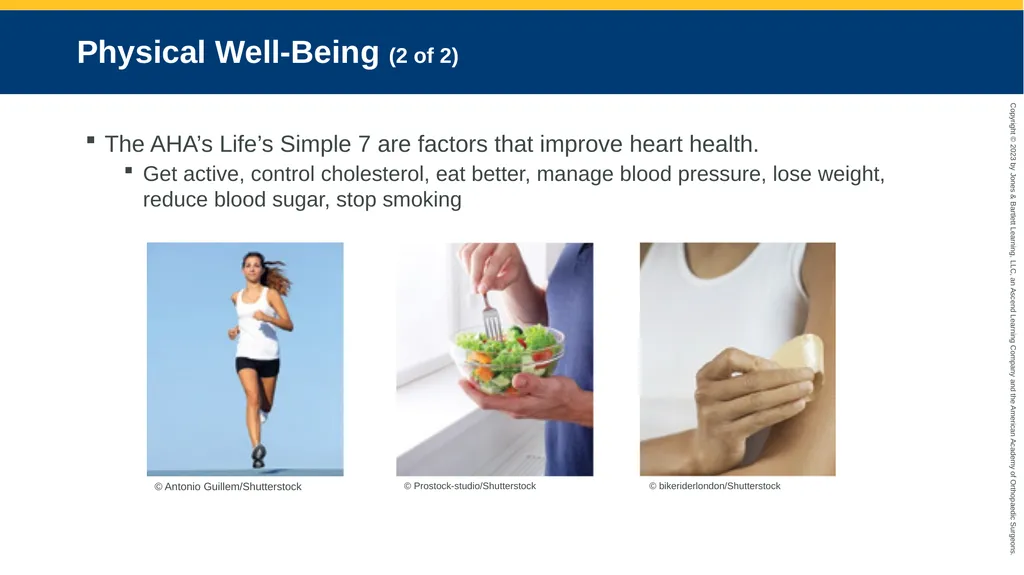
Physical Well-Being (2 of 2) The AHA’s Life’s Simple 7 are factors that improve heart health.
Get active, control cholesterol, eat better, manage blood pressure, lose weight, reduce blood sugar, stop smoking © Antonio Guillem/Shutterstock © Prostock-studio/Shutterstock © bikeriderlondon/Shutterstock<br>
Get active, control cholesterol, eat better, manage blood pressure, lose weight, reduce blood sugar, stop smoking © Antonio Guillem/Shutterstock © Prostock-studio/Shutterstock © bikeriderlondon/Shutterstock<br>
07
Nutrition (1 of 5) Nutritional information changes regularly, but current nutritional guidelines are readily available.
Consequences of poor nutrition
Eat foods in suggested portions from six main categories.
Each person’s requirements are different.<br>
Consequences of poor nutrition
Eat foods in suggested portions from six main categories.
Each person’s requirements are different.<br>
08
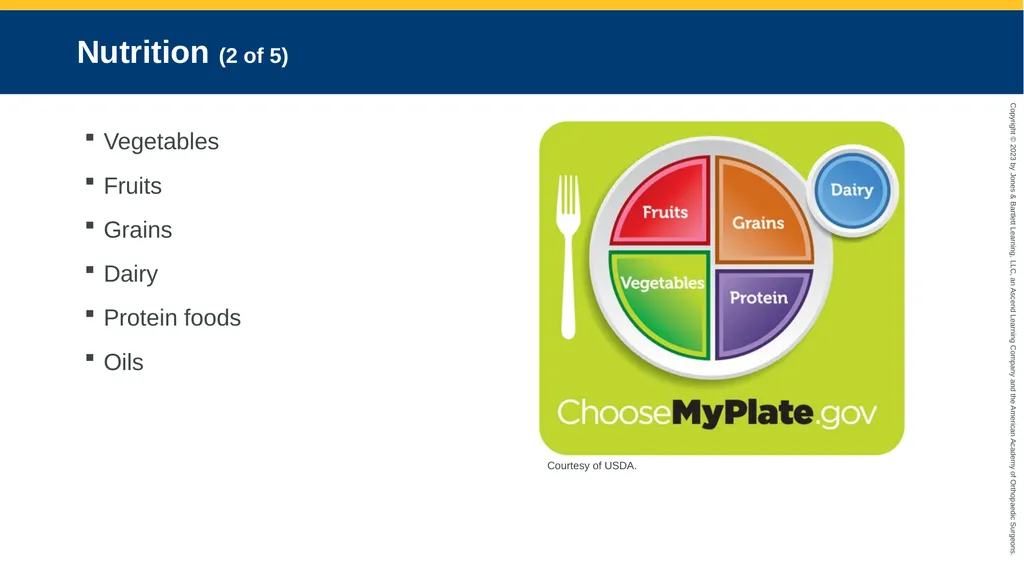
Nutrition (2 of 5) Vegetables
Fruits
Grains
Dairy
Protein foods
Oils Courtesy of USDA.<br>
Fruits
Grains
Dairy
Protein foods
Oils Courtesy of USDA.<br>
09
Nutrition (3 of 5) Read nutrition labels of prepared or processed foods.
Review:
Sodium levels
Amount and type of fat
Composition of carbohydrates<br>
Review:
Sodium levels
Amount and type of fat
Composition of carbohydrates<br>
10
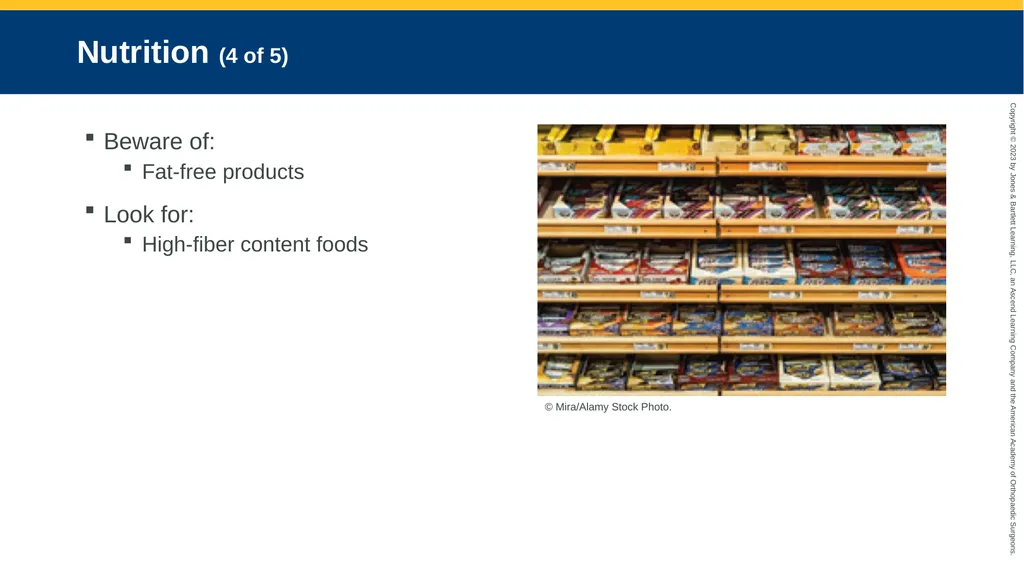
Nutrition (4 of 5) Beware of:
Fat-free products
Look for:
High-fiber content foods © Mira/Alamy Stock Photo.<br>
Fat-free products
Look for:
High-fiber content foods © Mira/Alamy Stock Photo.<br>
11
Nutrition (5 of 5) Plan for your shift as if you will get minimal time to rest or to eat a meal.
What to bring
What to avoid<br>
What to bring
What to avoid<br>
12
Weight Control The USDA’s dietary guidelines recommendations.
Make healthy food choices and avoid dieting.
Gradual weight reduction is key.<br>
Make healthy food choices and avoid dieting.
Gradual weight reduction is key.<br>
13
Exercise (1 of 3) Benefits of exercise
The exercise program for you depends on personal preferences and fitness goals.<br>
The exercise program for you depends on personal preferences and fitness goals.<br>
14
Exercise (2 of 3) Your exercise program should be targeted at maintaining or improving:
Cardiovascular endurance
Flexibility
Overall physical strength
Consult your primary care physician before beginning an exercise program.<br>
Cardiovascular endurance
Flexibility
Overall physical strength
Consult your primary care physician before beginning an exercise program.<br>
15
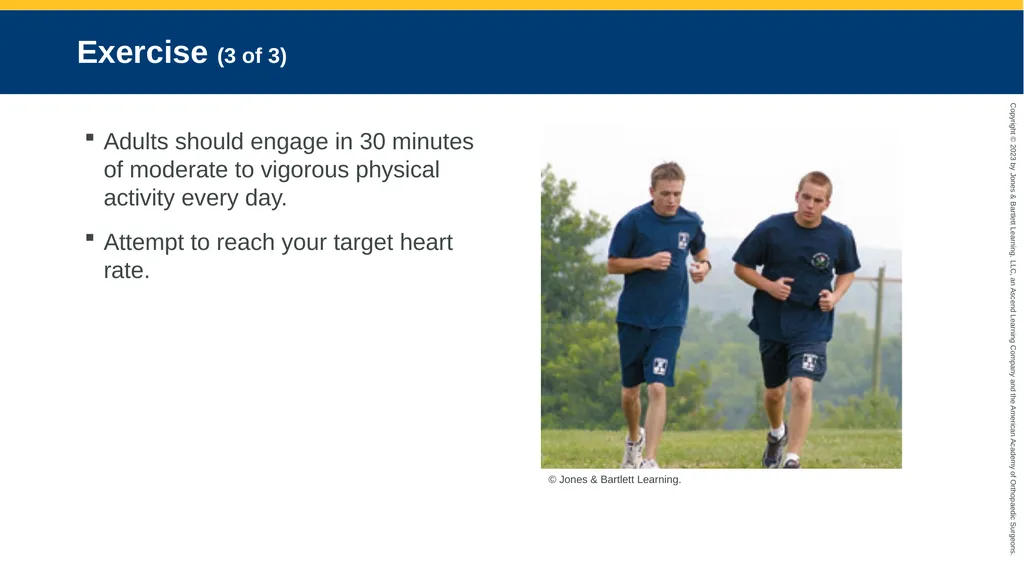
Exercise (3 of 3) Adults should engage in 30 minutes of moderate to vigorous physical activity every day.
Attempt to reach your target heart rate. © Jones & Bartlett Learning.<br>
Attempt to reach your target heart rate. © Jones & Bartlett Learning.<br>
16
Smoking and Tobacco If you don’t smoke, don’t start!
Everyone responds differently to smoke.
Options for smoking cessation
Electronic cigarettes<br>
Everyone responds differently to smoke.
Options for smoking cessation
Electronic cigarettes<br>
17
Alcohol Use Alcohol is a drug that can modify how the brain perceives stress.
Alcohol cannot alleviate stress.
The stress persists beyond the duration of the alcohol’s effects.
Using alcohol to cope can lead to dependence.<br>
Alcohol cannot alleviate stress.
The stress persists beyond the duration of the alcohol’s effects.
Using alcohol to cope can lead to dependence.<br>
18
Circadian Rhythms and Shift Work Your job as a paramedic will often conflict with your body’s circadian rhythms.
Ignoring your circadian rhythms can lead to several problems.
Determine your natural rhythms.
Tips for dealing with shift work
Do not overlook the need for sleep.<br>
Ignoring your circadian rhythms can lead to several problems.
Determine your natural rhythms.
Tips for dealing with shift work
Do not overlook the need for sleep.<br>
19
Periodic Health Risk Assessments Hereditary factors may affect your overall health.
Consider researching your family history.
Build health assessments into your routine physical checkups.<br>
Consider researching your family history.
Build health assessments into your routine physical checkups.<br>
20
Body Mechanics (1 of 3) A paramedic is required to lift and move a variety of patients.
Develop the following habits:
Minimize the number of total body lifts you have to perform.
Coordinate every lift prior to performing the lift.
Minimize the total amount of weight you have to lift.<br>
Develop the following habits:
Minimize the number of total body lifts you have to perform.
Coordinate every lift prior to performing the lift.
Minimize the total amount of weight you have to lift.<br>
21
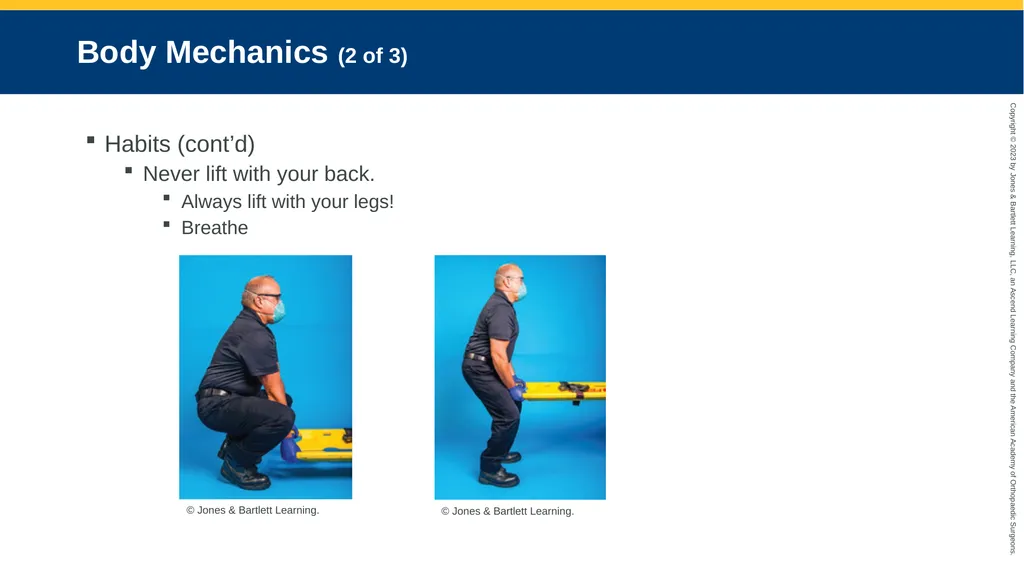
Body Mechanics (2 of 3) Habits (cont’d)
Never lift with your back.
Always lift with your legs!
Breathe © Jones & Bartlett Learning. © Jones & Bartlett Learning.<br>
Never lift with your back.
Always lift with your legs!
Breathe © Jones & Bartlett Learning. © Jones & Bartlett Learning.<br>
22
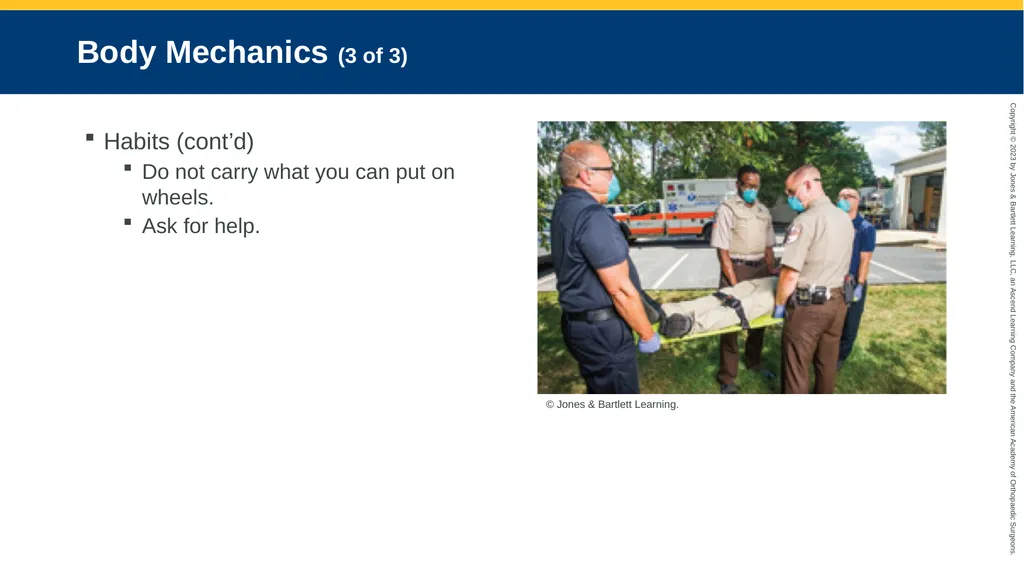
Body Mechanics (3 of 3) Habits (cont’d)
Do not carry what you can put on wheels.
Ask for help. © Jones & Bartlett Learning.<br>
Do not carry what you can put on wheels.
Ask for help. © Jones & Bartlett Learning.<br>
23
Mental Well-Being When you are subjected to stress, the fight-or-flight response is activated.
A paramedic needs to be in control of his or her emotions.<br>
A paramedic needs to be in control of his or her emotions.<br>
24
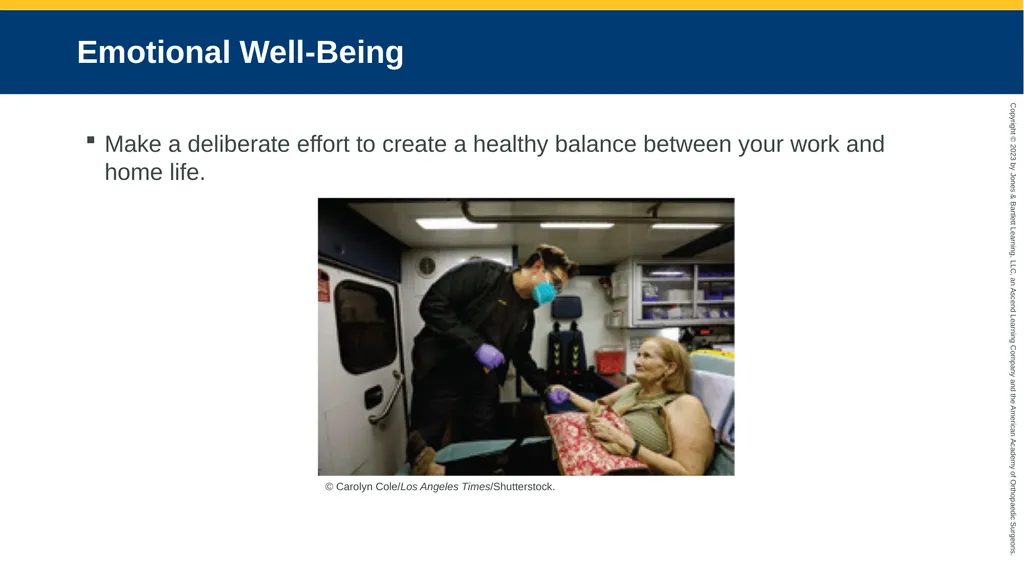
Emotional Well-Being Make a deliberate effort to create a healthy balance between your work and home life. © Carolyn Cole/Los Angeles Times/Shutterstock.<br>
25
Spiritual Well-Being Human spirituality is an unseen dimension of human experience.
Medical care supports the dignity and value of life and the sacredness of all people.<br>
Medical care supports the dignity and value of life and the sacredness of all people.<br>
26
Disease Transmission (1 of 2) Paramedics are called on to treat and transport patients with a variety of communicable and infectious diseases.
Inform other health care providers who may come in contact with the patient.<br>
Inform other health care providers who may come in contact with the patient.<br>
27
Disease Transmission (2 of 2) Infectious diseases can be transmitted in various ways:
Contact (direct or indirect)
Airborne
Foodborne
Vector-borne (insects or parasitic worms)<br>
Contact (direct or indirect)
Airborne
Foodborne
Vector-borne (insects or parasitic worms)<br>
28
Management of an Exposure Follow your department’s infection control plan, such as:
Turn over care to another EMS provider.
Wash affected area with soap and water.
If eyes were exposed, rinse them with water for at least 20 minutes as soon as possible.
Comply with all reporting requirements.
Get a medical evaluation.
Obtain proper immunization boosters.
Document the incident.<br>
Turn over care to another EMS provider.
Wash affected area with soap and water.
If eyes were exposed, rinse them with water for at least 20 minutes as soon as possible.
Comply with all reporting requirements.
Get a medical evaluation.
Obtain proper immunization boosters.
Document the incident.<br>
29
Protecting Yourself Due to the COVID-19 pandemic, EMS practices are changing rapidly.
Recommendations for protection updated as research and best practices shared
EMS follows standard precautions.
Prevention begins with personal health.
Annual examinations
Immunizations<br>
Recommendations for protection updated as research and best practices shared
EMS follows standard precautions.
Prevention begins with personal health.
Annual examinations
Immunizations<br>
30
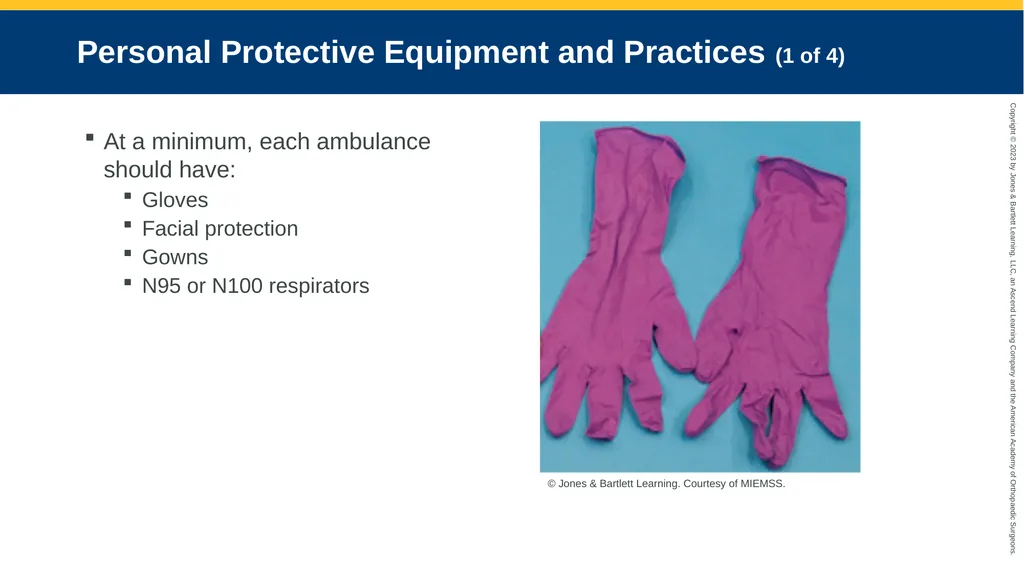
Personal Protective Equipment and Practices (1 of 4) At a minimum, each ambulance should have:
Gloves
Facial protection
Gowns
N95 or N100 respirators © Jones & Bartlett Learning. Courtesy of MIEMSS.<br>
Gloves
Facial protection
Gowns
N95 or N100 respirators © Jones & Bartlett Learning. Courtesy of MIEMSS.<br>
31
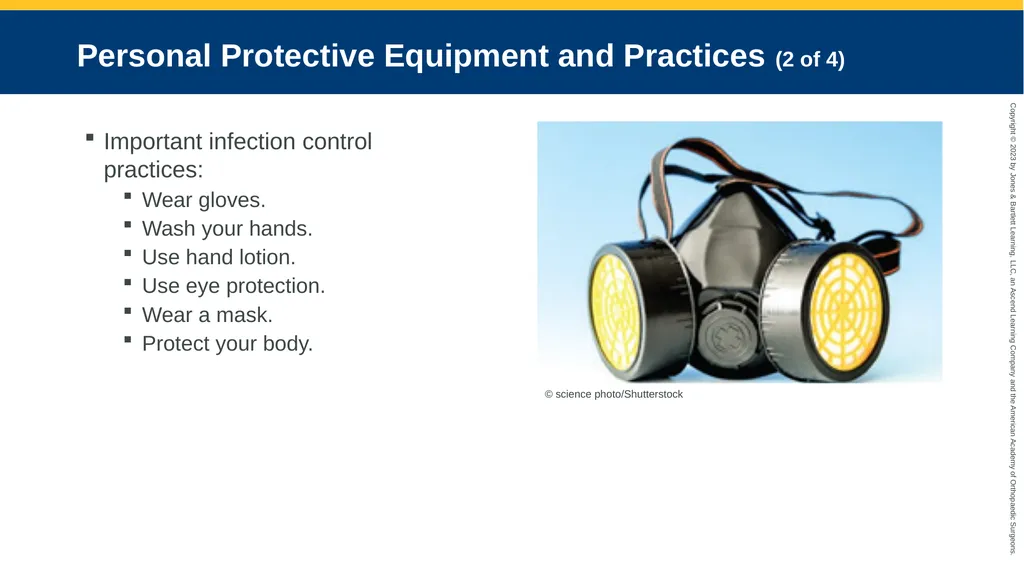
Personal Protective Equipment and Practices (2 of 4) Important infection control practices:
Wear gloves.
Wash your hands.
Use hand lotion.
Use eye protection.
Wear a mask.
Protect your body. © science photo/Shutterstock<br>
Wear gloves.
Wash your hands.
Use hand lotion.
Use eye protection.
Wear a mask.
Protect your body. © science photo/Shutterstock<br>
32
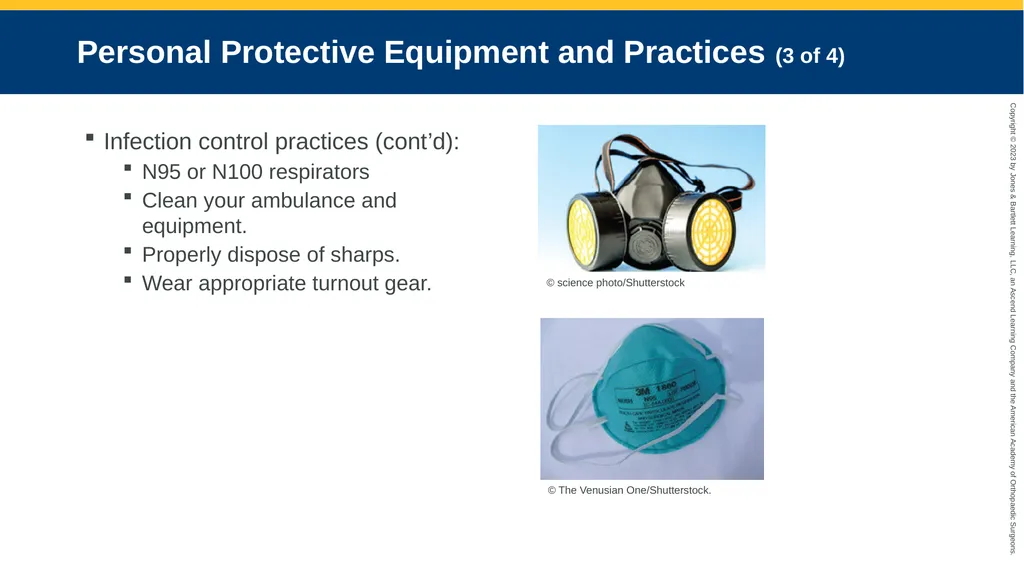
Personal Protective Equipment and Practices (3 of 4) Infection control practices (cont’d):
N95 or N100 respirators
Clean your ambulance and equipment.
Properly dispose of sharps.
Wear appropriate turnout gear. © science photo/Shutterstock © The Venusian One/Shutterstock.<br>
N95 or N100 respirators
Clean your ambulance and equipment.
Properly dispose of sharps.
Wear appropriate turnout gear. © science photo/Shutterstock © The Venusian One/Shutterstock.<br>
33
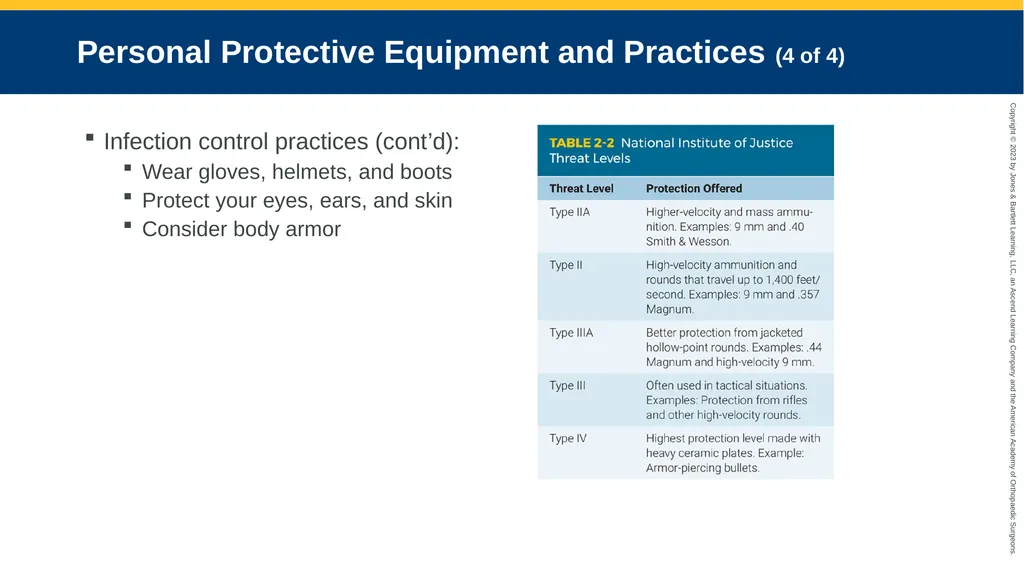
Personal Protective Equipment and Practices (4 of 4) Infection control practices (cont’d):
Wear gloves, helmets, and boots
Protect your eyes, ears, and skin
Consider body armor<br>
Wear gloves, helmets, and boots
Protect your eyes, ears, and skin
Consider body armor<br>
34
Hostile Situations (1 of 2) EMS should not arrive on scene first.
Scrutinize all information.
Ask for law enforcement response to any suspicious call.<br>
Scrutinize all information.
Ask for law enforcement response to any suspicious call.<br>
35
Hostile Situations (2 of 2) Once in contact with a hostile patient:
Listen more and talk less.
Do not argue or ridicule.
Concentrate on de-escalating emotions.
Show empathy.
Be aware of the environment.<br>
Listen more and talk less.
Do not argue or ridicule.
Concentrate on de-escalating emotions.
Show empathy.
Be aware of the environment.<br>
36
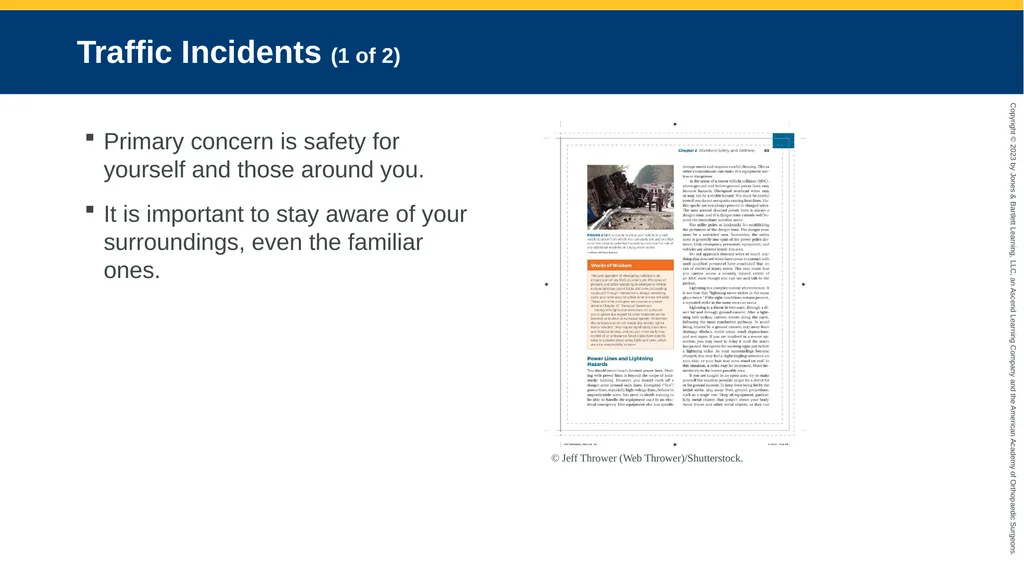
Traffic Incidents (1 of 2) Primary concern is safety for yourself and those around you.
It is important to stay aware of your surroundings, even the familiar ones. © Jeff Thrower (Web Thrower)/Shutterstock.<br>
It is important to stay aware of your surroundings, even the familiar ones. © Jeff Thrower (Web Thrower)/Shutterstock.<br>
37
Traffic Incidents (2 of 2) Make physical observations a mile before you approach the scene.
Approach should include:
Visual assessment of entire surroundings
Looking for hazards
Becoming familiar with response area to determine safest route
Alerting those available to help<br>
Approach should include:
Visual assessment of entire surroundings
Looking for hazards
Becoming familiar with response area to determine safest route
Alerting those available to help<br>
38
Power Lines and Lightning Hazards Dealing with power lines is beyond the scope of paramedic training.
Mark off a danger zone around such lines.
Use utility poles as landmarks.
Do not approach downed wires or touch anything wires have contacted, including patients.
Get inside your vehicle or unit!<br>
Mark off a danger zone around such lines.
Use utility poles as landmarks.
Do not approach downed wires or touch anything wires have contacted, including patients.
Get inside your vehicle or unit!<br>
39
Stress (1 of 3) EMS is a high-stress job.
Understanding the causes of stress and how to deal with them is critical to your:
Job performance
Health
Interpersonal relationships<br>
Understanding the causes of stress and how to deal with them is critical to your:
Job performance
Health
Interpersonal relationships<br>
40
Stress (2 of 3) You need to understand:
What stress is
Its physiologic effects
What you can do to minimize these effects
How to deal with stress on an emotional level<br>
What stress is
Its physiologic effects
What you can do to minimize these effects
How to deal with stress on an emotional level<br>
41
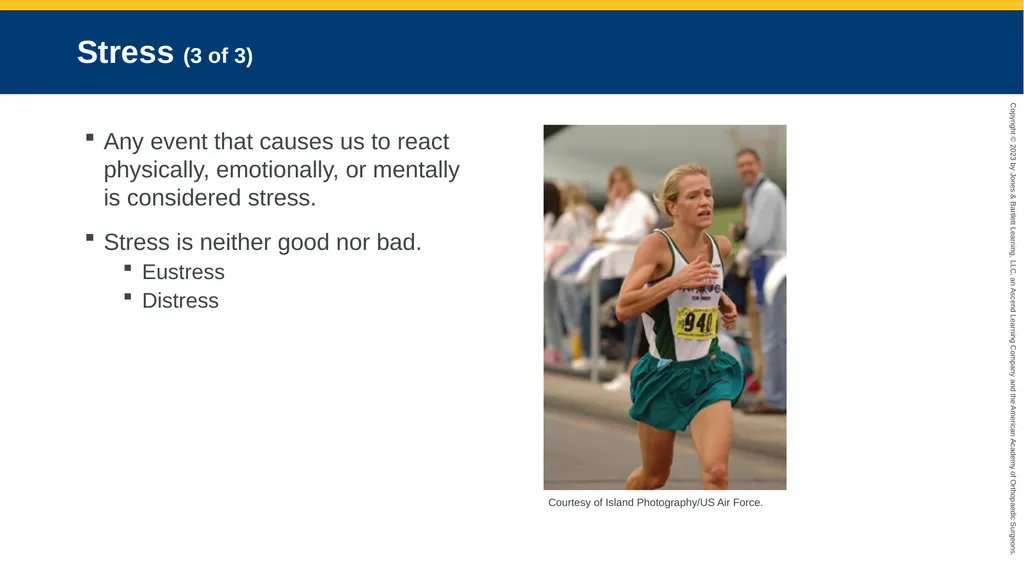
Stress (3 of 3) Any event that causes us to react physically, emotionally, or mentally is considered stress.
Stress is neither good nor bad.
Eustress
Distress Courtesy of Island Photography/US Air Force.<br>
Stress is neither good nor bad.
Eustress
Distress Courtesy of Island Photography/US Air Force.<br>
42
What Triggers Stress? A stress response often begins with events that are perceived as threatening or demanding.<br>
43
Physiology of Acute Stress (1 of 2) When a person perceives an event as threatening, a standard series of physiologic reactions are triggered.
Prepares us for fight-or-flight response<br>
Prepares us for fight-or-flight response<br>
44
Physiology of Acute Stress (2 of 2) Reactions to stress can be:
Acute
Delayed
Cumulative
Stress can result in many physical and psychological symptoms.
Prolonged or excessive stress is a strong contributor to:
Heart disease
Hypertension
Cancer
Depression
Job burnout<br>
Acute
Delayed
Cumulative
Stress can result in many physical and psychological symptoms.
Prolonged or excessive stress is a strong contributor to:
Heart disease
Hypertension
Cancer
Depression
Job burnout<br>
45
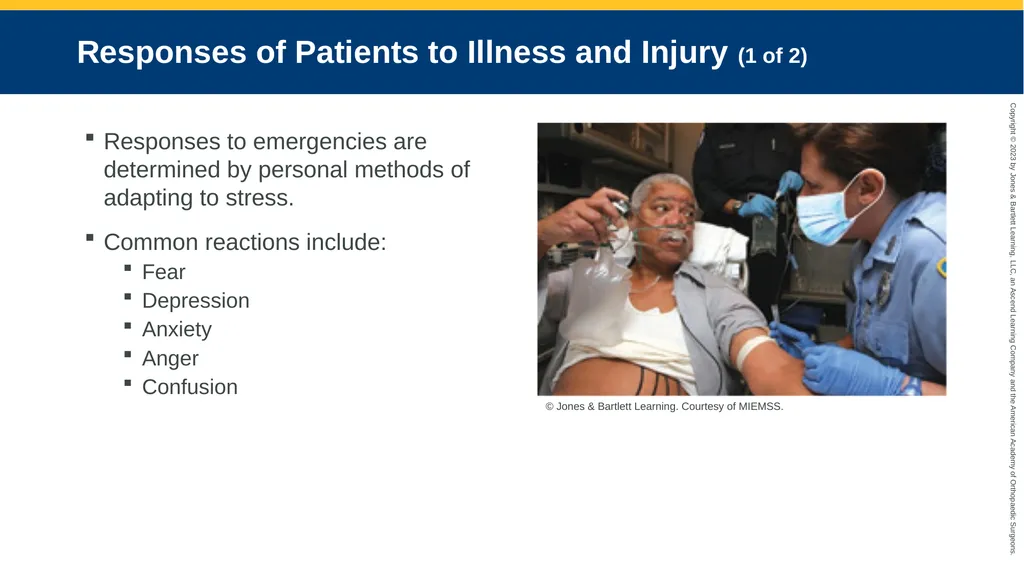
Responses of Patients to Illness and Injury (1 of 2) Responses to emergencies are determined by personal methods of adapting to stress.
Common reactions include:
Fear
Depression
Anxiety
Anger
Confusion © Jones & Bartlett Learning. Courtesy of MIEMSS.<br>
Common reactions include:
Fear
Depression
Anxiety
Anger
Confusion © Jones & Bartlett Learning. Courtesy of MIEMSS.<br>
46
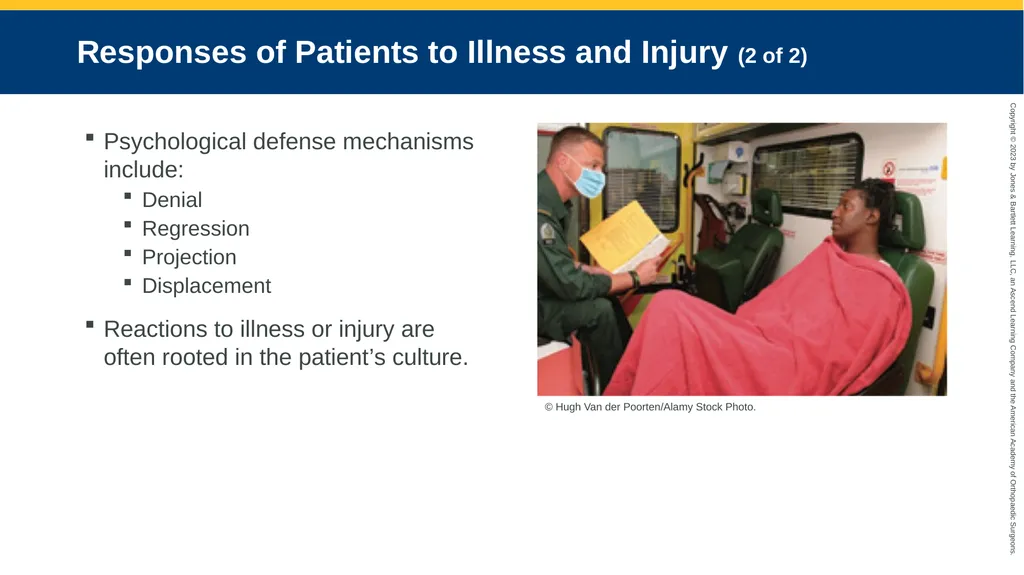
Responses of Patients to Illness and Injury (2 of 2) Psychological defense mechanisms include:
Denial
Regression
Projection
Displacement
Reactions to illness or injury are often rooted in the patient’s culture. © Hugh Van der Poorten/Alamy Stock Photo.<br>
Denial
Regression
Projection
Displacement
Reactions to illness or injury are often rooted in the patient’s culture. © Hugh Van der Poorten/Alamy Stock Photo.<br>
47
Responses of Family, Friends, and Bystanders (1 of 2) Bystanders and family members may exhibit responses similar to the patient’s.
Paramedics should remember:
Do not take it personally.
Remain calm.
Reassure.<br>
Paramedics should remember:
Do not take it personally.
Remain calm.
Reassure.<br>
48
Responses of Family, Friends, and Bystanders (2 of 2) Situations where people should be removed from the scene, but not left alone:
Anxiety
Blind panic
Depression
Overreaction
Conversion hysteria<br>
Anxiety
Blind panic
Depression
Overreaction
Conversion hysteria<br>
49
Paramedic Responses Paramedics are not immune to stress.
Avoid becoming irritated with a patient who does not seem ill or injured.
Recognize the signs of compassion fatigue so that it does not interfere with your work or family life.<br>
Avoid becoming irritated with a patient who does not seem ill or injured.
Recognize the signs of compassion fatigue so that it does not interfere with your work or family life.<br>
50
Coping With Your Own Stress (1 of 2) Early warning signs of stress
Identify your body’s reaction to the fight-or-flight response.<br>
Identify your body’s reaction to the fight-or-flight response.<br>
51
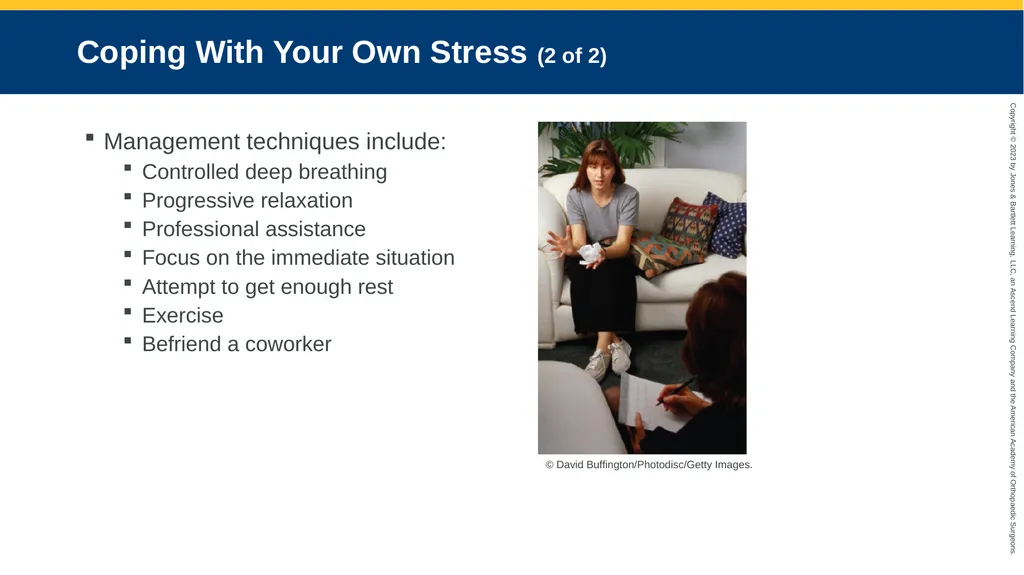
Coping With Your Own Stress (2 of 2) Management techniques include:
Controlled deep breathing
Progressive relaxation
Professional assistance
Focus on the immediate situation
Attempt to get enough rest
Exercise
Befriend a coworker © David Buffington/Photodisc/Getty Images.<br>
Controlled deep breathing
Progressive relaxation
Professional assistance
Focus on the immediate situation
Attempt to get enough rest
Exercise
Befriend a coworker © David Buffington/Photodisc/Getty Images.<br>
52
Burnout (1 of 2) The exhaustion of physical or emotional strength
May be a consequence of chronic, unrelieved stress
The timeline for burnout will vary among people.
Avoid false beliefs that can lead to burnout.
Signs and symptoms<br>
May be a consequence of chronic, unrelieved stress
The timeline for burnout will vary among people.
Avoid false beliefs that can lead to burnout.
Signs and symptoms<br>
53
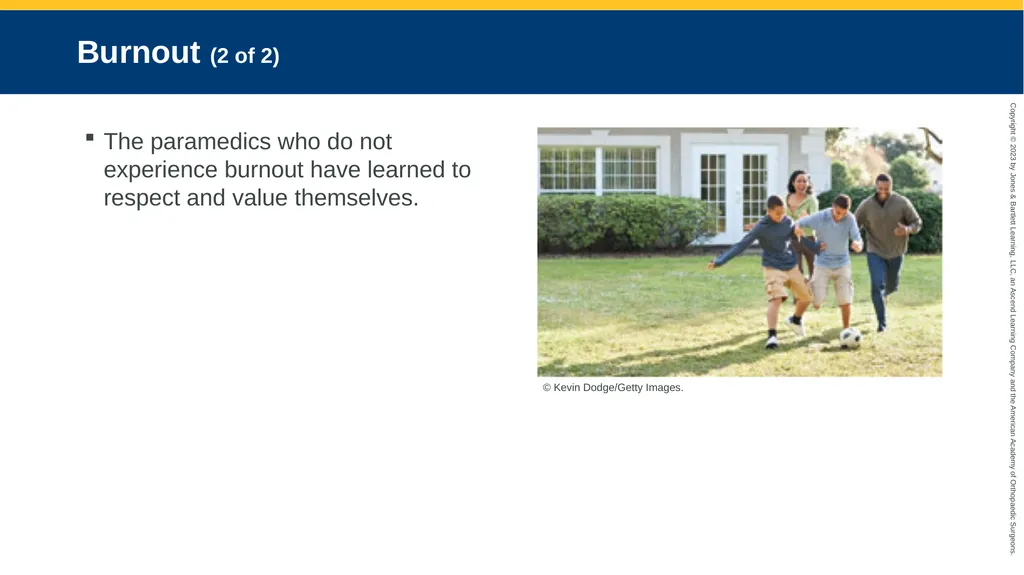
Burnout (2 of 2) The paramedics who do not experience burnout have learned to respect and value themselves. © Kevin Dodge/Getty Images.<br>
54
Coping With Death and Dying Encounters with life and death are an honor.
Births and deaths are a holy time in some cultures.
You will help many people.<br>
Births and deaths are a holy time in some cultures.
You will help many people.<br>
55
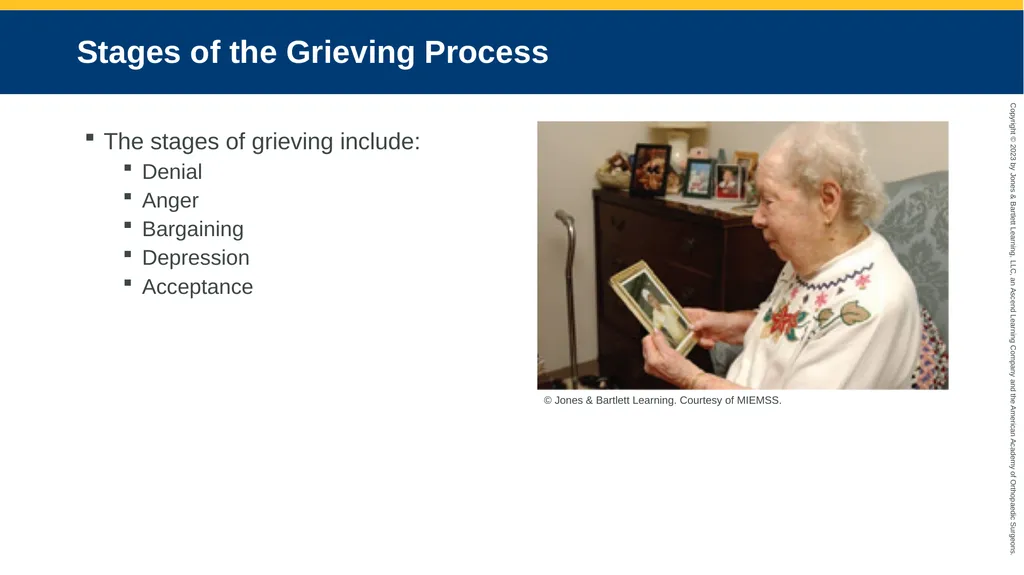
Stages of the Grieving Process The stages of grieving include:
Denial
Anger
Bargaining
Depression
Acceptance © Jones & Bartlett Learning. Courtesy of MIEMSS.<br>
Denial
Anger
Bargaining
Depression
Acceptance © Jones & Bartlett Learning. Courtesy of MIEMSS.<br>
56
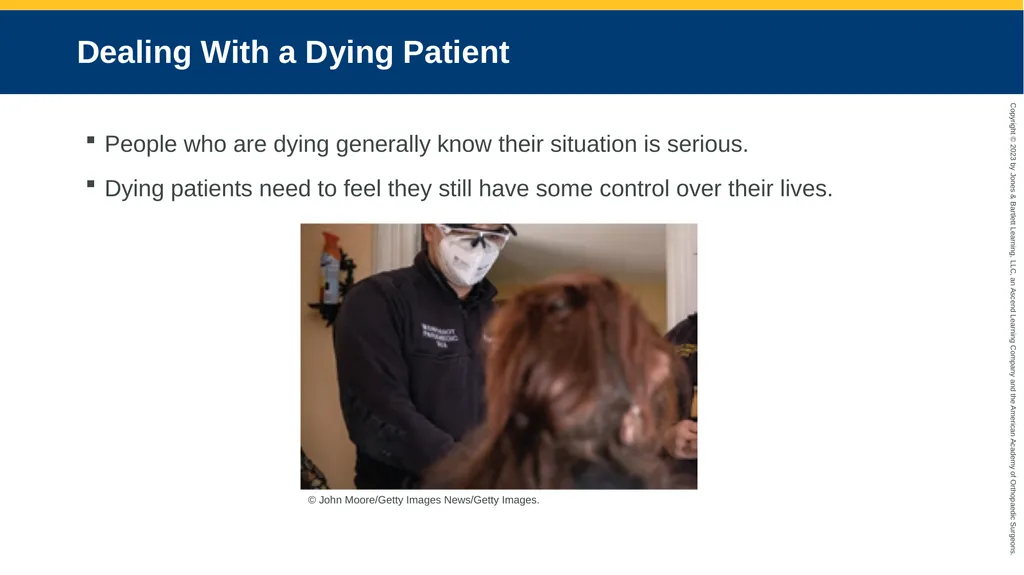
Dealing With a Dying Patient People who are dying generally know their situation is serious.
Dying patients need to feel they still have some control over their lives. © John Moore/Getty Images News/Getty Images.<br>
Dying patients need to feel they still have some control over their lives. © John Moore/Getty Images News/Getty Images.<br>
57
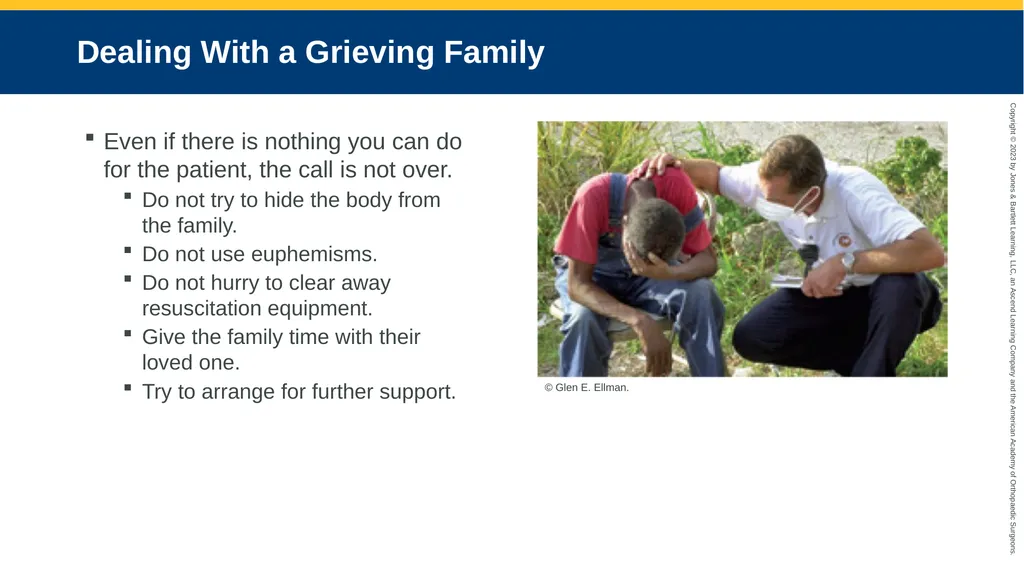
Dealing With a Grieving Family Even if there is nothing you can do for the patient, the call is not over.
Do not try to hide the body from the family.
Do not use euphemisms.
Do not hurry to clear away resuscitation equipment.
Give the family time with their loved one.
Try to arrange for further support. © Glen E. Ellman.<br>
Do not try to hide the body from the family.
Do not use euphemisms.
Do not hurry to clear away resuscitation equipment.
Give the family time with their loved one.
Try to arrange for further support. © Glen E. Ellman.<br>
58
Dealing With a Grieving Child Be particularly sensitive to the emotional needs of children.
Children up to 3 years of age will not be aware.
3- to 6-year-olds believe death is temporary.
6- to 9-year-olds may mask their feelings.
9- to 12-year-olds may want to know details.<br>
Children up to 3 years of age will not be aware.
3- to 6-year-olds believe death is temporary.
6- to 9-year-olds may mask their feelings.
9- to 12-year-olds may want to know details.<br>
59
After the Call Is Over (1 of 3) Everyone involved in shocking calls is likely to experience some intense feelings.
Do not keep feelings inside.
Every service should have debriefing procedures.
Watch for PTSD after critical incidents.<br>
Do not keep feelings inside.
Every service should have debriefing procedures.
Watch for PTSD after critical incidents.<br>
60
After the Call Is Over (2 of 3) Critical incident stress management (CISM) is a resource for emergency personnel involved in particularly traumatic calls.
Reactions are impossible to predict.
Give opportunities to debrief.
Never force someone to share their feelings or make debriefings mandatory.<br>
Reactions are impossible to predict.
Give opportunities to debrief.
Never force someone to share their feelings or make debriefings mandatory.<br>
61
After the Call Is Over (3 of 3) Employee assistance programs (EAPs)
Provided by trained, professional counselor who works outside of the service and is available off duty
EAPs are successful only if those who attend do so voluntarily and are willing to share issues that bother them.<br>
Provided by trained, professional counselor who works outside of the service and is available off duty
EAPs are successful only if those who attend do so voluntarily and are willing to share issues that bother them.<br>
62
Peer Support and Suicide Prevention EMS providers are not immune to thoughts of suicide or suicide attempts.
Prevention starts with recognizing that you or a colleague are becoming overwhelmed.<br>
Prevention starts with recognizing that you or a colleague are becoming overwhelmed.<br>