
Workforce Safety and Wellness CHAPTER 2: Focused
BR
Published · 65 slides · 0 views
1 / 1


Description
Workforce Safety and Wellness CHAPTER 2: Focused Lecture National EMS Education Standard Competencies (1 of 3) Preparatory Applies fundamental knowledge of the EMS system, safetywell-being of the AEMT, medicallegal and ethical issues to
Related Topics
Share
Embed code
Download this presentation From Below
"Workforce Safety and Wellness CHAPTER 2: Focused" is the property of its rightful owner. Permission is granted to download and print the materials on this website for personal, non-commercial use only, and to display it on your personal computer provided you do not modify the materials and that you retain all copyright notices contained in the materials. By downloading content from our website, you accept the terms of this agreement.
Presentation Transcript
01
Workforce Safety and Wellness CHAPTER 2: Focused Lecture<br>
02
National EMS Education Standard Competencies (1 of 3) Preparatory
Applies fundamental knowledge of the EMS system, safety/well-being of the AEMT, medical/legal and ethical issues to the provision of emergency care.<br>
Applies fundamental knowledge of the EMS system, safety/well-being of the AEMT, medical/legal and ethical issues to the provision of emergency care.<br>
03
National EMS Education Standard Competencies (2 of 3) Workforce Safety and Wellness
Standard safety precautions
Personal protective equipment
Stress management
Dealing with death and dying
Prevention of response-related injuries<br>
Standard safety precautions
Personal protective equipment
Stress management
Dealing with death and dying
Prevention of response-related injuries<br>
04
National EMS Education Standard Competencies (3 of 3) Workforce Safety and Wellness (cont'd)
Lifting and moving patients
Prevention of work-related injuries
Disease transmission
Wellness principles<br>
Lifting and moving patients
Prevention of work-related injuries
Disease transmission
Wellness principles<br>
05
Introduction To take care of others, we must take care of ourselves.
AEMT training includes recognition of hazards
Personal neglect
Health and safety hazards
Stress<br>
AEMT training includes recognition of hazards
Personal neglect
Health and safety hazards
Stress<br>
06
Protection From Infectious Diseases
(1 of 3) Infectious disease is a medical condition caused by organisms within the body.
Communicable disease can spread:
From person to person
From one species to another<br>
Communicable disease can spread:
From person to person
From one species to another<br>
07
Protection From Infectious Diseases
(2 of 3) Infection risk can be reduced by:
Immunizations
Protective techniques
Handwashing
When protective measures are used, risk to provider is negligible.<br>
Immunizations
Protective techniques
Handwashing
When protective measures are used, risk to provider is negligible.<br>
08
Protection From Infectious Diseases
(3 of 3) Proper cleaning and disinfecting of the ambulance and equipment will help prevent transfer of illnesses between patients.
Inform other providers who may come into contact with a patient of potential risk.<br>
Inform other providers who may come into contact with a patient of potential risk.<br>
09
Routes of Transmission (1 of 3) All contagious diseases are infectious.
Not all infectious diseases are contagious.
Pathogen: A microorganism capable of causing disease in a host
Host: Organism or person invaded<br>
Not all infectious diseases are contagious.
Pathogen: A microorganism capable of causing disease in a host
Host: Organism or person invaded<br>
10
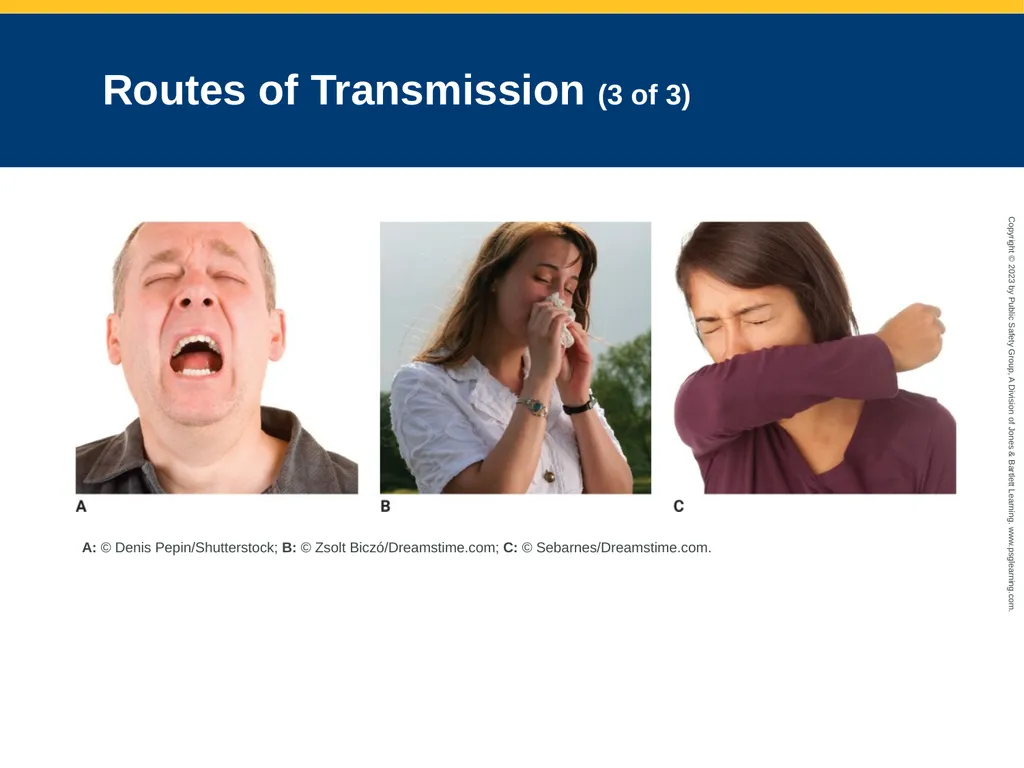
Routes of Transmission (2 of 3) Routes of Transmission (2 of 3) Contagious diseases can be transmitted from one person to another by:
Direct contact
Indirect contact
Airborne transmission
Food-borne transmission
Vector-borne transmission<br>
Direct contact
Indirect contact
Airborne transmission
Food-borne transmission
Vector-borne transmission<br>
11
Routes of Transmission (3 of 3) Routes of Transmission (3 of 3) A: © Denis Pepin/Shutterstock; B: © Zsolt Biczó/Dreamstime.com; C: © Sebarnes/Dreamstime.com.<br>
12
Risk Reduction and Prevention (1 of 2) All EMS personnel are trained in:
Handling bloodborne pathogens
Approaching patients who may have infectious diseases
Training is required by OSHA.<br>
Handling bloodborne pathogens
Approaching patients who may have infectious diseases
Training is required by OSHA.<br>
13
Risk Reduction and Prevention (2 of 2) CDC developed standard precautions to prevent workers from coming into direct contact with germs.
Assume every person is potentially infected.
Notify designated officer if exposed.<br>
Assume every person is potentially infected.
Notify designated officer if exposed.<br>
14
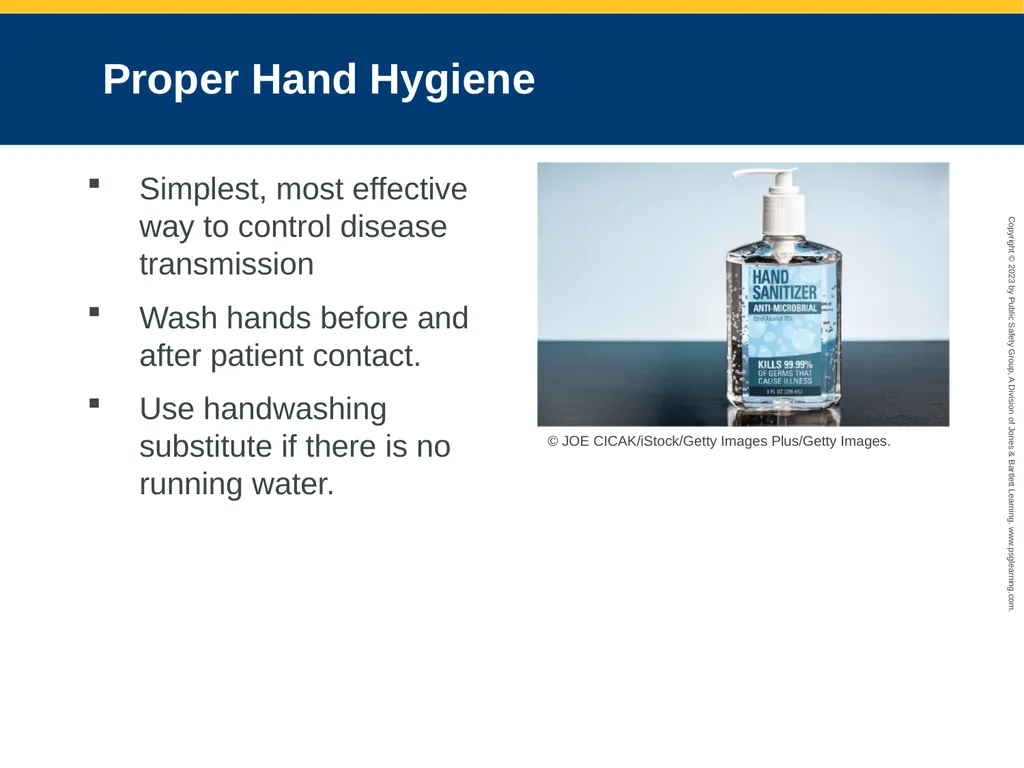
Proper Hand Hygiene Simplest, most effective way to control disease transmission
Wash hands before and after patient contact.
Use handwashing substitute if there is no running water. © JOE CICAK/iStock/Getty Images Plus/Getty Images.<br>
Wash hands before and after patient contact.
Use handwashing substitute if there is no running water. © JOE CICAK/iStock/Getty Images Plus/Getty Images.<br>
15
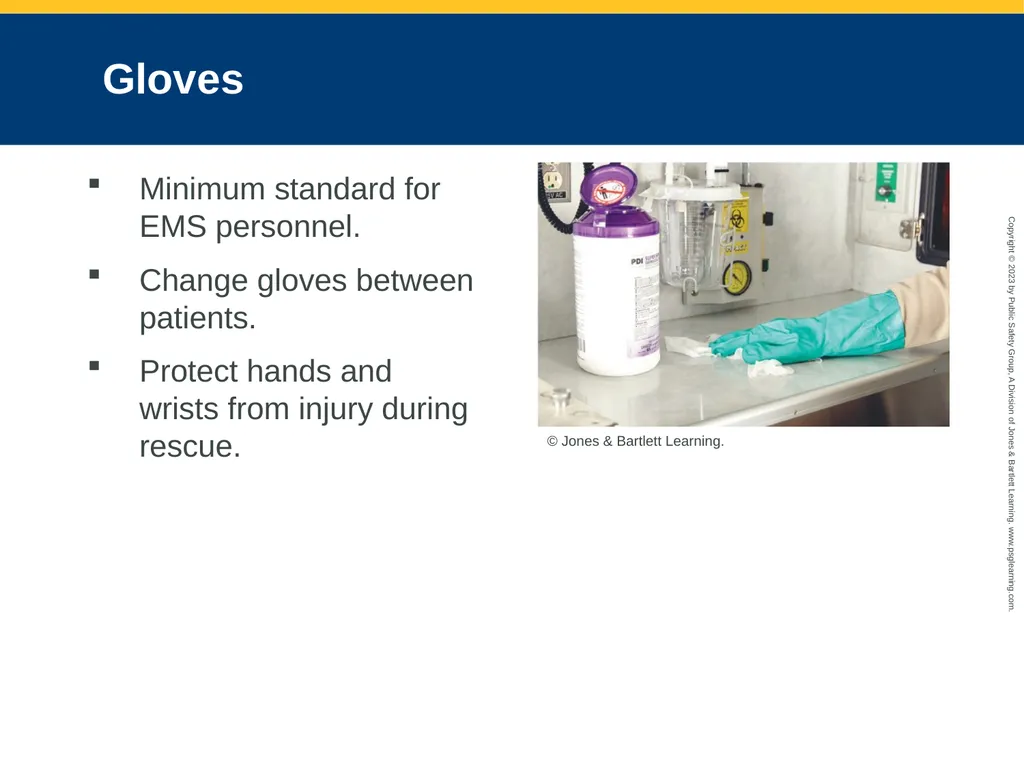
Gloves Minimum standard for EMS personnel.
Change gloves between patients.
Protect hands and wrists from injury during rescue. © Jones & Bartlett Learning.<br>
Change gloves between patients.
Protect hands and wrists from injury during rescue. © Jones & Bartlett Learning.<br>
16
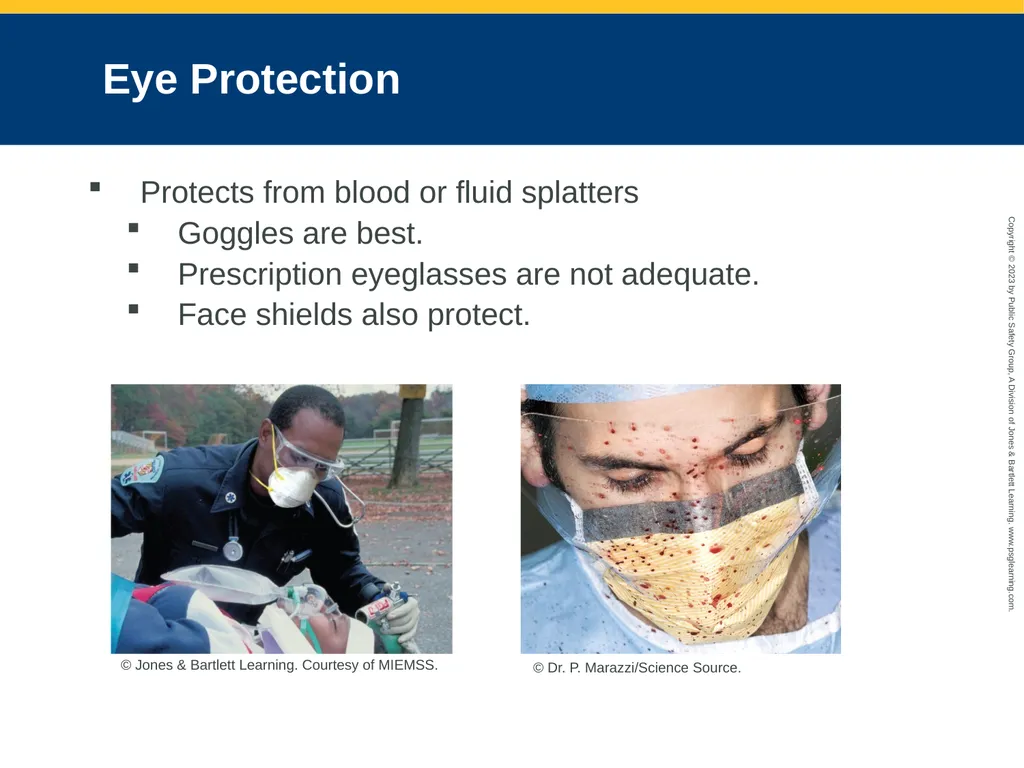
Eye Protection Protects from blood or fluid splatters
Goggles are best.
Prescription eyeglasses are not adequate.
Face shields also protect. © Jones & Bartlett Learning. Courtesy of MIEMSS. © Dr. P. Marazzi/Science Source.<br>
Goggles are best.
Prescription eyeglasses are not adequate.
Face shields also protect. © Jones & Bartlett Learning. Courtesy of MIEMSS. © Dr. P. Marazzi/Science Source.<br>
17
Gowns Provide protection from extensive blood splatter, when used with other PPE
May be worn in situations such as field delivery of infant or major trauma
Not practical in many situations<br>
May be worn in situations such as field delivery of infant or major trauma
Not practical in many situations<br>
18
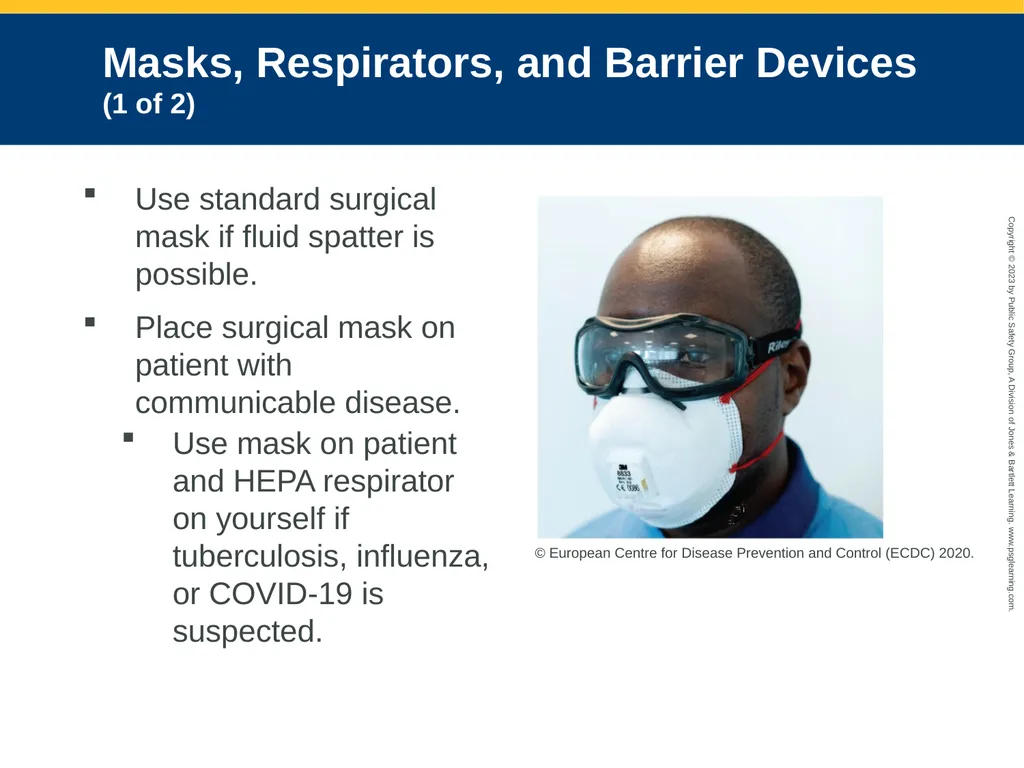
Masks, Respirators, and Barrier Devices (1 of 2) Use standard surgical mask if fluid spatter is possible.
Place surgical mask on patient with communicable disease.
Use mask on patient and HEPA respirator on yourself if tuberculosis, influenza, or COVID-19 is suspected. © European Centre for Disease Prevention and Control (ECDC) 2020.<br>
Place surgical mask on patient with communicable disease.
Use mask on patient and HEPA respirator on yourself if tuberculosis, influenza, or COVID-19 is suspected. © European Centre for Disease Prevention and Control (ECDC) 2020.<br>
19
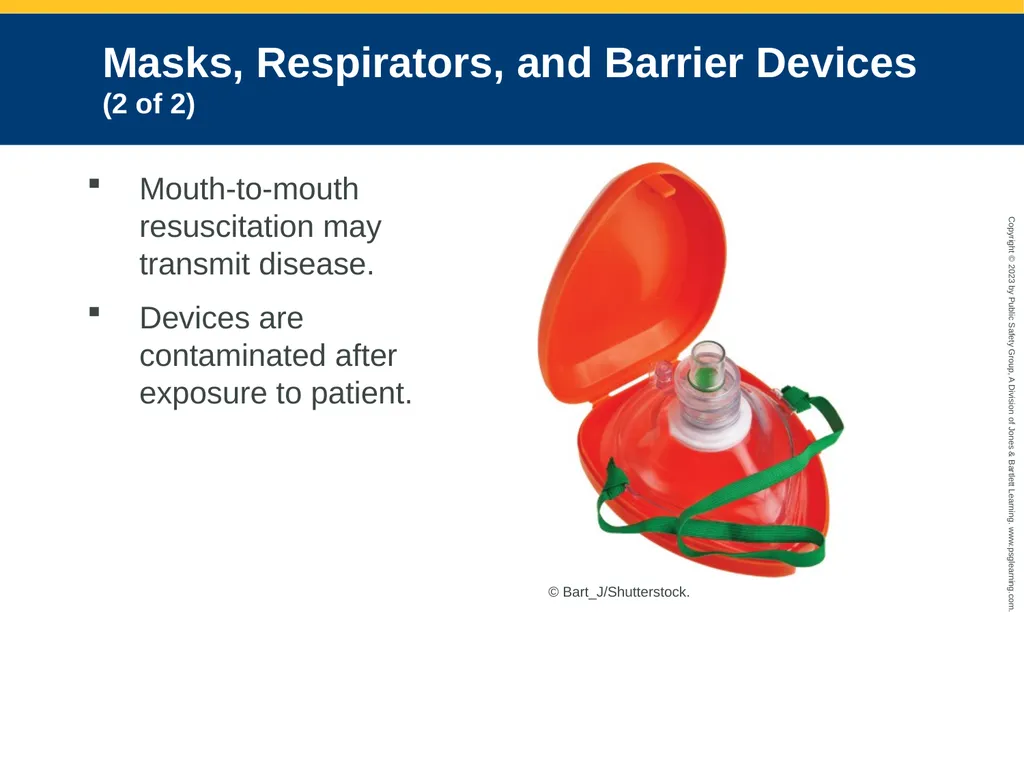
Masks, Respirators, and Barrier Devices (2 of 2) Mouth-to-mouth resuscitation may transmit disease.
Devices are contaminated after exposure to patient. © Bart_J/Shutterstock.<br>
Devices are contaminated after exposure to patient. © Bart_J/Shutterstock.<br>
20
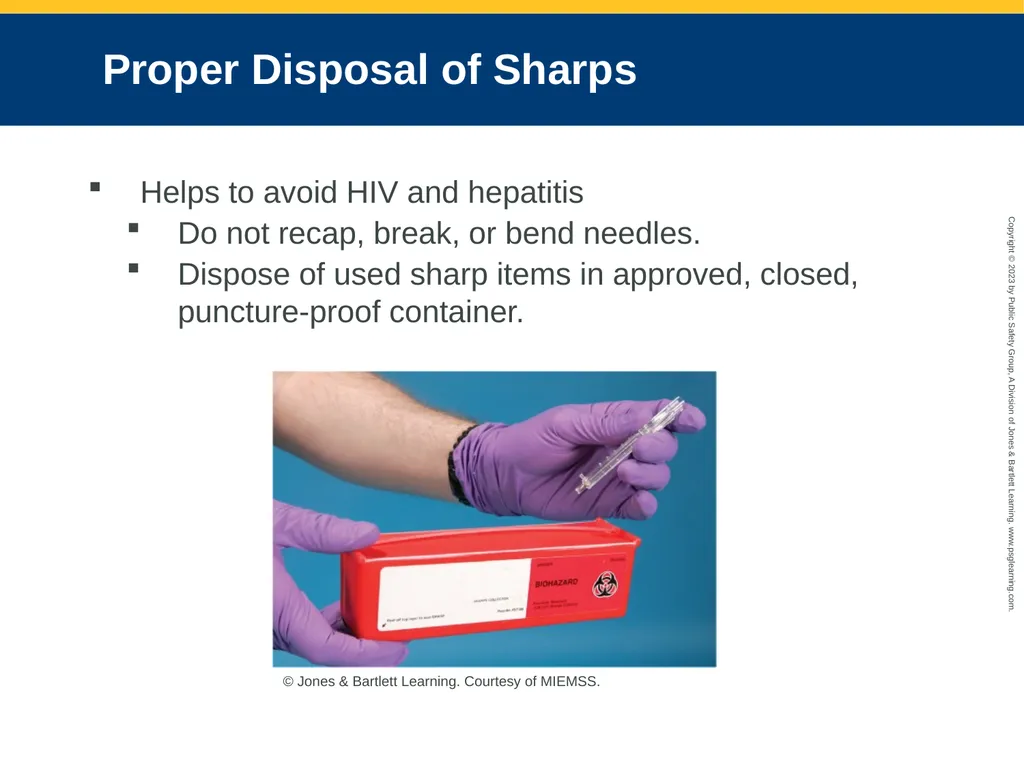
Proper Disposal of Sharps Helps to avoid HIV and hepatitis
Do not recap, break, or bend needles.
Dispose of used sharp items in approved, closed, puncture-proof container. © Jones & Bartlett Learning. Courtesy of MIEMSS.<br>
Do not recap, break, or bend needles.
Dispose of used sharp items in approved, closed, puncture-proof container. © Jones & Bartlett Learning. Courtesy of MIEMSS.<br>
21
Employer Responsibilities Your employer cannot guarantee a 100% risk-free environment.
Employer should follow OSHA and other regulations, such as CDC and NFPA.
Know and use your department’s infection control plan.<br>
Employer should follow OSHA and other regulations, such as CDC and NFPA.
Know and use your department’s infection control plan.<br>
22
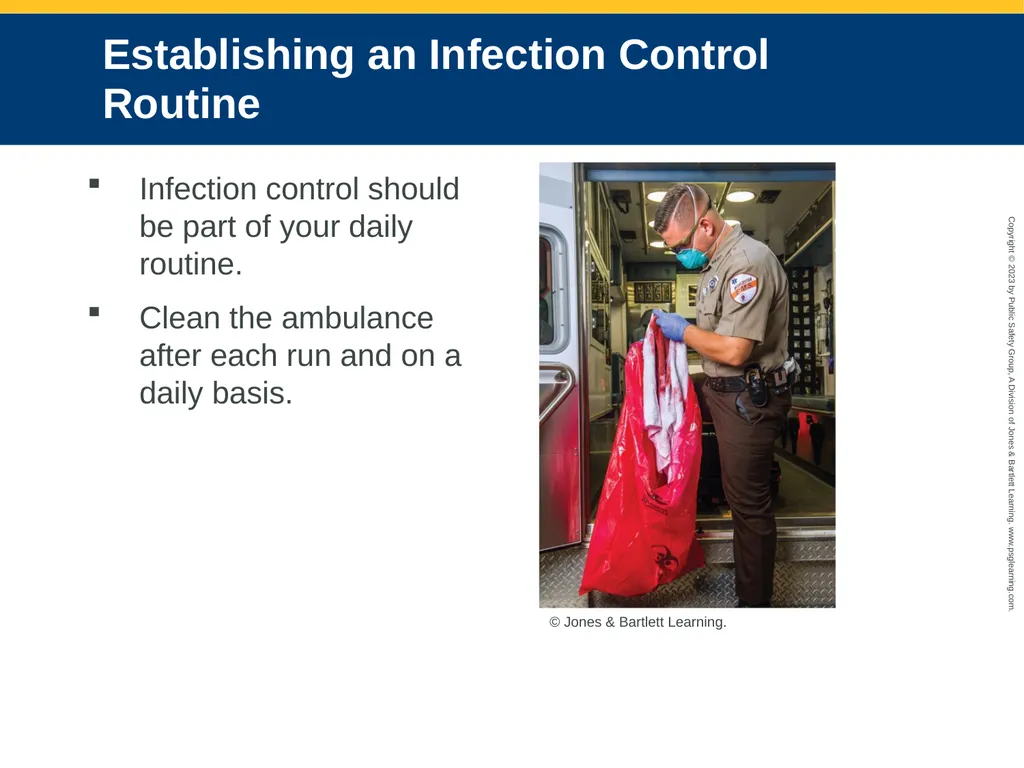
Establishing an Infection Control Routine Infection control should be part of your daily routine.
Clean the ambulance after each run and on a daily basis. © Jones & Bartlett Learning.<br>
Clean the ambulance after each run and on a daily basis. © Jones & Bartlett Learning.<br>
23
Immunity Immunity comes from:
Having been immunized or vaccinated
Recovering from an infection of that germ
Germs may cause no symptoms in some patients and serious illness in others.<br>
Having been immunized or vaccinated
Recovering from an infection of that germ
Germs may cause no symptoms in some patients and serious illness in others.<br>
24
Preventive Measures Maintain your personal health.
Receive immunizations.
Get a tuberculosis skin test yearly.
Always follow standard precautions.<br>
Receive immunizations.
Get a tuberculosis skin test yearly.
Always follow standard precautions.<br>
25
General Postexposure Management
(1 of 2) If you are exposed to a patient’s blood or bodily fluids:
Turn over patient care to another EMS provider.
When safe to do so, clean the exposed area.
Rinse eyes if necessary.
Activate your department’s infection control plan.<br>
Turn over patient care to another EMS provider.
When safe to do so, clean the exposed area.
Rinse eyes if necessary.
Activate your department’s infection control plan.<br>
26
General Postexposure Management
(2 of 2) You may not even realize you have been exposed until the hospital notifies you.
If you were wearing full PPE, no further follow-up may be necessary.
In other cases, specific postexposure or prophylaxis may be indicated.<br>
If you were wearing full PPE, no further follow-up may be necessary.
In other cases, specific postexposure or prophylaxis may be indicated.<br>
27
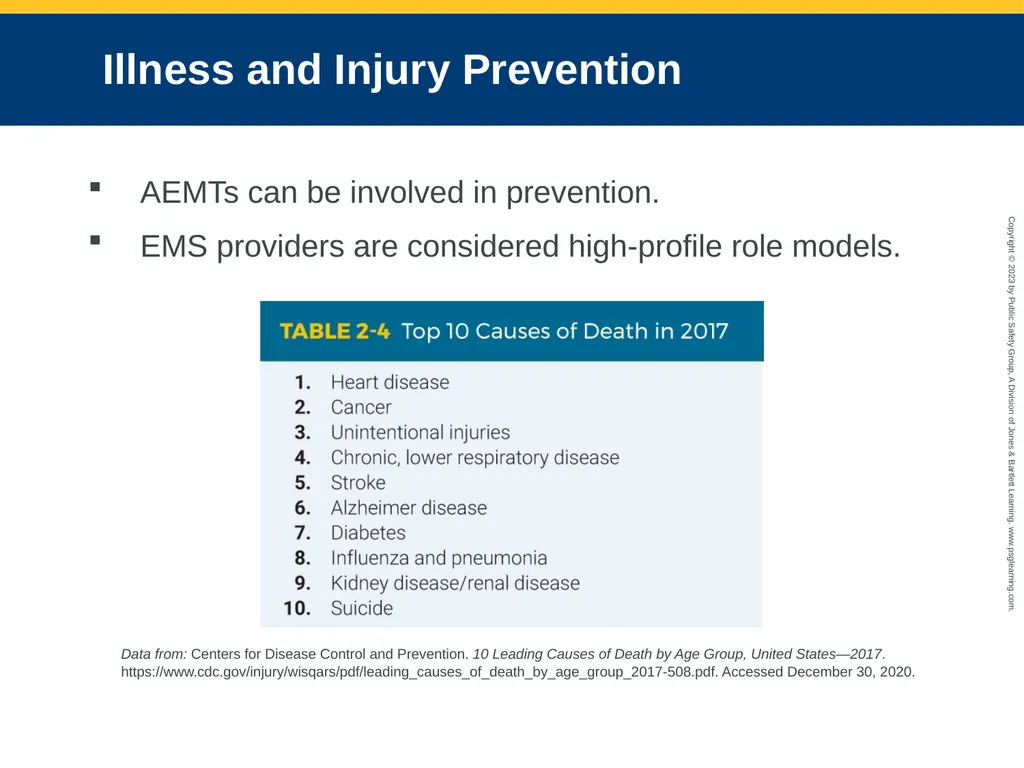
Illness and Injury Prevention AEMTs can be involved in prevention.
EMS providers are considered high-profile role models. Data from: Centers for Disease Control and Prevention. 10 Leading Causes of Death by Age Group, United States—2017. https://www.cdc.gov/injury/wisqars/pdf/leading_causes_of_death_by_age_group_2017-508.pdf. Accessed December 30, 2020.<br>
EMS providers are considered high-profile role models. Data from: Centers for Disease Control and Prevention. 10 Leading Causes of Death by Age Group, United States—2017. https://www.cdc.gov/injury/wisqars/pdf/leading_causes_of_death_by_age_group_2017-508.pdf. Accessed December 30, 2020.<br>
28
Scene Safety and Personal Protection
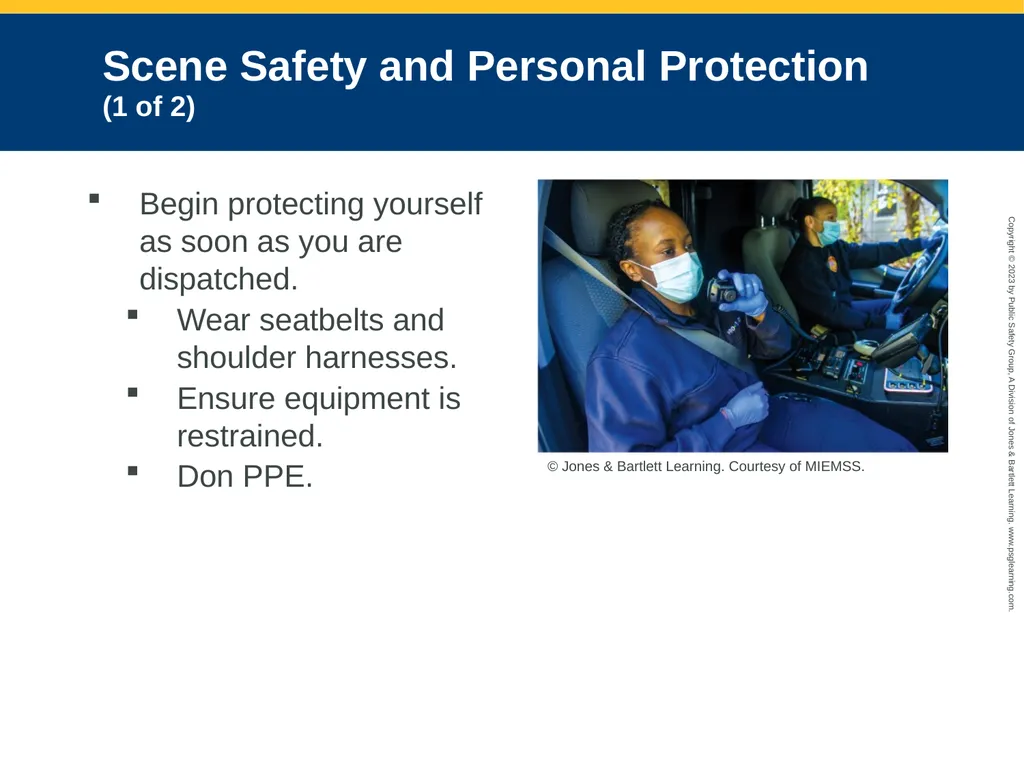
(1 of 2) Begin protecting yourself as soon as you are dispatched.
Wear seatbelts and shoulder harnesses.
Ensure equipment is restrained.
Don PPE. © Jones & Bartlett Learning. Courtesy of MIEMSS.<br>
Wear seatbelts and shoulder harnesses.
Ensure equipment is restrained.
Don PPE. © Jones & Bartlett Learning. Courtesy of MIEMSS.<br>
29
Scene Safety and Personal Protection
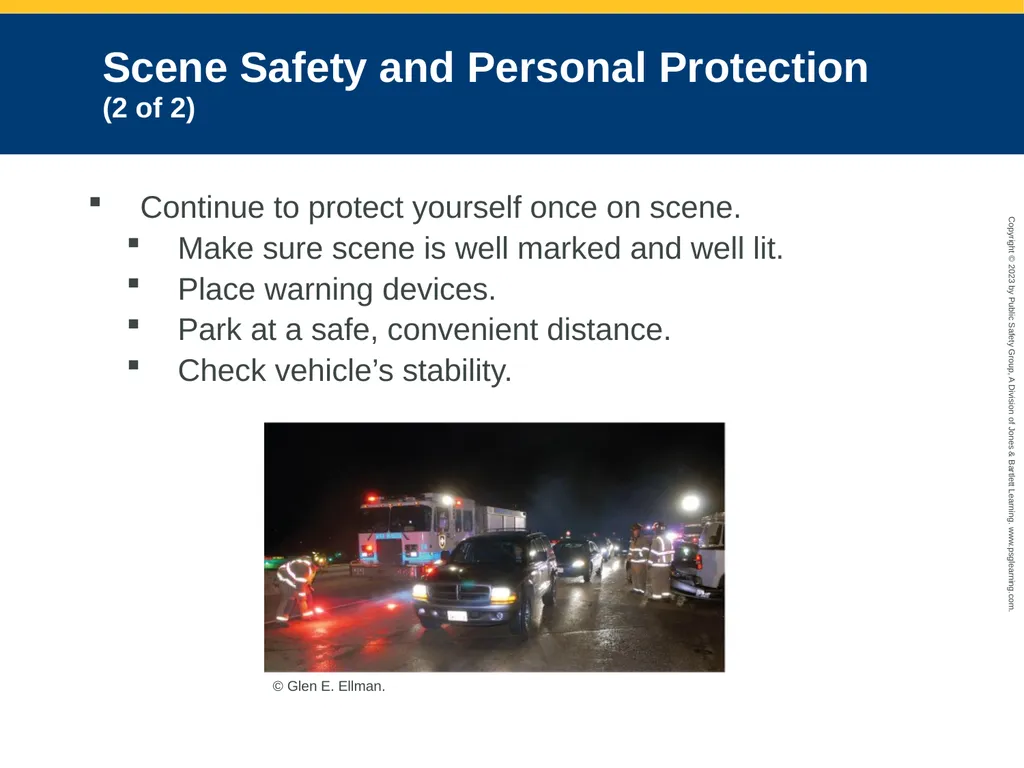
(2 of 2) Continue to protect yourself once on scene.
Make sure scene is well marked and well lit.
Place warning devices.
Park at a safe, convenient distance.
Check vehicle’s stability. © Glen E. Ellman.<br>
Make sure scene is well marked and well lit.
Place warning devices.
Park at a safe, convenient distance.
Check vehicle’s stability. © Glen E. Ellman.<br>
30
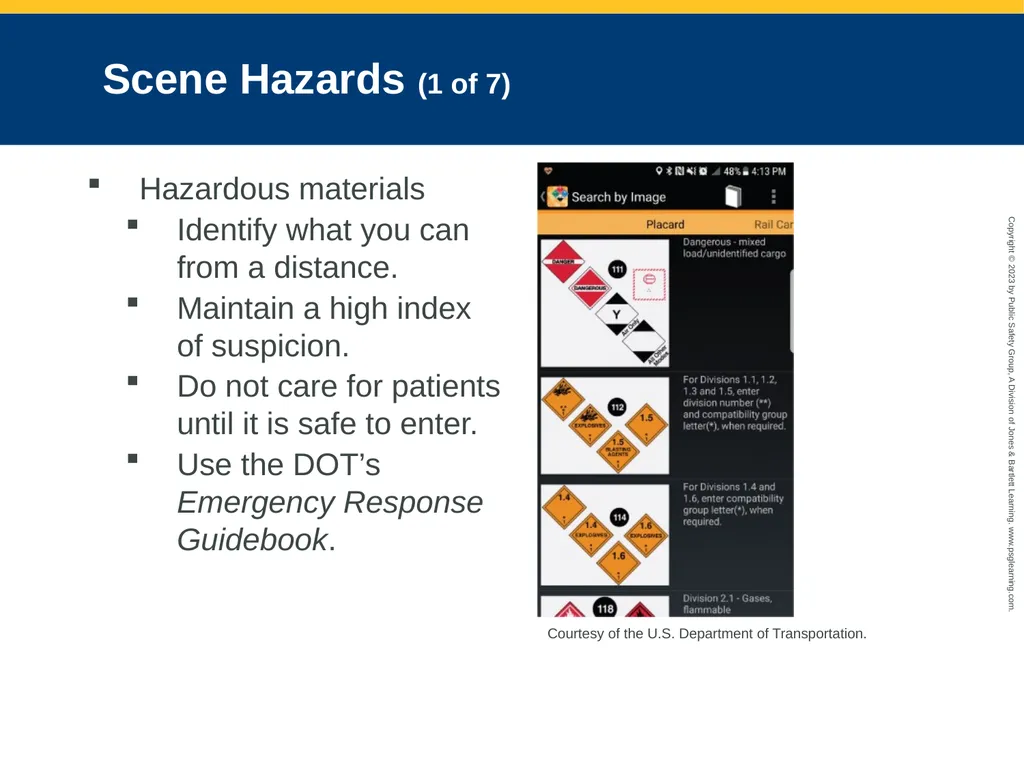
Scene Hazards (1 of 7) Hazardous materials
Identify what you can from a distance.
Maintain a high index of suspicion.
Do not care for patients until it is safe to enter.
Use the DOT’s Emergency Response Guidebook. Courtesy of the U.S. Department of Transportation.<br>
Identify what you can from a distance.
Maintain a high index of suspicion.
Do not care for patients until it is safe to enter.
Use the DOT’s Emergency Response Guidebook. Courtesy of the U.S. Department of Transportation.<br>
31
Scene Hazards (2 of 7) Vehicle crashes
Unstable and potentially lethal situations
Consider traffic hazards.
Park so you can easily leave the scene.
Be conscious of flow of traffic.
Be alert for hazards.
Use sufficient protective gear.<br>
Unstable and potentially lethal situations
Consider traffic hazards.
Park so you can easily leave the scene.
Be conscious of flow of traffic.
Be alert for hazards.
Use sufficient protective gear.<br>
32
Scene Hazards (3 of 7) Electricity
Dealing with power lines is beyond the scope of AEMT training.
Mark off a danger zone.
Do not approach downed wires.<br>
Dealing with power lines is beyond the scope of AEMT training.
Mark off a danger zone.
Do not approach downed wires.<br>
33
Scene Hazards (4 of 7) Lightning
Threat through direct hit or ground current
Stay away from drainage ditches, moist areas, small depressions, and wet ropes.
Move to the lowest possible area and avoid projections.<br>
Threat through direct hit or ground current
Stay away from drainage ditches, moist areas, small depressions, and wet ropes.
Move to the lowest possible area and avoid projections.<br>
34
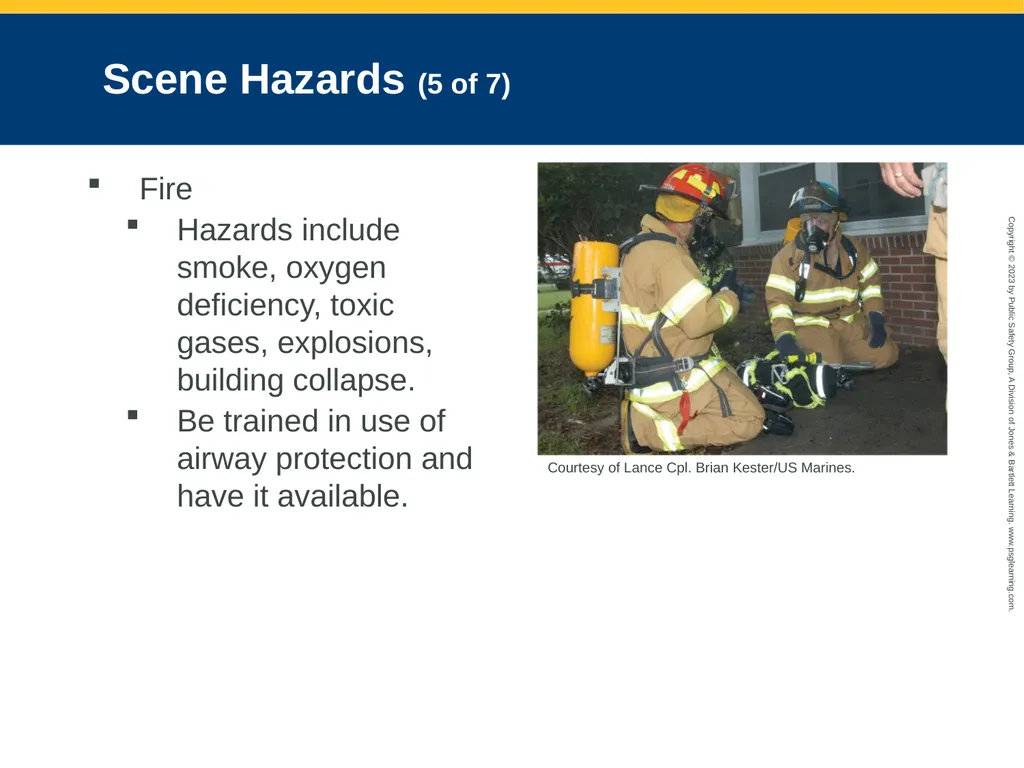
Scene Hazards (5 of 7) Fire
Hazards include smoke, oxygen deficiency, toxic gases, explosions, building collapse.
Be trained in use of airway protection and have it available. Courtesy of Lance Cpl. Brian Kester/US Marines.<br>
Hazards include smoke, oxygen deficiency, toxic gases, explosions, building collapse.
Be trained in use of airway protection and have it available. Courtesy of Lance Cpl. Brian Kester/US Marines.<br>
35
Scene Hazards (6 of 7) Mass violence
Can be created by:
Civil disturbances
Domestic disputes
Crime scenes
When several agencies respond, know who is in command.
Do not disturb crime scene evidence unless absolutely necessary.<br>
Can be created by:
Civil disturbances
Domestic disputes
Crime scenes
When several agencies respond, know who is in command.
Do not disturb crime scene evidence unless absolutely necessary.<br>
36
Scene Hazards (7 of 7) Behavioral emergencies
Emergencies that do not have a clear physical cause
Evaluate the patient in terms of a behavioral or psychiatric emergency that may lead to a violent patient reaction.<br>
Emergencies that do not have a clear physical cause
Evaluate the patient in terms of a behavioral or psychiatric emergency that may lead to a violent patient reaction.<br>
37
Protective Clothing: Preventing Injury
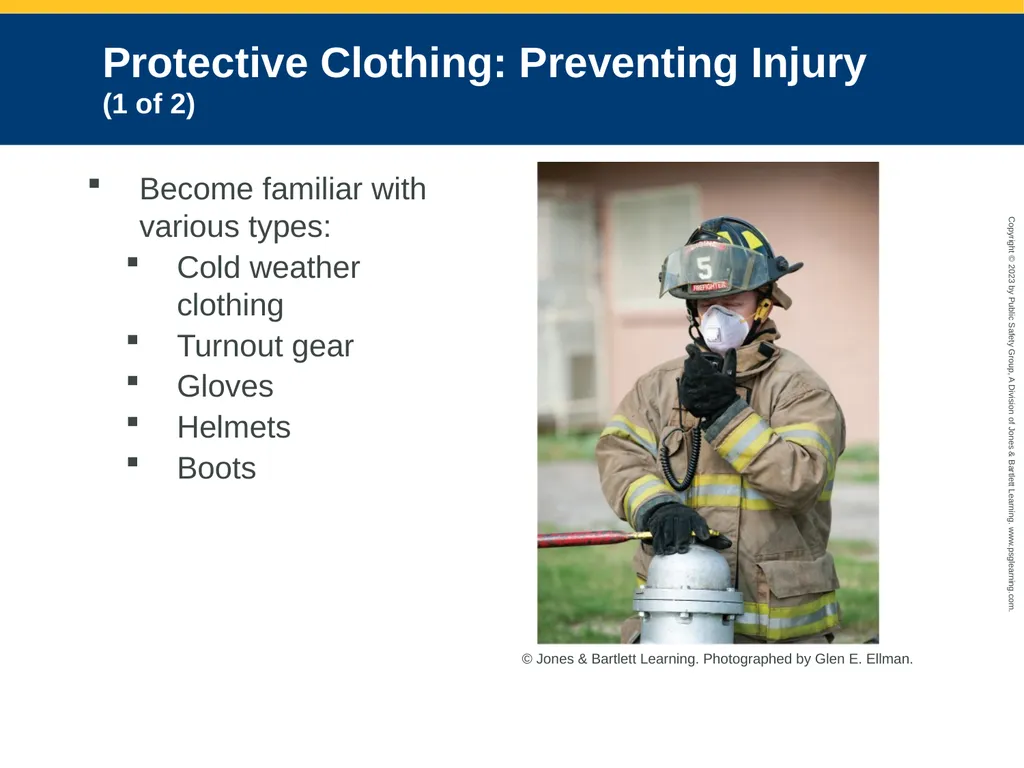
(1 of 2) Become familiar with various types:
Cold weather clothing
Turnout gear
Gloves
Helmets
Boots © Jones & Bartlett Learning. Photographed by Glen E. Ellman.<br>
Cold weather clothing
Turnout gear
Gloves
Helmets
Boots © Jones & Bartlett Learning. Photographed by Glen E. Ellman.<br>
38
Protective Clothing: Preventing Injury
(2 of 2) Eye protection
Ear protection
Skin protection
Body armor
Inspect clothing and gear regularly.<br>
Ear protection
Skin protection
Body armor
Inspect clothing and gear regularly.<br>
39
Stress (1 of 2) EMS is a high-stress job.
Important to know causes of stress and how to deal with them
General adaptation syndrome:
Alarm response to stress
Reaction and resistance
Recovery—or exhaustion<br>
Important to know causes of stress and how to deal with them
General adaptation syndrome:
Alarm response to stress
Reaction and resistance
Recovery—or exhaustion<br>
40
Stress (2 of 2) Physiologic signs of stress include:
Increased respirations and heart rate
Increased blood pressure
Cool, clammy skin
Dilated pupils
Muscle tension
Perspiration<br>
Increased respirations and heart rate
Increased blood pressure
Cool, clammy skin
Dilated pupils
Muscle tension
Perspiration<br>
41
Stress Reactions (1 of 2) Acute stress reactions
Occur during a stressful situation
Delayed stress reactions
Manifest after stressful event
Cumulative stress reactions
Result of prolonged or excessive stress<br>
Occur during a stressful situation
Delayed stress reactions
Manifest after stressful event
Cumulative stress reactions
Result of prolonged or excessive stress<br>
42
Stress Reactions (2 of 2) Acute severe stressors are sudden, severe, and unusually stressful/emotional
Mass-casualty incidents
Serious injury or traumatic death of child
Crash with injuries caused by emergency services provider
Death or serious injury of a coworker<br>
Mass-casualty incidents
Serious injury or traumatic death of child
Crash with injuries caused by emergency services provider
Death or serious injury of a coworker<br>
43
Posttraumatic Stress Disorder (PTSD) Characterized by reexperiencing the event and over-responding to stimuli that recall the event
Symptoms: depression, startle reactions, dissociative episodes
Results from failure to resolve traumatic stress or grief<br>
Symptoms: depression, startle reactions, dissociative episodes
Results from failure to resolve traumatic stress or grief<br>
44
Recognizing Stress Warning signs include:
Irritability toward coworkers, family, friends
Inability to concentrate
Difficulty sleeping, increased sleeping, or nightmares
Sadness, anxiety, guilt, or hopelessness
Loss of appetite (gastrointestinal disturbances)
Isolation<br>
Irritability toward coworkers, family, friends
Inability to concentrate
Difficulty sleeping, increased sleeping, or nightmares
Sadness, anxiety, guilt, or hopelessness
Loss of appetite (gastrointestinal disturbances)
Isolation<br>
45
Stress Management Tactics that alleviate stress reactions
Change work hours or cut back on overtime.
Talk about your feelings; seek help if needed.
Try to adopt a relaxed, philosophical outlook.
Minimize physical response to stress.<br>
Change work hours or cut back on overtime.
Talk about your feelings; seek help if needed.
Try to adopt a relaxed, philosophical outlook.
Minimize physical response to stress.<br>
46
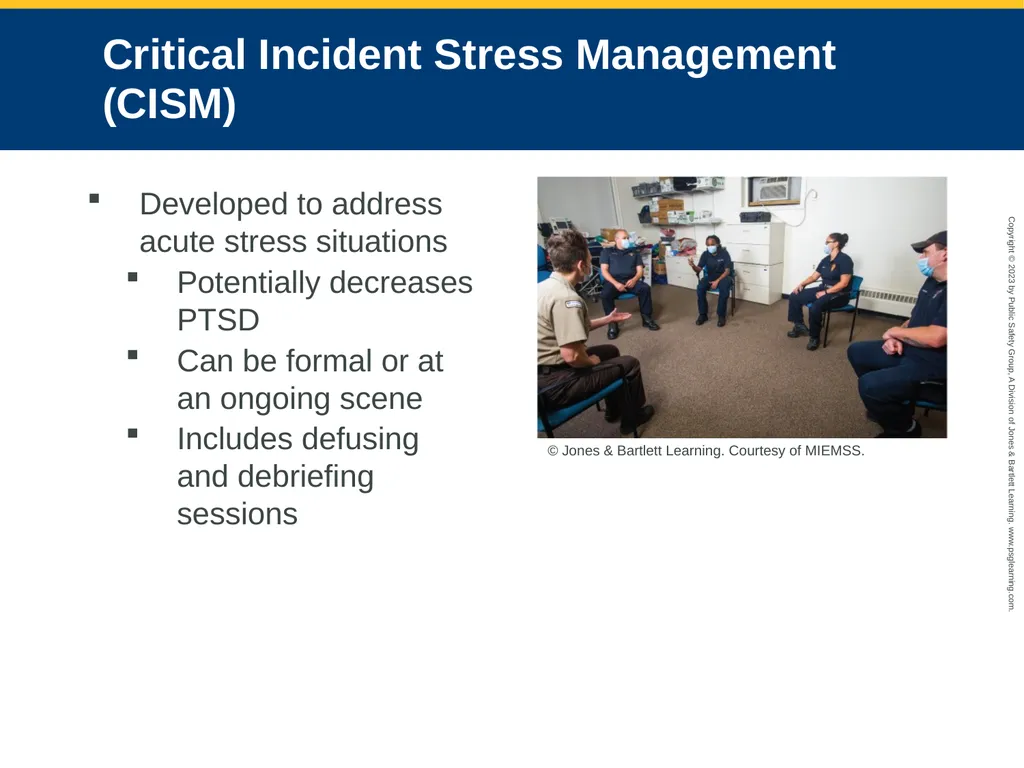
Critical Incident Stress Management (CISM) Developed to address acute stress situations
Potentially decreases PTSD
Can be formal or at an ongoing scene
Includes defusing and debriefing sessions © Jones & Bartlett Learning. Courtesy of MIEMSS.<br>
Potentially decreases PTSD
Can be formal or at an ongoing scene
Includes defusing and debriefing sessions © Jones & Bartlett Learning. Courtesy of MIEMSS.<br>
47
Burnout (1 of 2) Exhaustion of physical or emotional strength
Symptoms of impending burnout:
Chronic fatigue and irritability
Lack of desire to report to work
Feelings of being overwhelmed; overeating, smoking, or abusing drugs or alcohol<br>
Symptoms of impending burnout:
Chronic fatigue and irritability
Lack of desire to report to work
Feelings of being overwhelmed; overeating, smoking, or abusing drugs or alcohol<br>
48
Burnout (2 of 2) Preventing burnout
Take care of your own health
Learn how to relax
Do not make unreasonable demands
Debrief after tough calls<br>
Take care of your own health
Learn how to relax
Do not make unreasonable demands
Debrief after tough calls<br>
49
Compassion Fatigue Gradual lessening of compassion over time
Symptoms include:
High absenteeism
Difficult relationships with coworkers
Aggressive behavior toward patients
Strong negative attitudes toward work
Signs and symptoms may be subtle and not present all the time.<br>
Symptoms include:
High absenteeism
Difficult relationships with coworkers
Aggressive behavior toward patients
Strong negative attitudes toward work
Signs and symptoms may be subtle and not present all the time.<br>
50
Peer Support and Suicide Prevention Recognize that you or your colleagues are becoming overwhelmed.
Understand and select strategies to deal with stress in a constructive manner.
If you or a colleague expresses any suicidal ideations, seek help.<br>
Understand and select strategies to deal with stress in a constructive manner.
If you or a colleague expresses any suicidal ideations, seek help.<br>
51
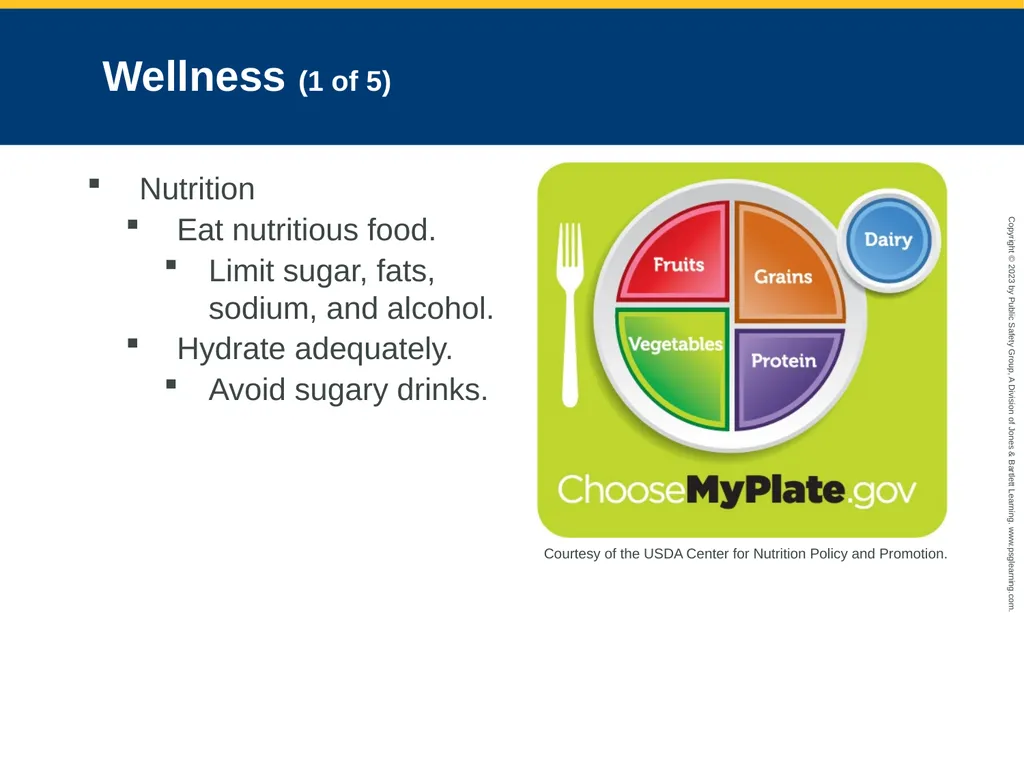
Wellness (1 of 5) Nutrition
Eat nutritious food.
Limit sugar, fats, sodium, and alcohol.
Hydrate adequately.
Avoid sugary drinks. Courtesy of the USDA Center for Nutrition Policy and Promotion.<br>
Eat nutritious food.
Limit sugar, fats, sodium, and alcohol.
Hydrate adequately.
Avoid sugary drinks. Courtesy of the USDA Center for Nutrition Policy and Promotion.<br>
52
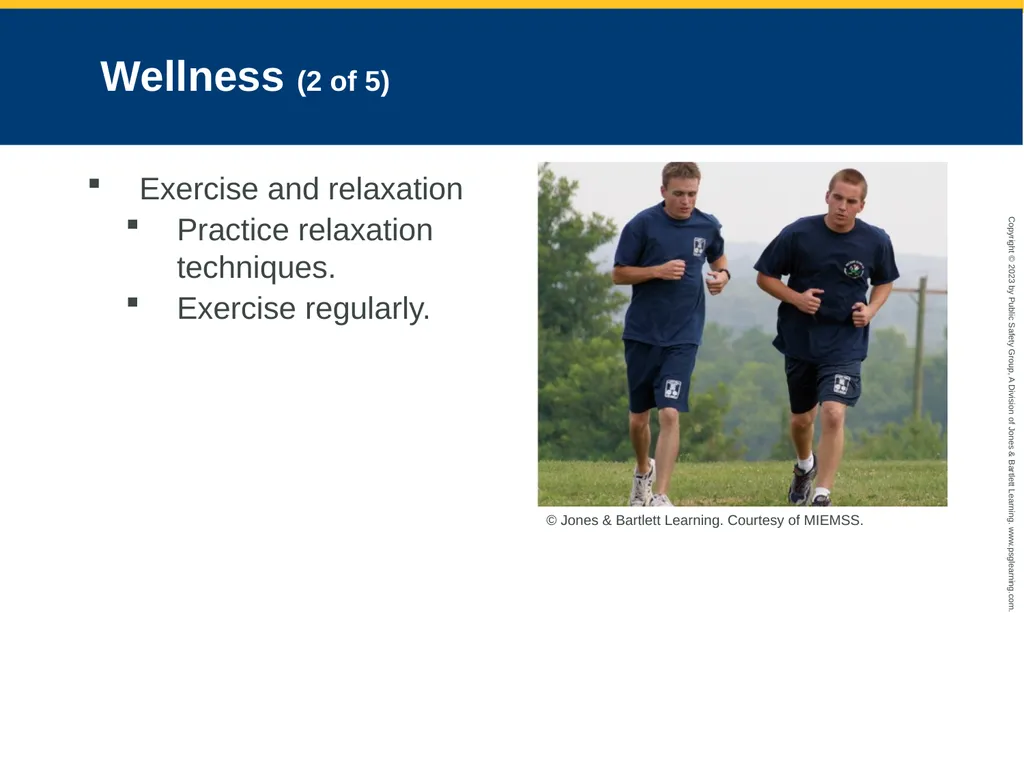
Wellness (2 of 5) Exercise and relaxation
Practice relaxation techniques.
Exercise regularly. © Jones & Bartlett Learning. Courtesy of MIEMSS.<br>
Practice relaxation techniques.
Exercise regularly. © Jones & Bartlett Learning. Courtesy of MIEMSS.<br>
53
Wellness (3 of 5) If you do not use tobacco or vape, do not start.
Sleep
Regular and uninterrupted
Quality, not length of time, is important.
Disease prevention
Know your family’s health history.
Adjust lifestyle if necessary.<br>
Sleep
Regular and uninterrupted
Quality, not length of time, is important.
Disease prevention
Know your family’s health history.
Adjust lifestyle if necessary.<br>
54
Wellness (4 of 5) Balancing work, family, and health
Find a balance between work and family.
Rotate schedule and take time off when possible.
Seek help if you are expressing significant stress.<br>
Find a balance between work and family.
Rotate schedule and take time off when possible.
Seek help if you are expressing significant stress.<br>
55
Wellness (5 of 5) Substance abuse
Acceptable consumption is one drink/day for women and two drinks/day for men
Increased use adversely affects body systems
Both prescription and illicit drugs can be abused and misused.
Take only as prescribed and as directed.
If a restricted drug is prescribed, notify employer.<br>
Acceptable consumption is one drink/day for women and two drinks/day for men
Increased use adversely affects body systems
Both prescription and illicit drugs can be abused and misused.
Take only as prescribed and as directed.
If a restricted drug is prescribed, notify employer.<br>
56
Workplace Issues (1 of 2) Diversity on the job
Each person is different.
Communicate respectfully.
Use cultural diversity as a resource.
Learn to relate effectively with other cultures.
Recognize that there are legitimate differences in how various cultures respond to stress.<br>
Each person is different.
Communicate respectfully.
Use cultural diversity as a resource.
Learn to relate effectively with other cultures.
Recognize that there are legitimate differences in how various cultures respond to stress.<br>
57
Workplace Issues (2 of 2) Sexual harassment
Unwelcome verbal or physical conduct, or an overheard conversation
Quid pro quo or hostile work environment
Perceptions, not intent, matter.
Keep lines of communication open.
Report harassment to supervisor immediately, and keep notes.<br>
Unwelcome verbal or physical conduct, or an overheard conversation
Quid pro quo or hostile work environment
Perceptions, not intent, matter.
Keep lines of communication open.
Report harassment to supervisor immediately, and keep notes.<br>
58
Death and Dying Death is likely to occur:
Somewhere other than the home
Quite suddenly or after a prolonged terminal illness
Stages of grieving:
Denial
Anger, hostility
Bargaining
Depression
Acceptance<br>
Somewhere other than the home
Quite suddenly or after a prolonged terminal illness
Stages of grieving:
Denial
Anger, hostility
Bargaining
Depression
Acceptance<br>
59
Working With Family Members Use special care with dying patients and family members.
Ask how you can help.
Do not say you know how they feel.
Allow the patient/family to grieve.
Maintain a professional attitude.<br>
Ask how you can help.
Do not say you know how they feel.
Allow the patient/family to grieve.
Maintain a professional attitude.<br>
60
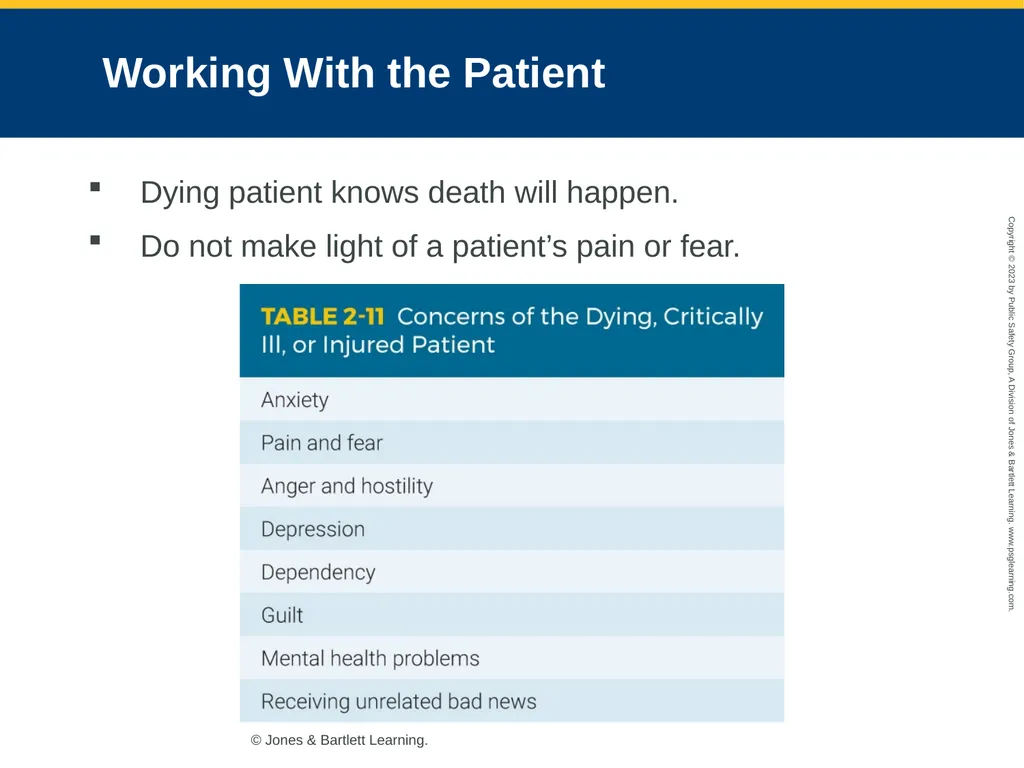
Working With the Patient Dying patient knows death will happen.
Do not make light of a patient’s pain or fear. © Jones & Bartlett Learning.<br>
Do not make light of a patient’s pain or fear. © Jones & Bartlett Learning.<br>
61
Dealing With the Death of a Child Tragic and dreaded event
Help the family through the initial period after the death.
Acknowledge the fact of the death.
If possible and appropriate, let the parents hold the child.
Do not overload parents with a lot of information.<br>
Help the family through the initial period after the death.
Acknowledge the fact of the death.
If possible and appropriate, let the parents hold the child.
Do not overload parents with a lot of information.<br>
62
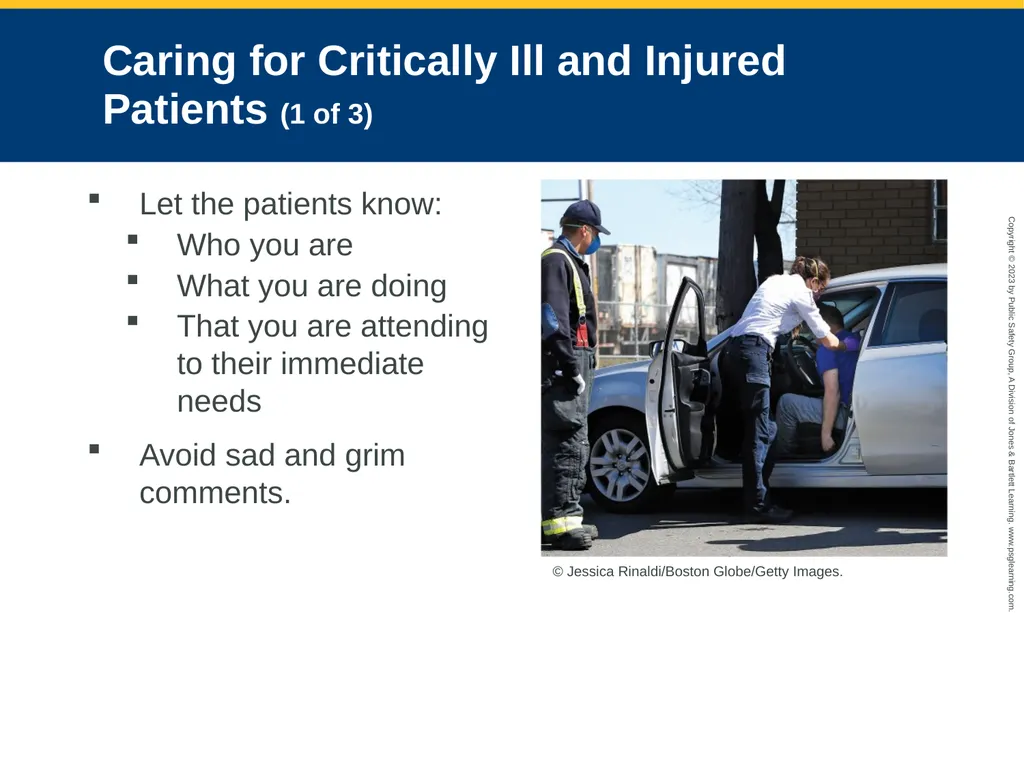
Caring for Critically Ill and Injured Patients (1 of 3) Let the patients know:
Who you are
What you are doing
That you are attending to their immediate needs
Avoid sad and grim comments. © Jessica Rinaldi/Boston Globe/Getty Images.<br>
Who you are
What you are doing
That you are attending to their immediate needs
Avoid sad and grim comments. © Jessica Rinaldi/Boston Globe/Getty Images.<br>
63
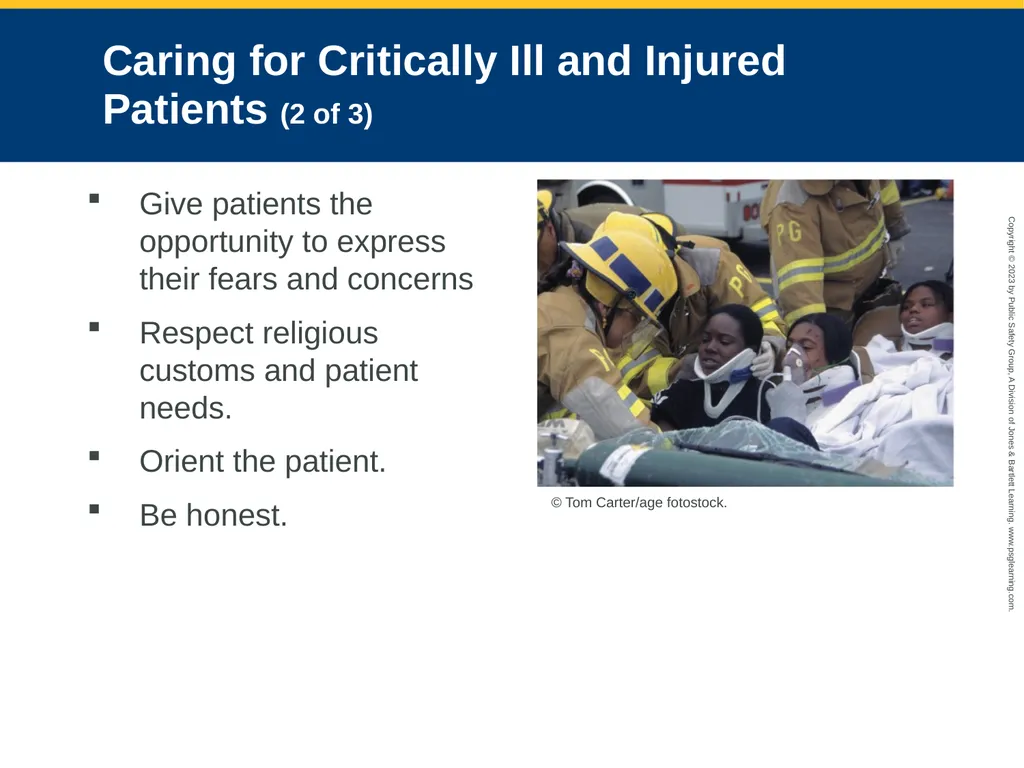
Caring for Critically Ill and Injured Patients (2 of 3) Give patients the opportunity to express their fears and concerns
Respect religious customs and patient needs.
Orient the patient.
Be honest. © Tom Carter/age fotostock.<br>
Respect religious customs and patient needs.
Orient the patient.
Be honest. © Tom Carter/age fotostock.<br>
64
Caring for Critically Ill and Injured Patients (3 of 3) Deal with possible initial refusal of care.
Allow for hope.
Locate and notify family members.
Injured and critically ill children
Care for as you would any patient.
Ask a responsible adult to accompany a child.<br>
Allow for hope.
Locate and notify family members.
Injured and critically ill children
Care for as you would any patient.
Ask a responsible adult to accompany a child.<br>
65
Uncertain Situations If it is unclear if a true medical emergency exists:
Contact medical control about need to transport.
Many minor signs may be early indicators of severe illness or injury.
If in doubt, acquire patient consent and transport.<br>
Contact medical control about need to transport.
Many minor signs may be early indicators of severe illness or injury.
If in doubt, acquire patient consent and transport.<br>