
Year 11 Love & Relationships Revision Booklet
SB
Published · 38 slides · 0 views
1 / 1
Description
Year 11 Love Relationships Revision Booklet 2023-24 Name: Teachers Name: 1 2 3 4 Key Concepts Read the information and add 2 bullet points to each box. The Love and Relationships Anthology comprises 15 poems which range in date from the
Related Topics
Share
Embed code
Download this presentation From Below
"Year 11 Love & Relationships Revision Booklet" is the property of its rightful owner. Permission is granted to download and print the materials on this website for personal, non-commercial use only, and to display it on your personal computer provided you do not modify the materials and that you retain all copyright notices contained in the materials. By downloading content from our website, you accept the terms of this agreement.
Presentation Transcript
01
Year 11
Love & Relationships Revision Booklet
2023-24 Name: Teacher’s Name: 1<br>
02
2<br>
03
3<br>
04
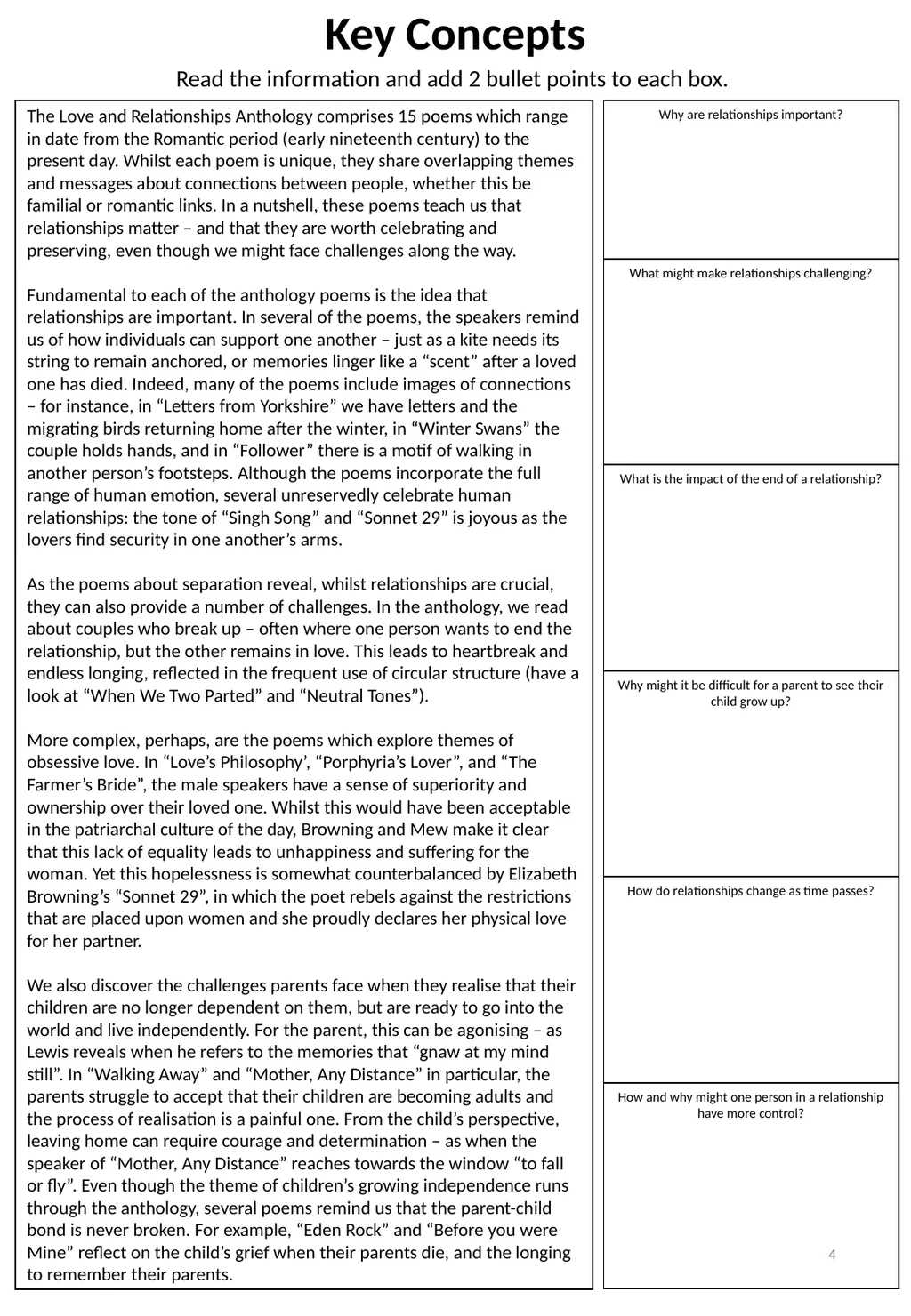
4 Key Concepts Read the information and add 2 bullet points to each box. The Love and Relationships Anthology comprises 15 poems which range in date from the Romantic period (early nineteenth century) to the present day. Whilst each poem is unique, they share overlapping themes and messages about connections between people, whether this be familial or romantic links. In a nutshell, these poems teach us that relationships matter – and that they are worth celebrating and preserving, even though we might face challenges along the way.
Fundamental to each of the anthology poems is the idea that relationships are important. In several of the poems, the speakers remind us of how individuals can support one another – just as a kite needs its string to remain anchored, or memories linger like a “scent” after a loved one has died. Indeed, many of the poems include images of connections – for instance, in “Letters from Yorkshire” we have letters and the migrating birds returning home after the winter, in “Winter Swans” the couple holds hands, and in “Follower” there is a motif of walking in another person’s footsteps. Although the poems incorporate the full range of human emotion, several unreservedly celebrate human relationships: the tone of “Singh Song” and “Sonnet 29” is joyous as the lovers find security in one another’s arms.
As the poems about separation reveal, whilst relationships are crucial, they can also provide a number of challenges. In the anthology, we read about couples who break up – often where one person wants to end the relationship, but the other remains in love. This leads to heartbreak and endless longing, reflected in the frequent use of circular structure (have a look at “When We Two Parted” and “Neutral Tones”).
More complex, perhaps, are the poems which explore themes of obsessive love. In “Love’s Philosophy’, “Porphyria’s Lover”, and “The Farmer’s Bride”, the male speakers have a sense of superiority and ownership over their loved one. Whilst this would have been acceptable in the patriarchal culture of the day, Browning and Mew make it clear that this lack of equality leads to unhappiness and suffering for the woman. Yet this hopelessness is somewhat counterbalanced by Elizabeth Browning’s “Sonnet 29”, in which the poet rebels against the restrictions that are placed upon women and she proudly declares her physical love for her partner.
We also discover the challenges parents face when they realise that their children are no longer dependent on them, but are ready to go into the world and live independently. For the parent, this can be agonising – as Lewis reveals when he refers to the memories that “gnaw at my mind still”. In “Walking Away” and “Mother, Any Distance” in particular, the parents struggle to accept that their children are becoming adults and the process of realisation is a painful one. From the child’s perspective, leaving home can require courage and determination – as when the speaker of “Mother, Any Distance” reaches towards the window “to fall or fly”. Even though the theme of children’s growing independence runs through the anthology, several poems remind us that the parent-child bond is never broken. For example, “Eden Rock” and “Before you were Mine” reflect on the child’s grief when their parents die, and the longing to remember their parents.<br>
Fundamental to each of the anthology poems is the idea that relationships are important. In several of the poems, the speakers remind us of how individuals can support one another – just as a kite needs its string to remain anchored, or memories linger like a “scent” after a loved one has died. Indeed, many of the poems include images of connections – for instance, in “Letters from Yorkshire” we have letters and the migrating birds returning home after the winter, in “Winter Swans” the couple holds hands, and in “Follower” there is a motif of walking in another person’s footsteps. Although the poems incorporate the full range of human emotion, several unreservedly celebrate human relationships: the tone of “Singh Song” and “Sonnet 29” is joyous as the lovers find security in one another’s arms.
As the poems about separation reveal, whilst relationships are crucial, they can also provide a number of challenges. In the anthology, we read about couples who break up – often where one person wants to end the relationship, but the other remains in love. This leads to heartbreak and endless longing, reflected in the frequent use of circular structure (have a look at “When We Two Parted” and “Neutral Tones”).
More complex, perhaps, are the poems which explore themes of obsessive love. In “Love’s Philosophy’, “Porphyria’s Lover”, and “The Farmer’s Bride”, the male speakers have a sense of superiority and ownership over their loved one. Whilst this would have been acceptable in the patriarchal culture of the day, Browning and Mew make it clear that this lack of equality leads to unhappiness and suffering for the woman. Yet this hopelessness is somewhat counterbalanced by Elizabeth Browning’s “Sonnet 29”, in which the poet rebels against the restrictions that are placed upon women and she proudly declares her physical love for her partner.
We also discover the challenges parents face when they realise that their children are no longer dependent on them, but are ready to go into the world and live independently. For the parent, this can be agonising – as Lewis reveals when he refers to the memories that “gnaw at my mind still”. In “Walking Away” and “Mother, Any Distance” in particular, the parents struggle to accept that their children are becoming adults and the process of realisation is a painful one. From the child’s perspective, leaving home can require courage and determination – as when the speaker of “Mother, Any Distance” reaches towards the window “to fall or fly”. Even though the theme of children’s growing independence runs through the anthology, several poems remind us that the parent-child bond is never broken. For example, “Eden Rock” and “Before you were Mine” reflect on the child’s grief when their parents die, and the longing to remember their parents.<br>
05
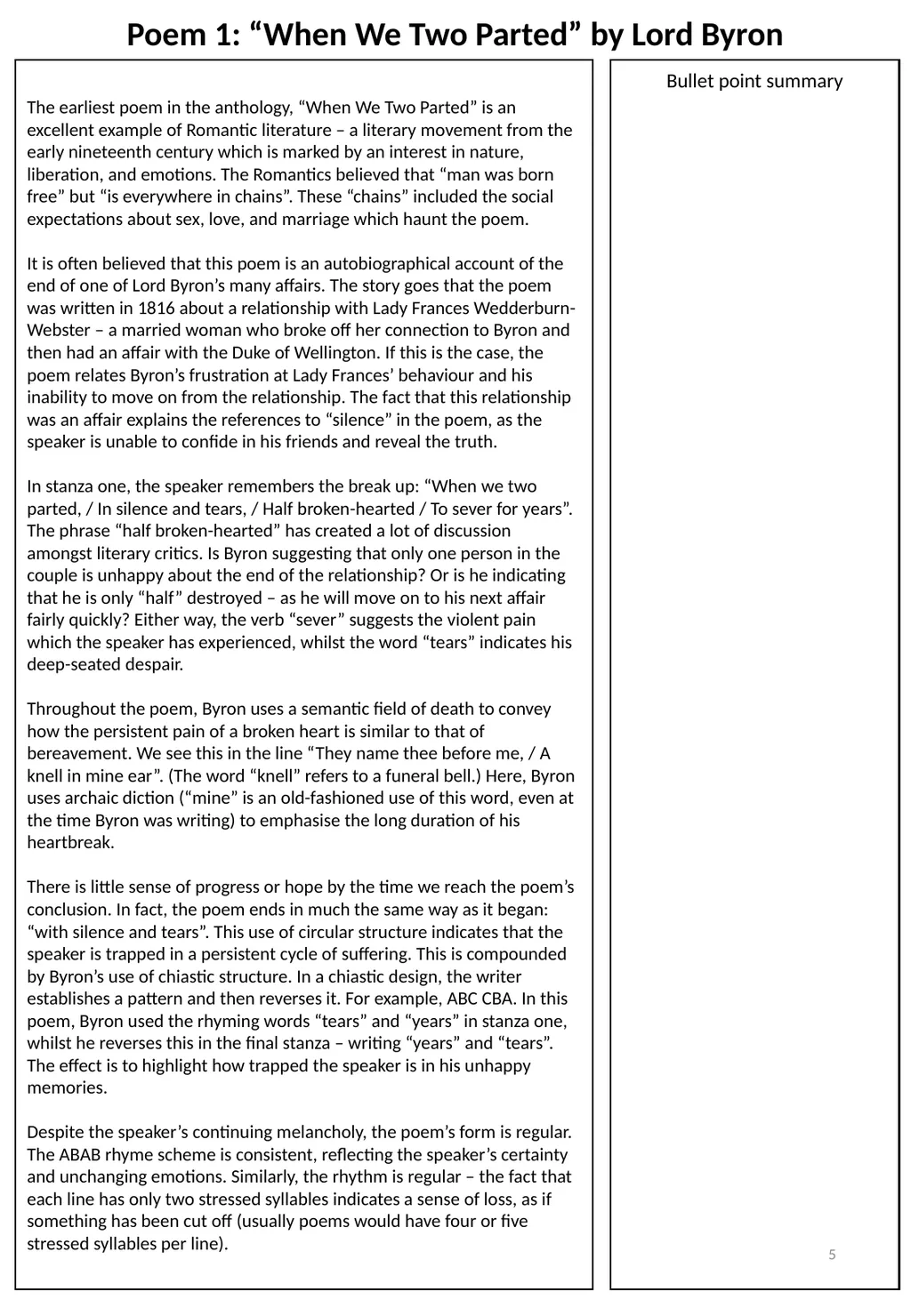
5 Poem 1: “When We Two Parted” by Lord Byron Bullet point summary The earliest poem in the anthology, “When We Two Parted” is an excellent example of Romantic literature – a literary movement from the early nineteenth century which is marked by an interest in nature, liberation, and emotions. The Romantics believed that “man was born free” but “is everywhere in chains”. These “chains” included the social expectations about sex, love, and marriage which haunt the poem.
It is often believed that this poem is an autobiographical account of the end of one of Lord Byron’s many affairs. The story goes that the poem was written in 1816 about a relationship with Lady Frances Wedderburn-Webster – a married woman who broke off her connection to Byron and then had an affair with the Duke of Wellington. If this is the case, the poem relates Byron’s frustration at Lady Frances’ behaviour and his inability to move on from the relationship. The fact that this relationship was an affair explains the references to “silence” in the poem, as the speaker is unable to confide in his friends and reveal the truth.
In stanza one, the speaker remembers the break up: “When we two parted, / In silence and tears, / Half broken-hearted / To sever for years”. The phrase “half broken-hearted” has created a lot of discussion amongst literary critics. Is Byron suggesting that only one person in the couple is unhappy about the end of the relationship? Or is he indicating that he is only “half” destroyed – as he will move on to his next affair fairly quickly? Either way, the verb “sever” suggests the violent pain which the speaker has experienced, whilst the word “tears” indicates his deep-seated despair.
Throughout the poem, Byron uses a semantic field of death to convey how the persistent pain of a broken heart is similar to that of bereavement. We see this in the line “They name thee before me, / A knell in mine ear”. (The word “knell” refers to a funeral bell.) Here, Byron uses archaic diction (“mine” is an old-fashioned use of this word, even at the time Byron was writing) to emphasise the long duration of his heartbreak.
There is little sense of progress or hope by the time we reach the poem’s conclusion. In fact, the poem ends in much the same way as it began: “with silence and tears”. This use of circular structure indicates that the speaker is trapped in a persistent cycle of suffering. This is compounded by Byron’s use of chiastic structure. In a chiastic design, the writer establishes a pattern and then reverses it. For example, ABC CBA. In this poem, Byron used the rhyming words “tears” and “years” in stanza one, whilst he reverses this in the final stanza – writing “years” and “tears”. The effect is to highlight how trapped the speaker is in his unhappy memories.
Despite the speaker’s continuing melancholy, the poem’s form is regular. The ABAB rhyme scheme is consistent, reflecting the speaker’s certainty and unchanging emotions. Similarly, the rhythm is regular – the fact that each line has only two stressed syllables indicates a sense of loss, as if something has been cut off (usually poems would have four or five stressed syllables per line).<br>
It is often believed that this poem is an autobiographical account of the end of one of Lord Byron’s many affairs. The story goes that the poem was written in 1816 about a relationship with Lady Frances Wedderburn-Webster – a married woman who broke off her connection to Byron and then had an affair with the Duke of Wellington. If this is the case, the poem relates Byron’s frustration at Lady Frances’ behaviour and his inability to move on from the relationship. The fact that this relationship was an affair explains the references to “silence” in the poem, as the speaker is unable to confide in his friends and reveal the truth.
In stanza one, the speaker remembers the break up: “When we two parted, / In silence and tears, / Half broken-hearted / To sever for years”. The phrase “half broken-hearted” has created a lot of discussion amongst literary critics. Is Byron suggesting that only one person in the couple is unhappy about the end of the relationship? Or is he indicating that he is only “half” destroyed – as he will move on to his next affair fairly quickly? Either way, the verb “sever” suggests the violent pain which the speaker has experienced, whilst the word “tears” indicates his deep-seated despair.
Throughout the poem, Byron uses a semantic field of death to convey how the persistent pain of a broken heart is similar to that of bereavement. We see this in the line “They name thee before me, / A knell in mine ear”. (The word “knell” refers to a funeral bell.) Here, Byron uses archaic diction (“mine” is an old-fashioned use of this word, even at the time Byron was writing) to emphasise the long duration of his heartbreak.
There is little sense of progress or hope by the time we reach the poem’s conclusion. In fact, the poem ends in much the same way as it began: “with silence and tears”. This use of circular structure indicates that the speaker is trapped in a persistent cycle of suffering. This is compounded by Byron’s use of chiastic structure. In a chiastic design, the writer establishes a pattern and then reverses it. For example, ABC CBA. In this poem, Byron used the rhyming words “tears” and “years” in stanza one, whilst he reverses this in the final stanza – writing “years” and “tears”. The effect is to highlight how trapped the speaker is in his unhappy memories.
Despite the speaker’s continuing melancholy, the poem’s form is regular. The ABAB rhyme scheme is consistent, reflecting the speaker’s certainty and unchanging emotions. Similarly, the rhythm is regular – the fact that each line has only two stressed syllables indicates a sense of loss, as if something has been cut off (usually poems would have four or five stressed syllables per line).<br>
06
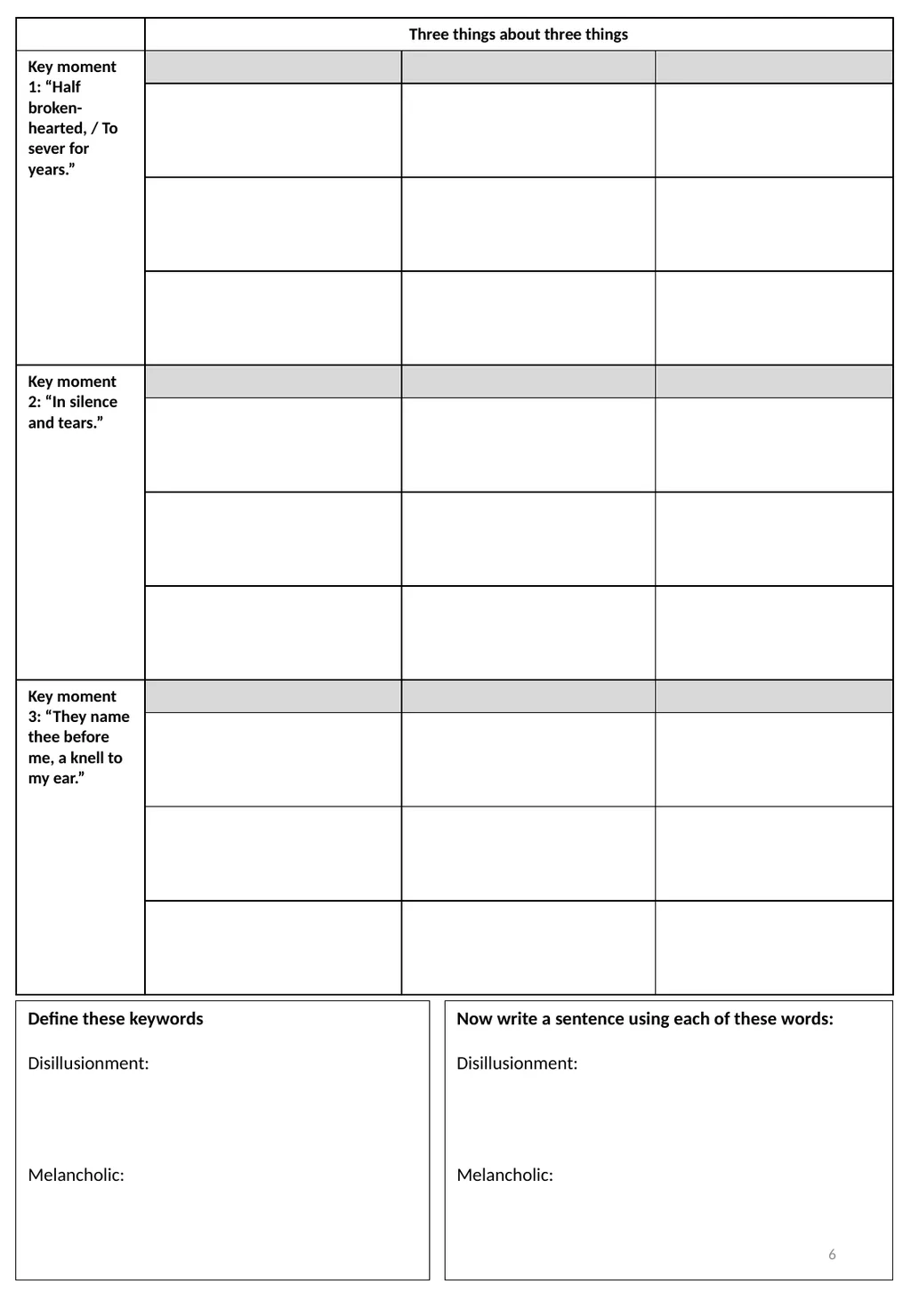
6 Define these keywords
Disillusionment:
Melancholic: Now write a sentence using each of these words:
Disillusionment:
Melancholic:<br>
Disillusionment:
Melancholic: Now write a sentence using each of these words:
Disillusionment:
Melancholic:<br>
07
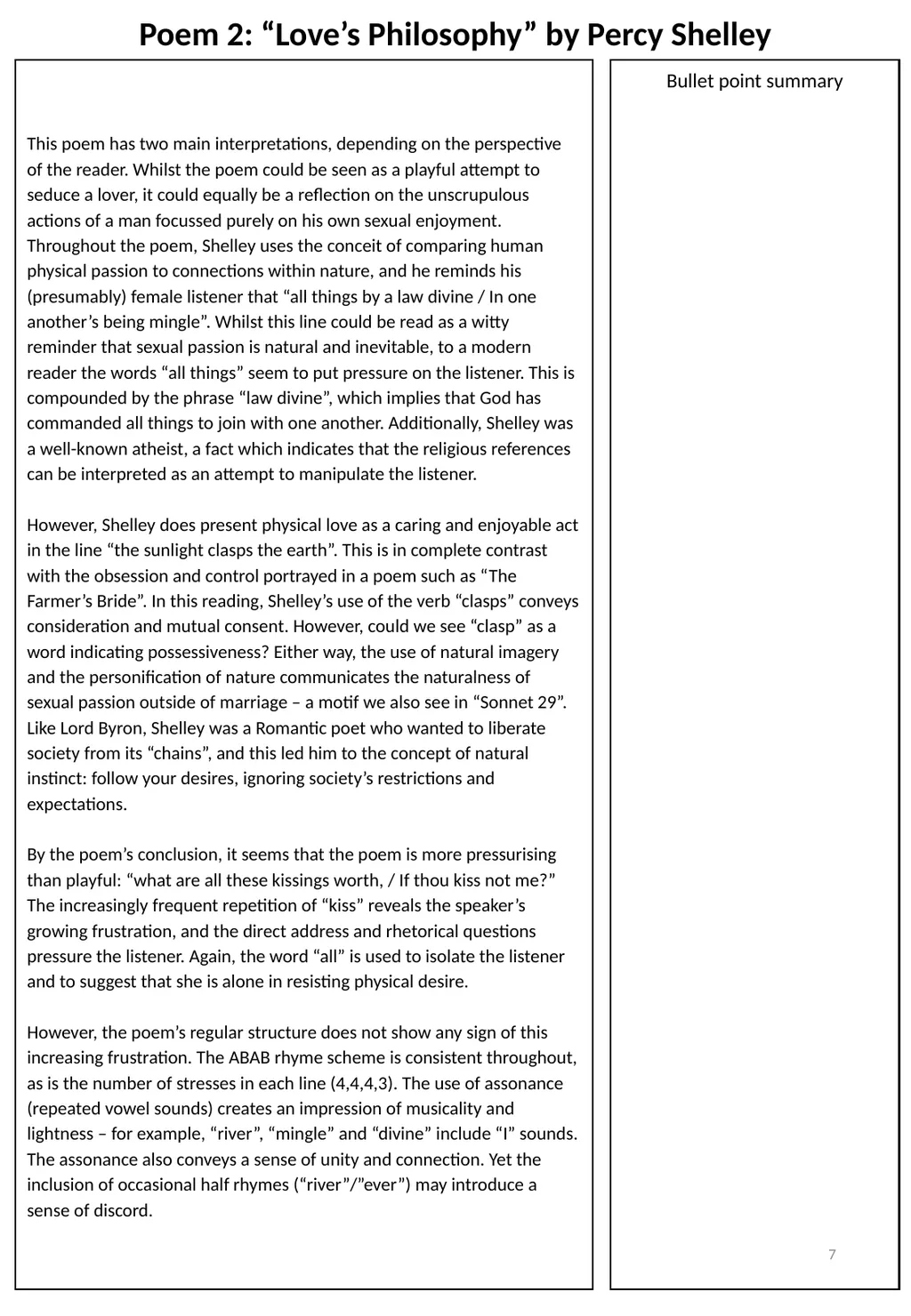
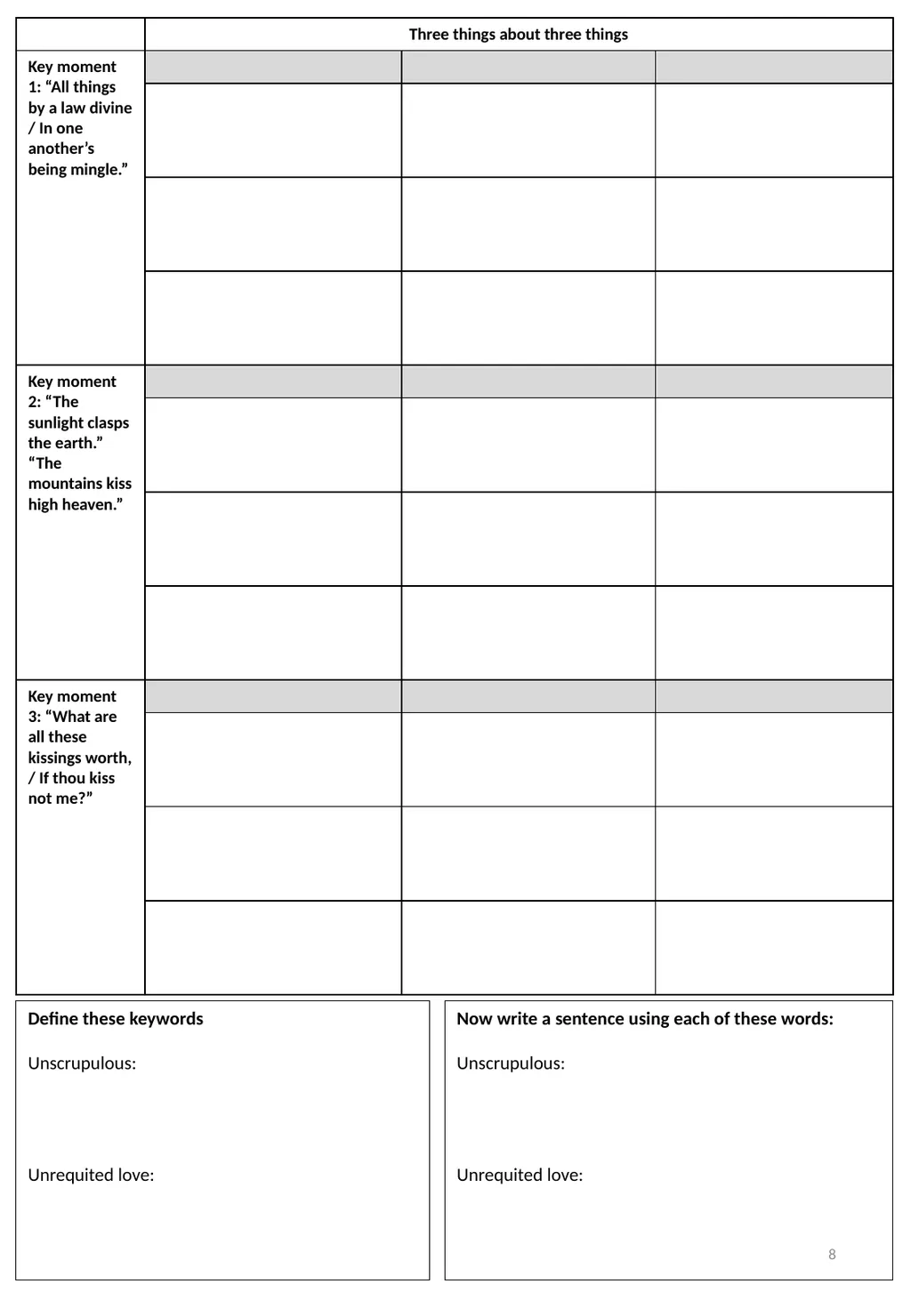
7 Poem 2: “Love’s Philosophy” by Percy Shelley Bullet point summary This poem has two main interpretations, depending on the perspective of the reader. Whilst the poem could be seen as a playful attempt to seduce a lover, it could equally be a reflection on the unscrupulous actions of a man focussed purely on his own sexual enjoyment. Throughout the poem, Shelley uses the conceit of comparing human physical passion to connections within nature, and he reminds his (presumably) female listener that “all things by a law divine / In one another’s being mingle”. Whilst this line could be read as a witty reminder that sexual passion is natural and inevitable, to a modern reader the words “all things” seem to put pressure on the listener. This is compounded by the phrase “law divine”, which implies that God has commanded all things to join with one another. Additionally, Shelley was a well-known atheist, a fact which indicates that the religious references can be interpreted as an attempt to manipulate the listener.
However, Shelley does present physical love as a caring and enjoyable act in the line “the sunlight clasps the earth”. This is in complete contrast with the obsession and control portrayed in a poem such as “The Farmer’s Bride”. In this reading, Shelley’s use of the verb “clasps” conveys consideration and mutual consent. However, could we see “clasp” as a word indicating possessiveness? Either way, the use of natural imagery and the personification of nature communicates the naturalness of sexual passion outside of marriage – a motif we also see in “Sonnet 29”. Like Lord Byron, Shelley was a Romantic poet who wanted to liberate society from its “chains”, and this led him to the concept of natural instinct: follow your desires, ignoring society’s restrictions and expectations.
By the poem’s conclusion, it seems that the poem is more pressurising than playful: “what are all these kissings worth, / If thou kiss not me?” The increasingly frequent repetition of “kiss” reveals the speaker’s growing frustration, and the direct address and rhetorical questions pressure the listener. Again, the word “all” is used to isolate the listener and to suggest that she is alone in resisting physical desire.
However, the poem’s regular structure does not show any sign of this increasing frustration. The ABAB rhyme scheme is consistent throughout, as is the number of stresses in each line (4,4,4,3). The use of assonance (repeated vowel sounds) creates an impression of musicality and lightness – for example, “river”, “mingle” and “divine” include “I” sounds. The assonance also conveys a sense of unity and connection. Yet the inclusion of occasional half rhymes (“river”/”ever”) may introduce a sense of discord.<br>
However, Shelley does present physical love as a caring and enjoyable act in the line “the sunlight clasps the earth”. This is in complete contrast with the obsession and control portrayed in a poem such as “The Farmer’s Bride”. In this reading, Shelley’s use of the verb “clasps” conveys consideration and mutual consent. However, could we see “clasp” as a word indicating possessiveness? Either way, the use of natural imagery and the personification of nature communicates the naturalness of sexual passion outside of marriage – a motif we also see in “Sonnet 29”. Like Lord Byron, Shelley was a Romantic poet who wanted to liberate society from its “chains”, and this led him to the concept of natural instinct: follow your desires, ignoring society’s restrictions and expectations.
By the poem’s conclusion, it seems that the poem is more pressurising than playful: “what are all these kissings worth, / If thou kiss not me?” The increasingly frequent repetition of “kiss” reveals the speaker’s growing frustration, and the direct address and rhetorical questions pressure the listener. Again, the word “all” is used to isolate the listener and to suggest that she is alone in resisting physical desire.
However, the poem’s regular structure does not show any sign of this increasing frustration. The ABAB rhyme scheme is consistent throughout, as is the number of stresses in each line (4,4,4,3). The use of assonance (repeated vowel sounds) creates an impression of musicality and lightness – for example, “river”, “mingle” and “divine” include “I” sounds. The assonance also conveys a sense of unity and connection. Yet the inclusion of occasional half rhymes (“river”/”ever”) may introduce a sense of discord.<br>
08
8 Define these keywords
Unscrupulous:
Unrequited love: Now write a sentence using each of these words:
Unscrupulous:
Unrequited love:<br>
Unscrupulous:
Unrequited love: Now write a sentence using each of these words:
Unscrupulous:
Unrequited love:<br>
09
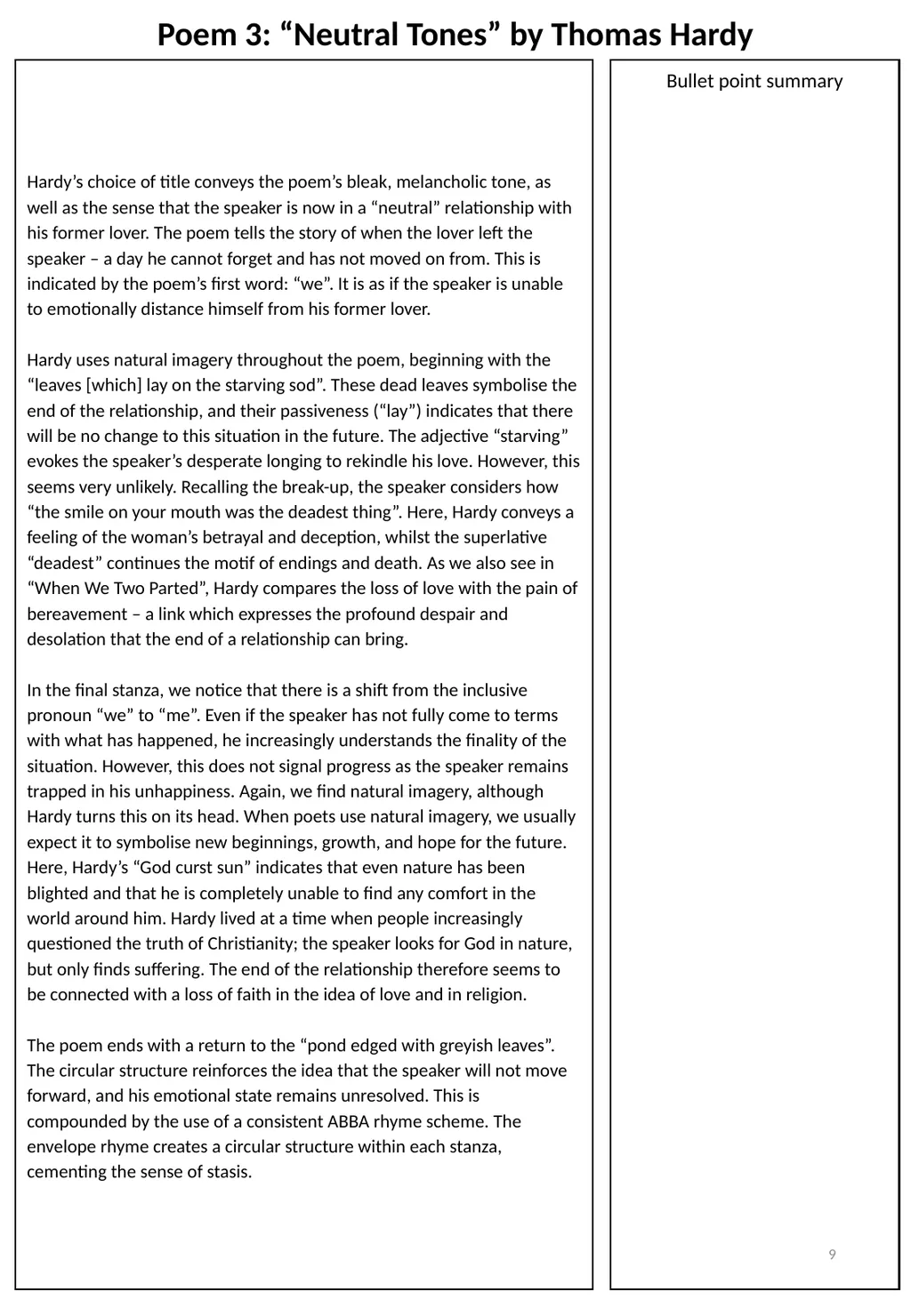
9 Poem 3: “Neutral Tones” by Thomas Hardy Bullet point summary Hardy’s choice of title conveys the poem’s bleak, melancholic tone, as well as the sense that the speaker is now in a “neutral” relationship with his former lover. The poem tells the story of when the lover left the speaker – a day he cannot forget and has not moved on from. This is indicated by the poem’s first word: “we”. It is as if the speaker is unable to emotionally distance himself from his former lover.
Hardy uses natural imagery throughout the poem, beginning with the “leaves [which] lay on the starving sod”. These dead leaves symbolise the end of the relationship, and their passiveness (“lay”) indicates that there will be no change to this situation in the future. The adjective “starving” evokes the speaker’s desperate longing to rekindle his love. However, this seems very unlikely. Recalling the break-up, the speaker considers how “the smile on your mouth was the deadest thing”. Here, Hardy conveys a feeling of the woman’s betrayal and deception, whilst the superlative “deadest” continues the motif of endings and death. As we also see in “When We Two Parted”, Hardy compares the loss of love with the pain of bereavement – a link which expresses the profound despair and desolation that the end of a relationship can bring.
In the final stanza, we notice that there is a shift from the inclusive pronoun “we” to “me”. Even if the speaker has not fully come to terms with what has happened, he increasingly understands the finality of the situation. However, this does not signal progress as the speaker remains trapped in his unhappiness. Again, we find natural imagery, although Hardy turns this on its head. When poets use natural imagery, we usually expect it to symbolise new beginnings, growth, and hope for the future. Here, Hardy’s “God curst sun” indicates that even nature has been blighted and that he is completely unable to find any comfort in the world around him. Hardy lived at a time when people increasingly questioned the truth of Christianity; the speaker looks for God in nature, but only finds suffering. The end of the relationship therefore seems to be connected with a loss of faith in the idea of love and in religion.
The poem ends with a return to the “pond edged with greyish leaves”. The circular structure reinforces the idea that the speaker will not move forward, and his emotional state remains unresolved. This is compounded by the use of a consistent ABBA rhyme scheme. The envelope rhyme creates a circular structure within each stanza, cementing the sense of stasis.<br>
Hardy uses natural imagery throughout the poem, beginning with the “leaves [which] lay on the starving sod”. These dead leaves symbolise the end of the relationship, and their passiveness (“lay”) indicates that there will be no change to this situation in the future. The adjective “starving” evokes the speaker’s desperate longing to rekindle his love. However, this seems very unlikely. Recalling the break-up, the speaker considers how “the smile on your mouth was the deadest thing”. Here, Hardy conveys a feeling of the woman’s betrayal and deception, whilst the superlative “deadest” continues the motif of endings and death. As we also see in “When We Two Parted”, Hardy compares the loss of love with the pain of bereavement – a link which expresses the profound despair and desolation that the end of a relationship can bring.
In the final stanza, we notice that there is a shift from the inclusive pronoun “we” to “me”. Even if the speaker has not fully come to terms with what has happened, he increasingly understands the finality of the situation. However, this does not signal progress as the speaker remains trapped in his unhappiness. Again, we find natural imagery, although Hardy turns this on its head. When poets use natural imagery, we usually expect it to symbolise new beginnings, growth, and hope for the future. Here, Hardy’s “God curst sun” indicates that even nature has been blighted and that he is completely unable to find any comfort in the world around him. Hardy lived at a time when people increasingly questioned the truth of Christianity; the speaker looks for God in nature, but only finds suffering. The end of the relationship therefore seems to be connected with a loss of faith in the idea of love and in religion.
The poem ends with a return to the “pond edged with greyish leaves”. The circular structure reinforces the idea that the speaker will not move forward, and his emotional state remains unresolved. This is compounded by the use of a consistent ABBA rhyme scheme. The envelope rhyme creates a circular structure within each stanza, cementing the sense of stasis.<br>
10
10 Define these keywords
Bitter:
Unresolved anguish: Now write a sentence using each of these words:
Bitter:
Unresolved anguish:<br>
Bitter:
Unresolved anguish: Now write a sentence using each of these words:
Bitter:
Unresolved anguish:<br>
11
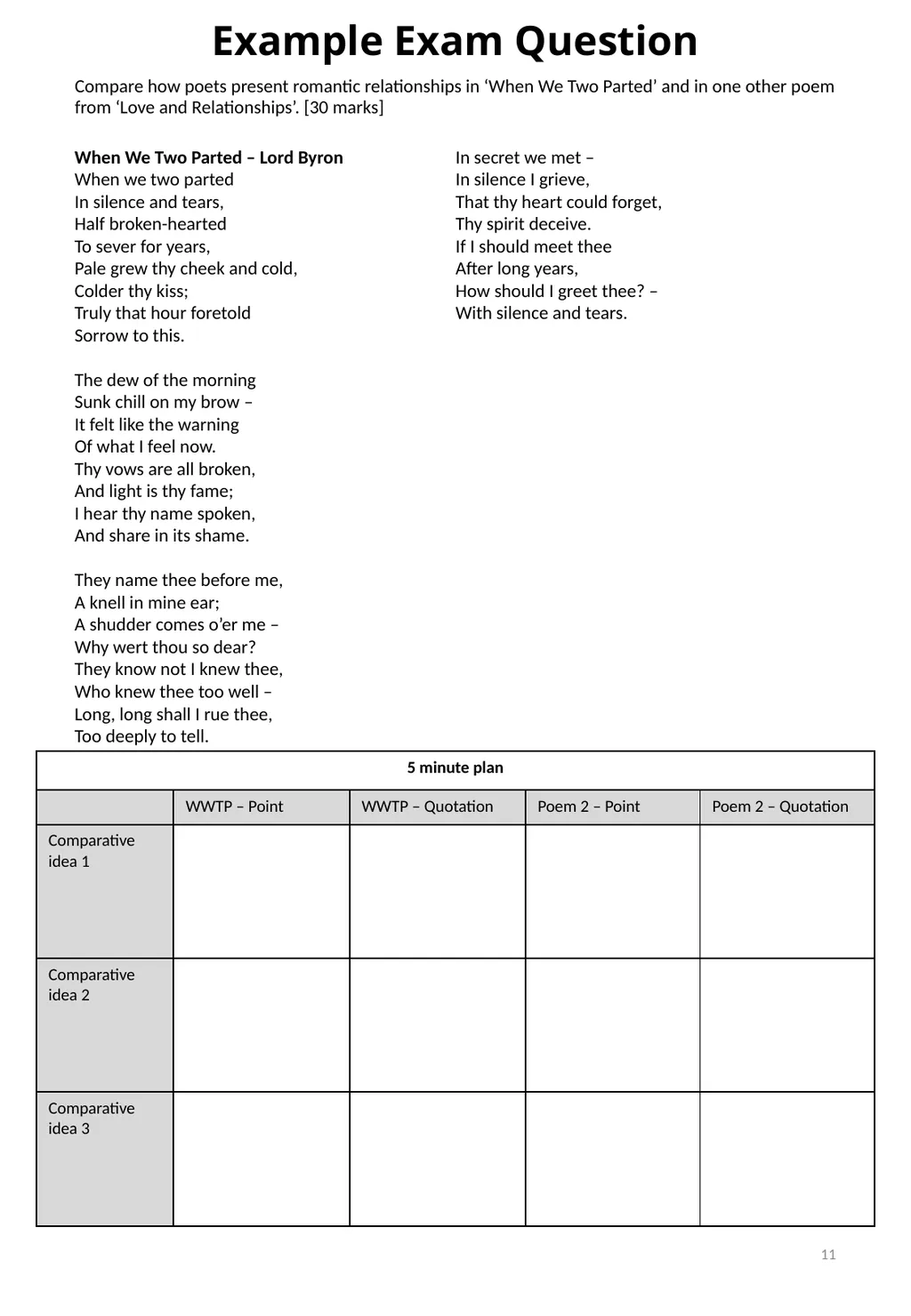
11 Example Exam Question Compare how poets present romantic relationships in ‘When We Two Parted’ and in one other poem from ‘Love and Relationships’. [30 marks] When We Two Parted – Lord Byron
When we two parted
In silence and tears,
Half broken-hearted
To sever for years,
Pale grew thy cheek and cold,
Colder thy kiss;
Truly that hour foretold
Sorrow to this.
The dew of the morning
Sunk chill on my brow –
It felt like the warning
Of what I feel now.
Thy vows are all broken,
And light is thy fame;
I hear thy name spoken,
And share in its shame.
They name thee before me,
A knell in mine ear;
A shudder comes o’er me –
Why wert thou so dear?
They know not I knew thee,
Who knew thee too well –
Long, long shall I rue thee,
Too deeply to tell.
In secret we met –
In silence I grieve,
That thy heart could forget,
Thy spirit deceive.
If I should meet thee
After long years,
How should I greet thee? –
With silence and tears.<br>
When we two parted
In silence and tears,
Half broken-hearted
To sever for years,
Pale grew thy cheek and cold,
Colder thy kiss;
Truly that hour foretold
Sorrow to this.
The dew of the morning
Sunk chill on my brow –
It felt like the warning
Of what I feel now.
Thy vows are all broken,
And light is thy fame;
I hear thy name spoken,
And share in its shame.
They name thee before me,
A knell in mine ear;
A shudder comes o’er me –
Why wert thou so dear?
They know not I knew thee,
Who knew thee too well –
Long, long shall I rue thee,
Too deeply to tell.
In secret we met –
In silence I grieve,
That thy heart could forget,
Thy spirit deceive.
If I should meet thee
After long years,
How should I greet thee? –
With silence and tears.<br>
12
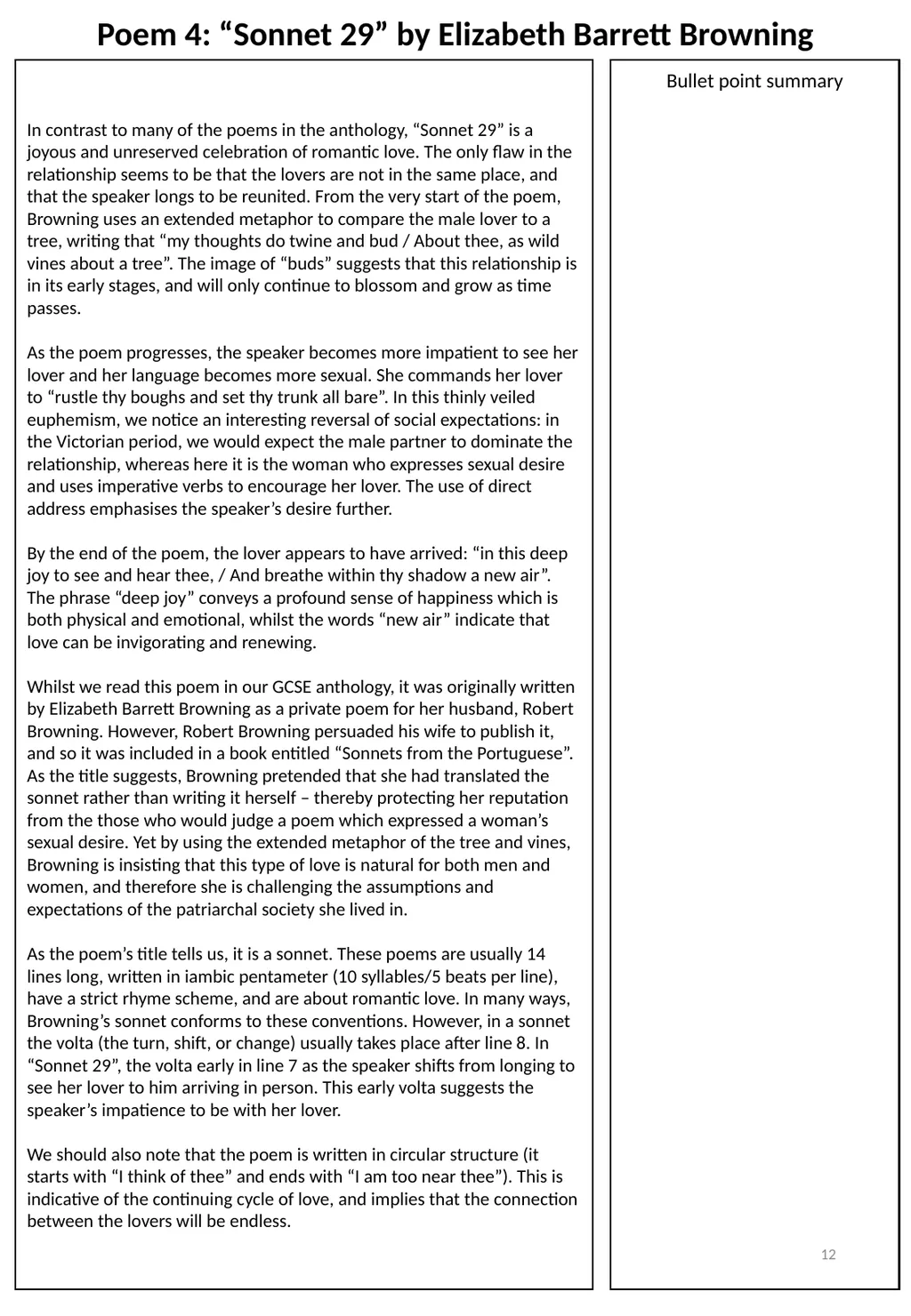
12 Poem 4: “Sonnet 29” by Elizabeth Barrett Browning Bullet point summary In contrast to many of the poems in the anthology, “Sonnet 29” is a joyous and unreserved celebration of romantic love. The only flaw in the relationship seems to be that the lovers are not in the same place, and that the speaker longs to be reunited. From the very start of the poem, Browning uses an extended metaphor to compare the male lover to a tree, writing that “my thoughts do twine and bud / About thee, as wild vines about a tree”. The image of “buds” suggests that this relationship is in its early stages, and will only continue to blossom and grow as time passes.
As the poem progresses, the speaker becomes more impatient to see her lover and her language becomes more sexual. She commands her lover to “rustle thy boughs and set thy trunk all bare”. In this thinly veiled euphemism, we notice an interesting reversal of social expectations: in the Victorian period, we would expect the male partner to dominate the relationship, whereas here it is the woman who expresses sexual desire and uses imperative verbs to encourage her lover. The use of direct address emphasises the speaker’s desire further.
By the end of the poem, the lover appears to have arrived: “in this deep joy to see and hear thee, / And breathe within thy shadow a new air”. The phrase “deep joy” conveys a profound sense of happiness which is both physical and emotional, whilst the words “new air” indicate that love can be invigorating and renewing.
Whilst we read this poem in our GCSE anthology, it was originally written by Elizabeth Barrett Browning as a private poem for her husband, Robert Browning. However, Robert Browning persuaded his wife to publish it, and so it was included in a book entitled “Sonnets from the Portuguese”. As the title suggests, Browning pretended that she had translated the sonnet rather than writing it herself – thereby protecting her reputation from the those who would judge a poem which expressed a woman’s sexual desire. Yet by using the extended metaphor of the tree and vines, Browning is insisting that this type of love is natural for both men and women, and therefore she is challenging the assumptions and expectations of the patriarchal society she lived in.
As the poem’s title tells us, it is a sonnet. These poems are usually 14 lines long, written in iambic pentameter (10 syllables/5 beats per line), have a strict rhyme scheme, and are about romantic love. In many ways, Browning’s sonnet conforms to these conventions. However, in a sonnet the volta (the turn, shift, or change) usually takes place after line 8. In “Sonnet 29”, the volta early in line 7 as the speaker shifts from longing to see her lover to him arriving in person. This early volta suggests the speaker’s impatience to be with her lover.
We should also note that the poem is written in circular structure (it starts with “I think of thee” and ends with “I am too near thee”). This is indicative of the continuing cycle of love, and implies that the connection between the lovers will be endless.<br>
As the poem progresses, the speaker becomes more impatient to see her lover and her language becomes more sexual. She commands her lover to “rustle thy boughs and set thy trunk all bare”. In this thinly veiled euphemism, we notice an interesting reversal of social expectations: in the Victorian period, we would expect the male partner to dominate the relationship, whereas here it is the woman who expresses sexual desire and uses imperative verbs to encourage her lover. The use of direct address emphasises the speaker’s desire further.
By the end of the poem, the lover appears to have arrived: “in this deep joy to see and hear thee, / And breathe within thy shadow a new air”. The phrase “deep joy” conveys a profound sense of happiness which is both physical and emotional, whilst the words “new air” indicate that love can be invigorating and renewing.
Whilst we read this poem in our GCSE anthology, it was originally written by Elizabeth Barrett Browning as a private poem for her husband, Robert Browning. However, Robert Browning persuaded his wife to publish it, and so it was included in a book entitled “Sonnets from the Portuguese”. As the title suggests, Browning pretended that she had translated the sonnet rather than writing it herself – thereby protecting her reputation from the those who would judge a poem which expressed a woman’s sexual desire. Yet by using the extended metaphor of the tree and vines, Browning is insisting that this type of love is natural for both men and women, and therefore she is challenging the assumptions and expectations of the patriarchal society she lived in.
As the poem’s title tells us, it is a sonnet. These poems are usually 14 lines long, written in iambic pentameter (10 syllables/5 beats per line), have a strict rhyme scheme, and are about romantic love. In many ways, Browning’s sonnet conforms to these conventions. However, in a sonnet the volta (the turn, shift, or change) usually takes place after line 8. In “Sonnet 29”, the volta early in line 7 as the speaker shifts from longing to see her lover to him arriving in person. This early volta suggests the speaker’s impatience to be with her lover.
We should also note that the poem is written in circular structure (it starts with “I think of thee” and ends with “I am too near thee”). This is indicative of the continuing cycle of love, and implies that the connection between the lovers will be endless.<br>
13
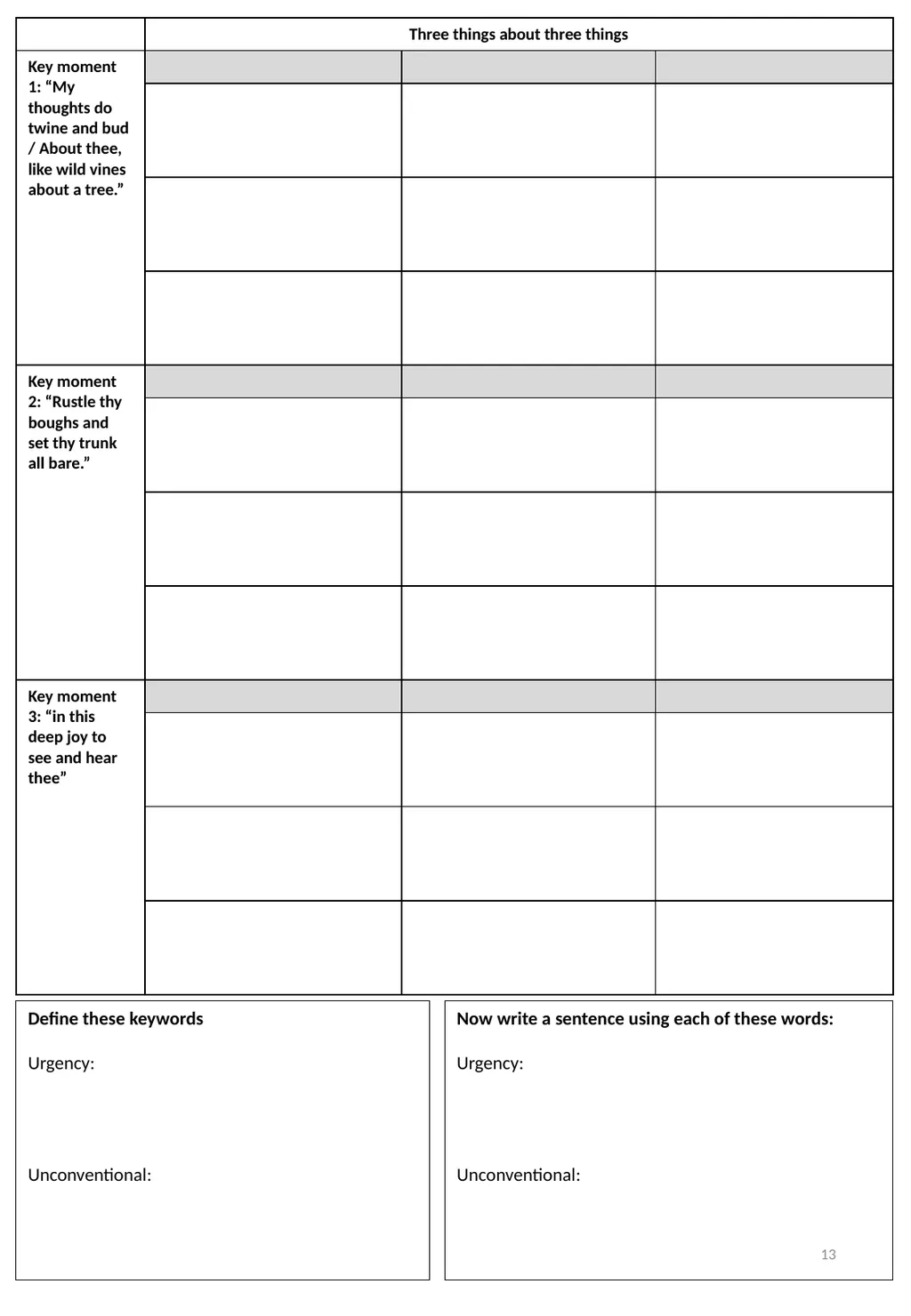
13 Define these keywords
Urgency:
Unconventional: Now write a sentence using each of these words:
Urgency:
Unconventional:<br>
Urgency:
Unconventional: Now write a sentence using each of these words:
Urgency:
Unconventional:<br>
14
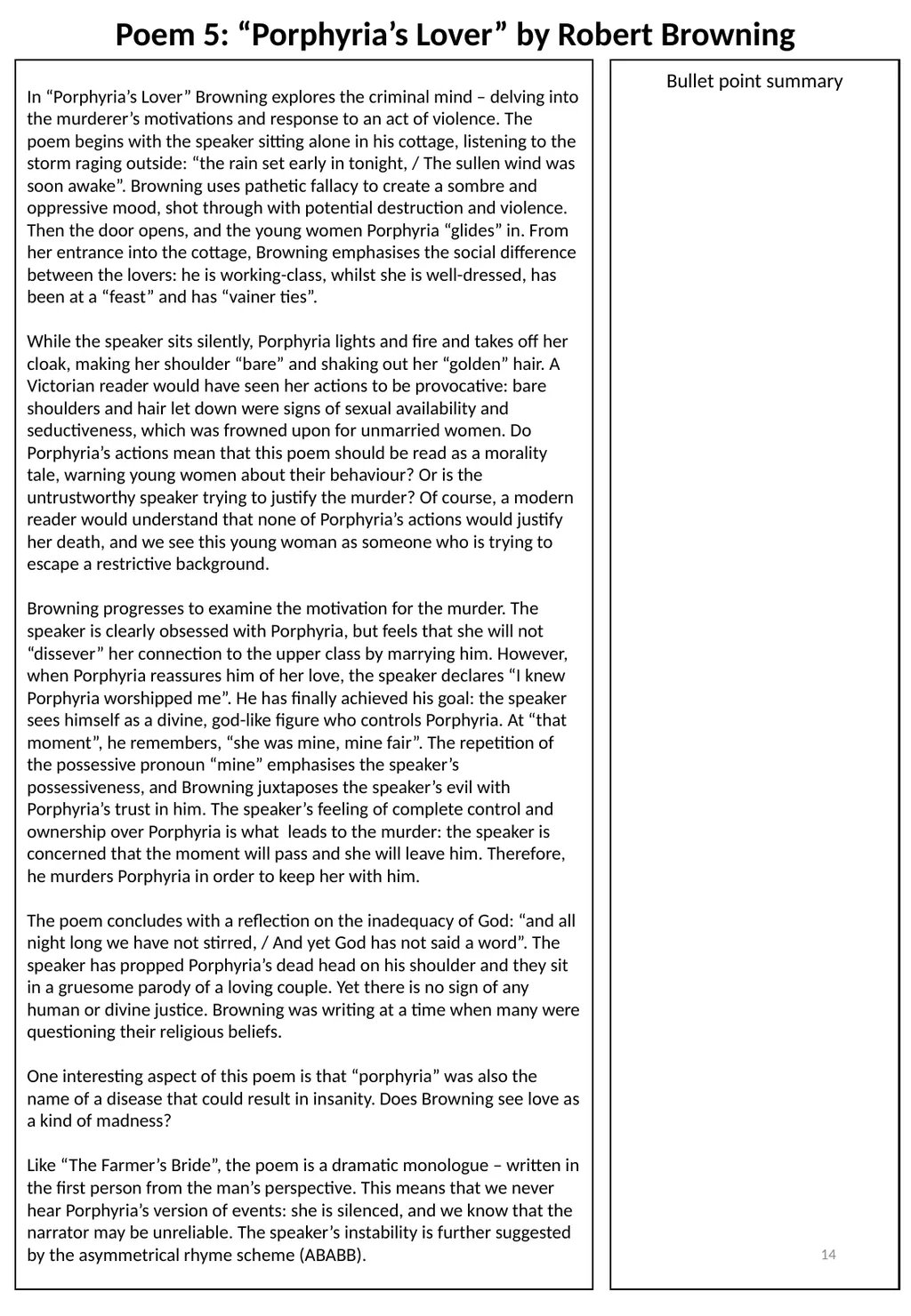
14 Poem 5: “Porphyria’s Lover” by Robert Browning Bullet point summary In “Porphyria’s Lover” Browning explores the criminal mind – delving into the murderer’s motivations and response to an act of violence. The poem begins with the speaker sitting alone in his cottage, listening to the storm raging outside: “the rain set early in tonight, / The sullen wind was soon awake”. Browning uses pathetic fallacy to create a sombre and oppressive mood, shot through with potential destruction and violence. Then the door opens, and the young women Porphyria “glides” in. From her entrance into the cottage, Browning emphasises the social difference between the lovers: he is working-class, whilst she is well-dressed, has been at a “feast” and has “vainer ties”.
While the speaker sits silently, Porphyria lights and fire and takes off her cloak, making her shoulder “bare” and shaking out her “golden” hair. A Victorian reader would have seen her actions to be provocative: bare shoulders and hair let down were signs of sexual availability and seductiveness, which was frowned upon for unmarried women. Do Porphyria’s actions mean that this poem should be read as a morality tale, warning young women about their behaviour? Or is the untrustworthy speaker trying to justify the murder? Of course, a modern reader would understand that none of Porphyria’s actions would justify her death, and we see this young woman as someone who is trying to escape a restrictive background.
Browning progresses to examine the motivation for the murder. The speaker is clearly obsessed with Porphyria, but feels that she will not “dissever” her connection to the upper class by marrying him. However, when Porphyria reassures him of her love, the speaker declares “I knew Porphyria worshipped me”. He has finally achieved his goal: the speaker sees himself as a divine, god-like figure who controls Porphyria. At “that moment”, he remembers, “she was mine, mine fair”. The repetition of the possessive pronoun “mine” emphasises the speaker’s possessiveness, and Browning juxtaposes the speaker’s evil with Porphyria’s trust in him. The speaker’s feeling of complete control and ownership over Porphyria is what leads to the murder: the speaker is concerned that the moment will pass and she will leave him. Therefore, he murders Porphyria in order to keep her with him.
The poem concludes with a reflection on the inadequacy of God: “and all night long we have not stirred, / And yet God has not said a word”. The speaker has propped Porphyria’s dead head on his shoulder and they sit in a gruesome parody of a loving couple. Yet there is no sign of any human or divine justice. Browning was writing at a time when many were questioning their religious beliefs.
One interesting aspect of this poem is that “porphyria” was also the name of a disease that could result in insanity. Does Browning see love as a kind of madness?
Like “The Farmer’s Bride”, the poem is a dramatic monologue – written in the first person from the man’s perspective. This means that we never hear Porphyria’s version of events: she is silenced, and we know that the narrator may be unreliable. The speaker’s instability is further suggested by the asymmetrical rhyme scheme (ABABB).<br>
While the speaker sits silently, Porphyria lights and fire and takes off her cloak, making her shoulder “bare” and shaking out her “golden” hair. A Victorian reader would have seen her actions to be provocative: bare shoulders and hair let down were signs of sexual availability and seductiveness, which was frowned upon for unmarried women. Do Porphyria’s actions mean that this poem should be read as a morality tale, warning young women about their behaviour? Or is the untrustworthy speaker trying to justify the murder? Of course, a modern reader would understand that none of Porphyria’s actions would justify her death, and we see this young woman as someone who is trying to escape a restrictive background.
Browning progresses to examine the motivation for the murder. The speaker is clearly obsessed with Porphyria, but feels that she will not “dissever” her connection to the upper class by marrying him. However, when Porphyria reassures him of her love, the speaker declares “I knew Porphyria worshipped me”. He has finally achieved his goal: the speaker sees himself as a divine, god-like figure who controls Porphyria. At “that moment”, he remembers, “she was mine, mine fair”. The repetition of the possessive pronoun “mine” emphasises the speaker’s possessiveness, and Browning juxtaposes the speaker’s evil with Porphyria’s trust in him. The speaker’s feeling of complete control and ownership over Porphyria is what leads to the murder: the speaker is concerned that the moment will pass and she will leave him. Therefore, he murders Porphyria in order to keep her with him.
The poem concludes with a reflection on the inadequacy of God: “and all night long we have not stirred, / And yet God has not said a word”. The speaker has propped Porphyria’s dead head on his shoulder and they sit in a gruesome parody of a loving couple. Yet there is no sign of any human or divine justice. Browning was writing at a time when many were questioning their religious beliefs.
One interesting aspect of this poem is that “porphyria” was also the name of a disease that could result in insanity. Does Browning see love as a kind of madness?
Like “The Farmer’s Bride”, the poem is a dramatic monologue – written in the first person from the man’s perspective. This means that we never hear Porphyria’s version of events: she is silenced, and we know that the narrator may be unreliable. The speaker’s instability is further suggested by the asymmetrical rhyme scheme (ABABB).<br>
15
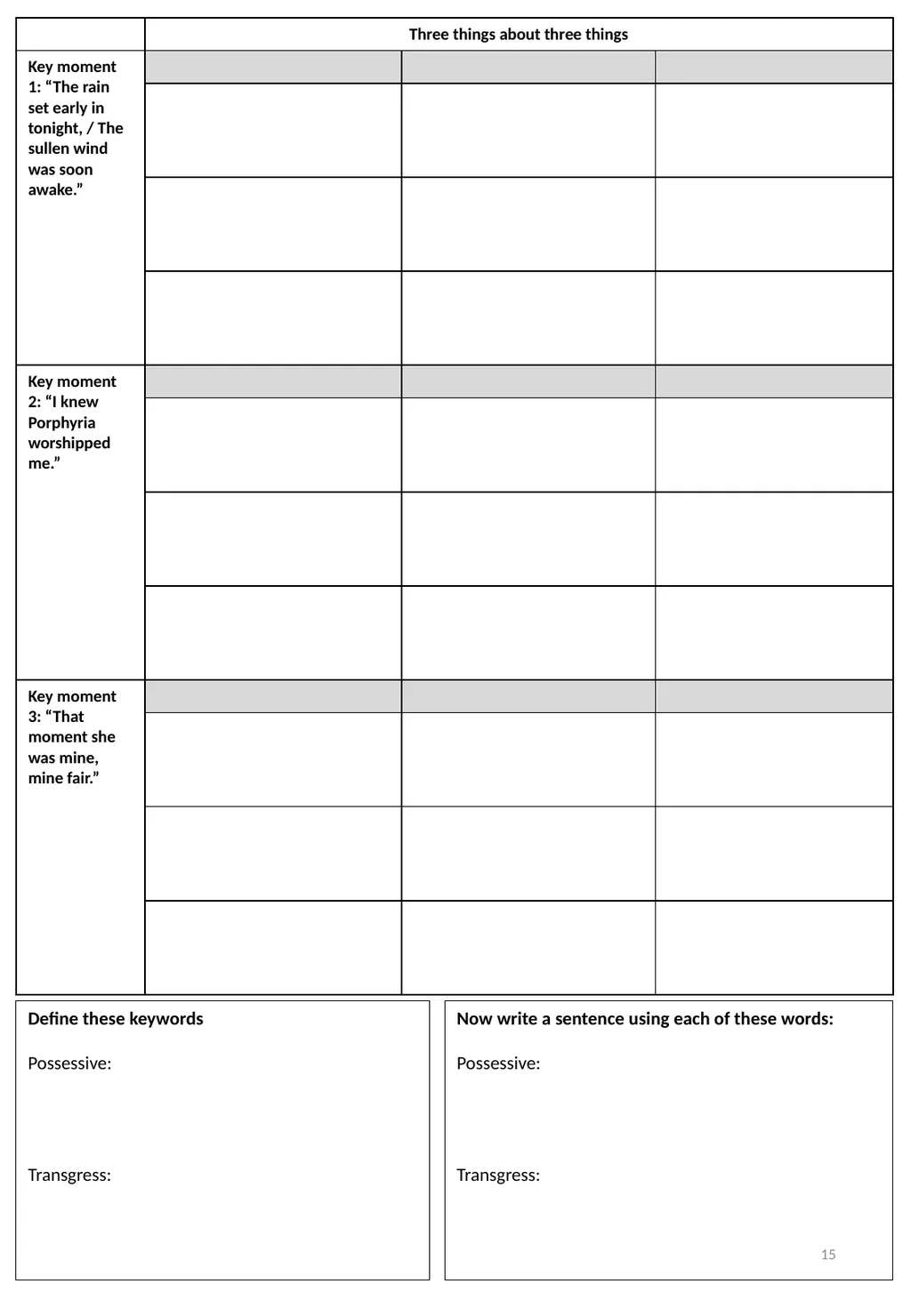
15 Define these keywords
Possessive:
Transgress: Now write a sentence using each of these words:
Possessive:
Transgress:<br>
Possessive:
Transgress: Now write a sentence using each of these words:
Possessive:
Transgress:<br>
16
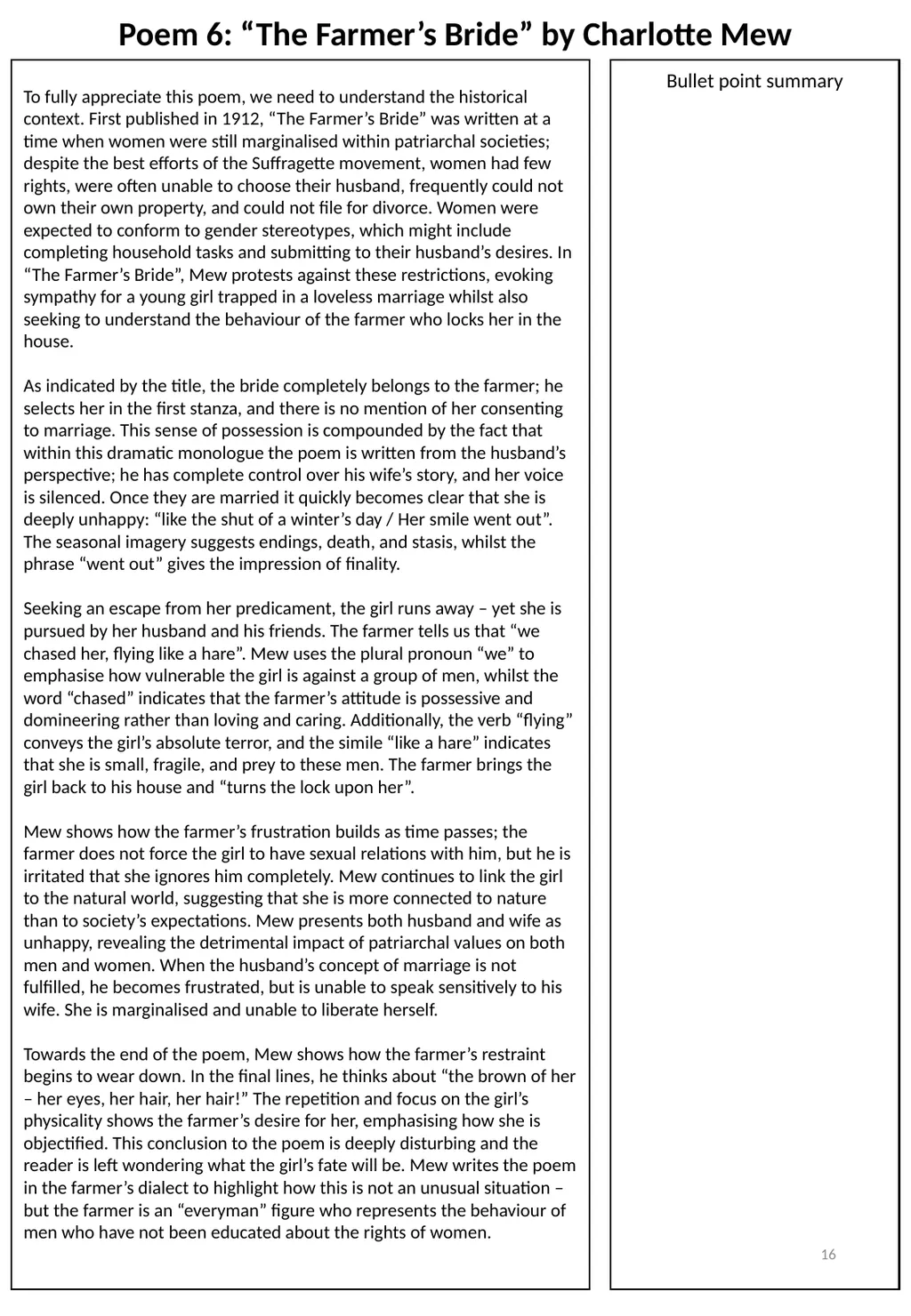
16 Poem 6: “The Farmer’s Bride” by Charlotte Mew Bullet point summary To fully appreciate this poem, we need to understand the historical context. First published in 1912, “The Farmer’s Bride” was written at a time when women were still marginalised within patriarchal societies; despite the best efforts of the Suffragette movement, women had few rights, were often unable to choose their husband, frequently could not own their own property, and could not file for divorce. Women were expected to conform to gender stereotypes, which might include completing household tasks and submitting to their husband’s desires. In “The Farmer’s Bride”, Mew protests against these restrictions, evoking sympathy for a young girl trapped in a loveless marriage whilst also seeking to understand the behaviour of the farmer who locks her in the house.
As indicated by the title, the bride completely belongs to the farmer; he selects her in the first stanza, and there is no mention of her consenting to marriage. This sense of possession is compounded by the fact that within this dramatic monologue the poem is written from the husband’s perspective; he has complete control over his wife’s story, and her voice is silenced. Once they are married it quickly becomes clear that she is deeply unhappy: “like the shut of a winter’s day / Her smile went out”. The seasonal imagery suggests endings, death, and stasis, whilst the phrase “went out” gives the impression of finality.
Seeking an escape from her predicament, the girl runs away – yet she is pursued by her husband and his friends. The farmer tells us that “we chased her, flying like a hare”. Mew uses the plural pronoun “we” to emphasise how vulnerable the girl is against a group of men, whilst the word “chased” indicates that the farmer’s attitude is possessive and domineering rather than loving and caring. Additionally, the verb “flying” conveys the girl’s absolute terror, and the simile “like a hare” indicates that she is small, fragile, and prey to these men. The farmer brings the girl back to his house and “turns the lock upon her”.
Mew shows how the farmer’s frustration builds as time passes; the farmer does not force the girl to have sexual relations with him, but he is irritated that she ignores him completely. Mew continues to link the girl to the natural world, suggesting that she is more connected to nature than to society’s expectations. Mew presents both husband and wife as unhappy, revealing the detrimental impact of patriarchal values on both men and women. When the husband’s concept of marriage is not fulfilled, he becomes frustrated, but is unable to speak sensitively to his wife. She is marginalised and unable to liberate herself.
Towards the end of the poem, Mew shows how the farmer’s restraint begins to wear down. In the final lines, he thinks about “the brown of her – her eyes, her hair, her hair!” The repetition and focus on the girl’s physicality shows the farmer’s desire for her, emphasising how she is objectified. This conclusion to the poem is deeply disturbing and the reader is left wondering what the girl’s fate will be. Mew writes the poem in the farmer’s dialect to highlight how this is not an unusual situation – but the farmer is an “everyman” figure who represents the behaviour of men who have not been educated about the rights of women.<br>
As indicated by the title, the bride completely belongs to the farmer; he selects her in the first stanza, and there is no mention of her consenting to marriage. This sense of possession is compounded by the fact that within this dramatic monologue the poem is written from the husband’s perspective; he has complete control over his wife’s story, and her voice is silenced. Once they are married it quickly becomes clear that she is deeply unhappy: “like the shut of a winter’s day / Her smile went out”. The seasonal imagery suggests endings, death, and stasis, whilst the phrase “went out” gives the impression of finality.
Seeking an escape from her predicament, the girl runs away – yet she is pursued by her husband and his friends. The farmer tells us that “we chased her, flying like a hare”. Mew uses the plural pronoun “we” to emphasise how vulnerable the girl is against a group of men, whilst the word “chased” indicates that the farmer’s attitude is possessive and domineering rather than loving and caring. Additionally, the verb “flying” conveys the girl’s absolute terror, and the simile “like a hare” indicates that she is small, fragile, and prey to these men. The farmer brings the girl back to his house and “turns the lock upon her”.
Mew shows how the farmer’s frustration builds as time passes; the farmer does not force the girl to have sexual relations with him, but he is irritated that she ignores him completely. Mew continues to link the girl to the natural world, suggesting that she is more connected to nature than to society’s expectations. Mew presents both husband and wife as unhappy, revealing the detrimental impact of patriarchal values on both men and women. When the husband’s concept of marriage is not fulfilled, he becomes frustrated, but is unable to speak sensitively to his wife. She is marginalised and unable to liberate herself.
Towards the end of the poem, Mew shows how the farmer’s restraint begins to wear down. In the final lines, he thinks about “the brown of her – her eyes, her hair, her hair!” The repetition and focus on the girl’s physicality shows the farmer’s desire for her, emphasising how she is objectified. This conclusion to the poem is deeply disturbing and the reader is left wondering what the girl’s fate will be. Mew writes the poem in the farmer’s dialect to highlight how this is not an unusual situation – but the farmer is an “everyman” figure who represents the behaviour of men who have not been educated about the rights of women.<br>
17
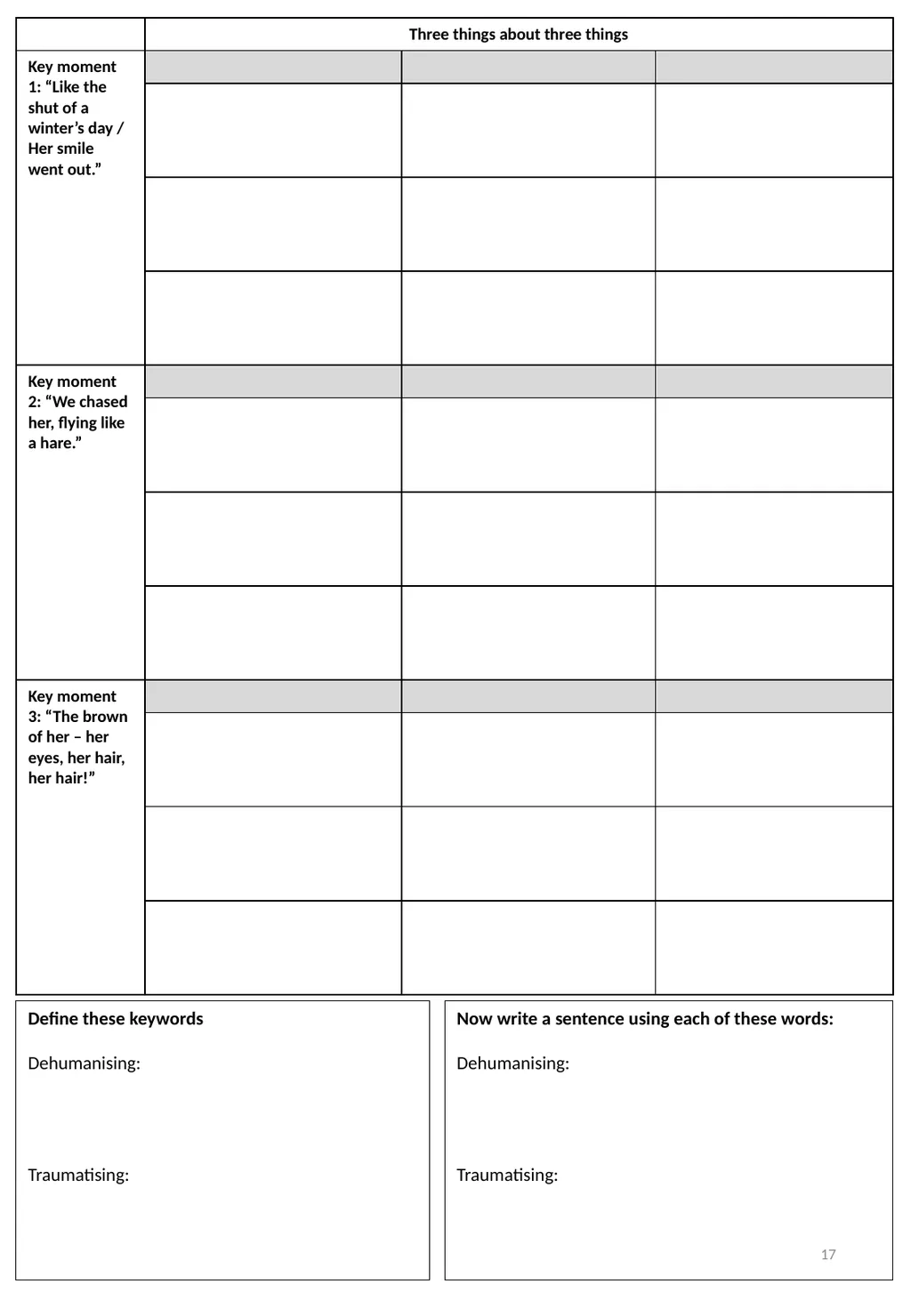
17 Define these keywords
Dehumanising:
Traumatising: Now write a sentence using each of these words:
Dehumanising:
Traumatising:<br>
Dehumanising:
Traumatising: Now write a sentence using each of these words:
Dehumanising:
Traumatising:<br>
18
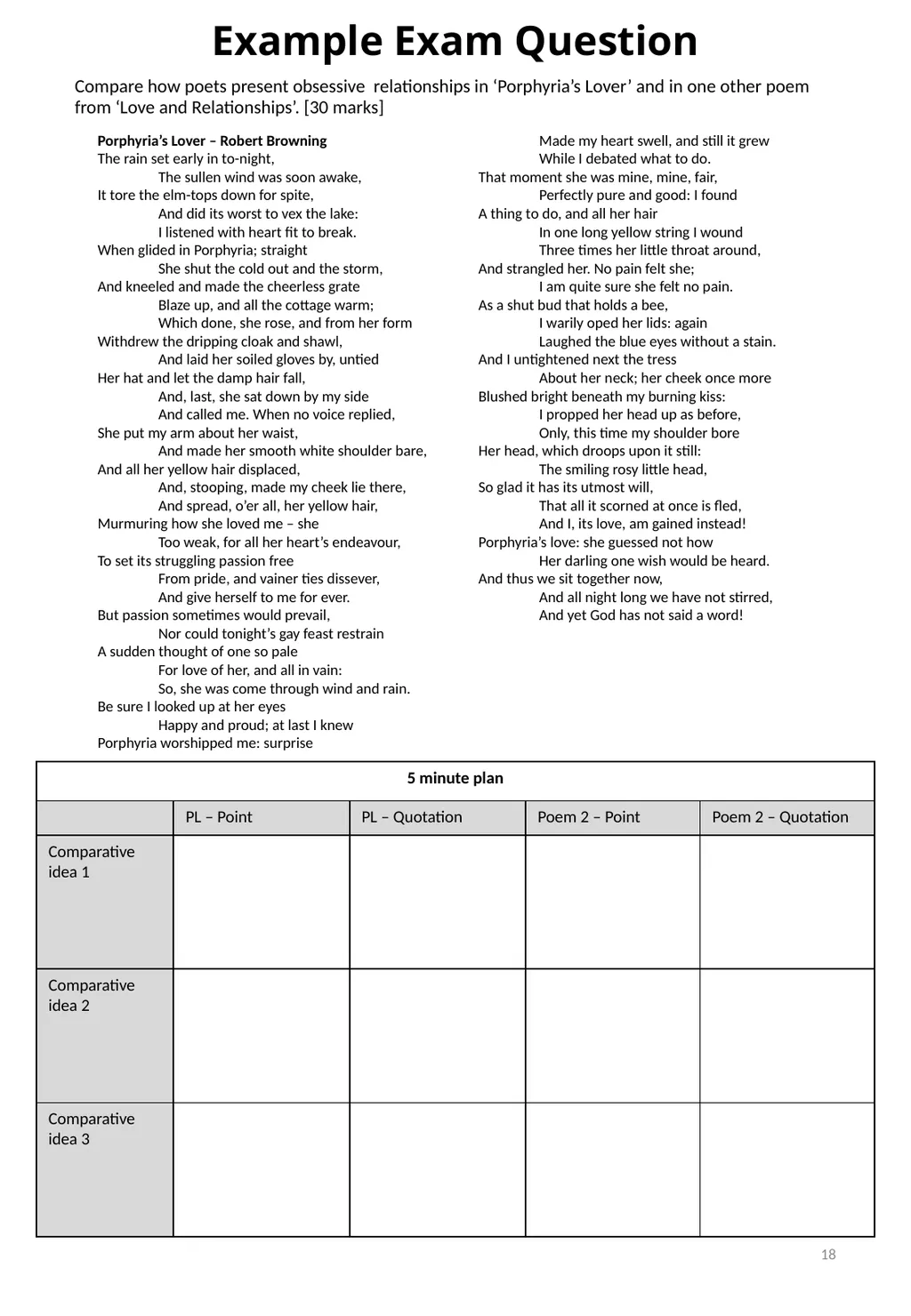
18 Example Exam Question Compare how poets present obsessive relationships in ‘Porphyria’s Lover’ and in one other poem from ‘Love and Relationships’. [30 marks] Porphyria’s Lover – Robert Browning
The rain set early in to-night,
The sullen wind was soon awake,
It tore the elm-tops down for spite,
And did its worst to vex the lake:
I listened with heart fit to break.
When glided in Porphyria; straight
She shut the cold out and the storm,
And kneeled and made the cheerless grate
Blaze up, and all the cottage warm;
Which done, she rose, and from her form
Withdrew the dripping cloak and shawl,
And laid her soiled gloves by, untied
Her hat and let the damp hair fall,
And, last, she sat down by my side
And called me. When no voice replied,
She put my arm about her waist,
And made her smooth white shoulder bare,
And all her yellow hair displaced,
And, stooping, made my cheek lie there,
And spread, o’er all, her yellow hair,
Murmuring how she loved me – she
Too weak, for all her heart’s endeavour,
To set its struggling passion free
From pride, and vainer ties dissever,
And give herself to me for ever.
But passion sometimes would prevail,
Nor could tonight’s gay feast restrain
A sudden thought of one so pale
For love of her, and all in vain:
So, she was come through wind and rain.
Be sure I looked up at her eyes
Happy and proud; at last I knew
Porphyria worshipped me: surprise
Made my heart swell, and still it grew
While I debated what to do.
That moment she was mine, mine, fair,
Perfectly pure and good: I found
A thing to do, and all her hair
In one long yellow string I wound
Three times her little throat around,
And strangled her. No pain felt she;
I am quite sure she felt no pain.
As a shut bud that holds a bee,
I warily oped her lids: again
Laughed the blue eyes without a stain.
And I untightened next the tress
About her neck; her cheek once more
Blushed bright beneath my burning kiss:
I propped her head up as before,
Only, this time my shoulder bore
Her head, which droops upon it still:
The smiling rosy little head,
So glad it has its utmost will,
That all it scorned at once is fled,
And I, its love, am gained instead!
Porphyria’s love: she guessed not how
Her darling one wish would be heard.
And thus we sit together now,
And all night long we have not stirred,
And yet God has not said a word!<br>
The rain set early in to-night,
The sullen wind was soon awake,
It tore the elm-tops down for spite,
And did its worst to vex the lake:
I listened with heart fit to break.
When glided in Porphyria; straight
She shut the cold out and the storm,
And kneeled and made the cheerless grate
Blaze up, and all the cottage warm;
Which done, she rose, and from her form
Withdrew the dripping cloak and shawl,
And laid her soiled gloves by, untied
Her hat and let the damp hair fall,
And, last, she sat down by my side
And called me. When no voice replied,
She put my arm about her waist,
And made her smooth white shoulder bare,
And all her yellow hair displaced,
And, stooping, made my cheek lie there,
And spread, o’er all, her yellow hair,
Murmuring how she loved me – she
Too weak, for all her heart’s endeavour,
To set its struggling passion free
From pride, and vainer ties dissever,
And give herself to me for ever.
But passion sometimes would prevail,
Nor could tonight’s gay feast restrain
A sudden thought of one so pale
For love of her, and all in vain:
So, she was come through wind and rain.
Be sure I looked up at her eyes
Happy and proud; at last I knew
Porphyria worshipped me: surprise
Made my heart swell, and still it grew
While I debated what to do.
That moment she was mine, mine, fair,
Perfectly pure and good: I found
A thing to do, and all her hair
In one long yellow string I wound
Three times her little throat around,
And strangled her. No pain felt she;
I am quite sure she felt no pain.
As a shut bud that holds a bee,
I warily oped her lids: again
Laughed the blue eyes without a stain.
And I untightened next the tress
About her neck; her cheek once more
Blushed bright beneath my burning kiss:
I propped her head up as before,
Only, this time my shoulder bore
Her head, which droops upon it still:
The smiling rosy little head,
So glad it has its utmost will,
That all it scorned at once is fled,
And I, its love, am gained instead!
Porphyria’s love: she guessed not how
Her darling one wish would be heard.
And thus we sit together now,
And all night long we have not stirred,
And yet God has not said a word!<br>
19
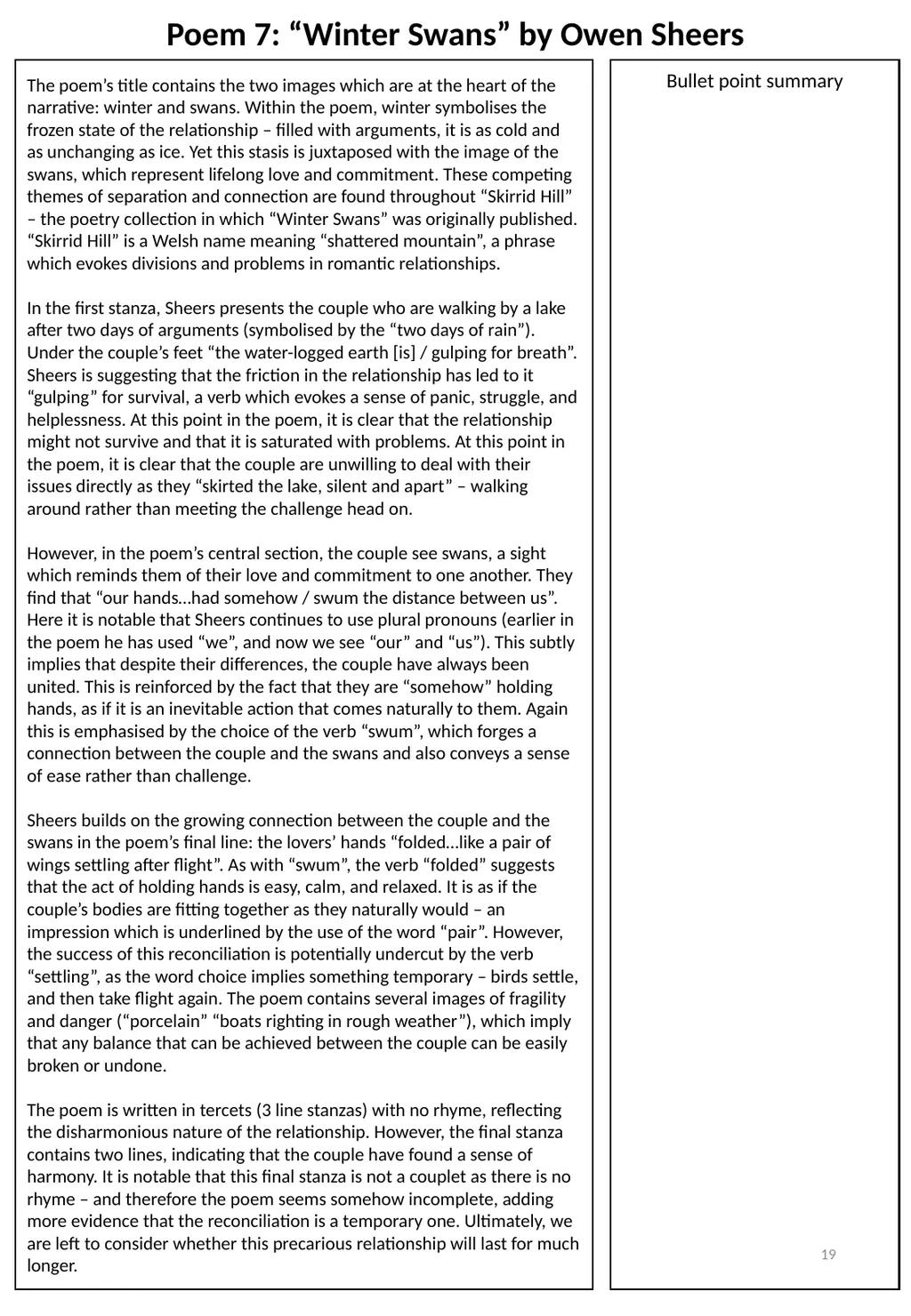
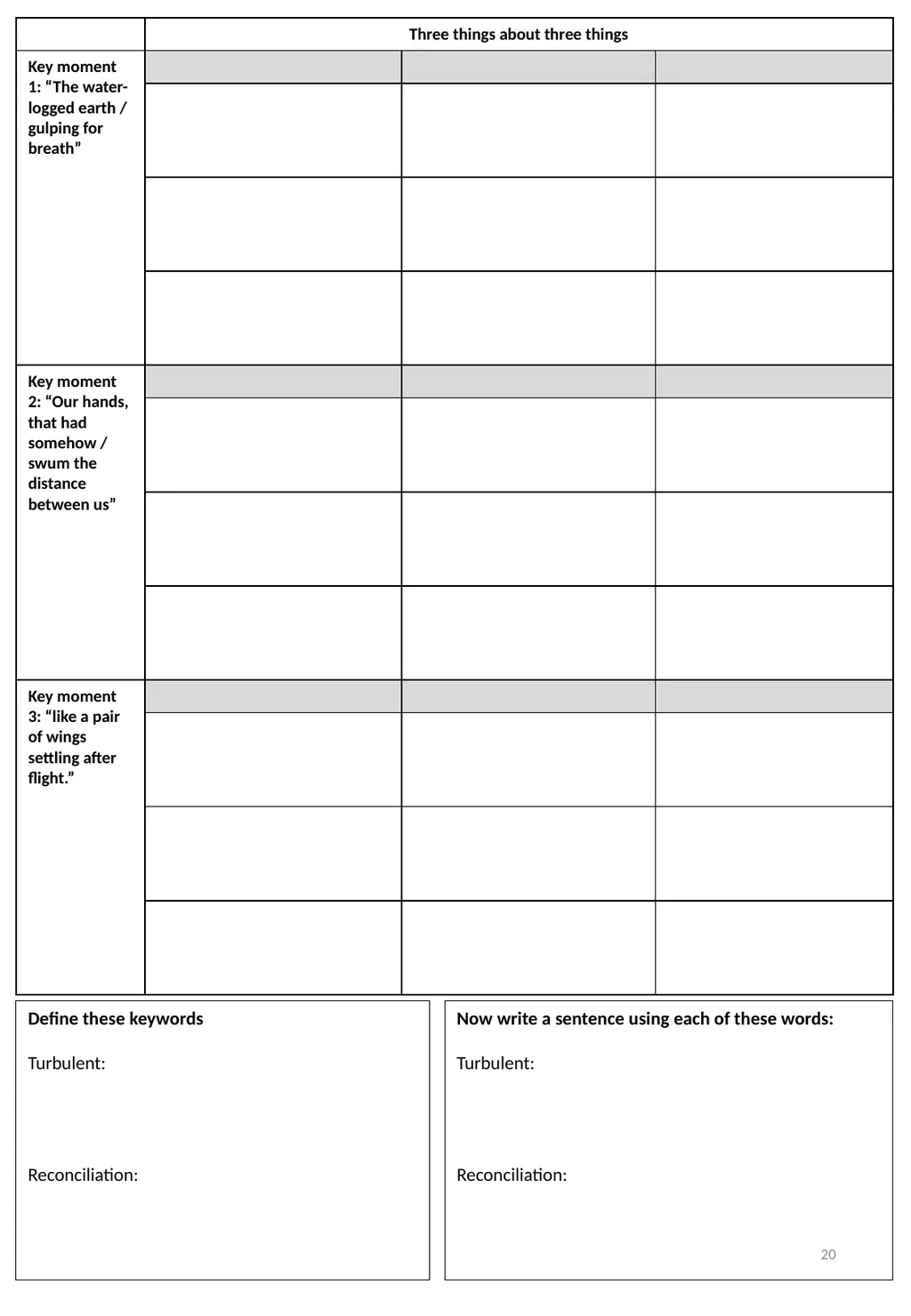
19 Poem 7: “Winter Swans” by Owen Sheers Bullet point summary The poem’s title contains the two images which are at the heart of the narrative: winter and swans. Within the poem, winter symbolises the frozen state of the relationship – filled with arguments, it is as cold and as unchanging as ice. Yet this stasis is juxtaposed with the image of the swans, which represent lifelong love and commitment. These competing themes of separation and connection are found throughout “Skirrid Hill” – the poetry collection in which “Winter Swans” was originally published. “Skirrid Hill” is a Welsh name meaning “shattered mountain”, a phrase which evokes divisions and problems in romantic relationships.
In the first stanza, Sheers presents the couple who are walking by a lake after two days of arguments (symbolised by the “two days of rain”). Under the couple’s feet “the water-logged earth [is] / gulping for breath”. Sheers is suggesting that the friction in the relationship has led to it “gulping” for survival, a verb which evokes a sense of panic, struggle, and helplessness. At this point in the poem, it is clear that the relationship might not survive and that it is saturated with problems. At this point in the poem, it is clear that the couple are unwilling to deal with their issues directly as they “skirted the lake, silent and apart” – walking around rather than meeting the challenge head on.
However, in the poem’s central section, the couple see swans, a sight which reminds them of their love and commitment to one another. They find that “our hands…had somehow / swum the distance between us”. Here it is notable that Sheers continues to use plural pronouns (earlier in the poem he has used “we”, and now we see “our” and “us”). This subtly implies that despite their differences, the couple have always been united. This is reinforced by the fact that they are “somehow” holding hands, as if it is an inevitable action that comes naturally to them. Again this is emphasised by the choice of the verb “swum”, which forges a connection between the couple and the swans and also conveys a sense of ease rather than challenge.
Sheers builds on the growing connection between the couple and the swans in the poem’s final line: the lovers’ hands “folded…like a pair of wings settling after flight”. As with “swum”, the verb “folded” suggests that the act of holding hands is easy, calm, and relaxed. It is as if the couple’s bodies are fitting together as they naturally would – an impression which is underlined by the use of the word “pair”. However, the success of this reconciliation is potentially undercut by the verb “settling”, as the word choice implies something temporary – birds settle, and then take flight again. The poem contains several images of fragility and danger (“porcelain” “boats righting in rough weather”), which imply that any balance that can be achieved between the couple can be easily broken or undone.
The poem is written in tercets (3 line stanzas) with no rhyme, reflecting the disharmonious nature of the relationship. However, the final stanza contains two lines, indicating that the couple have found a sense of harmony. It is notable that this final stanza is not a couplet as there is no rhyme – and therefore the poem seems somehow incomplete, adding more evidence that the reconciliation is a temporary one. Ultimately, we are left to consider whether this precarious relationship will last for much longer.<br>
In the first stanza, Sheers presents the couple who are walking by a lake after two days of arguments (symbolised by the “two days of rain”). Under the couple’s feet “the water-logged earth [is] / gulping for breath”. Sheers is suggesting that the friction in the relationship has led to it “gulping” for survival, a verb which evokes a sense of panic, struggle, and helplessness. At this point in the poem, it is clear that the relationship might not survive and that it is saturated with problems. At this point in the poem, it is clear that the couple are unwilling to deal with their issues directly as they “skirted the lake, silent and apart” – walking around rather than meeting the challenge head on.
However, in the poem’s central section, the couple see swans, a sight which reminds them of their love and commitment to one another. They find that “our hands…had somehow / swum the distance between us”. Here it is notable that Sheers continues to use plural pronouns (earlier in the poem he has used “we”, and now we see “our” and “us”). This subtly implies that despite their differences, the couple have always been united. This is reinforced by the fact that they are “somehow” holding hands, as if it is an inevitable action that comes naturally to them. Again this is emphasised by the choice of the verb “swum”, which forges a connection between the couple and the swans and also conveys a sense of ease rather than challenge.
Sheers builds on the growing connection between the couple and the swans in the poem’s final line: the lovers’ hands “folded…like a pair of wings settling after flight”. As with “swum”, the verb “folded” suggests that the act of holding hands is easy, calm, and relaxed. It is as if the couple’s bodies are fitting together as they naturally would – an impression which is underlined by the use of the word “pair”. However, the success of this reconciliation is potentially undercut by the verb “settling”, as the word choice implies something temporary – birds settle, and then take flight again. The poem contains several images of fragility and danger (“porcelain” “boats righting in rough weather”), which imply that any balance that can be achieved between the couple can be easily broken or undone.
The poem is written in tercets (3 line stanzas) with no rhyme, reflecting the disharmonious nature of the relationship. However, the final stanza contains two lines, indicating that the couple have found a sense of harmony. It is notable that this final stanza is not a couplet as there is no rhyme – and therefore the poem seems somehow incomplete, adding more evidence that the reconciliation is a temporary one. Ultimately, we are left to consider whether this precarious relationship will last for much longer.<br>
20
20 Define these keywords
Turbulent:
Reconciliation: Now write a sentence using each of these words:
Turbulent:
Reconciliation:<br>
Turbulent:
Reconciliation: Now write a sentence using each of these words:
Turbulent:
Reconciliation:<br>
21
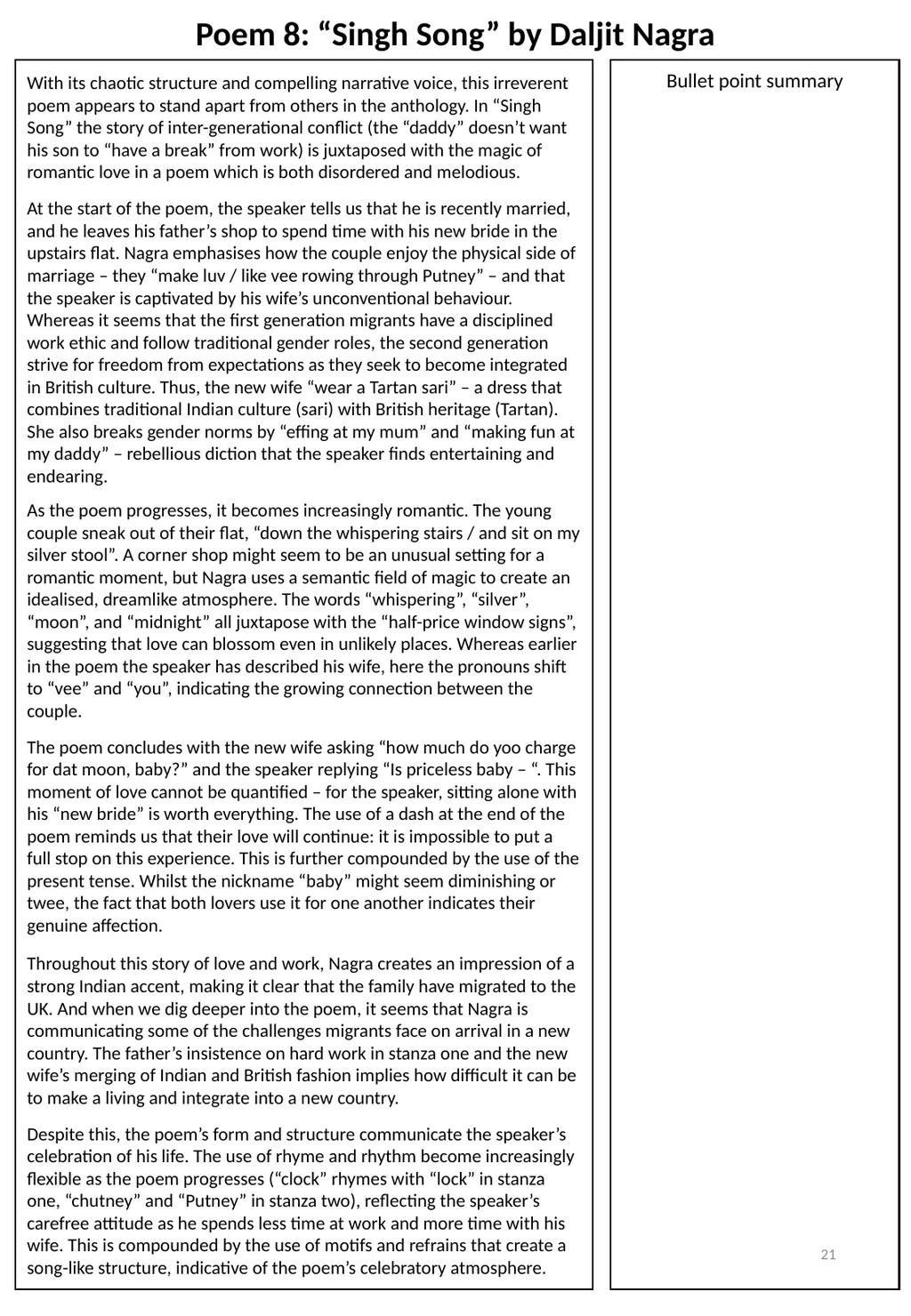
21 Poem 8: “Singh Song” by Daljit Nagra Bullet point summary With its chaotic structure and compelling narrative voice, this irreverent poem appears to stand apart from others in the anthology. In “Singh Song” the story of inter-generational conflict (the “daddy” doesn’t want his son to “have a break” from work) is juxtaposed with the magic of romantic love in a poem which is both disordered and melodious.
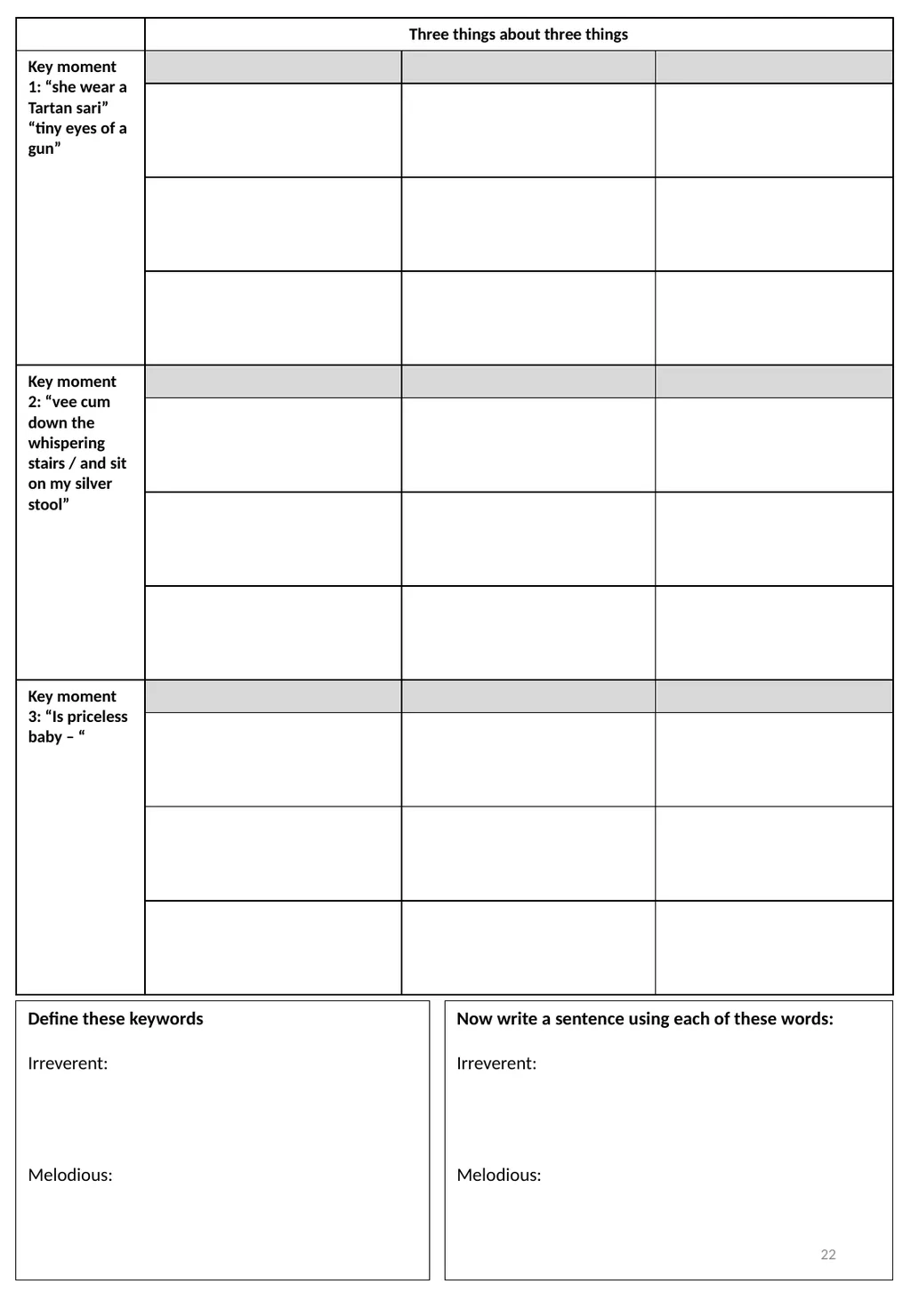
At the start of the poem, the speaker tells us that he is recently married, and he leaves his father’s shop to spend time with his new bride in the upstairs flat. Nagra emphasises how the couple enjoy the physical side of marriage – they “make luv / like vee rowing through Putney” – and that the speaker is captivated by his wife’s unconventional behaviour. Whereas it seems that the first generation migrants have a disciplined work ethic and follow traditional gender roles, the second generation strive for freedom from expectations as they seek to become integrated in British culture. Thus, the new wife “wear a Tartan sari” – a dress that combines traditional Indian culture (sari) with British heritage (Tartan). She also breaks gender norms by “effing at my mum” and “making fun at my daddy” – rebellious diction that the speaker finds entertaining and endearing.
As the poem progresses, it becomes increasingly romantic. The young couple sneak out of their flat, “down the whispering stairs / and sit on my silver stool”. A corner shop might seem to be an unusual setting for a romantic moment, but Nagra uses a semantic field of magic to create an idealised, dreamlike atmosphere. The words “whispering”, “silver”, “moon”, and “midnight” all juxtapose with the “half-price window signs”, suggesting that love can blossom even in unlikely places. Whereas earlier in the poem the speaker has described his wife, here the pronouns shift to “vee” and “you”, indicating the growing connection between the couple.
The poem concludes with the new wife asking “how much do yoo charge for dat moon, baby?” and the speaker replying “Is priceless baby – “. This moment of love cannot be quantified – for the speaker, sitting alone with his “new bride” is worth everything. The use of a dash at the end of the poem reminds us that their love will continue: it is impossible to put a full stop on this experience. This is further compounded by the use of the present tense. Whilst the nickname “baby” might seem diminishing or twee, the fact that both lovers use it for one another indicates their genuine affection.
Throughout this story of love and work, Nagra creates an impression of a strong Indian accent, making it clear that the family have migrated to the UK. And when we dig deeper into the poem, it seems that Nagra is communicating some of the challenges migrants face on arrival in a new country. The father’s insistence on hard work in stanza one and the new wife’s merging of Indian and British fashion implies how difficult it can be to make a living and integrate into a new country.
Despite this, the poem’s form and structure communicate the speaker’s celebration of his life. The use of rhyme and rhythm become increasingly flexible as the poem progresses (“clock” rhymes with “lock” in stanza one, “chutney” and “Putney” in stanza two), reflecting the speaker’s carefree attitude as he spends less time at work and more time with his wife. This is compounded by the use of motifs and refrains that create a song-like structure, indicative of the poem’s celebratory atmosphere.<br>
At the start of the poem, the speaker tells us that he is recently married, and he leaves his father’s shop to spend time with his new bride in the upstairs flat. Nagra emphasises how the couple enjoy the physical side of marriage – they “make luv / like vee rowing through Putney” – and that the speaker is captivated by his wife’s unconventional behaviour. Whereas it seems that the first generation migrants have a disciplined work ethic and follow traditional gender roles, the second generation strive for freedom from expectations as they seek to become integrated in British culture. Thus, the new wife “wear a Tartan sari” – a dress that combines traditional Indian culture (sari) with British heritage (Tartan). She also breaks gender norms by “effing at my mum” and “making fun at my daddy” – rebellious diction that the speaker finds entertaining and endearing.
As the poem progresses, it becomes increasingly romantic. The young couple sneak out of their flat, “down the whispering stairs / and sit on my silver stool”. A corner shop might seem to be an unusual setting for a romantic moment, but Nagra uses a semantic field of magic to create an idealised, dreamlike atmosphere. The words “whispering”, “silver”, “moon”, and “midnight” all juxtapose with the “half-price window signs”, suggesting that love can blossom even in unlikely places. Whereas earlier in the poem the speaker has described his wife, here the pronouns shift to “vee” and “you”, indicating the growing connection between the couple.
The poem concludes with the new wife asking “how much do yoo charge for dat moon, baby?” and the speaker replying “Is priceless baby – “. This moment of love cannot be quantified – for the speaker, sitting alone with his “new bride” is worth everything. The use of a dash at the end of the poem reminds us that their love will continue: it is impossible to put a full stop on this experience. This is further compounded by the use of the present tense. Whilst the nickname “baby” might seem diminishing or twee, the fact that both lovers use it for one another indicates their genuine affection.
Throughout this story of love and work, Nagra creates an impression of a strong Indian accent, making it clear that the family have migrated to the UK. And when we dig deeper into the poem, it seems that Nagra is communicating some of the challenges migrants face on arrival in a new country. The father’s insistence on hard work in stanza one and the new wife’s merging of Indian and British fashion implies how difficult it can be to make a living and integrate into a new country.
Despite this, the poem’s form and structure communicate the speaker’s celebration of his life. The use of rhyme and rhythm become increasingly flexible as the poem progresses (“clock” rhymes with “lock” in stanza one, “chutney” and “Putney” in stanza two), reflecting the speaker’s carefree attitude as he spends less time at work and more time with his wife. This is compounded by the use of motifs and refrains that create a song-like structure, indicative of the poem’s celebratory atmosphere.<br>
22
22 Define these keywords
Irreverent:
Melodious: Now write a sentence using each of these words:
Irreverent:
Melodious:<br>
Irreverent:
Melodious: Now write a sentence using each of these words:
Irreverent:
Melodious:<br>
23
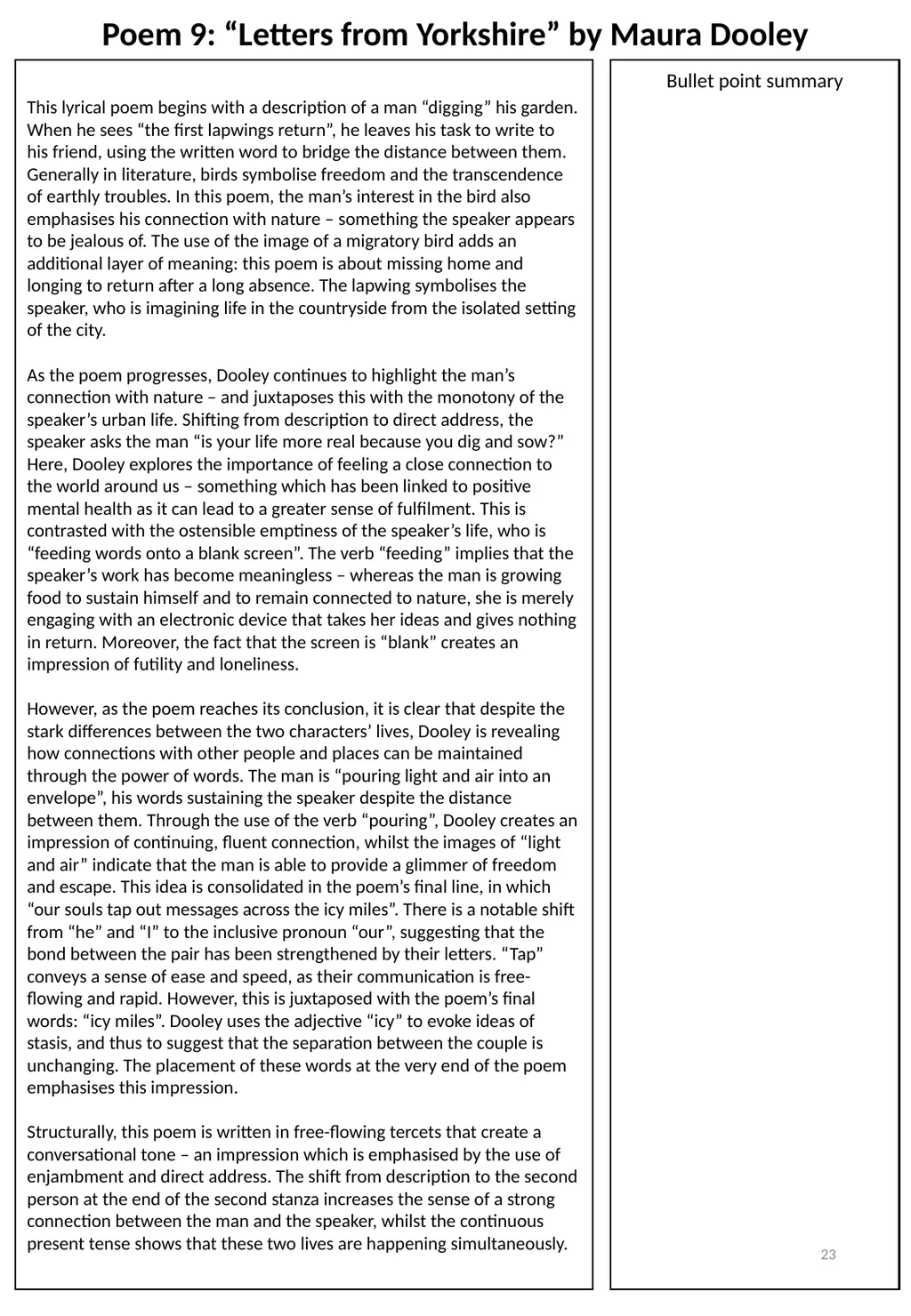
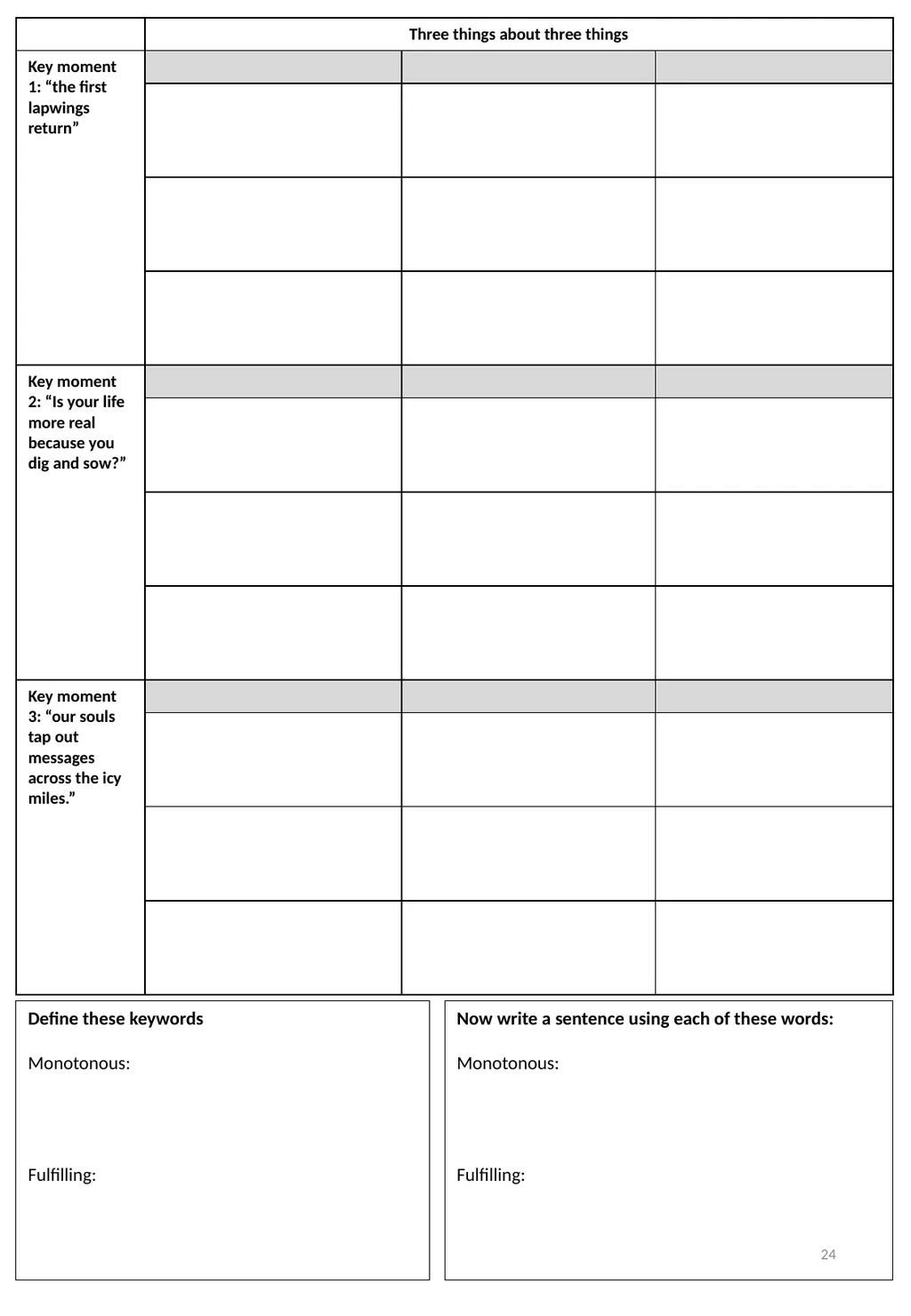
23 Poem 9: “Letters from Yorkshire” by Maura Dooley Bullet point summary This lyrical poem begins with a description of a man “digging” his garden. When he sees “the first lapwings return”, he leaves his task to write to his friend, using the written word to bridge the distance between them. Generally in literature, birds symbolise freedom and the transcendence of earthly troubles. In this poem, the man’s interest in the bird also emphasises his connection with nature – something the speaker appears to be jealous of. The use of the image of a migratory bird adds an additional layer of meaning: this poem is about missing home and longing to return after a long absence. The lapwing symbolises the speaker, who is imagining life in the countryside from the isolated setting of the city.
As the poem progresses, Dooley continues to highlight the man’s connection with nature – and juxtaposes this with the monotony of the speaker’s urban life. Shifting from description to direct address, the speaker asks the man “is your life more real because you dig and sow?” Here, Dooley explores the importance of feeling a close connection to the world around us – something which has been linked to positive mental health as it can lead to a greater sense of fulfilment. This is contrasted with the ostensible emptiness of the speaker’s life, who is “feeding words onto a blank screen”. The verb “feeding” implies that the speaker’s work has become meaningless – whereas the man is growing food to sustain himself and to remain connected to nature, she is merely engaging with an electronic device that takes her ideas and gives nothing in return. Moreover, the fact that the screen is “blank” creates an impression of futility and loneliness.
However, as the poem reaches its conclusion, it is clear that despite the stark differences between the two characters’ lives, Dooley is revealing how connections with other people and places can be maintained through the power of words. The man is “pouring light and air into an envelope”, his words sustaining the speaker despite the distance between them. Through the use of the verb “pouring”, Dooley creates an impression of continuing, fluent connection, whilst the images of “light and air” indicate that the man is able to provide a glimmer of freedom and escape. This idea is consolidated in the poem’s final line, in which “our souls tap out messages across the icy miles”. There is a notable shift from “he” and “I” to the inclusive pronoun “our”, suggesting that the bond between the pair has been strengthened by their letters. “Tap” conveys a sense of ease and speed, as their communication is free-flowing and rapid. However, this is juxtaposed with the poem’s final words: “icy miles”. Dooley uses the adjective “icy” to evoke ideas of stasis, and thus to suggest that the separation between the couple is unchanging. The placement of these words at the very end of the poem emphasises this impression.
Structurally, this poem is written in free-flowing tercets that create a conversational tone – an impression which is emphasised by the use of enjambment and direct address. The shift from description to the second person at the end of the second stanza increases the sense of a strong connection between the man and the speaker, whilst the continuous present tense shows that these two lives are happening simultaneously.<br>
As the poem progresses, Dooley continues to highlight the man’s connection with nature – and juxtaposes this with the monotony of the speaker’s urban life. Shifting from description to direct address, the speaker asks the man “is your life more real because you dig and sow?” Here, Dooley explores the importance of feeling a close connection to the world around us – something which has been linked to positive mental health as it can lead to a greater sense of fulfilment. This is contrasted with the ostensible emptiness of the speaker’s life, who is “feeding words onto a blank screen”. The verb “feeding” implies that the speaker’s work has become meaningless – whereas the man is growing food to sustain himself and to remain connected to nature, she is merely engaging with an electronic device that takes her ideas and gives nothing in return. Moreover, the fact that the screen is “blank” creates an impression of futility and loneliness.
However, as the poem reaches its conclusion, it is clear that despite the stark differences between the two characters’ lives, Dooley is revealing how connections with other people and places can be maintained through the power of words. The man is “pouring light and air into an envelope”, his words sustaining the speaker despite the distance between them. Through the use of the verb “pouring”, Dooley creates an impression of continuing, fluent connection, whilst the images of “light and air” indicate that the man is able to provide a glimmer of freedom and escape. This idea is consolidated in the poem’s final line, in which “our souls tap out messages across the icy miles”. There is a notable shift from “he” and “I” to the inclusive pronoun “our”, suggesting that the bond between the pair has been strengthened by their letters. “Tap” conveys a sense of ease and speed, as their communication is free-flowing and rapid. However, this is juxtaposed with the poem’s final words: “icy miles”. Dooley uses the adjective “icy” to evoke ideas of stasis, and thus to suggest that the separation between the couple is unchanging. The placement of these words at the very end of the poem emphasises this impression.
Structurally, this poem is written in free-flowing tercets that create a conversational tone – an impression which is emphasised by the use of enjambment and direct address. The shift from description to the second person at the end of the second stanza increases the sense of a strong connection between the man and the speaker, whilst the continuous present tense shows that these two lives are happening simultaneously.<br>
24
24 Define these keywords
Monotonous:
Fulfilling: Now write a sentence using each of these words:
Monotonous:
Fulfilling:<br>
Monotonous:
Fulfilling: Now write a sentence using each of these words:
Monotonous:
Fulfilling:<br>
25
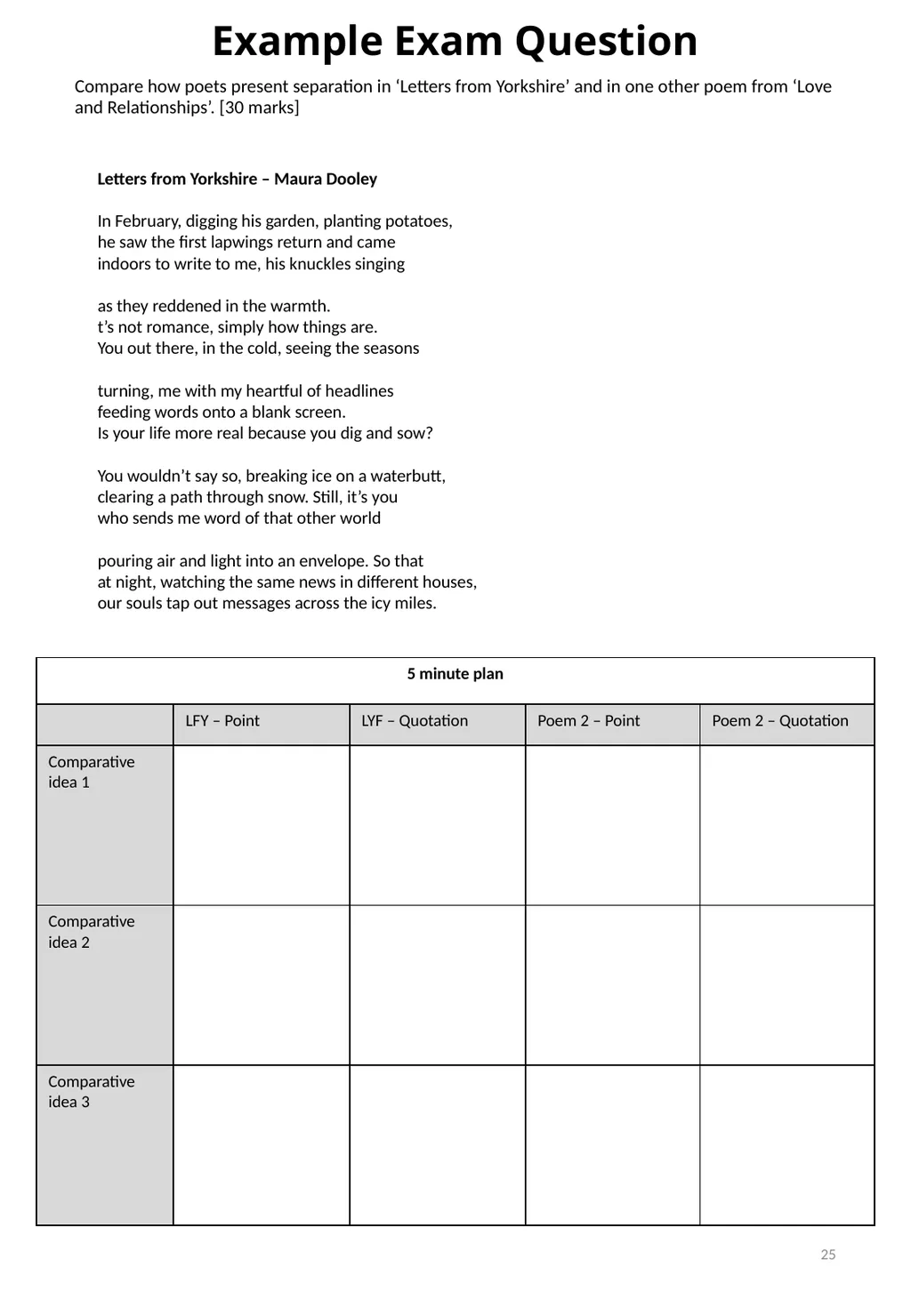
25 Example Exam Question Compare how poets present separation in ‘Letters from Yorkshire’ and in one other poem from ‘Love and Relationships’. [30 marks] Letters from Yorkshire – Maura Dooley
In February, digging his garden, planting potatoes,
he saw the first lapwings return and came
indoors to write to me, his knuckles singing
as they reddened in the warmth.
t’s not romance, simply how things are.
You out there, in the cold, seeing the seasons
turning, me with my heartful of headlines
feeding words onto a blank screen.
Is your life more real because you dig and sow?
You wouldn’t say so, breaking ice on a waterbutt,
clearing a path through snow. Still, it’s you
who sends me word of that other world
pouring air and light into an envelope. So that
at night, watching the same news in different houses,
our souls tap out messages across the icy miles.<br>
In February, digging his garden, planting potatoes,
he saw the first lapwings return and came
indoors to write to me, his knuckles singing
as they reddened in the warmth.
t’s not romance, simply how things are.
You out there, in the cold, seeing the seasons
turning, me with my heartful of headlines
feeding words onto a blank screen.
Is your life more real because you dig and sow?
You wouldn’t say so, breaking ice on a waterbutt,
clearing a path through snow. Still, it’s you
who sends me word of that other world
pouring air and light into an envelope. So that
at night, watching the same news in different houses,
our souls tap out messages across the icy miles.<br>
26
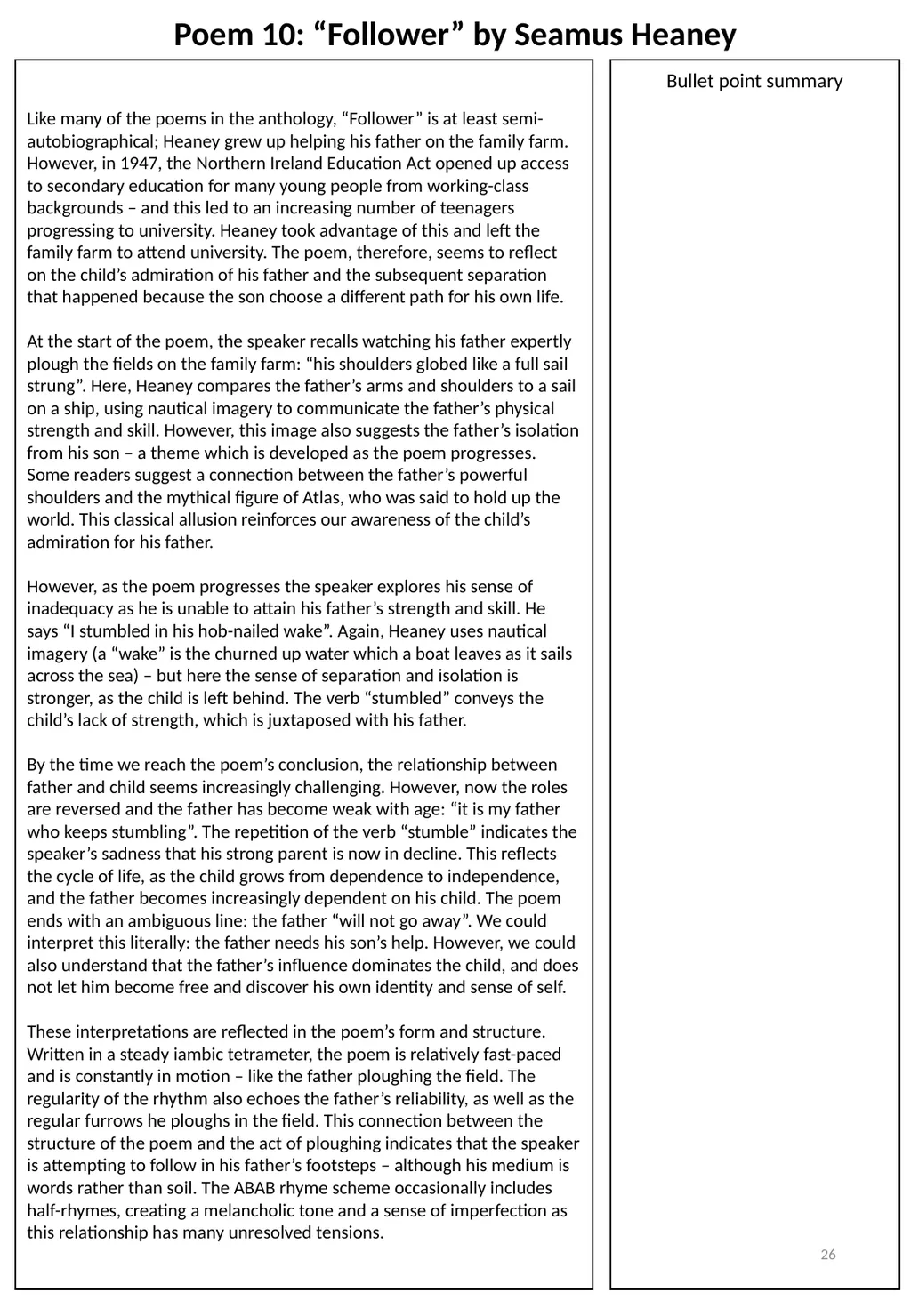
26 Poem 10: “Follower” by Seamus Heaney Bullet point summary Like many of the poems in the anthology, “Follower” is at least semi-autobiographical; Heaney grew up helping his father on the family farm. However, in 1947, the Northern Ireland Education Act opened up access to secondary education for many young people from working-class backgrounds – and this led to an increasing number of teenagers progressing to university. Heaney took advantage of this and left the family farm to attend university. The poem, therefore, seems to reflect on the child’s admiration of his father and the subsequent separation that happened because the son choose a different path for his own life.
At the start of the poem, the speaker recalls watching his father expertly plough the fields on the family farm: “his shoulders globed like a full sail strung”. Here, Heaney compares the father’s arms and shoulders to a sail on a ship, using nautical imagery to communicate the father’s physical strength and skill. However, this image also suggests the father’s isolation from his son – a theme which is developed as the poem progresses. Some readers suggest a connection between the father’s powerful shoulders and the mythical figure of Atlas, who was said to hold up the world. This classical allusion reinforces our awareness of the child’s admiration for his father.
However, as the poem progresses the speaker explores his sense of inadequacy as he is unable to attain his father’s strength and skill. He says “I stumbled in his hob-nailed wake”. Again, Heaney uses nautical imagery (a “wake” is the churned up water which a boat leaves as it sails across the sea) – but here the sense of separation and isolation is stronger, as the child is left behind. The verb “stumbled” conveys the child’s lack of strength, which is juxtaposed with his father.
By the time we reach the poem’s conclusion, the relationship between father and child seems increasingly challenging. However, now the roles are reversed and the father has become weak with age: “it is my father who keeps stumbling”. The repetition of the verb “stumble” indicates the speaker’s sadness that his strong parent is now in decline. This reflects the cycle of life, as the child grows from dependence to independence, and the father becomes increasingly dependent on his child. The poem ends with an ambiguous line: the father “will not go away”. We could interpret this literally: the father needs his son’s help. However, we could also understand that the father’s influence dominates the child, and does not let him become free and discover his own identity and sense of self.
These interpretations are reflected in the poem’s form and structure. Written in a steady iambic tetrameter, the poem is relatively fast-paced and is constantly in motion – like the father ploughing the field. The regularity of the rhythm also echoes the father’s reliability, as well as the regular furrows he ploughs in the field. This connection between the structure of the poem and the act of ploughing indicates that the speaker is attempting to follow in his father’s footsteps – although his medium is words rather than soil. The ABAB rhyme scheme occasionally includes half-rhymes, creating a melancholic tone and a sense of imperfection as this relationship has many unresolved tensions.<br>
At the start of the poem, the speaker recalls watching his father expertly plough the fields on the family farm: “his shoulders globed like a full sail strung”. Here, Heaney compares the father’s arms and shoulders to a sail on a ship, using nautical imagery to communicate the father’s physical strength and skill. However, this image also suggests the father’s isolation from his son – a theme which is developed as the poem progresses. Some readers suggest a connection between the father’s powerful shoulders and the mythical figure of Atlas, who was said to hold up the world. This classical allusion reinforces our awareness of the child’s admiration for his father.
However, as the poem progresses the speaker explores his sense of inadequacy as he is unable to attain his father’s strength and skill. He says “I stumbled in his hob-nailed wake”. Again, Heaney uses nautical imagery (a “wake” is the churned up water which a boat leaves as it sails across the sea) – but here the sense of separation and isolation is stronger, as the child is left behind. The verb “stumbled” conveys the child’s lack of strength, which is juxtaposed with his father.
By the time we reach the poem’s conclusion, the relationship between father and child seems increasingly challenging. However, now the roles are reversed and the father has become weak with age: “it is my father who keeps stumbling”. The repetition of the verb “stumble” indicates the speaker’s sadness that his strong parent is now in decline. This reflects the cycle of life, as the child grows from dependence to independence, and the father becomes increasingly dependent on his child. The poem ends with an ambiguous line: the father “will not go away”. We could interpret this literally: the father needs his son’s help. However, we could also understand that the father’s influence dominates the child, and does not let him become free and discover his own identity and sense of self.
These interpretations are reflected in the poem’s form and structure. Written in a steady iambic tetrameter, the poem is relatively fast-paced and is constantly in motion – like the father ploughing the field. The regularity of the rhythm also echoes the father’s reliability, as well as the regular furrows he ploughs in the field. This connection between the structure of the poem and the act of ploughing indicates that the speaker is attempting to follow in his father’s footsteps – although his medium is words rather than soil. The ABAB rhyme scheme occasionally includes half-rhymes, creating a melancholic tone and a sense of imperfection as this relationship has many unresolved tensions.<br>
27
27 Define these keywords
Nostalgic:
Aspirations: Now write a sentence using each of these words:
Nostalgic:
Aspirations:<br>
Nostalgic:
Aspirations: Now write a sentence using each of these words:
Nostalgic:
Aspirations:<br>
28
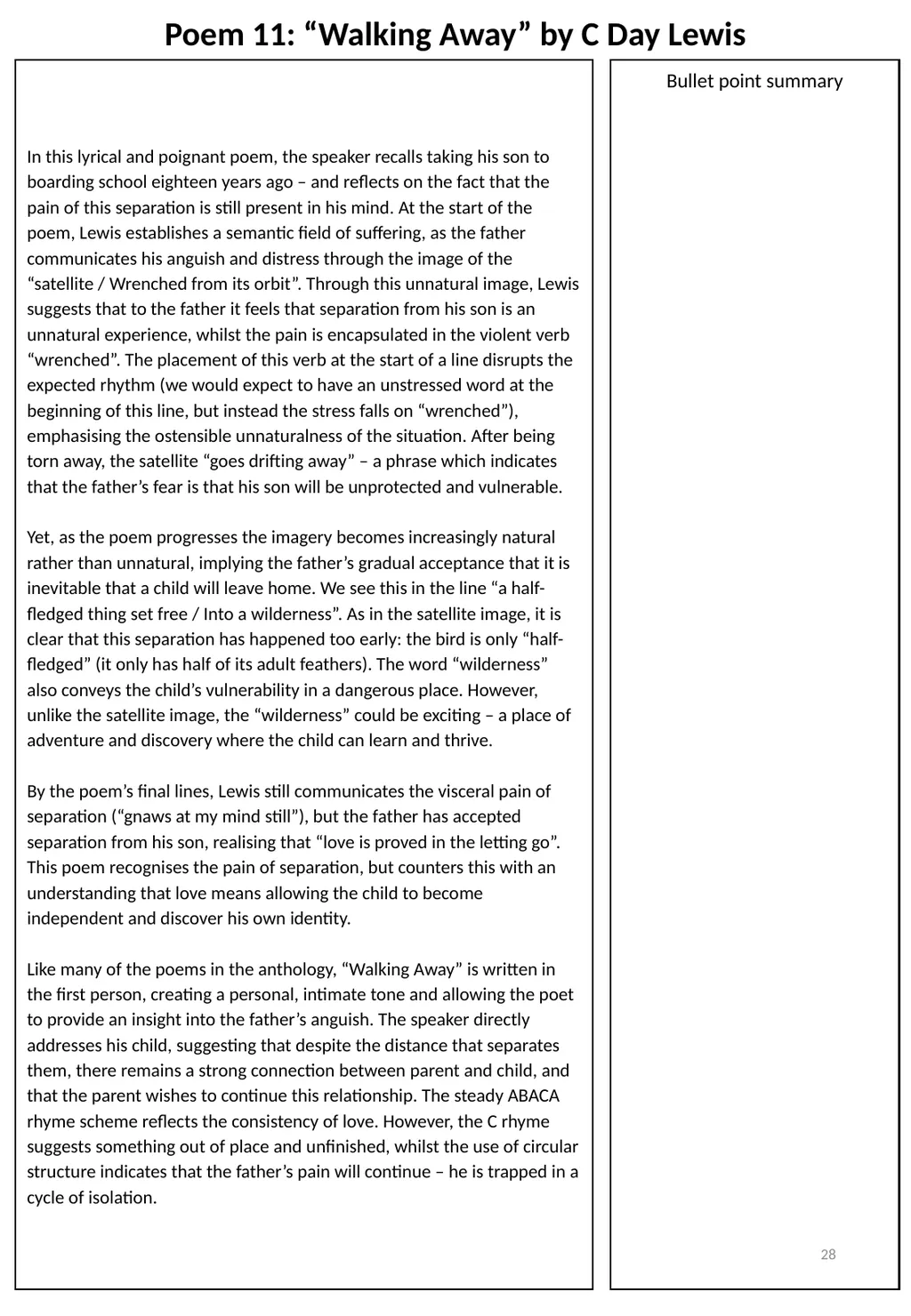
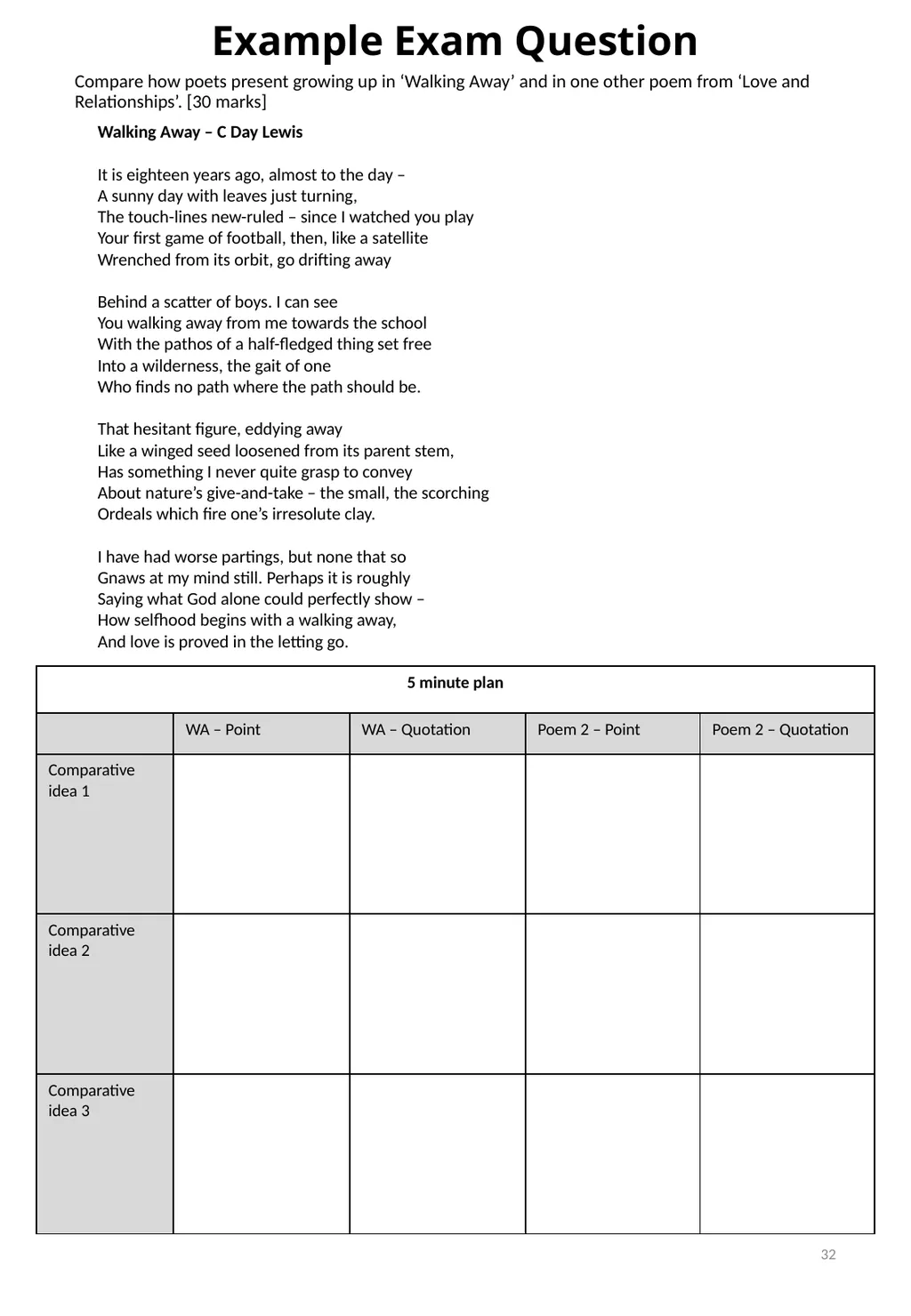
28 Poem 11: “Walking Away” by C Day Lewis Bullet point summary In this lyrical and poignant poem, the speaker recalls taking his son to boarding school eighteen years ago – and reflects on the fact that the pain of this separation is still present in his mind. At the start of the poem, Lewis establishes a semantic field of suffering, as the father communicates his anguish and distress through the image of the “satellite / Wrenched from its orbit”. Through this unnatural image, Lewis suggests that to the father it feels that separation from his son is an unnatural experience, whilst the pain is encapsulated in the violent verb “wrenched”. The placement of this verb at the start of a line disrupts the expected rhythm (we would expect to have an unstressed word at the beginning of this line, but instead the stress falls on “wrenched”), emphasising the ostensible unnaturalness of the situation. After being torn away, the satellite “goes drifting away” – a phrase which indicates that the father’s fear is that his son will be unprotected and vulnerable.
Yet, as the poem progresses the imagery becomes increasingly natural rather than unnatural, implying the father’s gradual acceptance that it is inevitable that a child will leave home. We see this in the line “a half-fledged thing set free / Into a wilderness”. As in the satellite image, it is clear that this separation has happened too early: the bird is only “half-fledged” (it only has half of its adult feathers). The word “wilderness” also conveys the child’s vulnerability in a dangerous place. However, unlike the satellite image, the “wilderness” could be exciting – a place of adventure and discovery where the child can learn and thrive.
By the poem’s final lines, Lewis still communicates the visceral pain of separation (“gnaws at my mind still”), but the father has accepted separation from his son, realising that “love is proved in the letting go”. This poem recognises the pain of separation, but counters this with an understanding that love means allowing the child to become independent and discover his own identity.
Like many of the poems in the anthology, “Walking Away” is written in the first person, creating a personal, intimate tone and allowing the poet to provide an insight into the father’s anguish. The speaker directly addresses his child, suggesting that despite the distance that separates them, there remains a strong connection between parent and child, and that the parent wishes to continue this relationship. The steady ABACA rhyme scheme reflects the consistency of love. However, the C rhyme suggests something out of place and unfinished, whilst the use of circular structure indicates that the father’s pain will continue – he is trapped in a cycle of isolation.<br>
Yet, as the poem progresses the imagery becomes increasingly natural rather than unnatural, implying the father’s gradual acceptance that it is inevitable that a child will leave home. We see this in the line “a half-fledged thing set free / Into a wilderness”. As in the satellite image, it is clear that this separation has happened too early: the bird is only “half-fledged” (it only has half of its adult feathers). The word “wilderness” also conveys the child’s vulnerability in a dangerous place. However, unlike the satellite image, the “wilderness” could be exciting – a place of adventure and discovery where the child can learn and thrive.
By the poem’s final lines, Lewis still communicates the visceral pain of separation (“gnaws at my mind still”), but the father has accepted separation from his son, realising that “love is proved in the letting go”. This poem recognises the pain of separation, but counters this with an understanding that love means allowing the child to become independent and discover his own identity.
Like many of the poems in the anthology, “Walking Away” is written in the first person, creating a personal, intimate tone and allowing the poet to provide an insight into the father’s anguish. The speaker directly addresses his child, suggesting that despite the distance that separates them, there remains a strong connection between parent and child, and that the parent wishes to continue this relationship. The steady ABACA rhyme scheme reflects the consistency of love. However, the C rhyme suggests something out of place and unfinished, whilst the use of circular structure indicates that the father’s pain will continue – he is trapped in a cycle of isolation.<br>
29
29 Define these keywords
Apprehensiveness:
Inevitable: Now write a sentence using each of these words:
Apprehensiveness:
Inevitable:<br>
Apprehensiveness:
Inevitable: Now write a sentence using each of these words:
Apprehensiveness:
Inevitable:<br>
30
30 Poem 12: “Eden Rock” by Charles Causley Bullet point summary The title of this poem alludes to the Biblical Garden of Eden, a place of idyllic perfection in which Adam and Eve live in harmony. Within the poem, Eden Rock conjures up a childhood memory of the child’s parents in their twenties, picnicking with their dog. The speaker is on the other side of the river, looking across at his parents as they set out the plates and skim stones. Causley shows how the speaker idolises his mother and admires her, as her “hair, the colour of wheat, [that] takes on the light”. The natural image of the wheat suggests her connection to the beauty of the landscape, whilst the “light” conveys ideas of purity and perfection. The speaker’s father is similarly idealised, standing in a suit and looking over towards his son on the far side of the river. Causley’s father fought in World War One, and died in 1924 of injuries he had sustained in the conflict. Causley was just seven years old at this point, and so grew up without his father. The speaker’s mother continues to set out the picnic, with the everyday, nostalgic language (“an old HP sauce bottle”) reflecting the normality of family life Causley must have missed in some ways.
As the poem progresses, it becomes clear that this idyllic setting is not just a memory or an imagining of a picnic; it is also an image of heaven. At the start of the fourth stanza, the “sky whitens, as if lit by three suns”, changing the setting to a supernatural one. Causley uses the colour white to connote heaven, in all its purity and perfection, whilst the “three suns” could symbolise the mother, father, and child finally being reunited after death. It is at this point that the river that separates parents and child takes on greater significance. In classical mythology, the River Styx or Lethe separates the land of the living from that of the dead, and so in the poem it now appears that the speaker is preparing to cross the river that divides life and death. The poem was written when Causley was late in life, meditating on his approaching death. At this point, the parents wave and say “crossing is not as hard as you might think”, providing reassurance to their son that his natural death with not be traumatic. The break in the final stanza may symbolise the speaker crossing the boundary to heaven, to be reunited with his parents.
Throughout the poem, the regular rhythm and consistent rhyme scheme indicates the reliable nature of the parent-child relationship, and also creates a calm and tranquil atmosphere that links with the reassurance that the speaker’s death will not be difficult. However, the half-rhymes (“Jack” “rock”) create a melancholic tone and a sense of incompletion – perhaps this mirrors the speaker’s feeling of loss as he thinks about his separation from his family.<br>
As the poem progresses, it becomes clear that this idyllic setting is not just a memory or an imagining of a picnic; it is also an image of heaven. At the start of the fourth stanza, the “sky whitens, as if lit by three suns”, changing the setting to a supernatural one. Causley uses the colour white to connote heaven, in all its purity and perfection, whilst the “three suns” could symbolise the mother, father, and child finally being reunited after death. It is at this point that the river that separates parents and child takes on greater significance. In classical mythology, the River Styx or Lethe separates the land of the living from that of the dead, and so in the poem it now appears that the speaker is preparing to cross the river that divides life and death. The poem was written when Causley was late in life, meditating on his approaching death. At this point, the parents wave and say “crossing is not as hard as you might think”, providing reassurance to their son that his natural death with not be traumatic. The break in the final stanza may symbolise the speaker crossing the boundary to heaven, to be reunited with his parents.
Throughout the poem, the regular rhythm and consistent rhyme scheme indicates the reliable nature of the parent-child relationship, and also creates a calm and tranquil atmosphere that links with the reassurance that the speaker’s death will not be difficult. However, the half-rhymes (“Jack” “rock”) create a melancholic tone and a sense of incompletion – perhaps this mirrors the speaker’s feeling of loss as he thinks about his separation from his family.<br>
31
31 Define these keywords
Idyllic:
Poignant: Now write a sentence using each of these words:
Idyllic:
Poignant:<br>
Idyllic:
Poignant: Now write a sentence using each of these words:
Idyllic:
Poignant:<br>
32
32 Example Exam Question Compare how poets present growing up in ‘Walking Away’ and in one other poem from ‘Love and Relationships’. [30 marks] Walking Away – C Day Lewis
It is eighteen years ago, almost to the day –
A sunny day with leaves just turning,
The touch-lines new-ruled – since I watched you play
Your first game of football, then, like a satellite
Wrenched from its orbit, go drifting away
Behind a scatter of boys. I can see
You walking away from me towards the school
With the pathos of a half-fledged thing set free
Into a wilderness, the gait of one
Who finds no path where the path should be.
That hesitant figure, eddying away
Like a winged seed loosened from its parent stem,
Has something I never quite grasp to convey
About nature’s give-and-take – the small, the scorching
Ordeals which fire one’s irresolute clay.
I have had worse partings, but none that so
Gnaws at my mind still. Perhaps it is roughly
Saying what God alone could perfectly show –
How selfhood begins with a walking away,
And love is proved in the letting go.<br>
It is eighteen years ago, almost to the day –
A sunny day with leaves just turning,
The touch-lines new-ruled – since I watched you play
Your first game of football, then, like a satellite
Wrenched from its orbit, go drifting away
Behind a scatter of boys. I can see
You walking away from me towards the school
With the pathos of a half-fledged thing set free
Into a wilderness, the gait of one
Who finds no path where the path should be.
That hesitant figure, eddying away
Like a winged seed loosened from its parent stem,
Has something I never quite grasp to convey
About nature’s give-and-take – the small, the scorching
Ordeals which fire one’s irresolute clay.
I have had worse partings, but none that so
Gnaws at my mind still. Perhaps it is roughly
Saying what God alone could perfectly show –
How selfhood begins with a walking away,
And love is proved in the letting go.<br>
33
33 Poem 13: “Mother, Any Distance” by Simon Armitage Bullet point summary This poem is taken from a collection entitled A Book of Matches, the title being based on a party game in which someone has to tell a story in the length of time it takes for a match to burn. The image of the burning match indicates how quickly key moments in life pass, and therefore how precious our memories become. Published in 1993 (when Armitage was 30 years old), the collection explores themes of growing up and becoming an adult - including breaking free from parental control.
At the start of “Mother, Any Distance”, the speaker’s mother is helping him to move house – a symbol for his increasing independence and discovery of his own identity. Armitage initially uses spatial imagery to hyperbolise the house’s daunting size: “the acres of the walls, the prairies of the floors”. The image of the “prairies” evokes the idea of the American frontier during the seventeenth and eighteenth centuries – a time when settlers in America were pushing westwards, exploring new spaces and claiming new land. The image therefore conveys the excitement and adventure of moving into a new house, as well as the anxiety and apprehension which accompanies this.
As the speaker measures the new house for carpets and curtains, he holds one end of a tape measure and his mother “pinches” the other end. Armitage uses the tape measure to symbolise the umbilical cord which connects mother and son – an image which is echoed in the pairing of “Anchor. Kite” later in the poem. Each of these symbols communicates connection between parent and child. This connection could be a positive one as the mother provides security for her son (being the anchor as he sails at sea, the string as he flies in the air). However, it could also imply a sense of restriction as the mother holds her son back, preventing him from reaching full freedom and independence. One of the poem’s central themes is the need to renegotiate parent-child relationships as time passes.
Leaving his mother downstairs, the speaker goes upstairs, where he “space-walk[s] through the empty bedrooms”. Like the image of the “prairies” earlier in the poem, this space metaphor suggests a heady mixture of adventure and fear, whilst the adjective “empty” implies that the son might feel isolated and somewhat lost in his new home. This is similar to Lewis’ description of the “hesitant” child walking to his new school in “Walking Away” – the child needs to leave the parent, but in doing so he finds himself lost and alone in the “wilderness”.
This complex mix of emotions is encapsulated in the final line of “Mother, Any Distance”, as Armitage writes that he reaches towards “an endless sky / to fall or fly”. Through using the image of the “endless sky”, Armitage suggests the limitless range of possibilities which are becoming accessible for the son as he becomes an adult. Yet whilst he may “fly” (succeed) in this new world, he may also “fall” (fail). We should note the order of the alliterative words – “fall” comes first, and the poem ends with “fly”, implying that success is the more likely option.
The poem is written in a loose sonnet form, which becomes increasingly free as it progresses. A sonnet usually contains 14 lines, is written in iambic pentameter (10 syllables and 5 beats per line), and has a tight rhyme scheme (often ABAB). Armitage approximates many of these features, but adds an extra line and abandons iambic pentameter. This shows the son’s increasing freedom from the restrictions placed upon him by his mother. As this happens, the poem also shifts from direct address (the “you” focussing on his mother’s reaction to him moving house), and shifts to “I” (the son’s independent experience).<br>
At the start of “Mother, Any Distance”, the speaker’s mother is helping him to move house – a symbol for his increasing independence and discovery of his own identity. Armitage initially uses spatial imagery to hyperbolise the house’s daunting size: “the acres of the walls, the prairies of the floors”. The image of the “prairies” evokes the idea of the American frontier during the seventeenth and eighteenth centuries – a time when settlers in America were pushing westwards, exploring new spaces and claiming new land. The image therefore conveys the excitement and adventure of moving into a new house, as well as the anxiety and apprehension which accompanies this.
As the speaker measures the new house for carpets and curtains, he holds one end of a tape measure and his mother “pinches” the other end. Armitage uses the tape measure to symbolise the umbilical cord which connects mother and son – an image which is echoed in the pairing of “Anchor. Kite” later in the poem. Each of these symbols communicates connection between parent and child. This connection could be a positive one as the mother provides security for her son (being the anchor as he sails at sea, the string as he flies in the air). However, it could also imply a sense of restriction as the mother holds her son back, preventing him from reaching full freedom and independence. One of the poem’s central themes is the need to renegotiate parent-child relationships as time passes.
Leaving his mother downstairs, the speaker goes upstairs, where he “space-walk[s] through the empty bedrooms”. Like the image of the “prairies” earlier in the poem, this space metaphor suggests a heady mixture of adventure and fear, whilst the adjective “empty” implies that the son might feel isolated and somewhat lost in his new home. This is similar to Lewis’ description of the “hesitant” child walking to his new school in “Walking Away” – the child needs to leave the parent, but in doing so he finds himself lost and alone in the “wilderness”.
This complex mix of emotions is encapsulated in the final line of “Mother, Any Distance”, as Armitage writes that he reaches towards “an endless sky / to fall or fly”. Through using the image of the “endless sky”, Armitage suggests the limitless range of possibilities which are becoming accessible for the son as he becomes an adult. Yet whilst he may “fly” (succeed) in this new world, he may also “fall” (fail). We should note the order of the alliterative words – “fall” comes first, and the poem ends with “fly”, implying that success is the more likely option.
The poem is written in a loose sonnet form, which becomes increasingly free as it progresses. A sonnet usually contains 14 lines, is written in iambic pentameter (10 syllables and 5 beats per line), and has a tight rhyme scheme (often ABAB). Armitage approximates many of these features, but adds an extra line and abandons iambic pentameter. This shows the son’s increasing freedom from the restrictions placed upon him by his mother. As this happens, the poem also shifts from direct address (the “you” focussing on his mother’s reaction to him moving house), and shifts to “I” (the son’s independent experience).<br>
34
34 Define these keywords
Renegotiating relationships:
Uncharted territory: Now write a sentence using each of these words:
Renegotiating relationships:
Uncharted territory:<br>
Renegotiating relationships:
Uncharted territory: Now write a sentence using each of these words:
Renegotiating relationships:
Uncharted territory:<br>
35
35 Poem 14: “Before You Were Mine” by Carol Ann Duffy Bullet point summary This ostensibly autobiographical poem begins with the speaker reflecting on her mother’s teenage years – her life before children, growing up in working-class Glasgow during the 1950s at a time when young women were supposed to obey their parents, focus on work or domestic life, and save themselves for their future husband. The mother’s rebellious behaviour leads to her going to parties and enjoying her freedom while her own mother waits with a “hiding [beating] for the late one”. When describing her mother’s teenage experiences, Duffy creates a sense of excitement and exuberance, comparing her mother to the glamorous fashion icon Marilyn Monroe. The mother’s enjoyment of life is encapsulated in the image of the “high-heeled red shoes”, which convey the mother’s pleasure in dressing to go out, whilst the colour “red” could symbolise romance and rebellion. Yet Duffy also describes the shoes as “relics”, meaning that the heels have become a historical item which are no longer used.
The word “relics” indicates that the mother’s life changed significantly when the child (the speaker) was born. The arrival of a baby meant the shoes were put away as the mother lost her freedom and instead gained adult responsibilities. The speaker reflects on this significant shift in her mother’s life, asking if “the decade ahead of my loud, possessive yell was the best one, eh?” Whilst this line contains an element of self-deprecating humour, the speaker does fully realise the pressures of bringing up a child; the word “yell” communicates the oppressiveness and restrictions that can accompany parental responsibilities. Readers are also struck by the unusual use of the adjective “possessive”. We might think that a parent “possesses” their baby, but here Duffy flips this idea on its head, indicating that the baby “possesses” the parent – dominating their life, demanding their time and attention. This motif is also found in the poem’s title and final line (“before you were mine”), which reflects the strength of familial love.
As the poem reaches its conclusion, Duffy reflects on this strong bond between mother and child. Whilst they conform to convention and attend mass (a Christian church service), the mother teaches her daughter to dance on the “wrong pavement”, implying that she is passing her rebellious streak on to the next generation. The poem ends with a complex sense of mourning and celebration of the mother’s life. The speaker recalls her mother’s memory “clear as scent” and almost sees her “ghost”. Her dominant thought of her mother is not of her as a parent, but as a carefree teenager who would “sparkle and waltz and laugh”, relishing her freedom.
This celebration of freedom is mirrored in the poem’s structure and form, as Duffy uses free verse (no particular rhyme or rhythm) and enjambment (run-on lines – no punctuation at the end of a line) to indicate a refusal to conform. This also creates a conversational tone, which is added to be the use of second person and questions. Duffy uses these structural techniques to suggest the strength of the familial bond and to indicate the speaker’s desire to keep this connection – even though her mother has now passed away.<br>
The word “relics” indicates that the mother’s life changed significantly when the child (the speaker) was born. The arrival of a baby meant the shoes were put away as the mother lost her freedom and instead gained adult responsibilities. The speaker reflects on this significant shift in her mother’s life, asking if “the decade ahead of my loud, possessive yell was the best one, eh?” Whilst this line contains an element of self-deprecating humour, the speaker does fully realise the pressures of bringing up a child; the word “yell” communicates the oppressiveness and restrictions that can accompany parental responsibilities. Readers are also struck by the unusual use of the adjective “possessive”. We might think that a parent “possesses” their baby, but here Duffy flips this idea on its head, indicating that the baby “possesses” the parent – dominating their life, demanding their time and attention. This motif is also found in the poem’s title and final line (“before you were mine”), which reflects the strength of familial love.
As the poem reaches its conclusion, Duffy reflects on this strong bond between mother and child. Whilst they conform to convention and attend mass (a Christian church service), the mother teaches her daughter to dance on the “wrong pavement”, implying that she is passing her rebellious streak on to the next generation. The poem ends with a complex sense of mourning and celebration of the mother’s life. The speaker recalls her mother’s memory “clear as scent” and almost sees her “ghost”. Her dominant thought of her mother is not of her as a parent, but as a carefree teenager who would “sparkle and waltz and laugh”, relishing her freedom.
This celebration of freedom is mirrored in the poem’s structure and form, as Duffy uses free verse (no particular rhyme or rhythm) and enjambment (run-on lines – no punctuation at the end of a line) to indicate a refusal to conform. This also creates a conversational tone, which is added to be the use of second person and questions. Duffy uses these structural techniques to suggest the strength of the familial bond and to indicate the speaker’s desire to keep this connection – even though her mother has now passed away.<br>
36
36 Define these keywords
Idealised:
Exuberant: Now write a sentence using each of these words:
Idealised:
Exuberant:<br>
Idealised:
Exuberant: Now write a sentence using each of these words:
Idealised:
Exuberant:<br>
37
37 Poem 15: “Climbing my Grandfather” by Andrew Waterhouse Bullet point summary In “Climbing my Grandfather”, Waterhouse uses an extended metaphor of mountaineering to explore the developing relationship between a young child and his grandfather. At the start of the poem, the child/speaker “decide[s] to do it free”. On the one hand, this indicates that the child is starting to climb onto his grandfather’s knee – launching himself into the relationship “free[ly]”, with no inhibitions or restrictions. On the other hand, we notice that Waterhouse uses the language of mountaineering to indicate that this “free” climb will be completed without ropes. Later in the poem, the speaker acknowledges that “climbing has its dangers”. In making this metaphorical connection, Waterhouse implies that there is a sense of danger – just opening oneself up to a relationship might result in disappointment or betrayal. The extended metaphor of climbing also indicates that developing relationships may require persistence and hard work, but it can lead to great rewards.
As the child climbs, he encounters “the glassy ridge of a scar”, the “old stitches” and “splintered” nails. Through using the imagery of old wounds, Waterhouse suggests that the grandfather has painful memories and life experiences that the child does not yet understand. The adjective “glassy” has a number of potential interpretations. It could evoke a sense of vulnerability, as if the grandfather is becoming fragile – this impression of the ageing body adds a sense of poignancy to the poem as we are aware that the grandfather might not live to see his grandchild grow up. In addition, “glassy” suggests that the child himself is in a precarious, dangerous situation: he might fall or slip, thus continuing the motif that building relationships can lead to challenges.
Reaching his grandfather’s shoulders and face, the child explores the “smiling” mouth and feels “the slow pulse of his good heart”. The grandfather’s calm “pulse” creates an impression of tranquillity and security, whilst the phrase “good heart” indicates the child’s admiration for the older man’s integrity and strong moral compass. We see a similar respect for the older generation in “Follower” by Seamus Heaney – although it is notable that both poems are written in the third person, creating a sense of distance and indicating that there are fractures in the relationship. Towards the conclusion of his poem, Waterhouse continues the extended metaphor of mountaineering and climbing onto the grandfather’s knee, as the child looks up and sees “birds circl[ing]”, just as a climber would at the summit of a mountain. This imagery conveys a sense of freedom and contentment.
The form of the poem consolidates the extended metaphor, as the large single stanza seems to represent the mountain, whilst the use of free verse (no particular rhyme or rhythm) links with the idea of climbing “free”. Waterhouse also uses free verse to create a relaxed, conversational tone, appropriate for a poem about building connections with others. Additionally, the use of the present tense adds a sense of immediacy and suggests that this relationship will continue.<br>
As the child climbs, he encounters “the glassy ridge of a scar”, the “old stitches” and “splintered” nails. Through using the imagery of old wounds, Waterhouse suggests that the grandfather has painful memories and life experiences that the child does not yet understand. The adjective “glassy” has a number of potential interpretations. It could evoke a sense of vulnerability, as if the grandfather is becoming fragile – this impression of the ageing body adds a sense of poignancy to the poem as we are aware that the grandfather might not live to see his grandchild grow up. In addition, “glassy” suggests that the child himself is in a precarious, dangerous situation: he might fall or slip, thus continuing the motif that building relationships can lead to challenges.
Reaching his grandfather’s shoulders and face, the child explores the “smiling” mouth and feels “the slow pulse of his good heart”. The grandfather’s calm “pulse” creates an impression of tranquillity and security, whilst the phrase “good heart” indicates the child’s admiration for the older man’s integrity and strong moral compass. We see a similar respect for the older generation in “Follower” by Seamus Heaney – although it is notable that both poems are written in the third person, creating a sense of distance and indicating that there are fractures in the relationship. Towards the conclusion of his poem, Waterhouse continues the extended metaphor of mountaineering and climbing onto the grandfather’s knee, as the child looks up and sees “birds circl[ing]”, just as a climber would at the summit of a mountain. This imagery conveys a sense of freedom and contentment.
The form of the poem consolidates the extended metaphor, as the large single stanza seems to represent the mountain, whilst the use of free verse (no particular rhyme or rhythm) links with the idea of climbing “free”. Waterhouse also uses free verse to create a relaxed, conversational tone, appropriate for a poem about building connections with others. Additionally, the use of the present tense adds a sense of immediacy and suggests that this relationship will continue.<br>
38
38 Define these keywords
Dependable:
Resolute: Now write a sentence using each of these words:
Dependable:
Resolute:<br>
Dependable:
Resolute: Now write a sentence using each of these words:
Dependable:
Resolute:<br>