
Year 9 Proof Dr J Frost
Description: Year 9 Proof Dr J Frost (jfrosttiffin.kingston.sch.uk) www.drfrostmaths.com Last modified: 26th April 2016 Objectives: Understand what is meant by a proof, and examples of what does and what doesnt constitute a proof. Be able to solve
Related Topics
Download Presentation
"Year 9 Proof Dr J Frost" is the property of its rightful owner. Permission is granted to download and print the materials on this website for personal, non-commercial use only, and to display it on your personal computer provided you do not modify the materials and that you retain all copyright notices contained in the materials. By downloading content from our website, you accept the terms of this agreement.
Presentation Transcript
slide1. Year 9 Proof Dr J Frost (jfrost@tiffin.kingston.sch.uk)
www.drfrostmaths.com Last modified: 26th April 2016 Objectives: Understand what is meant by a proof, and examples of what does and what doesn’t constitute a proof.
Be able to solve problems involving oddness/evenness, consecutive numbers and involving digits.<br>
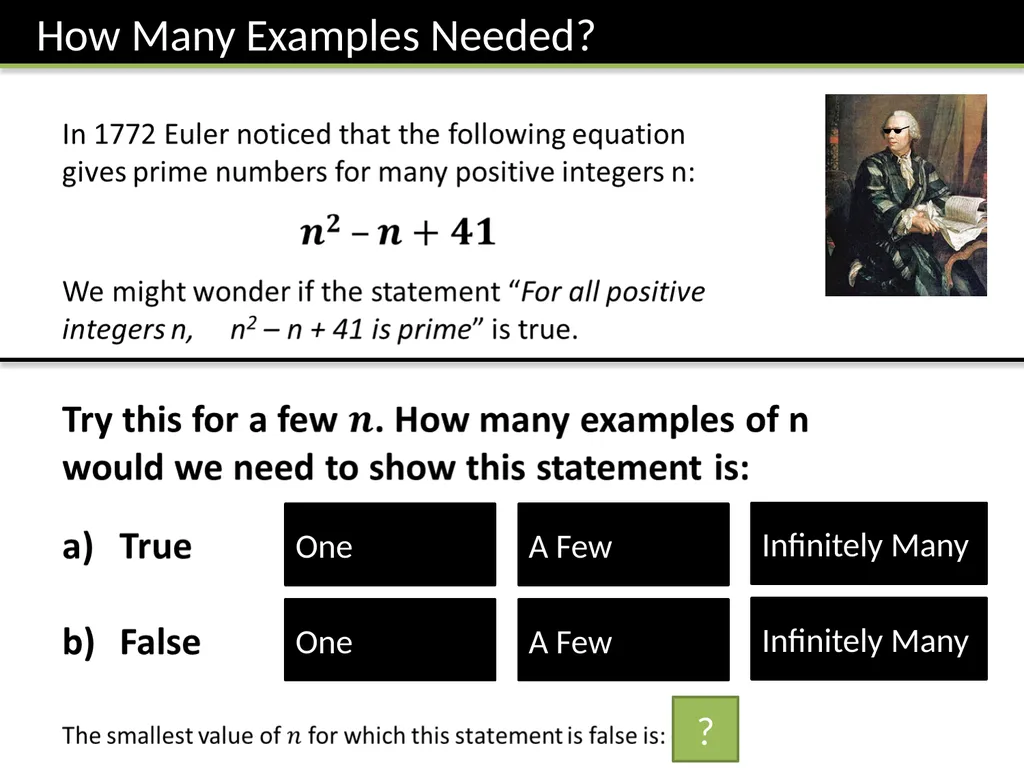
slide2. One ? A Few Infinitely Many One A Few Infinitely Many<br>
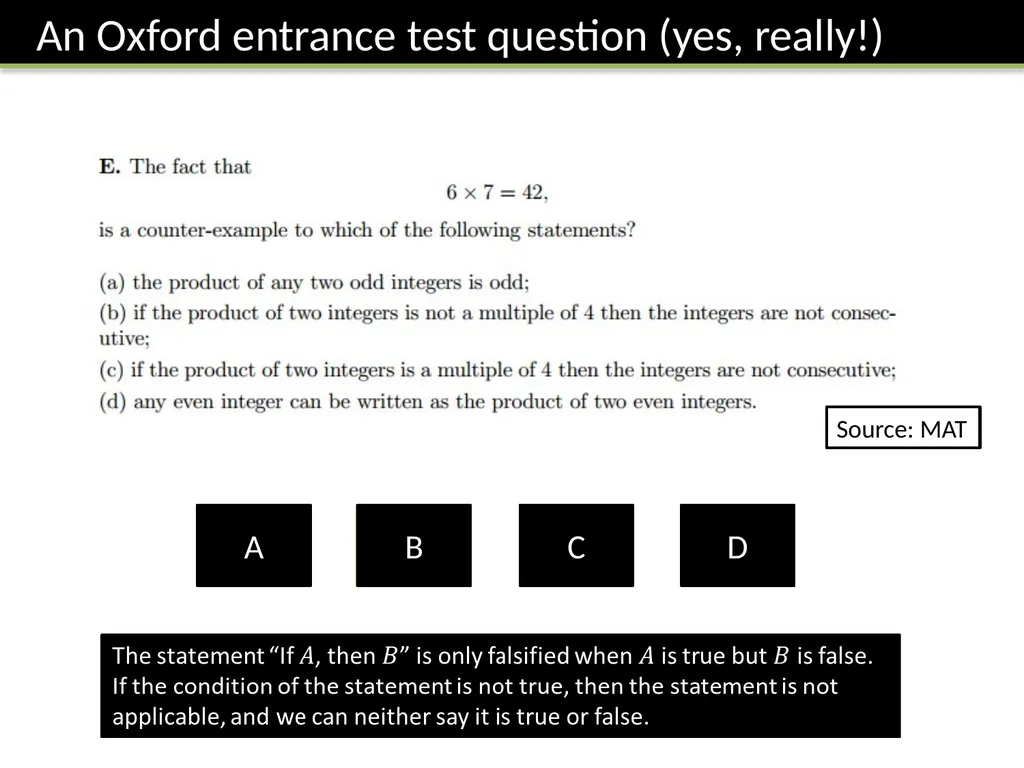
slide3. A B C D Source: MAT<br>
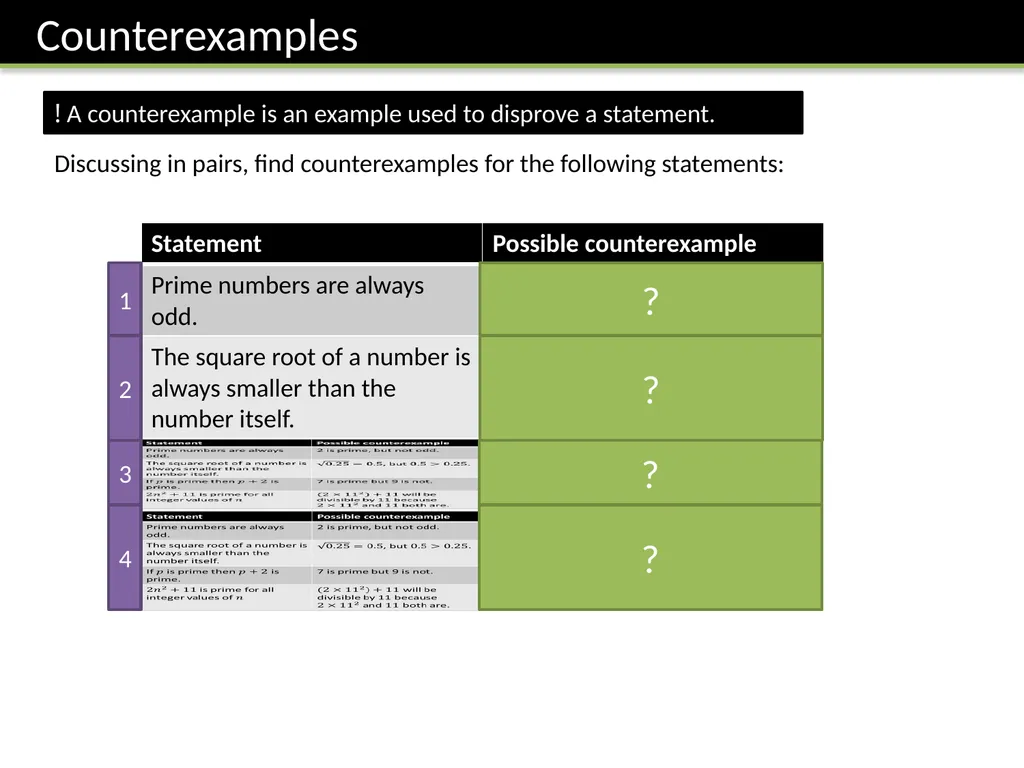
slide4. ! A counterexample is an example used to disprove a statement. Discussing in pairs, find counterexamples for the following statements: ? ? ? ? 1 2 3 4<br>
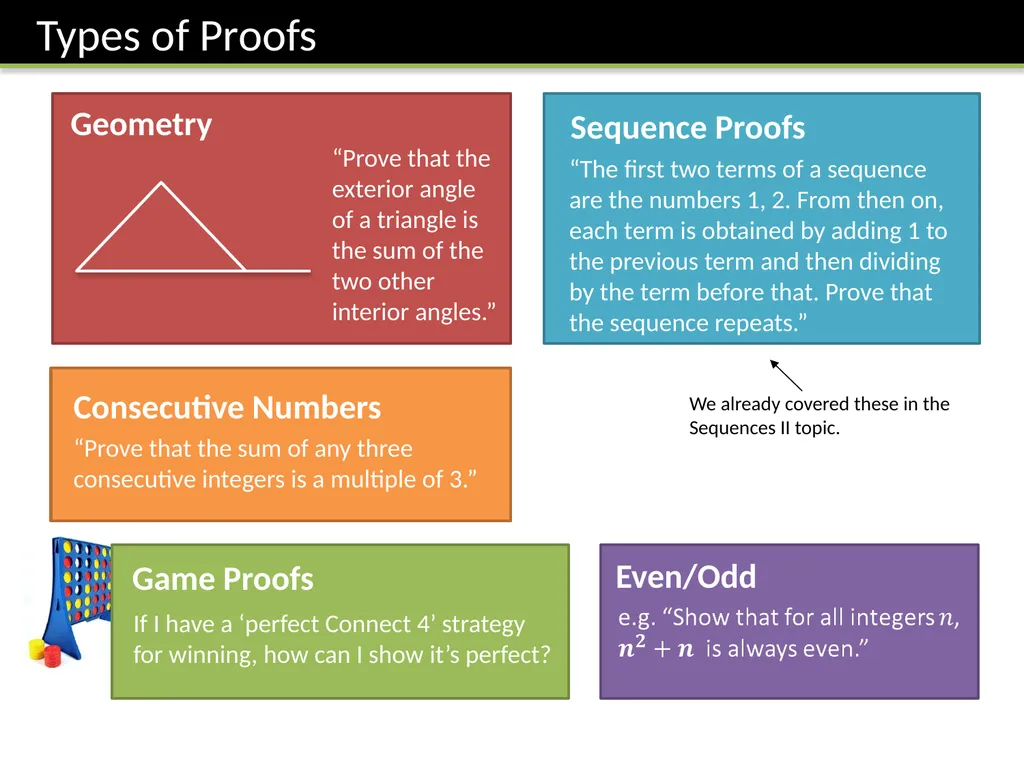
slide5. Geometry “Prove that the exterior angle of a triangle is the sum of the two other interior angles.” Sequence Proofs “The first two terms of a sequence are the numbers 1, 2. From then on, each term is obtained by adding 1 to the previous term and then dividing by the term before that. Prove that the sequence repeats.” Consecutive Numbers “Prove that the sum of any three consecutive integers is a multiple of 3.” Even/Odd We already covered these in the Sequences II topic. Game Proofs If I have a ‘perfect Connect 4’ strategy for winning, how can I show it’s perfect?<br>
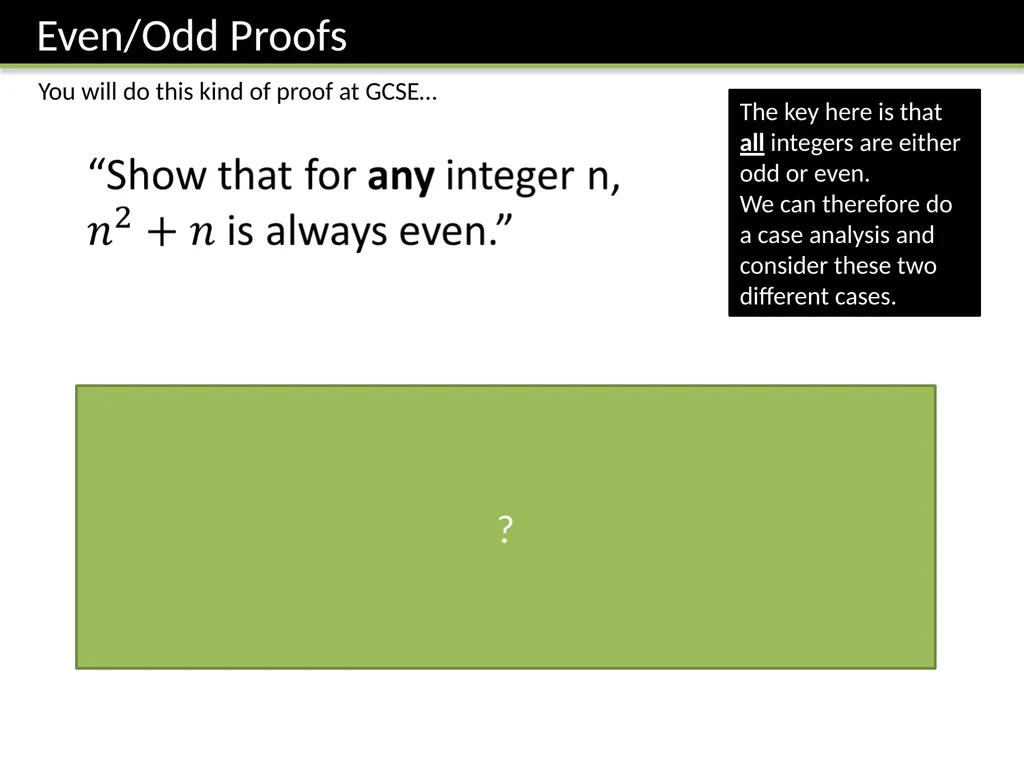
slide6. ? You will do this kind of proof at GCSE… The key here is that all integers are either odd or even.
We can therefore do a case analysis and consider these two different cases.<br>
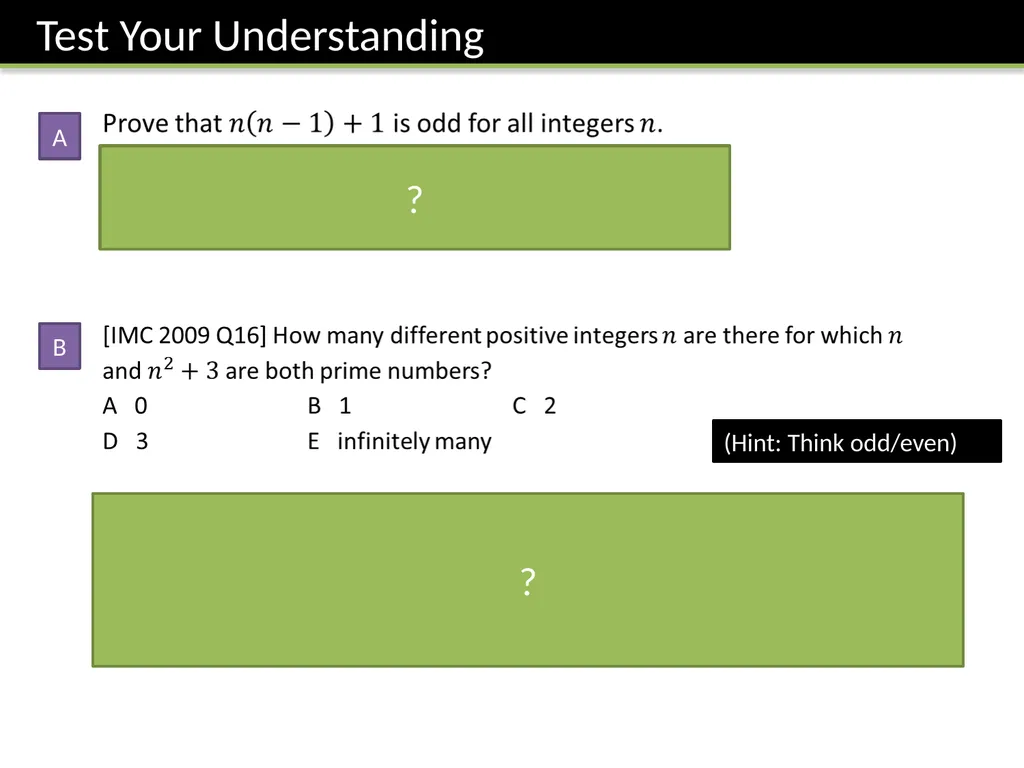
slide7. A B ? ? (Hint: Think odd/even)<br>
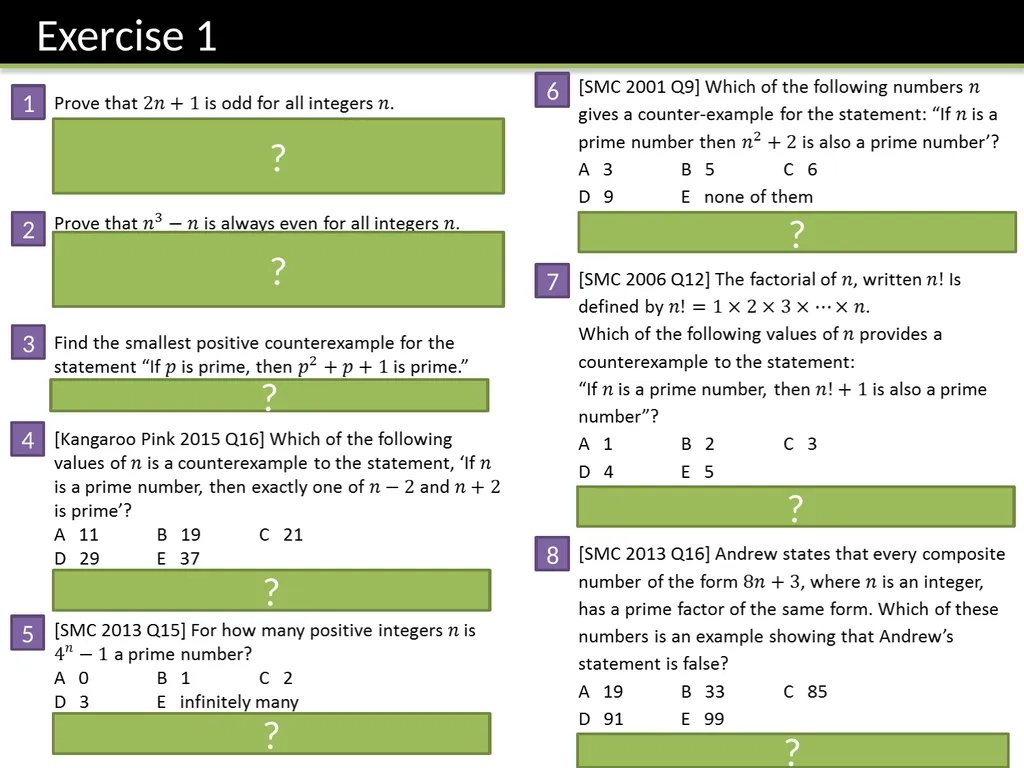
slide8. ? ? ? ? ? ? ? ? 1 2 3 4 5 6 7 8<br>
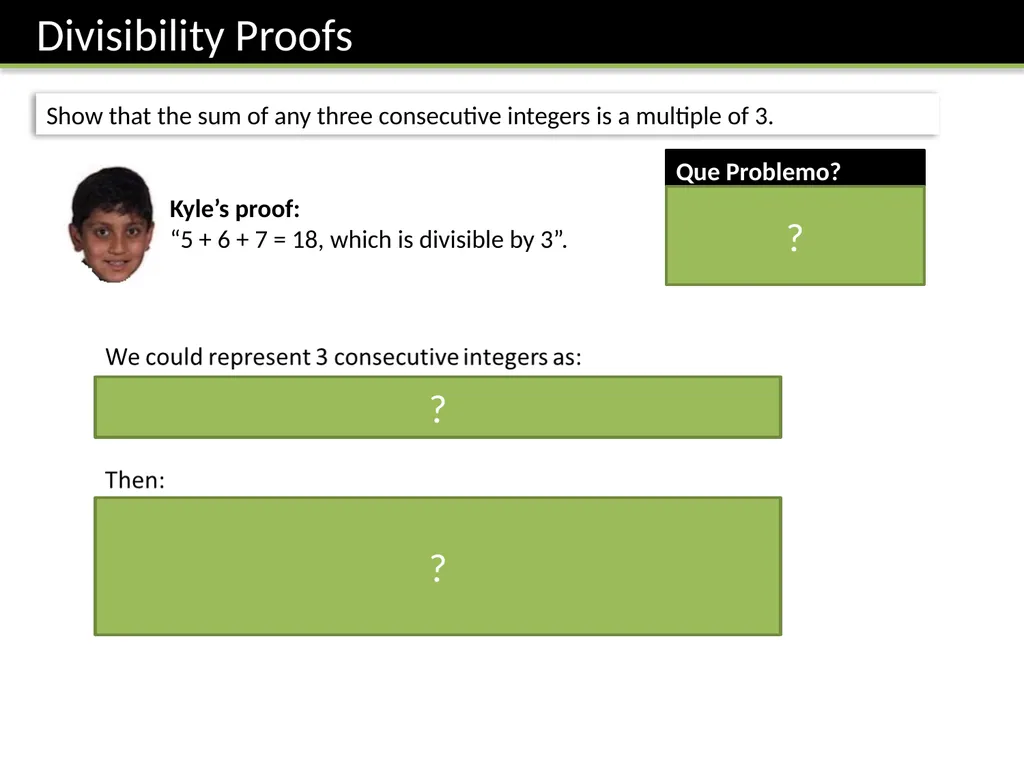
slide9. Show that the sum of any three consecutive integers is a multiple of 3. Kyle’s proof:
“5 + 6 + 7 = 18, which is divisible by 3”. Que Problemo?
He hasn’t shown it’s true for all possible integers. ? ? ?<br>
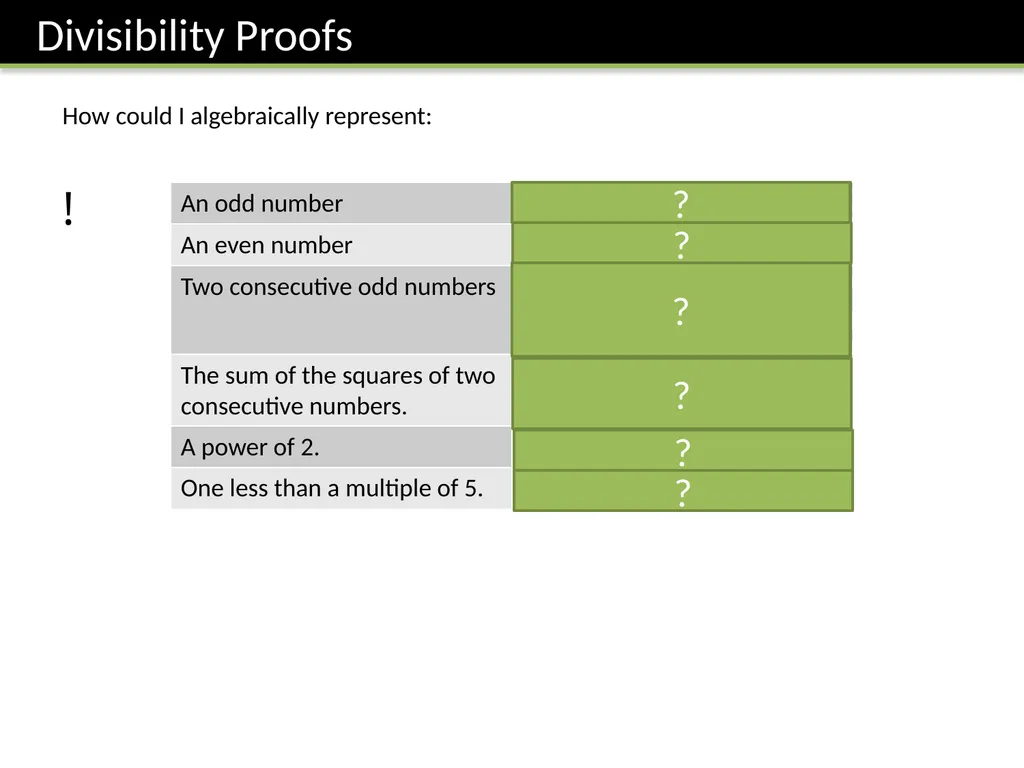
slide10. How could I algebraically represent: ! ? ? ? ? ? ?<br>
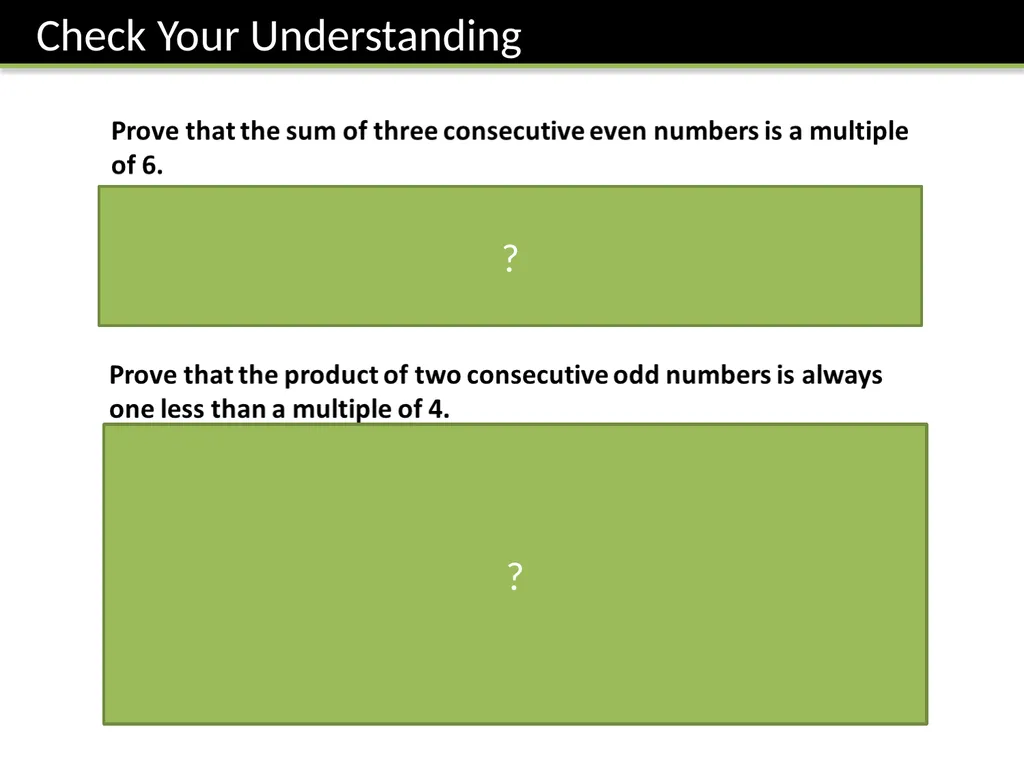
slide11. ? ?<br>
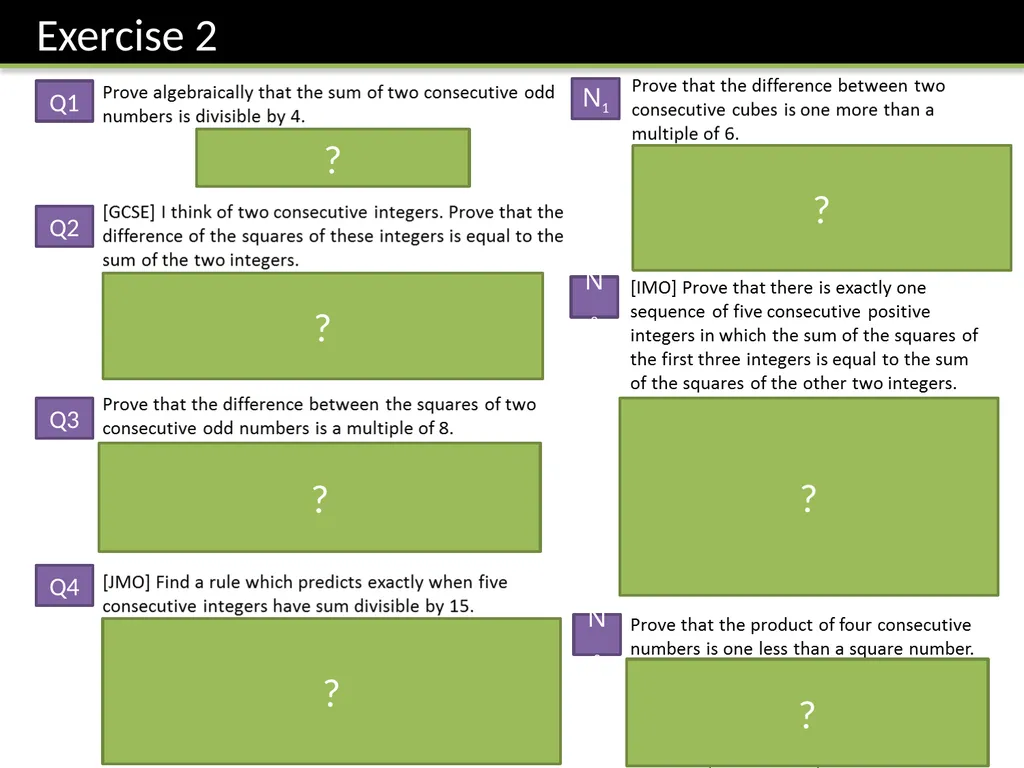
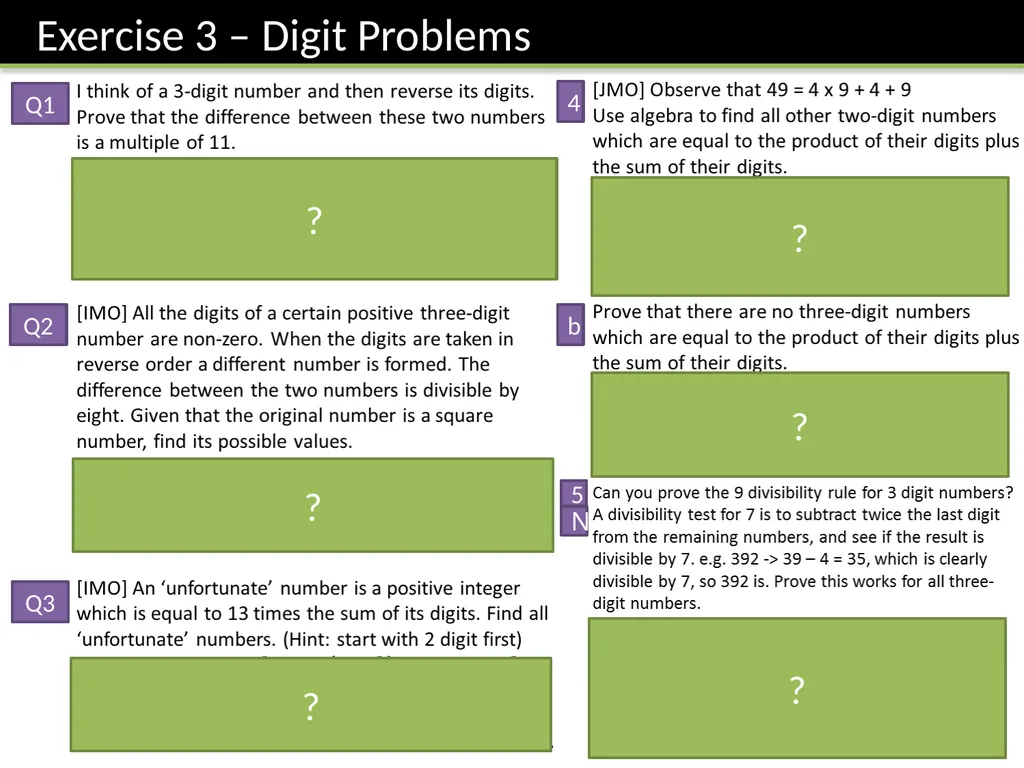
slide12. Q1 Q2 Q3 N1 N2 N3 ? ? ? ? ? ? ? Q4<br>
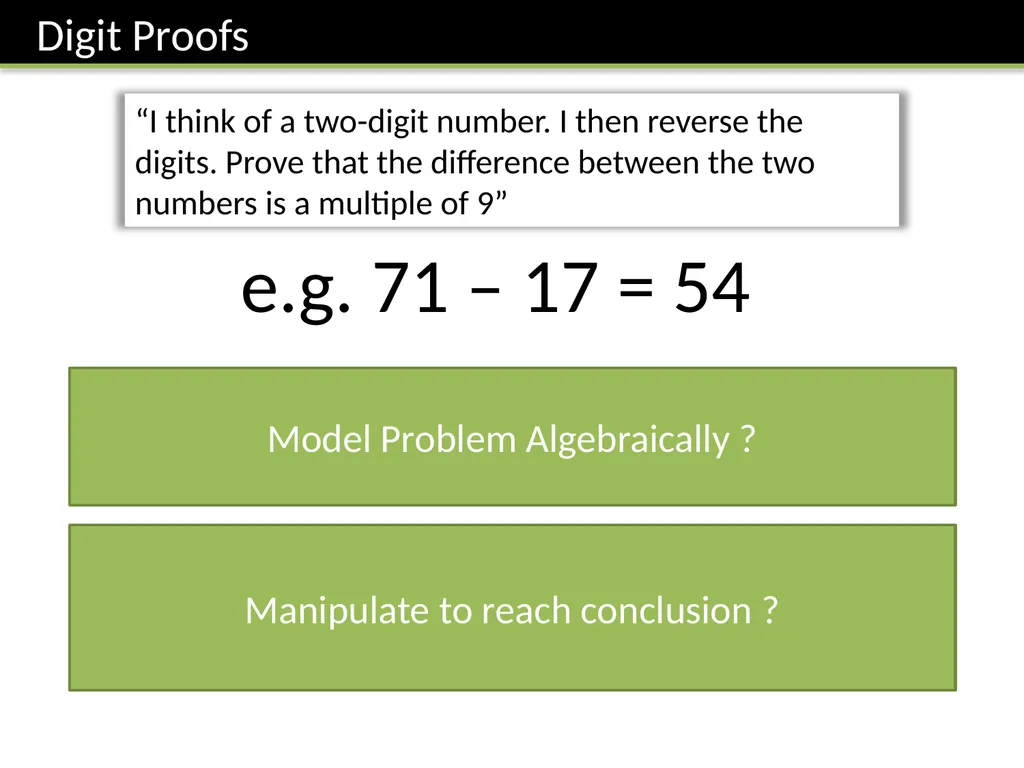
slide13. “I think of a two-digit number. I then reverse the digits. Prove that the difference between the two numbers is a multiple of 9” e.g. 71 – 17 = 54 Model Problem Algebraically ? (Note how factoring out the 9 is a good explicit way to show the expression is a multiple of 9) Manipulate to reach conclusion ?<br>
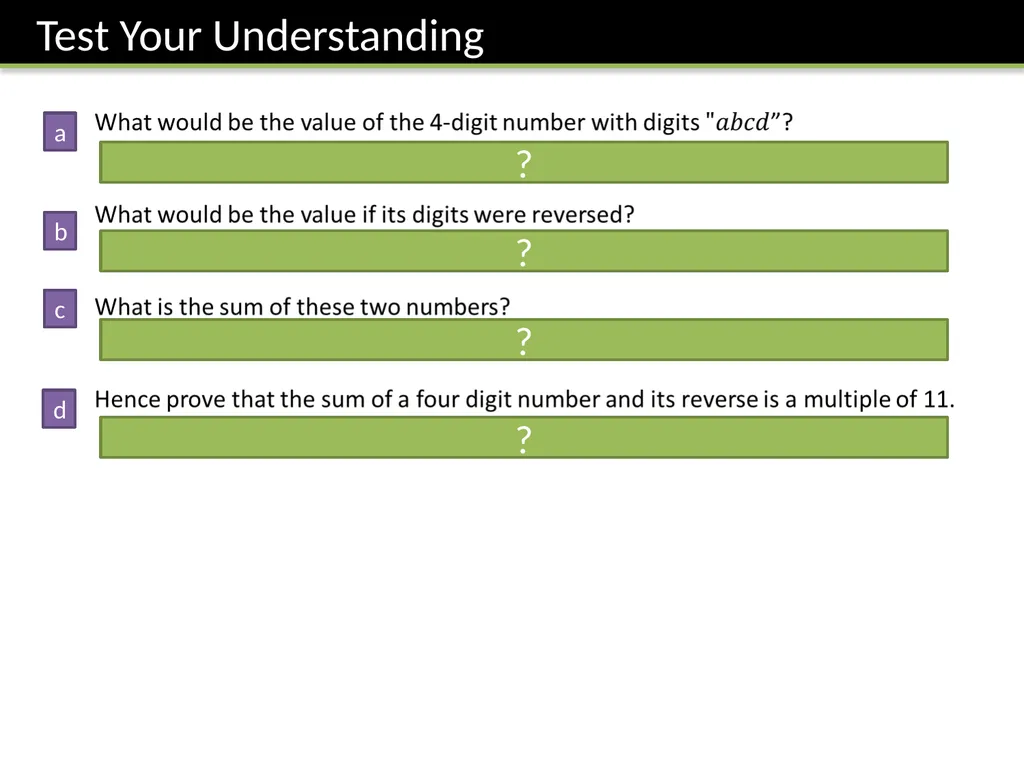
slide14. ? ? ? ? a b c d<br>
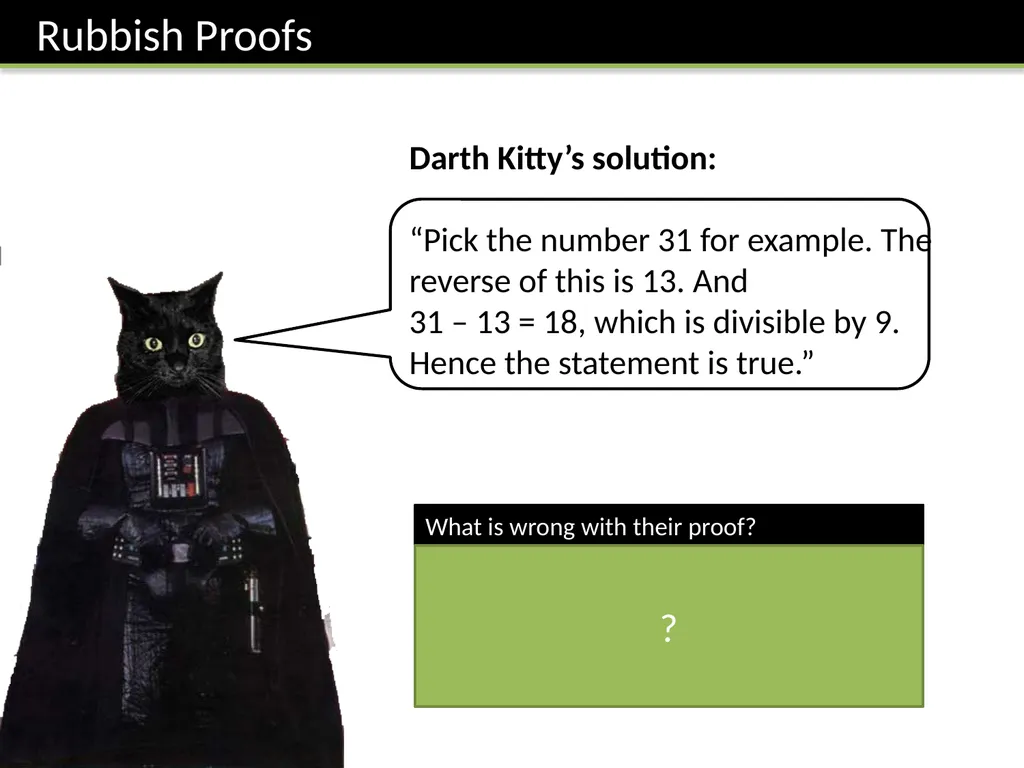
slide15. Darth Kitty’s solution:
“Pick the number 31 for example. The reverse of this is 13. And
31 – 13 = 18, which is divisible by 9. Hence the statement is true.” What is wrong with their proof? Showing something is true for one example is not sufficient. We need to show the statement is true for ANY POSSIBLE starting number we choose. ?<br>
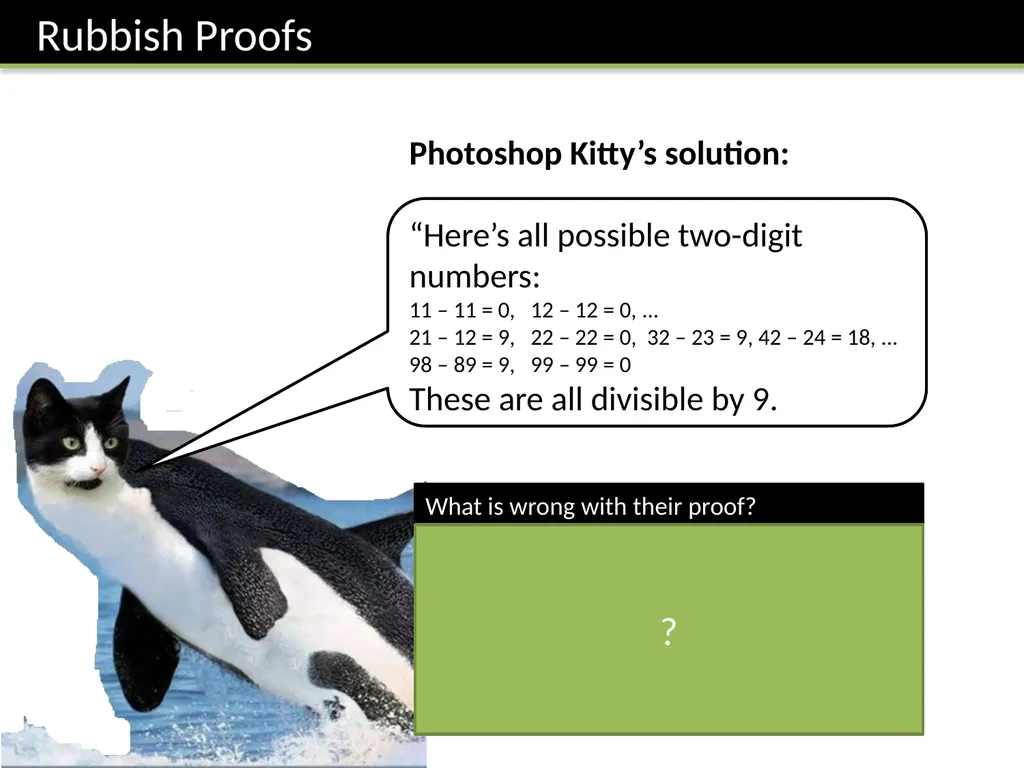
slide16. Photoshop Kitty’s solution:
“Here’s all possible two-digit numbers:
11 – 11 = 0, 12 – 12 = 0, ...
21 – 12 = 9, 22 – 22 = 0, 32 – 23 = 9, 42 – 24 = 18, ...
98 – 89 = 9, 99 – 99 = 0
These are all divisible by 9. What is wrong with their proof? Technically it’s a valid proof, because we’ve shown the statement is true for every possible two-digit number. But it’s bad maths having to list out every case, and would become difficult if for example we tried to generalise the statement to 3-digit numbers. ?<br>
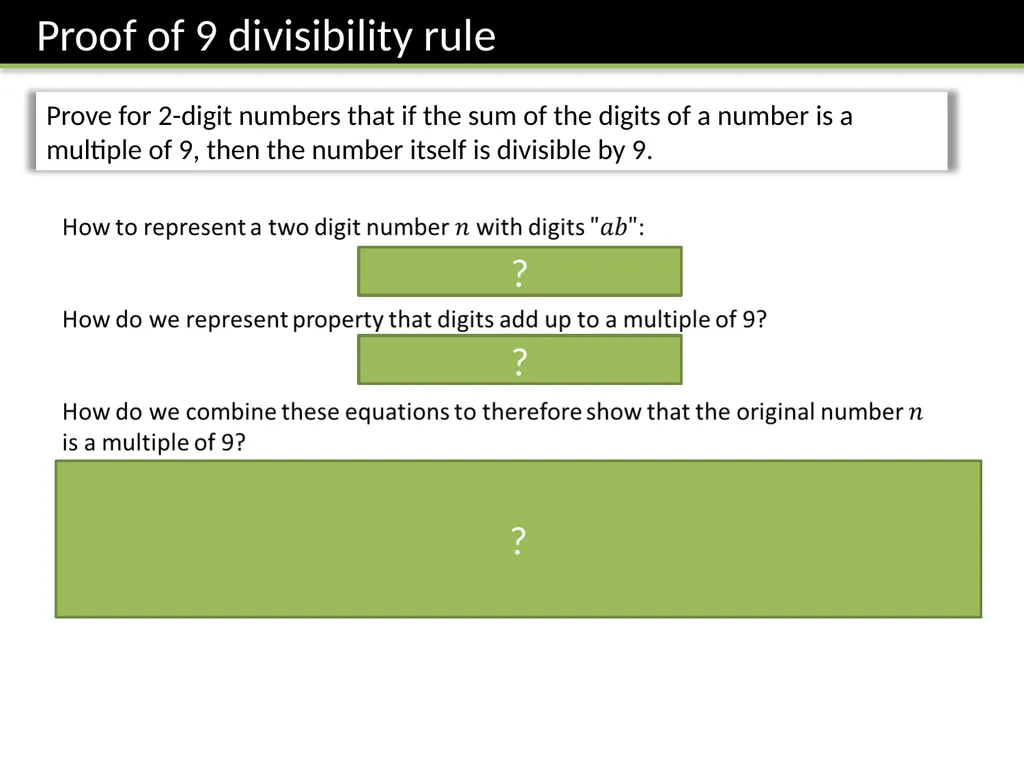
slide17. Prove for 2-digit numbers that if the sum of the digits of a number is a multiple of 9, then the number itself is divisible by 9. ? ? ?<br>
slide18. Q1 Q2 Q3 4 N ? ? ? ? ? ? b 5<br>
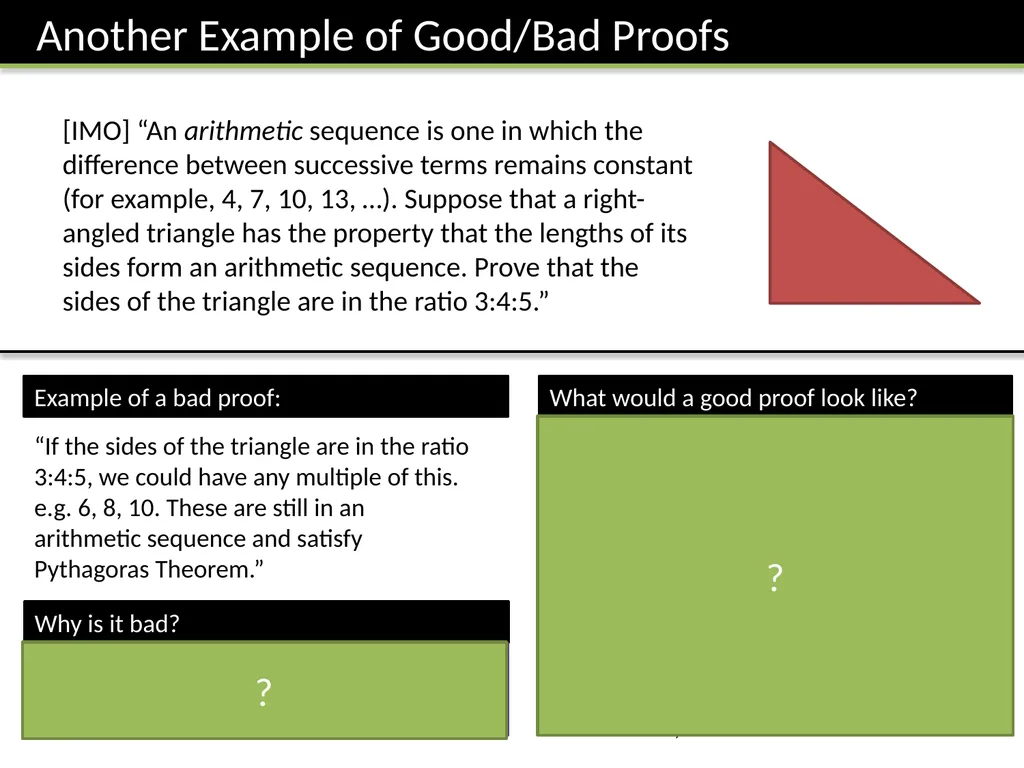
slide19. [IMO] “An arithmetic sequence is one in which the difference between successive terms remains constant (for example, 4, 7, 10, 13, …). Suppose that a right-angled triangle has the property that the lengths of its sides form an arithmetic sequence. Prove that the sides of the triangle are in the ratio 3:4:5.” Example of a bad proof: “If the sides of the triangle are in the ratio 3:4:5, we could have any multiple of this. e.g. 6, 8, 10. These are still in an arithmetic sequence and satisfy Pythagoras Theorem.” Why is it bad? We’re supposed to be showing that IF the sides form an arithmetic sequence THEN the sides have ratio 3:4:5. They’ve just shown the reverse! What would a good proof look like? Use our general structure for an algebraic proof!
“Assume that the sides form an arithmetic sequence.
Model this assumption, using algebraic expressions for side lengths that represent all possible arithmetic sequences, e.g. a-b, a, a+b.
Do some manipulation using Pythagoras...
Therefore, the sides have ratio 3:4:5.” ? ?<br>
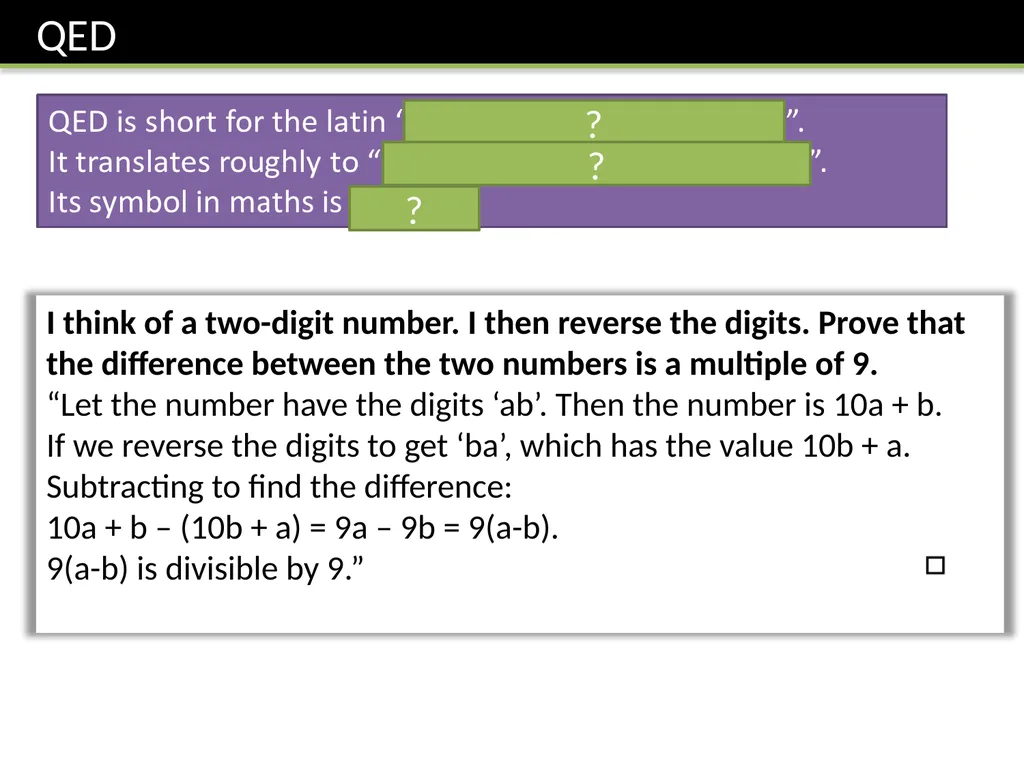
slide20. ? ? ? I think of a two-digit number. I then reverse the digits. Prove that the difference between the two numbers is a multiple of 9.
“Let the number have the digits ‘ab’. Then the number is 10a + b.
If we reverse the digits to get ‘ba’, which has the value 10b + a.
Subtracting to find the difference:
10a + b – (10b + a) = 9a – 9b = 9(a-b).
9(a-b) is divisible by 9.”<br>
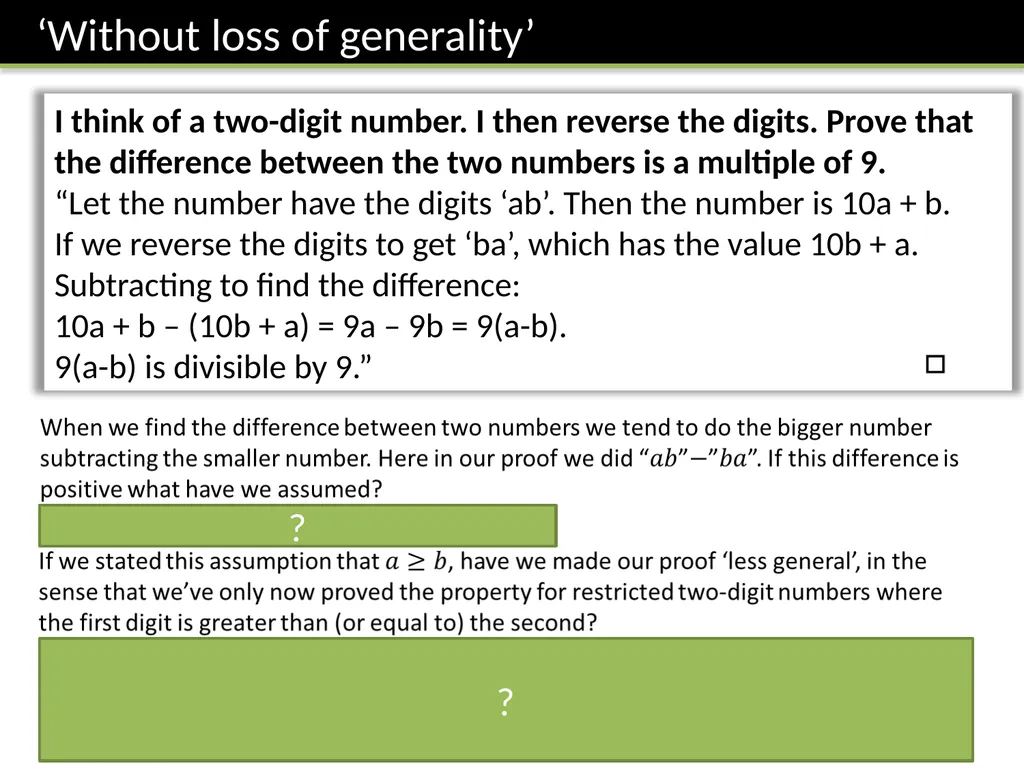
slide21. I think of a two-digit number. I then reverse the digits. Prove that the difference between the two numbers is a multiple of 9.
“Let the number have the digits ‘ab’. Then the number is 10a + b.
If we reverse the digits to get ‘ba’, which has the value 10b + a.
Subtracting to find the difference:
10a + b – (10b + a) = 9a – 9b = 9(a-b).
9(a-b) is divisible by 9.” ? ?<br>
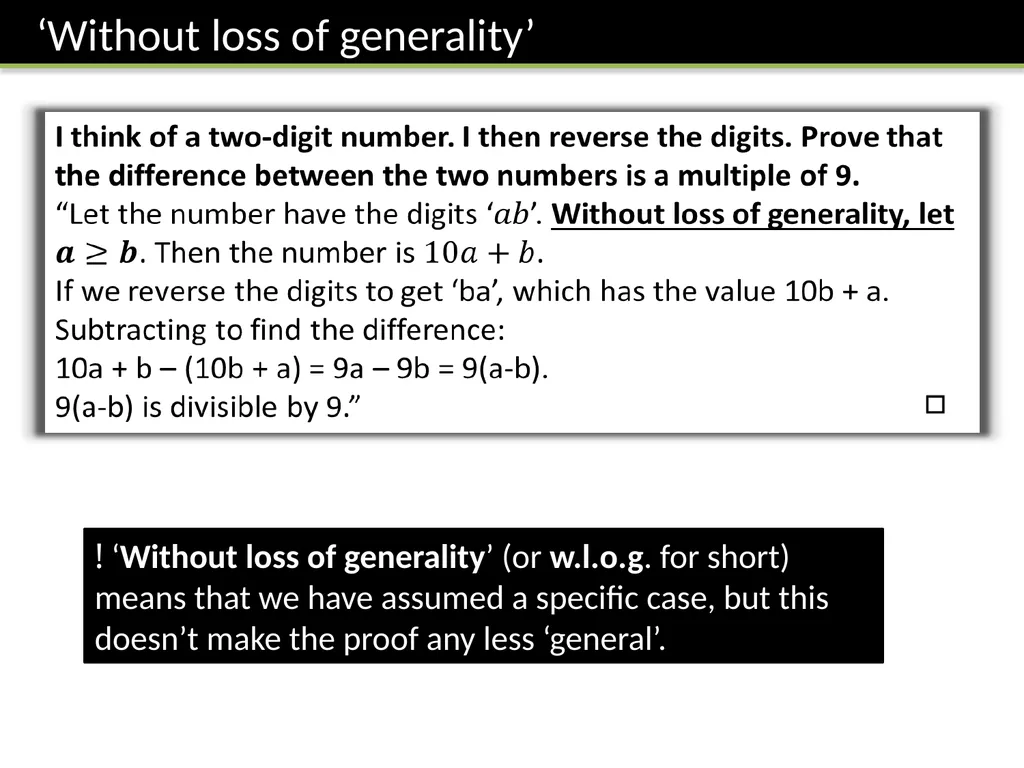
slide22. ! ‘Without loss of generality’ (or w.l.o.g. for short) means that we have assumed a specific case, but this doesn’t make the proof any less ‘general’.<br>
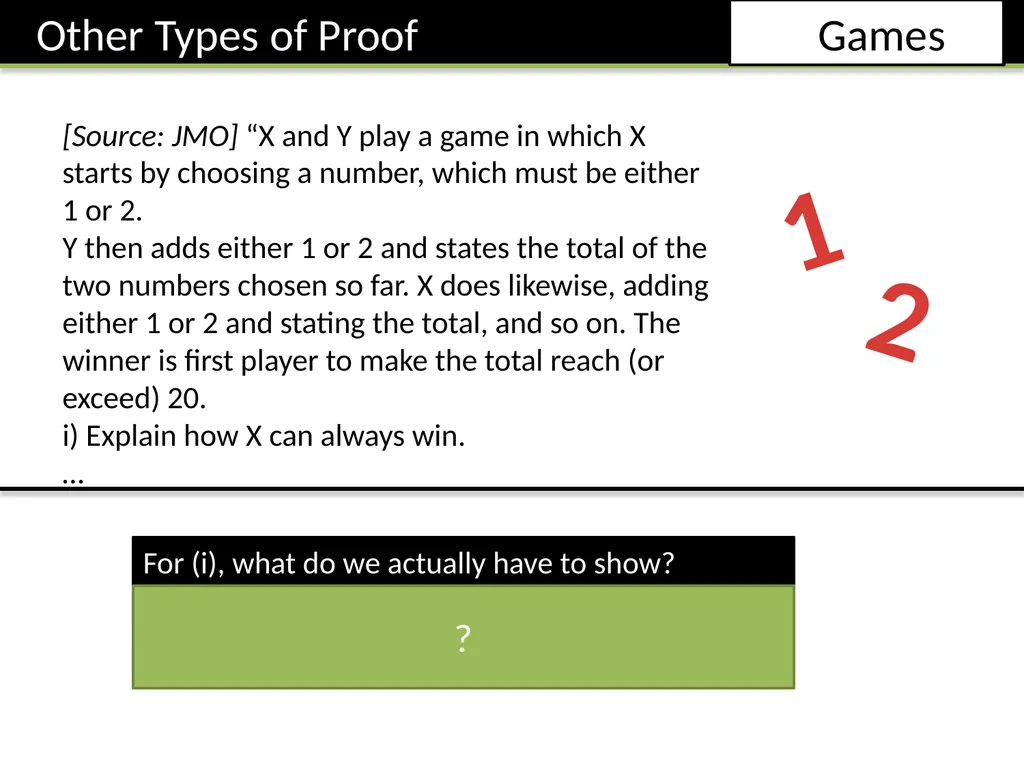
slide23. [Source: JMO] “X and Y play a game in which X starts by choosing a number, which must be either 1 or 2.
Y then adds either 1 or 2 and states the total of the two numbers chosen so far. X does likewise, adding either 1 or 2 and stating the total, and so on. The winner is first player to make the total reach (or exceed) 20.
i) Explain how X can always win.
… 1 2 For (i), what do we actually have to show? That for any way in which Y plays, we can always find a resulting move that guarantees us to win. ? Games<br>
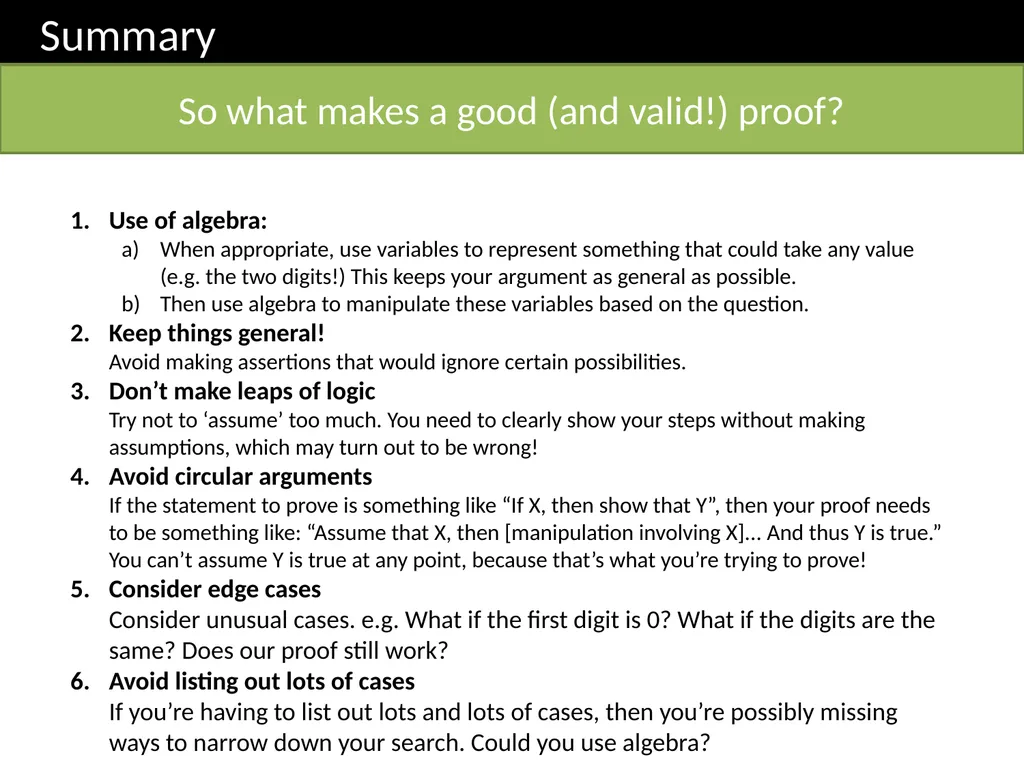
slide24. Summary So what makes a good (and valid!) proof? Use of algebra:
When appropriate, use variables to represent something that could take any value (e.g. the two digits!) This keeps your argument as general as possible.
Then use algebra to manipulate these variables based on the question.
Keep things general! Avoid making assertions that would ignore certain possibilities.
Don’t make leaps of logic Try not to ‘assume’ too much. You need to clearly show your steps without making assumptions, which may turn out to be wrong!
Avoid circular arguments If the statement to prove is something like “If X, then show that Y”, then your proof needs to be something like: “Assume that X, then [manipulation involving X]... And thus Y is true.” You can’t assume Y is true at any point, because that’s what you’re trying to prove!
Consider edge cases Consider unusual cases. e.g. What if the first digit is 0? What if the digits are the same? Does our proof still work?
Avoid listing out lots of cases If you’re having to list out lots and lots of cases, then you’re possibly missing ways to narrow down your search. Could you use algebra?<br>
www.drfrostmaths.com Last modified: 26th April 2016 Objectives: Understand what is meant by a proof, and examples of what does and what doesn’t constitute a proof.
Be able to solve problems involving oddness/evenness, consecutive numbers and involving digits.<br>
slide2. One ? A Few Infinitely Many One A Few Infinitely Many<br>
slide3. A B C D Source: MAT<br>
slide4. ! A counterexample is an example used to disprove a statement. Discussing in pairs, find counterexamples for the following statements: ? ? ? ? 1 2 3 4<br>
slide5. Geometry “Prove that the exterior angle of a triangle is the sum of the two other interior angles.” Sequence Proofs “The first two terms of a sequence are the numbers 1, 2. From then on, each term is obtained by adding 1 to the previous term and then dividing by the term before that. Prove that the sequence repeats.” Consecutive Numbers “Prove that the sum of any three consecutive integers is a multiple of 3.” Even/Odd We already covered these in the Sequences II topic. Game Proofs If I have a ‘perfect Connect 4’ strategy for winning, how can I show it’s perfect?<br>
slide6. ? You will do this kind of proof at GCSE… The key here is that all integers are either odd or even.
We can therefore do a case analysis and consider these two different cases.<br>
slide7. A B ? ? (Hint: Think odd/even)<br>
slide8. ? ? ? ? ? ? ? ? 1 2 3 4 5 6 7 8<br>
slide9. Show that the sum of any three consecutive integers is a multiple of 3. Kyle’s proof:
“5 + 6 + 7 = 18, which is divisible by 3”. Que Problemo?
He hasn’t shown it’s true for all possible integers. ? ? ?<br>
slide10. How could I algebraically represent: ! ? ? ? ? ? ?<br>
slide11. ? ?<br>
slide12. Q1 Q2 Q3 N1 N2 N3 ? ? ? ? ? ? ? Q4<br>
slide13. “I think of a two-digit number. I then reverse the digits. Prove that the difference between the two numbers is a multiple of 9” e.g. 71 – 17 = 54 Model Problem Algebraically ? (Note how factoring out the 9 is a good explicit way to show the expression is a multiple of 9) Manipulate to reach conclusion ?<br>
slide14. ? ? ? ? a b c d<br>
slide15. Darth Kitty’s solution:
“Pick the number 31 for example. The reverse of this is 13. And
31 – 13 = 18, which is divisible by 9. Hence the statement is true.” What is wrong with their proof? Showing something is true for one example is not sufficient. We need to show the statement is true for ANY POSSIBLE starting number we choose. ?<br>
slide16. Photoshop Kitty’s solution:
“Here’s all possible two-digit numbers:
11 – 11 = 0, 12 – 12 = 0, ...
21 – 12 = 9, 22 – 22 = 0, 32 – 23 = 9, 42 – 24 = 18, ...
98 – 89 = 9, 99 – 99 = 0
These are all divisible by 9. What is wrong with their proof? Technically it’s a valid proof, because we’ve shown the statement is true for every possible two-digit number. But it’s bad maths having to list out every case, and would become difficult if for example we tried to generalise the statement to 3-digit numbers. ?<br>
slide17. Prove for 2-digit numbers that if the sum of the digits of a number is a multiple of 9, then the number itself is divisible by 9. ? ? ?<br>
slide18. Q1 Q2 Q3 4 N ? ? ? ? ? ? b 5<br>
slide19. [IMO] “An arithmetic sequence is one in which the difference between successive terms remains constant (for example, 4, 7, 10, 13, …). Suppose that a right-angled triangle has the property that the lengths of its sides form an arithmetic sequence. Prove that the sides of the triangle are in the ratio 3:4:5.” Example of a bad proof: “If the sides of the triangle are in the ratio 3:4:5, we could have any multiple of this. e.g. 6, 8, 10. These are still in an arithmetic sequence and satisfy Pythagoras Theorem.” Why is it bad? We’re supposed to be showing that IF the sides form an arithmetic sequence THEN the sides have ratio 3:4:5. They’ve just shown the reverse! What would a good proof look like? Use our general structure for an algebraic proof!
“Assume that the sides form an arithmetic sequence.
Model this assumption, using algebraic expressions for side lengths that represent all possible arithmetic sequences, e.g. a-b, a, a+b.
Do some manipulation using Pythagoras...
Therefore, the sides have ratio 3:4:5.” ? ?<br>
slide20. ? ? ? I think of a two-digit number. I then reverse the digits. Prove that the difference between the two numbers is a multiple of 9.
“Let the number have the digits ‘ab’. Then the number is 10a + b.
If we reverse the digits to get ‘ba’, which has the value 10b + a.
Subtracting to find the difference:
10a + b – (10b + a) = 9a – 9b = 9(a-b).
9(a-b) is divisible by 9.”<br>
slide21. I think of a two-digit number. I then reverse the digits. Prove that the difference between the two numbers is a multiple of 9.
“Let the number have the digits ‘ab’. Then the number is 10a + b.
If we reverse the digits to get ‘ba’, which has the value 10b + a.
Subtracting to find the difference:
10a + b – (10b + a) = 9a – 9b = 9(a-b).
9(a-b) is divisible by 9.” ? ?<br>
slide22. ! ‘Without loss of generality’ (or w.l.o.g. for short) means that we have assumed a specific case, but this doesn’t make the proof any less ‘general’.<br>
slide23. [Source: JMO] “X and Y play a game in which X starts by choosing a number, which must be either 1 or 2.
Y then adds either 1 or 2 and states the total of the two numbers chosen so far. X does likewise, adding either 1 or 2 and stating the total, and so on. The winner is first player to make the total reach (or exceed) 20.
i) Explain how X can always win.
… 1 2 For (i), what do we actually have to show? That for any way in which Y plays, we can always find a resulting move that guarantees us to win. ? Games<br>
slide24. Summary So what makes a good (and valid!) proof? Use of algebra:
When appropriate, use variables to represent something that could take any value (e.g. the two digits!) This keeps your argument as general as possible.
Then use algebra to manipulate these variables based on the question.
Keep things general! Avoid making assertions that would ignore certain possibilities.
Don’t make leaps of logic Try not to ‘assume’ too much. You need to clearly show your steps without making assumptions, which may turn out to be wrong!
Avoid circular arguments If the statement to prove is something like “If X, then show that Y”, then your proof needs to be something like: “Assume that X, then [manipulation involving X]... And thus Y is true.” You can’t assume Y is true at any point, because that’s what you’re trying to prove!
Consider edge cases Consider unusual cases. e.g. What if the first digit is 0? What if the digits are the same? Does our proof still work?
Avoid listing out lots of cases If you’re having to list out lots and lots of cases, then you’re possibly missing ways to narrow down your search. Could you use algebra?<br>