Yeast There are approximately 37.2 trillion different cells in a human body Yeast is made of just one cell. It is a single-celled organism What is yeast? But there are lots of different types of yeast! Some yeasts are blobby (the yeast is
"Yeast There are approximately 37.2 trillion" is the property of its rightful owner. Permission is granted to
download and print the materials on this website for personal, non-commercial use only, and to display it
on your personal computer provided you do not modify the materials and that you retain all copyright
notices contained in the materials. By downloading content from our website, you accept the terms of this
agreement.
Presentation Transcript
01
Yeast<br>
02
There are approximately 37.2 trillion different cells in a human body Yeast is made of just one cell.
It is a single-celled organism What is yeast?<br>
03
But… there are lots of different types of yeast! Some yeasts are blobby
(the yeast is “budding”) Some are hairy looking<br>
04
Some yeasts become “stringy”
(called filaments) And some look like bullets
(and split in the middle)<br>
05
What is yeast used for? Yeast converts (ferments) sugar into ethanol (a type of alcohol) and a gas called carbon dioxide. Humans have been using yeast for around 10,000 years.
We use it today to make foods and drinks such as bread, beer and wine (and Marmite!). The carbon dioxide made by yeast forms the bubbles in crumpets. Useful yeasts!<br>
06
Yeast power! Yeast ferments (break down) sugars found in waste products like wheat straw and turns it into ethanol that can be used in car biofuel.<br>
07
Activity one Making Crumpets!<br>
08
Crumpets! Ingredients checklist
Strong white bread flour
Plain flour
Caster sugar
Warm milk
Warm water
Bicarbonate of soda
Salt
Yeast
Sunflower oil Equipment checklist
Bowl
Measuring jug
Spoon
Clingfilm
Frying pan
Crumpet rings
Spatula<br>
09
Method (what to do) 1. Add the two types of flour and yeast into the bowl, and stir. 2. Dissolve the sugar into the warm milk, using a measuring jug and spoon. 3. Add the sugar and milk mixture into the flour mix and stir until smooth. This usually takes around 3-4 minutes.<br>
10
4. Cover the bowl with clingfilm and place somewhere warm for 20 minutes (or up to 60 minutes if it is not warm enough).
Tidy your table! While we wait…….<br>
11
Activity two Yeast Balloons!<br>
12
Yeast Balloons Materials checklist
One plastic bottle
One balloon
One sachet of yeast
Two teaspoons of sugar
Warm water<br>
13
Method (what to do) 1. Pour warm water into the plastic bottle, so that it measures 4-5cm up the side. 2. Add the yeast to the water 4 to 5cm 3. Add the sugar to the water and yeast mixture. Put the bottle top on and give the bottle a gentle shake.<br>
14
4. Remove the bottle top and attach the balloon to the top of the bottle. 5. Place the bottle in a warm spot and watch! What is happening to the balloon?
Why is it happening?<br>
15
Activity one Making Crumpets!
Part 2<br>
16
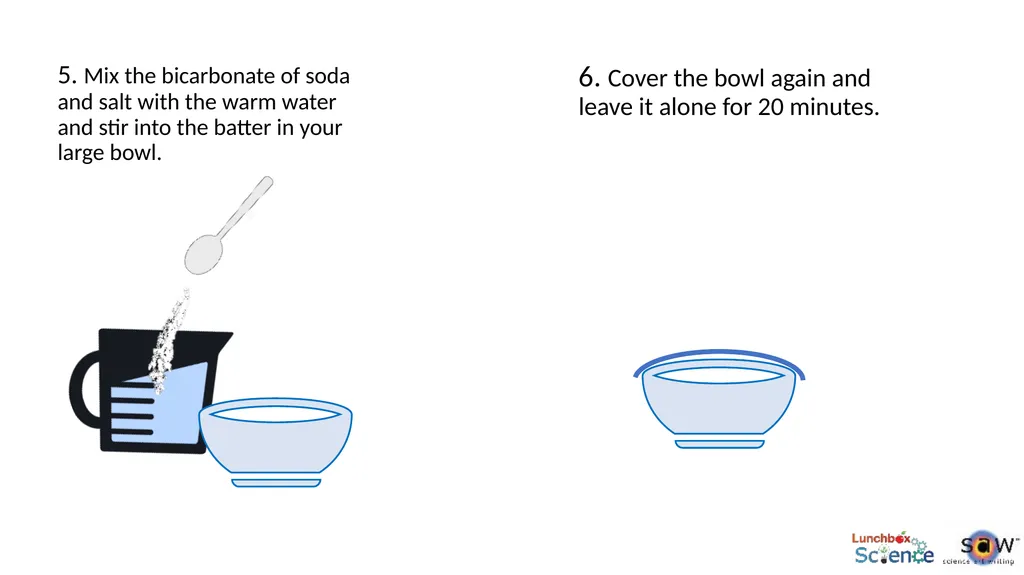
5. Mix the bicarbonate of soda and salt with the warm water and stir into the batter in your large bowl. 6. Cover the bowl again and leave it alone for 20 minutes.<br>
17
Cooking the crumpets 7. The crumpet batter is now ready to cook!
Grease a frying pan and four crumpet rings with sunflower oil and place on a medium heat. 8. Drop 2-3 tablespoons of batter into each ring. Cook until holes appear and the top of the crumpet is no longer runny.
Approximately 4-5 minutes.
Then use a spatula to turn the crumpets over and cook for a further 2/3 minutes.<br>
18
The crumpets are now ready to eat. You can also let them cool and warm them up later in a toaster! What has caused the holes to appear in the crumpet? How did the batter change when we added things to it and what did it look like? Create a word bank!
What new words have you come across?<br>
19
Activity Three Yeast Alive!<br>
20
You will need A bowl or plate
Fresh yeast
Sugar<br>
21
Method 1. Open the block of fresh yeast. What does is smell, look and feel like? 2. Put the yeast in a bowl or plate and add sugar.
Stir until the mixture changes How does the mixture change?
And why??<br>
22
Writing Activity<br>
23
Poetry What you will need:
Pen/pencil
Paper lined or plain
Your word bank
Science images During this session we will use the concepts, experiences, images and new vocabulary from the science as a starting point for writing poetry!<br>
24
Yeast inspired poetry What can you see when you look at the science images?
Some things to think about:
What colours can you see?
Describe what shapes you can see.
What does it look like?
Do any of the images remind you of anything?<br>
25
Art Activity 3D Yeast Structures<br>
26
3D Yeast Structures Materials
Cane
Masking tape
Craft pliers
PVA glue
Sponge/paintbrush
White tissue paper
Coloured tissue paper<br>
27
1. Bend the soaked cane to begin creating your yeast structure. Begin with creating hoops and securing with masking tape. 3. Refer back to the yeast images and choose a final colour tissue paper for your structure and apply it with the PVA mixture.
Now allow your structure to dry! 2. Once you are happy with your yeast structure use the PVA glue mixture and a sponge to apply white tissue paper and allow it to dry.<br>