1 CUSP Science Revisit lesson Grade 3 Biology Living things and their habitats Teacher notes Please note that the given tasks are suggestions only. Teachers may wish to make adaptations to suit their cohort. Some tasks require pupils to
"1 CUSP Science Revisit lesson Grade 3 Biology" is the property of its rightful owner. Permission is granted to
download and print the materials on this website for personal, non-commercial use only, and to display it
on your personal computer provided you do not modify the materials and that you retain all copyright
notices contained in the materials. By downloading content from our website, you accept the terms of this
agreement.
Presentation Transcript
01
1 CUSP Science Revisit lesson
Grade 3
Biology
Living things and their habitats<br>
02
Teacher notes Please note that the given tasks are suggestions only. Teachers may wish to make adaptations to suit their cohort.
Some tasks require pupils to examine images carefully, or annotate them, so enlarge or print these, as required.
The lesson has two vocabulary activities. One is a scripted example for teachers to say to pupils. The other is a task for pupils to complete.
Vocabulary tasks can be completed during any stage of the lesson, so please move the relevant slides to where they best fit within each lesson.
Where possible, pupils should examine specimens rather than photographs of specimens.
At the end of the lesson, return to the learning question to check that pupils are able to answer the question . 2<br>
03
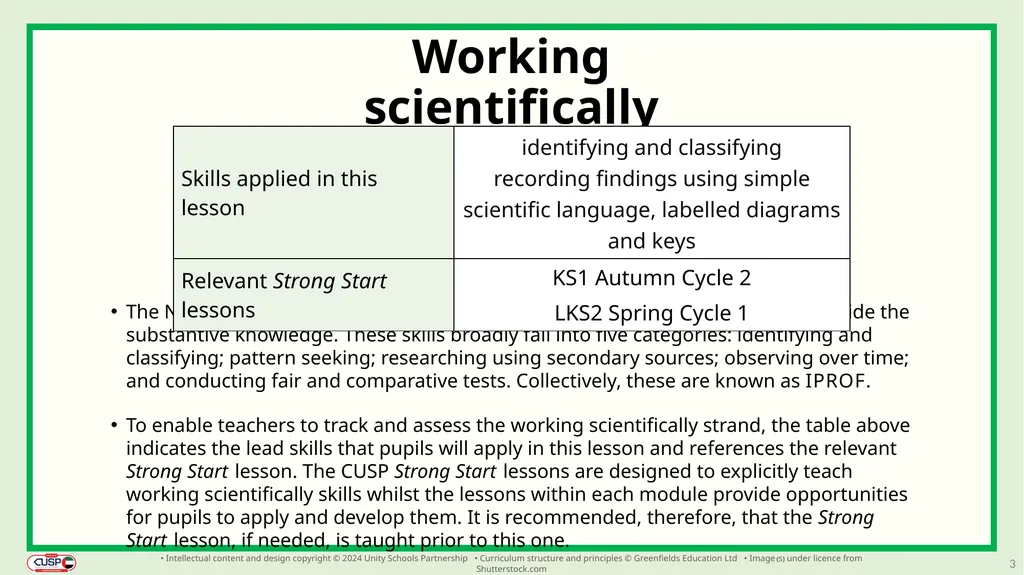
Working scientifically 3 The National Curriculum requires working scientifically skills to be taught alongside the substantive knowledge. These skills broadly fall into five categories: identifying and classifying; pattern seeking; researching using secondary sources; observing over time; and conducting fair and comparative tests. Collectively, these are known as IPROF.
To enable teachers to track and assess the working scientifically strand, the table above indicates the lead skills that pupils will apply in this lesson and references the relevant Strong Start lesson. The CUSP Strong Start lessons are designed to explicitly teach working scientifically skills whilst the lessons within each module provide opportunities for pupils to apply and develop them. It is recommended, therefore, that the Strong Start lesson, if needed, is taught prior to this one.<br>
04
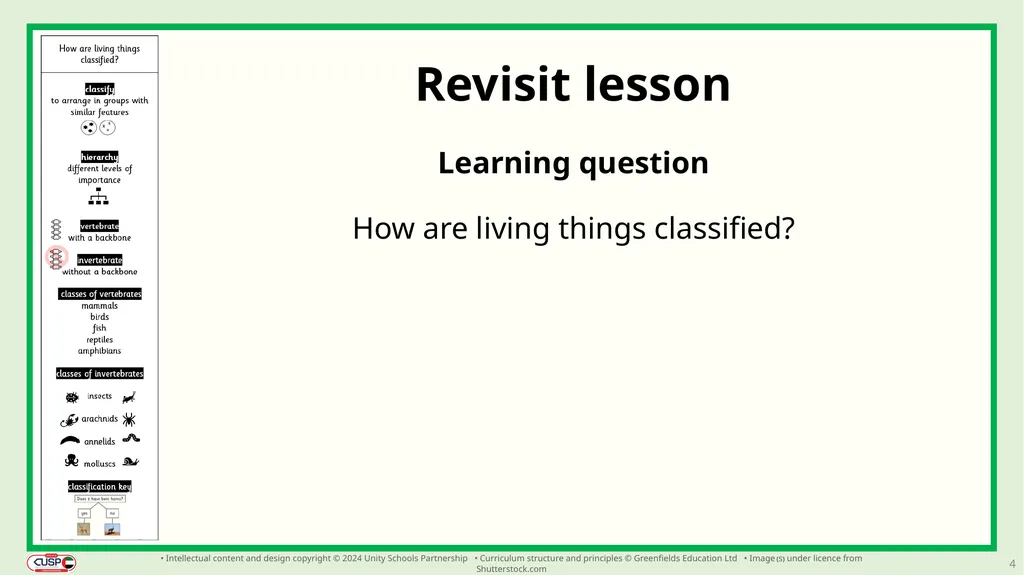
4 Revisit lesson Learning question
How are living things classified?<br>
05
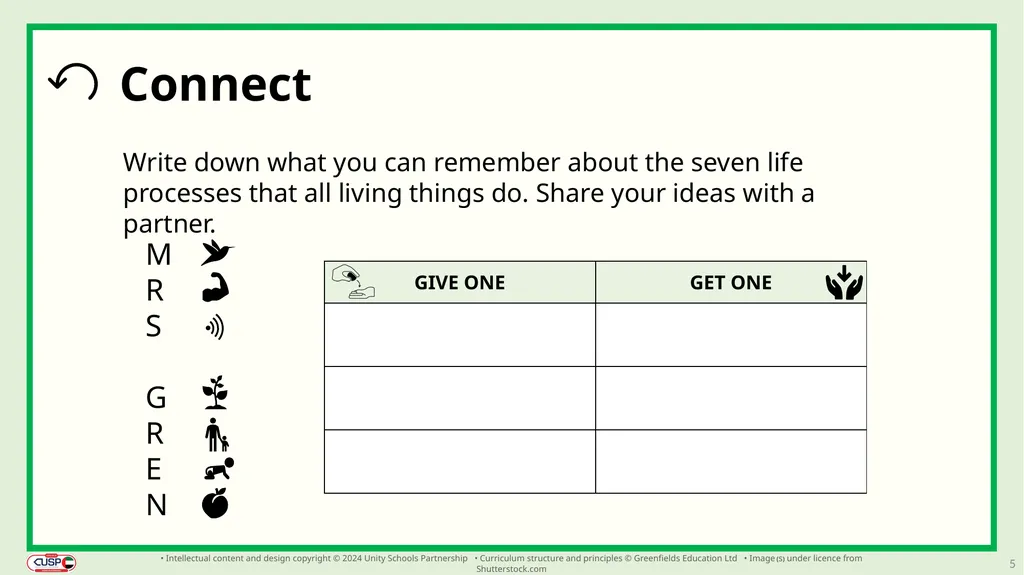
5 Connect Write down what you can remember about the seven life processes that all living things do. Share your ideas with a partner. M
R
S
G
R
E
N<br>
06
Vocabulary 6<br>
07
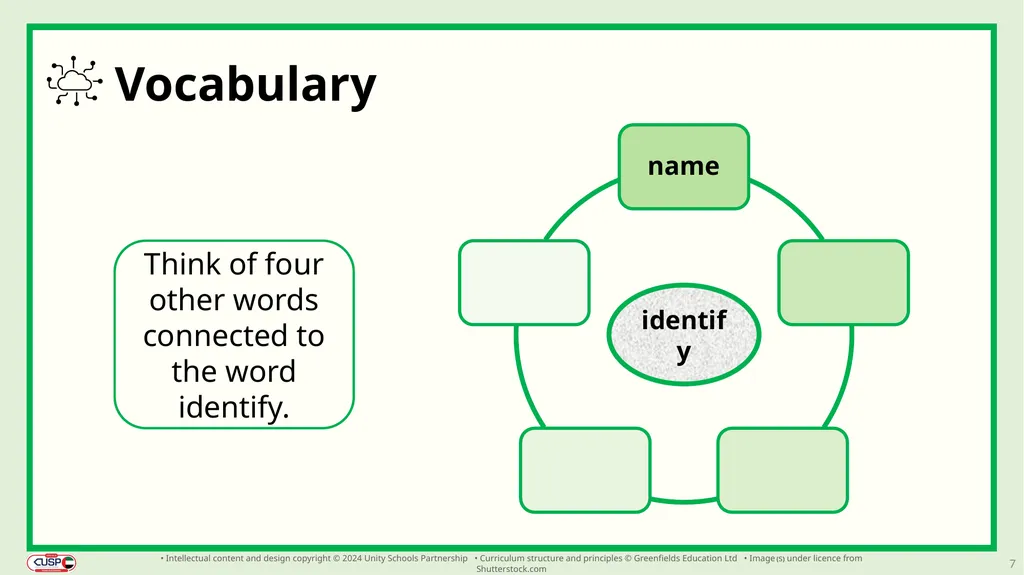
Vocabulary name identify Think of four other words connected to the word identify. 7<br>
08
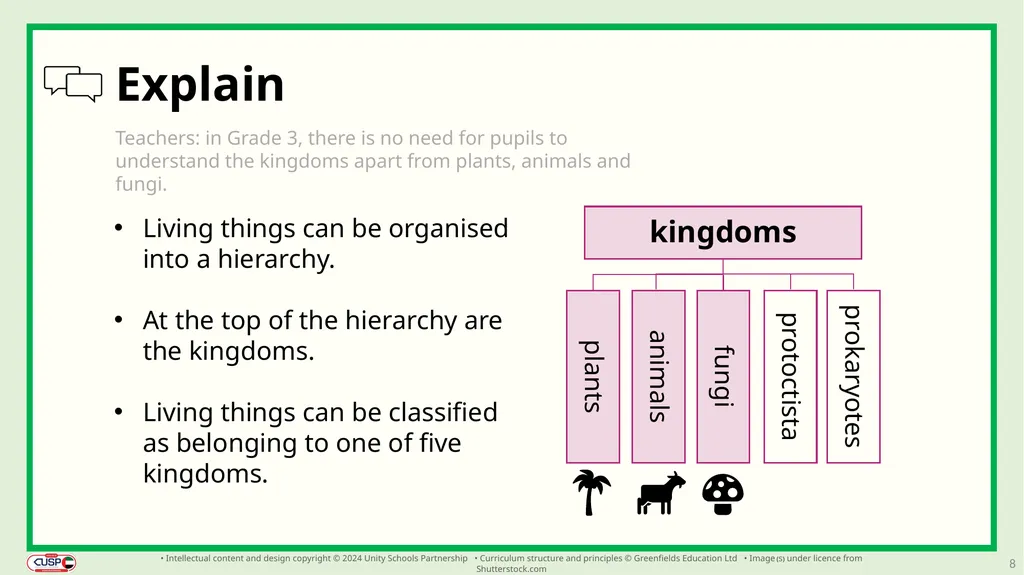
Explain 8 Living things can be organised into a hierarchy.
At the top of the hierarchy are the kingdoms.
Living things can be classified as belonging to one of five kingdoms. Teachers: in Grade 3, there is no need for pupils to understand the kingdoms apart from plants, animals and fungi.<br>
09
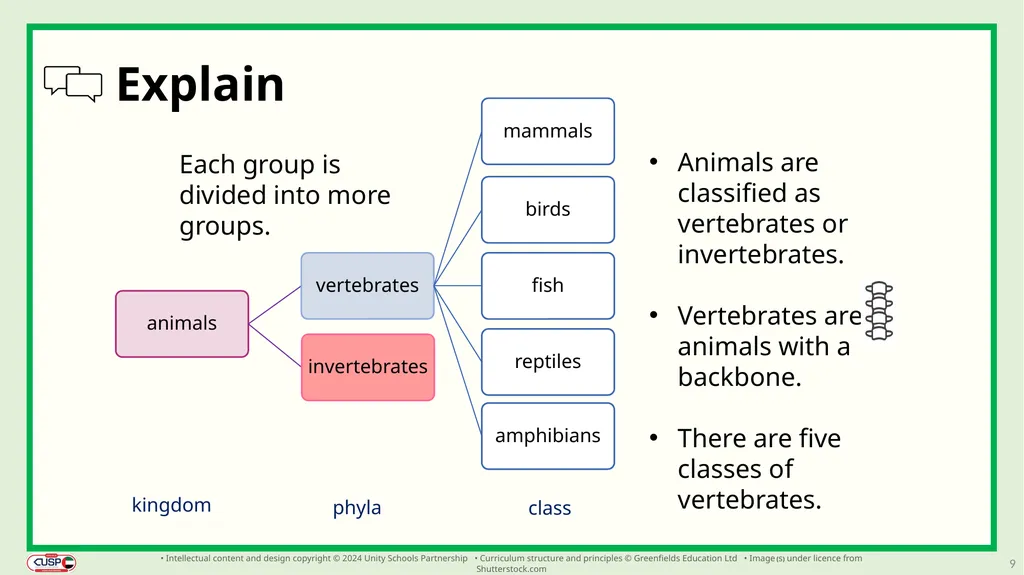
Explain 9 Animals are classified as vertebrates or invertebrates.
Vertebrates are animals with a backbone.
There are five classes of vertebrates. Each group is divided into more groups. kingdom phyla class<br>
10
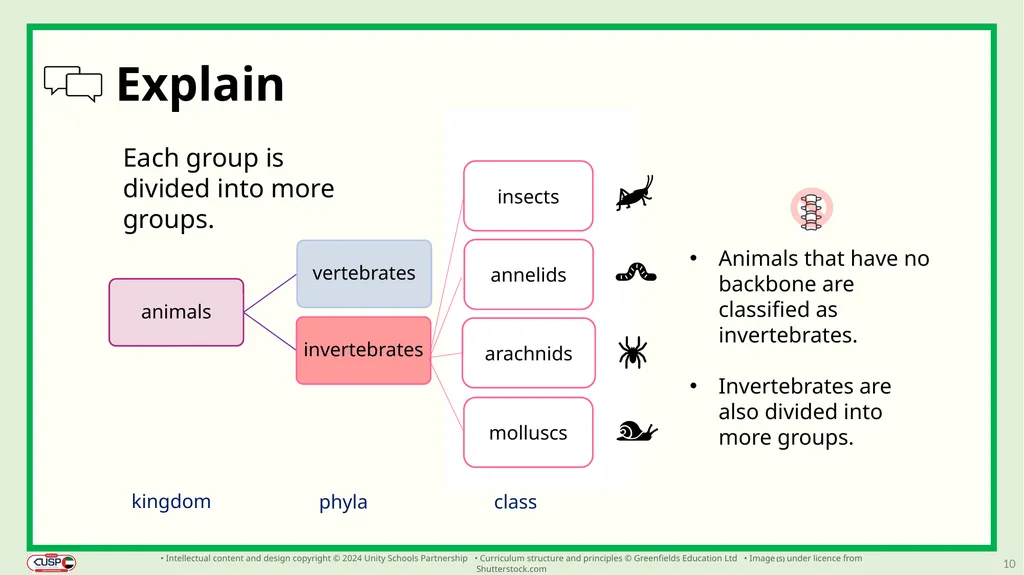
Explain 10 Animals that have no backbone are classified as invertebrates.
Invertebrates are also divided into more groups. kingdom phyla class Each group is divided into more groups.<br>
11
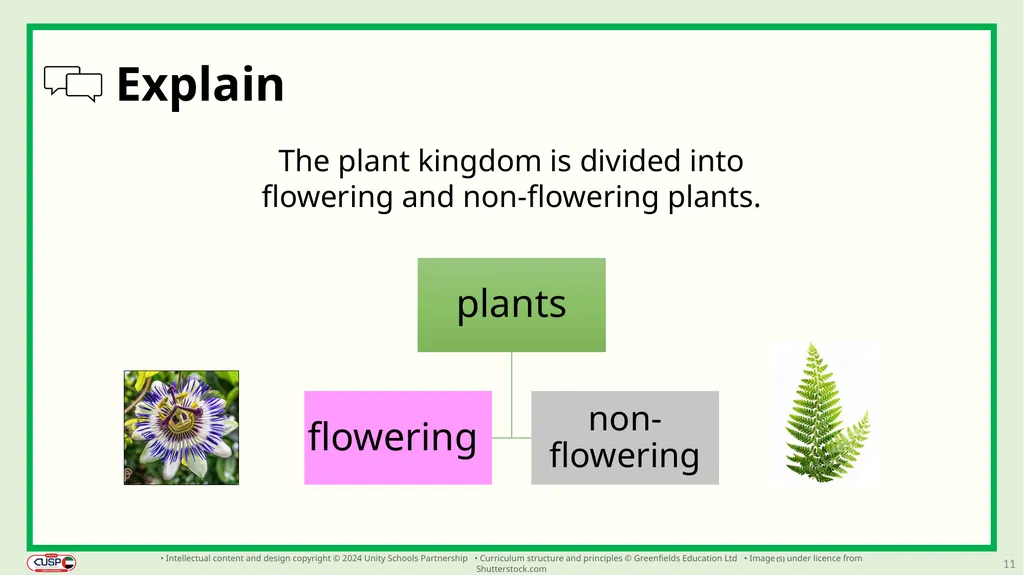
Explain 11 The plant kingdom is divided into flowering and non-flowering plants.<br>
12
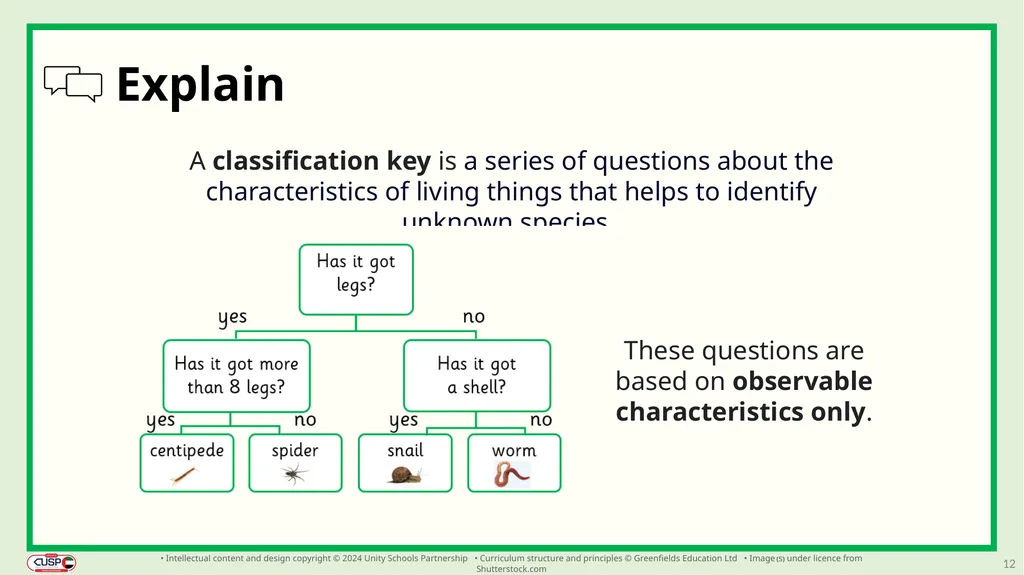
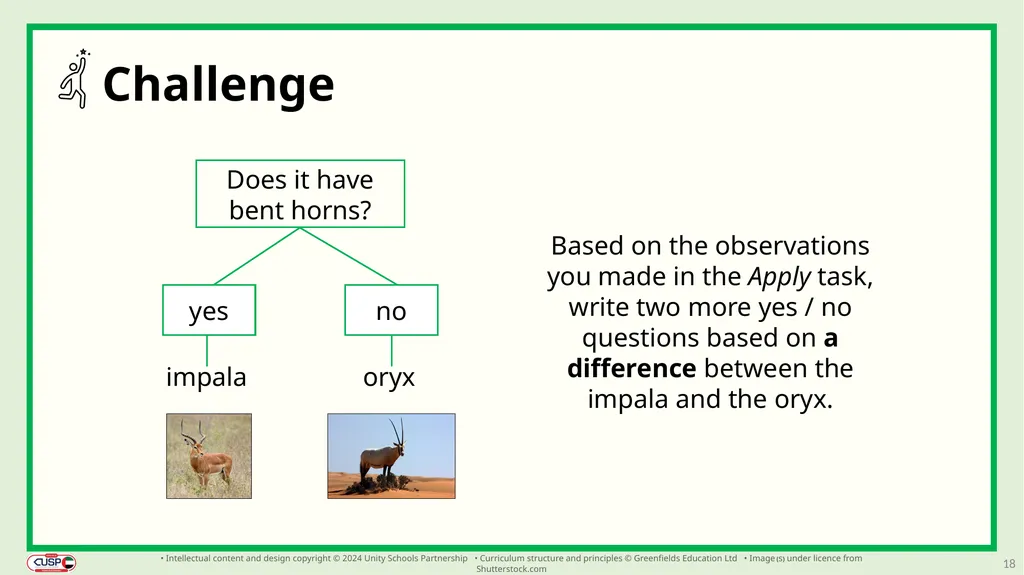
Explain 12 A classification key is a series of questions about the characteristics of living things that helps to identify unknown species. These questions are based on observable characteristics only.<br>
13
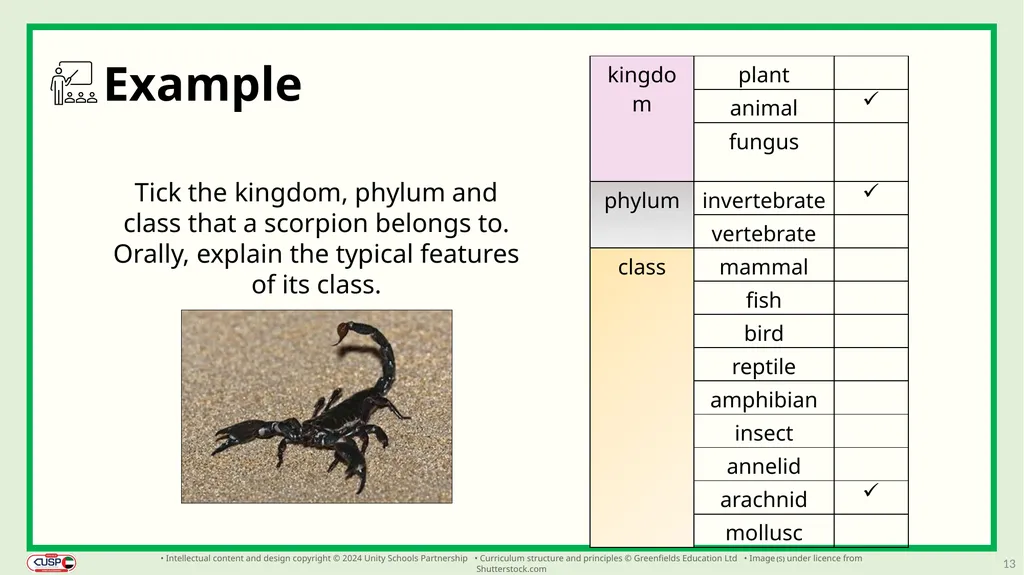
Example 13 Tick the kingdom, phylum and class that a scorpion belongs to. Orally, explain the typical features of its class.<br>
14
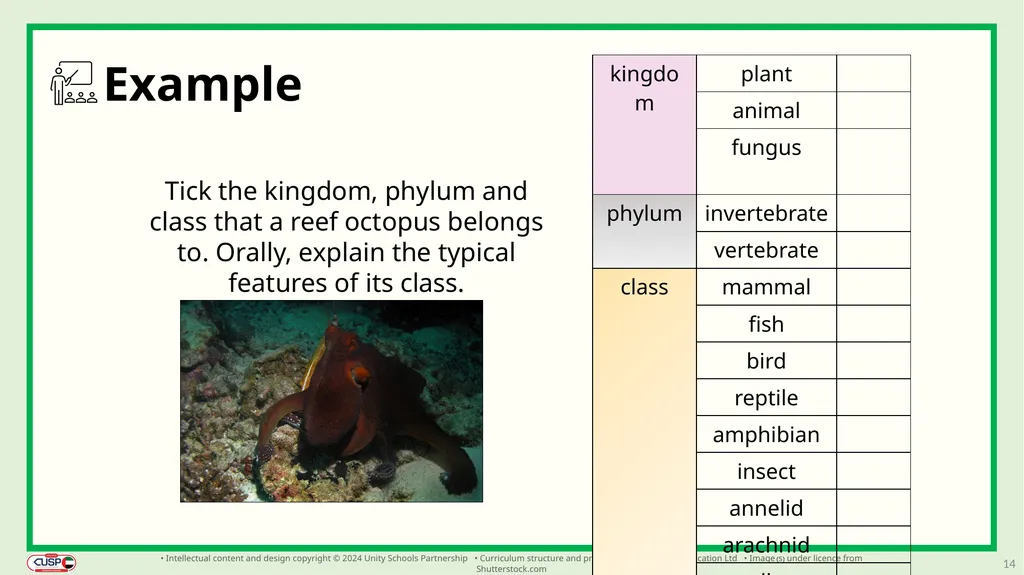
Example 14 Tick the kingdom, phylum and class that a reef octopus belongs to. Orally, explain the typical features of its class.<br>
15
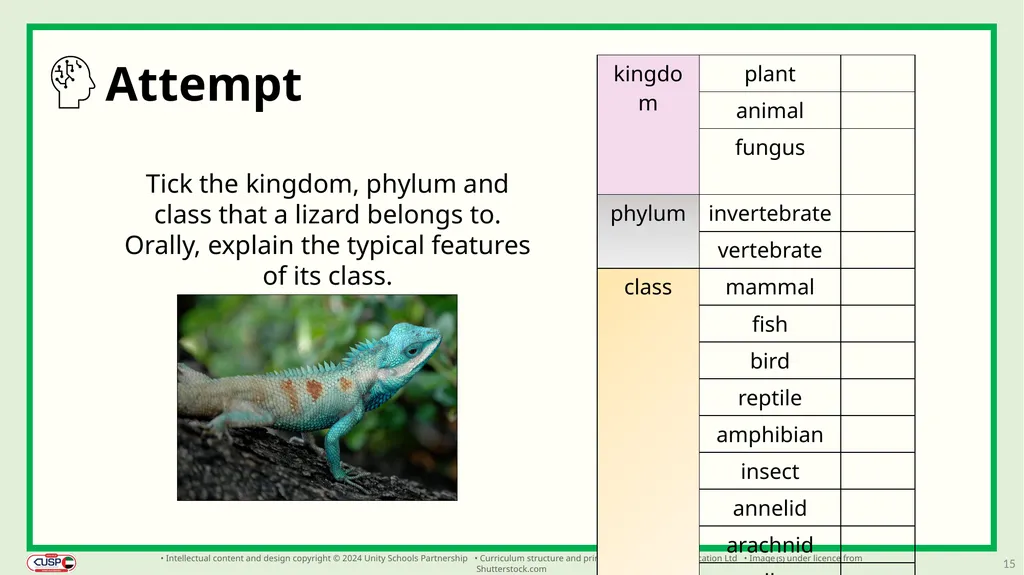
Attempt 15 Tick the kingdom, phylum and class that a lizard belongs to. Orally, explain the typical features of its class.<br>
16
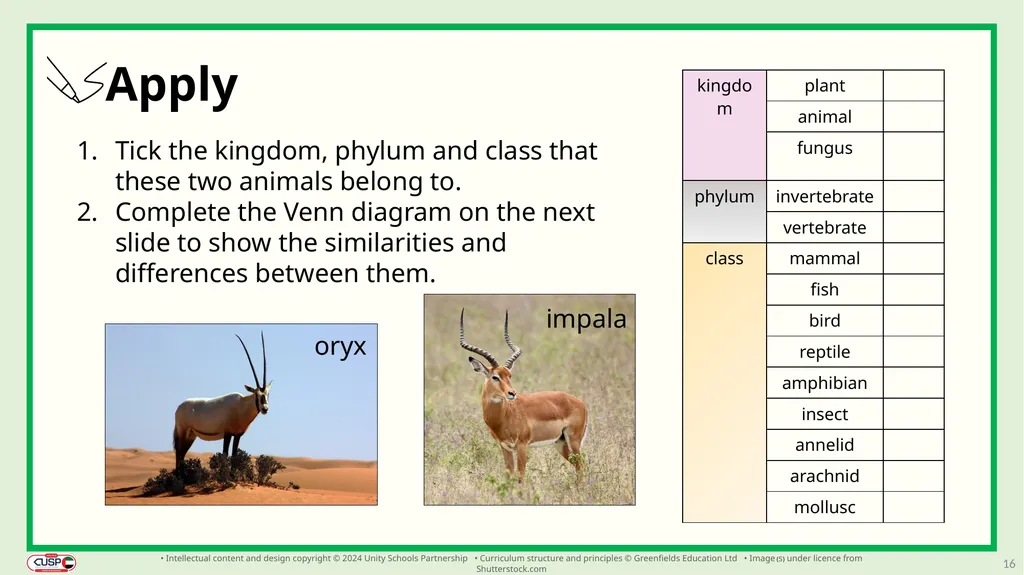
Apply 16 Tick the kingdom, phylum and class that these two animals belong to.
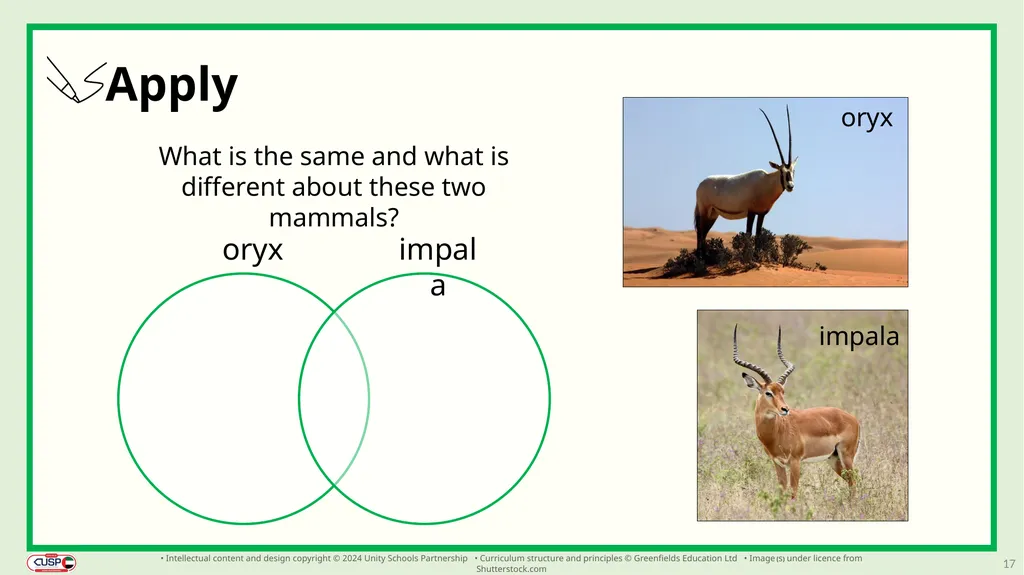
Complete the Venn diagram on the next slide to show the similarities and differences between them. impala oryx<br>
17
Apply 17 impala oryx impala oryx What is the same and what is different about these two mammals?<br>
18
Based on the observations you made in the Apply task, write two more yes / no questions based on a difference between the impala and the oryx. Challenge 18<br>
19
19 Reflection How are living things classified? I have become a little more expert at identifying and classifying things.<br>