
1 Massively Parallel Genomic Sequence Search on
Description: 1 Massively Parallel Genomic Sequence Search on Blue GeneP Heshan Lin (NCSU) Pavan Balaji (ANL) Ruth Poole, Carlos Sosa (IBM) Xiaosong Ma (NCSU ORNL) Wu Feng (VT) 2 Sequence Search Fundamental tool in computational biology Search
Related Topics
Download Presentation
"1 Massively Parallel Genomic Sequence Search on" is the property of its rightful owner. Permission is granted to download and print the materials on this website for personal, non-commercial use only, and to display it on your personal computer provided you do not modify the materials and that you retain all copyright notices contained in the materials. By downloading content from our website, you accept the terms of this agreement.
Presentation Transcript
slide1. 1 Massively Parallel Genomic Sequence Search on Blue Gene/P Heshan Lin (NCSU)
Pavan Balaji (ANL)
Ruth Poole, Carlos Sosa (IBM)
Xiaosong Ma (NCSU & ORNL)
Wu Feng (VT)<br>
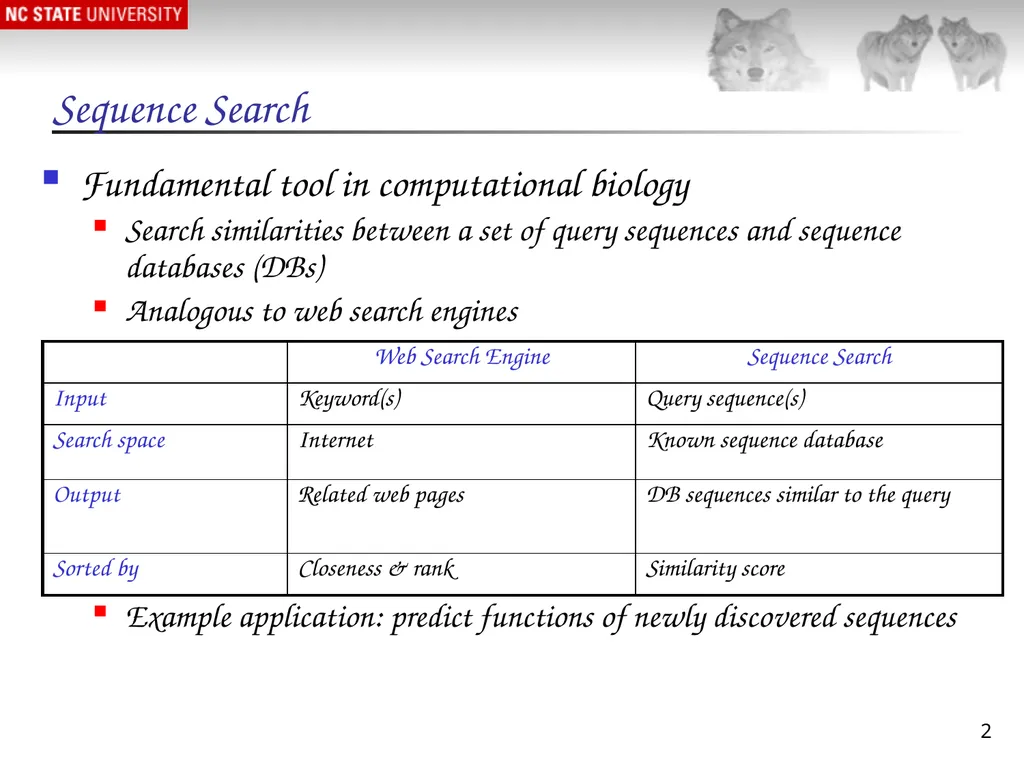
slide2. 2 Sequence Search Fundamental tool in computational biology
Search similarities between a set of query sequences and sequence databases (DBs)
Analogous to web search engines
Example application: predict functions of newly discovered sequences<br>
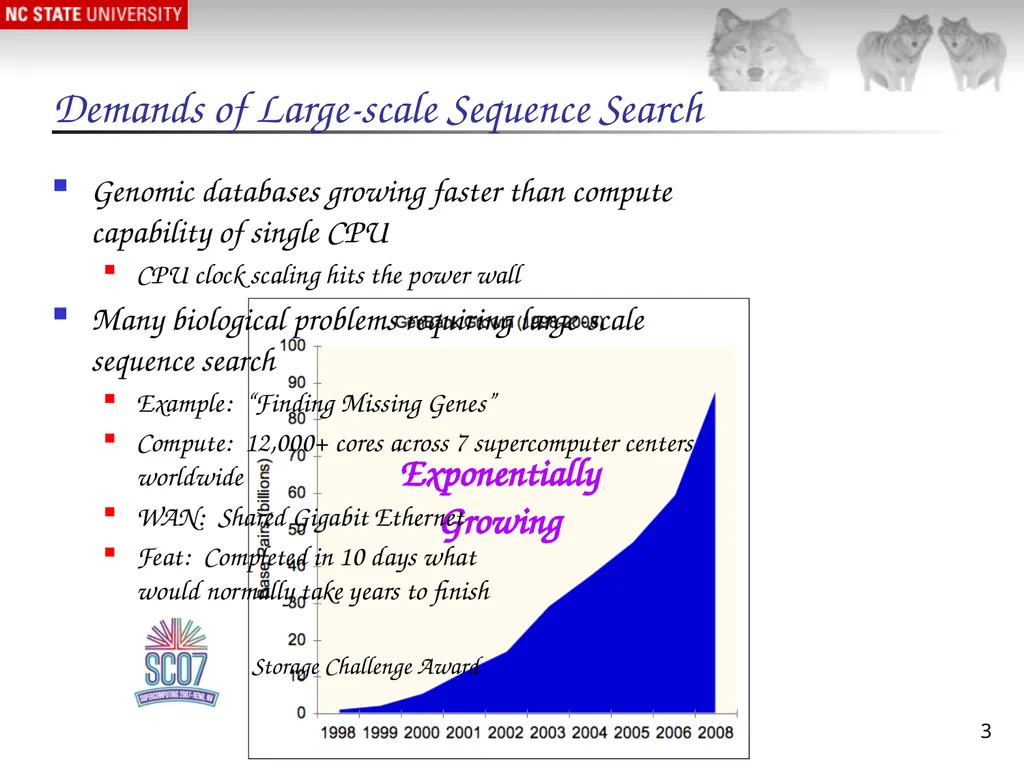
slide3. 3 Demands of Large-scale Sequence Search Genomic databases growing faster than compute capability of single CPU
CPU clock scaling hits the power wall
Many biological problems requiring large-scale sequence search
Example: “Finding Missing Genes”
Compute: 12,000+ cores across 7 supercomputer centers worldwide
WAN: Shared Gigabit Ethernet
Feat: Completed in 10 days what would normally take years to finish Storage Challenge Award<br>
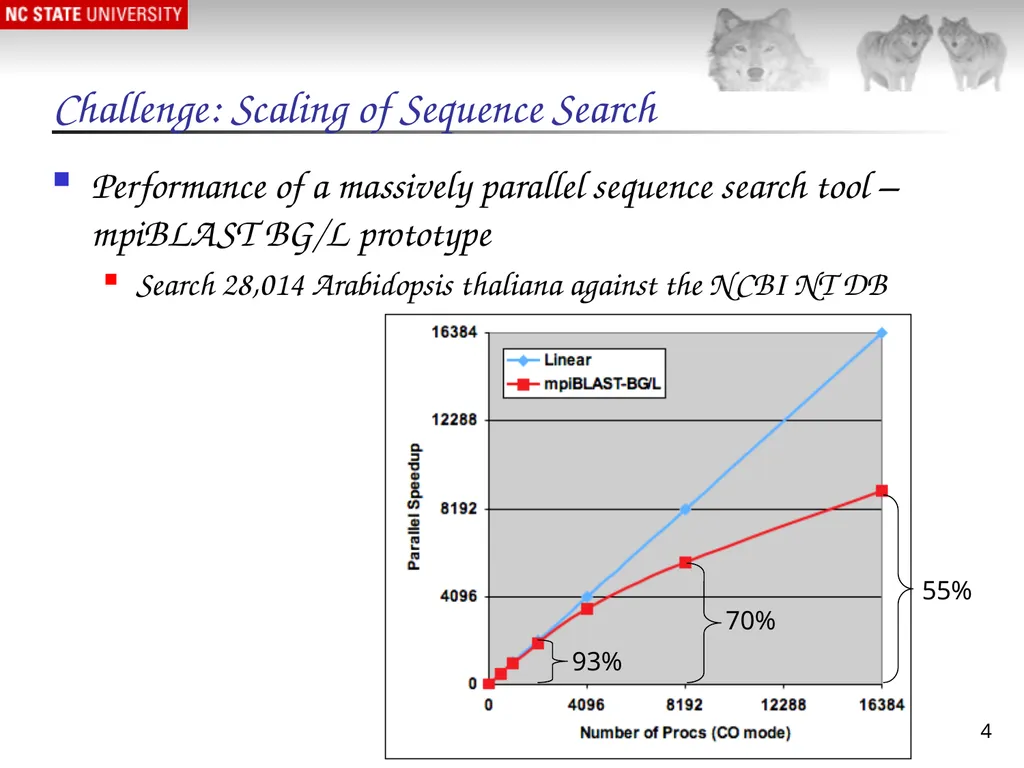
slide4. 4 Challenge: Scaling of Sequence Search Performance of a massively parallel sequence search tool – mpiBLAST BG/L prototype
Search 28,014 Arabidopsis thaliana against the NCBI NT DB 93% 70% 55%<br>
slide5. 5 Our Major Contributions Identification of key design issues of scalable sequence search on next-generation massively parallel supercomputers
I/O and scheduling optimizations that allow efficient sequence searching across 10,000s of processors
An extended prototype of mpiBLAST on BG/P with up to 32,768 compute cores (93% efficiency).<br>
slide6. 6 Road Map Introduction
Background
Optimizations
Performance Results
Conclusion<br>
slide7. 7 BLAST & mpiBLAST BLAST (Basic Local Alignment Sequence Tool)
De facto standard tool for sequence search
Computationally intensive: O(n2) worst-case
Algorithm: Heuristics-based alignment
Execution time of a BLAST job hard to predic
mpiBLAST
Originally master-worker with database segmentation
Enhanced for large-scale deployments
Parallel I/O [Lin05, Ching06]
Hierarchical Scheduling [Gardner06]
Integrated I/O & Scheduling [Thorsen07]<br>
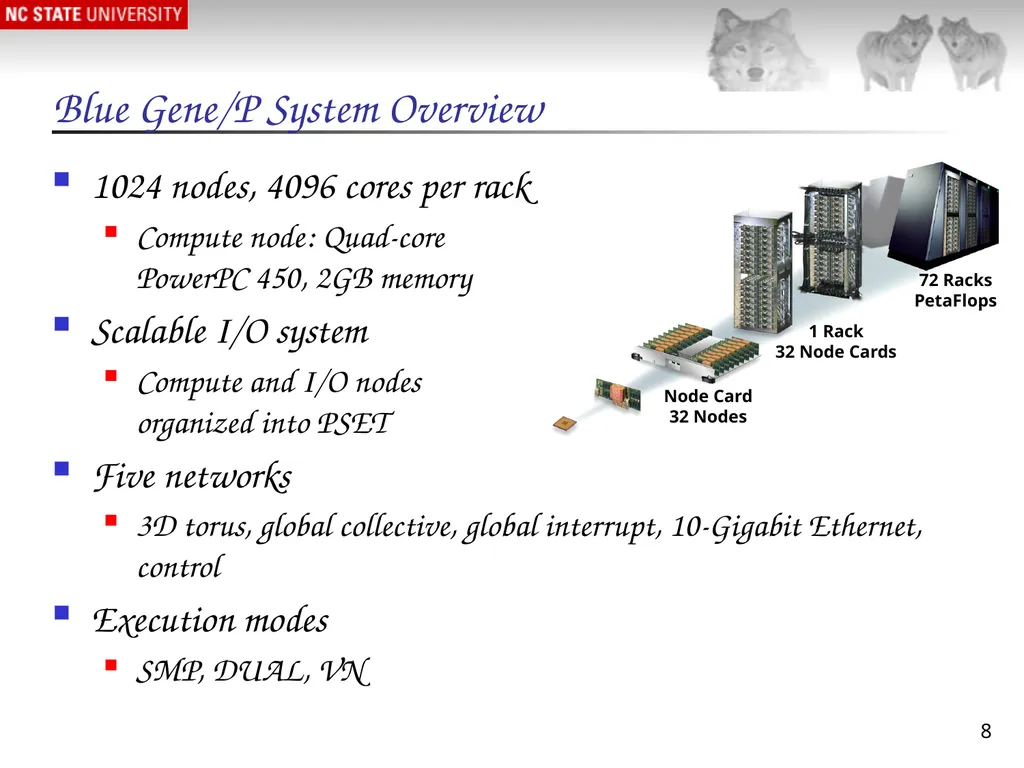
slide8. 8 Blue Gene/P System Overview 1024 nodes, 4096 cores per rack
Compute node: Quad-core PowerPC 450, 2GB memory
Scalable I/O system
Compute and I/O nodes organized into PSET
Five networks
3D torus, global collective, global interrupt, 10-Gigabit Ethernet, control
Execution modes
SMP, DUAL, VN Node Card 32 Nodes 72 Racks PetaFlops 1 Rack 32 Node Cards<br>
slide9. 9 Road Map Introduction
Background
Optimizations
Performance Results
Conclusion<br>
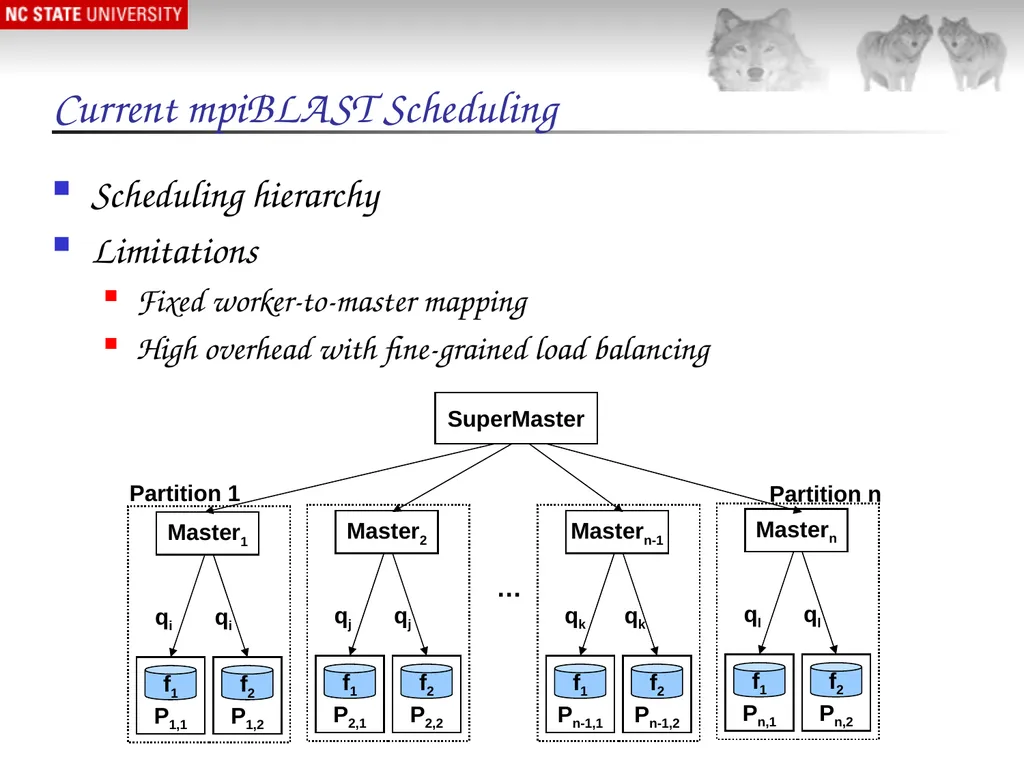
slide10. Current mpiBLAST Scheduling Scheduling hierarchy
Limitations
Fixed worker-to-master mapping
High overhead with fine-grained load balancing<br>
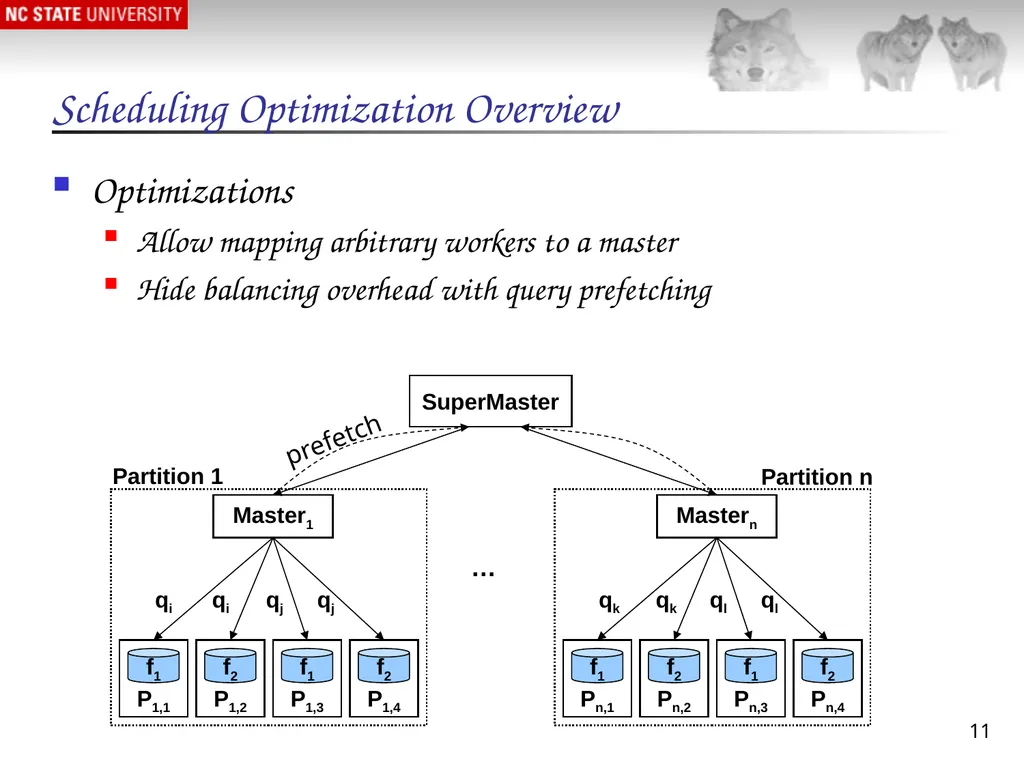
slide11. 11 Scheduling Optimization Overview Optimizations
Allow mapping arbitrary workers to a master
Hide balancing overhead with query prefetching<br>
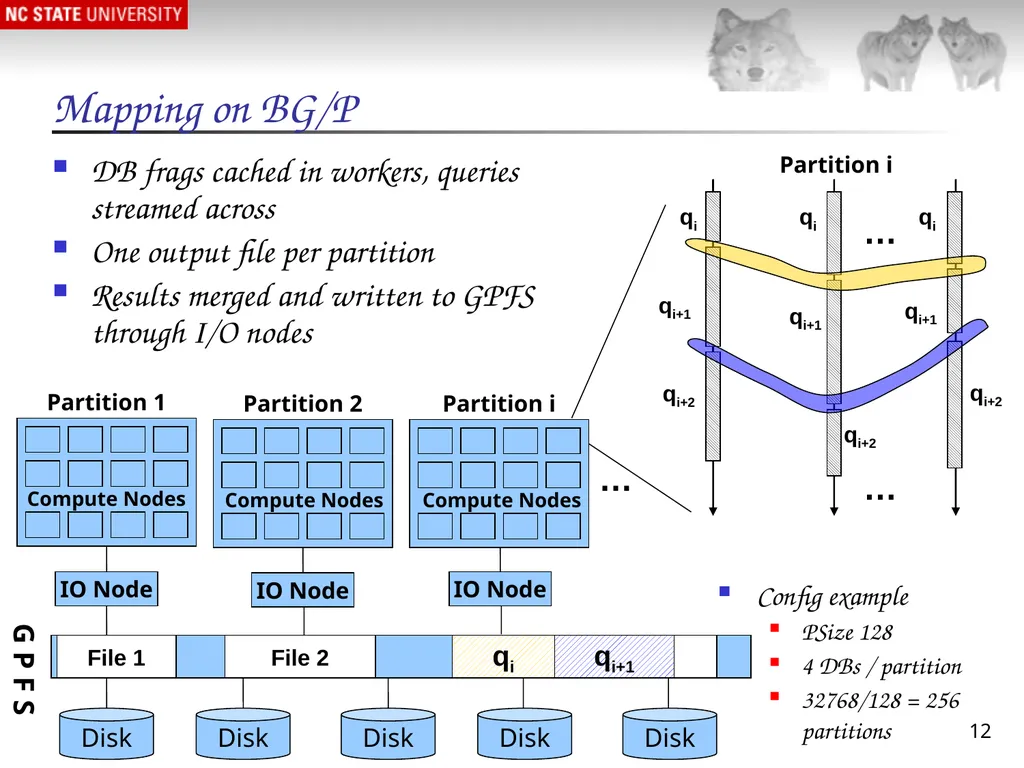
slide12. 12 Mapping on BG/P … Partition 1 Disk Disk Disk Disk Disk DB frags cached in workers, queries streamed across
One output file per partition
Results merged and written to GPFS through I/O nodes Compute Nodes IO Node IO Node qi+2 qi qi+1 qi+2 qi qi+1 qi+2 qi qi+1 … … Config example
PSize 128
4 DBs / partition
32768/128 = 256 partitions IO Node Partition i Compute Nodes Compute Nodes Partition 2 Partition i File i qi qi+1 File 1 File 2 G P F S<br>
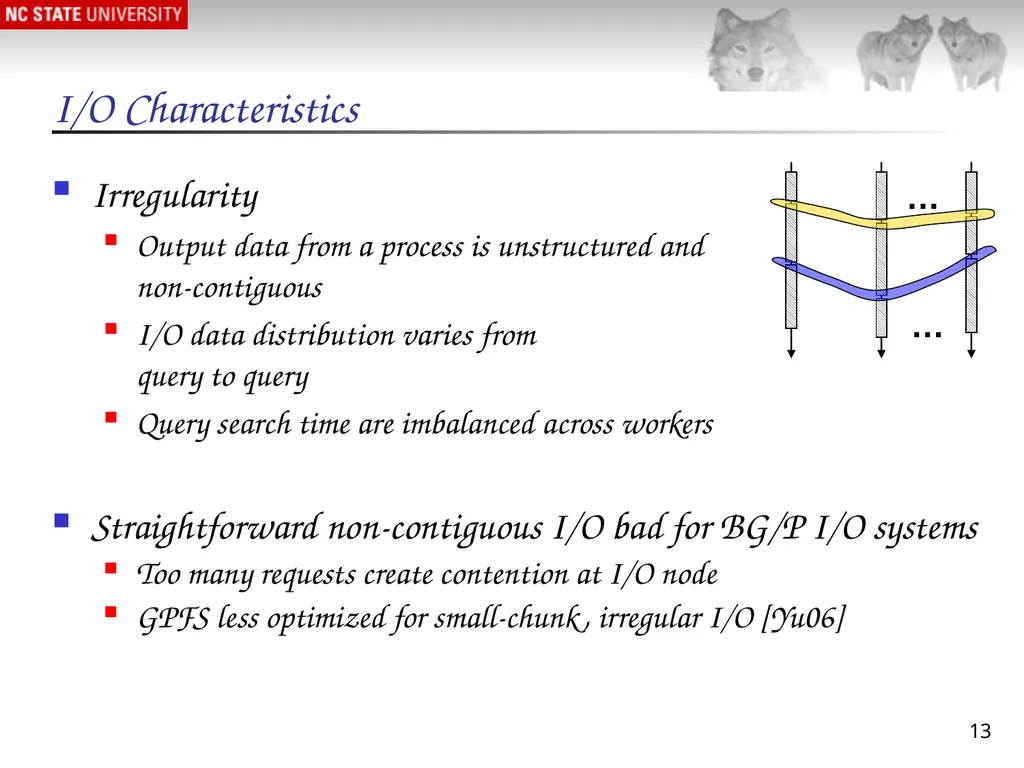
slide13. 13 I/O Characteristics Irregularity
Output data from a process is unstructured and non-contiguous
I/O data distribution varies from query to query
Query search time are imbalanced across workers … … Straightforward non-contiguous I/O bad for BG/P I/O systems
Too many requests create contention at I/O node
GPFS less optimized for small-chunk, irregular I/O [Yu06]<br>
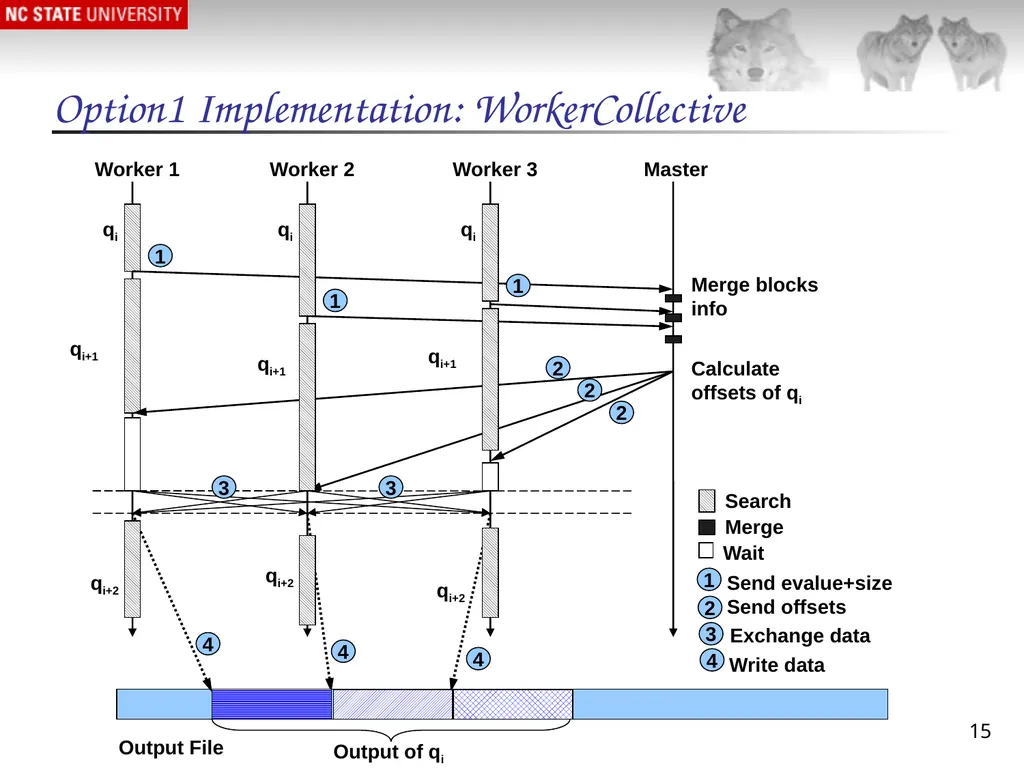
slide14. 14 Existing Option 1: Collective I/O Optimizes accesses from N processes
Two-phase I/O: Merge small, non-contiguous I/O requests into large, contiguous ones
Advantage
Excellent I/O throughput
Highly optimized on Blue Gene [Yu06]
Disadvantage
Synchronization between processes
Suitable applications
Synchronizations in the compute kernel
Balanced computation time between I/O phases<br>
slide15. 15 Option1 Implementation: WorkerCollective qi Merge blocks info qi+1 Calculate offsets of qi Output of qi qi qi+1 qi+2 qi qi+1 qi+2 1 1 1 2 2 2 Search Merge 1 Send evalue+size 2 Send offsets 3 Write data 4 Exchange data 3 3 Wait 4 4 4 qi+2 Worker 1 Worker 2 Worker 3 Master Output File<br>
slide16. 16 Existing Option2: Optimized Independent I/O Optimized with data sieving
Read-modify-write: read in large chunks and only modify target regions
Advantages
Does not incur synchronizations
Performs well for dense non-contiguous requests
Disadvantages
Introduces redundant data accesses
Causes lock contentions with false sharing<br>
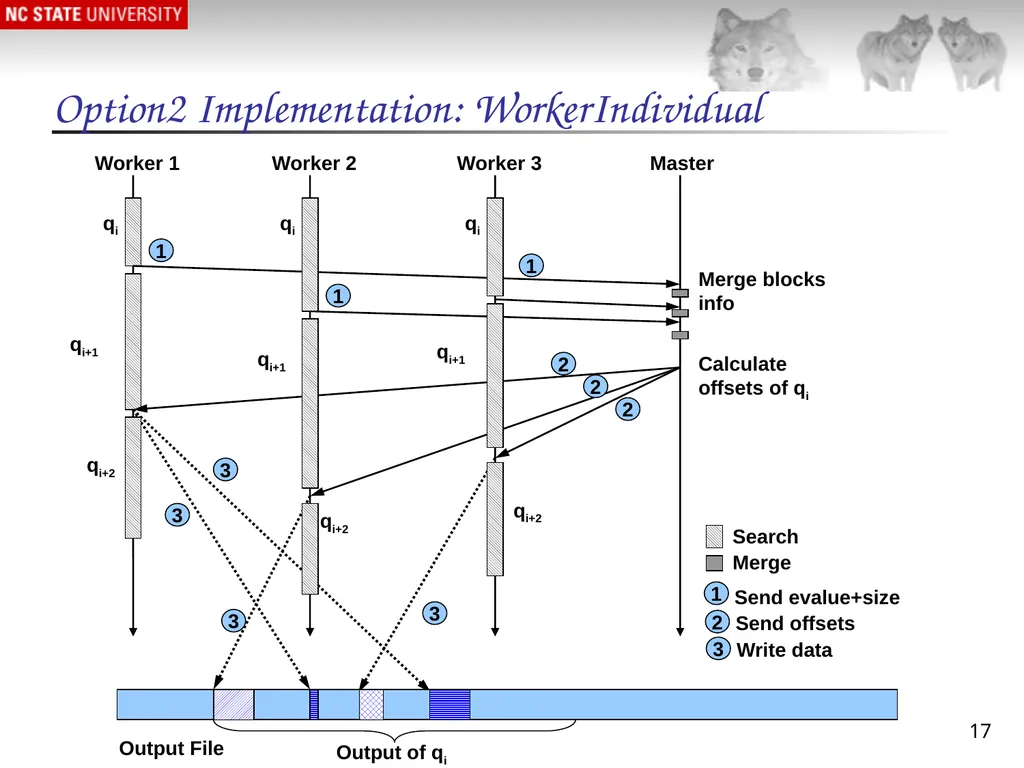
slide17. 17 Option2 Implementation: WorkerIndividual qi Merge blocks info qi+1 Calculate offsets of qi Worker 1 Worker 2 Worker 3 Master qi+2 qi qi+1 qi+2 qi qi+1 qi+2 Search Merge 1 Send evalue+size 1 2 Send offsets 3 Write data 1 1 2 2 2 3 3 3 3 Output of qi Output File<br>
slide18. 18 Our Design: Asynchronous Two-Phase I/O Achieving high I/O throughput without forcing synchronization
Asynchronously aggregate small, non-contiguous I/O requests into large chunks
Current implementation
Master selects a write leader for each query
Write leader aggregates requests from other workers<br>
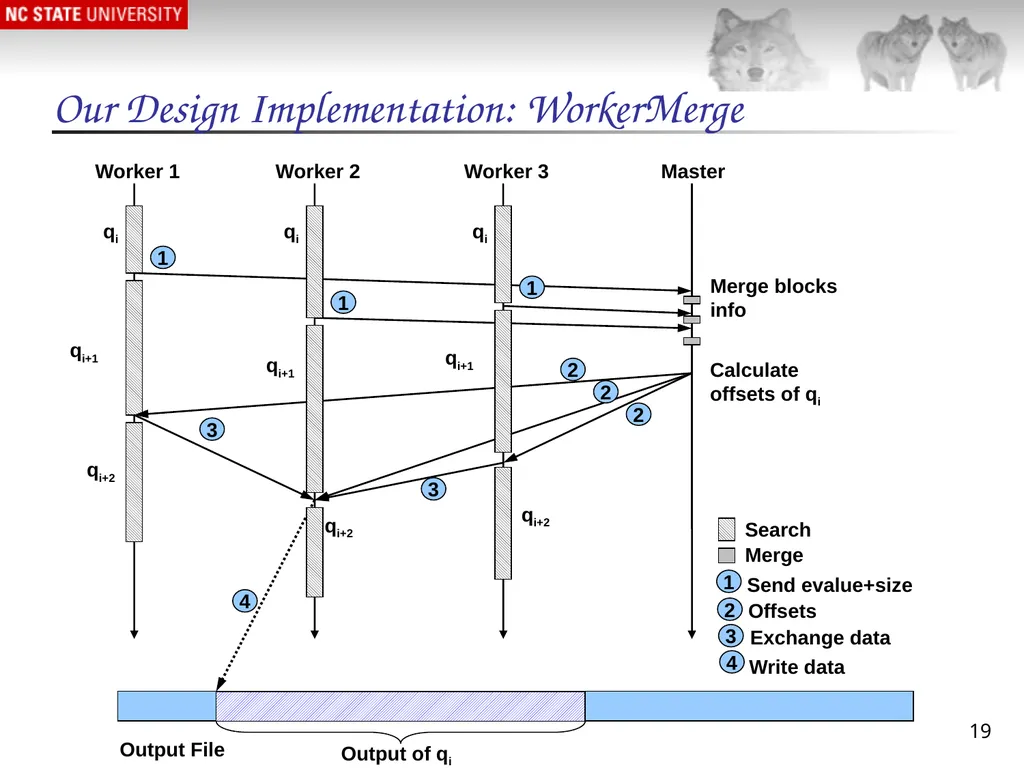
slide19. 19 Our Design Implementation: WorkerMerge qi Merge blocks info qi+1 Calculate offsets of qi qi+2 qi qi+1 qi+2 qi qi+1 qi+2 1 1 1 2 2 2 4 Output of qi Search Merge 1 Send evalue+size 2 Offsets 3 3 Worker 1 Worker 2 Worker 3 Master Output File 3 Write data 4 Exchange data<br>
slide20. 20 Discussion WorkerMerge implementation concerns
Non-blocking MPI communications vs. threads
Incremental write to avoid memory overflow
Only a limited amount of data collected and written at a time
Will split-collective I/O help?
MPI_File_write_all_begin, MPI_File_write_all_end
MPI_File_set_view is synchronized by definition<br>
slide21. 21 Road Map Introduction
Background
Optimizations
Performance Results
Conclusion<br>
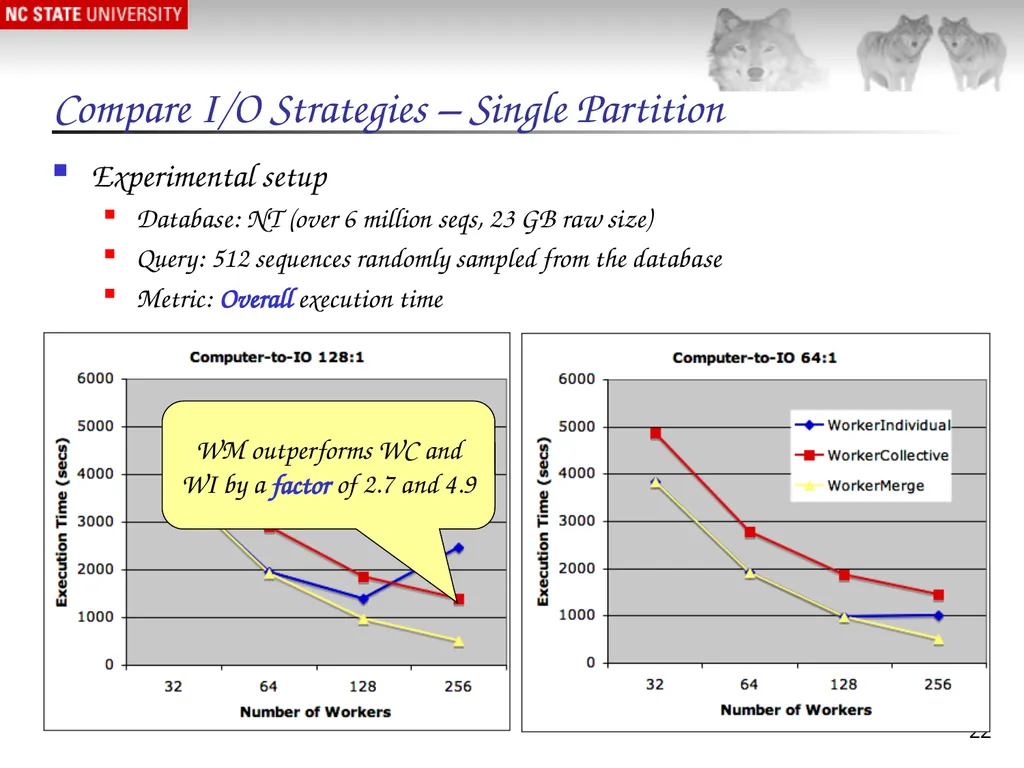
slide22. 22 Compare I/O Strategies – Single Partition Experimental setup
Database: NT (over 6 million seqs, 23 GB raw size)
Query: 512 sequences randomly sampled from the database
Metric: Overall execution time WM outperforms WC and WI by a factor of 2.7 and 4.9<br>
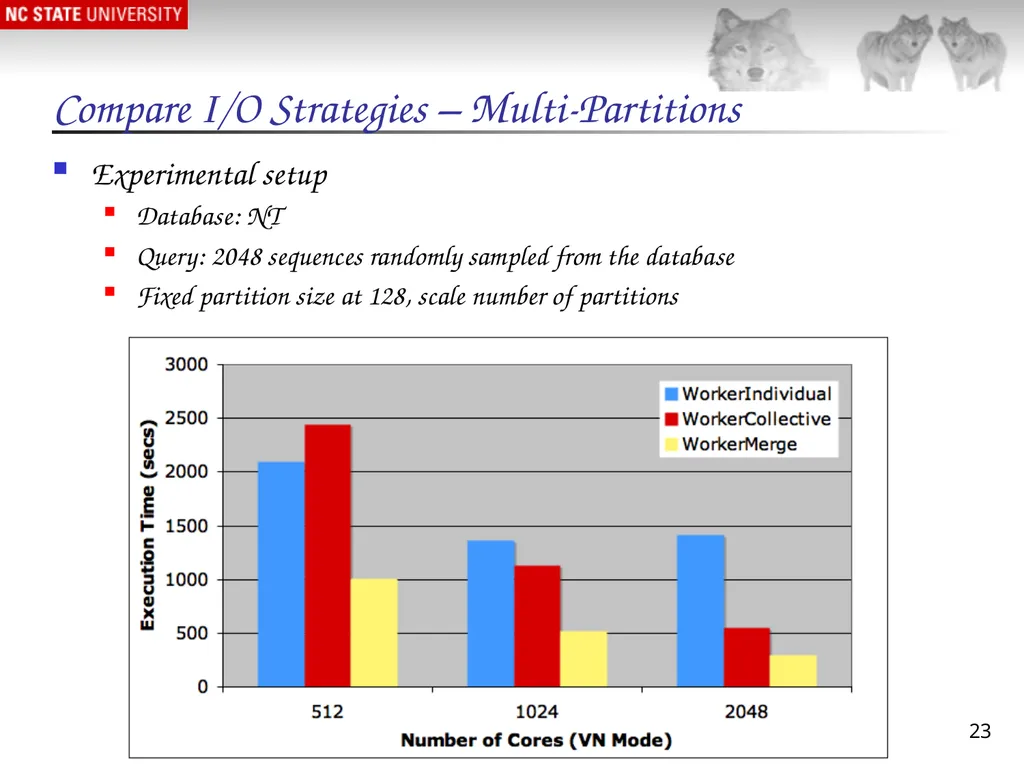
slide23. 23 Compare I/O Strategies – Multi-Partitions Experimental setup
Database: NT
Query: 2048 sequences randomly sampled from the database
Fixed partition size at 128, scale number of partitions<br>
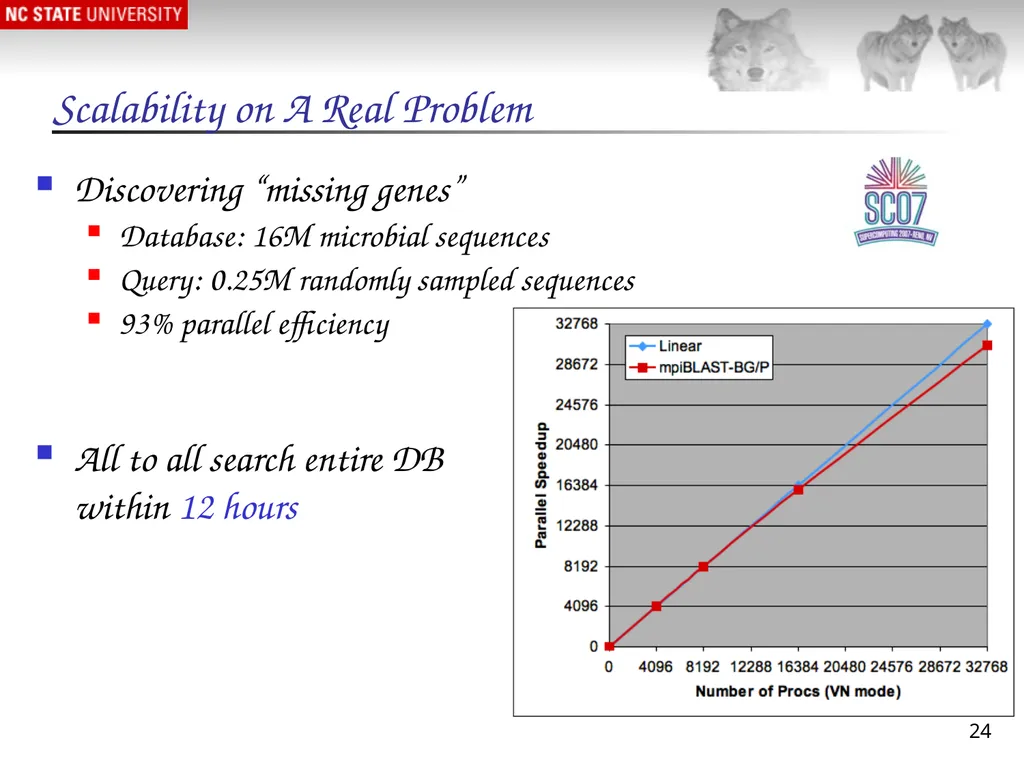
slide24. 24 Scalability on A Real Problem Discovering “missing genes”
Database: 16M microbial sequences
Query: 0.25M randomly sampled sequences
93% parallel efficiency All to all search entire DB within 12 hours<br>
slide25. 25 Road Map Introduction
Background
Optimizations
Performance Results
Conclusion<br>
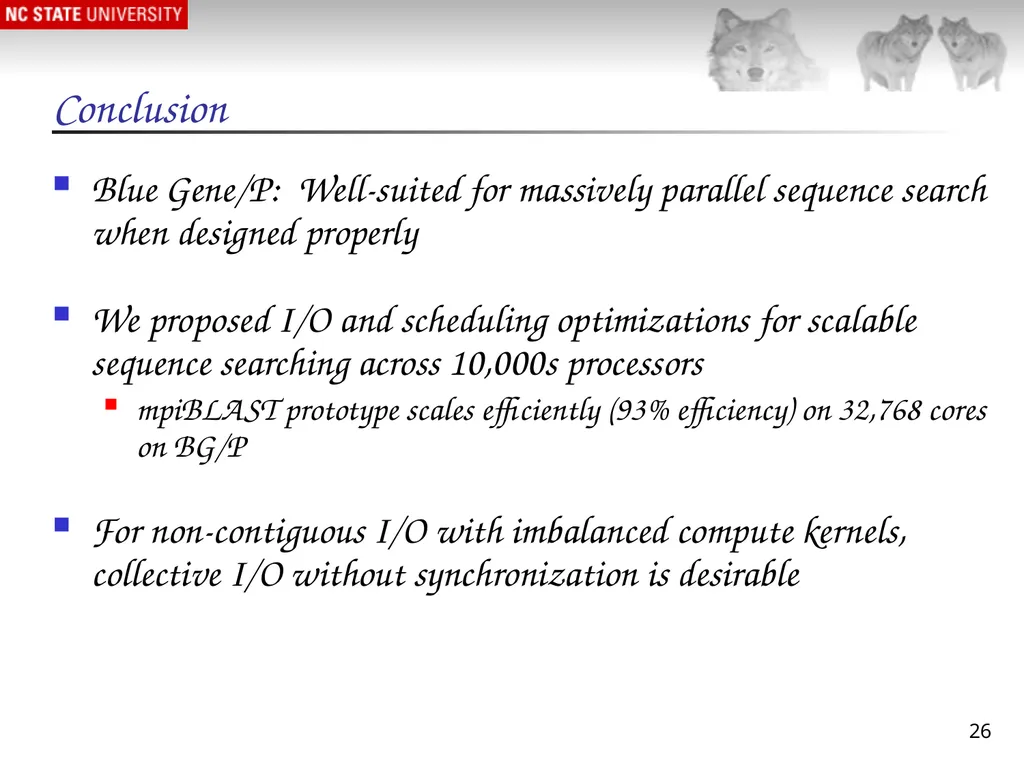
slide26. 26 Conclusion Blue Gene/P: Well-suited for massively parallel sequence search when designed properly
We proposed I/O and scheduling optimizations for scalable sequence searching across 10,000s processors
mpiBLAST prototype scales efficiently (93% efficiency) on 32,768 cores on BG/P
For non-contiguous I/O with imbalanced compute kernels, collective I/O without synchronization is desirable<br>
slide27. 27 References O. Thorsen, K. Jiang, A. Peters, B. Smith, H. Lin, W. Feng and C. Sosa, "Parallel Genomic Sequence-Search on a Massively Parallel System," ACM Int’l Conference on Computing Frontiers, 2007.
H. Yu, R. Sahoo, C. Howson, G. Almasi, J. Castanos, M. Gupta J. Moreira, J. Parker, T. Engelsiepen, R. Ross, R. Thakur, R. Latham, and W. Gropp, "High Performance File I/O for the BlueGene/L Supercomputer," 12th IEEE Int’l Symposium on High-Performance Computer Architecture (HPCA-12), 2006.
M. Gardner, W. Feng, J. Archuleta, H. Lin and X. Ma, "Parallel Genomic Sequence-Searching on an Ad-Hoc Grid: Experiences, Lessons Learned, and Implications," IEEE/ACM Int’l Conference for High-Performance Computing, Networking, Storage and Analysis (SC), Best Paper Finalist, 2006.
H. Lin, X. Ma, P. Chandramohan, A. Geist and N. Samatova, "Efficient Data Access for Parallel BLAST," IEEE Int’l Parallel and Distributed Processing Symposium (IPDPS), 2005.
A. Ching, W. Feng, H. Lin, X. Ma and A. Choudhary, "Exploring I/O Strategies for Parallel Sequence Database Search Tools with S3aSim," ACM Int’l Symposium on High Performance Distributed Computing (HPDC), 2006.<br>
slide28. 28 Thank You Questions?<br>
Pavan Balaji (ANL)
Ruth Poole, Carlos Sosa (IBM)
Xiaosong Ma (NCSU & ORNL)
Wu Feng (VT)<br>
slide2. 2 Sequence Search Fundamental tool in computational biology
Search similarities between a set of query sequences and sequence databases (DBs)
Analogous to web search engines
Example application: predict functions of newly discovered sequences<br>
slide3. 3 Demands of Large-scale Sequence Search Genomic databases growing faster than compute capability of single CPU
CPU clock scaling hits the power wall
Many biological problems requiring large-scale sequence search
Example: “Finding Missing Genes”
Compute: 12,000+ cores across 7 supercomputer centers worldwide
WAN: Shared Gigabit Ethernet
Feat: Completed in 10 days what would normally take years to finish Storage Challenge Award<br>
slide4. 4 Challenge: Scaling of Sequence Search Performance of a massively parallel sequence search tool – mpiBLAST BG/L prototype
Search 28,014 Arabidopsis thaliana against the NCBI NT DB 93% 70% 55%<br>
slide5. 5 Our Major Contributions Identification of key design issues of scalable sequence search on next-generation massively parallel supercomputers
I/O and scheduling optimizations that allow efficient sequence searching across 10,000s of processors
An extended prototype of mpiBLAST on BG/P with up to 32,768 compute cores (93% efficiency).<br>
slide6. 6 Road Map Introduction
Background
Optimizations
Performance Results
Conclusion<br>
slide7. 7 BLAST & mpiBLAST BLAST (Basic Local Alignment Sequence Tool)
De facto standard tool for sequence search
Computationally intensive: O(n2) worst-case
Algorithm: Heuristics-based alignment
Execution time of a BLAST job hard to predic
mpiBLAST
Originally master-worker with database segmentation
Enhanced for large-scale deployments
Parallel I/O [Lin05, Ching06]
Hierarchical Scheduling [Gardner06]
Integrated I/O & Scheduling [Thorsen07]<br>
slide8. 8 Blue Gene/P System Overview 1024 nodes, 4096 cores per rack
Compute node: Quad-core PowerPC 450, 2GB memory
Scalable I/O system
Compute and I/O nodes organized into PSET
Five networks
3D torus, global collective, global interrupt, 10-Gigabit Ethernet, control
Execution modes
SMP, DUAL, VN Node Card 32 Nodes 72 Racks PetaFlops 1 Rack 32 Node Cards<br>
slide9. 9 Road Map Introduction
Background
Optimizations
Performance Results
Conclusion<br>
slide10. Current mpiBLAST Scheduling Scheduling hierarchy
Limitations
Fixed worker-to-master mapping
High overhead with fine-grained load balancing<br>
slide11. 11 Scheduling Optimization Overview Optimizations
Allow mapping arbitrary workers to a master
Hide balancing overhead with query prefetching<br>
slide12. 12 Mapping on BG/P … Partition 1 Disk Disk Disk Disk Disk DB frags cached in workers, queries streamed across
One output file per partition
Results merged and written to GPFS through I/O nodes Compute Nodes IO Node IO Node qi+2 qi qi+1 qi+2 qi qi+1 qi+2 qi qi+1 … … Config example
PSize 128
4 DBs / partition
32768/128 = 256 partitions IO Node Partition i Compute Nodes Compute Nodes Partition 2 Partition i File i qi qi+1 File 1 File 2 G P F S<br>
slide13. 13 I/O Characteristics Irregularity
Output data from a process is unstructured and non-contiguous
I/O data distribution varies from query to query
Query search time are imbalanced across workers … … Straightforward non-contiguous I/O bad for BG/P I/O systems
Too many requests create contention at I/O node
GPFS less optimized for small-chunk, irregular I/O [Yu06]<br>
slide14. 14 Existing Option 1: Collective I/O Optimizes accesses from N processes
Two-phase I/O: Merge small, non-contiguous I/O requests into large, contiguous ones
Advantage
Excellent I/O throughput
Highly optimized on Blue Gene [Yu06]
Disadvantage
Synchronization between processes
Suitable applications
Synchronizations in the compute kernel
Balanced computation time between I/O phases<br>
slide15. 15 Option1 Implementation: WorkerCollective qi Merge blocks info qi+1 Calculate offsets of qi Output of qi qi qi+1 qi+2 qi qi+1 qi+2 1 1 1 2 2 2 Search Merge 1 Send evalue+size 2 Send offsets 3 Write data 4 Exchange data 3 3 Wait 4 4 4 qi+2 Worker 1 Worker 2 Worker 3 Master Output File<br>
slide16. 16 Existing Option2: Optimized Independent I/O Optimized with data sieving
Read-modify-write: read in large chunks and only modify target regions
Advantages
Does not incur synchronizations
Performs well for dense non-contiguous requests
Disadvantages
Introduces redundant data accesses
Causes lock contentions with false sharing<br>
slide17. 17 Option2 Implementation: WorkerIndividual qi Merge blocks info qi+1 Calculate offsets of qi Worker 1 Worker 2 Worker 3 Master qi+2 qi qi+1 qi+2 qi qi+1 qi+2 Search Merge 1 Send evalue+size 1 2 Send offsets 3 Write data 1 1 2 2 2 3 3 3 3 Output of qi Output File<br>
slide18. 18 Our Design: Asynchronous Two-Phase I/O Achieving high I/O throughput without forcing synchronization
Asynchronously aggregate small, non-contiguous I/O requests into large chunks
Current implementation
Master selects a write leader for each query
Write leader aggregates requests from other workers<br>
slide19. 19 Our Design Implementation: WorkerMerge qi Merge blocks info qi+1 Calculate offsets of qi qi+2 qi qi+1 qi+2 qi qi+1 qi+2 1 1 1 2 2 2 4 Output of qi Search Merge 1 Send evalue+size 2 Offsets 3 3 Worker 1 Worker 2 Worker 3 Master Output File 3 Write data 4 Exchange data<br>
slide20. 20 Discussion WorkerMerge implementation concerns
Non-blocking MPI communications vs. threads
Incremental write to avoid memory overflow
Only a limited amount of data collected and written at a time
Will split-collective I/O help?
MPI_File_write_all_begin, MPI_File_write_all_end
MPI_File_set_view is synchronized by definition<br>
slide21. 21 Road Map Introduction
Background
Optimizations
Performance Results
Conclusion<br>
slide22. 22 Compare I/O Strategies – Single Partition Experimental setup
Database: NT (over 6 million seqs, 23 GB raw size)
Query: 512 sequences randomly sampled from the database
Metric: Overall execution time WM outperforms WC and WI by a factor of 2.7 and 4.9<br>
slide23. 23 Compare I/O Strategies – Multi-Partitions Experimental setup
Database: NT
Query: 2048 sequences randomly sampled from the database
Fixed partition size at 128, scale number of partitions<br>
slide24. 24 Scalability on A Real Problem Discovering “missing genes”
Database: 16M microbial sequences
Query: 0.25M randomly sampled sequences
93% parallel efficiency All to all search entire DB within 12 hours<br>
slide25. 25 Road Map Introduction
Background
Optimizations
Performance Results
Conclusion<br>
slide26. 26 Conclusion Blue Gene/P: Well-suited for massively parallel sequence search when designed properly
We proposed I/O and scheduling optimizations for scalable sequence searching across 10,000s processors
mpiBLAST prototype scales efficiently (93% efficiency) on 32,768 cores on BG/P
For non-contiguous I/O with imbalanced compute kernels, collective I/O without synchronization is desirable<br>
slide27. 27 References O. Thorsen, K. Jiang, A. Peters, B. Smith, H. Lin, W. Feng and C. Sosa, "Parallel Genomic Sequence-Search on a Massively Parallel System," ACM Int’l Conference on Computing Frontiers, 2007.
H. Yu, R. Sahoo, C. Howson, G. Almasi, J. Castanos, M. Gupta J. Moreira, J. Parker, T. Engelsiepen, R. Ross, R. Thakur, R. Latham, and W. Gropp, "High Performance File I/O for the BlueGene/L Supercomputer," 12th IEEE Int’l Symposium on High-Performance Computer Architecture (HPCA-12), 2006.
M. Gardner, W. Feng, J. Archuleta, H. Lin and X. Ma, "Parallel Genomic Sequence-Searching on an Ad-Hoc Grid: Experiences, Lessons Learned, and Implications," IEEE/ACM Int’l Conference for High-Performance Computing, Networking, Storage and Analysis (SC), Best Paper Finalist, 2006.
H. Lin, X. Ma, P. Chandramohan, A. Geist and N. Samatova, "Efficient Data Access for Parallel BLAST," IEEE Int’l Parallel and Distributed Processing Symposium (IPDPS), 2005.
A. Ching, W. Feng, H. Lin, X. Ma and A. Choudhary, "Exploring I/O Strategies for Parallel Sequence Database Search Tools with S3aSim," ACM Int’l Symposium on High Performance Distributed Computing (HPDC), 2006.<br>
slide28. 28 Thank You Questions?<br>