
1 Reliability and Resilience Exploring the
CP
Published · 19 slides · 0 views
1 / 1
Description
1 Reliability and Resilience Exploring the Relationship Chanan Singh Department of Electrical and Computer Engineering Texas AM University Panel PESGM 2019 Diversity of Views on Reliability and Resilience National Infrastructure Advisory
Related Topics
Share
Embed code
Download this presentation From Below
"1 Reliability and Resilience Exploring the" is the property of its rightful owner. Permission is granted to download and print the materials on this website for personal, non-commercial use only, and to display it on your personal computer provided you do not modify the materials and that you retain all copyright notices contained in the materials. By downloading content from our website, you accept the terms of this agreement.
Presentation Transcript
01
1 Reliability and Resilience
Exploring the Relationship Chanan Singh
Department of Electrical and Computer Engineering
Texas A&M University Panel PESGM 2019<br>
Exploring the Relationship Chanan Singh
Department of Electrical and Computer Engineering
Texas A&M University Panel PESGM 2019<br>
02
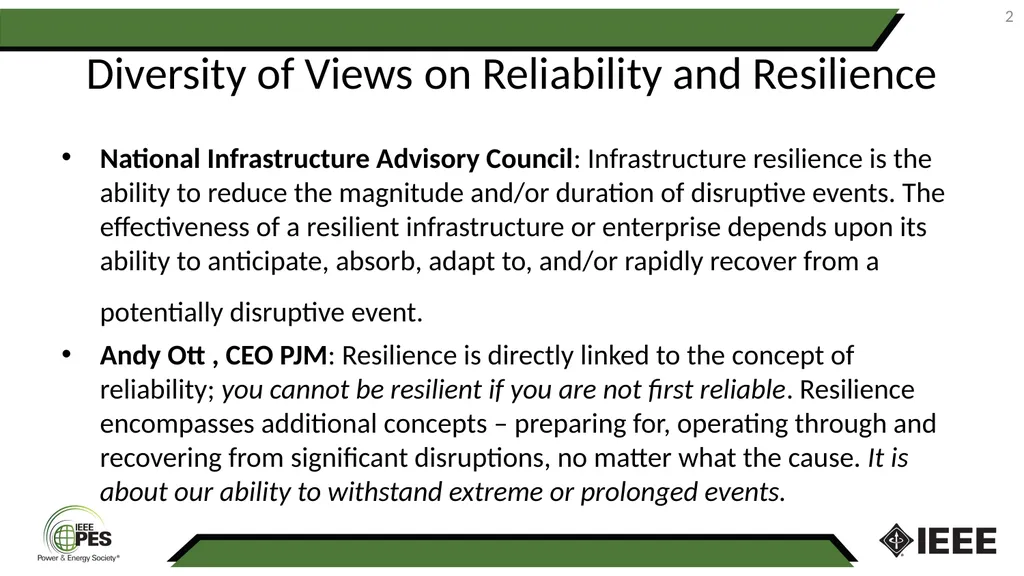
Diversity of Views on Reliability and Resilience National Infrastructure Advisory Council: Infrastructure resilience is the ability to reduce the magnitude and/or duration of disruptive events. The effectiveness of a resilient infrastructure or enterprise depends upon its ability to anticipate, absorb, adapt to, and/or rapidly recover from a potentially disruptive event.
Andy Ott , CEO PJM: Resilience is directly linked to the concept of reliability; you cannot be resilient if you are not first reliable. Resilience encompasses additional concepts – preparing for, operating through and recovering from significant disruptions, no matter what the cause. It is about our ability to withstand extreme or prolonged events. 2<br>
Andy Ott , CEO PJM: Resilience is directly linked to the concept of reliability; you cannot be resilient if you are not first reliable. Resilience encompasses additional concepts – preparing for, operating through and recovering from significant disruptions, no matter what the cause. It is about our ability to withstand extreme or prolonged events. 2<br>
03
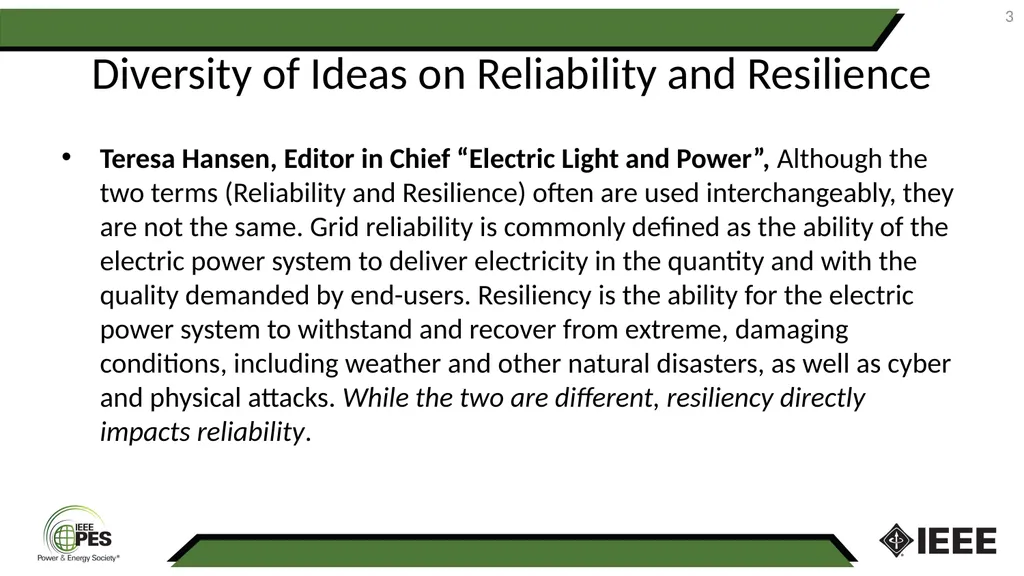
Diversity of Ideas on Reliability and Resilience Teresa Hansen, Editor in Chief “Electric Light and Power”, Although the two terms (Reliability and Resilience) often are used interchangeably, they are not the same. Grid reliability is commonly defined as the ability of the electric power system to deliver electricity in the quantity and with the quality demanded by end-users. Resiliency is the ability for the electric power system to withstand and recover from extreme, damaging conditions, including weather and other natural disasters, as well as cyber and physical attacks. While the two are different, resiliency directly impacts reliability. 3<br>
04
Diversity of Ideas on Reliability and Resilience Aaron Clark-Ginsberg, Rand Corporation: While interlinked, a resilient grid is not necessarily one that is reliable and a reliable one is not necessarily resilient. As long as a grid comes back quickly it can be considered resilient. 4<br>
05
Common Links between Reliability and Resilience Reliability encompasses the rate of occurrence of events, the management as well as the recovery.
Resilience appears to be more focused on adopting to the event as well as the recovery process. The rate of occurrence is not part of resilience.
Most views recognize the interlink of reliability and resilience although some would like to believe these are disjoint. 5<br>
Resilience appears to be more focused on adopting to the event as well as the recovery process. The rate of occurrence is not part of resilience.
Most views recognize the interlink of reliability and resilience although some would like to believe these are disjoint. 5<br>
06
Definitions of Reliability and Resilience Reliability
Grid reliability is commonly understood as the measure of the ability of electric power system to satisfy the electric load of the customers.
Resiliency:
Resiliency is the ability for the electric power system to withstand and recover from extreme, damaging conditions, including weather and other natural disasters, as well as cyber and physical attacks. 6<br>
Grid reliability is commonly understood as the measure of the ability of electric power system to satisfy the electric load of the customers.
Resiliency:
Resiliency is the ability for the electric power system to withstand and recover from extreme, damaging conditions, including weather and other natural disasters, as well as cyber and physical attacks. 6<br>
07
Looking into Grid Reliability Measurement Reliability is expressed using reliability indices.
At the bulk power system level, following indices have been proposed:
Frequency of load loss events
Duration of load loss events
Daily Loss of Load Probability
Hourly Loss of Load Expectation
EUE 7<br>
At the bulk power system level, following indices have been proposed:
Frequency of load loss events
Duration of load loss events
Daily Loss of Load Probability
Hourly Loss of Load Expectation
EUE 7<br>
08
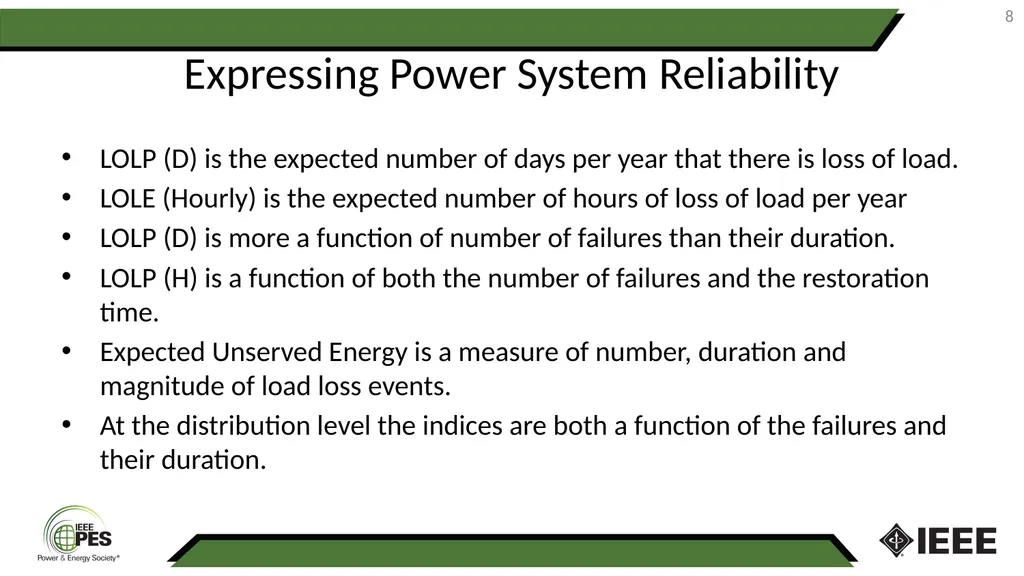
Expressing Power System Reliability LOLP (D) is the expected number of days per year that there is loss of load.
LOLE (Hourly) is the expected number of hours of loss of load per year
LOLP (D) is more a function of number of failures than their duration.
LOLP (H) is a function of both the number of failures and the restoration time.
Expected Unserved Energy is a measure of number, duration and magnitude of load loss events.
At the distribution level the indices are both a function of the failures and their duration. 8<br>
LOLE (Hourly) is the expected number of hours of loss of load per year
LOLP (D) is more a function of number of failures than their duration.
LOLP (H) is a function of both the number of failures and the restoration time.
Expected Unserved Energy is a measure of number, duration and magnitude of load loss events.
At the distribution level the indices are both a function of the failures and their duration. 8<br>
09
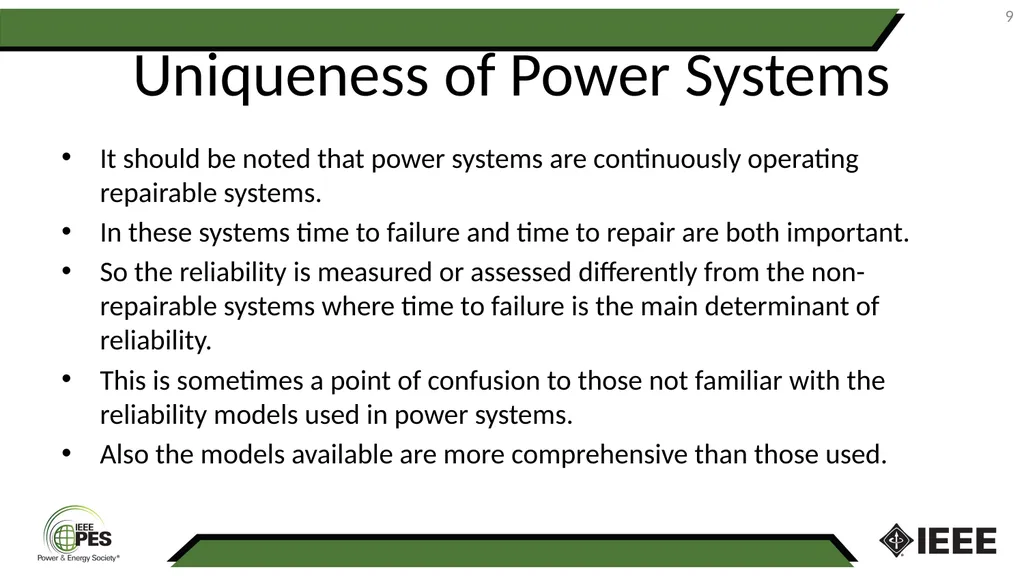
Uniqueness of Power Systems It should be noted that power systems are continuously operating repairable systems.
In these systems time to failure and time to repair are both important.
So the reliability is measured or assessed differently from the non-repairable systems where time to failure is the main determinant of reliability.
This is sometimes a point of confusion to those not familiar with the reliability models used in power systems.
Also the models available are more comprehensive than those used. 9<br>
In these systems time to failure and time to repair are both important.
So the reliability is measured or assessed differently from the non-repairable systems where time to failure is the main determinant of reliability.
This is sometimes a point of confusion to those not familiar with the reliability models used in power systems.
Also the models available are more comprehensive than those used. 9<br>
10
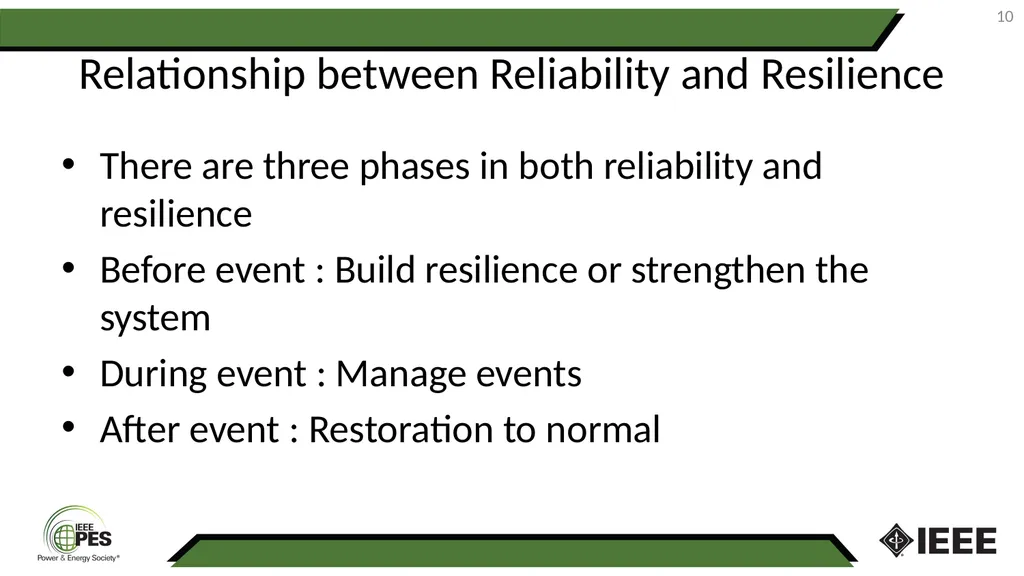
Relationship between Reliability and Resilience There are three phases in both reliability and resilience
Before event : Build resilience or strengthen the system
During event : Manage events
After event : Restoration to normal 10<br>
Before event : Build resilience or strengthen the system
During event : Manage events
After event : Restoration to normal 10<br>
11
Are Reliability and Resilience Different May be or may be not.
Depends on the environment and period of consideration. 11<br>
Depends on the environment and period of consideration. 11<br>
12
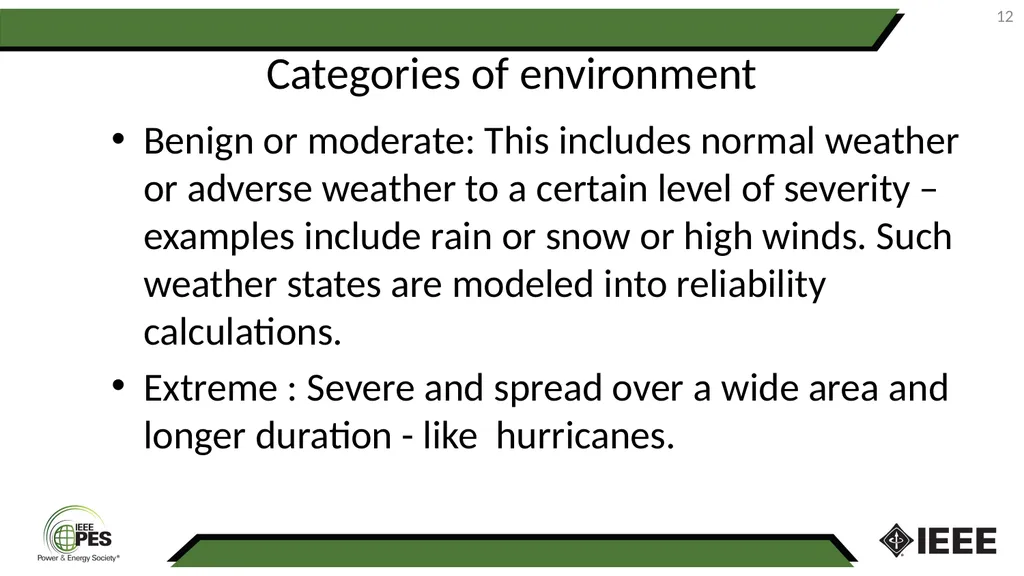
Categories of environment Benign or moderate: This includes normal weather or adverse weather to a certain level of severity – examples include rain or snow or high winds. Such weather states are modeled into reliability calculations.
Extreme : Severe and spread over a wide area and longer duration - like hurricanes. 12<br>
Extreme : Severe and spread over a wide area and longer duration - like hurricanes. 12<br>
13
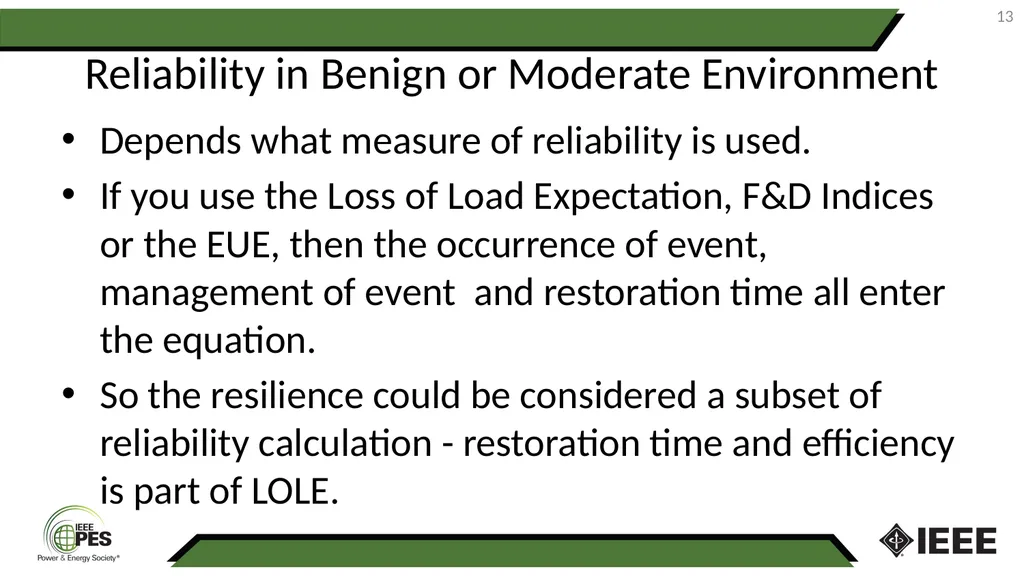
Reliability in Benign or Moderate Environment Depends what measure of reliability is used.
If you use the Loss of Load Expectation, F&D Indices or the EUE, then the occurrence of event, management of event and restoration time all enter the equation.
So the resilience could be considered a subset of reliability calculation - restoration time and efficiency is part of LOLE. 13<br>
If you use the Loss of Load Expectation, F&D Indices or the EUE, then the occurrence of event, management of event and restoration time all enter the equation.
So the resilience could be considered a subset of reliability calculation - restoration time and efficiency is part of LOLE. 13<br>
14
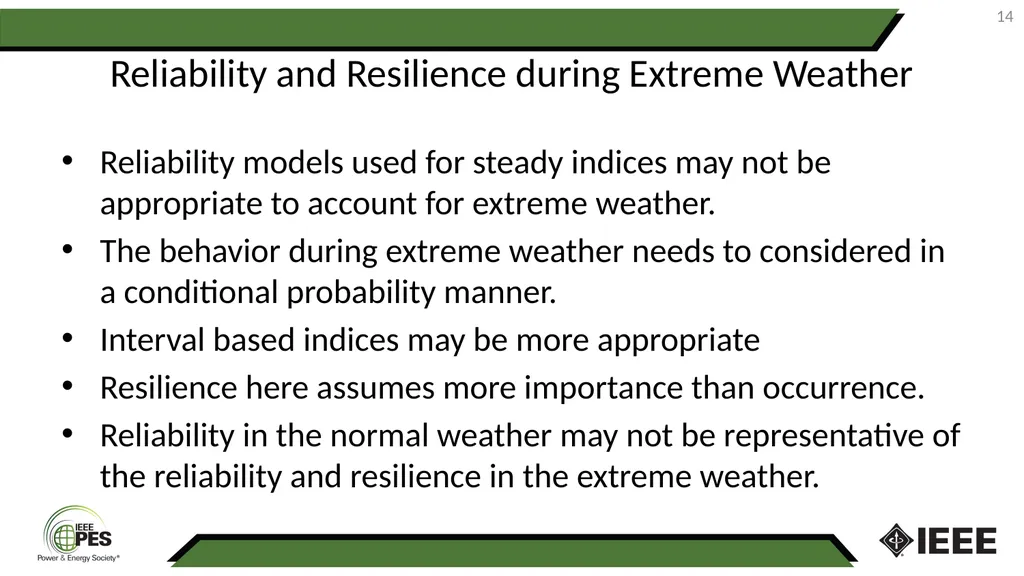
Reliability and Resilience during Extreme Weather Reliability models used for steady indices may not be appropriate to account for extreme weather.
The behavior during extreme weather needs to considered in a conditional probability manner.
Interval based indices may be more appropriate
Resilience here assumes more importance than occurrence.
Reliability in the normal weather may not be representative of the reliability and resilience in the extreme weather. 14<br>
The behavior during extreme weather needs to considered in a conditional probability manner.
Interval based indices may be more appropriate
Resilience here assumes more importance than occurrence.
Reliability in the normal weather may not be representative of the reliability and resilience in the extreme weather. 14<br>
15
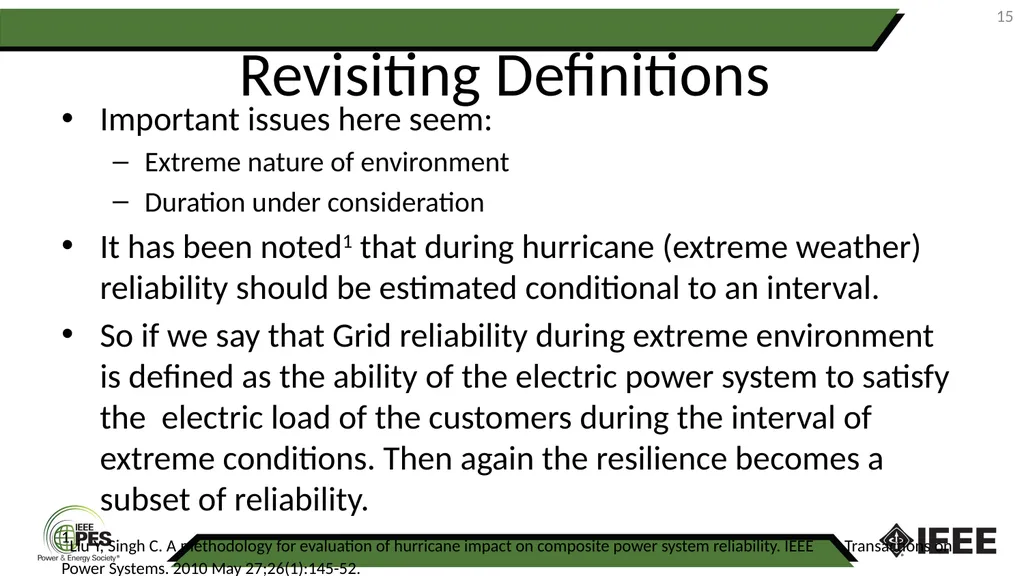
Revisiting Definitions Important issues here seem:
Extreme nature of environment
Duration under consideration
It has been noted1 that during hurricane (extreme weather) reliability should be estimated conditional to an interval.
So if we say that Grid reliability during extreme environment is defined as the ability of the electric power system to satisfy the electric load of the customers during the interval of extreme conditions. Then again the resilience becomes a subset of reliability.
1Liu Y, Singh C. A methodology for evaluation of hurricane impact on composite power system reliability. IEEE Transactions on Power Systems. 2010 May 27;26(1):145-52. 15<br>
Extreme nature of environment
Duration under consideration
It has been noted1 that during hurricane (extreme weather) reliability should be estimated conditional to an interval.
So if we say that Grid reliability during extreme environment is defined as the ability of the electric power system to satisfy the electric load of the customers during the interval of extreme conditions. Then again the resilience becomes a subset of reliability.
1Liu Y, Singh C. A methodology for evaluation of hurricane impact on composite power system reliability. IEEE Transactions on Power Systems. 2010 May 27;26(1):145-52. 15<br>
16
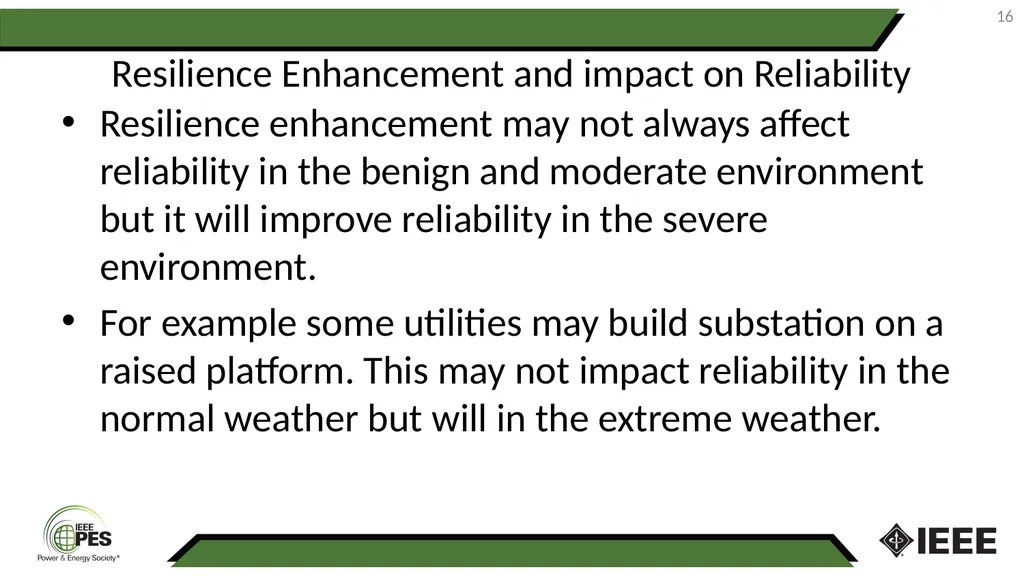
Resilience Enhancement and impact on Reliability Resilience enhancement may not always affect reliability in the benign and moderate environment but it will improve reliability in the severe environment.
For example some utilities may build substation on a raised platform. This may not impact reliability in the normal weather but will in the extreme weather. 16<br>
For example some utilities may build substation on a raised platform. This may not impact reliability in the normal weather but will in the extreme weather. 16<br>
17
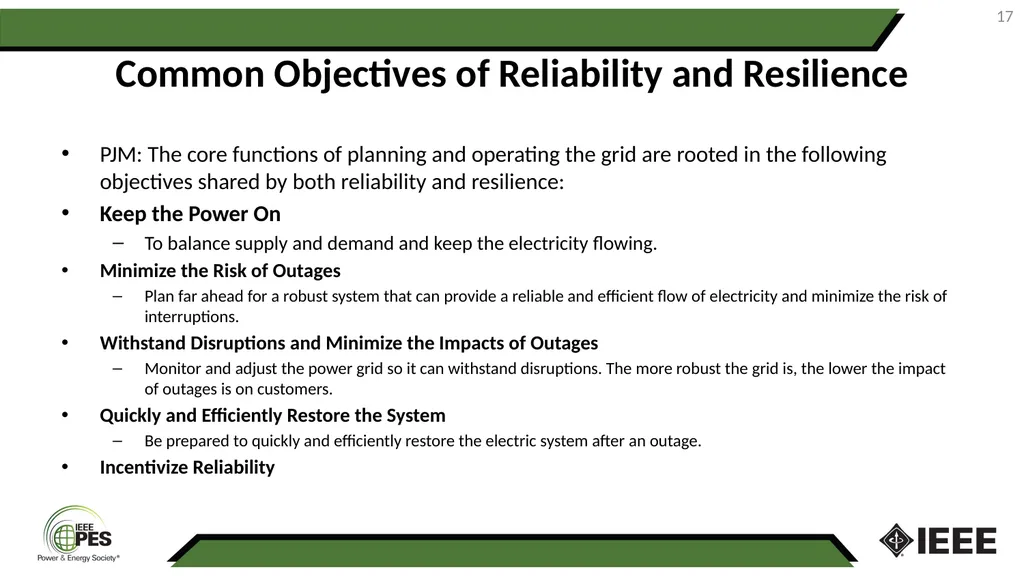
Common Objectives of Reliability and Resilience PJM: The core functions of planning and operating the grid are rooted in the following objectives shared by both reliability and resilience:
Keep the Power On
To balance supply and demand and keep the electricity flowing.
Minimize the Risk of Outages
Plan far ahead for a robust system that can provide a reliable and efficient flow of electricity and minimize the risk of interruptions.
Withstand Disruptions and Minimize the Impacts of Outages
Monitor and adjust the power grid so it can withstand disruptions. The more robust the grid is, the lower the impact of outages is on customers.
Quickly and Efficiently Restore the System
Be prepared to quickly and efficiently restore the electric system after an outage.
Incentivize Reliability 17<br>
Keep the Power On
To balance supply and demand and keep the electricity flowing.
Minimize the Risk of Outages
Plan far ahead for a robust system that can provide a reliable and efficient flow of electricity and minimize the risk of interruptions.
Withstand Disruptions and Minimize the Impacts of Outages
Monitor and adjust the power grid so it can withstand disruptions. The more robust the grid is, the lower the impact of outages is on customers.
Quickly and Efficiently Restore the System
Be prepared to quickly and efficiently restore the electric system after an outage.
Incentivize Reliability 17<br>
18
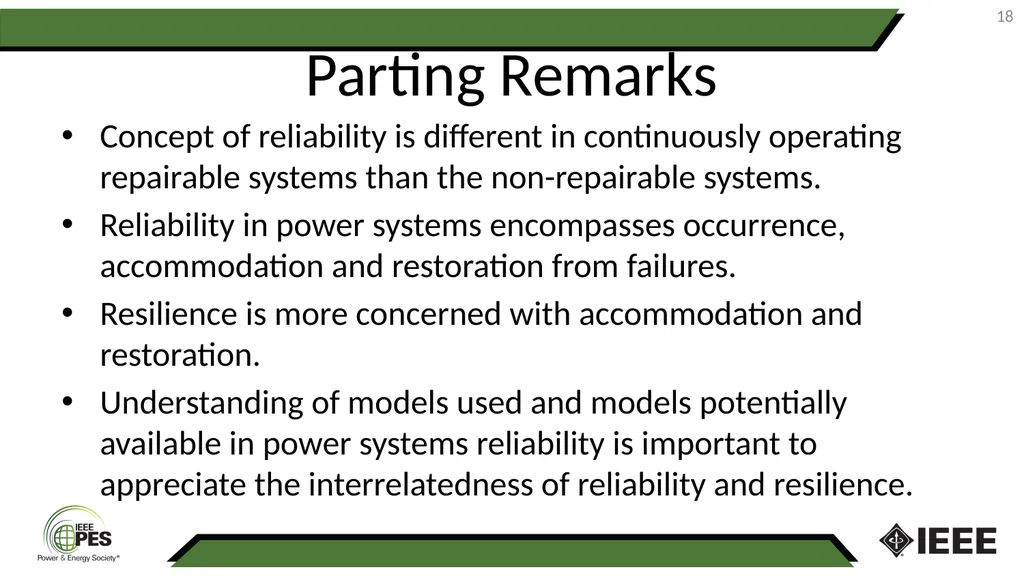
Parting Remarks Concept of reliability is different in continuously operating repairable systems than the non-repairable systems.
Reliability in power systems encompasses occurrence, accommodation and restoration from failures.
Resilience is more concerned with accommodation and restoration.
Understanding of models used and models potentially available in power systems reliability is important to appreciate the interrelatedness of reliability and resilience. 18<br>
Reliability in power systems encompasses occurrence, accommodation and restoration from failures.
Resilience is more concerned with accommodation and restoration.
Understanding of models used and models potentially available in power systems reliability is important to appreciate the interrelatedness of reliability and resilience. 18<br>
19
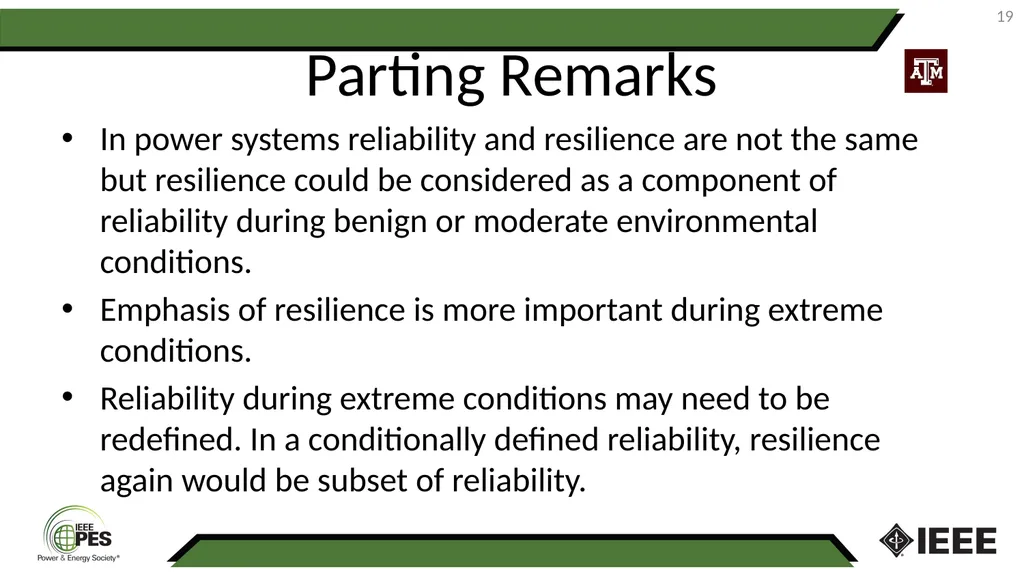
Parting Remarks In power systems reliability and resilience are not the same but resilience could be considered as a component of reliability during benign or moderate environmental conditions.
Emphasis of resilience is more important during extreme conditions.
Reliability during extreme conditions may need to be redefined. In a conditionally defined reliability, resilience again would be subset of reliability. 19<br>
Emphasis of resilience is more important during extreme conditions.
Reliability during extreme conditions may need to be redefined. In a conditionally defined reliability, resilience again would be subset of reliability. 19<br>