
1 Unit 18:GLOBAL BUSINESS ENVIRONMENT Lo 3:




Description: 1 Unit 18:GLOBAL BUSINESS ENVIRONMENT Lo 3: evaluate how operating in a global market influences an organizations structure, culture and functions 2 Unit 18: global business environment p3: evaluate the influences of globalization on
Related Topics
Download Presentation
"1 Unit 18:GLOBAL BUSINESS ENVIRONMENT Lo 3:" is the property of its rightful owner. Permission is granted to download and print the materials on this website for personal, non-commercial use only, and to display it on your personal computer provided you do not modify the materials and that you retain all copyright notices contained in the materials. By downloading content from our website, you accept the terms of this agreement.
Presentation Transcript
slide1. 1<br>
slide2. Unit 18:GLOBAL BUSINESS ENVIRONMENT Lo 3: evaluate how operating in a global market influences an organization’s structure, culture and functions 2<br>
slide3. Unit 18: global business environment
p3: evaluate the influences of globalization on organizational governance and leadership, structure, culture and functions. 3<br>
slide4. THE EFFECT OF GLOBALISATION ON Organisational governance Globalisation is a leading concept which has become the main factor in the operations of businesses during the last few decades. This phenomenon affects the economy, business life, society and environment in different ways, and almost all corporations have been affected by these changes. 4<br>
slide5. THE EFFECT OF GLOBALISATION ON Organisational governance Changes in the operations of business is mostly as a result of the following:-
-Increasing competition
- Rapid changing of technology
- Information transfer.
The issue stated above makes corporations more profit oriented instead of a long term and sustainable company. However, corporations are a vital part of society which needs to be organised properly. 5<br>
slide6. THE EFFECT OF GLOBALISATION ON Organisational governance The competition from globalisation can be related to products and service costs and prices, target market, technological adaptation, quick response and quick production by companies, in addition to such things as quality and customer satisfaction. When a company produces with less cost and sells cheaper, it will be able to increase its market share. 6<br>
slide7. THE EFFECT OF GLOBALISATION ON Organisational governance Customers have choices in the market and because of this they want to acquire goods and services quickly and in a more efficient way. And they are also expecting high quality at a cheap price which they are willing to pay. These expectations need a response from the company, otherwise the sales of the company will decrease and they will lose profit and market share. A company must always be ready for price competitions for product and service and for changes in customer preferences because all of these are global market requirements. 7<br>
slide8. THE EFFECT OF GLOBALISATION ON Organisational governance The introduction of new technology is one of the main factors that lead to globalisation. This has lead to entrepreneur and internationally oriented firms exploiting new business opportunities. Internet and e-commerce procedures hold particular potential for SMEs seeking to broaden their involvement into new international markets (Wrighta & Etemad, 2001). Technology is also one of the main tools of competition and for enhancing the quality of goods and services it can also lead to increase in cost for a company. 8<br>
slide9. THE EFFECT OF GLOBALISATION ON Organisational governance In order to remain competitive in a global environment a company has to use the latest technology to increase their sales and product quality. Globalisation has increased the speed of technology transfer and technological improvement additionally customer expectations are directing markets. Companies that are operating in a capital intensive markets are at risk and to reduce the risk of operating at a loss rapidly adapting to the concern of the customer and market expectations is very important. It is recommended that these companies have an efficient technology management and efficient Research and Development (R&D) Department. 9<br>
slide10. THE EFFECT OF GLOBALISATION ON Organisational governance The challenge of governance in a globalizing world is to engross in a process of political deliberation which aims at laying out and resetting the standards of global business conduct. While stakeholder management deals with the idea of internalizing the demands, values and interests of those constituents that touch or are regarded by corporate decision-making, there is also indication that political Corporate Social Responsibility (CSR) can be realized as a crusade of the corporation into environmental and social challenges such as human rights, global warming, or deforestation (Scherer & Palazzo, 2008). 10<br>
slide11. THE EFFECT OF GLOBALISATION ON Organisational governance Various stakeholders (e.g. Worker, purchaser, client, providers etc.) additionally shareholders and regulators of the firm have a duty to make sure proper performance is important and therefore , corporate governance isn’t always only related to companies, but also to all connected persons in society. Therefore the shifting view of a company obligation shifts the focal point from the actual hassle that society refers. 11<br>
slide12. THE EFFECT OF GLOBALISATION ON Organisational governance Equally it can be seen that globalization has an enormous effect on society and business spirit which can be seen in different ways. Business requires more regulation and proper and socially responsible behaviour.
The relationship between business failure and scandals, increased after globalization, and good governance is needed for bossiness to operate effectively and effcietnly. 12<br>
slide13. Mckinsey 7S model of organisation The McKinsey 7-S framework was developed in the early 1980s, the basic premise of the model is that there are seven internal aspects of an organization that need to be aligned if it is to be successful. This model involves seven interdependent factors which are categorized as either "hard" or "soft" elements which will be explored in detail on the following slides. 13<br>
slide14. Mckinsey 7S model of organisation 14<br>
slide15. Mckinsey 7S model of organisation Strategy is a plan developed by a firm to achieve sustained competitive advantage and successfully compete in the market. What does a well-aligned strategy mean in 7s McKinsey model? In general, a sound strategy is the one that is clearly articulated, is long-term, helps to achieve competitive advantage and is reinforced by strong vision, mission and values. But it is hard to tell if such strategy is well-aligned with other elements when analyzed alone. 15<br>
slide16. Mckinsey 7S model of organisation The key in 7s model is not to look at your company to find the great strategy,
structure, systems and etc. but to look if its aligned with other elements.
For example, short-term strategy is usually a poor choice for a company but
if its aligned with other 6 elements, then it may provide strong results. 16<br>
slide17. Mckinsey 7S model of organisation Structure represents the way business divisions and units are organized and includes the information of who is accountable to whom. In other words, structure is the organizational chart of the firm. It is also one of the most visible and easy to change elements of the framework. 17<br>
slide18. Mckinsey 7S model of organisation Systems are the processes and procedures of the company, which reveal business’ daily activities and how decisions are made. Systems are the area of
the firm that determines how business is done and it should be the main focus for managers during organizational change. 18<br>
slide19. Mckinsey 7S model of organisation Skills are the abilities that firm’s employees perform very well. They also include capabilities and competences. During organizational change, the
question often arises of what skills the company will really need to reinforce its new strategy or new structure. 19<br>
slide20. Mckinsey 7S model of organisation Staff element is concerned with what type and how many employees an organization will need and how they will be recruited, trained, motivated and
rewarded.
Style represents the way the company is managed by top-level managers, how they interact, what actions do they take and their symbolic value. In other words, it is the management style of company’s leaders. 20<br>
slide21. Mckinsey 7S model of organisation Shared Values are at the core of McKinsey 7s model. They are the norms and standards that guide employee behaviour and company actions and thus, are the foundation of every organization. 21<br>
slide22. Hofstede’s dimensions of culture The theory of Hofstede’s cultural dimensions constitutes a framework revolving around cross-cultural communication, which was devised by Geert Hofstede. The dimensions collectively portray the impact of the culture ingrained in society on the values of the members of that society. They also describe the relationship between these values and behaviour, with the help of a structure based on factor analysis. In other words, this theory studies significant aspects of culture and provides them a rating on a comparison scale.
The theory of Hofstede’s cultural dimensions constitutes a framework revolving around cross-cultural communication can be seen on the slide below. 22<br>
slide23. Hofstede’s dimensions of culture 23<br>
slide24. Hofstede’s dimensions of culture Below is an overview of the six cultural dimensions:
Power Distance: This dimension explains the extent to which members who are less powerful in a society accept and also expect that the distribution of power takes place unequally.
Uncertainty Avoidance: It is a dimension that describes the extent to which people in society are not at ease with ambiguity and uncertainty.
Individualism vs. Collectivism: The focus of this dimension is on the question regarding whether people have a preference for being left alone to look after themselves or want to remain in a closely knitted network. 24<br>
slide25. Hofstede’s dimensions of culture Masculinity vs. Femininity: Masculinity implies a society’s preference for assertiveness, heroism, achievement and material reward for attaining success. On the contrary, femininity represents a preference for modesty, cooperation, quality of life and caring for the weak.
Long-Term vs. Short-Term Orientation: Long-term orientation describes the inclination of a society toward searching for virtue. Short-term orientation pertains to those societies that are strongly inclined toward the establishment of the absolute truth.
Indulgence vs. Restraint: This revolves around the degree to which societies can exercise control over their impulses and desires. 25<br>
slide26. Hofstede’s dimensions of culture Hofstede’s cultural dimensions have formed a fundamental framework for viewing others. International business people, psychologists, communications researchers, and diplomats all benefit from Hofstede’s work, as well as everyone else. Utilizing these interpretative frameworks leads to a greater understanding of ourselves and others. 26<br>
slide27. REFERENCES Ebrary.net. (2018). Globalisation and corporate governance, Globalisation, Competition, Exchange of Technology - Corporate Governance and International Business - Academic library - free online college e textbooks. [online] Available at: https://ebrary.net/186/accounting/globalisation_corporate_governance [Accessed 23 Oct. 2018].
Bhowmick, A. (2018). Globalization and Corporate Governance - iPleaders. [online] iPleaders. Available at: https://blog.ipleaders.in/globalization-and-corporate-governance/ [Accessed 23 Oct. 2018]. 27<br>
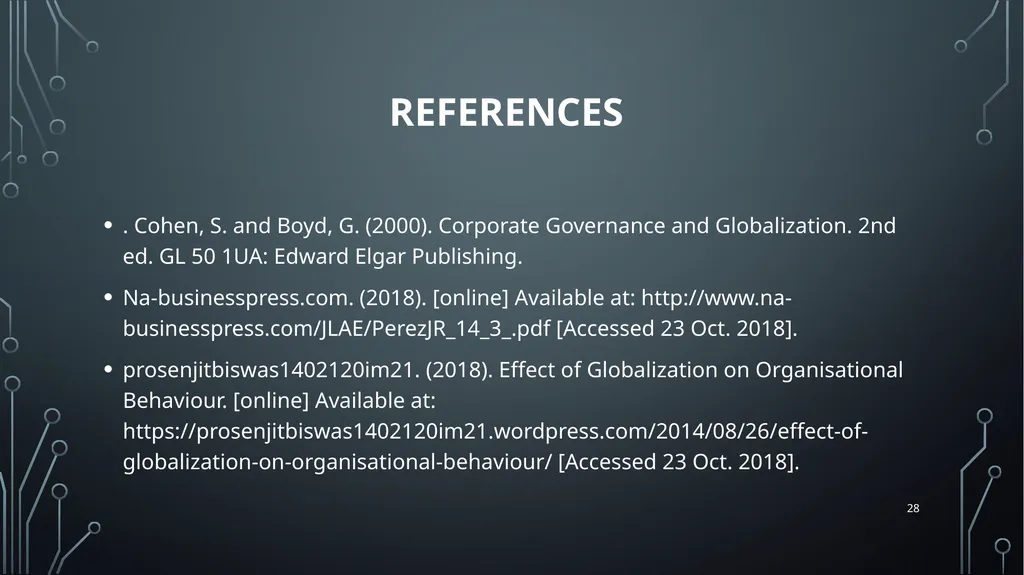
slide28. REFERENCES . Cohen, S. and Boyd, G. (2000). Corporate Governance and Globalization. 2nd ed. GL 50 1UA: Edward Elgar Publishing.
Na-businesspress.com. (2018). [online] Available at: http://www.na-businesspress.com/JLAE/PerezJR_14_3_.pdf [Accessed 23 Oct. 2018].
prosenjitbiswas1402120im21. (2018). Effect of Globalization on Organisational Behaviour. [online] Available at: https://prosenjitbiswas1402120im21.wordpress.com/2014/08/26/effect-of-globalization-on-organisational-behaviour/ [Accessed 23 Oct. 2018]. 28<br>
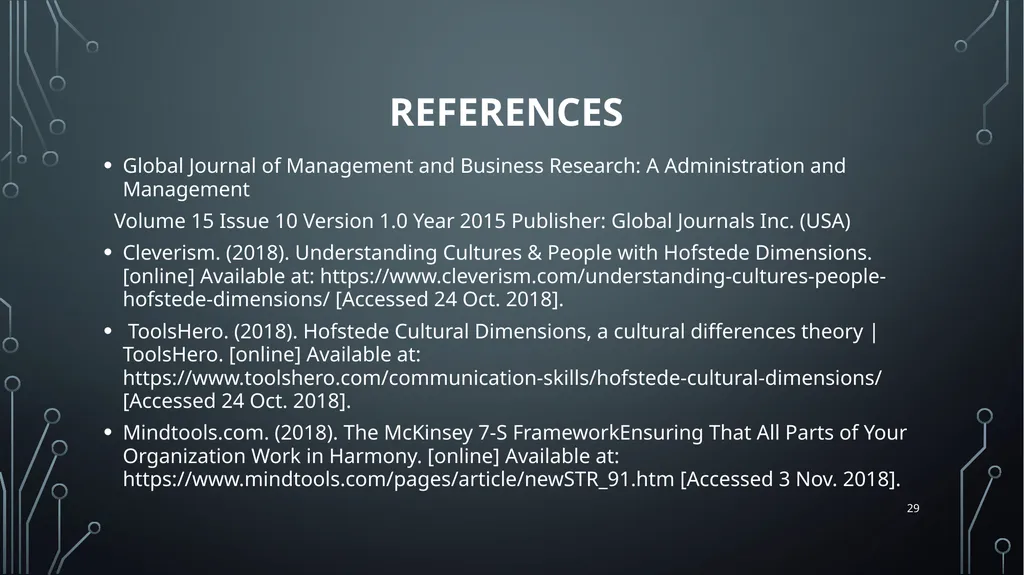
slide29. REFERENCES Global Journal of Management and Business Research: A Administration and Management
Volume 15 Issue 10 Version 1.0 Year 2015 Publisher: Global Journals Inc. (USA)
Cleverism. (2018). Understanding Cultures & People with Hofstede Dimensions. [online] Available at: https://www.cleverism.com/understanding-cultures-people-hofstede-dimensions/ [Accessed 24 Oct. 2018].
ToolsHero. (2018). Hofstede Cultural Dimensions, a cultural differences theory | ToolsHero. [online] Available at: https://www.toolshero.com/communication-skills/hofstede-cultural-dimensions/ [Accessed 24 Oct. 2018].
Mindtools.com. (2018). The McKinsey 7-S FrameworkEnsuring That All Parts of Your Organization Work in Harmony. [online] Available at: https://www.mindtools.com/pages/article/newSTR_91.htm [Accessed 3 Nov. 2018]. 29<br>
slide2. Unit 18:GLOBAL BUSINESS ENVIRONMENT Lo 3: evaluate how operating in a global market influences an organization’s structure, culture and functions 2<br>
slide3. Unit 18: global business environment
p3: evaluate the influences of globalization on organizational governance and leadership, structure, culture and functions. 3<br>
slide4. THE EFFECT OF GLOBALISATION ON Organisational governance Globalisation is a leading concept which has become the main factor in the operations of businesses during the last few decades. This phenomenon affects the economy, business life, society and environment in different ways, and almost all corporations have been affected by these changes. 4<br>
slide5. THE EFFECT OF GLOBALISATION ON Organisational governance Changes in the operations of business is mostly as a result of the following:-
-Increasing competition
- Rapid changing of technology
- Information transfer.
The issue stated above makes corporations more profit oriented instead of a long term and sustainable company. However, corporations are a vital part of society which needs to be organised properly. 5<br>
slide6. THE EFFECT OF GLOBALISATION ON Organisational governance The competition from globalisation can be related to products and service costs and prices, target market, technological adaptation, quick response and quick production by companies, in addition to such things as quality and customer satisfaction. When a company produces with less cost and sells cheaper, it will be able to increase its market share. 6<br>
slide7. THE EFFECT OF GLOBALISATION ON Organisational governance Customers have choices in the market and because of this they want to acquire goods and services quickly and in a more efficient way. And they are also expecting high quality at a cheap price which they are willing to pay. These expectations need a response from the company, otherwise the sales of the company will decrease and they will lose profit and market share. A company must always be ready for price competitions for product and service and for changes in customer preferences because all of these are global market requirements. 7<br>
slide8. THE EFFECT OF GLOBALISATION ON Organisational governance The introduction of new technology is one of the main factors that lead to globalisation. This has lead to entrepreneur and internationally oriented firms exploiting new business opportunities. Internet and e-commerce procedures hold particular potential for SMEs seeking to broaden their involvement into new international markets (Wrighta & Etemad, 2001). Technology is also one of the main tools of competition and for enhancing the quality of goods and services it can also lead to increase in cost for a company. 8<br>
slide9. THE EFFECT OF GLOBALISATION ON Organisational governance In order to remain competitive in a global environment a company has to use the latest technology to increase their sales and product quality. Globalisation has increased the speed of technology transfer and technological improvement additionally customer expectations are directing markets. Companies that are operating in a capital intensive markets are at risk and to reduce the risk of operating at a loss rapidly adapting to the concern of the customer and market expectations is very important. It is recommended that these companies have an efficient technology management and efficient Research and Development (R&D) Department. 9<br>
slide10. THE EFFECT OF GLOBALISATION ON Organisational governance The challenge of governance in a globalizing world is to engross in a process of political deliberation which aims at laying out and resetting the standards of global business conduct. While stakeholder management deals with the idea of internalizing the demands, values and interests of those constituents that touch or are regarded by corporate decision-making, there is also indication that political Corporate Social Responsibility (CSR) can be realized as a crusade of the corporation into environmental and social challenges such as human rights, global warming, or deforestation (Scherer & Palazzo, 2008). 10<br>
slide11. THE EFFECT OF GLOBALISATION ON Organisational governance Various stakeholders (e.g. Worker, purchaser, client, providers etc.) additionally shareholders and regulators of the firm have a duty to make sure proper performance is important and therefore , corporate governance isn’t always only related to companies, but also to all connected persons in society. Therefore the shifting view of a company obligation shifts the focal point from the actual hassle that society refers. 11<br>
slide12. THE EFFECT OF GLOBALISATION ON Organisational governance Equally it can be seen that globalization has an enormous effect on society and business spirit which can be seen in different ways. Business requires more regulation and proper and socially responsible behaviour.
The relationship between business failure and scandals, increased after globalization, and good governance is needed for bossiness to operate effectively and effcietnly. 12<br>
slide13. Mckinsey 7S model of organisation The McKinsey 7-S framework was developed in the early 1980s, the basic premise of the model is that there are seven internal aspects of an organization that need to be aligned if it is to be successful. This model involves seven interdependent factors which are categorized as either "hard" or "soft" elements which will be explored in detail on the following slides. 13<br>
slide14. Mckinsey 7S model of organisation 14<br>
slide15. Mckinsey 7S model of organisation Strategy is a plan developed by a firm to achieve sustained competitive advantage and successfully compete in the market. What does a well-aligned strategy mean in 7s McKinsey model? In general, a sound strategy is the one that is clearly articulated, is long-term, helps to achieve competitive advantage and is reinforced by strong vision, mission and values. But it is hard to tell if such strategy is well-aligned with other elements when analyzed alone. 15<br>
slide16. Mckinsey 7S model of organisation The key in 7s model is not to look at your company to find the great strategy,
structure, systems and etc. but to look if its aligned with other elements.
For example, short-term strategy is usually a poor choice for a company but
if its aligned with other 6 elements, then it may provide strong results. 16<br>
slide17. Mckinsey 7S model of organisation Structure represents the way business divisions and units are organized and includes the information of who is accountable to whom. In other words, structure is the organizational chart of the firm. It is also one of the most visible and easy to change elements of the framework. 17<br>
slide18. Mckinsey 7S model of organisation Systems are the processes and procedures of the company, which reveal business’ daily activities and how decisions are made. Systems are the area of
the firm that determines how business is done and it should be the main focus for managers during organizational change. 18<br>
slide19. Mckinsey 7S model of organisation Skills are the abilities that firm’s employees perform very well. They also include capabilities and competences. During organizational change, the
question often arises of what skills the company will really need to reinforce its new strategy or new structure. 19<br>
slide20. Mckinsey 7S model of organisation Staff element is concerned with what type and how many employees an organization will need and how they will be recruited, trained, motivated and
rewarded.
Style represents the way the company is managed by top-level managers, how they interact, what actions do they take and their symbolic value. In other words, it is the management style of company’s leaders. 20<br>
slide21. Mckinsey 7S model of organisation Shared Values are at the core of McKinsey 7s model. They are the norms and standards that guide employee behaviour and company actions and thus, are the foundation of every organization. 21<br>
slide22. Hofstede’s dimensions of culture The theory of Hofstede’s cultural dimensions constitutes a framework revolving around cross-cultural communication, which was devised by Geert Hofstede. The dimensions collectively portray the impact of the culture ingrained in society on the values of the members of that society. They also describe the relationship between these values and behaviour, with the help of a structure based on factor analysis. In other words, this theory studies significant aspects of culture and provides them a rating on a comparison scale.
The theory of Hofstede’s cultural dimensions constitutes a framework revolving around cross-cultural communication can be seen on the slide below. 22<br>
slide23. Hofstede’s dimensions of culture 23<br>
slide24. Hofstede’s dimensions of culture Below is an overview of the six cultural dimensions:
Power Distance: This dimension explains the extent to which members who are less powerful in a society accept and also expect that the distribution of power takes place unequally.
Uncertainty Avoidance: It is a dimension that describes the extent to which people in society are not at ease with ambiguity and uncertainty.
Individualism vs. Collectivism: The focus of this dimension is on the question regarding whether people have a preference for being left alone to look after themselves or want to remain in a closely knitted network. 24<br>
slide25. Hofstede’s dimensions of culture Masculinity vs. Femininity: Masculinity implies a society’s preference for assertiveness, heroism, achievement and material reward for attaining success. On the contrary, femininity represents a preference for modesty, cooperation, quality of life and caring for the weak.
Long-Term vs. Short-Term Orientation: Long-term orientation describes the inclination of a society toward searching for virtue. Short-term orientation pertains to those societies that are strongly inclined toward the establishment of the absolute truth.
Indulgence vs. Restraint: This revolves around the degree to which societies can exercise control over their impulses and desires. 25<br>
slide26. Hofstede’s dimensions of culture Hofstede’s cultural dimensions have formed a fundamental framework for viewing others. International business people, psychologists, communications researchers, and diplomats all benefit from Hofstede’s work, as well as everyone else. Utilizing these interpretative frameworks leads to a greater understanding of ourselves and others. 26<br>
slide27. REFERENCES Ebrary.net. (2018). Globalisation and corporate governance, Globalisation, Competition, Exchange of Technology - Corporate Governance and International Business - Academic library - free online college e textbooks. [online] Available at: https://ebrary.net/186/accounting/globalisation_corporate_governance [Accessed 23 Oct. 2018].
Bhowmick, A. (2018). Globalization and Corporate Governance - iPleaders. [online] iPleaders. Available at: https://blog.ipleaders.in/globalization-and-corporate-governance/ [Accessed 23 Oct. 2018]. 27<br>
slide28. REFERENCES . Cohen, S. and Boyd, G. (2000). Corporate Governance and Globalization. 2nd ed. GL 50 1UA: Edward Elgar Publishing.
Na-businesspress.com. (2018). [online] Available at: http://www.na-businesspress.com/JLAE/PerezJR_14_3_.pdf [Accessed 23 Oct. 2018].
prosenjitbiswas1402120im21. (2018). Effect of Globalization on Organisational Behaviour. [online] Available at: https://prosenjitbiswas1402120im21.wordpress.com/2014/08/26/effect-of-globalization-on-organisational-behaviour/ [Accessed 23 Oct. 2018]. 28<br>
slide29. REFERENCES Global Journal of Management and Business Research: A Administration and Management
Volume 15 Issue 10 Version 1.0 Year 2015 Publisher: Global Journals Inc. (USA)
Cleverism. (2018). Understanding Cultures & People with Hofstede Dimensions. [online] Available at: https://www.cleverism.com/understanding-cultures-people-hofstede-dimensions/ [Accessed 24 Oct. 2018].
ToolsHero. (2018). Hofstede Cultural Dimensions, a cultural differences theory | ToolsHero. [online] Available at: https://www.toolshero.com/communication-skills/hofstede-cultural-dimensions/ [Accessed 24 Oct. 2018].
Mindtools.com. (2018). The McKinsey 7-S FrameworkEnsuring That All Parts of Your Organization Work in Harmony. [online] Available at: https://www.mindtools.com/pages/article/newSTR_91.htm [Accessed 3 Nov. 2018]. 29<br>