
1 Year & Sem. – I Year & I SEM
YM
Published · 33 slides · 0 views
1 / 1


Description
1 Year Sem. I Year I SEM Subject Basic Mechanical Engineering ( 1FY3-07) Unit 1 Presented by Dilip kumar Prajapati (Assistant Professor) Dilip Prajapati (Assistant Professor) , JECRC, JAIPUR JAIPUR ENGINEERING COLLEGE AND RESEARCH
Related Topics
Share
Embed code
Download this presentation From Below
"1 Year & Sem. – I Year & I SEM" is the property of its rightful owner. Permission is granted to download and print the materials on this website for personal, non-commercial use only, and to display it on your personal computer provided you do not modify the materials and that you retain all copyright notices contained in the materials. By downloading content from our website, you accept the terms of this agreement.
Presentation Transcript
01
1 Year & Sem. – I Year & I SEM
Subject –Basic Mechanical Engineering ( 1FY3-07)
Unit– 1
Presented by – Dilip kumar Prajapati (Assistant Professor) Dilip Prajapati (Assistant Professor) , JECRC, JAIPUR JAIPUR ENGINEERING COLLEGE AND RESEARCH CENTER 1<br>
Subject –Basic Mechanical Engineering ( 1FY3-07)
Unit– 1
Presented by – Dilip kumar Prajapati (Assistant Professor) Dilip Prajapati (Assistant Professor) , JECRC, JAIPUR JAIPUR ENGINEERING COLLEGE AND RESEARCH CENTER 1<br>
02
1 Dilip Prajapati(Assistant Professor) JECRC JAIPUR VISION AND MISSION OF INSTITUTE 2 VISION OF INSTITUTE
To became a renowned centre of outcome based learning and work towards academic professional ,cultural and social enrichment of the lives of individuals and communities . MISSION OF INSTITUTE
Focus on evaluation of learning ,outcomes and motivate students to research aptitude by project based learning.
Identify based on informed perception of Indian ,regional and global needs ,the area of focus and provide platform to gain knowledge and solutions.
Offer opportunities for interaction between academic and industry .
Develop human potential to its fullest extent so that intellectually capable and imaginatively gifted leaders may emerge.<br>
To became a renowned centre of outcome based learning and work towards academic professional ,cultural and social enrichment of the lives of individuals and communities . MISSION OF INSTITUTE
Focus on evaluation of learning ,outcomes and motivate students to research aptitude by project based learning.
Identify based on informed perception of Indian ,regional and global needs ,the area of focus and provide platform to gain knowledge and solutions.
Offer opportunities for interaction between academic and industry .
Develop human potential to its fullest extent so that intellectually capable and imaginatively gifted leaders may emerge.<br>
03
1 Dilip Prajapati(Assistant Professor) JECRC Jaipur VISION AND MISSION OF DEPARTMENT 3 Vision
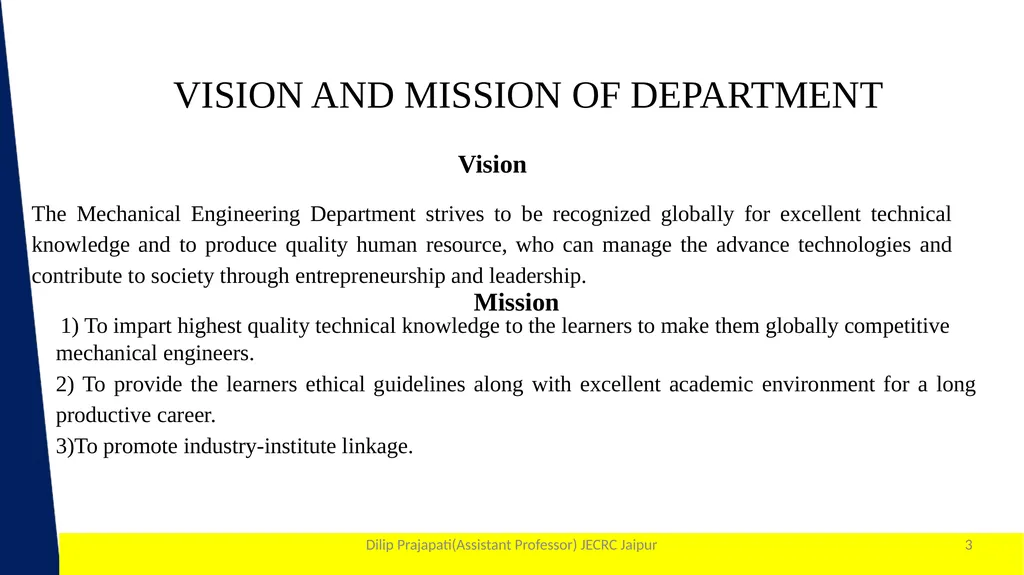
The Mechanical Engineering Department strives to be recognized globally for excellent technical knowledge and to produce quality human resource, who can manage the advance technologies and contribute to society through entrepreneurship and leadership. Mission
1) To impart highest quality technical knowledge to the learners to make them globally competitive
mechanical engineers.
2) To provide the learners ethical guidelines along with excellent academic environment for a long productive career.
3)To promote industry-institute linkage.<br>
The Mechanical Engineering Department strives to be recognized globally for excellent technical knowledge and to produce quality human resource, who can manage the advance technologies and contribute to society through entrepreneurship and leadership. Mission
1) To impart highest quality technical knowledge to the learners to make them globally competitive
mechanical engineers.
2) To provide the learners ethical guidelines along with excellent academic environment for a long productive career.
3)To promote industry-institute linkage.<br>
04
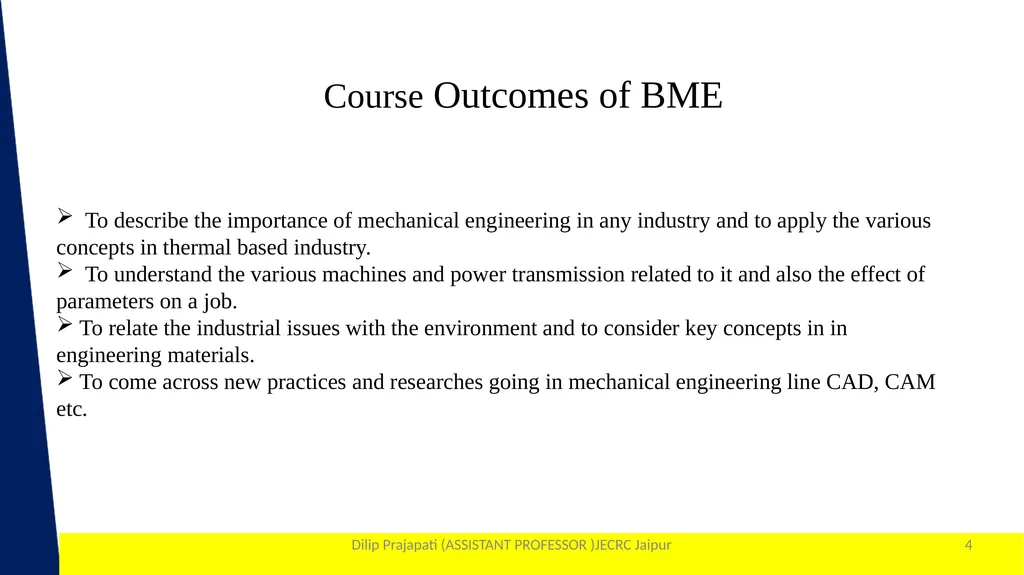
1 Dilip Prajapati (ASSISTANT PROFESSOR )JECRC Jaipur Course Outcomes of BME 4 To describe the importance of mechanical engineering in any industry and to apply the various concepts in thermal based industry.
To understand the various machines and power transmission related to it and also the effect of parameters on a job.
To relate the industrial issues with the environment and to consider key concepts in in engineering materials.
To come across new practices and researches going in mechanical engineering line CAD, CAM etc.<br>
To understand the various machines and power transmission related to it and also the effect of parameters on a job.
To relate the industrial issues with the environment and to consider key concepts in in engineering materials.
To come across new practices and researches going in mechanical engineering line CAD, CAM etc.<br>
05
1 Dilip Prajapati(ASSISTANT PROFESSOR) , JECRC, JAIPUR Contents of UNIT-1 5 Introduction to mechanical engineering.
Concepts of thermal engineering.
Mechanical machine design.
Industrial engineering.
Manufacturing technology.<br>
Concepts of thermal engineering.
Mechanical machine design.
Industrial engineering.
Manufacturing technology.<br>
06
1 Dilip Prajapati(ASSISTANT PROFESSOR) , JECRC, JAIPUR Introduction to mechanical engineering 6 Mechanical engineering is an engineering branch that combines engineering physics and mathematics principles with materials science to design, analyze, manufacture, and maintain mechanical systems.
The mechanical engineering field requires an understanding of core areas including mechanics, dynamics, thermodynamics, materials science, structural analysis, and electricity.
In addition to these core principles, mechanical engineers use tools such as computer-aided design (CAD), computer-aided manufacturing (CAM), and product lifecycle management to design and analyze manufacturing plants, industrial equipment and machinery, heating and cooling systems, transport systems, aircraft, watercraft, robotics, medical devices, weapons, and others.<br>
The mechanical engineering field requires an understanding of core areas including mechanics, dynamics, thermodynamics, materials science, structural analysis, and electricity.
In addition to these core principles, mechanical engineers use tools such as computer-aided design (CAD), computer-aided manufacturing (CAM), and product lifecycle management to design and analyze manufacturing plants, industrial equipment and machinery, heating and cooling systems, transport systems, aircraft, watercraft, robotics, medical devices, weapons, and others.<br>
07
1 Dilip Prajapati (ASSISTANT PROFESSOR) , JECRC, JAIPUR Concepts of thermal Engineering 7 THERMODYNAMICS: It is the science of the relations between heat, Work and the properties of the systems.
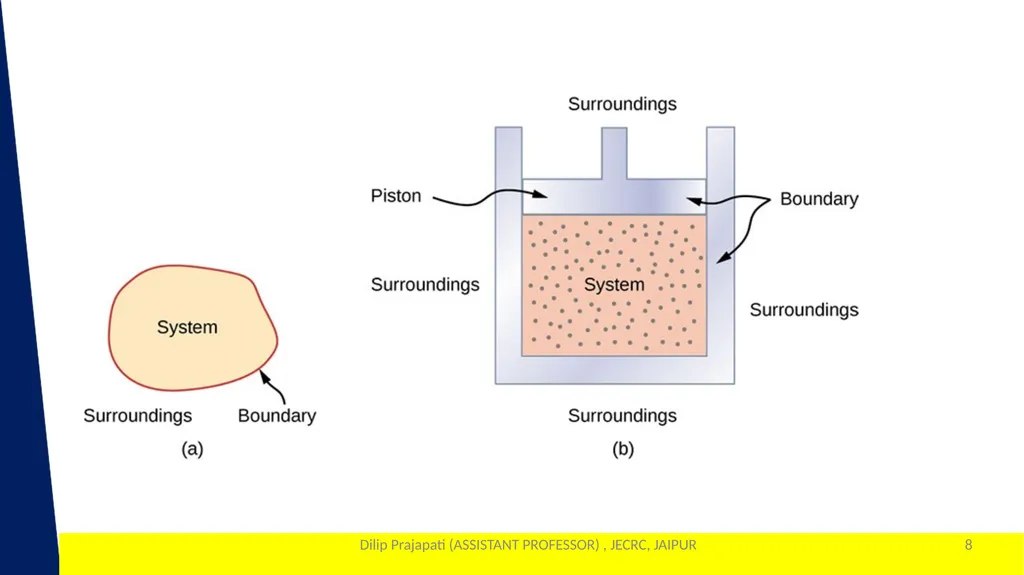
In our study of thermodynamics, we will choose a small part of the universe to which we will apply the laws of thermodynamics. We call this subset a SYSTEM.
The system is a macroscopically identifiable collection of matter on which we focus our attention (eg: the water kettle or the aircraft engine).
The rest of the universe outside the system close enough to the system to have some perceptible effect on the system is called the surroundings.
The surfaces which separates the system from the surroundings are called the boundaries as shown in fig below (e.g: walls of the kettle, the housing of the engine)<br>
In our study of thermodynamics, we will choose a small part of the universe to which we will apply the laws of thermodynamics. We call this subset a SYSTEM.
The system is a macroscopically identifiable collection of matter on which we focus our attention (eg: the water kettle or the aircraft engine).
The rest of the universe outside the system close enough to the system to have some perceptible effect on the system is called the surroundings.
The surfaces which separates the system from the surroundings are called the boundaries as shown in fig below (e.g: walls of the kettle, the housing of the engine)<br>
08
1 Dilip Prajapati (ASSISTANT PROFESSOR) , JECRC, JAIPUR 8<br>
09
1 Dilip Prajapati (ASSISTANT PROFESSOR) , JECRC, JAIPUR 9 Types of system
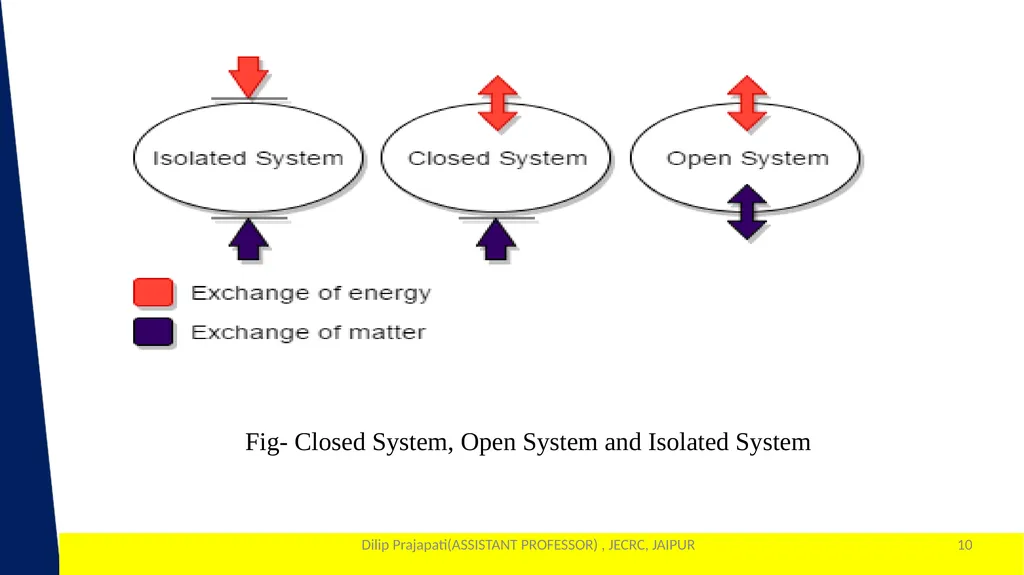
Closed system - in which no mass is permitted to cross the system boundary i.e. we would always consider a system of constant mass. We do permit heat and work to enter or leave but not mass. system Boundary Heat/work in Heat/work Out No mass entry or exit.
Open system- in which we permit mass to cross the system boundary in either direction (from the system to surroundings or vice versa). In analysing open systems, we typically look at a specified region of space, and observe what happens at the boundaries of that region.
Isolated System - in which there is no interaction between system and the surroundings. It is of fixed mass and energy, and hence there is no mass and energy transfer across the system boundary.<br>
Closed system - in which no mass is permitted to cross the system boundary i.e. we would always consider a system of constant mass. We do permit heat and work to enter or leave but not mass. system Boundary Heat/work in Heat/work Out No mass entry or exit.
Open system- in which we permit mass to cross the system boundary in either direction (from the system to surroundings or vice versa). In analysing open systems, we typically look at a specified region of space, and observe what happens at the boundaries of that region.
Isolated System - in which there is no interaction between system and the surroundings. It is of fixed mass and energy, and hence there is no mass and energy transfer across the system boundary.<br>
10
1 Dilip Prajapati(ASSISTANT PROFESSOR) , JECRC, JAIPUR 10 Fig- Closed System, Open System and Isolated System<br>
11
1 Dilip Prajapati (ASSISTANT PROFESSOR) , JECRC, JAIPUR 11 Macroscopic and Microscopic Approaches
In macroscopic approach, certain quantity of matter is considered, without a concern on the events occurring at the molecular level. These effects can be perceived by human senses or measured by instruments. (e.g.: pressure, temperature)
In microscopic approach, the effect of molecular motion is Considered.
e.g. At microscopic level the pressure of a gas is not constant, the temperature of a gas is a function of the velocity of molecules.
Most microscopic properties cannot be measured with common instruments nor can be perceived by human senses.<br>
In macroscopic approach, certain quantity of matter is considered, without a concern on the events occurring at the molecular level. These effects can be perceived by human senses or measured by instruments. (e.g.: pressure, temperature)
In microscopic approach, the effect of molecular motion is Considered.
e.g. At microscopic level the pressure of a gas is not constant, the temperature of a gas is a function of the velocity of molecules.
Most microscopic properties cannot be measured with common instruments nor can be perceived by human senses.<br>
12
1 Dilip Prajapati (ASSISTANT PROFESSOR) , JECRC, JAIPUR 12 Property
It is some characteristic of the system to which some physically meaningful numbers can be assigned without knowing the history behind it.
These are macroscopic in nature.
Invariably the properties must enable us to identify the system.
eg: Anand weighs 72 kg and is 1.75 m tall. We are not concerned how he got to that stage. We are not interested what he ate!!.
Categories of Properties
Extensive property: whose value depends on the size or extent of the system (upper case letters as the symbols). eg: Volume, Mass (V,M). If mass is increased, the value of extensive property also increases.
Intensive property : whose value is independent of the size or extent of the system. eg: pressure, temperature (p, T).<br>
It is some characteristic of the system to which some physically meaningful numbers can be assigned without knowing the history behind it.
These are macroscopic in nature.
Invariably the properties must enable us to identify the system.
eg: Anand weighs 72 kg and is 1.75 m tall. We are not concerned how he got to that stage. We are not interested what he ate!!.
Categories of Properties
Extensive property: whose value depends on the size or extent of the system (upper case letters as the symbols). eg: Volume, Mass (V,M). If mass is increased, the value of extensive property also increases.
Intensive property : whose value is independent of the size or extent of the system. eg: pressure, temperature (p, T).<br>
13
1 Dilip Prajapati(ASSISTANT PROFESSOR) , JECRC, JAIPUR 13 Specific property: It is the value of an extensive property per unit mass of system. (lower case letters as symbols) eg: specific volume, density (v, ρ).
It is a special case of an intensive property.
Most widely referred properties in thermodynamics: Pressure; Volume; Temperature; Entropy; Enthalpy; Internal energy.
State: It is the condition of a system as defined by the values of all its properties. It gives a complete description of the system. Any operation in which one or more properties of a system change is called a change of state.
Phase: It is a quantity of mass that is homogeneous throughout in chemical composition and physical structure. e.g. solid, liquid, vapour, gas. Phase consisting of more than one phase is known as heterogenous system .<br>
It is a special case of an intensive property.
Most widely referred properties in thermodynamics: Pressure; Volume; Temperature; Entropy; Enthalpy; Internal energy.
State: It is the condition of a system as defined by the values of all its properties. It gives a complete description of the system. Any operation in which one or more properties of a system change is called a change of state.
Phase: It is a quantity of mass that is homogeneous throughout in chemical composition and physical structure. e.g. solid, liquid, vapour, gas. Phase consisting of more than one phase is known as heterogenous system .<br>
14
1 Dilip Prajapati (ASSISTANT PROFESSOR) , JECRC, JAIPUR 14 Path And Process
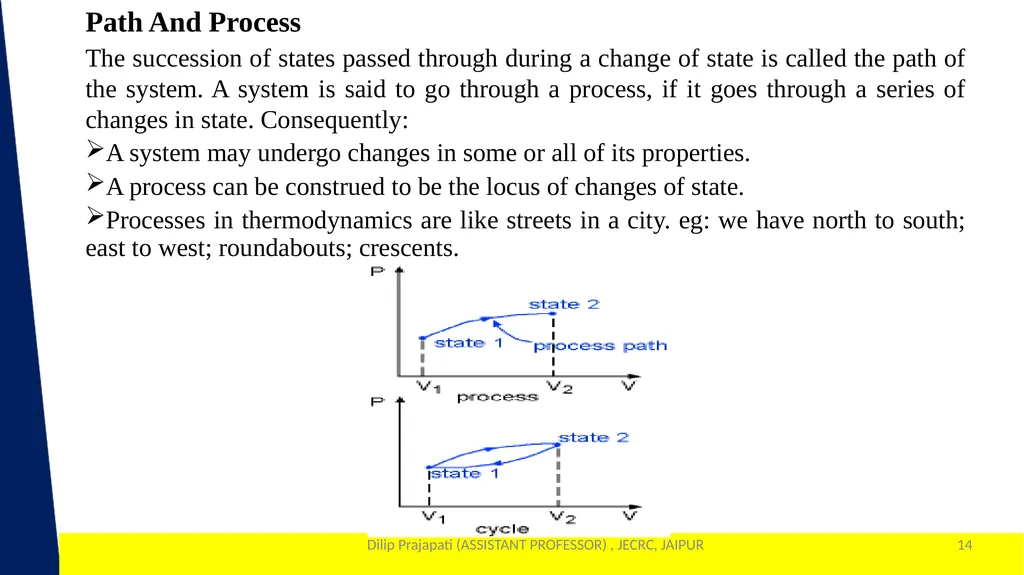
The succession of states passed through during a change of state is called the path of the system. A system is said to go through a process, if it goes through a series of changes in state. Consequently:
A system may undergo changes in some or all of its properties.
A process can be construed to be the locus of changes of state.
Processes in thermodynamics are like streets in a city. eg: we have north to south; east to west; roundabouts; crescents.<br>
The succession of states passed through during a change of state is called the path of the system. A system is said to go through a process, if it goes through a series of changes in state. Consequently:
A system may undergo changes in some or all of its properties.
A process can be construed to be the locus of changes of state.
Processes in thermodynamics are like streets in a city. eg: we have north to south; east to west; roundabouts; crescents.<br>
15
1 Dilip Prajapati (ASSISTANT PROFESSOR) , JECRC, JAIPUR 15 Types of Processes
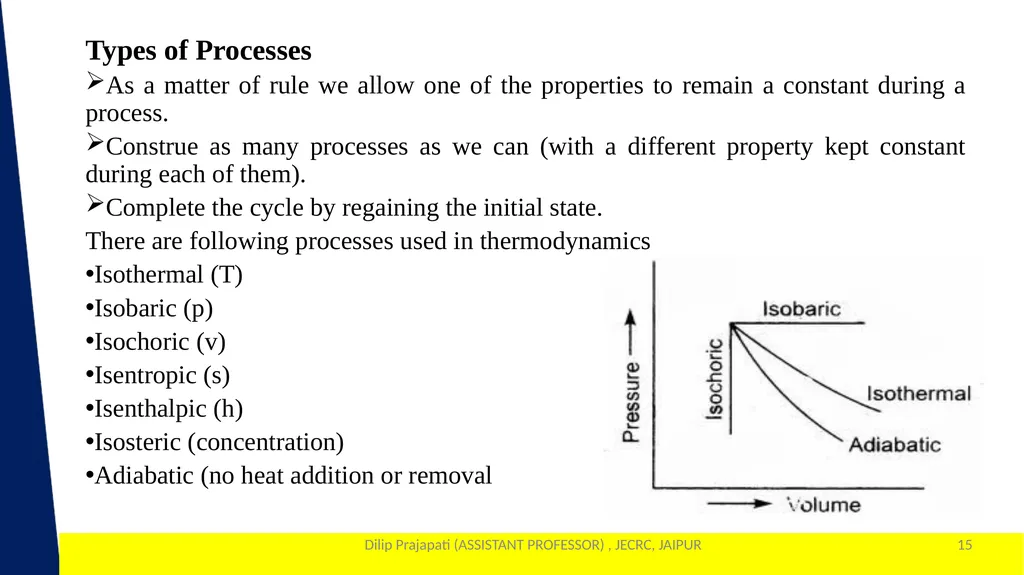
As a matter of rule we allow one of the properties to remain a constant during a process.
Construe as many processes as we can (with a different property kept constant during each of them).
Complete the cycle by regaining the initial state.
There are following processes used in thermodynamics
Isothermal (T)
Isobaric (p)
Isochoric (v)
Isentropic (s)
Isenthalpic (h)
Isosteric (concentration)
Adiabatic (no heat addition or removal<br>
As a matter of rule we allow one of the properties to remain a constant during a process.
Construe as many processes as we can (with a different property kept constant during each of them).
Complete the cycle by regaining the initial state.
There are following processes used in thermodynamics
Isothermal (T)
Isobaric (p)
Isochoric (v)
Isentropic (s)
Isenthalpic (h)
Isosteric (concentration)
Adiabatic (no heat addition or removal<br>
16
1 Dilip Prajapati(ASSISTANT PROFESSOR) , JECRC, JAIPUR 16 Quasi-static Processes
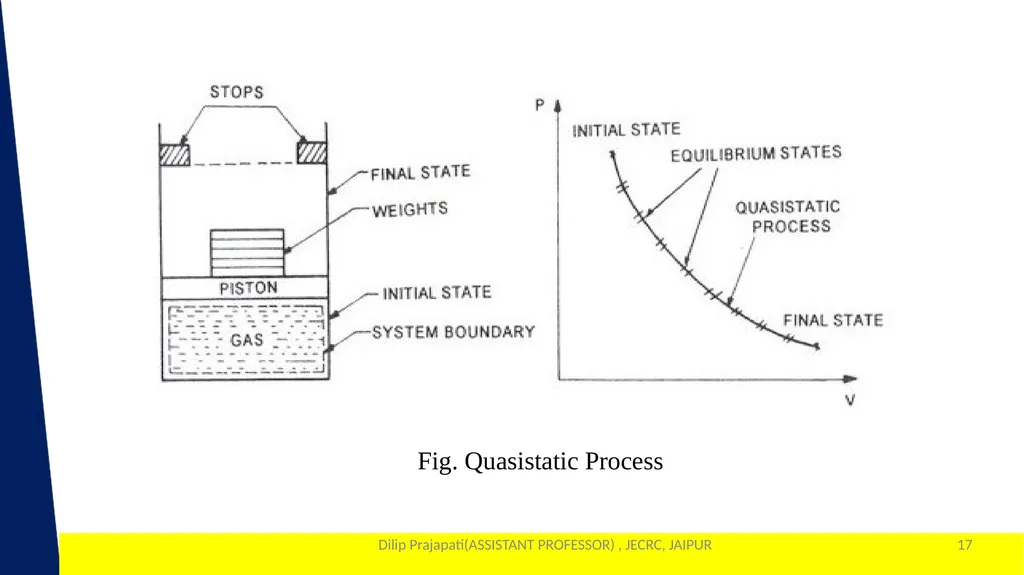
A quasi-static process is one in which
The deviation from thermodynamic equilibrium is infinitesimal.
All states of the system passes through are equilibrium states.
If we remove the weights slowly one by one the pressure of the gas will displace the piston gradually. It is quasistatic.
On the other hand if we remove all the weights at once the piston will be kicked up by the gas pressure.(This is unrestrained expansion) but we don’t consider that the work is done - because it is not in a sustained manner
In both cases the systems have undergone a change of state.
Another eg: if a person climbs down a ladder from roof to ground, it is a quasistatic process. On the other hand if he jumps then it is not a quasistatic process.<br>
A quasi-static process is one in which
The deviation from thermodynamic equilibrium is infinitesimal.
All states of the system passes through are equilibrium states.
If we remove the weights slowly one by one the pressure of the gas will displace the piston gradually. It is quasistatic.
On the other hand if we remove all the weights at once the piston will be kicked up by the gas pressure.(This is unrestrained expansion) but we don’t consider that the work is done - because it is not in a sustained manner
In both cases the systems have undergone a change of state.
Another eg: if a person climbs down a ladder from roof to ground, it is a quasistatic process. On the other hand if he jumps then it is not a quasistatic process.<br>
17
1 Dilip Prajapati(ASSISTANT PROFESSOR) , JECRC, JAIPUR 17 Fig. Quasistatic Process<br>
18
1 Dilip prajapati(ASSISTANT PROFESSOR) , JECRC, JAIPUR 18 Equilibrium State
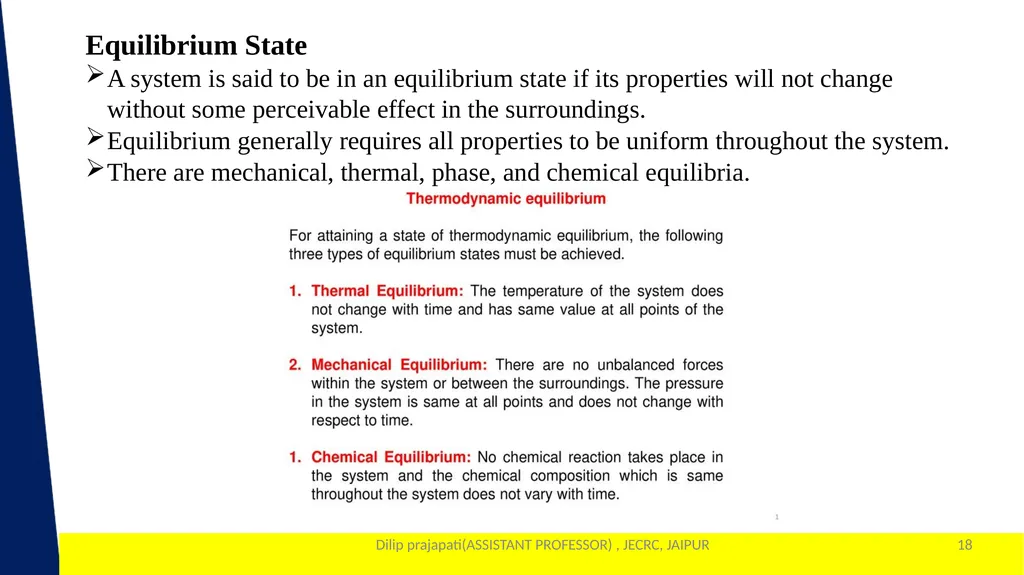
A system is said to be in an equilibrium state if its properties will not change without some perceivable effect in the surroundings.
Equilibrium generally requires all properties to be uniform throughout the system.
There are mechanical, thermal, phase, and chemical equilibria.<br>
A system is said to be in an equilibrium state if its properties will not change without some perceivable effect in the surroundings.
Equilibrium generally requires all properties to be uniform throughout the system.
There are mechanical, thermal, phase, and chemical equilibria.<br>
19
1 Dilip Prajapati (ASSISTANT PROFESSOR) , JECRC, JAIPUR 19 Zeroth Law of thermodynamics
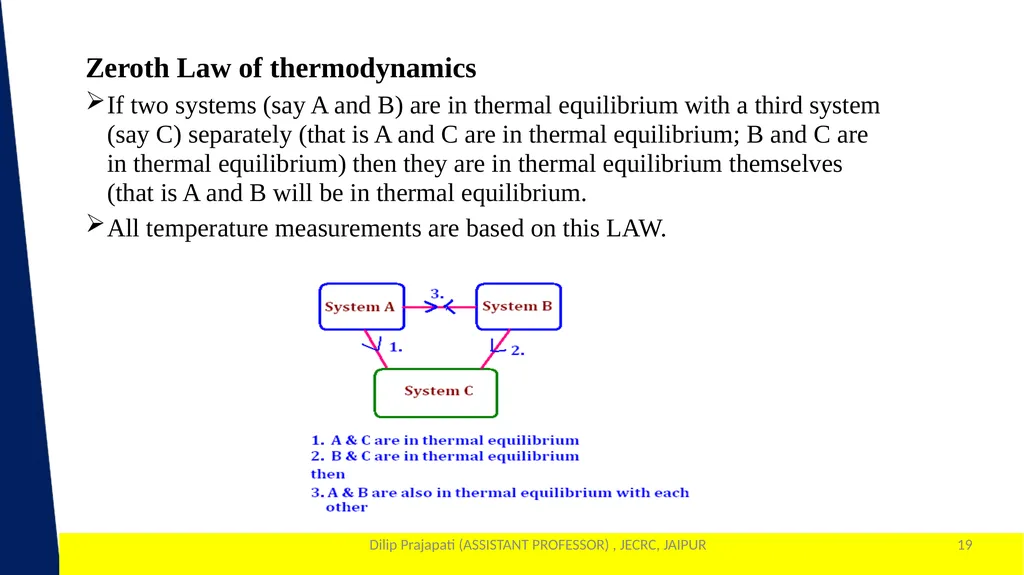
If two systems (say A and B) are in thermal equilibrium with a third system (say C) separately (that is A and C are in thermal equilibrium; B and C are in thermal equilibrium) then they are in thermal equilibrium themselves (that is A and B will be in thermal equilibrium.
All temperature measurements are based on this LAW.<br>
If two systems (say A and B) are in thermal equilibrium with a third system (say C) separately (that is A and C are in thermal equilibrium; B and C are in thermal equilibrium) then they are in thermal equilibrium themselves (that is A and B will be in thermal equilibrium.
All temperature measurements are based on this LAW.<br>
20
1 Dilip Prajapati(ASSISTANT PROFESSOR) , JECRC, JAIPUR 20 Work and Heat
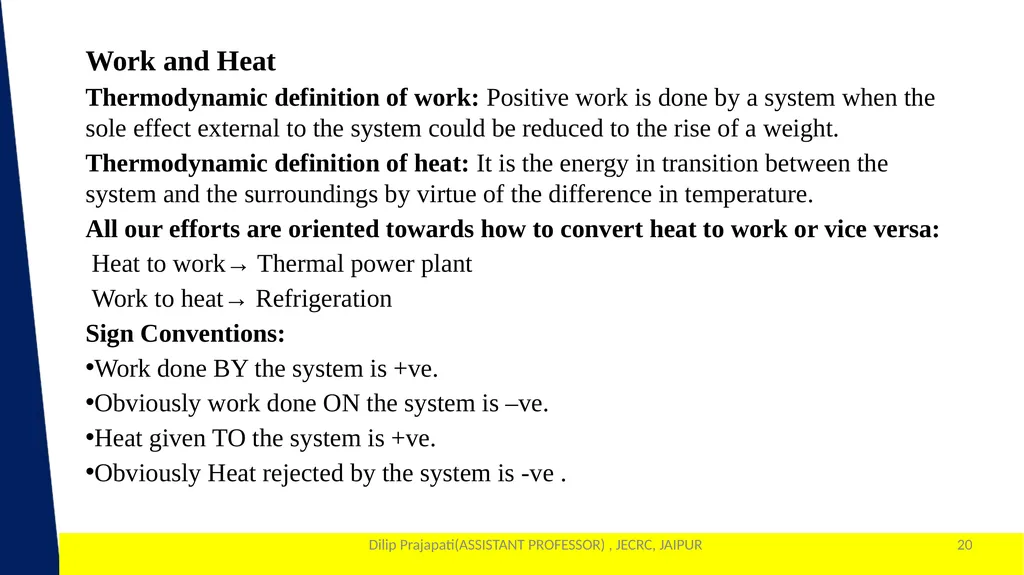
Thermodynamic definition of work: Positive work is done by a system when the sole effect external to the system could be reduced to the rise of a weight.
Thermodynamic definition of heat: It is the energy in transition between the system and the surroundings by virtue of the difference in temperature.
All our efforts are oriented towards how to convert heat to work or vice versa:
Heat to work→ Thermal power plant
Work to heat→ Refrigeration
Sign Conventions:
Work done BY the system is +ve.
Obviously work done ON the system is –ve.
Heat given TO the system is +ve.
Obviously Heat rejected by the system is -ve .<br>
Thermodynamic definition of work: Positive work is done by a system when the sole effect external to the system could be reduced to the rise of a weight.
Thermodynamic definition of heat: It is the energy in transition between the system and the surroundings by virtue of the difference in temperature.
All our efforts are oriented towards how to convert heat to work or vice versa:
Heat to work→ Thermal power plant
Work to heat→ Refrigeration
Sign Conventions:
Work done BY the system is +ve.
Obviously work done ON the system is –ve.
Heat given TO the system is +ve.
Obviously Heat rejected by the system is -ve .<br>
21
1 Dilip Prajapati(ASSISTANT PROFESSOR) , JECRC, JAIPUR First law of thermodynamics 21 Statement:
When a closed system executes a complete cycle the sum of heat interactions is equal to the sum of work interactions.
Mathematically
Σ Q=Σ W
The summations being over the entire cycle
Alternate statement:
When a closed system undergoes a cycle the cyclic integral of heat is equal to the cyclic integral of work.
Mathematically
ɠ δQ = ɠ δW0
HEAT and WORK are not properties because they depend on the path and end states.
HEAT and WORK are not properties because their net change in a cycle is not zero.<br>
When a closed system executes a complete cycle the sum of heat interactions is equal to the sum of work interactions.
Mathematically
Σ Q=Σ W
The summations being over the entire cycle
Alternate statement:
When a closed system undergoes a cycle the cyclic integral of heat is equal to the cyclic integral of work.
Mathematically
ɠ δQ = ɠ δW0
HEAT and WORK are not properties because they depend on the path and end states.
HEAT and WORK are not properties because their net change in a cycle is not zero.<br>
22
1 Dilip Prajapati(ASSISTANT PROFESSOR) , JECRC, JAIPUR 22 The Kelvin–Planck statement (or the Heat Engine Statement) of the second law of thermodynamics states that it is impossible to devise a cyclically operating heat engine, the effect of which is to absorb energy in the form of heat from a single thermal reservoir and to deliver an equivalent amount of work.
This implies that it is impossible to build a heat engine that has 100% thermal efficiency.
Clausius Statement: It is impossible to construct a device which operates in a cycle and produces no effect other than the transfer of heat from a cooler body to a hotter body.
Carnot's theorem: Carnot's theorem states that all heat engines between two heat reservoirs are less efficient than a Carnot heat engine operating between the same reservoirs. Every Carnot heat engine between a pair of heat reservoirs is equally efficient, regardless of the working substance employed or the operation details. Second Law of Thermodynamics<br>
This implies that it is impossible to build a heat engine that has 100% thermal efficiency.
Clausius Statement: It is impossible to construct a device which operates in a cycle and produces no effect other than the transfer of heat from a cooler body to a hotter body.
Carnot's theorem: Carnot's theorem states that all heat engines between two heat reservoirs are less efficient than a Carnot heat engine operating between the same reservoirs. Every Carnot heat engine between a pair of heat reservoirs is equally efficient, regardless of the working substance employed or the operation details. Second Law of Thermodynamics<br>
23
1 Dilip Prajapati(ASSISTANT PROFESSOR) , JECRC, JAIPUR 23 Entropy
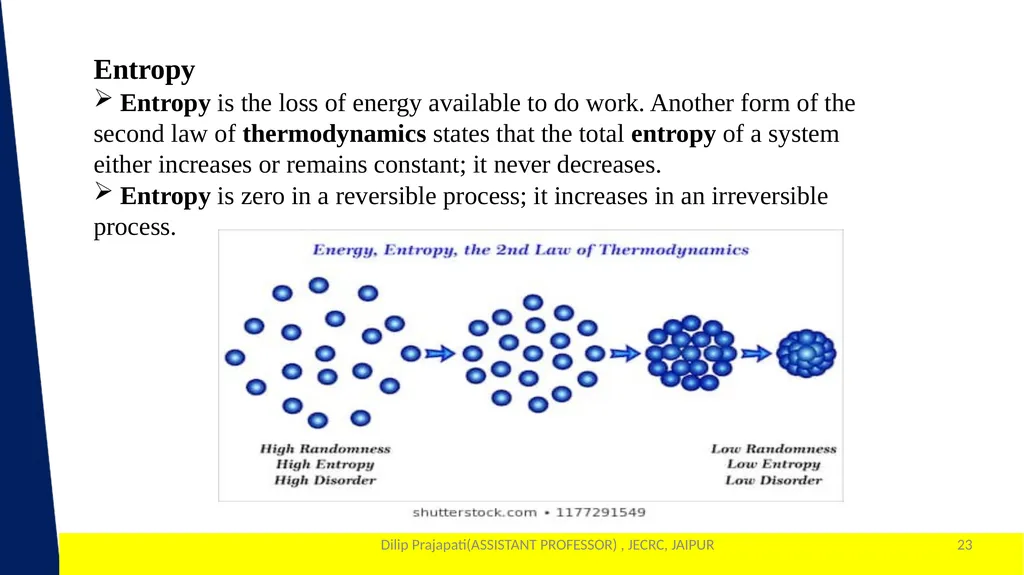
Entropy is the loss of energy available to do work. Another form of the second law of thermodynamics states that the total entropy of a system either increases or remains constant; it never decreases.
Entropy is zero in a reversible process; it increases in an irreversible process.<br>
Entropy is the loss of energy available to do work. Another form of the second law of thermodynamics states that the total entropy of a system either increases or remains constant; it never decreases.
Entropy is zero in a reversible process; it increases in an irreversible process.<br>
24
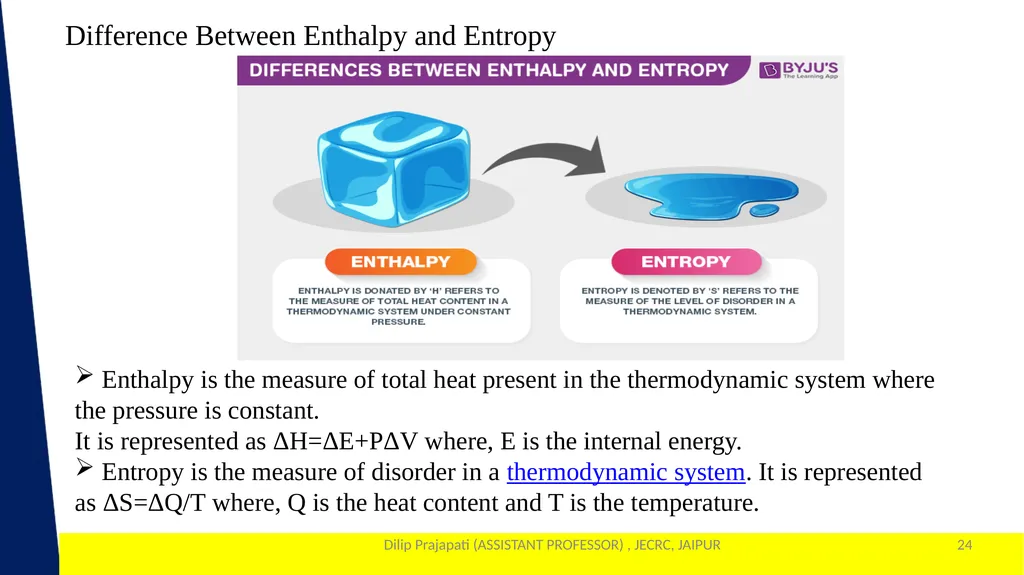
1 Dilip Prajapati (ASSISTANT PROFESSOR) , JECRC, JAIPUR 24 Difference Between Enthalpy and Entropy Enthalpy is the measure of total heat present in the thermodynamic system where the pressure is constant.
It is represented as ΔH=ΔE+PΔV where, E is the internal energy.
Entropy is the measure of disorder in a thermodynamic system. It is represented as ΔS=ΔQ/T where, Q is the heat content and T is the temperature.<br>
It is represented as ΔH=ΔE+PΔV where, E is the internal energy.
Entropy is the measure of disorder in a thermodynamic system. It is represented as ΔS=ΔQ/T where, Q is the heat content and T is the temperature.<br>
25
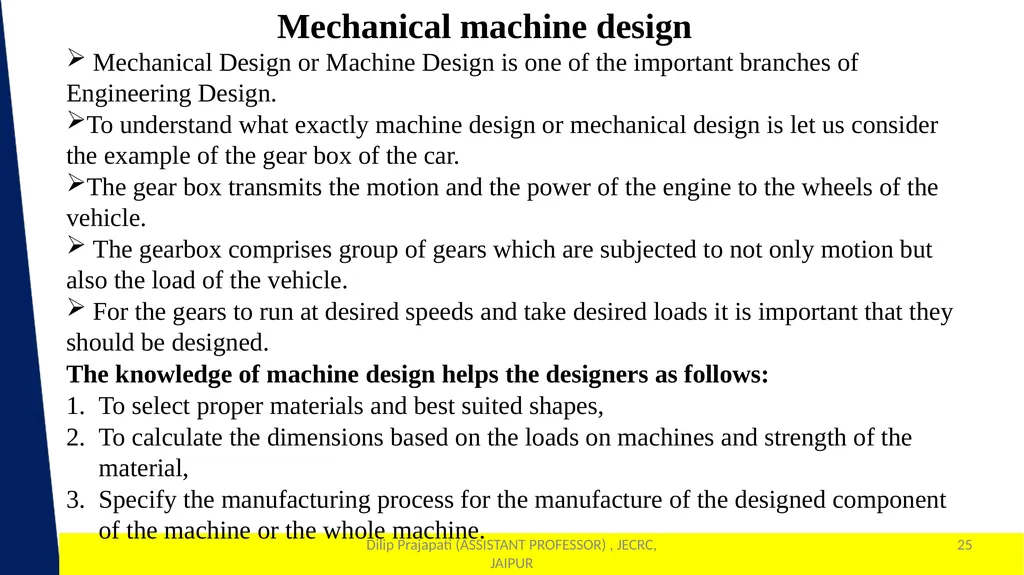
1 Dilip Prajapati (ASSISTANT PROFESSOR) , JECRC, JAIPUR 25 Mechanical Design or Machine Design is one of the important branches of Engineering Design.
To understand what exactly machine design or mechanical design is let us consider the example of the gear box of the car.
The gear box transmits the motion and the power of the engine to the wheels of the vehicle.
The gearbox comprises group of gears which are subjected to not only motion but also the load of the vehicle.
For the gears to run at desired speeds and take desired loads it is important that they should be designed.
The knowledge of machine design helps the designers as follows:
To select proper materials and best suited shapes,
To calculate the dimensions based on the loads on machines and strength of the material,
Specify the manufacturing process for the manufacture of the designed component of the machine or the whole machine. Mechanical machine design<br>
To understand what exactly machine design or mechanical design is let us consider the example of the gear box of the car.
The gear box transmits the motion and the power of the engine to the wheels of the vehicle.
The gearbox comprises group of gears which are subjected to not only motion but also the load of the vehicle.
For the gears to run at desired speeds and take desired loads it is important that they should be designed.
The knowledge of machine design helps the designers as follows:
To select proper materials and best suited shapes,
To calculate the dimensions based on the loads on machines and strength of the material,
Specify the manufacturing process for the manufacture of the designed component of the machine or the whole machine. Mechanical machine design<br>
26
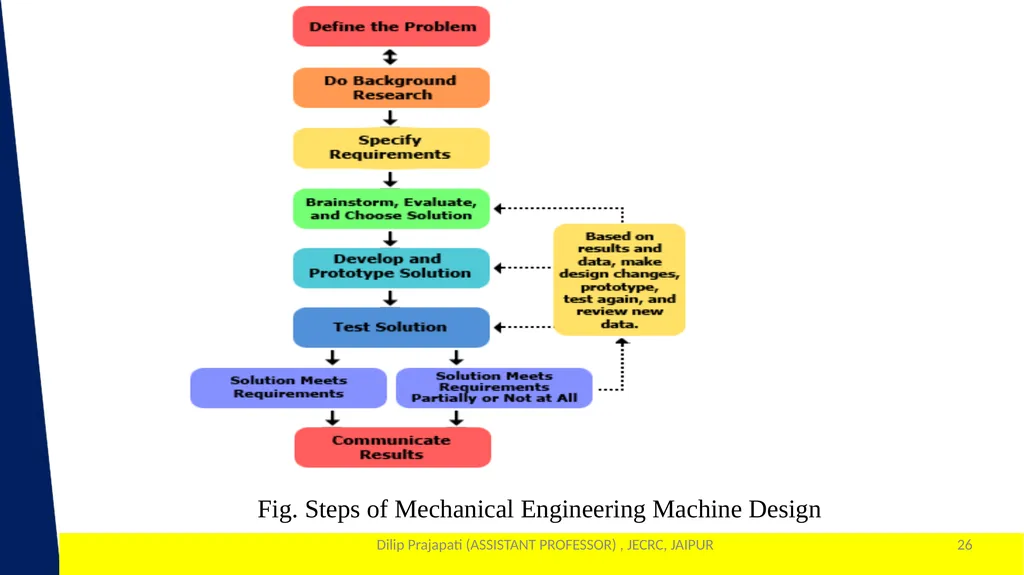
1 Dilip Prajapati (ASSISTANT PROFESSOR) , JECRC, JAIPUR 26 Fig. Steps of Mechanical Engineering Machine Design<br>
27
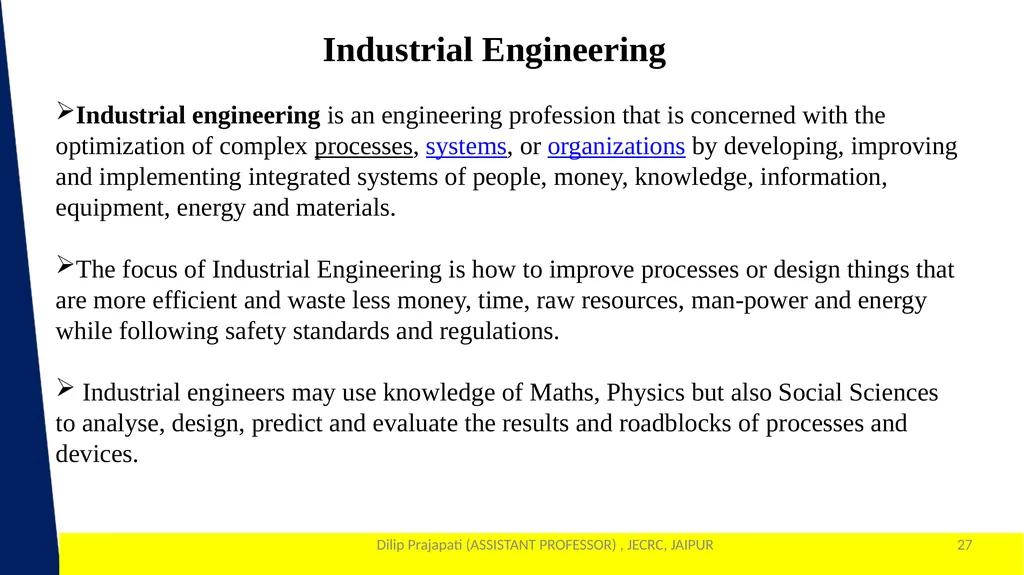
1 Dilip Prajapati (ASSISTANT PROFESSOR) , JECRC, JAIPUR 27 Industrial Engineering Industrial engineering is an engineering profession that is concerned with the optimization of complex processes, systems, or organizations by developing, improving and implementing integrated systems of people, money, knowledge, information, equipment, energy and materials.
The focus of Industrial Engineering is how to improve processes or design things that are more efficient and waste less money, time, raw resources, man-power and energy while following safety standards and regulations.
Industrial engineers may use knowledge of Maths, Physics but also Social Sciences to analyse, design, predict and evaluate the results and roadblocks of processes and devices.<br>
The focus of Industrial Engineering is how to improve processes or design things that are more efficient and waste less money, time, raw resources, man-power and energy while following safety standards and regulations.
Industrial engineers may use knowledge of Maths, Physics but also Social Sciences to analyse, design, predict and evaluate the results and roadblocks of processes and devices.<br>
28
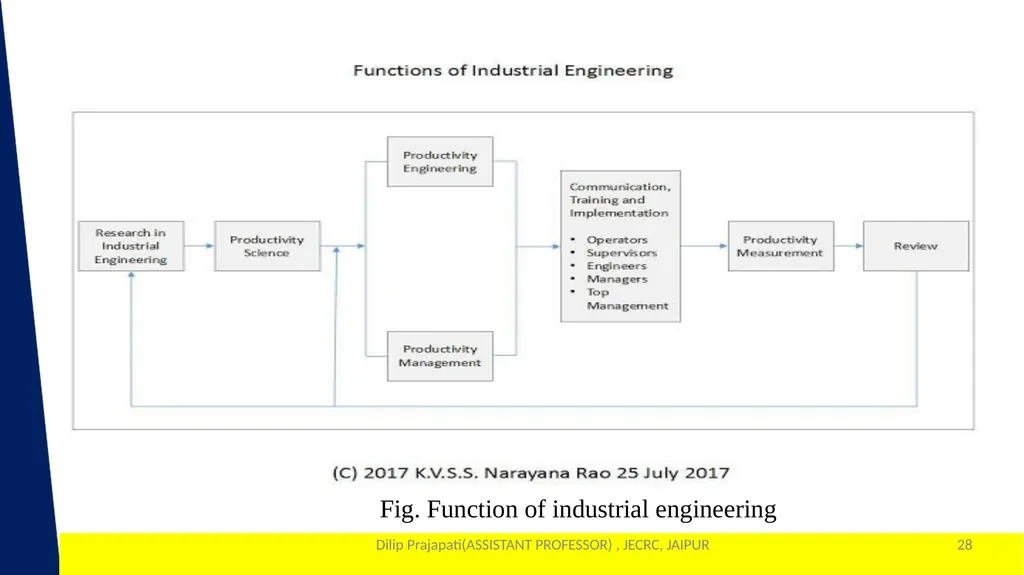
1 Dilip Prajapati(ASSISTANT PROFESSOR) , JECRC, JAIPUR 28 Fig. Function of industrial engineering<br>
29
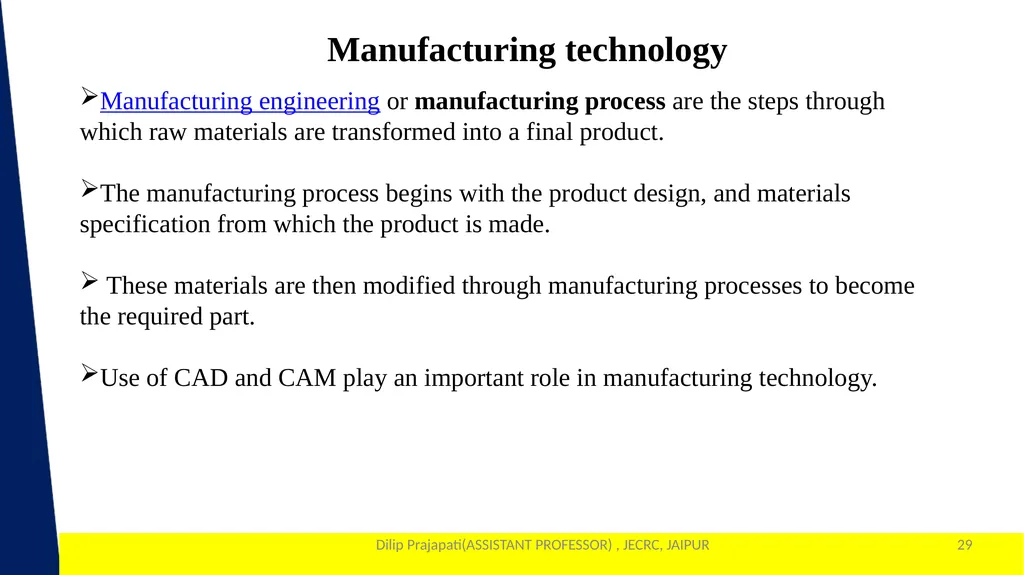
1 Dilip Prajapati(ASSISTANT PROFESSOR) , JECRC, JAIPUR 29 Manufacturing technology Manufacturing engineering or manufacturing process are the steps through which raw materials are transformed into a final product.
The manufacturing process begins with the product design, and materials specification from which the product is made.
These materials are then modified through manufacturing processes to become the required part.
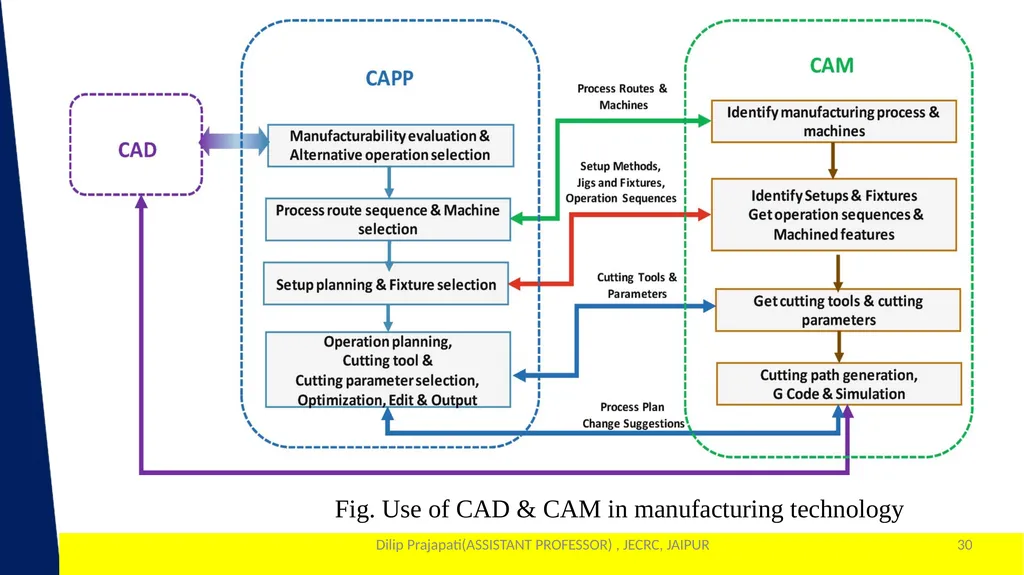
Use of CAD and CAM play an important role in manufacturing technology.<br>
The manufacturing process begins with the product design, and materials specification from which the product is made.
These materials are then modified through manufacturing processes to become the required part.
Use of CAD and CAM play an important role in manufacturing technology.<br>
30
1 Dilip Prajapati(ASSISTANT PROFESSOR) , JECRC, JAIPUR 30 Fig. Use of CAD & CAM in manufacturing technology<br>
31
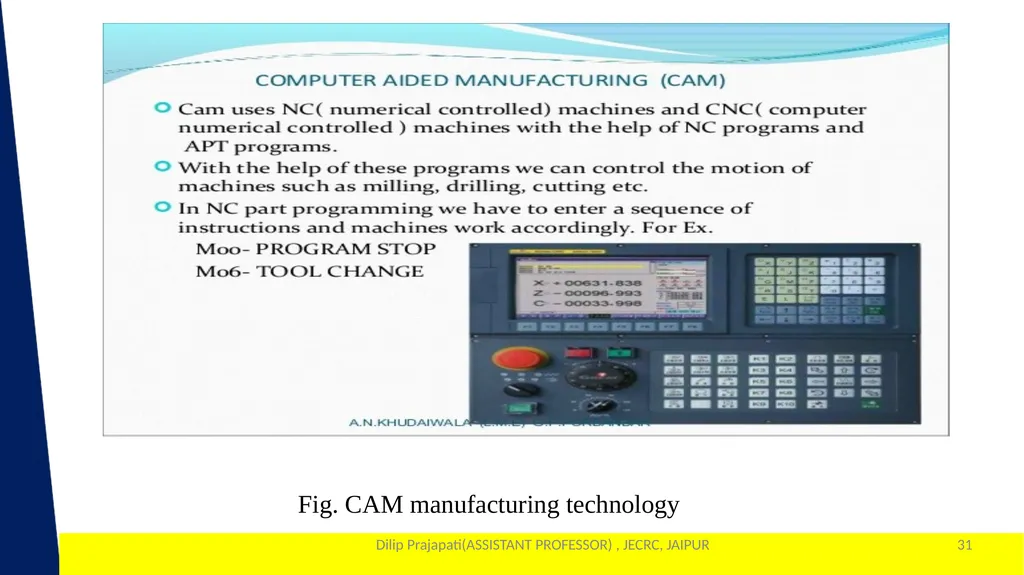
1 Dilip Prajapati(ASSISTANT PROFESSOR) , JECRC, JAIPUR 31 Fig. CAM manufacturing technology<br>
32
1 Dilip Prajapati(ASSISTANT PROFESSOR) , JECRC, JAIPUR 32 References https://nptel.ac.in/courses/112/108/112108148/
https://en.wikipedia.org/wiki/Mechanical_engineering
https://byjus.com/physics/differences-between-enthalpy-and-entropy/
https://en.wikipedia.org/wiki/Industrial_engineering<br>
https://en.wikipedia.org/wiki/Mechanical_engineering
https://byjus.com/physics/differences-between-enthalpy-and-entropy/
https://en.wikipedia.org/wiki/Industrial_engineering<br>
33
Dilip Prajapati (ASSISTANT PROFESSOR) , JECRC, JAIPUR 33<br>