
10. Lessons Learned 6. Recommendations/Solutions
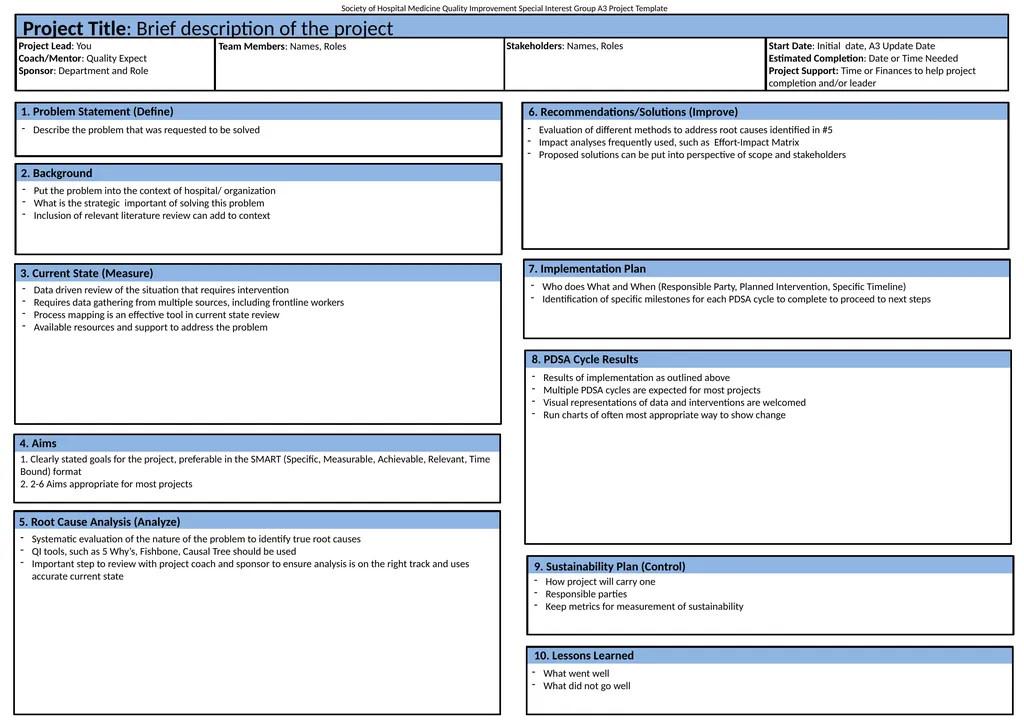
Description: 10. Lessons Learned 6. RecommendationsSolutions (Improve) 7. Implementation Plan 8. PDSA Cycle Results 9. Sustainability Plan (Control) 4. Aims 3. Current State (Measure) 2. Background Project Title: Brief description of the project
Related Topics
Download Presentation
"10. Lessons Learned 6. Recommendations/Solutions" is the property of its rightful owner. Permission is granted to download and print the materials on this website for personal, non-commercial use only, and to display it on your personal computer provided you do not modify the materials and that you retain all copyright notices contained in the materials. By downloading content from our website, you accept the terms of this agreement.
Presentation Transcript
slide1. 10. Lessons Learned 6. Recommendations/Solutions (Improve) 7. Implementation Plan 8. PDSA Cycle Results 9. Sustainability Plan (Control) 4. Aims 3. Current State (Measure) 2. Background Project Title: Brief description of the project Project Lead: You
Coach/Mentor: Quality Expect
Sponsor: Department and Role Team Members: Names, Roles Stakeholders: Names, Roles 1. Problem Statement (Define) 5. Root Cause Analysis (Analyze) 1. Clearly stated goals for the project, preferable in the SMART (Specific, Measurable, Achievable, Relevant, Time Bound) format
2. 2-6 Aims appropriate for most projects Data driven review of the situation that requires intervention
Requires data gathering from multiple sources, including frontline workers
Process mapping is an effective tool in current state review
Available resources and support to address the problem Describe the problem that was requested to be solved Put the problem into the context of hospital/ organization
What is the strategic important of solving this problem
Inclusion of relevant literature review can add to context Systematic evaluation of the nature of the problem to identify true root causes
QI tools, such as 5 Why’s, Fishbone, Causal Tree should be used
Important step to review with project coach and sponsor to ensure analysis is on the right track and uses accurate current state How project will carry one
Responsible parties
Keep metrics for measurement of sustainability What went well
What did not go well Results of implementation as outlined above
Multiple PDSA cycles are expected for most projects
Visual representations of data and interventions are welcomed
Run charts of often most appropriate way to show change Who does What and When (Responsible Party, Planned Intervention, Specific Timeline)
Identification of specific milestones for each PDSA cycle to complete to proceed to next steps Evaluation of different methods to address root causes identified in #5
Impact analyses frequently used, such as Effort-Impact Matrix
Proposed solutions can be put into perspective of scope and stakeholders Start Date: Initial date, A3 Update Date
Estimated Completion: Date or Time Needed
Project Support: Time or Finances to help project completion and/or leader Society of Hospital Medicine Quality Improvement Special Interest Group A3 Project Template<br>
Coach/Mentor: Quality Expect
Sponsor: Department and Role Team Members: Names, Roles Stakeholders: Names, Roles 1. Problem Statement (Define) 5. Root Cause Analysis (Analyze) 1. Clearly stated goals for the project, preferable in the SMART (Specific, Measurable, Achievable, Relevant, Time Bound) format
2. 2-6 Aims appropriate for most projects Data driven review of the situation that requires intervention
Requires data gathering from multiple sources, including frontline workers
Process mapping is an effective tool in current state review
Available resources and support to address the problem Describe the problem that was requested to be solved Put the problem into the context of hospital/ organization
What is the strategic important of solving this problem
Inclusion of relevant literature review can add to context Systematic evaluation of the nature of the problem to identify true root causes
QI tools, such as 5 Why’s, Fishbone, Causal Tree should be used
Important step to review with project coach and sponsor to ensure analysis is on the right track and uses accurate current state How project will carry one
Responsible parties
Keep metrics for measurement of sustainability What went well
What did not go well Results of implementation as outlined above
Multiple PDSA cycles are expected for most projects
Visual representations of data and interventions are welcomed
Run charts of often most appropriate way to show change Who does What and When (Responsible Party, Planned Intervention, Specific Timeline)
Identification of specific milestones for each PDSA cycle to complete to proceed to next steps Evaluation of different methods to address root causes identified in #5
Impact analyses frequently used, such as Effort-Impact Matrix
Proposed solutions can be put into perspective of scope and stakeholders Start Date: Initial date, A3 Update Date
Estimated Completion: Date or Time Needed
Project Support: Time or Finances to help project completion and/or leader Society of Hospital Medicine Quality Improvement Special Interest Group A3 Project Template<br>