
5 mm Fluorescence map from 93.8 m depth Hotspot
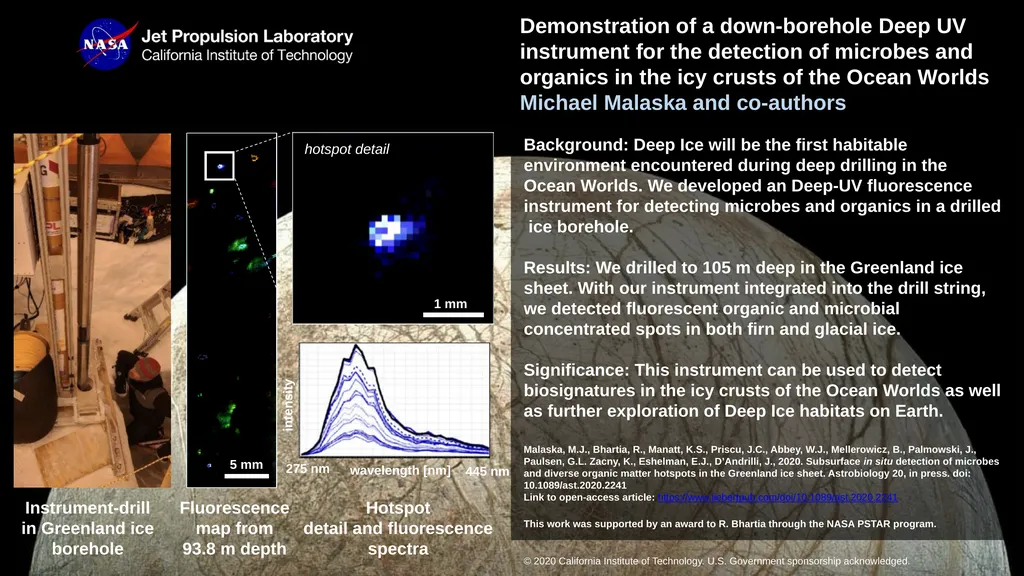
Description: 5 mm Fluorescence map from 93.8 m depth Hotspot detail and fluorescence spectra wavelength nm intensity 1 mm 275 nm 445 nm hotspot detail Instrument-drill in Greenland ice borehole Demonstration of a down-borehole Deep UV instrument for
Related Topics
Download Presentation
"5 mm Fluorescence map from 93.8 m depth Hotspot" is the property of its rightful owner. Permission is granted to download and print the materials on this website for personal, non-commercial use only, and to display it on your personal computer provided you do not modify the materials and that you retain all copyright notices contained in the materials. By downloading content from our website, you accept the terms of this agreement.
Presentation Transcript
slide1. 5 mm Fluorescence
map from
93.8 m depth Hotspot
detail and fluorescence spectra wavelength [nm] intensity 1 mm 275 nm 445 nm hotspot detail Instrument-drill
in Greenland ice borehole Demonstration of a down-borehole Deep UV instrument for the detection of microbes and organics in the icy crusts of the Ocean Worlds
Michael Malaska and co-authors Background: Deep Ice will be the first habitable environment encountered during deep drilling in the Ocean Worlds. We developed an Deep-UV fluorescence instrument for detecting microbes and organics in a drilled ice borehole.
Results: We drilled to 105 m deep in the Greenland ice sheet. With our instrument integrated into the drill string, we detected fluorescent organic and microbial concentrated spots in both firn and glacial ice.
Significance: This instrument can be used to detect biosignatures in the icy crusts of the Ocean Worlds as well as further exploration of Deep Ice habitats on Earth. This work was supported by an award to R. Bhartia through the NASA PSTAR program. Malaska, M.J., Bhartia, R., Manatt, K.S., Priscu, J.C., Abbey, W.J., Mellerowicz, B., Palmowski, J., Paulsen, G.L. Zacny, K., Eshelman, E.J., D’Andrilli, J., 2020. Subsurface in situ detection of microbes and diverse organic matter hotspots in the Greenland ice sheet. Astrobiology 20, in press. doi: 10.1089/ast.2020.2241
Link to open-access article: https://www.liebertpub.com/doi/10.1089/ast.2020.2241 © 2020 California Institute of Technology. U.S. Government sponsorship acknowledged.<br>
map from
93.8 m depth Hotspot
detail and fluorescence spectra wavelength [nm] intensity 1 mm 275 nm 445 nm hotspot detail Instrument-drill
in Greenland ice borehole Demonstration of a down-borehole Deep UV instrument for the detection of microbes and organics in the icy crusts of the Ocean Worlds
Michael Malaska and co-authors Background: Deep Ice will be the first habitable environment encountered during deep drilling in the Ocean Worlds. We developed an Deep-UV fluorescence instrument for detecting microbes and organics in a drilled ice borehole.
Results: We drilled to 105 m deep in the Greenland ice sheet. With our instrument integrated into the drill string, we detected fluorescent organic and microbial concentrated spots in both firn and glacial ice.
Significance: This instrument can be used to detect biosignatures in the icy crusts of the Ocean Worlds as well as further exploration of Deep Ice habitats on Earth. This work was supported by an award to R. Bhartia through the NASA PSTAR program. Malaska, M.J., Bhartia, R., Manatt, K.S., Priscu, J.C., Abbey, W.J., Mellerowicz, B., Palmowski, J., Paulsen, G.L. Zacny, K., Eshelman, E.J., D’Andrilli, J., 2020. Subsurface in situ detection of microbes and diverse organic matter hotspots in the Greenland ice sheet. Astrobiology 20, in press. doi: 10.1089/ast.2020.2241
Link to open-access article: https://www.liebertpub.com/doi/10.1089/ast.2020.2241 © 2020 California Institute of Technology. U.S. Government sponsorship acknowledged.<br>