
6–2 © 2012 Cengage Learning. All Rights Reserved.
Description: 62 2012 Cengage Learning. All Rights Reserved. May not be copied, scanned, or duplicated, in whole or in part, except for use as permitted in a license distributed with a certain product or service or otherwise on a password-protected
Related Topics
Download Presentation
"6–2 © 2012 Cengage Learning. All Rights Reserved." is the property of its rightful owner. Permission is granted to download and print the materials on this website for personal, non-commercial use only, and to display it on your personal computer provided you do not modify the materials and that you retain all copyright notices contained in the materials. By downloading content from our website, you accept the terms of this agreement.
Presentation Transcript
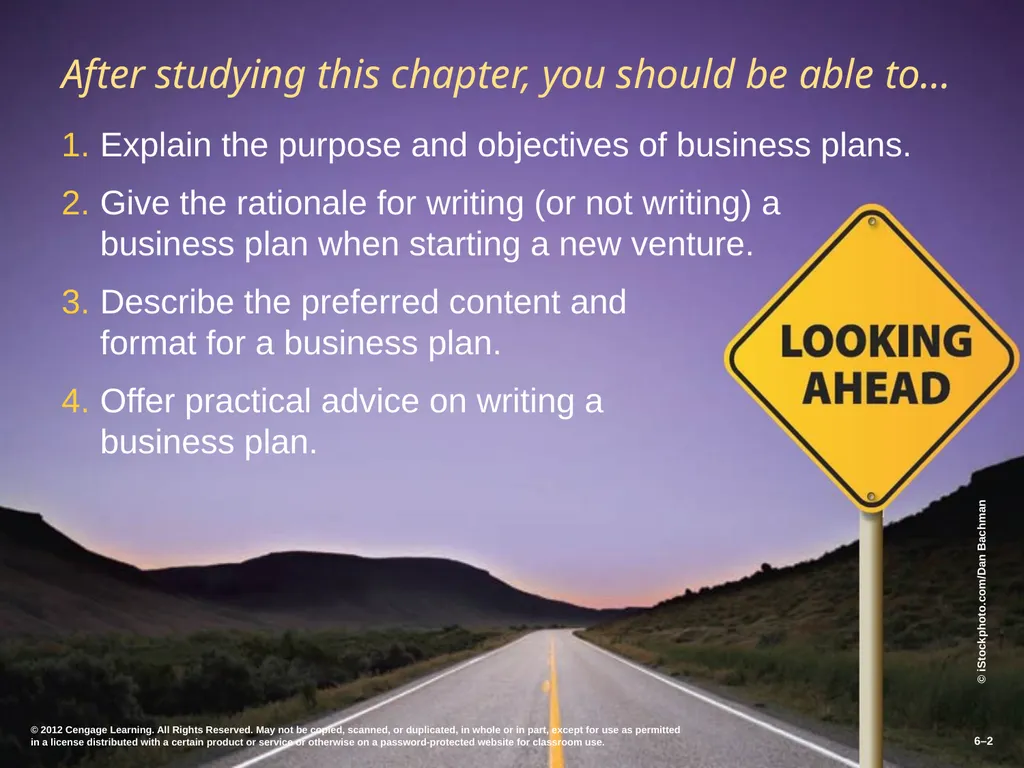
slide2. 6–2 © 2012 Cengage Learning. All Rights Reserved. May not be copied, scanned, or duplicated, in whole or in part, except for use as permitted in a license distributed with a certain product or service or otherwise on a password-protected website for classroom use. After studying this chapter, you should be able to… Explain the purpose and objectives of business plans.
Give the rationale for writing (or not writing) a business plan when starting a new venture.
Describe the preferred content and format for a business plan.
Offer practical advice on writing a business plan.<br>
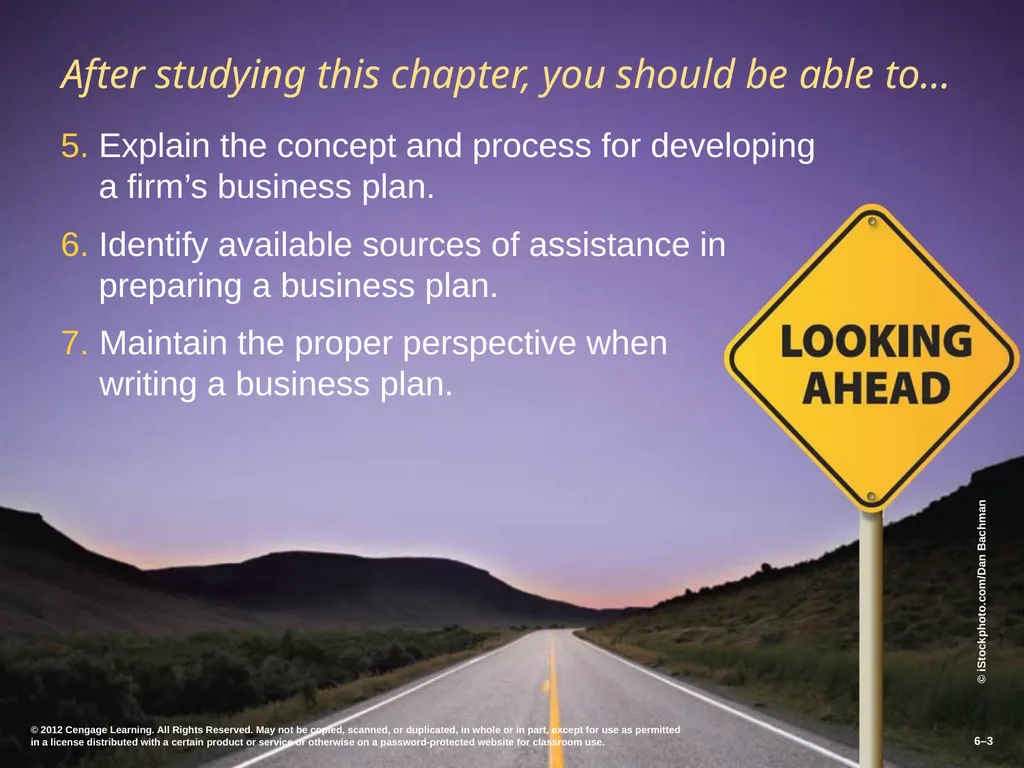
slide3. 6–3 © 2012 Cengage Learning. All Rights Reserved. May not be copied, scanned, or duplicated, in whole or in part, except for use as permitted in a license distributed with a certain product or service or otherwise on a password-protected website for classroom use. After studying this chapter, you should be able to… Explain the concept and process for developing a firm’s business plan.
Identify available sources of assistance in preparing a business plan.
Maintain the proper perspective when writing a business plan.<br>
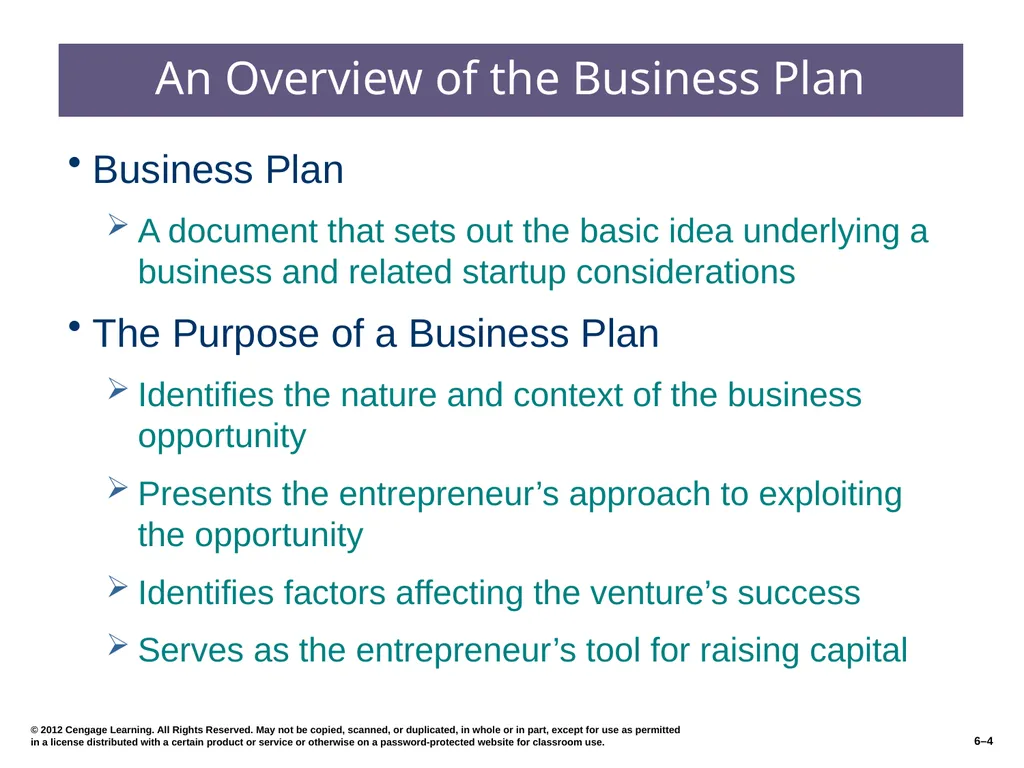
slide4. An Overview of the Business Plan Business Plan
A document that sets out the basic idea underlying a business and related startup considerations
The Purpose of a Business Plan
Identifies the nature and context of the business opportunity
Presents the entrepreneur’s approach to exploiting the opportunity
Identifies factors affecting the venture’s success
Serves as the entrepreneur’s tool for raising capital 6–4 © 2012 Cengage Learning. All Rights Reserved. May not be copied, scanned, or duplicated, in whole or in part, except for use as permitted in a license distributed with a certain product or service or otherwise on a password-protected website for classroom use.<br>
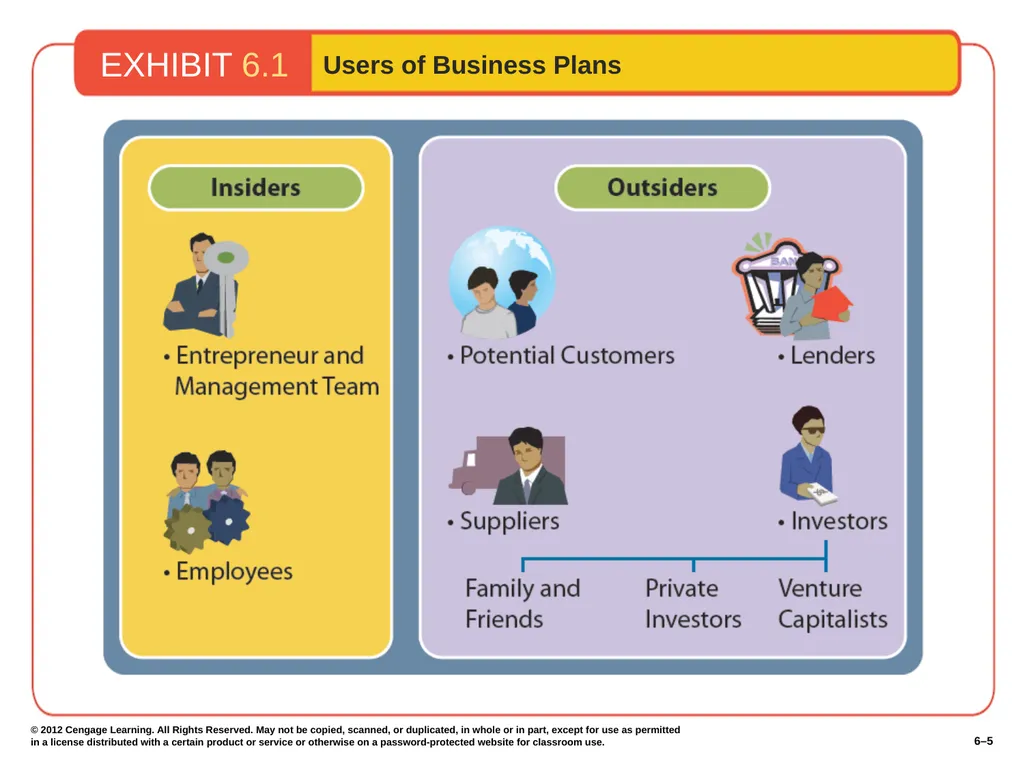
slide5. 6–5 © 2012 Cengage Learning. All Rights Reserved. May not be copied, scanned, or duplicated, in whole or in part, except for use as permitted in a license distributed with a certain product or service or otherwise on a password-protected website for classroom use. EXHIBIT 6.1 Users of Business Plans<br>
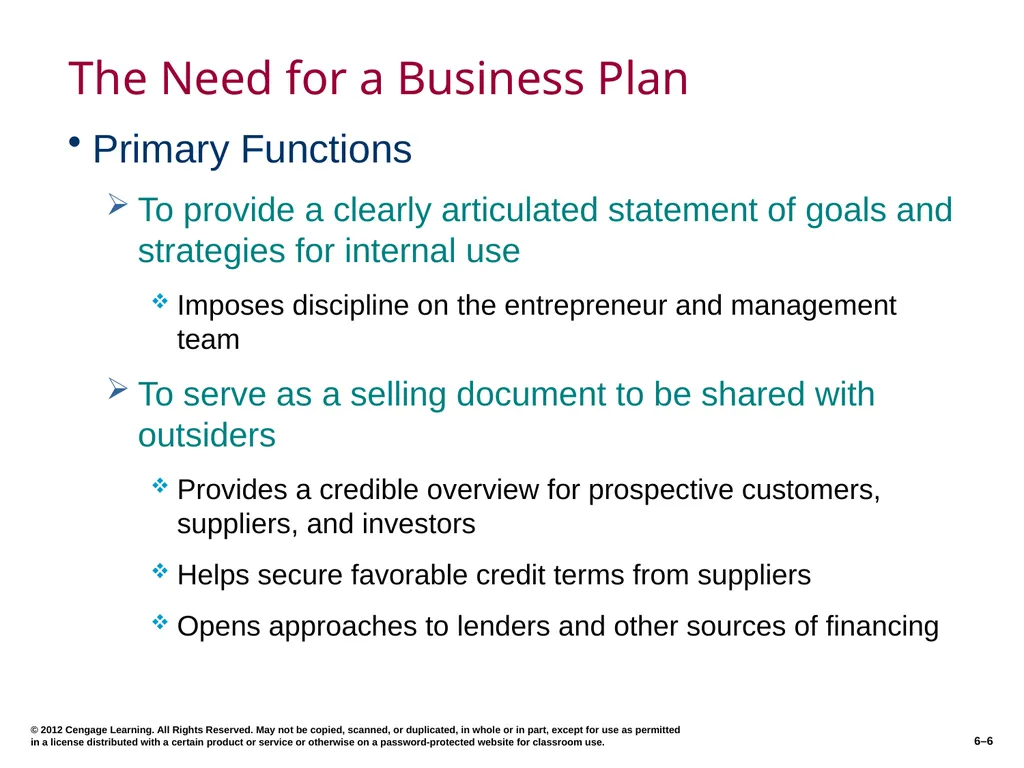
slide6. The Need for a Business Plan Primary Functions
To provide a clearly articulated statement of goals and strategies for internal use
Imposes discipline on the entrepreneur and management team
To serve as a selling document to be shared with outsiders
Provides a credible overview for prospective customers, suppliers, and investors
Helps secure favorable credit terms from suppliers
Opens approaches to lenders and other sources of financing 6–6 © 2012 Cengage Learning. All Rights Reserved. May not be copied, scanned, or duplicated, in whole or in part, except for use as permitted in a license distributed with a certain product or service or otherwise on a password-protected website for classroom use.<br>
slide7. 6–7 How Much Business Planning is Needed? Factors affecting the extent of a business plan:
Cost in time and money to prepare the plan
Management style and ability
Preferences of the management team
Complexity of the business
Competitive environment
Level of uncertainty © 2012 Cengage Learning. All Rights Reserved. May not be copied, scanned, or duplicated, in whole or in part, except for use as permitted in a license distributed with a certain product or service or otherwise on a password-protected website for classroom use.<br>
slide8. Types of Business Plans The Dehydrated Plan
A short form of a business plan that presents only the most important issues and projections.
The Comprehensive Plan
A full business plan that provides an in-depth analysis of the critical factors that will determine a firm’s success or failure, along with all the underlying assumptions. 6–8 © 2012 Cengage Learning. All Rights Reserved. May not be copied, scanned, or duplicated, in whole or in part, except for use as permitted in a license distributed with a certain product or service or otherwise on a password-protected website for classroom use.<br>
slide9. Preparing a Business Plan Issues critical in preparing a business plan:
The content and basic format of the plan
Factual support for the concept in the form of strong supporting evidence
The effectiveness of the written presentation
Clear writing that effectively communicates 6–9 © 2012 Cengage Learning. All Rights Reserved. May not be copied, scanned, or duplicated, in whole or in part, except for use as permitted in a license distributed with a certain product or service or otherwise on a password-protected website for classroom use.<br>
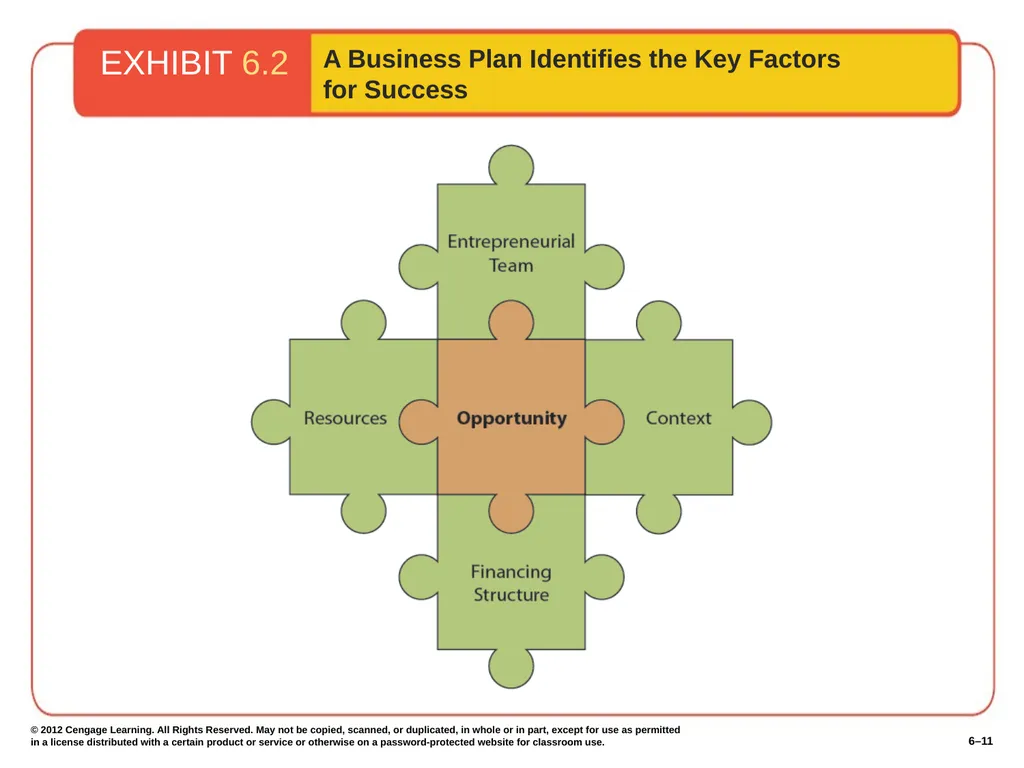
slide10. Content of a Business Plan Factors that help determine the content of a business plan for a startup:
The opportunity
Critical resources
The entrepreneurial team
The financing structure
The context (or external factors) 6–10 © 2012 Cengage Learning. All Rights Reserved. May not be copied, scanned, or duplicated, in whole or in part, except for use as permitted in a license distributed with a certain product or service or otherwise on a password-protected website for classroom use.<br>
slide11. 6–11 © 2012 Cengage Learning. All Rights Reserved. May not be copied, scanned, or duplicated, in whole or in part, except for use as permitted in a license distributed with a certain product or service or otherwise on a password-protected website for classroom use. EXHIBIT 6.2 A Business Plan Identifies the Key Factors for Success<br>
slide12. Major Sections of Business Plans © 2012 Cengage Learning. All Rights Reserved. May not be copied, scanned, or duplicated, in whole or in part, except for use as permitted in a license distributed with a certain product or service or otherwise on a password-protected website for classroom use. 6–12 Section Headings
Cover Page
Table of Contents
Executive Summary
Industry, Target Customer, and Competitor Analysis
Company Description
Product/Service Plan
Marketing Plan
Operations and Development Plan
Management Team
Critical Risks
Offering
Exit Strategy
Financial Plan
Appendix of Supporting Documents<br>
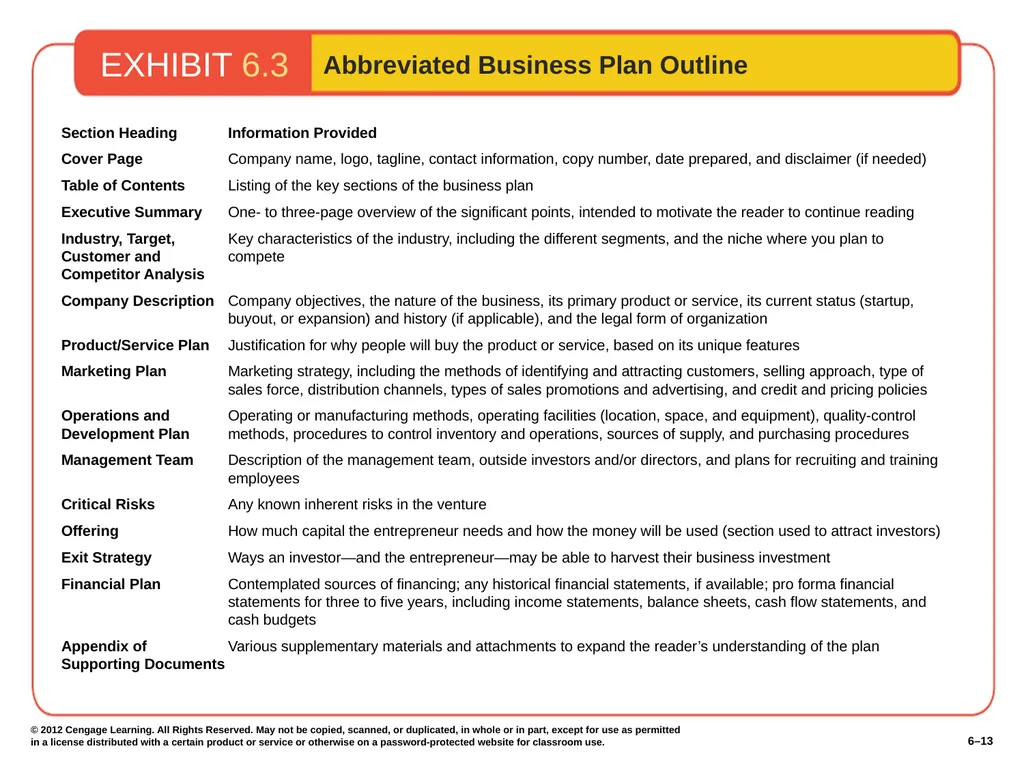
slide13. 6–13 © 2012 Cengage Learning. All Rights Reserved. May not be copied, scanned, or duplicated, in whole or in part, except for use as permitted in a license distributed with a certain product or service or otherwise on a password-protected website for classroom use. EXHIBIT 6.3 Abbreviated Business Plan Outline Section Heading Information Provided
Cover Page Company name, logo, tagline, contact information, copy number, date prepared, and disclaimer (if needed)
Table of Contents Listing of the key sections of the business plan
Executive Summary One- to three-page overview of the significant points, intended to motivate the reader to continue reading
Industry, Target, Key characteristics of the industry, including the different segments, and the niche where you plan to Customer and compete Competitor Analysis
Company Description Company objectives, the nature of the business, its primary product or service, its current status (startup, buyout, or expansion) and history (if applicable), and the legal form of organization
Product/Service Plan Justification for why people will buy the product or service, based on its unique features
Marketing Plan Marketing strategy, including the methods of identifying and attracting customers, selling approach, type of sales force, distribution channels, types of sales promotions and advertising, and credit and pricing policies
Operations and Operating or manufacturing methods, operating facilities (location, space, and equipment), quality-control Development Plan methods, procedures to control inventory and operations, sources of supply, and purchasing procedures
Management Team Description of the management team, outside investors and/or directors, and plans for recruiting and training employees
Critical Risks Any known inherent risks in the venture
Offering How much capital the entrepreneur needs and how the money will be used (section used to attract investors)
Exit Strategy Ways an investor—and the entrepreneur—may be able to harvest their business investment
Financial Plan Contemplated sources of financing; any historical financial statements, if available; pro forma financial statements for three to five years, including income statements, balance sheets, cash flow statements, and cash budgets
Appendix of Various supplementary materials and attachments to expand the reader’s understanding of the plan Supporting Documents<br>
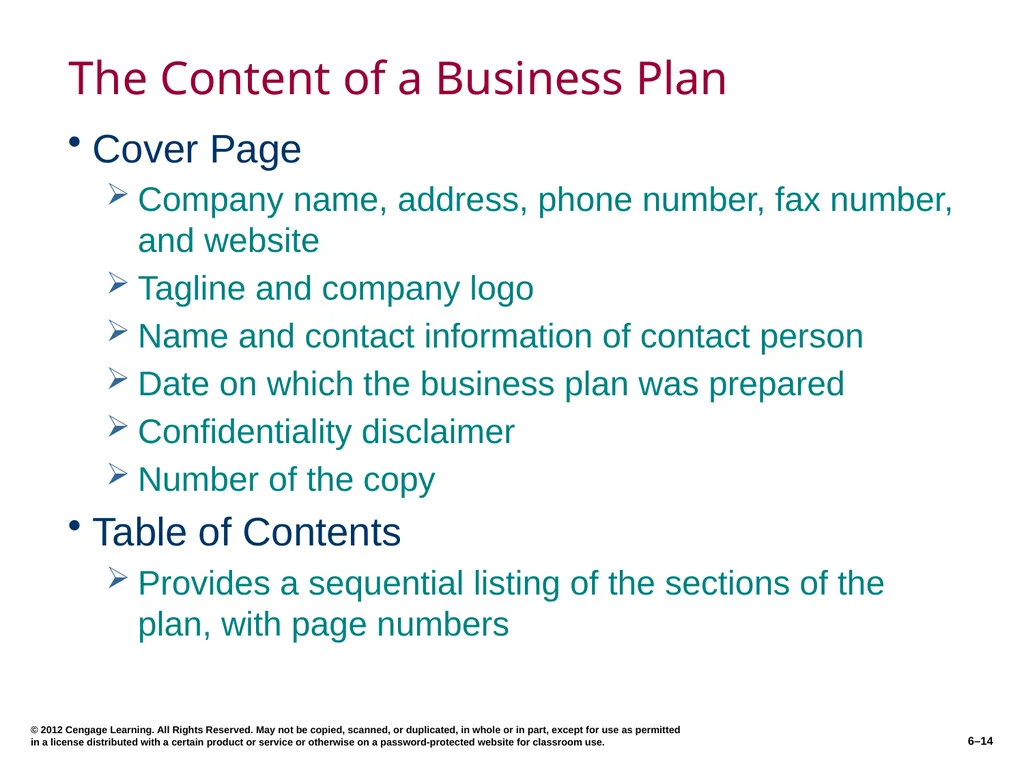
slide14. The Content of a Business Plan Cover Page
Company name, address, phone number, fax number, and website
Tagline and company logo
Name and contact information of contact person
Date on which the business plan was prepared
Confidentiality disclaimer
Number of the copy
Table of Contents
Provides a sequential listing of the sections of the plan, with page numbers 6–14 © 2012 Cengage Learning. All Rights Reserved. May not be copied, scanned, or duplicated, in whole or in part, except for use as permitted in a license distributed with a certain product or service or otherwise on a password-protected website for classroom use.<br>
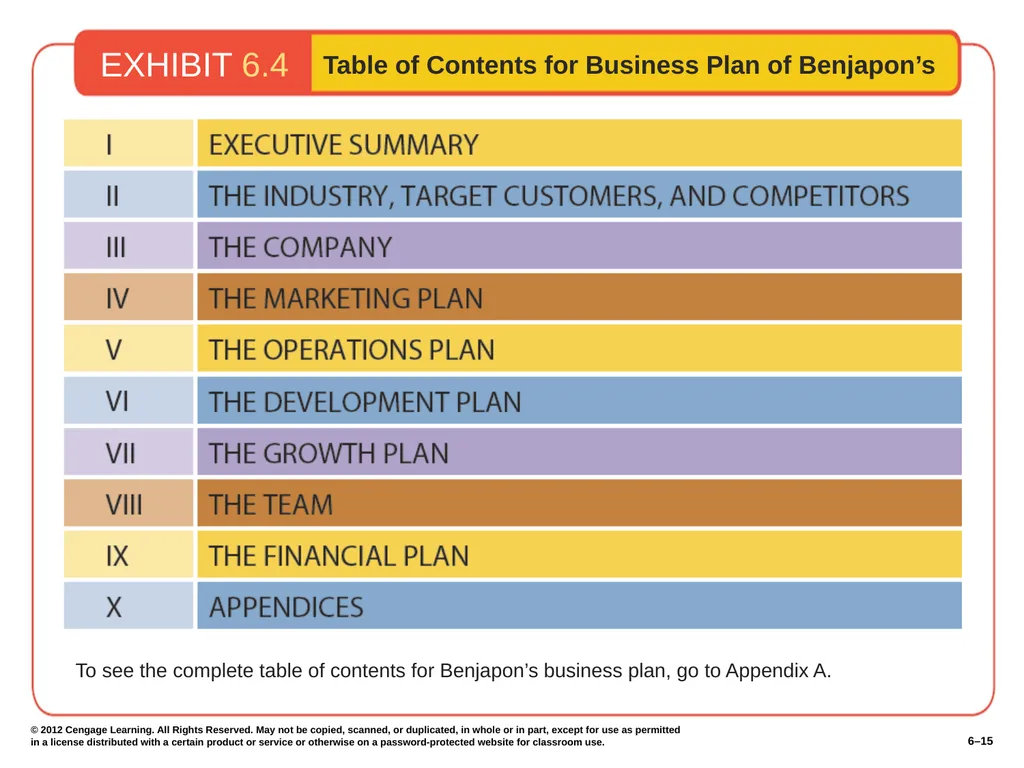
slide15. 6–15 © 2012 Cengage Learning. All Rights Reserved. May not be copied, scanned, or duplicated, in whole or in part, except for use as permitted in a license distributed with a certain product or service or otherwise on a password-protected website for classroom use. EXHIBIT 6.4 Table of Contents for Business Plan of Benjapon’s To see the complete table of contents for Benjapon’s business plan, go to Appendix A.<br>
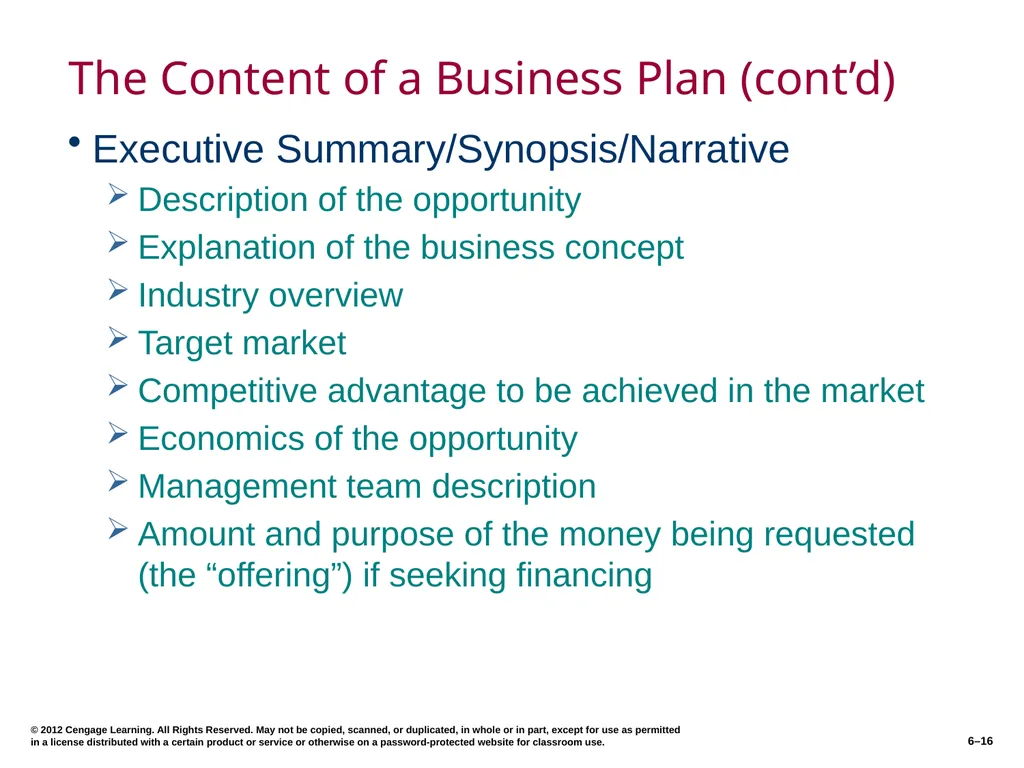
slide16. The Content of a Business Plan (cont’d) Executive Summary/Synopsis/Narrative
Description of the opportunity
Explanation of the business concept
Industry overview
Target market
Competitive advantage to be achieved in the market
Economics of the opportunity
Management team description
Amount and purpose of the money being requested (the “offering”) if seeking financing 6–16 © 2012 Cengage Learning. All Rights Reserved. May not be copied, scanned, or duplicated, in whole or in part, except for use as permitted in a license distributed with a certain product or service or otherwise on a password-protected website for classroom use.<br>
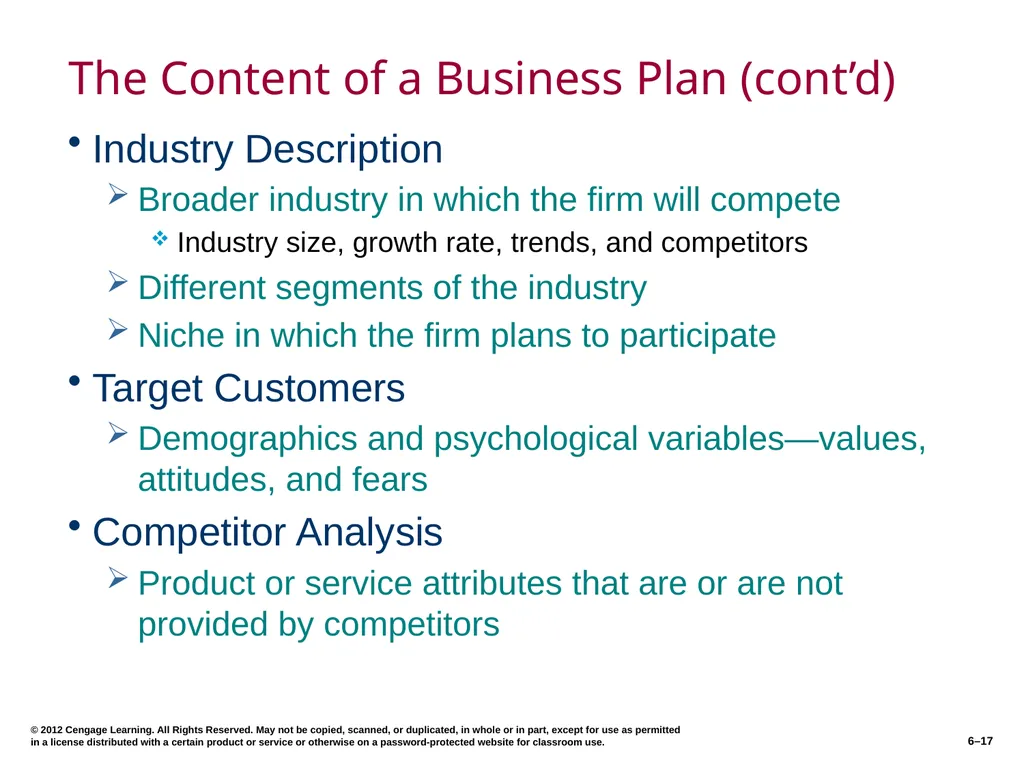
slide17. The Content of a Business Plan (cont’d) Industry Description
Broader industry in which the firm will compete
Industry size, growth rate, trends, and competitors
Different segments of the industry
Niche in which the firm plans to participate
Target Customers
Demographics and psychological variables—values, attitudes, and fears
Competitor Analysis
Product or service attributes that are or are not provided by competitors 6–17 © 2012 Cengage Learning. All Rights Reserved. May not be copied, scanned, or duplicated, in whole or in part, except for use as permitted in a license distributed with a certain product or service or otherwise on a password-protected website for classroom use.<br>
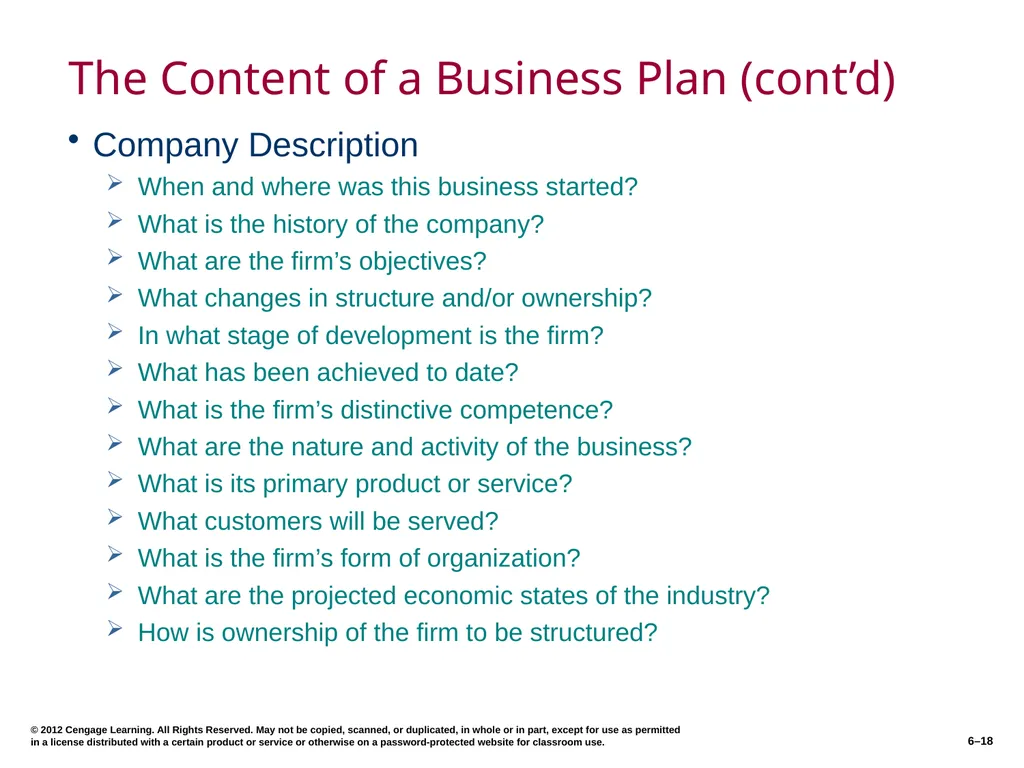
slide18. 6–18 The Content of a Business Plan (cont’d) Company Description
When and where was this business started?
What is the history of the company?
What are the firm’s objectives?
What changes in structure and/or ownership?
In what stage of development is the firm?
What has been achieved to date?
What is the firm’s distinctive competence?
What are the nature and activity of the business?
What is its primary product or service?
What customers will be served?
What is the firm’s form of organization?
What are the projected economic states of the industry?
How is ownership of the firm to be structured? © 2012 Cengage Learning. All Rights Reserved. May not be copied, scanned, or duplicated, in whole or in part, except for use as permitted in a license distributed with a certain product or service or otherwise on a password-protected website for classroom use.<br>
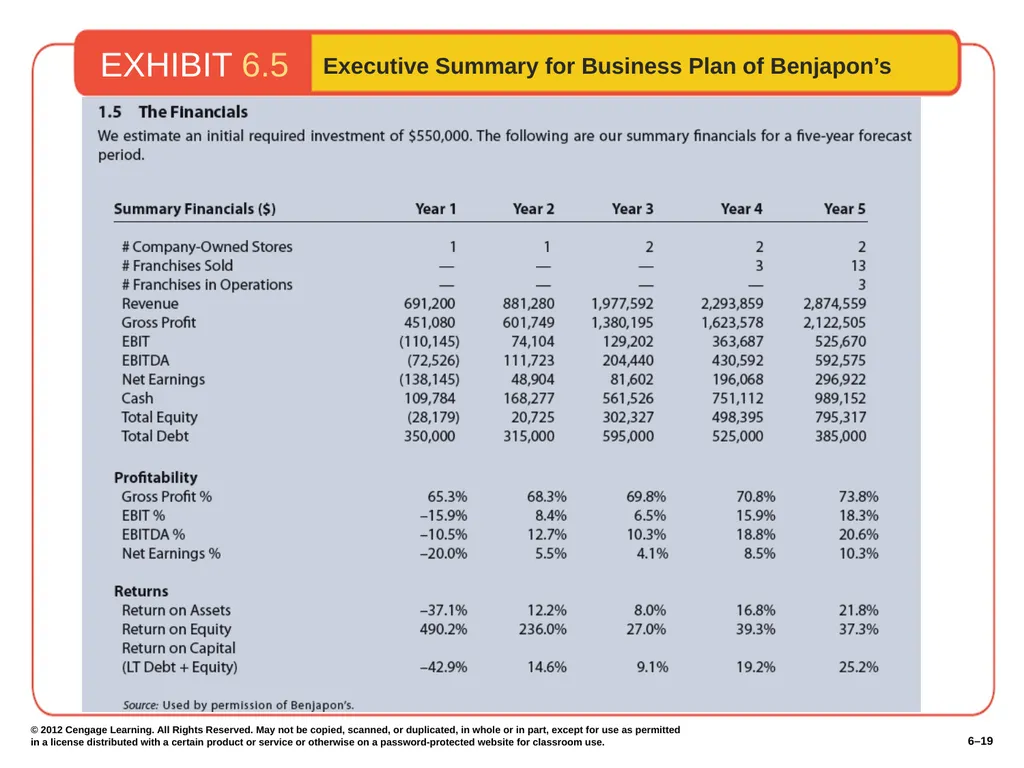
slide19. 6–19 © 2012 Cengage Learning. All Rights Reserved. May not be copied, scanned, or duplicated, in whole or in part, except for use as permitted in a license distributed with a certain product or service or otherwise on a password-protected website for classroom use. EXHIBIT 6.5 Executive Summary for Business Plan of Benjapon’s<br>
slide20. The Content of a Business Plan (cont’d) Product/Service Plan
Describes the product and/or service to be provided and explains its merits
Marketing Plan
Describes the user benefits of the product or service and the type of market that exists
Operations and Development Plan
How product will be produced or service provided
Management Team
Describes the firm’s organizational structure and the backgrounds and qualifications of key personnel 6–20 © 2012 Cengage Learning. All Rights Reserved. May not be copied, scanned, or duplicated, in whole or in part, except for use as permitted in a license distributed with a certain product or service or otherwise on a password-protected website for classroom use.<br>
slide21. The Content of a Business Plan (cont’d) Critical Risks
Identifies the potential risks that may be encountered by an investor
Offering
Indicates to an investor how much money is needed and when, and how the money will be used
Financial Plan
Projects the company’s financial position based on well-substantiated assumptions and explains of how the figures have been determined
Pro forma statements project a firm’s financial condition for up to five years. 6–21 © 2012 Cengage Learning. All Rights Reserved. May not be copied, scanned, or duplicated, in whole or in part, except for use as permitted in a license distributed with a certain product or service or otherwise on a password-protected website for classroom use.<br>
slide22. 6–22 The Content of a Business Plan (cont’d) Appendix of Supporting Documents
Supplementary materials and attachments to expand the reader’s understanding of the plan:
Résumés of key investors and owners/managers
Professional references
Photographs of products, facilities, and buildings
Marketing research studies
Pertinent published research
Signed contracts of sale © 2012 Cengage Learning. All Rights Reserved. May not be copied, scanned, or duplicated, in whole or in part, except for use as permitted in a license distributed with a certain product or service or otherwise on a password-protected website for classroom use.<br>
slide23. Advice for Writing a Business Plan Analyze the Market Thoroughly
What is the target market?
How large is the target market?
What problems concern the target market?
Are any of these problems greater than the one you’re addressing?
How does your product or service fix the problem?
Who will buy your product or service?
How much are they willing to pay for it?
Why do they need it?
Why would they buy from you?
Who are your competitors?
What are their strengths and weaknesses? 6–23 © 2012 Cengage Learning. All Rights Reserved. May not be copied, scanned, or duplicated, in whole or in part, except for use as permitted in a license distributed with a certain product or service or otherwise on a password-protected website for classroom use.<br>
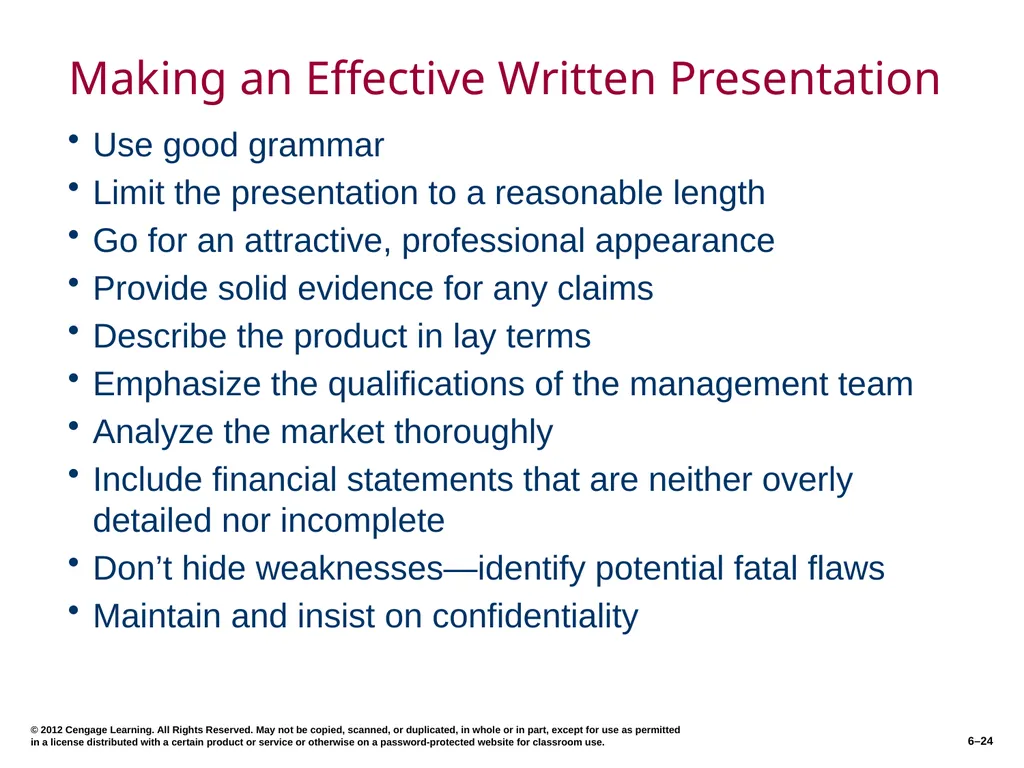
slide24. 6–24 Making an Effective Written Presentation Use good grammar
Limit the presentation to a reasonable length
Go for an attractive, professional appearance
Provide solid evidence for any claims
Describe the product in lay terms
Emphasize the qualifications of the management team
Analyze the market thoroughly
Include financial statements that are neither overly detailed nor incomplete
Don’t hide weaknesses—identify potential fatal flaws
Maintain and insist on confidentiality © 2012 Cengage Learning. All Rights Reserved. May not be copied, scanned, or duplicated, in whole or in part, except for use as permitted in a license distributed with a certain product or service or otherwise on a password-protected website for classroom use.<br>
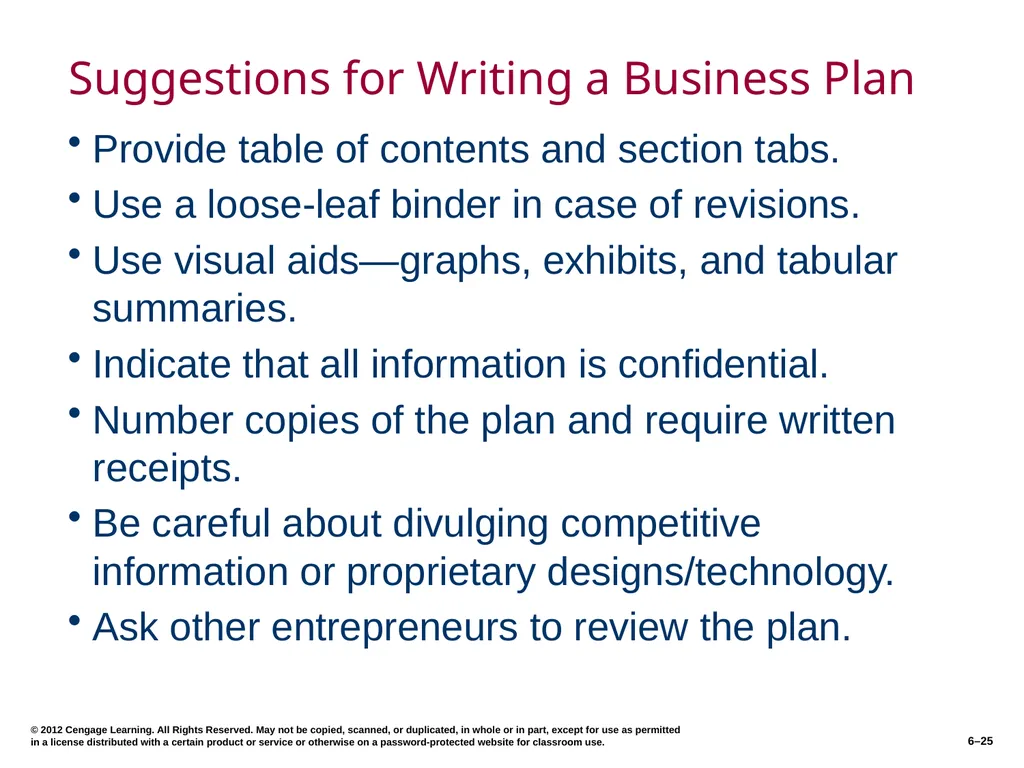
slide25. 6–25 Suggestions for Writing a Business Plan Provide table of contents and section tabs.
Use a loose-leaf binder in case of revisions.
Use visual aids—graphs, exhibits, and tabular summaries.
Indicate that all information is confidential.
Number copies of the plan and require written receipts.
Be careful about divulging competitive information or proprietary designs/technology.
Ask other entrepreneurs to review the plan. © 2012 Cengage Learning. All Rights Reserved. May not be copied, scanned, or duplicated, in whole or in part, except for use as permitted in a license distributed with a certain product or service or otherwise on a password-protected website for classroom use.<br>
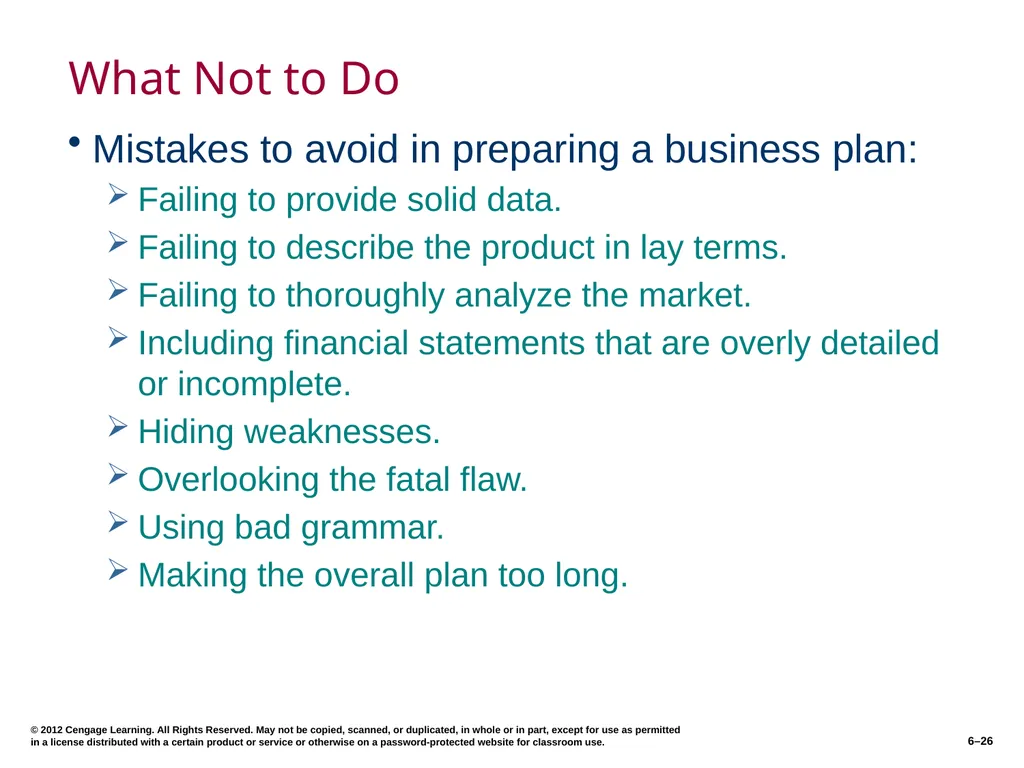
slide26. 6–26 What Not to Do Mistakes to avoid in preparing a business plan:
Failing to provide solid data.
Failing to describe the product in lay terms.
Failing to thoroughly analyze the market.
Including financial statements that are overly detailed or incomplete.
Hiding weaknesses.
Overlooking the fatal flaw.
Using bad grammar.
Making the overall plan too long. © 2012 Cengage Learning. All Rights Reserved. May not be copied, scanned, or duplicated, in whole or in part, except for use as permitted in a license distributed with a certain product or service or otherwise on a password-protected website for classroom use.<br>
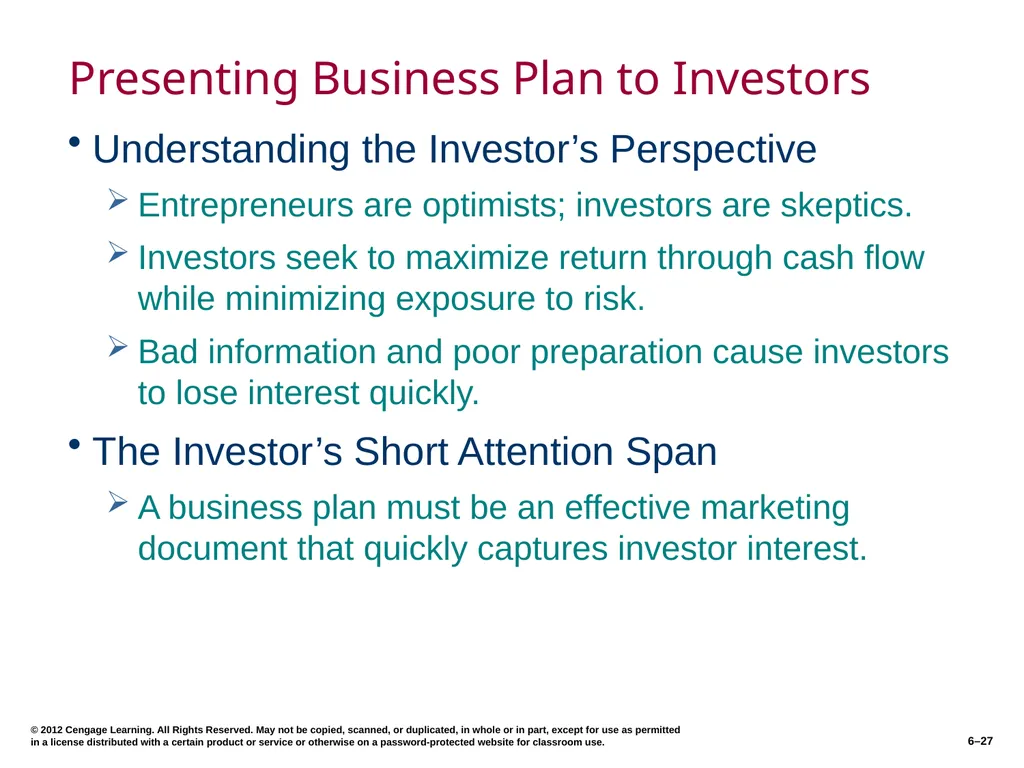
slide27. 6–27 Presenting Business Plan to Investors Understanding the Investor’s Perspective
Entrepreneurs are optimists; investors are skeptics.
Investors seek to maximize return through cash flow while minimizing exposure to risk.
Bad information and poor preparation cause investors to lose interest quickly.
The Investor’s Short Attention Span
A business plan must be an effective marketing document that quickly captures investor interest. © 2012 Cengage Learning. All Rights Reserved. May not be copied, scanned, or duplicated, in whole or in part, except for use as permitted in a license distributed with a certain product or service or otherwise on a password-protected website for classroom use.<br>
slide28. 6–28 Plan Features that Attract Investors Plans that speak the investors’ language:
Are market-oriented in meeting identifiable customer needs; are not product-oriented.
Show evidence of target customer acceptance of the proposed product or service.
Present credible and not overly optimistic financial projections.
Are not a formal prospectus or offering memorandum. © 2012 Cengage Learning. All Rights Reserved. May not be copied, scanned, or duplicated, in whole or in part, except for use as permitted in a license distributed with a certain product or service or otherwise on a password-protected website for classroom use.<br>
slide29. Understanding the Business Model Business Model
An analysis of how a firm plans to create profits and cash flows given its revenue sources, its cost structures, and the required size of investment.
Business Model Elements
The revenue model defines the nature and types of a firm’s sources of revenues
The cost structures that drive the company’s costs and expenses
The maximum investment that will be required to make the business profitable and cash flows positive 6–29 © 2012 Cengage Learning. All Rights Reserved. May not be copied, scanned, or duplicated, in whole or in part, except for use as permitted in a license distributed with a certain product or service or otherwise on a password-protected website for classroom use.<br>
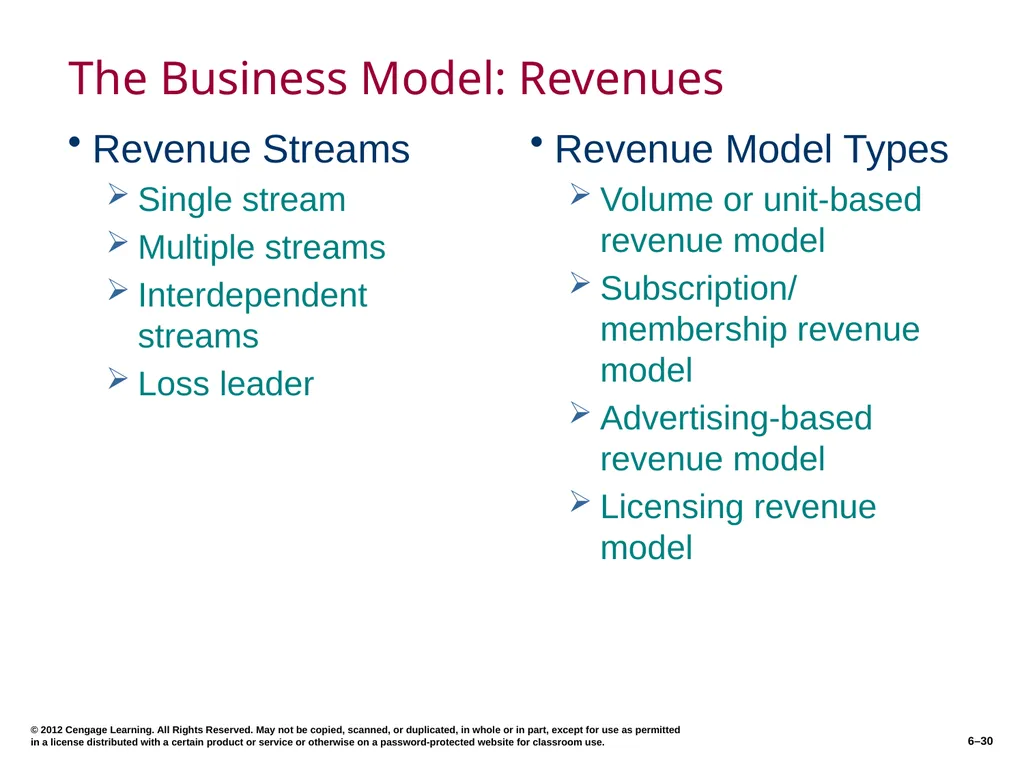
slide30. The Business Model: Revenues Revenue Streams
Single stream
Multiple streams
Interdependent streams
Loss leader Revenue Model Types
Volume or unit-based revenue model
Subscription/membership revenue model
Advertising-based revenue model
Licensing revenue model 6–30 © 2012 Cengage Learning. All Rights Reserved. May not be copied, scanned, or duplicated, in whole or in part, except for use as permitted in a license distributed with a certain product or service or otherwise on a password-protected website for classroom use.<br>
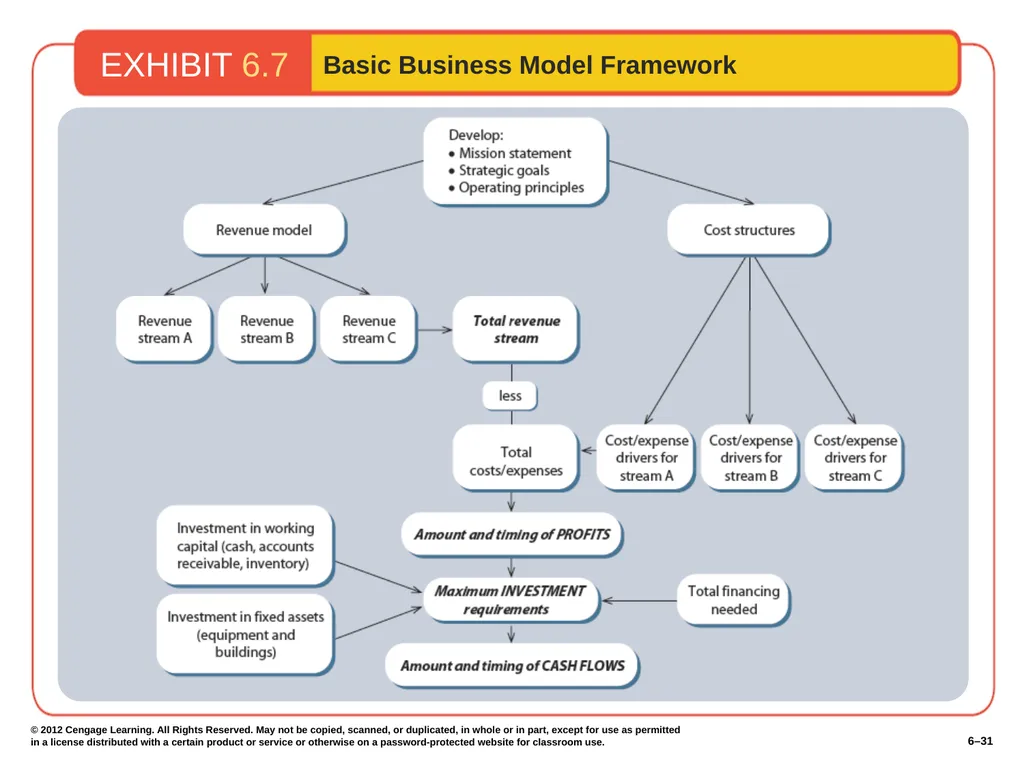
slide31. 6–31 © 2012 Cengage Learning. All Rights Reserved. May not be copied, scanned, or duplicated, in whole or in part, except for use as permitted in a license distributed with a certain product or service or otherwise on a password-protected website for classroom use. EXHIBIT 6.7 Basic Business Model Framework<br>
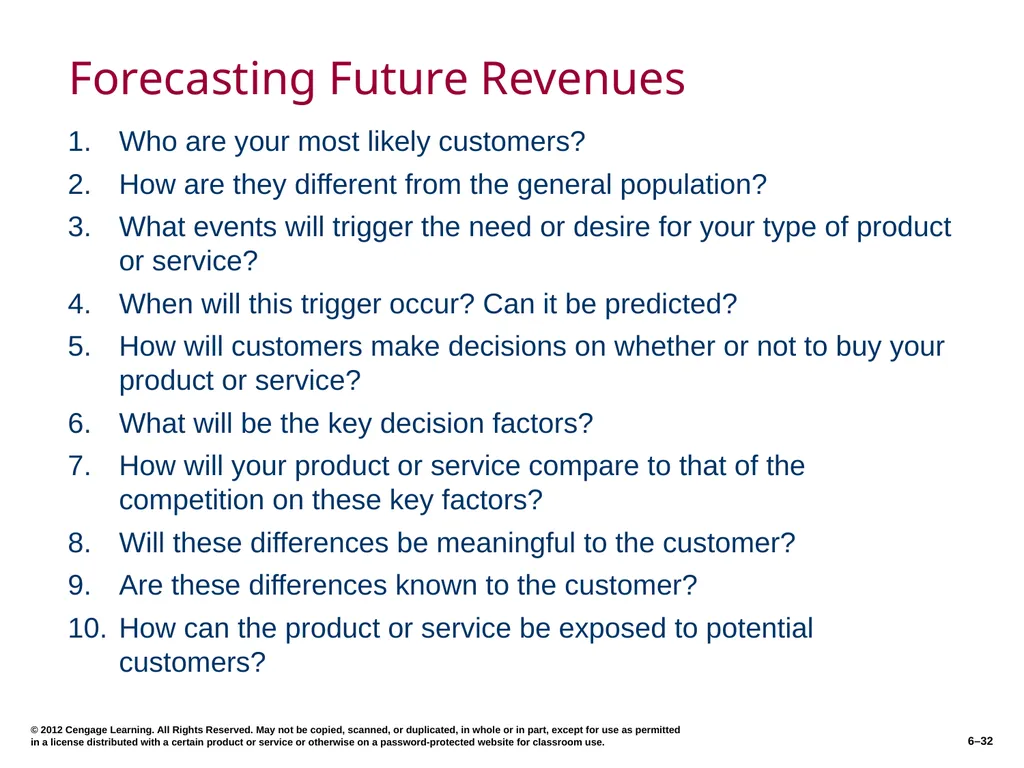
slide32. Forecasting Future Revenues Who are your most likely customers?
How are they different from the general population?
What events will trigger the need or desire for your type of product or service?
When will this trigger occur? Can it be predicted?
How will customers make decisions on whether or not to buy your product or service?
What will be the key decision factors?
How will your product or service compare to that of the competition on these key factors?
Will these differences be meaningful to the customer?
Are these differences known to the customer?
How can the product or service be exposed to potential customers? 6–32 © 2012 Cengage Learning. All Rights Reserved. May not be copied, scanned, or duplicated, in whole or in part, except for use as permitted in a license distributed with a certain product or service or otherwise on a password-protected website for classroom use.<br>
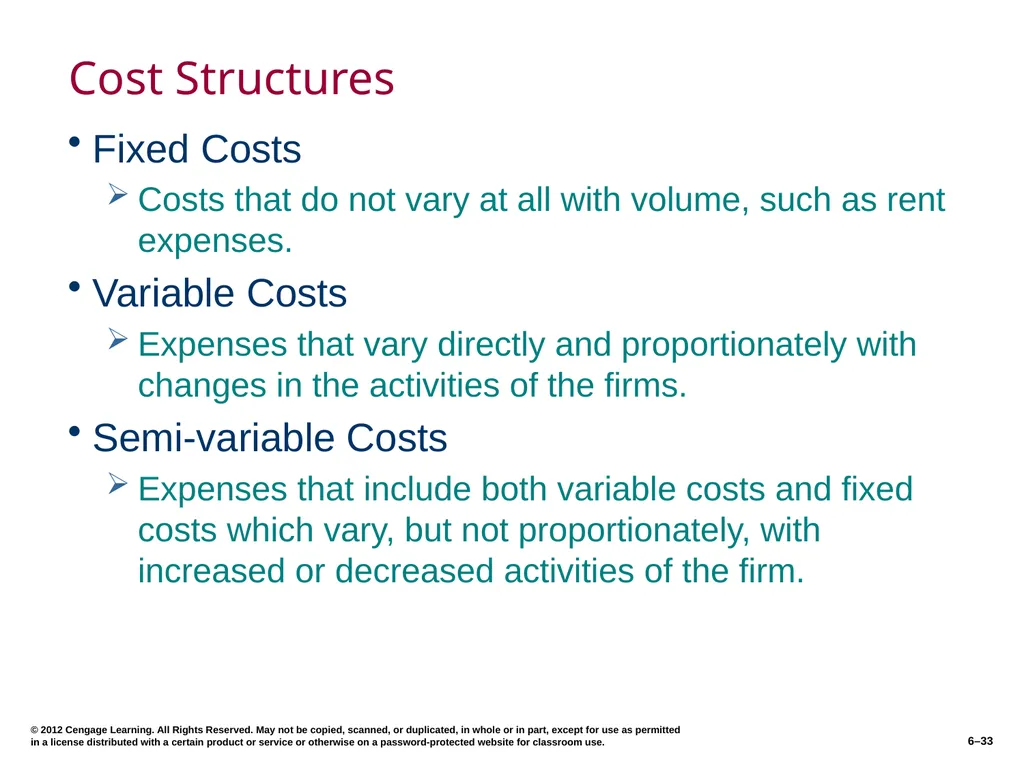
slide33. Cost Structures Fixed Costs
Costs that do not vary at all with volume, such as rent expenses.
Variable Costs
Expenses that vary directly and proportionately with changes in the activities of the firms.
Semi-variable Costs
Expenses that include both variable costs and fixed costs which vary, but not proportionately, with increased or decreased activities of the firm. 6–33 © 2012 Cengage Learning. All Rights Reserved. May not be copied, scanned, or duplicated, in whole or in part, except for use as permitted in a license distributed with a certain product or service or otherwise on a password-protected website for classroom use.<br>
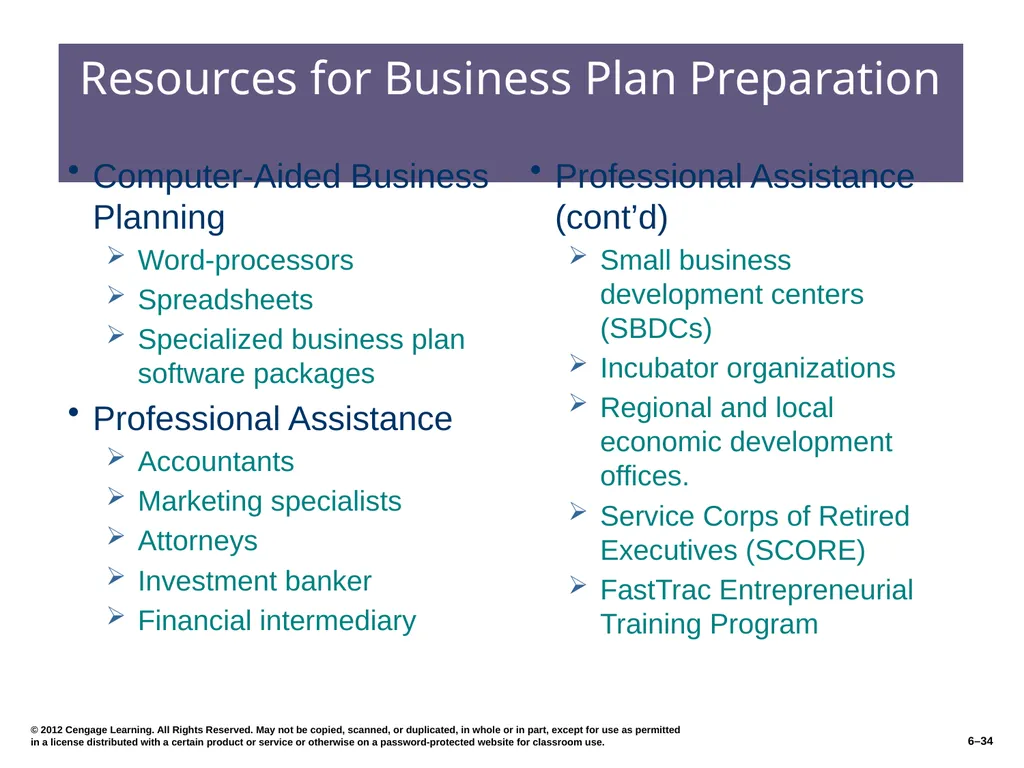
slide34. 6–34 Resources for Business Plan Preparation Computer-Aided Business Planning
Word-processors
Spreadsheets
Specialized business plan software packages
Professional Assistance
Accountants
Marketing specialists
Attorneys
Investment banker
Financial intermediary Professional Assistance (cont’d)
Small business development centers (SBDCs)
Incubator organizations
Regional and local economic development offices.
Service Corps of Retired Executives (SCORE)
FastTrac Entrepreneurial Training Program © 2012 Cengage Learning. All Rights Reserved. May not be copied, scanned, or duplicated, in whole or in part, except for use as permitted in a license distributed with a certain product or service or otherwise on a password-protected website for classroom use.<br>
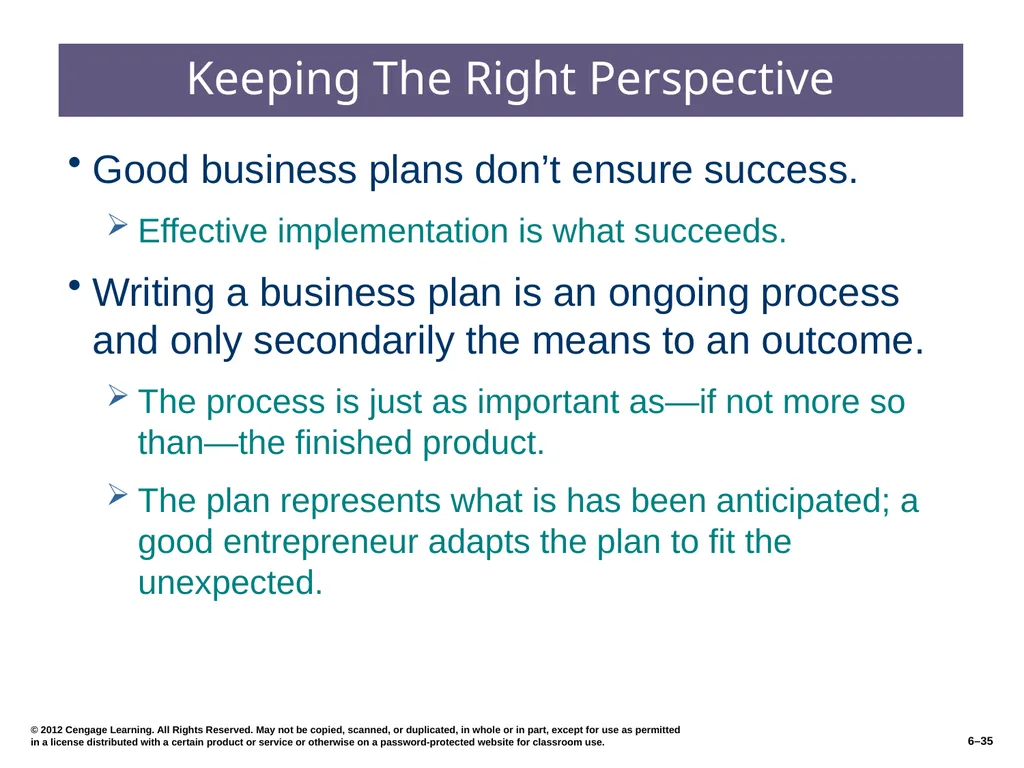
slide35. Keeping The Right Perspective Good business plans don’t ensure success.
Effective implementation is what succeeds.
Writing a business plan is an ongoing process and only secondarily the means to an outcome.
The process is just as important as—if not more so than—the finished product.
The plan represents what is has been anticipated; a good entrepreneur adapts the plan to fit the unexpected. 6–35 © 2012 Cengage Learning. All Rights Reserved. May not be copied, scanned, or duplicated, in whole or in part, except for use as permitted in a license distributed with a certain product or service or otherwise on a password-protected website for classroom use.<br>
slide36. business plan
dehydrated plan
comprehensive plan
executive summary
product/service plan
marketing plan
operations and development plan
management team critical risks
offering
exit strategy
financial plan
pro forma statements
business model
revenue model
cost structures
maximum investment 6–36 © 2012 Cengage Learning. All Rights Reserved. May not be copied, scanned, or duplicated, in whole or in part, except for use as permitted in a license distributed with a certain product or service or otherwise on a password-protected website for classroom use.<br>
Give the rationale for writing (or not writing) a business plan when starting a new venture.
Describe the preferred content and format for a business plan.
Offer practical advice on writing a business plan.<br>
slide3. 6–3 © 2012 Cengage Learning. All Rights Reserved. May not be copied, scanned, or duplicated, in whole or in part, except for use as permitted in a license distributed with a certain product or service or otherwise on a password-protected website for classroom use. After studying this chapter, you should be able to… Explain the concept and process for developing a firm’s business plan.
Identify available sources of assistance in preparing a business plan.
Maintain the proper perspective when writing a business plan.<br>
slide4. An Overview of the Business Plan Business Plan
A document that sets out the basic idea underlying a business and related startup considerations
The Purpose of a Business Plan
Identifies the nature and context of the business opportunity
Presents the entrepreneur’s approach to exploiting the opportunity
Identifies factors affecting the venture’s success
Serves as the entrepreneur’s tool for raising capital 6–4 © 2012 Cengage Learning. All Rights Reserved. May not be copied, scanned, or duplicated, in whole or in part, except for use as permitted in a license distributed with a certain product or service or otherwise on a password-protected website for classroom use.<br>
slide5. 6–5 © 2012 Cengage Learning. All Rights Reserved. May not be copied, scanned, or duplicated, in whole or in part, except for use as permitted in a license distributed with a certain product or service or otherwise on a password-protected website for classroom use. EXHIBIT 6.1 Users of Business Plans<br>
slide6. The Need for a Business Plan Primary Functions
To provide a clearly articulated statement of goals and strategies for internal use
Imposes discipline on the entrepreneur and management team
To serve as a selling document to be shared with outsiders
Provides a credible overview for prospective customers, suppliers, and investors
Helps secure favorable credit terms from suppliers
Opens approaches to lenders and other sources of financing 6–6 © 2012 Cengage Learning. All Rights Reserved. May not be copied, scanned, or duplicated, in whole or in part, except for use as permitted in a license distributed with a certain product or service or otherwise on a password-protected website for classroom use.<br>
slide7. 6–7 How Much Business Planning is Needed? Factors affecting the extent of a business plan:
Cost in time and money to prepare the plan
Management style and ability
Preferences of the management team
Complexity of the business
Competitive environment
Level of uncertainty © 2012 Cengage Learning. All Rights Reserved. May not be copied, scanned, or duplicated, in whole or in part, except for use as permitted in a license distributed with a certain product or service or otherwise on a password-protected website for classroom use.<br>
slide8. Types of Business Plans The Dehydrated Plan
A short form of a business plan that presents only the most important issues and projections.
The Comprehensive Plan
A full business plan that provides an in-depth analysis of the critical factors that will determine a firm’s success or failure, along with all the underlying assumptions. 6–8 © 2012 Cengage Learning. All Rights Reserved. May not be copied, scanned, or duplicated, in whole or in part, except for use as permitted in a license distributed with a certain product or service or otherwise on a password-protected website for classroom use.<br>
slide9. Preparing a Business Plan Issues critical in preparing a business plan:
The content and basic format of the plan
Factual support for the concept in the form of strong supporting evidence
The effectiveness of the written presentation
Clear writing that effectively communicates 6–9 © 2012 Cengage Learning. All Rights Reserved. May not be copied, scanned, or duplicated, in whole or in part, except for use as permitted in a license distributed with a certain product or service or otherwise on a password-protected website for classroom use.<br>
slide10. Content of a Business Plan Factors that help determine the content of a business plan for a startup:
The opportunity
Critical resources
The entrepreneurial team
The financing structure
The context (or external factors) 6–10 © 2012 Cengage Learning. All Rights Reserved. May not be copied, scanned, or duplicated, in whole or in part, except for use as permitted in a license distributed with a certain product or service or otherwise on a password-protected website for classroom use.<br>
slide11. 6–11 © 2012 Cengage Learning. All Rights Reserved. May not be copied, scanned, or duplicated, in whole or in part, except for use as permitted in a license distributed with a certain product or service or otherwise on a password-protected website for classroom use. EXHIBIT 6.2 A Business Plan Identifies the Key Factors for Success<br>
slide12. Major Sections of Business Plans © 2012 Cengage Learning. All Rights Reserved. May not be copied, scanned, or duplicated, in whole or in part, except for use as permitted in a license distributed with a certain product or service or otherwise on a password-protected website for classroom use. 6–12 Section Headings
Cover Page
Table of Contents
Executive Summary
Industry, Target Customer, and Competitor Analysis
Company Description
Product/Service Plan
Marketing Plan
Operations and Development Plan
Management Team
Critical Risks
Offering
Exit Strategy
Financial Plan
Appendix of Supporting Documents<br>
slide13. 6–13 © 2012 Cengage Learning. All Rights Reserved. May not be copied, scanned, or duplicated, in whole or in part, except for use as permitted in a license distributed with a certain product or service or otherwise on a password-protected website for classroom use. EXHIBIT 6.3 Abbreviated Business Plan Outline Section Heading Information Provided
Cover Page Company name, logo, tagline, contact information, copy number, date prepared, and disclaimer (if needed)
Table of Contents Listing of the key sections of the business plan
Executive Summary One- to three-page overview of the significant points, intended to motivate the reader to continue reading
Industry, Target, Key characteristics of the industry, including the different segments, and the niche where you plan to Customer and compete Competitor Analysis
Company Description Company objectives, the nature of the business, its primary product or service, its current status (startup, buyout, or expansion) and history (if applicable), and the legal form of organization
Product/Service Plan Justification for why people will buy the product or service, based on its unique features
Marketing Plan Marketing strategy, including the methods of identifying and attracting customers, selling approach, type of sales force, distribution channels, types of sales promotions and advertising, and credit and pricing policies
Operations and Operating or manufacturing methods, operating facilities (location, space, and equipment), quality-control Development Plan methods, procedures to control inventory and operations, sources of supply, and purchasing procedures
Management Team Description of the management team, outside investors and/or directors, and plans for recruiting and training employees
Critical Risks Any known inherent risks in the venture
Offering How much capital the entrepreneur needs and how the money will be used (section used to attract investors)
Exit Strategy Ways an investor—and the entrepreneur—may be able to harvest their business investment
Financial Plan Contemplated sources of financing; any historical financial statements, if available; pro forma financial statements for three to five years, including income statements, balance sheets, cash flow statements, and cash budgets
Appendix of Various supplementary materials and attachments to expand the reader’s understanding of the plan Supporting Documents<br>
slide14. The Content of a Business Plan Cover Page
Company name, address, phone number, fax number, and website
Tagline and company logo
Name and contact information of contact person
Date on which the business plan was prepared
Confidentiality disclaimer
Number of the copy
Table of Contents
Provides a sequential listing of the sections of the plan, with page numbers 6–14 © 2012 Cengage Learning. All Rights Reserved. May not be copied, scanned, or duplicated, in whole or in part, except for use as permitted in a license distributed with a certain product or service or otherwise on a password-protected website for classroom use.<br>
slide15. 6–15 © 2012 Cengage Learning. All Rights Reserved. May not be copied, scanned, or duplicated, in whole or in part, except for use as permitted in a license distributed with a certain product or service or otherwise on a password-protected website for classroom use. EXHIBIT 6.4 Table of Contents for Business Plan of Benjapon’s To see the complete table of contents for Benjapon’s business plan, go to Appendix A.<br>
slide16. The Content of a Business Plan (cont’d) Executive Summary/Synopsis/Narrative
Description of the opportunity
Explanation of the business concept
Industry overview
Target market
Competitive advantage to be achieved in the market
Economics of the opportunity
Management team description
Amount and purpose of the money being requested (the “offering”) if seeking financing 6–16 © 2012 Cengage Learning. All Rights Reserved. May not be copied, scanned, or duplicated, in whole or in part, except for use as permitted in a license distributed with a certain product or service or otherwise on a password-protected website for classroom use.<br>
slide17. The Content of a Business Plan (cont’d) Industry Description
Broader industry in which the firm will compete
Industry size, growth rate, trends, and competitors
Different segments of the industry
Niche in which the firm plans to participate
Target Customers
Demographics and psychological variables—values, attitudes, and fears
Competitor Analysis
Product or service attributes that are or are not provided by competitors 6–17 © 2012 Cengage Learning. All Rights Reserved. May not be copied, scanned, or duplicated, in whole or in part, except for use as permitted in a license distributed with a certain product or service or otherwise on a password-protected website for classroom use.<br>
slide18. 6–18 The Content of a Business Plan (cont’d) Company Description
When and where was this business started?
What is the history of the company?
What are the firm’s objectives?
What changes in structure and/or ownership?
In what stage of development is the firm?
What has been achieved to date?
What is the firm’s distinctive competence?
What are the nature and activity of the business?
What is its primary product or service?
What customers will be served?
What is the firm’s form of organization?
What are the projected economic states of the industry?
How is ownership of the firm to be structured? © 2012 Cengage Learning. All Rights Reserved. May not be copied, scanned, or duplicated, in whole or in part, except for use as permitted in a license distributed with a certain product or service or otherwise on a password-protected website for classroom use.<br>
slide19. 6–19 © 2012 Cengage Learning. All Rights Reserved. May not be copied, scanned, or duplicated, in whole or in part, except for use as permitted in a license distributed with a certain product or service or otherwise on a password-protected website for classroom use. EXHIBIT 6.5 Executive Summary for Business Plan of Benjapon’s<br>
slide20. The Content of a Business Plan (cont’d) Product/Service Plan
Describes the product and/or service to be provided and explains its merits
Marketing Plan
Describes the user benefits of the product or service and the type of market that exists
Operations and Development Plan
How product will be produced or service provided
Management Team
Describes the firm’s organizational structure and the backgrounds and qualifications of key personnel 6–20 © 2012 Cengage Learning. All Rights Reserved. May not be copied, scanned, or duplicated, in whole or in part, except for use as permitted in a license distributed with a certain product or service or otherwise on a password-protected website for classroom use.<br>
slide21. The Content of a Business Plan (cont’d) Critical Risks
Identifies the potential risks that may be encountered by an investor
Offering
Indicates to an investor how much money is needed and when, and how the money will be used
Financial Plan
Projects the company’s financial position based on well-substantiated assumptions and explains of how the figures have been determined
Pro forma statements project a firm’s financial condition for up to five years. 6–21 © 2012 Cengage Learning. All Rights Reserved. May not be copied, scanned, or duplicated, in whole or in part, except for use as permitted in a license distributed with a certain product or service or otherwise on a password-protected website for classroom use.<br>
slide22. 6–22 The Content of a Business Plan (cont’d) Appendix of Supporting Documents
Supplementary materials and attachments to expand the reader’s understanding of the plan:
Résumés of key investors and owners/managers
Professional references
Photographs of products, facilities, and buildings
Marketing research studies
Pertinent published research
Signed contracts of sale © 2012 Cengage Learning. All Rights Reserved. May not be copied, scanned, or duplicated, in whole or in part, except for use as permitted in a license distributed with a certain product or service or otherwise on a password-protected website for classroom use.<br>
slide23. Advice for Writing a Business Plan Analyze the Market Thoroughly
What is the target market?
How large is the target market?
What problems concern the target market?
Are any of these problems greater than the one you’re addressing?
How does your product or service fix the problem?
Who will buy your product or service?
How much are they willing to pay for it?
Why do they need it?
Why would they buy from you?
Who are your competitors?
What are their strengths and weaknesses? 6–23 © 2012 Cengage Learning. All Rights Reserved. May not be copied, scanned, or duplicated, in whole or in part, except for use as permitted in a license distributed with a certain product or service or otherwise on a password-protected website for classroom use.<br>
slide24. 6–24 Making an Effective Written Presentation Use good grammar
Limit the presentation to a reasonable length
Go for an attractive, professional appearance
Provide solid evidence for any claims
Describe the product in lay terms
Emphasize the qualifications of the management team
Analyze the market thoroughly
Include financial statements that are neither overly detailed nor incomplete
Don’t hide weaknesses—identify potential fatal flaws
Maintain and insist on confidentiality © 2012 Cengage Learning. All Rights Reserved. May not be copied, scanned, or duplicated, in whole or in part, except for use as permitted in a license distributed with a certain product or service or otherwise on a password-protected website for classroom use.<br>
slide25. 6–25 Suggestions for Writing a Business Plan Provide table of contents and section tabs.
Use a loose-leaf binder in case of revisions.
Use visual aids—graphs, exhibits, and tabular summaries.
Indicate that all information is confidential.
Number copies of the plan and require written receipts.
Be careful about divulging competitive information or proprietary designs/technology.
Ask other entrepreneurs to review the plan. © 2012 Cengage Learning. All Rights Reserved. May not be copied, scanned, or duplicated, in whole or in part, except for use as permitted in a license distributed with a certain product or service or otherwise on a password-protected website for classroom use.<br>
slide26. 6–26 What Not to Do Mistakes to avoid in preparing a business plan:
Failing to provide solid data.
Failing to describe the product in lay terms.
Failing to thoroughly analyze the market.
Including financial statements that are overly detailed or incomplete.
Hiding weaknesses.
Overlooking the fatal flaw.
Using bad grammar.
Making the overall plan too long. © 2012 Cengage Learning. All Rights Reserved. May not be copied, scanned, or duplicated, in whole or in part, except for use as permitted in a license distributed with a certain product or service or otherwise on a password-protected website for classroom use.<br>
slide27. 6–27 Presenting Business Plan to Investors Understanding the Investor’s Perspective
Entrepreneurs are optimists; investors are skeptics.
Investors seek to maximize return through cash flow while minimizing exposure to risk.
Bad information and poor preparation cause investors to lose interest quickly.
The Investor’s Short Attention Span
A business plan must be an effective marketing document that quickly captures investor interest. © 2012 Cengage Learning. All Rights Reserved. May not be copied, scanned, or duplicated, in whole or in part, except for use as permitted in a license distributed with a certain product or service or otherwise on a password-protected website for classroom use.<br>
slide28. 6–28 Plan Features that Attract Investors Plans that speak the investors’ language:
Are market-oriented in meeting identifiable customer needs; are not product-oriented.
Show evidence of target customer acceptance of the proposed product or service.
Present credible and not overly optimistic financial projections.
Are not a formal prospectus or offering memorandum. © 2012 Cengage Learning. All Rights Reserved. May not be copied, scanned, or duplicated, in whole or in part, except for use as permitted in a license distributed with a certain product or service or otherwise on a password-protected website for classroom use.<br>
slide29. Understanding the Business Model Business Model
An analysis of how a firm plans to create profits and cash flows given its revenue sources, its cost structures, and the required size of investment.
Business Model Elements
The revenue model defines the nature and types of a firm’s sources of revenues
The cost structures that drive the company’s costs and expenses
The maximum investment that will be required to make the business profitable and cash flows positive 6–29 © 2012 Cengage Learning. All Rights Reserved. May not be copied, scanned, or duplicated, in whole or in part, except for use as permitted in a license distributed with a certain product or service or otherwise on a password-protected website for classroom use.<br>
slide30. The Business Model: Revenues Revenue Streams
Single stream
Multiple streams
Interdependent streams
Loss leader Revenue Model Types
Volume or unit-based revenue model
Subscription/membership revenue model
Advertising-based revenue model
Licensing revenue model 6–30 © 2012 Cengage Learning. All Rights Reserved. May not be copied, scanned, or duplicated, in whole or in part, except for use as permitted in a license distributed with a certain product or service or otherwise on a password-protected website for classroom use.<br>
slide31. 6–31 © 2012 Cengage Learning. All Rights Reserved. May not be copied, scanned, or duplicated, in whole or in part, except for use as permitted in a license distributed with a certain product or service or otherwise on a password-protected website for classroom use. EXHIBIT 6.7 Basic Business Model Framework<br>
slide32. Forecasting Future Revenues Who are your most likely customers?
How are they different from the general population?
What events will trigger the need or desire for your type of product or service?
When will this trigger occur? Can it be predicted?
How will customers make decisions on whether or not to buy your product or service?
What will be the key decision factors?
How will your product or service compare to that of the competition on these key factors?
Will these differences be meaningful to the customer?
Are these differences known to the customer?
How can the product or service be exposed to potential customers? 6–32 © 2012 Cengage Learning. All Rights Reserved. May not be copied, scanned, or duplicated, in whole or in part, except for use as permitted in a license distributed with a certain product or service or otherwise on a password-protected website for classroom use.<br>
slide33. Cost Structures Fixed Costs
Costs that do not vary at all with volume, such as rent expenses.
Variable Costs
Expenses that vary directly and proportionately with changes in the activities of the firms.
Semi-variable Costs
Expenses that include both variable costs and fixed costs which vary, but not proportionately, with increased or decreased activities of the firm. 6–33 © 2012 Cengage Learning. All Rights Reserved. May not be copied, scanned, or duplicated, in whole or in part, except for use as permitted in a license distributed with a certain product or service or otherwise on a password-protected website for classroom use.<br>
slide34. 6–34 Resources for Business Plan Preparation Computer-Aided Business Planning
Word-processors
Spreadsheets
Specialized business plan software packages
Professional Assistance
Accountants
Marketing specialists
Attorneys
Investment banker
Financial intermediary Professional Assistance (cont’d)
Small business development centers (SBDCs)
Incubator organizations
Regional and local economic development offices.
Service Corps of Retired Executives (SCORE)
FastTrac Entrepreneurial Training Program © 2012 Cengage Learning. All Rights Reserved. May not be copied, scanned, or duplicated, in whole or in part, except for use as permitted in a license distributed with a certain product or service or otherwise on a password-protected website for classroom use.<br>
slide35. Keeping The Right Perspective Good business plans don’t ensure success.
Effective implementation is what succeeds.
Writing a business plan is an ongoing process and only secondarily the means to an outcome.
The process is just as important as—if not more so than—the finished product.
The plan represents what is has been anticipated; a good entrepreneur adapts the plan to fit the unexpected. 6–35 © 2012 Cengage Learning. All Rights Reserved. May not be copied, scanned, or duplicated, in whole or in part, except for use as permitted in a license distributed with a certain product or service or otherwise on a password-protected website for classroom use.<br>
slide36. business plan
dehydrated plan
comprehensive plan
executive summary
product/service plan
marketing plan
operations and development plan
management team critical risks
offering
exit strategy
financial plan
pro forma statements
business model
revenue model
cost structures
maximum investment 6–36 © 2012 Cengage Learning. All Rights Reserved. May not be copied, scanned, or duplicated, in whole or in part, except for use as permitted in a license distributed with a certain product or service or otherwise on a password-protected website for classroom use.<br>