
8th – 11th May – Atonement 14th – 18th May
MY
Published · 13 slides · 0 views

1 / 1

Description
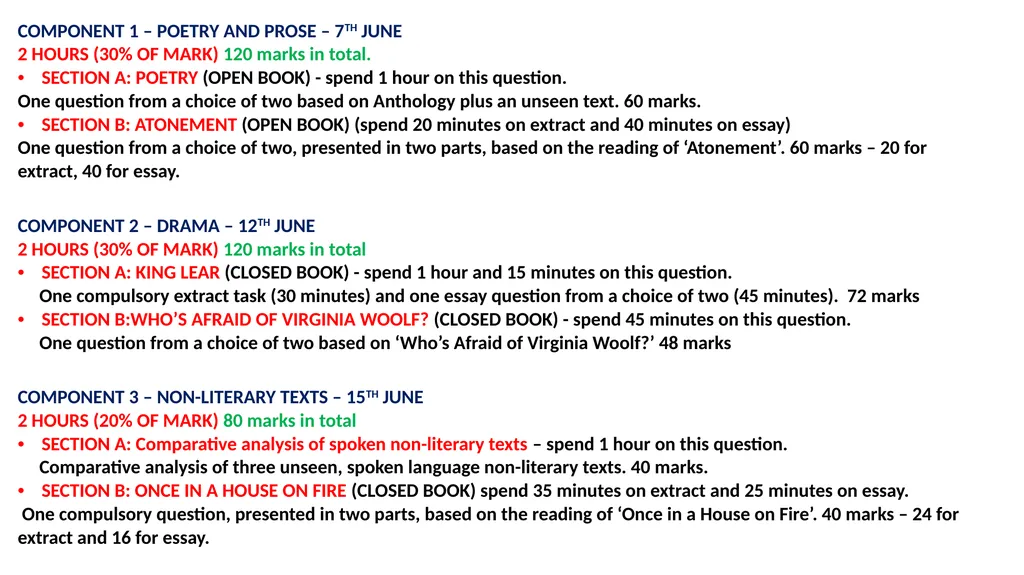
8th 11th May Atonement 14th 18th May Atonement 21st 25th May Atonement wc 4th June AtonementWhos Afraid of V W? wc 11th June Whos Afraid of VWOnce in a House on Fire C1 exam 7th June C2 exam 12th June C3 exam
Related Topics
Share
Embed code
Download this presentation From Below
"8th – 11th May – Atonement 14th – 18th May" is the property of its rightful owner. Permission is granted to download and print the materials on this website for personal, non-commercial use only, and to display it on your personal computer provided you do not modify the materials and that you retain all copyright notices contained in the materials. By downloading content from our website, you accept the terms of this agreement.
Presentation Transcript
01
8th – 11th May – Atonement
14th – 18th May – Atonement
21st – 25th May – Atonement
w/c 4th June – Atonement/Who’s Afraid of V W?
w/c 11th June – Who’s Afraid of VW/Once in a House on Fire
C1 exam – 7th June
C2 exam – 12th June
C3 exam – 15th June<br>
14th – 18th May – Atonement
21st – 25th May – Atonement
w/c 4th June – Atonement/Who’s Afraid of V W?
w/c 11th June – Who’s Afraid of VW/Once in a House on Fire
C1 exam – 7th June
C2 exam – 12th June
C3 exam – 15th June<br>
02
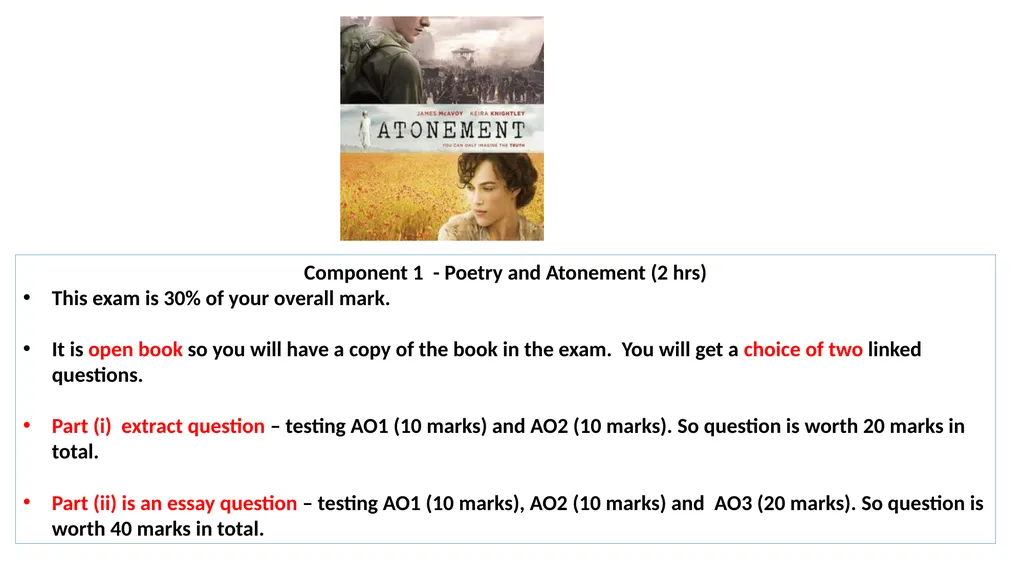
Component 1 - Poetry and Atonement (2 hrs)
This exam is 30% of your overall mark.
It is open book so you will have a copy of the book in the exam. You will get a choice of two linked questions.
Part (i) extract question – testing AO1 (10 marks) and AO2 (10 marks). So question is worth 20 marks in total.
Part (ii) is an essay question – testing AO1 (10 marks), AO2 (10 marks) and AO3 (20 marks). So question is worth 40 marks in total.<br>
This exam is 30% of your overall mark.
It is open book so you will have a copy of the book in the exam. You will get a choice of two linked questions.
Part (i) extract question – testing AO1 (10 marks) and AO2 (10 marks). So question is worth 20 marks in total.
Part (ii) is an essay question – testing AO1 (10 marks), AO2 (10 marks) and AO3 (20 marks). So question is worth 40 marks in total.<br>
03
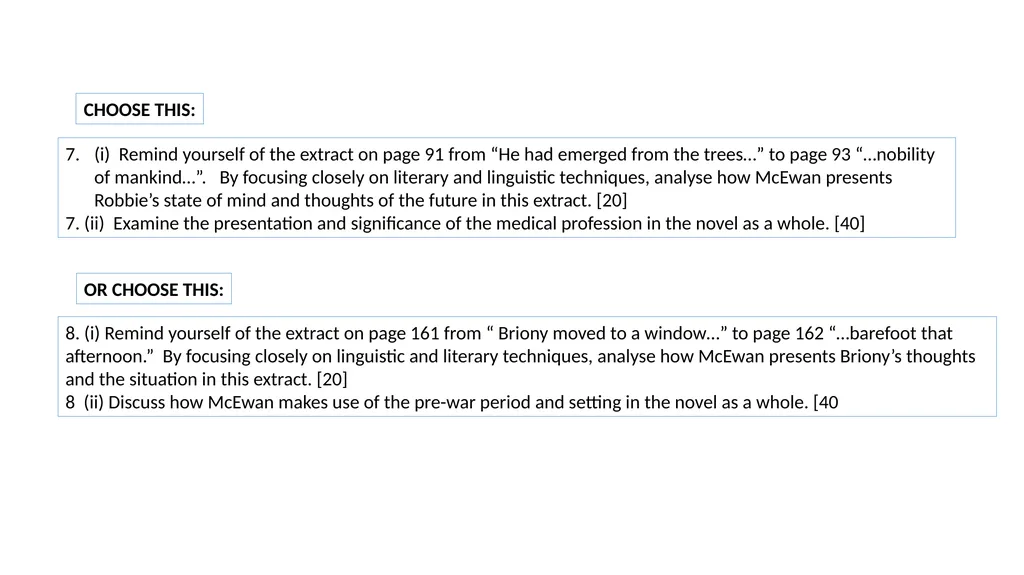
(i) Remind yourself of the extract on page 91 from “He had emerged from the trees…” to page 93 “…nobility of mankind…”. By focusing closely on literary and linguistic techniques, analyse how McEwan presents Robbie’s state of mind and thoughts of the future in this extract. [20]
7. (ii) Examine the presentation and significance of the medical profession in the novel as a whole. [40] 8. (i) Remind yourself of the extract on page 161 from “ Briony moved to a window…” to page 162 “…barefoot that afternoon.” By focusing closely on linguistic and literary techniques, analyse how McEwan presents Briony’s thoughts and the situation in this extract. [20]
8 (ii) Discuss how McEwan makes use of the pre-war period and setting in the novel as a whole. [40 CHOOSE THIS: OR CHOOSE THIS:<br>
7. (ii) Examine the presentation and significance of the medical profession in the novel as a whole. [40] 8. (i) Remind yourself of the extract on page 161 from “ Briony moved to a window…” to page 162 “…barefoot that afternoon.” By focusing closely on linguistic and literary techniques, analyse how McEwan presents Briony’s thoughts and the situation in this extract. [20]
8 (ii) Discuss how McEwan makes use of the pre-war period and setting in the novel as a whole. [40 CHOOSE THIS: OR CHOOSE THIS:<br>
04
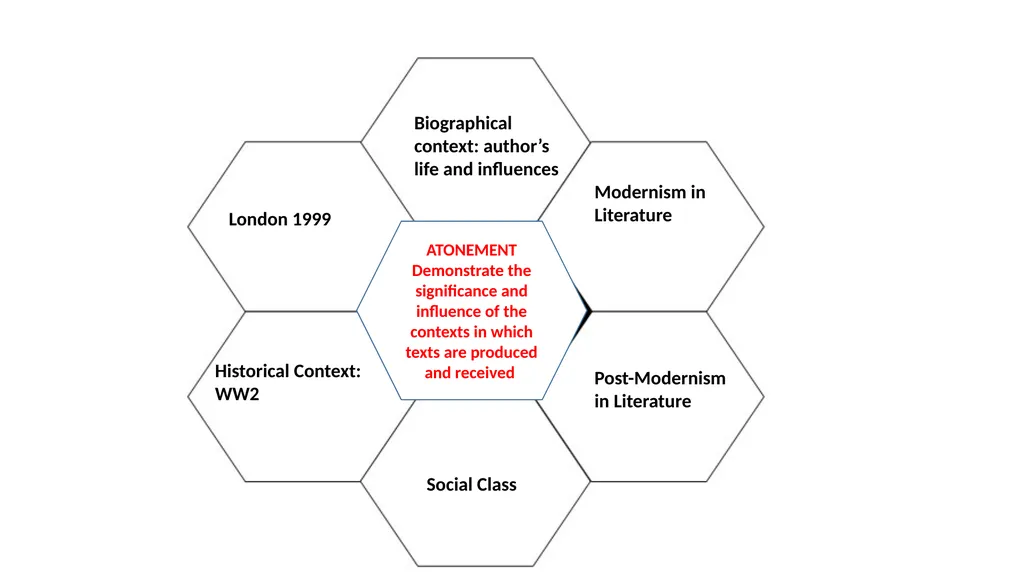
ATONEMENT Demonstrate the significance and influence of the contexts in which texts are produced and received Biographical context: author’s life and influences Modernism in Literature London 1999 Historical Context: WW2 Social Class Post-Modernism in Literature<br>
05
With your pencil and ruler, draw lines from the edges of your hexagons to the edge of your page<br>
06
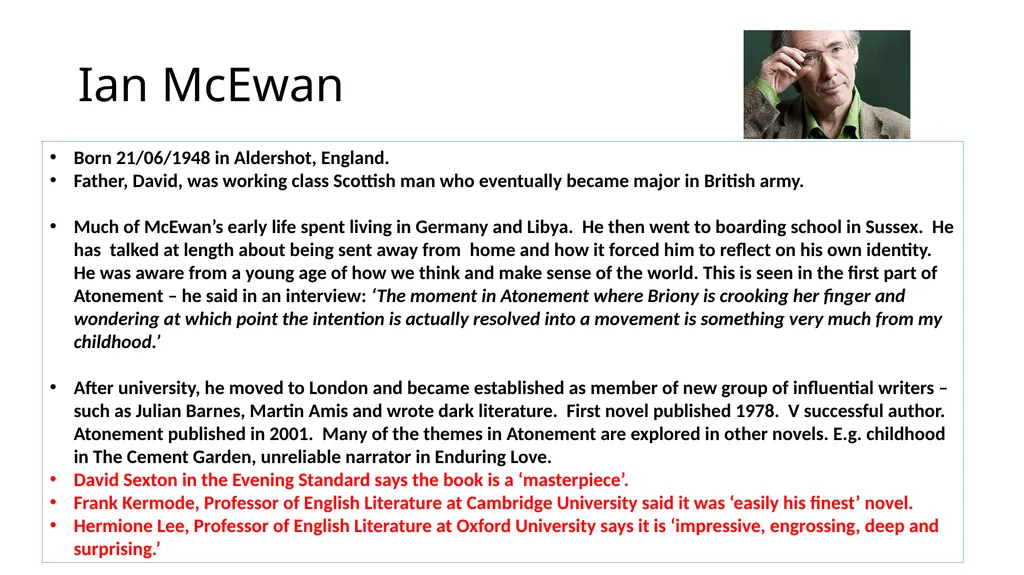
Ian McEwan Born 21/06/1948 in Aldershot, England.
Father, David, was working class Scottish man who eventually became major in British army.
Much of McEwan’s early life spent living in Germany and Libya. He then went to boarding school in Sussex. He has talked at length about being sent away from home and how it forced him to reflect on his own identity. He was aware from a young age of how we think and make sense of the world. This is seen in the first part of Atonement – he said in an interview: ‘The moment in Atonement where Briony is crooking her finger and wondering at which point the intention is actually resolved into a movement is something very much from my childhood.’
After university, he moved to London and became established as member of new group of influential writers –such as Julian Barnes, Martin Amis and wrote dark literature. First novel published 1978. V successful author. Atonement published in 2001. Many of the themes in Atonement are explored in other novels. E.g. childhood in The Cement Garden, unreliable narrator in Enduring Love.
David Sexton in the Evening Standard says the book is a ‘masterpiece’.
Frank Kermode, Professor of English Literature at Cambridge University said it was ‘easily his finest’ novel.
Hermione Lee, Professor of English Literature at Oxford University says it is ‘impressive, engrossing, deep and surprising.’<br>
Father, David, was working class Scottish man who eventually became major in British army.
Much of McEwan’s early life spent living in Germany and Libya. He then went to boarding school in Sussex. He has talked at length about being sent away from home and how it forced him to reflect on his own identity. He was aware from a young age of how we think and make sense of the world. This is seen in the first part of Atonement – he said in an interview: ‘The moment in Atonement where Briony is crooking her finger and wondering at which point the intention is actually resolved into a movement is something very much from my childhood.’
After university, he moved to London and became established as member of new group of influential writers –such as Julian Barnes, Martin Amis and wrote dark literature. First novel published 1978. V successful author. Atonement published in 2001. Many of the themes in Atonement are explored in other novels. E.g. childhood in The Cement Garden, unreliable narrator in Enduring Love.
David Sexton in the Evening Standard says the book is a ‘masterpiece’.
Frank Kermode, Professor of English Literature at Cambridge University said it was ‘easily his finest’ novel.
Hermione Lee, Professor of English Literature at Oxford University says it is ‘impressive, engrossing, deep and surprising.’<br>
07
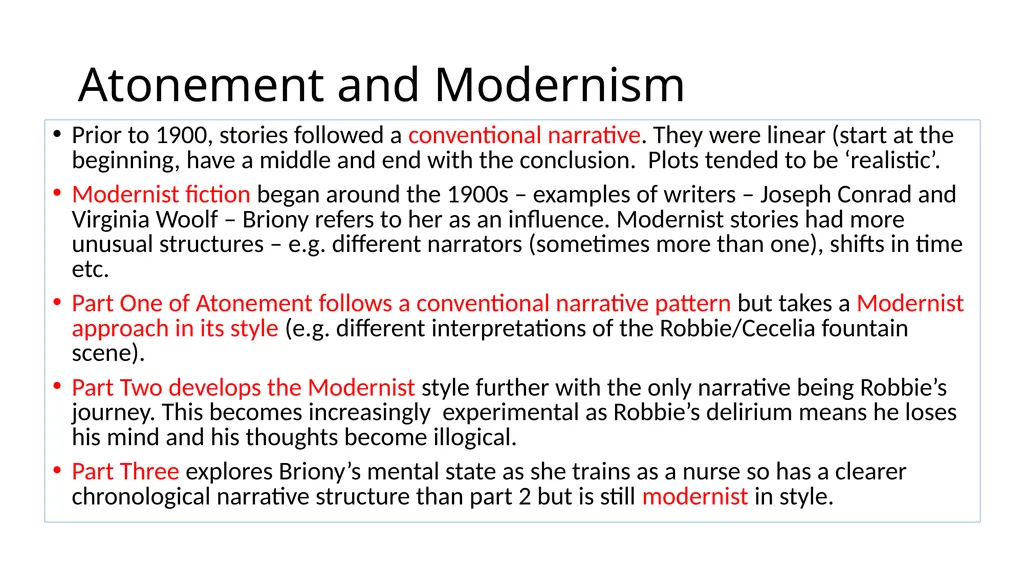
Atonement and Modernism Prior to 1900, stories followed a conventional narrative. They were linear (start at the beginning, have a middle and end with the conclusion. Plots tended to be ‘realistic’.
Modernist fiction began around the 1900s – examples of writers – Joseph Conrad and Virginia Woolf – Briony refers to her as an influence. Modernist stories had more unusual structures – e.g. different narrators (sometimes more than one), shifts in time etc.
Part One of Atonement follows a conventional narrative pattern but takes a Modernist approach in its style (e.g. different interpretations of the Robbie/Cecelia fountain scene).
Part Two develops the Modernist style further with the only narrative being Robbie’s journey. This becomes increasingly experimental as Robbie’s delirium means he loses his mind and his thoughts become illogical.
Part Three explores Briony’s mental state as she trains as a nurse so has a clearer chronological narrative structure than part 2 but is still modernist in style.<br>
Modernist fiction began around the 1900s – examples of writers – Joseph Conrad and Virginia Woolf – Briony refers to her as an influence. Modernist stories had more unusual structures – e.g. different narrators (sometimes more than one), shifts in time etc.
Part One of Atonement follows a conventional narrative pattern but takes a Modernist approach in its style (e.g. different interpretations of the Robbie/Cecelia fountain scene).
Part Two develops the Modernist style further with the only narrative being Robbie’s journey. This becomes increasingly experimental as Robbie’s delirium means he loses his mind and his thoughts become illogical.
Part Three explores Briony’s mental state as she trains as a nurse so has a clearer chronological narrative structure than part 2 but is still modernist in style.<br>
08
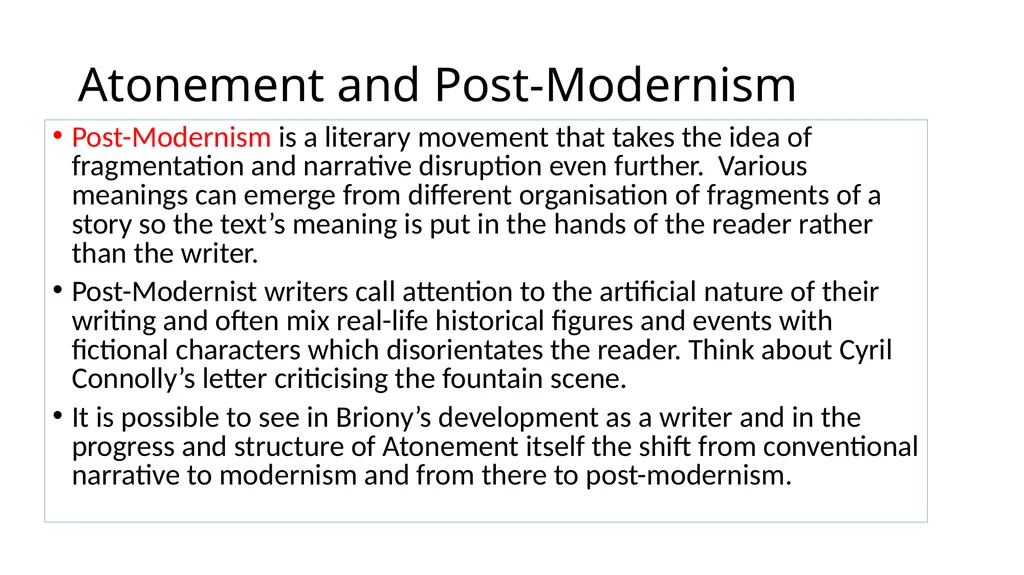
Atonement and Post-Modernism Post-Modernism is a literary movement that takes the idea of fragmentation and narrative disruption even further. Various meanings can emerge from different organisation of fragments of a story so the text’s meaning is put in the hands of the reader rather than the writer.
Post-Modernist writers call attention to the artificial nature of their writing and often mix real-life historical figures and events with fictional characters which disorientates the reader. Think about Cyril Connolly’s letter criticising the fountain scene.
It is possible to see in Briony’s development as a writer and in the progress and structure of Atonement itself the shift from conventional narrative to modernism and from there to post-modernism.<br>
Post-Modernist writers call attention to the artificial nature of their writing and often mix real-life historical figures and events with fictional characters which disorientates the reader. Think about Cyril Connolly’s letter criticising the fountain scene.
It is possible to see in Briony’s development as a writer and in the progress and structure of Atonement itself the shift from conventional narrative to modernism and from there to post-modernism.<br>
09
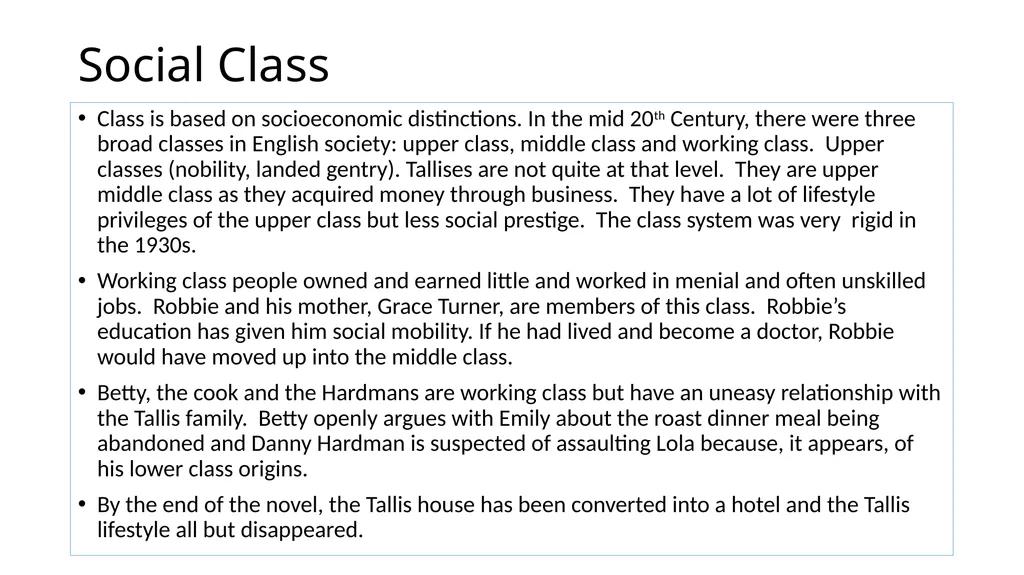
Social Class Class is based on socioeconomic distinctions. In the mid 20th Century, there were three broad classes in English society: upper class, middle class and working class. Upper classes (nobility, landed gentry). Tallises are not quite at that level. They are upper middle class as they acquired money through business. They have a lot of lifestyle privileges of the upper class but less social prestige. The class system was very rigid in the 1930s.
Working class people owned and earned little and worked in menial and often unskilled jobs. Robbie and his mother, Grace Turner, are members of this class. Robbie’s education has given him social mobility. If he had lived and become a doctor, Robbie would have moved up into the middle class.
Betty, the cook and the Hardmans are working class but have an uneasy relationship with the Tallis family. Betty openly argues with Emily about the roast dinner meal being abandoned and Danny Hardman is suspected of assaulting Lola because, it appears, of his lower class origins.
By the end of the novel, the Tallis house has been converted into a hotel and the Tallis lifestyle all but disappeared.<br>
Working class people owned and earned little and worked in menial and often unskilled jobs. Robbie and his mother, Grace Turner, are members of this class. Robbie’s education has given him social mobility. If he had lived and become a doctor, Robbie would have moved up into the middle class.
Betty, the cook and the Hardmans are working class but have an uneasy relationship with the Tallis family. Betty openly argues with Emily about the roast dinner meal being abandoned and Danny Hardman is suspected of assaulting Lola because, it appears, of his lower class origins.
By the end of the novel, the Tallis house has been converted into a hotel and the Tallis lifestyle all but disappeared.<br>
10
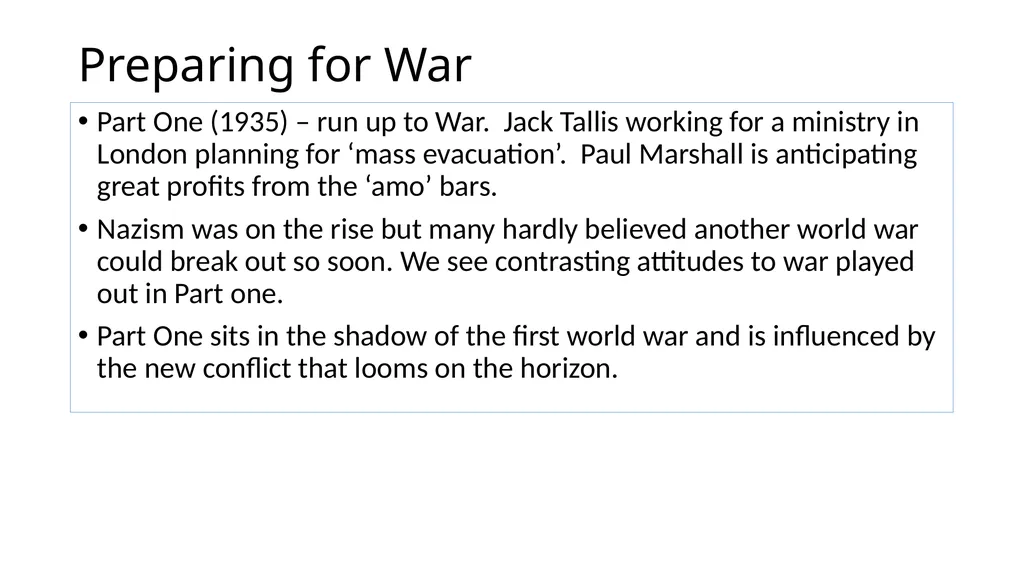
Preparing for War Part One (1935) – run up to War. Jack Tallis working for a ministry in London planning for ‘mass evacuation’. Paul Marshall is anticipating great profits from the ‘amo’ bars.
Nazism was on the rise but many hardly believed another world war could break out so soon. We see contrasting attitudes to war played out in Part one.
Part One sits in the shadow of the first world war and is influenced by the new conflict that looms on the horizon.<br>
Nazism was on the rise but many hardly believed another world war could break out so soon. We see contrasting attitudes to war played out in Part one.
Part One sits in the shadow of the first world war and is influenced by the new conflict that looms on the horizon.<br>
11
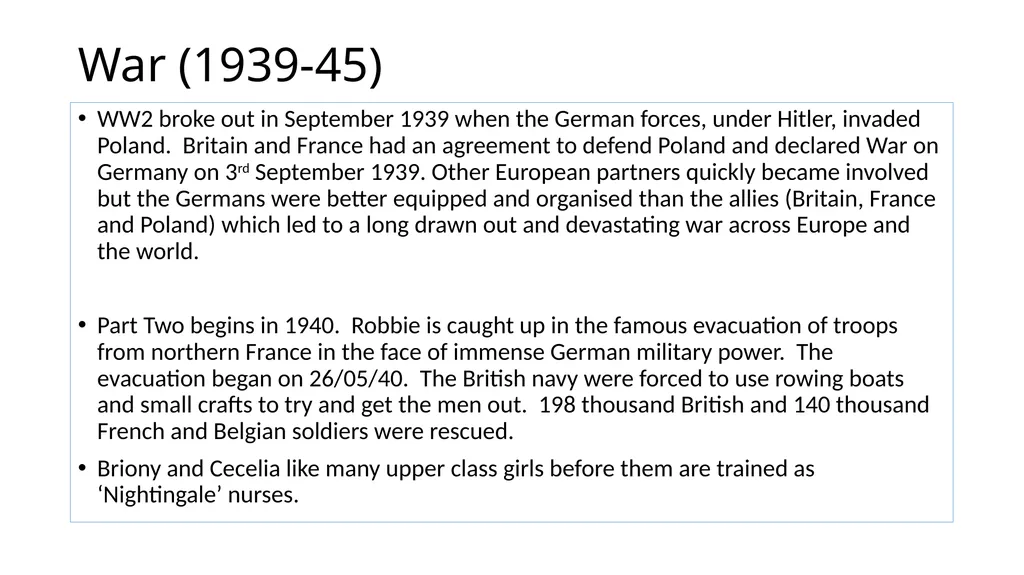
War (1939-45) WW2 broke out in September 1939 when the German forces, under Hitler, invaded Poland. Britain and France had an agreement to defend Poland and declared War on Germany on 3rd September 1939. Other European partners quickly became involved but the Germans were better equipped and organised than the allies (Britain, France and Poland) which led to a long drawn out and devastating war across Europe and the world.
Part Two begins in 1940. Robbie is caught up in the famous evacuation of troops from northern France in the face of immense German military power. The evacuation began on 26/05/40. The British navy were forced to use rowing boats and small crafts to try and get the men out. 198 thousand British and 140 thousand French and Belgian soldiers were rescued.
Briony and Cecelia like many upper class girls before them are trained as ‘Nightingale’ nurses.<br>
Part Two begins in 1940. Robbie is caught up in the famous evacuation of troops from northern France in the face of immense German military power. The evacuation began on 26/05/40. The British navy were forced to use rowing boats and small crafts to try and get the men out. 198 thousand British and 140 thousand French and Belgian soldiers were rescued.
Briony and Cecelia like many upper class girls before them are trained as ‘Nightingale’ nurses.<br>
12
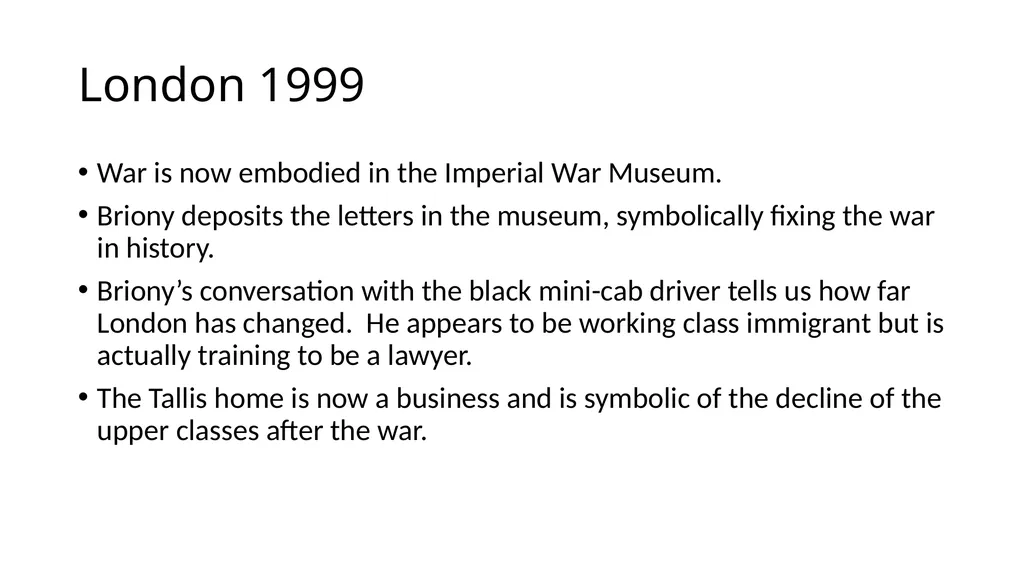
London 1999 War is now embodied in the Imperial War Museum.
Briony deposits the letters in the museum, symbolically fixing the war in history.
Briony’s conversation with the black mini-cab driver tells us how far London has changed. He appears to be working class immigrant but is actually training to be a lawyer.
The Tallis home is now a business and is symbolic of the decline of the upper classes after the war.<br>
Briony deposits the letters in the museum, symbolically fixing the war in history.
Briony’s conversation with the black mini-cab driver tells us how far London has changed. He appears to be working class immigrant but is actually training to be a lawyer.
The Tallis home is now a business and is symbolic of the decline of the upper classes after the war.<br>