A computer code for calculating velocity structure parameters using Rayleigh wave phase velocity dispersion data Amir Mansour Farahbod1, Zahra Rasouli2, Mohammad Reza Gheitanchi3 1- Geological Survey of Canada 2- International Institute of
"A computer code for calculating velocity structure" is the property of its rightful owner. Permission is granted to
download and print the materials on this website for personal, non-commercial use only, and to display it
on your personal computer provided you do not modify the materials and that you retain all copyright
notices contained in the materials. By downloading content from our website, you accept the terms of this
agreement.
Presentation Transcript
01
A computer code for calculating velocity structure parameters using Rayleigh wave phase velocity dispersion data Amir Mansour Farahbod1, Zahra Rasouli2, Mohammad Reza Gheitanchi3 1- Geological Survey of Canada
2- International Institute of Earthquake Engineering and Seismology
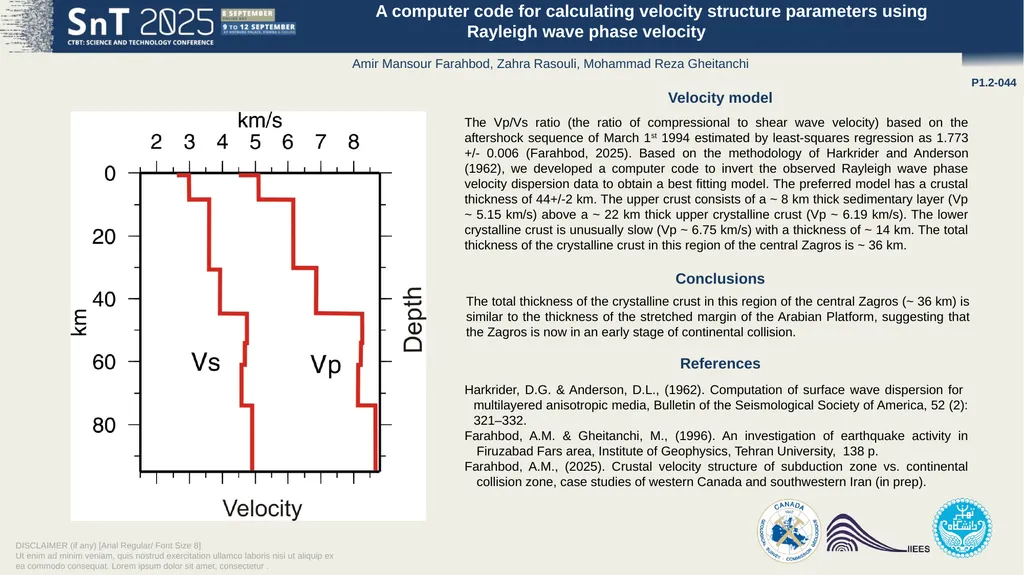
3- Institute of Geophysics, Tehran University We developed a computer code to derive a crust and upper mantle velocity structure for southwest Iran (Firuzabad region) in the central Zagros by an application of the two-event, single-station method of Rayleigh wave phase velocity dispersion analysis. Three sets of digital recordings of large earthquakes in the Firuzabad region in 1994 and 1995 made at the Iranian Long Period Array (ILPA) were used to perform the spectral analysis. The observed Rayleigh wave phase velocity dispersion data then systematically inverted to obtain a best fitting model. The preferred model has a crustal thickness of 44+/-2 km. The upper crust consists of a ~ 8 km thick sedimentary layer (Vp ~ 5.15 km/s) above a ~ 22 km thick upper crystalline crust (Vp ~ 6.19 km/s). The lower crystalline crust is unusually slow (Vp ~ 6.75 km/s) with a thickness of ~ 14 km. The total thickness of the crystalline crust in this region of the central Zagros (~ 36 km) is similar to the thickness of the stretched margin of the Arabian Platform, suggesting that the Zagros is now in an early stage of continental collision. P1.2-044<br>
02
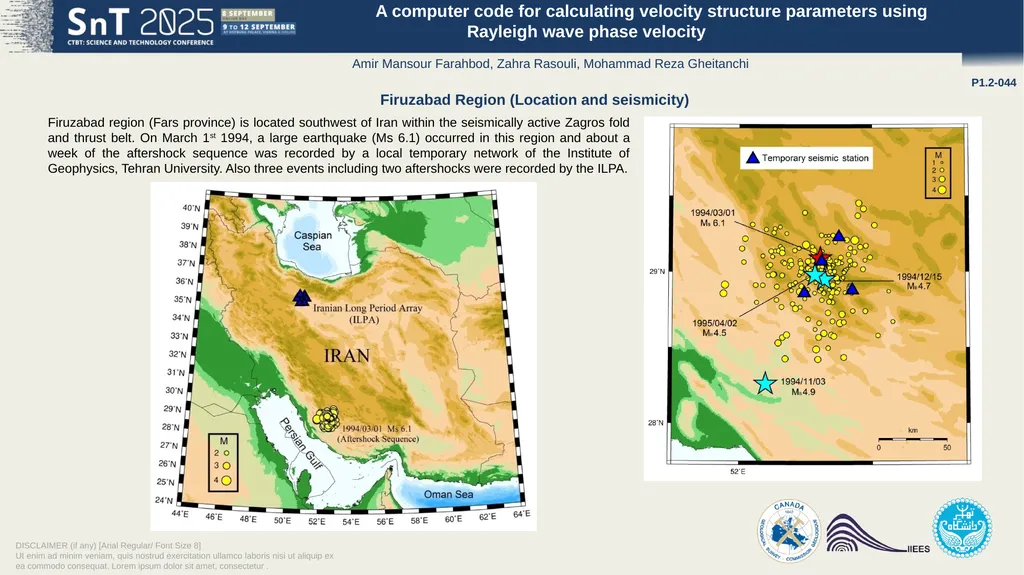
A computer code for calculating velocity structure parameters using Rayleigh wave phase velocity dispersion data Firuzabad region (Fars province) is located southwest of Iran within the seismically active Zagros fold and thrust belt. On March 1st 1994, a large earthquake (Ms 6.1) occurred in this region and about a week of the aftershock sequence was recorded by a local temporary network of the Institute of Geophysics, Tehran University. Also three events including two aftershocks were recorded by the ILPA. Amir Mansour Farahbod, Zahra Rasouli, Mohammad Reza Gheitanchi DISCLAIMER (if any) [Arial Regular/ Font Size 8]
Ut enim ad minim veniam, quis nostrud exercitation ullamco laboris nisi ut aliquip ex ea commodo consequat. Lorem ipsum dolor sit amet, consectetur . Firuzabad Region (Location and seismicity) P1.2-044<br>
03
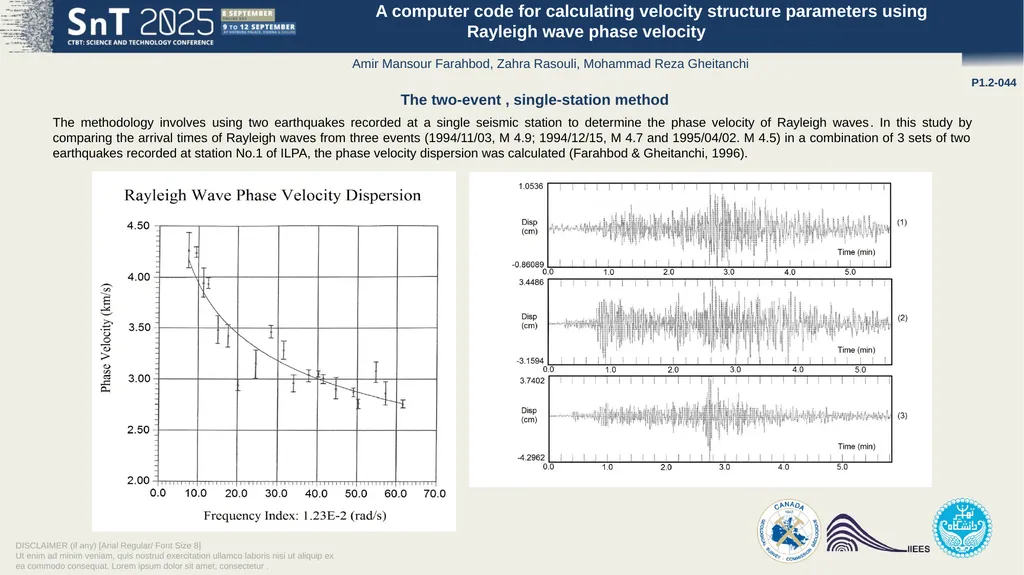
A computer code for calculating velocity structure parameters using Rayleigh wave phase velocity dispersion data The methodology involves using two earthquakes recorded at a single seismic station to determine the phase velocity of Rayleigh waves. In this study by comparing the arrival times of Rayleigh waves from three events (1994/11/03, M 4.9; 1994/12/15, M 4.7 and 1995/04/02. M 4.5) in a combination of 3 sets of two earthquakes recorded at station No.1 of ILPA, the phase velocity dispersion was calculated (Farahbod & Gheitanchi, 1996). Amir Mansour Farahbod, Zahra Rasouli, Mohammad Reza Gheitanchi DISCLAIMER (if any) [Arial Regular/ Font Size 8]
Ut enim ad minim veniam, quis nostrud exercitation ullamco laboris nisi ut aliquip ex ea commodo consequat. Lorem ipsum dolor sit amet, consectetur . The two-event , single-station method P1.2-044<br>
04
A computer code for calculating velocity structure parameters using Rayleigh wave phase velocity dispersion data The Vp/Vs ratio (the ratio of compressional to shear wave velocity) based on the aftershock sequence of March 1st 1994 estimated by least-squares regression as 1.773 +/- 0.006 (Farahbod, 2025). Based on the methodology of Harkrider and Anderson (1962), we developed a computer code to invert the observed Rayleigh wave phase velocity dispersion data to obtain a best fitting model. The preferred model has a crustal thickness of 44+/-2 km. The upper crust consists of a ~ 8 km thick sedimentary layer (Vp ~ 5.15 km/s) above a ~ 22 km thick upper crystalline crust (Vp ~ 6.19 km/s). The lower crystalline crust is unusually slow (Vp ~ 6.75 km/s) with a thickness of ~ 14 km. The total thickness of the crystalline crust in this region of the central Zagros is ~ 36 km. Amir Mansour Farahbod, Zahra Rasouli, Mohammad Reza Gheitanchi DISCLAIMER (if any) [Arial Regular/ Font Size 8]
Ut enim ad minim veniam, quis nostrud exercitation ullamco laboris nisi ut aliquip ex ea commodo consequat. Lorem ipsum dolor sit amet, consectetur . Velocity model P1.2-044 Harkrider, D.G. & Anderson, D.L., (1962). Computation of surface wave dispersion for multilayered anisotropic media, Bulletin of the Seismological Society of America, 52 (2): 321–332.
Farahbod, A.M. & Gheitanchi, M., (1996). An investigation of earthquake activity in Firuzabad Fars area, Institute of Geophysics, Tehran University, 138 p.
Farahbod, A.M., (2025). Crustal velocity structure of subduction zone vs. continental collision zone, case studies of western Canada and southwestern Iran (in prep). References Conclusions The total thickness of the crystalline crust in this region of the central Zagros (~ 36 km) is similar to the thickness of the stretched margin of the Arabian Platform, suggesting that the Zagros is now in an early stage of continental collision.<br>