
“A safe environment to learn and test negotiation



Description: A safe environment to learn and test negotiation techniques Successful Strategies for International Mediation Middle East Study Group University of Hull March 14, 2018 www.negotiationlab.co.uk Models Referenced Israeli Palestinian Talks
Related Topics
Download Presentation
"“A safe environment to learn and test negotiation" is the property of its rightful owner. Permission is granted to download and print the materials on this website for personal, non-commercial use only, and to display it on your personal computer provided you do not modify the materials and that you retain all copyright notices contained in the materials. By downloading content from our website, you accept the terms of this agreement.
Presentation Transcript
slide1. “A safe environment to learn and test negotiation techniques”<br>
slide2. Successful Strategies for International Mediation Middle East Study Group University of Hull March 14, 2018
www.negotiationlab.co.uk<br>
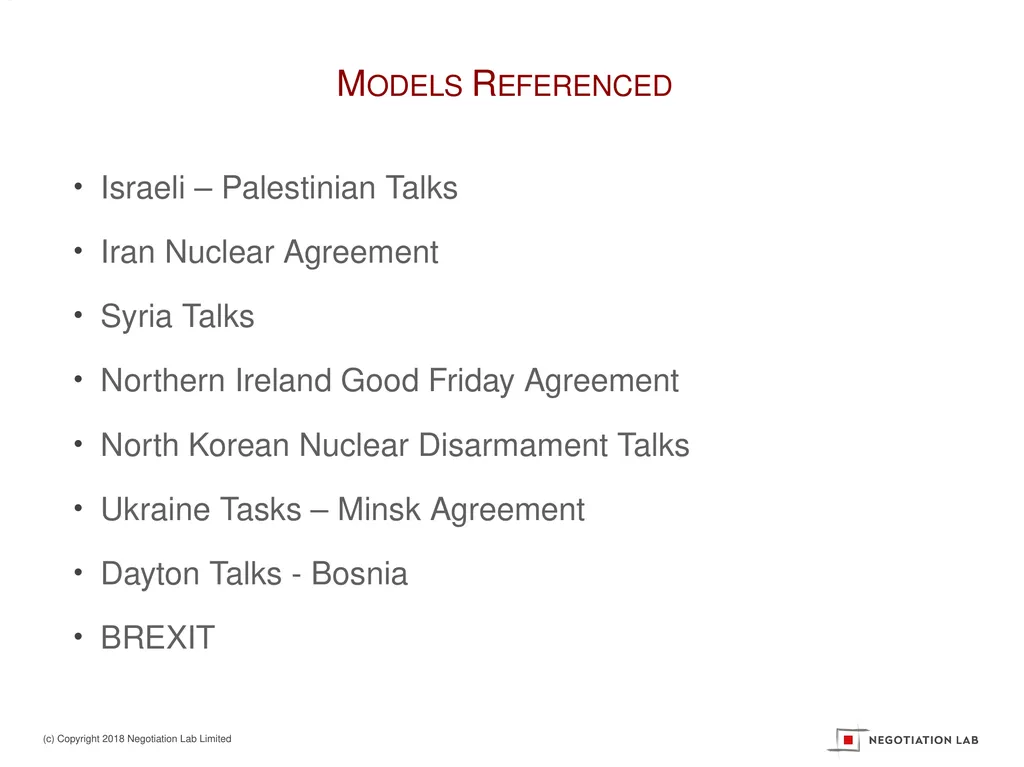
slide3. Models Referenced Israeli – Palestinian Talks
Iran Nuclear Agreement
Syria Talks
Northern Ireland Good Friday Agreement
North Korean Nuclear Disarmament Talks
Ukraine Tasks – Minsk Agreement
Dayton Talks - Bosnia
BREXIT<br>
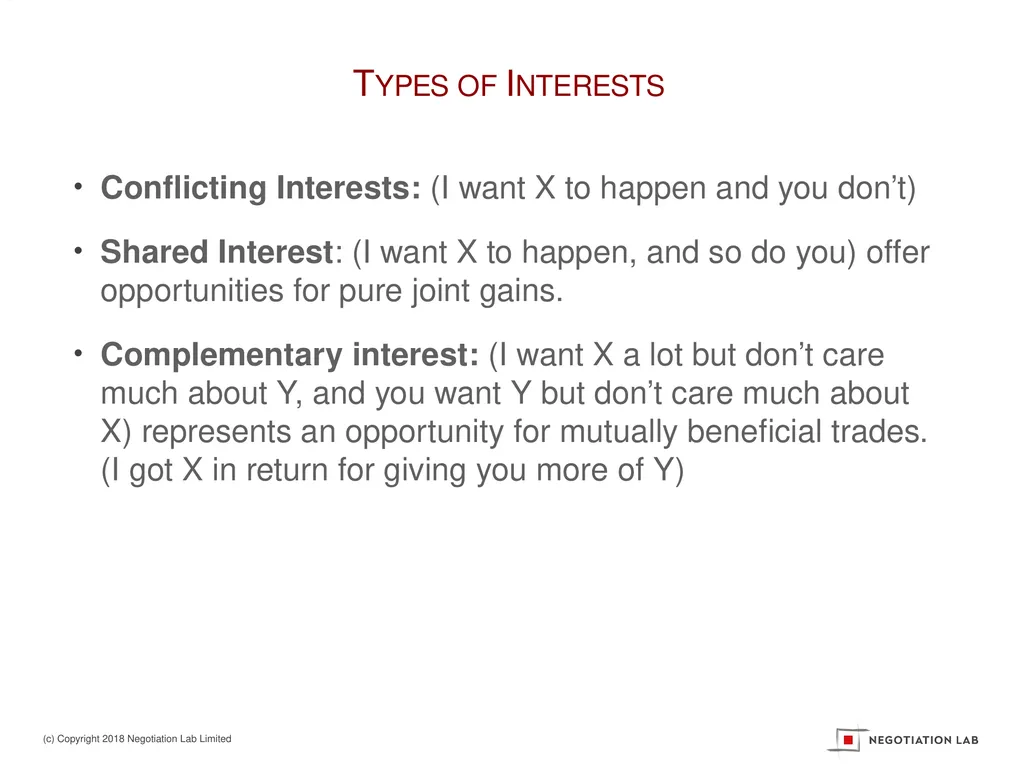
slide4. Types of Interests Conflicting Interests: (I want X to happen and you don’t)
Shared Interest: (I want X to happen, and so do you) offer opportunities for pure joint gains.
Complementary interest: (I want X a lot but don’t care much about Y, and you want Y but don’t care much about X) represents an opportunity for mutually beneficial trades. (I got X in return for giving you more of Y)<br>
slide5. Elements Needed For Successful International Negotiations No Pre-conditions to talks – they are a delaying tactic, used (a) by the powerful to avoid policy changes (b) used by the weak to exact concessions from the start.
Agenda setting – specific goals of parties must be set and prioritized set at the outset of talks. Discussing issues in the right sequence.
Team Effort - using several levels of negotiators. Technical details need to be worked out before political decisions can be made. Match levels of expertise carefully.<br>
slide6. Elements Needed For Successful International Negotiations Talks kept confidential - you cannot negotiate in sound bites. At certain times, both parties can agree to “float ideas” to prepare the public,.
Held in neutral territory - It reduces the chances of “playing to an audience” or being lobbied. Home teams always have an advantage - it is easier to control the agenda.
Agree on the definition of terms - Before signing off on deal agree on meaning of terms and translated terminology.<br>
slide7. Overcoming Strategic Barriers Verification regimes- arranging to observe each other’s actions as a way of reducing mutual uncertainty.
Mutual deterrence – making credible mutual commitments to devastating retaliation in the event of non-compliance.
Incrementalism – proceeding in a series of small and mutually verifiable steps, making future gains contingent on meeting current obligation.
Outside guarantors – involving powerful external parties as guarantors of the agreement with an understanding that they will punish non-compliance.<br>
slide8. The Value of Mapping Linkages Linked-system analysis has prescriptive as well as descriptive potential.
Negotiators who map out and reengineer linked systems can enhance their ability to shape the basic structure within which negotiations take place by: (1) transforming alternatives to agreements; (2) enhancing or diminishing opportunities for creating joint value through trades; and (3) changing the attitudes of their counterparts.
Negotiators also can take steps to counter the efforts of others to advance their interests through linkage. WATKINS, M. and PASSOW, S., 1996. Analyzing Linked Systems of Negotiations. Negotiation Journal, 12(4), pp. 325-339.<br>
slide9. Strategic Advantage to Mapping Linkages In multi-party, multi-issue and multi-context disputes, negotiators try to advance their positions by linking and delinking their ideas and interests into separate sets or sub-sets of negotiations before deciding on an outcome.
Strategically, it gives them the opportunity to reframe a discussion that can either create opportunities for cooperation or erect barriers as a defensive measure.
As negotiations can be difficult to initiate, maintain and/or conclude, so the importance of linking this process to something with momentum is a technique that is often utilized. Part of this leveraging process is the tactical use of sequential linkages – when the results of past negotiations or the prospect of future negotiations affect current ones. WATKINS, M. and PASSOW, S., 1996. Analyzing Linked Systems of Negotiations. Negotiation Journal, 12(4), pp. 325-339.<br>
slide10. Anatomy of Linkages Linkages are competitive if agreement in one negotiation precludes agreement in other linked negotiations.
Linkages are reciprocal if agreement must be reached in all the linked negotiations for overall agreement to be possible.
Linkages are synergistic if it enhances negotiators’ opportunities to make mutually beneficial trades and reach agreement.
Linkages are antagonistic if it diminishes negotiators’ opportunities to make mutually beneficial trades and reach agreement. WATKINS, M. and PASSOW, S., 1996. Analyzing Linked Systems of Negotiations. Negotiation Journal, 12(4), pp. 325-339<br>
slide11. Physiology of Linkages Two negotiations are serially linked if an event in one negotiation influences the behavior in another negotiation, but not the reverse.
Two negotiations are interactively linked if influence flows in both directions or if events in the linked negotiations interact.
Negotiators may be able to make unilateral moves to change the structure of the linked system by creating linkages before other parties become aware of what is going on. WATKINS, M. and PASSOW, S., 1996. Analyzing Linked Systems of Negotiations. Negotiation Journal, 12(4), pp. 325-339<br>
slide12. HARVARD METHOD
OF
‘PRINCIPLED NEGOTIATION’<br>
slide13. Principled negotiation: change the game – negotiate on the merits Don’t Bargain Over Positions
Separate the People From the Problem
Focus on Interests, Not Positions
Invest Options for Mutual Gain
Insist on Using Objective Criteria<br>
slide14. PRINCIPLED NEGOTIATION: STRATEGIC INTERESTS Conflicting Interests: (I want X to happen and you don’t) moves to (I want a more valuable resource and so do you).
Shared Interests: (I want X to happen, and so do you) offer opportunities for pure joint gains.
Complementary interests: (I want X a lot but don’t care much about Y, and you want Y but don’t care much about X) represents an opportunity for mutually beneficial trades. (I got X in return for giving you more of Y).<br>
slide15. The Value of Mapping Linkages Linked-system analysis has prescriptive as well as descriptive potential.
Negotiators who map out and reengineer linked systems can enhance their ability to shape the basic structure within which negotiations take place by: (1) transforming alternatives to agreements; (2) enhancing or diminishing opportunities for creating joint value through trades; and (3) changing the attitudes of their counterparts.
Negotiators also can take steps to counter the efforts of others to advance their interests through linkage. WATKINS, M. and PASSOW, S., 1996. Analyzing Linked Systems of Negotiations. Negotiation Journal, 12(4), pp. 325-339.<br>
slide16. Strategic Advantage to Mapping Linkages In multi-party, multi-issue and multi-context disputes, negotiators try to advance their positions by linking and delinking their ideas and interests into separate sets or sub-sets of negotiations before deciding on an outcome.
Strategically, it gives them the opportunity to reframe a discussion that can either create opportunities for cooperation or erect barriers as a defensive measure.
As negotiations can be difficult to initiate, maintain and/or conclude, so the importance of linking this process to something with momentum is a technique that is often utilized. Part of this leveraging process is the tactical use of sequential linkages – when the results of past negotiations or the prospect of future negotiations affect current ones. WATKINS, M. and PASSOW, S., 1996. Analyzing Linked Systems of Negotiations. Negotiation Journal, 12(4), pp. 325-339.<br>
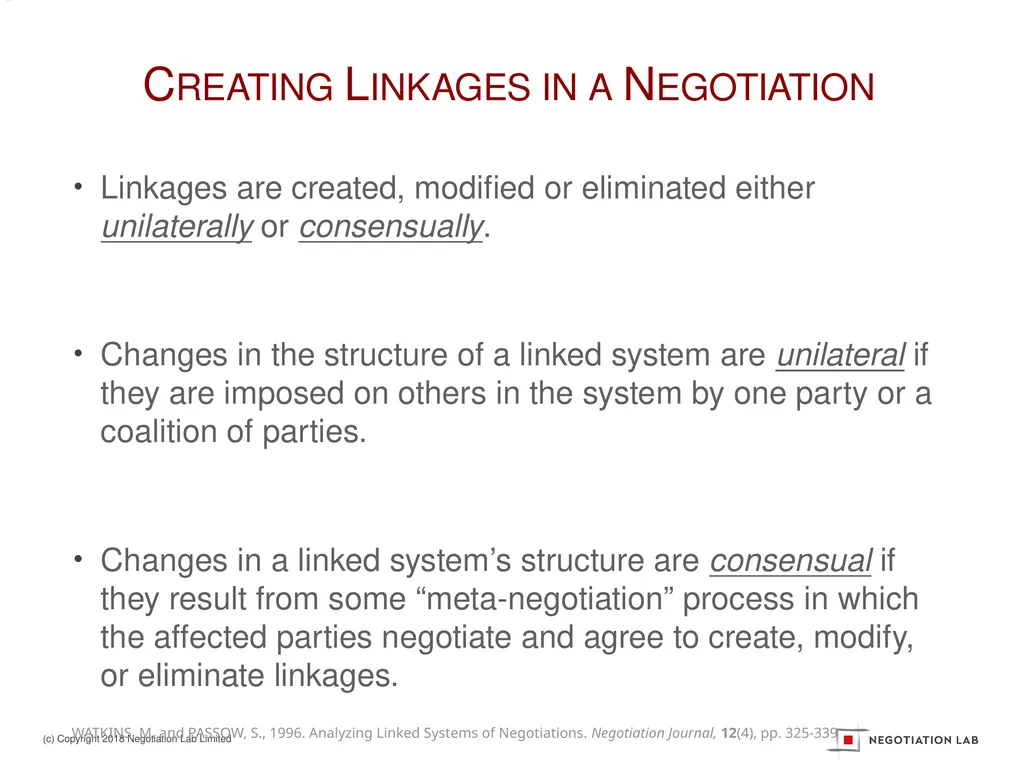
slide17. Creating Linkages in a Negotiation Linkages are created, modified or eliminated either unilaterally or consensually.
Changes in the structure of a linked system are unilateral if they are imposed on others in the system by one party or a coalition of parties.
Changes in a linked system’s structure are consensual if they result from some “meta-negotiation” process in which the affected parties negotiate and agree to create, modify, or eliminate linkages. WATKINS, M. and PASSOW, S., 1996. Analyzing Linked Systems of Negotiations. Negotiation Journal, 12(4), pp. 325-339<br>
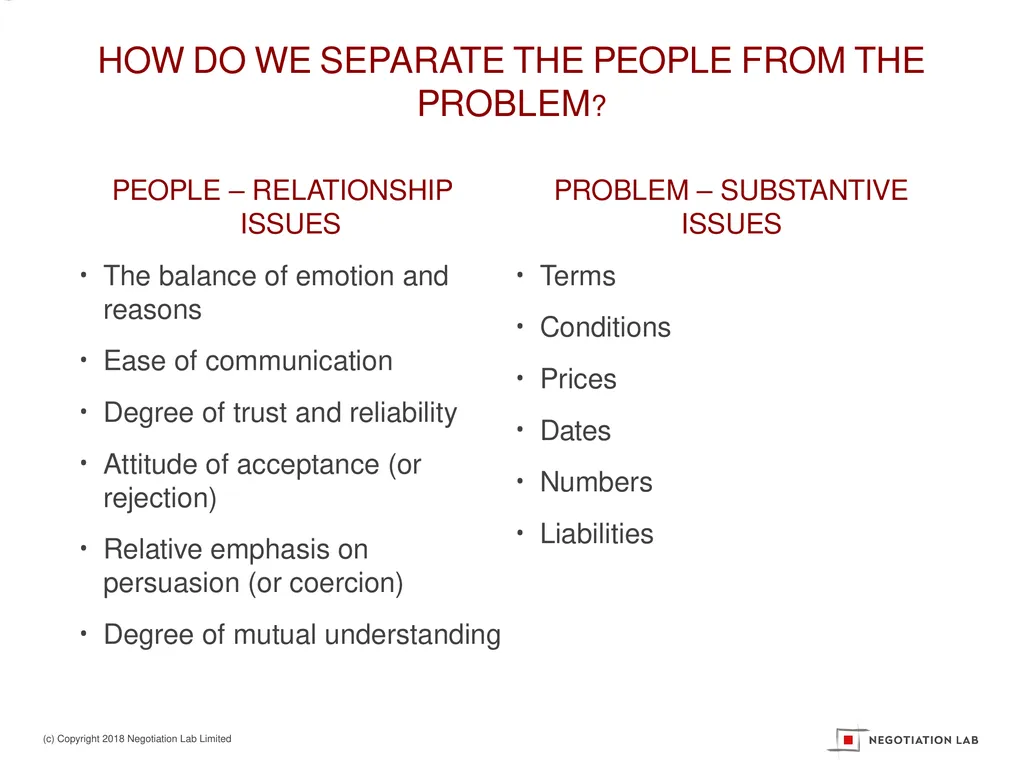
slide18. HOW DO WE SEPARATE THE PEOPLE FROM THE PROBLEM? PEOPLE – RELATIONSHIP ISSUES
The balance of emotion and reasons
Ease of communication
Degree of trust and reliability
Attitude of acceptance (or rejection)
Relative emphasis on persuasion (or coercion)
Degree of mutual understanding PROBLEM – SUBSTANTIVE ISSUES
Terms
Conditions
Prices
Dates
Numbers
Liabilities<br>
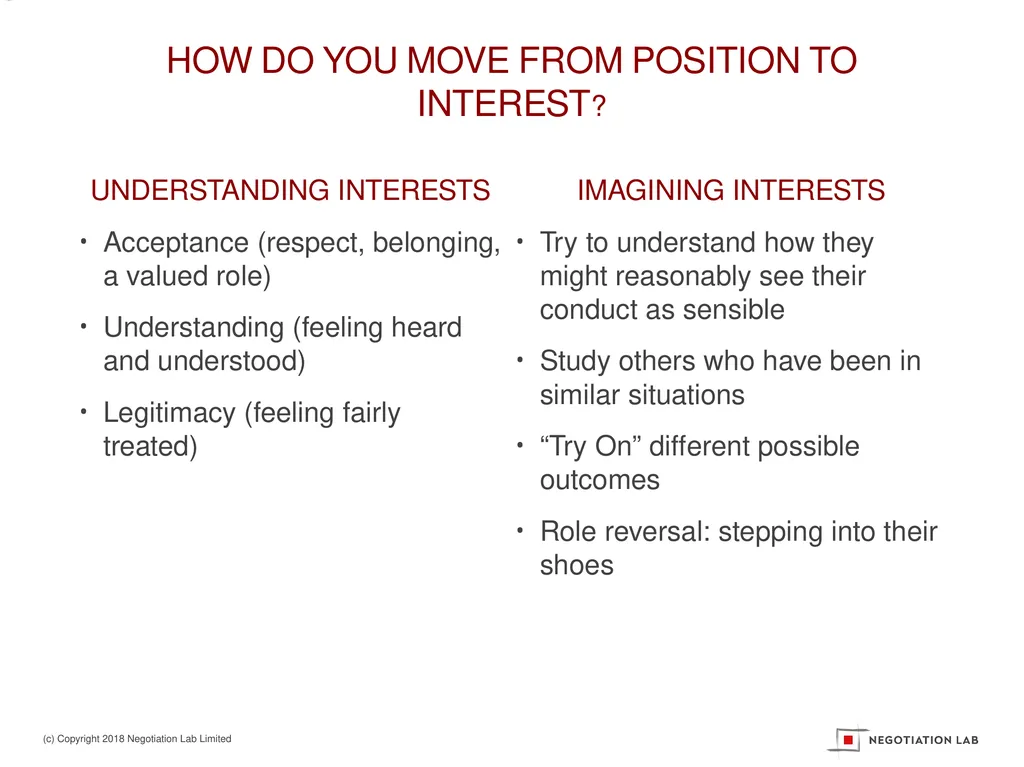
slide19. HOW DO YOU MOVE FROM POSITION TO INTEREST? UNDERSTANDING INTERESTS
Acceptance (respect, belonging, a valued role)
Understanding (feeling heard and understood)
Legitimacy (feeling fairly treated) IMAGINING INTERESTS
Try to understand how they might reasonably see their conduct as sensible
Study others who have been in similar situations
“Try On” different possible outcomes
Role reversal: stepping into their shoes<br>
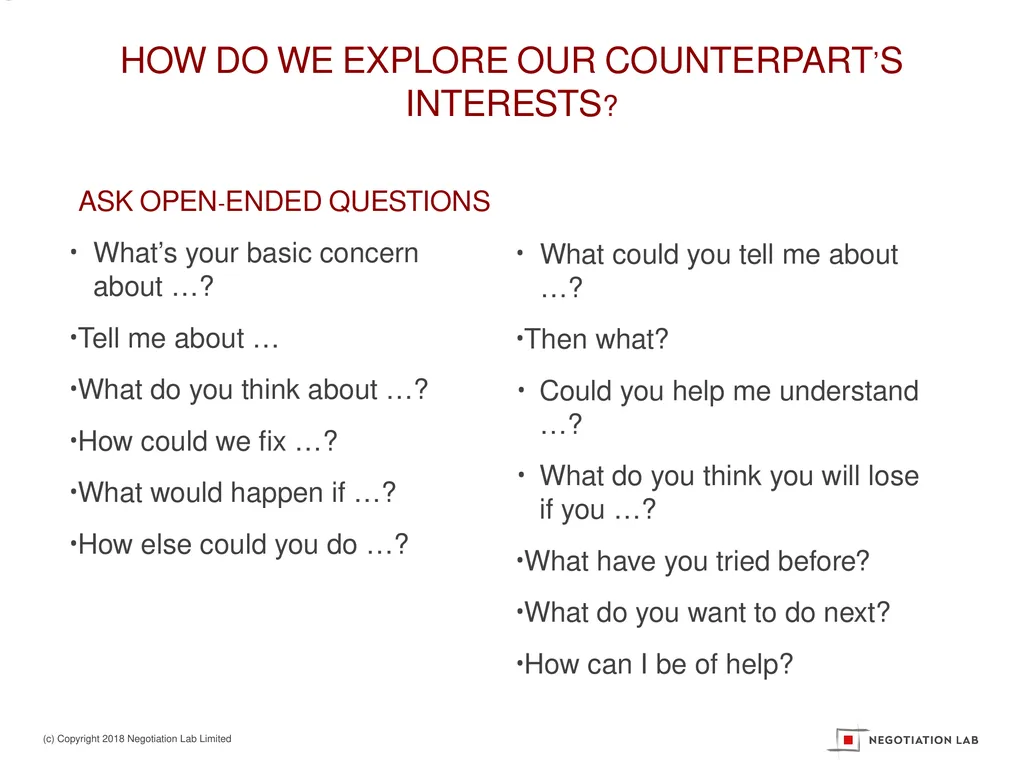
slide20. HOW DO WE EXPLORE OUR COUNTERPART’S INTERESTS? What’s your basic concern about …?
Tell me about …
What do you think about …?
How could we fix …?
What would happen if …?
How else could you do …? What could you tell me about …?
Then what?
Could you help me understand …?
What do you think you will lose if you …?
What have you tried before?
What do you want to do next?
How can I be of help? ASK OPEN-ENDED QUESTIONS<br>
slide21. THE DIFFERENCE BETWEEN HEARING AND ACTIVE LISTENING Are we listening to what we want to hear or what the person is saying?
How do we show someone we have heard what they have said?
Active listening requires a higher Ask-to-Talk ratio
Need to constantly ask WHY?<br>
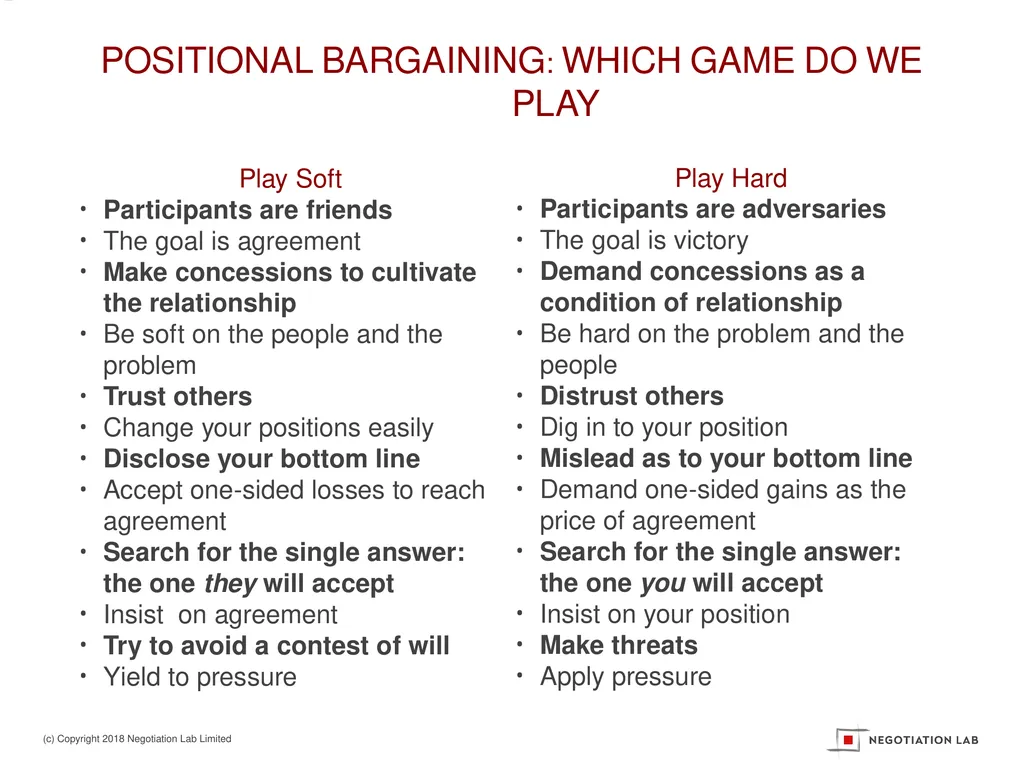
slide22. POSITIONAL BARGAINING: WHICH GAME DO WE PLAY Play Soft
Participants are friends
The goal is agreement
Make concessions to cultivate the relationship
Be soft on the people and the problem
Trust others
Change your positions easily
Disclose your bottom line
Accept one-sided losses to reach agreement
Search for the single answer: the one they will accept
Insist on agreement
Try to avoid a contest of will
Yield to pressure Play Hard
Participants are adversaries
The goal is victory
Demand concessions as a condition of relationship
Be hard on the problem and the people
Distrust others
Dig in to your position
Mislead as to your bottom line
Demand one-sided gains as the price of agreement
Search for the single answer: the one you will accept
Insist on your position
Make threats
Apply pressure<br>
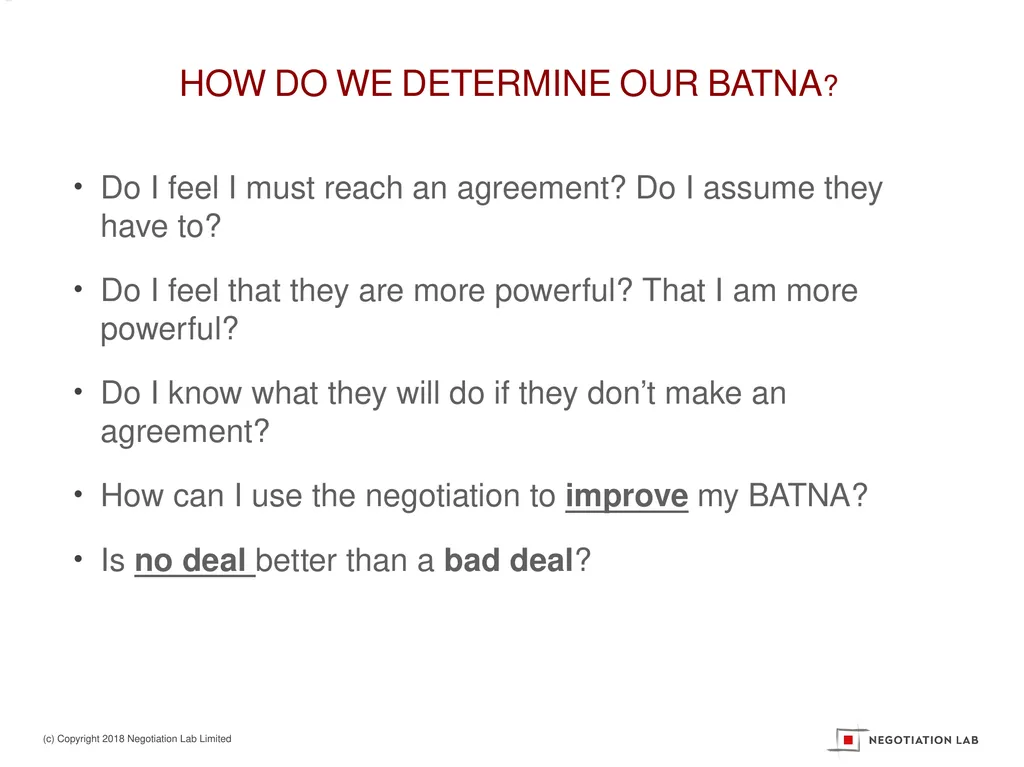
slide23. HOW DO WE DETERMINE OUR BATNA? Do I feel I must reach an agreement? Do I assume they have to?
Do I feel that they are more powerful? That I am more powerful?
Do I know what they will do if they don’t make an agreement?
How can I use the negotiation to improve my BATNA?
Is no deal better than a bad deal?<br>
slide24. LEVELS OF TRUST<br>
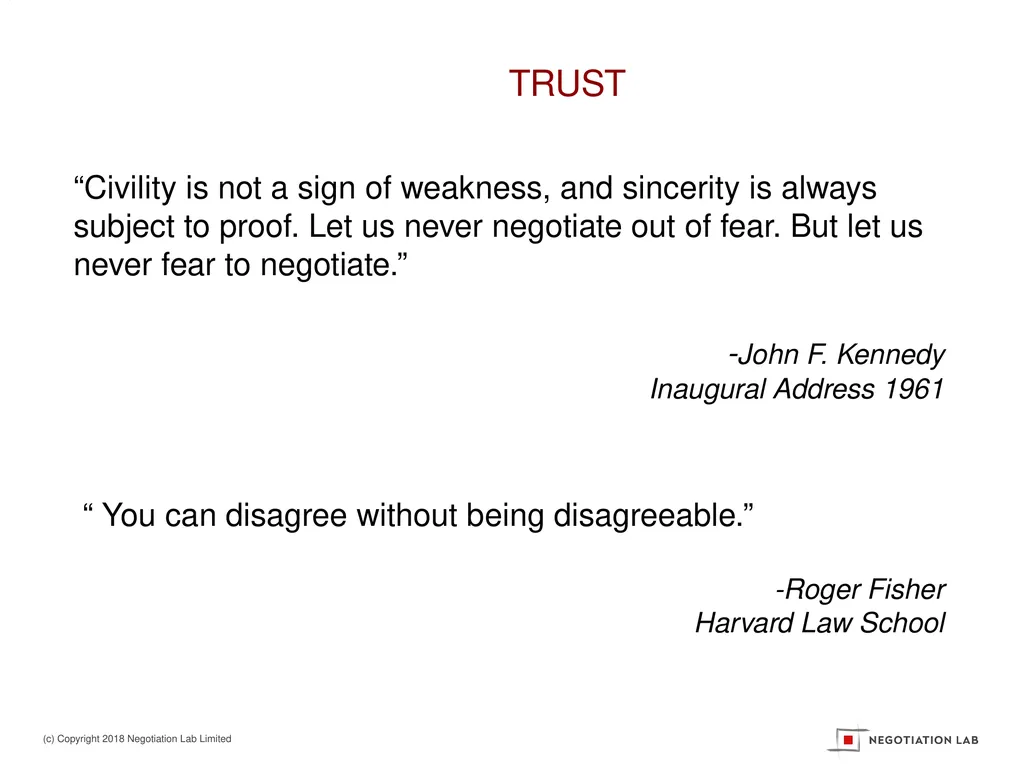
slide25. TRUST “Civility is not a sign of weakness, and sincerity is always subject to proof. Let us never negotiate out of fear. But let us never fear to negotiate.”
-John F. Kennedy
Inaugural Address 1961
“ You can disagree without being disagreeable.”
-Roger Fisher
Harvard Law School<br>
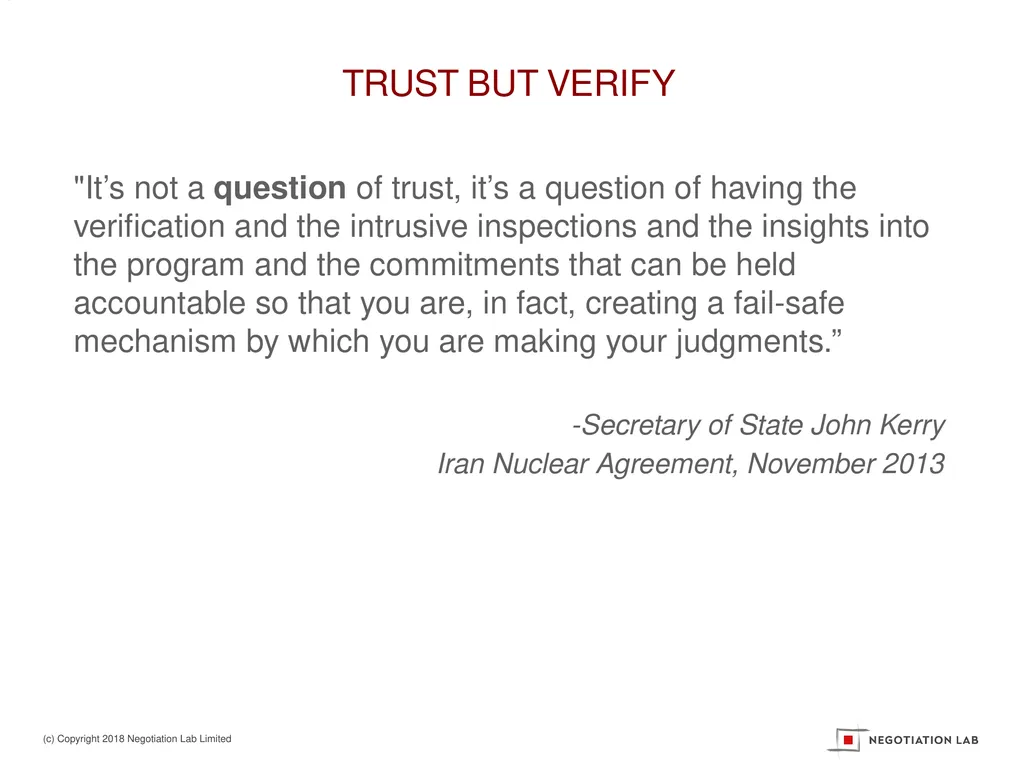
slide26. TRUST BUT VERIFY "It’s not a question of trust, it’s a question of having the verification and the intrusive inspections and the insights into the program and the commitments that can be held accountable so that you are, in fact, creating a fail-safe mechanism by which you are making your judgments.”
-Secretary of State John Kerry
Iran Nuclear Agreement, November 2013<br>
slide27. EXPECTATIONS OF TRUST Trust cannot be a precondition of negotiation
Trust is earned, it is not a given.
Trust once lost, can be regained.
Trust can be rebuilt slowly with “confidence building” measures.<br>
slide28. WHEN TRUST IS NOT POSSIBLE Make offers on several issues at a time.
Look for hidden patterns and cues in your counterpart’s offers and responses.
Think holistically to gain insight into your counterpart’s interests.
Make reciprocal concessions.
Introduce data, logic and objective standards that might help to break logjams.
Express sympathy, apologize, or compliment your counterpart.
Invoke expertise, authority and social norms to establish influence.<br>
slide29. WHEN TRUST SEEMS POSSIBLE Invoke expertise, authority and social norms to establish influence.
Focus on the issue, not the people.
Look to the future and find a shared vision.
Identify a common enemy.
Mix Q&A with making and justifying offers.
Take a break, suggest another approach, or call in a mediator.<br>
slide30. WHEN TRUST IS LIKELY Assume trustworthiness.
Get to know your counterpart personally.
Try to be likable
Behave consistently and predictably.
Prioritize your interests and give away a little information about them.
Take your counterpart’s perspective.
Highlight similarities between the negotiators.
Engage in reciprocal Q&A.
Paraphrase your counterpart’s positions.
Keep agreements tentative until the end.<br>
slide2. Successful Strategies for International Mediation Middle East Study Group University of Hull March 14, 2018
www.negotiationlab.co.uk<br>
slide3. Models Referenced Israeli – Palestinian Talks
Iran Nuclear Agreement
Syria Talks
Northern Ireland Good Friday Agreement
North Korean Nuclear Disarmament Talks
Ukraine Tasks – Minsk Agreement
Dayton Talks - Bosnia
BREXIT<br>
slide4. Types of Interests Conflicting Interests: (I want X to happen and you don’t)
Shared Interest: (I want X to happen, and so do you) offer opportunities for pure joint gains.
Complementary interest: (I want X a lot but don’t care much about Y, and you want Y but don’t care much about X) represents an opportunity for mutually beneficial trades. (I got X in return for giving you more of Y)<br>
slide5. Elements Needed For Successful International Negotiations No Pre-conditions to talks – they are a delaying tactic, used (a) by the powerful to avoid policy changes (b) used by the weak to exact concessions from the start.
Agenda setting – specific goals of parties must be set and prioritized set at the outset of talks. Discussing issues in the right sequence.
Team Effort - using several levels of negotiators. Technical details need to be worked out before political decisions can be made. Match levels of expertise carefully.<br>
slide6. Elements Needed For Successful International Negotiations Talks kept confidential - you cannot negotiate in sound bites. At certain times, both parties can agree to “float ideas” to prepare the public,.
Held in neutral territory - It reduces the chances of “playing to an audience” or being lobbied. Home teams always have an advantage - it is easier to control the agenda.
Agree on the definition of terms - Before signing off on deal agree on meaning of terms and translated terminology.<br>
slide7. Overcoming Strategic Barriers Verification regimes- arranging to observe each other’s actions as a way of reducing mutual uncertainty.
Mutual deterrence – making credible mutual commitments to devastating retaliation in the event of non-compliance.
Incrementalism – proceeding in a series of small and mutually verifiable steps, making future gains contingent on meeting current obligation.
Outside guarantors – involving powerful external parties as guarantors of the agreement with an understanding that they will punish non-compliance.<br>
slide8. The Value of Mapping Linkages Linked-system analysis has prescriptive as well as descriptive potential.
Negotiators who map out and reengineer linked systems can enhance their ability to shape the basic structure within which negotiations take place by: (1) transforming alternatives to agreements; (2) enhancing or diminishing opportunities for creating joint value through trades; and (3) changing the attitudes of their counterparts.
Negotiators also can take steps to counter the efforts of others to advance their interests through linkage. WATKINS, M. and PASSOW, S., 1996. Analyzing Linked Systems of Negotiations. Negotiation Journal, 12(4), pp. 325-339.<br>
slide9. Strategic Advantage to Mapping Linkages In multi-party, multi-issue and multi-context disputes, negotiators try to advance their positions by linking and delinking their ideas and interests into separate sets or sub-sets of negotiations before deciding on an outcome.
Strategically, it gives them the opportunity to reframe a discussion that can either create opportunities for cooperation or erect barriers as a defensive measure.
As negotiations can be difficult to initiate, maintain and/or conclude, so the importance of linking this process to something with momentum is a technique that is often utilized. Part of this leveraging process is the tactical use of sequential linkages – when the results of past negotiations or the prospect of future negotiations affect current ones. WATKINS, M. and PASSOW, S., 1996. Analyzing Linked Systems of Negotiations. Negotiation Journal, 12(4), pp. 325-339.<br>
slide10. Anatomy of Linkages Linkages are competitive if agreement in one negotiation precludes agreement in other linked negotiations.
Linkages are reciprocal if agreement must be reached in all the linked negotiations for overall agreement to be possible.
Linkages are synergistic if it enhances negotiators’ opportunities to make mutually beneficial trades and reach agreement.
Linkages are antagonistic if it diminishes negotiators’ opportunities to make mutually beneficial trades and reach agreement. WATKINS, M. and PASSOW, S., 1996. Analyzing Linked Systems of Negotiations. Negotiation Journal, 12(4), pp. 325-339<br>
slide11. Physiology of Linkages Two negotiations are serially linked if an event in one negotiation influences the behavior in another negotiation, but not the reverse.
Two negotiations are interactively linked if influence flows in both directions or if events in the linked negotiations interact.
Negotiators may be able to make unilateral moves to change the structure of the linked system by creating linkages before other parties become aware of what is going on. WATKINS, M. and PASSOW, S., 1996. Analyzing Linked Systems of Negotiations. Negotiation Journal, 12(4), pp. 325-339<br>
slide12. HARVARD METHOD
OF
‘PRINCIPLED NEGOTIATION’<br>
slide13. Principled negotiation: change the game – negotiate on the merits Don’t Bargain Over Positions
Separate the People From the Problem
Focus on Interests, Not Positions
Invest Options for Mutual Gain
Insist on Using Objective Criteria<br>
slide14. PRINCIPLED NEGOTIATION: STRATEGIC INTERESTS Conflicting Interests: (I want X to happen and you don’t) moves to (I want a more valuable resource and so do you).
Shared Interests: (I want X to happen, and so do you) offer opportunities for pure joint gains.
Complementary interests: (I want X a lot but don’t care much about Y, and you want Y but don’t care much about X) represents an opportunity for mutually beneficial trades. (I got X in return for giving you more of Y).<br>
slide15. The Value of Mapping Linkages Linked-system analysis has prescriptive as well as descriptive potential.
Negotiators who map out and reengineer linked systems can enhance their ability to shape the basic structure within which negotiations take place by: (1) transforming alternatives to agreements; (2) enhancing or diminishing opportunities for creating joint value through trades; and (3) changing the attitudes of their counterparts.
Negotiators also can take steps to counter the efforts of others to advance their interests through linkage. WATKINS, M. and PASSOW, S., 1996. Analyzing Linked Systems of Negotiations. Negotiation Journal, 12(4), pp. 325-339.<br>
slide16. Strategic Advantage to Mapping Linkages In multi-party, multi-issue and multi-context disputes, negotiators try to advance their positions by linking and delinking their ideas and interests into separate sets or sub-sets of negotiations before deciding on an outcome.
Strategically, it gives them the opportunity to reframe a discussion that can either create opportunities for cooperation or erect barriers as a defensive measure.
As negotiations can be difficult to initiate, maintain and/or conclude, so the importance of linking this process to something with momentum is a technique that is often utilized. Part of this leveraging process is the tactical use of sequential linkages – when the results of past negotiations or the prospect of future negotiations affect current ones. WATKINS, M. and PASSOW, S., 1996. Analyzing Linked Systems of Negotiations. Negotiation Journal, 12(4), pp. 325-339.<br>
slide17. Creating Linkages in a Negotiation Linkages are created, modified or eliminated either unilaterally or consensually.
Changes in the structure of a linked system are unilateral if they are imposed on others in the system by one party or a coalition of parties.
Changes in a linked system’s structure are consensual if they result from some “meta-negotiation” process in which the affected parties negotiate and agree to create, modify, or eliminate linkages. WATKINS, M. and PASSOW, S., 1996. Analyzing Linked Systems of Negotiations. Negotiation Journal, 12(4), pp. 325-339<br>
slide18. HOW DO WE SEPARATE THE PEOPLE FROM THE PROBLEM? PEOPLE – RELATIONSHIP ISSUES
The balance of emotion and reasons
Ease of communication
Degree of trust and reliability
Attitude of acceptance (or rejection)
Relative emphasis on persuasion (or coercion)
Degree of mutual understanding PROBLEM – SUBSTANTIVE ISSUES
Terms
Conditions
Prices
Dates
Numbers
Liabilities<br>
slide19. HOW DO YOU MOVE FROM POSITION TO INTEREST? UNDERSTANDING INTERESTS
Acceptance (respect, belonging, a valued role)
Understanding (feeling heard and understood)
Legitimacy (feeling fairly treated) IMAGINING INTERESTS
Try to understand how they might reasonably see their conduct as sensible
Study others who have been in similar situations
“Try On” different possible outcomes
Role reversal: stepping into their shoes<br>
slide20. HOW DO WE EXPLORE OUR COUNTERPART’S INTERESTS? What’s your basic concern about …?
Tell me about …
What do you think about …?
How could we fix …?
What would happen if …?
How else could you do …? What could you tell me about …?
Then what?
Could you help me understand …?
What do you think you will lose if you …?
What have you tried before?
What do you want to do next?
How can I be of help? ASK OPEN-ENDED QUESTIONS<br>
slide21. THE DIFFERENCE BETWEEN HEARING AND ACTIVE LISTENING Are we listening to what we want to hear or what the person is saying?
How do we show someone we have heard what they have said?
Active listening requires a higher Ask-to-Talk ratio
Need to constantly ask WHY?<br>
slide22. POSITIONAL BARGAINING: WHICH GAME DO WE PLAY Play Soft
Participants are friends
The goal is agreement
Make concessions to cultivate the relationship
Be soft on the people and the problem
Trust others
Change your positions easily
Disclose your bottom line
Accept one-sided losses to reach agreement
Search for the single answer: the one they will accept
Insist on agreement
Try to avoid a contest of will
Yield to pressure Play Hard
Participants are adversaries
The goal is victory
Demand concessions as a condition of relationship
Be hard on the problem and the people
Distrust others
Dig in to your position
Mislead as to your bottom line
Demand one-sided gains as the price of agreement
Search for the single answer: the one you will accept
Insist on your position
Make threats
Apply pressure<br>
slide23. HOW DO WE DETERMINE OUR BATNA? Do I feel I must reach an agreement? Do I assume they have to?
Do I feel that they are more powerful? That I am more powerful?
Do I know what they will do if they don’t make an agreement?
How can I use the negotiation to improve my BATNA?
Is no deal better than a bad deal?<br>
slide24. LEVELS OF TRUST<br>
slide25. TRUST “Civility is not a sign of weakness, and sincerity is always subject to proof. Let us never negotiate out of fear. But let us never fear to negotiate.”
-John F. Kennedy
Inaugural Address 1961
“ You can disagree without being disagreeable.”
-Roger Fisher
Harvard Law School<br>
slide26. TRUST BUT VERIFY "It’s not a question of trust, it’s a question of having the verification and the intrusive inspections and the insights into the program and the commitments that can be held accountable so that you are, in fact, creating a fail-safe mechanism by which you are making your judgments.”
-Secretary of State John Kerry
Iran Nuclear Agreement, November 2013<br>
slide27. EXPECTATIONS OF TRUST Trust cannot be a precondition of negotiation
Trust is earned, it is not a given.
Trust once lost, can be regained.
Trust can be rebuilt slowly with “confidence building” measures.<br>
slide28. WHEN TRUST IS NOT POSSIBLE Make offers on several issues at a time.
Look for hidden patterns and cues in your counterpart’s offers and responses.
Think holistically to gain insight into your counterpart’s interests.
Make reciprocal concessions.
Introduce data, logic and objective standards that might help to break logjams.
Express sympathy, apologize, or compliment your counterpart.
Invoke expertise, authority and social norms to establish influence.<br>
slide29. WHEN TRUST SEEMS POSSIBLE Invoke expertise, authority and social norms to establish influence.
Focus on the issue, not the people.
Look to the future and find a shared vision.
Identify a common enemy.
Mix Q&A with making and justifying offers.
Take a break, suggest another approach, or call in a mediator.<br>
slide30. WHEN TRUST IS LIKELY Assume trustworthiness.
Get to know your counterpart personally.
Try to be likable
Behave consistently and predictably.
Prioritize your interests and give away a little information about them.
Take your counterpart’s perspective.
Highlight similarities between the negotiators.
Engage in reciprocal Q&A.
Paraphrase your counterpart’s positions.
Keep agreements tentative until the end.<br>