04
What is academic integrity? umanitoba.ca<br>
05
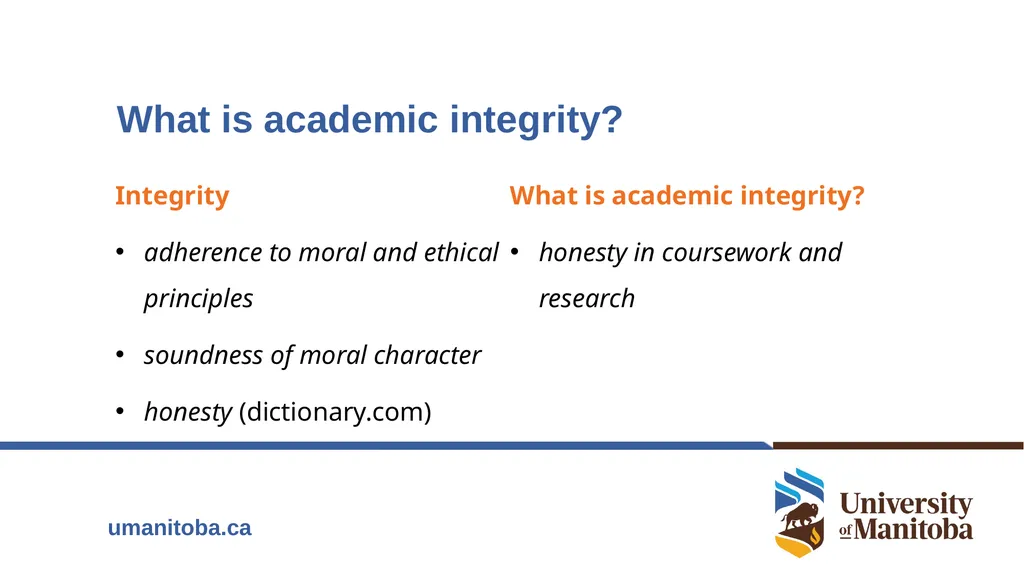
What is academic integrity? Integrity
adherence to moral and ethical principles
soundness of moral character
honesty (dictionary.com)
What is academic integrity?
honesty in coursework and research umanitoba.ca<br>
06
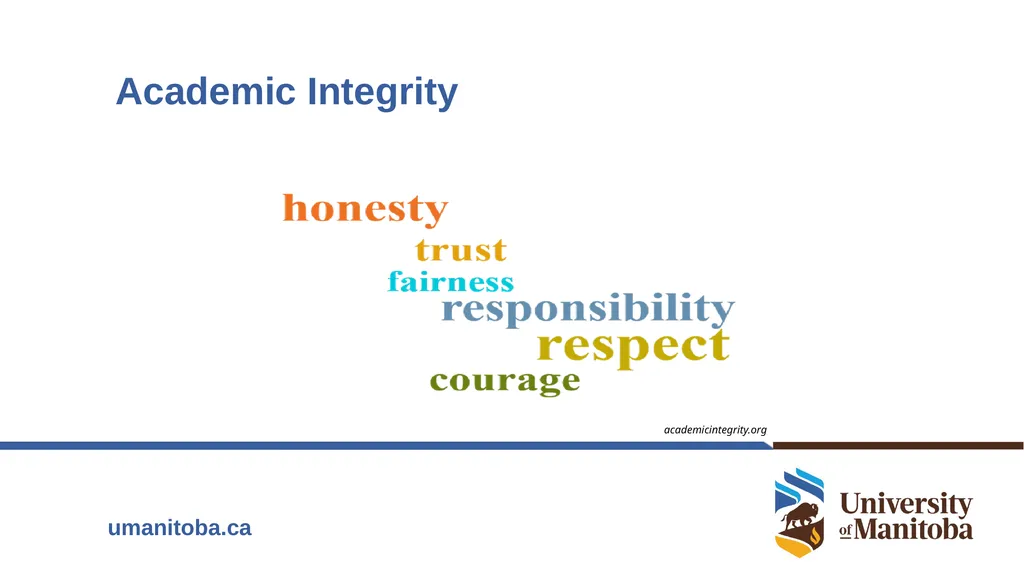
academicintegrity.org Academic Integrity umanitoba.ca<br>
07
Why should students care�about academic integrity? umanitoba.ca<br>
08
Why should students care about academic integrity? Eliminates unfair advantage between students
Foundation of your university degree
Gives your degree value
Builds moral character
Prepares students for future life and work demands umanitoba.ca<br>
09
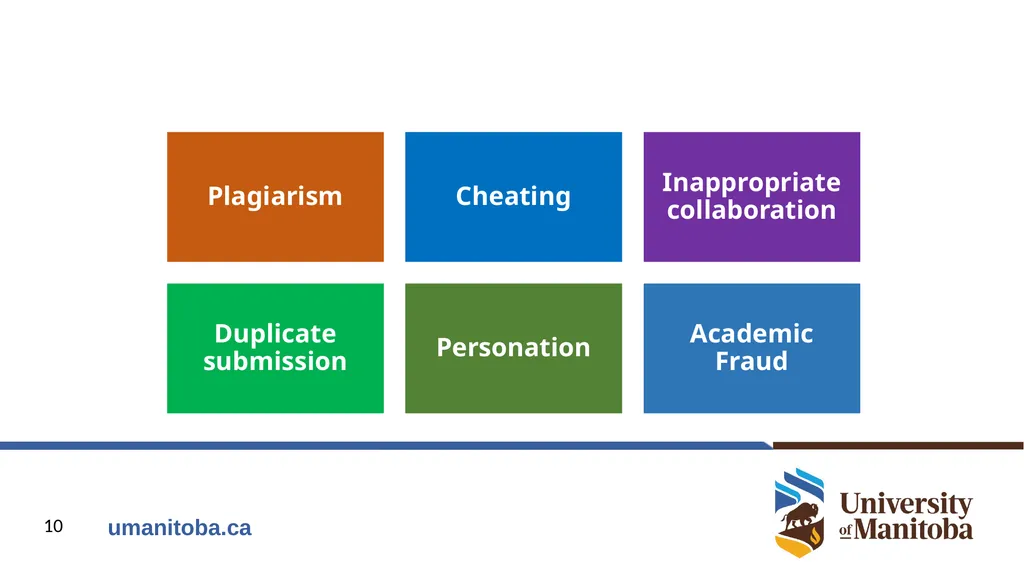
What are the various types of academic misconduct? umanitoba.ca<br>
11
“the presentation or use of information, ideas, sentences, findings, etc. as one’s own without appropriate citation in a written assignment, test or final examination.” This definition is located in the Student Academic Misconduct Procedure. umanitoba.ca<br>
12
Copying text (even if from the instructor’s notes or course textbook) verbatim, without including it in quotation marks and citing the source.
Copying non-written media (e.g., part of or entire diagrams, tables, graphs, maps, images, pictures, or photos) without proper referencing or permissions.
Copying sentences and changing some words without proper citation or acknowledging the source of the ideas or information.
Presenting an idea, summary of information, etc., without acknowledging the source of those ideas or information. Source: These examples were compiled by members of the Academic Integrity Working Group (AIWG) and Associate Dean’s representing various faculties, using experiences and documents from the Office of Student Advocacy as resources for their preparation. umanitoba.ca<br>
13
“the circumventing of fair testing procedures or contravention of exam regulations. Such acts may be premeditated/planned or may be unintentional or opportunistic.” This definition is located in the Student Academic Misconduct Procedure. umanitoba.ca<br>
14
“Looking at another student’s paper or screen during an examination.
“Allowing other students to view/use answers during a test or examination.
“Possession of unauthorized materials in the examination room that could help performance on the exam.” Source: These examples were compiled by members of the Academic Integrity Working Group (AIWG) and Associate Dean’s representing various faculties, using experiences and documents from the Office of Student Advocacy as resources for their preparation. umanitoba.ca<br>
15
“When a student and any other unauthorized person work together on assignments, projects, tests, labs or other work unless authorized by the course instructor.” This definition is located in the Student Academic Misconduct Procedure. umanitoba.ca<br>
16
Seeking substantial help or working together on part or all of an assignment of any sort - without permission. Students are encouraged to carefully read assignment instructions and to ask their instructor if at all unsure about the rules on collaboration for any assignment, quiz, lab or test. Having someone proofread a paper for language correctness is not considered inappropriate collaboration, if permission is sought from the instructor before doing so. Proofreader is not to help with the academic content of the paper.
Dishonest use of old assignments and tests for the purpose of completing new assignments, e.g., stealing tests from examination rooms, distributing exams when told not to do so. Source: These examples were compiled by members of the Academic Integrity Working Group (AIWG) and Associate Dean’s representing various faculties, using experiences and documents from the Office of Student Advocacy as resources for their preparation. umanitoba.ca<br>
17
“cheating where a student submits a paper, assignment, or test in full or in part, for more than one course without the permission of the course instructor.” Plagiarism This definition is located in the Student Academic Misconduct Procedure. umanitoba.ca<br>
18
“Submitting a paper written and graded for another course.
“Submitting data, images, diagrams, tables or maps that were completed for another course without proper citation and without permission from the instructor.
“Submitting labs or other assignments written or graded for the same or another course.” Examples of Plagiarism Examples of duplicate submission Source: These examples were compiled by members of the Academic Integrity Working Group (AIWG) and Associate Dean’s representing various faculties, using experiences and documents from the Office of Student Advocacy as resources for their preparation. umanitoba.ca<br>
19
“writing an assignment, lab, test, or examination for another student, or the unauthorized use of another person’s signature or identification in order to impersonate someone else. Personation includes both the personator and the person initiating the personation.” This definition is located in the Student Academic Misconduct Procedure. umanitoba.ca<br>
20
“Writing a paper, assignment or lab for another student.
“Attending and writing a test or examination for another student.
“Use of false identification or a fake signature of another person to write an examination or obtain services from the university.
“Recording attendance for another student. Examples of personation Source: These examples were compiled by members of the Academic Integrity Working Group (AIWG) and Associate Dean’s representing various faculties, using experiences and documents from the Office of Student Advocacy as resources for their preparation. umanitoba.ca<br>
21
“falsification of data or official documents as well as the falsification of medical or compassionate circumstances/ documentation to gain accommodations to complete assignments, tests or examinations.” This definition is located in the Student Academic Misconduct Procedure. umanitoba.ca<br>
22
“Submitting false material for assignment or lab (i.e., made-up data).
“Purchasing a term paper or assignment or paying someone to prepare it (having someone proofread is excluded, unless prohibited by instructor).
“Using a website or social media site to dishonestly complete a paper, assignment or lab.” Source: These examples were compiled by members of the Academic Integrity Working Group (AIWG) and Associate Dean’s representing various faculties, using experiences and documents from the Office of Student Advocacy as resources for their preparation. umanitoba.ca<br>
23
What are the expectations in this course? umanitoba.ca<br>
24
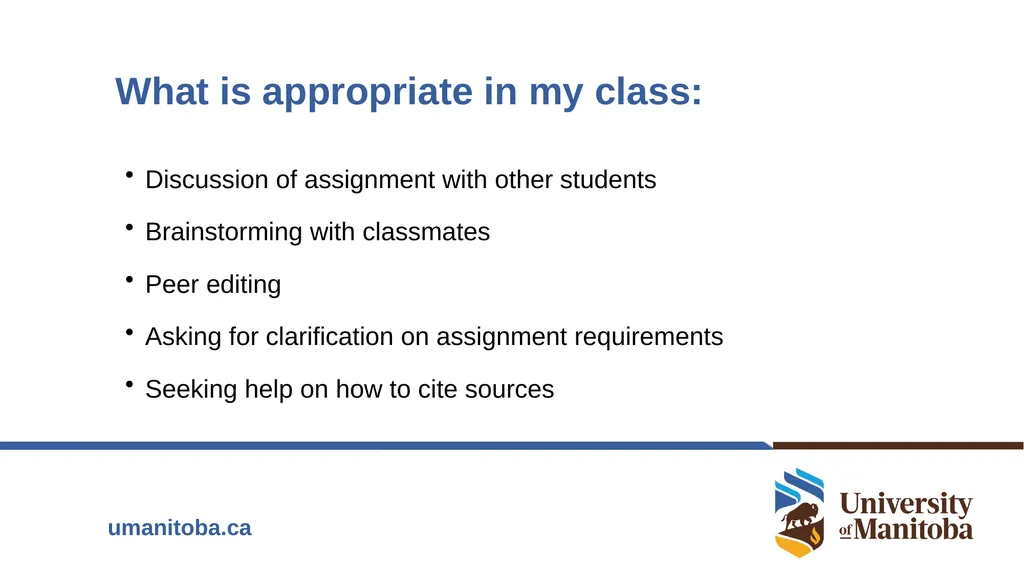
What is appropriate in my class: Discussion of assignment with other students
Brainstorming with classmates
Peer editing
Asking for clarification on assignment requirements
Seeking help on how to cite sources umanitoba.ca<br>
25
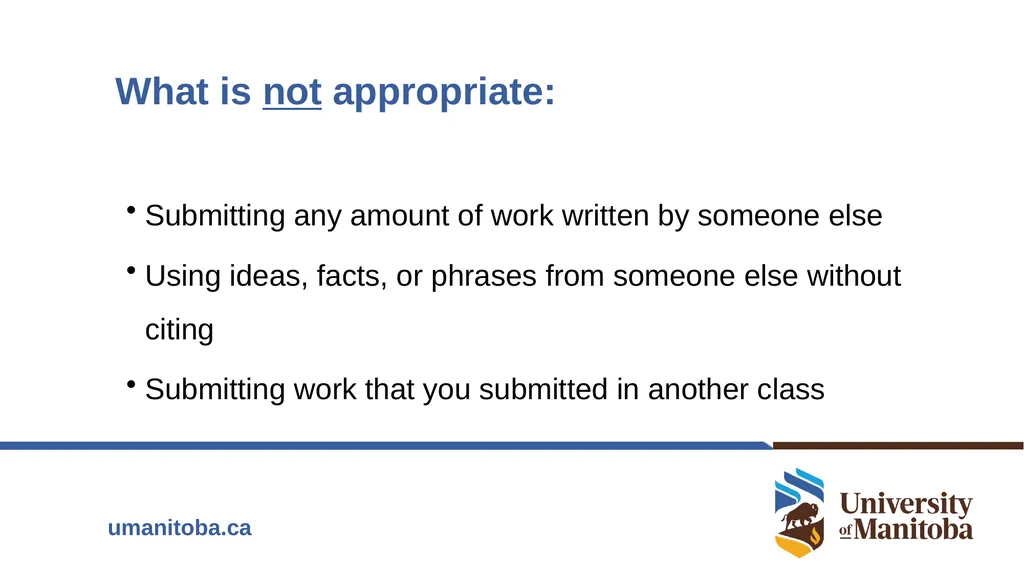
What is not appropriate: Submitting any amount of work written by someone else
Using ideas, facts, or phrases from someone else without citing
Submitting work that you submitted in another class umanitoba.ca<br>
26
Where can students get more information? umanitoba.ca<br>
27
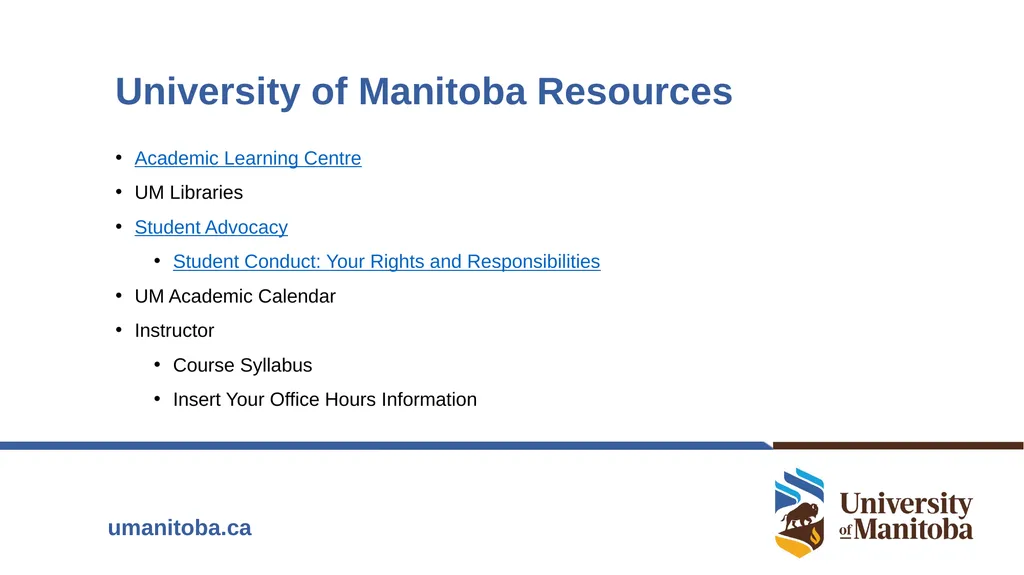
University of Manitoba Resources Academic Learning Centre
UM Libraries
Student Advocacy
Student Conduct: Your Rights and Responsibilities
UM Academic Calendar
Instructor
Course Syllabus
Insert Your Office Hours Information umanitoba.ca<br>