Aliphatic amines Anik Sinha Department of Chemistry S.B.S.Goverment College, Hili B.Sc 2nd Year(General) Overview Introduction Classifications of amines Synthesis of aliphatic amines Heinsbergs method of amine separation Grabriel
"Aliphatic amines Anik Sinha Department of" is the property of its rightful owner. Permission is granted to
download and print the materials on this website for personal, non-commercial use only, and to display it
on your personal computer provided you do not modify the materials and that you retain all copyright
notices contained in the materials. By downloading content from our website, you accept the terms of this
agreement.
Presentation Transcript
01
Aliphatic amines Anik Sinha
Department of Chemistry
S.B.S.Goverment College, Hili B.Sc 2nd Year(General)<br>
02
Overview Introduction
Classifications of amines
Synthesis of aliphatic amines
Heinsberg’s method of amine separation
Grabriel Phthalimide Synthesis
Distinction of 10, 20, 30 amines
Basicity of amines
Reference<br>
03
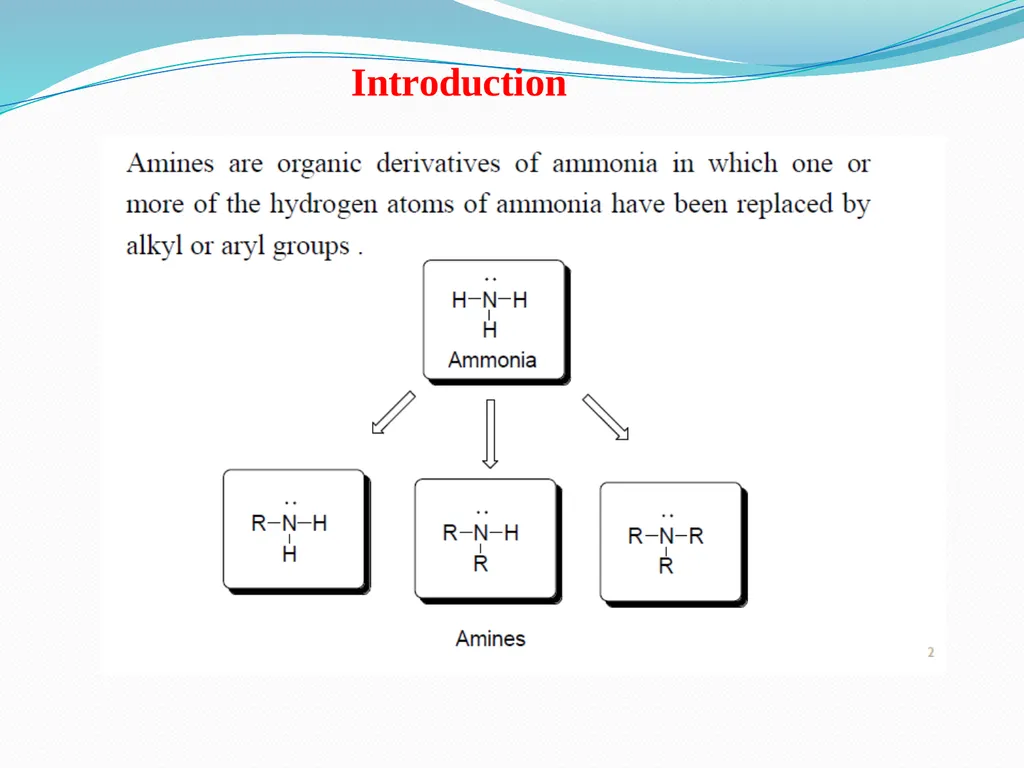
Introduction<br>
04
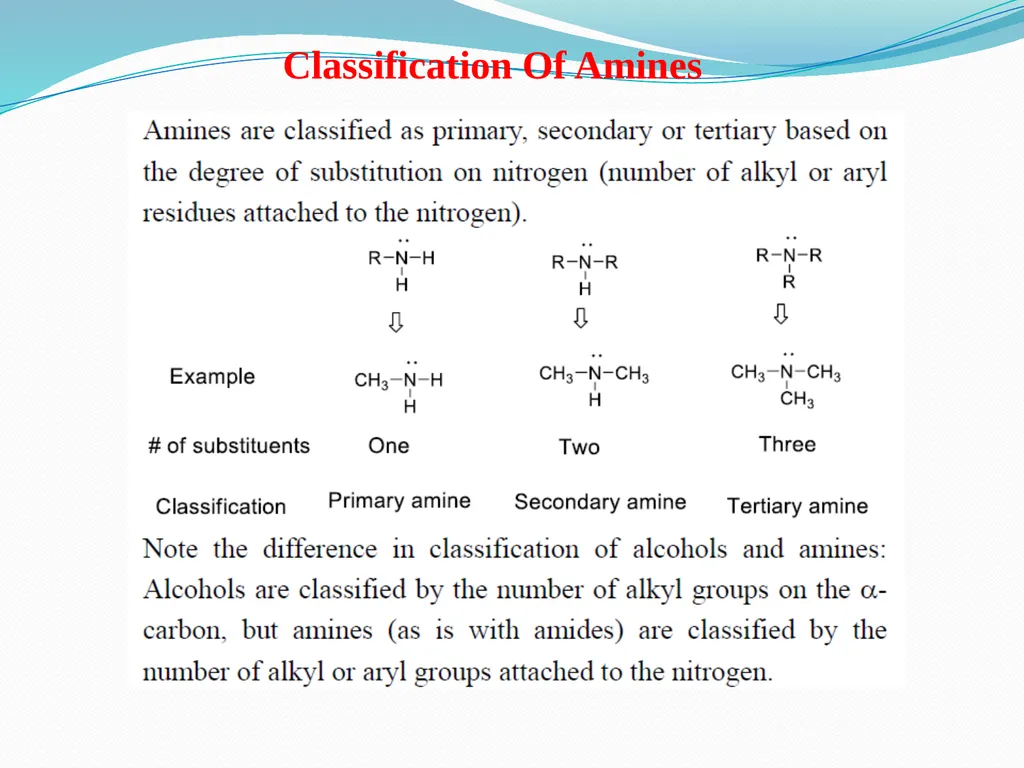
Classification Of Amines<br>
05
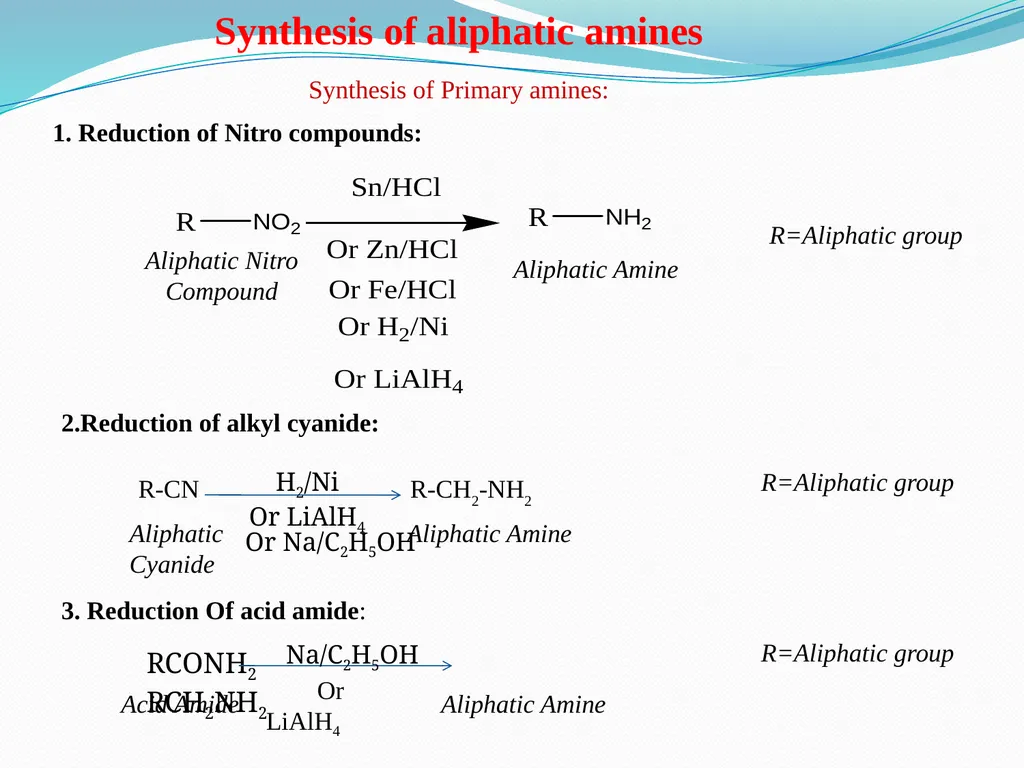
Synthesis of aliphatic amines 1. Reduction of Nitro compounds: Aliphatic Nitro
Compound Aliphatic Amine R=Aliphatic group 2.Reduction of alkyl cyanide: R-CN R-CH2-NH2 H2/Ni
Or LiAlH4 Or Na/C2H5OH 3. Reduction Of acid amide: R=Aliphatic group RCONH2 RCH2NH2 Na/C2H5OH Or LiAlH4 R=Aliphatic group Aliphatic Cyanide Aliphatic Amine Aliphatic Amine Acid Amide Synthesis of Primary amines:<br>
06
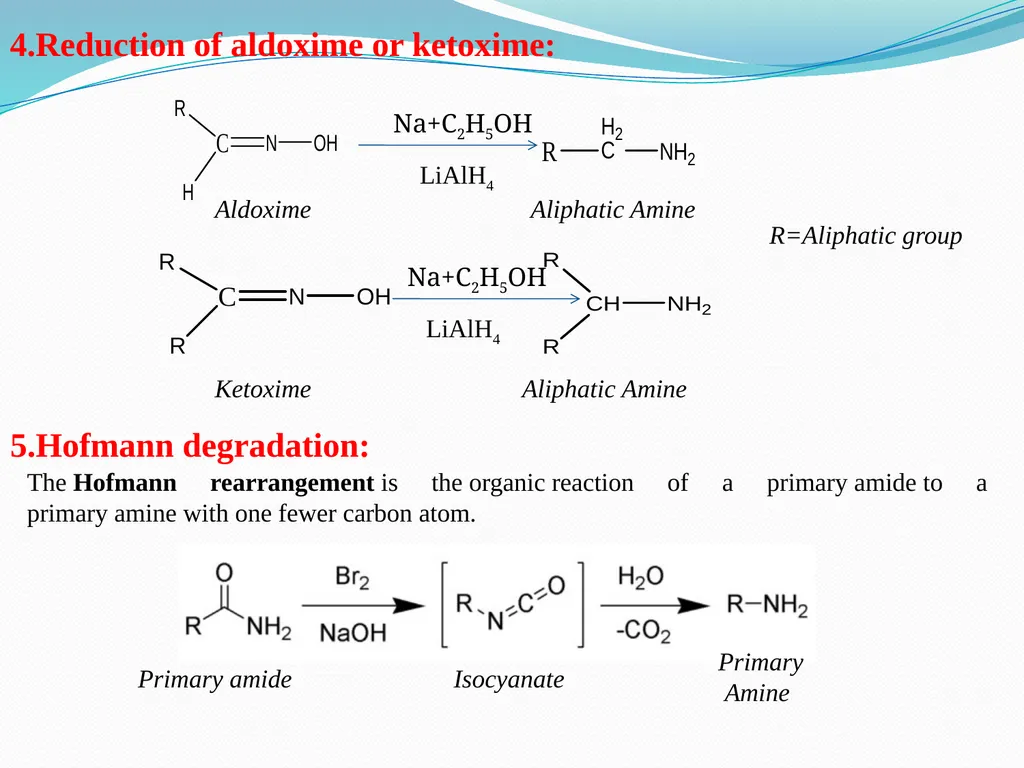
4.Reduction of aldoxime or ketoxime: Na+C2H5OH LiAlH4 Na+C2H5OH LiAlH4 Aldoxime Ketoxime Aliphatic Amine Aliphatic Amine R=Aliphatic group 5.Hofmann degradation: The Hofmann rearrangement is the organic reaction of a primary amide to a primary amine with one fewer carbon atom. Primary amide Isocyanate Primary
Amine<br>
07
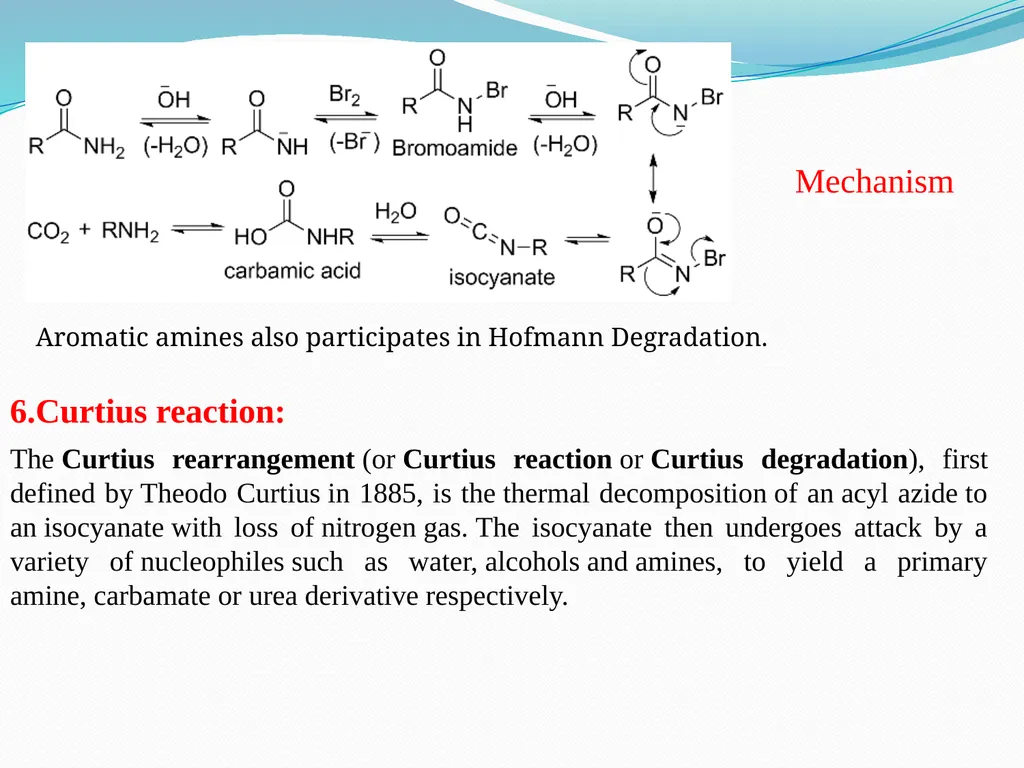
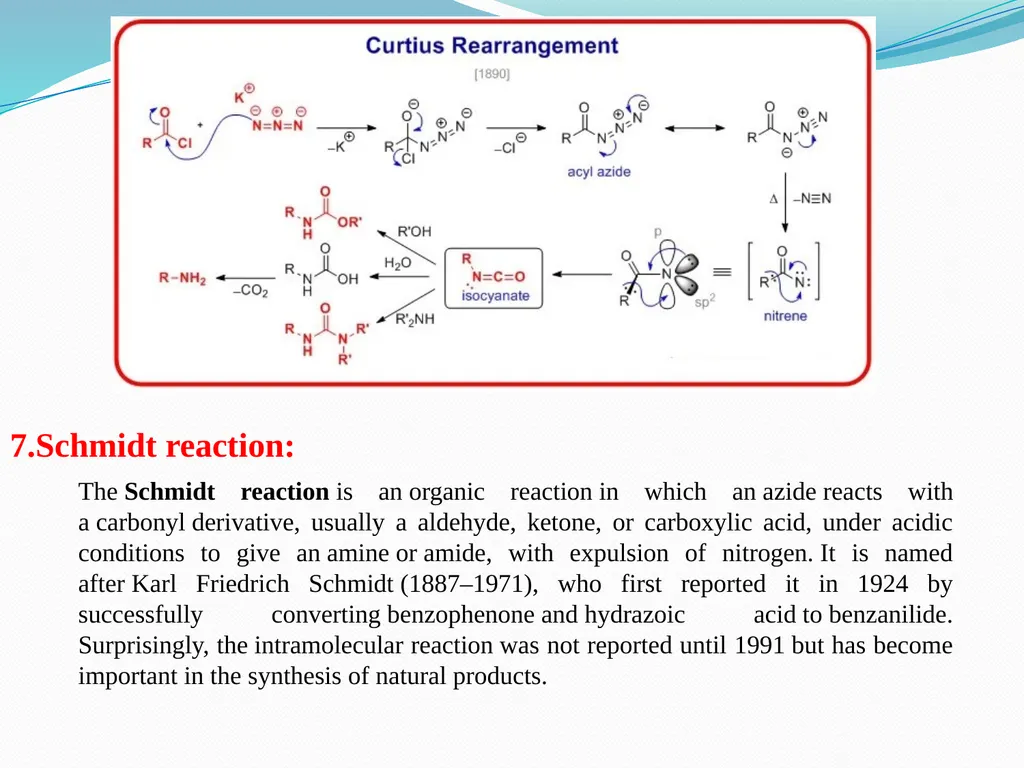
Mechanism Aromatic amines also participates in Hofmann Degradation. 6.Curtius reaction: The Curtius rearrangement (or Curtius reaction or Curtius degradation), first defined by Theodo Curtius in 1885, is the thermal decomposition of an acyl azide to an isocyanate with loss of nitrogen gas. The isocyanate then undergoes attack by a variety of nucleophiles such as water, alcohols and amines, to yield a primary amine, carbamate or urea derivative respectively.<br>
08
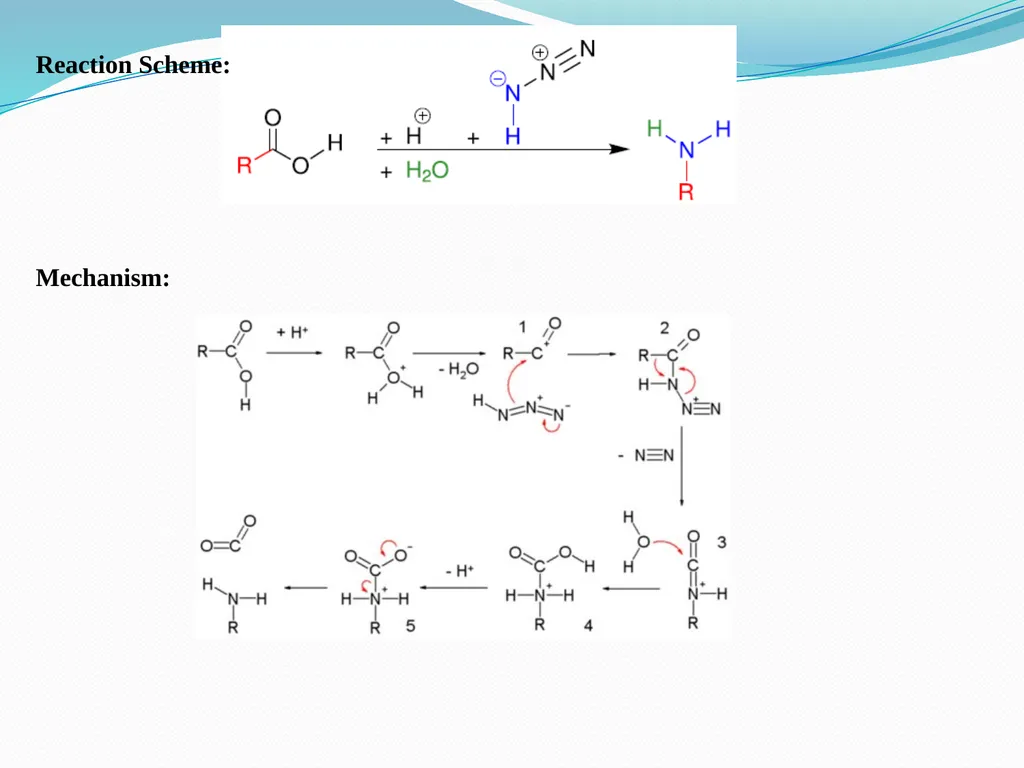
7.Schmidt reaction: The Schmidt reaction is an organic reaction in which an azide reacts with a carbonyl derivative, usually a aldehyde, ketone, or carboxylic acid, under acidic conditions to give an amine or amide, with expulsion of nitrogen. It is named after Karl Friedrich Schmidt (1887–1971), who first reported it in 1924 by successfully converting benzophenone and hydrazoic acid to benzanilide. Surprisingly, the intramolecular reaction was not reported until 1991 but has become important in the synthesis of natural products.<br>
09
Reaction Scheme: Mechanism:<br>
10
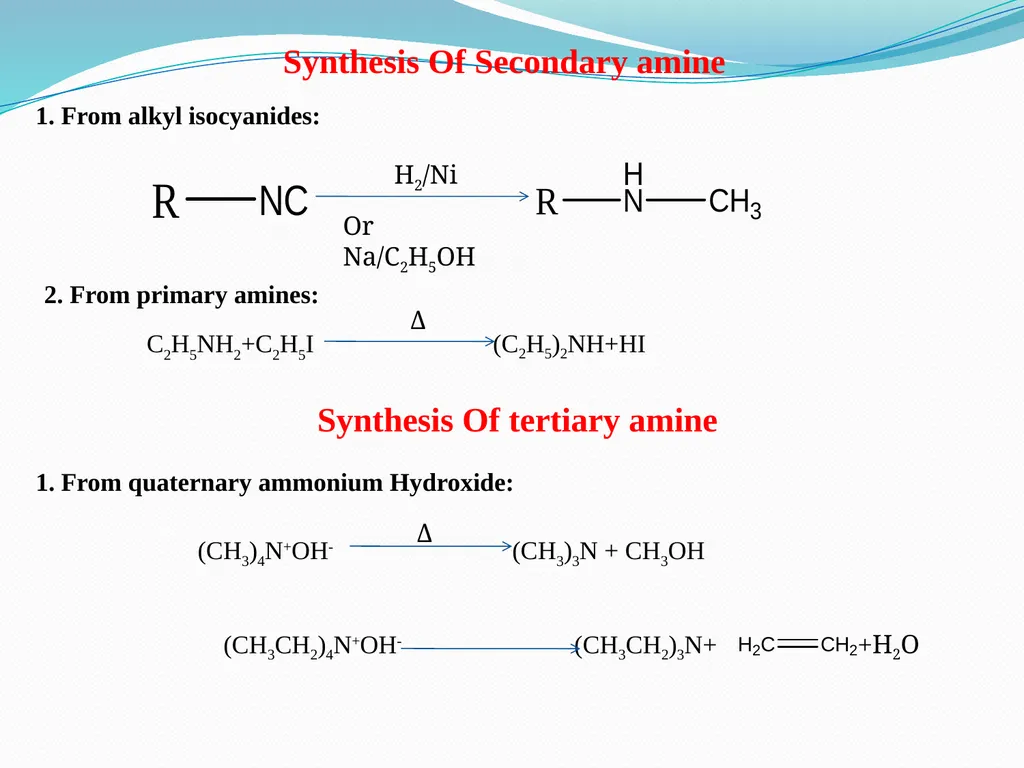
Synthesis Of Secondary amine 1. From alkyl isocyanides: H2/Ni Or Na/C2H5OH 2. From primary amines: C2H5NH2+C2H5I (C2H5)2NH+HI Δ Synthesis Of tertiary amine 1. From quaternary ammonium Hydroxide: (CH3)4N+OH- (CH3)3N + CH3OH Δ (CH3CH2)4N+OH- (CH3CH2)3N+ +H2O<br>
11
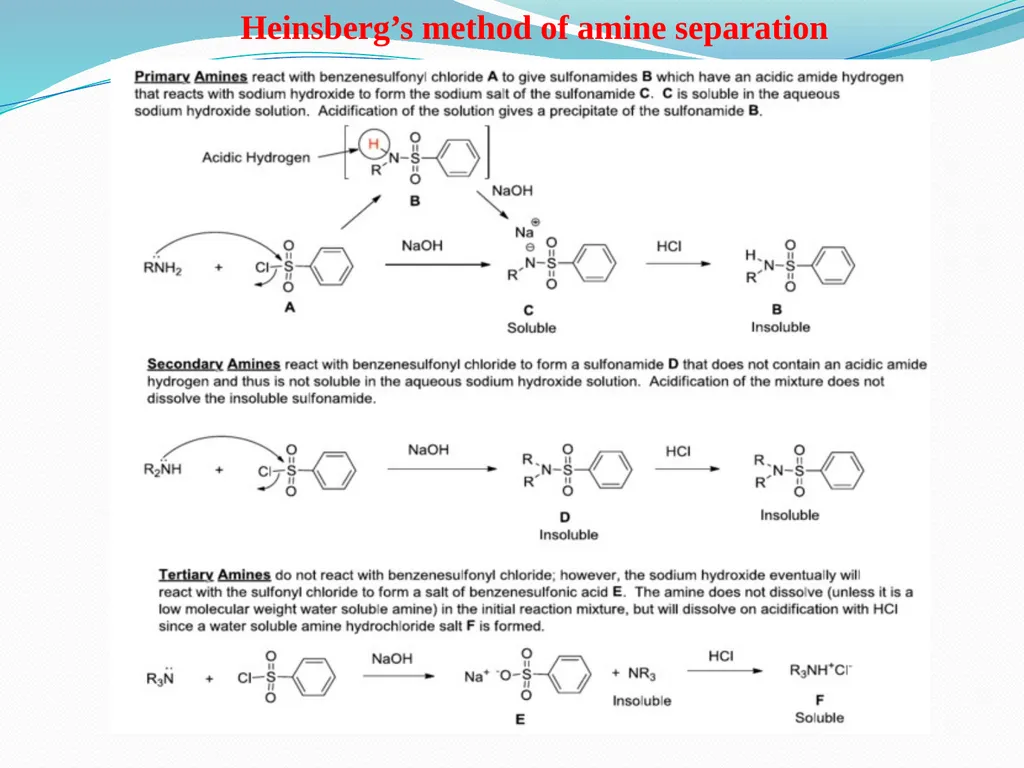
Heinsberg’s method of amine separation<br>
12
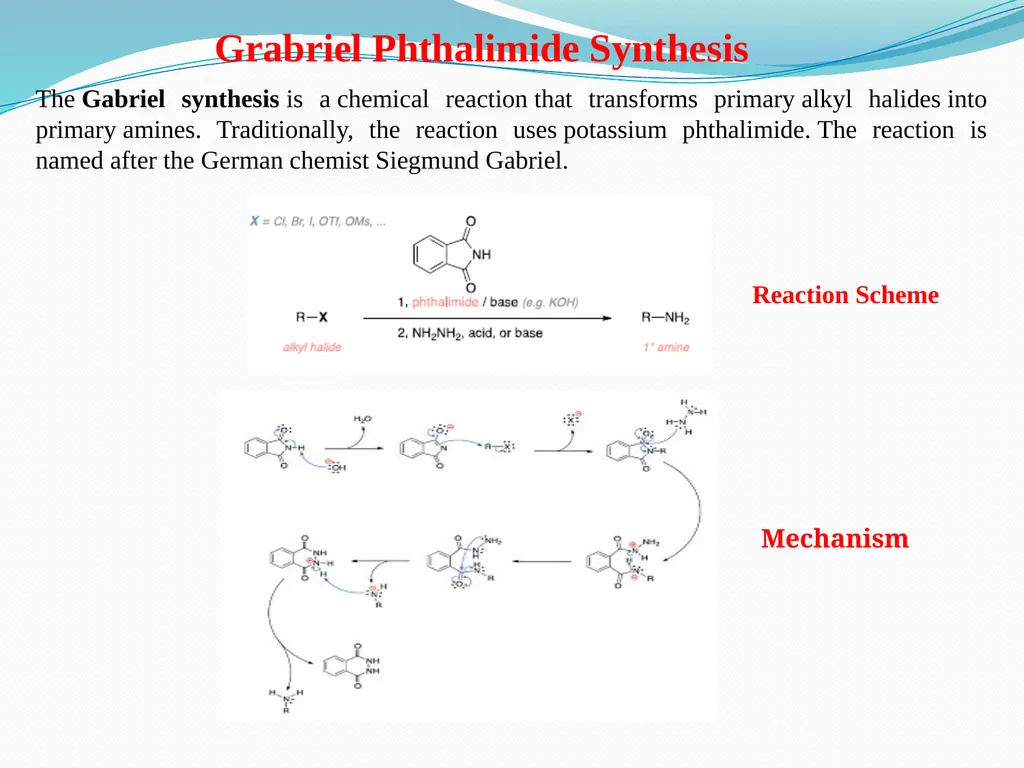
Grabriel Phthalimide Synthesis The Gabriel synthesis is a chemical reaction that transforms primary alkyl halides into primary amines. Traditionally, the reaction uses potassium phthalimide. The reaction is named after the German chemist Siegmund Gabriel. Mechanism Reaction Scheme<br>
13
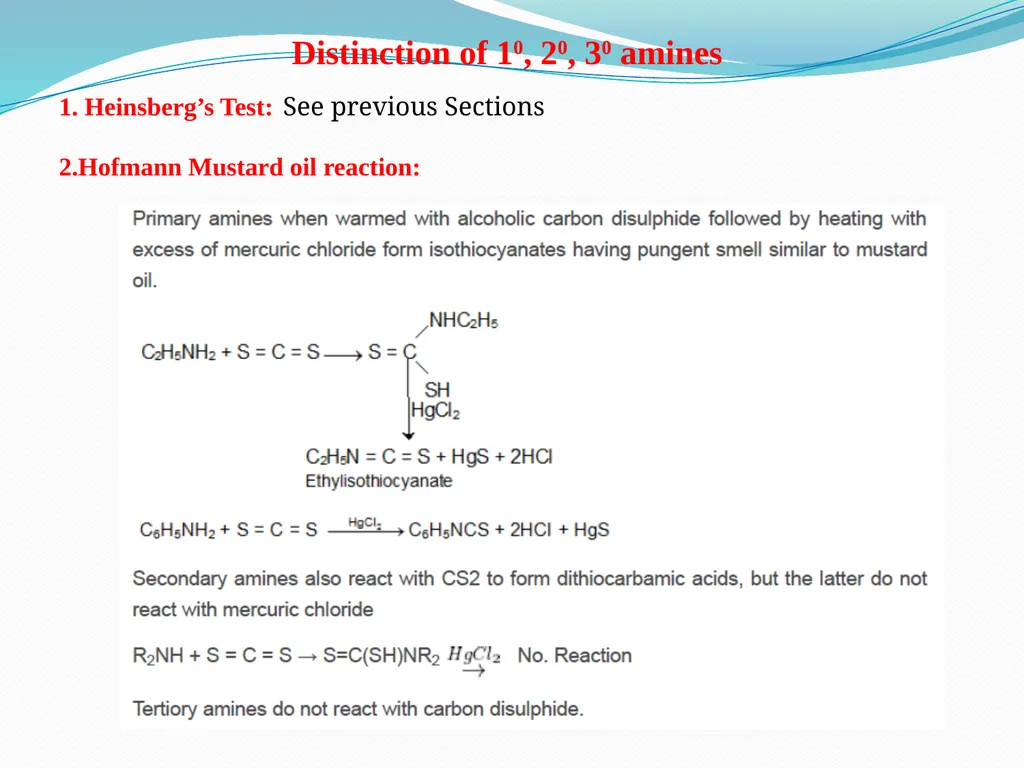
Distinction of 10, 20, 30 amines 1. Heinsberg’s Test: See previous Sections 2.Hofmann Mustard oil reaction:<br>
14
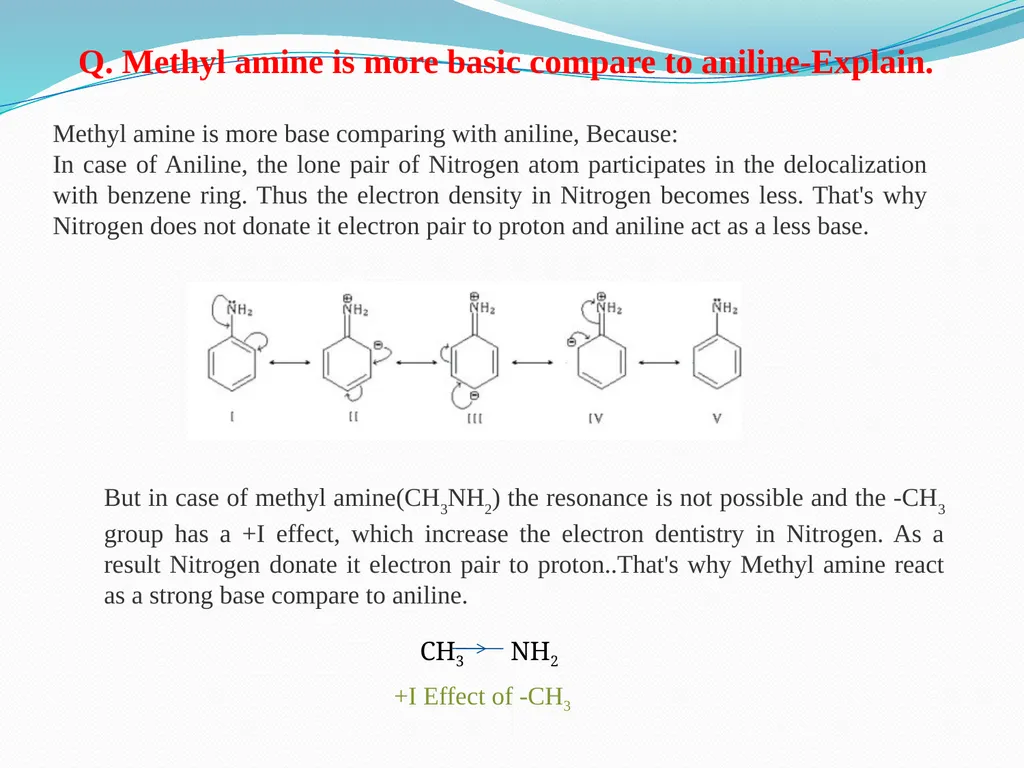
Q. Methyl amine is more basic compare to aniline-Explain. Methyl amine is more base comparing with aniline, Because:
In case of Aniline, the lone pair of Nitrogen atom participates in the delocalization with benzene ring. Thus the electron density in Nitrogen becomes less. That's why Nitrogen does not donate it electron pair to proton and aniline act as a less base. But in case of methyl amine(CH3NH2) the resonance is not possible and the -CH3 group has a +I effect, which increase the electron dentistry in Nitrogen. As a result Nitrogen donate it electron pair to proton..That's why Methyl amine react as a strong base compare to aniline. CH3 NH2 +I Effect of -CH3<br>
15
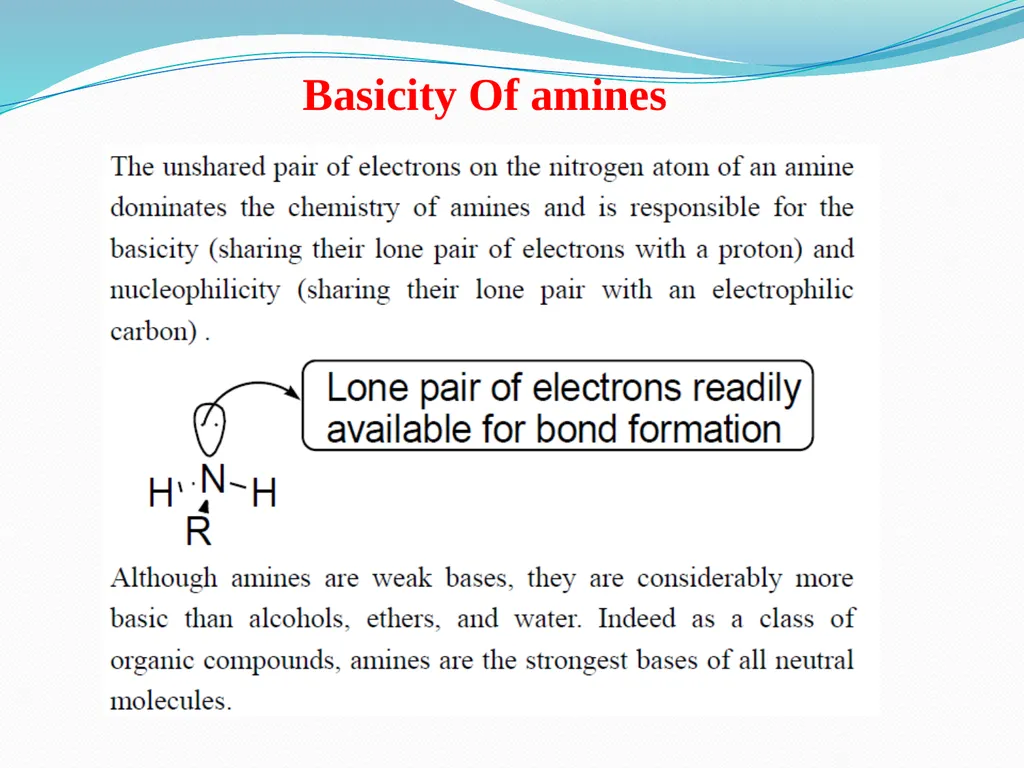
Basicity Of amines<br>
16
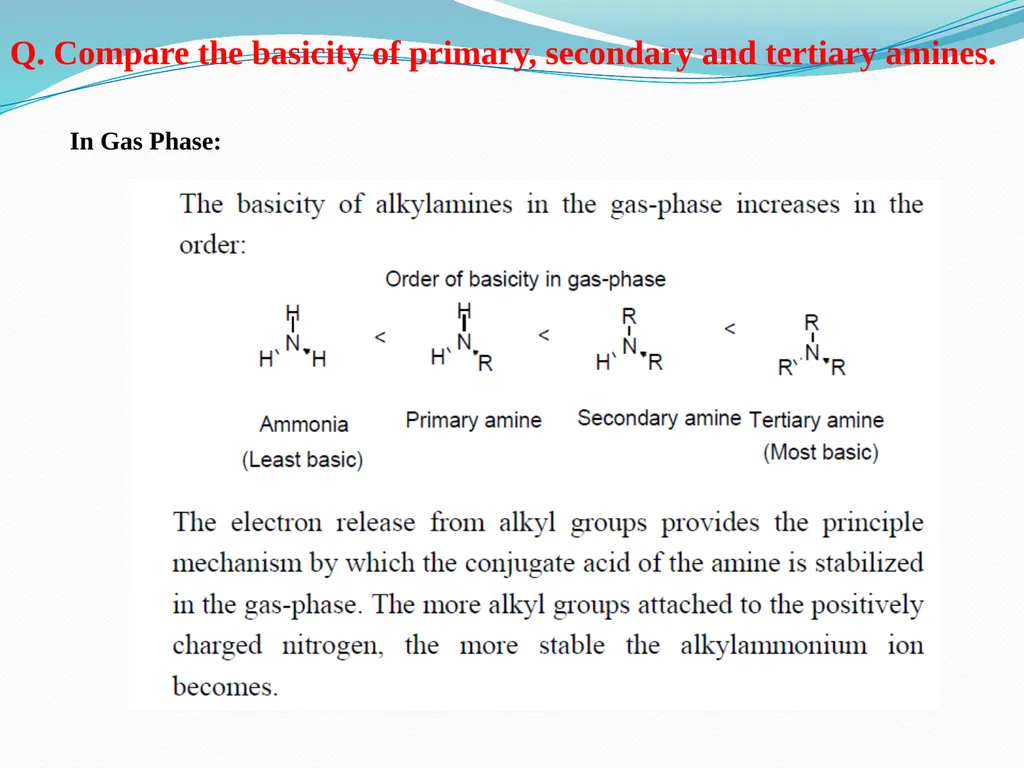
Q. Compare the basicity of primary, secondary and tertiary amines. In Gas Phase:<br>
17
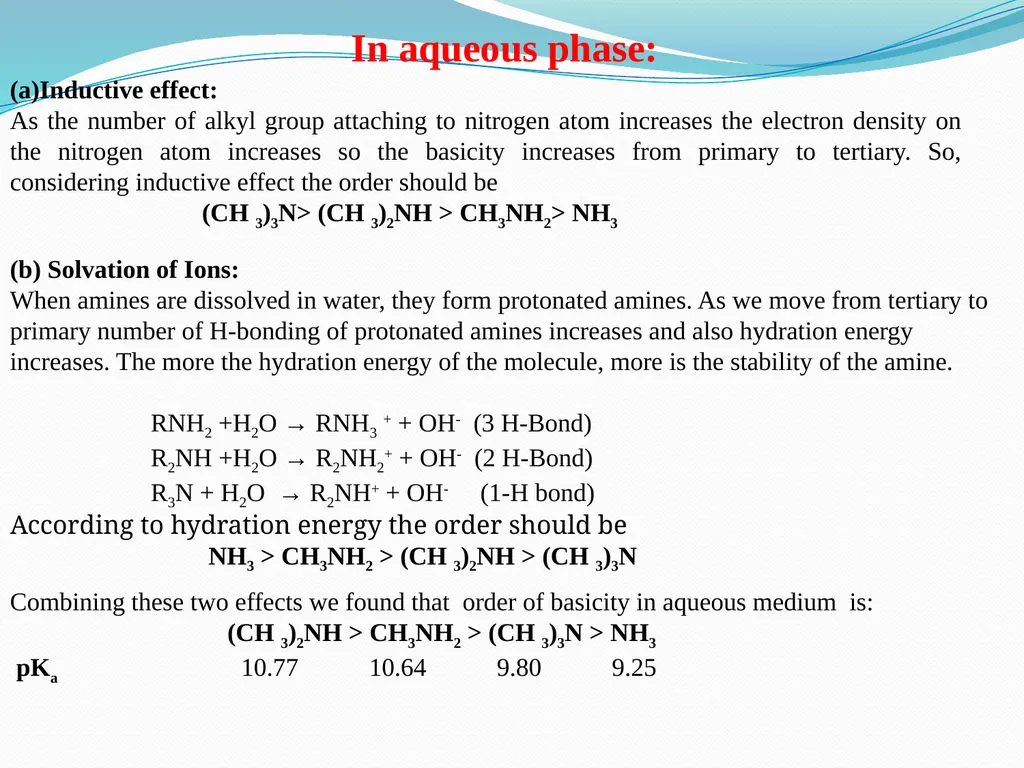
In aqueous phase: Combining these two effects we found that order of basicity in aqueous medium is: (CH 3)2NH > CH3NH2 > (CH 3)3N > NH3 pKa 10.77 10.64 9.80 9.25 (a)Inductive effect:
As the number of alkyl group attaching to nitrogen atom increases the electron density on the nitrogen atom increases so the basicity increases from primary to tertiary. So, considering inductive effect the order should be
(CH 3)3N> (CH 3)2NH > CH3NH2> NH3 (b) Solvation of Ions:
When amines are dissolved in water, they form protonated amines. As we move from tertiary to primary number of H-bonding of protonated amines increases and also hydration energy increases. The more the hydration energy of the molecule, more is the stability of the amine. RNH2 +H2O → RNH3 + + OH- (3 H-Bond) R2NH +H2O → R2NH2+ + OH- (2 H-Bond) R3N + H2O → R2NH+ + OH- (1-H bond) According to hydration energy the order should be
NH3 > CH3NH2 > (CH 3)2NH > (CH 3)3N<br>
18
Reference 1.Organic Chemistry by I.L.Finar
2.Organic Chemistry by Morrison and Boyd.
3.Advance organic chemistry by bahl & bahl.
4.Organic Chemistry by Brucee.
5.Organic chemistry by R.L.Madan
6.A guidebook to Mechanism in Organic chmeistry by P.Sykes
7.Wikipidea<br>