
An Asymmetric Distributed Shared Memory Model for


Description: An Asymmetric Distributed Shared Memory Model for Heterogeneous Parallel Systems Isaac Gelado, Javier Cabezas. John Stone, Sanjay Patel, Nacho Navarro and Wen-mei Hwu 3172010 ASPLOS 2010 -- Pittsburgh 1 1. Introduction: Heterogeneous
Related Topics
Download Presentation
"An Asymmetric Distributed Shared Memory Model for" is the property of its rightful owner. Permission is granted to download and print the materials on this website for personal, non-commercial use only, and to display it on your personal computer provided you do not modify the materials and that you retain all copyright notices contained in the materials. By downloading content from our website, you accept the terms of this agreement.
Presentation Transcript
slide1. An Asymmetric Distributed Shared Memory Model for Heterogeneous Parallel Systems Isaac Gelado, Javier Cabezas. John Stone,
Sanjay Patel, Nacho Navarro and Wen-mei Hwu 3/17/2010 ASPLOS 2010 -- Pittsburgh 1<br>
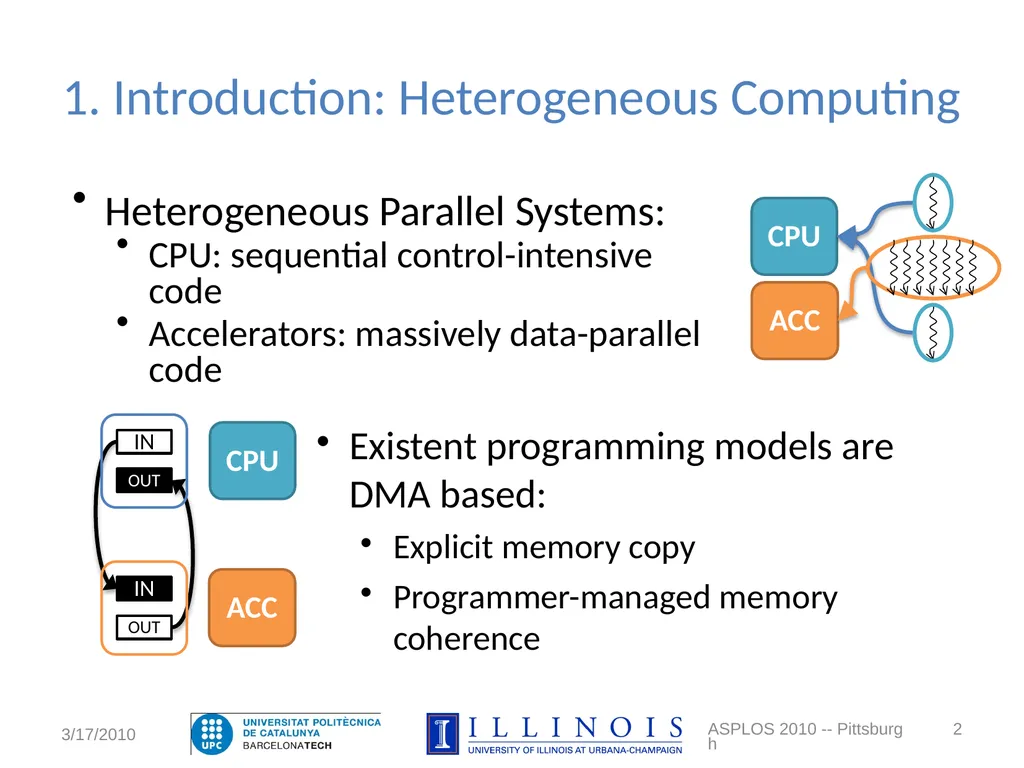
slide2. 1. Introduction: Heterogeneous Computing 3/17/2010 ASPLOS 2010 -- Pittsburgh 2 Heterogeneous Parallel Systems:
CPU: sequential control-intensive code
Accelerators: massively data-parallel code CPU ACC Existent programming models are DMA based:
Explicit memory copy
Programmer-managed memory coherence<br>
slide3. Outline Introduction
Motivation
ADSM: Asymmetric Distributed Shared Memory
GMAC: Global Memory for ACcelerators
Experimental Results
Conclusions 3/17/2010 ASPLOS 2010 -- Pittsburgh 3<br>
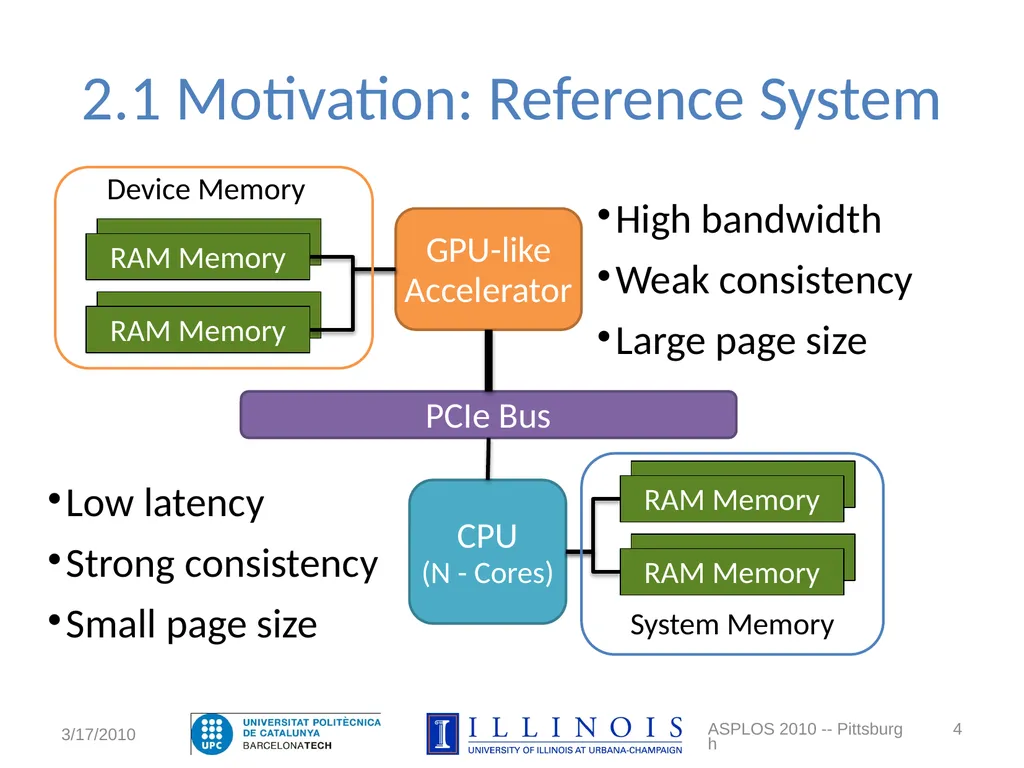
slide4. 2.1 Motivation: Reference System 3/17/2010 ASPLOS 2010 -- Pittsburgh CPU
(N - Cores) PCIe Bus GPU-like
Accelerator 4 High bandwidth
Weak consistency
Large page size Low latency
Strong consistency
Small page size Device Memory System Memory<br>
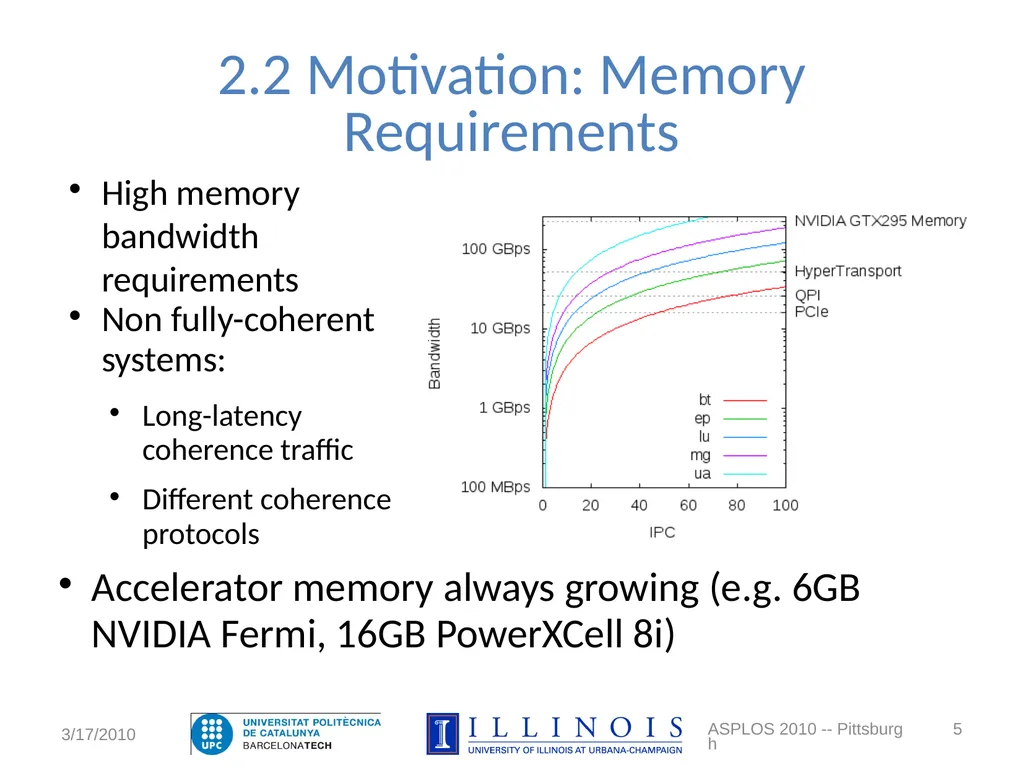
slide5. 2.2 Motivation: Memory Requirements High memory bandwidth requirements
Non fully-coherent systems:
Long-latency coherence traffic
Different coherence protocols Accelerator memory always growing (e.g. 6GB NVIDIA Fermi, 16GB PowerXCell 8i) 3/17/2010 ASPLOS 2010 -- Pittsburgh 5<br>
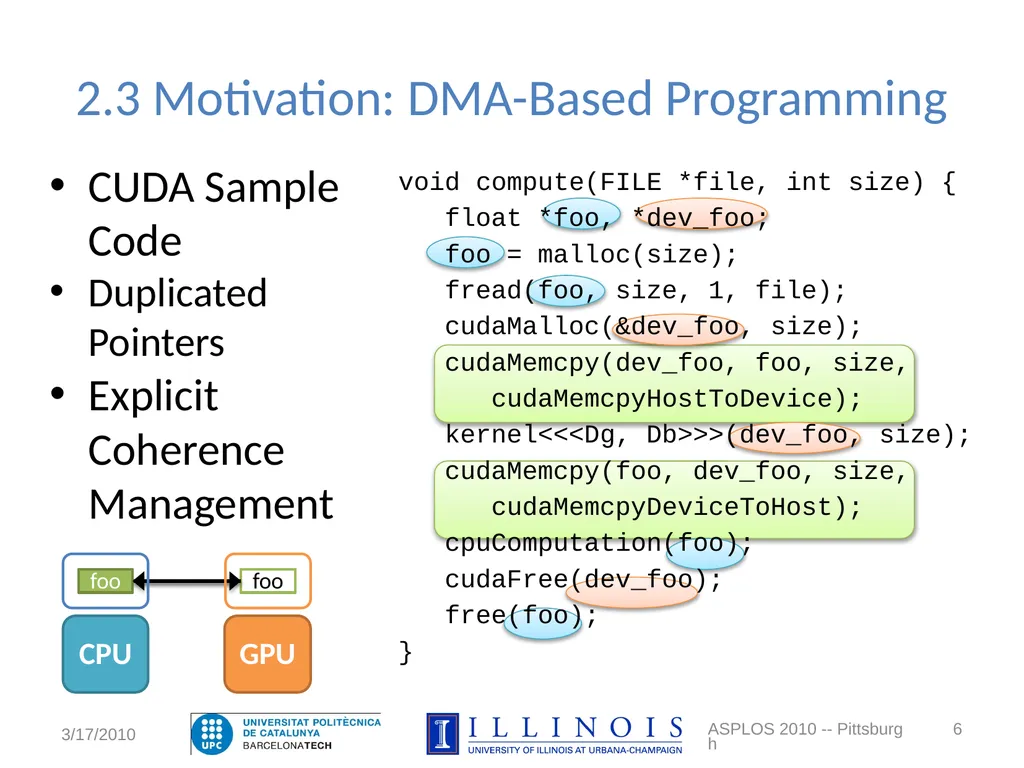
slide6. 2.3 Motivation: DMA-Based Programming 3/17/2010 ASPLOS 2010 -- Pittsburgh 6 Duplicated Pointers Explicit Coherence Management CUDA Sample Code CPU GPU void compute(FILE *file, int size) {
float *foo, *dev_foo;
foo = malloc(size);
fread(foo, size, 1, file);
cudaMalloc(&dev_foo, size);
cudaMemcpy(dev_foo, foo, size,
cudaMemcpyHostToDevice);
kernel<<<Dg, Db>>>(dev_foo, size);
cudaMemcpy(foo, dev_foo, size,
cudaMemcpyDeviceToHost);
cpuComputation(foo);
cudaFree(dev_foo);
free(foo);
}<br>
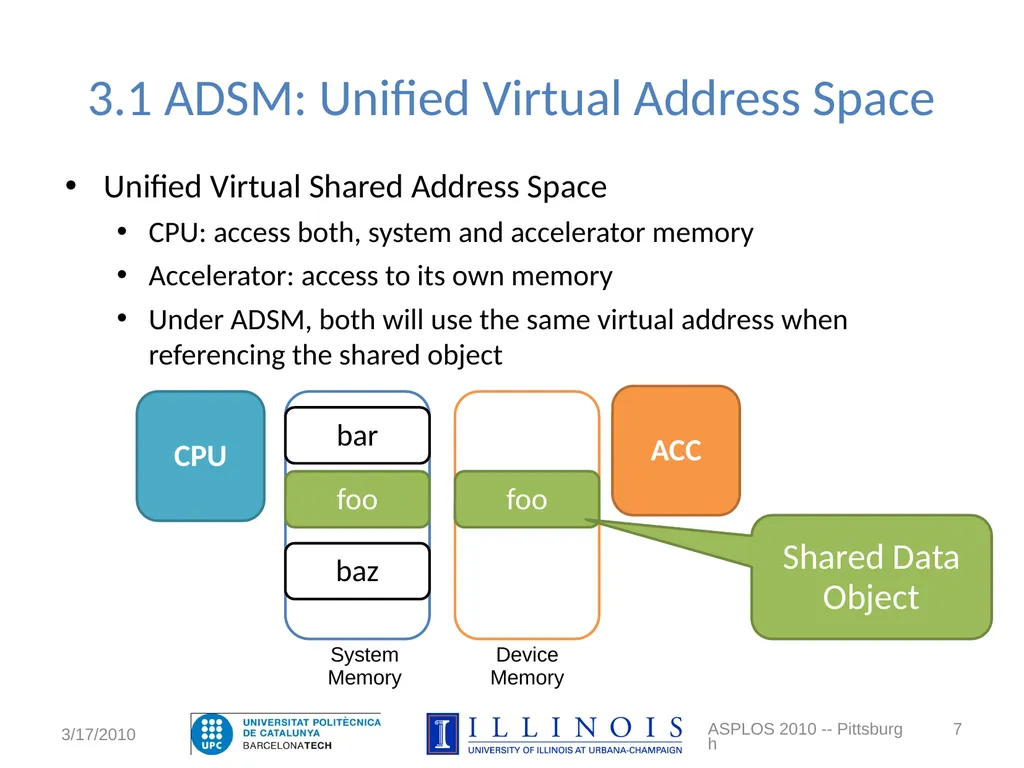
slide7. 3.1 ADSM: Unified Virtual Address Space Unified Virtual Shared Address Space
CPU: access both, system and accelerator memory
Accelerator: access to its own memory
Under ADSM, both will use the same virtual address when referencing the shared object CPU ACC Shared Data
Object 3/17/2010 ASPLOS 2010 -- Pittsburgh 7 System Memory Device Memory<br>
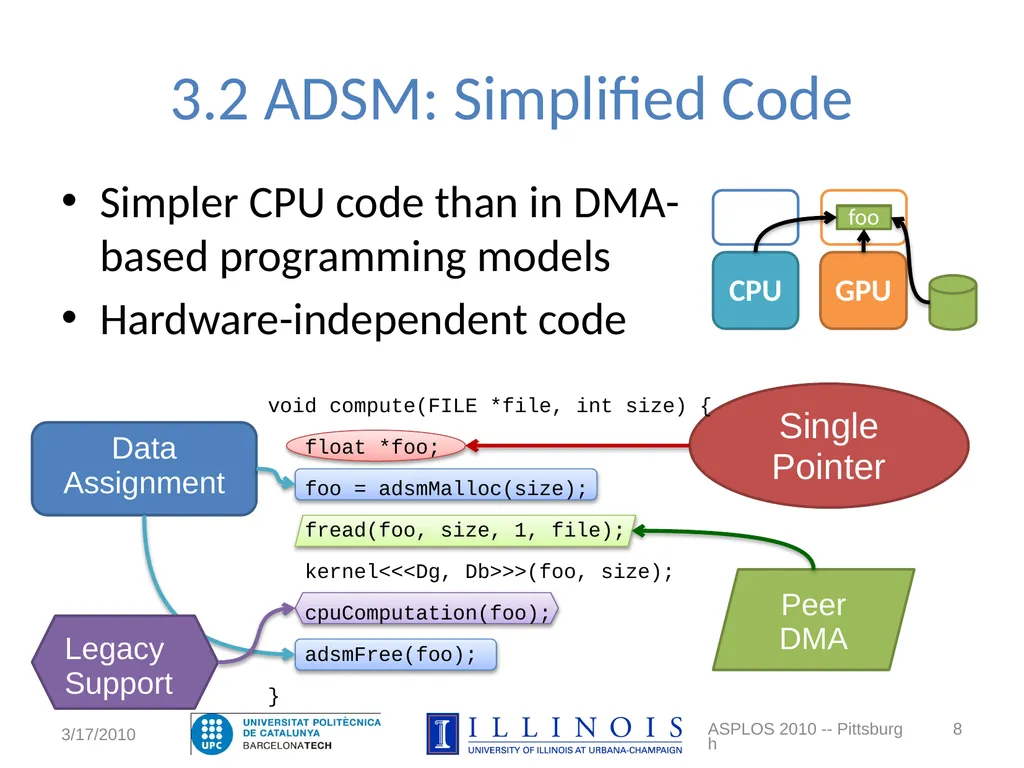
slide8. 3.2 ADSM: Simplified Code Simpler CPU code than in DMA-based programming models
Hardware-independent code Single Pointer Data
Assignment Peer DMA Legacy Support 3/17/2010 ASPLOS 2010 -- Pittsburgh 8 void compute(FILE *file, int size) {
float *foo;
foo = adsmMalloc(size);
fread(foo, size, 1, file);
kernel<<<Dg, Db>>>(foo, size);
cpuComputation(foo);
adsmFree(foo);
}<br>
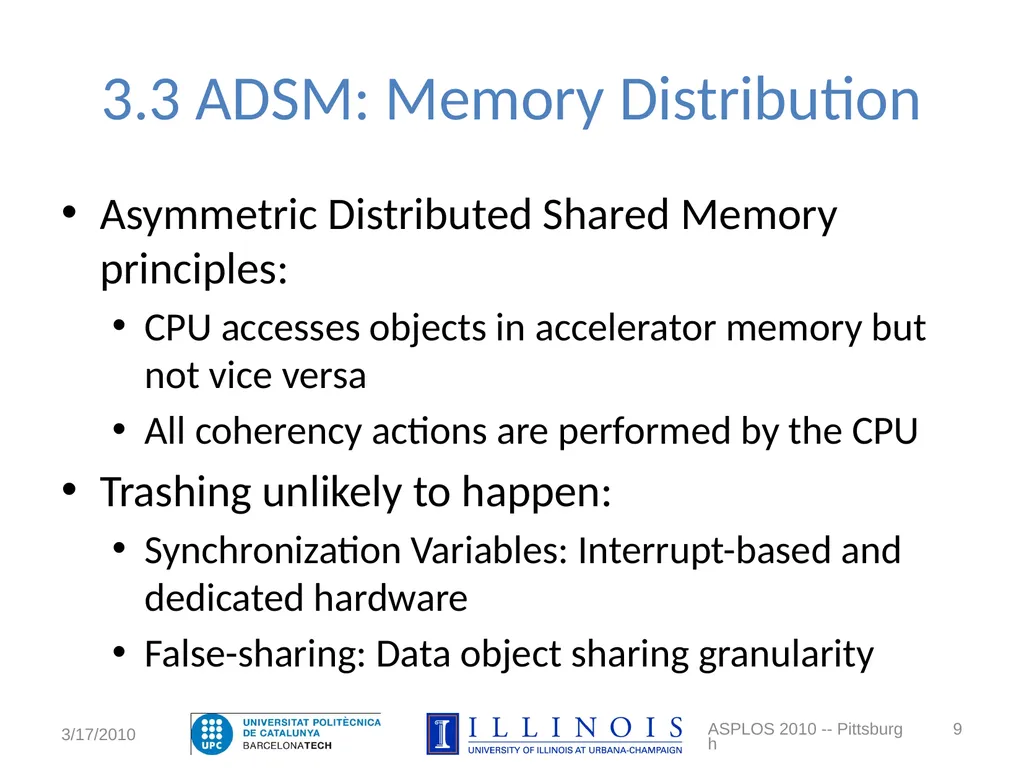
slide9. 3.3 ADSM: Memory Distribution Asymmetric Distributed Shared Memory principles:
CPU accesses objects in accelerator memory but not vice versa
All coherency actions are performed by the CPU
Trashing unlikely to happen:
Synchronization Variables: Interrupt-based and dedicated hardware
False-sharing: Data object sharing granularity 3/17/2010 ASPLOS 2010 -- Pittsburgh 9<br>
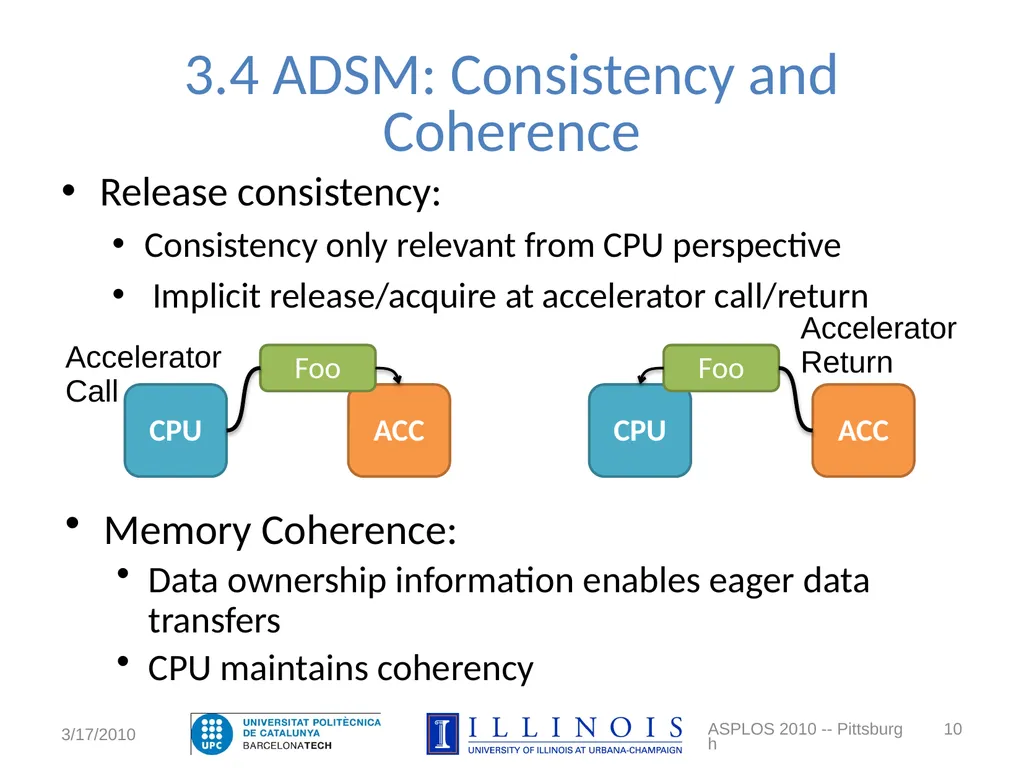
slide10. 3.4 ADSM: Consistency and Coherence Release consistency:
Consistency only relevant from CPU perspective
Implicit release/acquire at accelerator call/return Accelerator
Return Accelerator
Call 3/17/2010 ASPLOS 2010 -- Pittsburgh 10 Memory Coherence:
Data ownership information enables eager data transfers
CPU maintains coherency<br>
slide11. 4. Global Memory for Accelerators ADSM implementation
User-level shared library
GNU / Linux Systems
NVIDIA CUDA GPUs 3/17/2010 ASPLOS 2010 -- Pittsburgh 11<br>
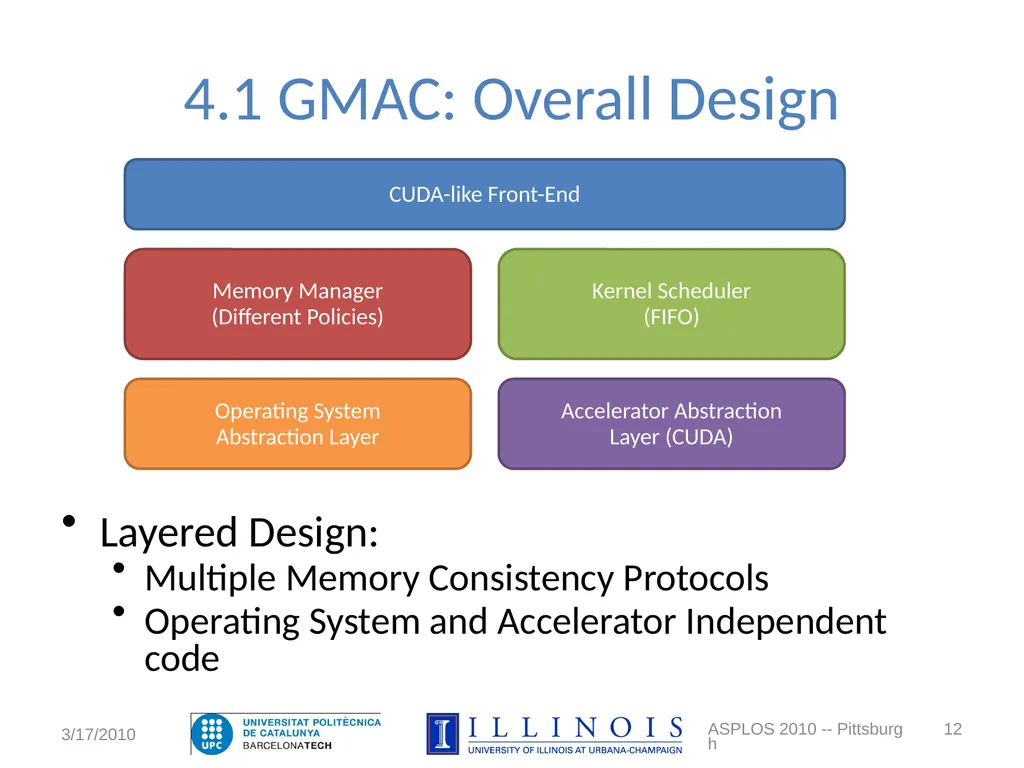
slide12. 4.1 GMAC: Overall Design Layered Design:
Multiple Memory Consistency Protocols
Operating System and Accelerator Independent code 3/17/2010 ASPLOS 2010 -- Pittsburgh 12<br>
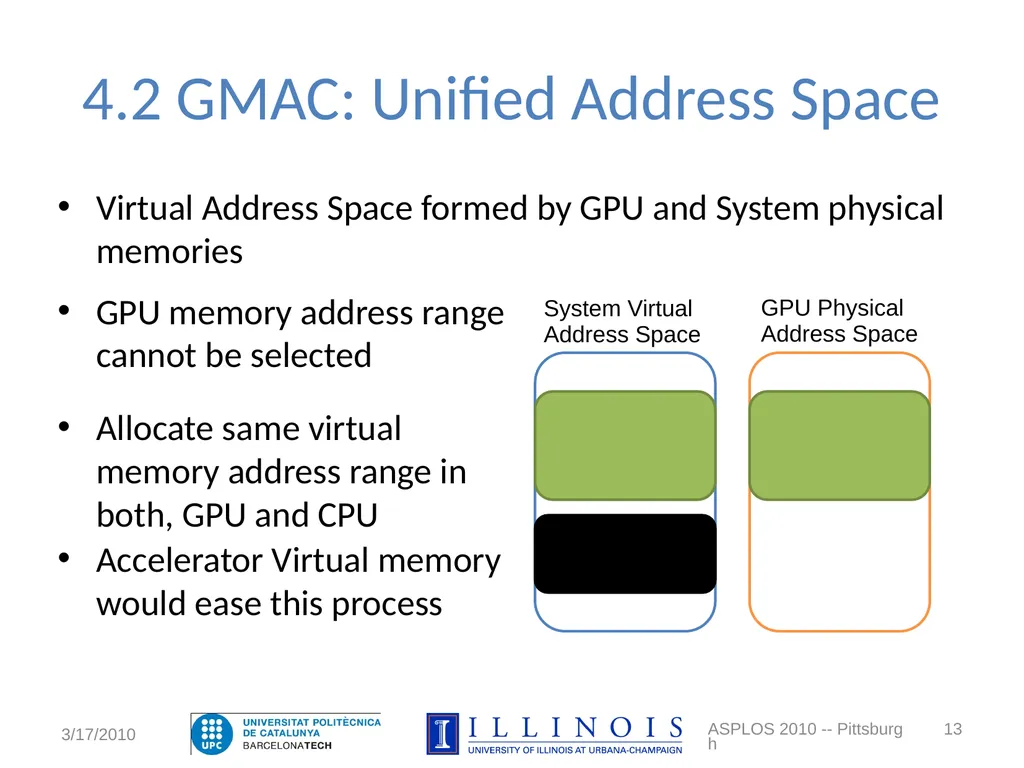
slide13. 4.2 GMAC: Unified Address Space System Virtual
Address Space GPU Physical
Address Space 3/17/2010 ASPLOS 2010 -- Pittsburgh 13 Virtual Address Space formed by GPU and System physical memories GPU memory address range cannot be selected Allocate same virtual memory address range in both, GPU and CPU Accelerator Virtual memory would ease this process<br>
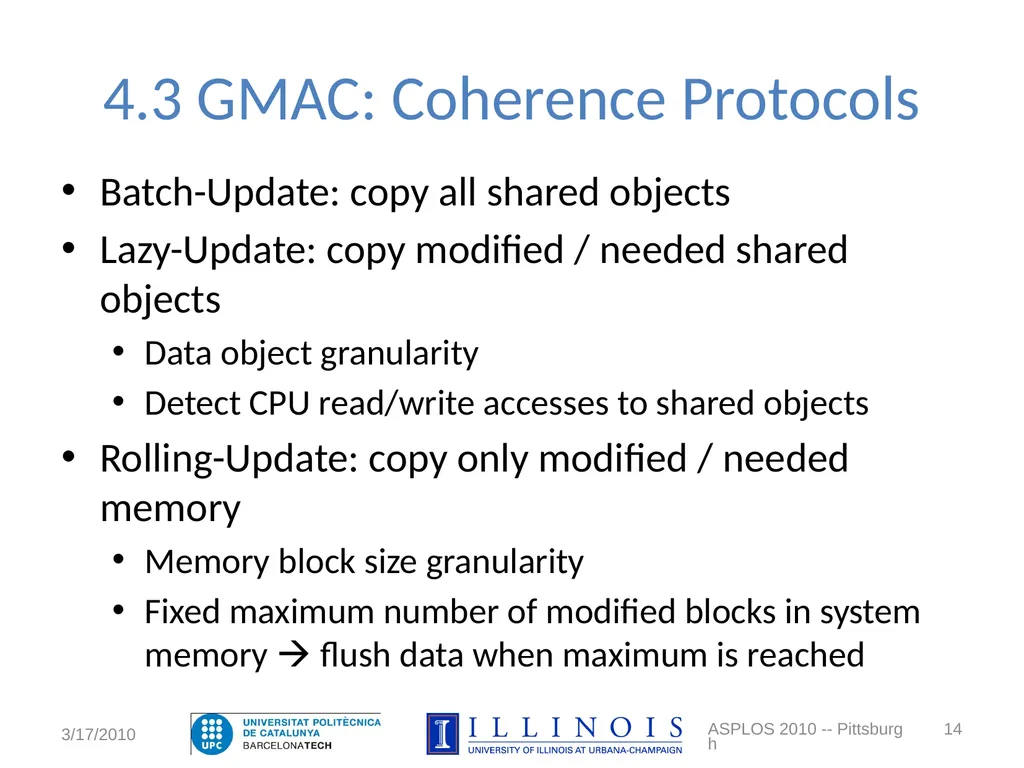
slide14. Batch-Update: copy all shared objects
Lazy-Update: copy modified / needed shared objects
Data object granularity
Detect CPU read/write accesses to shared objects
Rolling-Update: copy only modified / needed memory
Memory block size granularity
Fixed maximum number of modified blocks in system memory flush data when maximum is reached 4.3 GMAC: Coherence Protocols 3/17/2010 ASPLOS 2010 -- Pittsburgh 14<br>
slide15. 5.1 Results: GMAC vs. CUDA 3/17/2010 ASPLOS 2010 -- Pittsburgh 15 Batch-Update overheads:
Copy output data on call
Copy non-used data
Similar performance for CUDA, Lazy-Update and Rolling-Update<br>
slide16. 5.2 Results: Lazy vs. Rolling on 3D Stencil Extra data copy for small data objects
Trade-off between bandwidth and page fault overhead 3/17/2010 ASPLOS 2010 -- Pittsburgh 16<br>
slide17. 6. Conclusions Unified virtual shared address space simplifies programming of heterogeneous systems
Asymmetric Distributed Shared Memory
CPU access accelerator memory but not vice versa
Coherence actions only executed by CPU
Experimental results shows no performance degradation
Memory translation in accelerators is key to efficient implement ADSM 3/17/2010 ASPLOS 2010 -- Pittsburgh 17<br>
slide18. Thank you for your attention Eager to start using GMAC?
http://code.google.com/p/adsm/
igelado@ac.upc.edu
adsm-users@googlegroups.com 3/17/2010 18 ASPLOS 2010 -- Pittsburgh<br>
slide19. Backup Slides 3/17/2010 ASPLOS 2010 -- Pittsburgh 19<br>
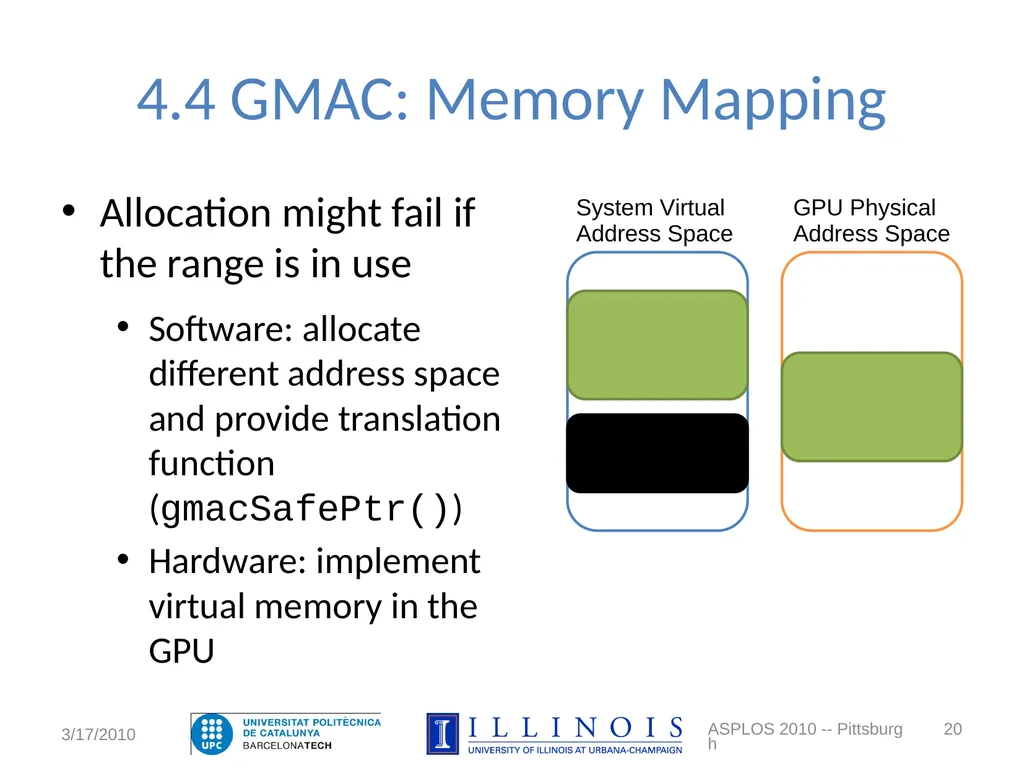
slide20. 4.4 GMAC: Memory Mapping Software: allocate different address space and provide translation function (gmacSafePtr())
Hardware: implement virtual memory in the GPU 3/17/2010 ASPLOS 2010 -- Pittsburgh 20 System Virtual
Address Space GPU Physical
Address Space Allocation might fail if the range is in use<br>
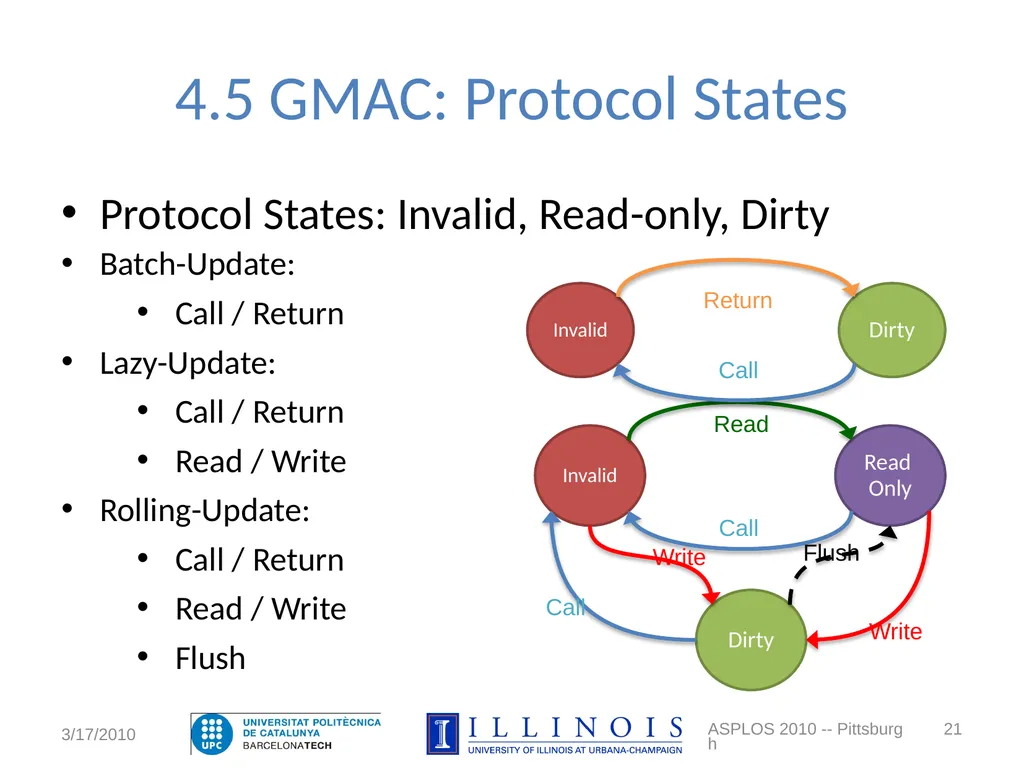
slide21. 4.5 GMAC: Protocol States Protocol States: Invalid, Read-only, Dirty 3/17/2010 ASPLOS 2010 -- Pittsburgh 21 Batch-Update:
Call / Return
Lazy-Update:
Call / Return
Read / Write
Rolling-Update:
Call / Return
Read / Write
Flush<br>
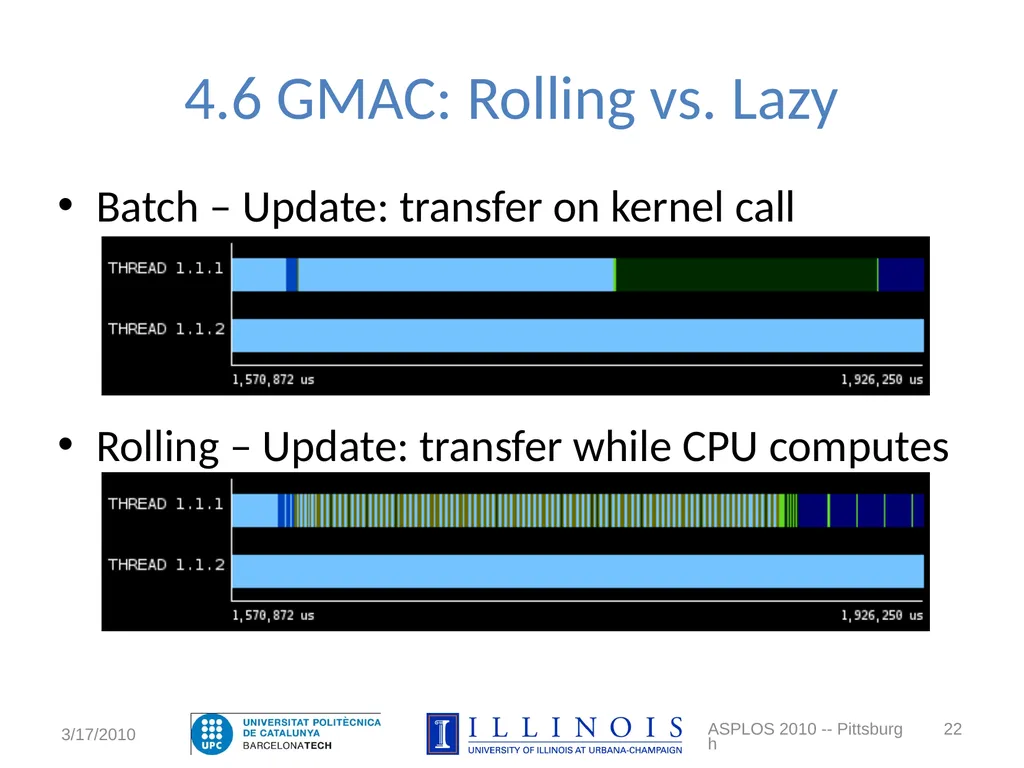
slide22. 4.6 GMAC: Rolling vs. Lazy 3/17/2010 ASPLOS 2010 -- Pittsburgh 22 Batch – Update: transfer on kernel call Rolling – Update: transfer while CPU computes<br>
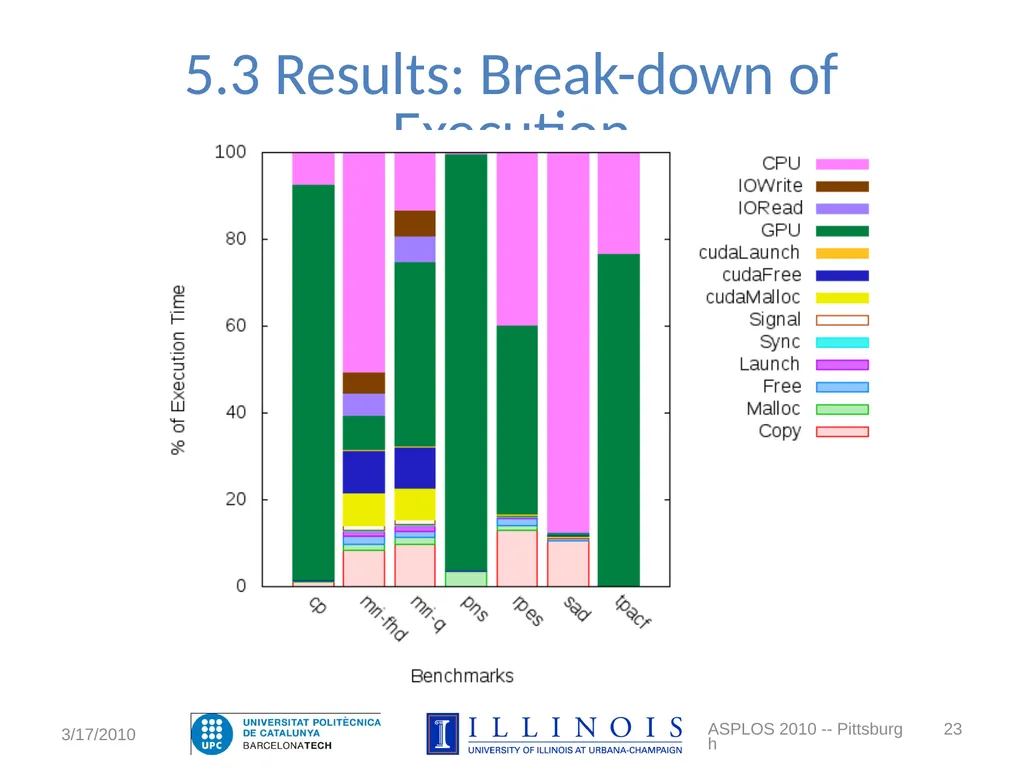
slide23. 5.3 Results: Break-down of Execution 3/17/2010 ASPLOS 2010 -- Pittsburgh 23<br>
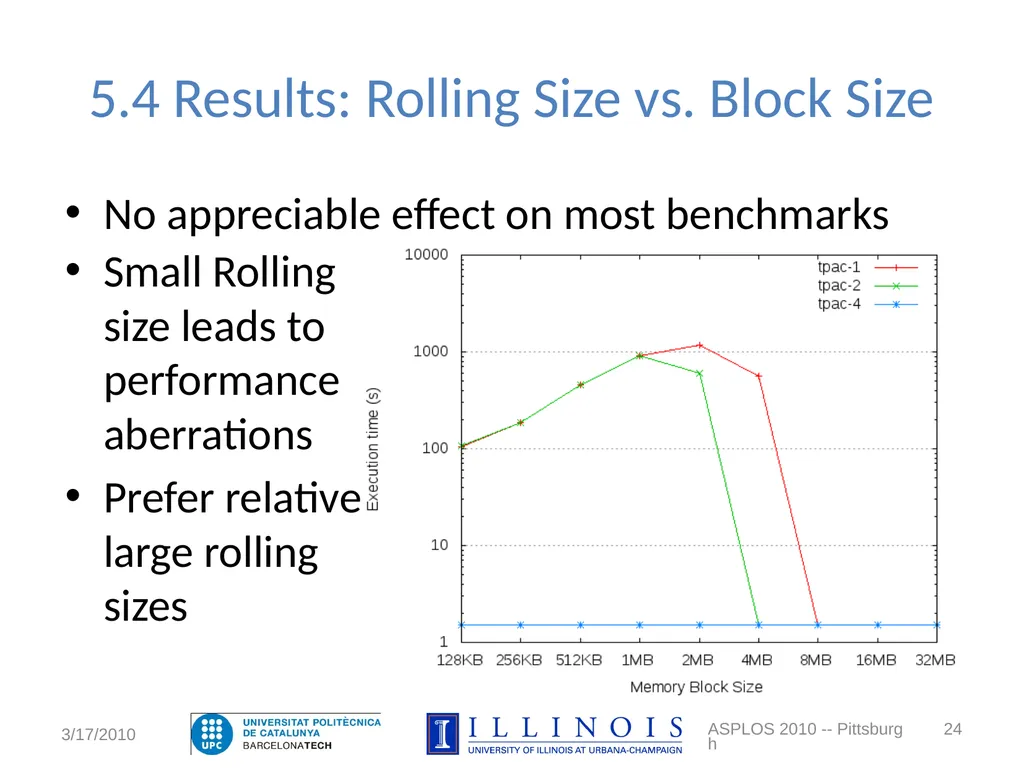
slide24. 5.4 Results: Rolling Size vs. Block Size No appreciable effect on most benchmarks 3/17/2010 ASPLOS 2010 -- Pittsburgh 24 Small Rolling size leads to performance aberrations
Prefer relative large rolling sizes<br>
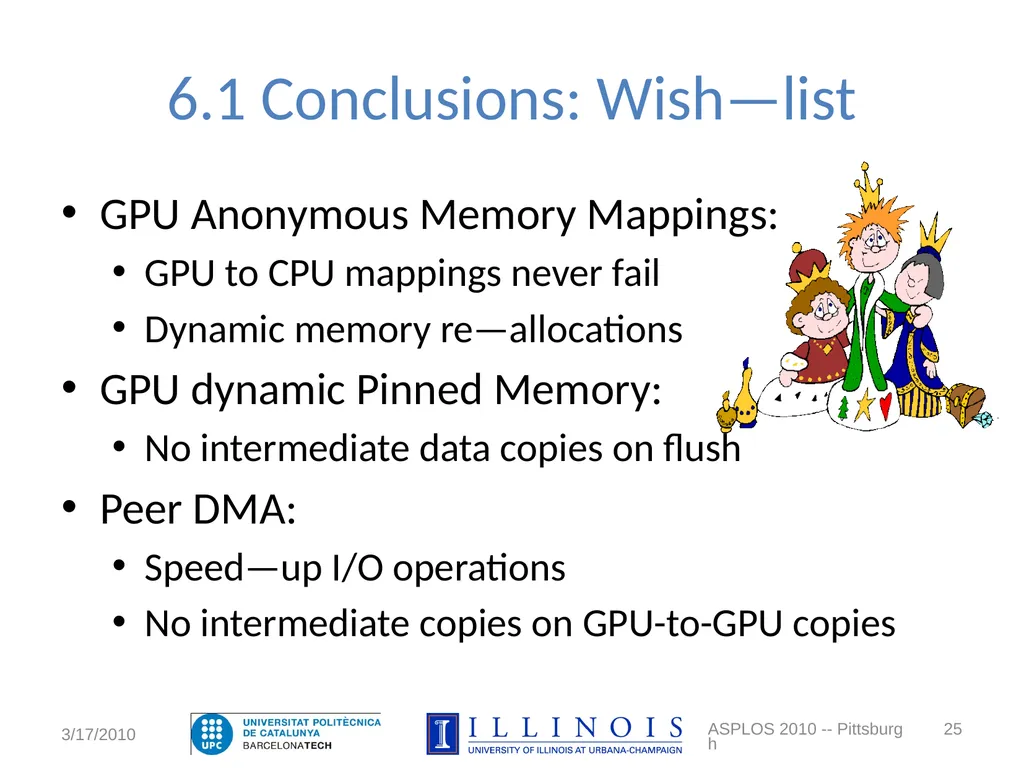
slide25. 6.1 Conclusions: Wish—list GPU Anonymous Memory Mappings:
GPU to CPU mappings never fail
Dynamic memory re—allocations
GPU dynamic Pinned Memory:
No intermediate data copies on flush
Peer DMA:
Speed—up I/O operations
No intermediate copies on GPU-to-GPU copies 3/17/2010 ASPLOS 2010 -- Pittsburgh 25<br>
Sanjay Patel, Nacho Navarro and Wen-mei Hwu 3/17/2010 ASPLOS 2010 -- Pittsburgh 1<br>
slide2. 1. Introduction: Heterogeneous Computing 3/17/2010 ASPLOS 2010 -- Pittsburgh 2 Heterogeneous Parallel Systems:
CPU: sequential control-intensive code
Accelerators: massively data-parallel code CPU ACC Existent programming models are DMA based:
Explicit memory copy
Programmer-managed memory coherence<br>
slide3. Outline Introduction
Motivation
ADSM: Asymmetric Distributed Shared Memory
GMAC: Global Memory for ACcelerators
Experimental Results
Conclusions 3/17/2010 ASPLOS 2010 -- Pittsburgh 3<br>
slide4. 2.1 Motivation: Reference System 3/17/2010 ASPLOS 2010 -- Pittsburgh CPU
(N - Cores) PCIe Bus GPU-like
Accelerator 4 High bandwidth
Weak consistency
Large page size Low latency
Strong consistency
Small page size Device Memory System Memory<br>
slide5. 2.2 Motivation: Memory Requirements High memory bandwidth requirements
Non fully-coherent systems:
Long-latency coherence traffic
Different coherence protocols Accelerator memory always growing (e.g. 6GB NVIDIA Fermi, 16GB PowerXCell 8i) 3/17/2010 ASPLOS 2010 -- Pittsburgh 5<br>
slide6. 2.3 Motivation: DMA-Based Programming 3/17/2010 ASPLOS 2010 -- Pittsburgh 6 Duplicated Pointers Explicit Coherence Management CUDA Sample Code CPU GPU void compute(FILE *file, int size) {
float *foo, *dev_foo;
foo = malloc(size);
fread(foo, size, 1, file);
cudaMalloc(&dev_foo, size);
cudaMemcpy(dev_foo, foo, size,
cudaMemcpyHostToDevice);
kernel<<<Dg, Db>>>(dev_foo, size);
cudaMemcpy(foo, dev_foo, size,
cudaMemcpyDeviceToHost);
cpuComputation(foo);
cudaFree(dev_foo);
free(foo);
}<br>
slide7. 3.1 ADSM: Unified Virtual Address Space Unified Virtual Shared Address Space
CPU: access both, system and accelerator memory
Accelerator: access to its own memory
Under ADSM, both will use the same virtual address when referencing the shared object CPU ACC Shared Data
Object 3/17/2010 ASPLOS 2010 -- Pittsburgh 7 System Memory Device Memory<br>
slide8. 3.2 ADSM: Simplified Code Simpler CPU code than in DMA-based programming models
Hardware-independent code Single Pointer Data
Assignment Peer DMA Legacy Support 3/17/2010 ASPLOS 2010 -- Pittsburgh 8 void compute(FILE *file, int size) {
float *foo;
foo = adsmMalloc(size);
fread(foo, size, 1, file);
kernel<<<Dg, Db>>>(foo, size);
cpuComputation(foo);
adsmFree(foo);
}<br>
slide9. 3.3 ADSM: Memory Distribution Asymmetric Distributed Shared Memory principles:
CPU accesses objects in accelerator memory but not vice versa
All coherency actions are performed by the CPU
Trashing unlikely to happen:
Synchronization Variables: Interrupt-based and dedicated hardware
False-sharing: Data object sharing granularity 3/17/2010 ASPLOS 2010 -- Pittsburgh 9<br>
slide10. 3.4 ADSM: Consistency and Coherence Release consistency:
Consistency only relevant from CPU perspective
Implicit release/acquire at accelerator call/return Accelerator
Return Accelerator
Call 3/17/2010 ASPLOS 2010 -- Pittsburgh 10 Memory Coherence:
Data ownership information enables eager data transfers
CPU maintains coherency<br>
slide11. 4. Global Memory for Accelerators ADSM implementation
User-level shared library
GNU / Linux Systems
NVIDIA CUDA GPUs 3/17/2010 ASPLOS 2010 -- Pittsburgh 11<br>
slide12. 4.1 GMAC: Overall Design Layered Design:
Multiple Memory Consistency Protocols
Operating System and Accelerator Independent code 3/17/2010 ASPLOS 2010 -- Pittsburgh 12<br>
slide13. 4.2 GMAC: Unified Address Space System Virtual
Address Space GPU Physical
Address Space 3/17/2010 ASPLOS 2010 -- Pittsburgh 13 Virtual Address Space formed by GPU and System physical memories GPU memory address range cannot be selected Allocate same virtual memory address range in both, GPU and CPU Accelerator Virtual memory would ease this process<br>
slide14. Batch-Update: copy all shared objects
Lazy-Update: copy modified / needed shared objects
Data object granularity
Detect CPU read/write accesses to shared objects
Rolling-Update: copy only modified / needed memory
Memory block size granularity
Fixed maximum number of modified blocks in system memory flush data when maximum is reached 4.3 GMAC: Coherence Protocols 3/17/2010 ASPLOS 2010 -- Pittsburgh 14<br>
slide15. 5.1 Results: GMAC vs. CUDA 3/17/2010 ASPLOS 2010 -- Pittsburgh 15 Batch-Update overheads:
Copy output data on call
Copy non-used data
Similar performance for CUDA, Lazy-Update and Rolling-Update<br>
slide16. 5.2 Results: Lazy vs. Rolling on 3D Stencil Extra data copy for small data objects
Trade-off between bandwidth and page fault overhead 3/17/2010 ASPLOS 2010 -- Pittsburgh 16<br>
slide17. 6. Conclusions Unified virtual shared address space simplifies programming of heterogeneous systems
Asymmetric Distributed Shared Memory
CPU access accelerator memory but not vice versa
Coherence actions only executed by CPU
Experimental results shows no performance degradation
Memory translation in accelerators is key to efficient implement ADSM 3/17/2010 ASPLOS 2010 -- Pittsburgh 17<br>
slide18. Thank you for your attention Eager to start using GMAC?
http://code.google.com/p/adsm/
igelado@ac.upc.edu
adsm-users@googlegroups.com 3/17/2010 18 ASPLOS 2010 -- Pittsburgh<br>
slide19. Backup Slides 3/17/2010 ASPLOS 2010 -- Pittsburgh 19<br>
slide20. 4.4 GMAC: Memory Mapping Software: allocate different address space and provide translation function (gmacSafePtr())
Hardware: implement virtual memory in the GPU 3/17/2010 ASPLOS 2010 -- Pittsburgh 20 System Virtual
Address Space GPU Physical
Address Space Allocation might fail if the range is in use<br>
slide21. 4.5 GMAC: Protocol States Protocol States: Invalid, Read-only, Dirty 3/17/2010 ASPLOS 2010 -- Pittsburgh 21 Batch-Update:
Call / Return
Lazy-Update:
Call / Return
Read / Write
Rolling-Update:
Call / Return
Read / Write
Flush<br>
slide22. 4.6 GMAC: Rolling vs. Lazy 3/17/2010 ASPLOS 2010 -- Pittsburgh 22 Batch – Update: transfer on kernel call Rolling – Update: transfer while CPU computes<br>
slide23. 5.3 Results: Break-down of Execution 3/17/2010 ASPLOS 2010 -- Pittsburgh 23<br>
slide24. 5.4 Results: Rolling Size vs. Block Size No appreciable effect on most benchmarks 3/17/2010 ASPLOS 2010 -- Pittsburgh 24 Small Rolling size leads to performance aberrations
Prefer relative large rolling sizes<br>
slide25. 6.1 Conclusions: Wish—list GPU Anonymous Memory Mappings:
GPU to CPU mappings never fail
Dynamic memory re—allocations
GPU dynamic Pinned Memory:
No intermediate data copies on flush
Peer DMA:
Speed—up I/O operations
No intermediate copies on GPU-to-GPU copies 3/17/2010 ASPLOS 2010 -- Pittsburgh 25<br>