
ANIMAL GENETICS & BREEDING UNIT – III Principles
PM
Published · 24 slides · 0 views
1 / 1

Description
ANIMAL GENETICS BREEDING UNIT III Principles of Animal Breeding Theory Inbreeding Depression Heterosis Dr K G Mandal Department of Animal Genetics Breeding Bihar Veterinary College, Patna Bihar Animal Sciences University, Patna
Related Topics
Share
Embed code
Download this presentation From Below
"ANIMAL GENETICS & BREEDING UNIT – III Principles" is the property of its rightful owner. Permission is granted to download and print the materials on this website for personal, non-commercial use only, and to display it on your personal computer provided you do not modify the materials and that you retain all copyright notices contained in the materials. By downloading content from our website, you accept the terms of this agreement.
Presentation Transcript
01
ANIMAL GENETICS & BREEDING
UNIT – III
Principles of Animal Breeding Theory
Inbreeding Depression & Heterosis
Dr K G Mandal Department of Animal Genetics & Breeding Bihar Veterinary College, Patna Bihar Animal Sciences University, Patna<br>
UNIT – III
Principles of Animal Breeding Theory
Inbreeding Depression & Heterosis
Dr K G Mandal Department of Animal Genetics & Breeding Bihar Veterinary College, Patna Bihar Animal Sciences University, Patna<br>
02
Inbreeding Depression Inbreeding Depression:
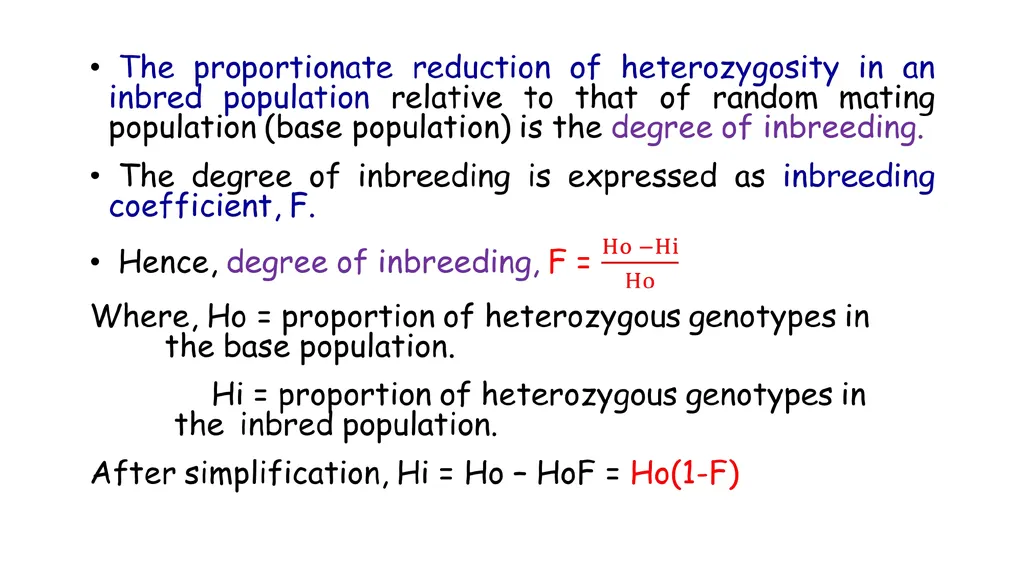
Decrease in mean phenotypic value of the characters associated with fitness, reproduction and physiological efficiency of the individuals due to inbreeding is known as inbreeding depression.
Inbreeding converts a proportion of heterozygotes into identical homozygotes in each generation. Hence, the frequency of homozygous genotype increases at the expense of frequency of heterozygotes.<br>
Decrease in mean phenotypic value of the characters associated with fitness, reproduction and physiological efficiency of the individuals due to inbreeding is known as inbreeding depression.
Inbreeding converts a proportion of heterozygotes into identical homozygotes in each generation. Hence, the frequency of homozygous genotype increases at the expense of frequency of heterozygotes.<br>
03
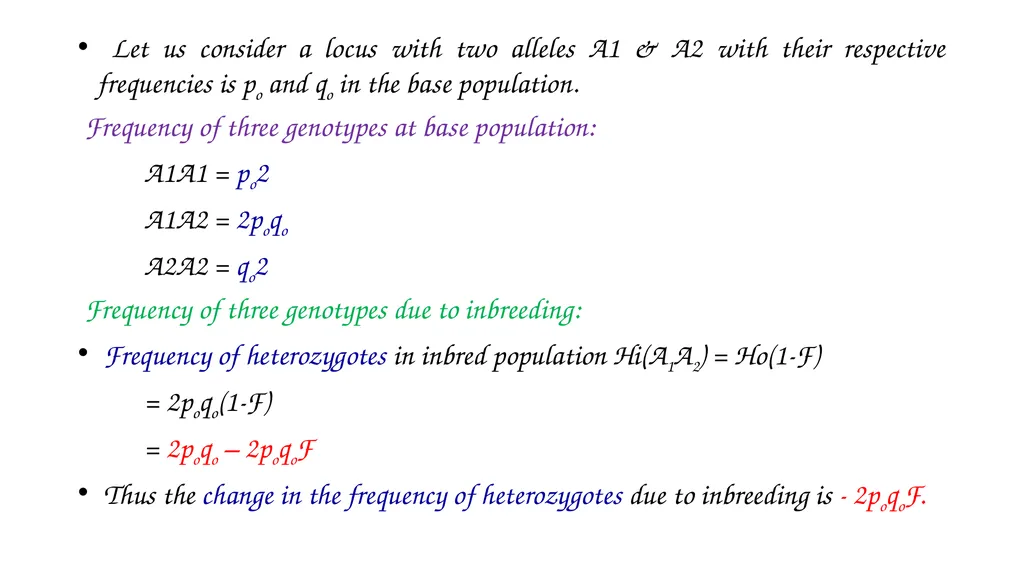
Let us consider a locus with two alleles A1 & A2 with their respective frequencies is po and qo in the base population.
Frequency of three genotypes at base population:
A1A1 = po2
A1A2 = 2poqo
A2A2 = qo2
Frequency of three genotypes due to inbreeding:
Frequency of heterozygotes in inbred population Hi(A1A2) = Ho(1-F)
= 2poqo(1-F)
= 2poqo – 2poqoF
Thus the change in the frequency of heterozygotes due to inbreeding is - 2poqoF.<br>
Frequency of three genotypes at base population:
A1A1 = po2
A1A2 = 2poqo
A2A2 = qo2
Frequency of three genotypes due to inbreeding:
Frequency of heterozygotes in inbred population Hi(A1A2) = Ho(1-F)
= 2poqo(1-F)
= 2poqo – 2poqoF
Thus the change in the frequency of heterozygotes due to inbreeding is - 2poqoF.<br>
04
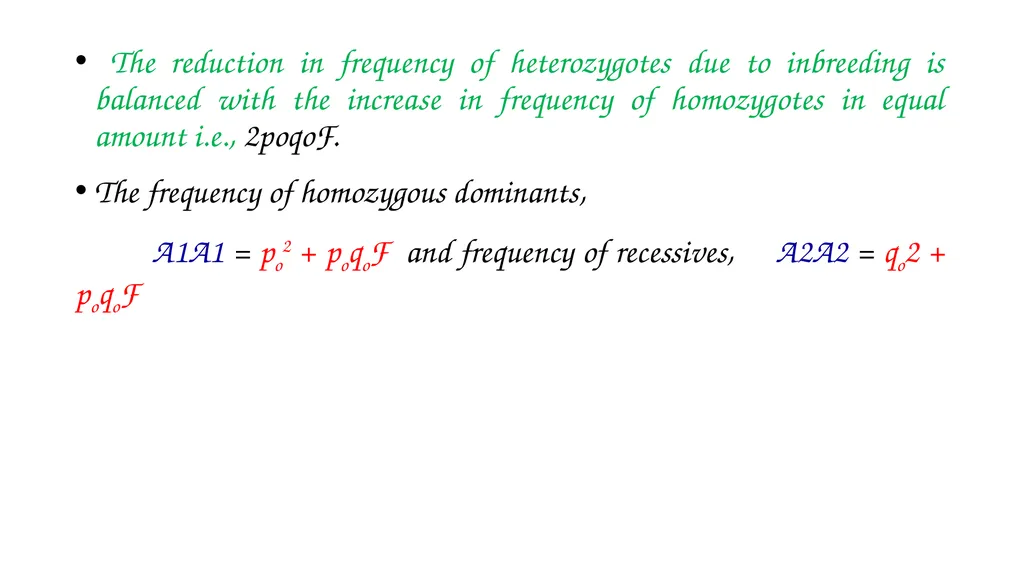
The reduction in frequency of heterozygotes due to inbreeding is balanced with the increase in frequency of homozygotes in equal amount i.e., 2poqoF.
The frequency of homozygous dominants,
A1A1 = po2 + poqoF and frequency of recessives, A2A2 = qo2 + poqoF<br>
The frequency of homozygous dominants,
A1A1 = po2 + poqoF and frequency of recessives, A2A2 = qo2 + poqoF<br>
05
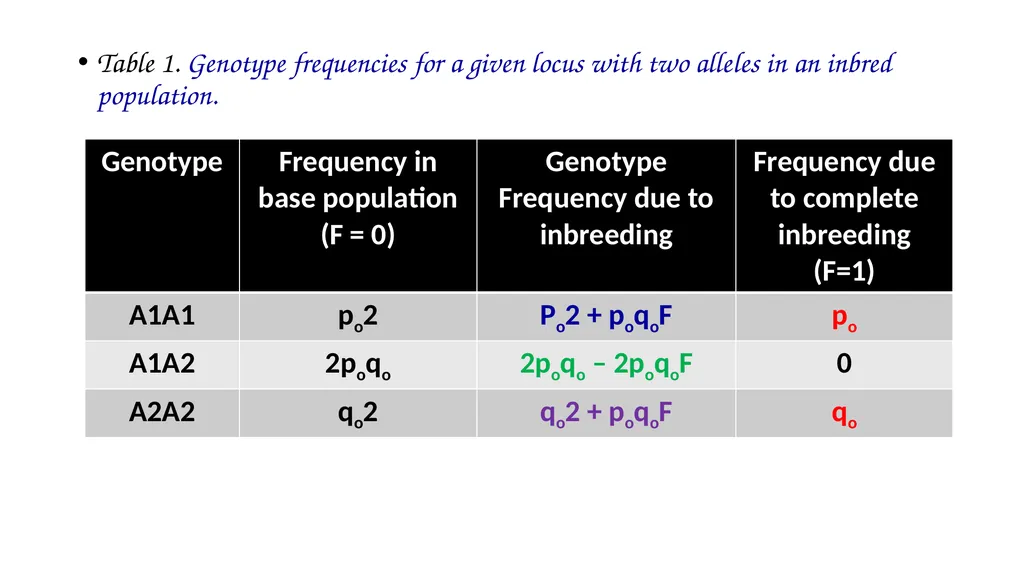
Table 1. Genotype frequencies for a given locus with two alleles in an inbred population.<br>
06
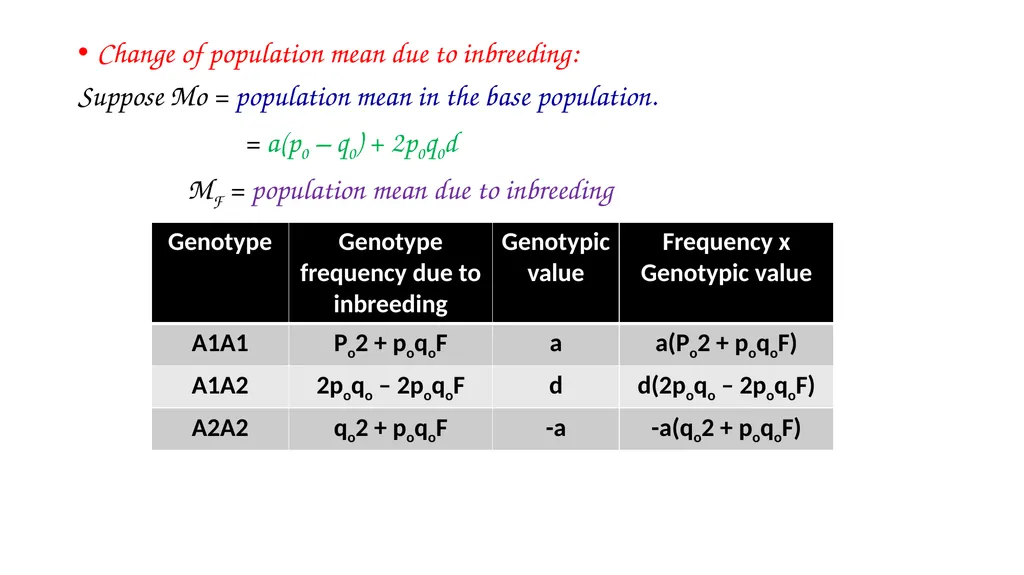
Change of population mean due to inbreeding:
Suppose Mo = population mean in the base population.
= a(p0 – q0) + 2p0q0d
MF = population mean due to inbreeding<br>
Suppose Mo = population mean in the base population.
= a(p0 – q0) + 2p0q0d
MF = population mean due to inbreeding<br>
07
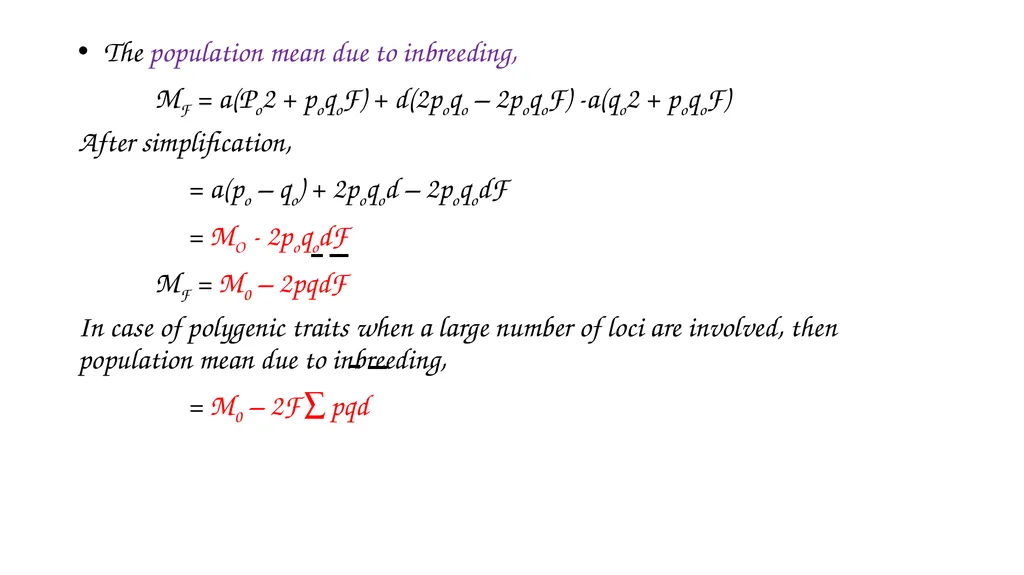
The population mean due to inbreeding,
MF = a(Po2 + poqoF) + d(2poqo – 2poqoF) -a(qo2 + poqoF)
After simplification,
= a(po – qo) + 2poqod – 2poqodF
= MO - 2poqodF
MF = M0 – 2pqdF
In case of polygenic traits when a large number of loci are involved, then population mean due to inbreeding,
= M0 – 2F∑pqd<br>
MF = a(Po2 + poqoF) + d(2poqo – 2poqoF) -a(qo2 + poqoF)
After simplification,
= a(po – qo) + 2poqod – 2poqodF
= MO - 2poqodF
MF = M0 – 2pqdF
In case of polygenic traits when a large number of loci are involved, then population mean due to inbreeding,
= M0 – 2F∑pqd<br>
08
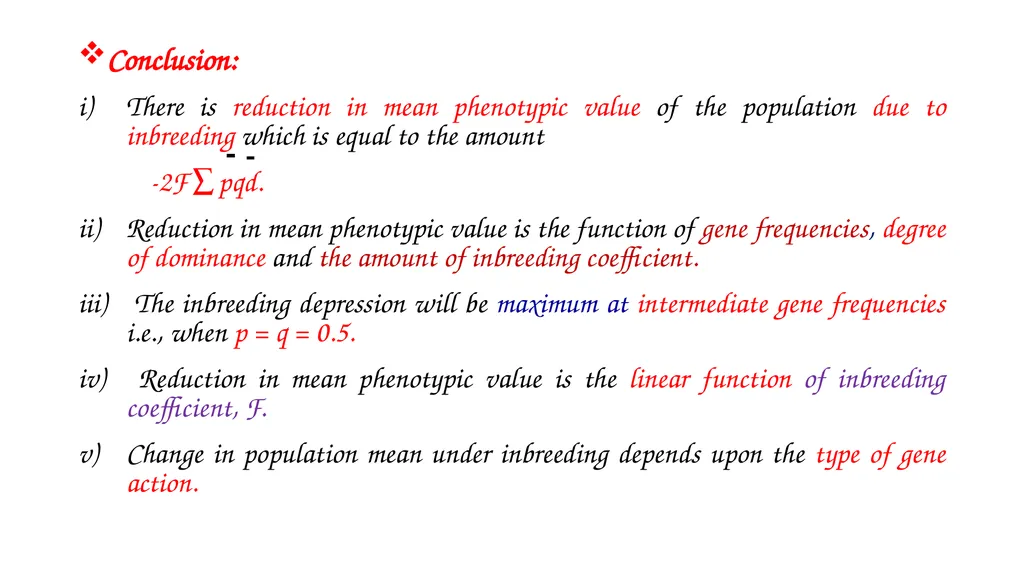
Conclusion:
There is reduction in mean phenotypic value of the population due to inbreeding which is equal to the amount
-2F∑pqd.
Reduction in mean phenotypic value is the function of gene frequencies, degree of dominance and the amount of inbreeding coefficient.
The inbreeding depression will be maximum at intermediate gene frequencies i.e., when p = q = 0.5.
Reduction in mean phenotypic value is the linear function of inbreeding coefficient, F.
Change in population mean under inbreeding depends upon the type of gene action.<br>
There is reduction in mean phenotypic value of the population due to inbreeding which is equal to the amount
-2F∑pqd.
Reduction in mean phenotypic value is the function of gene frequencies, degree of dominance and the amount of inbreeding coefficient.
The inbreeding depression will be maximum at intermediate gene frequencies i.e., when p = q = 0.5.
Reduction in mean phenotypic value is the linear function of inbreeding coefficient, F.
Change in population mean under inbreeding depends upon the type of gene action.<br>
09
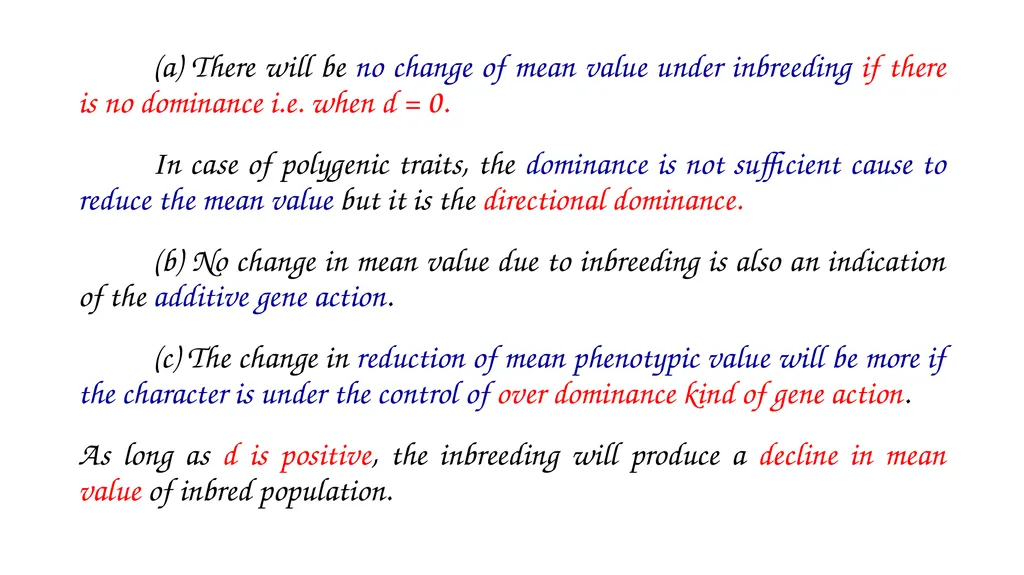
(a) There will be no change of mean value under inbreeding if there is no dominance i.e. when d = 0.
In case of polygenic traits, the dominance is not sufficient cause to reduce the mean value but it is the directional dominance.
(b) No change in mean value due to inbreeding is also an indication of the additive gene action.
(c) The change in reduction of mean phenotypic value will be more if the character is under the control of over dominance kind of gene action.
As long as d is positive, the inbreeding will produce a decline in mean value of inbred population.<br>
In case of polygenic traits, the dominance is not sufficient cause to reduce the mean value but it is the directional dominance.
(b) No change in mean value due to inbreeding is also an indication of the additive gene action.
(c) The change in reduction of mean phenotypic value will be more if the character is under the control of over dominance kind of gene action.
As long as d is positive, the inbreeding will produce a decline in mean value of inbred population.<br>
10
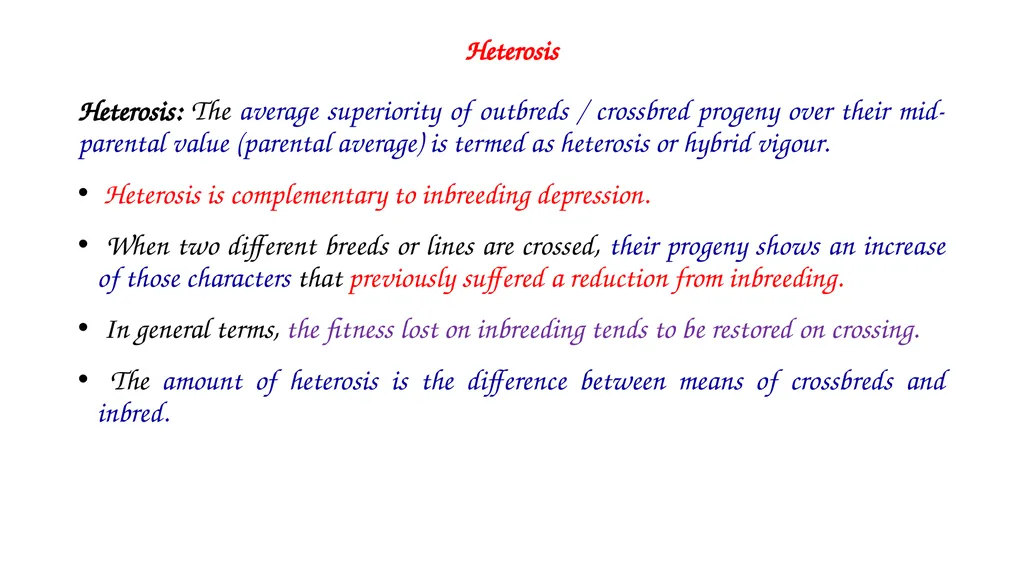
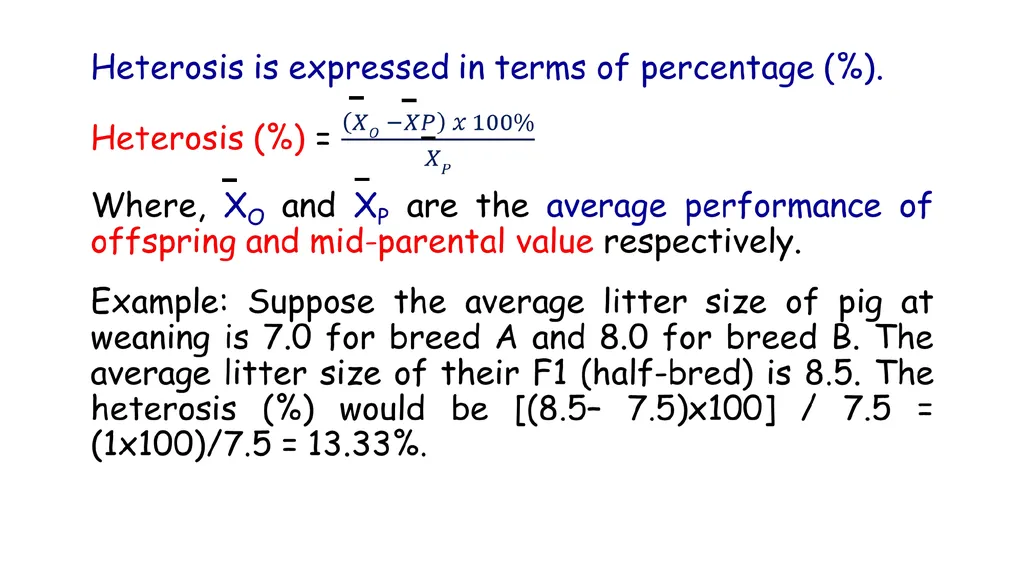
Heterosis Heterosis: The average superiority of outbreds / crossbred progeny over their mid-parental value (parental average) is termed as heterosis or hybrid vigour.
Heterosis is complementary to inbreeding depression.
When two different breeds or lines are crossed, their progeny shows an increase of those characters that previously suffered a reduction from inbreeding.
In general terms, the fitness lost on inbreeding tends to be restored on crossing.
The amount of heterosis is the difference between means of crossbreds and inbred.<br>
Heterosis is complementary to inbreeding depression.
When two different breeds or lines are crossed, their progeny shows an increase of those characters that previously suffered a reduction from inbreeding.
In general terms, the fitness lost on inbreeding tends to be restored on crossing.
The amount of heterosis is the difference between means of crossbreds and inbred.<br>
11
Heterosis in terms of gene frequency:
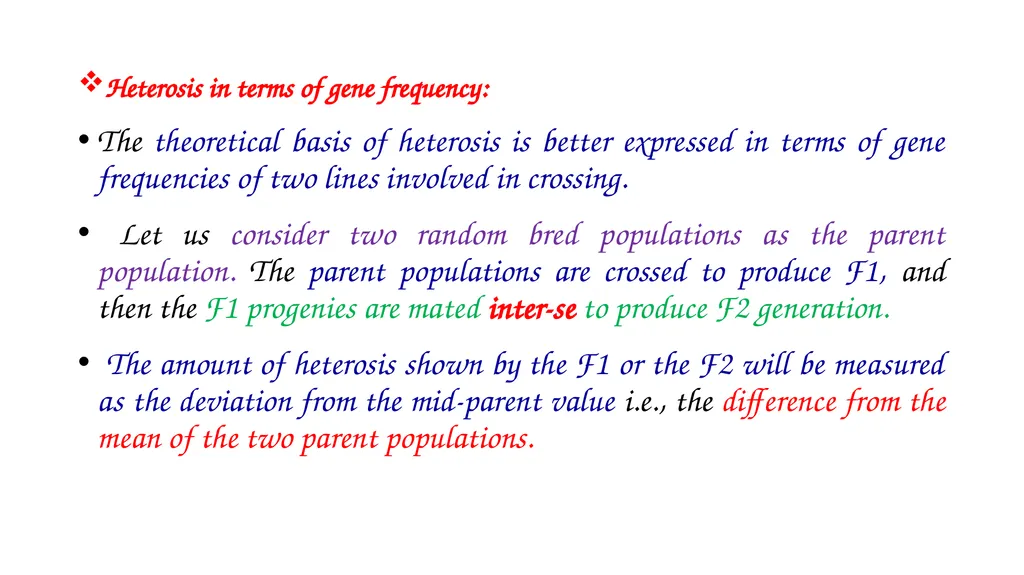
The theoretical basis of heterosis is better expressed in terms of gene frequencies of two lines involved in crossing.
Let us consider two random bred populations as the parent population. The parent populations are crossed to produce F1, and then the F1 progenies are mated inter-se to produce F2 generation.
The amount of heterosis shown by the F1 or the F2 will be measured as the deviation from the mid-parent value i.e., the difference from the mean of the two parent populations.<br>
The theoretical basis of heterosis is better expressed in terms of gene frequencies of two lines involved in crossing.
Let us consider two random bred populations as the parent population. The parent populations are crossed to produce F1, and then the F1 progenies are mated inter-se to produce F2 generation.
The amount of heterosis shown by the F1 or the F2 will be measured as the deviation from the mid-parent value i.e., the difference from the mean of the two parent populations.<br>
12
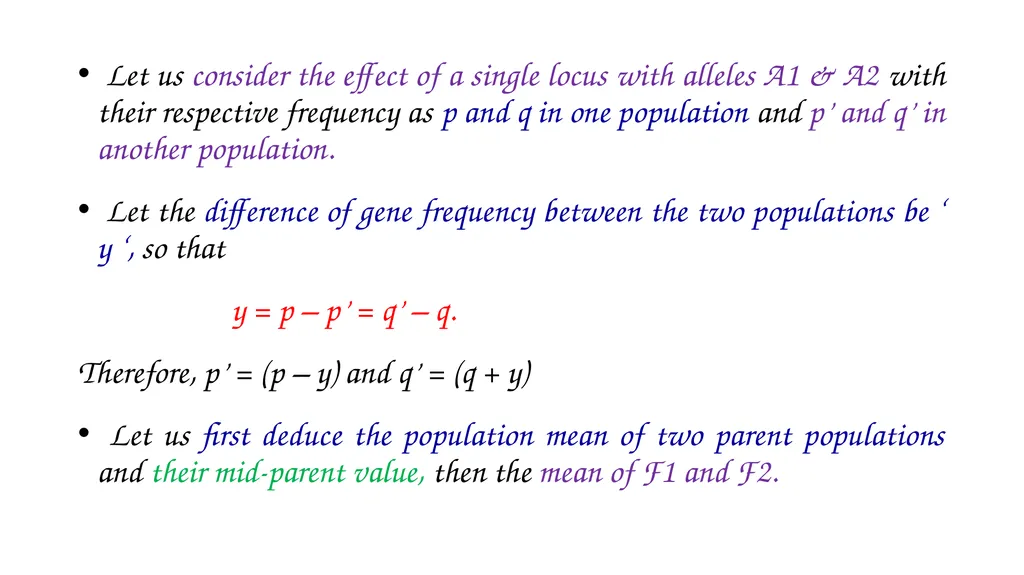
Let us consider the effect of a single locus with alleles A1 & A2 with their respective frequency as p and q in one population and p’ and q’ in another population.
Let the difference of gene frequency between the two populations be ‘ y ‘, so that
y = p – p’ = q’ – q.
Therefore, p’ = (p – y) and q’ = (q + y)
Let us first deduce the population mean of two parent populations and their mid-parent value, then the mean of F1 and F2.<br>
Let the difference of gene frequency between the two populations be ‘ y ‘, so that
y = p – p’ = q’ – q.
Therefore, p’ = (p – y) and q’ = (q + y)
Let us first deduce the population mean of two parent populations and their mid-parent value, then the mean of F1 and F2.<br>
13
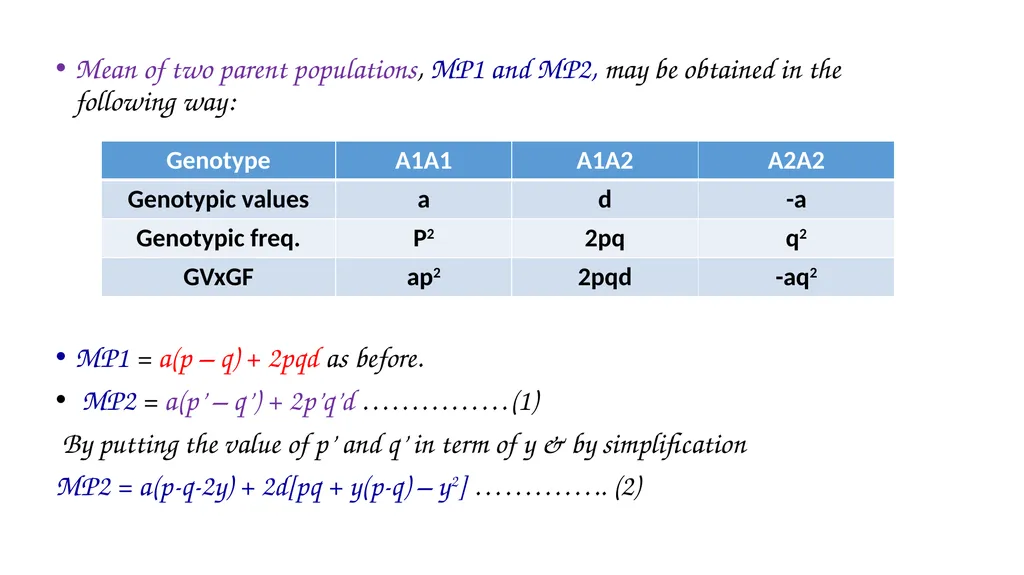
Mean of two parent populations, MP1 and MP2, may be obtained in the following way:
MP1 = a(p – q) + 2pqd as before.
MP2 = a(p’ – q’) + 2p’q’d ……………(1)
By putting the value of p’ and q’ in term of y & by simplification
MP2 = a(p-q-2y) + 2d[pq + y(p-q) – y2] ………….. (2)<br>
MP1 = a(p – q) + 2pqd as before.
MP2 = a(p’ – q’) + 2p’q’d ……………(1)
By putting the value of p’ and q’ in term of y & by simplification
MP2 = a(p-q-2y) + 2d[pq + y(p-q) – y2] ………….. (2)<br>
14
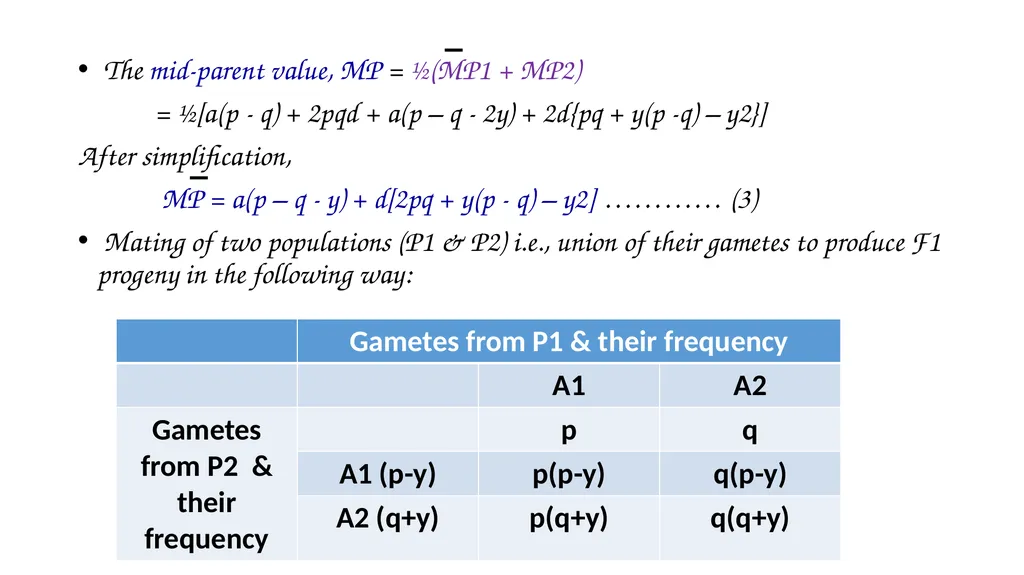
The mid-parent value, MP = ½(MP1 + MP2)
= ½[a(p - q) + 2pqd + a(p – q - 2y) + 2d{pq + y(p -q) – y2}]
After simplification,
MP = a(p – q - y) + d[2pq + y(p - q) – y2] ………… (3)
Mating of two populations (P1 & P2) i.e., union of their gametes to produce F1 progeny in the following way:<br>
= ½[a(p - q) + 2pqd + a(p – q - 2y) + 2d{pq + y(p -q) – y2}]
After simplification,
MP = a(p – q - y) + d[2pq + y(p - q) – y2] ………… (3)
Mating of two populations (P1 & P2) i.e., union of their gametes to produce F1 progeny in the following way:<br>
15
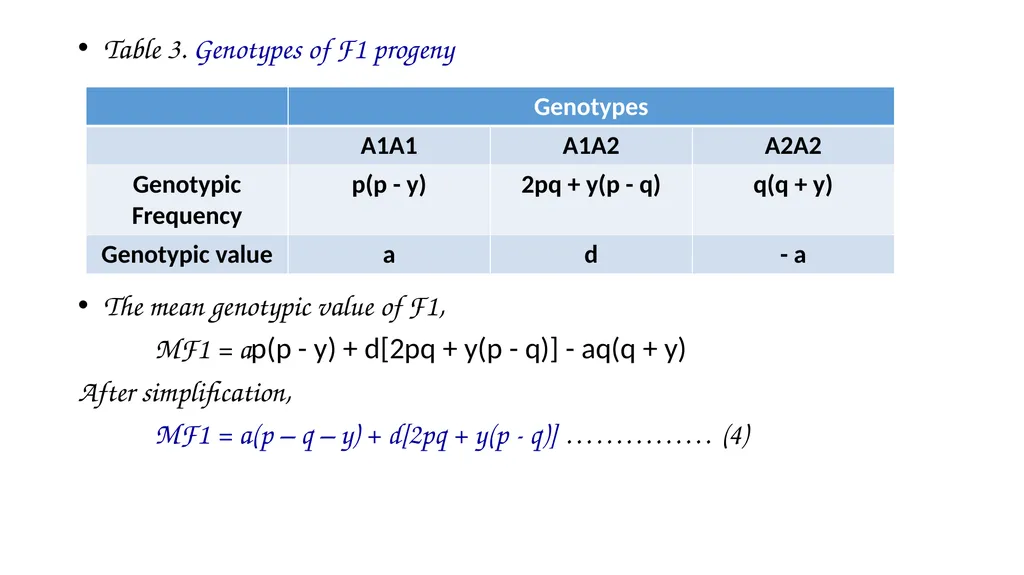
Table 3. Genotypes of F1 progeny
The mean genotypic value of F1,
MF1 = ap(p - y) + d[2pq + y(p - q)] - aq(q + y)
After simplification,
MF1 = a(p – q – y) + d[2pq + y(p - q)] …………… (4)<br>
The mean genotypic value of F1,
MF1 = ap(p - y) + d[2pq + y(p - q)] - aq(q + y)
After simplification,
MF1 = a(p – q – y) + d[2pq + y(p - q)] …………… (4)<br>
16
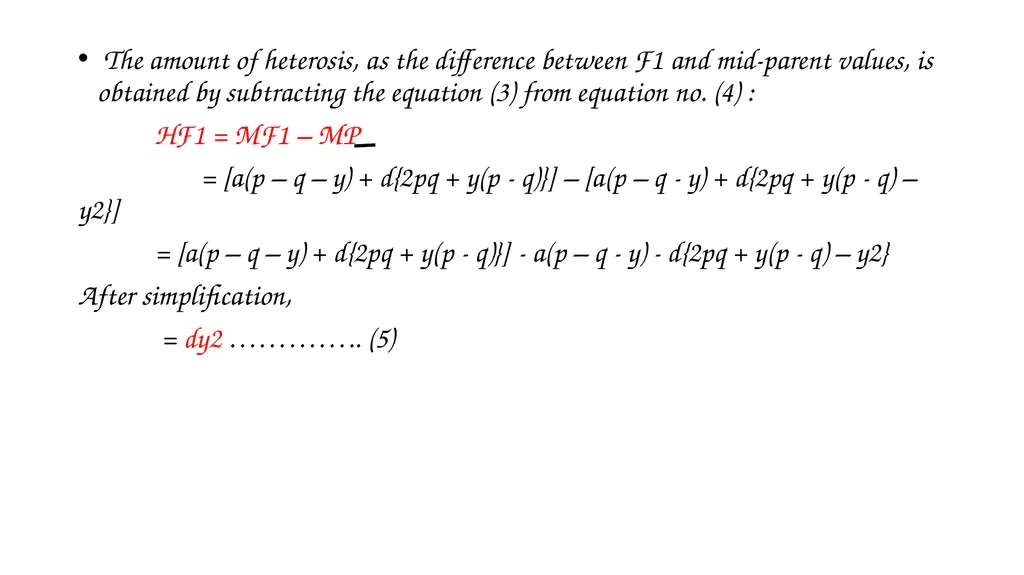
The amount of heterosis, as the difference between F1 and mid-parent values, is obtained by subtracting the equation (3) from equation no. (4) :
HF1 = MF1 – MP
= [a(p – q – y) + d{2pq + y(p - q)}] – [a(p – q - y) + d{2pq + y(p - q) – y2}]
= [a(p – q – y) + d{2pq + y(p - q)}] - a(p – q - y) - d{2pq + y(p - q) – y2}
After simplification,
= dy2 ………….. (5)<br>
HF1 = MF1 – MP
= [a(p – q – y) + d{2pq + y(p - q)}] – [a(p – q - y) + d{2pq + y(p - q) – y2}]
= [a(p – q – y) + d{2pq + y(p - q)}] - a(p – q - y) - d{2pq + y(p - q) – y2}
After simplification,
= dy2 ………….. (5)<br>
17
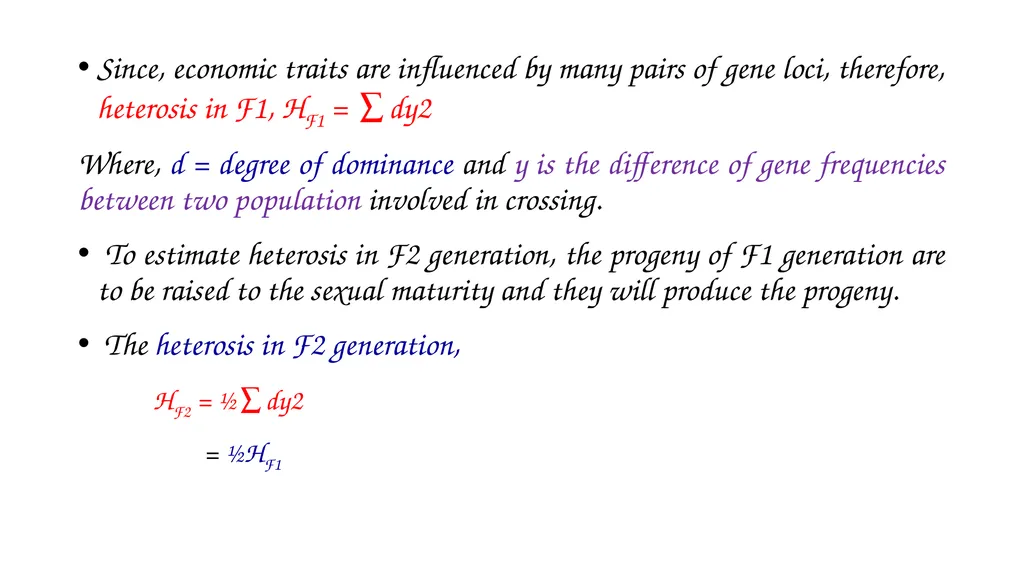
Since, economic traits are influenced by many pairs of gene loci, therefore, heterosis in F1, HF1 = ∑dy2
Where, d = degree of dominance and y is the difference of gene frequencies between two population involved in crossing.
To estimate heterosis in F2 generation, the progeny of F1 generation are to be raised to the sexual maturity and they will produce the progeny.
The heterosis in F2 generation,
HF2 = ½∑dy2
= ½HF1<br>
Where, d = degree of dominance and y is the difference of gene frequencies between two population involved in crossing.
To estimate heterosis in F2 generation, the progeny of F1 generation are to be raised to the sexual maturity and they will produce the progeny.
The heterosis in F2 generation,
HF2 = ½∑dy2
= ½HF1<br>
18
CONCLUSION :
Heterosis, just like inbreeding depression, depends for its occurrence on dominance. Loci without dominance (d = 0) cause neither inbreeding depression nor heterosis.
2. The occurrence of heterosis, like inbreeding depression, depends on directional dominance. The absence of dominance is not sufficient ground for concluding that the individual loci show no dominance.
3. The amount of heterosis, following a cross between two lines/breeds/populations, depends on square of the difference of gene frequency (y) between the two populations / breeds.<br>
Heterosis, just like inbreeding depression, depends for its occurrence on dominance. Loci without dominance (d = 0) cause neither inbreeding depression nor heterosis.
2. The occurrence of heterosis, like inbreeding depression, depends on directional dominance. The absence of dominance is not sufficient ground for concluding that the individual loci show no dominance.
3. The amount of heterosis, following a cross between two lines/breeds/populations, depends on square of the difference of gene frequency (y) between the two populations / breeds.<br>
19
4. If the lines are highly inbred and so completely homozygous for all the loci, then the difference of gene frequency between them can be either 0 or 1. Then, heterosis will be equal to the sum of the dominance deviations d (∑d) of those loci.
5. The heterosis in F2 generation is reduced to half to that of heterosis exhibited in F1. In other words, the F2 is expected to drop back half-way from the F1 value towards the mid-parent value.<br>
5. The heterosis in F2 generation is reduced to half to that of heterosis exhibited in F1. In other words, the F2 is expected to drop back half-way from the F1 value towards the mid-parent value.<br>
20
Genetic Basis of Heterosis:
There are various thesis explaining the genetic basis of heterosis. The following are some of them:
Theory of dominance given by Jones (1917-18).
Theory of heterozygosity given by Stubb Pirschle (1940).
Theory of non-allelic gene interaction (epistasis) as given by Oliver and Green (1944).
Theory of over dominance introduced by Hull (1945). Over dominance is the condition when heterozygote offspring become superior than both the homozygote parents.
Out of all these theorem, the over dominance as proposed by Hull (1945) is most appropriate.<br>
There are various thesis explaining the genetic basis of heterosis. The following are some of them:
Theory of dominance given by Jones (1917-18).
Theory of heterozygosity given by Stubb Pirschle (1940).
Theory of non-allelic gene interaction (epistasis) as given by Oliver and Green (1944).
Theory of over dominance introduced by Hull (1945). Over dominance is the condition when heterozygote offspring become superior than both the homozygote parents.
Out of all these theorem, the over dominance as proposed by Hull (1945) is most appropriate.<br>
21
Types of Heterosis:
According to the direction, heterosis is of three types :
1. Positive, 2. Negative and 3. Zero
According to degree or intensity, it is of two types:
Euheterosis: In euheterosis the degree or intensity of heterosis is more. The traits which show greatest inbreeding depression due to inbreeding will show maximum hybrid vigour or heterosis. Lowly heritable traits like all reproductive traits, physiological efficiency and fitness etc. will show euheterosis.
Luxurient heterosis: In this the degree or intensity is lesser in comparison to euheterosis. Highly heritable traits like adult body weight, growth rate, etc. will show luxuriant heterosis.<br>
According to the direction, heterosis is of three types :
1. Positive, 2. Negative and 3. Zero
According to degree or intensity, it is of two types:
Euheterosis: In euheterosis the degree or intensity of heterosis is more. The traits which show greatest inbreeding depression due to inbreeding will show maximum hybrid vigour or heterosis. Lowly heritable traits like all reproductive traits, physiological efficiency and fitness etc. will show euheterosis.
Luxurient heterosis: In this the degree or intensity is lesser in comparison to euheterosis. Highly heritable traits like adult body weight, growth rate, etc. will show luxuriant heterosis.<br>
22
Thank You<br>