
APHIS ERGONOMICS PROGRAM DRIVING Ergonomics
NS
Published · 62 slides · 0 views

1 / 1






Description
APHIS ERGONOMICS PROGRAM DRIVING Ergonomics Presented by: Ginger E. Dorsey APHIS Ergonomics Program Manager APHIS Ergonomics Program creating healthy workspaces through healthy work habits Ergonomics Definition: Fitting the job to the
Related Topics
Share
Embed code
Download this presentation From Below
"APHIS ERGONOMICS PROGRAM DRIVING Ergonomics" is the property of its rightful owner. Permission is granted to download and print the materials on this website for personal, non-commercial use only, and to display it on your personal computer provided you do not modify the materials and that you retain all copyright notices contained in the materials. By downloading content from our website, you accept the terms of this agreement.
Presentation Transcript
01
APHIS ERGONOMICS PROGRAM
DRIVING Ergonomics Presented by:
Ginger E. Dorsey
APHIS Ergonomics Program Manager APHIS Ergonomics Program creating healthy workspaces through healthy work habits<br>
Ginger E. Dorsey
APHIS Ergonomics Program Manager APHIS Ergonomics Program creating healthy workspaces through healthy work habits<br>
02
Ergonomics Definition: Fitting the job to the worker.
Goals:
Fit you to your car so you can drive in a way that maximizes the natural ability of your body to move and respond to physical stress.
Decrease risk of injury/illness.
Enhance worker productivity. APHIS Ergonomics Program creating healthy workspaces through healthy work habits<br>
Goals:
Fit you to your car so you can drive in a way that maximizes the natural ability of your body to move and respond to physical stress.
Decrease risk of injury/illness.
Enhance worker productivity. APHIS Ergonomics Program creating healthy workspaces through healthy work habits<br>
03
Understand There is no such thing as the average person.
It is not normal to be in pain.
Different people respond differently to their work environments, particularly after an injury, due to:
Hereditary;
Age;
Gender;
Lifestyles. APHIS Ergonomics Program creating healthy workspaces through healthy work habits<br>
It is not normal to be in pain.
Different people respond differently to their work environments, particularly after an injury, due to:
Hereditary;
Age;
Gender;
Lifestyles. APHIS Ergonomics Program creating healthy workspaces through healthy work habits<br>
04
Work-related Musculoskeletal
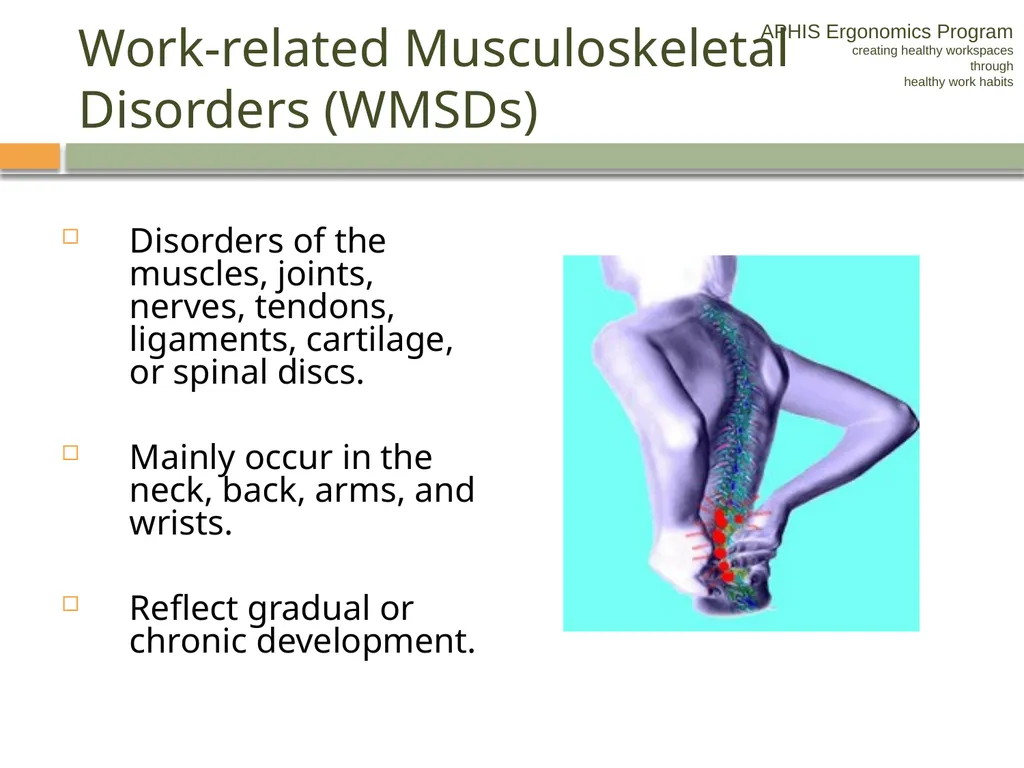
Disorders (WMSDs) Disorders of the muscles, joints, nerves, tendons, ligaments, cartilage, or spinal discs.
Mainly occur in the neck, back, arms, and wrists.
Reflect gradual or chronic development. APHIS Ergonomics Program creating healthy workspaces through healthy work habits<br>
Mainly occur in the neck, back, arms, and wrists.
Reflect gradual or chronic development. APHIS Ergonomics Program creating healthy workspaces through healthy work habits<br>
05
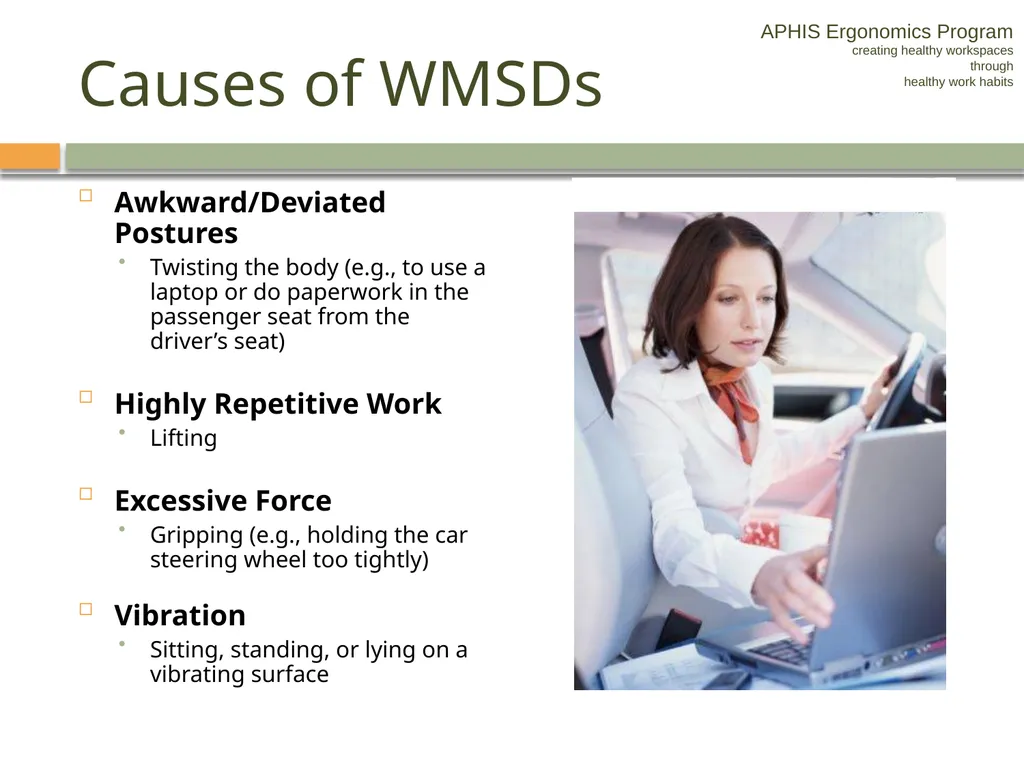
Causes of WMSDs Awkward/Deviated Postures
Twisting the body (e.g., to use a laptop or do paperwork in the passenger seat from the driver’s seat)
Highly Repetitive Work
Lifting
Excessive Force
Gripping (e.g., holding the car steering wheel too tightly)
Vibration
Sitting, standing, or lying on a vibrating surface APHIS Ergonomics Program creating healthy workspaces through healthy work habits<br>
Twisting the body (e.g., to use a laptop or do paperwork in the passenger seat from the driver’s seat)
Highly Repetitive Work
Lifting
Excessive Force
Gripping (e.g., holding the car steering wheel too tightly)
Vibration
Sitting, standing, or lying on a vibrating surface APHIS Ergonomics Program creating healthy workspaces through healthy work habits<br>
06
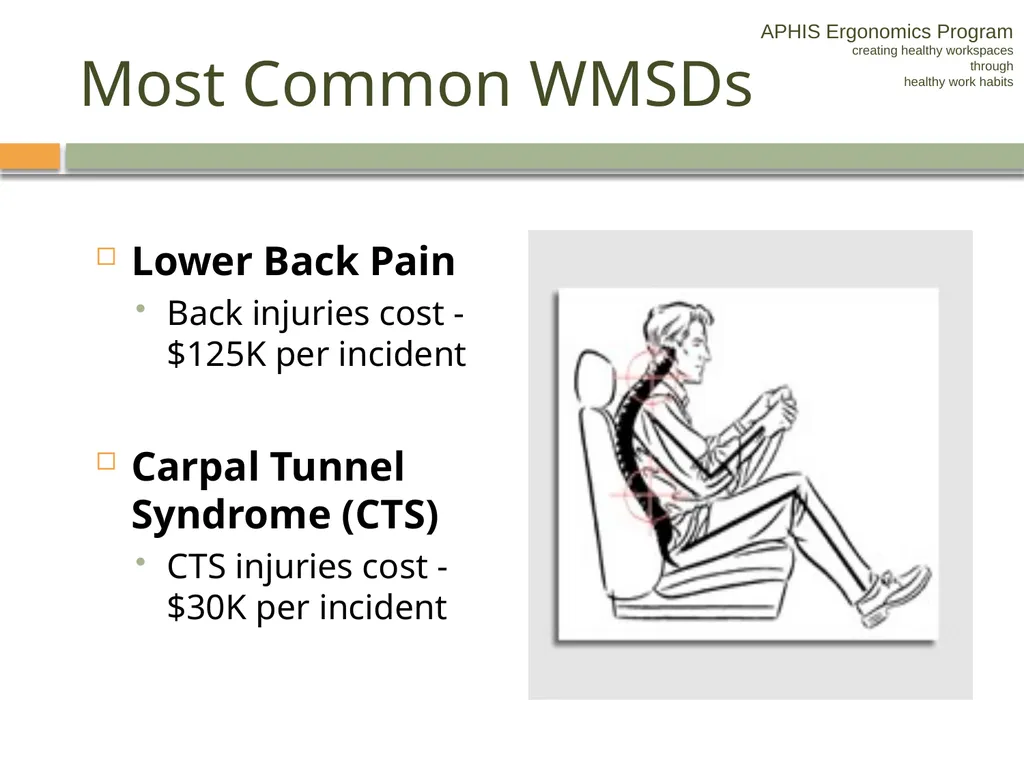
Lower Back Pain
Back injuries cost - $125K per incident
Carpal Tunnel Syndrome (CTS)
CTS injuries cost - $30K per incident Most Common WMSDs APHIS Ergonomics Program creating healthy workspaces through healthy work habits<br>
Back injuries cost - $125K per incident
Carpal Tunnel Syndrome (CTS)
CTS injuries cost - $30K per incident Most Common WMSDs APHIS Ergonomics Program creating healthy workspaces through healthy work habits<br>
07
Work-related musculoskeletal discomforts and their causes associated with driving.
How to identify if you are an at risk driver.
Recommended postures to minimize your risk for musculoskeletal injuries while driving.
Exercises and stretches to relieve tension. What You Will Learn APHIS Ergonomics Program creating healthy workspaces through healthy work habits<br>
How to identify if you are an at risk driver.
Recommended postures to minimize your risk for musculoskeletal injuries while driving.
Exercises and stretches to relieve tension. What You Will Learn APHIS Ergonomics Program creating healthy workspaces through healthy work habits<br>
08
Reported Driving Discomforts and Their Associated Causes APHIS Ergonomics Program
creating healthy workspaces
through
healthy work habits<br>
09
A recent survey from Loughborough University in the UK linked long hours behind the wheel to:
back pain;
greater risk for low back trouble than sitting and standing jobs/activities;
increased frequency of discomforts with the number of miles driven annually. Driving Statistics APHIS Ergonomics Program creating healthy workspaces through healthy work habits<br>
back pain;
greater risk for low back trouble than sitting and standing jobs/activities;
increased frequency of discomforts with the number of miles driven annually. Driving Statistics APHIS Ergonomics Program creating healthy workspaces through healthy work habits<br>
10
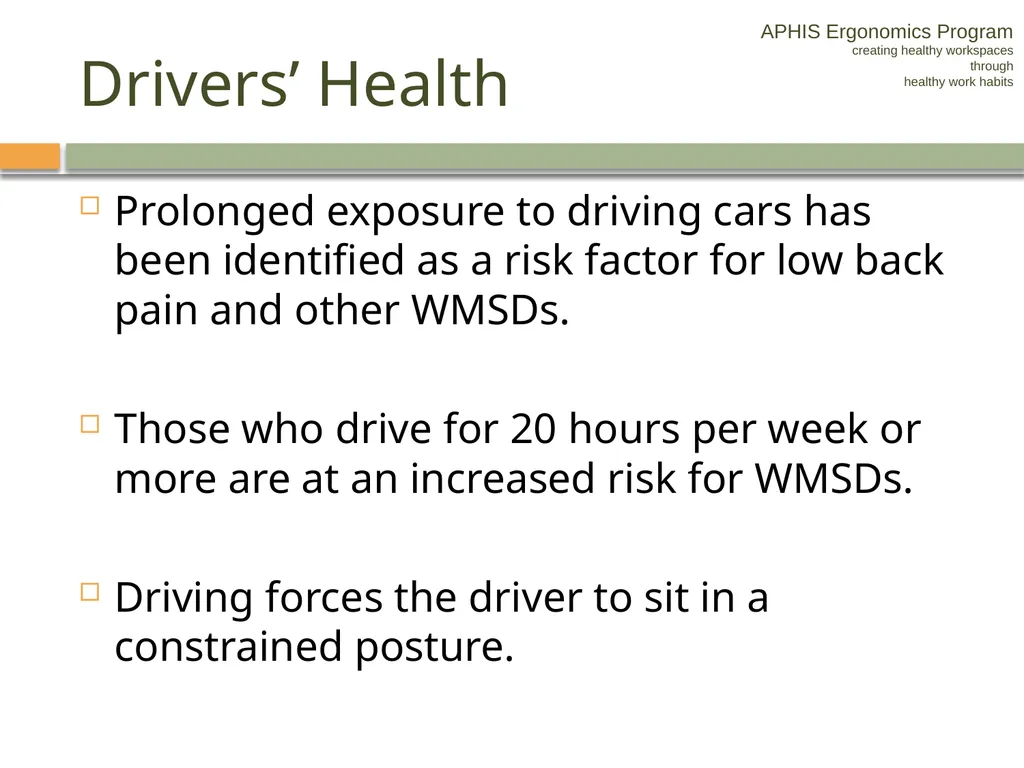
Drivers’ Health Prolonged exposure to driving cars has been identified as a risk factor for low back pain and other WMSDs.
Those who drive for 20 hours per week or more are at an increased risk for WMSDs.
Driving forces the driver to sit in a constrained posture. APHIS Ergonomics Program creating healthy workspaces through healthy work habits<br>
Those who drive for 20 hours per week or more are at an increased risk for WMSDs.
Driving forces the driver to sit in a constrained posture. APHIS Ergonomics Program creating healthy workspaces through healthy work habits<br>
11
What types of discomforts do you experience
while driving?
Do you work out of your car? APHIS Ergonomics Program creating healthy workspaces through healthy work habits Question?<br>
while driving?
Do you work out of your car? APHIS Ergonomics Program creating healthy workspaces through healthy work habits Question?<br>
12
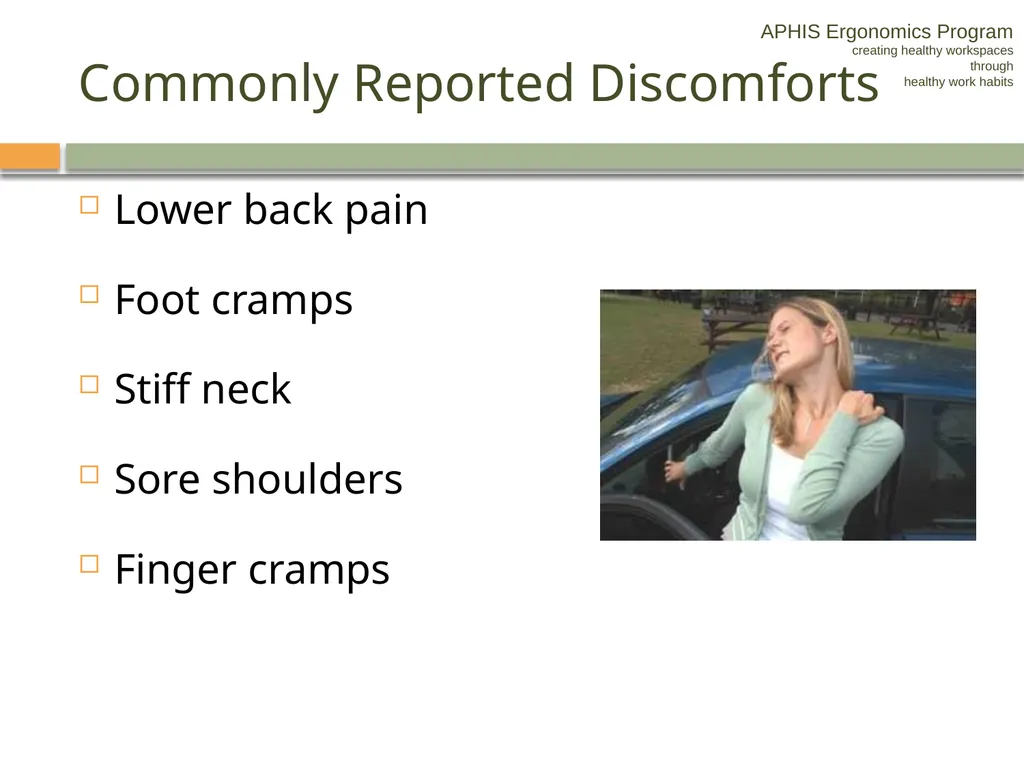
Commonly Reported Discomforts Lower back pain
Foot cramps
Stiff neck
Sore shoulders
Finger cramps APHIS Ergonomics Program creating healthy workspaces through healthy work habits<br>
Foot cramps
Stiff neck
Sore shoulders
Finger cramps APHIS Ergonomics Program creating healthy workspaces through healthy work habits<br>
13
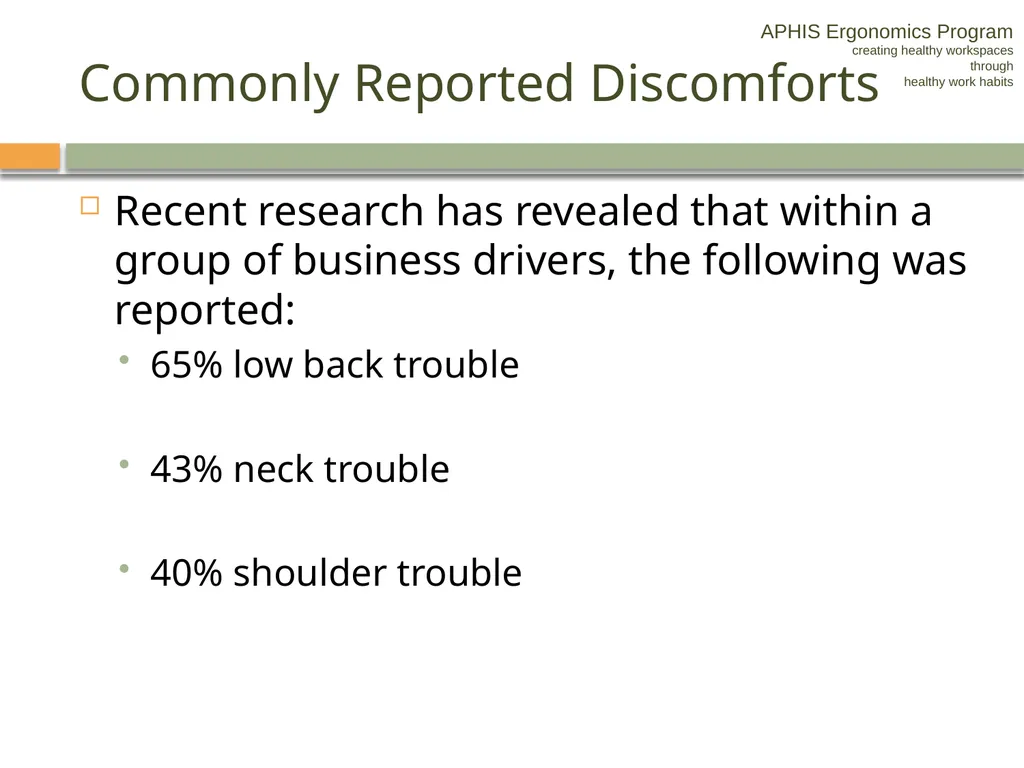
Commonly Reported Discomforts Recent research has revealed that within a group of business drivers, the following was reported:
65% low back trouble
43% neck trouble
40% shoulder trouble APHIS Ergonomics Program creating healthy workspaces through healthy work habits<br>
65% low back trouble
43% neck trouble
40% shoulder trouble APHIS Ergonomics Program creating healthy workspaces through healthy work habits<br>
14
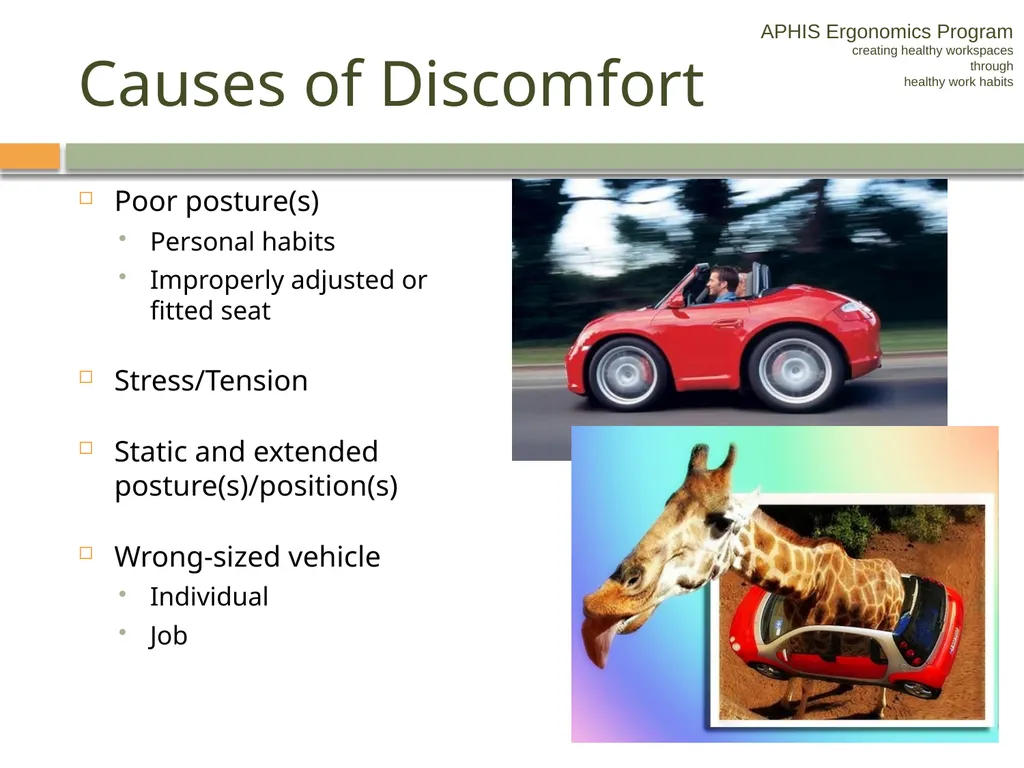
Causes of Discomfort Poor posture(s)
Personal habits
Improperly adjusted or fitted seat
Stress/Tension
Static and extended posture(s)/position(s)
Wrong-sized vehicle
Individual
Job APHIS Ergonomics Program creating healthy workspaces through healthy work habits<br>
Personal habits
Improperly adjusted or fitted seat
Stress/Tension
Static and extended posture(s)/position(s)
Wrong-sized vehicle
Individual
Job APHIS Ergonomics Program creating healthy workspaces through healthy work habits<br>
15
Causes of Discomfort The shape of the vehicle seat itself may put pressure on selected parts of the legs, back and buttocks.
Leads to pain or discomfort at pressure point.
Affects blood flow to the legs and feet.
Low frequency whole-body vibration in moving cars and trucks can contribute to effects on the lower back and performance problems. APHIS Ergonomics Program creating healthy workspaces through healthy work habits<br>
Leads to pain or discomfort at pressure point.
Affects blood flow to the legs and feet.
Low frequency whole-body vibration in moving cars and trucks can contribute to effects on the lower back and performance problems. APHIS Ergonomics Program creating healthy workspaces through healthy work habits<br>
16
Contact your agency Safety & Health Program for:
Blurred vision;
Decrease in manual coordination;
Drowsiness (even with proper rest);
Low back pain;
Insomnia;
Headaches or upset stomach. Causes of Discomfort Vibration APHIS Ergonomics Program creating healthy workspaces through healthy work habits<br>
Blurred vision;
Decrease in manual coordination;
Drowsiness (even with proper rest);
Low back pain;
Insomnia;
Headaches or upset stomach. Causes of Discomfort Vibration APHIS Ergonomics Program creating healthy workspaces through healthy work habits<br>
17
Causes of Discomfort
Driving Conditions Your body experiences up-and-down vibrations from the car travelling on uneven or bumpy road surfaces.
The body moves sideways when you turn on corners.
Depending on how fast you accelerate or decelerate, you will feel a force on your body. APHIS Ergonomics Program creating healthy workspaces through healthy work habits<br>
The body moves sideways when you turn on corners.
Depending on how fast you accelerate or decelerate, you will feel a force on your body. APHIS Ergonomics Program creating healthy workspaces through healthy work habits<br>
18
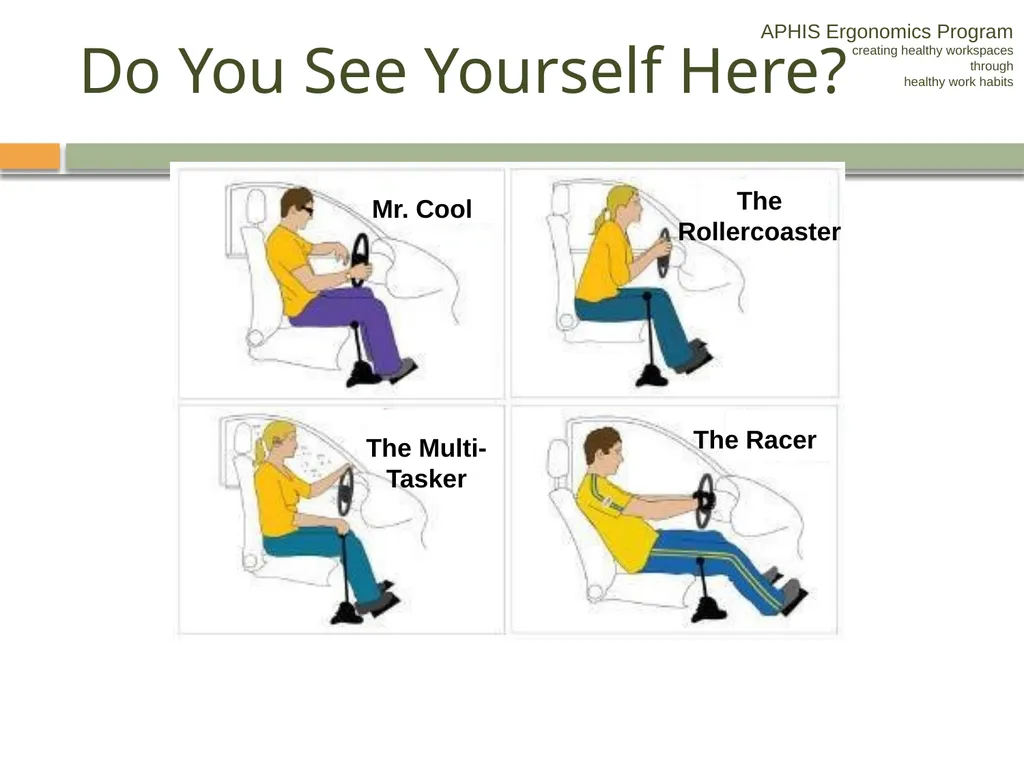
Do You See Yourself Here? APHIS Ergonomics Program
creating healthy workspaces
through
healthy work habits Mr. Cool The Racer The Rollercoaster The Multi-Tasker<br>
19
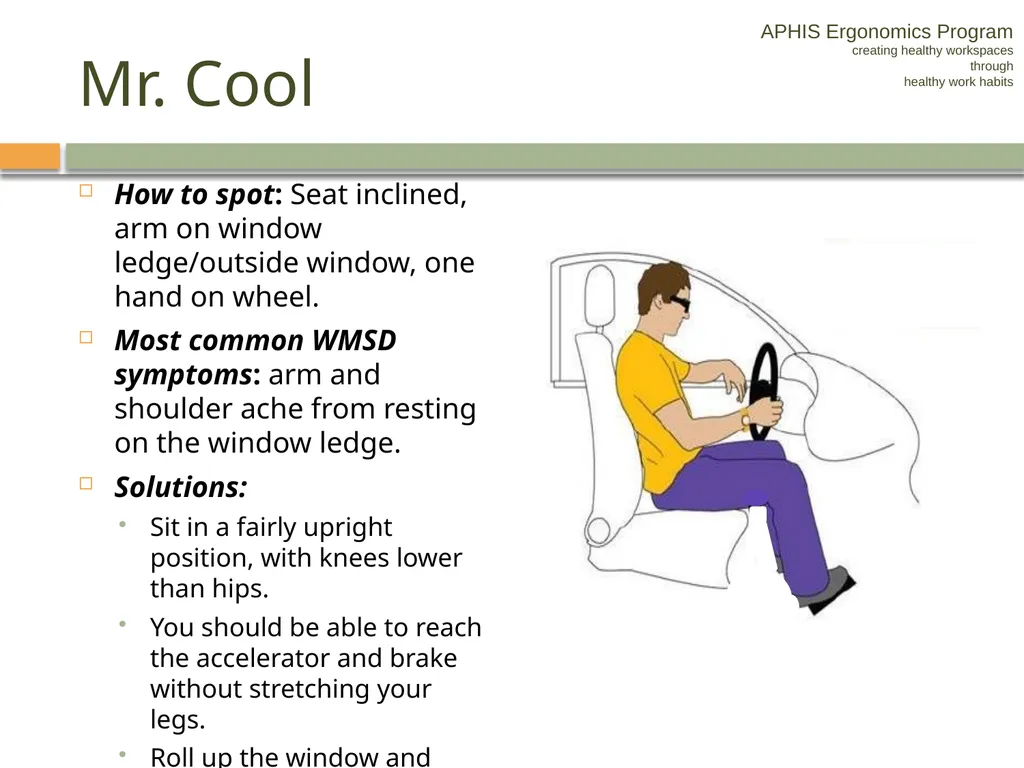
Mr. Cool How to spot: Seat inclined, arm on window ledge/outside window, one hand on wheel.
Most common WMSD symptoms: arm and shoulder ache from resting on the window ledge.
Solutions:
Sit in a fairly upright position, with knees lower than hips.
You should be able to reach the accelerator and brake without stretching your legs.
Roll up the window and keep both arms on the steering wheel. APHIS Ergonomics Program creating healthy workspaces through healthy work habits<br>
Most common WMSD symptoms: arm and shoulder ache from resting on the window ledge.
Solutions:
Sit in a fairly upright position, with knees lower than hips.
You should be able to reach the accelerator and brake without stretching your legs.
Roll up the window and keep both arms on the steering wheel. APHIS Ergonomics Program creating healthy workspaces through healthy work habits<br>
20
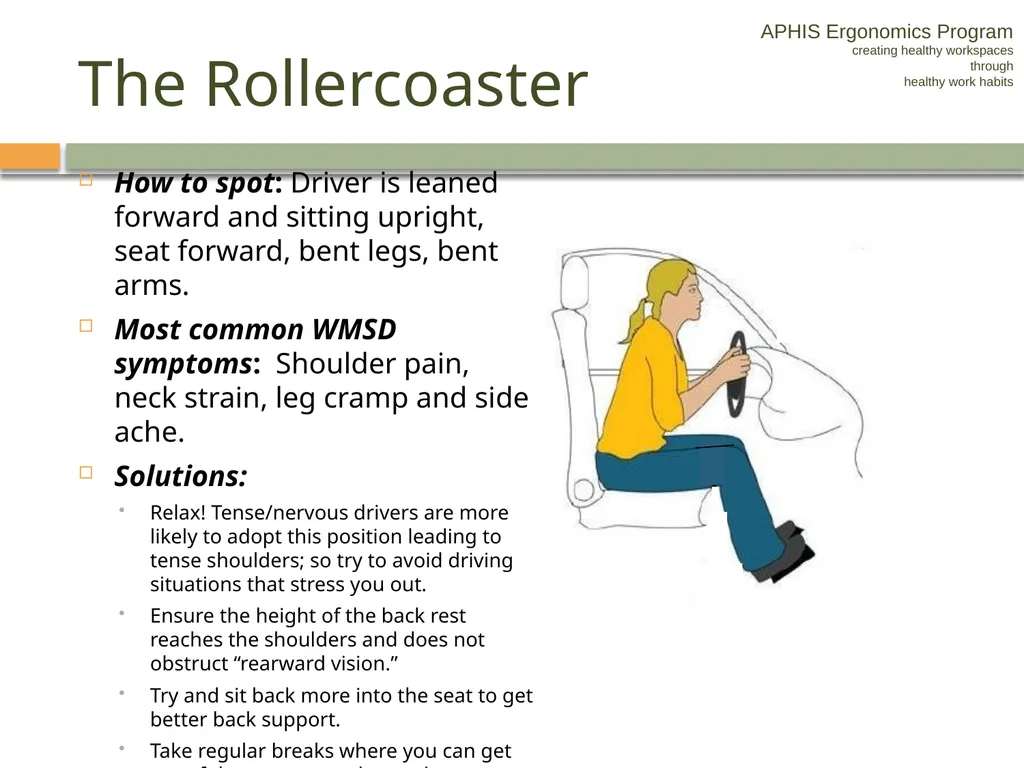
The Rollercoaster How to spot: Driver is leaned forward and sitting upright, seat forward, bent legs, bent arms.
Most common WMSD symptoms: Shoulder pain, neck strain, leg cramp and side ache.
Solutions:
Relax! Tense/nervous drivers are more likely to adopt this position leading to tense shoulders; so try to avoid driving situations that stress you out.
Ensure the height of the back rest reaches the shoulders and does not obstruct “rearward vision.”
Try and sit back more into the seat to get better back support.
Take regular breaks where you can get out of the car to stretch your legs. APHIS Ergonomics Program creating healthy workspaces through healthy work habits<br>
Most common WMSD symptoms: Shoulder pain, neck strain, leg cramp and side ache.
Solutions:
Relax! Tense/nervous drivers are more likely to adopt this position leading to tense shoulders; so try to avoid driving situations that stress you out.
Ensure the height of the back rest reaches the shoulders and does not obstruct “rearward vision.”
Try and sit back more into the seat to get better back support.
Take regular breaks where you can get out of the car to stretch your legs. APHIS Ergonomics Program creating healthy workspaces through healthy work habits<br>
21
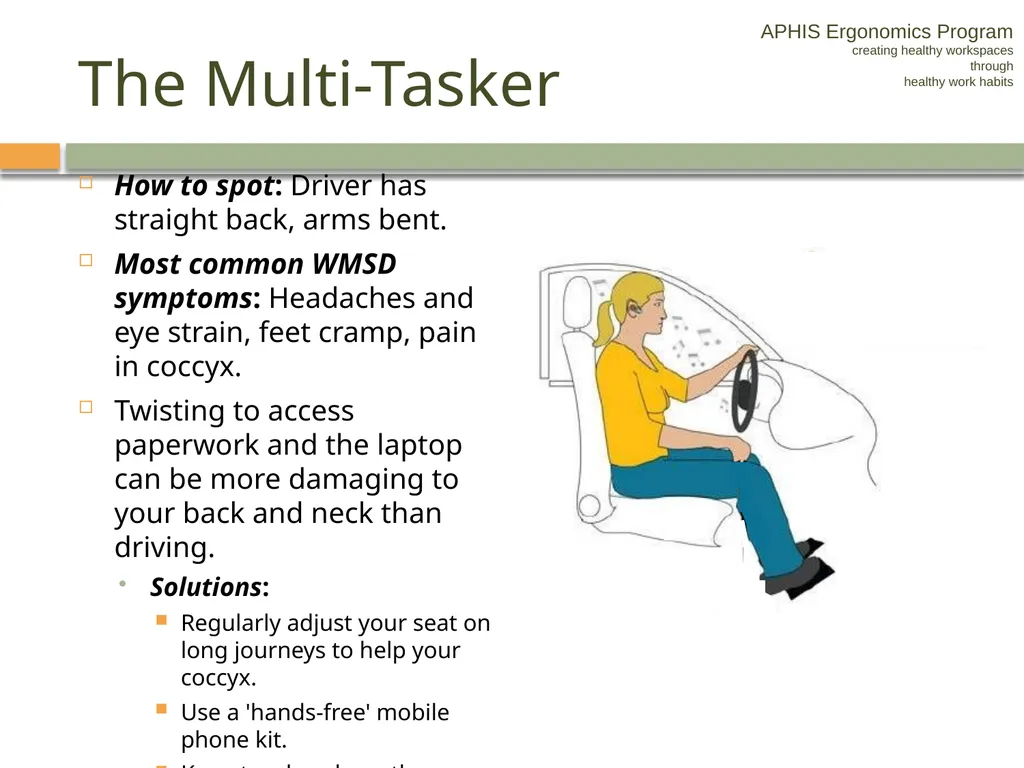
The Multi-Tasker How to spot: Driver has straight back, arms bent.
Most common WMSD symptoms: Headaches and eye strain, feet cramp, pain in coccyx.
Twisting to access paperwork and the laptop can be more damaging to your back and neck than driving.
Solutions:
Regularly adjust your seat on long journeys to help your coccyx.
Use a 'hands-free' mobile phone kit.
Keep two hands on the wheel. APHIS Ergonomics Program creating healthy workspaces through healthy work habits<br>
Most common WMSD symptoms: Headaches and eye strain, feet cramp, pain in coccyx.
Twisting to access paperwork and the laptop can be more damaging to your back and neck than driving.
Solutions:
Regularly adjust your seat on long journeys to help your coccyx.
Use a 'hands-free' mobile phone kit.
Keep two hands on the wheel. APHIS Ergonomics Program creating healthy workspaces through healthy work habits<br>
22
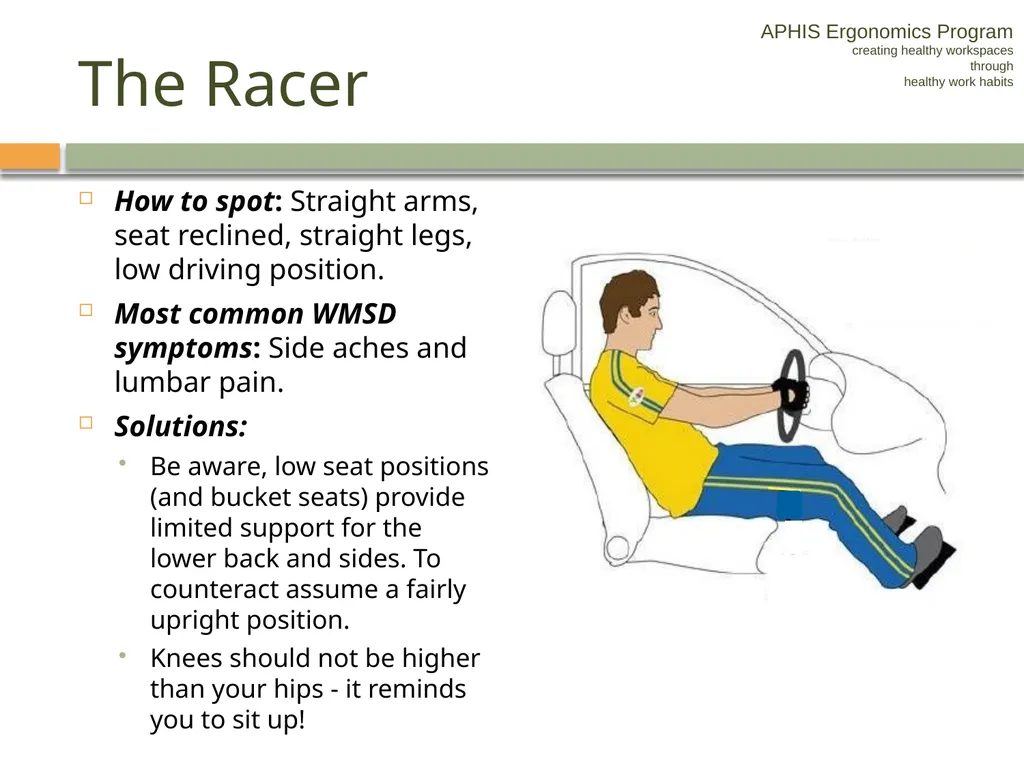
The Racer How to spot: Straight arms, seat reclined, straight legs, low driving position.
Most common WMSD symptoms: Side aches and lumbar pain.
Solutions:
Be aware, low seat positions (and bucket seats) provide limited support for the lower back and sides. To counteract assume a fairly upright position.
Knees should not be higher than your hips - it reminds you to sit up! APHIS Ergonomics Program creating healthy workspaces through healthy work habits<br>
Most common WMSD symptoms: Side aches and lumbar pain.
Solutions:
Be aware, low seat positions (and bucket seats) provide limited support for the lower back and sides. To counteract assume a fairly upright position.
Knees should not be higher than your hips - it reminds you to sit up! APHIS Ergonomics Program creating healthy workspaces through healthy work habits<br>
23
Risk Assessment APHIS Ergonomics Program
creating healthy workspaces
through
healthy work habits<br>
24
Are You an at Risk Driver? Perform an Initial Self-Risk Assessment.
Driving at work. Ask yourself about the time spent in the vehicle and typical daily/weekly mileage.
Use the Car Selection Check-List to help evaluate features of the car and seat design.
Body discomfort. Use the Body Part Discomfort Map to identify any discomfort experienced in a typical week.
Working from the car. Ask yourself about work activities undertaken in the car e.g., manual handling, laptop/PDA use, paperwork.
Use the Working From Your Car guide for a quick assessment.
Lifestyle. Consider your personal lifestyle factors, e.g., physical activity, smoking. APHIS Ergonomics Program creating healthy workspaces through healthy work habits<br>
Driving at work. Ask yourself about the time spent in the vehicle and typical daily/weekly mileage.
Use the Car Selection Check-List to help evaluate features of the car and seat design.
Body discomfort. Use the Body Part Discomfort Map to identify any discomfort experienced in a typical week.
Working from the car. Ask yourself about work activities undertaken in the car e.g., manual handling, laptop/PDA use, paperwork.
Use the Working From Your Car guide for a quick assessment.
Lifestyle. Consider your personal lifestyle factors, e.g., physical activity, smoking. APHIS Ergonomics Program creating healthy workspaces through healthy work habits<br>
25
Identifying at Risk Drivers Upon the completion of your self-risk assessment, it may be necessary to:
Contact your Safety and Health Specialist or the APHIS Ergonomics Program to:
Observe the work tasks performed which may increase risk;
Discuss options and solutions for improved driving support and comfort. APHIS Ergonomics Program creating healthy workspaces through healthy work habits<br>
Contact your Safety and Health Specialist or the APHIS Ergonomics Program to:
Observe the work tasks performed which may increase risk;
Discuss options and solutions for improved driving support and comfort. APHIS Ergonomics Program creating healthy workspaces through healthy work habits<br>
26
Identifying at Risk Drivers Upon the completion of your self-risk assessment, it may be necessary to:
Take urgent action to obtain continued support until your risk is deemed minimal, if you:
Present with severe pain or a medical history of low back injury;
Drive an inappropriate car;
Have high driving exposure;
Have other risk factors (e.g., as manual handling). APHIS Ergonomics Program creating healthy workspaces through healthy work habits<br>
Take urgent action to obtain continued support until your risk is deemed minimal, if you:
Present with severe pain or a medical history of low back injury;
Drive an inappropriate car;
Have high driving exposure;
Have other risk factors (e.g., as manual handling). APHIS Ergonomics Program creating healthy workspaces through healthy work habits<br>
27
Minimizing Your Risks APHIS Ergonomics Program
creating healthy workspaces
through
healthy work habits<br>
28
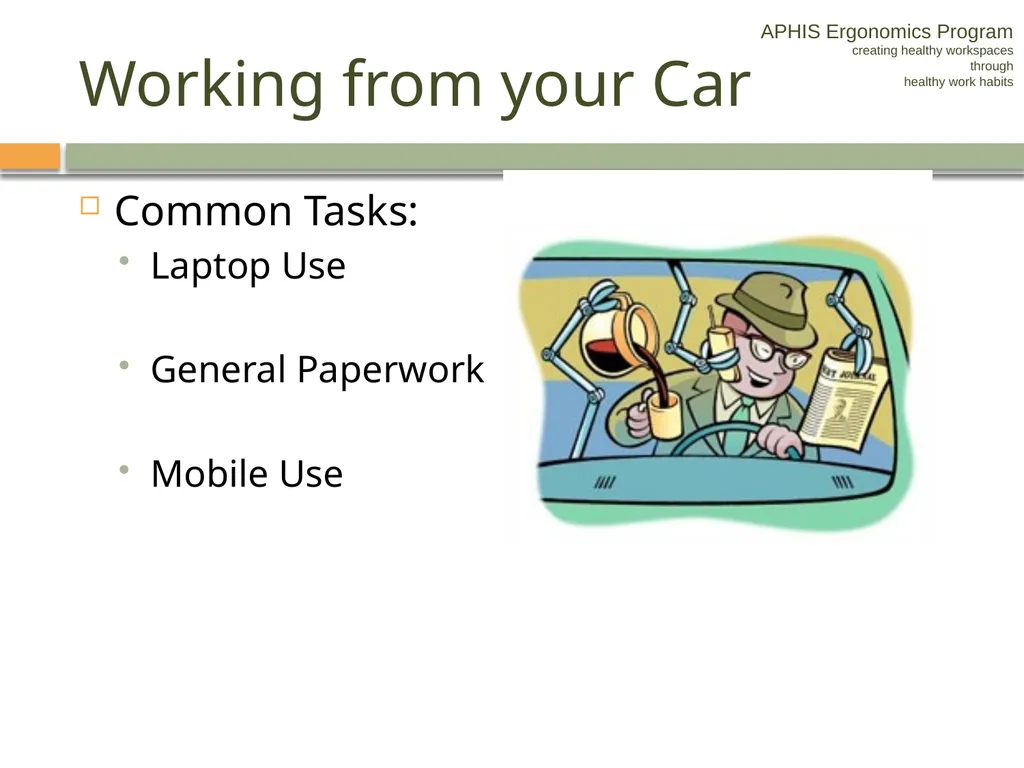
Working from your Car Common Tasks:
Laptop Use
General Paperwork
Mobile Use APHIS Ergonomics Program creating healthy workspaces through healthy work habits<br>
Laptop Use
General Paperwork
Mobile Use APHIS Ergonomics Program creating healthy workspaces through healthy work habits<br>
29
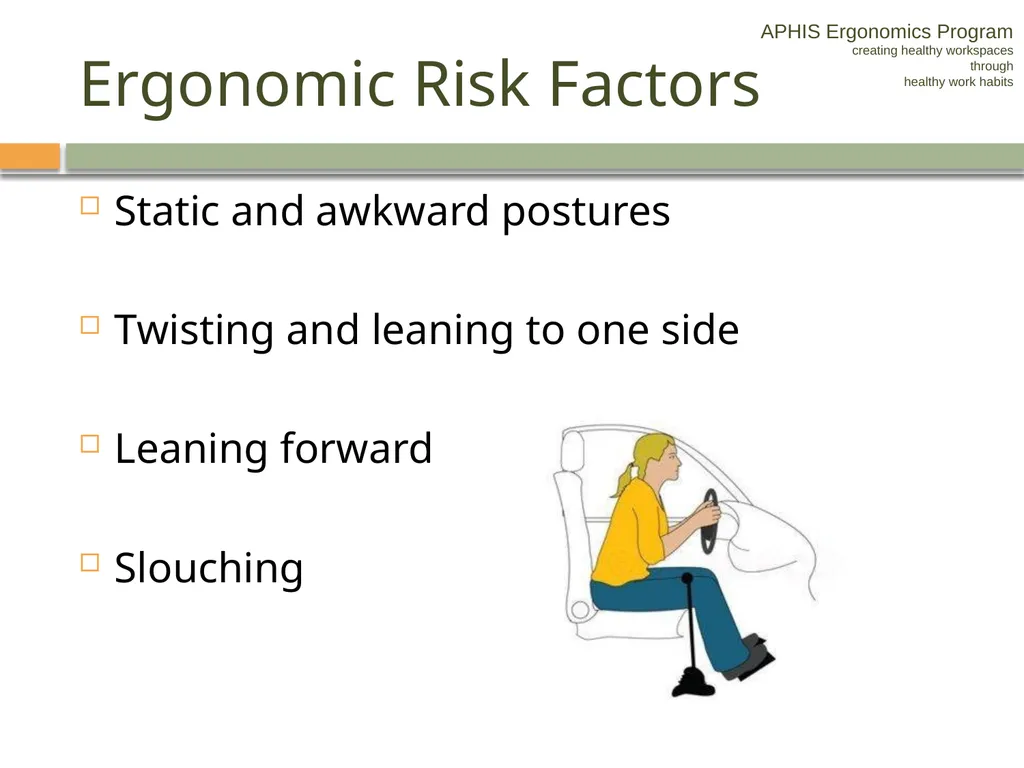
Ergonomic Risk Factors Static and awkward postures
Twisting and leaning to one side
Leaning forward
Slouching APHIS Ergonomics Program creating healthy workspaces through healthy work habits<br>
Twisting and leaning to one side
Leaning forward
Slouching APHIS Ergonomics Program creating healthy workspaces through healthy work habits<br>
30
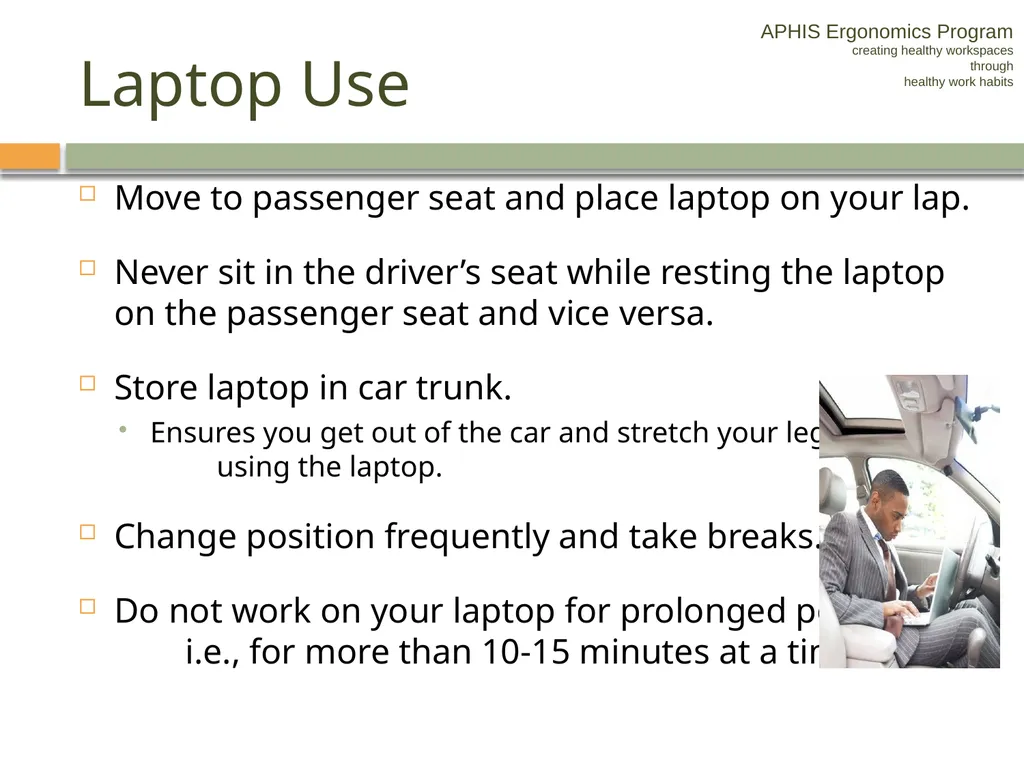
Laptop Use Move to passenger seat and place laptop on your lap.
Never sit in the driver’s seat while resting the laptop on the passenger seat and vice versa.
Store laptop in car trunk.
Ensures you get out of the car and stretch your legs before using the laptop.
Change position frequently and take breaks.
Do not work on your laptop for prolonged periods i.e., for more than 10-15 minutes at a time. APHIS Ergonomics Program creating healthy workspaces through healthy work habits<br>
Never sit in the driver’s seat while resting the laptop on the passenger seat and vice versa.
Store laptop in car trunk.
Ensures you get out of the car and stretch your legs before using the laptop.
Change position frequently and take breaks.
Do not work on your laptop for prolonged periods i.e., for more than 10-15 minutes at a time. APHIS Ergonomics Program creating healthy workspaces through healthy work habits<br>
31
General Paperwork Try to achieve as good a range of postures as possible, avoiding:
Slouching;
Leaning forwards;
Twisting.
Change position frequently and take breaks.
Never sit in the driver’s seat while reading the paperwork on the passenger seat and vice versa. APHIS Ergonomics Program creating healthy workspaces through healthy work habits<br>
Slouching;
Leaning forwards;
Twisting.
Change position frequently and take breaks.
Never sit in the driver’s seat while reading the paperwork on the passenger seat and vice versa. APHIS Ergonomics Program creating healthy workspaces through healthy work habits<br>
32
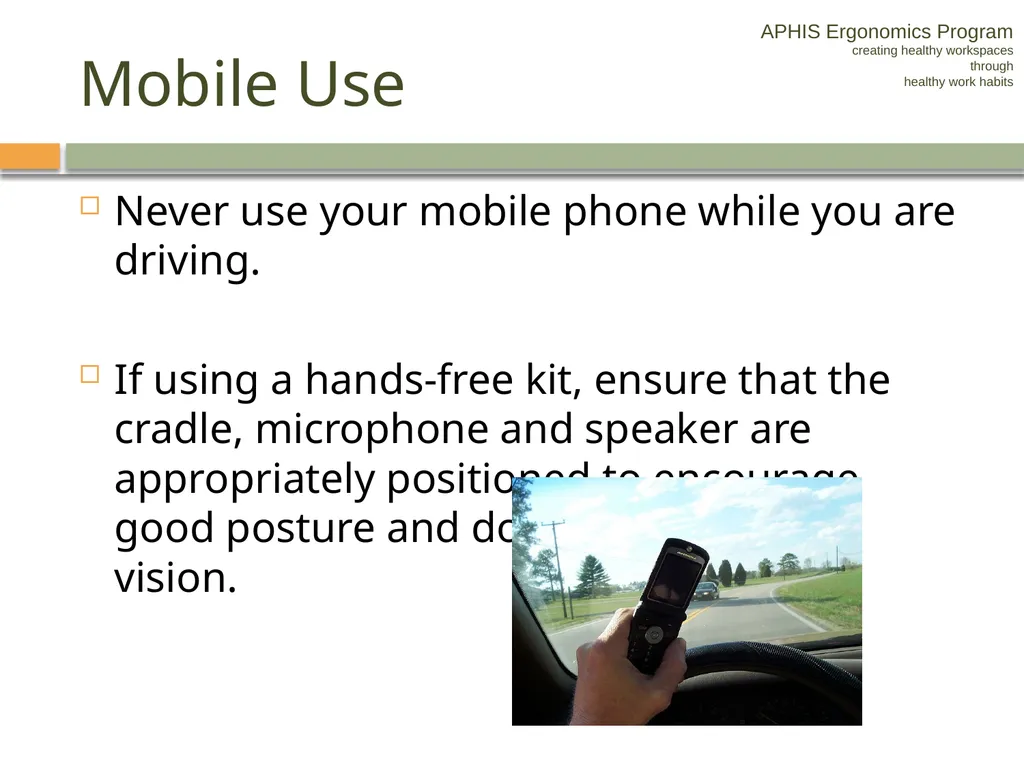
Mobile Use Never use your mobile phone while you are driving.
If using a hands-free kit, ensure that the cradle, microphone and speaker are appropriately positioned to encourage good posture and do not obscure your vision. APHIS Ergonomics Program creating healthy workspaces through healthy work habits<br>
If using a hands-free kit, ensure that the cradle, microphone and speaker are appropriately positioned to encourage good posture and do not obscure your vision. APHIS Ergonomics Program creating healthy workspaces through healthy work habits<br>
33
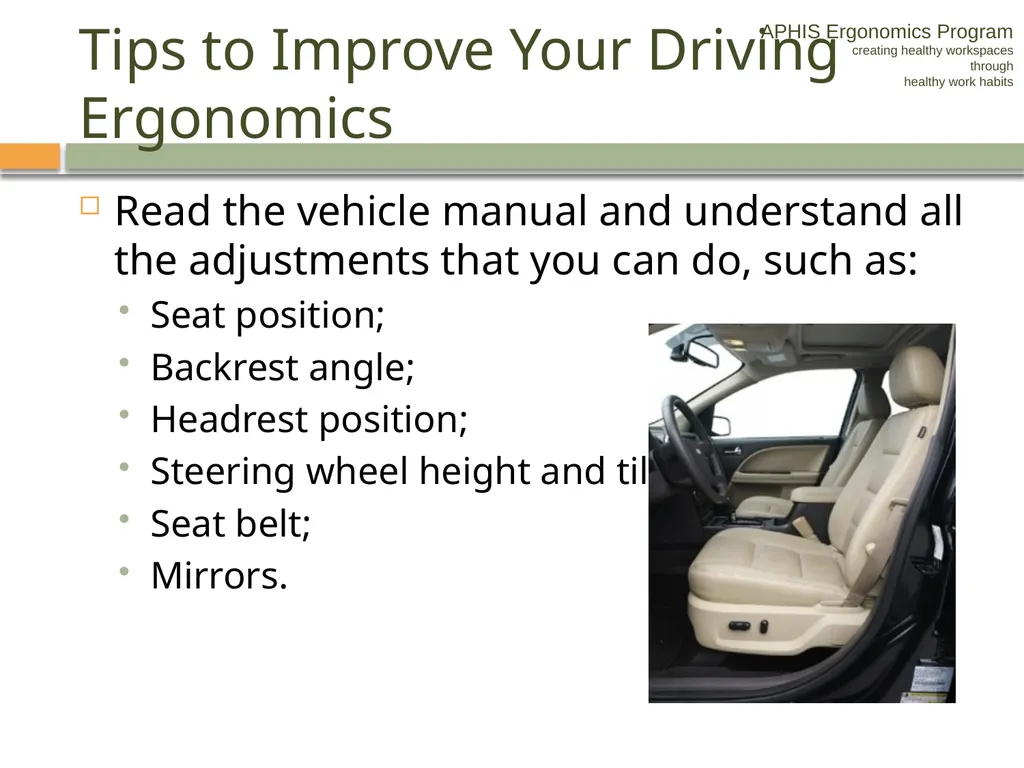
Tips to Improve Your Driving Ergonomics Read the vehicle manual and understand all the adjustments that you can do, such as:
Seat position;
Backrest angle;
Headrest position;
Steering wheel height and tilt;
Seat belt;
Mirrors. APHIS Ergonomics Program creating healthy workspaces through healthy work habits<br>
Seat position;
Backrest angle;
Headrest position;
Steering wheel height and tilt;
Seat belt;
Mirrors. APHIS Ergonomics Program creating healthy workspaces through healthy work habits<br>
34
Tips to Improve Your Driving Ergonomics Before you start your next drive:
Remove items from your pockets (e.g., wallet or keys).
May press on soft tissue as you sit down;
This compression can reduce circulation or press on nerves and other soft tissues.
Position items that you may need during your drive (e.g., sunglasses, tissue, mints, etc.).
Place such as to minimize reaching while driving;
Take time to pull over if necessary to avoid awkward reaching. APHIS Ergonomics Program creating healthy workspaces through healthy work habits<br>
Remove items from your pockets (e.g., wallet or keys).
May press on soft tissue as you sit down;
This compression can reduce circulation or press on nerves and other soft tissues.
Position items that you may need during your drive (e.g., sunglasses, tissue, mints, etc.).
Place such as to minimize reaching while driving;
Take time to pull over if necessary to avoid awkward reaching. APHIS Ergonomics Program creating healthy workspaces through healthy work habits<br>
35
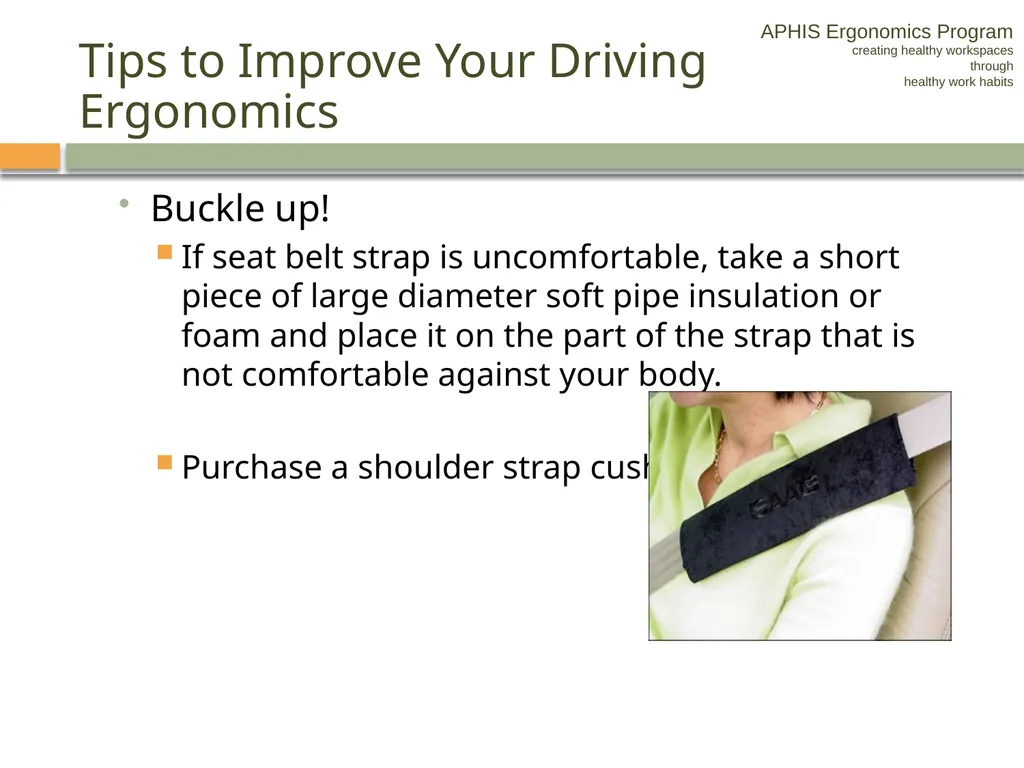
Tips to Improve Your Driving Ergonomics Buckle up!
If seat belt strap is uncomfortable, take a short piece of large diameter soft pipe insulation or foam and place it on the part of the strap that is not comfortable against your body.
Purchase a shoulder strap cushion. APHIS Ergonomics Program creating healthy workspaces through healthy work habits<br>
If seat belt strap is uncomfortable, take a short piece of large diameter soft pipe insulation or foam and place it on the part of the strap that is not comfortable against your body.
Purchase a shoulder strap cushion. APHIS Ergonomics Program creating healthy workspaces through healthy work habits<br>
36
Tips to Improve Your Driving Ergonomics Raise your seat - as high as you can but still be comfortable.
This height will optimize your vision through the windows.
You should be able to see at least 76 mm (3 in.) over the top of the steering wheel.
Ensure that you have sufficient room between the roof and the top of your head. APHIS Ergonomics Program creating healthy workspaces through healthy work habits<br>
This height will optimize your vision through the windows.
You should be able to see at least 76 mm (3 in.) over the top of the steering wheel.
Ensure that you have sufficient room between the roof and the top of your head. APHIS Ergonomics Program creating healthy workspaces through healthy work habits<br>
37
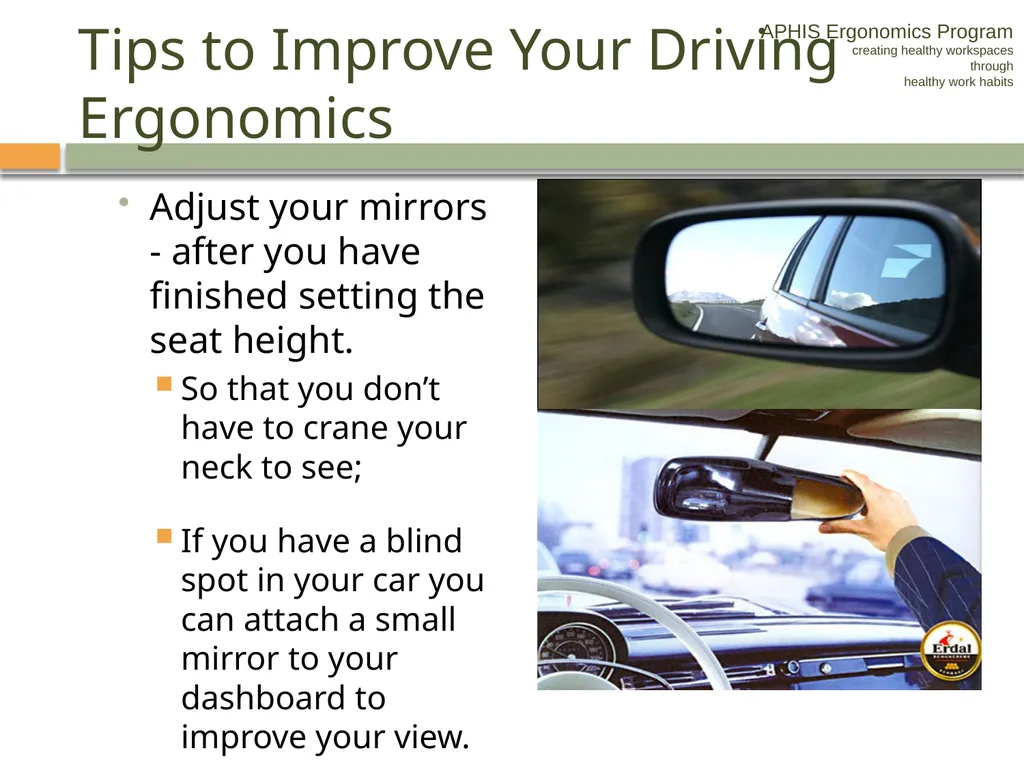
Tips to Improve Your Driving Ergonomics Adjust your mirrors - after you have finished setting the seat height.
So that you don’t have to crane your neck to see;
If you have a blind spot in your car you can attach a small mirror to your dashboard to improve your view. APHIS Ergonomics Program creating healthy workspaces through healthy work habits<br>
So that you don’t have to crane your neck to see;
If you have a blind spot in your car you can attach a small mirror to your dashboard to improve your view. APHIS Ergonomics Program creating healthy workspaces through healthy work habits<br>
38
Tips to Improve Your Driving Ergonomics Adjust your lumbar support: up-and-down and in-and-out until you feel an even pressure along your back from the hips to shoulder height.
The lower part of your back should feel supported, i.e., no gaps or pressure points in the back support area.
If not supported, roll up a small towel and place in the curve of your back;
Obtain a lumbar pillow if necessary.
Adjust your back tilt.
The least amount of pressure on the back occurs when your seat back is 100-110 degrees so that you are slightly reclined.
The back support should fully support your back.
If you are leaning too far back, you may end up bending your head and neck forward, which may cause muscle fatigue, neck or shoulder pain, tingling in the fingers, etc.
If you cannot recline your seat, take frequent breaks from your upright posture by shifting your weight side to side and using small upper body motions to relax the back. APHIS Ergonomics Program creating healthy workspaces through healthy work habits<br>
The lower part of your back should feel supported, i.e., no gaps or pressure points in the back support area.
If not supported, roll up a small towel and place in the curve of your back;
Obtain a lumbar pillow if necessary.
Adjust your back tilt.
The least amount of pressure on the back occurs when your seat back is 100-110 degrees so that you are slightly reclined.
The back support should fully support your back.
If you are leaning too far back, you may end up bending your head and neck forward, which may cause muscle fatigue, neck or shoulder pain, tingling in the fingers, etc.
If you cannot recline your seat, take frequent breaks from your upright posture by shifting your weight side to side and using small upper body motions to relax the back. APHIS Ergonomics Program creating healthy workspaces through healthy work habits<br>
39
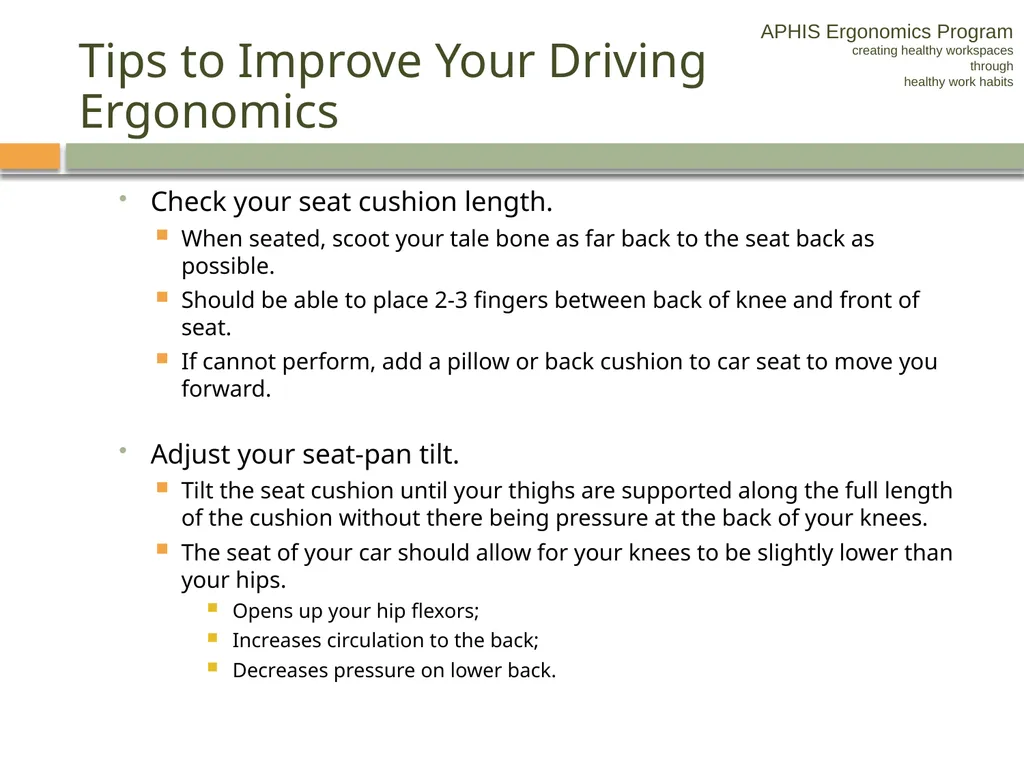
Tips to Improve Your Driving Ergonomics Check your seat cushion length.
When seated, scoot your tale bone as far back to the seat back as possible.
Should be able to place 2-3 fingers between back of knee and front of seat.
If cannot perform, add a pillow or back cushion to car seat to move you forward.
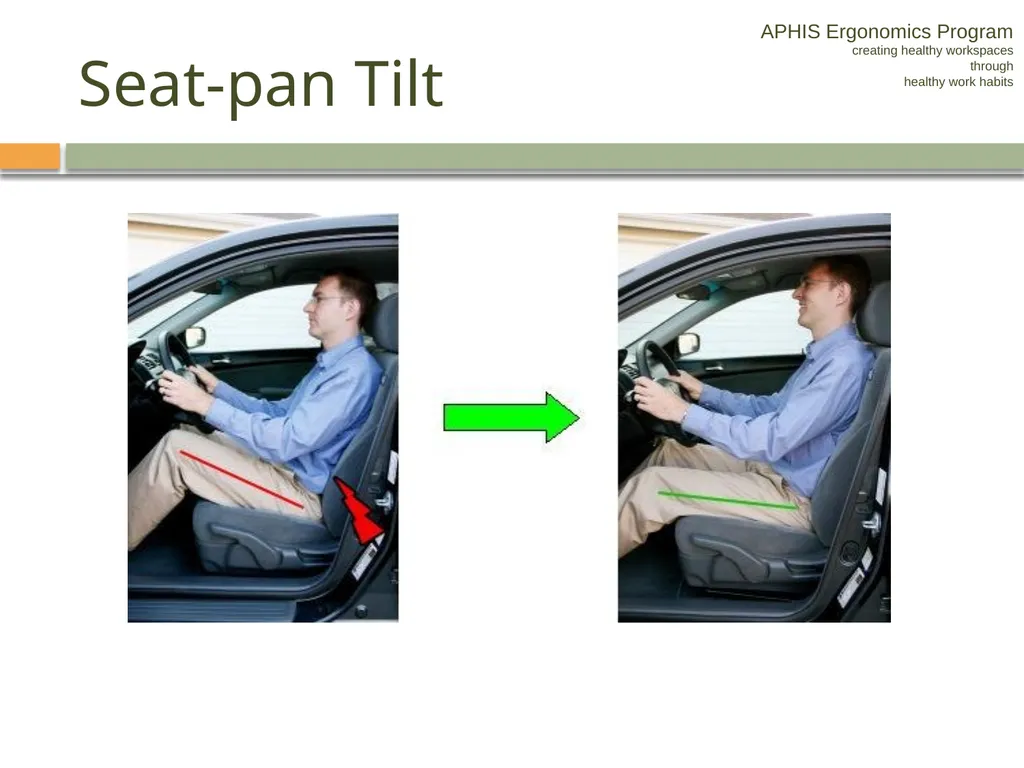
Adjust your seat-pan tilt.
Tilt the seat cushion until your thighs are supported along the full length of the cushion without there being pressure at the back of your knees.
The seat of your car should allow for your knees to be slightly lower than your hips.
Opens up your hip flexors;
Increases circulation to the back;
Decreases pressure on lower back. APHIS Ergonomics Program creating healthy workspaces through healthy work habits<br>
When seated, scoot your tale bone as far back to the seat back as possible.
Should be able to place 2-3 fingers between back of knee and front of seat.
If cannot perform, add a pillow or back cushion to car seat to move you forward.
Adjust your seat-pan tilt.
Tilt the seat cushion until your thighs are supported along the full length of the cushion without there being pressure at the back of your knees.
The seat of your car should allow for your knees to be slightly lower than your hips.
Opens up your hip flexors;
Increases circulation to the back;
Decreases pressure on lower back. APHIS Ergonomics Program creating healthy workspaces through healthy work habits<br>
40
Seat-pan Tilt APHIS Ergonomics Program
creating healthy workspaces
through
healthy work habits<br>
41
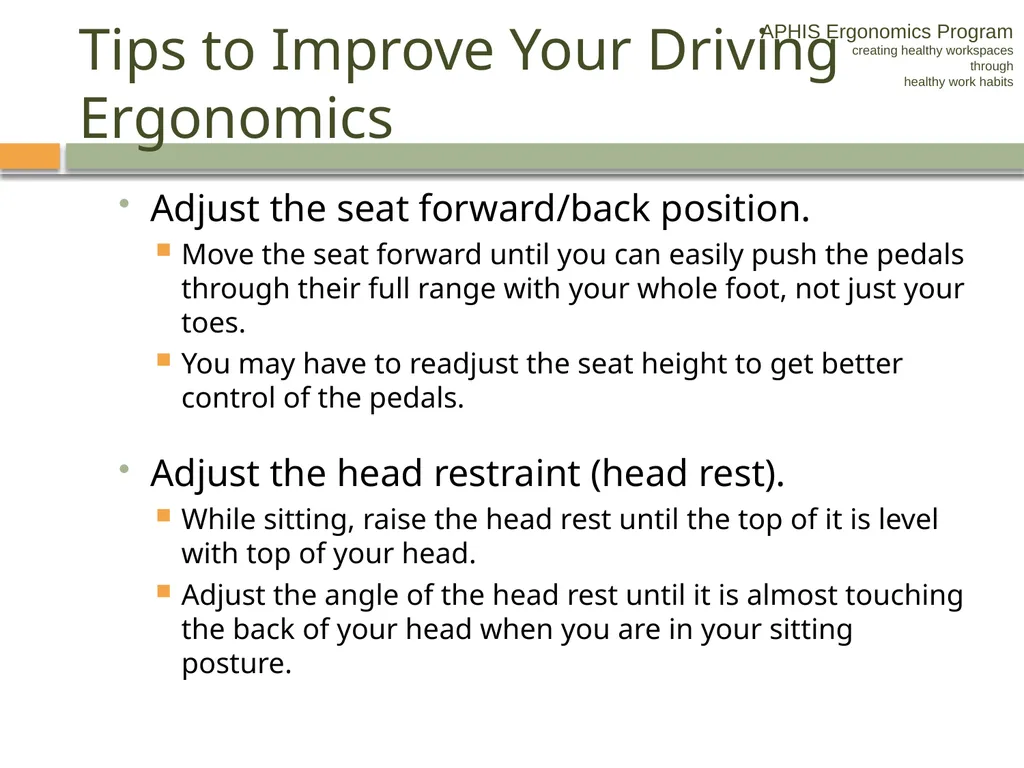
Tips to Improve Your Driving Ergonomics Adjust the seat forward/back position.
Move the seat forward until you can easily push the pedals through their full range with your whole foot, not just your toes.
You may have to readjust the seat height to get better control of the pedals.
Adjust the head restraint (head rest).
While sitting, raise the head rest until the top of it is level with top of your head.
Adjust the angle of the head rest until it is almost touching the back of your head when you are in your sitting posture. APHIS Ergonomics Program creating healthy workspaces through healthy work habits<br>
Move the seat forward until you can easily push the pedals through their full range with your whole foot, not just your toes.
You may have to readjust the seat height to get better control of the pedals.
Adjust the head restraint (head rest).
While sitting, raise the head rest until the top of it is level with top of your head.
Adjust the angle of the head rest until it is almost touching the back of your head when you are in your sitting posture. APHIS Ergonomics Program creating healthy workspaces through healthy work habits<br>
42
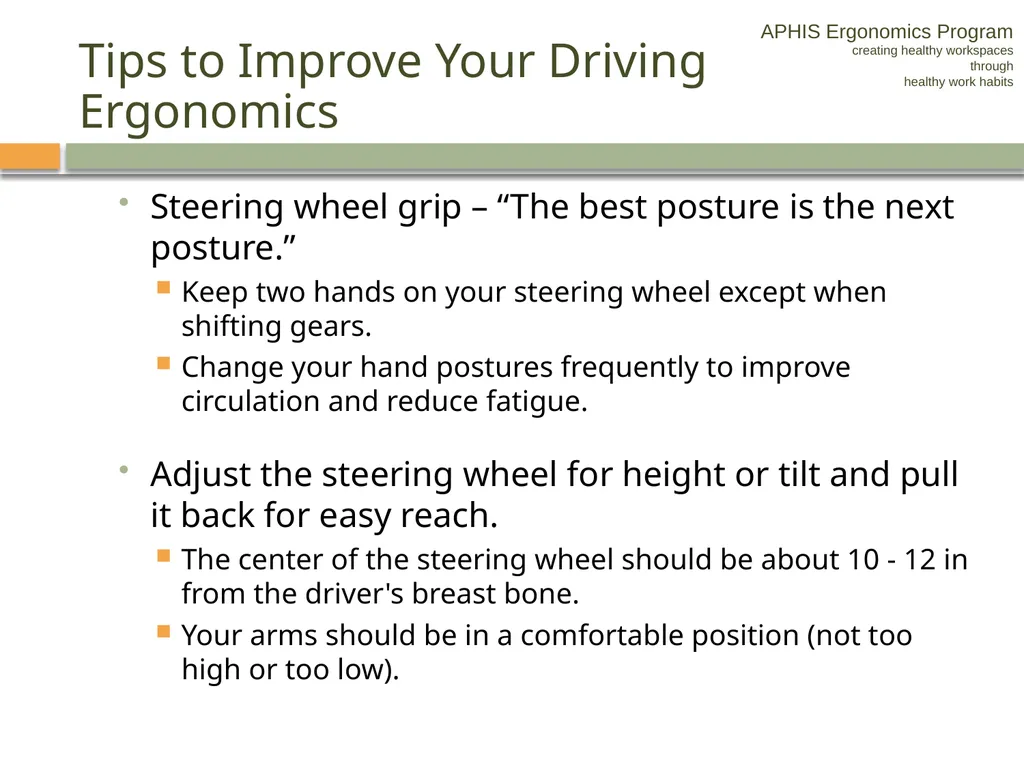
Tips to Improve Your Driving Ergonomics Steering wheel grip – “The best posture is the next posture.”
Keep two hands on your steering wheel except when shifting gears.
Change your hand postures frequently to improve circulation and reduce fatigue.
Adjust the steering wheel for height or tilt and pull it back for easy reach.
The center of the steering wheel should be about 10 - 12 in from the driver's breast bone.
Your arms should be in a comfortable position (not too high or too low). APHIS Ergonomics Program creating healthy workspaces through healthy work habits<br>
Keep two hands on your steering wheel except when shifting gears.
Change your hand postures frequently to improve circulation and reduce fatigue.
Adjust the steering wheel for height or tilt and pull it back for easy reach.
The center of the steering wheel should be about 10 - 12 in from the driver's breast bone.
Your arms should be in a comfortable position (not too high or too low). APHIS Ergonomics Program creating healthy workspaces through healthy work habits<br>
43
Tips to Improve Your Driving
Ergonomics – Steering Wheel Grip Common postures to avoid:
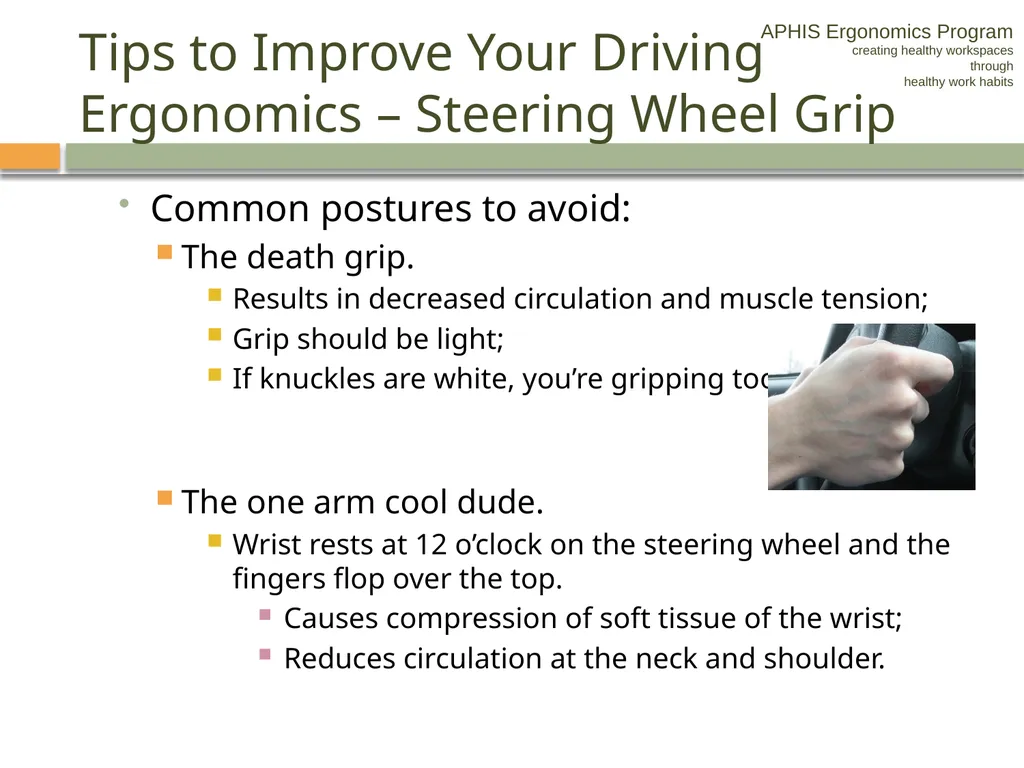
The death grip.
Results in decreased circulation and muscle tension;
Grip should be light;
If knuckles are white, you’re gripping too hard.
The one arm cool dude.
Wrist rests at 12 o’clock on the steering wheel and the fingers flop over the top.
Causes compression of soft tissue of the wrist;
Reduces circulation at the neck and shoulder. APHIS Ergonomics Program creating healthy workspaces through healthy work habits<br>
The death grip.
Results in decreased circulation and muscle tension;
Grip should be light;
If knuckles are white, you’re gripping too hard.
The one arm cool dude.
Wrist rests at 12 o’clock on the steering wheel and the fingers flop over the top.
Causes compression of soft tissue of the wrist;
Reduces circulation at the neck and shoulder. APHIS Ergonomics Program creating healthy workspaces through healthy work habits<br>
44
Tips to Improve Your Driving
Ergonomics – Steering Wheel Grip Common postures to avoid:
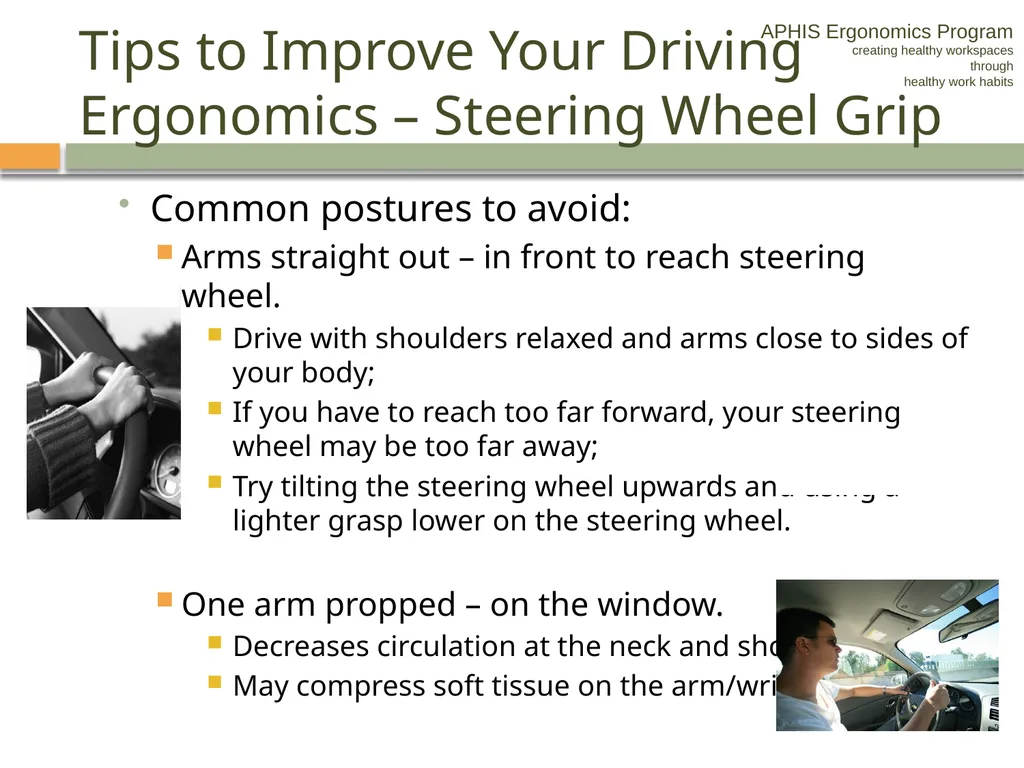
Arms straight out – in front to reach steering wheel.
Drive with shoulders relaxed and arms close to sides of your body;
If you have to reach too far forward, your steering wheel may be too far away;
Try tilting the steering wheel upwards and using a lighter grasp lower on the steering wheel.
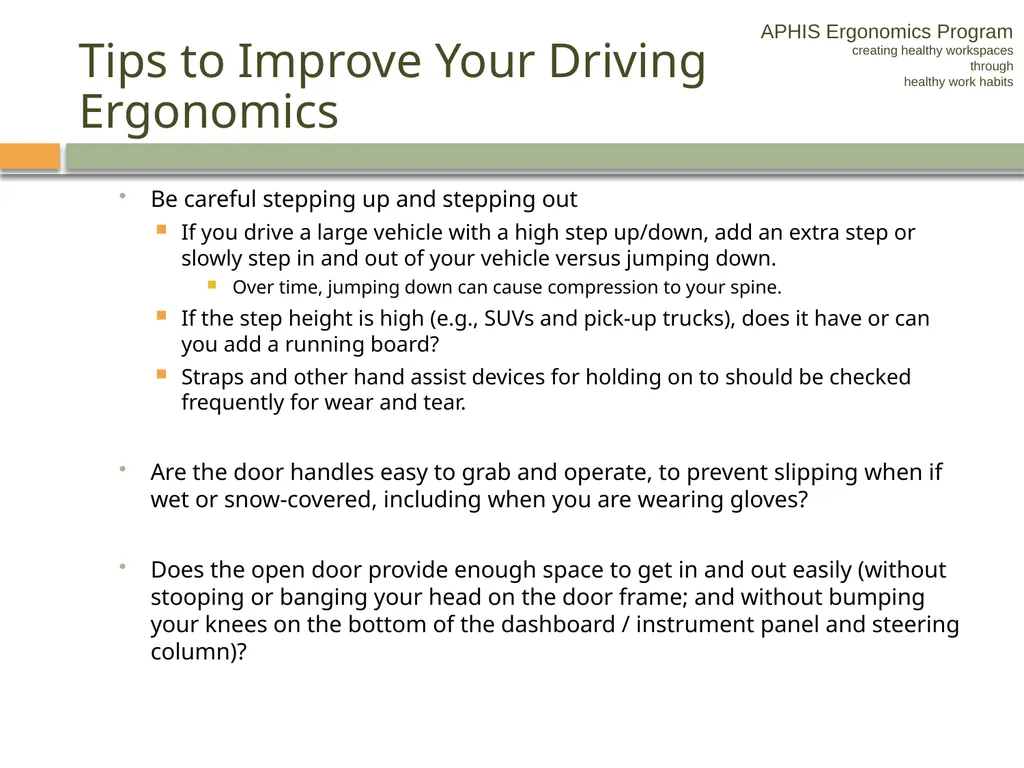
One arm propped – on the window.
Decreases circulation at the neck and shoulder;
May compress soft tissue on the arm/wrist. APHIS Ergonomics Program creating healthy workspaces through healthy work habits<br>
Arms straight out – in front to reach steering wheel.
Drive with shoulders relaxed and arms close to sides of your body;
If you have to reach too far forward, your steering wheel may be too far away;
Try tilting the steering wheel upwards and using a lighter grasp lower on the steering wheel.
One arm propped – on the window.
Decreases circulation at the neck and shoulder;
May compress soft tissue on the arm/wrist. APHIS Ergonomics Program creating healthy workspaces through healthy work habits<br>
45
Tips to Improve Your Driving Ergonomics Be careful stepping up and stepping out
If you drive a large vehicle with a high step up/down, add an extra step or slowly step in and out of your vehicle versus jumping down.
Over time, jumping down can cause compression to your spine.
If the step height is high (e.g., SUVs and pick-up trucks), does it have or can you add a running board?
Straps and other hand assist devices for holding on to should be checked frequently for wear and tear.
Are the door handles easy to grab and operate, to prevent slipping when if wet or snow-covered, including when you are wearing gloves?
Does the open door provide enough space to get in and out easily (without stooping or banging your head on the door frame; and without bumping your knees on the bottom of the dashboard / instrument panel and steering column)? APHIS Ergonomics Program creating healthy workspaces through healthy work habits<br>
If you drive a large vehicle with a high step up/down, add an extra step or slowly step in and out of your vehicle versus jumping down.
Over time, jumping down can cause compression to your spine.
If the step height is high (e.g., SUVs and pick-up trucks), does it have or can you add a running board?
Straps and other hand assist devices for holding on to should be checked frequently for wear and tear.
Are the door handles easy to grab and operate, to prevent slipping when if wet or snow-covered, including when you are wearing gloves?
Does the open door provide enough space to get in and out easily (without stooping or banging your head on the door frame; and without bumping your knees on the bottom of the dashboard / instrument panel and steering column)? APHIS Ergonomics Program creating healthy workspaces through healthy work habits<br>
46
Do’s
Take stretch breaks every 3-4 hrs;
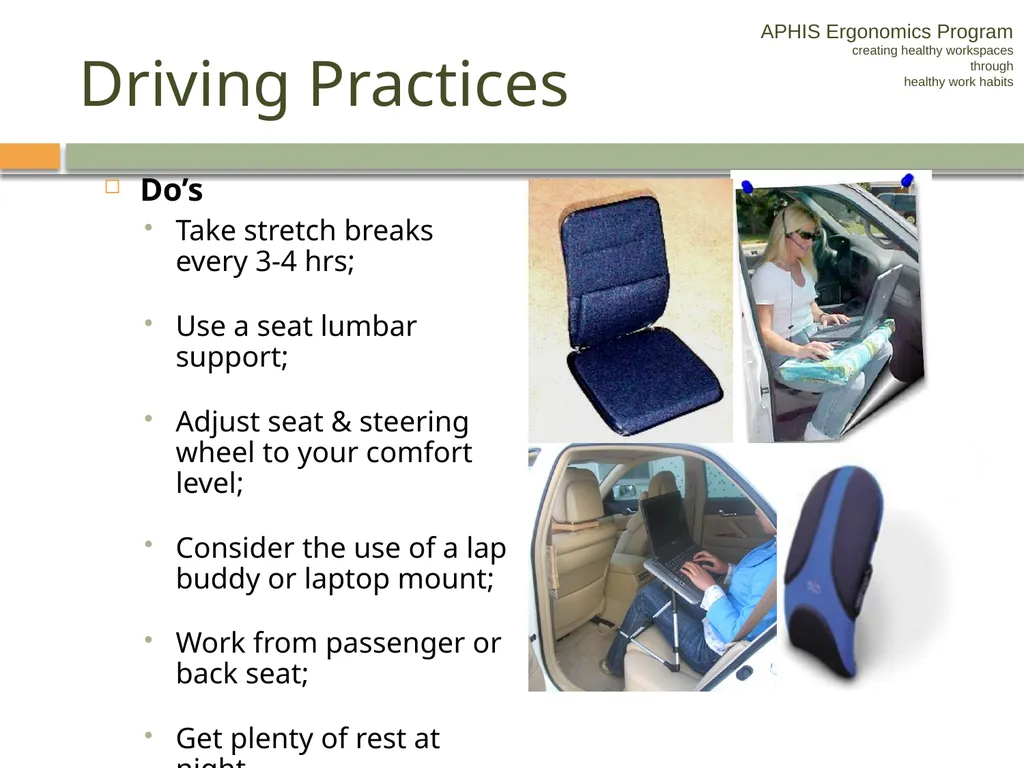
Use a seat lumbar support;
Adjust seat & steering wheel to your comfort level;
Consider the use of a lap buddy or laptop mount;
Work from passenger or back seat;
Get plenty of rest at night. Driving Practices APHIS Ergonomics Program creating healthy workspaces through healthy work habits<br>
Take stretch breaks every 3-4 hrs;
Use a seat lumbar support;
Adjust seat & steering wheel to your comfort level;
Consider the use of a lap buddy or laptop mount;
Work from passenger or back seat;
Get plenty of rest at night. Driving Practices APHIS Ergonomics Program creating healthy workspaces through healthy work habits<br>
47
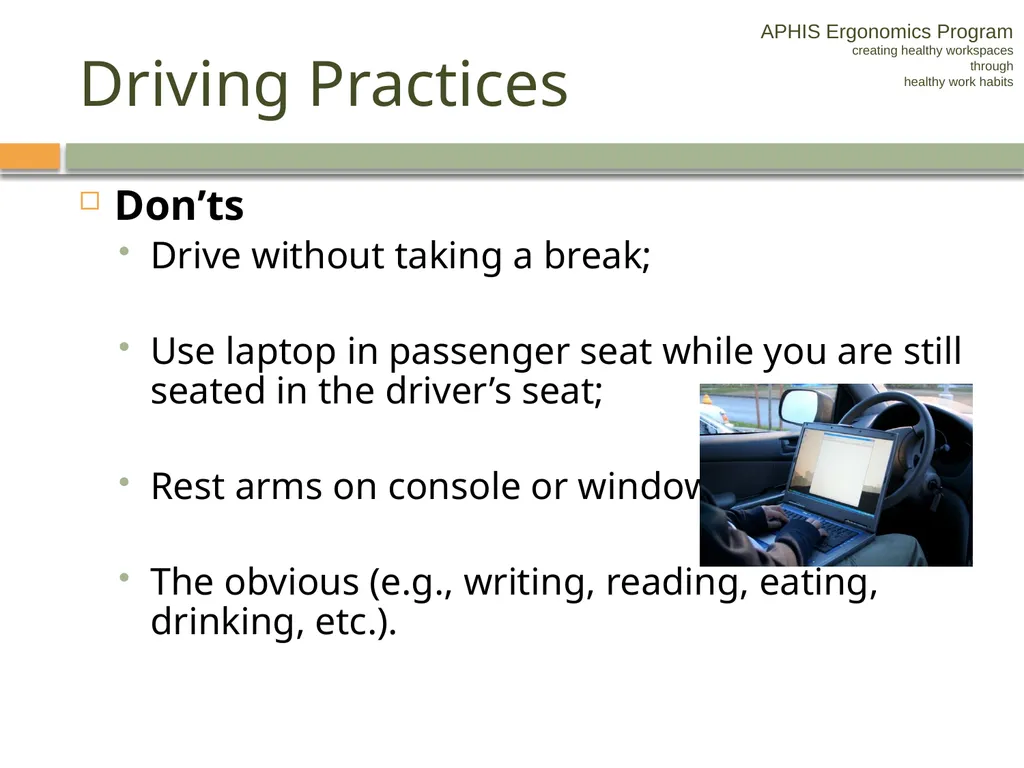
Don’ts
Drive without taking a break;
Use laptop in passenger seat while you are still seated in the driver’s seat;
Rest arms on console or windowsill;
The obvious (e.g., writing, reading, eating, drinking, etc.). Driving Practices APHIS Ergonomics Program creating healthy workspaces through healthy work habits<br>
Drive without taking a break;
Use laptop in passenger seat while you are still seated in the driver’s seat;
Rest arms on console or windowsill;
The obvious (e.g., writing, reading, eating, drinking, etc.). Driving Practices APHIS Ergonomics Program creating healthy workspaces through healthy work habits<br>
48
Lumbar and Seat Supports
McCarty’s Sacro-Ease: http://www.mccartys.com/catalog/
Obus Forme Back Rest Supports:
http://www.obusforme.ca/obus_forme/sit/back-supports.html
Laptop Mounts
Jotto Desk: www.jottodesk.us
DeskSpaceAnyplace.com: www.deskspaceanyplace.com
The Air Desk: www.airdesks.com
Lap Cushions
Lap Desk Pillow: www.froogle.com APHIS Ergonomics Program creating healthy workspaces through healthy work habits Vehicle Accessory Resources<br>
McCarty’s Sacro-Ease: http://www.mccartys.com/catalog/
Obus Forme Back Rest Supports:
http://www.obusforme.ca/obus_forme/sit/back-supports.html
Laptop Mounts
Jotto Desk: www.jottodesk.us
DeskSpaceAnyplace.com: www.deskspaceanyplace.com
The Air Desk: www.airdesks.com
Lap Cushions
Lap Desk Pillow: www.froogle.com APHIS Ergonomics Program creating healthy workspaces through healthy work habits Vehicle Accessory Resources<br>
49
You can perform the following exercises and stretches at work throughout your day. These exercises can help energize your body and relieve muscle tension. APHIS Ergonomics Program
creating healthy workspaces
through
healthy work habits Exercises / Stretches<br>
50
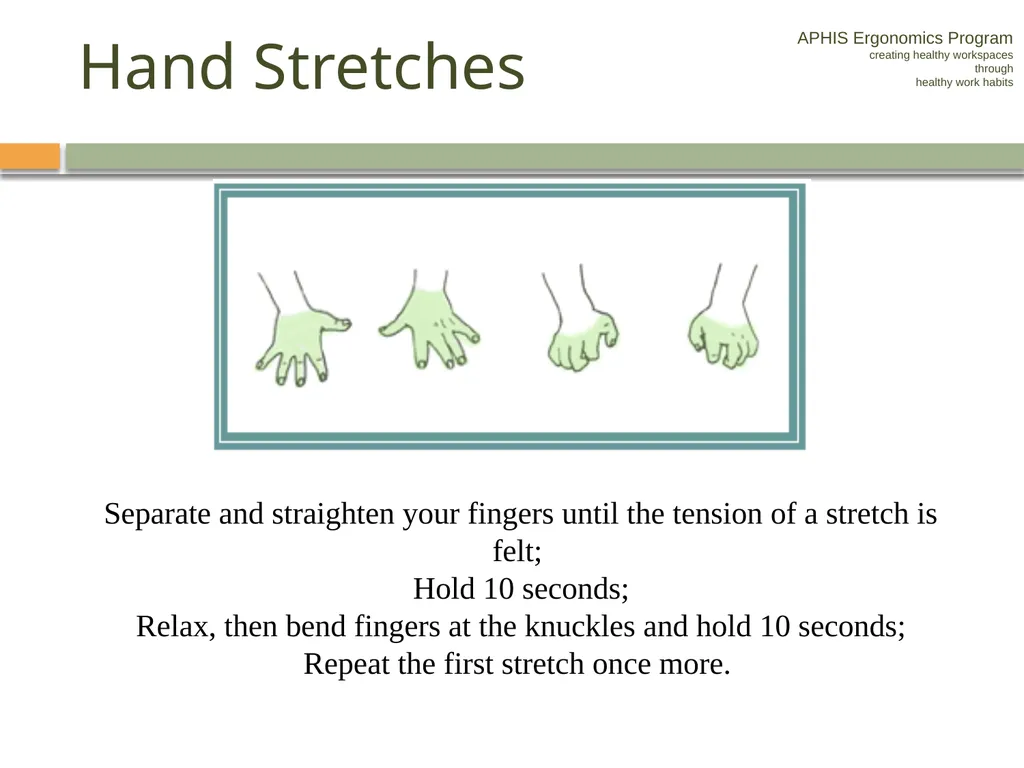
Separate and straighten your fingers until the tension of a stretch is felt;
Hold 10 seconds;
Relax, then bend fingers at the knuckles and hold 10 seconds;
Repeat the first stretch once more. Hand Stretches APHIS Ergonomics Program
creating healthy workspaces
through
healthy work habits<br>
51
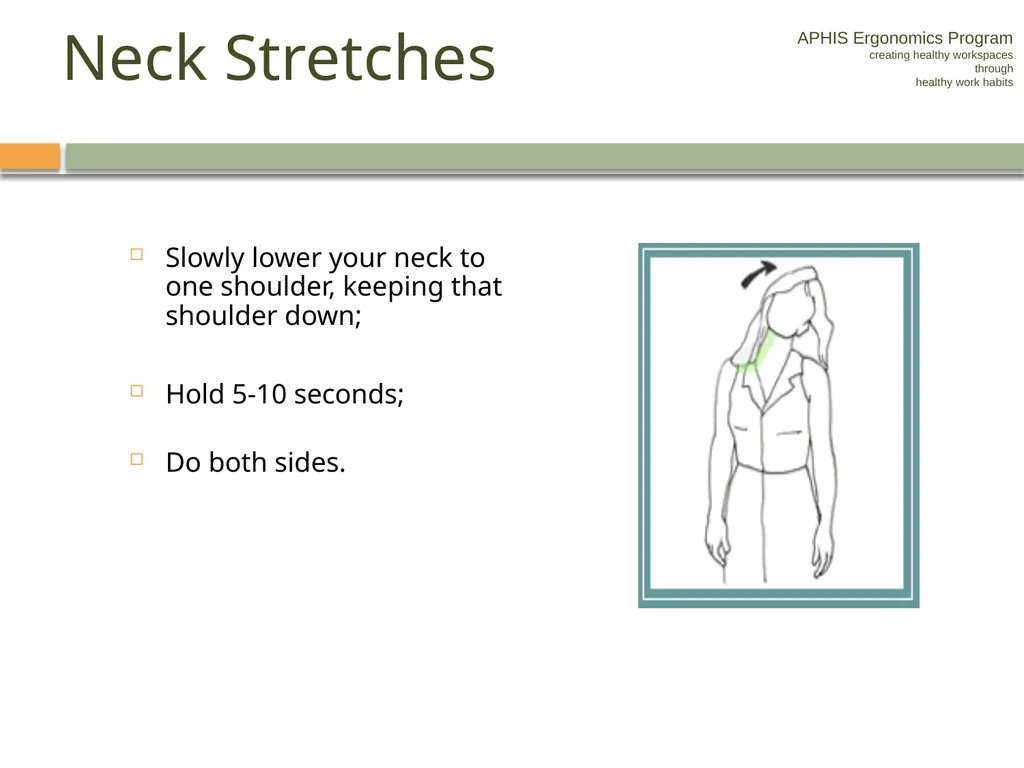
Neck Stretches Slowly lower your neck to one shoulder, keeping that shoulder down;
Hold 5-10 seconds;
Do both sides. APHIS Ergonomics Program creating healthy workspaces through healthy work habits<br>
Hold 5-10 seconds;
Do both sides. APHIS Ergonomics Program creating healthy workspaces through healthy work habits<br>
52
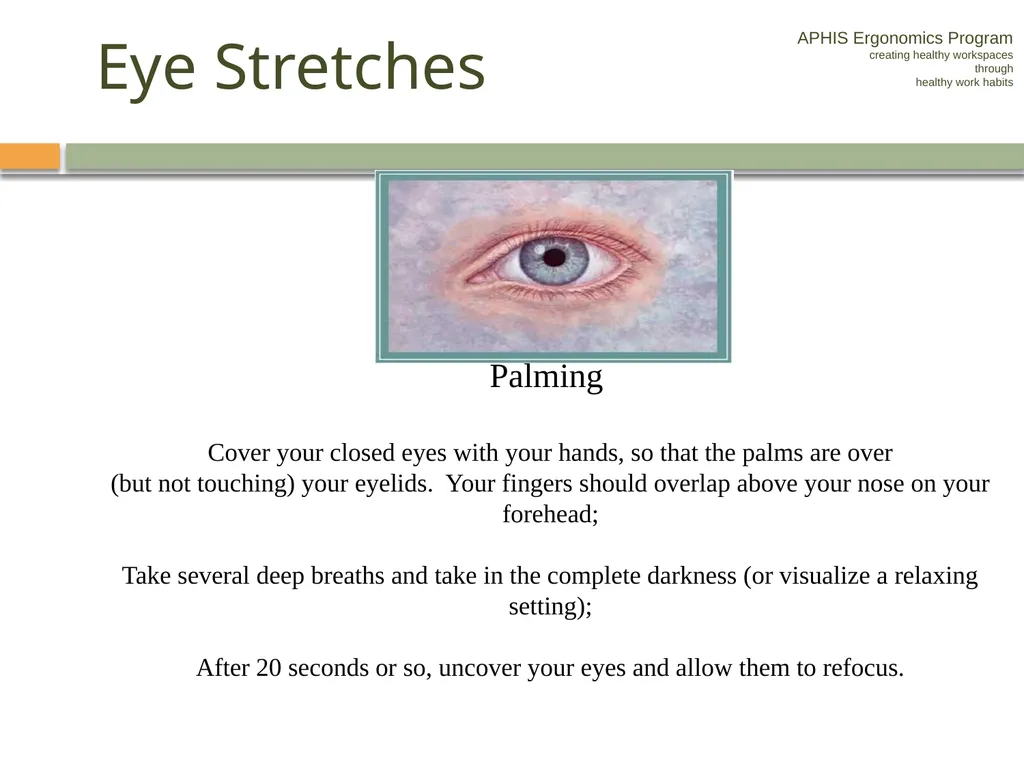
Palming
Cover your closed eyes with your hands, so that the palms are over
(but not touching) your eyelids. Your fingers should overlap above your nose on your forehead; Take several deep breaths and take in the complete darkness (or visualize a relaxing setting); After 20 seconds or so, uncover your eyes and allow them to refocus. Eye Stretches APHIS Ergonomics Program creating healthy workspaces through healthy work habits<br>
Cover your closed eyes with your hands, so that the palms are over
(but not touching) your eyelids. Your fingers should overlap above your nose on your forehead; Take several deep breaths and take in the complete darkness (or visualize a relaxing setting); After 20 seconds or so, uncover your eyes and allow them to refocus. Eye Stretches APHIS Ergonomics Program creating healthy workspaces through healthy work habits<br>
53
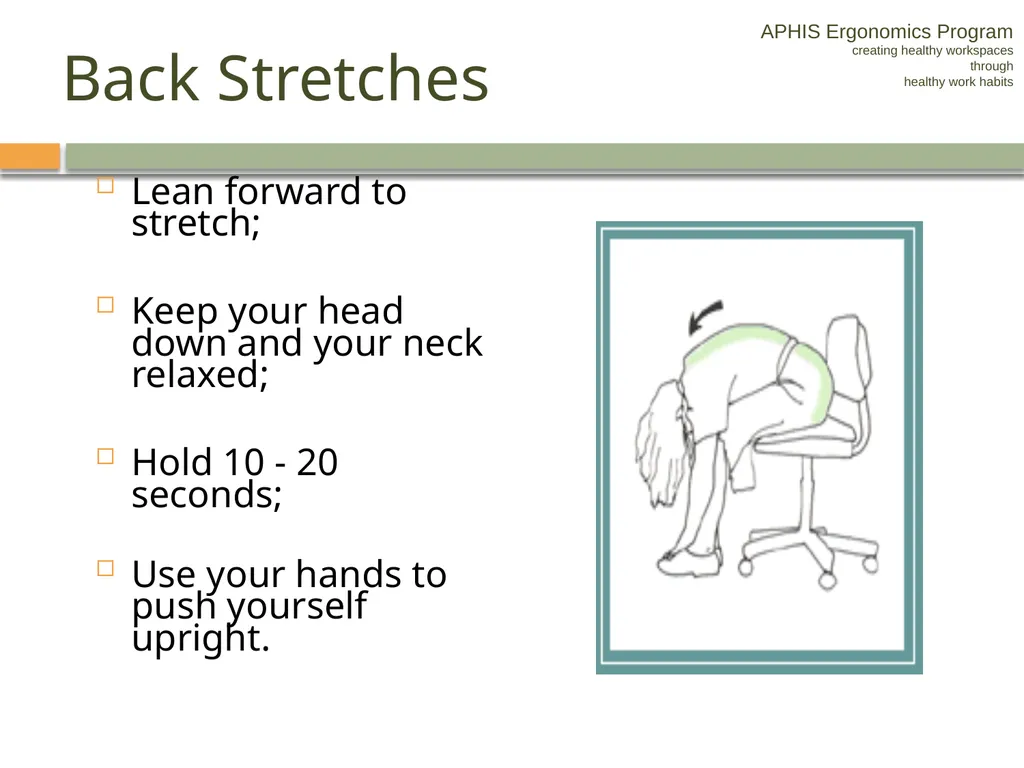
Lean forward to stretch;
Keep your head down and your neck relaxed;
Hold 10 - 20 seconds;
Use your hands to push yourself upright. APHIS Ergonomics Program creating healthy workspaces through healthy work habits Back Stretches<br>
Keep your head down and your neck relaxed;
Hold 10 - 20 seconds;
Use your hands to push yourself upright. APHIS Ergonomics Program creating healthy workspaces through healthy work habits Back Stretches<br>
54
Stand with hands on your hips;
Gently turn your torso at the waist and look over your shoulder until you feel the stretch;
Hold 8 - 10 seconds;
Repeat other side;
Keep your knees slightly flexed;
Do not hold your breath. APHIS Ergonomics Program creating healthy workspaces through healthy work habits Back Stretches<br>
Gently turn your torso at the waist and look over your shoulder until you feel the stretch;
Hold 8 - 10 seconds;
Repeat other side;
Keep your knees slightly flexed;
Do not hold your breath. APHIS Ergonomics Program creating healthy workspaces through healthy work habits Back Stretches<br>
55
APHIS Ergonomics Program
creating healthy workspaces
through
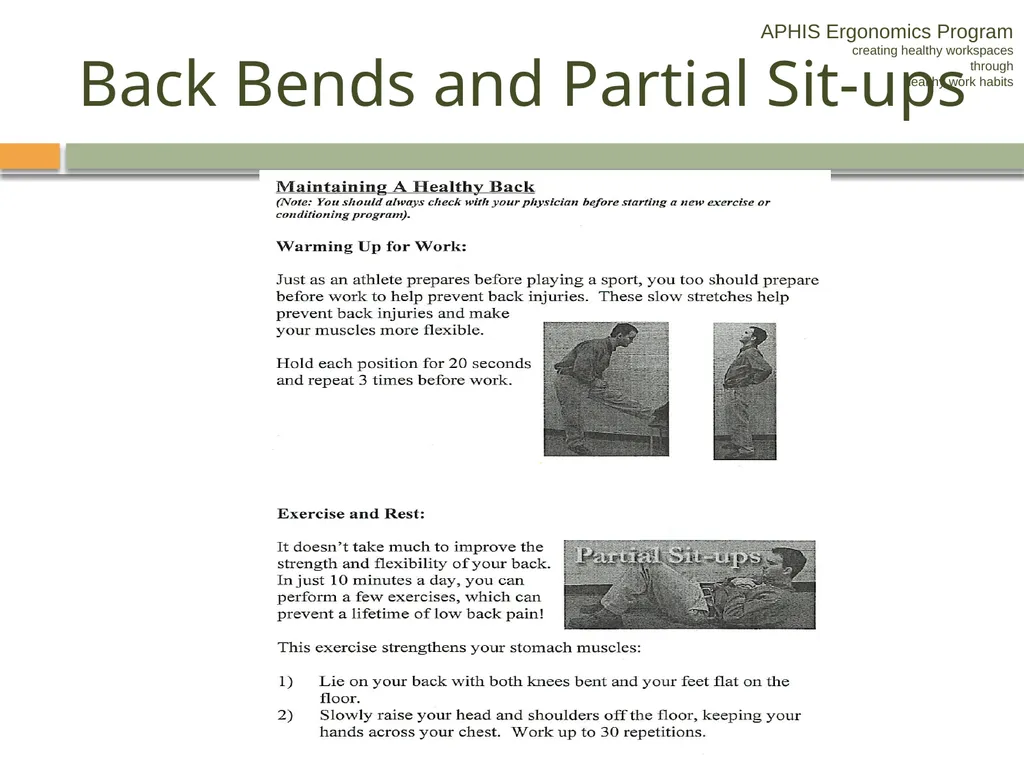
healthy work habits Back Bends and Partial Sit-ups<br>
56
APHIS Ergonomics Program
creating healthy workspaces
through
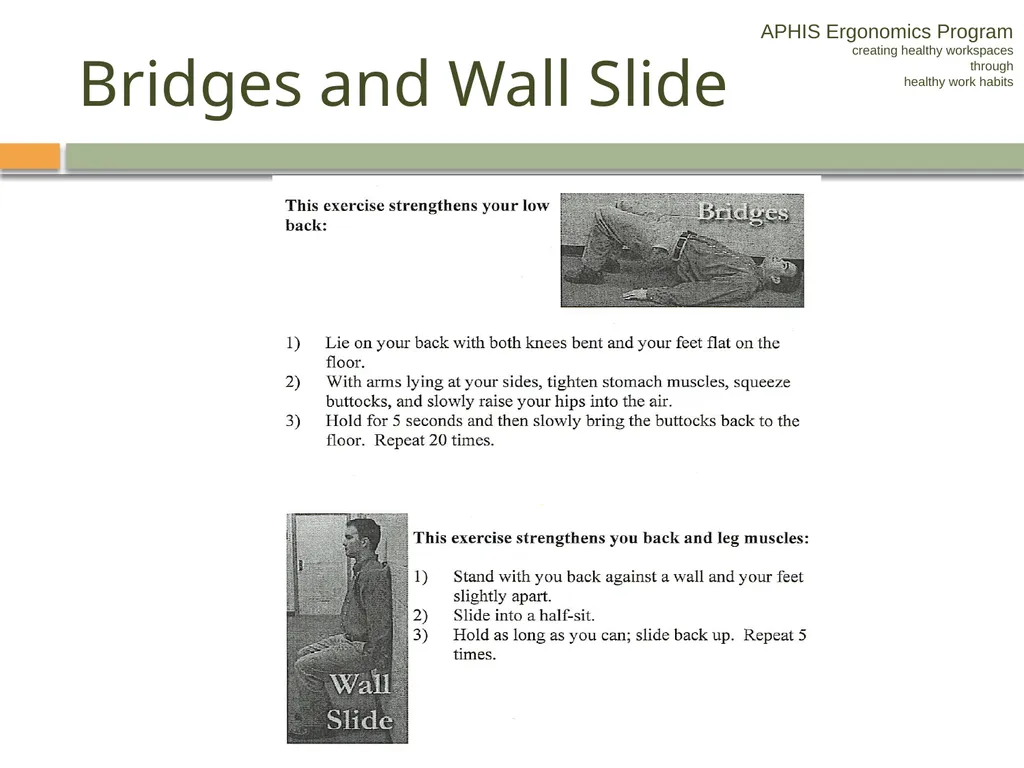
healthy work habits Bridges and Wall Slide<br>
57
APHIS Ergonomics Program
creating healthy workspaces
through
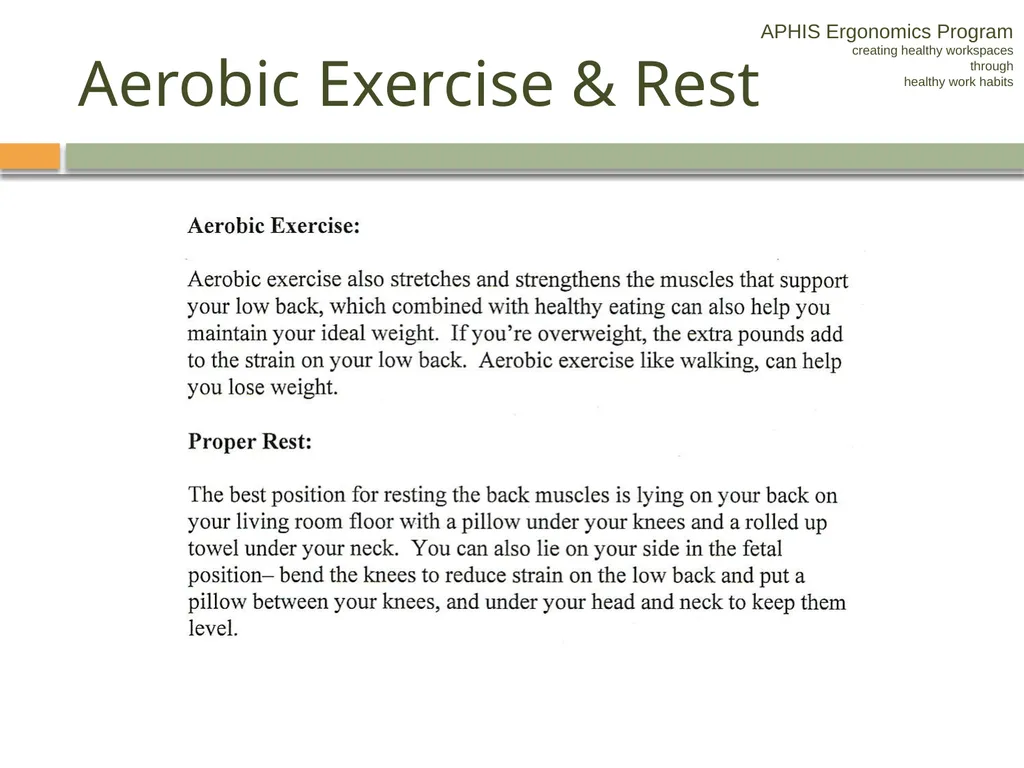
healthy work habits Aerobic Exercise & Rest<br>
58
Educational/Evaluation Resources APHIS Ergonomics Program
creating healthy workspaces
through
healthy work habits<br>
59
Ergonomics Video-Lending Library (APHIS only)
“Back Protection – Defending Your Safety Zone”
“Office Ergonomics – It’s Your Move”
Posters
Individual, Group, or Worksite Ergonomic Evaluations
Phone Consultations
Correspondence via Email
*Contact your agency Safety and Health Program for more information. APHIS Ergonomics Program creating healthy workspaces through healthy work habits Available Resources/Tools<br>
“Back Protection – Defending Your Safety Zone”
“Office Ergonomics – It’s Your Move”
Posters
Individual, Group, or Worksite Ergonomic Evaluations
Phone Consultations
Correspondence via Email
*Contact your agency Safety and Health Program for more information. APHIS Ergonomics Program creating healthy workspaces through healthy work habits Available Resources/Tools<br>
60
Summary - Driving Postures Poor seated postures are generally considered to contribute to WMSDs.
Good posture is a key feature in the prevention of back pain.
However, even good postures can result in discomfort;
It is important to note that no single posture is ideal if maintained for long periods of time.
Adopting a range of comfortable postures, and frequent changes of posture, may help to delay the onset of discomfort in driving.
Any seating position should account for the need to vary posture. APHIS Ergonomics Program creating healthy workspaces through healthy work habits<br>
Good posture is a key feature in the prevention of back pain.
However, even good postures can result in discomfort;
It is important to note that no single posture is ideal if maintained for long periods of time.
Adopting a range of comfortable postures, and frequent changes of posture, may help to delay the onset of discomfort in driving.
Any seating position should account for the need to vary posture. APHIS Ergonomics Program creating healthy workspaces through healthy work habits<br>
61
Understand: causes of WMSDs & ways you can prevent them when driving.
Respect: potential hazards caused by poor postures.
Communicate: ways to eliminate stress factors & report symptoms early.
Commitment: eliminate WMSDs in your driving environment. APHIS Ergonomics Program creating healthy workspaces through healthy work habits Summary<br>
Respect: potential hazards caused by poor postures.
Communicate: ways to eliminate stress factors & report symptoms early.
Commitment: eliminate WMSDs in your driving environment. APHIS Ergonomics Program creating healthy workspaces through healthy work habits Summary<br>
62
Ginger E. Dorsey, IH, CIE
APHIS Ergonomics Program Manager
USDA APHIS EMSSD SHEPB
4700 River Road, Unit 124
Riverdale, MD 20737
301.436.3165
ginger.e.dorsey@aphis.usda.gov APHIS Ergonomics Program creating healthy workspaces through healthy work habits<br>
APHIS Ergonomics Program Manager
USDA APHIS EMSSD SHEPB
4700 River Road, Unit 124
Riverdale, MD 20737
301.436.3165
ginger.e.dorsey@aphis.usda.gov APHIS Ergonomics Program creating healthy workspaces through healthy work habits<br>