
Applying Social Analytics to Understand
Description: Applying Social Analytics to Understand Development of Artificial Intelligence in Legal Theory and Practice Tashkent State Law University Tashkent, October 22, 2024 Prof. Dr. habil. Andrey V. REZAEV, Professor and Senior Researcher, Rikkyo
Related Topics
Download Presentation
"Applying Social Analytics to Understand" is the property of its rightful owner. Permission is granted to download and print the materials on this website for personal, non-commercial use only, and to display it on your personal computer provided you do not modify the materials and that you retain all copyright notices contained in the materials. By downloading content from our website, you accept the terms of this agreement.
Presentation Transcript
slide1. Applying Social Analytics to Understand Development of Artificial Intelligence in Legal Theory and Practice Tashkent State Law University
Tashkent, October 22, 2024
Prof. Dr. habil. Andrey V. REZAEV,
Professor and Senior Researcher, Rikkyo Institute for Global Urban Studies,
College of Sociology, Rikkyo University, Tokyo, Japan
Email: rezaev@hotmail.com<br>
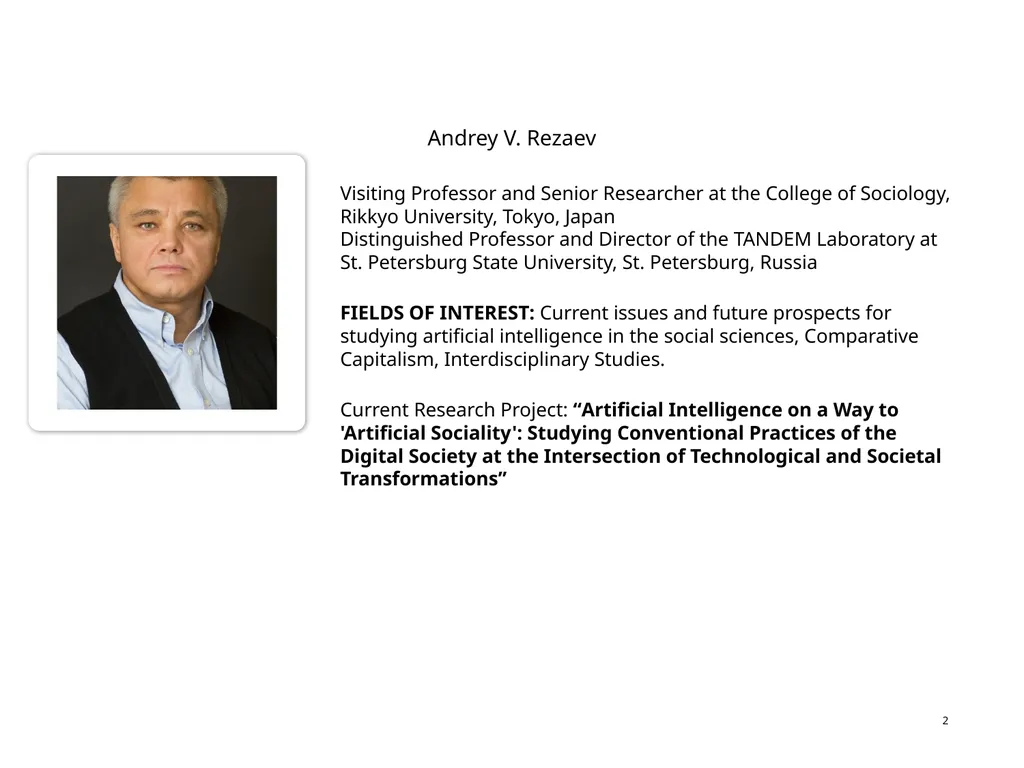
slide2. Andrey V. Rezaev Visiting Professor and Senior Researcher at the College of Sociology, Rikkyo University, Tokyo, Japan
Distinguished Professor and Director of the TANDEM Laboratory at
St. Petersburg State University, St. Petersburg, Russia
FIELDS OF INTEREST: Current issues and future prospects for studying artificial intelligence in the social sciences, Comparative Capitalism, Interdisciplinary Studies.
Current Research Project: “Artificial Intelligence on a Way to 'Artificial Sociality': Studying Conventional Practices of the Digital Society at the Intersection of Technological and Societal Transformations” 2<br>
slide3. Background This is a project we started at the ISA Congress in Toronto, back in 2018. At the time we asked ourselves: are social scientists ready to analyze AI and AS (artificial sociality)? [Rezaev, Tregubova, 2018].
We envisaged it as a longitudinal Project to be developed at the International Research Laboratory TANDEM, St Petersburg State University, Russia
COVID pandemic and all international happenings have disrupted our research plans.<br>
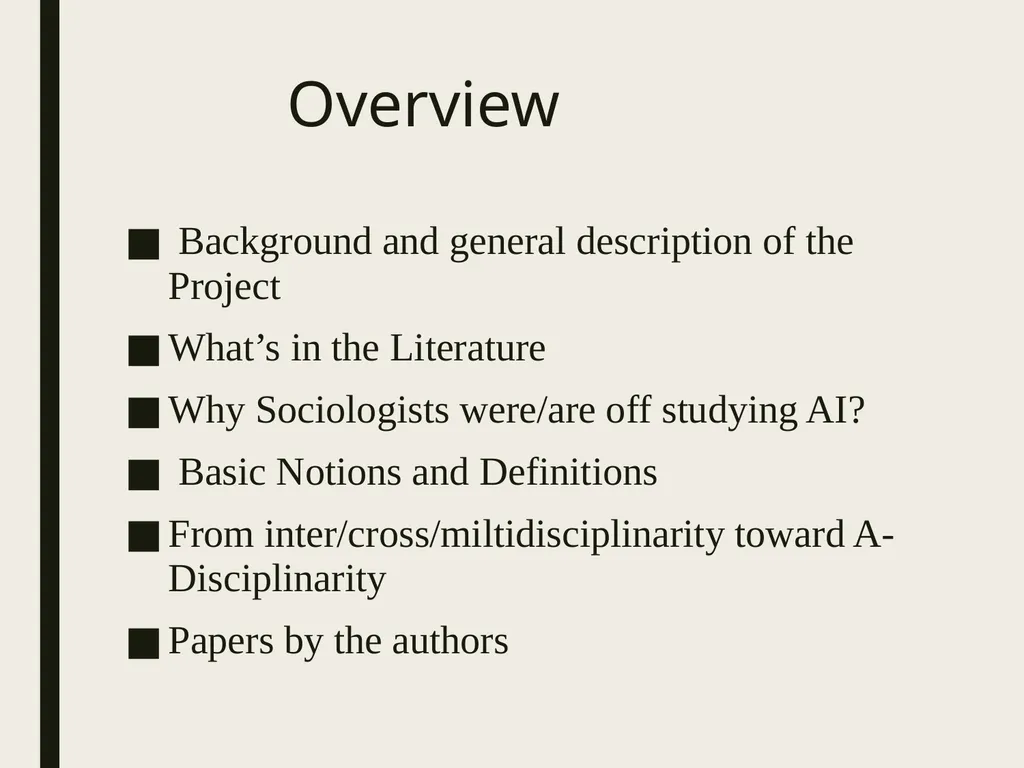
slide4. Overview Background and general description of the Project
What’s in the Literature
Why Sociologists were/are off studying AI?
Basic Notions and Definitions
From inter/cross/miltidisciplinarity toward A-Disciplinarity
Papers by the authors<br>
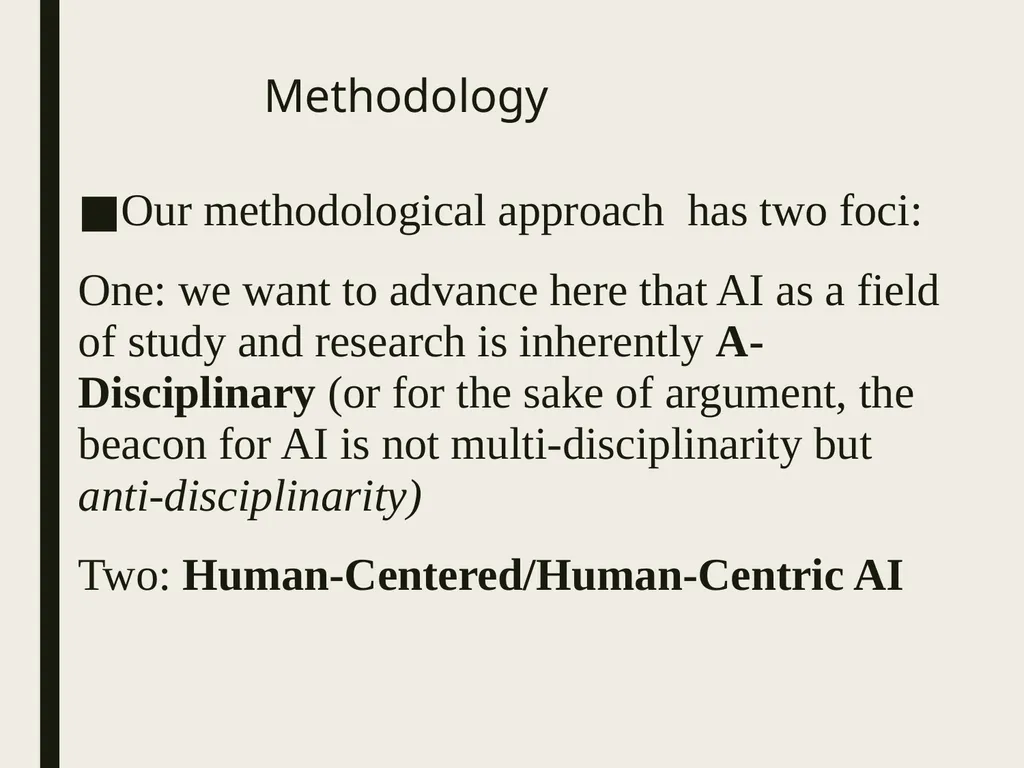
slide5. Methodology Our methodological approach has two foci:
One: we want to advance here that AI as a field of study and research is inherently A-Disciplinary (or for the sake of argument, the beacon for AI is not multi-disciplinarity but anti-disciplinarity)
Two: Human-Centered/Human-Centric AI<br>
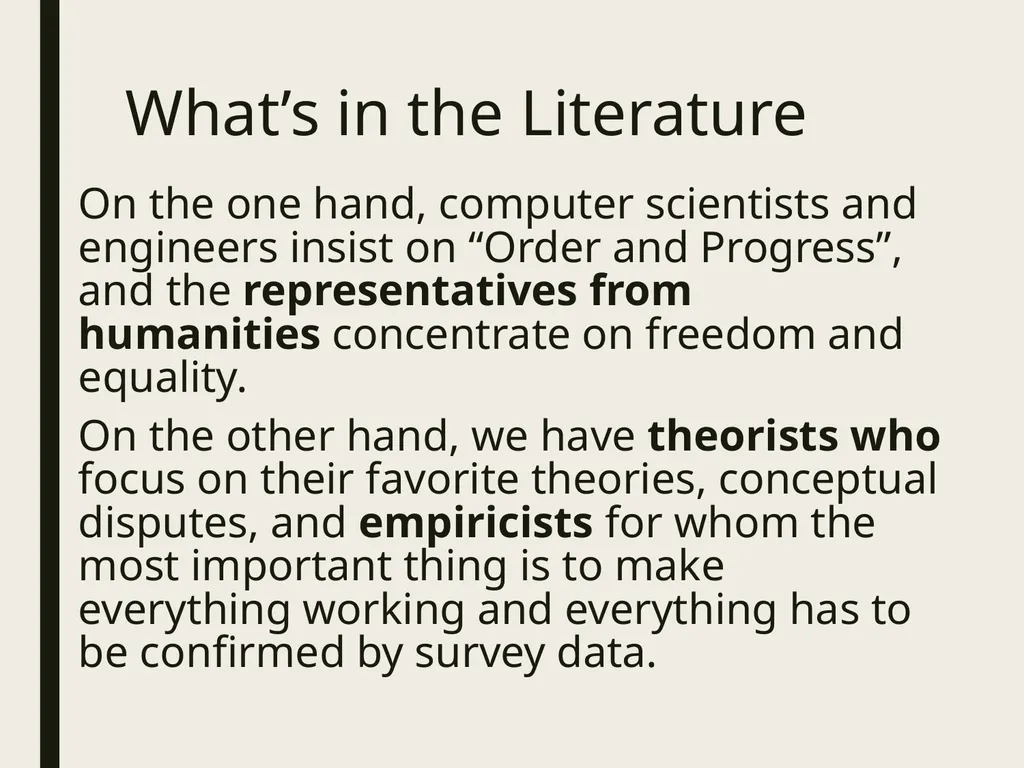
slide6. What’s in the Literature On the one hand, computer scientists and engineers insist on “Order and Progress”, and the representatives from humanities concentrate on freedom and equality.
On the other hand, we have theorists who focus on their favorite theories, conceptual disputes, and empiricists for whom the most important thing is to make everything working and everything has to be confirmed by survey data.<br>
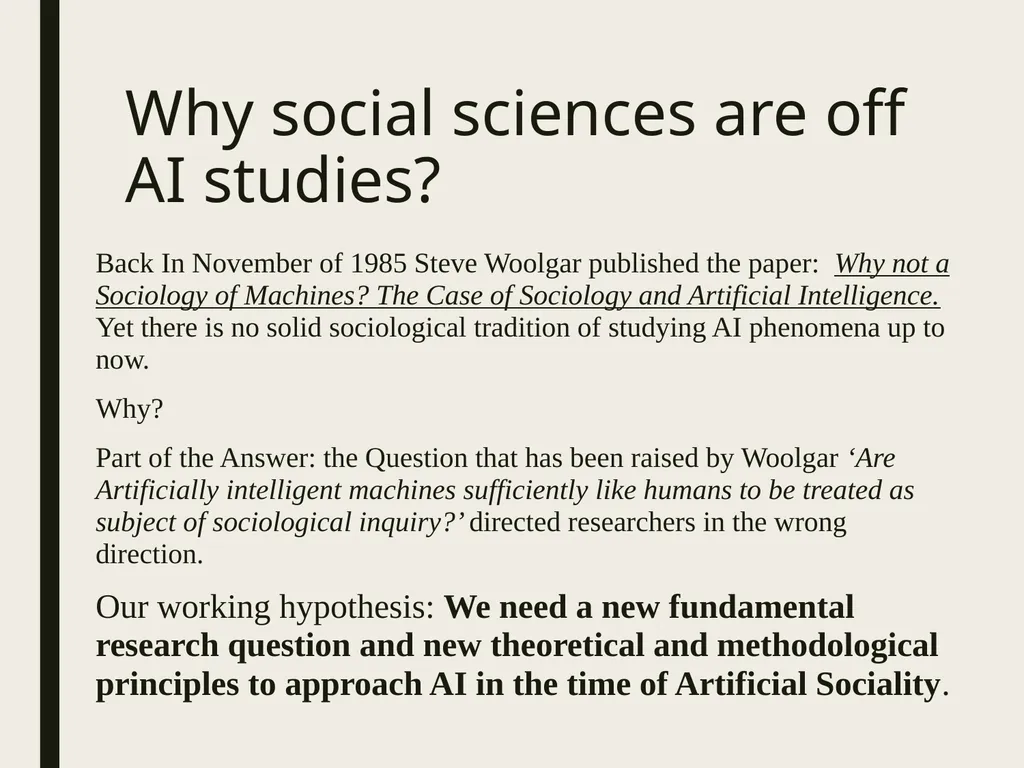
slide7. Why social sciences are off AI studies? Back In November of 1985 Steve Woolgar published the paper: Why not a Sociology of Machines? The Case of Sociology and Artificial Intelligence. Yet there is no solid sociological tradition of studying AI phenomena up to now.
Why?
Part of the Answer: the Question that has been raised by Woolgar ‘Are Artificially intelligent machines sufficiently like humans to be treated as subject of sociological inquiry?’ directed researchers in the wrong direction.
Our working hypothesis: We need a new fundamental research question and new theoretical and methodological principles to approach AI in the time of Artificial Sociality.<br>
slide8. How social sciences deal with new reality There have appeared new notions in social sciences papers in recent years. These notions are basically limited to quite a narrow circle of technical terms such as “Internet”, “networks”, “cyber”, “digital”, “social media”, “new media”.
Social scientists adopt these terms for their study and just add them to the word “society” and continue discussions under rubrics respectively: “Internet Society”, “Network Society”, “Digital Society”, “Cyber Society”, “Social Media Society”, “New Media Society”.
Social sciences simply don’t know how to study and what to measure in the system: ‘Human-machine-human”.<br>
slide9. COVID-19 Pandemic brought a lot of new questions for new reality One example:
Why should one talk to a doctor, to a Person about Vaccine? What Vaccine to use: Pfizer or Moderna, AstraZeneca?
Computer NOW can READ EVERYTHING about these Vaccines, about ingredients, about side effects, about efficacy, computer can make comparisons, etc.
Computer NOW can test one’s physical conditions
Computer NOW can produce arguably more accurate ‘judgement’/recommendation for a human being about relevance of using this or that Vaccine. Why then to talk to a Doctor/human being?<br>
slide10. AI: Working Definition - Andrey V. Rezaev Twelve Theses on Artificial Intelligence and Artificial Sociality // Monitoring of Public Opinion: Economic and Social Changes, No. 1, 2021, P. 23 https://monitoringjournal.ru/index.php/monitoring/article/view/1894 Artificial Intelligence is an ensemble of rational, logical, and formalized instrumental rules developed and coded by human beings that organize the processes and activities to emulate rational/intellectual structures and fabricate and reproduce goal-oriented practices as well as the mechanisms for constructing further coding and decision making.<br>
slide11. Basic characteristics of AI Five fundamental characteristics underline our definition:
First, AI is an artifice, a product of human beings, it is not something transcendental or inherently a-social.
Second, the substantial nature of AI is not something objectifiable as a material gimmick; AI’s essence manifests itself as a set of rational and logically formalized rules but not as an attained appliance per se.
Third, AI is a set of instrumentally coded rules.
Fourth, an instrumentally coded set of rules is oriented to generate an appliance/product that imitates human beings' intellectual activities.
Fifth, emulated intellectual constructions make it possible for AI to further independently code and make intellectual or goal-oriented decisions, not necessarily with assistance or control from human beings.<br>
slide12. Artificial sociality On the one hand, AI appears as a technological device designed to solve a task that is impossible for a human. On the other hand, AI does not exist only in a technical environment. Technologies initially focused on instrumental tasks become the environment and participants in human interactions.
We call this tendency artificial sociality.<br>
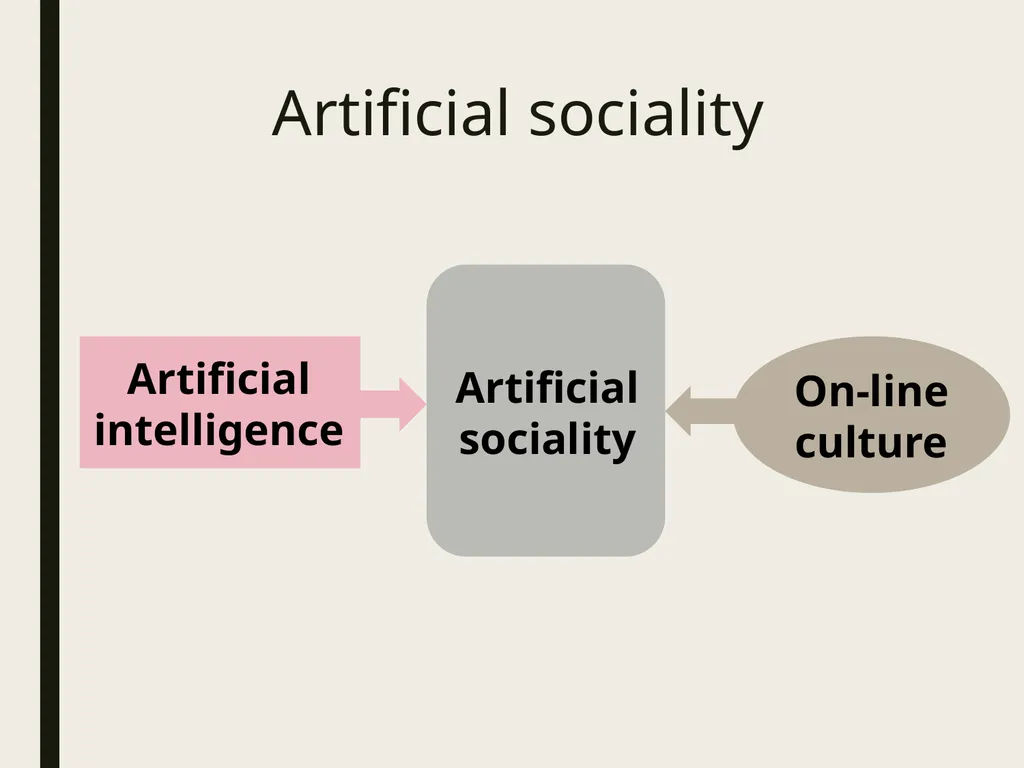
slide13. Artificial intelligence On-line culture Artificial sociality Artificial sociality<br>
slide14. Human-machine interdependence Human intelligence cannot be replaced soon. Thus, humans and AI need to work together. The overall objective for AI is not to confront but to improve reality of human life. The tasks for humans are to make AI technologies responsible and accountable.
The human-machine-interdependence is a new reality of artificial sociality.<br>
slide15. Social Analytics Social analytics today is designed not to predict but to pose problems. Before the development of artificial sociality, sociologists could at least offer solutions to problems in the industrial era. Today, this is not the case because the principle is violated.
We do not know what the machine does to the human interaction, and we cannot predict its actions. One way to see this is that AI does not understand the existential dimension of human life: pain, loneliness, death, birth, the joy of human interconnectedness, and social intercourse.<br>
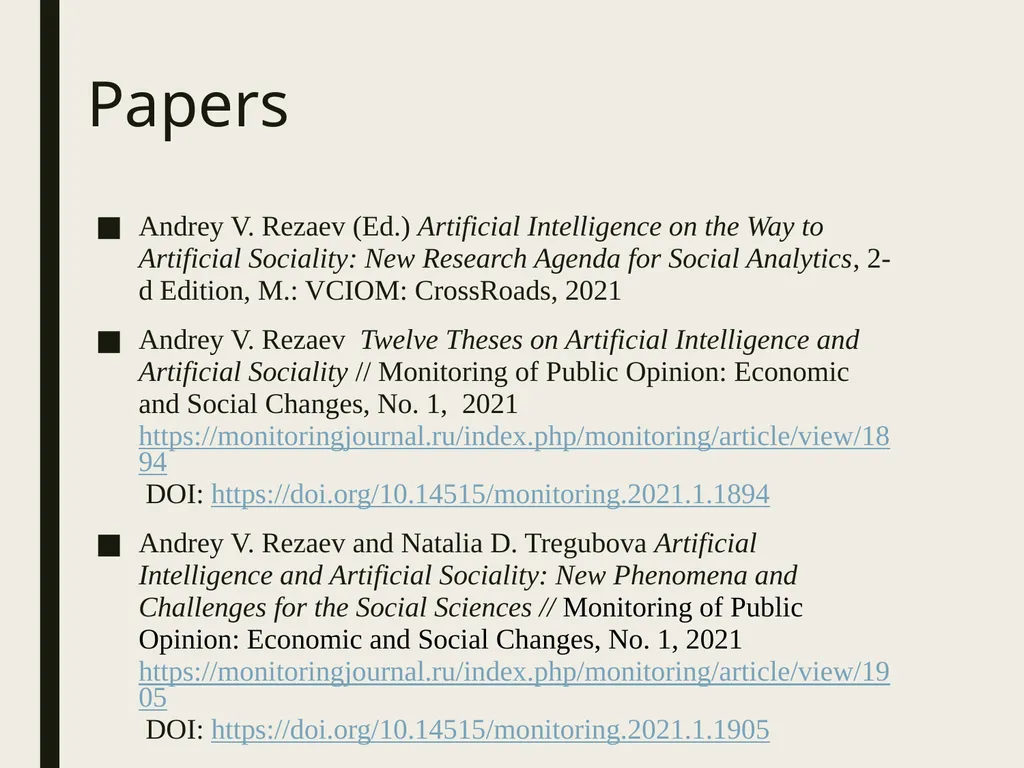
slide16. Papers Andrey V. Rezaev (Ed.) Artificial Intelligence on the Way to Artificial Sociality: New Research Agenda for Social Analytics, 2-d Edition, M.: VCIOM: CrossRoads, 2021
Andrey V. Rezaev Twelve Theses on Artificial Intelligence and Artificial Sociality // Monitoring of Public Opinion: Economic and Social Changes, No. 1, 2021 https://monitoringjournal.ru/index.php/monitoring/article/view/1894 DOI: https://doi.org/10.14515/monitoring.2021.1.1894
Andrey V. Rezaev and Natalia D. Tregubova Artificial Intelligence and Artificial Sociality: New Phenomena and Challenges for the Social Sciences // Monitoring of Public Opinion: Economic and Social Changes, No. 1, 2021 https://monitoringjournal.ru/index.php/monitoring/article/view/1905 DOI: https://doi.org/10.14515/monitoring.2021.1.1905<br>
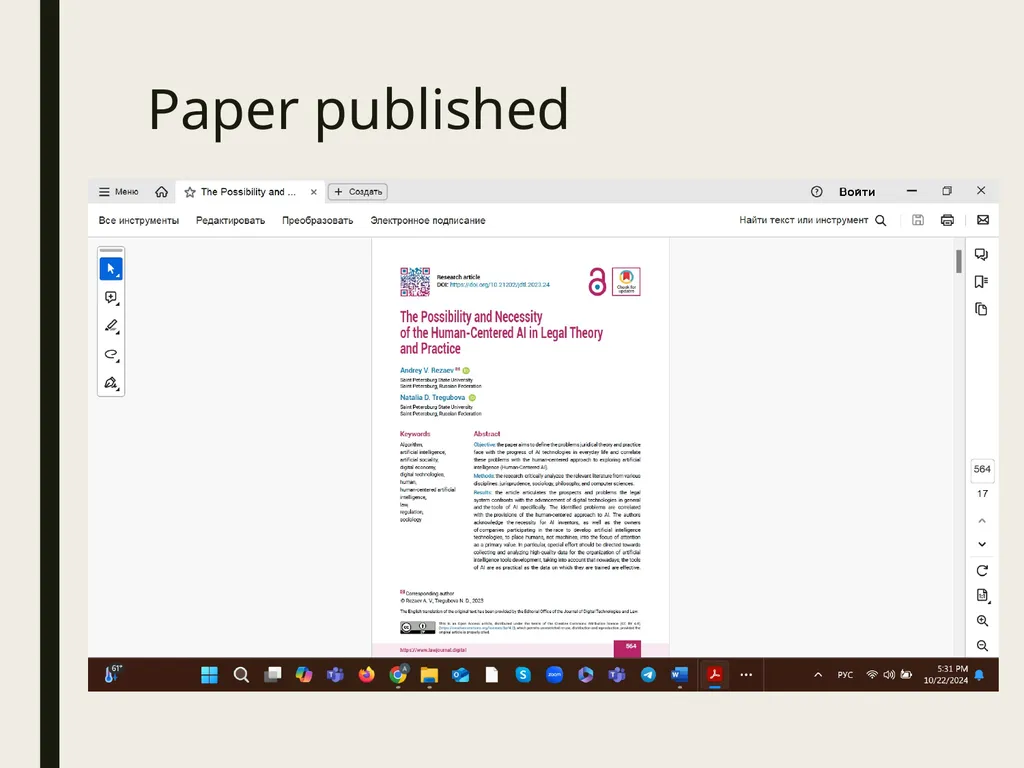
slide17. Paper published<br>
Tashkent, October 22, 2024
Prof. Dr. habil. Andrey V. REZAEV,
Professor and Senior Researcher, Rikkyo Institute for Global Urban Studies,
College of Sociology, Rikkyo University, Tokyo, Japan
Email: rezaev@hotmail.com<br>
slide2. Andrey V. Rezaev Visiting Professor and Senior Researcher at the College of Sociology, Rikkyo University, Tokyo, Japan
Distinguished Professor and Director of the TANDEM Laboratory at
St. Petersburg State University, St. Petersburg, Russia
FIELDS OF INTEREST: Current issues and future prospects for studying artificial intelligence in the social sciences, Comparative Capitalism, Interdisciplinary Studies.
Current Research Project: “Artificial Intelligence on a Way to 'Artificial Sociality': Studying Conventional Practices of the Digital Society at the Intersection of Technological and Societal Transformations” 2<br>
slide3. Background This is a project we started at the ISA Congress in Toronto, back in 2018. At the time we asked ourselves: are social scientists ready to analyze AI and AS (artificial sociality)? [Rezaev, Tregubova, 2018].
We envisaged it as a longitudinal Project to be developed at the International Research Laboratory TANDEM, St Petersburg State University, Russia
COVID pandemic and all international happenings have disrupted our research plans.<br>
slide4. Overview Background and general description of the Project
What’s in the Literature
Why Sociologists were/are off studying AI?
Basic Notions and Definitions
From inter/cross/miltidisciplinarity toward A-Disciplinarity
Papers by the authors<br>
slide5. Methodology Our methodological approach has two foci:
One: we want to advance here that AI as a field of study and research is inherently A-Disciplinary (or for the sake of argument, the beacon for AI is not multi-disciplinarity but anti-disciplinarity)
Two: Human-Centered/Human-Centric AI<br>
slide6. What’s in the Literature On the one hand, computer scientists and engineers insist on “Order and Progress”, and the representatives from humanities concentrate on freedom and equality.
On the other hand, we have theorists who focus on their favorite theories, conceptual disputes, and empiricists for whom the most important thing is to make everything working and everything has to be confirmed by survey data.<br>
slide7. Why social sciences are off AI studies? Back In November of 1985 Steve Woolgar published the paper: Why not a Sociology of Machines? The Case of Sociology and Artificial Intelligence. Yet there is no solid sociological tradition of studying AI phenomena up to now.
Why?
Part of the Answer: the Question that has been raised by Woolgar ‘Are Artificially intelligent machines sufficiently like humans to be treated as subject of sociological inquiry?’ directed researchers in the wrong direction.
Our working hypothesis: We need a new fundamental research question and new theoretical and methodological principles to approach AI in the time of Artificial Sociality.<br>
slide8. How social sciences deal with new reality There have appeared new notions in social sciences papers in recent years. These notions are basically limited to quite a narrow circle of technical terms such as “Internet”, “networks”, “cyber”, “digital”, “social media”, “new media”.
Social scientists adopt these terms for their study and just add them to the word “society” and continue discussions under rubrics respectively: “Internet Society”, “Network Society”, “Digital Society”, “Cyber Society”, “Social Media Society”, “New Media Society”.
Social sciences simply don’t know how to study and what to measure in the system: ‘Human-machine-human”.<br>
slide9. COVID-19 Pandemic brought a lot of new questions for new reality One example:
Why should one talk to a doctor, to a Person about Vaccine? What Vaccine to use: Pfizer or Moderna, AstraZeneca?
Computer NOW can READ EVERYTHING about these Vaccines, about ingredients, about side effects, about efficacy, computer can make comparisons, etc.
Computer NOW can test one’s physical conditions
Computer NOW can produce arguably more accurate ‘judgement’/recommendation for a human being about relevance of using this or that Vaccine. Why then to talk to a Doctor/human being?<br>
slide10. AI: Working Definition - Andrey V. Rezaev Twelve Theses on Artificial Intelligence and Artificial Sociality // Monitoring of Public Opinion: Economic and Social Changes, No. 1, 2021, P. 23 https://monitoringjournal.ru/index.php/monitoring/article/view/1894 Artificial Intelligence is an ensemble of rational, logical, and formalized instrumental rules developed and coded by human beings that organize the processes and activities to emulate rational/intellectual structures and fabricate and reproduce goal-oriented practices as well as the mechanisms for constructing further coding and decision making.<br>
slide11. Basic characteristics of AI Five fundamental characteristics underline our definition:
First, AI is an artifice, a product of human beings, it is not something transcendental or inherently a-social.
Second, the substantial nature of AI is not something objectifiable as a material gimmick; AI’s essence manifests itself as a set of rational and logically formalized rules but not as an attained appliance per se.
Third, AI is a set of instrumentally coded rules.
Fourth, an instrumentally coded set of rules is oriented to generate an appliance/product that imitates human beings' intellectual activities.
Fifth, emulated intellectual constructions make it possible for AI to further independently code and make intellectual or goal-oriented decisions, not necessarily with assistance or control from human beings.<br>
slide12. Artificial sociality On the one hand, AI appears as a technological device designed to solve a task that is impossible for a human. On the other hand, AI does not exist only in a technical environment. Technologies initially focused on instrumental tasks become the environment and participants in human interactions.
We call this tendency artificial sociality.<br>
slide13. Artificial intelligence On-line culture Artificial sociality Artificial sociality<br>
slide14. Human-machine interdependence Human intelligence cannot be replaced soon. Thus, humans and AI need to work together. The overall objective for AI is not to confront but to improve reality of human life. The tasks for humans are to make AI technologies responsible and accountable.
The human-machine-interdependence is a new reality of artificial sociality.<br>
slide15. Social Analytics Social analytics today is designed not to predict but to pose problems. Before the development of artificial sociality, sociologists could at least offer solutions to problems in the industrial era. Today, this is not the case because the principle is violated.
We do not know what the machine does to the human interaction, and we cannot predict its actions. One way to see this is that AI does not understand the existential dimension of human life: pain, loneliness, death, birth, the joy of human interconnectedness, and social intercourse.<br>
slide16. Papers Andrey V. Rezaev (Ed.) Artificial Intelligence on the Way to Artificial Sociality: New Research Agenda for Social Analytics, 2-d Edition, M.: VCIOM: CrossRoads, 2021
Andrey V. Rezaev Twelve Theses on Artificial Intelligence and Artificial Sociality // Monitoring of Public Opinion: Economic and Social Changes, No. 1, 2021 https://monitoringjournal.ru/index.php/monitoring/article/view/1894 DOI: https://doi.org/10.14515/monitoring.2021.1.1894
Andrey V. Rezaev and Natalia D. Tregubova Artificial Intelligence and Artificial Sociality: New Phenomena and Challenges for the Social Sciences // Monitoring of Public Opinion: Economic and Social Changes, No. 1, 2021 https://monitoringjournal.ru/index.php/monitoring/article/view/1905 DOI: https://doi.org/10.14515/monitoring.2021.1.1905<br>
slide17. Paper published<br>