
Artificial Intelligence CS482, CS682, MW 1 – 2:15,



Description: Artificial Intelligence CS482, CS682, MW 1 2:15, SEM 201, MS 227 Prerequisites: 302, 365 Instructor: Sushil Louis, sushilcse.unr.edu, http:www.cse.unr.edusushil Questions Rational agents and performance metrics Suppose that the
Related Topics
Download Presentation
"Artificial Intelligence CS482, CS682, MW 1 – 2:15," is the property of its rightful owner. Permission is granted to download and print the materials on this website for personal, non-commercial use only, and to display it on your personal computer provided you do not modify the materials and that you retain all copyright notices contained in the materials. By downloading content from our website, you accept the terms of this agreement.
Presentation Transcript
slide1. Artificial Intelligence CS482, CS682, MW 1 – 2:15, SEM 201, MS 227
Prerequisites: 302, 365
Instructor: Sushil Louis, sushil@cse.unr.edu, http://www.cse.unr.edu/~sushil<br>
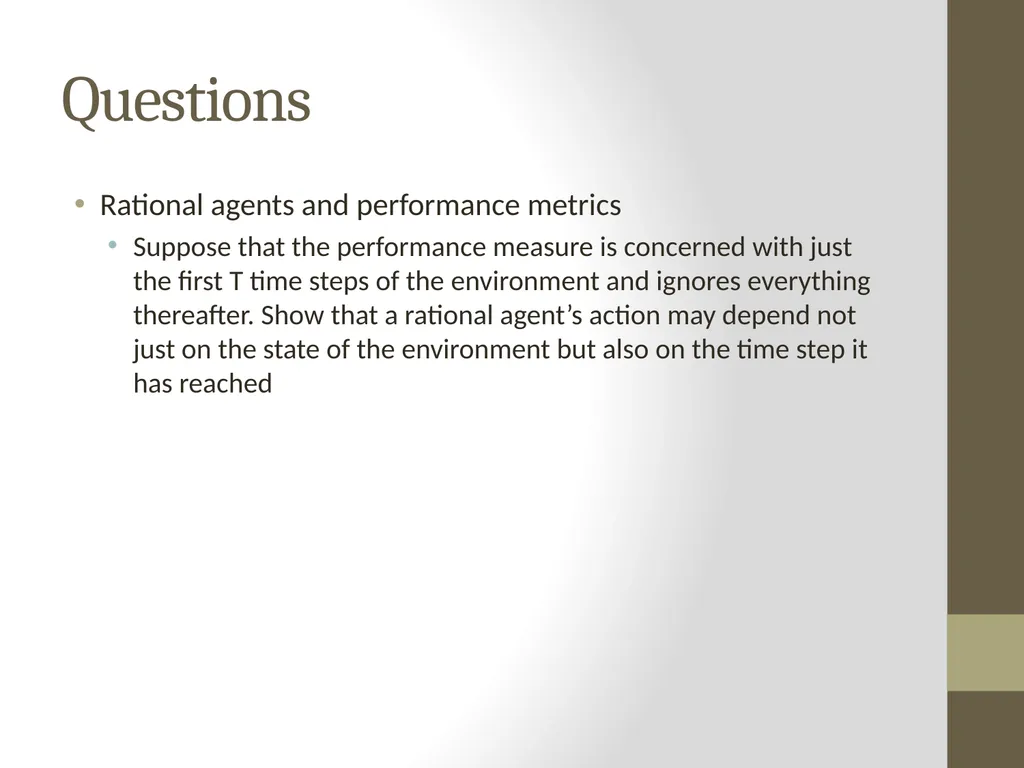
slide2. Questions Rational agents and performance metrics
Suppose that the performance measure is concerned with just the first T time steps of the environment and ignores everything thereafter. Show that a rational agent’s action may depend not just on the state of the environment but also on the time step it has reached<br>
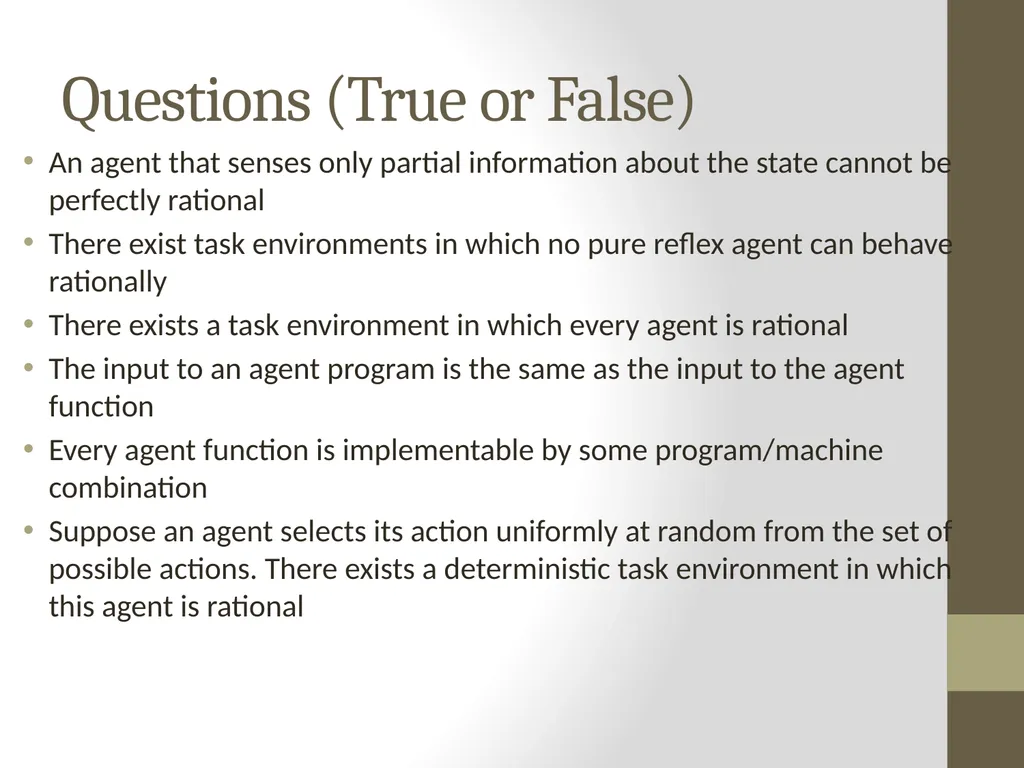
slide3. Questions (True or False) An agent that senses only partial information about the state cannot be perfectly rational
There exist task environments in which no pure reflex agent can behave rationally
There exists a task environment in which every agent is rational
The input to an agent program is the same as the input to the agent function
Every agent function is implementable by some program/machine combination
Suppose an agent selects its action uniformly at random from the set of possible actions. There exists a deterministic task environment in which this agent is rational<br>
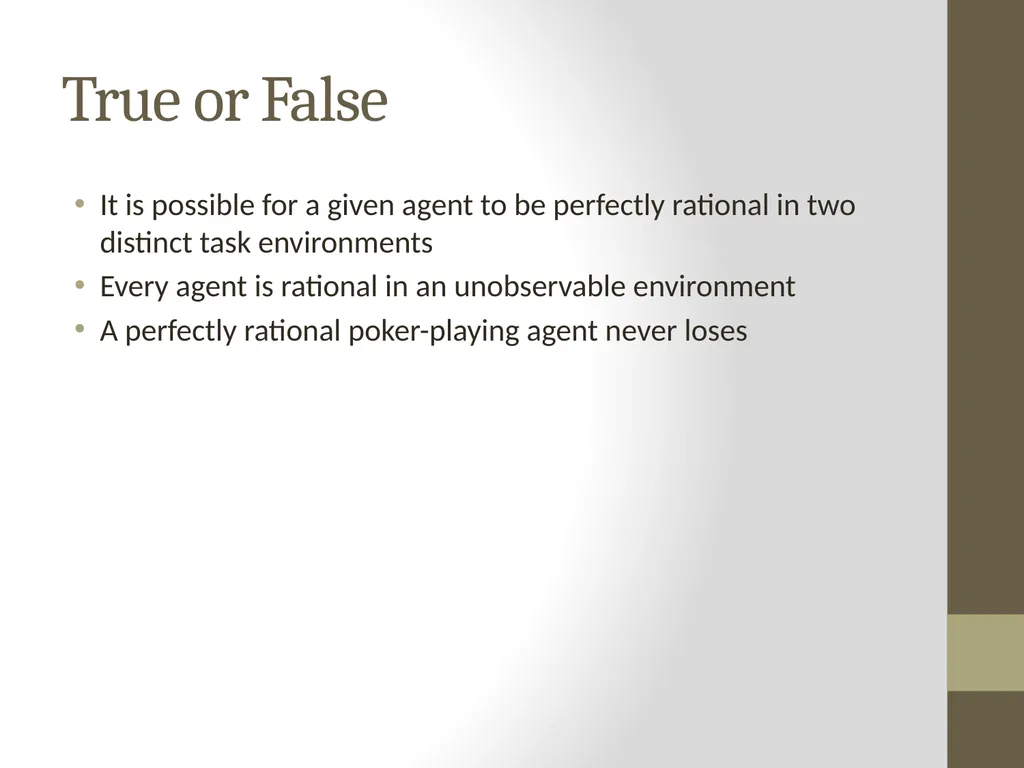
slide4. True or False It is possible for a given agent to be perfectly rational in two distinct task environments
Every agent is rational in an unobservable environment
A perfectly rational poker-playing agent never loses<br>
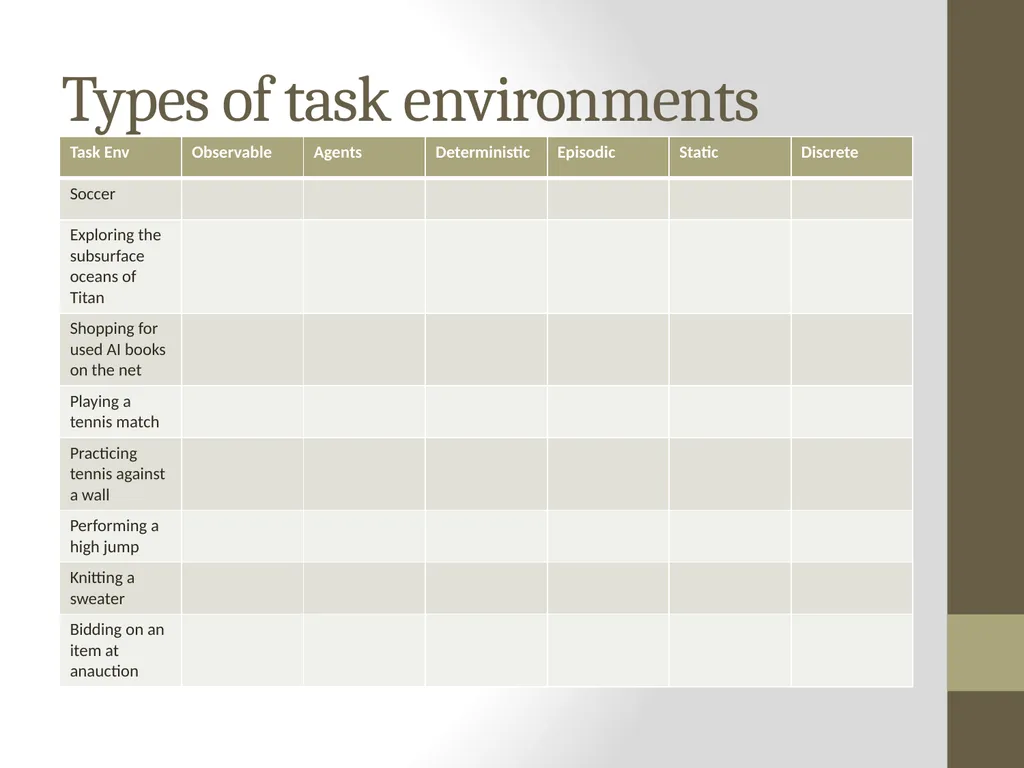
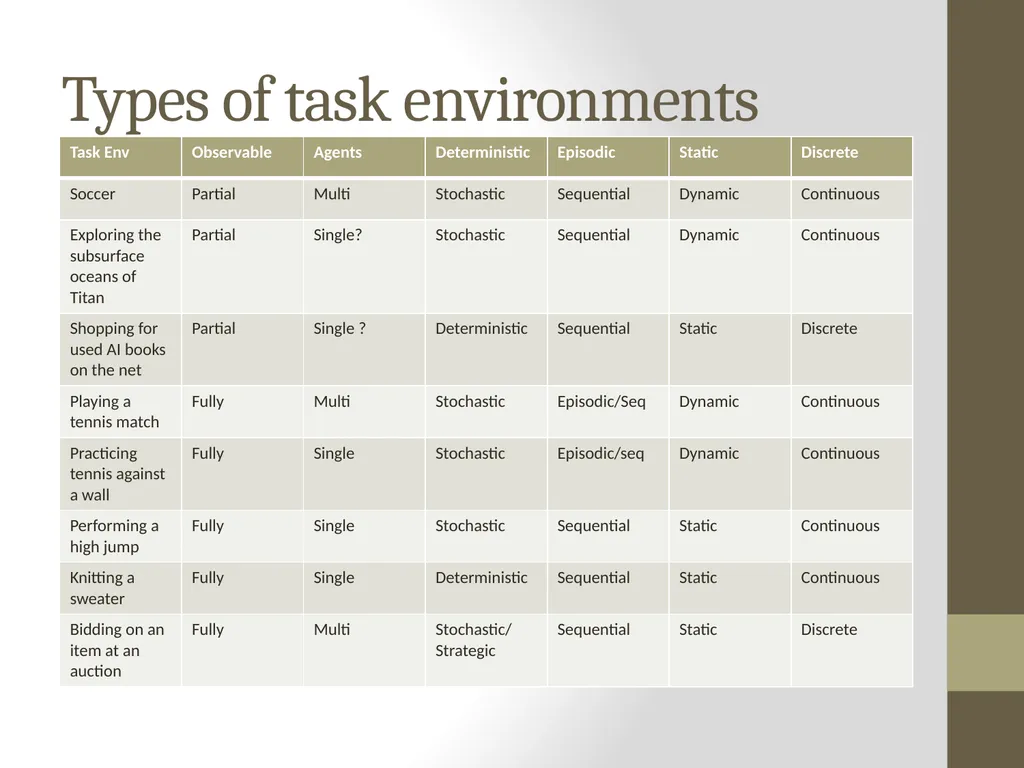
slide5. Types of task environments<br>
slide6. Types of task environments<br>
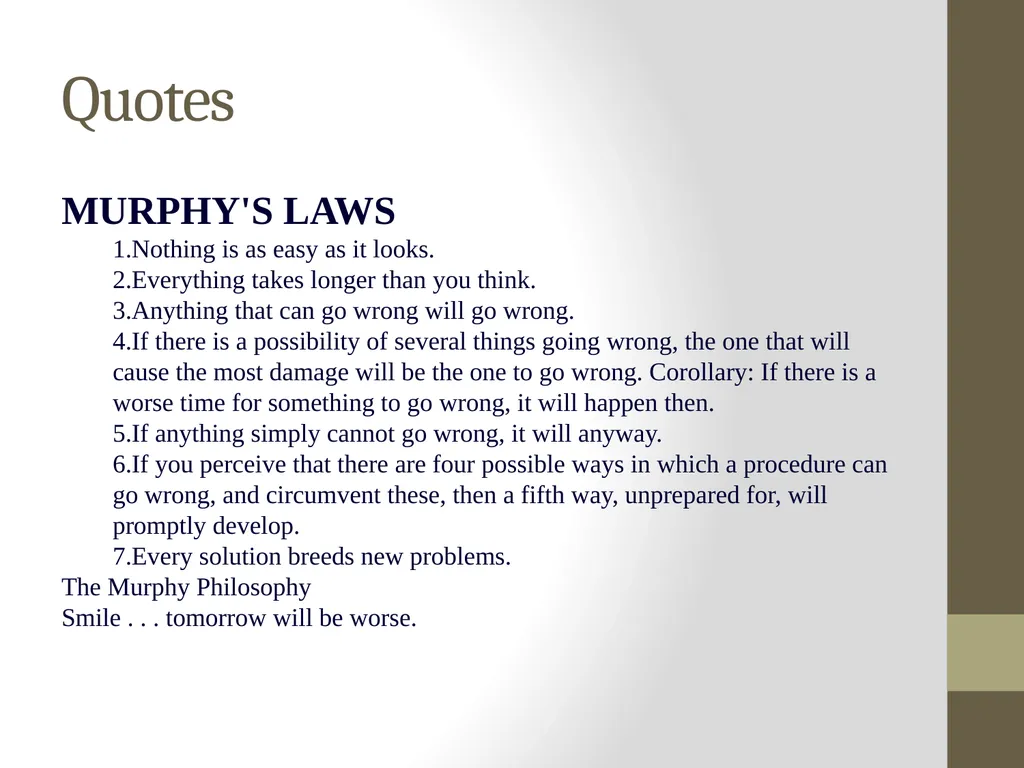
slide7. Quotes MURPHY'S LAWS
Nothing is as easy as it looks.
Everything takes longer than you think.
Anything that can go wrong will go wrong.
If there is a possibility of several things going wrong, the one that will cause the most damage will be the one to go wrong. Corollary: If there is a worse time for something to go wrong, it will happen then.
If anything simply cannot go wrong, it will anyway.
If you perceive that there are four possible ways in which a procedure can go wrong, and circumvent these, then a fifth way, unprepared for, will promptly develop.
Every solution breeds new problems.
The Murphy Philosophy
Smile . . . tomorrow will be worse.<br>
slide8. Arthur C. Clarke Any sufficiently advanced technology is indistinguishable from magic.<br>
slide9. Outline Problem solving agents
Problem types
Problem formulation
Example Problems
Basic Search Algorithms<br>
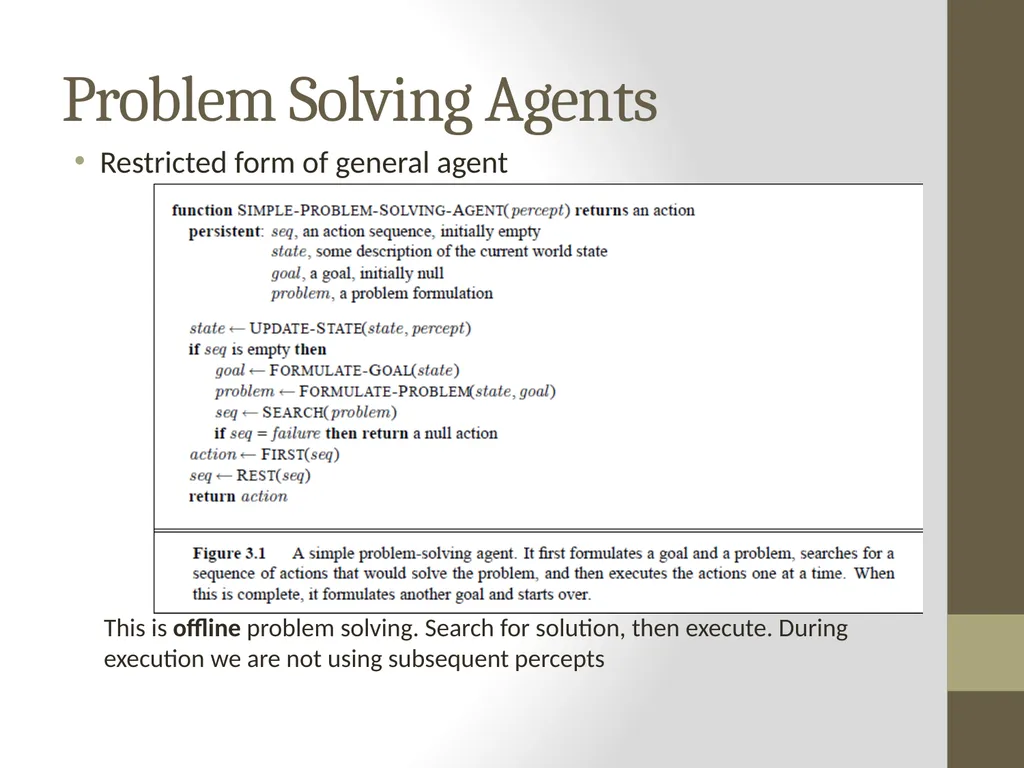
slide10. Problem Solving Agents Restricted form of general agent This is offline problem solving. Search for solution, then execute. During execution we are not using subsequent percepts<br>
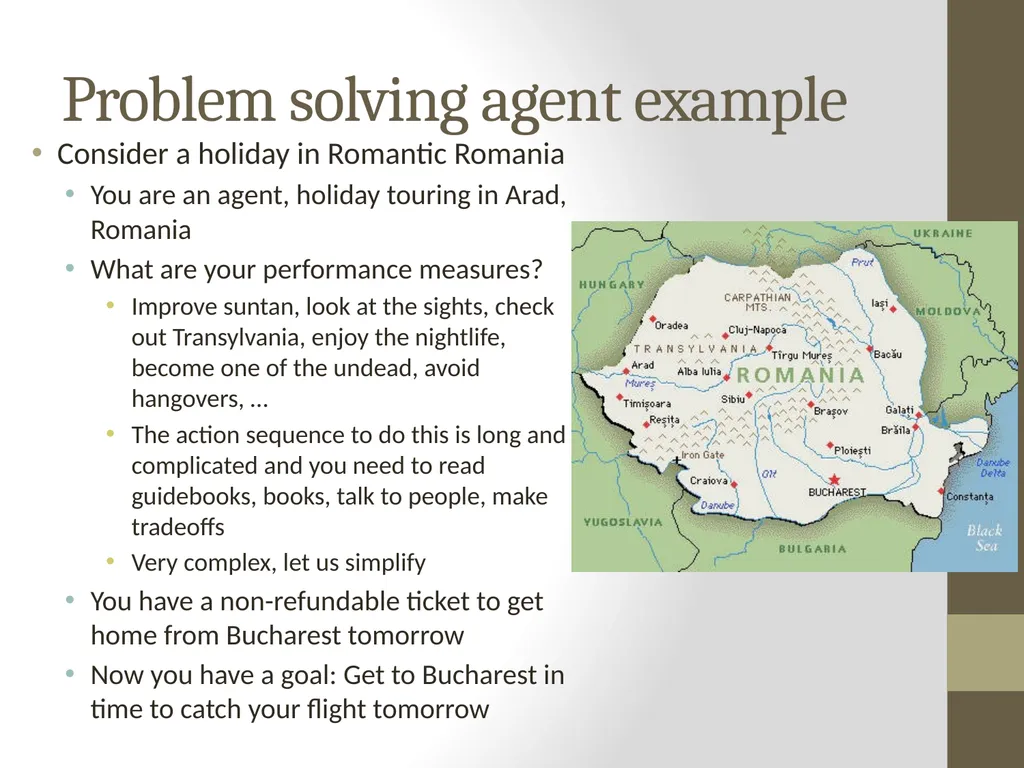
slide11. Problem solving agent example Consider a holiday in Romantic Romania
You are an agent, holiday touring in Arad, Romania
What are your performance measures?
Improve suntan, look at the sights, check out Transylvania, enjoy the nightlife, become one of the undead, avoid hangovers, …
The action sequence to do this is long and complicated and you need to read guidebooks, books, talk to people, make tradeoffs
Very complex, let us simplify
You have a non-refundable ticket to get home from Bucharest tomorrow
Now you have a goal: Get to Bucharest in time to catch your flight tomorrow<br>
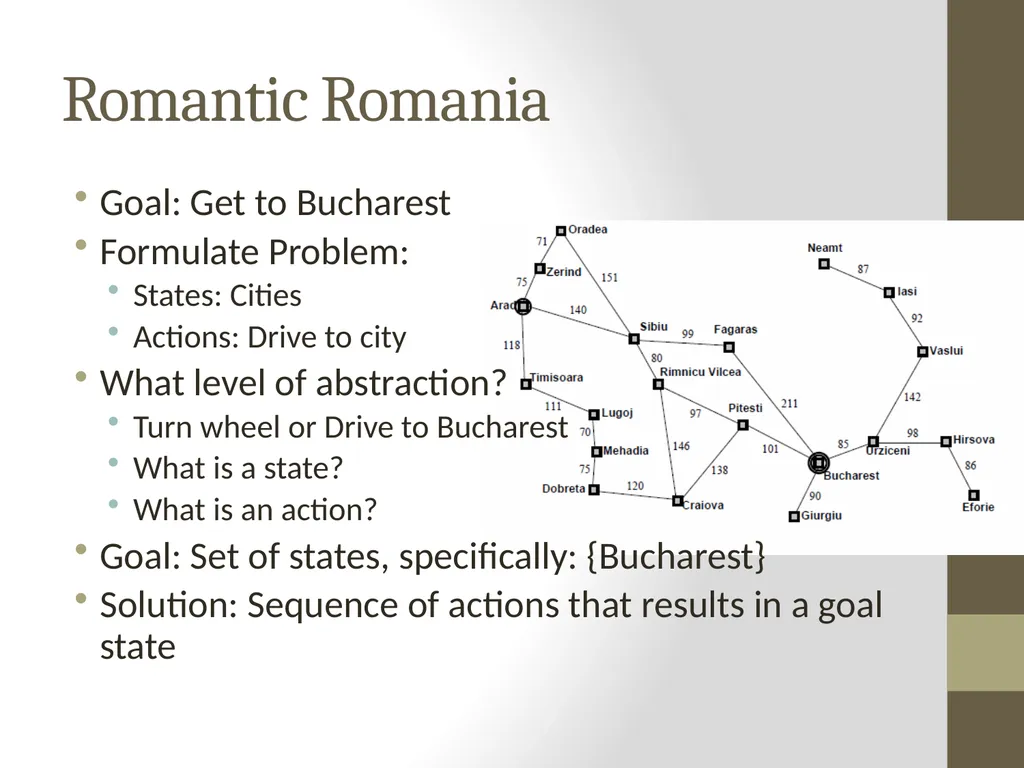
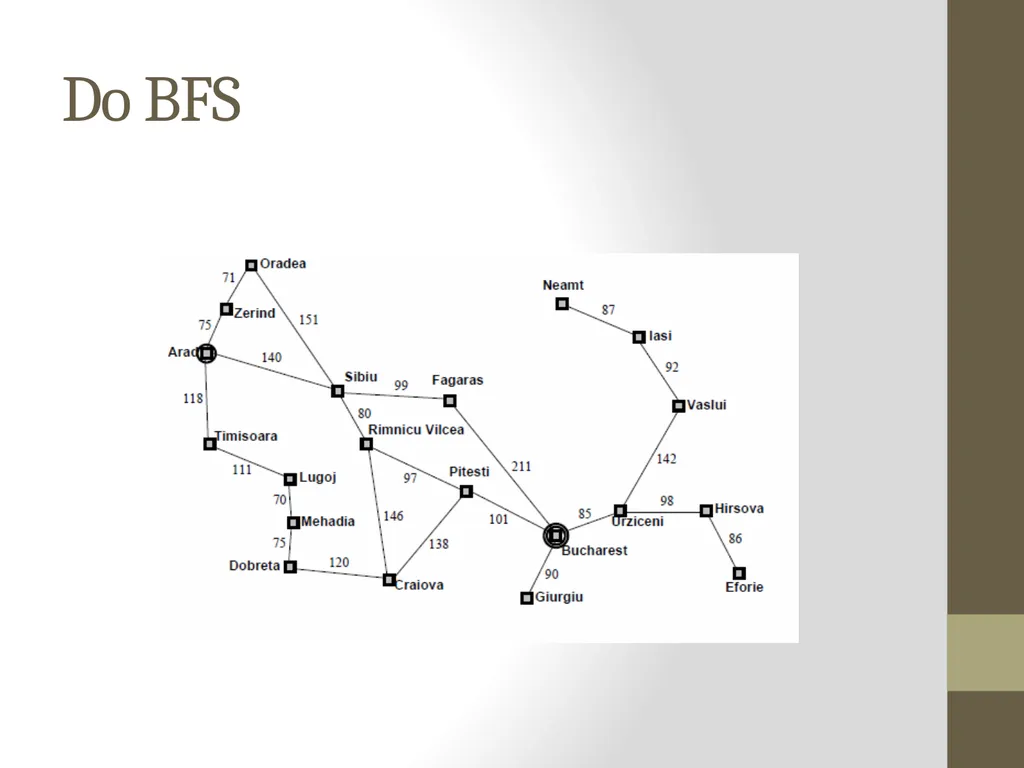
slide12. Romantic Romania Goal: Get to Bucharest
Formulate Problem:
States: Cities
Actions: Drive to city
What level of abstraction?
Turn wheel or Drive to Bucharest
What is a state?
What is an action?
Goal: Set of states, specifically: {Bucharest}
Solution: Sequence of actions that results in a goal state<br>
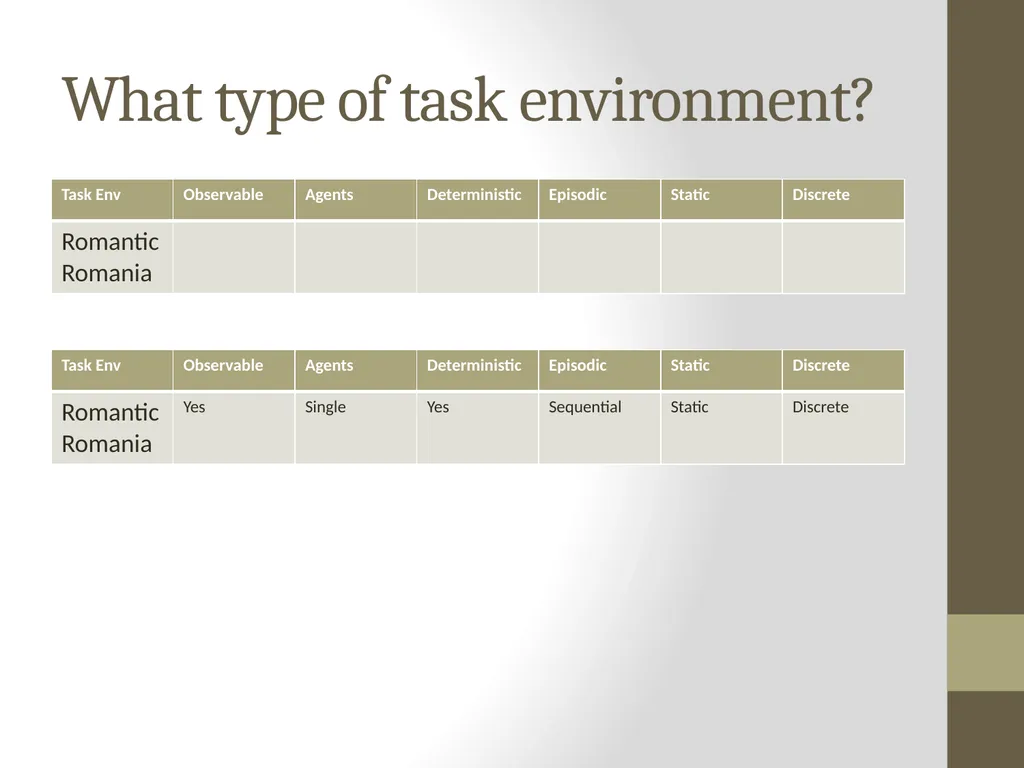
slide13. What type of task environment?<br>
slide14. Problem solution A fixed sequence of actions
Agent searches for a sequence of actions that will lead to a goal state
So we :
Formulate the problem,
Search for a solution,
Execute the action sequence
Execution phase does NOT consider percepts in this simple example. In control theory: Open-Loop system<br>
slide15. Back to Romanian problem formulation Initial State, S_0
In(Arad)
Actions
Actions(S) returns set of actions possible in state S
{Go(Sibiu), Go(Timisoara), Go(Zerind)}
Transition Model: What does an action do?
Result (In(Arad), Go(Zerind)) = In(Zerind)
State space is a directed graph
A Path in the state space is a sequence of states connected by a sequence of actions
Goal State(s) In(Bucharest)
Path COST function
Some agents are better than others lower cost
Path costs are non-negative (>= 0) State
Space
of our problem A solution is a sequence of actions leading from the initial state to a goal state<br>
slide16. Abstraction The real world is absurdly complex so state space must be abstracted for problem solving
In(Arad) means somewhere in Arad but where
Result(In (Arad), Go(Zerind)) = In (Zerind). Yay but how do you find the highway out and what side do you drive on and where’s the gas station, and …..
In a more expressive, less abstract representation of the world, In(Arad) must correspond to some real location in Arad (Hotel Phoenix perhaps)
Similarly a solution, a sequence of actions, must correspond to real actions in the less abstract real-world. A Solution Path must correspond to a real path
Our abstraction should make the original problem easier while at the same time enabling a correspondence with a more expressive representation<br>
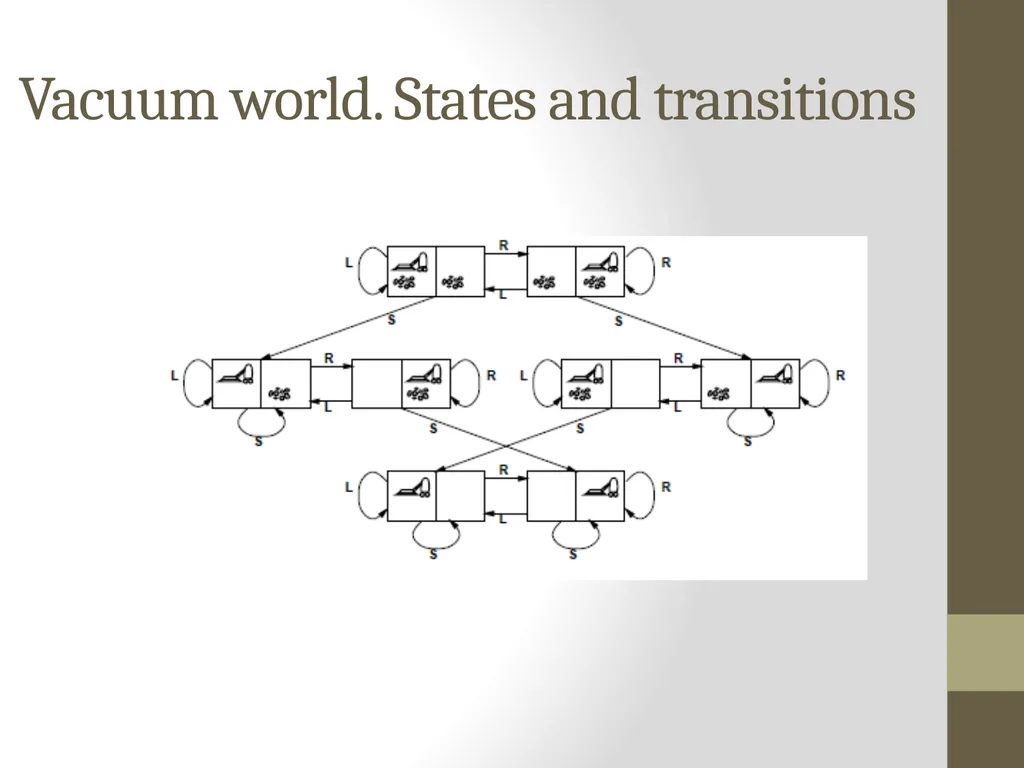
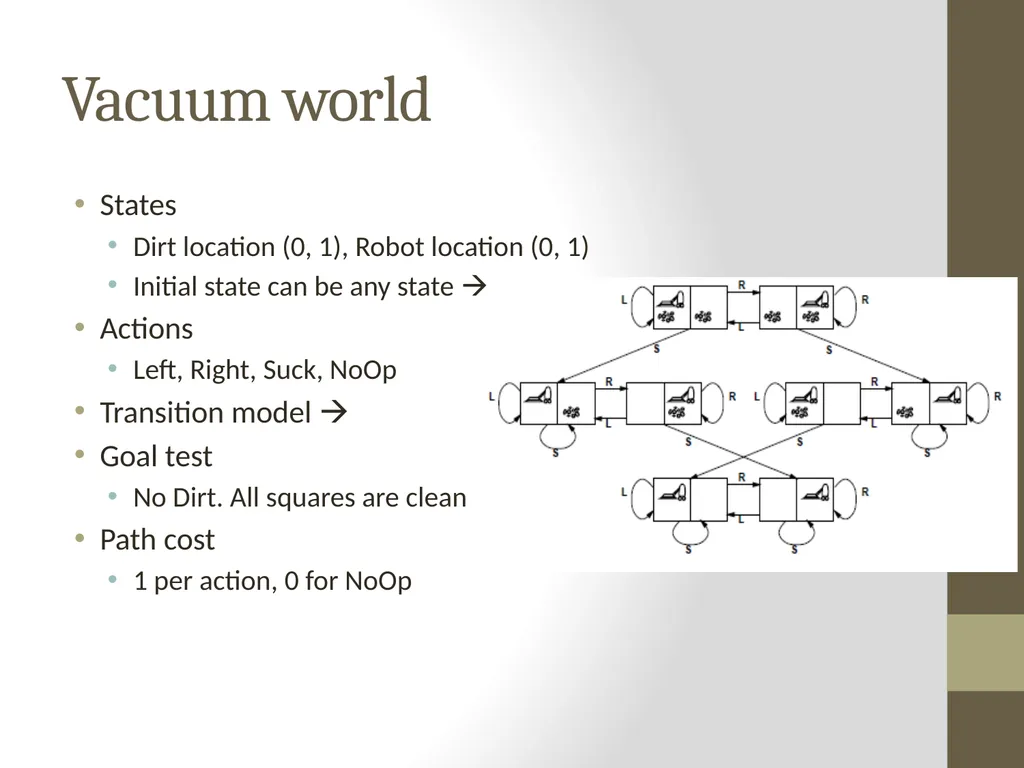
slide17. Vacuum world. States and transitions<br>
slide18. Vacuum world States
?
Actions
?
Transition model (see figure)
Goal test
?
Path cost
?<br>
slide19. Vacuum world States
Dirt location (0, 1), Robot location (0, 1)
Initial state can be any state
Actions
Left, Right, Suck, NoOp
Transition model
Goal test
No Dirt. All squares are clean
Path cost
1 per action, 0 for NoOp<br>
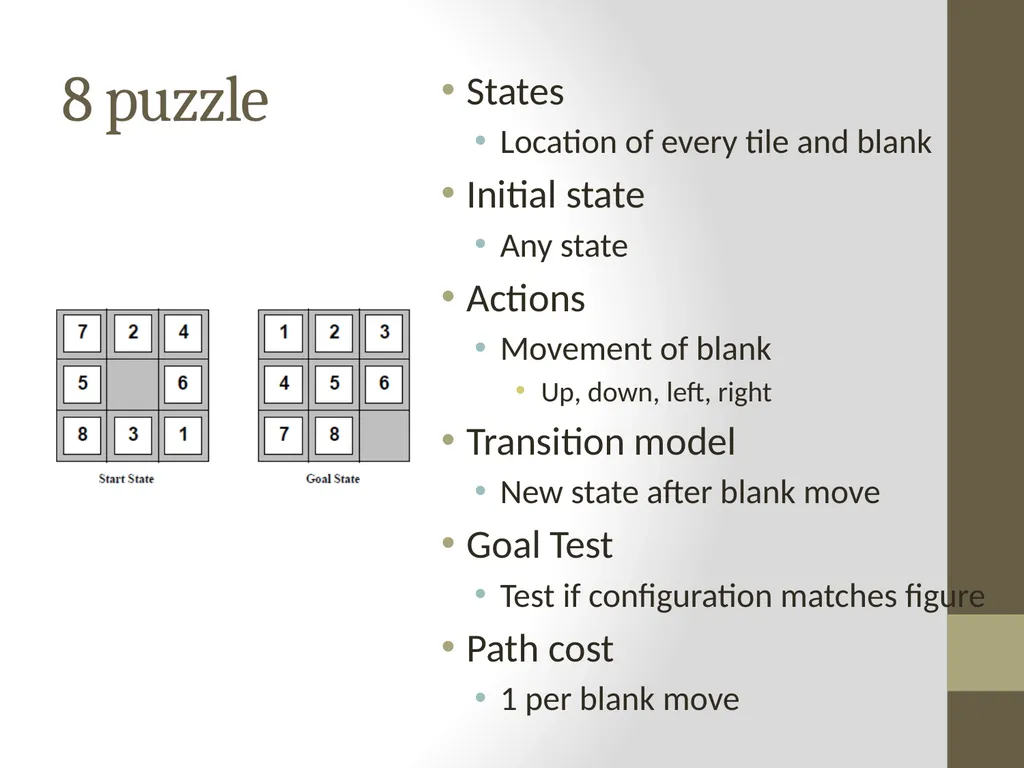
slide20. 8 puzzle States
Location of every tile and blank
Initial state
Any state
Actions
Movement of blank
Up, down, left, right
Transition model
New state after blank move
Goal Test
Test if configuration matches figure
Path cost
1 per blank move<br>
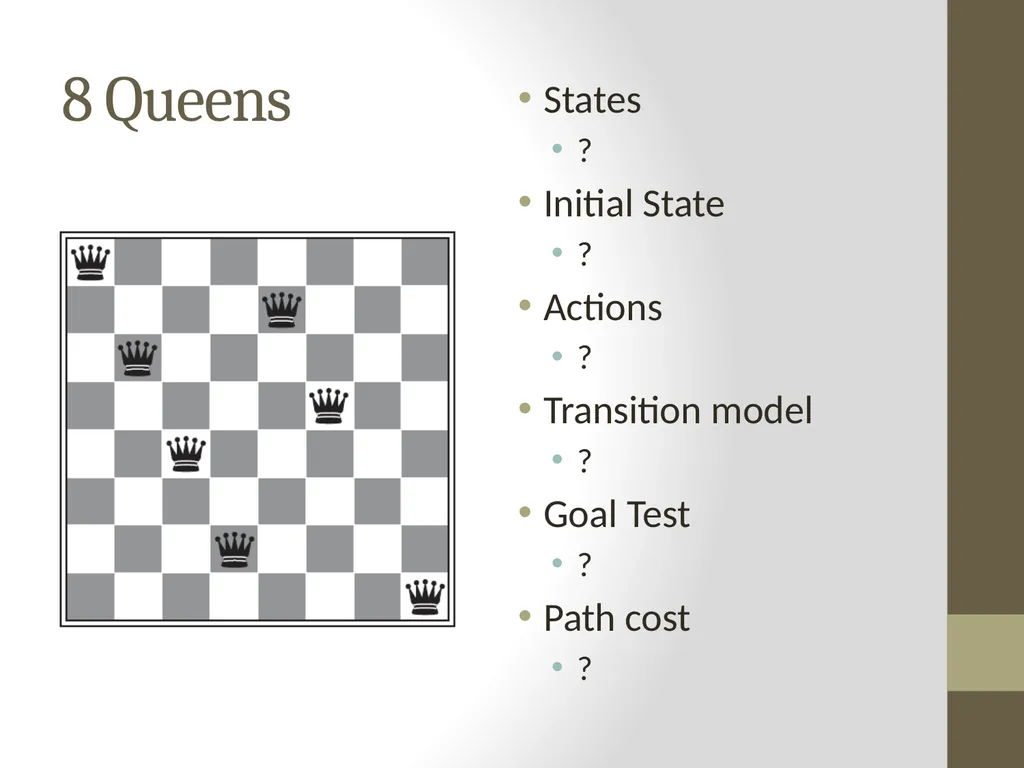
slide21. 8 Queens States
?
Initial State
?
Actions
?
Transition model
?
Goal Test
?
Path cost
?<br>
slide22. Real world problems Route finding
TSP
VLSI
Robot Navigation
Automatic assembly sequencing<br>
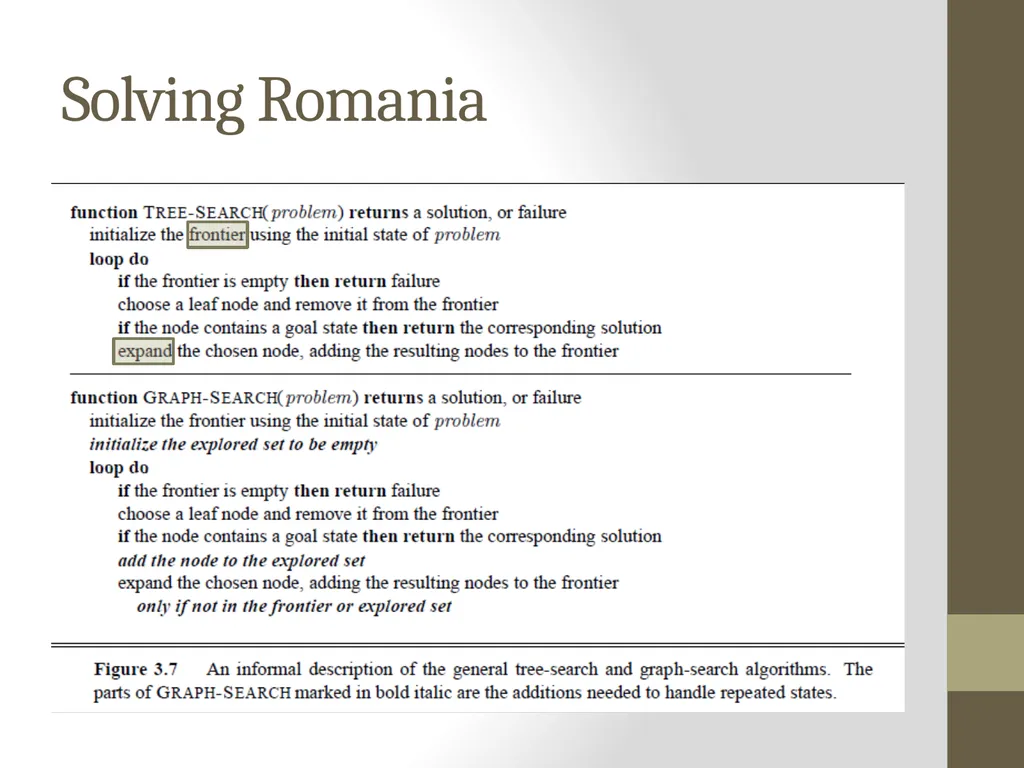
slide23. Solving Romania<br>
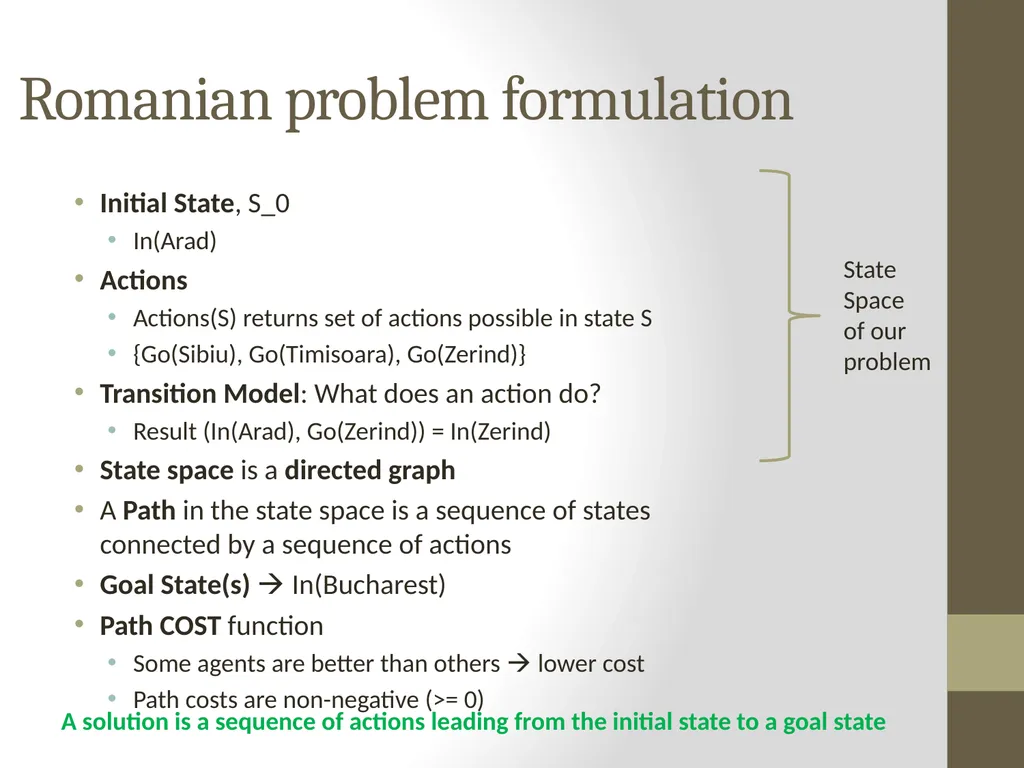
slide24. Romanian problem formulation Initial State, S_0
In(Arad)
Actions
Actions(S) returns set of actions possible in state S
{Go(Sibiu), Go(Timisoara), Go(Zerind)}
Transition Model: What does an action do?
Result (In(Arad), Go(Zerind)) = In(Zerind)
State space is a directed graph
A Path in the state space is a sequence of states connected by a sequence of actions
Goal State(s) In(Bucharest)
Path COST function
Some agents are better than others lower cost
Path costs are non-negative (>= 0) State
Space
of our problem A solution is a sequence of actions leading from the initial state to a goal state<br>
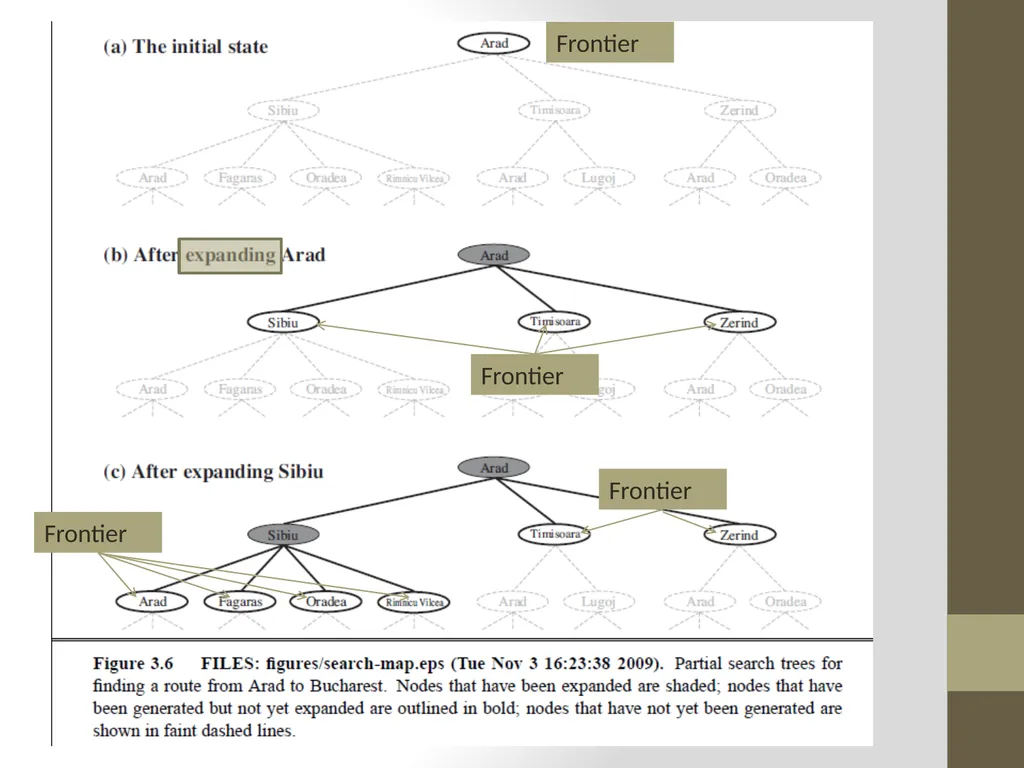
slide25. Frontier Frontier Frontier Frontier<br>
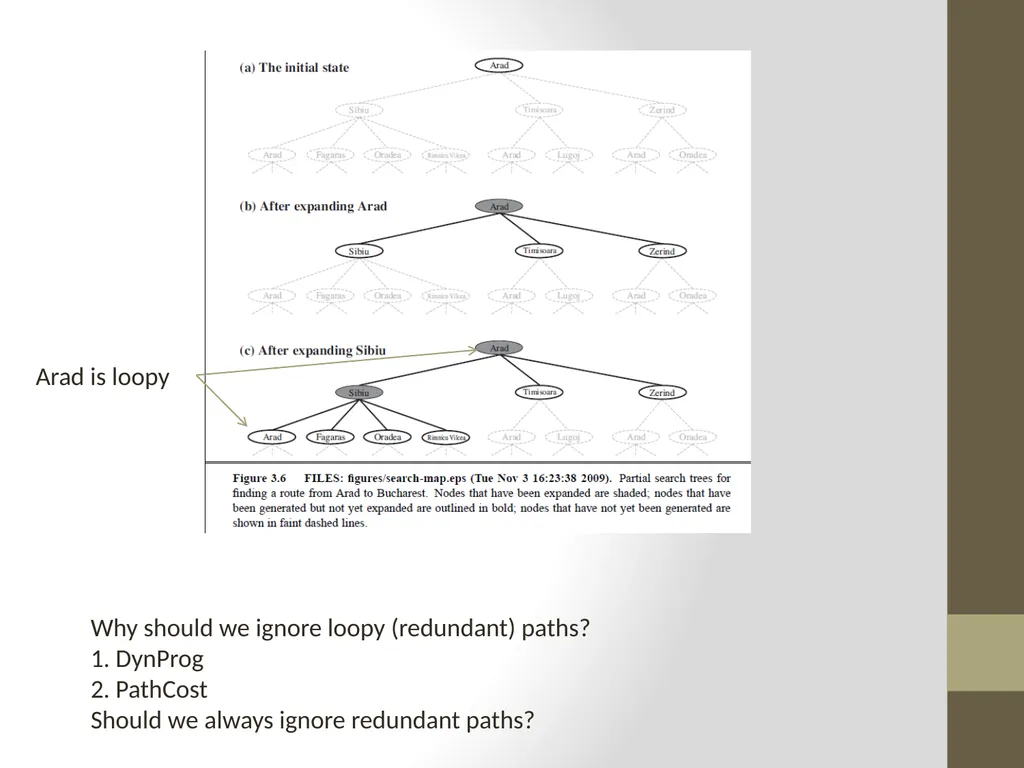
slide26. Arad is loopy Why should we ignore loopy (redundant) paths?
1. DynProg
2. PathCost
Should we always ignore redundant paths?<br>
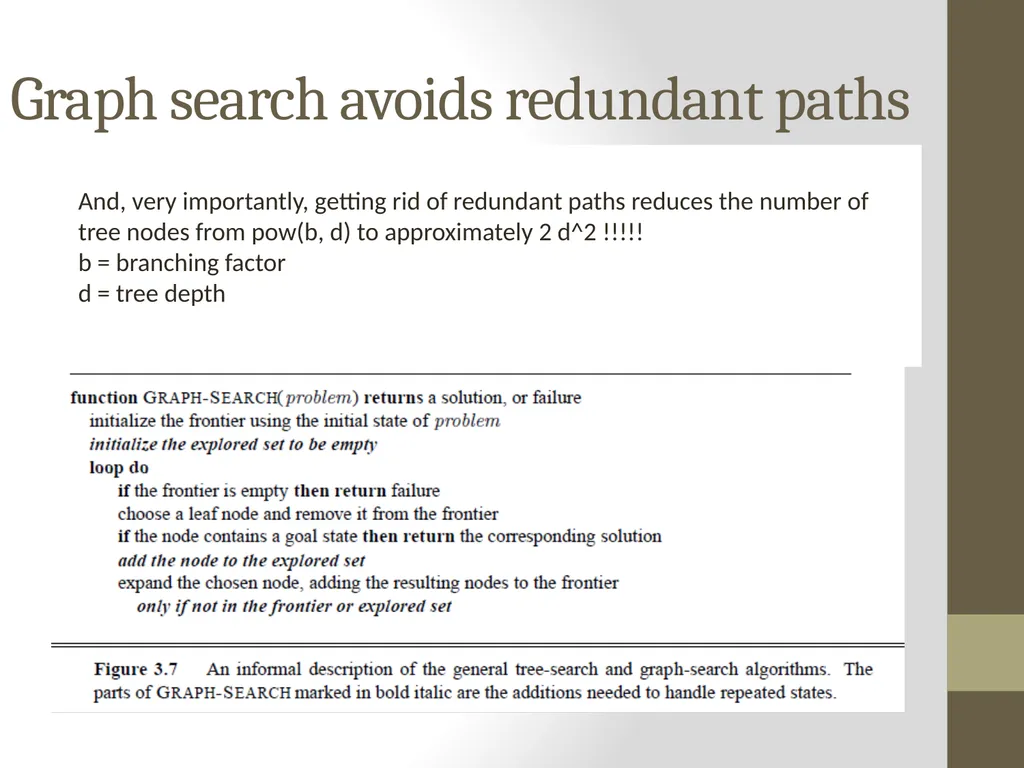
slide27. Graph search avoids redundant paths And, very importantly, getting rid of redundant paths reduces the number of tree nodes from pow(b, d) to approximately 2 d^2 !!!!!
b = branching factor
d = tree depth<br>
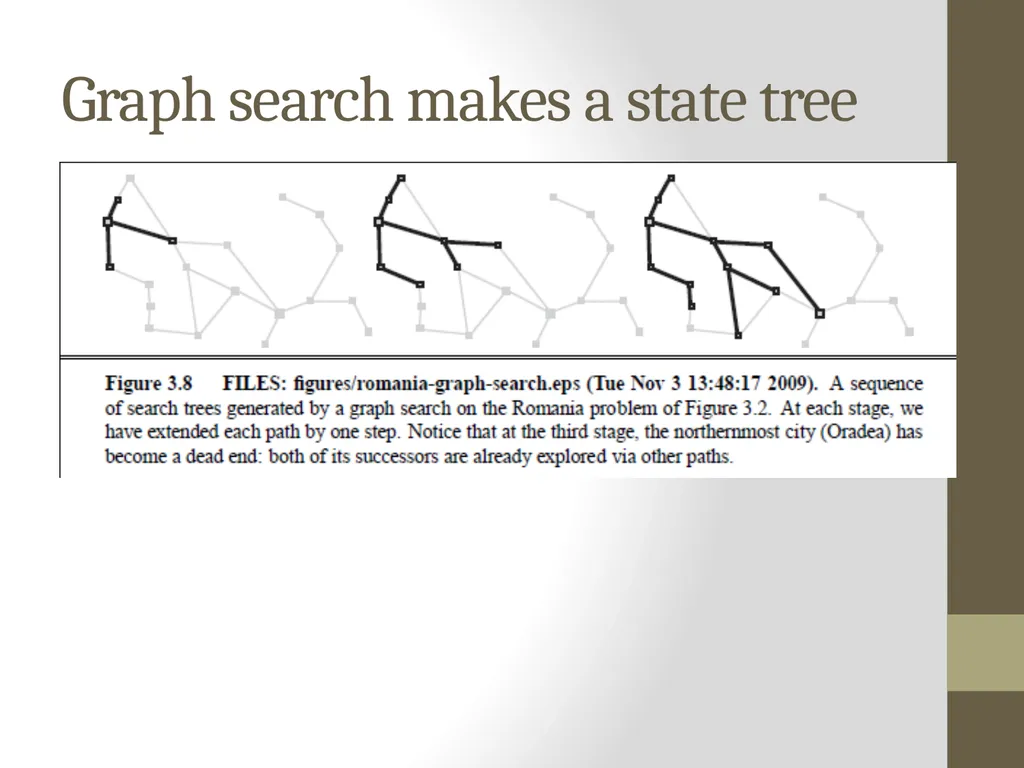
slide28. Graph search makes a state tree<br>
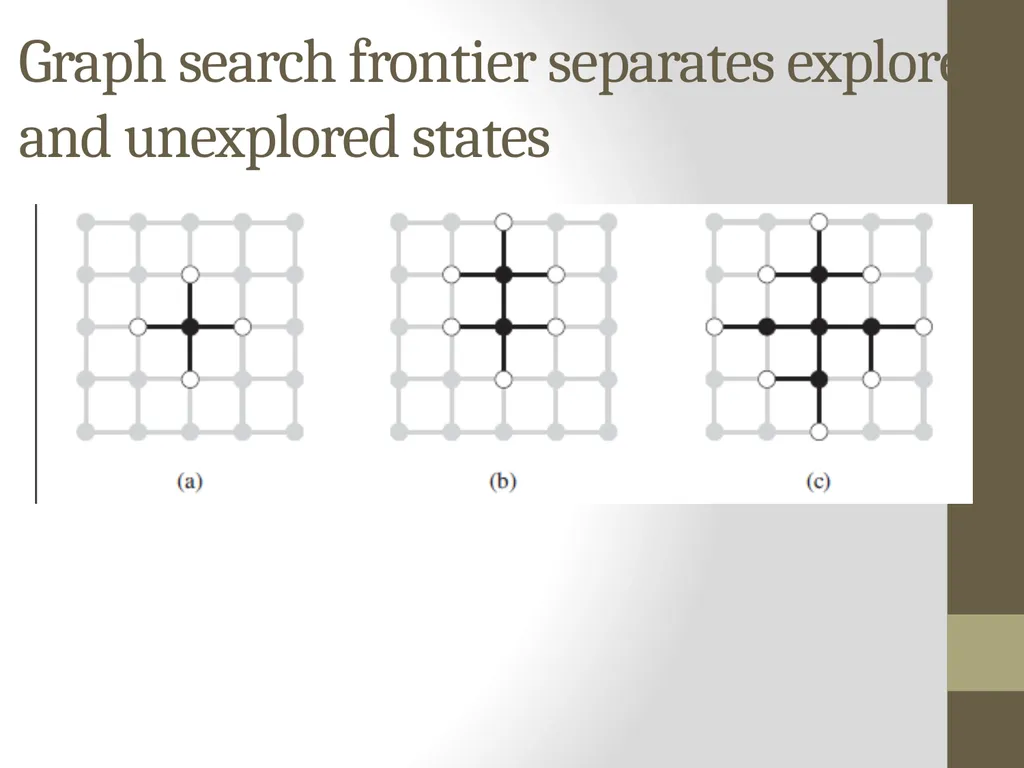
slide29. Graph search frontier separates explored and unexplored states<br>
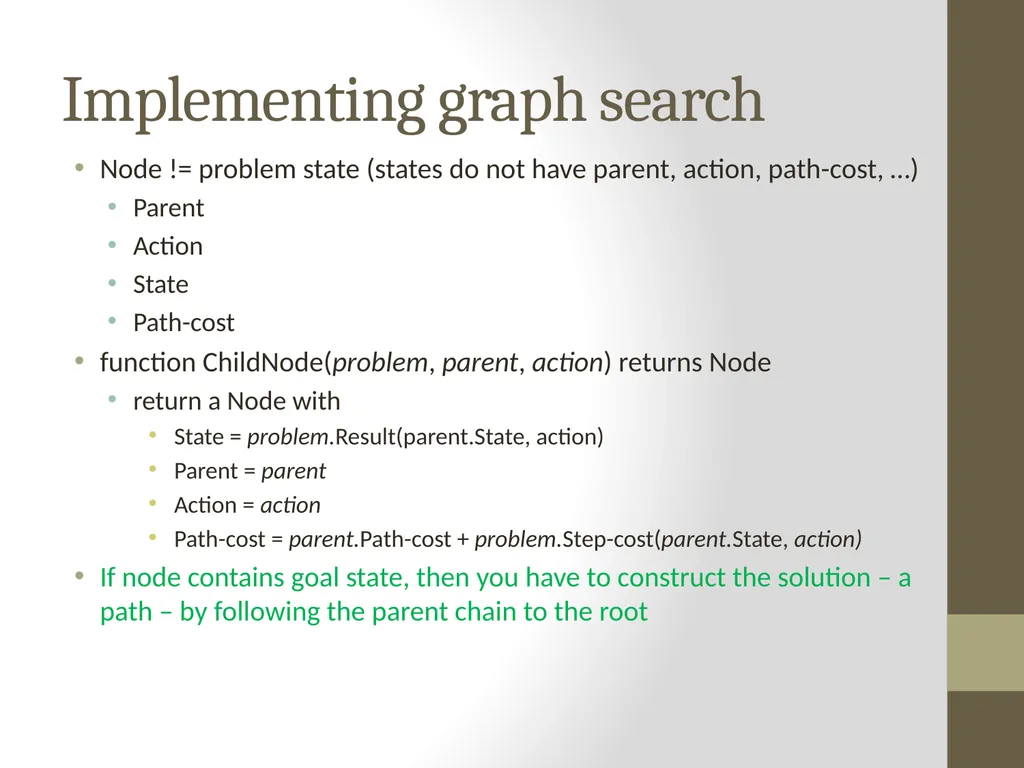
slide30. Implementing graph search Node != problem state (states do not have parent, action, path-cost, …)
Parent
Action
State
Path-cost
function ChildNode(problem, parent, action) returns Node
return a Node with
State = problem.Result(parent.State, action)
Parent = parent
Action = action
Path-cost = parent.Path-cost + problem.Step-cost(parent.State, action)
If node contains goal state, then you have to construct the solution – a path – by following the parent chain to the root<br>
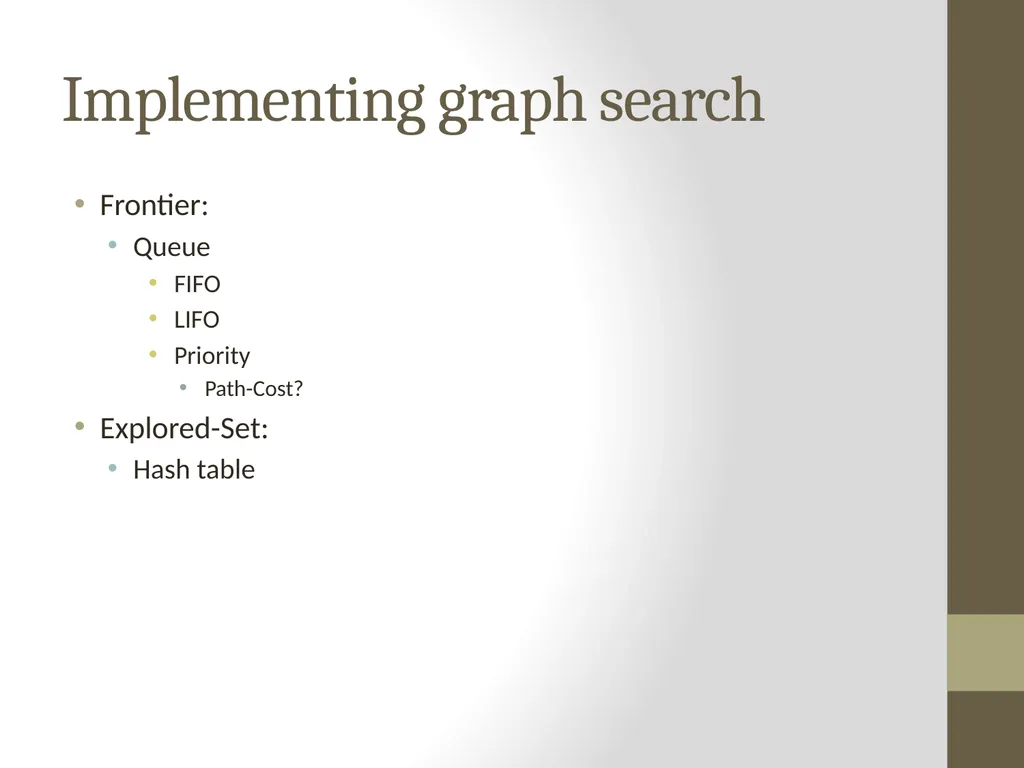
slide31. Implementing graph search Frontier:
Queue
FIFO
LIFO
Priority
Path-Cost?
Explored-Set:
Hash table<br>
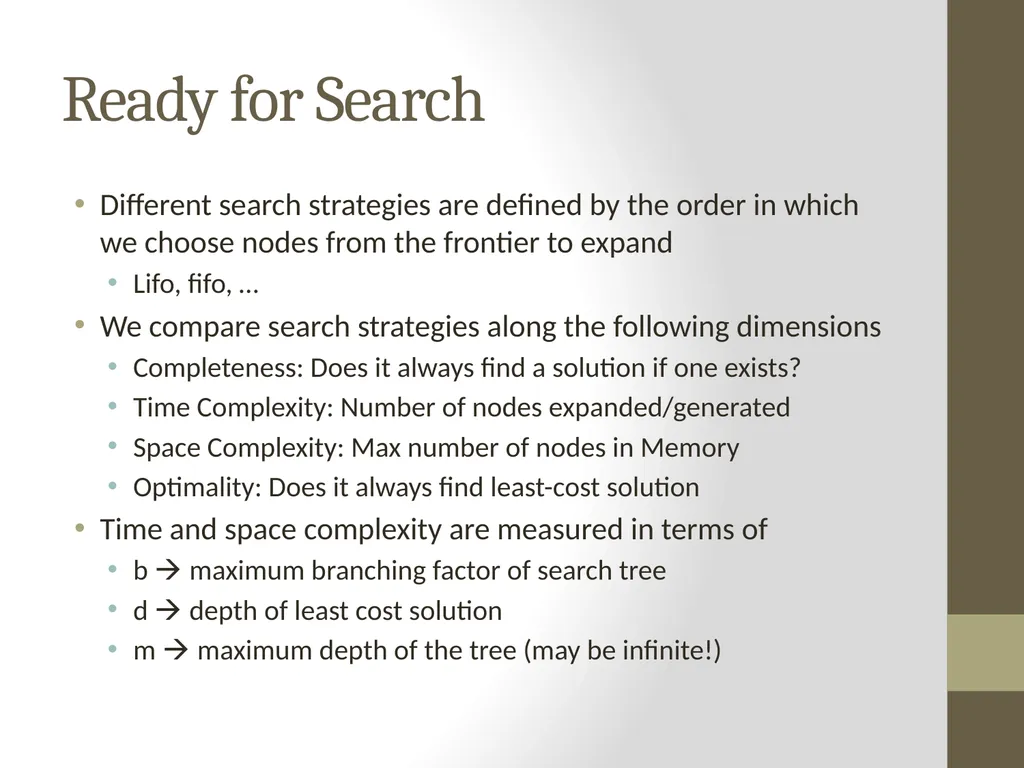
slide32. Ready for Search Different search strategies are defined by the order in which we choose nodes from the frontier to expand
Lifo, fifo, …
We compare search strategies along the following dimensions
Completeness: Does it always find a solution if one exists?
Time Complexity: Number of nodes expanded/generated
Space Complexity: Max number of nodes in Memory
Optimality: Does it always find least-cost solution
Time and space complexity are measured in terms of
b maximum branching factor of search tree
d depth of least cost solution
m maximum depth of the tree (may be infinite!)<br>
slide33. Uninformed Search Breadth-first
Uniform-cost
Depth-first
Depth-limited
Iterative deepening<br>
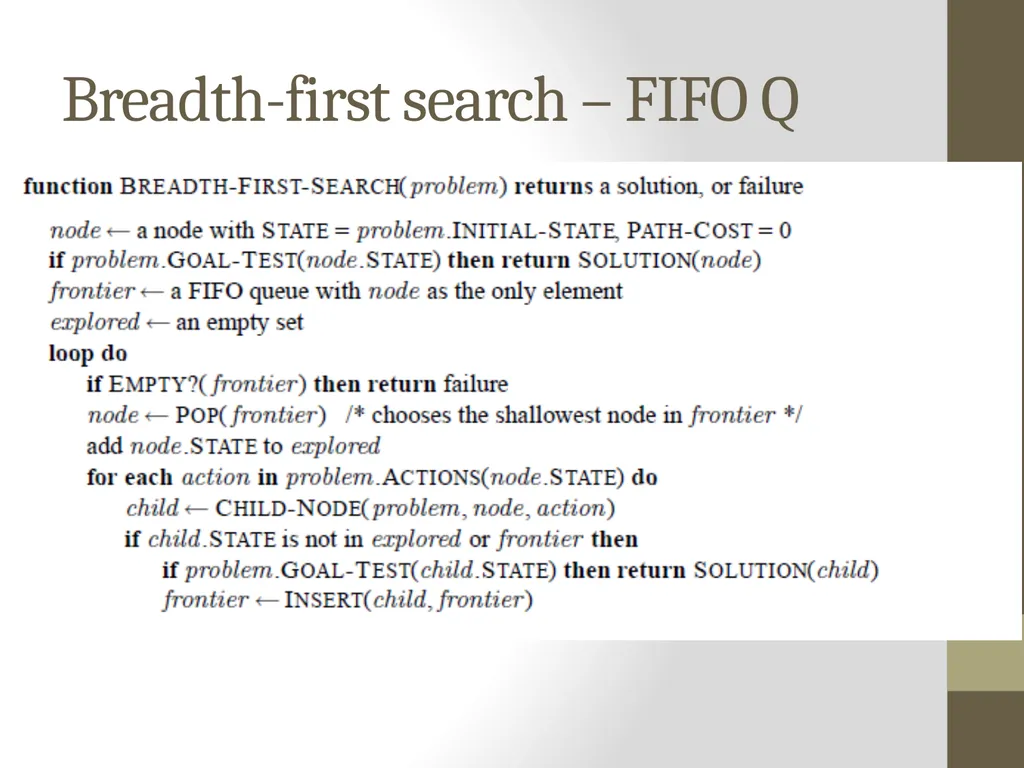
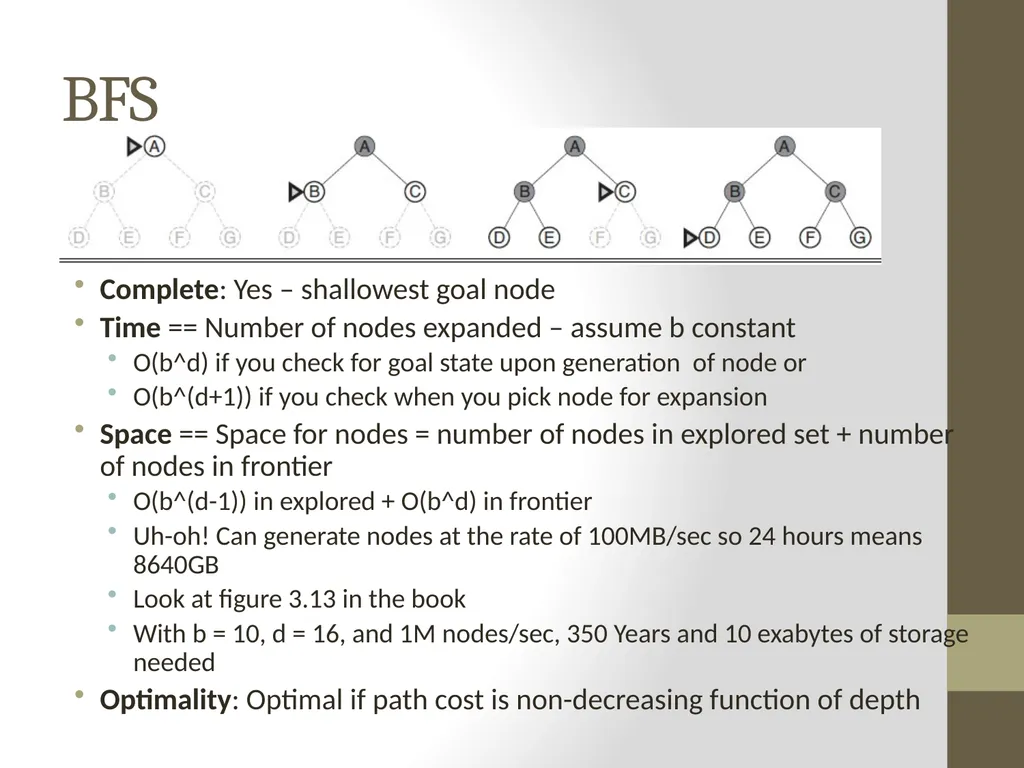
slide34. Breadth-first search – FIFO Q<br>
slide35. BFS Complete: Yes – shallowest goal node
Time == Number of nodes expanded – assume b constant
O(b^d) if you check for goal state upon generation of node or
O(b^(d+1)) if you check when you pick node for expansion
Space == Space for nodes = number of nodes in explored set + number of nodes in frontier
O(b^(d-1)) in explored + O(b^d) in frontier
Uh-oh! Can generate nodes at the rate of 100MB/sec so 24 hours means 8640GB
Look at figure 3.13 in the book
With b = 10, d = 16, and 1M nodes/sec, 350 Years and 10 exabytes of storage needed
Optimality: Optimal if path cost is non-decreasing function of depth<br>
slide36. Do BFS<br>
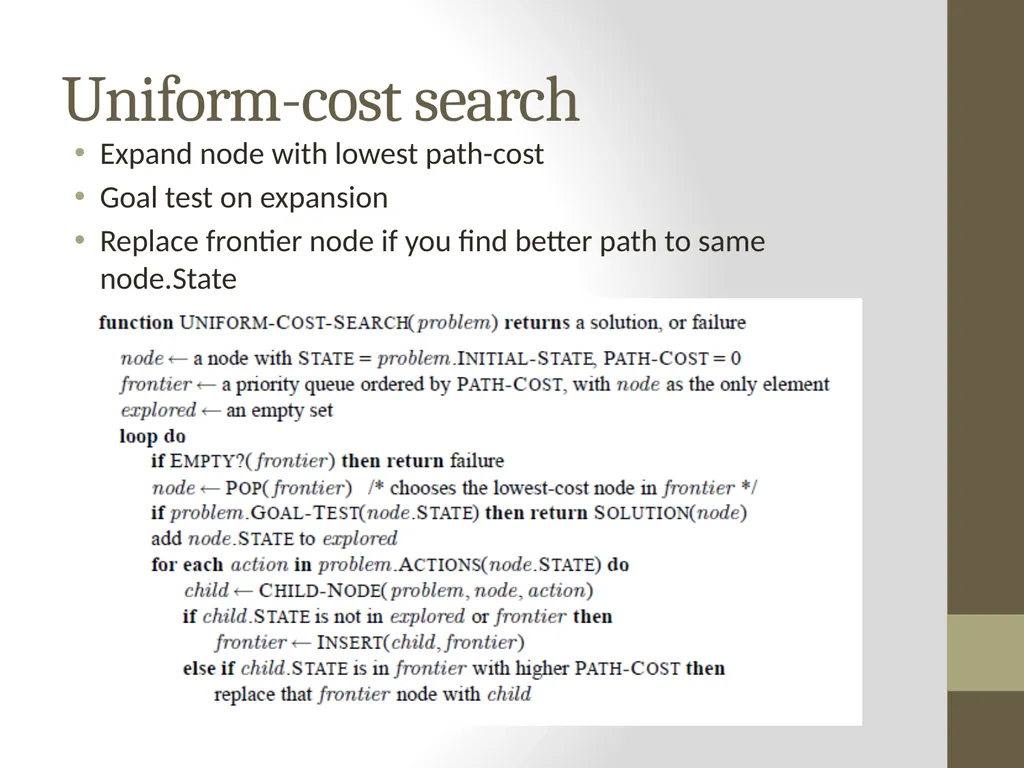
slide37. Uniform-cost search Expand node with lowest path-cost
Goal test on expansion
Replace frontier node if you find better path to same node.State<br>
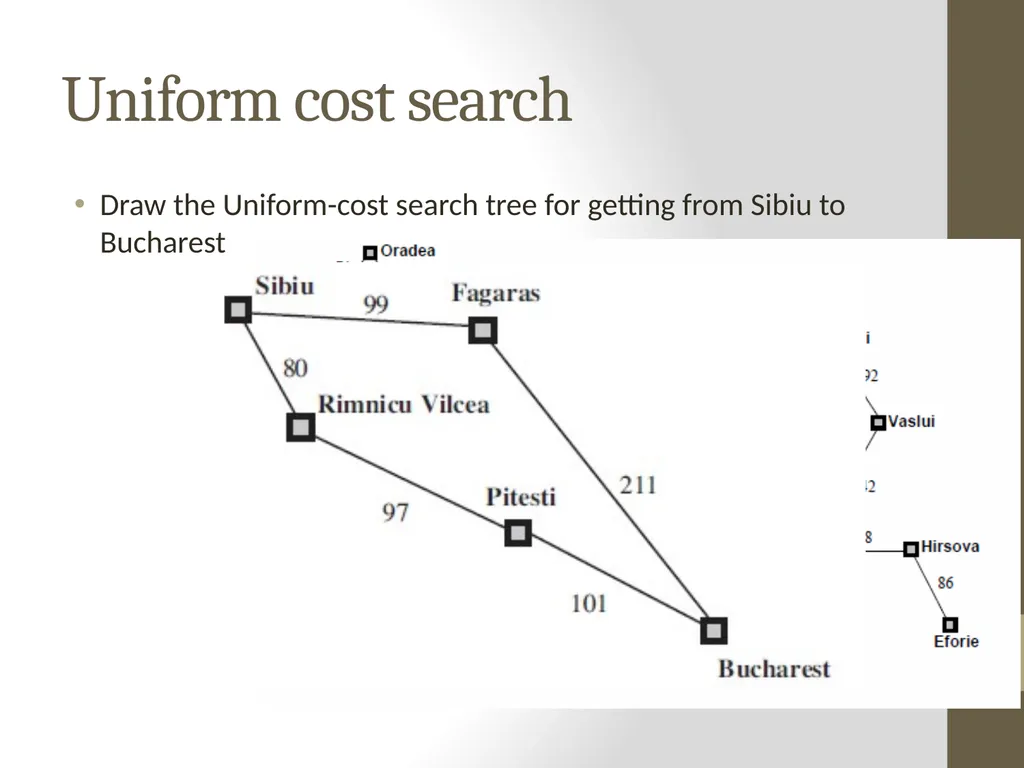
slide38. Uniform cost search Draw the Uniform-cost search tree for getting from Sibiu to Bucharest<br>
slide39. Uniform cost search Complete if every step cost is > 0
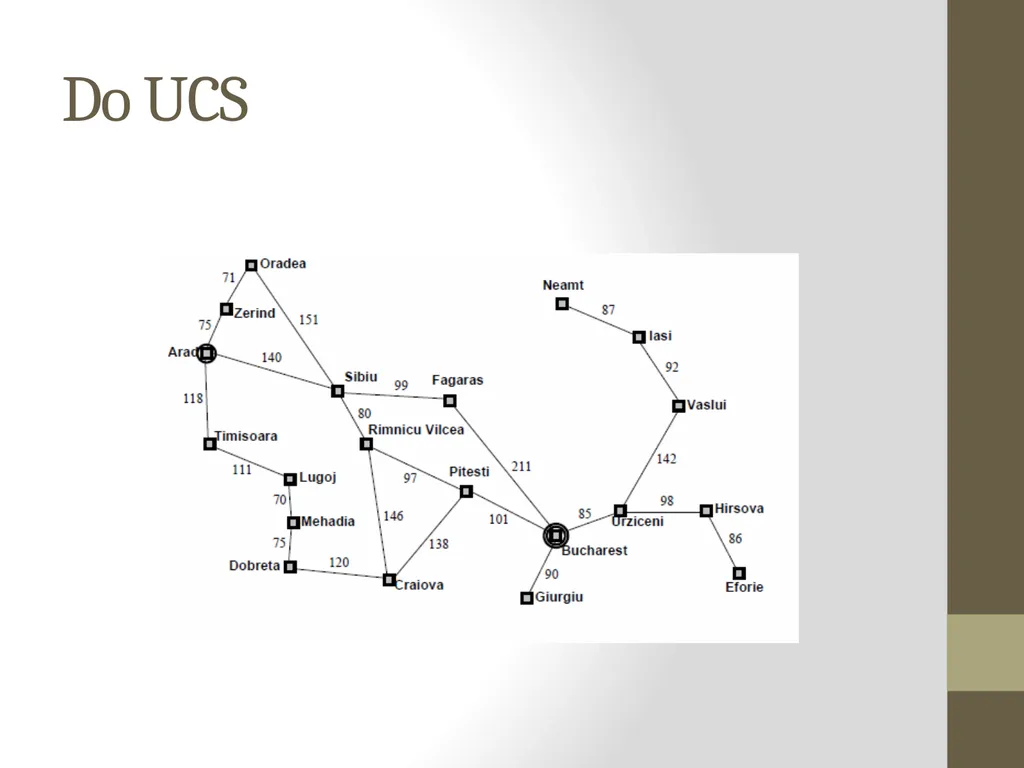
Optimal
Time/Space – Strictly more than BFS<br>
slide40. Do UCS<br>
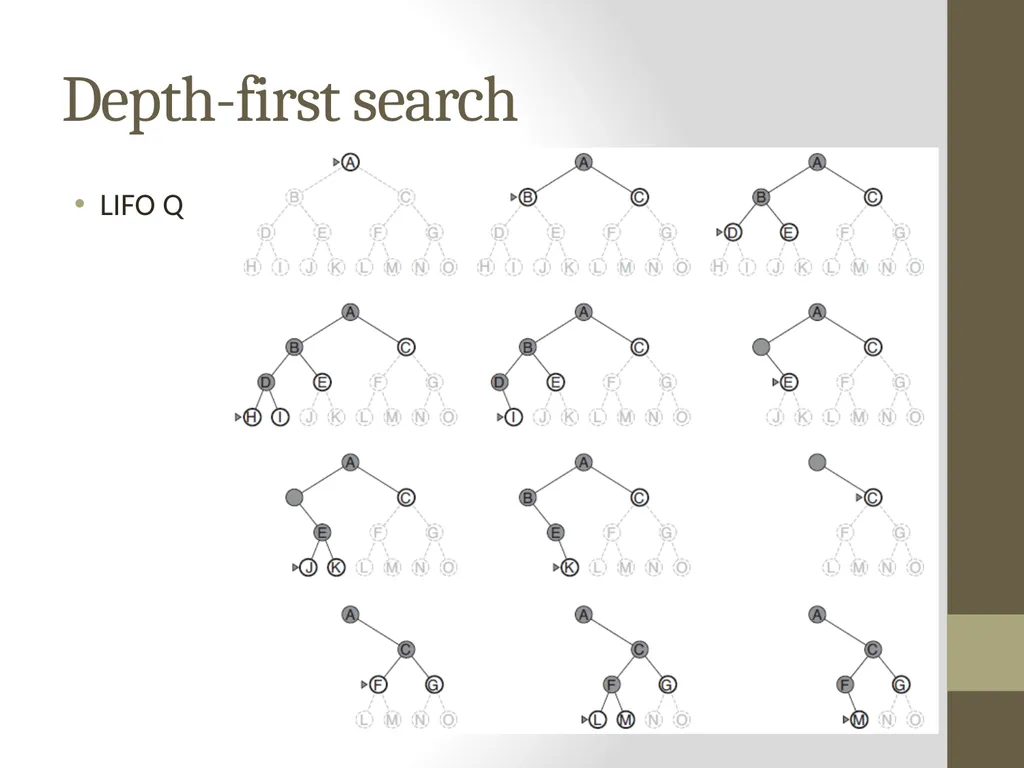
slide41. Depth-first search LIFO Q<br>
slide42. DFS Often easy to implement recursively
Completeness:
Graph search version is complete in finite spaces
Tree search version can be infinitely loopy
Not-optimal
Time: If d is depth of shallowest optimal solution, and m is max depth of tree, DFS may generate O(b^m) >> O(b^d)
Space: O(bm) ! Not bad and we can go lower to O(m) with some fancy housekeeping (backtracking search)
Some kind of DFS used a lot in AI because space requirements are low
What kinds?<br>
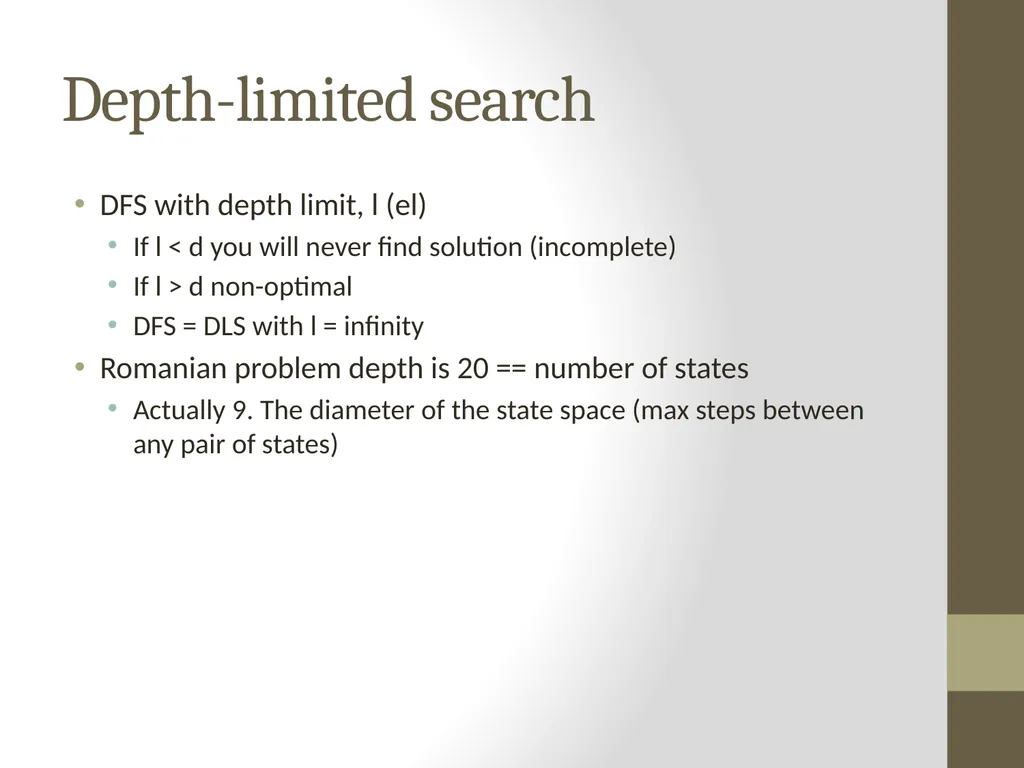
slide43. Depth-limited search DFS with depth limit, l (el)
If l < d you will never find solution (incomplete)
If l > d non-optimal
DFS = DLS with l = infinity
Romanian problem depth is 20 == number of states
Actually 9. The diameter of the state space (max steps between any pair of states)<br>
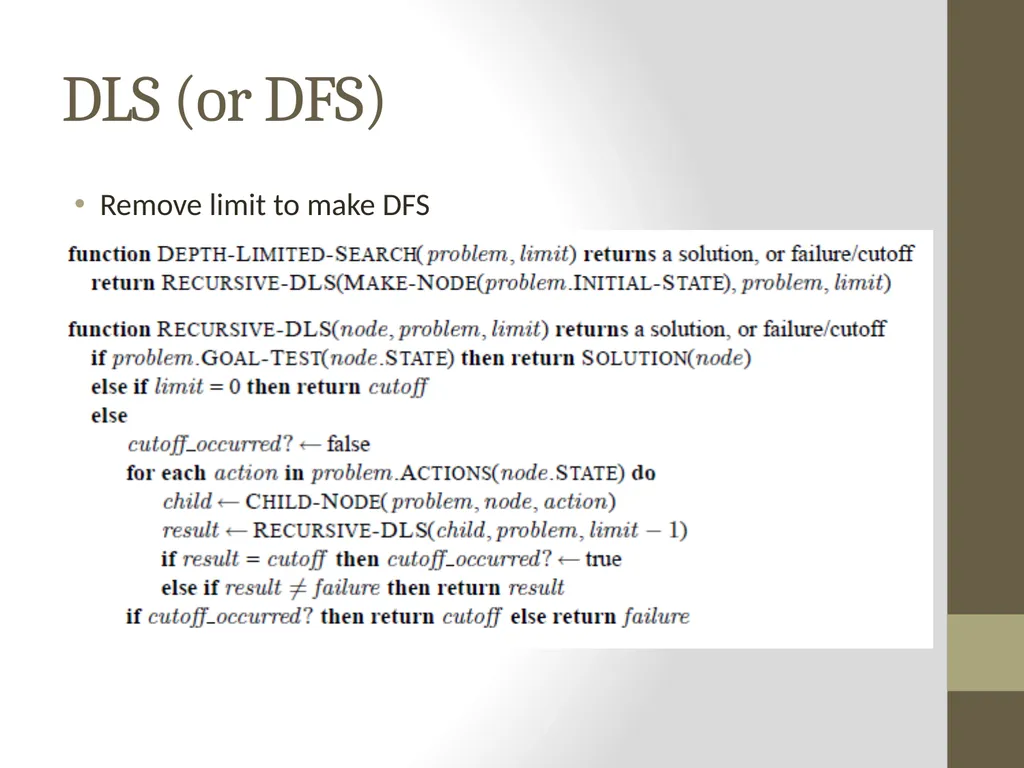
slide44. DLS (or DFS) Remove limit to make DFS<br>
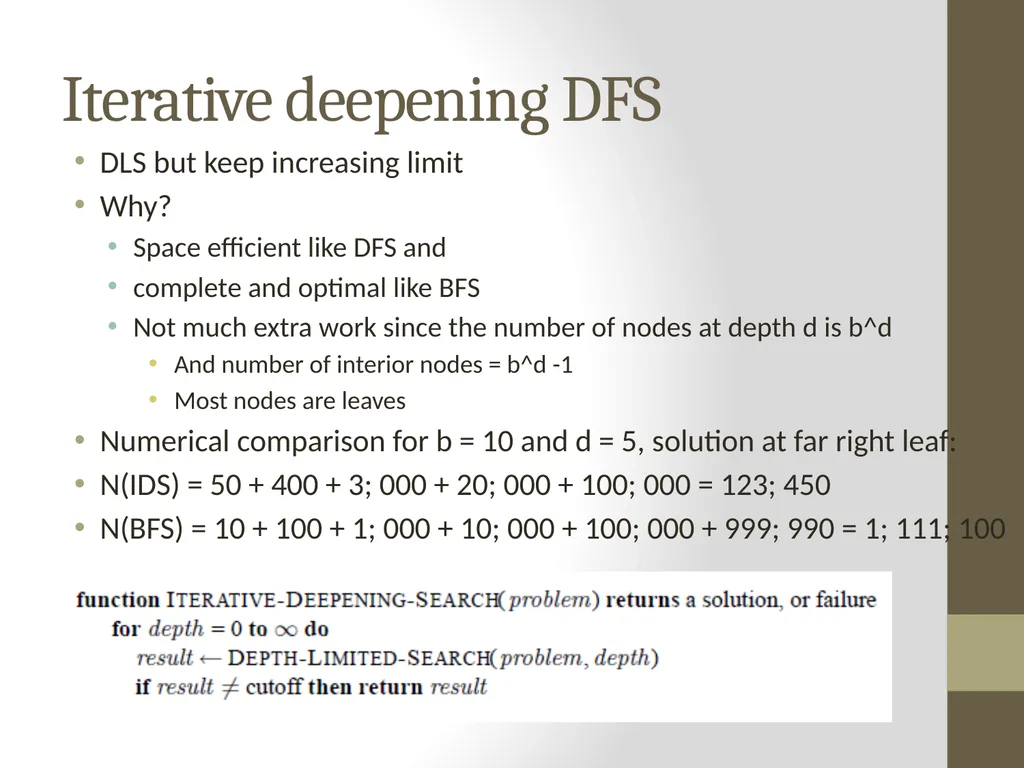
slide45. Iterative deepening DFS DLS but keep increasing limit
Why?
Space efficient like DFS and
complete and optimal like BFS
Not much extra work since the number of nodes at depth d is b^d
And number of interior nodes = b^d -1
Most nodes are leaves
Numerical comparison for b = 10 and d = 5, solution at far right leaf:
N(IDS) = 50 + 400 + 3; 000 + 20; 000 + 100; 000 = 123; 450
N(BFS) = 10 + 100 + 1; 000 + 10; 000 + 100; 000 + 999; 990 = 1; 111; 100<br>
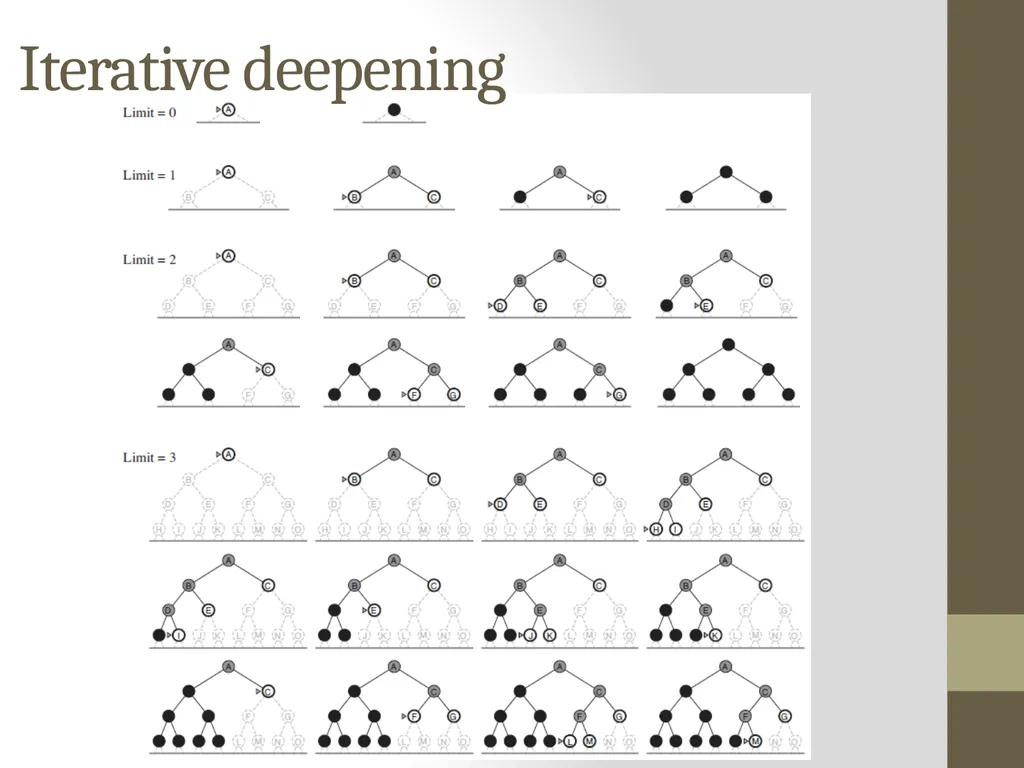
slide46. Iterative deepening<br>
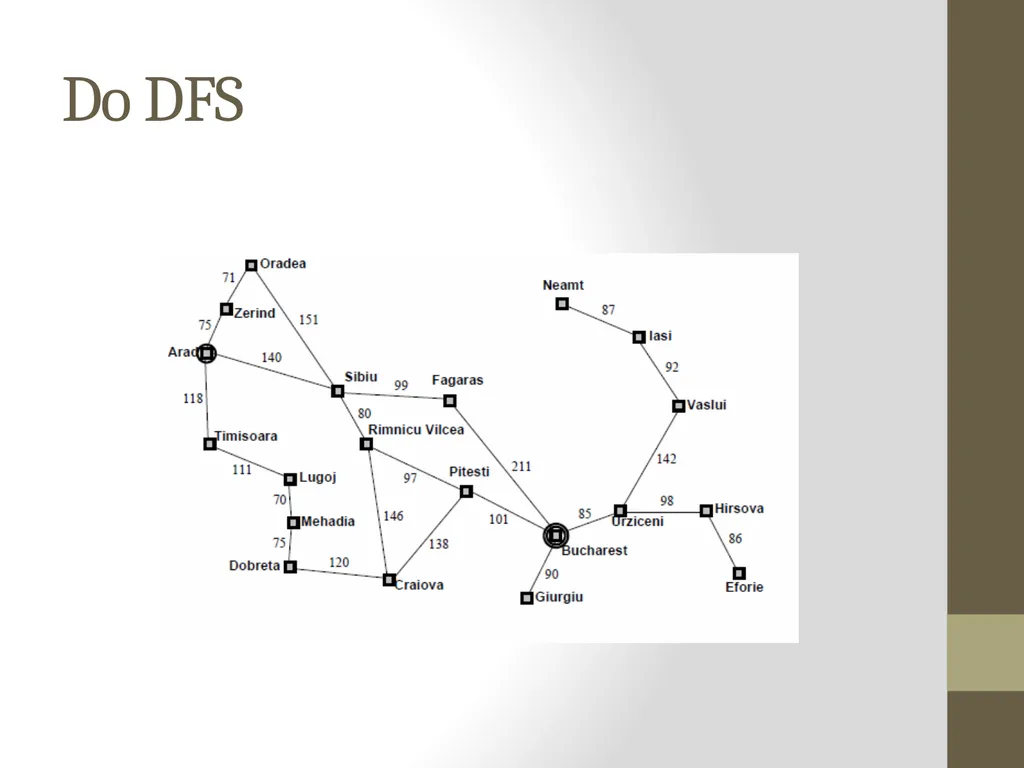
slide47. Do DFS<br>
slide48. Iterative lengthening Expand all nodes with cost less than < C
Increase C if goal not found
Min of all node costs explored in prior step
Check textbook<br>
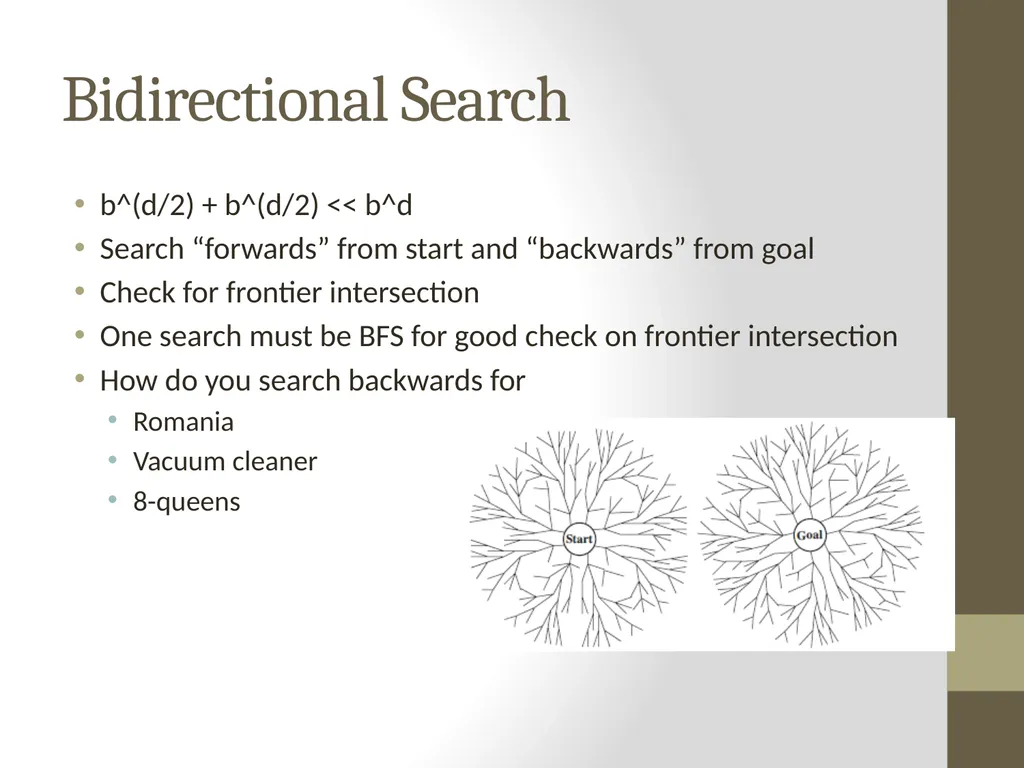
slide49. Bidirectional Search b^(d/2) + b^(d/2) << b^d
Search “forwards” from start and “backwards” from goal
Check for frontier intersection
One search must be BFS for good check on frontier intersection
How do you search backwards for
Romania
Vacuum cleaner
8-queens<br>
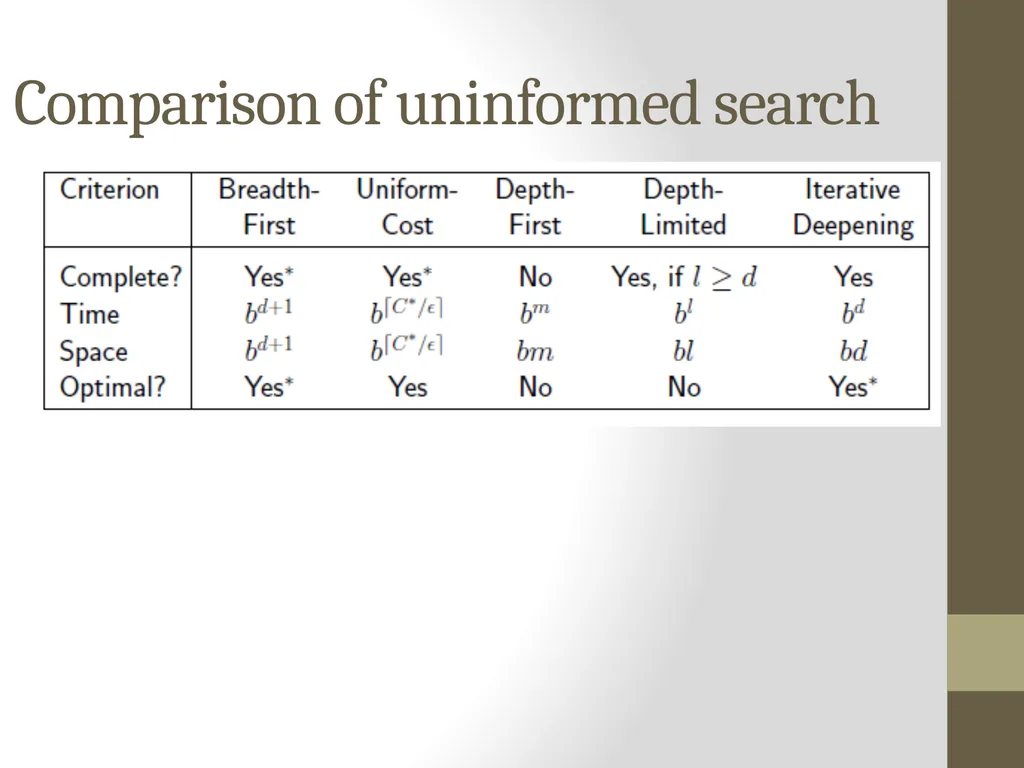
slide50. Comparison of uninformed search<br>
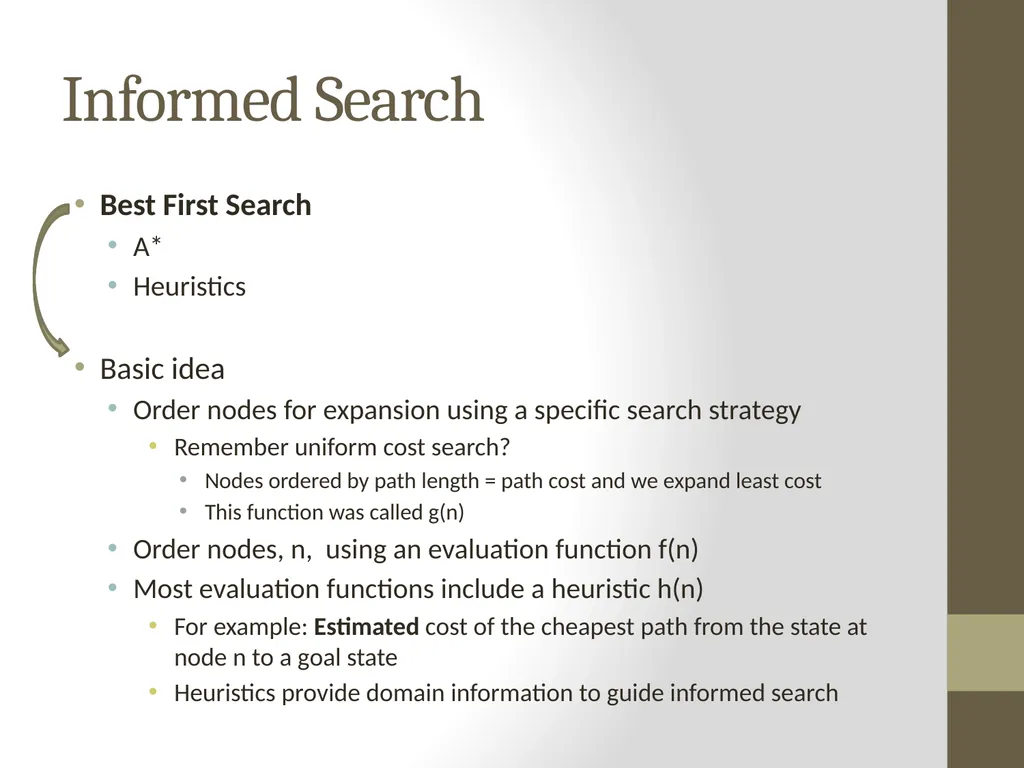
slide51. Informed Search Best First Search
A*
Heuristics
Basic idea
Order nodes for expansion using a specific search strategy
Remember uniform cost search?
Nodes ordered by path length = path cost and we expand least cost
This function was called g(n)
Order nodes, n, using an evaluation function f(n)
Most evaluation functions include a heuristic h(n)
For example: Estimated cost of the cheapest path from the state at node n to a goal state
Heuristics provide domain information to guide informed search<br>
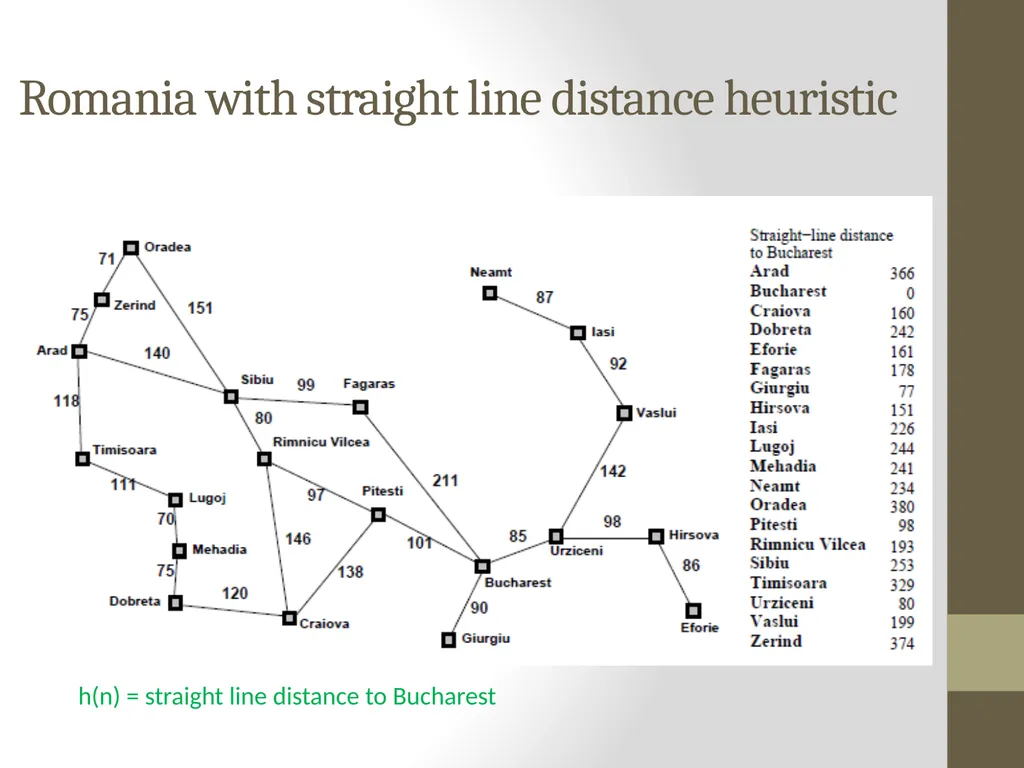
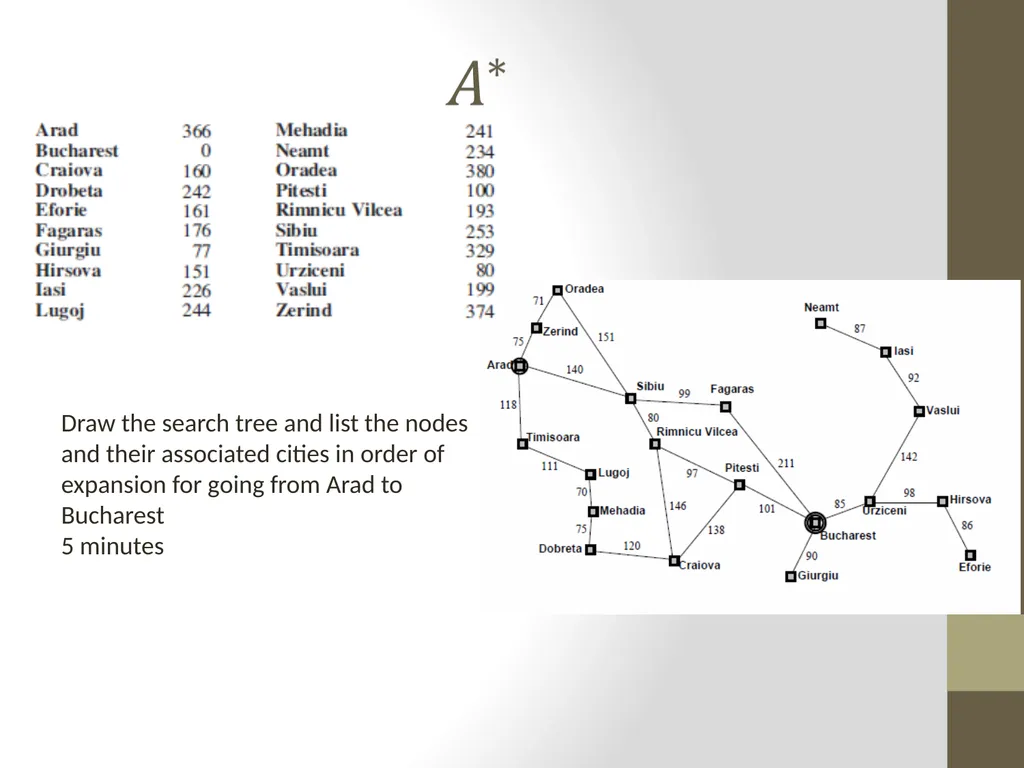
slide52. Romania with straight line distance heuristic h(n) = straight line distance to Bucharest<br>
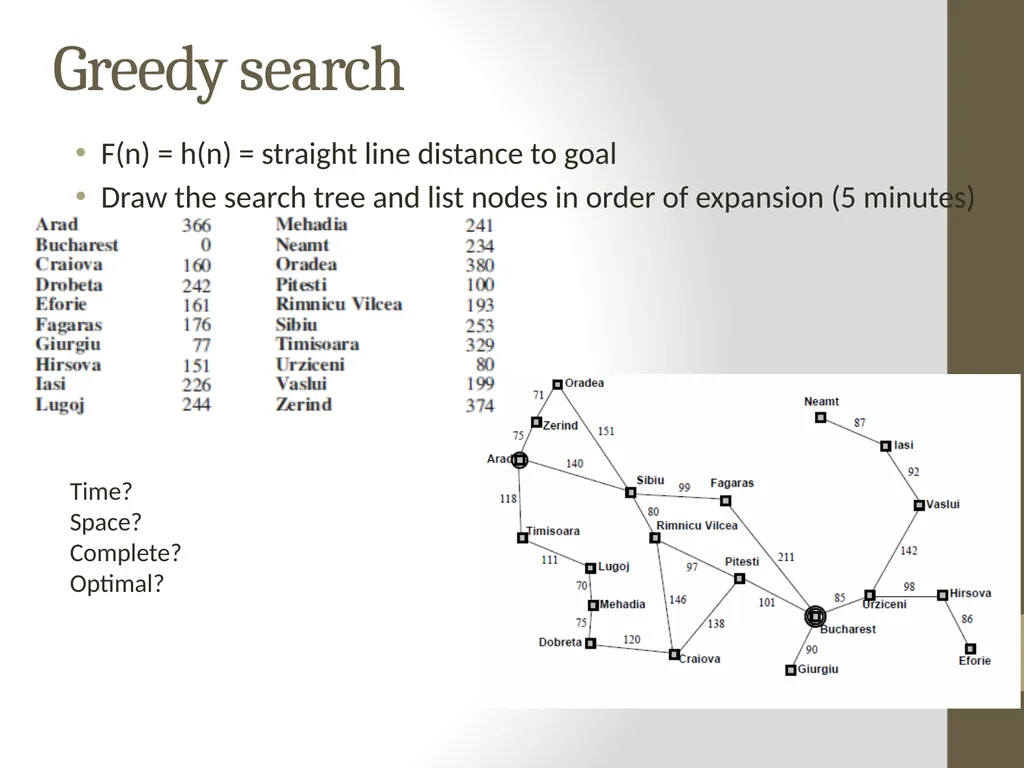
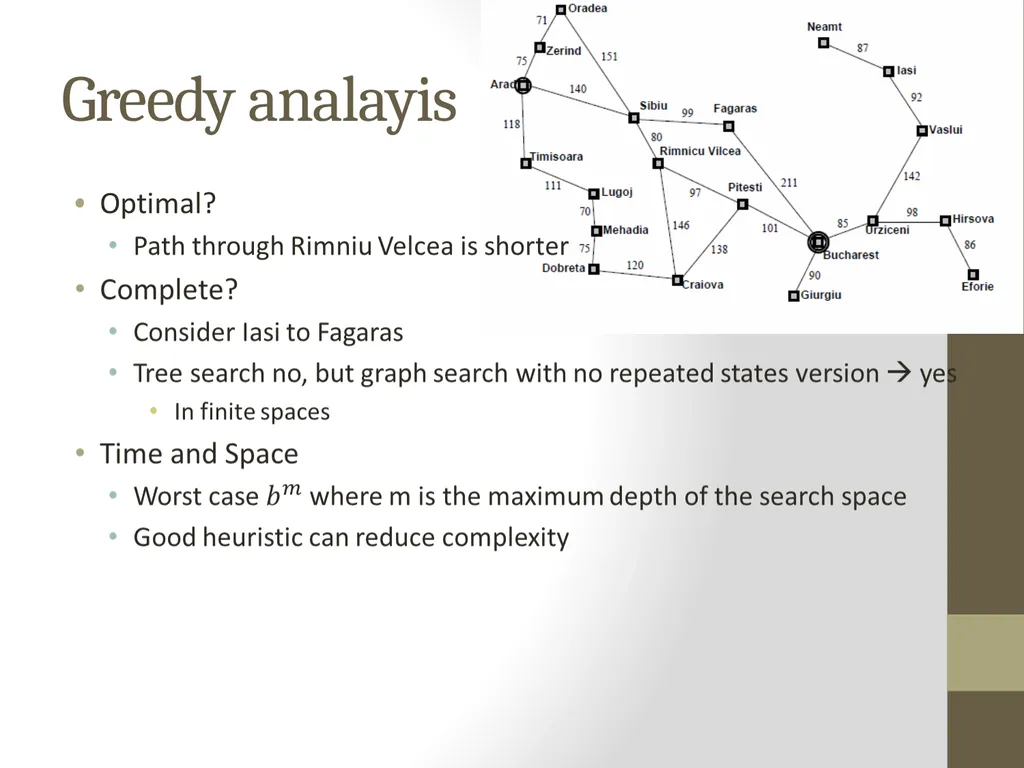
slide53. Greedy search F(n) = h(n) = straight line distance to goal
Draw the search tree and list nodes in order of expansion (5 minutes) Time?
Space?
Complete?
Optimal?<br>
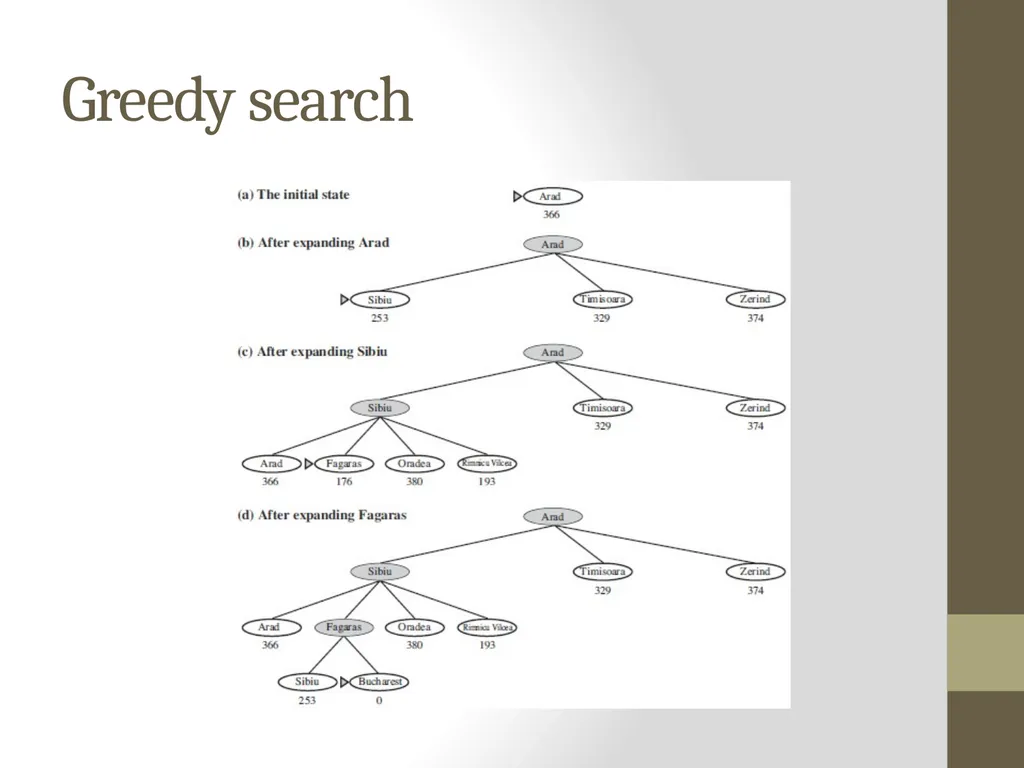
slide54. Greedy search<br>
slide55. Greedy analayis<br>
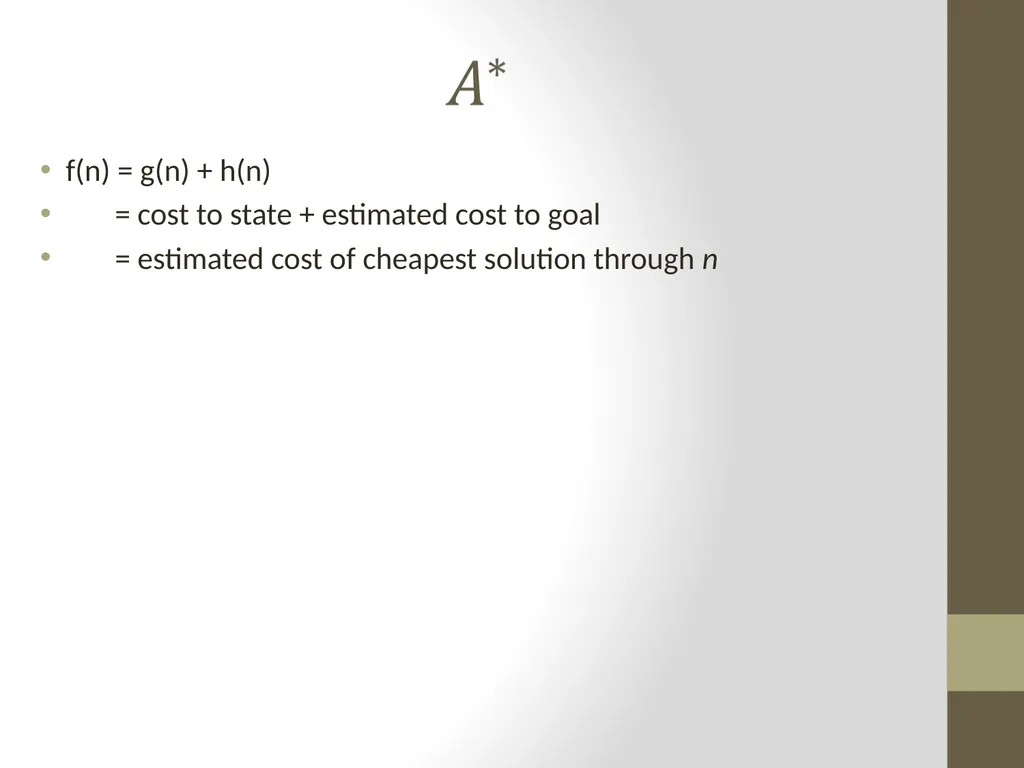
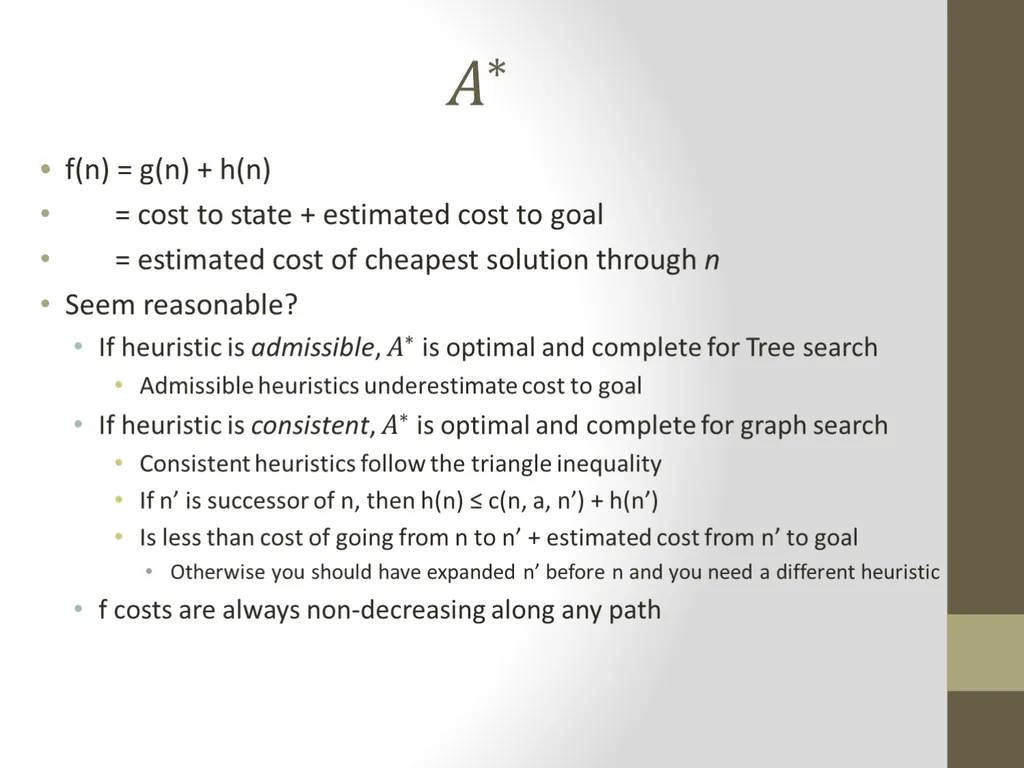
slide56. f(n) = g(n) + h(n)
= cost to state + estimated cost to goal
= estimated cost of cheapest solution through n<br>
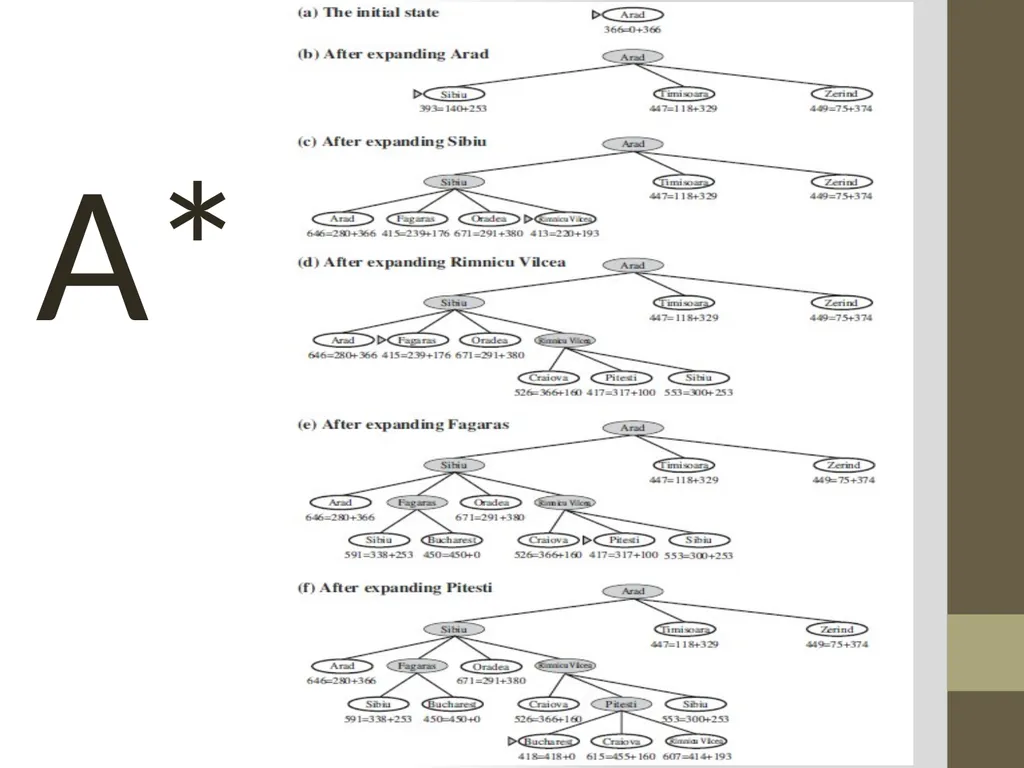
slide57. Draw the search tree and list the nodes and their associated cities in order of expansion for going from Arad to Bucharest
5 minutes<br>
slide58. A*<br>
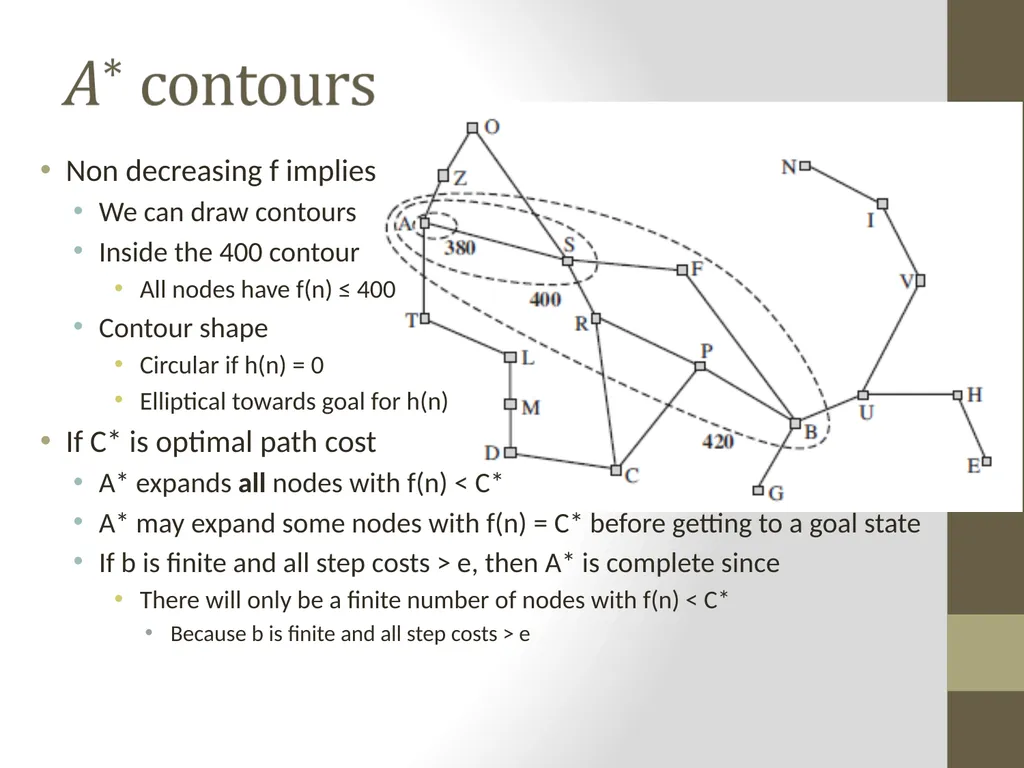
slide60. Non decreasing f implies
We can draw contours
Inside the 400 contour
All nodes have f(n) ≤ 400
Contour shape
Circular if h(n) = 0
Elliptical towards goal for h(n)
If C* is optimal path cost
A* expands all nodes with f(n) < C*
A* may expand some nodes with f(n) = C* before getting to a goal state
If b is finite and all step costs > e, then A* is complete since
There will only be a finite number of nodes with f(n) < C*
Because b is finite and all step costs > e<br>
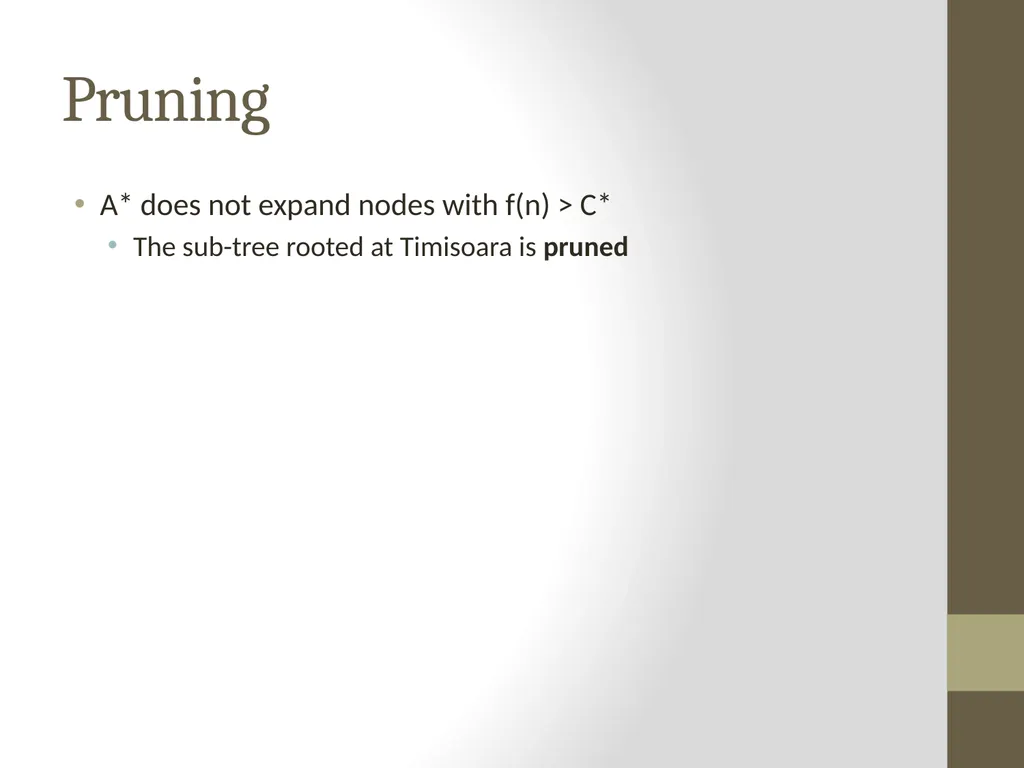
slide61. Pruning A* does not expand nodes with f(n) > C*
The sub-tree rooted at Timisoara is pruned<br>
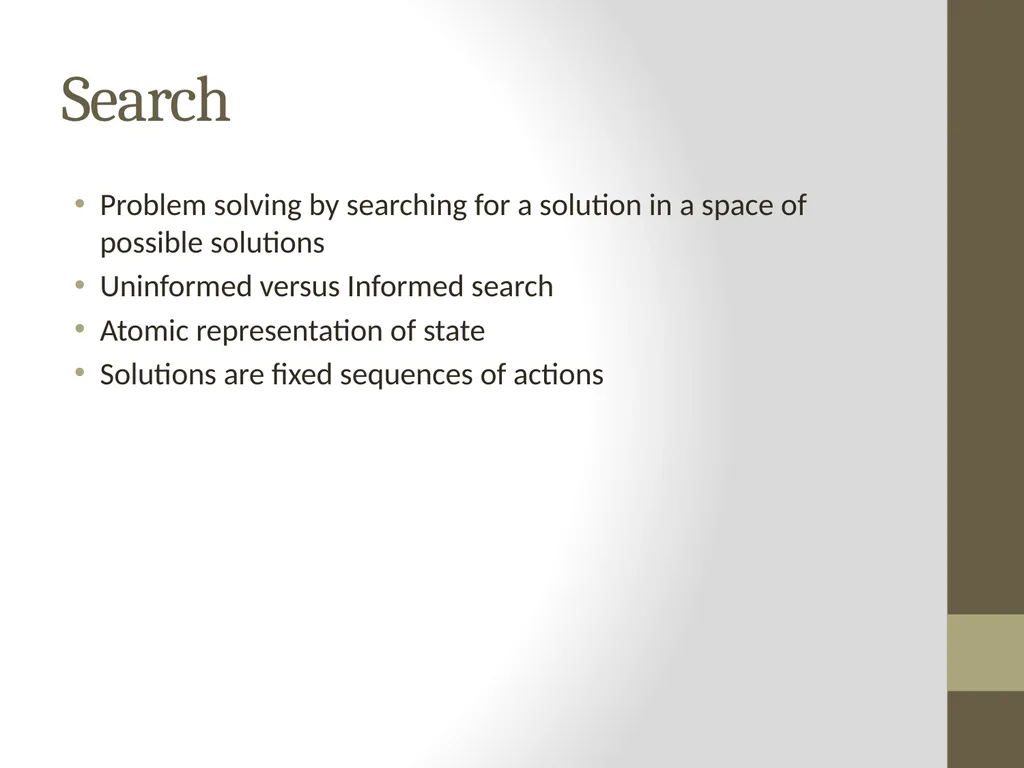
slide62. Search Problem solving by searching for a solution in a space of possible solutions
Uninformed versus Informed search
Atomic representation of state
Solutions are fixed sequences of actions<br>
Prerequisites: 302, 365
Instructor: Sushil Louis, sushil@cse.unr.edu, http://www.cse.unr.edu/~sushil<br>
slide2. Questions Rational agents and performance metrics
Suppose that the performance measure is concerned with just the first T time steps of the environment and ignores everything thereafter. Show that a rational agent’s action may depend not just on the state of the environment but also on the time step it has reached<br>
slide3. Questions (True or False) An agent that senses only partial information about the state cannot be perfectly rational
There exist task environments in which no pure reflex agent can behave rationally
There exists a task environment in which every agent is rational
The input to an agent program is the same as the input to the agent function
Every agent function is implementable by some program/machine combination
Suppose an agent selects its action uniformly at random from the set of possible actions. There exists a deterministic task environment in which this agent is rational<br>
slide4. True or False It is possible for a given agent to be perfectly rational in two distinct task environments
Every agent is rational in an unobservable environment
A perfectly rational poker-playing agent never loses<br>
slide5. Types of task environments<br>
slide6. Types of task environments<br>
slide7. Quotes MURPHY'S LAWS
Nothing is as easy as it looks.
Everything takes longer than you think.
Anything that can go wrong will go wrong.
If there is a possibility of several things going wrong, the one that will cause the most damage will be the one to go wrong. Corollary: If there is a worse time for something to go wrong, it will happen then.
If anything simply cannot go wrong, it will anyway.
If you perceive that there are four possible ways in which a procedure can go wrong, and circumvent these, then a fifth way, unprepared for, will promptly develop.
Every solution breeds new problems.
The Murphy Philosophy
Smile . . . tomorrow will be worse.<br>
slide8. Arthur C. Clarke Any sufficiently advanced technology is indistinguishable from magic.<br>
slide9. Outline Problem solving agents
Problem types
Problem formulation
Example Problems
Basic Search Algorithms<br>
slide10. Problem Solving Agents Restricted form of general agent This is offline problem solving. Search for solution, then execute. During execution we are not using subsequent percepts<br>
slide11. Problem solving agent example Consider a holiday in Romantic Romania
You are an agent, holiday touring in Arad, Romania
What are your performance measures?
Improve suntan, look at the sights, check out Transylvania, enjoy the nightlife, become one of the undead, avoid hangovers, …
The action sequence to do this is long and complicated and you need to read guidebooks, books, talk to people, make tradeoffs
Very complex, let us simplify
You have a non-refundable ticket to get home from Bucharest tomorrow
Now you have a goal: Get to Bucharest in time to catch your flight tomorrow<br>
slide12. Romantic Romania Goal: Get to Bucharest
Formulate Problem:
States: Cities
Actions: Drive to city
What level of abstraction?
Turn wheel or Drive to Bucharest
What is a state?
What is an action?
Goal: Set of states, specifically: {Bucharest}
Solution: Sequence of actions that results in a goal state<br>
slide13. What type of task environment?<br>
slide14. Problem solution A fixed sequence of actions
Agent searches for a sequence of actions that will lead to a goal state
So we :
Formulate the problem,
Search for a solution,
Execute the action sequence
Execution phase does NOT consider percepts in this simple example. In control theory: Open-Loop system<br>
slide15. Back to Romanian problem formulation Initial State, S_0
In(Arad)
Actions
Actions(S) returns set of actions possible in state S
{Go(Sibiu), Go(Timisoara), Go(Zerind)}
Transition Model: What does an action do?
Result (In(Arad), Go(Zerind)) = In(Zerind)
State space is a directed graph
A Path in the state space is a sequence of states connected by a sequence of actions
Goal State(s) In(Bucharest)
Path COST function
Some agents are better than others lower cost
Path costs are non-negative (>= 0) State
Space
of our problem A solution is a sequence of actions leading from the initial state to a goal state<br>
slide16. Abstraction The real world is absurdly complex so state space must be abstracted for problem solving
In(Arad) means somewhere in Arad but where
Result(In (Arad), Go(Zerind)) = In (Zerind). Yay but how do you find the highway out and what side do you drive on and where’s the gas station, and …..
In a more expressive, less abstract representation of the world, In(Arad) must correspond to some real location in Arad (Hotel Phoenix perhaps)
Similarly a solution, a sequence of actions, must correspond to real actions in the less abstract real-world. A Solution Path must correspond to a real path
Our abstraction should make the original problem easier while at the same time enabling a correspondence with a more expressive representation<br>
slide17. Vacuum world. States and transitions<br>
slide18. Vacuum world States
?
Actions
?
Transition model (see figure)
Goal test
?
Path cost
?<br>
slide19. Vacuum world States
Dirt location (0, 1), Robot location (0, 1)
Initial state can be any state
Actions
Left, Right, Suck, NoOp
Transition model
Goal test
No Dirt. All squares are clean
Path cost
1 per action, 0 for NoOp<br>
slide20. 8 puzzle States
Location of every tile and blank
Initial state
Any state
Actions
Movement of blank
Up, down, left, right
Transition model
New state after blank move
Goal Test
Test if configuration matches figure
Path cost
1 per blank move<br>
slide21. 8 Queens States
?
Initial State
?
Actions
?
Transition model
?
Goal Test
?
Path cost
?<br>
slide22. Real world problems Route finding
TSP
VLSI
Robot Navigation
Automatic assembly sequencing<br>
slide23. Solving Romania<br>
slide24. Romanian problem formulation Initial State, S_0
In(Arad)
Actions
Actions(S) returns set of actions possible in state S
{Go(Sibiu), Go(Timisoara), Go(Zerind)}
Transition Model: What does an action do?
Result (In(Arad), Go(Zerind)) = In(Zerind)
State space is a directed graph
A Path in the state space is a sequence of states connected by a sequence of actions
Goal State(s) In(Bucharest)
Path COST function
Some agents are better than others lower cost
Path costs are non-negative (>= 0) State
Space
of our problem A solution is a sequence of actions leading from the initial state to a goal state<br>
slide25. Frontier Frontier Frontier Frontier<br>
slide26. Arad is loopy Why should we ignore loopy (redundant) paths?
1. DynProg
2. PathCost
Should we always ignore redundant paths?<br>
slide27. Graph search avoids redundant paths And, very importantly, getting rid of redundant paths reduces the number of tree nodes from pow(b, d) to approximately 2 d^2 !!!!!
b = branching factor
d = tree depth<br>
slide28. Graph search makes a state tree<br>
slide29. Graph search frontier separates explored and unexplored states<br>
slide30. Implementing graph search Node != problem state (states do not have parent, action, path-cost, …)
Parent
Action
State
Path-cost
function ChildNode(problem, parent, action) returns Node
return a Node with
State = problem.Result(parent.State, action)
Parent = parent
Action = action
Path-cost = parent.Path-cost + problem.Step-cost(parent.State, action)
If node contains goal state, then you have to construct the solution – a path – by following the parent chain to the root<br>
slide31. Implementing graph search Frontier:
Queue
FIFO
LIFO
Priority
Path-Cost?
Explored-Set:
Hash table<br>
slide32. Ready for Search Different search strategies are defined by the order in which we choose nodes from the frontier to expand
Lifo, fifo, …
We compare search strategies along the following dimensions
Completeness: Does it always find a solution if one exists?
Time Complexity: Number of nodes expanded/generated
Space Complexity: Max number of nodes in Memory
Optimality: Does it always find least-cost solution
Time and space complexity are measured in terms of
b maximum branching factor of search tree
d depth of least cost solution
m maximum depth of the tree (may be infinite!)<br>
slide33. Uninformed Search Breadth-first
Uniform-cost
Depth-first
Depth-limited
Iterative deepening<br>
slide34. Breadth-first search – FIFO Q<br>
slide35. BFS Complete: Yes – shallowest goal node
Time == Number of nodes expanded – assume b constant
O(b^d) if you check for goal state upon generation of node or
O(b^(d+1)) if you check when you pick node for expansion
Space == Space for nodes = number of nodes in explored set + number of nodes in frontier
O(b^(d-1)) in explored + O(b^d) in frontier
Uh-oh! Can generate nodes at the rate of 100MB/sec so 24 hours means 8640GB
Look at figure 3.13 in the book
With b = 10, d = 16, and 1M nodes/sec, 350 Years and 10 exabytes of storage needed
Optimality: Optimal if path cost is non-decreasing function of depth<br>
slide36. Do BFS<br>
slide37. Uniform-cost search Expand node with lowest path-cost
Goal test on expansion
Replace frontier node if you find better path to same node.State<br>
slide38. Uniform cost search Draw the Uniform-cost search tree for getting from Sibiu to Bucharest<br>
slide39. Uniform cost search Complete if every step cost is > 0
Optimal
Time/Space – Strictly more than BFS<br>
slide40. Do UCS<br>
slide41. Depth-first search LIFO Q<br>
slide42. DFS Often easy to implement recursively
Completeness:
Graph search version is complete in finite spaces
Tree search version can be infinitely loopy
Not-optimal
Time: If d is depth of shallowest optimal solution, and m is max depth of tree, DFS may generate O(b^m) >> O(b^d)
Space: O(bm) ! Not bad and we can go lower to O(m) with some fancy housekeeping (backtracking search)
Some kind of DFS used a lot in AI because space requirements are low
What kinds?<br>
slide43. Depth-limited search DFS with depth limit, l (el)
If l < d you will never find solution (incomplete)
If l > d non-optimal
DFS = DLS with l = infinity
Romanian problem depth is 20 == number of states
Actually 9. The diameter of the state space (max steps between any pair of states)<br>
slide44. DLS (or DFS) Remove limit to make DFS<br>
slide45. Iterative deepening DFS DLS but keep increasing limit
Why?
Space efficient like DFS and
complete and optimal like BFS
Not much extra work since the number of nodes at depth d is b^d
And number of interior nodes = b^d -1
Most nodes are leaves
Numerical comparison for b = 10 and d = 5, solution at far right leaf:
N(IDS) = 50 + 400 + 3; 000 + 20; 000 + 100; 000 = 123; 450
N(BFS) = 10 + 100 + 1; 000 + 10; 000 + 100; 000 + 999; 990 = 1; 111; 100<br>
slide46. Iterative deepening<br>
slide47. Do DFS<br>
slide48. Iterative lengthening Expand all nodes with cost less than < C
Increase C if goal not found
Min of all node costs explored in prior step
Check textbook<br>
slide49. Bidirectional Search b^(d/2) + b^(d/2) << b^d
Search “forwards” from start and “backwards” from goal
Check for frontier intersection
One search must be BFS for good check on frontier intersection
How do you search backwards for
Romania
Vacuum cleaner
8-queens<br>
slide50. Comparison of uninformed search<br>
slide51. Informed Search Best First Search
A*
Heuristics
Basic idea
Order nodes for expansion using a specific search strategy
Remember uniform cost search?
Nodes ordered by path length = path cost and we expand least cost
This function was called g(n)
Order nodes, n, using an evaluation function f(n)
Most evaluation functions include a heuristic h(n)
For example: Estimated cost of the cheapest path from the state at node n to a goal state
Heuristics provide domain information to guide informed search<br>
slide52. Romania with straight line distance heuristic h(n) = straight line distance to Bucharest<br>
slide53. Greedy search F(n) = h(n) = straight line distance to goal
Draw the search tree and list nodes in order of expansion (5 minutes) Time?
Space?
Complete?
Optimal?<br>
slide54. Greedy search<br>
slide55. Greedy analayis<br>
slide56. f(n) = g(n) + h(n)
= cost to state + estimated cost to goal
= estimated cost of cheapest solution through n<br>
slide57. Draw the search tree and list the nodes and their associated cities in order of expansion for going from Arad to Bucharest
5 minutes<br>
slide58. A*<br>
slide60. Non decreasing f implies
We can draw contours
Inside the 400 contour
All nodes have f(n) ≤ 400
Contour shape
Circular if h(n) = 0
Elliptical towards goal for h(n)
If C* is optimal path cost
A* expands all nodes with f(n) < C*
A* may expand some nodes with f(n) = C* before getting to a goal state
If b is finite and all step costs > e, then A* is complete since
There will only be a finite number of nodes with f(n) < C*
Because b is finite and all step costs > e<br>
slide61. Pruning A* does not expand nodes with f(n) > C*
The sub-tree rooted at Timisoara is pruned<br>
slide62. Search Problem solving by searching for a solution in a space of possible solutions
Uninformed versus Informed search
Atomic representation of state
Solutions are fixed sequences of actions<br>