
Artificial Intelligence CS482, CS682, MW 1 – 2:15,


Description: Artificial Intelligence CS482, CS682, MW 1 2:15, SEM 201, MS 227 Prerequisites: 302, 365 Instructor: Sushil Louis, sushilcse.unr.edu, http:www.cse.unr.edusushil Search Leftovers Non-determinism in search Solutions can be contingency
Related Topics
Download Presentation
"Artificial Intelligence CS482, CS682, MW 1 – 2:15," is the property of its rightful owner. Permission is granted to download and print the materials on this website for personal, non-commercial use only, and to display it on your personal computer provided you do not modify the materials and that you retain all copyright notices contained in the materials. By downloading content from our website, you accept the terms of this agreement.
Presentation Transcript
slide1. Artificial Intelligence CS482, CS682, MW 1 – 2:15, SEM 201, MS 227
Prerequisites: 302, 365
Instructor: Sushil Louis, sushil@cse.unr.edu, http://www.cse.unr.edu/~sushil<br>
slide2. Search Leftovers Non-determinism in search
Solutions can be contingency plans (trees)
How do we handle non-determinism?
First: What types of determinism?
Second: For each type, how do we handle it?
Partial Observability
What types of observability do we have?
How do we handle each?
Don’t forget Kriegspeil and partial observability in games
Online-vs-Offline search and execution
Learning search algorithms<br>
slide3. Non-determinism in Actions Erratic vacuum-cleaners
Bad suck actions example
And-Or trees
AND
You can end up in multiple states as the result of an action
You have to find a path from all of these states (AND)
OR
Try each action
Any one action can lead to the goal state(s) (OR)<br>
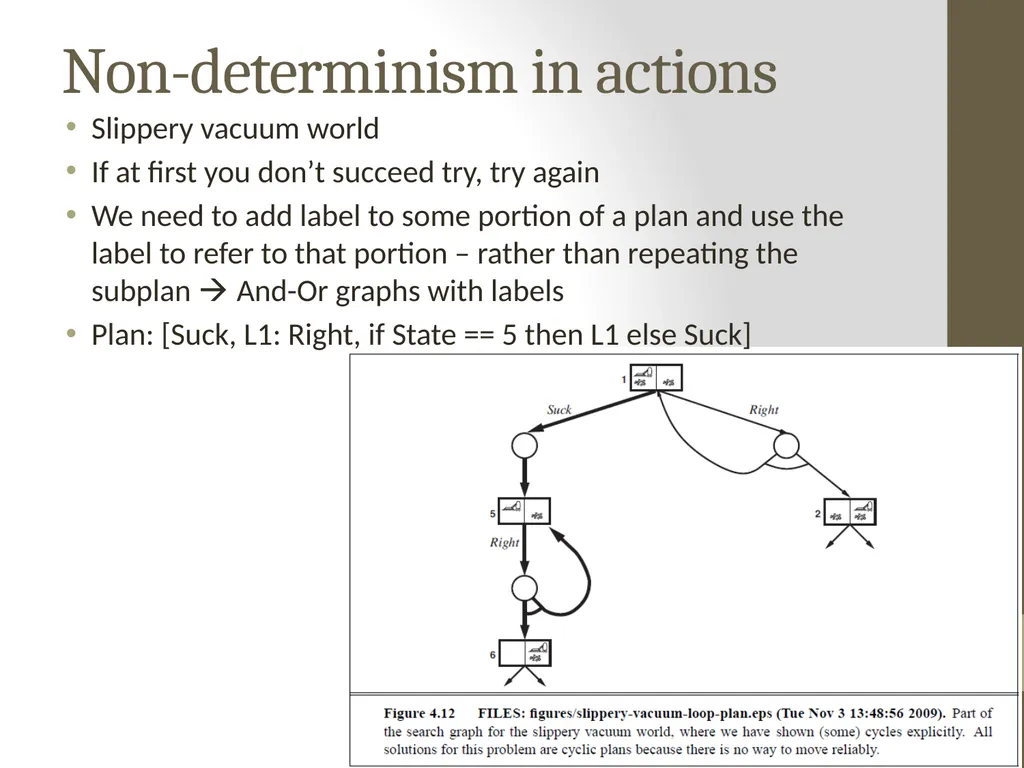
slide4. Non-determinism in actions Slippery vacuum world
If at first you don’t succeed try, try again
We need to add label to some portion of a plan and use the label to refer to that portion – rather than repeating the subplan And-Or graphs with labels
Plan: [Suck, L1: Right, if State == 5 then L1 else Suck]<br>
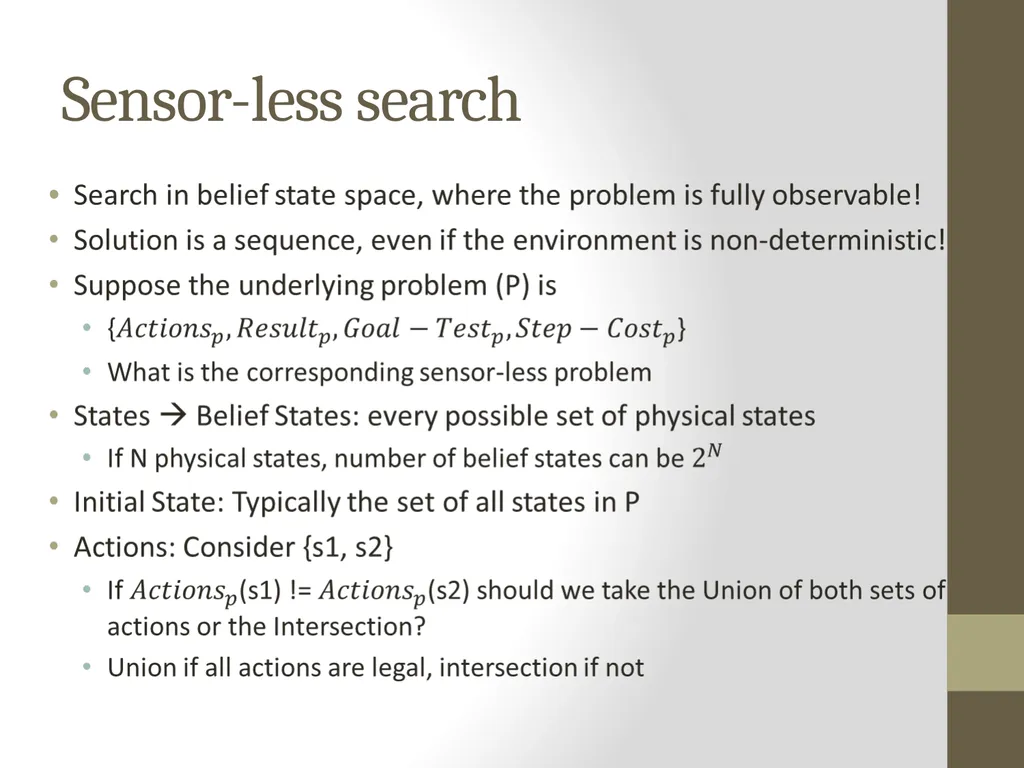
slide5. Searching with Partial observation Agents percepts cannot pin down the exact state the agent is in
Let Agents have Belief states
Search for a sequence of belief states that leads to a goal
Search for a plan that leads to a goal
First: NO percepts sensor-less
States? (Belief states)
Initial State?
Actions?
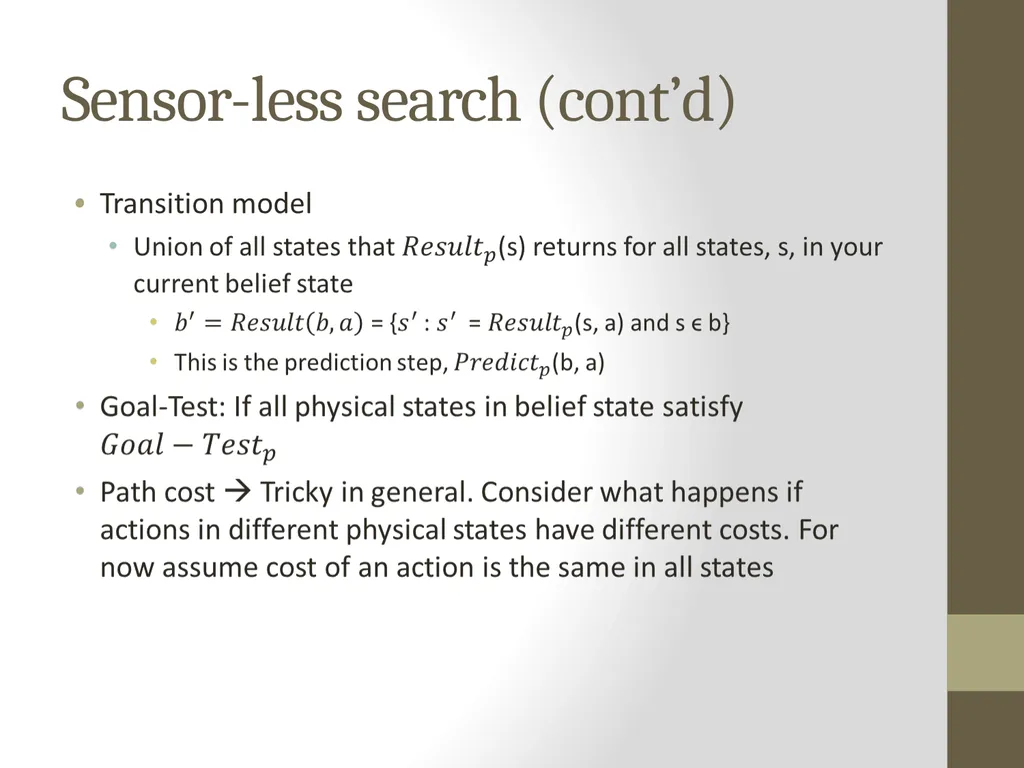
Transition Model?
Goal test?
Path cost? Consider sensor-less vacuum world<br>
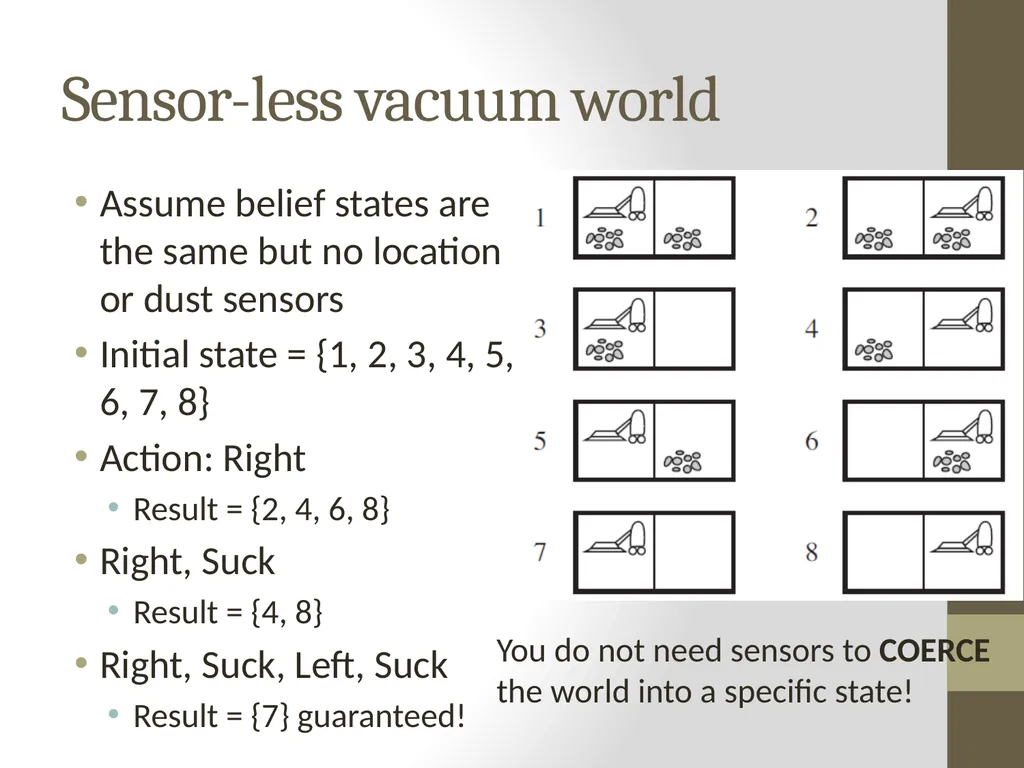
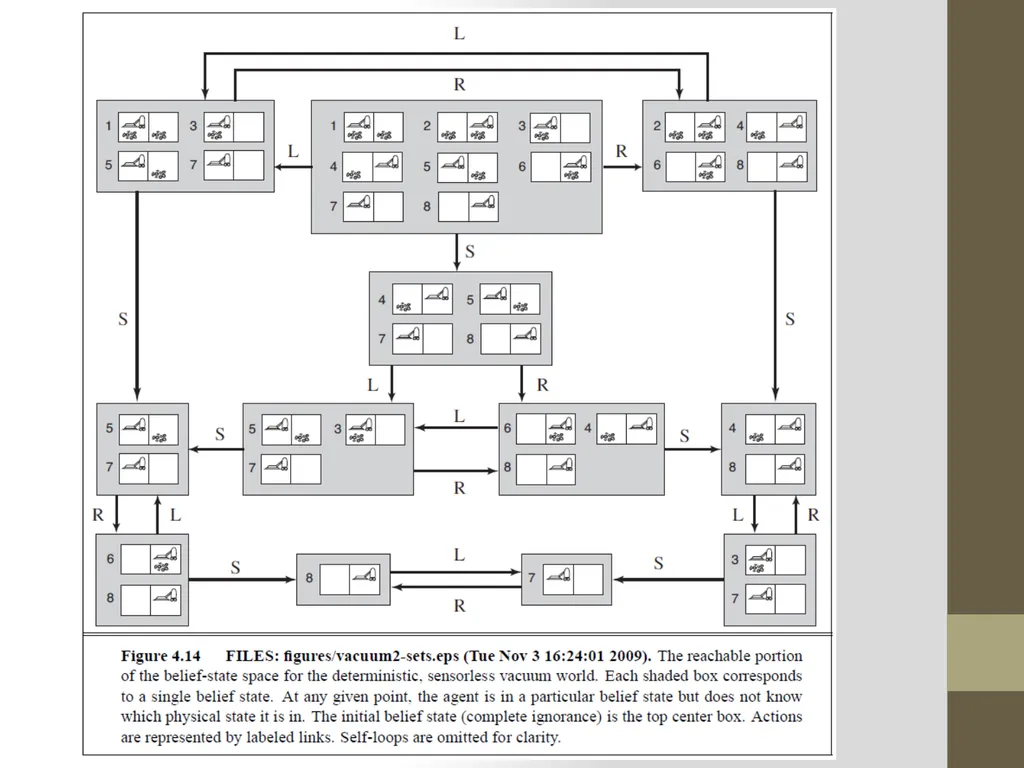
slide6. Sensor-less vacuum world Assume belief states are the same but no location or dust sensors
Initial state = {1, 2, 3, 4, 5, 6, 7, 8}
Action: Right
Result = {2, 4, 6, 8}
Right, Suck
Result = {4, 8}
Right, Suck, Left, Suck
Result = {7} guaranteed! You do not need sensors to COERCE the world into a specific state!<br>
slide7. Sensor-less search<br>
slide8. Sensor-less search (cont’d)<br>
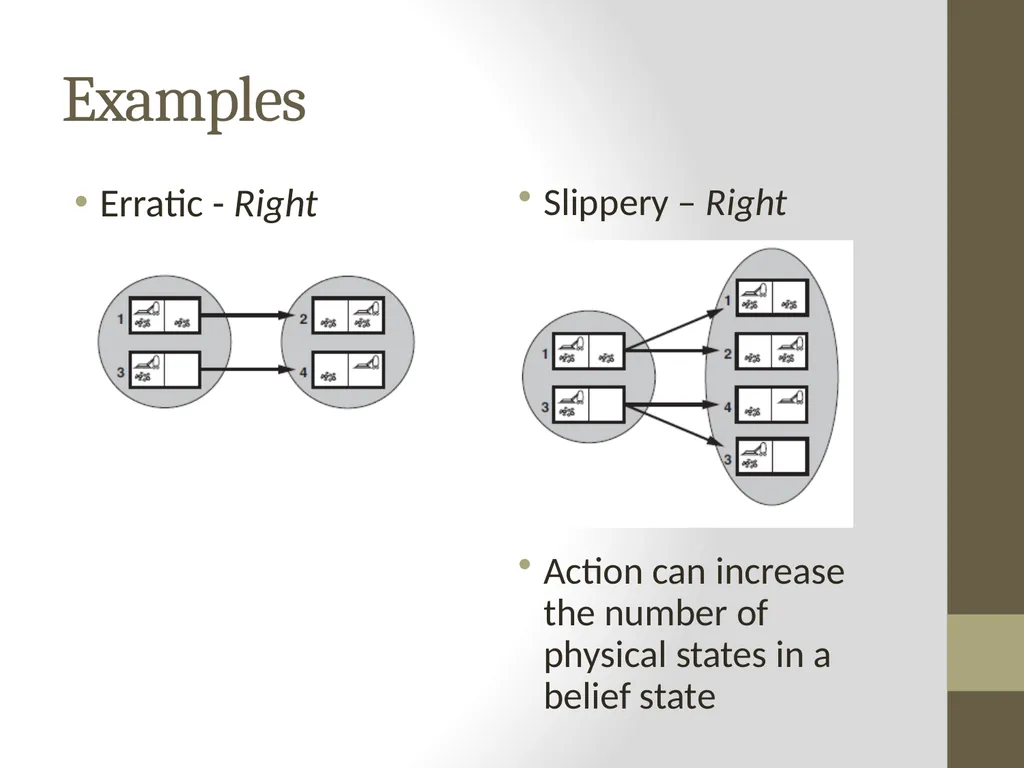
slide9. Examples Erratic - Right Slippery – Right
Action can increase the number of physical states in a belief state<br>
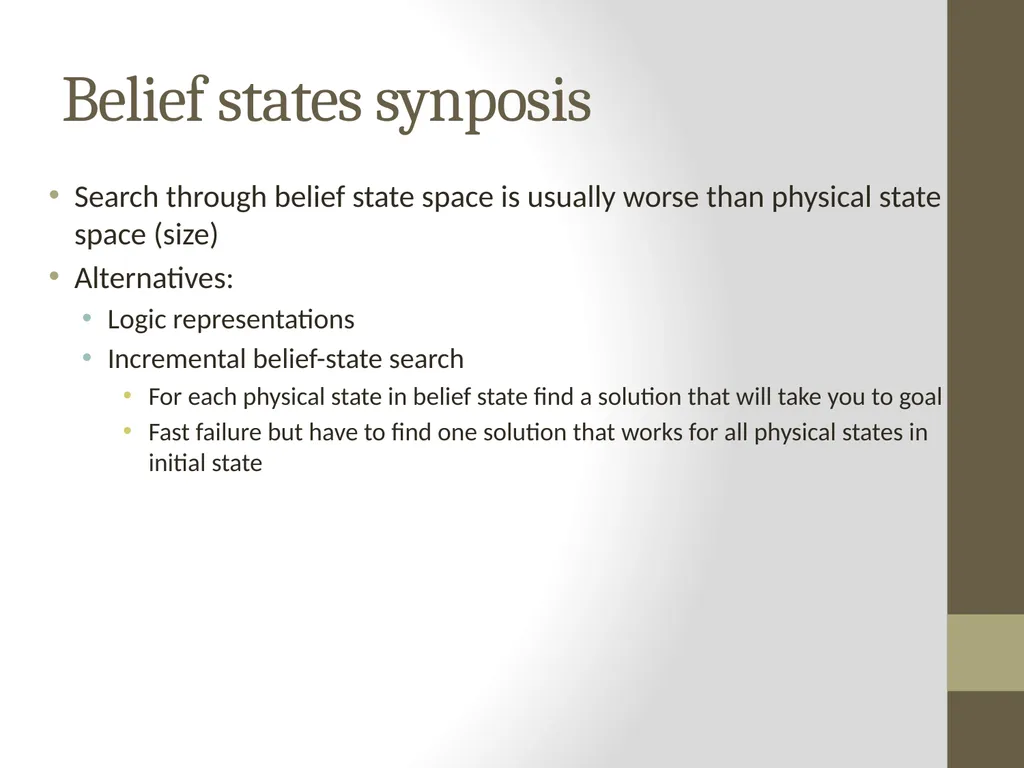
slide11. Belief states synposis Search through belief state space is usually worse than physical state space (size)
Alternatives:
Logic representations
Incremental belief-state search
For each physical state in belief state find a solution that will take you to goal
Fast failure but have to find one solution that works for all physical states in initial state<br>
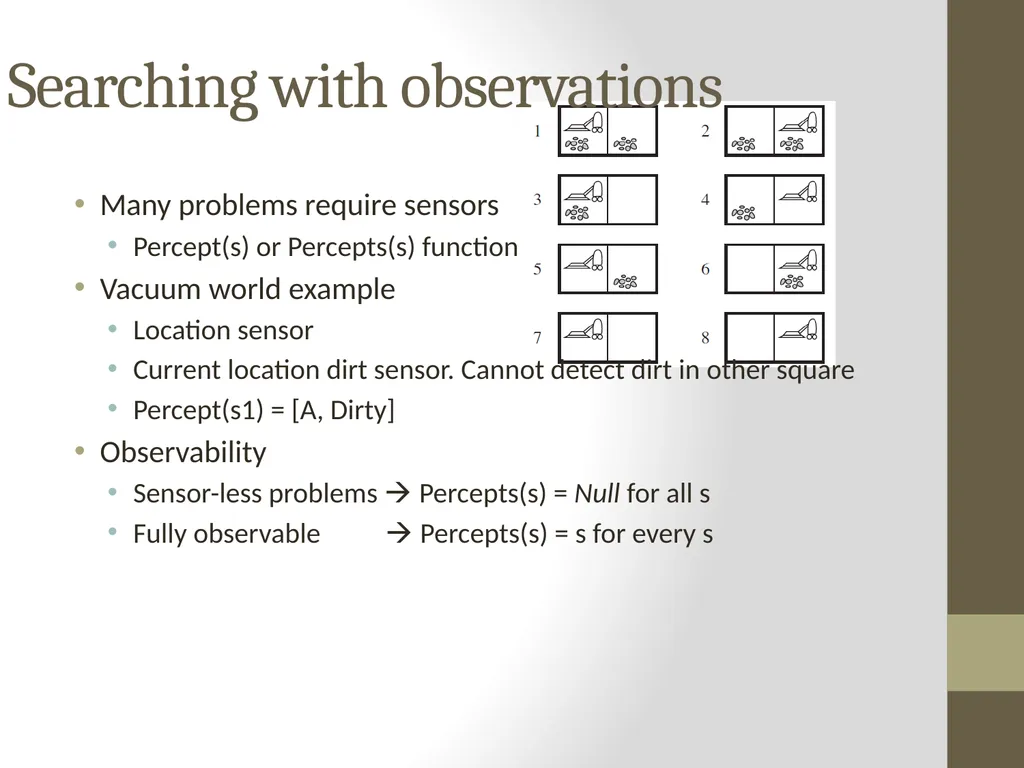
slide12. Searching with observations Many problems require sensors
Percept(s) or Percepts(s) function
Vacuum world example
Location sensor
Current location dirt sensor. Cannot detect dirt in other square
Percept(s1) = [A, Dirty]
Observability
Sensor-less problems Percepts(s) = Null for all s
Fully observable Percepts(s) = s for every s<br>
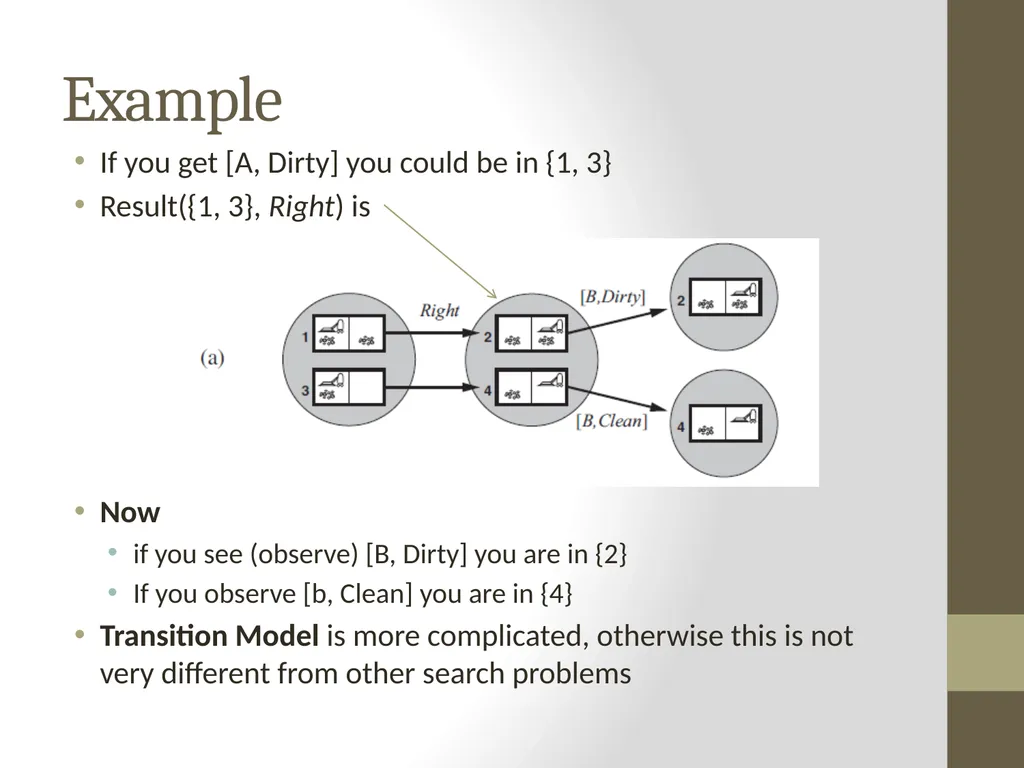
slide13. Example If you get [A, Dirty] you could be in {1, 3}
Result({1, 3}, Right) is
Now
if you see (observe) [B, Dirty] you are in {2}
If you observe [b, Clean] you are in {4}
Transition Model is more complicated, otherwise this is not very different from other search problems<br>
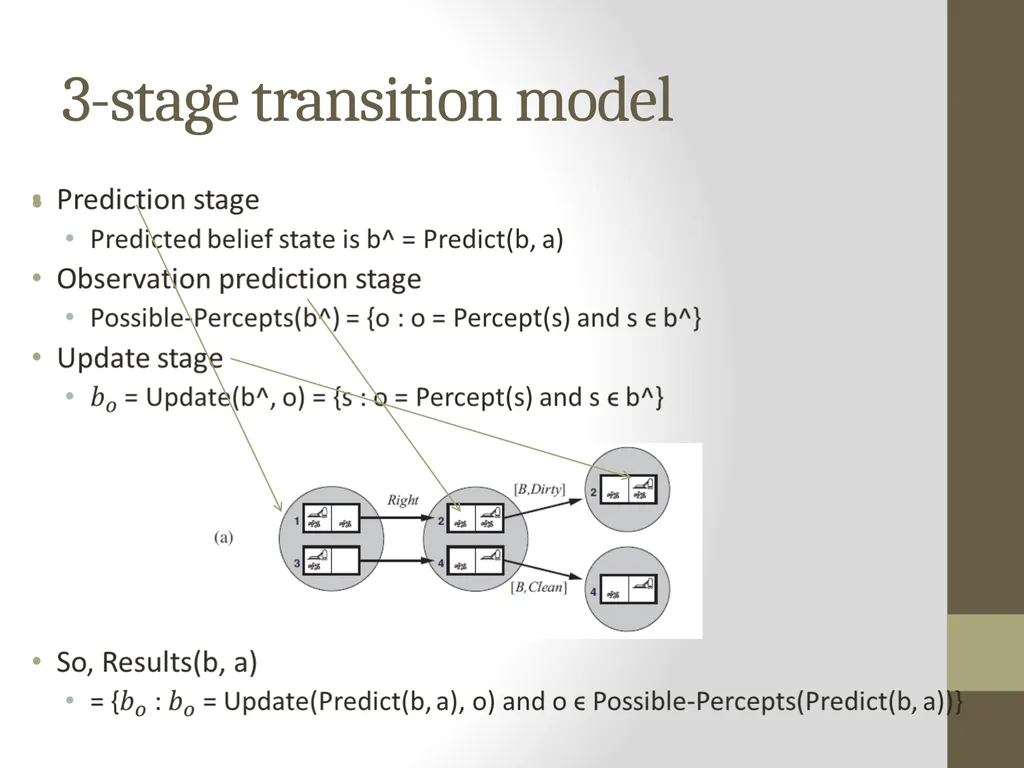
slide14. 3-stage transition model<br>
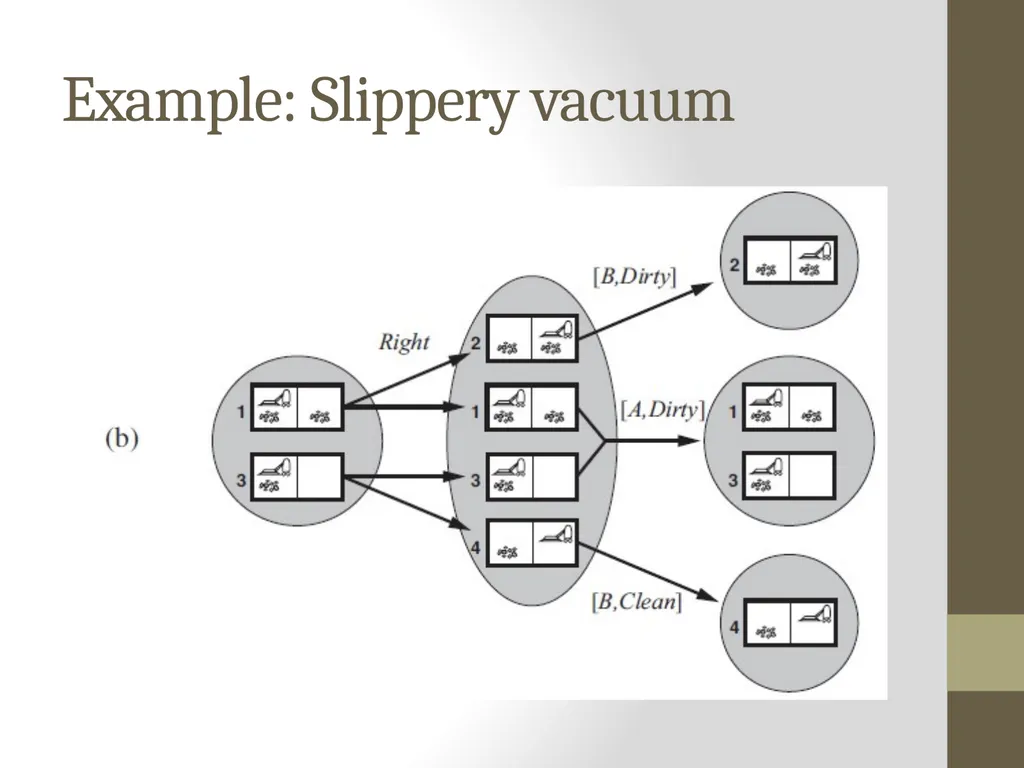
slide15. Example: Slippery vacuum<br>
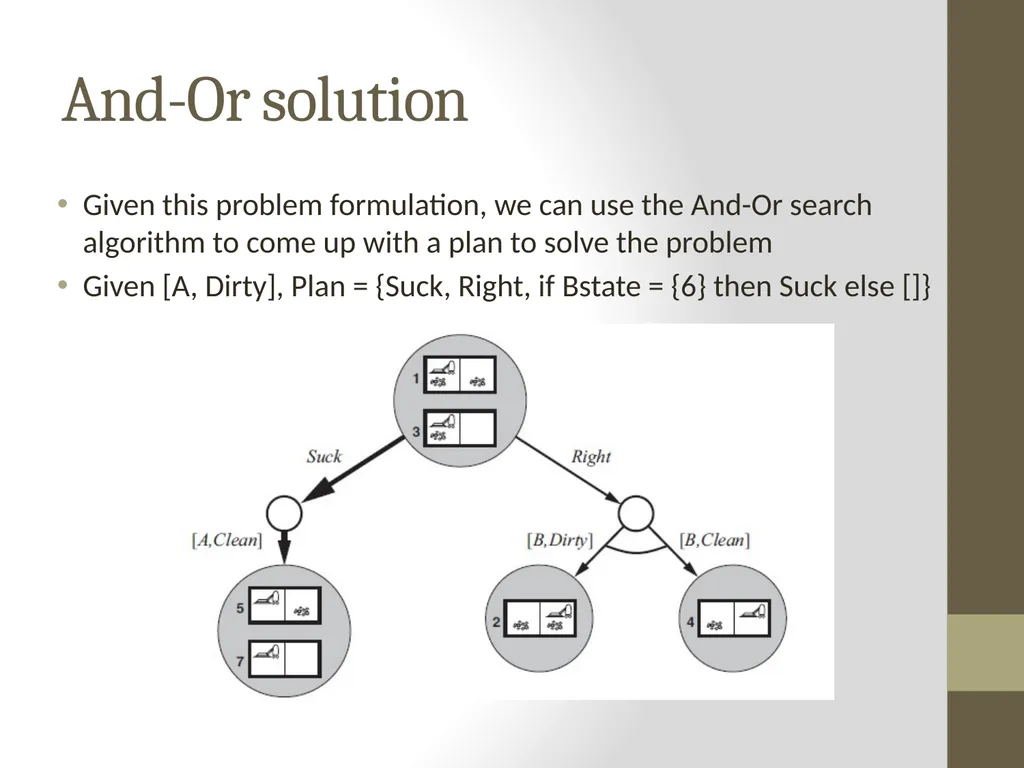
slide16. And-Or solution Given this problem formulation, we can use the And-Or search algorithm to come up with a plan to solve the problem
Given [A, Dirty], Plan = {Suck, Right, if Bstate = {6} then Suck else []}<br>
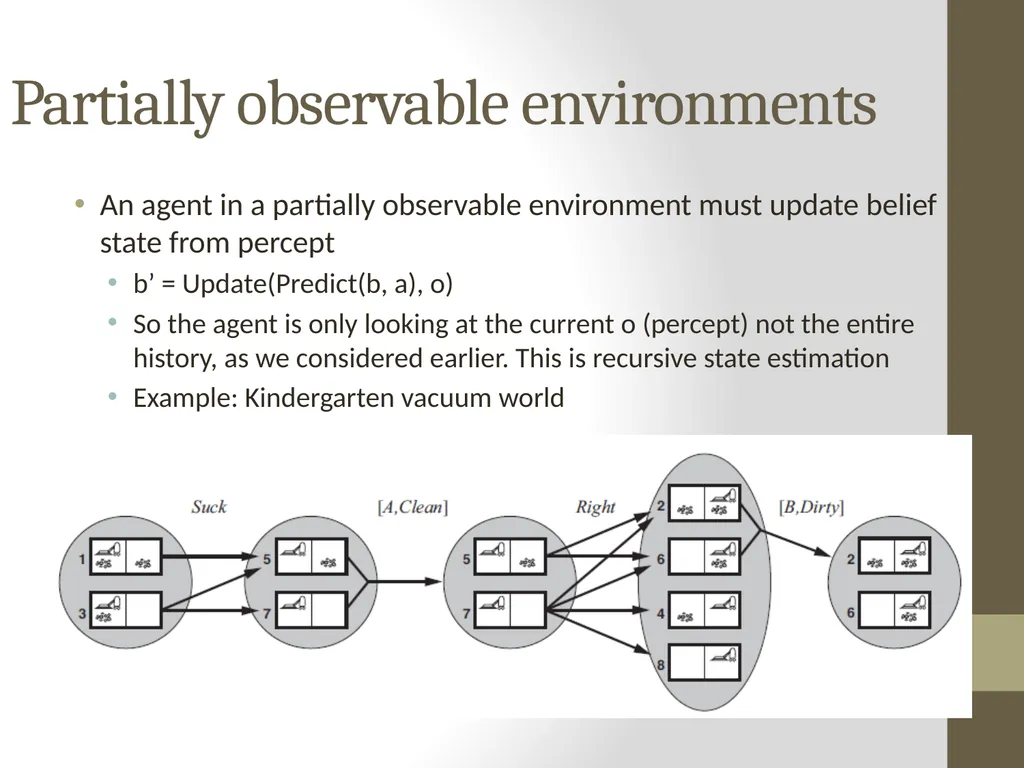
slide17. Partially observable environments An agent in a partially observable environment must update belief state from percept
b’ = Update(Predict(b, a), o)
So the agent is only looking at the current o (percept) not the entire history, as we considered earlier. This is recursive state estimation
Example: Kindergarten vacuum world<br>
slide18. Localization in robotics Maintaining belief states is a core function of any Intelligent Agent
Monitoring, filtering, state estimation
Robot:
Four sonar sensors (NSWE) give correct data
Robot has correct map of environment
Move is broken Robot moves to random adjacent square
Robot must determine current location
Suppose it gets [NSW] obstacles N, S, and W<br>
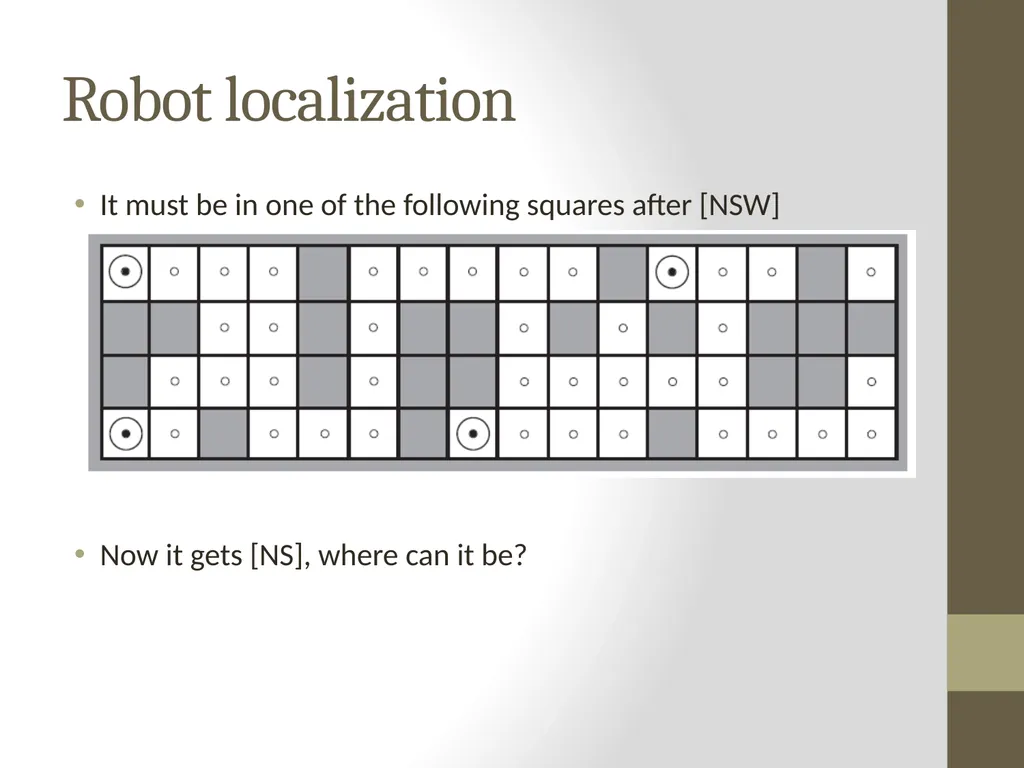
slide19. Robot localization It must be in one of the following squares after [NSW]
Now it gets [NS], where can it be?<br>
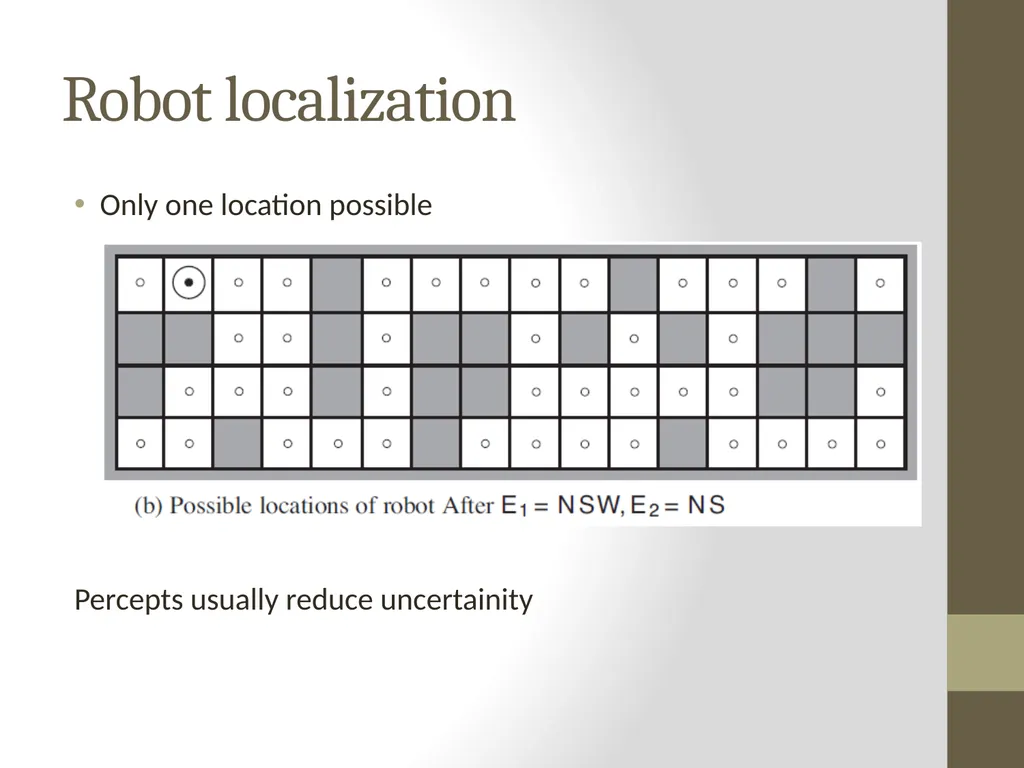
slide20. Robot localization Only one location possible
Percepts usually reduce uncertainity<br>
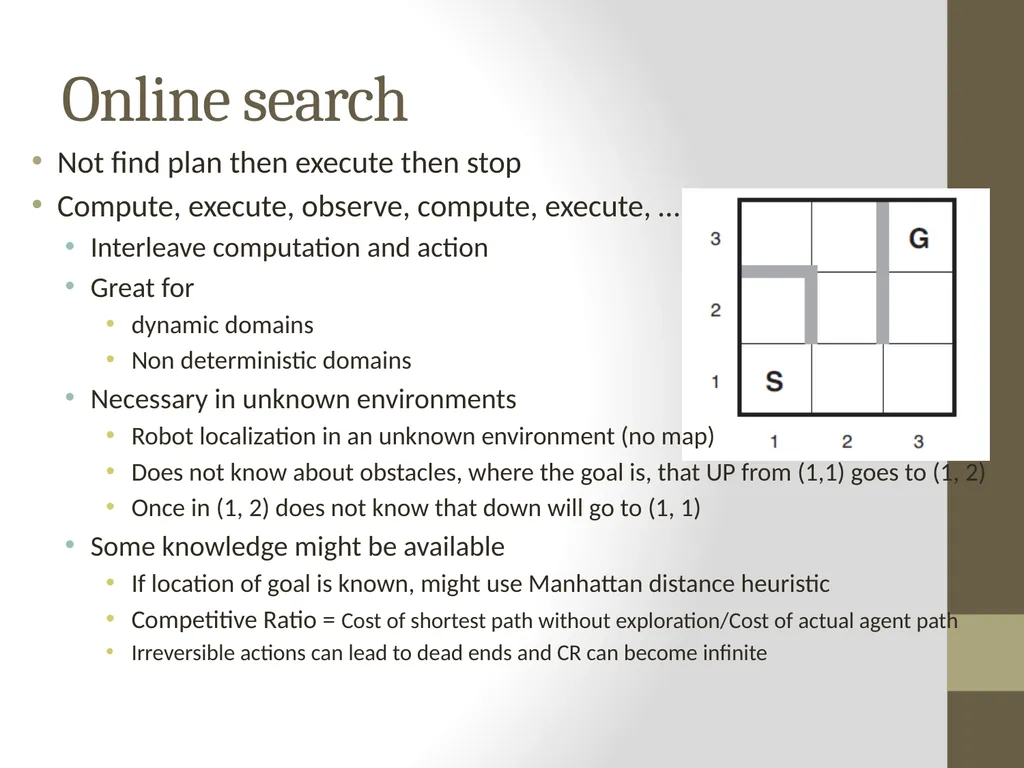
slide21. Online search Not find plan then execute then stop
Compute, execute, observe, compute, execute, …
Interleave computation and action
Great for
dynamic domains
Non deterministic domains
Necessary in unknown environments
Robot localization in an unknown environment (no map)
Does not know about obstacles, where the goal is, that UP from (1,1) goes to (1, 2)
Once in (1, 2) does not know that down will go to (1, 1)
Some knowledge might be available
If location of goal is known, might use Manhattan distance heuristic
Competitive Ratio = Cost of shortest path without exploration/Cost of actual agent path
Irreversible actions can lead to dead ends and CR can become infinite<br>
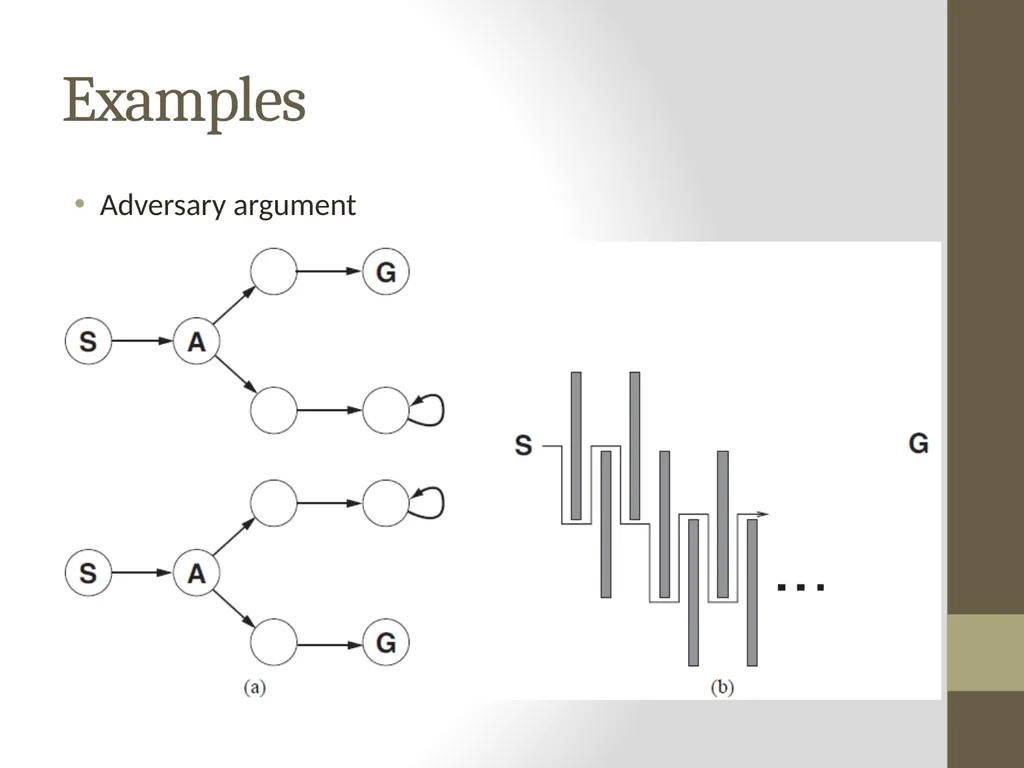
slide22. Examples Adversary argument<br>
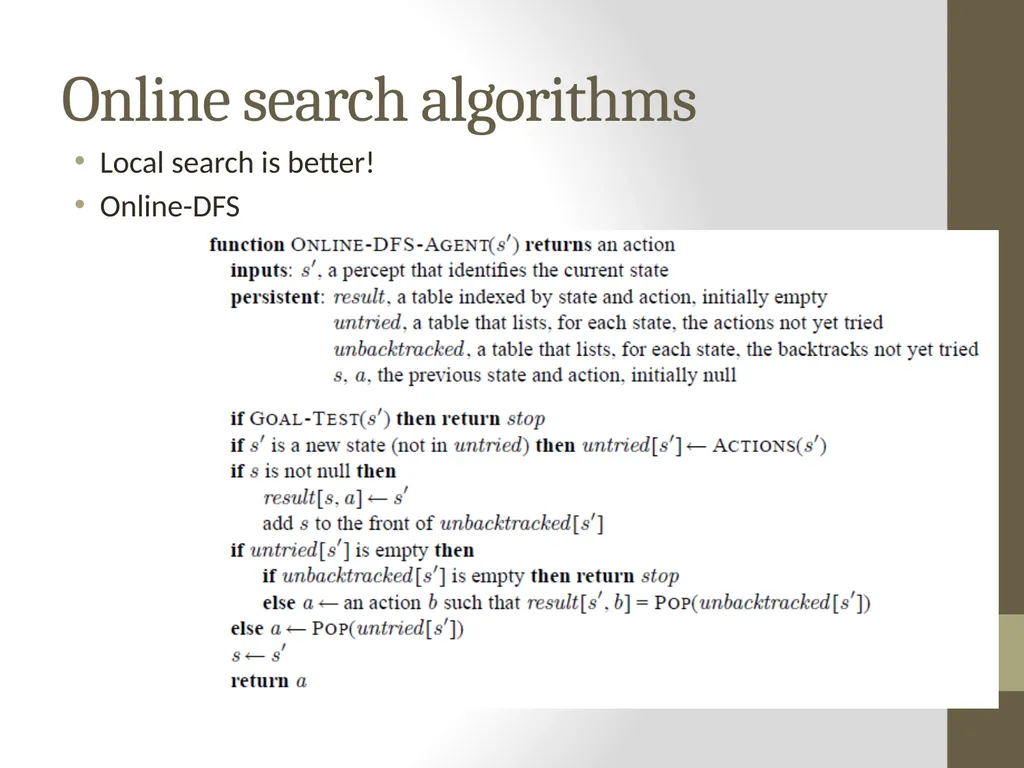
slide23. Online search algorithms Local search is better!
Online-DFS<br>
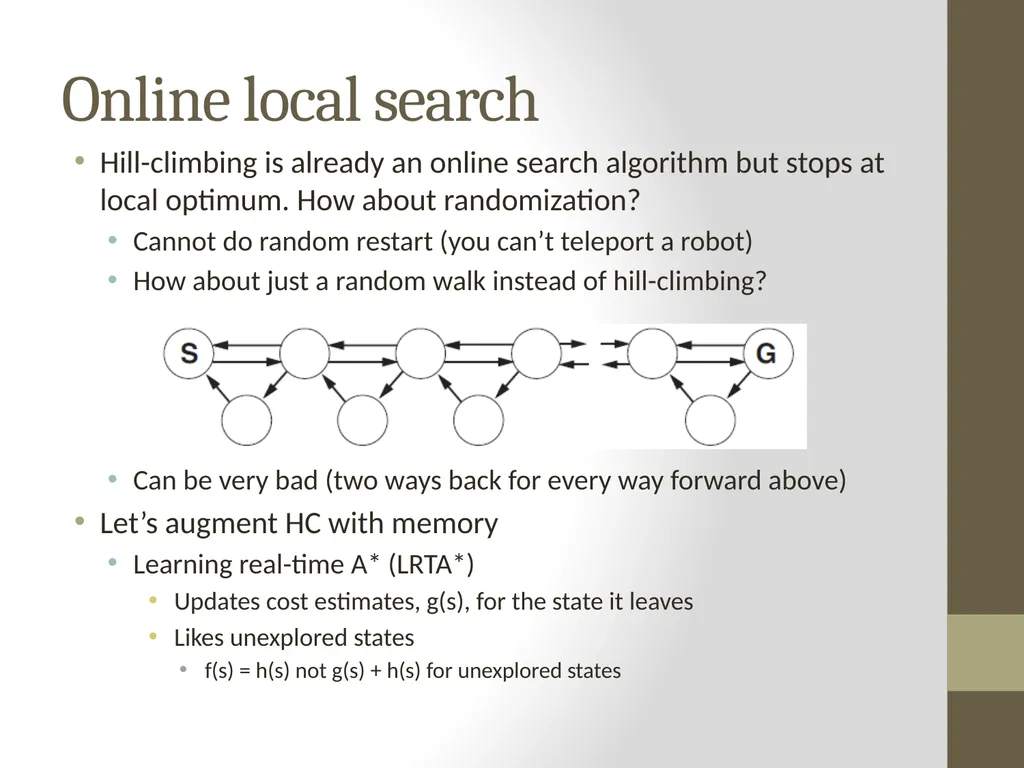
slide24. Online local search Hill-climbing is already an online search algorithm but stops at local optimum. How about randomization?
Cannot do random restart (you can’t teleport a robot)
How about just a random walk instead of hill-climbing?
Can be very bad (two ways back for every way forward above)
Let’s augment HC with memory
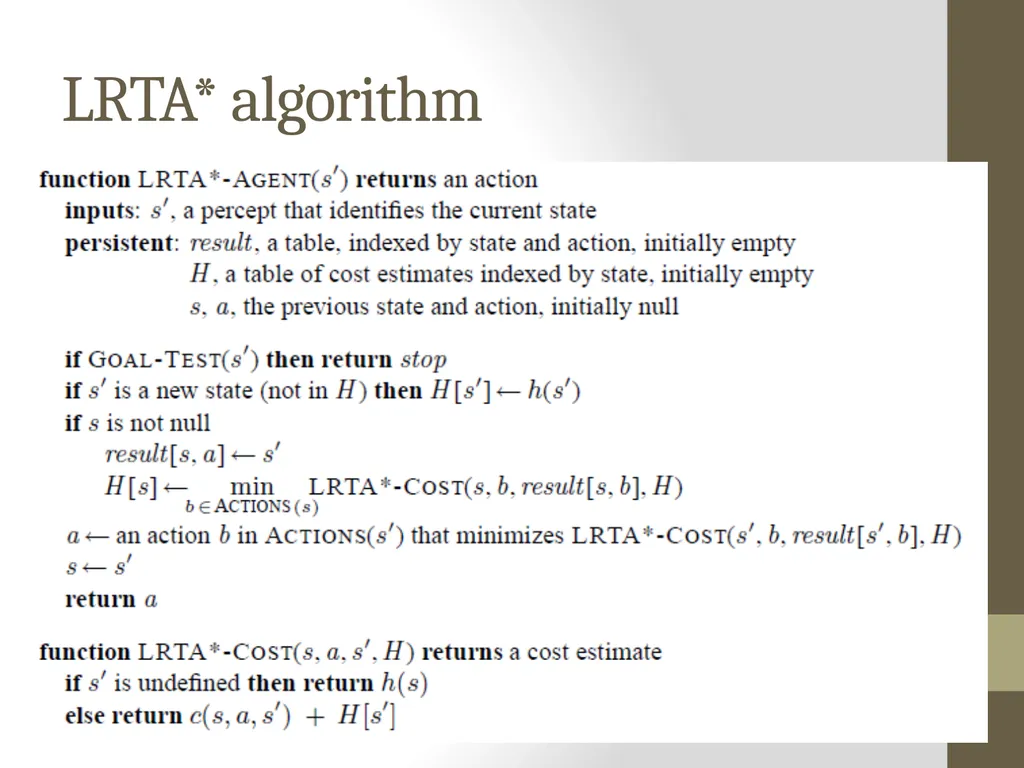
Learning real-time A* (LRTA*)
Updates cost estimates, g(s), for the state it leaves
Likes unexplored states
f(s) = h(s) not g(s) + h(s) for unexplored states<br>
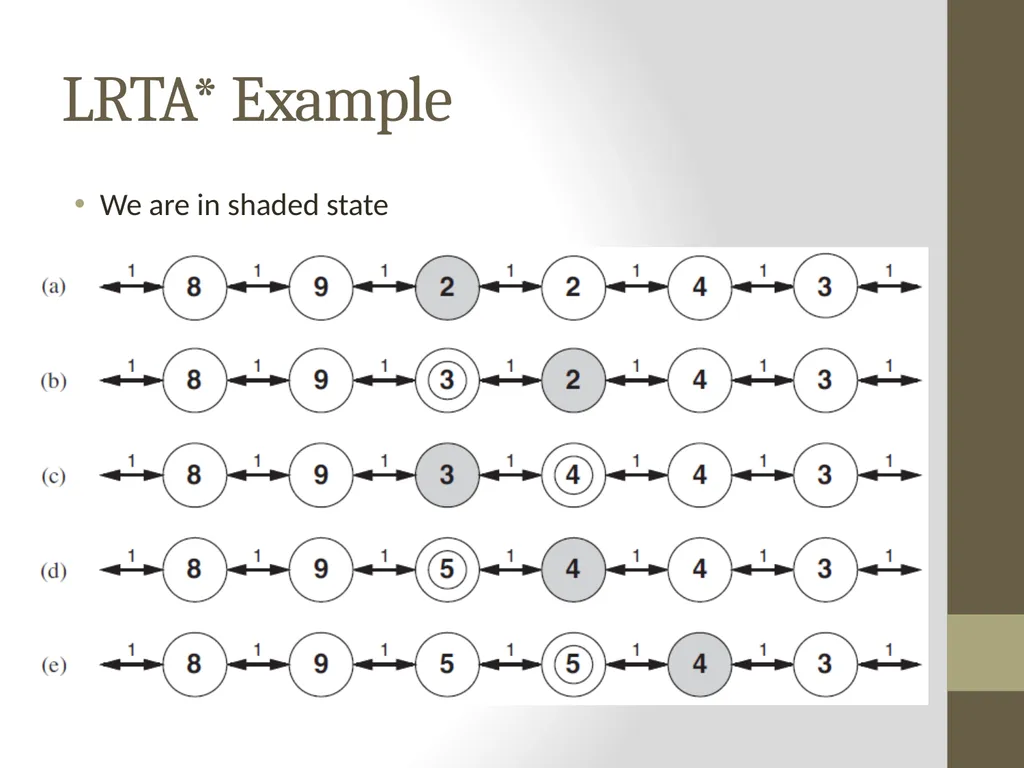
slide25. LRTA* Example We are in shaded state<br>
slide26. LRTA* algorithm<br>
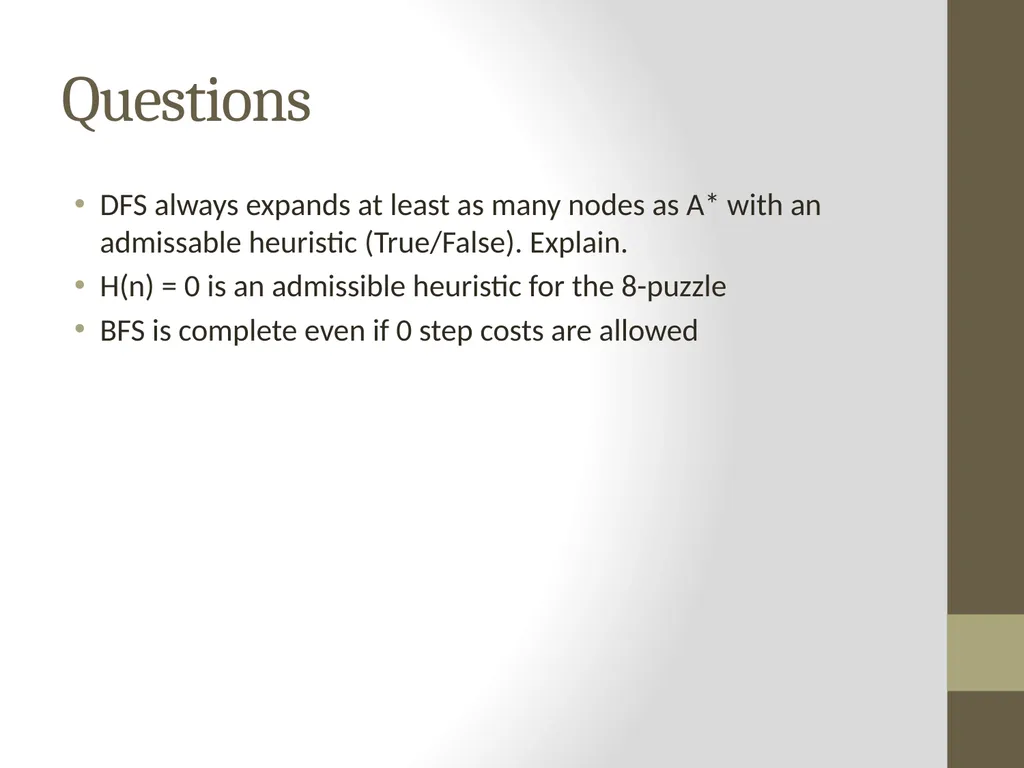
slide27. Questions DFS always expands at least as many nodes as A* with an admissable heuristic (True/False). Explain.
H(n) = 0 is an admissible heuristic for the 8-puzzle
BFS is complete even if 0 step costs are allowed<br>
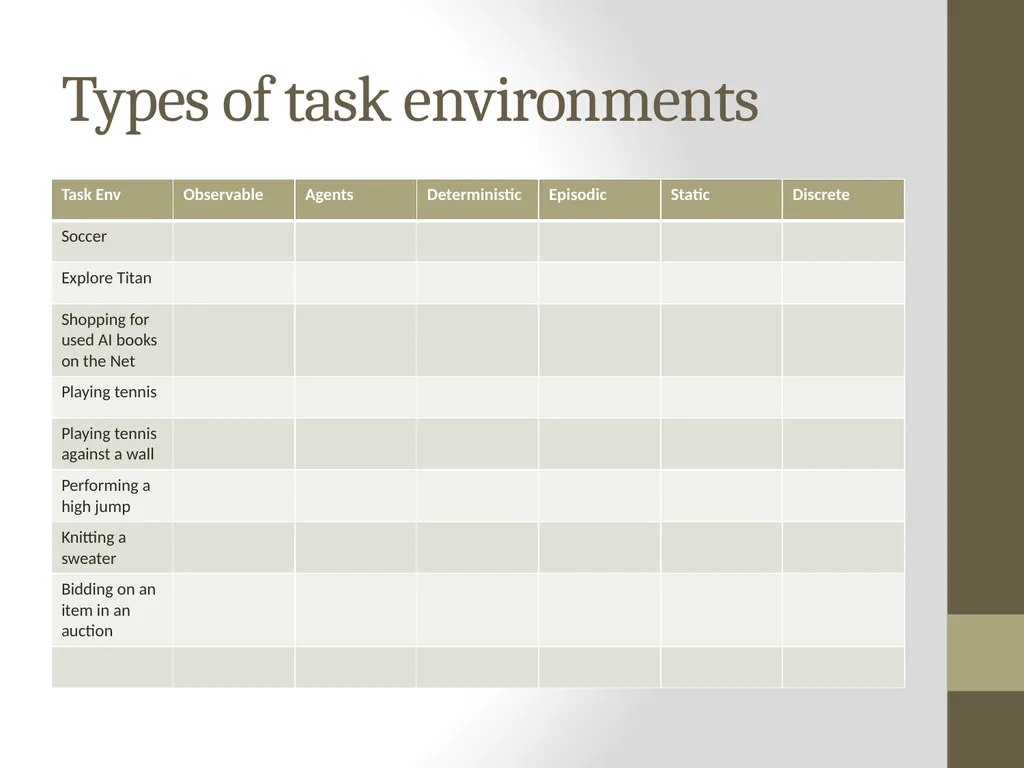
slide28. Types of task environments<br>
Prerequisites: 302, 365
Instructor: Sushil Louis, sushil@cse.unr.edu, http://www.cse.unr.edu/~sushil<br>
slide2. Search Leftovers Non-determinism in search
Solutions can be contingency plans (trees)
How do we handle non-determinism?
First: What types of determinism?
Second: For each type, how do we handle it?
Partial Observability
What types of observability do we have?
How do we handle each?
Don’t forget Kriegspeil and partial observability in games
Online-vs-Offline search and execution
Learning search algorithms<br>
slide3. Non-determinism in Actions Erratic vacuum-cleaners
Bad suck actions example
And-Or trees
AND
You can end up in multiple states as the result of an action
You have to find a path from all of these states (AND)
OR
Try each action
Any one action can lead to the goal state(s) (OR)<br>
slide4. Non-determinism in actions Slippery vacuum world
If at first you don’t succeed try, try again
We need to add label to some portion of a plan and use the label to refer to that portion – rather than repeating the subplan And-Or graphs with labels
Plan: [Suck, L1: Right, if State == 5 then L1 else Suck]<br>
slide5. Searching with Partial observation Agents percepts cannot pin down the exact state the agent is in
Let Agents have Belief states
Search for a sequence of belief states that leads to a goal
Search for a plan that leads to a goal
First: NO percepts sensor-less
States? (Belief states)
Initial State?
Actions?
Transition Model?
Goal test?
Path cost? Consider sensor-less vacuum world<br>
slide6. Sensor-less vacuum world Assume belief states are the same but no location or dust sensors
Initial state = {1, 2, 3, 4, 5, 6, 7, 8}
Action: Right
Result = {2, 4, 6, 8}
Right, Suck
Result = {4, 8}
Right, Suck, Left, Suck
Result = {7} guaranteed! You do not need sensors to COERCE the world into a specific state!<br>
slide7. Sensor-less search<br>
slide8. Sensor-less search (cont’d)<br>
slide9. Examples Erratic - Right Slippery – Right
Action can increase the number of physical states in a belief state<br>
slide11. Belief states synposis Search through belief state space is usually worse than physical state space (size)
Alternatives:
Logic representations
Incremental belief-state search
For each physical state in belief state find a solution that will take you to goal
Fast failure but have to find one solution that works for all physical states in initial state<br>
slide12. Searching with observations Many problems require sensors
Percept(s) or Percepts(s) function
Vacuum world example
Location sensor
Current location dirt sensor. Cannot detect dirt in other square
Percept(s1) = [A, Dirty]
Observability
Sensor-less problems Percepts(s) = Null for all s
Fully observable Percepts(s) = s for every s<br>
slide13. Example If you get [A, Dirty] you could be in {1, 3}
Result({1, 3}, Right) is
Now
if you see (observe) [B, Dirty] you are in {2}
If you observe [b, Clean] you are in {4}
Transition Model is more complicated, otherwise this is not very different from other search problems<br>
slide14. 3-stage transition model<br>
slide15. Example: Slippery vacuum<br>
slide16. And-Or solution Given this problem formulation, we can use the And-Or search algorithm to come up with a plan to solve the problem
Given [A, Dirty], Plan = {Suck, Right, if Bstate = {6} then Suck else []}<br>
slide17. Partially observable environments An agent in a partially observable environment must update belief state from percept
b’ = Update(Predict(b, a), o)
So the agent is only looking at the current o (percept) not the entire history, as we considered earlier. This is recursive state estimation
Example: Kindergarten vacuum world<br>
slide18. Localization in robotics Maintaining belief states is a core function of any Intelligent Agent
Monitoring, filtering, state estimation
Robot:
Four sonar sensors (NSWE) give correct data
Robot has correct map of environment
Move is broken Robot moves to random adjacent square
Robot must determine current location
Suppose it gets [NSW] obstacles N, S, and W<br>
slide19. Robot localization It must be in one of the following squares after [NSW]
Now it gets [NS], where can it be?<br>
slide20. Robot localization Only one location possible
Percepts usually reduce uncertainity<br>
slide21. Online search Not find plan then execute then stop
Compute, execute, observe, compute, execute, …
Interleave computation and action
Great for
dynamic domains
Non deterministic domains
Necessary in unknown environments
Robot localization in an unknown environment (no map)
Does not know about obstacles, where the goal is, that UP from (1,1) goes to (1, 2)
Once in (1, 2) does not know that down will go to (1, 1)
Some knowledge might be available
If location of goal is known, might use Manhattan distance heuristic
Competitive Ratio = Cost of shortest path without exploration/Cost of actual agent path
Irreversible actions can lead to dead ends and CR can become infinite<br>
slide22. Examples Adversary argument<br>
slide23. Online search algorithms Local search is better!
Online-DFS<br>
slide24. Online local search Hill-climbing is already an online search algorithm but stops at local optimum. How about randomization?
Cannot do random restart (you can’t teleport a robot)
How about just a random walk instead of hill-climbing?
Can be very bad (two ways back for every way forward above)
Let’s augment HC with memory
Learning real-time A* (LRTA*)
Updates cost estimates, g(s), for the state it leaves
Likes unexplored states
f(s) = h(s) not g(s) + h(s) for unexplored states<br>
slide25. LRTA* Example We are in shaded state<br>
slide26. LRTA* algorithm<br>
slide27. Questions DFS always expands at least as many nodes as A* with an admissable heuristic (True/False). Explain.
H(n) = 0 is an admissible heuristic for the 8-puzzle
BFS is complete even if 0 step costs are allowed<br>
slide28. Types of task environments<br>