Association and Causation in Epidemiological Studies 1. Introduction Definitions Association Causation Importance in epidemiological research Overview of key concepts 2. Types of Associations Positive and Negative Associations Direct and
"Association and Causation in Epidemiological" is the property of its rightful owner. Permission is granted to
download and print the materials on this website for personal, non-commercial use only, and to display it
on your personal computer provided you do not modify the materials and that you retain all copyright
notices contained in the materials. By downloading content from our website, you accept the terms of this
agreement.
Presentation Transcript
01
Association and Causation in Epidemiological Studies<br>
02
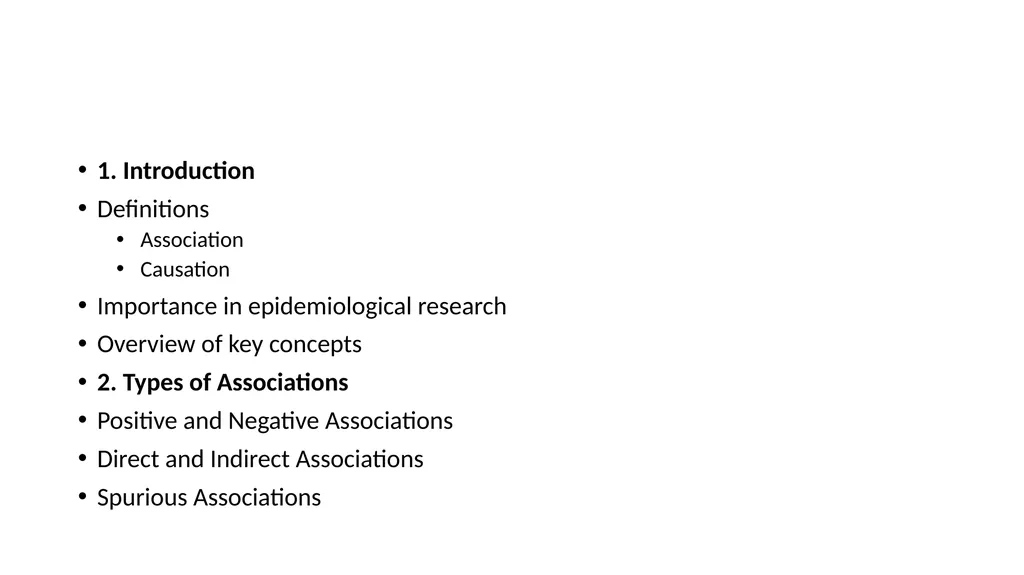
1. Introduction
Definitions
Association
Causation
Importance in epidemiological research
Overview of key concepts
2. Types of Associations
Positive and Negative Associations
Direct and Indirect Associations
Spurious Associations<br>
03
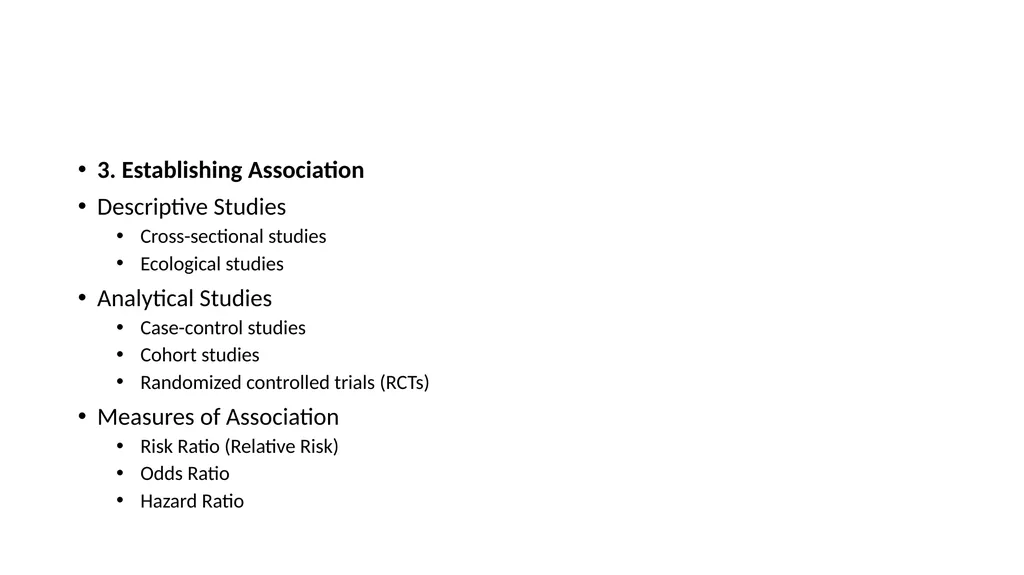
3. Establishing Association
Descriptive Studies
Cross-sectional studies
Ecological studies
Analytical Studies
Case-control studies
Cohort studies
Randomized controlled trials (RCTs)
Measures of Association
Risk Ratio (Relative Risk)
Odds Ratio
Hazard Ratio<br>
04
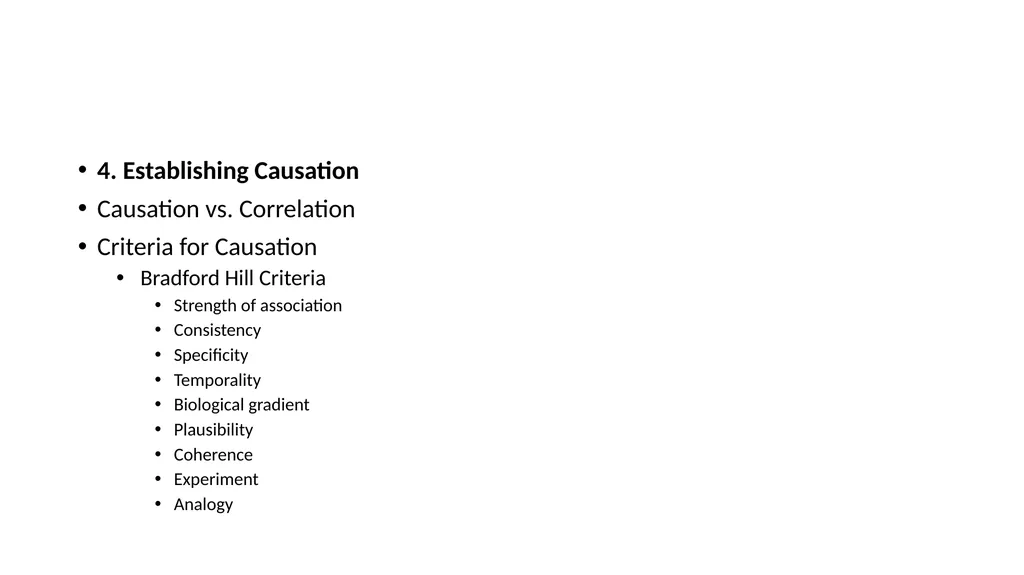
4. Establishing Causation
Causation vs. Correlation
Criteria for Causation
Bradford Hill Criteria
Strength of association
Consistency
Specificity
Temporality
Biological gradient
Plausibility
Coherence
Experiment
Analogy<br>
05
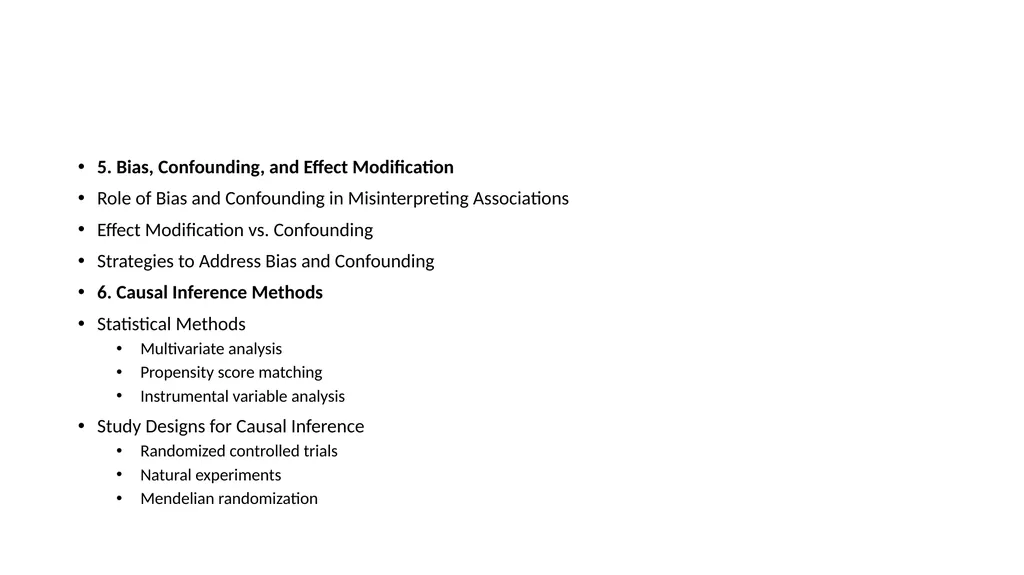
5. Bias, Confounding, and Effect Modification
Role of Bias and Confounding in Misinterpreting Associations
Effect Modification vs. Confounding
Strategies to Address Bias and Confounding
6. Causal Inference Methods
Statistical Methods
Multivariate analysis
Propensity score matching
Instrumental variable analysis
Study Designs for Causal Inference
Randomized controlled trials
Natural experiments
Mendelian randomization<br>
06
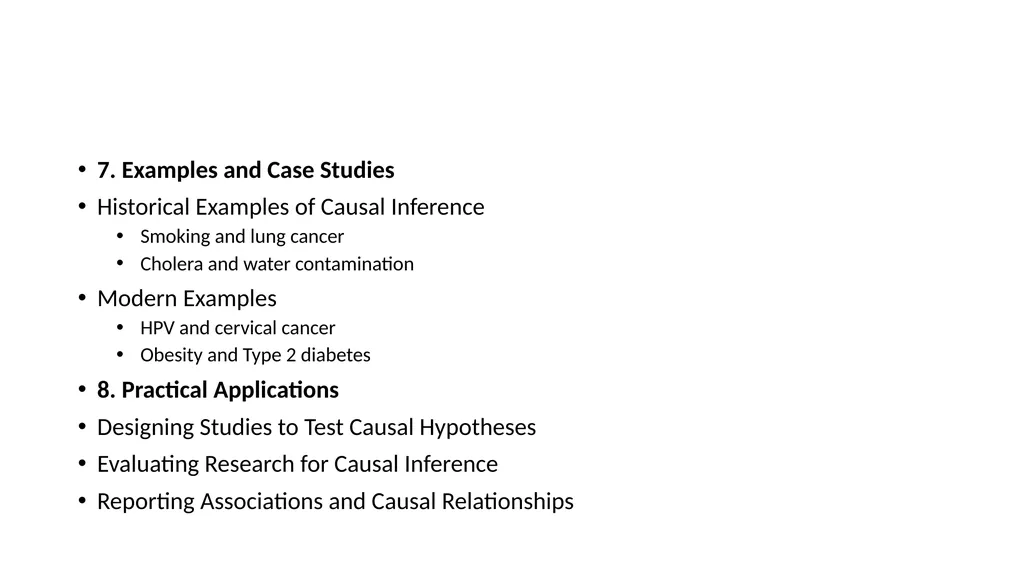
7. Examples and Case Studies
Historical Examples of Causal Inference
Smoking and lung cancer
Cholera and water contamination
Modern Examples
HPV and cervical cancer
Obesity and Type 2 diabetes
8. Practical Applications
Designing Studies to Test Causal Hypotheses
Evaluating Research for Causal Inference
Reporting Associations and Causal Relationships<br>
07
9. Conclusion
Summary of Key Points
Importance of Causal Inference in Public Health
Questions and Discussion<br>
08
Lecture Content
1. Introduction
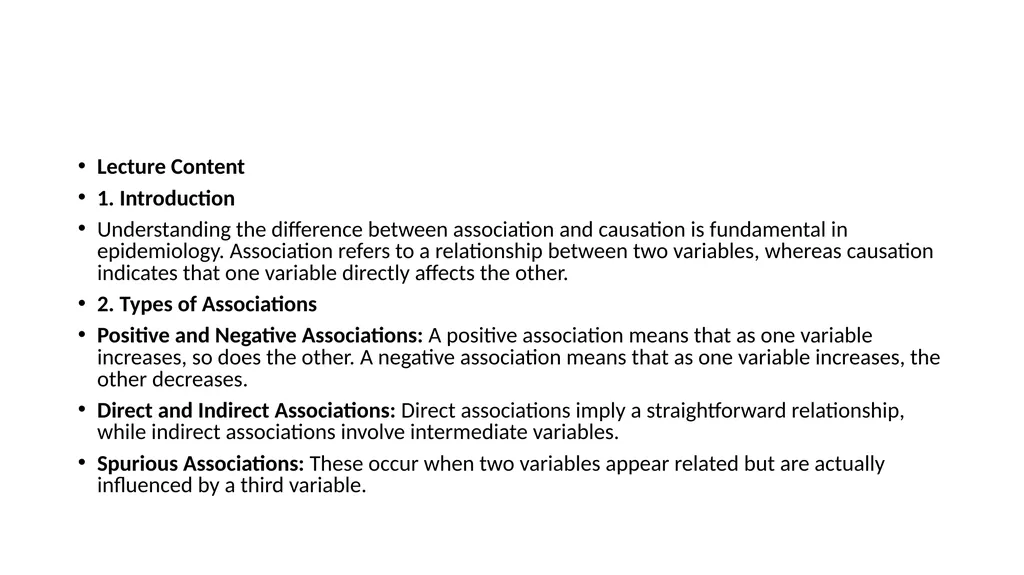
Understanding the difference between association and causation is fundamental in epidemiology. Association refers to a relationship between two variables, whereas causation indicates that one variable directly affects the other.
2. Types of Associations
Positive and Negative Associations: A positive association means that as one variable increases, so does the other. A negative association means that as one variable increases, the other decreases.
Direct and Indirect Associations: Direct associations imply a straightforward relationship, while indirect associations involve intermediate variables.
Spurious Associations: These occur when two variables appear related but are actually influenced by a third variable.<br>
09
3. Establishing Association
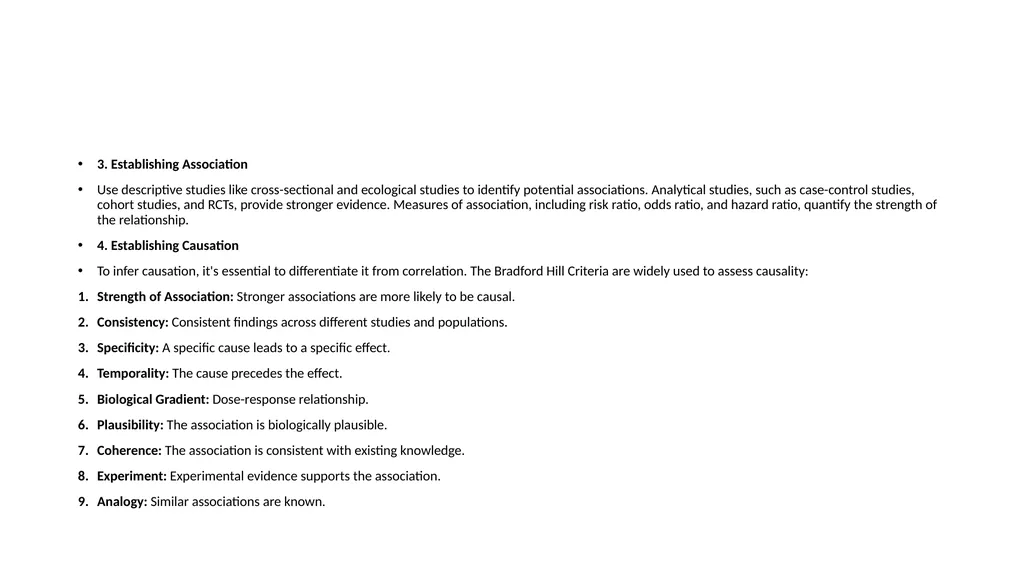
Use descriptive studies like cross-sectional and ecological studies to identify potential associations. Analytical studies, such as case-control studies, cohort studies, and RCTs, provide stronger evidence. Measures of association, including risk ratio, odds ratio, and hazard ratio, quantify the strength of the relationship.
4. Establishing Causation
To infer causation, it's essential to differentiate it from correlation. The Bradford Hill Criteria are widely used to assess causality:
Strength of Association: Stronger associations are more likely to be causal.
Consistency: Consistent findings across different studies and populations.
Specificity: A specific cause leads to a specific effect.
Temporality: The cause precedes the effect.
Biological Gradient: Dose-response relationship.
Plausibility: The association is biologically plausible.
Coherence: The association is consistent with existing knowledge.
Experiment: Experimental evidence supports the association.
Analogy: Similar associations are known.<br>
10
5. Bias, Confounding, and Effect Modification
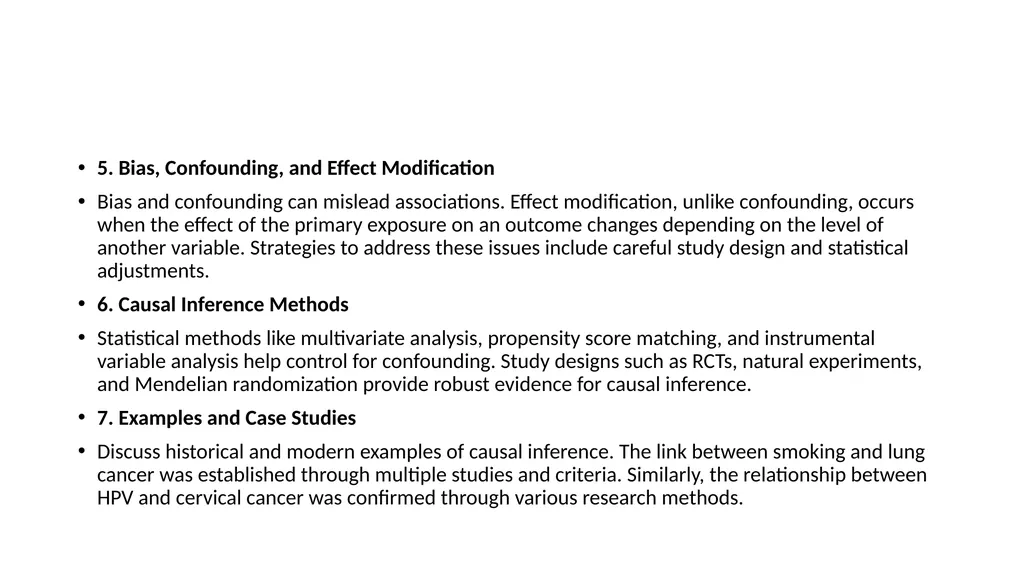
Bias and confounding can mislead associations. Effect modification, unlike confounding, occurs when the effect of the primary exposure on an outcome changes depending on the level of another variable. Strategies to address these issues include careful study design and statistical adjustments.
6. Causal Inference Methods
Statistical methods like multivariate analysis, propensity score matching, and instrumental variable analysis help control for confounding. Study designs such as RCTs, natural experiments, and Mendelian randomization provide robust evidence for causal inference.
7. Examples and Case Studies
Discuss historical and modern examples of causal inference. The link between smoking and lung cancer was established through multiple studies and criteria. Similarly, the relationship between HPV and cervical cancer was confirmed through various research methods.<br>
11
8. Practical Applications
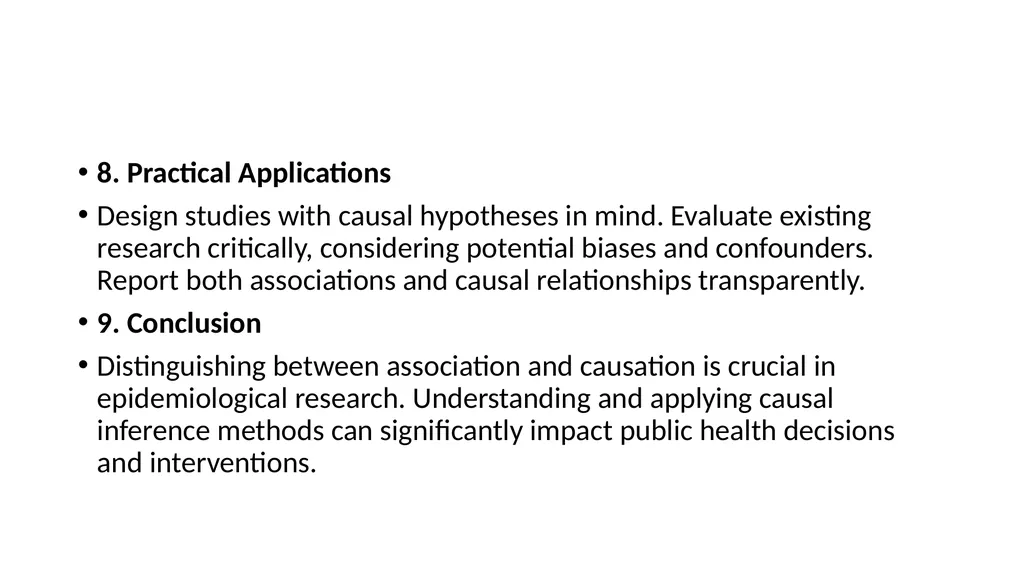
Design studies with causal hypotheses in mind. Evaluate existing research critically, considering potential biases and confounders. Report both associations and causal relationships transparently.
9. Conclusion
Distinguishing between association and causation is crucial in epidemiological research. Understanding and applying causal inference methods can significantly impact public health decisions and interventions.<br>
12
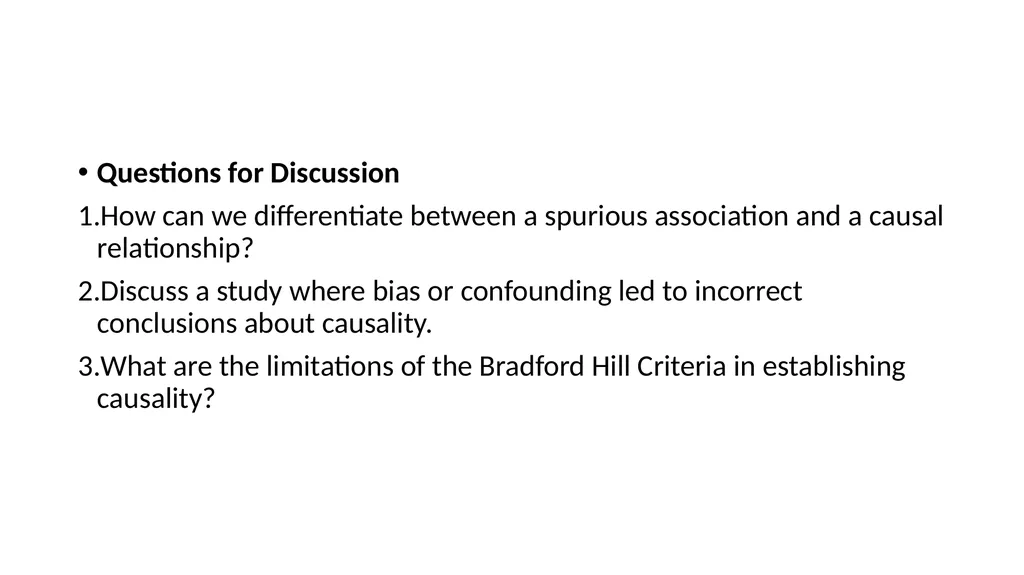
Questions for Discussion
How can we differentiate between a spurious association and a causal relationship?
Discuss a study where bias or confounding led to incorrect conclusions about causality.
What are the limitations of the Bradford Hill Criteria in establishing causality?<br>