Basic Emergency Care Approach to the acutely ill and injured Conflict Related Injury module Primary Survey Objectives By the end of this presentation, you will be able to: Describe the trauma primary survey approach for conflict-related
"Basic Emergency Care Approach to the acutely ill" is the property of its rightful owner. Permission is granted to
download and print the materials on this website for personal, non-commercial use only, and to display it
on your personal computer provided you do not modify the materials and that you retain all copyright
notices contained in the materials. By downloading content from our website, you accept the terms of this
agreement.
Presentation Transcript
01
Basic Emergency Care Approach to the acutely ill and injured Conflict Related Injury module
Primary Survey<br>
02
Objectives By the end of this presentation, you will be able to:
Describe the trauma primary survey approach for conflict-related injury
Identify signs and symptoms of acute life and limb-threatening conditions
Identify critical CABCDE actions for conflict-related injury<br>
03
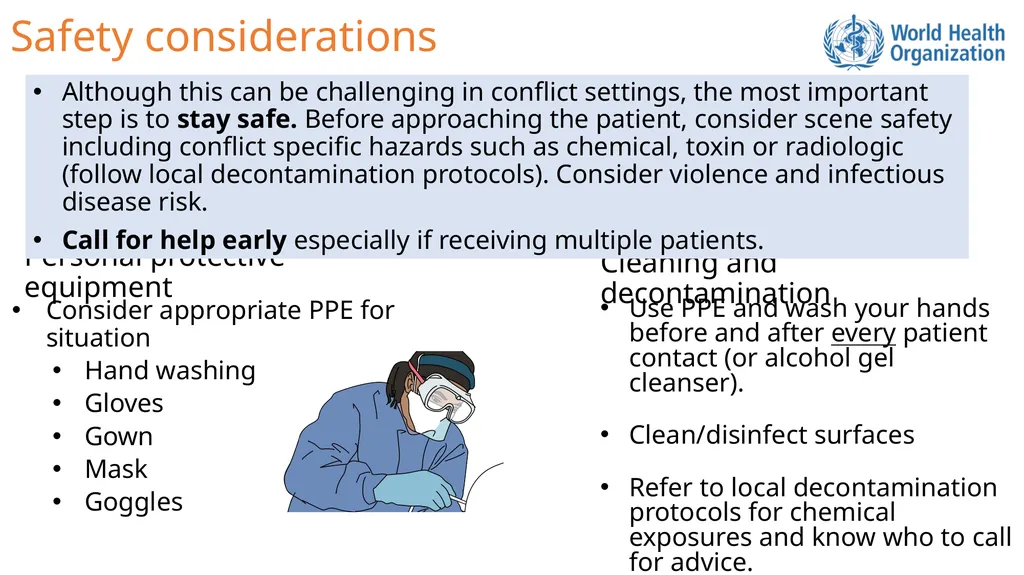
Safety considerations Personal protective equipment Consider appropriate PPE for situation
Hand washing
Gloves
Gown
Mask
Goggles Cleaning and decontamination Use PPE and wash your hands before and after every patient contact (or alcohol gel cleanser).
Clean/disinfect surfaces
Refer to local decontamination protocols for chemical exposures and know who to call for advice. Although this can be challenging in conflict settings, the most important step is to stay safe. Before approaching the patient, consider scene safety including conflict specific hazards such as chemical, toxin or radiologic (follow local decontamination protocols). Consider violence and infectious disease risk.
Call for help early especially if receiving multiple patients.<br>
04
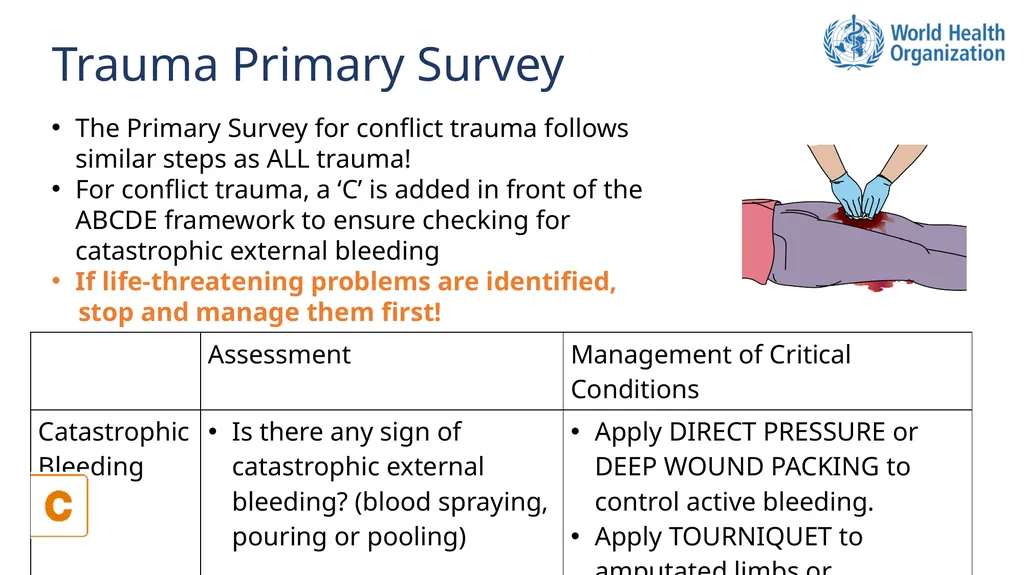
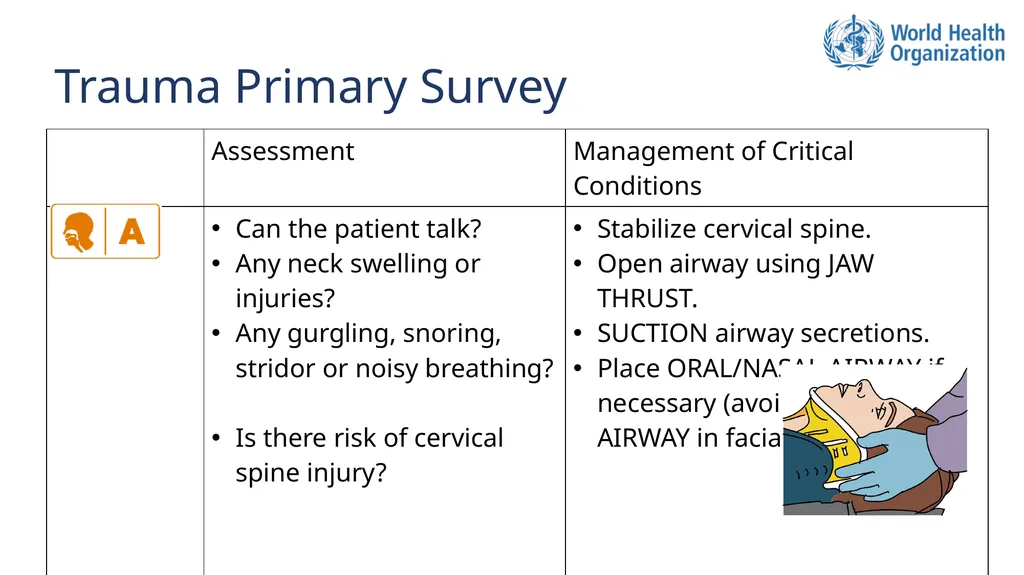
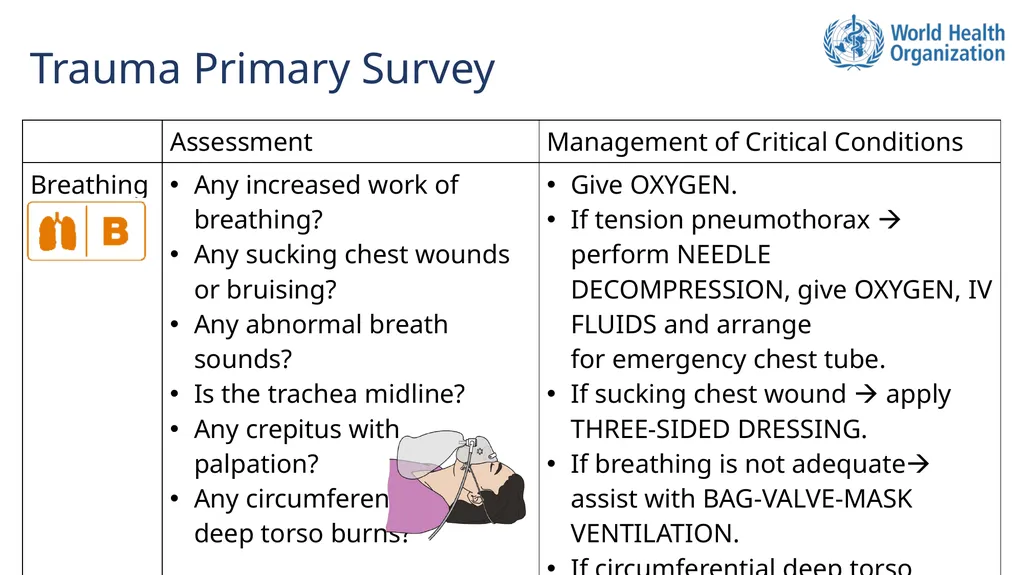
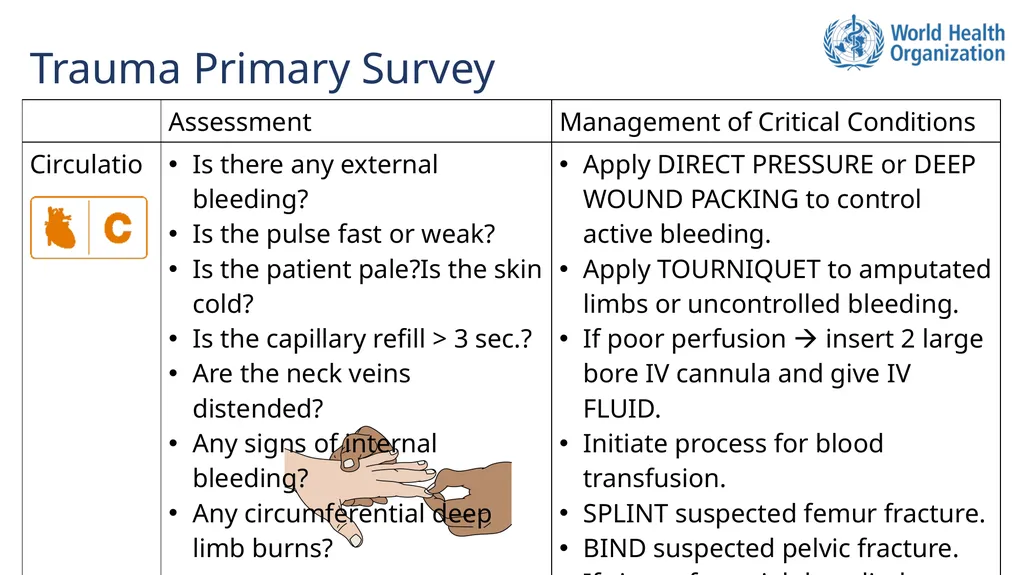
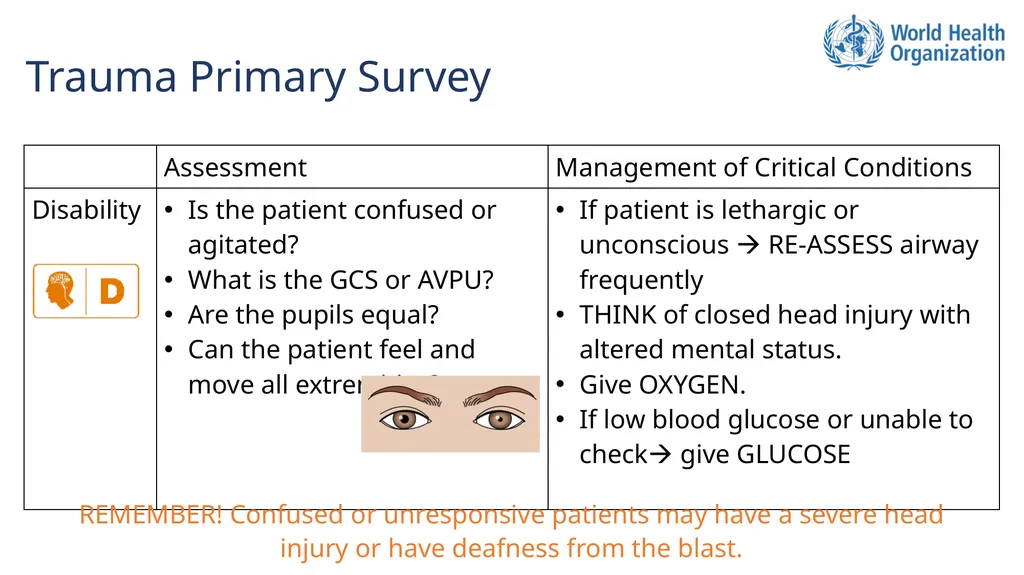
Trauma Primary Survey The Primary Survey for conflict trauma follows similar steps as ALL trauma!
For conflict trauma, a ‘C’ is added in front of the ABCDE framework to ensure checking for catastrophic external bleeding
If life-threatening problems are identified,
stop and manage them first!<br>
05
Trauma Primary Survey<br>
06
Trauma Primary Survey<br>
07
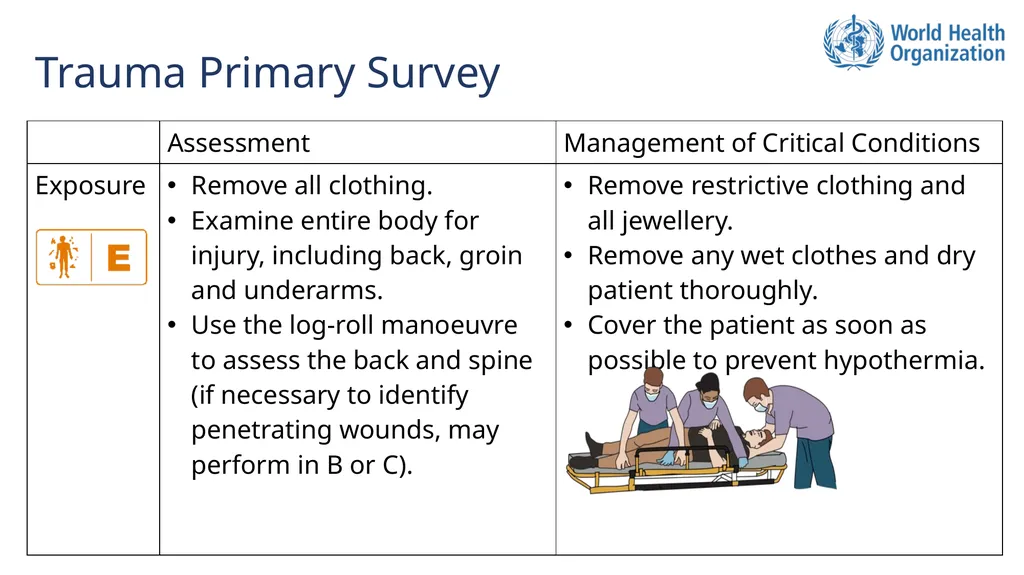
Trauma Primary Survey<br>
08
Trauma Primary Survey REMEMBER! Confused or unresponsive patients may have a severe head injury or have deafness from the blast.<br>
09
Trauma Primary Survey<br>
10
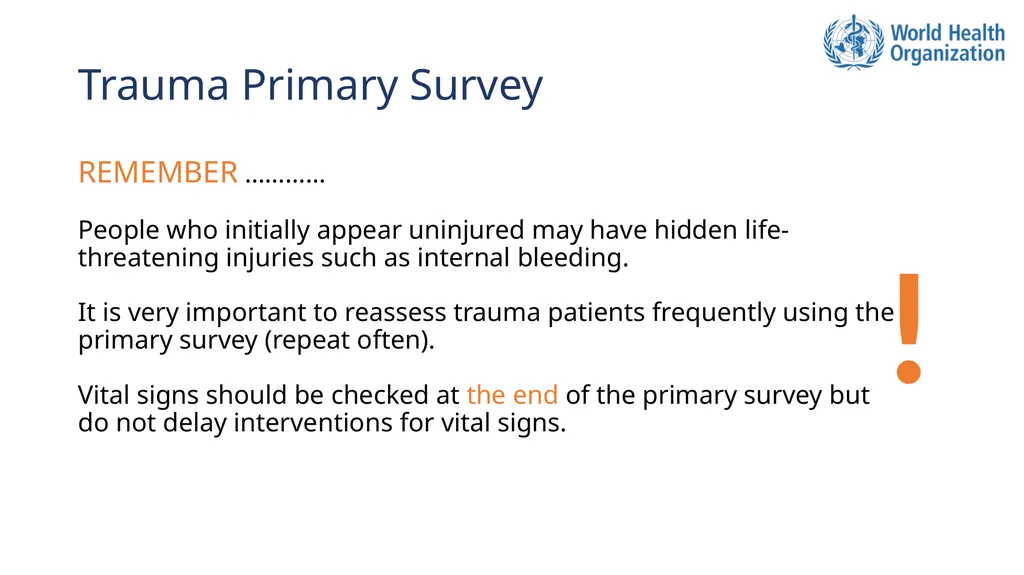
Trauma Primary Survey REMEMBER …………
People who initially appear uninjured may have hidden life-threatening injuries such as internal bleeding.
It is very important to reassess trauma patients frequently using the primary survey (repeat often).
Vital signs should be checked at the end of the primary survey but do not delay interventions for vital signs. !<br>
11
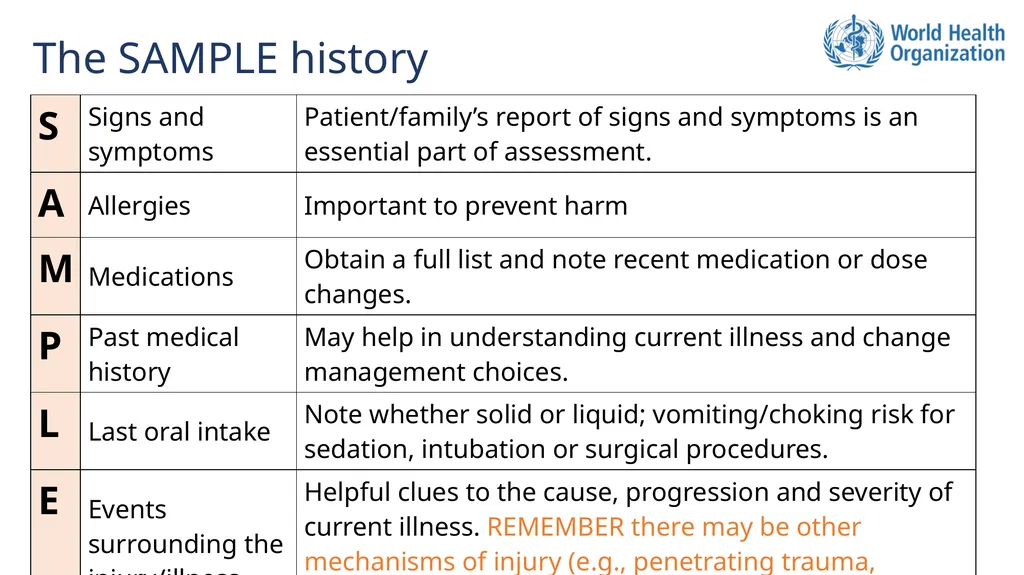
The SAMPLE history<br>
12
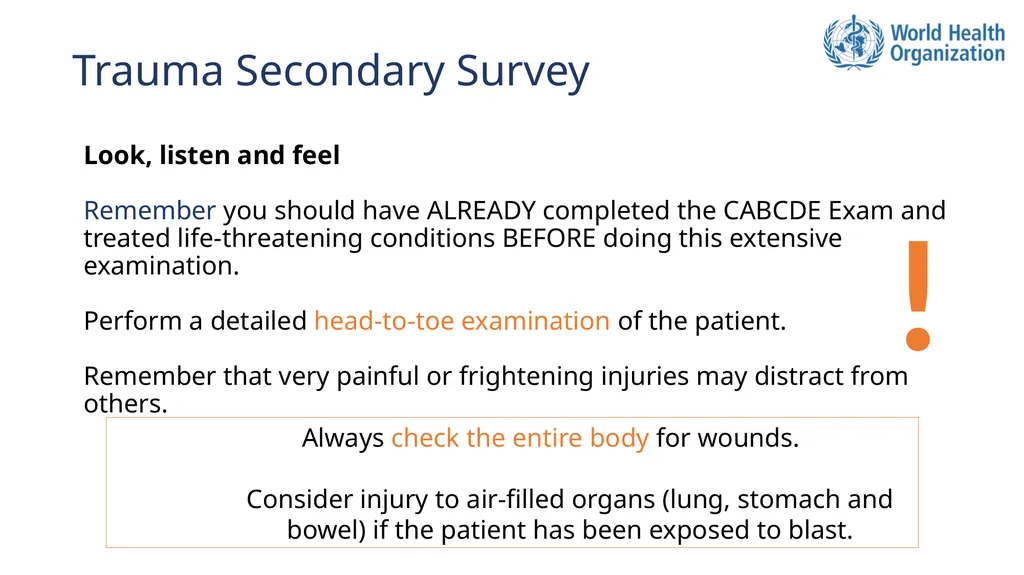
Trauma Secondary Survey Look, listen and feel
Remember you should have ALREADY completed the CABCDE Exam and treated life-threatening conditions BEFORE doing this extensive examination.
Perform a detailed head-to-toe examination of the patient.
Remember that very painful or frightening injuries may distract from others. ! Always check the entire body for wounds.
Consider injury to air-filled organs (lung, stomach and bowel) if the patient has been exposed to blast.<br>
13
Special considerations Children, Pregnancy and Older Adults
The CABCDE exam follows the same sequence for special population groups. Consider any:
Anatomical differences
Physiological differences e.g., vital signs
Specific vulnerability to injury
Remember:
Children may have significant internal injuries even if no/minimal external sign of injury.
Resuscitation of the pregnant woman gives the best chance of survival for the woman and the foetus.
Older adults have less physiological reserve and may decompensate faster from traumatic injuries. !<br>
14
Disposition Considerations Trauma patients can have complex injuries and get worse or die very quickly.
High-risk conditions always require HANDOVER/TRANSFER to a specialist unit for ongoing care.
Remember that if a patient required OXYGEN arrange to continue it during transport and handover.
Ensure bleeding is controlled and arrange for early blood transfusion.
If an injured person is displaying signs of shock, ensure treatment with IV FLUIDS or blood is continued on transfer.
Communicate injuries, important medical problems and what has been done for the patient during handover/transfer.<br>
15
REMEMBER<br>
16
Summary In this presentation, we have covered:
The trauma primary survey approach for conflict-related injury
The signs and symptoms of acute life- and limb- threatening conditions
Critical CABCDE actions for conflict-related injury<br>