
Basic Mental Health Literacy for Accompaniment
DJ
Published · 50 slides · 0 views
1 / 1


Description
Basic Mental Health Literacy for Accompaniment Based on content created by: Wendell J. Callahan, Phd Michael Juarez, MA University of San Diego Catholic Institute for Mental Health Ministry Jennifer Hayes Housel Overview PURPOSE: To equip
Related Topics
Share
Embed code
Download this presentation From Below
"Basic Mental Health Literacy for Accompaniment" is the property of its rightful owner. Permission is granted to download and print the materials on this website for personal, non-commercial use only, and to display it on your personal computer provided you do not modify the materials and that you retain all copyright notices contained in the materials. By downloading content from our website, you accept the terms of this agreement.
Presentation Transcript
01
Basic Mental Health Literacy for Accompaniment Based on content created by:
Wendell J. Callahan, Phd
Michael Juarez, MA
University of San Diego
Catholic Institute for Mental Health Ministry
Jennifer Hayes Housel<br>
Wendell J. Callahan, Phd
Michael Juarez, MA
University of San Diego
Catholic Institute for Mental Health Ministry
Jennifer Hayes Housel<br>
02
Overview PURPOSE:
To equip Catholic parishioners, clergy, and religious with practical information about mental health
To provide foundational understanding of mental health literacy within the context of our Catholic faith and practical strategies for creating supportive environments
Because improved mental health literacy benefits all
_______________________________
This course DOES NOT prepare learners to diagnose mental illness, nor offer any other type of mental health clinical care, nor to offer advanced spiritual care INTERNATIONAL ASSOCIATION OF CATHOLIC MENTAL HEALTH MINISTERS<br>
To equip Catholic parishioners, clergy, and religious with practical information about mental health
To provide foundational understanding of mental health literacy within the context of our Catholic faith and practical strategies for creating supportive environments
Because improved mental health literacy benefits all
_______________________________
This course DOES NOT prepare learners to diagnose mental illness, nor offer any other type of mental health clinical care, nor to offer advanced spiritual care INTERNATIONAL ASSOCIATION OF CATHOLIC MENTAL HEALTH MINISTERS<br>
03
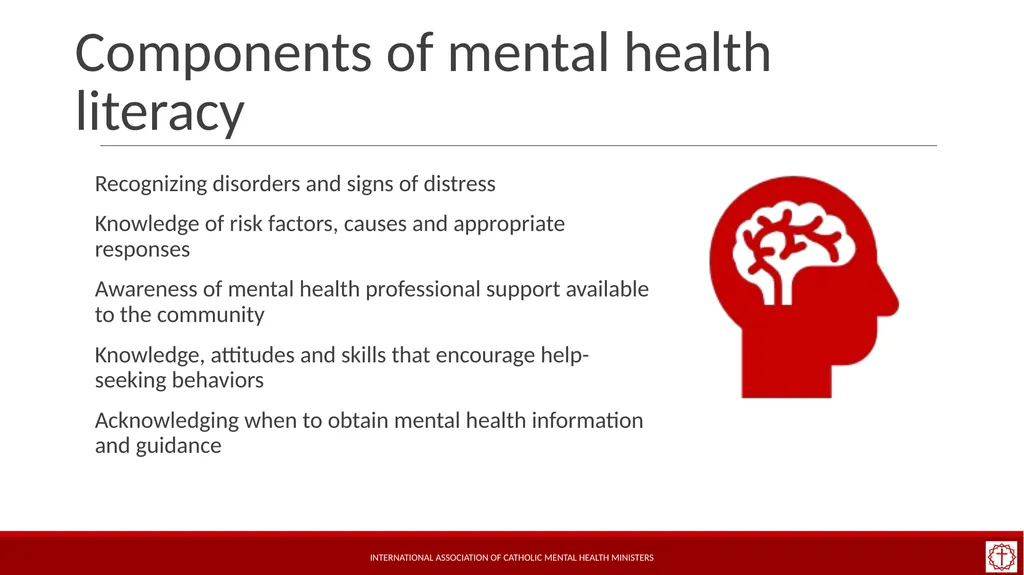
Components of mental health literacy Recognizing disorders and signs of distress
Knowledge of risk factors, causes and appropriate responses
Awareness of mental health professional support available to the community
Knowledge, attitudes and skills that encourage help-seeking behaviors
Acknowledging when to obtain mental health information and guidance INTERNATIONAL ASSOCIATION OF CATHOLIC MENTAL HEALTH MINISTERS<br>
Knowledge of risk factors, causes and appropriate responses
Awareness of mental health professional support available to the community
Knowledge, attitudes and skills that encourage help-seeking behaviors
Acknowledging when to obtain mental health information and guidance INTERNATIONAL ASSOCIATION OF CATHOLIC MENTAL HEALTH MINISTERS<br>
04
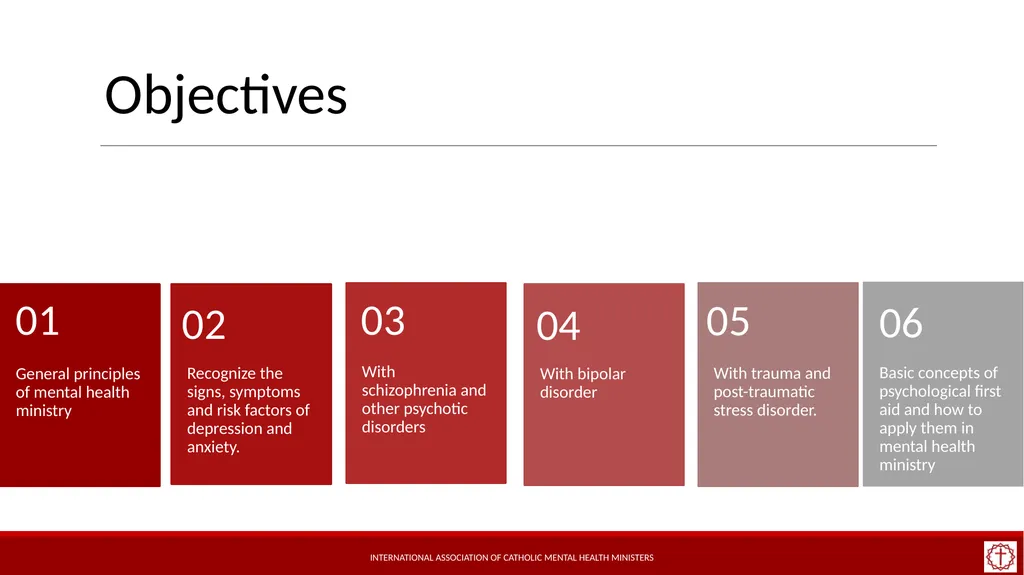
INTERNATIONAL ASSOCIATION OF CATHOLIC MENTAL HEALTH MINISTERS Objectives<br>
05
Lesson 1 GENERAL CONSIDERATIONS IN MENTAL HEALTH LITERACY INTERNATIONAL ASSOCIATION OF CATHOLIC MENTAL HEALTH MINISTERS<br>
06
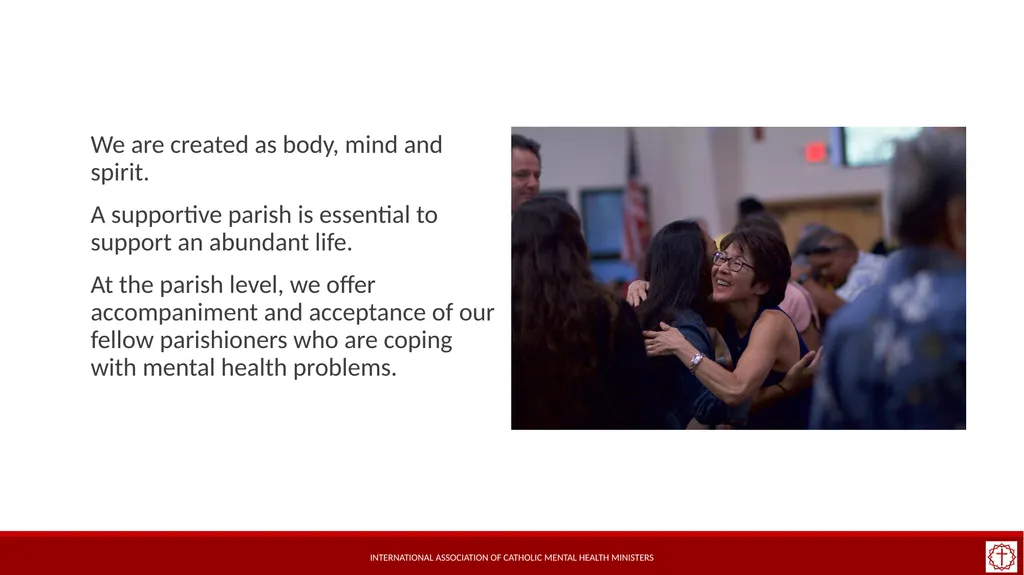
We are created as body, mind and spirit.
A supportive parish is essential to support an abundant life.
At the parish level, we offer accompaniment and acceptance of our fellow parishioners who are coping with mental health problems. INTERNATIONAL ASSOCIATION OF CATHOLIC MENTAL HEALTH MINISTERS<br>
A supportive parish is essential to support an abundant life.
At the parish level, we offer accompaniment and acceptance of our fellow parishioners who are coping with mental health problems. INTERNATIONAL ASSOCIATION OF CATHOLIC MENTAL HEALTH MINISTERS<br>
07
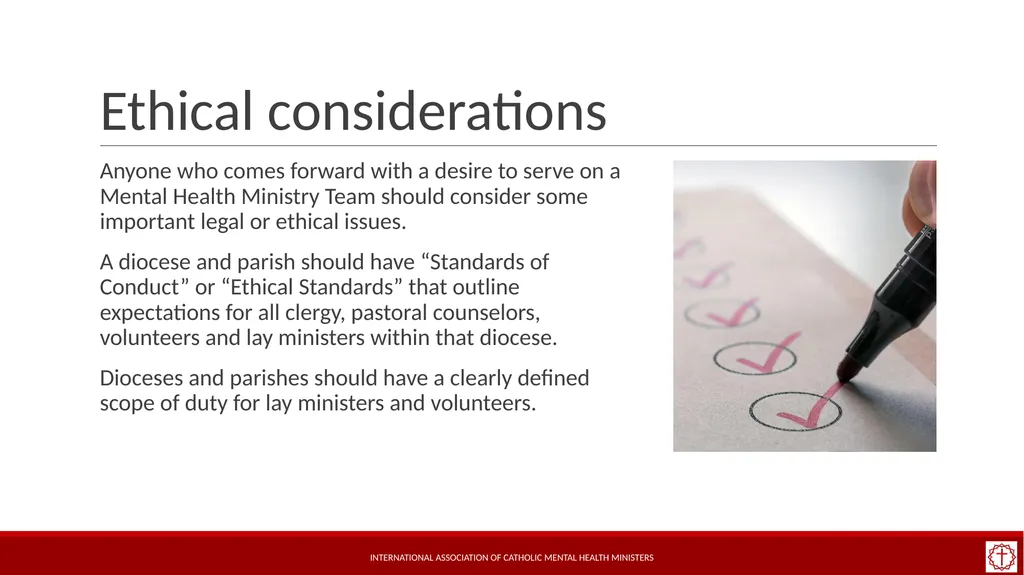
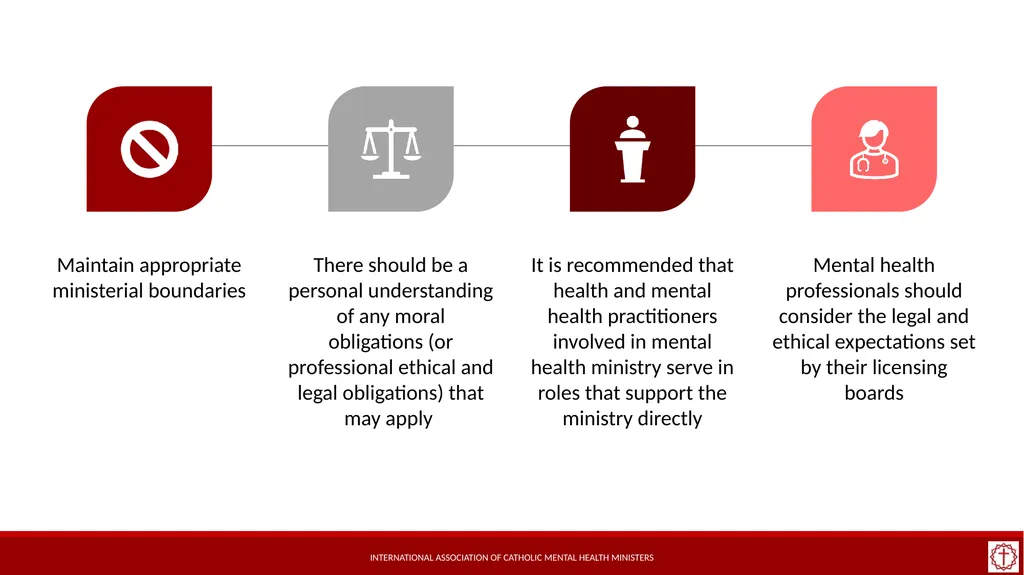
Ethical considerations Anyone who comes forward with a desire to serve on a Mental Health Ministry Team should consider some important legal or ethical issues.
A diocese and parish should have “Standards of Conduct” or “Ethical Standards” that outline expectations for all clergy, pastoral counselors, volunteers and lay ministers within that diocese.
Dioceses and parishes should have a clearly defined scope of duty for lay ministers and volunteers. INTERNATIONAL ASSOCIATION OF CATHOLIC MENTAL HEALTH MINISTERS<br>
A diocese and parish should have “Standards of Conduct” or “Ethical Standards” that outline expectations for all clergy, pastoral counselors, volunteers and lay ministers within that diocese.
Dioceses and parishes should have a clearly defined scope of duty for lay ministers and volunteers. INTERNATIONAL ASSOCIATION OF CATHOLIC MENTAL HEALTH MINISTERS<br>
08
INTERNATIONAL ASSOCIATION OF CATHOLIC MENTAL HEALTH MINISTERS<br>
09
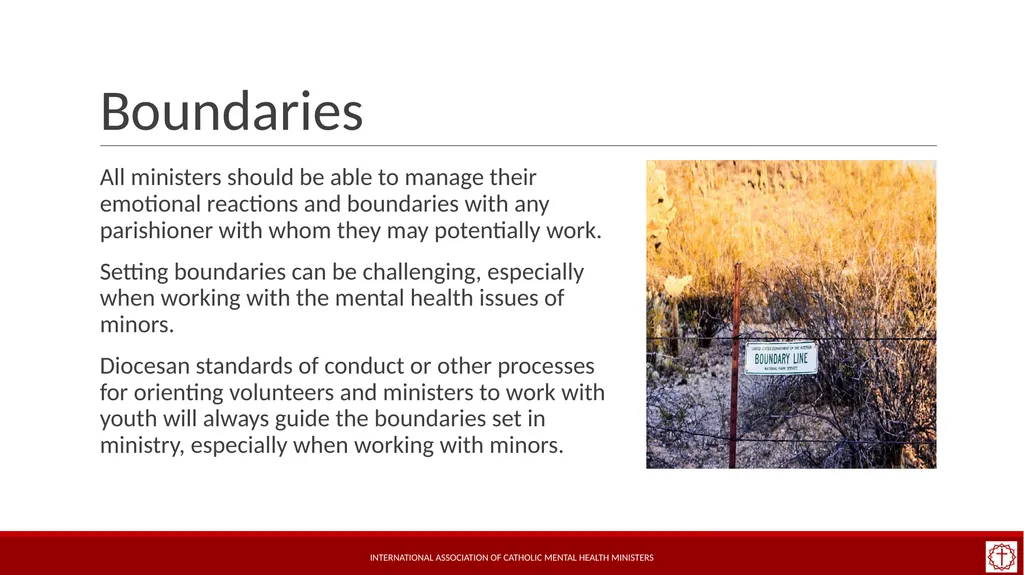
Boundaries All ministers should be able to manage their emotional reactions and boundaries with any parishioner with whom they may potentially work.
Setting boundaries can be challenging, especially when working with the mental health issues of minors.
Diocesan standards of conduct or other processes for orienting volunteers and ministers to work with youth will always guide the boundaries set in ministry, especially when working with minors. INTERNATIONAL ASSOCIATION OF CATHOLIC MENTAL HEALTH MINISTERS<br>
Setting boundaries can be challenging, especially when working with the mental health issues of minors.
Diocesan standards of conduct or other processes for orienting volunteers and ministers to work with youth will always guide the boundaries set in ministry, especially when working with minors. INTERNATIONAL ASSOCIATION OF CATHOLIC MENTAL HEALTH MINISTERS<br>
10
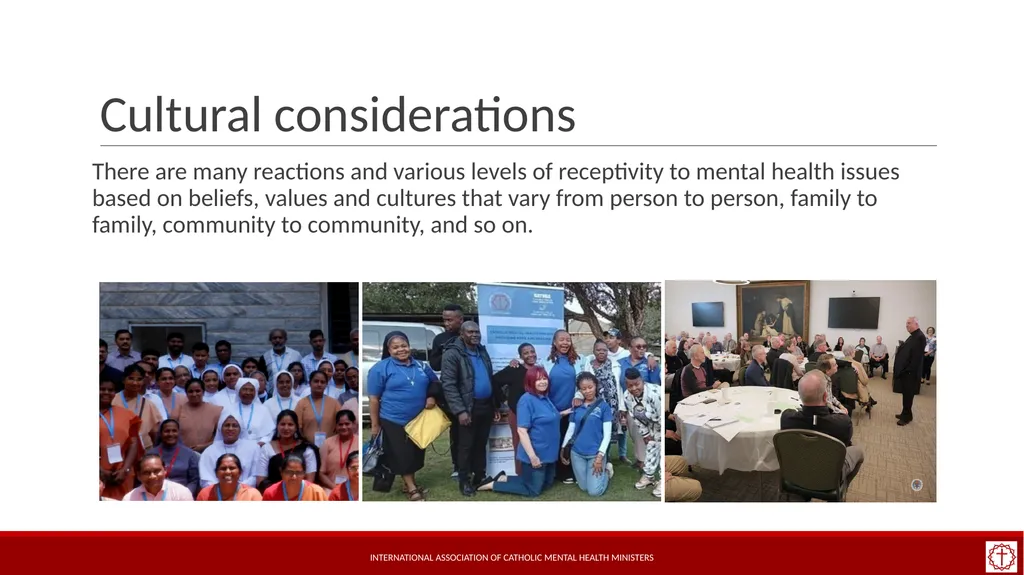
Cultural considerations There are many reactions and various levels of receptivity to mental health issues based on beliefs, values and cultures that vary from person to person, family to family, community to community, and so on. INTERNATIONAL ASSOCIATION OF CATHOLIC MENTAL HEALTH MINISTERS<br>
11
Lay mental health ministry motivation INTERNATIONAL ASSOCIATION OF CATHOLIC MENTAL HEALTH MINISTERS<br>
12
Talking person to person For the person seeking or receiving mental health support it is important for them to feel seen and heard.
There is no one size fits all solution for a person dealing with mental health issues.
Effective communication with the person seeking help is crucial and can help to de-escalate a potential crisis in a safe and respectful way. INTERNATIONAL ASSOCIATION OF CATHOLIC MENTAL HEALTH MINISTERS<br>
There is no one size fits all solution for a person dealing with mental health issues.
Effective communication with the person seeking help is crucial and can help to de-escalate a potential crisis in a safe and respectful way. INTERNATIONAL ASSOCIATION OF CATHOLIC MENTAL HEALTH MINISTERS<br>
13
Speak slowly and confidently with a gentle, calm and caring tone.
Don’t respond in a hostile, disciplinary or challenging manner.
It is important to remain respectful of the person’s space.
Try to calm yourself and avoid nervous behavior.
Consider taking a break from the conversation for a chance to calm down.
If the situation continues to escalate despite these attempts, consider calling for emergency services. Helpful tips INTERNATIONAL ASSOCIATION OF CATHOLIC MENTAL HEALTH MINISTERS<br>
Don’t respond in a hostile, disciplinary or challenging manner.
It is important to remain respectful of the person’s space.
Try to calm yourself and avoid nervous behavior.
Consider taking a break from the conversation for a chance to calm down.
If the situation continues to escalate despite these attempts, consider calling for emergency services. Helpful tips INTERNATIONAL ASSOCIATION OF CATHOLIC MENTAL HEALTH MINISTERS<br>
14
Suicidality and risk of harm Acute distress may include active suicidal behavior and/or threatening behavior.
Active suicidal behavior refers to the intention and plan for serious self harm.
Threatening behavior refers to the intention and plan to do harm to others.
The mental health minister's role in these situations is to try to maintain the safety of themselves, the person in crisis and others that may be in the area (e.g., if the crisis is occurring during a parish event or church service).
If a person you have engaged with is in an acute state of distress you may need to call emergency services. INTERNATIONAL ASSOCIATION OF CATHOLIC MENTAL HEALTH MINISTERS<br>
Active suicidal behavior refers to the intention and plan for serious self harm.
Threatening behavior refers to the intention and plan to do harm to others.
The mental health minister's role in these situations is to try to maintain the safety of themselves, the person in crisis and others that may be in the area (e.g., if the crisis is occurring during a parish event or church service).
If a person you have engaged with is in an acute state of distress you may need to call emergency services. INTERNATIONAL ASSOCIATION OF CATHOLIC MENTAL HEALTH MINISTERS<br>
15
Call for emergency services if Someone is in immediate danger of hurting themselves or others
They are taking pills or dangerous substances, using a weapon, or threatening harm
They are violent or suicidal
It is not safe to, or you cannot drive yourself or the person to the emergency room
Inform the emergency service that you are calling because of a mental health emergency
Keep the person experiencing the emergency in sight, to the degree possible, until emergency services arrive INTERNATIONAL ASSOCIATION OF CATHOLIC MENTAL HEALTH MINISTERS<br>
They are taking pills or dangerous substances, using a weapon, or threatening harm
They are violent or suicidal
It is not safe to, or you cannot drive yourself or the person to the emergency room
Inform the emergency service that you are calling because of a mental health emergency
Keep the person experiencing the emergency in sight, to the degree possible, until emergency services arrive INTERNATIONAL ASSOCIATION OF CATHOLIC MENTAL HEALTH MINISTERS<br>
16
Lesson 1 Reflection How can lay mental health ministers effectively engage in person-to-person conversations to ensure individuals feel seen and heard in a non-judgmental setting?
How can lay mental health ministers effectively set boundaries while managing their emotional reactions, and ensuring the safety and well-being of those they serve? INTERNATIONAL ASSOCIATION OF CATHOLIC MENTAL HEALTH MINISTERS<br>
How can lay mental health ministers effectively set boundaries while managing their emotional reactions, and ensuring the safety and well-being of those they serve? INTERNATIONAL ASSOCIATION OF CATHOLIC MENTAL HEALTH MINISTERS<br>
17
Lesson 2 RECOGNIZING THE SIGNS AND SYMPTOMS OF DEPRESSION AND ANXIETY DISORDERS INTERNATIONAL ASSOCIATION OF CATHOLIC MENTAL HEALTH MINISTERS<br>
18
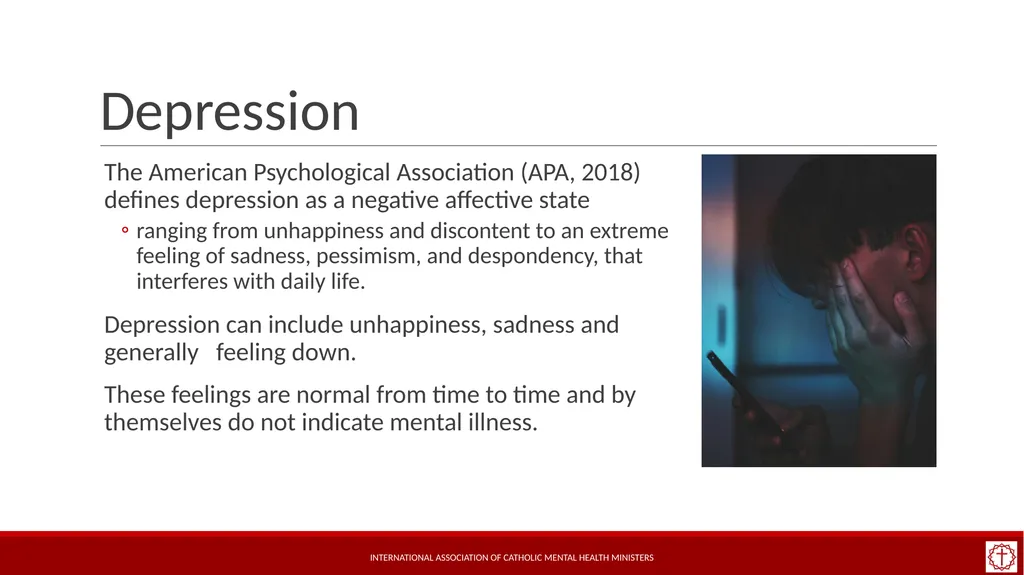
Depression The American Psychological Association (APA, 2018) defines depression as a negative affective state
ranging from unhappiness and discontent to an extreme feeling of sadness, pessimism, and despondency, that interferes with daily life.
Depression can include unhappiness, sadness and generally feeling down.
These feelings are normal from time to time and by themselves do not indicate mental illness. INTERNATIONAL ASSOCIATION OF CATHOLIC MENTAL HEALTH MINISTERS<br>
ranging from unhappiness and discontent to an extreme feeling of sadness, pessimism, and despondency, that interferes with daily life.
Depression can include unhappiness, sadness and generally feeling down.
These feelings are normal from time to time and by themselves do not indicate mental illness. INTERNATIONAL ASSOCIATION OF CATHOLIC MENTAL HEALTH MINISTERS<br>
19
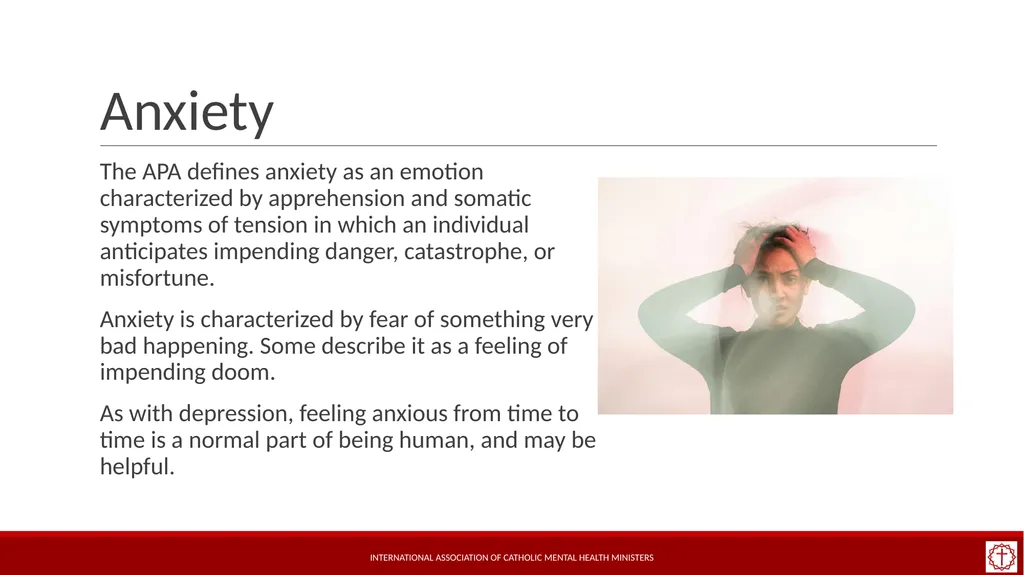
Anxiety The APA defines anxiety as an emotion characterized by apprehension and somatic symptoms of tension in which an individual anticipates impending danger, catastrophe, or misfortune.
Anxiety is characterized by fear of something very bad happening. Some describe it as a feeling of impending doom.
As with depression, feeling anxious from time to time is a normal part of being human, and may be helpful. INTERNATIONAL ASSOCIATION OF CATHOLIC MENTAL HEALTH MINISTERS<br>
Anxiety is characterized by fear of something very bad happening. Some describe it as a feeling of impending doom.
As with depression, feeling anxious from time to time is a normal part of being human, and may be helpful. INTERNATIONAL ASSOCIATION OF CATHOLIC MENTAL HEALTH MINISTERS<br>
20
SETTING: Parish hall after a Sunday morning meeting. A few people linger with coffee. PAUL, a man in his late 30s, sits alone at a corner table. His coffee is untouched. He's watching the room but not engaging — present in body, absent in spirit. SAM, his friend, has been watching him from across the room. He refills his own coffee and makes his way over.
SAM: Hey. Mind if I sit?
PAUL: Go ahead. (Sam sits. Doesn't rush to fill the silence. Takes a sip of coffee.)
SAM: You've been quieter lately. I've noticed it a few weeks now. Not just today.
PAUL: I'm fine. Just tired.
SAM: Yeah?
PAUL: I don't know. Everything just feels... heavy. Like it takes a lot of effort just to get here today.
SAM: How long has it felt that way? Lesson 2 vignette - Paul and Sam<br>
SAM: Hey. Mind if I sit?
PAUL: Go ahead. (Sam sits. Doesn't rush to fill the silence. Takes a sip of coffee.)
SAM: You've been quieter lately. I've noticed it a few weeks now. Not just today.
PAUL: I'm fine. Just tired.
SAM: Yeah?
PAUL: I don't know. Everything just feels... heavy. Like it takes a lot of effort just to get here today.
SAM: How long has it felt that way? Lesson 2 vignette - Paul and Sam<br>
21
PAUL: A while. A few months maybe. I kept thinking it would pass.
SAM: Has it?
PAUL: No.
SAM: I'm glad you said that. I wasn't sure if I should say anything. But I'm glad I did.
PAUL: I'm not really ready to talk about it. Not right now.
SAM: That's okay. I'm not going anywhere. (pause) And whenever you are — I'm here. And if it would help; there are people who know more about this kind of thing than I do. I can help you find someone, if you want.
PAUL: Maybe. Thanks for... I don't know. Thanks for noticing.
(Sam nods. Stays seated. They sit together in silence for a moment — not uncomfortable. Just two people, present with each other. Lesson 2 vignette (cont.) - Paul and Sam<br>
SAM: Has it?
PAUL: No.
SAM: I'm glad you said that. I wasn't sure if I should say anything. But I'm glad I did.
PAUL: I'm not really ready to talk about it. Not right now.
SAM: That's okay. I'm not going anywhere. (pause) And whenever you are — I'm here. And if it would help; there are people who know more about this kind of thing than I do. I can help you find someone, if you want.
PAUL: Maybe. Thanks for... I don't know. Thanks for noticing.
(Sam nods. Stays seated. They sit together in silence for a moment — not uncomfortable. Just two people, present with each other. Lesson 2 vignette (cont.) - Paul and Sam<br>
22
Lesson 2 Reflection How might you respond to a parishioner who shares concerns about anxiety that is interfering with their everyday life?
How might Sam's approach to offering reassurance and resources without pressuring Paul to talk immediately contribute to a supportive environment for someone struggling with mental health issues? INTERNATIONAL ASSOCIATION OF CATHOLIC MENTAL HEALTH MINISTERS<br>
How might Sam's approach to offering reassurance and resources without pressuring Paul to talk immediately contribute to a supportive environment for someone struggling with mental health issues? INTERNATIONAL ASSOCIATION OF CATHOLIC MENTAL HEALTH MINISTERS<br>
23
Lesson 3 RECOGNIZING THE SIGNS AND SYMPTOMS OF SCHIZOPHRENIA AND PSYCHOTIC DISORDERS INTERNATIONAL ASSOCIATION OF CATHOLIC MENTAL HEALTH MINISTERS<br>
24
Psychosis The American Psychological Association (2018) defines psychosis as an abnormal mental state involving significant problems with reality testing.
It is characterized by serious impairments or disruptions in the most fundamental higher brain functions—perception, cognition and cognitive processing, and emotions or affect—as manifested in behavioral phenomena, such as delusions, hallucinations, and significantly disorganized speech.
Cognition refers to thinking while cognitive processing refers to closely related processes such as attention, reasoning, memory and judgement. INTERNATIONAL ASSOCIATION OF CATHOLIC MENTAL HEALTH MINISTERS<br>
It is characterized by serious impairments or disruptions in the most fundamental higher brain functions—perception, cognition and cognitive processing, and emotions or affect—as manifested in behavioral phenomena, such as delusions, hallucinations, and significantly disorganized speech.
Cognition refers to thinking while cognitive processing refers to closely related processes such as attention, reasoning, memory and judgement. INTERNATIONAL ASSOCIATION OF CATHOLIC MENTAL HEALTH MINISTERS<br>
25
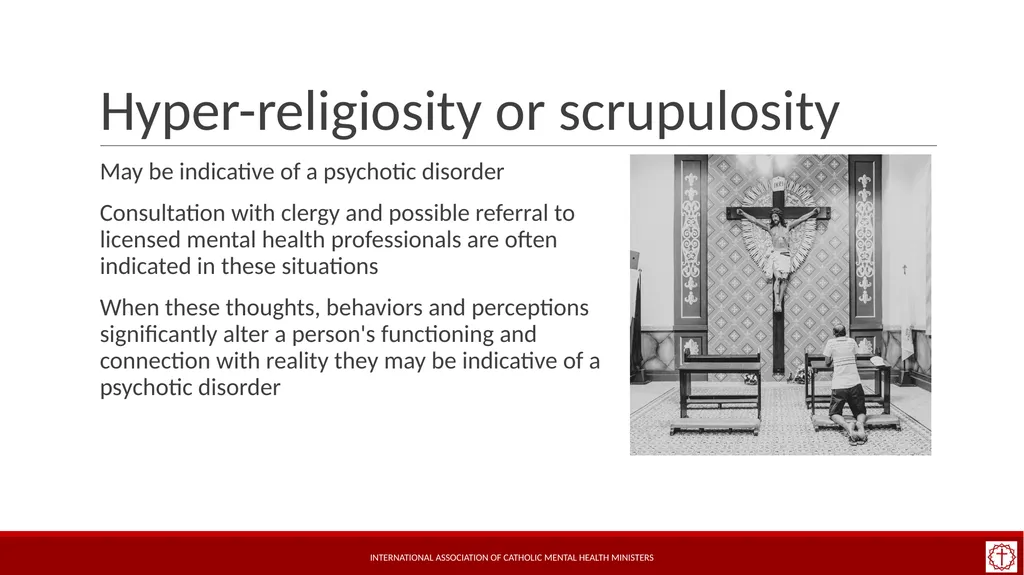
Hyper-religiosity or scrupulosity INTERNATIONAL ASSOCIATION OF CATHOLIC MENTAL HEALTH MINISTERS May be indicative of a psychotic disorder
Consultation with clergy and possible referral to licensed mental health professionals are often indicated in these situations
When these thoughts, behaviors and perceptions significantly alter a person's functioning and connection with reality they may be indicative of a psychotic disorder<br>
Consultation with clergy and possible referral to licensed mental health professionals are often indicated in these situations
When these thoughts, behaviors and perceptions significantly alter a person's functioning and connection with reality they may be indicative of a psychotic disorder<br>
26
Risk factors for schizophrenia Include genetic and family history
There is 10 percent risk of schizophrenia in individuals with at least one first degree biological relative with schizophrenia.
It is thought that a biological risk for the disorder is inherited that may be triggered by environmental or other stressors.
Stressors may include:
pregnancy and birth complications, including maternal influenza during pregnancy
exposure to environmental toxins
substance abuse INTERNATIONAL ASSOCIATION OF CATHOLIC MENTAL HEALTH MINISTERS<br>
There is 10 percent risk of schizophrenia in individuals with at least one first degree biological relative with schizophrenia.
It is thought that a biological risk for the disorder is inherited that may be triggered by environmental or other stressors.
Stressors may include:
pregnancy and birth complications, including maternal influenza during pregnancy
exposure to environmental toxins
substance abuse INTERNATIONAL ASSOCIATION OF CATHOLIC MENTAL HEALTH MINISTERS<br>
27
Lesson 3 vignette – Kate and Sarah SETTING:
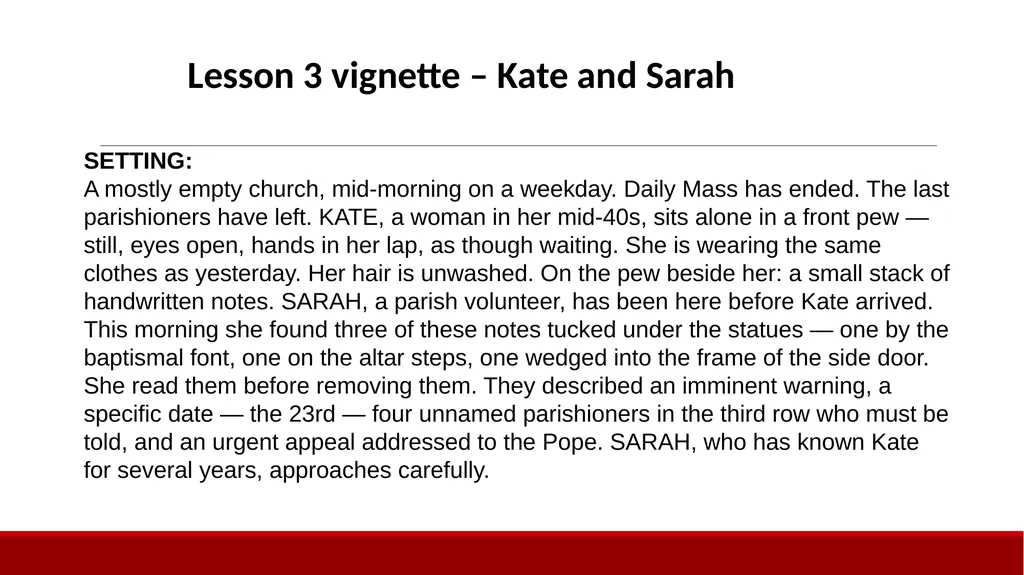
A mostly empty church, mid-morning on a weekday. Daily Mass has ended. The last parishioners have left. KATE, a woman in her mid-40s, sits alone in a front pew — still, eyes open, hands in her lap, as though waiting. She is wearing the same clothes as yesterday. Her hair is unwashed. On the pew beside her: a small stack of handwritten notes. SARAH, a parish volunteer, has been here before Kate arrived. This morning she found three of these notes tucked under the statues — one by the baptismal font, one on the altar steps, one wedged into the frame of the side door. She read them before removing them. They described an imminent warning, a specific date — the 23rd — four unnamed parishioners in the third row who must be told, and an urgent appeal addressed to the Pope. SARAH, who has known Kate for several years, approaches carefully.<br>
A mostly empty church, mid-morning on a weekday. Daily Mass has ended. The last parishioners have left. KATE, a woman in her mid-40s, sits alone in a front pew — still, eyes open, hands in her lap, as though waiting. She is wearing the same clothes as yesterday. Her hair is unwashed. On the pew beside her: a small stack of handwritten notes. SARAH, a parish volunteer, has been here before Kate arrived. This morning she found three of these notes tucked under the statues — one by the baptismal font, one on the altar steps, one wedged into the frame of the side door. She read them before removing them. They described an imminent warning, a specific date — the 23rd — four unnamed parishioners in the third row who must be told, and an urgent appeal addressed to the Pope. SARAH, who has known Kate for several years, approaches carefully.<br>
28
Lesson 3 vignette – Kate and Sarah SARAH: Kate. Hi. I've seen you here a few mornings now. And I found your notes this morning — the ones by the font and the altar.
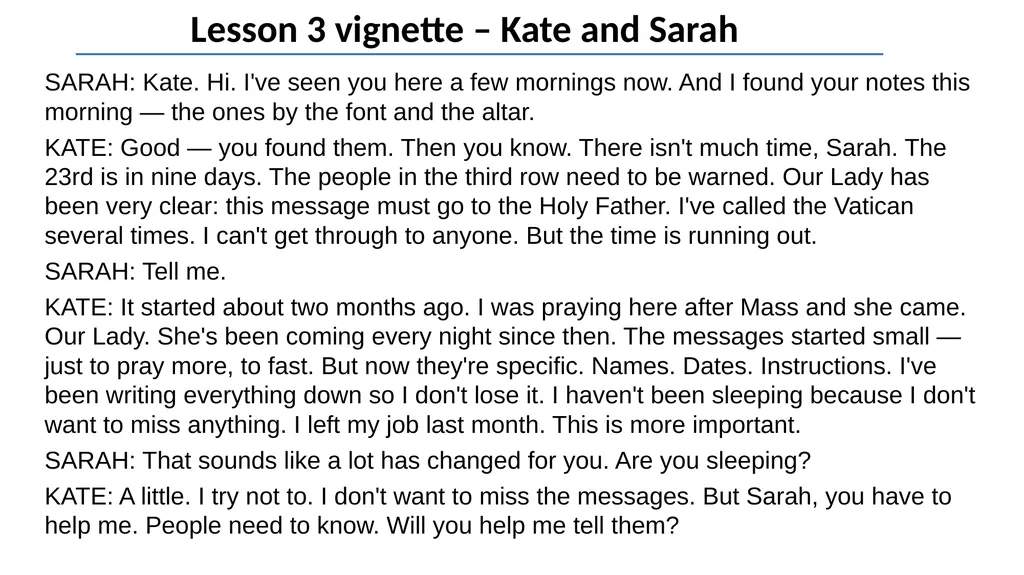
KATE: Good — you found them. Then you know. There isn't much time, Sarah. The 23rd is in nine days. The people in the third row need to be warned. Our Lady has been very clear: this message must go to the Holy Father. I've called the Vatican several times. I can't get through to anyone. But the time is running out.
SARAH: Tell me.
KATE: It started about two months ago. I was praying here after Mass and she came. Our Lady. She's been coming every night since then. The messages started small — just to pray more, to fast. But now they're specific. Names. Dates. Instructions. I've been writing everything down so I don't lose it. I haven't been sleeping because I don't want to miss anything. I left my job last month. This is more important.
SARAH: That sounds like a lot has changed for you. Are you sleeping?
KATE: A little. I try not to. I don't want to miss the messages. But Sarah, you have to help me. People need to know. Will you help me tell them?<br>
KATE: Good — you found them. Then you know. There isn't much time, Sarah. The 23rd is in nine days. The people in the third row need to be warned. Our Lady has been very clear: this message must go to the Holy Father. I've called the Vatican several times. I can't get through to anyone. But the time is running out.
SARAH: Tell me.
KATE: It started about two months ago. I was praying here after Mass and she came. Our Lady. She's been coming every night since then. The messages started small — just to pray more, to fast. But now they're specific. Names. Dates. Instructions. I've been writing everything down so I don't lose it. I haven't been sleeping because I don't want to miss anything. I left my job last month. This is more important.
SARAH: That sounds like a lot has changed for you. Are you sleeping?
KATE: A little. I try not to. I don't want to miss the messages. But Sarah, you have to help me. People need to know. Will you help me tell them?<br>
29
Lesson 3 vignette (cont.) – Kate and Sarah SARAH: Kate, I want to ask you something before we talk about that. Are you having any thoughts of hurting yourself or anyone else?
KATE: No. Of course not. This is a mission of love.
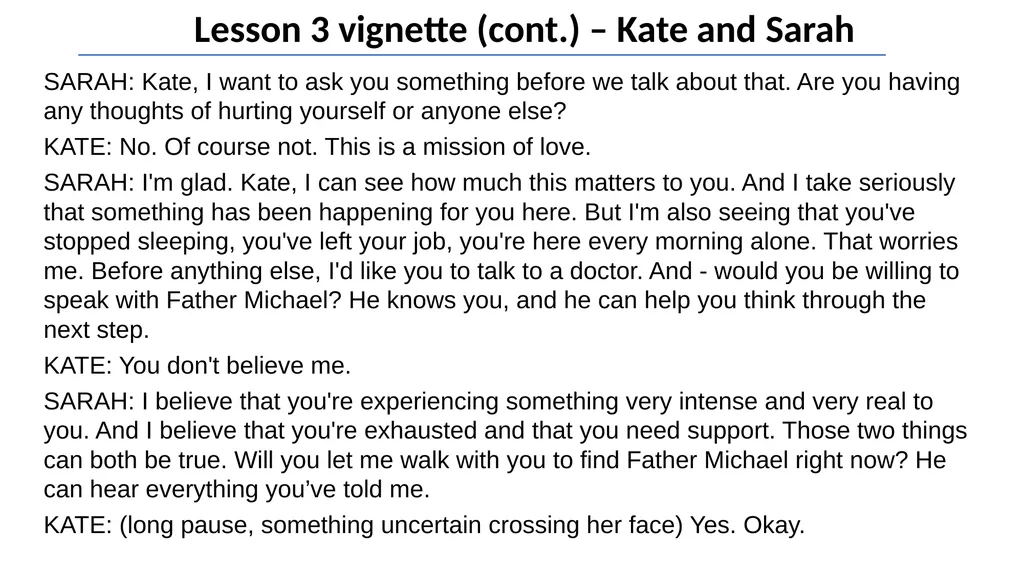
SARAH: I'm glad. Kate, I can see how much this matters to you. And I take seriously that something has been happening for you here. But I'm also seeing that you've stopped sleeping, you've left your job, you're here every morning alone. That worries me. Before anything else, I'd like you to talk to a doctor. And - would you be willing to speak with Father Michael? He knows you, and he can help you think through the next step.
KATE: You don't believe me.
SARAH: I believe that you're experiencing something very intense and very real to you. And I believe that you're exhausted and that you need support. Those two things can both be true. Will you let me walk with you to find Father Michael right now? He can hear everything you’ve told me.
KATE: (long pause, something uncertain crossing her face) Yes. Okay.<br>
KATE: No. Of course not. This is a mission of love.
SARAH: I'm glad. Kate, I can see how much this matters to you. And I take seriously that something has been happening for you here. But I'm also seeing that you've stopped sleeping, you've left your job, you're here every morning alone. That worries me. Before anything else, I'd like you to talk to a doctor. And - would you be willing to speak with Father Michael? He knows you, and he can help you think through the next step.
KATE: You don't believe me.
SARAH: I believe that you're experiencing something very intense and very real to you. And I believe that you're exhausted and that you need support. Those two things can both be true. Will you let me walk with you to find Father Michael right now? He can hear everything you’ve told me.
KATE: (long pause, something uncertain crossing her face) Yes. Okay.<br>
30
Lesson 3 Reflection How can one assist when there may be signs of a psychotic disorder when hyper-religiosity and scrupulosity are present in a Catholic context?
Considering the importance of early recognition and intervention in cases of schizophrenia and psychotic disorders. How can understanding the signs and symptoms, as demonstrated in the vignette with Kate and Sarah, help in providing timely support and resources to individuals experiencing these mental health challenges? INTERNATIONAL ASSOCIATION OF CATHOLIC MENTAL HEALTH MINISTERS<br>
Considering the importance of early recognition and intervention in cases of schizophrenia and psychotic disorders. How can understanding the signs and symptoms, as demonstrated in the vignette with Kate and Sarah, help in providing timely support and resources to individuals experiencing these mental health challenges? INTERNATIONAL ASSOCIATION OF CATHOLIC MENTAL HEALTH MINISTERS<br>
31
Lesson 4 RECOGNIZING THE SIGNS AND SYMPTOMS OF BIPOLAR DISORDERS INTERNATIONAL ASSOCIATION OF CATHOLIC MENTAL HEALTH MINISTERS<br>
32
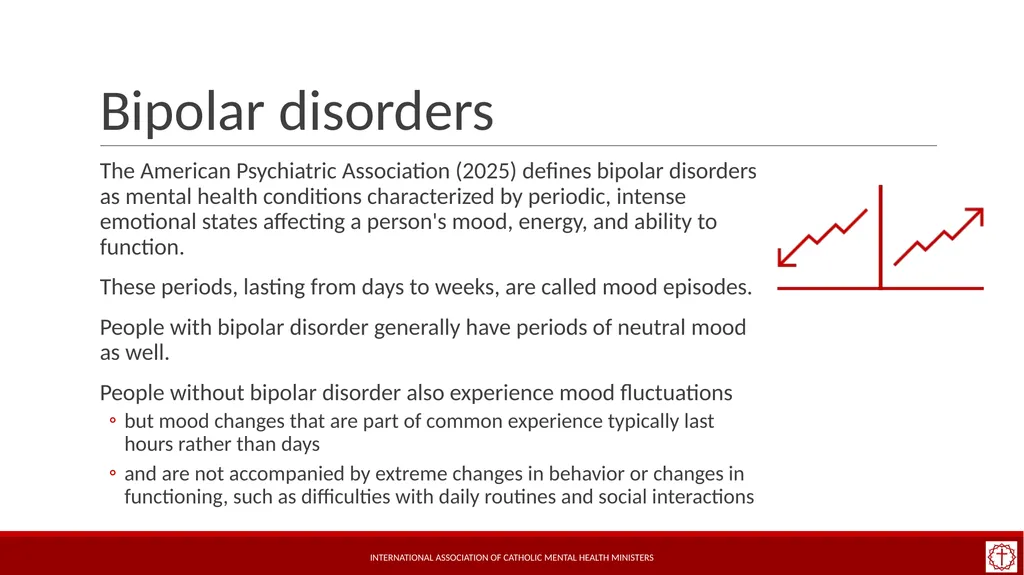
Bipolar disorders The American Psychiatric Association (2025) defines bipolar disorders as mental health conditions characterized by periodic, intense emotional states affecting a person's mood, energy, and ability to function.
These periods, lasting from days to weeks, are called mood episodes.
People with bipolar disorder generally have periods of neutral mood as well.
People without bipolar disorder also experience mood fluctuations
but mood changes that are part of common experience typically last hours rather than days
and are not accompanied by extreme changes in behavior or changes in functioning, such as difficulties with daily routines and social interactions INTERNATIONAL ASSOCIATION OF CATHOLIC MENTAL HEALTH MINISTERS<br>
These periods, lasting from days to weeks, are called mood episodes.
People with bipolar disorder generally have periods of neutral mood as well.
People without bipolar disorder also experience mood fluctuations
but mood changes that are part of common experience typically last hours rather than days
and are not accompanied by extreme changes in behavior or changes in functioning, such as difficulties with daily routines and social interactions INTERNATIONAL ASSOCIATION OF CATHOLIC MENTAL HEALTH MINISTERS<br>
33
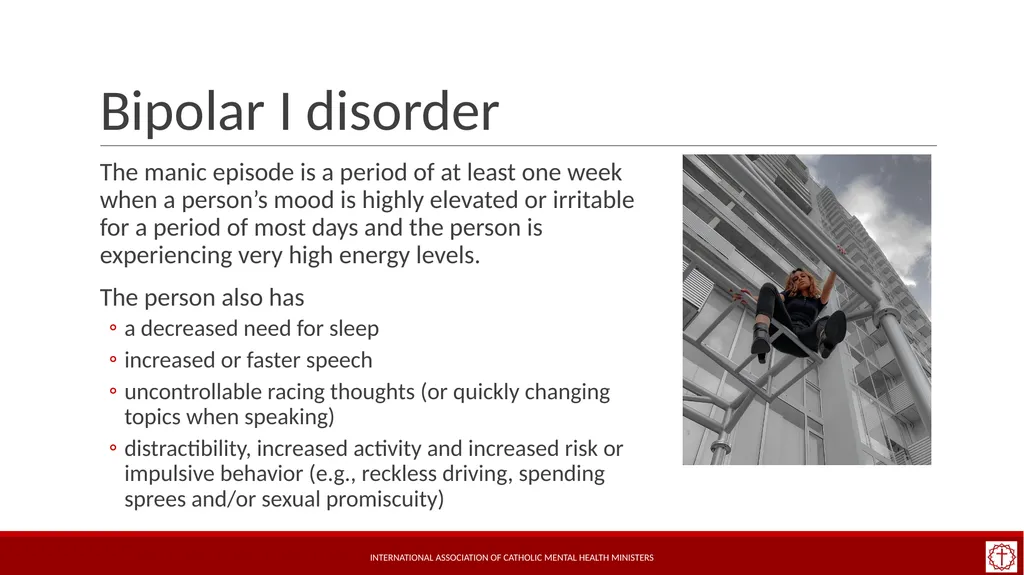
Bipolar I disorder The manic episode is a period of at least one week when a person’s mood is highly elevated or irritable for a period of most days and the person is experiencing very high energy levels.
The person also has
a decreased need for sleep
increased or faster speech
uncontrollable racing thoughts (or quickly changing topics when speaking)
distractibility, increased activity and increased risk or impulsive behavior (e.g., reckless driving, spending sprees and/or sexual promiscuity) INTERNATIONAL ASSOCIATION OF CATHOLIC MENTAL HEALTH MINISTERS<br>
The person also has
a decreased need for sleep
increased or faster speech
uncontrollable racing thoughts (or quickly changing topics when speaking)
distractibility, increased activity and increased risk or impulsive behavior (e.g., reckless driving, spending sprees and/or sexual promiscuity) INTERNATIONAL ASSOCIATION OF CATHOLIC MENTAL HEALTH MINISTERS<br>
34
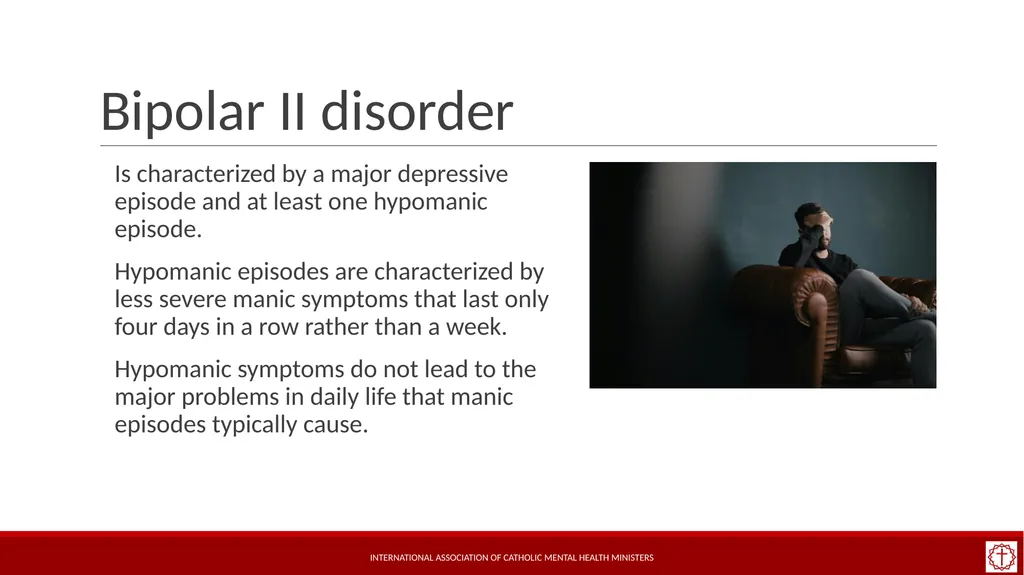
Bipolar II disorder Is characterized by a major depressive episode and at least one hypomanic episode.
Hypomanic episodes are characterized by less severe manic symptoms that last only four days in a row rather than a week.
Hypomanic symptoms do not lead to the major problems in daily life that manic episodes typically cause. INTERNATIONAL ASSOCIATION OF CATHOLIC MENTAL HEALTH MINISTERS<br>
Hypomanic episodes are characterized by less severe manic symptoms that last only four days in a row rather than a week.
Hypomanic symptoms do not lead to the major problems in daily life that manic episodes typically cause. INTERNATIONAL ASSOCIATION OF CATHOLIC MENTAL HEALTH MINISTERS<br>
35
Risk factors The age of onset for bipolar disorders tends to be in the early 20s.
The risk of suicide is significantly higher among people with bipolar I disorder than among the general population.
Ongoing substance abuse can complicate treatment and recovery from bipolar I disorder
Other risk factors
genetic predisposition and family history
childhood trauma
stressful life events and substance abuse INTERNATIONAL ASSOCIATION OF CATHOLIC MENTAL HEALTH MINISTERS<br>
The risk of suicide is significantly higher among people with bipolar I disorder than among the general population.
Ongoing substance abuse can complicate treatment and recovery from bipolar I disorder
Other risk factors
genetic predisposition and family history
childhood trauma
stressful life events and substance abuse INTERNATIONAL ASSOCIATION OF CATHOLIC MENTAL HEALTH MINISTERS<br>
36
Lesson 4 vignette: Jane and Tina SETTING:
Parish meeting room, after a volunteer coordination meeting. Chairs still pulled out, papers on the table. JANE is stacking chairs quickly, humming to herself, moving with more energy than the task requires. TINA lingers after the others have left. They've been friends or three years. JANE is bright, energized, fast-talking, warm, and entirely convinced she is fine. INTERNATIONAL ASSOCIATION OF CATHOLIC MENTAL HEALTH MINISTERS<br>
Parish meeting room, after a volunteer coordination meeting. Chairs still pulled out, papers on the table. JANE is stacking chairs quickly, humming to herself, moving with more energy than the task requires. TINA lingers after the others have left. They've been friends or three years. JANE is bright, energized, fast-talking, warm, and entirely convinced she is fine. INTERNATIONAL ASSOCIATION OF CATHOLIC MENTAL HEALTH MINISTERS<br>
37
Lesson 4 vignette – Tina and Jane TINA: Hey — leave those. I wanted to catch you for a minute.
JANE: Catch me? I'm right here. Did you see how much we got done tonight? I think we can add two more events before Easter. I was thinking a retreat weekend and maybe a youth outreach — I already drafted an outline, I'll send it to you tonight.
TINA: Jane. Can you sit down for a second?
JANE: What's wrong?
TINA: Nothing's wrong. I just — I've been noticing some things, and I wanted to talk to you about them. Not to worry you. Just because I care about you.
JANE: Okay...
TINA: You've taken on four new volunteer roles since January. You've been calling people after ten at night with ideas. Maria mentioned you bought a new car last week — on the same day you saw it. And when I ask how you're sleeping, you say three or four hours but you seem fine with that.
JANE: I am fine with it. I feel great, actually. Better than I have in a long time. Isn't that allowed?<br>
JANE: Catch me? I'm right here. Did you see how much we got done tonight? I think we can add two more events before Easter. I was thinking a retreat weekend and maybe a youth outreach — I already drafted an outline, I'll send it to you tonight.
TINA: Jane. Can you sit down for a second?
JANE: What's wrong?
TINA: Nothing's wrong. I just — I've been noticing some things, and I wanted to talk to you about them. Not to worry you. Just because I care about you.
JANE: Okay...
TINA: You've taken on four new volunteer roles since January. You've been calling people after ten at night with ideas. Maria mentioned you bought a new car last week — on the same day you saw it. And when I ask how you're sleeping, you say three or four hours but you seem fine with that.
JANE: I am fine with it. I feel great, actually. Better than I have in a long time. Isn't that allowed?<br>
38
Lesson 4 vignette (cont.) – Tina and Jane TINA: Of course it is. I'm glad you feel good. It's just — the combination of things. The pace. I’ve known you for three years, Jane, and this is a different gear.
JANE: So, what are you saying? That I'm too enthusiastic? That I shouldn't be taking things on?
TINA: I'm not saying you should stop anything. I'm saying I've noticed a pattern, and I think it might be worth talking to your doctor about. Just to have a conversation. That's all.
JANE: I haven't been to the doctor in a while.
TINA: Can I ask, have there been times before when you felt this way? This much energy, this much going on at once? And then afterward, a period when things got very heavy?
JANE: (quietly, after a moment) A few times. A few years back. It didn't last.
TINA: Would you be willing to mention that to a doctor? You don't have to go in with a diagnosis or an explanation. Just tell them what you told me — that this has happened before, and you want to understand it.
JANE: I'll think about it.
TINA: That's enough. Thank you for hearing me out.<br>
JANE: So, what are you saying? That I'm too enthusiastic? That I shouldn't be taking things on?
TINA: I'm not saying you should stop anything. I'm saying I've noticed a pattern, and I think it might be worth talking to your doctor about. Just to have a conversation. That's all.
JANE: I haven't been to the doctor in a while.
TINA: Can I ask, have there been times before when you felt this way? This much energy, this much going on at once? And then afterward, a period when things got very heavy?
JANE: (quietly, after a moment) A few times. A few years back. It didn't last.
TINA: Would you be willing to mention that to a doctor? You don't have to go in with a diagnosis or an explanation. Just tell them what you told me — that this has happened before, and you want to understand it.
JANE: I'll think about it.
TINA: That's enough. Thank you for hearing me out.<br>
39
Lesson 4 Reflection How can one differentiate between normal mood fluctuations and the mood episodes characteristic of bipolar disorders?
Reflect on the key signs and symptoms of bipolar I and bipolar II disorders, how can recognizing these help in providing timely support and intervention? INTERNATIONAL ASSOCIATION OF CATHOLIC MENTAL HEALTH MINISTERS<br>
Reflect on the key signs and symptoms of bipolar I and bipolar II disorders, how can recognizing these help in providing timely support and intervention? INTERNATIONAL ASSOCIATION OF CATHOLIC MENTAL HEALTH MINISTERS<br>
40
Lesson 5 RECOGNIZING THE SIGNS AND SYMPTOMS OF TRAUMA AND POST-TRAUMATIC STRESS DISORDERS INTERNATIONAL ASSOCIATION OF CATHOLIC MENTAL HEALTH MINISTERS<br>
41
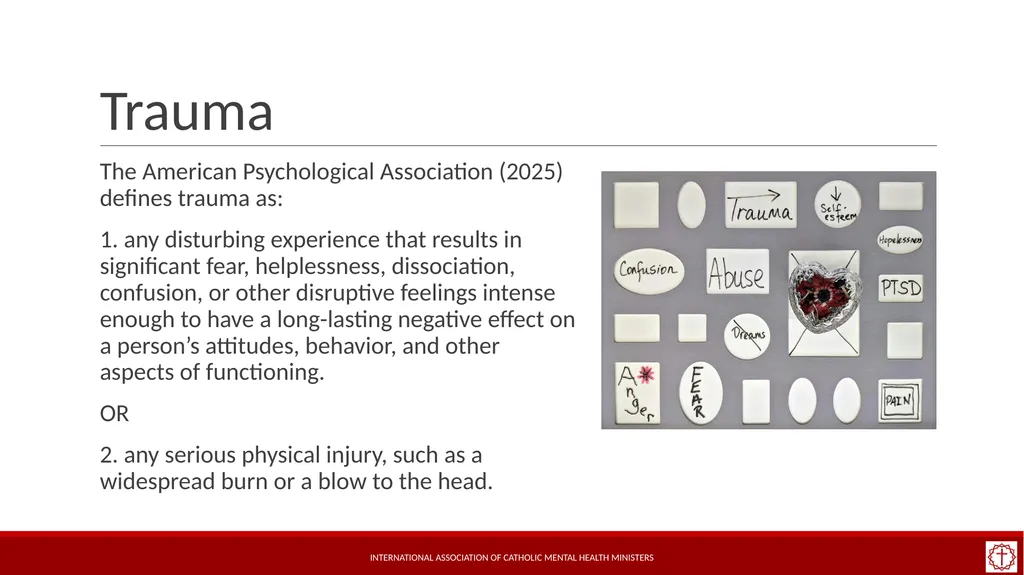
Trauma The American Psychological Association (2025) defines trauma as:
1. any disturbing experience that results in significant fear, helplessness, dissociation, confusion, or other disruptive feelings intense enough to have a long-lasting negative effect on a person’s attitudes, behavior, and other aspects of functioning.
OR
2. any serious physical injury, such as a widespread burn or a blow to the head. INTERNATIONAL ASSOCIATION OF CATHOLIC MENTAL HEALTH MINISTERS<br>
1. any disturbing experience that results in significant fear, helplessness, dissociation, confusion, or other disruptive feelings intense enough to have a long-lasting negative effect on a person’s attitudes, behavior, and other aspects of functioning.
OR
2. any serious physical injury, such as a widespread burn or a blow to the head. INTERNATIONAL ASSOCIATION OF CATHOLIC MENTAL HEALTH MINISTERS<br>
42
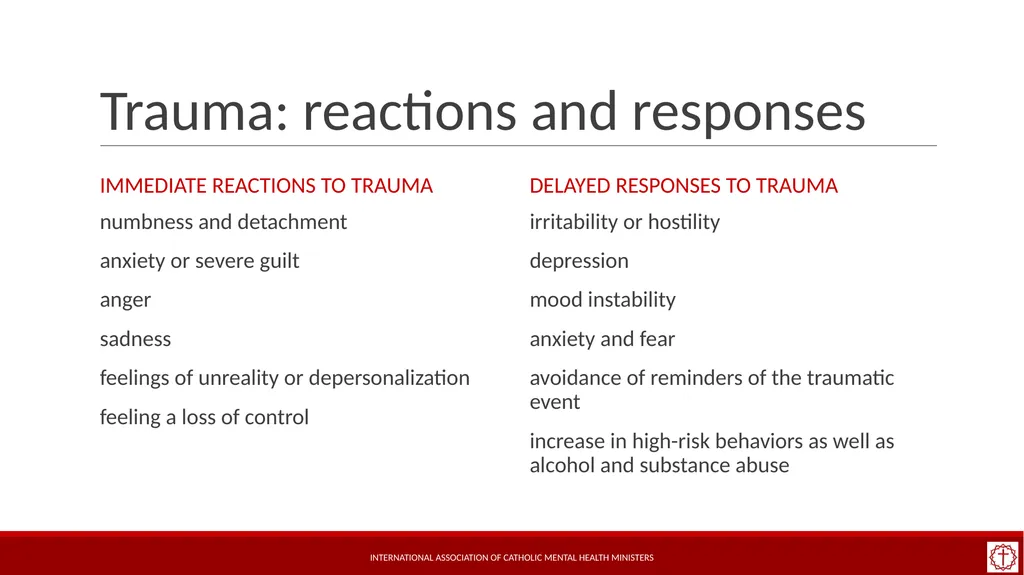
Trauma: reactions and responses IMMEDIATE REACTIONS TO TRAUMA numbness and detachment
anxiety or severe guilt
anger
sadness
feelings of unreality or depersonalization
feeling a loss of control DELAYED RESPONSES TO TRAUMA irritability or hostility
depression
mood instability
anxiety and fear
avoidance of reminders of the traumatic event
increase in high-risk behaviors as well as alcohol and substance abuse INTERNATIONAL ASSOCIATION OF CATHOLIC MENTAL HEALTH MINISTERS<br>
anxiety or severe guilt
anger
sadness
feelings of unreality or depersonalization
feeling a loss of control DELAYED RESPONSES TO TRAUMA irritability or hostility
depression
mood instability
anxiety and fear
avoidance of reminders of the traumatic event
increase in high-risk behaviors as well as alcohol and substance abuse INTERNATIONAL ASSOCIATION OF CATHOLIC MENTAL HEALTH MINISTERS<br>
43
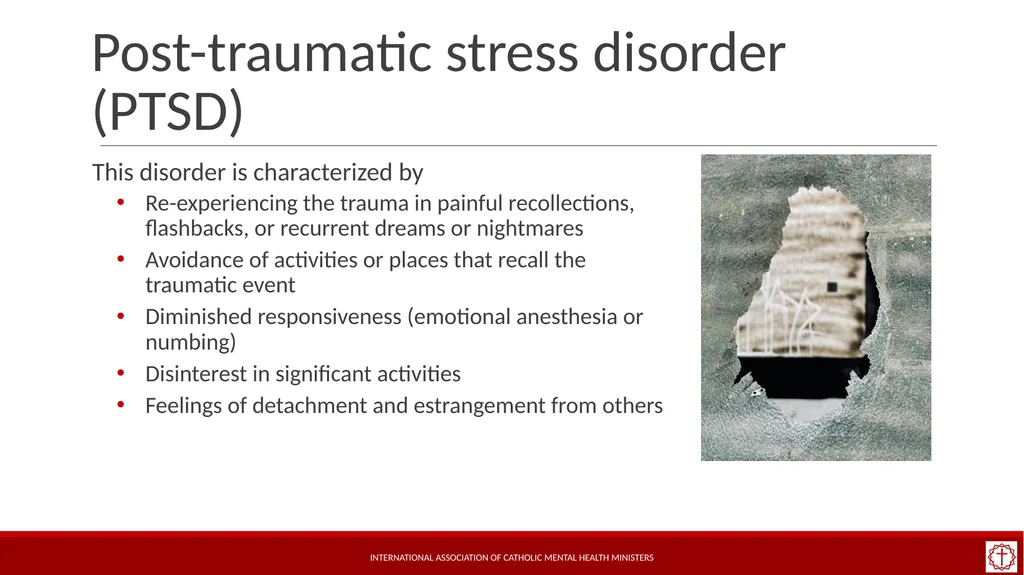
Post-traumatic stress disorder (PTSD) This disorder is characterized by
Re-experiencing the trauma in painful recollections, flashbacks, or recurrent dreams or nightmares
Avoidance of activities or places that recall the traumatic event
Diminished responsiveness (emotional anesthesia or numbing)
Disinterest in significant activities
Feelings of detachment and estrangement from others INTERNATIONAL ASSOCIATION OF CATHOLIC MENTAL HEALTH MINISTERS<br>
Re-experiencing the trauma in painful recollections, flashbacks, or recurrent dreams or nightmares
Avoidance of activities or places that recall the traumatic event
Diminished responsiveness (emotional anesthesia or numbing)
Disinterest in significant activities
Feelings of detachment and estrangement from others INTERNATIONAL ASSOCIATION OF CATHOLIC MENTAL HEALTH MINISTERS<br>
44
The primary risk factor for post-traumatic stress disorder (PTSD) is the experiencing of a traumatic event.
Other risk factors:
A prior history of trauma, especially repeated trauma beginning in childhood.
Other mental health conditions such as depression and anxiety.
Social and environmental factors including lack of social support, poverty and stressful life events.
Biological factors such as genetics, brain chemistry and sex (ie, women are somewhat more likely to develop PTSD).
Personality traits such as neuroticism and lower intelligence. Risk factors INTERNATIONAL ASSOCIATION OF CATHOLIC MENTAL HEALTH MINISTERS<br>
Other risk factors:
A prior history of trauma, especially repeated trauma beginning in childhood.
Other mental health conditions such as depression and anxiety.
Social and environmental factors including lack of social support, poverty and stressful life events.
Biological factors such as genetics, brain chemistry and sex (ie, women are somewhat more likely to develop PTSD).
Personality traits such as neuroticism and lower intelligence. Risk factors INTERNATIONAL ASSOCIATION OF CATHOLIC MENTAL HEALTH MINISTERS<br>
45
SETTING:
Parish hall, after Sunday Mass, late morning. A few parishioners linger near the food table, talking. CHRIS, 30s, sits alone at a table to one side, a cup of coffee untouched in front of him. He is not disheveled, but he looks tired. ALEXIS, 40s, a parishioner who knew Chris before his military deployment, notices him from across the room and crosses to him. Lesson 5 vignette – Chris and Alex<br>
Parish hall, after Sunday Mass, late morning. A few parishioners linger near the food table, talking. CHRIS, 30s, sits alone at a table to one side, a cup of coffee untouched in front of him. He is not disheveled, but he looks tired. ALEXIS, 40s, a parishioner who knew Chris before his military deployment, notices him from across the room and crosses to him. Lesson 5 vignette – Chris and Alex<br>
46
Lesson 5 vignette – Chris and Alex ALEXIS: Chris. Mind if I sit?
CHRIS: Not at all.
ALEXIS: You’ve been coming to the early Mass lately. Slipping out before the social hour. We’ve missed you.
CHRIS: Crowds have been... a lot. Since I got back.
ALEXIS: How long has it been — about nine months now?
CHRIS: Yeah. It should be easier by now. (Across the room, someone sets down a metal tray. The clatter is sudden. CHRIS startles — hands flat on the table, shoulders up. He catches himself. A beat. He is aware Alexis noticed.)
CHRIS: Sorry.
ALEXIS: Don’t apologize. Is that happening often?
CHRIS: The nights are worse. I keep having these dreams. Sometimes it’s like I’m right back there. I wake up at three in the morning and I can’t...
ALEXIS: How long has that been going on?<br>
CHRIS: Not at all.
ALEXIS: You’ve been coming to the early Mass lately. Slipping out before the social hour. We’ve missed you.
CHRIS: Crowds have been... a lot. Since I got back.
ALEXIS: How long has it been — about nine months now?
CHRIS: Yeah. It should be easier by now. (Across the room, someone sets down a metal tray. The clatter is sudden. CHRIS startles — hands flat on the table, shoulders up. He catches himself. A beat. He is aware Alexis noticed.)
CHRIS: Sorry.
ALEXIS: Don’t apologize. Is that happening often?
CHRIS: The nights are worse. I keep having these dreams. Sometimes it’s like I’m right back there. I wake up at three in the morning and I can’t...
ALEXIS: How long has that been going on?<br>
47
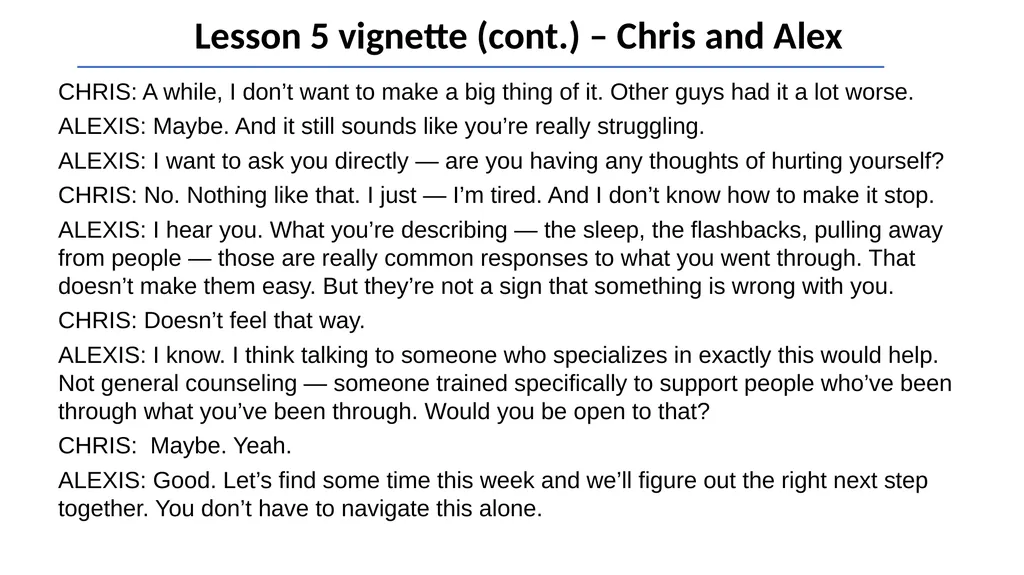
Lesson 5 vignette (cont.) – Chris and Alex CHRIS: A while, I don’t want to make a big thing of it. Other guys had it a lot worse.
ALEXIS: Maybe. And it still sounds like you’re really struggling.
ALEXIS: I want to ask you directly — are you having any thoughts of hurting yourself?
CHRIS: No. Nothing like that. I just — I’m tired. And I don’t know how to make it stop.
ALEXIS: I hear you. What you’re describing — the sleep, the flashbacks, pulling away from people — those are really common responses to what you went through. That doesn’t make them easy. But they’re not a sign that something is wrong with you.
CHRIS: Doesn’t feel that way.
ALEXIS: I know. I think talking to someone who specializes in exactly this would help. Not general counseling — someone trained specifically to support people who’ve been through what you’ve been through. Would you be open to that?
CHRIS: Maybe. Yeah.
ALEXIS: Good. Let’s find some time this week and we’ll figure out the right next step together. You don’t have to navigate this alone.<br>
ALEXIS: Maybe. And it still sounds like you’re really struggling.
ALEXIS: I want to ask you directly — are you having any thoughts of hurting yourself?
CHRIS: No. Nothing like that. I just — I’m tired. And I don’t know how to make it stop.
ALEXIS: I hear you. What you’re describing — the sleep, the flashbacks, pulling away from people — those are really common responses to what you went through. That doesn’t make them easy. But they’re not a sign that something is wrong with you.
CHRIS: Doesn’t feel that way.
ALEXIS: I know. I think talking to someone who specializes in exactly this would help. Not general counseling — someone trained specifically to support people who’ve been through what you’ve been through. Would you be open to that?
CHRIS: Maybe. Yeah.
ALEXIS: Good. Let’s find some time this week and we’ll figure out the right next step together. You don’t have to navigate this alone.<br>
48
Lesson 5 Reflection What are some normal emotional responses to trauma? What are some signs of Post-Traumatic Stress Disorder (PTSD)?
How can recognizing avoidance behaviors and diminished responsiveness help in accompaniment for individuals who have experienced trauma? INTERNATIONAL ASSOCIATION OF CATHOLIC MENTAL HEALTH MINISTERS<br>
How can recognizing avoidance behaviors and diminished responsiveness help in accompaniment for individuals who have experienced trauma? INTERNATIONAL ASSOCIATION OF CATHOLIC MENTAL HEALTH MINISTERS<br>
49
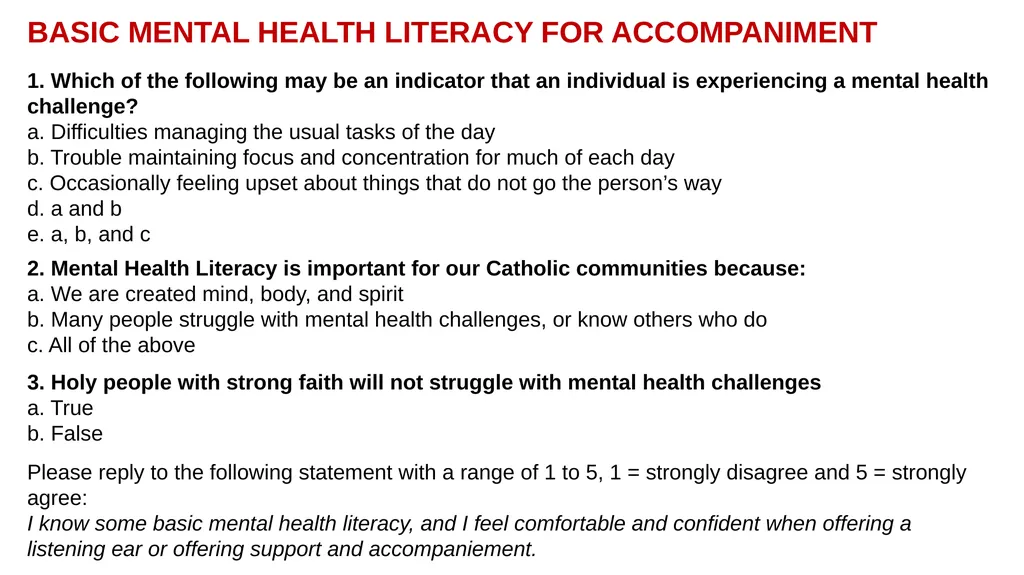
BASIC MENTAL HEALTH LITERACY FOR ACCOMPANIMENT
1. Which of the following may be an indicator that an individual is experiencing a mental health challenge?
a. Difficulties managing the usual tasks of the day
b. Trouble maintaining focus and concentration for much of each day
c. Occasionally feeling upset about things that do not go the person’s way
d. a and b
e. a, b, and c
2. Mental Health Literacy is important for our Catholic communities because:
a. We are created mind, body, and spirit
b. Many people struggle with mental health challenges, or know others who do
c. All of the above
3. Holy people with strong faith will not struggle with mental health challenges
a. True
b. False
Please reply to the following statement with a range of 1 to 5, 1 = strongly disagree and 5 = strongly agree:
I know some basic mental health literacy, and I feel comfortable and confident when offering a listening ear or offering support and accompaniement.<br>
1. Which of the following may be an indicator that an individual is experiencing a mental health challenge?
a. Difficulties managing the usual tasks of the day
b. Trouble maintaining focus and concentration for much of each day
c. Occasionally feeling upset about things that do not go the person’s way
d. a and b
e. a, b, and c
2. Mental Health Literacy is important for our Catholic communities because:
a. We are created mind, body, and spirit
b. Many people struggle with mental health challenges, or know others who do
c. All of the above
3. Holy people with strong faith will not struggle with mental health challenges
a. True
b. False
Please reply to the following statement with a range of 1 to 5, 1 = strongly disagree and 5 = strongly agree:
I know some basic mental health literacy, and I feel comfortable and confident when offering a listening ear or offering support and accompaniement.<br>
50
Congratulations You have completed Lessons 1 through 5, of the content included in CMHM’s
Basic Mental Health Literacy for Accompaniment! INTERNATIONAL ASSOCIATION OF CATHOLIC MENTAL HEALTH MINISTERS<br>
Basic Mental Health Literacy for Accompaniment! INTERNATIONAL ASSOCIATION OF CATHOLIC MENTAL HEALTH MINISTERS<br>