
Be healthy, be active! A Healthy eating Challenge
CP
Published · 28 slides · 0 views

1 / 1

Description
Be healthy, be active! A Healthy eating Challenge for pupils aged 7-11 years The Challenge Plan and create a Healthy Food, Healthy You display for your school dining room or entrance to encourage the school community to be healthy and
Related Topics
Share
Embed code
Download this presentation From Below
"Be healthy, be active! A Healthy eating Challenge" is the property of its rightful owner. Permission is granted to download and print the materials on this website for personal, non-commercial use only, and to display it on your personal computer provided you do not modify the materials and that you retain all copyright notices contained in the materials. By downloading content from our website, you accept the terms of this agreement.
Presentation Transcript
01
Be healthy, be active! A Healthy eating Challenge for pupils aged 7-11 years<br>
02
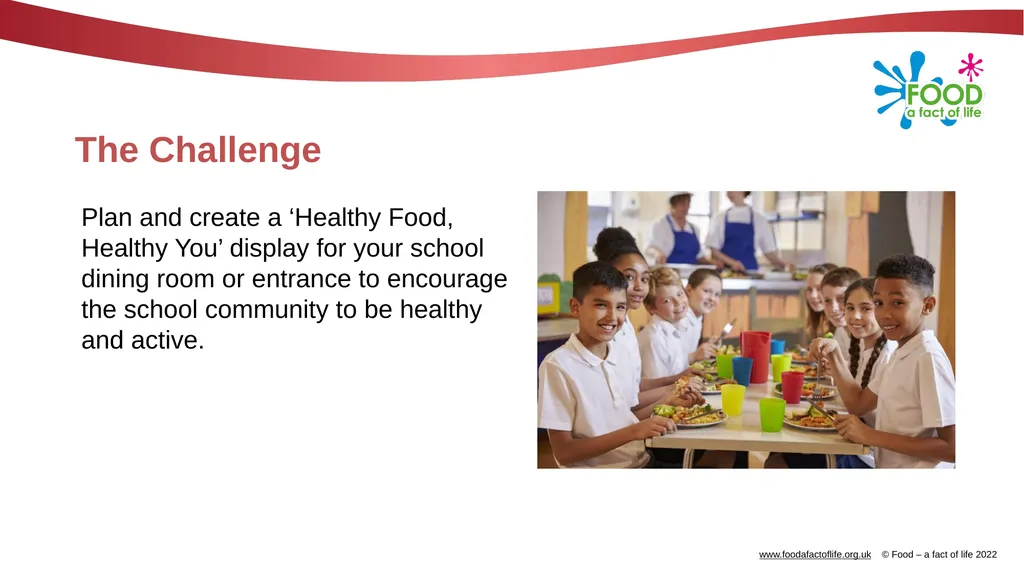
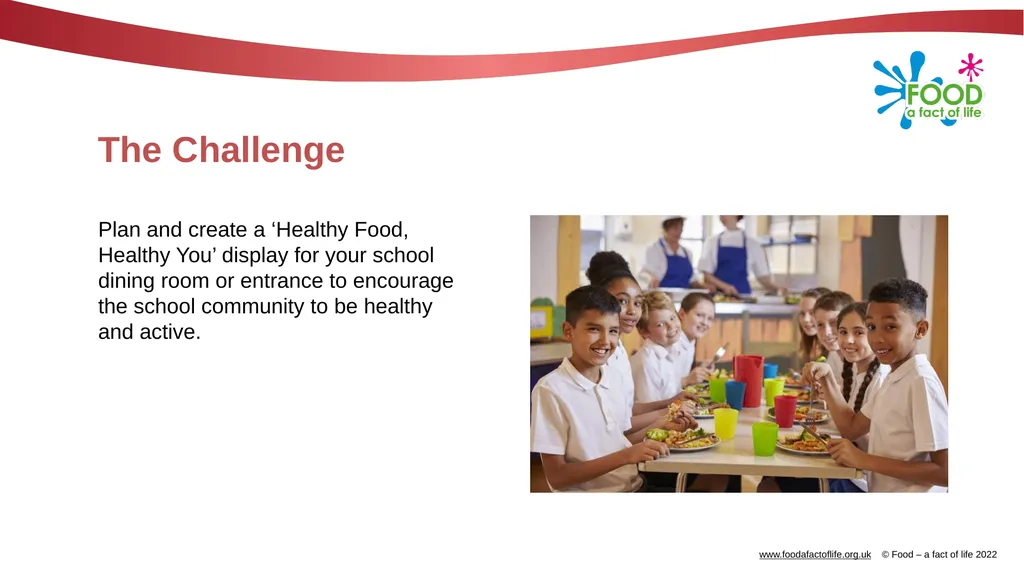
The Challenge Plan and create a ‘Healthy Food, Healthy You’ display for your school dining room or entrance to encourage the school community to be healthy and active.<br>
03
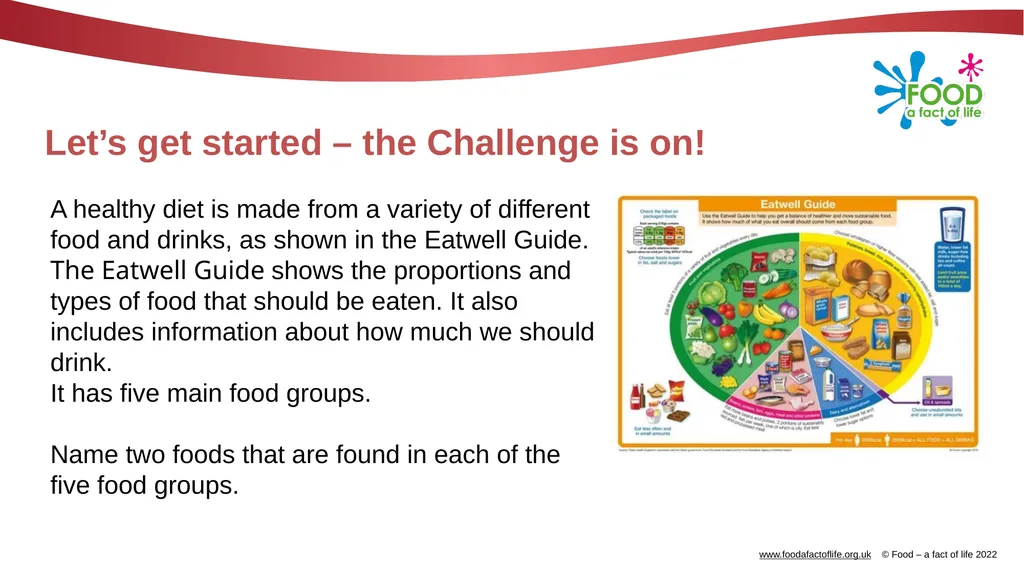
Let’s get started – the Challenge is on! A healthy diet is made from a variety of different food and drinks, as shown in the Eatwell Guide.
The Eatwell Guide shows the proportions and types of food that should be eaten. It also includes information about how much we should drink.
It has five main food groups.
Name two foods that are found in each of the five food groups.<br>
The Eatwell Guide shows the proportions and types of food that should be eaten. It also includes information about how much we should drink.
It has five main food groups.
Name two foods that are found in each of the five food groups.<br>
04
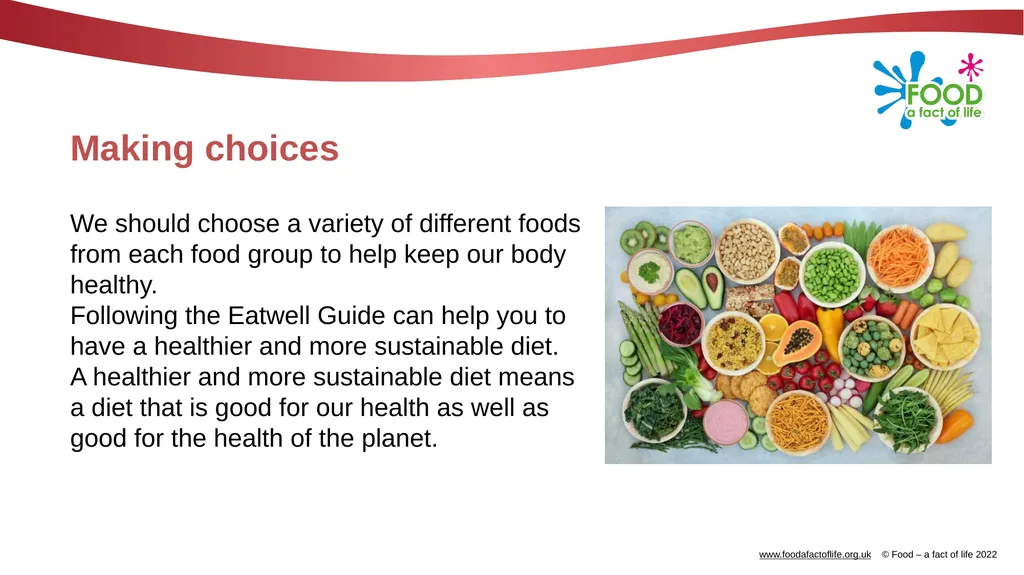
Making choices We should choose a variety of different foods from each food group to help keep our body healthy.
Following the Eatwell Guide can help you to have a healthier and more sustainable diet.
A healthier and more sustainable diet means a diet that is good for our health as well as good for the health of the planet.<br>
Following the Eatwell Guide can help you to have a healthier and more sustainable diet.
A healthier and more sustainable diet means a diet that is good for our health as well as good for the health of the planet.<br>
05
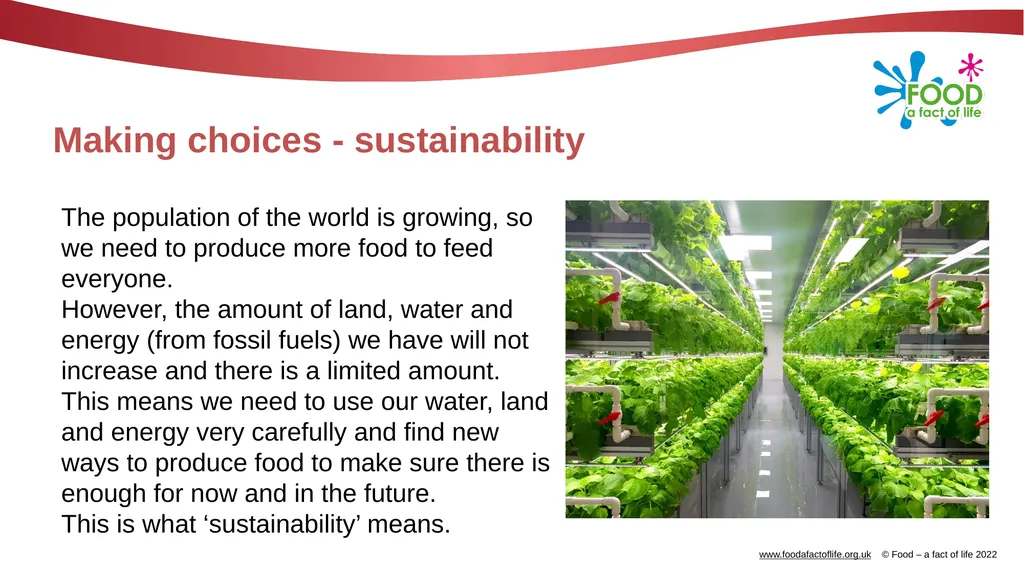
Making choices - sustainability The population of the world is growing, so we need to produce more food to feed everyone.
However, the amount of land, water and energy (from fossil fuels) we have will not increase and there is a limited amount.
This means we need to use our water, land and energy very carefully and find new ways to produce food to make sure there is enough for now and in the future.
This is what ‘sustainability’ means.<br>
However, the amount of land, water and energy (from fossil fuels) we have will not increase and there is a limited amount.
This means we need to use our water, land and energy very carefully and find new ways to produce food to make sure there is enough for now and in the future.
This is what ‘sustainability’ means.<br>
06
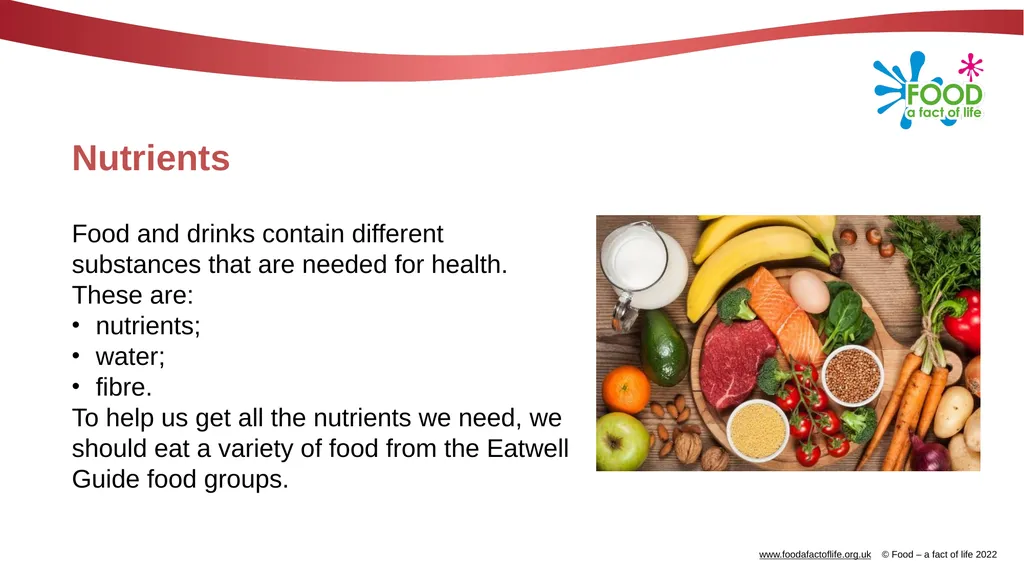
Nutrients Food and drinks contain different substances that are needed for health.
These are:
nutrients;
water;
fibre.
To help us get all the nutrients we need, we should eat a variety of food from the Eatwell Guide food groups.<br>
These are:
nutrients;
water;
fibre.
To help us get all the nutrients we need, we should eat a variety of food from the Eatwell Guide food groups.<br>
07
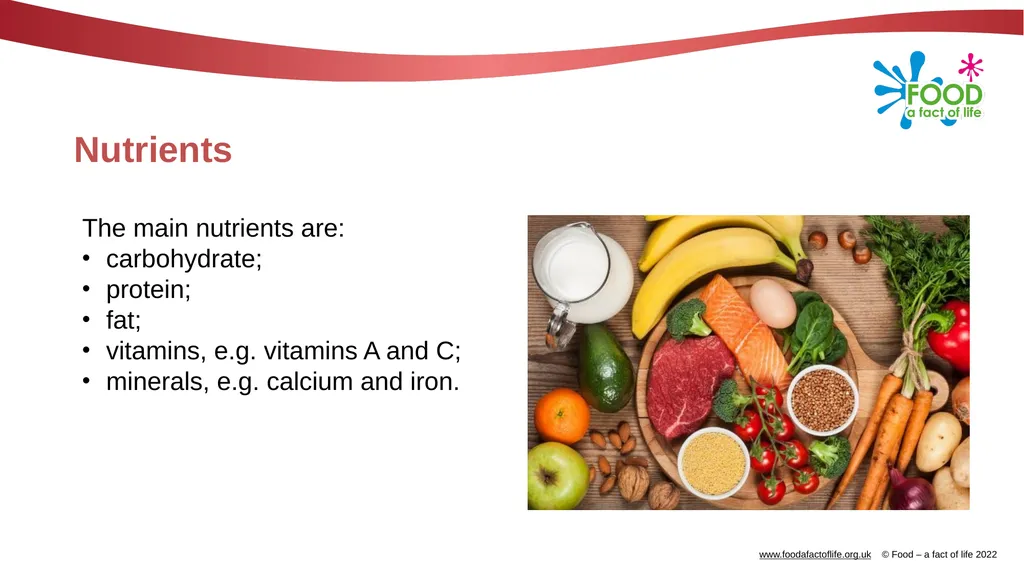
Nutrients The main nutrients are:
carbohydrate;
protein;
fat;
vitamins, e.g. vitamins A and C;
minerals, e.g. calcium and iron.<br>
carbohydrate;
protein;
fat;
vitamins, e.g. vitamins A and C;
minerals, e.g. calcium and iron.<br>
08
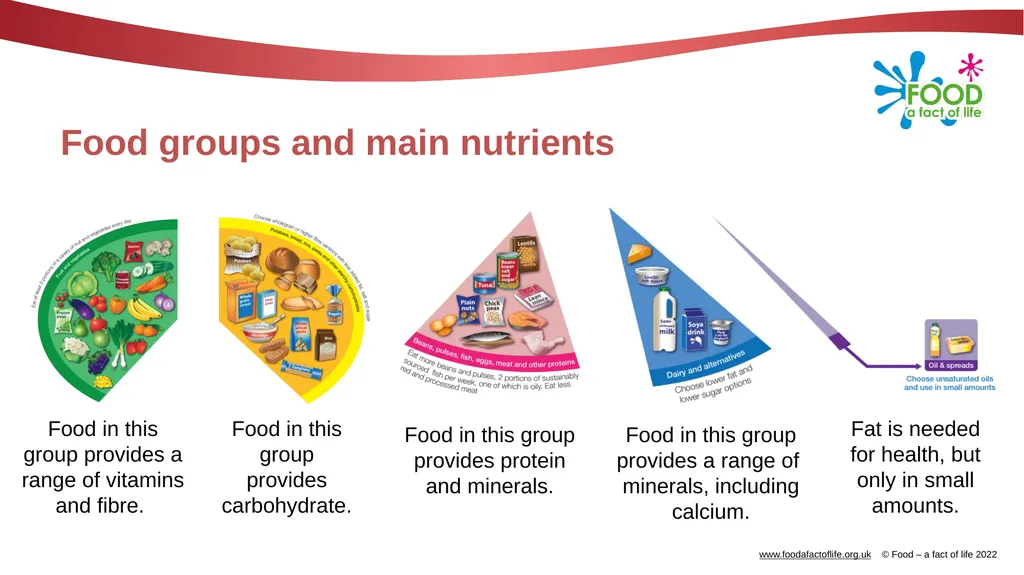
Food groups and main nutrients Food in this group provides a range of vitamins and fibre. Food in this group provides carbohydrate. Food in this group provides protein and minerals. Food in this group provides a range of minerals, including calcium. Fat is needed for health, but only in small amounts.<br>
09
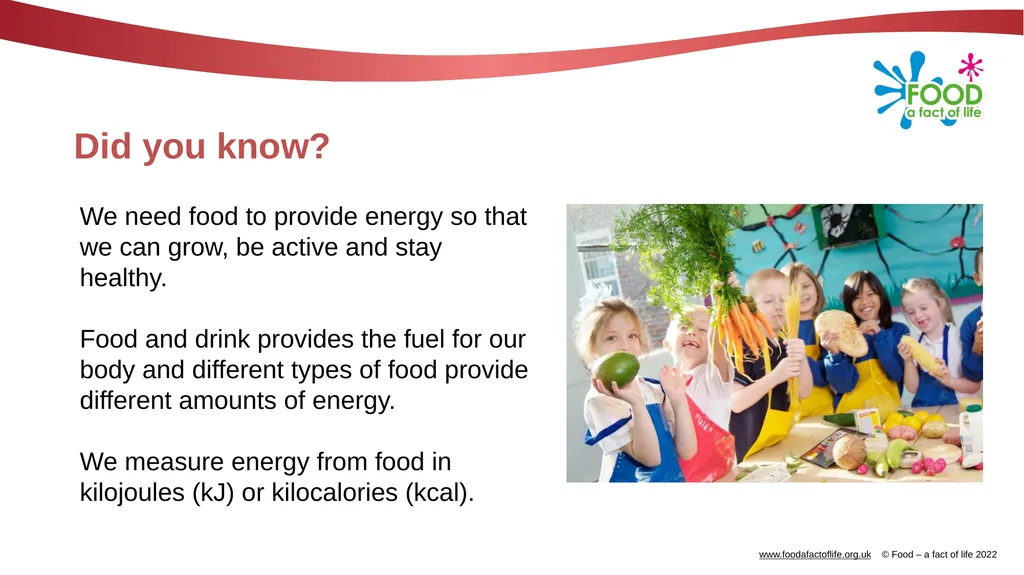
Did you know? We need food to provide energy so that we can grow, be active and stay healthy.
Food and drink provides the fuel for our body and different types of food provide different amounts of energy.
We measure energy from food in kilojoules (kJ) or kilocalories (kcal).<br>
Food and drink provides the fuel for our body and different types of food provide different amounts of energy.
We measure energy from food in kilojoules (kJ) or kilocalories (kcal).<br>
10
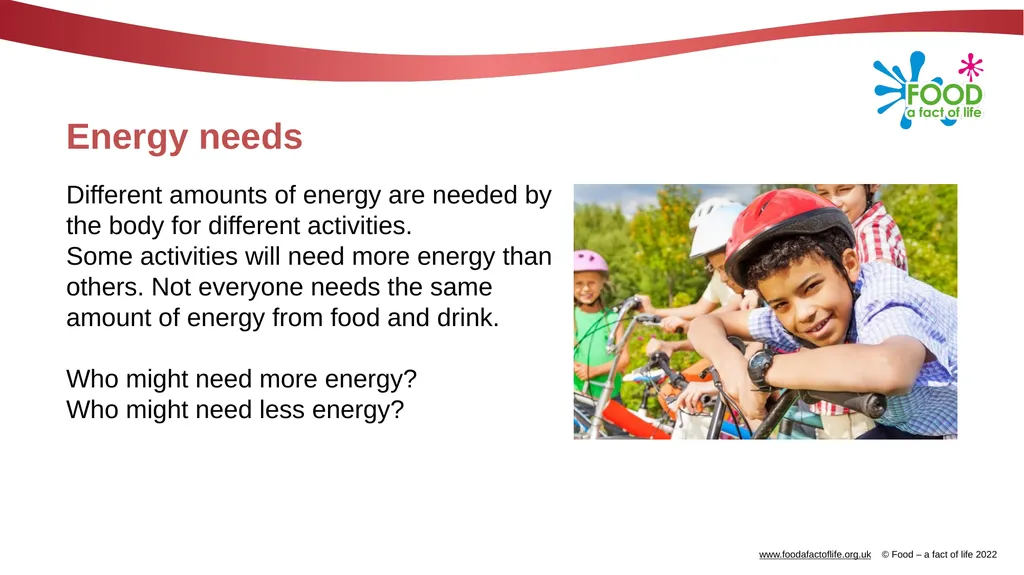
Energy needs Different amounts of energy are needed by the body for different activities.
Some activities will need more energy than others. Not everyone needs the same amount of energy from food and drink.
Who might need more energy?
Who might need less energy?<br>
Some activities will need more energy than others. Not everyone needs the same amount of energy from food and drink.
Who might need more energy?
Who might need less energy?<br>
11
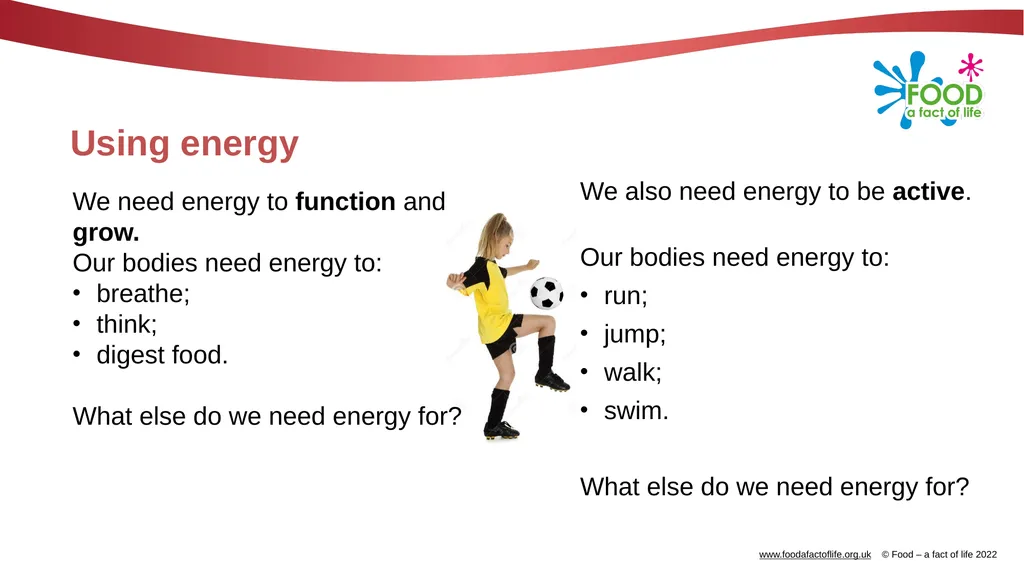
Using energy We also need energy to be active.
Our bodies need energy to:
run;
jump;
walk;
swim.
What else do we need energy for? We need energy to function and grow.
Our bodies need energy to:
breathe;
think;
digest food.
What else do we need energy for?<br>
Our bodies need energy to:
run;
jump;
walk;
swim.
What else do we need energy for? We need energy to function and grow.
Our bodies need energy to:
breathe;
think;
digest food.
What else do we need energy for?<br>
12
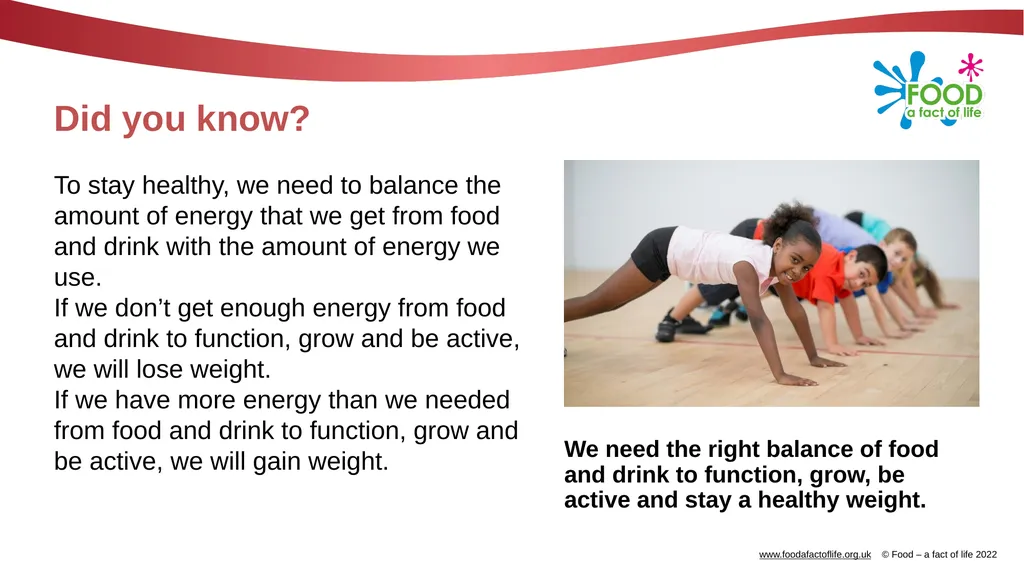
Did you know? To stay healthy, we need to balance the amount of energy that we get from food and drink with the amount of energy we use.
If we don’t get enough energy from food and drink to function, grow and be active, we will lose weight.
If we have more energy than we needed from food and drink to function, grow and be active, we will gain weight. We need the right balance of food and drink to function, grow, be active and stay a healthy weight.<br>
If we don’t get enough energy from food and drink to function, grow and be active, we will lose weight.
If we have more energy than we needed from food and drink to function, grow and be active, we will gain weight. We need the right balance of food and drink to function, grow, be active and stay a healthy weight.<br>
13
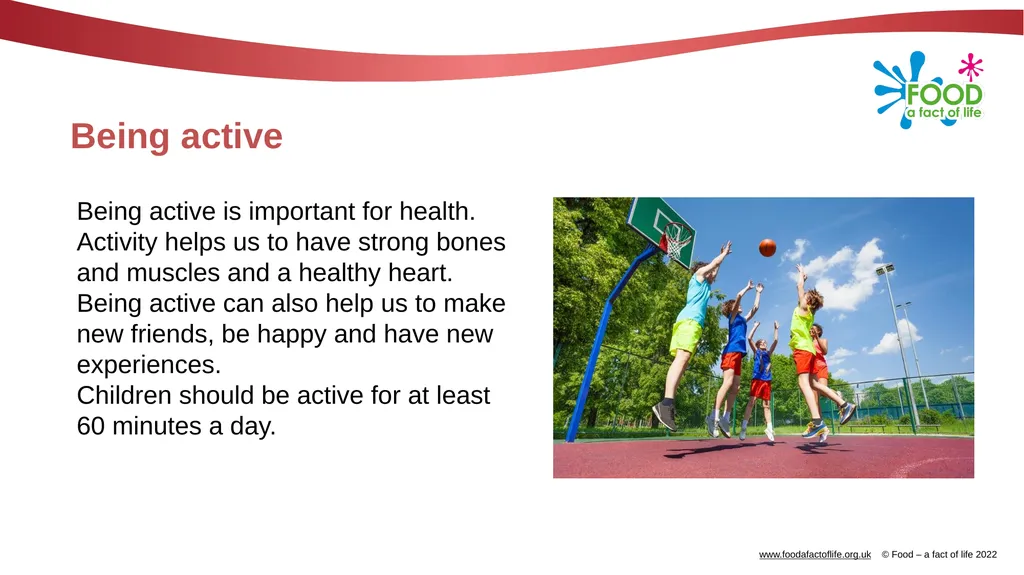
Being active Being active is important for health.
Activity helps us to have strong bones and muscles and a healthy heart.
Being active can also help us to make new friends, be happy and have new experiences.
Children should be active for at least 60 minutes a day.<br>
Activity helps us to have strong bones and muscles and a healthy heart.
Being active can also help us to make new friends, be happy and have new experiences.
Children should be active for at least 60 minutes a day.<br>
14
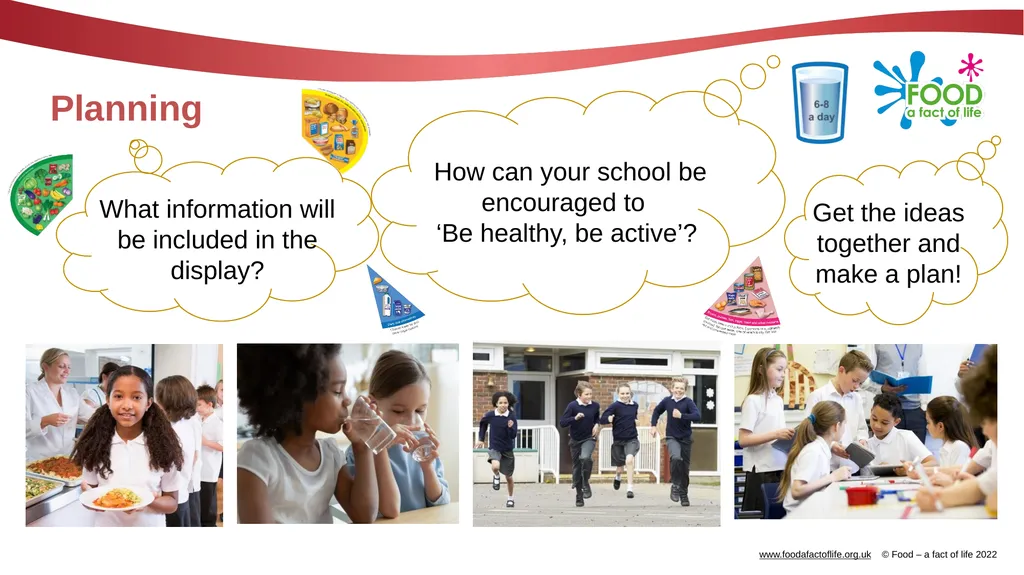
Planning Get the ideas together and make a plan! How can your school be encouraged to
‘Be healthy, be active’? What information will be included in the display?<br>
‘Be healthy, be active’? What information will be included in the display?<br>
15
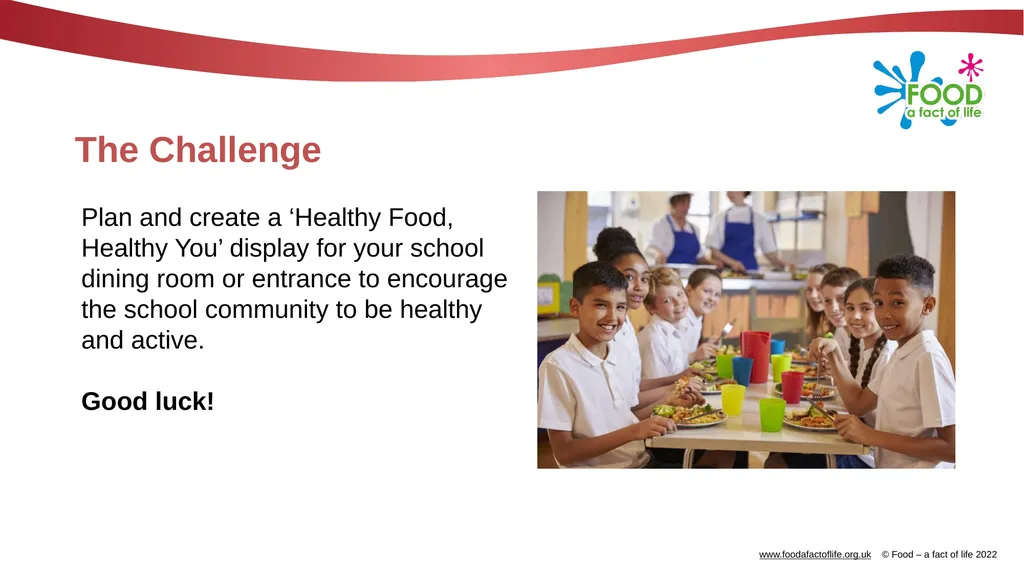
The Challenge Plan and create a ‘Healthy Food, Healthy You’ display for your school dining room or entrance to encourage the school community to be healthy and active.
Good luck!<br>
Good luck!<br>
16
Teachers’ guide<br>
17
The Food – a fact of life Challenges The Food – a fact of life Challenge activities have been written to support teachers not following the national curriculum for their specific country or those following a challenge or theme-based approach. However, they could be used in any school across the UK.
The Challenges cover Healthy eating, Cooking and Where food comes from and provide a wide range of activities that teachers can select depending on their pupils’ needs, age and abilities, and the time available.
There are 12 Challenges developed to be used with nursery, primary or secondary pupils.
Each Challenge comprises the Challenge, opportunities for learning and a variety of pupil activities that can be completed individually or in groups. Each Challenge culminates in a final outcome, which could be paper based, such as a report, poster, newspaper article or presentation, video, interactive activity, recipe, dish/range of dishes or menu depending on the theme of the Challenge.
An optional pupil certificate is available to download and personalise once the Challenge has been achieved.<br>
The Challenges cover Healthy eating, Cooking and Where food comes from and provide a wide range of activities that teachers can select depending on their pupils’ needs, age and abilities, and the time available.
There are 12 Challenges developed to be used with nursery, primary or secondary pupils.
Each Challenge comprises the Challenge, opportunities for learning and a variety of pupil activities that can be completed individually or in groups. Each Challenge culminates in a final outcome, which could be paper based, such as a report, poster, newspaper article or presentation, video, interactive activity, recipe, dish/range of dishes or menu depending on the theme of the Challenge.
An optional pupil certificate is available to download and personalise once the Challenge has been achieved.<br>
18
The Challenge Plan and create a ‘Healthy Food, Healthy You’ display for your school dining room or entrance to encourage the school community to be healthy and active.<br>
19
Opportunities for learning By undertaking this challenge, the opportunities for learning include:
researching the Eatwell Guide and how it can be applied to make healthy food choices;
investigating the key messages and foods included in each group of the Eatwell Guide;
applying knowledge of healthier and more sustainable diets;
investigating energy and nutrients;
exploring the benefits of an active lifestyle.<br>
researching the Eatwell Guide and how it can be applied to make healthy food choices;
investigating the key messages and foods included in each group of the Eatwell Guide;
applying knowledge of healthier and more sustainable diets;
investigating energy and nutrients;
exploring the benefits of an active lifestyle.<br>
20
How can pupils complete the Challenge? A range of activity suggestions have been provided – you can choose the ones that are most suitable for your pupils and the time that you have available to complete the challenge.
Activities include:
Finding out – activities around investigating the Eatwell Guide, applying knowledge of healthy eating to food choice, energy and nutrients, benefits of physical activity.
Making and evaluating – activities around applying knowledge of healthy eating and sustainable diets, demonstrating a range of practical food skills and cooking methods, demonstrating the principles of food hygiene and safety.
Bringing it all together – planning and making a display to encourage healthy eating and activity in the school community.<br>
Activities include:
Finding out – activities around investigating the Eatwell Guide, applying knowledge of healthy eating to food choice, energy and nutrients, benefits of physical activity.
Making and evaluating – activities around applying knowledge of healthy eating and sustainable diets, demonstrating a range of practical food skills and cooking methods, demonstrating the principles of food hygiene and safety.
Bringing it all together – planning and making a display to encourage healthy eating and activity in the school community.<br>
21
Finding out - activities Pupils, individually or in groups, could:
Healthy eating / Eatwell Guide:
view the Eatwell guide presentation.
complete Workbook 2 covering healthy eating, drinking and activity.
view the Meals and snacks presentation. This looks at how these relate to the Eatwell Guide.
complete the Diet and Health and Healthy Lifestyles Food route journal. User guide here.
keep a record of what they eat and drink for two days using the Food and Drink diary worksheet. Compare with what is shown on the Eatwell guide.<br>
Healthy eating / Eatwell Guide:
view the Eatwell guide presentation.
complete Workbook 2 covering healthy eating, drinking and activity.
view the Meals and snacks presentation. This looks at how these relate to the Eatwell Guide.
complete the Diet and Health and Healthy Lifestyles Food route journal. User guide here.
keep a record of what they eat and drink for two days using the Food and Drink diary worksheet. Compare with what is shown on the Eatwell guide.<br>
22
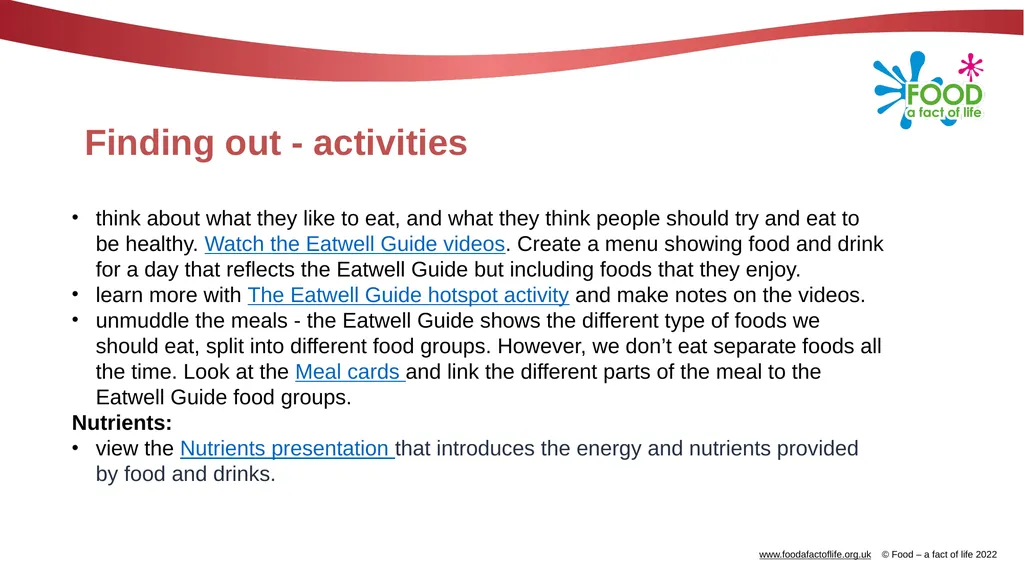
Finding out - activities think about what they like to eat, and what they think people should try and eat to be healthy. Watch the Eatwell Guide videos. Create a menu showing food and drink for a day that reflects the Eatwell Guide but including foods that they enjoy.
learn more with The Eatwell Guide hotspot activity and make notes on the videos.
unmuddle the meals - the Eatwell Guide shows the different type of foods we should eat, split into different food groups. However, we don’t eat separate foods all the time. Look at the Meal cards and link the different parts of the meal to the Eatwell Guide food groups.
Nutrients:
view the Nutrients presentation that introduces the energy and nutrients provided by food and drinks.<br>
learn more with The Eatwell Guide hotspot activity and make notes on the videos.
unmuddle the meals - the Eatwell Guide shows the different type of foods we should eat, split into different food groups. However, we don’t eat separate foods all the time. Look at the Meal cards and link the different parts of the meal to the Eatwell Guide food groups.
Nutrients:
view the Nutrients presentation that introduces the energy and nutrients provided by food and drinks.<br>
23
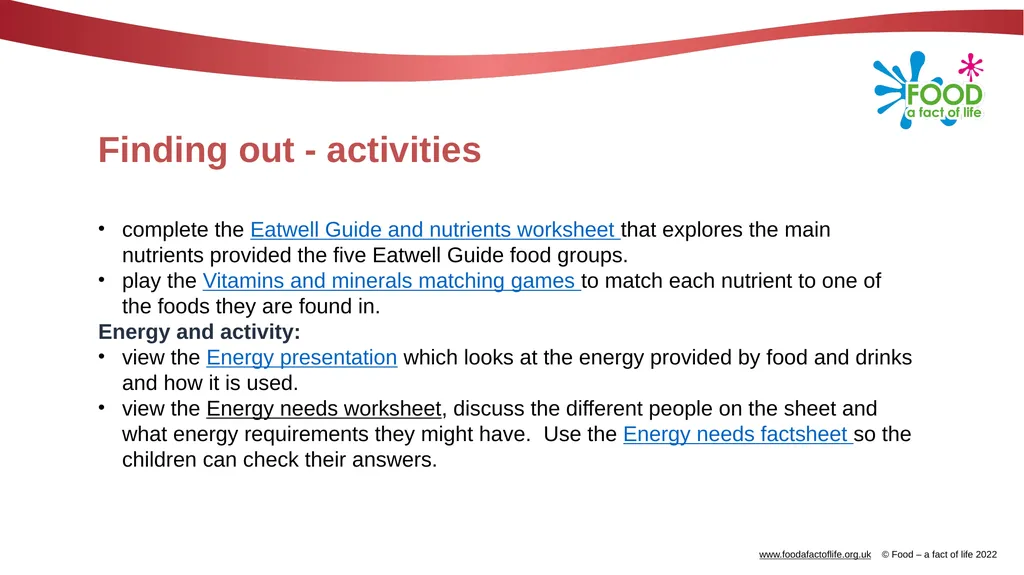
Finding out - activities complete the Eatwell Guide and nutrients worksheet that explores the main nutrients provided the five Eatwell Guide food groups.
play the Vitamins and minerals matching games to match each nutrient to one of the foods they are found in.
Energy and activity:
view the Energy presentation which looks at the energy provided by food and drinks and how it is used.
view the Energy needs worksheet, discuss the different people on the sheet and what energy requirements they might have. Use the Energy needs factsheet so the children can check their answers.<br>
play the Vitamins and minerals matching games to match each nutrient to one of the foods they are found in.
Energy and activity:
view the Energy presentation which looks at the energy provided by food and drinks and how it is used.
view the Energy needs worksheet, discuss the different people on the sheet and what energy requirements they might have. Use the Energy needs factsheet so the children can check their answers.<br>
24
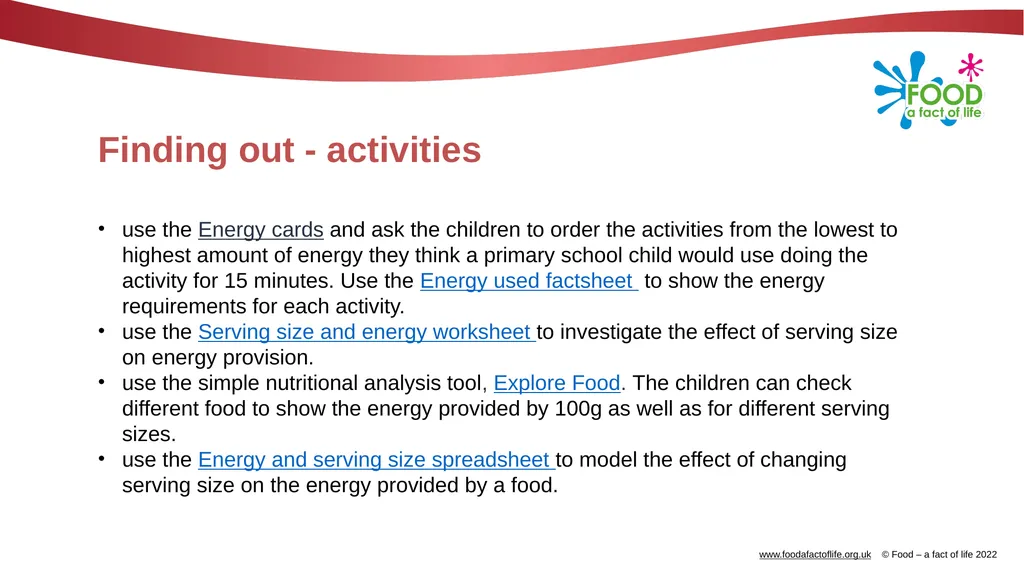
Finding out - activities use the Energy cards and ask the children to order the activities from the lowest to highest amount of energy they think a primary school child would use doing the activity for 15 minutes. Use the Energy used factsheet to show the energy requirements for each activity.
use the Serving size and energy worksheet to investigate the effect of serving size on energy provision.
use the simple nutritional analysis tool, Explore Food. The children can check different food to show the energy provided by 100g as well as for different serving sizes.
use the Energy and serving size spreadsheet to model the effect of changing serving size on the energy provided by a food.<br>
use the Serving size and energy worksheet to investigate the effect of serving size on energy provision.
use the simple nutritional analysis tool, Explore Food. The children can check different food to show the energy provided by 100g as well as for different serving sizes.
use the Energy and serving size spreadsheet to model the effect of changing serving size on the energy provided by a food.<br>
25
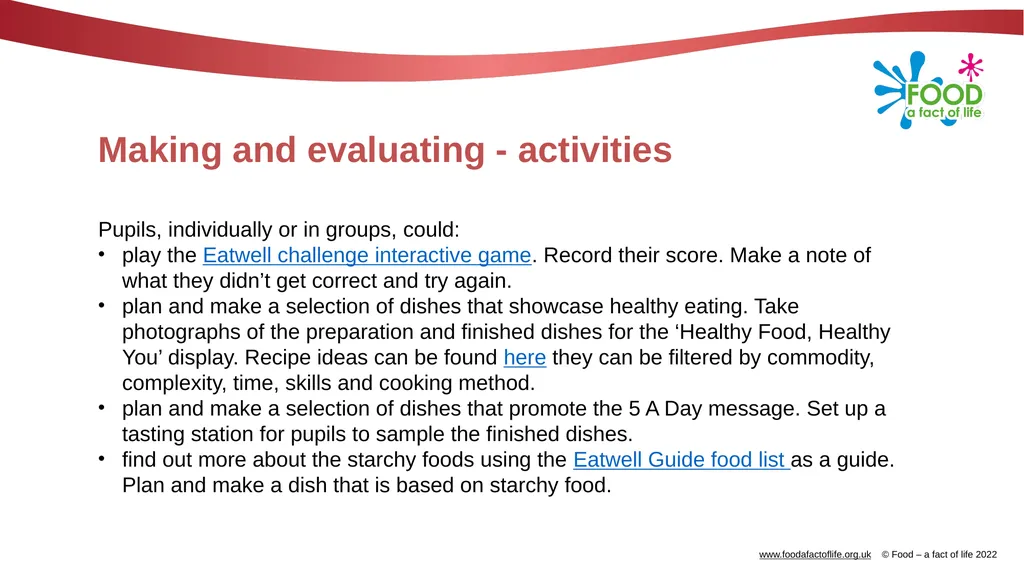
Making and evaluating - activities Pupils, individually or in groups, could:
play the Eatwell challenge interactive game. Record their score. Make a note of what they didn’t get correct and try again.
plan and make a selection of dishes that showcase healthy eating. Take photographs of the preparation and finished dishes for the ‘Healthy Food, Healthy You’ display. Recipe ideas can be found here they can be filtered by commodity, complexity, time, skills and cooking method.
plan and make a selection of dishes that promote the 5 A Day message. Set up a tasting station for pupils to sample the finished dishes.
find out more about the starchy foods using the Eatwell Guide food list as a guide. Plan and make a dish that is based on starchy food.<br>
play the Eatwell challenge interactive game. Record their score. Make a note of what they didn’t get correct and try again.
plan and make a selection of dishes that showcase healthy eating. Take photographs of the preparation and finished dishes for the ‘Healthy Food, Healthy You’ display. Recipe ideas can be found here they can be filtered by commodity, complexity, time, skills and cooking method.
plan and make a selection of dishes that promote the 5 A Day message. Set up a tasting station for pupils to sample the finished dishes.
find out more about the starchy foods using the Eatwell Guide food list as a guide. Plan and make a dish that is based on starchy food.<br>
26
Bringing it all together Pupils should:
Plan and create a ‘Healthy Food, Healthy You’ display for your school dining room or entrance to encourage the school community to be healthy and active.
The campaign should showcase their knowledge of:
the Eatwell Guide and food groups;
energy needs;
why activity is important.<br>
Plan and create a ‘Healthy Food, Healthy You’ display for your school dining room or entrance to encourage the school community to be healthy and active.
The campaign should showcase their knowledge of:
the Eatwell Guide and food groups;
energy needs;
why activity is important.<br>
27
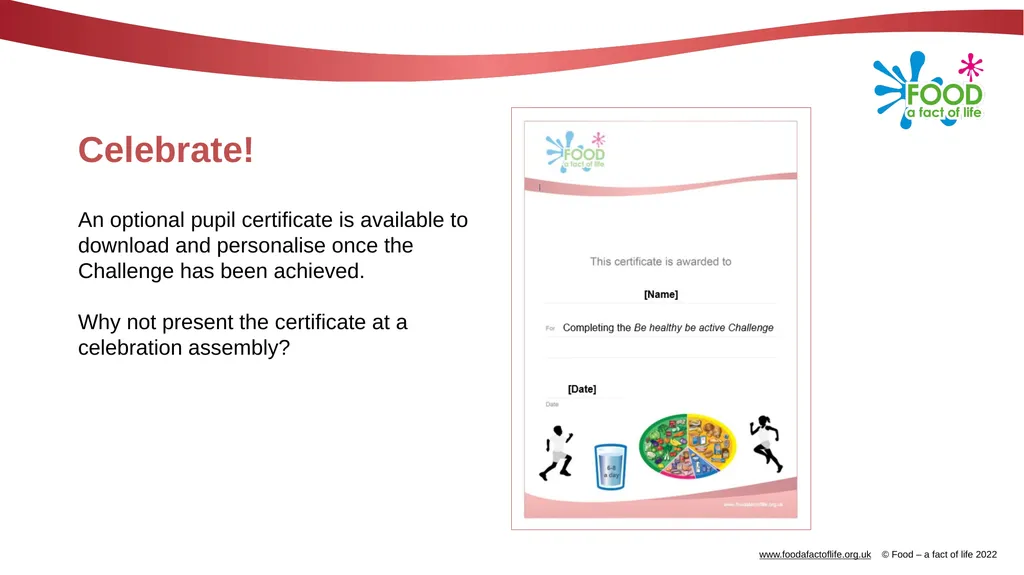
Celebrate! An optional pupil certificate is available to download and personalise once the Challenge has been achieved.
Why not present the certificate at a celebration assembly?<br>
Why not present the certificate at a celebration assembly?<br>
28
Be healthy, be active! For further information, go to:
www.foodafactoflife.org.uk This resource meets the Guidelines for producers and users of school education resources about food.<br>
www.foodafactoflife.org.uk This resource meets the Guidelines for producers and users of school education resources about food.<br>