
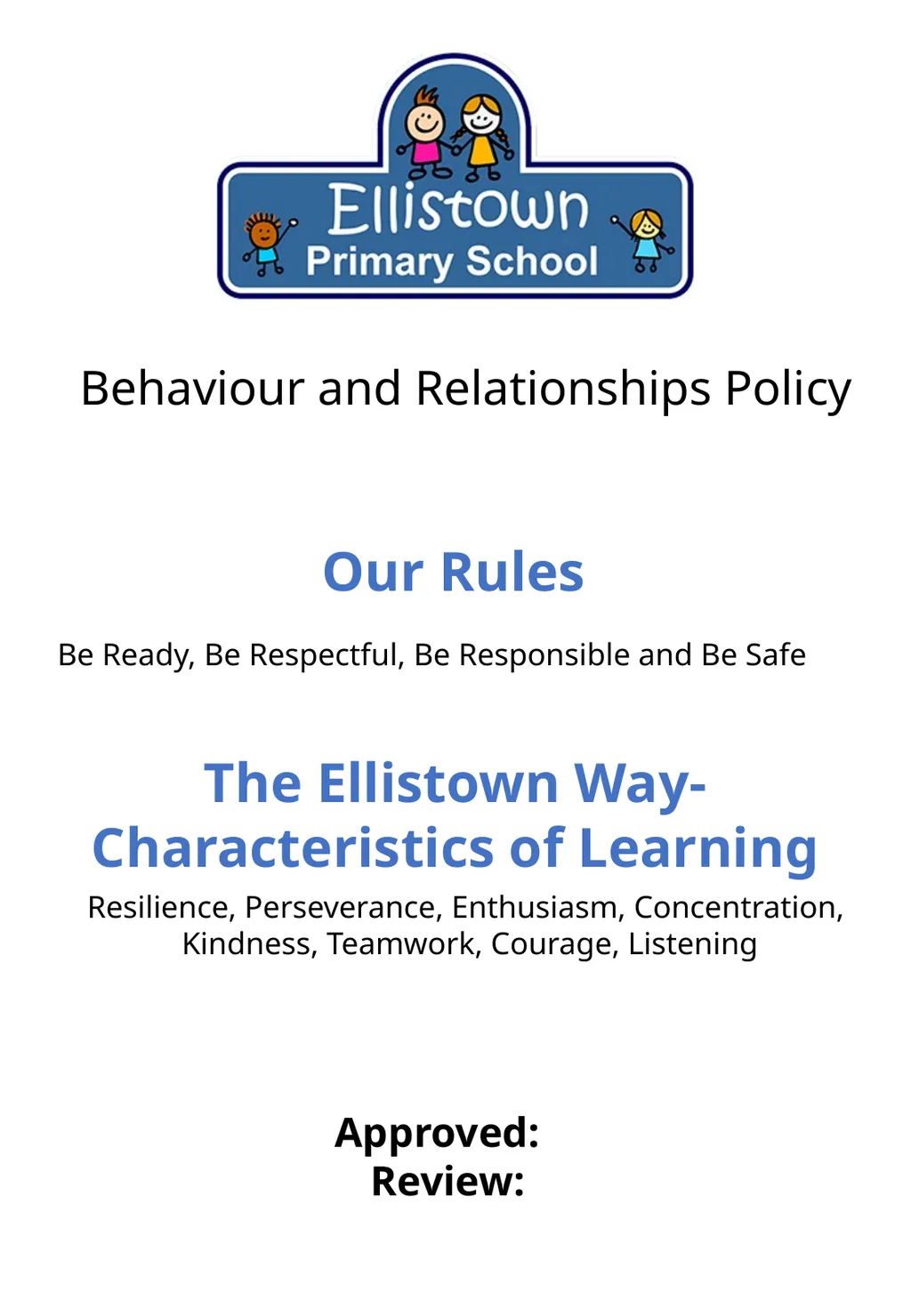
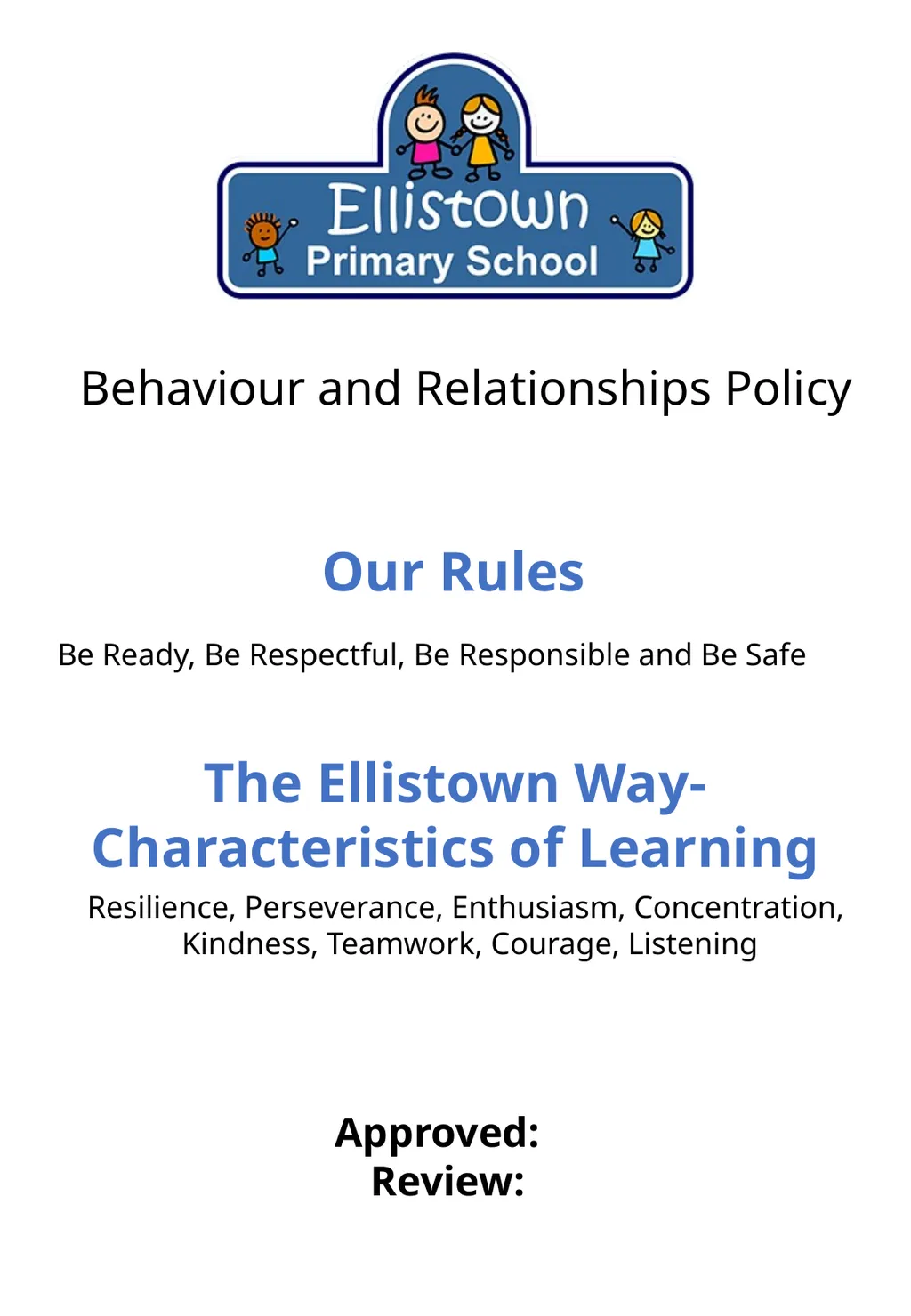
Behaviour and Relationships Policy Our Rules Be
MS
Published · 11 slides · 0 views
1 / 1
Description
Behaviour and Relationships Policy Our Rules Be Ready, Be Respectful, Be Responsible and Be Safe The Ellistown Way- Characteristics of Learning Resilience, Perseverance, Enthusiasm, Concentration, Kindness, Teamwork, Courage, Listening
Related Topics
Share
Embed code
Download this presentation From Below
"Behaviour and Relationships Policy Our Rules Be" is the property of its rightful owner. Permission is granted to download and print the materials on this website for personal, non-commercial use only, and to display it on your personal computer provided you do not modify the materials and that you retain all copyright notices contained in the materials. By downloading content from our website, you accept the terms of this agreement.
Presentation Transcript
01
Behaviour and Relationships Policy Our Rules Be Ready, Be Respectful, Be Responsible and Be Safe The Ellistown Way-
Characteristics of Learning Resilience, Perseverance, Enthusiasm, Concentration,
Kindness, Teamwork, Courage, Listening Approved:
Review:<br>
Characteristics of Learning Resilience, Perseverance, Enthusiasm, Concentration,
Kindness, Teamwork, Courage, Listening Approved:
Review:<br>
02
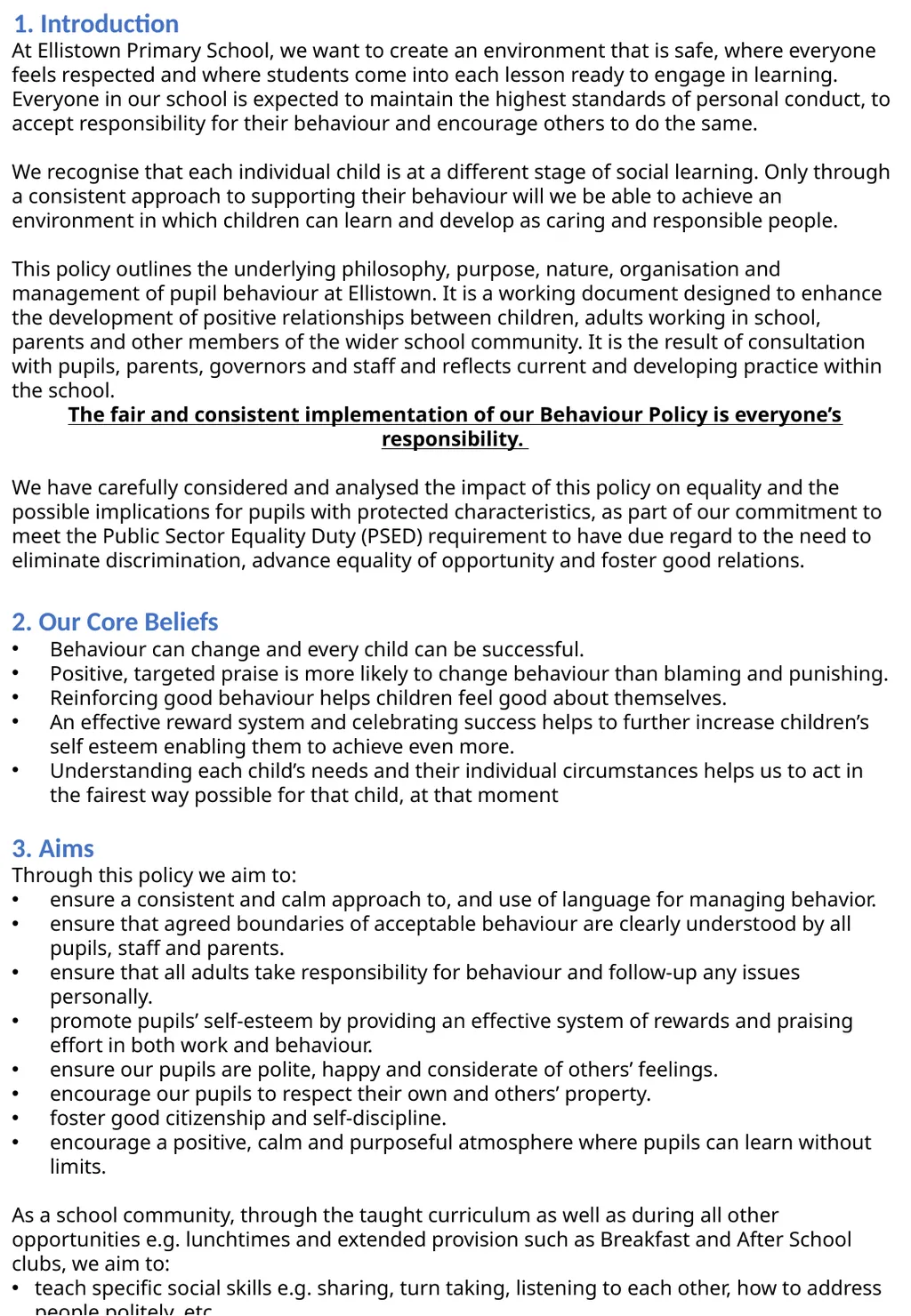
1. Introduction At Ellistown Primary School, we want to create an environment that is safe, where everyone feels respected and where students come into each lesson ready to engage in learning. Everyone in our school is expected to maintain the highest standards of personal conduct, to accept responsibility for their behaviour and encourage others to do the same.
We recognise that each individual child is at a different stage of social learning. Only through a consistent approach to supporting their behaviour will we be able to achieve an environment in which children can learn and develop as caring and responsible people.
This policy outlines the underlying philosophy, purpose, nature, organisation and management of pupil behaviour at Ellistown. It is a working document designed to enhance the development of positive relationships between children, adults working in school, parents and other members of the wider school community. It is the result of consultation with pupils, parents, governors and staff and reflects current and developing practice within the school.
The fair and consistent implementation of our Behaviour Policy is everyone’s responsibility.
We have carefully considered and analysed the impact of this policy on equality and the possible implications for pupils with protected characteristics, as part of our commitment to meet the Public Sector Equality Duty (PSED) requirement to have due regard to the need to eliminate discrimination, advance equality of opportunity and foster good relations.
2. Our Core Beliefs
Behaviour can change and every child can be successful.
Positive, targeted praise is more likely to change behaviour than blaming and punishing.
Reinforcing good behaviour helps children feel good about themselves.
An effective reward system and celebrating success helps to further increase children’s self esteem enabling them to achieve even more.
Understanding each child’s needs and their individual circumstances helps us to act in the fairest way possible for that child, at that moment
3. Aims
Through this policy we aim to:
ensure a consistent and calm approach to, and use of language for managing behavior.
ensure that agreed boundaries of acceptable behaviour are clearly understood by all pupils, staff and parents.
ensure that all adults take responsibility for behaviour and follow-up any issues personally.
promote pupils’ self-esteem by providing an effective system of rewards and praising effort in both work and behaviour.
ensure our pupils are polite, happy and considerate of others’ feelings.
encourage our pupils to respect their own and others’ property.
foster good citizenship and self-discipline.
encourage a positive, calm and purposeful atmosphere where pupils can learn without limits.
As a school community, through the taught curriculum as well as during all other opportunities e.g. lunchtimes and extended provision such as Breakfast and After School clubs, we aim to:
teach specific social skills e.g. sharing, turn taking, listening to each other, how to address people politely, etc.
teach strategies for children to solve conflicts peacefully.
teach specific co-operative and collaborative skills to enable children to work effectively as a member of a group.
agree boundaries of acceptable behaviour with all pupils and regularly remind children of these.<br>
We recognise that each individual child is at a different stage of social learning. Only through a consistent approach to supporting their behaviour will we be able to achieve an environment in which children can learn and develop as caring and responsible people.
This policy outlines the underlying philosophy, purpose, nature, organisation and management of pupil behaviour at Ellistown. It is a working document designed to enhance the development of positive relationships between children, adults working in school, parents and other members of the wider school community. It is the result of consultation with pupils, parents, governors and staff and reflects current and developing practice within the school.
The fair and consistent implementation of our Behaviour Policy is everyone’s responsibility.
We have carefully considered and analysed the impact of this policy on equality and the possible implications for pupils with protected characteristics, as part of our commitment to meet the Public Sector Equality Duty (PSED) requirement to have due regard to the need to eliminate discrimination, advance equality of opportunity and foster good relations.
2. Our Core Beliefs
Behaviour can change and every child can be successful.
Positive, targeted praise is more likely to change behaviour than blaming and punishing.
Reinforcing good behaviour helps children feel good about themselves.
An effective reward system and celebrating success helps to further increase children’s self esteem enabling them to achieve even more.
Understanding each child’s needs and their individual circumstances helps us to act in the fairest way possible for that child, at that moment
3. Aims
Through this policy we aim to:
ensure a consistent and calm approach to, and use of language for managing behavior.
ensure that agreed boundaries of acceptable behaviour are clearly understood by all pupils, staff and parents.
ensure that all adults take responsibility for behaviour and follow-up any issues personally.
promote pupils’ self-esteem by providing an effective system of rewards and praising effort in both work and behaviour.
ensure our pupils are polite, happy and considerate of others’ feelings.
encourage our pupils to respect their own and others’ property.
foster good citizenship and self-discipline.
encourage a positive, calm and purposeful atmosphere where pupils can learn without limits.
As a school community, through the taught curriculum as well as during all other opportunities e.g. lunchtimes and extended provision such as Breakfast and After School clubs, we aim to:
teach specific social skills e.g. sharing, turn taking, listening to each other, how to address people politely, etc.
teach strategies for children to solve conflicts peacefully.
teach specific co-operative and collaborative skills to enable children to work effectively as a member of a group.
agree boundaries of acceptable behaviour with all pupils and regularly remind children of these.<br>
03
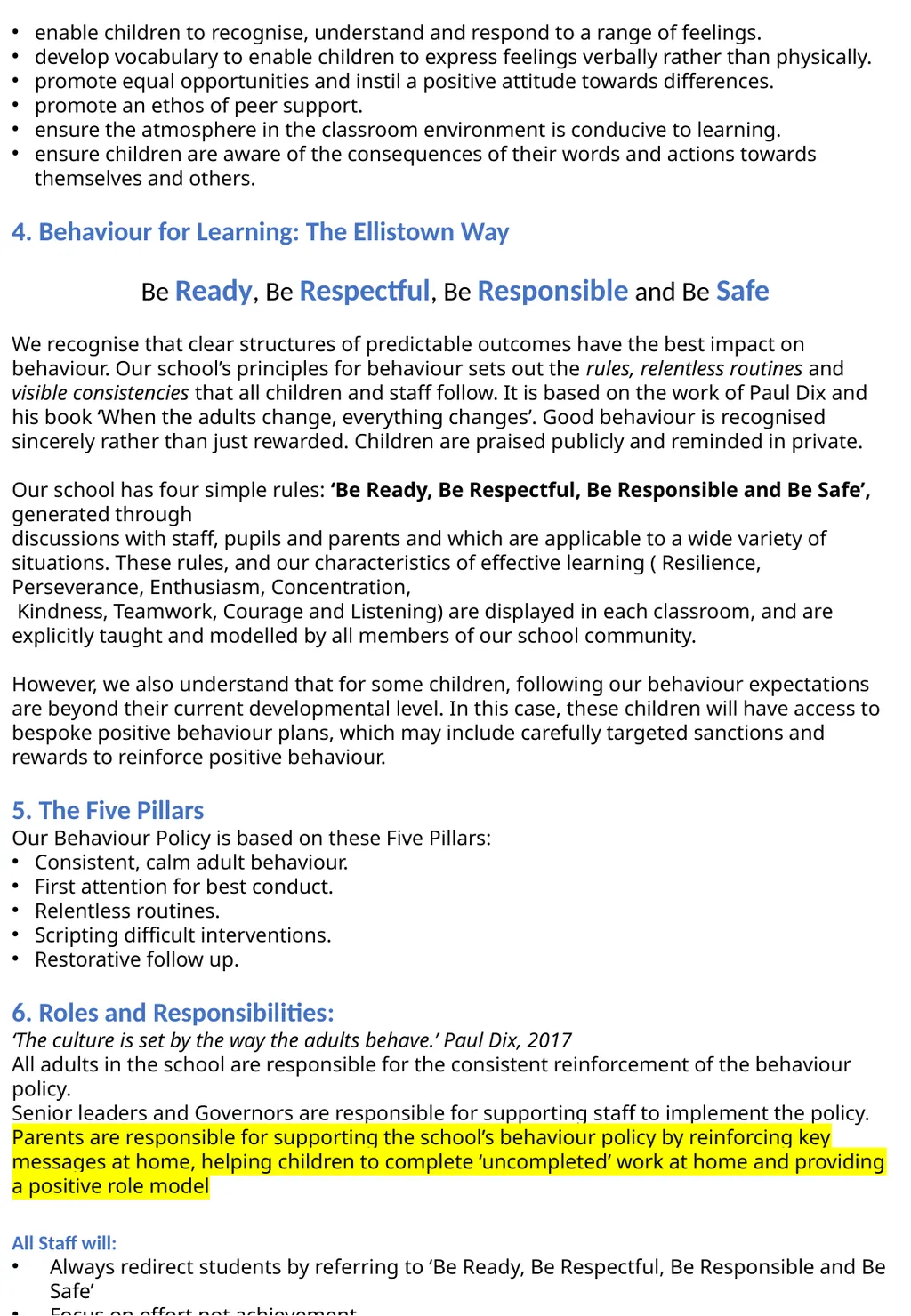
enable children to recognise, understand and respond to a range of feelings.
develop vocabulary to enable children to express feelings verbally rather than physically.
promote equal opportunities and instil a positive attitude towards differences.
promote an ethos of peer support.
ensure the atmosphere in the classroom environment is conducive to learning.
ensure children are aware of the consequences of their words and actions towards themselves and others.
4. Behaviour for Learning: The Ellistown Way
Be Ready, Be Respectful, Be Responsible and Be Safe
We recognise that clear structures of predictable outcomes have the best impact on behaviour. Our school’s principles for behaviour sets out the rules, relentless routines and visible consistencies that all children and staff follow. It is based on the work of Paul Dix and his book ‘When the adults change, everything changes’. Good behaviour is recognised sincerely rather than just rewarded. Children are praised publicly and reminded in private.
Our school has four simple rules: ‘Be Ready, Be Respectful, Be Responsible and Be Safe’, generated through
discussions with staff, pupils and parents and which are applicable to a wide variety of situations. These rules, and our characteristics of effective learning ( Resilience, Perseverance, Enthusiasm, Concentration,
Kindness, Teamwork, Courage and Listening) are displayed in each classroom, and are explicitly taught and modelled by all members of our school community.
However, we also understand that for some children, following our behaviour expectations are beyond their current developmental level. In this case, these children will have access to bespoke positive behaviour plans, which may include carefully targeted sanctions and rewards to reinforce positive behaviour.
5. The Five Pillars
Our Behaviour Policy is based on these Five Pillars:
Consistent, calm adult behaviour.
First attention for best conduct.
Relentless routines.
Scripting difficult interventions.
Restorative follow up.
6. Roles and Responsibilities:
‘The culture is set by the way the adults behave.’ Paul Dix, 2017
All adults in the school are responsible for the consistent reinforcement of the behaviour policy.
Senior leaders and Governors are responsible for supporting staff to implement the policy. Parents are responsible for supporting the school’s behaviour policy by reinforcing key messages at home, helping children to complete ‘uncompleted’ work at home and providing a positive role model
All Staff will:
Always redirect students by referring to ‘Be Ready, Be Respectful, Be Responsible and Be Safe’
Focus on effort not achievement.
Celebrate when children go above and beyond expectations
Be calm and give ‘take up time’ when going through the behaviour pathway.
Never ignore or walk past children who are behaving badly
Deliberately and persistently catch students doing the right thing and praise them in front of others
Know their classes well and develop positive relationships with all students
Relentlessly work to build mutual respect
Demonstrate unconditional care and compassion<br>
develop vocabulary to enable children to express feelings verbally rather than physically.
promote equal opportunities and instil a positive attitude towards differences.
promote an ethos of peer support.
ensure the atmosphere in the classroom environment is conducive to learning.
ensure children are aware of the consequences of their words and actions towards themselves and others.
4. Behaviour for Learning: The Ellistown Way
Be Ready, Be Respectful, Be Responsible and Be Safe
We recognise that clear structures of predictable outcomes have the best impact on behaviour. Our school’s principles for behaviour sets out the rules, relentless routines and visible consistencies that all children and staff follow. It is based on the work of Paul Dix and his book ‘When the adults change, everything changes’. Good behaviour is recognised sincerely rather than just rewarded. Children are praised publicly and reminded in private.
Our school has four simple rules: ‘Be Ready, Be Respectful, Be Responsible and Be Safe’, generated through
discussions with staff, pupils and parents and which are applicable to a wide variety of situations. These rules, and our characteristics of effective learning ( Resilience, Perseverance, Enthusiasm, Concentration,
Kindness, Teamwork, Courage and Listening) are displayed in each classroom, and are explicitly taught and modelled by all members of our school community.
However, we also understand that for some children, following our behaviour expectations are beyond their current developmental level. In this case, these children will have access to bespoke positive behaviour plans, which may include carefully targeted sanctions and rewards to reinforce positive behaviour.
5. The Five Pillars
Our Behaviour Policy is based on these Five Pillars:
Consistent, calm adult behaviour.
First attention for best conduct.
Relentless routines.
Scripting difficult interventions.
Restorative follow up.
6. Roles and Responsibilities:
‘The culture is set by the way the adults behave.’ Paul Dix, 2017
All adults in the school are responsible for the consistent reinforcement of the behaviour policy.
Senior leaders and Governors are responsible for supporting staff to implement the policy. Parents are responsible for supporting the school’s behaviour policy by reinforcing key messages at home, helping children to complete ‘uncompleted’ work at home and providing a positive role model
All Staff will:
Always redirect students by referring to ‘Be Ready, Be Respectful, Be Responsible and Be Safe’
Focus on effort not achievement.
Celebrate when children go above and beyond expectations
Be calm and give ‘take up time’ when going through the behaviour pathway.
Never ignore or walk past children who are behaving badly
Deliberately and persistently catch students doing the right thing and praise them in front of others
Know their classes well and develop positive relationships with all students
Relentlessly work to build mutual respect
Demonstrate unconditional care and compassion<br>
04
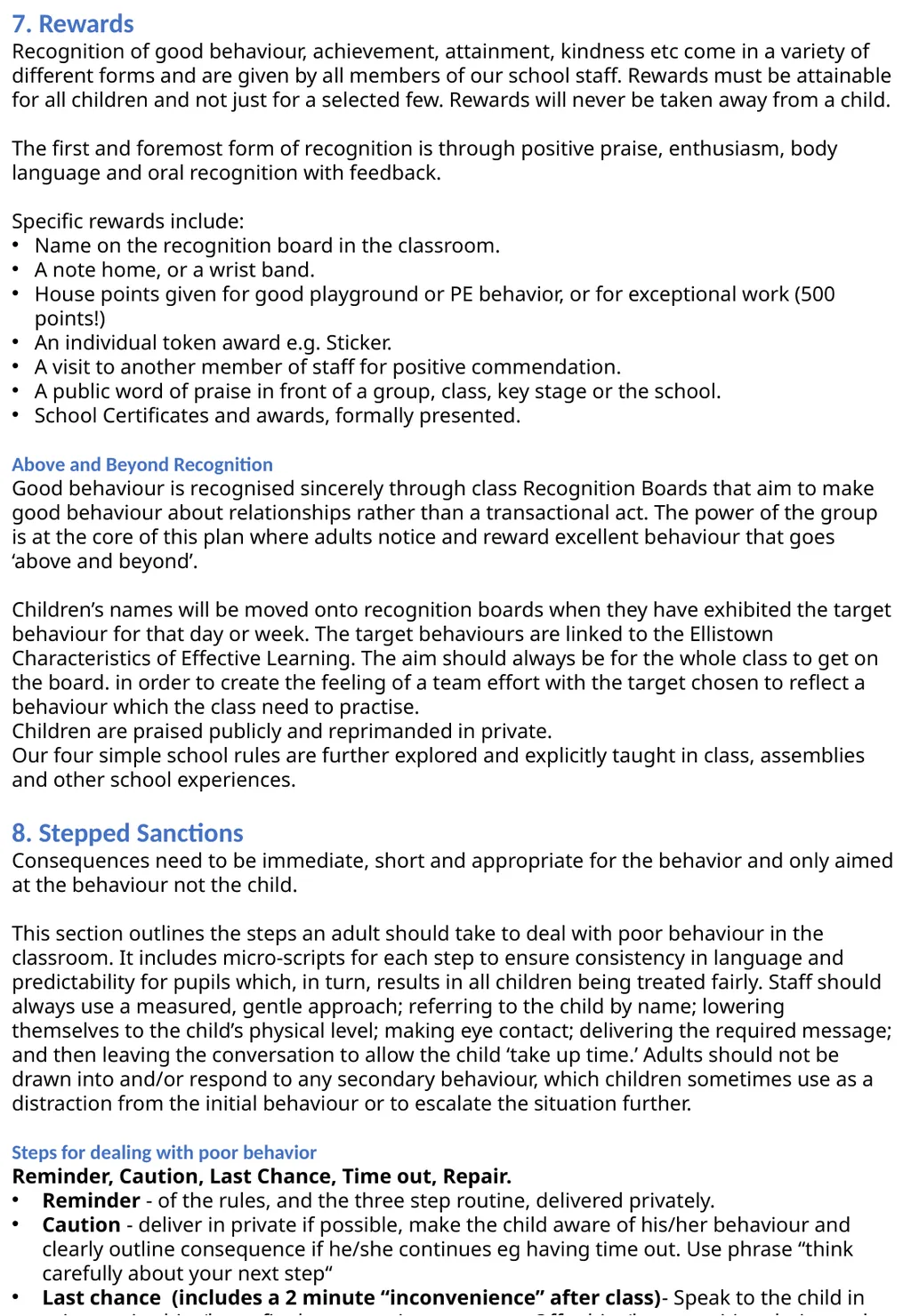
7. Rewards
Recognition of good behaviour, achievement, attainment, kindness etc come in a variety of different forms and are given by all members of our school staff. Rewards must be attainable for all children and not just for a selected few. Rewards will never be taken away from a child.
The first and foremost form of recognition is through positive praise, enthusiasm, body language and oral recognition with feedback.
Specific rewards include:
Name on the recognition board in the classroom.
A note home, or a wrist band.
House points given for good playground or PE behavior, or for exceptional work (500 points!)
An individual token award e.g. Sticker.
A visit to another member of staff for positive commendation.
A public word of praise in front of a group, class, key stage or the school.
School Certificates and awards, formally presented.
Above and Beyond Recognition
Good behaviour is recognised sincerely through class Recognition Boards that aim to make good behaviour about relationships rather than a transactional act. The power of the group is at the core of this plan where adults notice and reward excellent behaviour that goes ‘above and beyond’.
Children’s names will be moved onto recognition boards when they have exhibited the target behaviour for that day or week. The target behaviours are linked to the Ellistown Characteristics of Effective Learning. The aim should always be for the whole class to get on the board. in order to create the feeling of a team effort with the target chosen to reflect a behaviour which the class need to practise.
Children are praised publicly and reprimanded in private.
Our four simple school rules are further explored and explicitly taught in class, assemblies and other school experiences.
8. Stepped Sanctions
Consequences need to be immediate, short and appropriate for the behavior and only aimed at the behaviour not the child.
This section outlines the steps an adult should take to deal with poor behaviour in the classroom. It includes micro-scripts for each step to ensure consistency in language and predictability for pupils which, in turn, results in all children being treated fairly. Staff should always use a measured, gentle approach; referring to the child by name; lowering themselves to the child’s physical level; making eye contact; delivering the required message; and then leaving the conversation to allow the child ‘take up time.’ Adults should not be drawn into and/or respond to any secondary behaviour, which children sometimes use as a distraction from the initial behaviour or to escalate the situation further.
Steps for dealing with poor behavior
Reminder, Caution, Last Chance, Time out, Repair.
Reminder - of the rules, and the three step routine, delivered privately.
Caution - deliver in private if possible, make the child aware of his/her behaviour and clearly outline consequence if he/she continues eg having time out. Use phrase “think carefully about your next step“
Last chance (includes a 2 minute “inconvenience” after class)- Speak to the child in private, give him/her a final opportunity to engage. Offer him/her a positive choice to do and use the microscript (see Behaviour Blueprint). The two minutes is owed when the child reaches this step, it is not part of a future negotiation on behaviour, it cannot be removed reduced or substituted.<br>
Recognition of good behaviour, achievement, attainment, kindness etc come in a variety of different forms and are given by all members of our school staff. Rewards must be attainable for all children and not just for a selected few. Rewards will never be taken away from a child.
The first and foremost form of recognition is through positive praise, enthusiasm, body language and oral recognition with feedback.
Specific rewards include:
Name on the recognition board in the classroom.
A note home, or a wrist band.
House points given for good playground or PE behavior, or for exceptional work (500 points!)
An individual token award e.g. Sticker.
A visit to another member of staff for positive commendation.
A public word of praise in front of a group, class, key stage or the school.
School Certificates and awards, formally presented.
Above and Beyond Recognition
Good behaviour is recognised sincerely through class Recognition Boards that aim to make good behaviour about relationships rather than a transactional act. The power of the group is at the core of this plan where adults notice and reward excellent behaviour that goes ‘above and beyond’.
Children’s names will be moved onto recognition boards when they have exhibited the target behaviour for that day or week. The target behaviours are linked to the Ellistown Characteristics of Effective Learning. The aim should always be for the whole class to get on the board. in order to create the feeling of a team effort with the target chosen to reflect a behaviour which the class need to practise.
Children are praised publicly and reprimanded in private.
Our four simple school rules are further explored and explicitly taught in class, assemblies and other school experiences.
8. Stepped Sanctions
Consequences need to be immediate, short and appropriate for the behavior and only aimed at the behaviour not the child.
This section outlines the steps an adult should take to deal with poor behaviour in the classroom. It includes micro-scripts for each step to ensure consistency in language and predictability for pupils which, in turn, results in all children being treated fairly. Staff should always use a measured, gentle approach; referring to the child by name; lowering themselves to the child’s physical level; making eye contact; delivering the required message; and then leaving the conversation to allow the child ‘take up time.’ Adults should not be drawn into and/or respond to any secondary behaviour, which children sometimes use as a distraction from the initial behaviour or to escalate the situation further.
Steps for dealing with poor behavior
Reminder, Caution, Last Chance, Time out, Repair.
Reminder - of the rules, and the three step routine, delivered privately.
Caution - deliver in private if possible, make the child aware of his/her behaviour and clearly outline consequence if he/she continues eg having time out. Use phrase “think carefully about your next step“
Last chance (includes a 2 minute “inconvenience” after class)- Speak to the child in private, give him/her a final opportunity to engage. Offer him/her a positive choice to do and use the microscript (see Behaviour Blueprint). The two minutes is owed when the child reaches this step, it is not part of a future negotiation on behaviour, it cannot be removed reduced or substituted.<br>
05
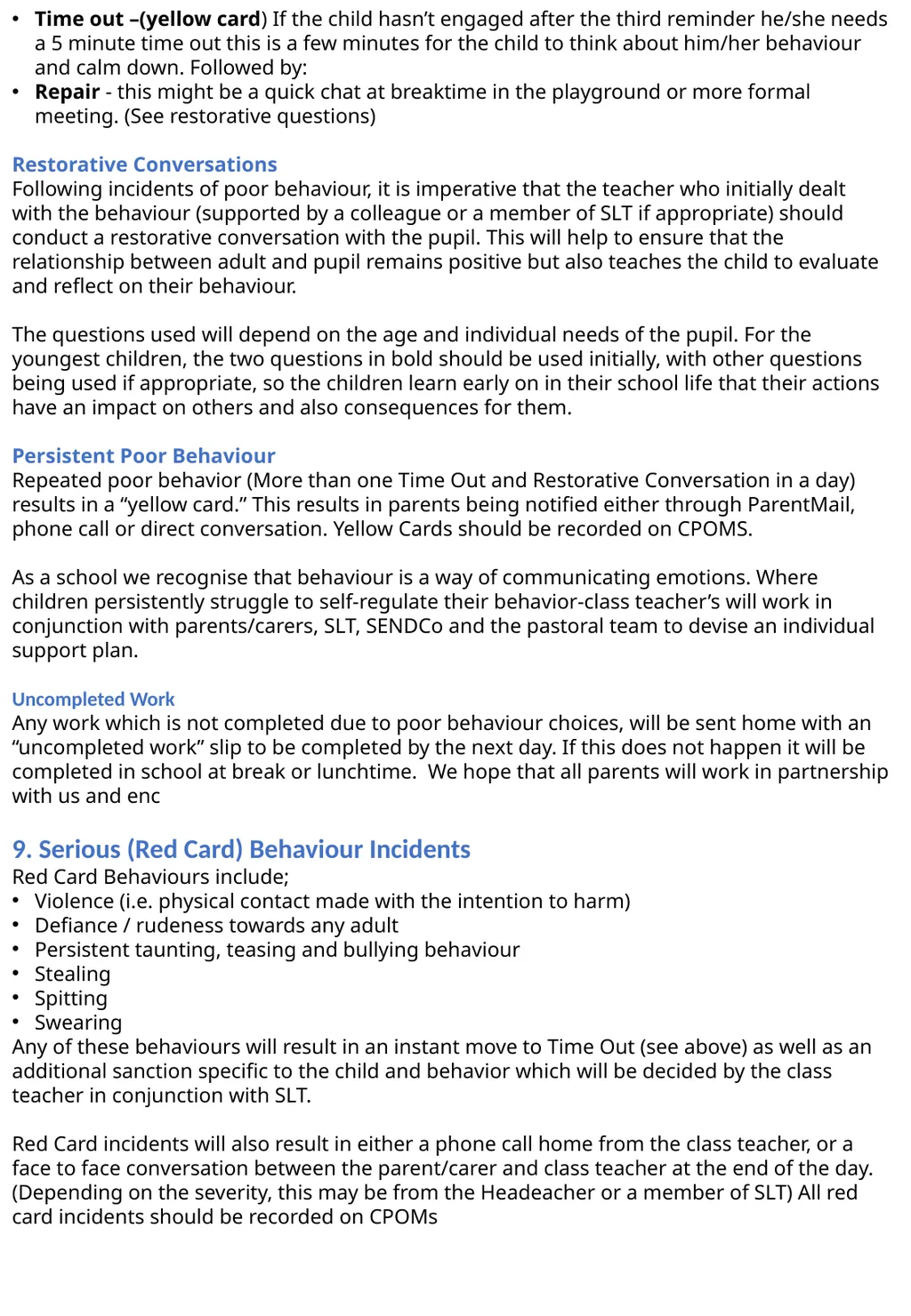
Time out –(yellow card) If the child hasn’t engaged after the third reminder he/she needs a 5 minute time out this is a few minutes for the child to think about him/her behaviour and calm down. Followed by:
Repair - this might be a quick chat at breaktime in the playground or more formal meeting. (See restorative questions)
Restorative Conversations
Following incidents of poor behaviour, it is imperative that the teacher who initially dealt with the behaviour (supported by a colleague or a member of SLT if appropriate) should conduct a restorative conversation with the pupil. This will help to ensure that the relationship between adult and pupil remains positive but also teaches the child to evaluate and reflect on their behaviour.
The questions used will depend on the age and individual needs of the pupil. For the youngest children, the two questions in bold should be used initially, with other questions being used if appropriate, so the children learn early on in their school life that their actions have an impact on others and also consequences for them.
Persistent Poor Behaviour
Repeated poor behavior (More than one Time Out and Restorative Conversation in a day) results in a “yellow card.” This results in parents being notified either through ParentMail, phone call or direct conversation. Yellow Cards should be recorded on CPOMS.
As a school we recognise that behaviour is a way of communicating emotions. Where children persistently struggle to self-regulate their behavior-class teacher’s will work in conjunction with parents/carers, SLT, SENDCo and the pastoral team to devise an individual support plan.
Uncompleted Work
Any work which is not completed due to poor behaviour choices, will be sent home with an “uncompleted work” slip to be completed by the next day. If this does not happen it will be completed in school at break or lunchtime. We hope that all parents will work in partnership with us and enc
9. Serious (Red Card) Behaviour Incidents
Red Card Behaviours include;
Violence (i.e. physical contact made with the intention to harm)
Defiance / rudeness towards any adult
Persistent taunting, teasing and bullying behaviour
Stealing
Spitting
Swearing
Any of these behaviours will result in an instant move to Time Out (see above) as well as an additional sanction specific to the child and behavior which will be decided by the class teacher in conjunction with SLT.
Red Card incidents will also result in either a phone call home from the class teacher, or a face to face conversation between the parent/carer and class teacher at the end of the day. (Depending on the severity, this may be from the Headeacher or a member of SLT) All red card incidents should be recorded on CPOMs<br>
Repair - this might be a quick chat at breaktime in the playground or more formal meeting. (See restorative questions)
Restorative Conversations
Following incidents of poor behaviour, it is imperative that the teacher who initially dealt with the behaviour (supported by a colleague or a member of SLT if appropriate) should conduct a restorative conversation with the pupil. This will help to ensure that the relationship between adult and pupil remains positive but also teaches the child to evaluate and reflect on their behaviour.
The questions used will depend on the age and individual needs of the pupil. For the youngest children, the two questions in bold should be used initially, with other questions being used if appropriate, so the children learn early on in their school life that their actions have an impact on others and also consequences for them.
Persistent Poor Behaviour
Repeated poor behavior (More than one Time Out and Restorative Conversation in a day) results in a “yellow card.” This results in parents being notified either through ParentMail, phone call or direct conversation. Yellow Cards should be recorded on CPOMS.
As a school we recognise that behaviour is a way of communicating emotions. Where children persistently struggle to self-regulate their behavior-class teacher’s will work in conjunction with parents/carers, SLT, SENDCo and the pastoral team to devise an individual support plan.
Uncompleted Work
Any work which is not completed due to poor behaviour choices, will be sent home with an “uncompleted work” slip to be completed by the next day. If this does not happen it will be completed in school at break or lunchtime. We hope that all parents will work in partnership with us and enc
9. Serious (Red Card) Behaviour Incidents
Red Card Behaviours include;
Violence (i.e. physical contact made with the intention to harm)
Defiance / rudeness towards any adult
Persistent taunting, teasing and bullying behaviour
Stealing
Spitting
Swearing
Any of these behaviours will result in an instant move to Time Out (see above) as well as an additional sanction specific to the child and behavior which will be decided by the class teacher in conjunction with SLT.
Red Card incidents will also result in either a phone call home from the class teacher, or a face to face conversation between the parent/carer and class teacher at the end of the day. (Depending on the severity, this may be from the Headeacher or a member of SLT) All red card incidents should be recorded on CPOMs<br>
06
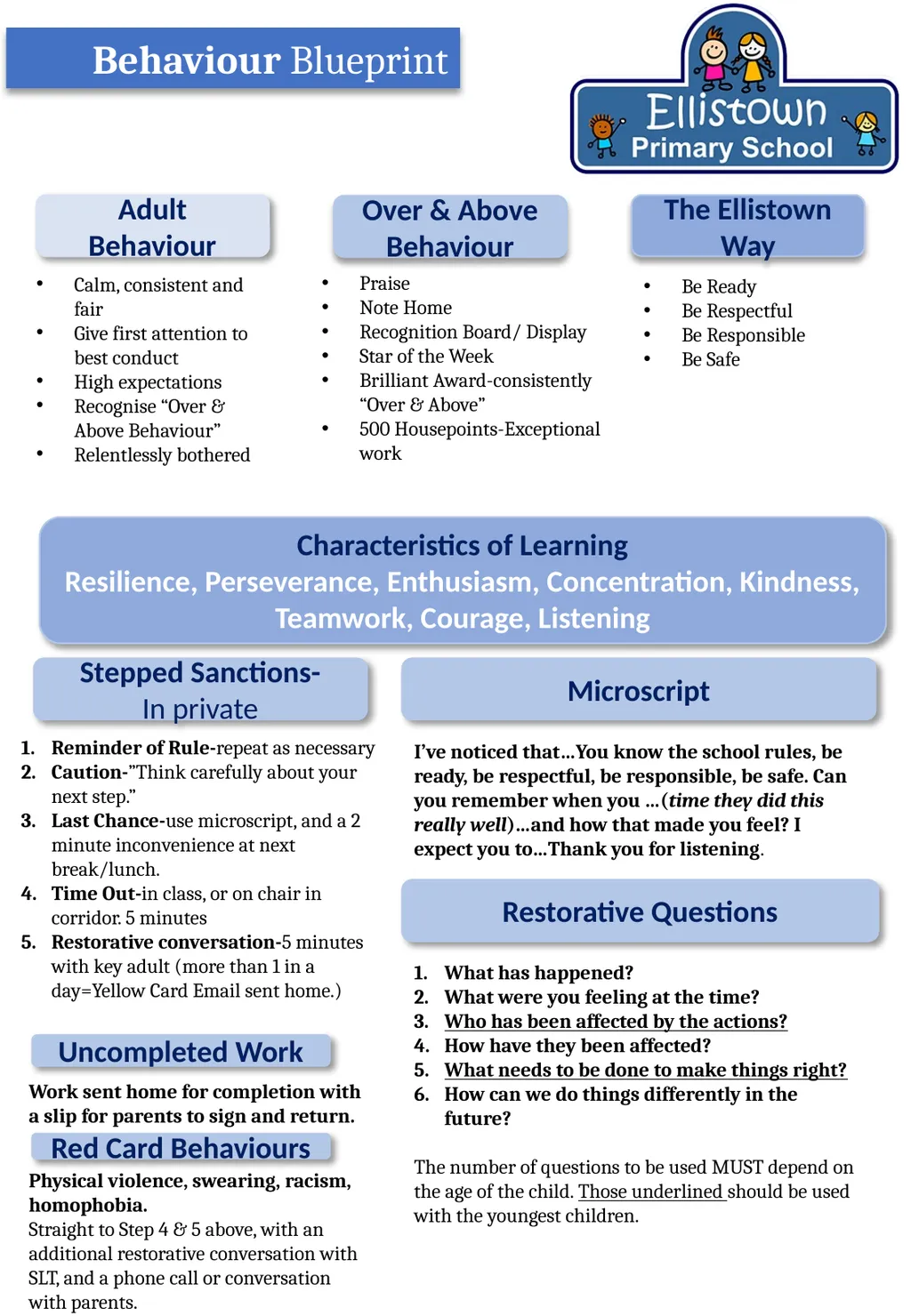
Behaviour Blueprint Adult Behaviour The Ellistown Way Over & Above Behaviour Calm, consistent and fair
Give first attention to best conduct
High expectations
Recognise “Over & Above Behaviour”
Relentlessly bothered Praise
Note Home
Recognition Board/ Display
Star of the Week
Brilliant Award-consistently “Over & Above”
500 Housepoints-Exceptional work Be Ready
Be Respectful
Be Responsible
Be Safe Stepped Sanctions-
In private Reminder of Rule-repeat as necessary
Caution-”Think carefully about your next step.”
Last Chance-use microscript, and a 2 minute inconvenience at next break/lunch.
Time Out-in class, or on chair in corridor. 5 minutes
Restorative conversation-5 minutes with key adult (more than 1 in a day=Yellow Card Email sent home.) Microscript I’ve noticed that…You know the school rules, be ready, be respectful, be responsible, be safe. Can you remember when you …(time they did this really well)…and how that made you feel? I expect you to…Thank you for listening. Restorative Questions What has happened?
What were you feeling at the time?
Who has been affected by the actions?
How have they been affected?
What needs to be done to make things right?
How can we do things differently in the future?
The number of questions to be used MUST depend on the age of the child. Those underlined should be used with the youngest children. Red Card Behaviours Physical violence, swearing, racism, homophobia.
Straight to Step 4 & 5 above, with an additional restorative conversation with SLT, and a phone call or conversation with parents. Characteristics of Learning
Resilience, Perseverance, Enthusiasm, Concentration, Kindness, Teamwork, Courage, Listening Uncompleted Work Work sent home for completion with a slip for parents to sign and return.<br>
Give first attention to best conduct
High expectations
Recognise “Over & Above Behaviour”
Relentlessly bothered Praise
Note Home
Recognition Board/ Display
Star of the Week
Brilliant Award-consistently “Over & Above”
500 Housepoints-Exceptional work Be Ready
Be Respectful
Be Responsible
Be Safe Stepped Sanctions-
In private Reminder of Rule-repeat as necessary
Caution-”Think carefully about your next step.”
Last Chance-use microscript, and a 2 minute inconvenience at next break/lunch.
Time Out-in class, or on chair in corridor. 5 minutes
Restorative conversation-5 minutes with key adult (more than 1 in a day=Yellow Card Email sent home.) Microscript I’ve noticed that…You know the school rules, be ready, be respectful, be responsible, be safe. Can you remember when you …(time they did this really well)…and how that made you feel? I expect you to…Thank you for listening. Restorative Questions What has happened?
What were you feeling at the time?
Who has been affected by the actions?
How have they been affected?
What needs to be done to make things right?
How can we do things differently in the future?
The number of questions to be used MUST depend on the age of the child. Those underlined should be used with the youngest children. Red Card Behaviours Physical violence, swearing, racism, homophobia.
Straight to Step 4 & 5 above, with an additional restorative conversation with SLT, and a phone call or conversation with parents. Characteristics of Learning
Resilience, Perseverance, Enthusiasm, Concentration, Kindness, Teamwork, Courage, Listening Uncompleted Work Work sent home for completion with a slip for parents to sign and return.<br>
07
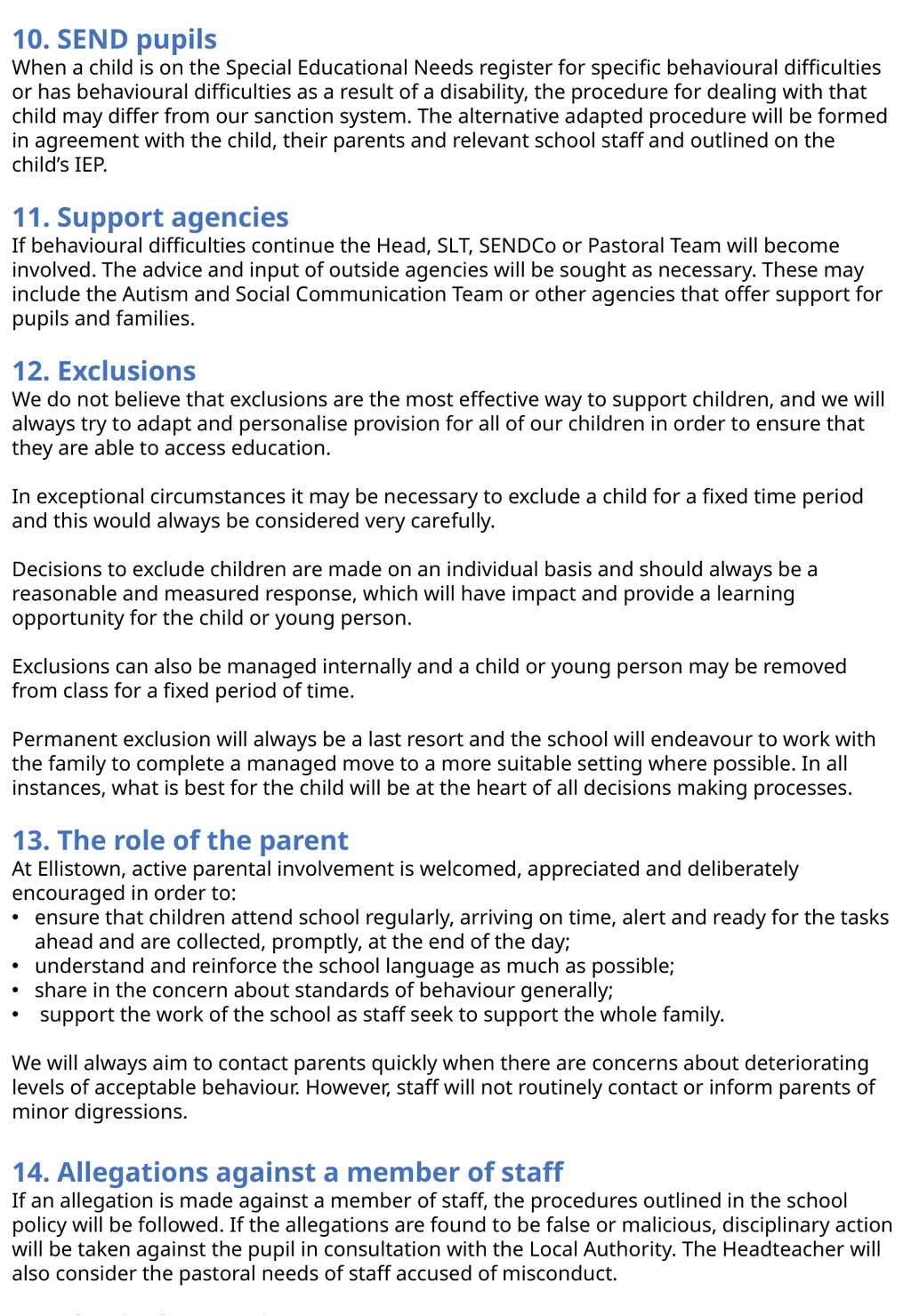
10. SEND pupils
When a child is on the Special Educational Needs register for specific behavioural difficulties or has behavioural difficulties as a result of a disability, the procedure for dealing with that child may differ from our sanction system. The alternative adapted procedure will be formed in agreement with the child, their parents and relevant school staff and outlined on the child’s IEP.
11. Support agencies
If behavioural difficulties continue the Head, SLT, SENDCo or Pastoral Team will become involved. The advice and input of outside agencies will be sought as necessary. These may include the Autism and Social Communication Team or other agencies that offer support for pupils and families.
12. Exclusions
We do not believe that exclusions are the most effective way to support children, and we will always try to adapt and personalise provision for all of our children in order to ensure that they are able to access education.
In exceptional circumstances it may be necessary to exclude a child for a fixed time period and this would always be considered very carefully.
Decisions to exclude children are made on an individual basis and should always be a reasonable and measured response, which will have impact and provide a learning opportunity for the child or young person.
Exclusions can also be managed internally and a child or young person may be removed from class for a fixed period of time.
Permanent exclusion will always be a last resort and the school will endeavour to work with the family to complete a managed move to a more suitable setting where possible. In all instances, what is best for the child will be at the heart of all decisions making processes.
13. The role of the parent
At Ellistown, active parental involvement is welcomed, appreciated and deliberately encouraged in order to:
ensure that children attend school regularly, arriving on time, alert and ready for the tasks ahead and are collected, promptly, at the end of the day;
understand and reinforce the school language as much as possible;
share in the concern about standards of behaviour generally;
support the work of the school as staff seek to support the whole family.
We will always aim to contact parents quickly when there are concerns about deteriorating levels of acceptable behaviour. However, staff will not routinely contact or inform parents of minor digressions.
14. Allegations against a member of staff
If an allegation is made against a member of staff, the procedures outlined in the school policy will be followed. If the allegations are found to be false or malicious, disciplinary action will be taken against the pupil in consultation with the Local Authority. The Headteacher will also consider the pastoral needs of staff accused of misconduct.
15. Physical Restraint
Members of staff have the power to use reasonable force to prevent children committing an offence, injuring themselves or others, or damaging property, and to maintain good order and discipline in the classroom.<br>
When a child is on the Special Educational Needs register for specific behavioural difficulties or has behavioural difficulties as a result of a disability, the procedure for dealing with that child may differ from our sanction system. The alternative adapted procedure will be formed in agreement with the child, their parents and relevant school staff and outlined on the child’s IEP.
11. Support agencies
If behavioural difficulties continue the Head, SLT, SENDCo or Pastoral Team will become involved. The advice and input of outside agencies will be sought as necessary. These may include the Autism and Social Communication Team or other agencies that offer support for pupils and families.
12. Exclusions
We do not believe that exclusions are the most effective way to support children, and we will always try to adapt and personalise provision for all of our children in order to ensure that they are able to access education.
In exceptional circumstances it may be necessary to exclude a child for a fixed time period and this would always be considered very carefully.
Decisions to exclude children are made on an individual basis and should always be a reasonable and measured response, which will have impact and provide a learning opportunity for the child or young person.
Exclusions can also be managed internally and a child or young person may be removed from class for a fixed period of time.
Permanent exclusion will always be a last resort and the school will endeavour to work with the family to complete a managed move to a more suitable setting where possible. In all instances, what is best for the child will be at the heart of all decisions making processes.
13. The role of the parent
At Ellistown, active parental involvement is welcomed, appreciated and deliberately encouraged in order to:
ensure that children attend school regularly, arriving on time, alert and ready for the tasks ahead and are collected, promptly, at the end of the day;
understand and reinforce the school language as much as possible;
share in the concern about standards of behaviour generally;
support the work of the school as staff seek to support the whole family.
We will always aim to contact parents quickly when there are concerns about deteriorating levels of acceptable behaviour. However, staff will not routinely contact or inform parents of minor digressions.
14. Allegations against a member of staff
If an allegation is made against a member of staff, the procedures outlined in the school policy will be followed. If the allegations are found to be false or malicious, disciplinary action will be taken against the pupil in consultation with the Local Authority. The Headteacher will also consider the pastoral needs of staff accused of misconduct.
15. Physical Restraint
Members of staff have the power to use reasonable force to prevent children committing an offence, injuring themselves or others, or damaging property, and to maintain good order and discipline in the classroom.<br>
08
Only staff who have been trained in Physical Restraint (TeamTeach) should restrain a child.
Incidents of physical restraint must:
Always be used as a last resort.
Only be by experienced, trained staff.
Be applied using the minimum amount of force and for the minimum amount of time
possible.
Be used in a way that maintains the safety and dignity of all concerned.
Never be used as a form of punishment.
Be recorded on CPOMS and reported to parents.
We appreciate these incidents can cause distress for the adults involved, therefore all staff are
entitled to take some time away from the classroom to recover their composure. In extreme cases, the
member of staff may be allowed to go home by a member of SLT.
16. Application and scope of this policy
This Behaviour Policy is applicable to our entire school community and will only be effective if everyone is empowered to use it with confidence and consistency. There may be occasions when special rules need to be applied, e.g. in the dining room, at play and lunch times or when off site, etc. but the same principles of promoting good behaviour will always apply.
Monitoring & Evaluation
The school’s Leadership Team will monitor the effectiveness of the policy at least once every two years and report back to the Local Governing Body. The Leadership Team will also monitor the visible consistencies around the school and the use of language and personal follow-up. Records will be kept by the Leadership Team in order to monitor and evaluate any changes brought about by the policy.
All concerned parties will be kept informed of any review and action that will need to be taken.<br>
Incidents of physical restraint must:
Always be used as a last resort.
Only be by experienced, trained staff.
Be applied using the minimum amount of force and for the minimum amount of time
possible.
Be used in a way that maintains the safety and dignity of all concerned.
Never be used as a form of punishment.
Be recorded on CPOMS and reported to parents.
We appreciate these incidents can cause distress for the adults involved, therefore all staff are
entitled to take some time away from the classroom to recover their composure. In extreme cases, the
member of staff may be allowed to go home by a member of SLT.
16. Application and scope of this policy
This Behaviour Policy is applicable to our entire school community and will only be effective if everyone is empowered to use it with confidence and consistency. There may be occasions when special rules need to be applied, e.g. in the dining room, at play and lunch times or when off site, etc. but the same principles of promoting good behaviour will always apply.
Monitoring & Evaluation
The school’s Leadership Team will monitor the effectiveness of the policy at least once every two years and report back to the Local Governing Body. The Leadership Team will also monitor the visible consistencies around the school and the use of language and personal follow-up. Records will be kept by the Leadership Team in order to monitor and evaluate any changes brought about by the policy.
All concerned parties will be kept informed of any review and action that will need to be taken.<br>
09
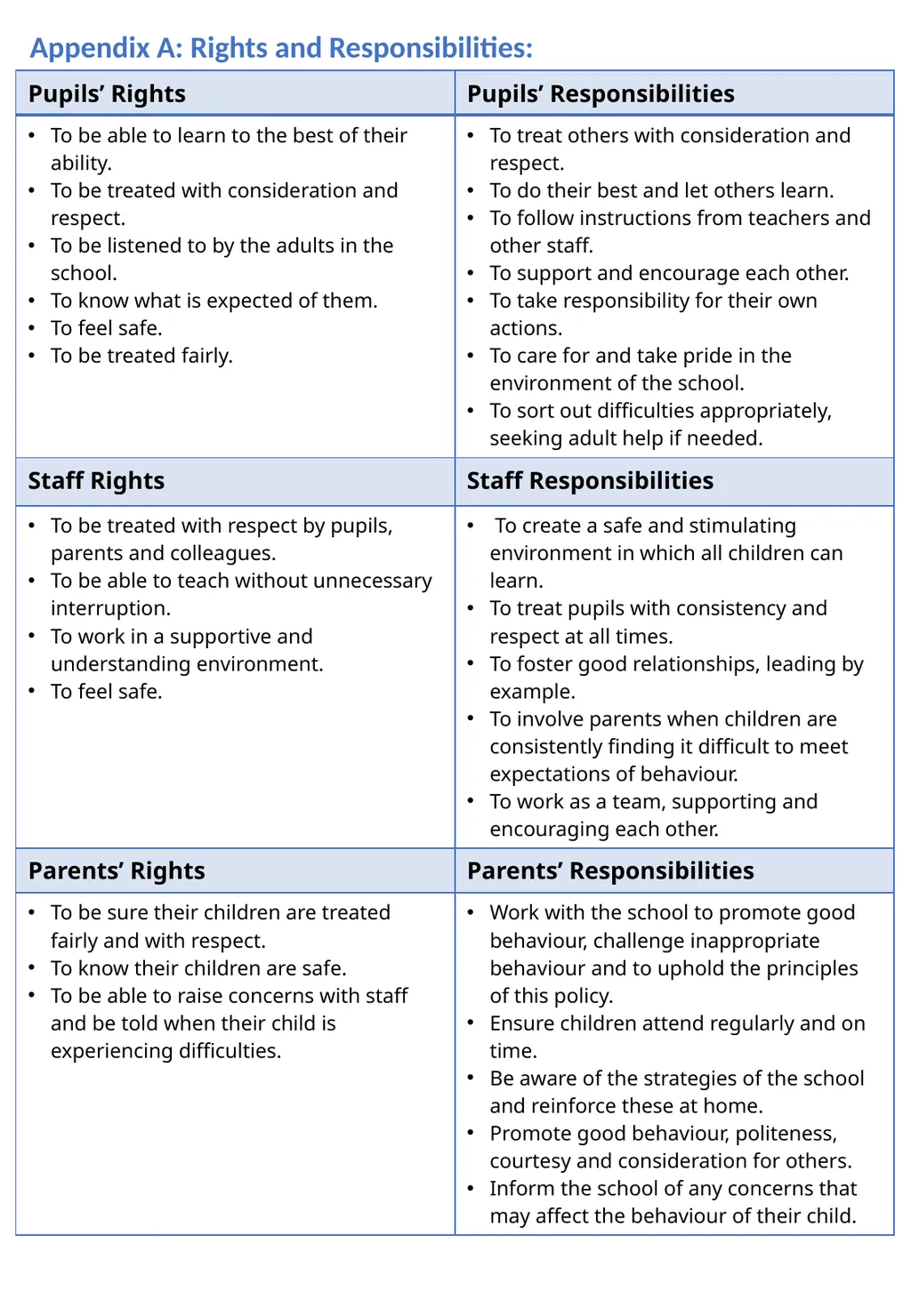
Appendix A: Rights and Responsibilities:<br>
10
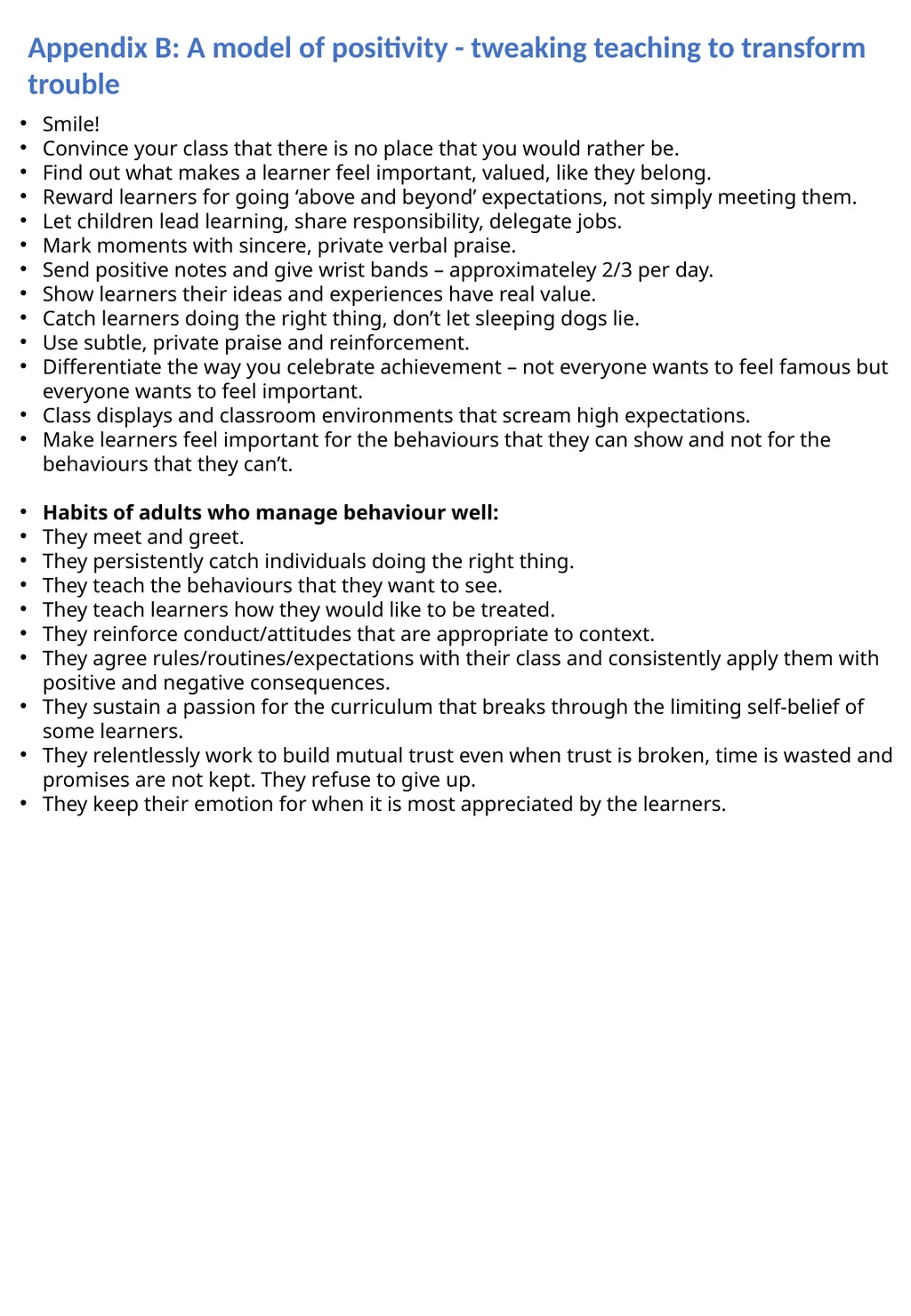
Appendix B: A model of positivity - tweaking teaching to transform trouble Smile!
Convince your class that there is no place that you would rather be.
Find out what makes a learner feel important, valued, like they belong.
Reward learners for going ‘above and beyond’ expectations, not simply meeting them.
Let children lead learning, share responsibility, delegate jobs.
Mark moments with sincere, private verbal praise.
Send positive notes and give wrist bands – approximateley 2/3 per day.
Show learners their ideas and experiences have real value.
Catch learners doing the right thing, don’t let sleeping dogs lie.
Use subtle, private praise and reinforcement.
Differentiate the way you celebrate achievement – not everyone wants to feel famous but everyone wants to feel important.
Class displays and classroom environments that scream high expectations.
Make learners feel important for the behaviours that they can show and not for the behaviours that they can’t.
Habits of adults who manage behaviour well:
They meet and greet.
They persistently catch individuals doing the right thing.
They teach the behaviours that they want to see.
They teach learners how they would like to be treated.
They reinforce conduct/attitudes that are appropriate to context.
They agree rules/routines/expectations with their class and consistently apply them with positive and negative consequences.
They sustain a passion for the curriculum that breaks through the limiting self-belief of some learners.
They relentlessly work to build mutual trust even when trust is broken, time is wasted and promises are not kept. They refuse to give up.
They keep their emotion for when it is most appreciated by the learners.<br>
Convince your class that there is no place that you would rather be.
Find out what makes a learner feel important, valued, like they belong.
Reward learners for going ‘above and beyond’ expectations, not simply meeting them.
Let children lead learning, share responsibility, delegate jobs.
Mark moments with sincere, private verbal praise.
Send positive notes and give wrist bands – approximateley 2/3 per day.
Show learners their ideas and experiences have real value.
Catch learners doing the right thing, don’t let sleeping dogs lie.
Use subtle, private praise and reinforcement.
Differentiate the way you celebrate achievement – not everyone wants to feel famous but everyone wants to feel important.
Class displays and classroom environments that scream high expectations.
Make learners feel important for the behaviours that they can show and not for the behaviours that they can’t.
Habits of adults who manage behaviour well:
They meet and greet.
They persistently catch individuals doing the right thing.
They teach the behaviours that they want to see.
They teach learners how they would like to be treated.
They reinforce conduct/attitudes that are appropriate to context.
They agree rules/routines/expectations with their class and consistently apply them with positive and negative consequences.
They sustain a passion for the curriculum that breaks through the limiting self-belief of some learners.
They relentlessly work to build mutual trust even when trust is broken, time is wasted and promises are not kept. They refuse to give up.
They keep their emotion for when it is most appreciated by the learners.<br>
11
Appendix C: A model of positivity –Effective 30 Second Interventions Gentle approach, personal, non-threatening, side on, eye level or lower.
State the behaviour that was observed and which rule/expectation/routine it contravenes.
Tell the learner what the sanction is. Immediately refer to previous good behaviour/learning as a model for the desired behaviour.
Walk away; allow him/her time to decide what to do next. If there are comments as you walk away, write them down and follow up later.
Look around the room with a view to catch somebody following the rules.
How to land a difficult message, softly:
Remind the learner of their previous good behaviour.
Challenge their negative internal monologue ‘You can do this, you are intelligent and able.’
Thank the child for listening.
Position yourself lower than eye level or side on if you are standing; don’t demand sustained eye contact.
Use a soft, disappointed tone.
Remind yourself that the sanction is a consequence not personal retribution.
Walk away as soon you have finished speaking.
Refocusing the conversation
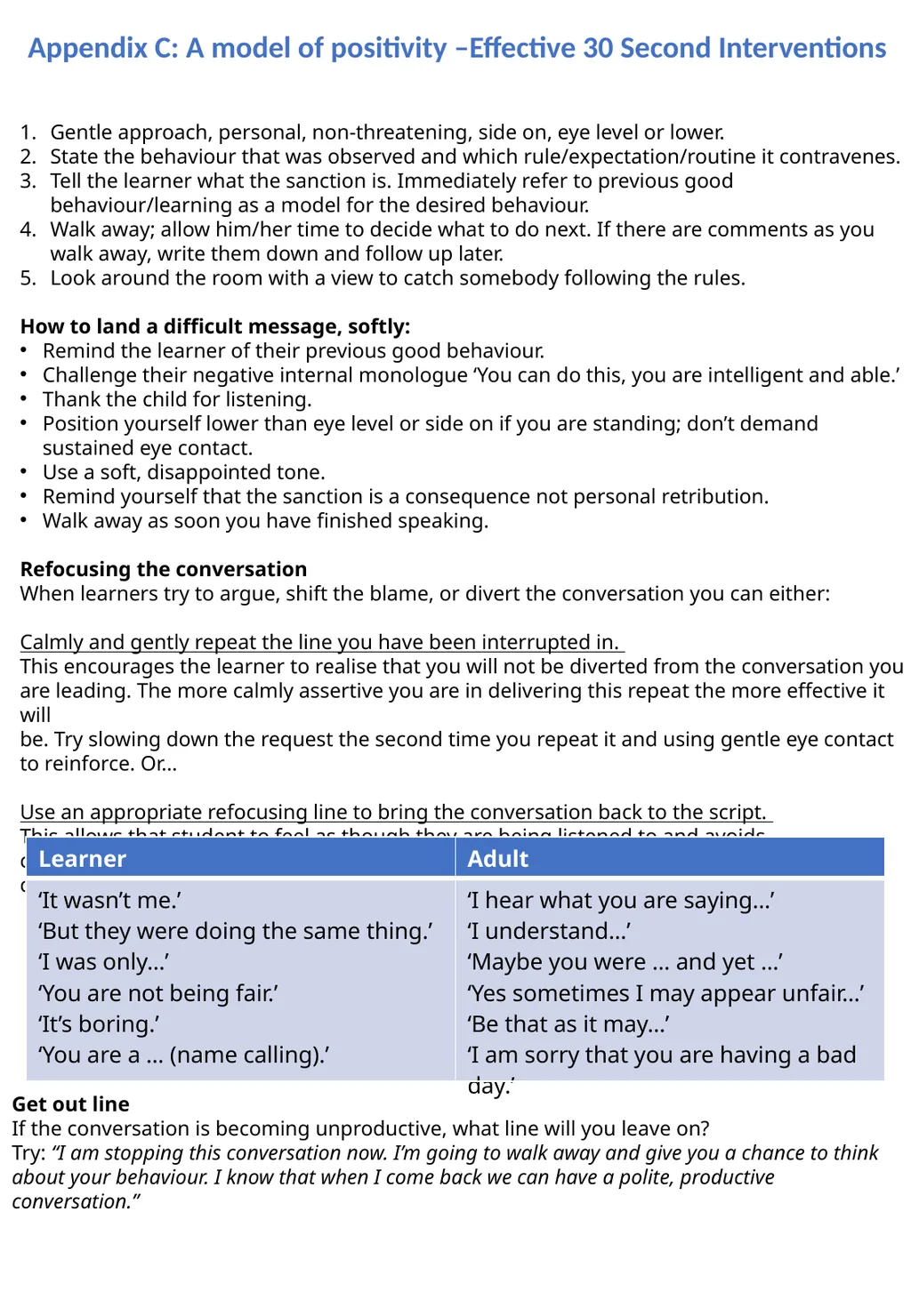
When learners try to argue, shift the blame, or divert the conversation you can either:
Calmly and gently repeat the line you have been interrupted in.
This encourages the learner to realise that you will not be diverted from the conversation you
are leading. The more calmly assertive you are in delivering this repeat the more effective it will
be. Try slowing down the request the second time you repeat it and using gentle eye contact to reinforce. Or…
Use an appropriate refocusing line to bring the conversation back to the script.
This allows that student to feel as though they are being listened to and avoids conversational
cul-de-sacs. Get out line
If the conversation is becoming unproductive, what line will you leave on?
Try: “I am stopping this conversation now. I’m going to walk away and give you a chance to think about your behaviour. I know that when I come back we can have a polite, productive conversation.”<br>
State the behaviour that was observed and which rule/expectation/routine it contravenes.
Tell the learner what the sanction is. Immediately refer to previous good behaviour/learning as a model for the desired behaviour.
Walk away; allow him/her time to decide what to do next. If there are comments as you walk away, write them down and follow up later.
Look around the room with a view to catch somebody following the rules.
How to land a difficult message, softly:
Remind the learner of their previous good behaviour.
Challenge their negative internal monologue ‘You can do this, you are intelligent and able.’
Thank the child for listening.
Position yourself lower than eye level or side on if you are standing; don’t demand sustained eye contact.
Use a soft, disappointed tone.
Remind yourself that the sanction is a consequence not personal retribution.
Walk away as soon you have finished speaking.
Refocusing the conversation
When learners try to argue, shift the blame, or divert the conversation you can either:
Calmly and gently repeat the line you have been interrupted in.
This encourages the learner to realise that you will not be diverted from the conversation you
are leading. The more calmly assertive you are in delivering this repeat the more effective it will
be. Try slowing down the request the second time you repeat it and using gentle eye contact to reinforce. Or…
Use an appropriate refocusing line to bring the conversation back to the script.
This allows that student to feel as though they are being listened to and avoids conversational
cul-de-sacs. Get out line
If the conversation is becoming unproductive, what line will you leave on?
Try: “I am stopping this conversation now. I’m going to walk away and give you a chance to think about your behaviour. I know that when I come back we can have a polite, productive conversation.”<br>