Biosecurity Overview Adapted from the FAD
Description: Biosecurity Overview Adapted from the FAD PRePNAHEMS Guidelines: Biosecurity (2016) Basic biosecurity concepts Routes of exposure Steps to develop a biosecurity plan Three levels of biosecurity Practical application of operational measures
Related Topics
Download Presentation
"Biosecurity Overview Adapted from the FAD" is the property of its rightful owner. Permission is granted to download and print the materials on this website for personal, non-commercial use only, and to display it on your personal computer provided you do not modify the materials and that you retain all copyright notices contained in the materials. By downloading content from our website, you accept the terms of this agreement.
Presentation Transcript
slide1. Biosecurity Overview Adapted from the FAD PReP/NAHEMS Guidelines: Biosecurity (2016)<br>
slide2. Basic biosecurity concepts
Routes of exposure
Steps to develop a biosecurity plan
Three levels of biosecurity
Practical application of operational measures in bioexclusion and biocontainment USDA APHIS and CFSPH FAD PReP/NAHEMS Guidelines: Biosecurity - Overview This Presentation<br>
slide3. Measures or management practices
Prevent spread of disease
Protect in routine, daily management
Contain disease in an emergency
Individual assessment/analysis
Health status and species
Management and site arrangement
Sources of contamination
Areas needing protection USDA APHIS and CFSPH FAD PReP/NAHEMS Guidelines: Biosecurity - Overview Biosecurity Concepts<br>
slide4. Line of Separation
Imagined or physical
Pathways for disease movements
Onto, off of, and within the facility
Critical control points
Measures to prevent transfer
People, supplies, equipment, vehicles, feed, mortalities, animals
Bioexclusion and/or biocontainment USDA APHIS and CFSPH FAD PReP/NAHEMS Guidelines: Biosecurity - Overview Separate Clean and Dirty<br>
slide5. Routes of Exposure to Disease USDA APHIS and CFSPH FAD PReP/NAHEMS Guidelines: Biosecurity - Overview<br>
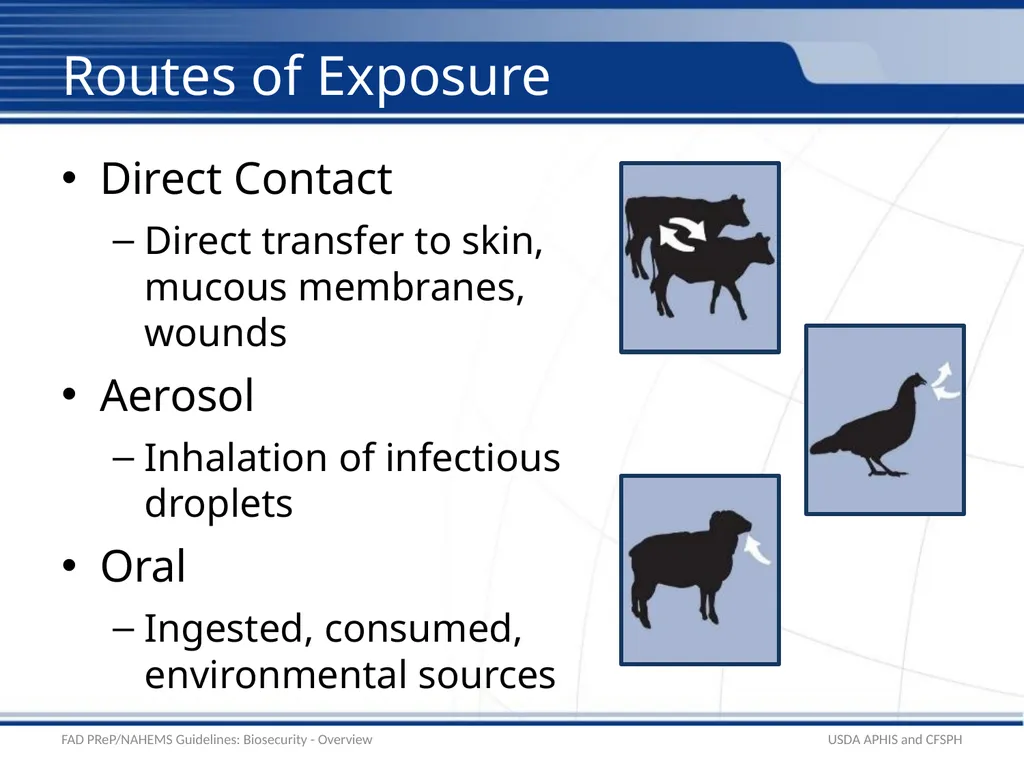
slide6. Direct Contact
Direct transfer to skin, mucous membranes, wounds
Aerosol
Inhalation of infectious droplets
Oral
Ingested, consumed,environmental sources USDA APHIS and CFSPH FAD PReP/NAHEMS Guidelines: Biosecurity - Overview Routes of Exposure<br>
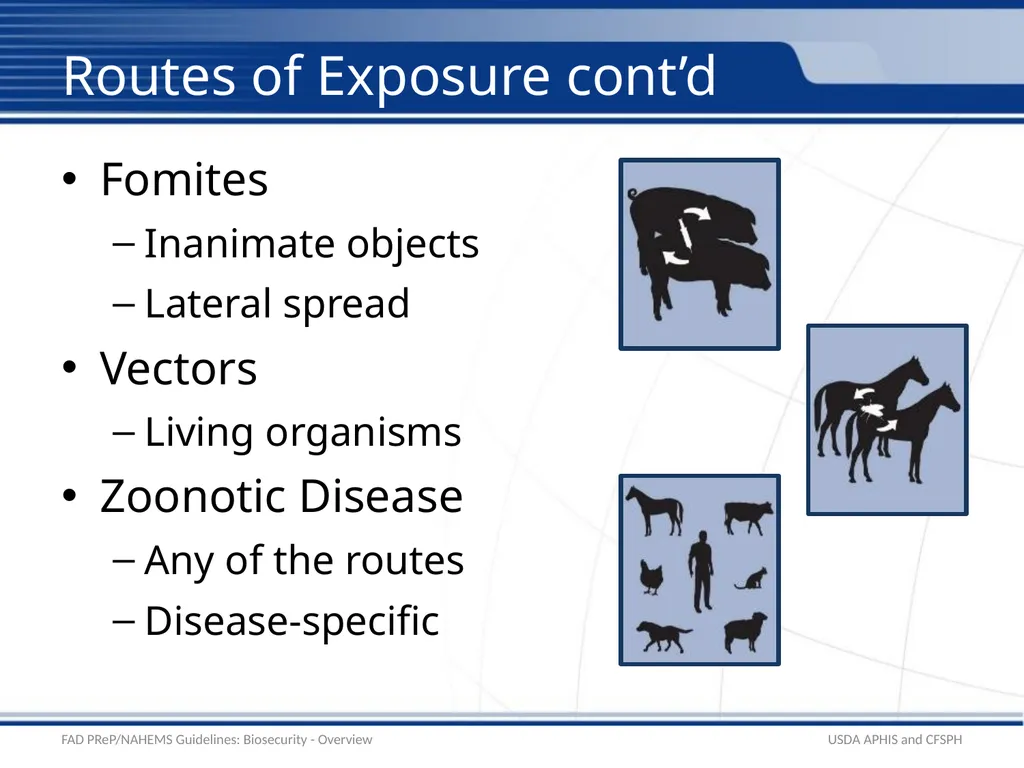
slide7. Fomites
Inanimate objects
Lateral spread
Vectors
Living organisms
Zoonotic Disease
Any of the routes
Disease-specific USDA APHIS and CFSPH FAD PReP/NAHEMS Guidelines: Biosecurity - Overview Routes of Exposure cont’d<br>
slide8. Developing a Biosecurity Plan USDA APHIS and CFSPH FAD PReP/NAHEMS Guidelines: Biosecurity - Overview<br>
slide9. Step 1: Prioritize the disease agents
Consider species/susceptibility, housing, management, wildlife exposure
Step 2: Conduct a facility assessment
Identify pathways/movements
Step 3: Implement processes to minimize impact of disease
Prevent movements that carry disease USDA APHIS and CFSPH FAD PReP/NAHEMS Guidelines: Biosecurity - Overview Developing a Biosecurity Plan<br>
slide10. Movements of animals
Closed herd is more protected
Additions from offspring within the herd
Managed in small, isolated groups
All-in/all-out management, less co-mingling
Animals that leave and return create a risk for the herd/flock
Quarantines restrict movements USDA APHIS and CFSPH FAD PReP/NAHEMS Guidelines: Biosecurity - Overview Developing a Plan cont’d<br>
slide11. Levels of Biosecurity USDA APHIS and CFSPH FAD PReP/NAHEMS Guidelines: Biosecurity - Overview<br>
slide12. Conceptual
Location, geospatial siting, orientation of the facility
Structural
Capital investment, construction to prevent disease spread
Operational
Processes, management practices, standard operating procedures to exclude or contain disease USDA APHIS and CFSPH FAD PReP/NAHEMS Guidelines: Biosecurity - Overview Three Levels of Biosecurity<br>
slide13. Premises Biosecurity USDA APHIS and CFSPH FAD PReP/NAHEMS Guidelines: Biosecurity - Overview<br>
slide14. Responsibility and authority
Assesses, designs, implements
Monitors and enforces
Ensures ongoing effectiveness
Certifies compliance
Communicates and trains everyone on concepts and procedures USDA APHIS and CFSPH FAD PReP/NAHEMS Guidelines: Biosecurity - Overview Officer, Manager, Coordinator<br>
slide15. Line of Separation
Prevent pathogens from crossing
Point of access = critical control point
Biosecurity measure defined for each movement
Perimeter Buffer Area
Transition with sanitation standard
Area of reduced contamination
Wider separation between clean and dirty USDA APHIS and CFSPH FAD PReP/NAHEMS Guidelines: Biosecurity - Overview Establish Separation<br>
slide16. Fomites
Decontamination
People
Biosecurity attire and sanitation
Vectors
Barriers or control programs
Production traffic patterns
Avoid cross contamination USDA APHIS and CFSPH FAD PReP/NAHEMS Guidelines: Biosecurity - Overview Operational Measures<br>
slide17. Cleaning and disinfection
Reduces, inactivates, or destroys biological pathogens
Physical, chemical, or combination
Biosecurity attire/PPE
Prevents transfer by outerwear
Protects responder health if zoonotic USDA APHIS and CFSPH FAD PReP/NAHEMS Guidelines: Biosecurity - Overview C&D and Biosecurity Attire/PPE<br>
slide18. Biosecurity in an FAD Response USDA APHIS and CFSPH FAD PReP/NAHEMS Guidelines: Biosecurity - Overview<br>
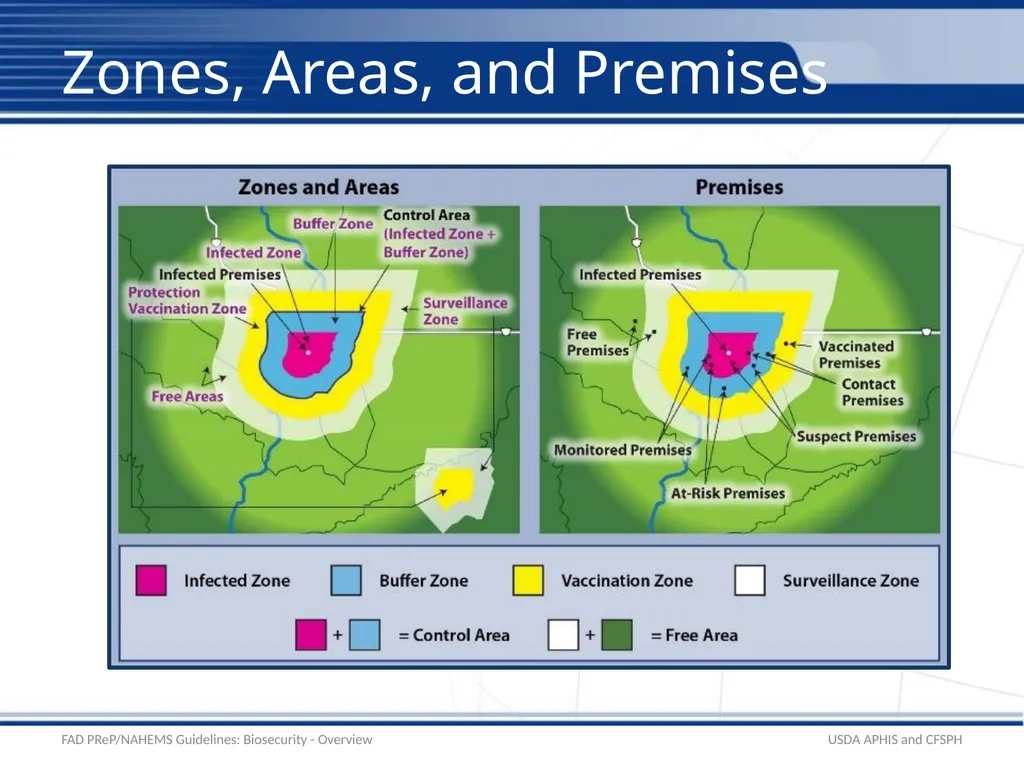
slide19. USDA APHIS and CFSPH FAD PReP/NAHEMS Guidelines: Biosecurity - Overview Zones, Areas, and Premises<br>
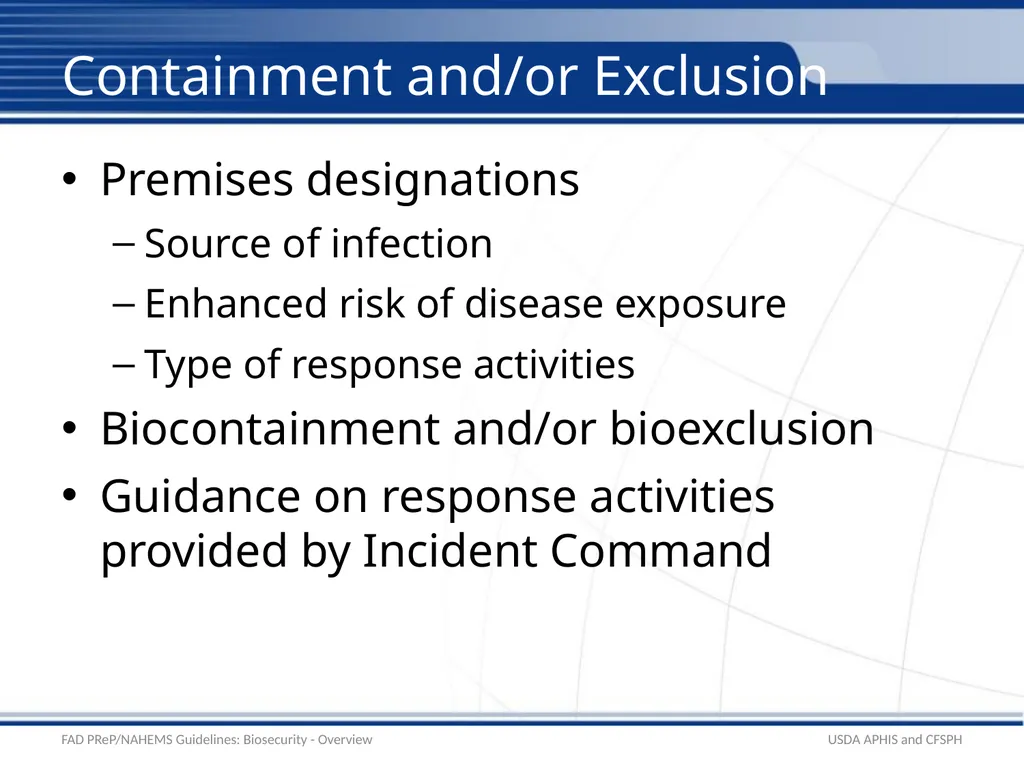
slide20. Premises designations
Source of infection
Enhanced risk of disease exposure
Type of response activities
Biocontainment and/or bioexclusion
Guidance on response activities provided by Incident Command USDA APHIS and CFSPH FAD PReP/NAHEMS Guidelines: Biosecurity - Overview Containment and/or Exclusion<br>
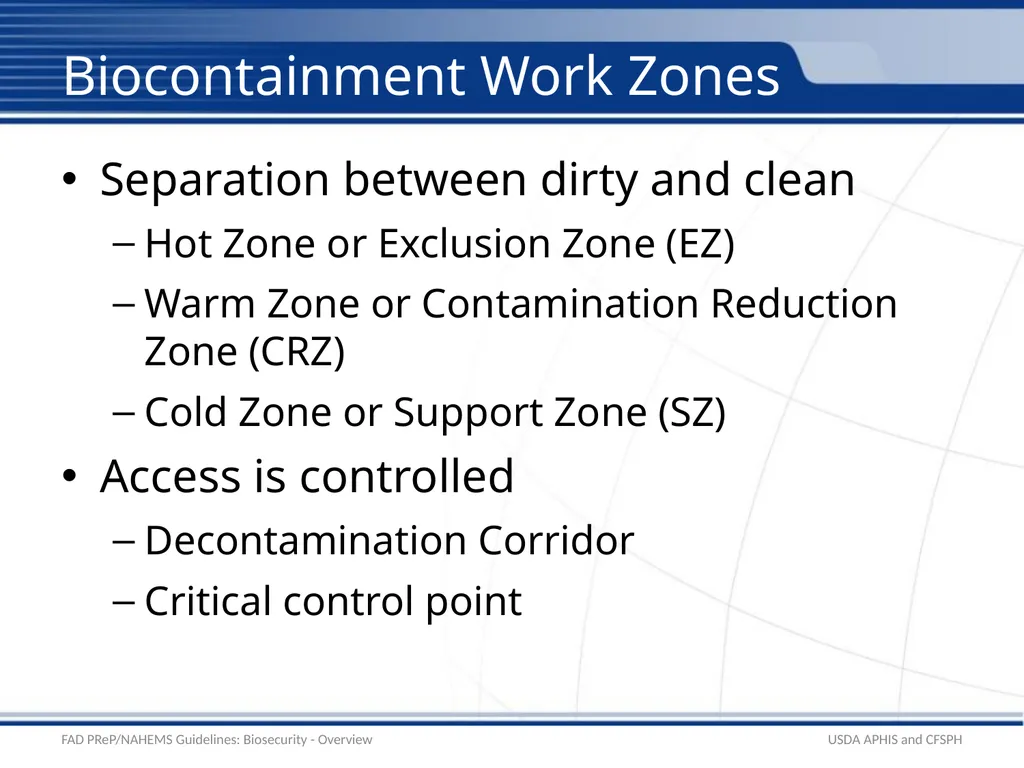
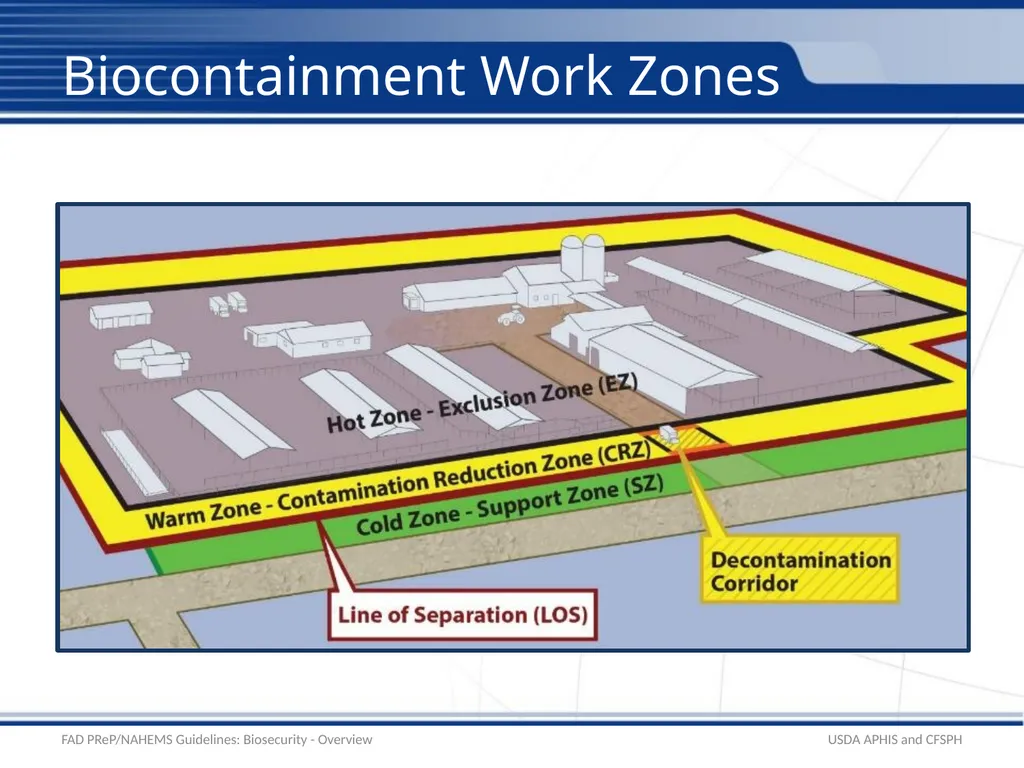
slide21. Separation between dirty and clean
Hot Zone or Exclusion Zone (EZ)
Warm Zone or Contamination Reduction Zone (CRZ)
Cold Zone or Support Zone (SZ)
Access is controlled
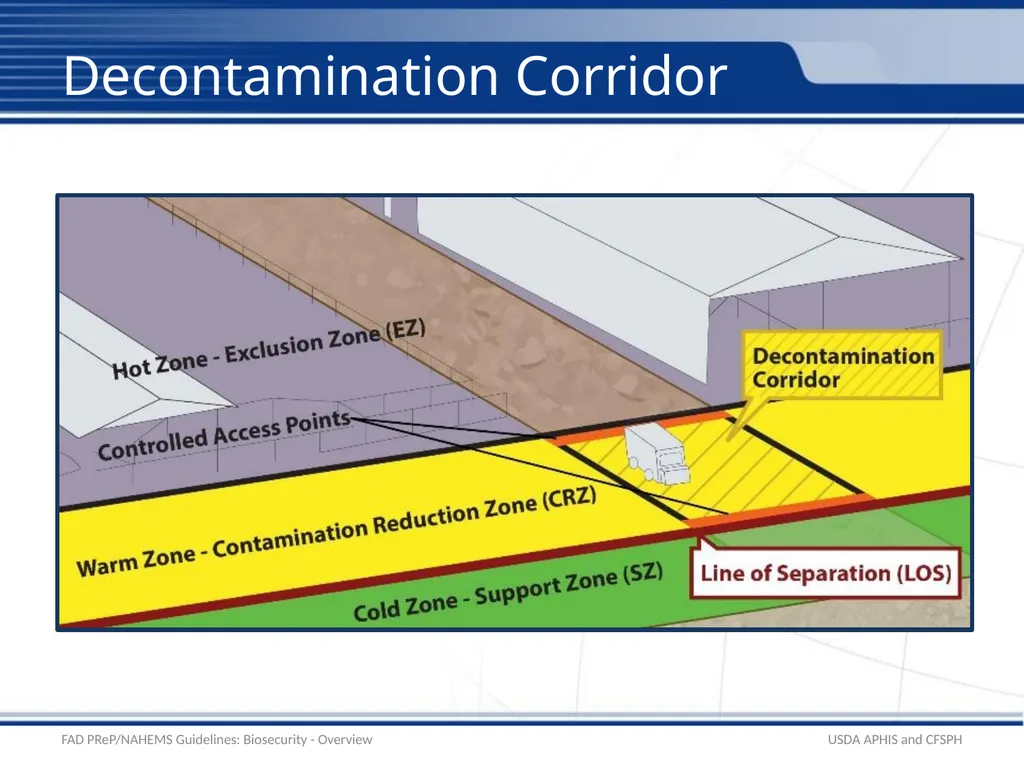
Decontamination Corridor
Critical control point USDA APHIS and CFSPH FAD PReP/NAHEMS Guidelines: Biosecurity - Overview Biocontainment Work Zones<br>
slide22. USDA APHIS and CFSPH FAD PReP/NAHEMS Guidelines: Biosecurity - Overview Biocontainment Work Zones<br>
slide23. USDA APHIS and CFSPH FAD PReP/NAHEMS Guidelines: Biosecurity - Overview Decontamination Corridor<br>
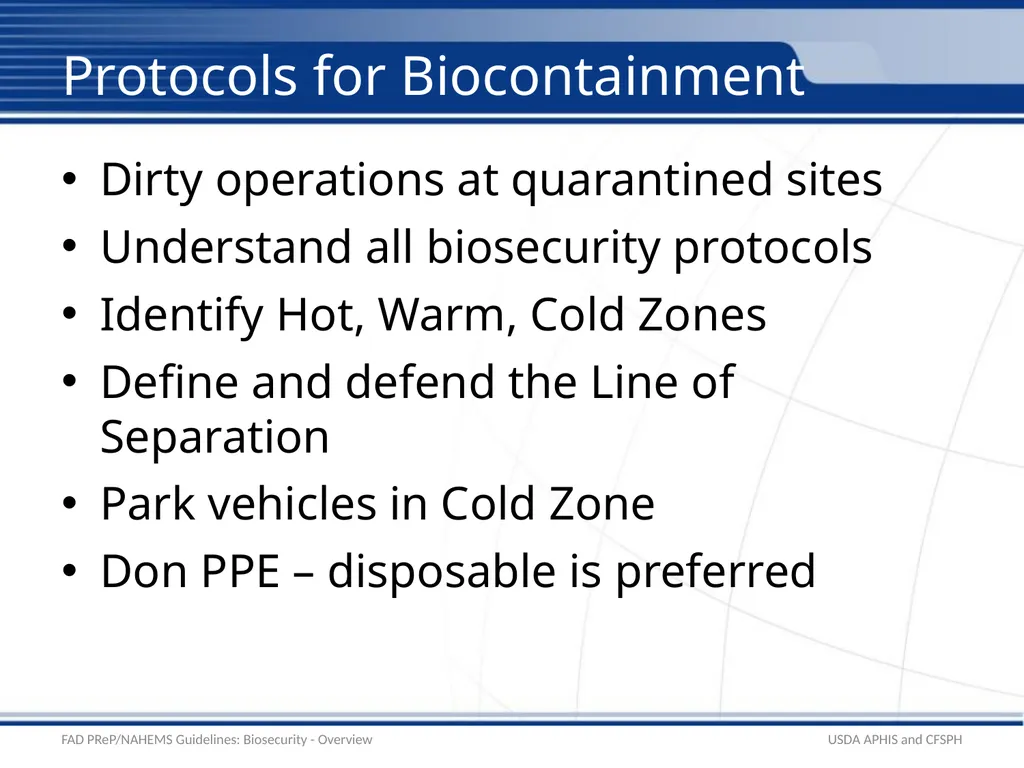
slide24. Dirty operations at quarantined sites
Understand all biosecurity protocols
Identify Hot, Warm, Cold Zones
Define and defend the Line of Separation
Park vehicles in Cold Zone
Don PPE – disposable is preferred USDA APHIS and CFSPH FAD PReP/NAHEMS Guidelines: Biosecurity - Overview Protocols for Biocontainment<br>
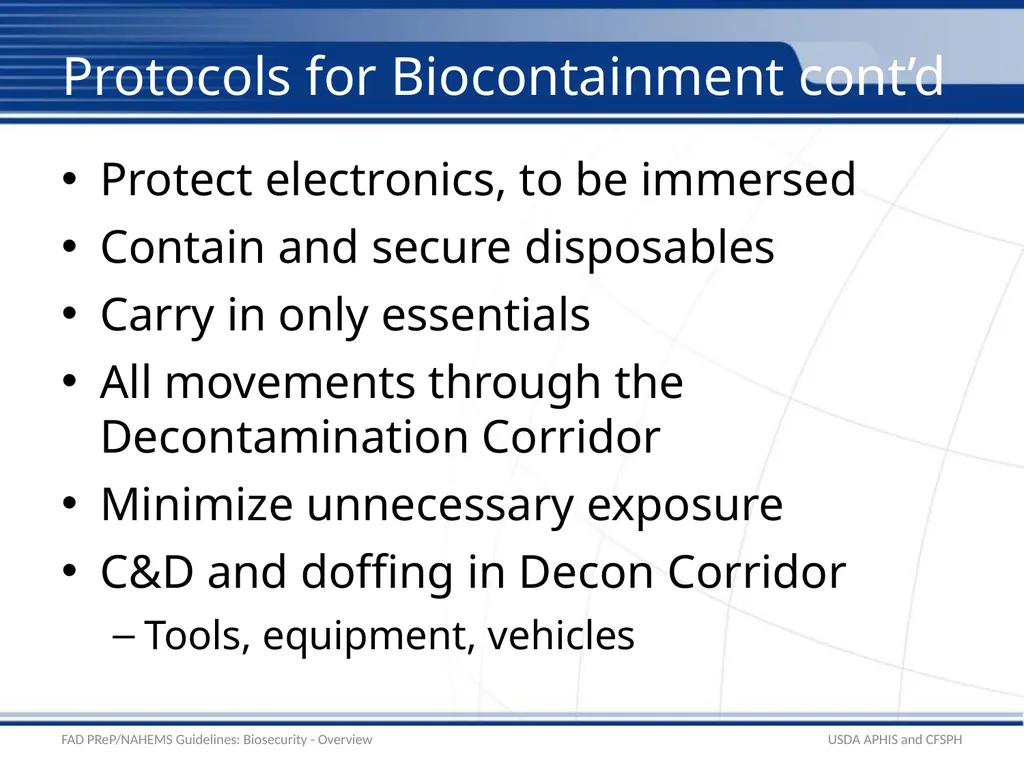
slide25. Protect electronics, to be immersed
Contain and secure disposables
Carry in only essentials
All movements through the Decontamination Corridor
Minimize unnecessary exposure
C&D and doffing in Decon Corridor
Tools, equipment, vehicles USDA APHIS and CFSPH FAD PReP/NAHEMS Guidelines: Biosecurity - Overview Protocols for Biocontainment cont’d<br>
slide26. Clean operations at non-infected sites
Follow premises’ biosecurity plan
Identify Line of Separation
Animal area is clean, protected side
Remove all contamination prior to entry at controlled access point
Don biosecurity attire/PPE USDA APHIS and CFSPH FAD PReP/NAHEMS Guidelines: Biosecurity - Overview Protocols for Bioexclusion<br>
slide27. Minimize movements and spread
Begin activities with most susceptible animal group
When exiting across Line of Separation, doff PPE
C&D boots and all equipment
Secure disposables according to the biosecurity plan USDA APHIS and CFSPH FAD PReP/NAHEMS Guidelines: Biosecurity - Overview Protocols for Bioexclusion cont’d<br>
slide28. Biosecurity concepts multifaceted
Protect healthy animals from introduction of disease
Contain disease from spreading in an outbreak
FAD response efforts require both biocontainment and bioexclusion practiced correctly and consistently USDA APHIS and CFSPH FAD PReP/NAHEMS Guidelines: Biosecurity - Overview Conclusion<br>
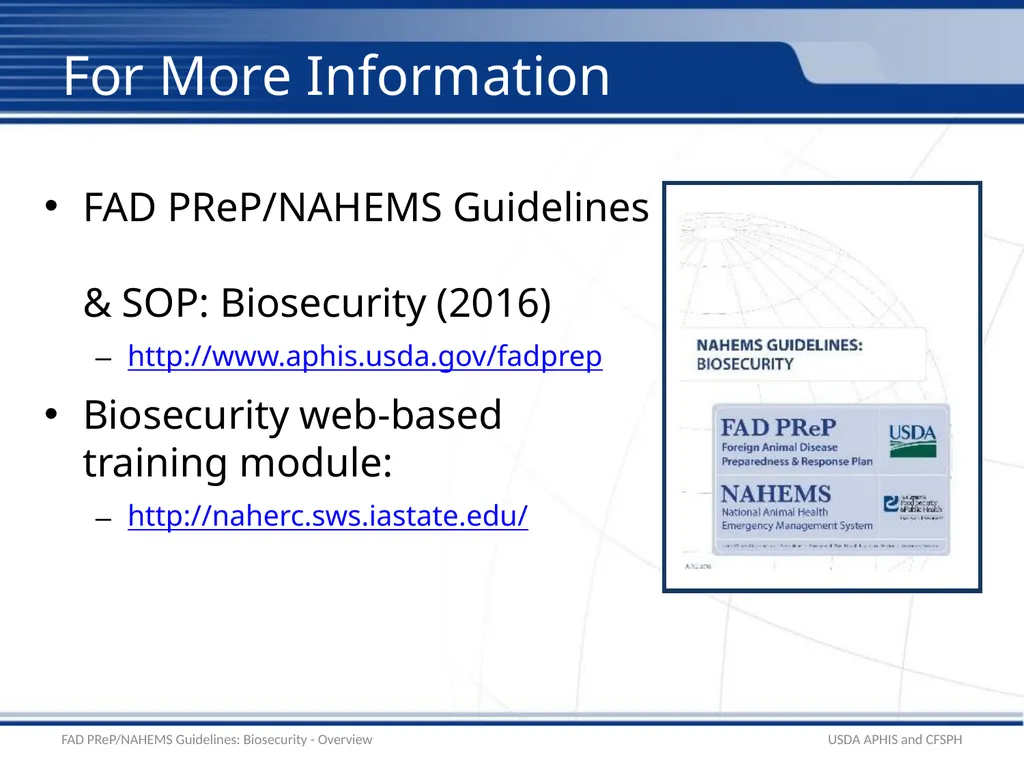
slide29. USDA APHIS and CFSPH FAD PReP/NAHEMS Guidelines: Biosecurity - Overview For More Information FAD PReP/NAHEMS Guidelines & SOP: Biosecurity (2016)
http://www.aphis.usda.gov/fadprep
Biosecurity web-based training module:
http://naherc.sws.iastate.edu/<br>
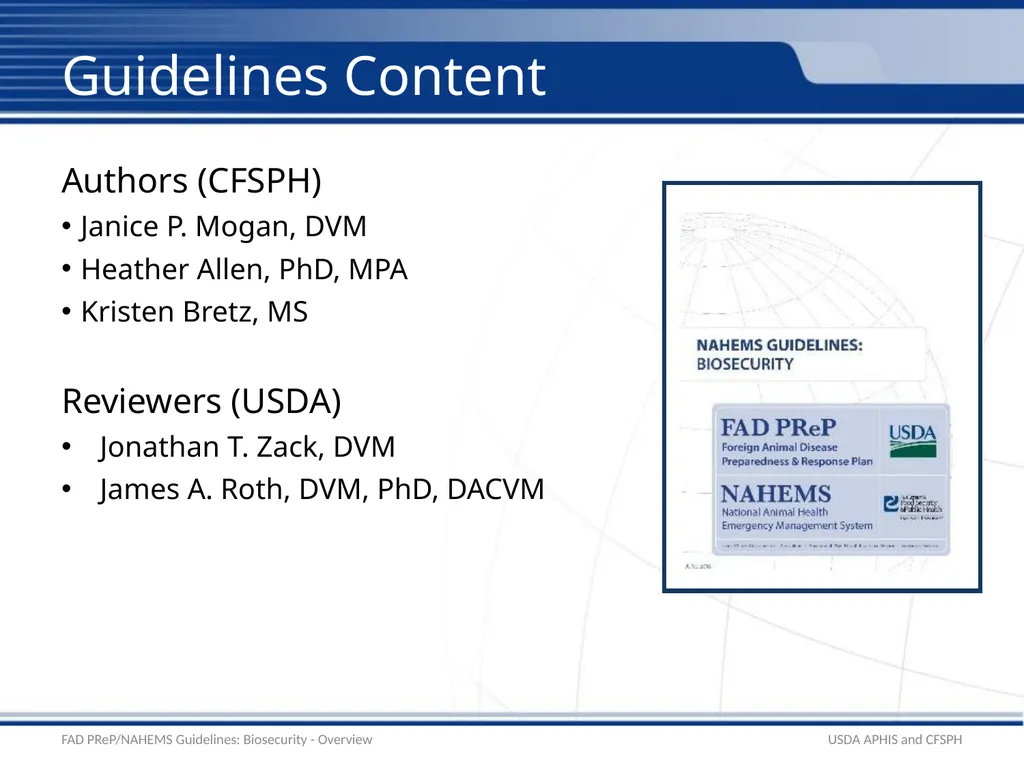
slide30. Authors (CFSPH)
Janice P. Mogan, DVM
Heather Allen, PhD, MPA
Kristen Bretz, MS
Reviewers (USDA)
Jonathan T. Zack, DVM
James A. Roth, DVM, PhD, DACVM USDA APHIS and CFSPH FAD PReP/NAHEMS Guidelines: Biosecurity - Overview Guidelines Content<br>
slide31. Acknowledgments Development of this presentation was by the Center for Food Security and Public Health at Iowa State University through funding from the USDA APHIS Veterinary Services PPT Authors: Janice P. Mogan, DVM; Logan Kilburn
Reviewer: Kristen Bretz, MS<br>

slide2. Basic biosecurity concepts
Routes of exposure
Steps to develop a biosecurity plan
Three levels of biosecurity
Practical application of operational measures in bioexclusion and biocontainment USDA APHIS and CFSPH FAD PReP/NAHEMS Guidelines: Biosecurity - Overview This Presentation<br>
slide3. Measures or management practices
Prevent spread of disease
Protect in routine, daily management
Contain disease in an emergency
Individual assessment/analysis
Health status and species
Management and site arrangement
Sources of contamination
Areas needing protection USDA APHIS and CFSPH FAD PReP/NAHEMS Guidelines: Biosecurity - Overview Biosecurity Concepts<br>
slide4. Line of Separation
Imagined or physical
Pathways for disease movements
Onto, off of, and within the facility
Critical control points
Measures to prevent transfer
People, supplies, equipment, vehicles, feed, mortalities, animals
Bioexclusion and/or biocontainment USDA APHIS and CFSPH FAD PReP/NAHEMS Guidelines: Biosecurity - Overview Separate Clean and Dirty<br>
slide5. Routes of Exposure to Disease USDA APHIS and CFSPH FAD PReP/NAHEMS Guidelines: Biosecurity - Overview<br>
slide6. Direct Contact
Direct transfer to skin, mucous membranes, wounds
Aerosol
Inhalation of infectious droplets
Oral
Ingested, consumed,environmental sources USDA APHIS and CFSPH FAD PReP/NAHEMS Guidelines: Biosecurity - Overview Routes of Exposure<br>
slide7. Fomites
Inanimate objects
Lateral spread
Vectors
Living organisms
Zoonotic Disease
Any of the routes
Disease-specific USDA APHIS and CFSPH FAD PReP/NAHEMS Guidelines: Biosecurity - Overview Routes of Exposure cont’d<br>
slide8. Developing a Biosecurity Plan USDA APHIS and CFSPH FAD PReP/NAHEMS Guidelines: Biosecurity - Overview<br>
slide9. Step 1: Prioritize the disease agents
Consider species/susceptibility, housing, management, wildlife exposure
Step 2: Conduct a facility assessment
Identify pathways/movements
Step 3: Implement processes to minimize impact of disease
Prevent movements that carry disease USDA APHIS and CFSPH FAD PReP/NAHEMS Guidelines: Biosecurity - Overview Developing a Biosecurity Plan<br>
slide10. Movements of animals
Closed herd is more protected
Additions from offspring within the herd
Managed in small, isolated groups
All-in/all-out management, less co-mingling
Animals that leave and return create a risk for the herd/flock
Quarantines restrict movements USDA APHIS and CFSPH FAD PReP/NAHEMS Guidelines: Biosecurity - Overview Developing a Plan cont’d<br>
slide11. Levels of Biosecurity USDA APHIS and CFSPH FAD PReP/NAHEMS Guidelines: Biosecurity - Overview<br>
slide12. Conceptual
Location, geospatial siting, orientation of the facility
Structural
Capital investment, construction to prevent disease spread
Operational
Processes, management practices, standard operating procedures to exclude or contain disease USDA APHIS and CFSPH FAD PReP/NAHEMS Guidelines: Biosecurity - Overview Three Levels of Biosecurity<br>
slide13. Premises Biosecurity USDA APHIS and CFSPH FAD PReP/NAHEMS Guidelines: Biosecurity - Overview<br>
slide14. Responsibility and authority
Assesses, designs, implements
Monitors and enforces
Ensures ongoing effectiveness
Certifies compliance
Communicates and trains everyone on concepts and procedures USDA APHIS and CFSPH FAD PReP/NAHEMS Guidelines: Biosecurity - Overview Officer, Manager, Coordinator<br>
slide15. Line of Separation
Prevent pathogens from crossing
Point of access = critical control point
Biosecurity measure defined for each movement
Perimeter Buffer Area
Transition with sanitation standard
Area of reduced contamination
Wider separation between clean and dirty USDA APHIS and CFSPH FAD PReP/NAHEMS Guidelines: Biosecurity - Overview Establish Separation<br>
slide16. Fomites
Decontamination
People
Biosecurity attire and sanitation
Vectors
Barriers or control programs
Production traffic patterns
Avoid cross contamination USDA APHIS and CFSPH FAD PReP/NAHEMS Guidelines: Biosecurity - Overview Operational Measures<br>
slide17. Cleaning and disinfection
Reduces, inactivates, or destroys biological pathogens
Physical, chemical, or combination
Biosecurity attire/PPE
Prevents transfer by outerwear
Protects responder health if zoonotic USDA APHIS and CFSPH FAD PReP/NAHEMS Guidelines: Biosecurity - Overview C&D and Biosecurity Attire/PPE<br>
slide18. Biosecurity in an FAD Response USDA APHIS and CFSPH FAD PReP/NAHEMS Guidelines: Biosecurity - Overview<br>
slide19. USDA APHIS and CFSPH FAD PReP/NAHEMS Guidelines: Biosecurity - Overview Zones, Areas, and Premises<br>
slide20. Premises designations
Source of infection
Enhanced risk of disease exposure
Type of response activities
Biocontainment and/or bioexclusion
Guidance on response activities provided by Incident Command USDA APHIS and CFSPH FAD PReP/NAHEMS Guidelines: Biosecurity - Overview Containment and/or Exclusion<br>
slide21. Separation between dirty and clean
Hot Zone or Exclusion Zone (EZ)
Warm Zone or Contamination Reduction Zone (CRZ)
Cold Zone or Support Zone (SZ)
Access is controlled
Decontamination Corridor
Critical control point USDA APHIS and CFSPH FAD PReP/NAHEMS Guidelines: Biosecurity - Overview Biocontainment Work Zones<br>
slide22. USDA APHIS and CFSPH FAD PReP/NAHEMS Guidelines: Biosecurity - Overview Biocontainment Work Zones<br>
slide23. USDA APHIS and CFSPH FAD PReP/NAHEMS Guidelines: Biosecurity - Overview Decontamination Corridor<br>
slide24. Dirty operations at quarantined sites
Understand all biosecurity protocols
Identify Hot, Warm, Cold Zones
Define and defend the Line of Separation
Park vehicles in Cold Zone
Don PPE – disposable is preferred USDA APHIS and CFSPH FAD PReP/NAHEMS Guidelines: Biosecurity - Overview Protocols for Biocontainment<br>
slide25. Protect electronics, to be immersed
Contain and secure disposables
Carry in only essentials
All movements through the Decontamination Corridor
Minimize unnecessary exposure
C&D and doffing in Decon Corridor
Tools, equipment, vehicles USDA APHIS and CFSPH FAD PReP/NAHEMS Guidelines: Biosecurity - Overview Protocols for Biocontainment cont’d<br>
slide26. Clean operations at non-infected sites
Follow premises’ biosecurity plan
Identify Line of Separation
Animal area is clean, protected side
Remove all contamination prior to entry at controlled access point
Don biosecurity attire/PPE USDA APHIS and CFSPH FAD PReP/NAHEMS Guidelines: Biosecurity - Overview Protocols for Bioexclusion<br>
slide27. Minimize movements and spread
Begin activities with most susceptible animal group
When exiting across Line of Separation, doff PPE
C&D boots and all equipment
Secure disposables according to the biosecurity plan USDA APHIS and CFSPH FAD PReP/NAHEMS Guidelines: Biosecurity - Overview Protocols for Bioexclusion cont’d<br>
slide28. Biosecurity concepts multifaceted
Protect healthy animals from introduction of disease
Contain disease from spreading in an outbreak
FAD response efforts require both biocontainment and bioexclusion practiced correctly and consistently USDA APHIS and CFSPH FAD PReP/NAHEMS Guidelines: Biosecurity - Overview Conclusion<br>
slide29. USDA APHIS and CFSPH FAD PReP/NAHEMS Guidelines: Biosecurity - Overview For More Information FAD PReP/NAHEMS Guidelines & SOP: Biosecurity (2016)
http://www.aphis.usda.gov/fadprep
Biosecurity web-based training module:
http://naherc.sws.iastate.edu/<br>
slide30. Authors (CFSPH)
Janice P. Mogan, DVM
Heather Allen, PhD, MPA
Kristen Bretz, MS
Reviewers (USDA)
Jonathan T. Zack, DVM
James A. Roth, DVM, PhD, DACVM USDA APHIS and CFSPH FAD PReP/NAHEMS Guidelines: Biosecurity - Overview Guidelines Content<br>
slide31. Acknowledgments Development of this presentation was by the Center for Food Security and Public Health at Iowa State University through funding from the USDA APHIS Veterinary Services PPT Authors: Janice P. Mogan, DVM; Logan Kilburn
Reviewer: Kristen Bretz, MS<br>