BRICS 2016 Formalization of the labour market:
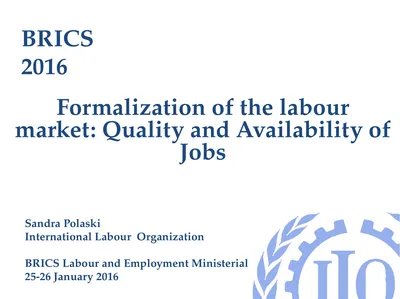
Description: BRICS 2016 Formalization of the labour market: Quality and Availability of Jobs Sandra Polaski International Labour Organization BRICS Labour and Employment Ministerial 25-26 January 2016 Integration of macroeconomic and other policies to
Related Topics
Download Presentation
"BRICS 2016 Formalization of the labour market:" is the property of its rightful owner. Permission is granted to download and print the materials on this website for personal, non-commercial use only, and to display it on your personal computer provided you do not modify the materials and that you retain all copyright notices contained in the materials. By downloading content from our website, you accept the terms of this agreement.
Presentation Transcript
slide1. BRICS 2016 Formalization of the labour market: Quality and Availability of Jobs Sandra Polaski
International Labour Organization
BRICS Labour and Employment Ministerial 25-26 January 2016<br>
slide2. Integration of macroeconomic and other policies to promote job creation in the formal economy
Formalizing informal jobs and enterprises
Enterprise modernization and increased productivity to foster formal employment
Improving occupational safety and health
Enforcement and protection of workers’ rights Topics for Session 2 discussion<br>
slide3. A1 Macroeconomic policy: Effects of fiscal consolidation on employment Fiscal balances of some BRICS affected by low commodity prices
Excessive expenditure cuts could worsen the employment outlook Projected rise in unemployment levels in emerging economies, millions of people
(baseline vs. spending cuts by commodity exporters)<br>
slide4. A2 Gaps in capital formation remain large In per capita terms, BRICS still have only a fraction of invested capital compared with high-income OECD
This partly reflects low public capital stocks and physical infrastructure deficits Gross fixed capital formation per worker in the
non-agricultural sector
(000s of USD at constant prices/exchange rates)<br>
slide5. Pro-employment macroeconomic policies
Counter-cyclical policy to avoid increase in unemployment
Use available fiscal space to increase well-targeted investment in infrastructure, public goods
Consider providing incentives for other productive investments
Social protection schemes act as automatic stabilizers and are associated with higher productivity
Labour market policies to augment aggregate demand and enhance productivity A3 Integration of macroeconomic, labour and social policies to promote job creation in the formal economy<br>
slide6. A4 Investments in social protection are associated with higher labour productivity Public social expenditure (% GDP) and GDP per worker (constant 1990 US$ PPP), latest year Note: Latest data available (2010-2013)Source: Social protection expenditure: ILO World Social Protection Report 2014/15, updated based on national information; labour productivity: ILO KILM based on Conference Board estimates.<br>
slide7. A5 Higher levels of employment offering social protection associated with higher labour productivity Note: Latest data available (2008-2014)Source: Social protection coverage: ILO World Social Protection Report 2014/15, updated based on national information; labour productivity: ILO KILM based on Conference Board estimates. Share of the labour force contributing to an old age pension scheme (%) and GDP per worker (constant 1990 US$ PPP), latest year<br>
slide8. A6 Economic growth in the BRICS has translated into higher wages and stronger aggregate demand Real average wage index, 2007/08 - 2014 Note:Data for India are only available once every two years. For this reason, data points appear every other year with the exception of 2007 and 2008. Real wage growth between 2007 and 2008 (17%) actually refers to the real wage growth between 2005-06 and 2007-08.
**Due to a break in the series, the 2014 estimate in South Africa refers to year-on-year growth for the last three quarters of 2013 to 2014.
Source:ILO Global Wage Database (www.ilo.org/ilostat)<br>
slide9. A7 One effective policy tool to reduce inequality has been the minimum wage Notes: Data refer to 2011 in India, 2010/11 in South Africa, 2009 in China and 2012 in Brazil and the Russian Federation. In Brazil and the Russian Federation, the national minimum wage is used. In China, the minimum wage in Beijing is used. In South Africa and India, the minimum wage is a weighted average of the minimum wages in effect. Minimum wages were weighted by the number of employees who earned a particular minimum wage. Source:: ILO estimates based on national statistical sources Ratio of the minimum to median wage<br>
slide10. B1 Fostering transition to formality of informal jobs and enterprises ILO Recommendation 204: a guiding framework to achieve three interrelated objectives
Promote the creation and sustainability of enterprises and decent jobs in the formal economy
Facilitate the transition of workers and economic units from the informal to the formal economy
Prevent the informalization of formal economy jobs<br>
slide11. B2 Informal employment in the BRICS
% of non-agricultural employment, latest year available<br>
slide12. Effective provision of information
Assistance in complying with relevant laws and regulations
Consider well-targeted financial support (loan guarantees, discounted tax rates during limited transition period, etc.)
Preventive and appropriate corrective measures
Effective sanctions to address tax evasion and avoidance of social contributions, labour laws and regulations B3 Facilitating the transition of firms to the formal economy<br>
slide13. Progressively extend protection to workers in the informal economy:
social security (pensions, unemployment benefits, health care)
coverage of minimum wage laws
improved working conditions
maternity protection
Targetted active labour market policies and training programs to enable workers to compete for formal jobs B4 Facilitating the transition of workers to the formal economy<br>
slide14. C1 Enterprise modernization and productivity
ILO Approach: Improve both management practices and working conditions to increase productivity Inputs
modern management practices
and
improved working conditions Intermediate Outcomes
Â
SME Productivity improved Final ImpactÂ
More and better jobs
Additional income for both firms and workers<br>
slide15. C2 Does it work? Lessons from large firms
Better Work Vietnam Investments in good working conditions are not just a “cost”
Improved working conditions associated with 6-8% higher profits
Dialogue matters for firm improvement
Profitability effect strongest when improvements in working conditions include dialogue with workers
Profitability effect driven by higher productivity
Higher performing firms provide higher wages but enjoy similar supply chain position as their lower performing competitors Source: Better Work survey data collected from 2010-2013 in 185 factories enrolled in Better Work Vietnam. Over 5,000 worker responses and 500 manager responses collected.<br>
slide16. C3 Some results from research and
ILO SCORE Program Investments in occupational safety and health improve SME productivity
Packages that integrate working conditions into core operations of businesses more successful
40-50% of SMEs in SCORE program report cost savings in first three months
SCORE participants report 16% decrease in accidents and more business from international buyers Sources:
Croucher et al. (2013), Can Better Working Conditions Improve the Performance of SMEs?
Data from SCORE Monitoring System<br>
slide17. D1 Improving occupational safety and health: an urgent challenge for the BRICS<br>
slide18. D2 BRICS’ Work-Related Deaths Caused by Disease Total BRICS Work-Related Deaths
1.04 Million 845,000<br>
slide19. D3 Inverse Correlation of Competitiveness
and Occupational Safety and Health Note:Source: (Source: WSH Institute and World Economic Forum, 2012–2013)<br>
slide20. E1 Ratification of International Labour Standards in the BRICS countries Ratifications of the Fundamental Conventions, by year
(Accumulated number)<br>
slide21. E2 Overall ratification of ILO conventions
in BRICS countries Source:: NORMLEX Number of Conventions ratified by BRICS countries<br>
slide22. E3 Fundamental Principles and Rights
at Work in the BRICS Child labour: overall trends show decline. Comprehensive laws and policies in place on CL, with some important laws still pending approval.
Forced labour: rising concerns with human trafficking. New legislative measures introduced on FL, sometimes with a special focus on human trafficking or “slave labour”.
Discrimination: gender pay gap higher than global average of 23%. New laws against workplace discrimination but limited enforcement in practice.<br>
slide23. Collective bargaining coverage rate in the BRICS Note:With the exception of China, rates are defined as the percentage of employees covered by collective (wage) bargaining as a proportion of all employees, adjusted for the possibility that some workers do not have the right to bargain collectively over wages. In China, the rate represents workers covered by collective contracts. The law mandates that the official union represent workers' interests in a process of collective consultation with employers over wages and other conditions of work. The legal provisions for collective consultation do not provide for workers or employers to carry out protected industrial action. Source: : ILO STAT (www.ilo.org/ilostat) Trends in collective bargaining coverage rate<br>
slide24. Overall, the years of high growth in the BRICS produced some important improvements in each of the labour markets
Good growth in wages
Extensions of social protection coverage
Strengthened laws on labour rights
Moderate job growth
Major challenges ahead
Further increase in living standards, wages, social benefits
Maintaining progress under lower growth, tight fiscal conditions
Effective enforcement of laws protecting workers’ rights
Tackling informality and bringing all workers under rights and benefits regimes Summary<br>
slide25. BRICS 2016 Thank you Sandra Polaski
International Labour Organization
Meeting of the Ministers of Labour and Employment of BRICS countries
25-26 January 2016<br>
International Labour Organization
BRICS Labour and Employment Ministerial 25-26 January 2016<br>
slide2. Integration of macroeconomic and other policies to promote job creation in the formal economy
Formalizing informal jobs and enterprises
Enterprise modernization and increased productivity to foster formal employment
Improving occupational safety and health
Enforcement and protection of workers’ rights Topics for Session 2 discussion<br>
slide3. A1 Macroeconomic policy: Effects of fiscal consolidation on employment Fiscal balances of some BRICS affected by low commodity prices
Excessive expenditure cuts could worsen the employment outlook Projected rise in unemployment levels in emerging economies, millions of people
(baseline vs. spending cuts by commodity exporters)<br>
slide4. A2 Gaps in capital formation remain large In per capita terms, BRICS still have only a fraction of invested capital compared with high-income OECD
This partly reflects low public capital stocks and physical infrastructure deficits Gross fixed capital formation per worker in the
non-agricultural sector
(000s of USD at constant prices/exchange rates)<br>
slide5. Pro-employment macroeconomic policies
Counter-cyclical policy to avoid increase in unemployment
Use available fiscal space to increase well-targeted investment in infrastructure, public goods
Consider providing incentives for other productive investments
Social protection schemes act as automatic stabilizers and are associated with higher productivity
Labour market policies to augment aggregate demand and enhance productivity A3 Integration of macroeconomic, labour and social policies to promote job creation in the formal economy<br>
slide6. A4 Investments in social protection are associated with higher labour productivity Public social expenditure (% GDP) and GDP per worker (constant 1990 US$ PPP), latest year Note: Latest data available (2010-2013)Source: Social protection expenditure: ILO World Social Protection Report 2014/15, updated based on national information; labour productivity: ILO KILM based on Conference Board estimates.<br>
slide7. A5 Higher levels of employment offering social protection associated with higher labour productivity Note: Latest data available (2008-2014)Source: Social protection coverage: ILO World Social Protection Report 2014/15, updated based on national information; labour productivity: ILO KILM based on Conference Board estimates. Share of the labour force contributing to an old age pension scheme (%) and GDP per worker (constant 1990 US$ PPP), latest year<br>
slide8. A6 Economic growth in the BRICS has translated into higher wages and stronger aggregate demand Real average wage index, 2007/08 - 2014 Note:Data for India are only available once every two years. For this reason, data points appear every other year with the exception of 2007 and 2008. Real wage growth between 2007 and 2008 (17%) actually refers to the real wage growth between 2005-06 and 2007-08.
**Due to a break in the series, the 2014 estimate in South Africa refers to year-on-year growth for the last three quarters of 2013 to 2014.
Source:ILO Global Wage Database (www.ilo.org/ilostat)<br>
slide9. A7 One effective policy tool to reduce inequality has been the minimum wage Notes: Data refer to 2011 in India, 2010/11 in South Africa, 2009 in China and 2012 in Brazil and the Russian Federation. In Brazil and the Russian Federation, the national minimum wage is used. In China, the minimum wage in Beijing is used. In South Africa and India, the minimum wage is a weighted average of the minimum wages in effect. Minimum wages were weighted by the number of employees who earned a particular minimum wage. Source:: ILO estimates based on national statistical sources Ratio of the minimum to median wage<br>
slide10. B1 Fostering transition to formality of informal jobs and enterprises ILO Recommendation 204: a guiding framework to achieve three interrelated objectives
Promote the creation and sustainability of enterprises and decent jobs in the formal economy
Facilitate the transition of workers and economic units from the informal to the formal economy
Prevent the informalization of formal economy jobs<br>
slide11. B2 Informal employment in the BRICS
% of non-agricultural employment, latest year available<br>
slide12. Effective provision of information
Assistance in complying with relevant laws and regulations
Consider well-targeted financial support (loan guarantees, discounted tax rates during limited transition period, etc.)
Preventive and appropriate corrective measures
Effective sanctions to address tax evasion and avoidance of social contributions, labour laws and regulations B3 Facilitating the transition of firms to the formal economy<br>
slide13. Progressively extend protection to workers in the informal economy:
social security (pensions, unemployment benefits, health care)
coverage of minimum wage laws
improved working conditions
maternity protection
Targetted active labour market policies and training programs to enable workers to compete for formal jobs B4 Facilitating the transition of workers to the formal economy<br>
slide14. C1 Enterprise modernization and productivity
ILO Approach: Improve both management practices and working conditions to increase productivity Inputs
modern management practices
and
improved working conditions Intermediate Outcomes
Â
SME Productivity improved Final ImpactÂ
More and better jobs
Additional income for both firms and workers<br>
slide15. C2 Does it work? Lessons from large firms
Better Work Vietnam Investments in good working conditions are not just a “cost”
Improved working conditions associated with 6-8% higher profits
Dialogue matters for firm improvement
Profitability effect strongest when improvements in working conditions include dialogue with workers
Profitability effect driven by higher productivity
Higher performing firms provide higher wages but enjoy similar supply chain position as their lower performing competitors Source: Better Work survey data collected from 2010-2013 in 185 factories enrolled in Better Work Vietnam. Over 5,000 worker responses and 500 manager responses collected.<br>
slide16. C3 Some results from research and
ILO SCORE Program Investments in occupational safety and health improve SME productivity
Packages that integrate working conditions into core operations of businesses more successful
40-50% of SMEs in SCORE program report cost savings in first three months
SCORE participants report 16% decrease in accidents and more business from international buyers Sources:
Croucher et al. (2013), Can Better Working Conditions Improve the Performance of SMEs?
Data from SCORE Monitoring System<br>
slide17. D1 Improving occupational safety and health: an urgent challenge for the BRICS<br>
slide18. D2 BRICS’ Work-Related Deaths Caused by Disease Total BRICS Work-Related Deaths
1.04 Million 845,000<br>
slide19. D3 Inverse Correlation of Competitiveness
and Occupational Safety and Health Note:Source: (Source: WSH Institute and World Economic Forum, 2012–2013)<br>
slide20. E1 Ratification of International Labour Standards in the BRICS countries Ratifications of the Fundamental Conventions, by year
(Accumulated number)<br>
slide21. E2 Overall ratification of ILO conventions
in BRICS countries Source:: NORMLEX Number of Conventions ratified by BRICS countries<br>
slide22. E3 Fundamental Principles and Rights
at Work in the BRICS Child labour: overall trends show decline. Comprehensive laws and policies in place on CL, with some important laws still pending approval.
Forced labour: rising concerns with human trafficking. New legislative measures introduced on FL, sometimes with a special focus on human trafficking or “slave labour”.
Discrimination: gender pay gap higher than global average of 23%. New laws against workplace discrimination but limited enforcement in practice.<br>
slide23. Collective bargaining coverage rate in the BRICS Note:With the exception of China, rates are defined as the percentage of employees covered by collective (wage) bargaining as a proportion of all employees, adjusted for the possibility that some workers do not have the right to bargain collectively over wages. In China, the rate represents workers covered by collective contracts. The law mandates that the official union represent workers' interests in a process of collective consultation with employers over wages and other conditions of work. The legal provisions for collective consultation do not provide for workers or employers to carry out protected industrial action. Source: : ILO STAT (www.ilo.org/ilostat) Trends in collective bargaining coverage rate<br>
slide24. Overall, the years of high growth in the BRICS produced some important improvements in each of the labour markets
Good growth in wages
Extensions of social protection coverage
Strengthened laws on labour rights
Moderate job growth
Major challenges ahead
Further increase in living standards, wages, social benefits
Maintaining progress under lower growth, tight fiscal conditions
Effective enforcement of laws protecting workers’ rights
Tackling informality and bringing all workers under rights and benefits regimes Summary<br>
slide25. BRICS 2016 Thank you Sandra Polaski
International Labour Organization
Meeting of the Ministers of Labour and Employment of BRICS countries
25-26 January 2016<br>