
BRIGANCE III TRAINEE BOOKLET MATERNAL AND CHILD
CM
Published · 90 slides · 0 views

1 / 1







Description
BRIGANCE III TRAINEE BOOKLET MATERNAL AND CHILD HEALTH NURSES Outline Guidance for MCH use why, what, how and when What is different about Brigance III? Brigance in MCH practice - 2016 survey results - practice - scoring options - referral
Related Topics
Share
Embed code
Download this presentation From Below
"BRIGANCE III TRAINEE BOOKLET MATERNAL AND CHILD" is the property of its rightful owner. Permission is granted to download and print the materials on this website for personal, non-commercial use only, and to display it on your personal computer provided you do not modify the materials and that you retain all copyright notices contained in the materials. By downloading content from our website, you accept the terms of this agreement.
Presentation Transcript
01
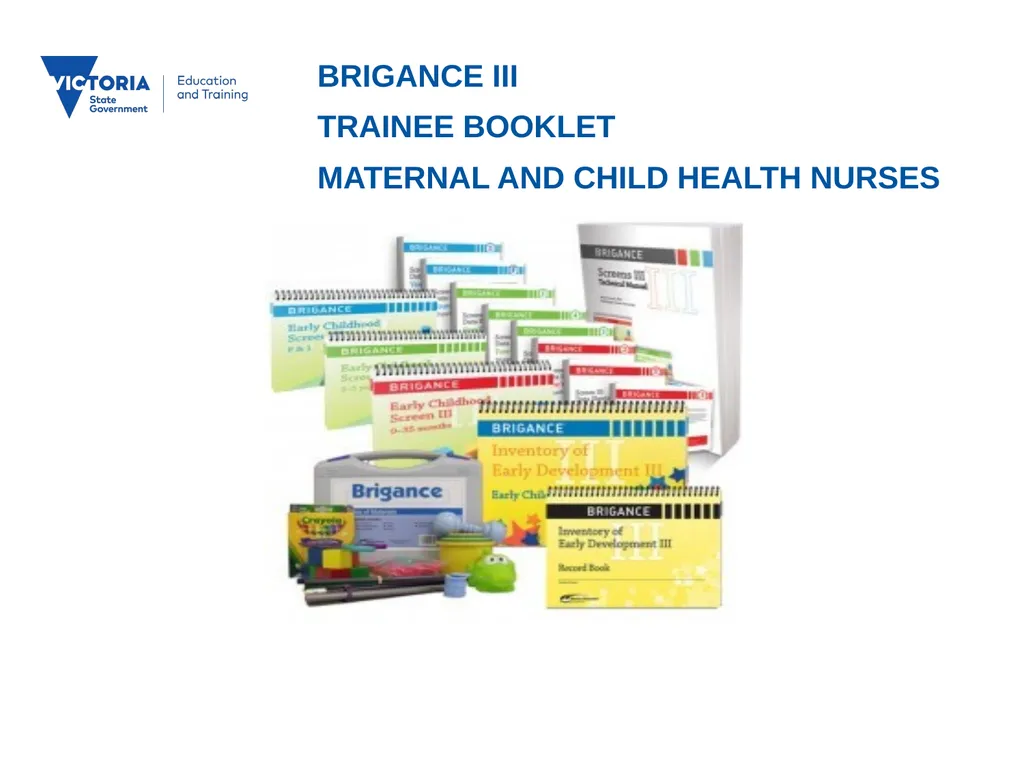
BRIGANCE III
TRAINEE BOOKLET
MATERNAL AND CHILD HEALTH NURSES<br>
TRAINEE BOOKLET
MATERNAL AND CHILD HEALTH NURSES<br>
02
Outline Guidance for MCH use why, what, how and when
What is different about Brigance III?
Brigance in MCH practice
- 2016 survey results
- practice
- scoring options
- referral pathways
- resources<br>
What is different about Brigance III?
Brigance in MCH practice
- 2016 survey results
- practice
- scoring options
- referral pathways
- resources<br>
03
Slides and Training Booklet Booklet in order of presentation but some slides are not in booklet
Yellow outline of slide indicates it is not in training booklet<br>
Yellow outline of slide indicates it is not in training booklet<br>
04
Resources for MCH Nurses Resources include: tip sheets with entry points, cut off scores, colour coded data sheets, information about interpreting results, discussing results with parents and case studies for use with this training presentation.
http://www.education.vic.gov.au/childhood/professionals/health/Pages/mch.aspx#link43<br>
http://www.education.vic.gov.au/childhood/professionals/health/Pages/mch.aspx#link43<br>
05
BRIGANCE screens
Why?<br>
06
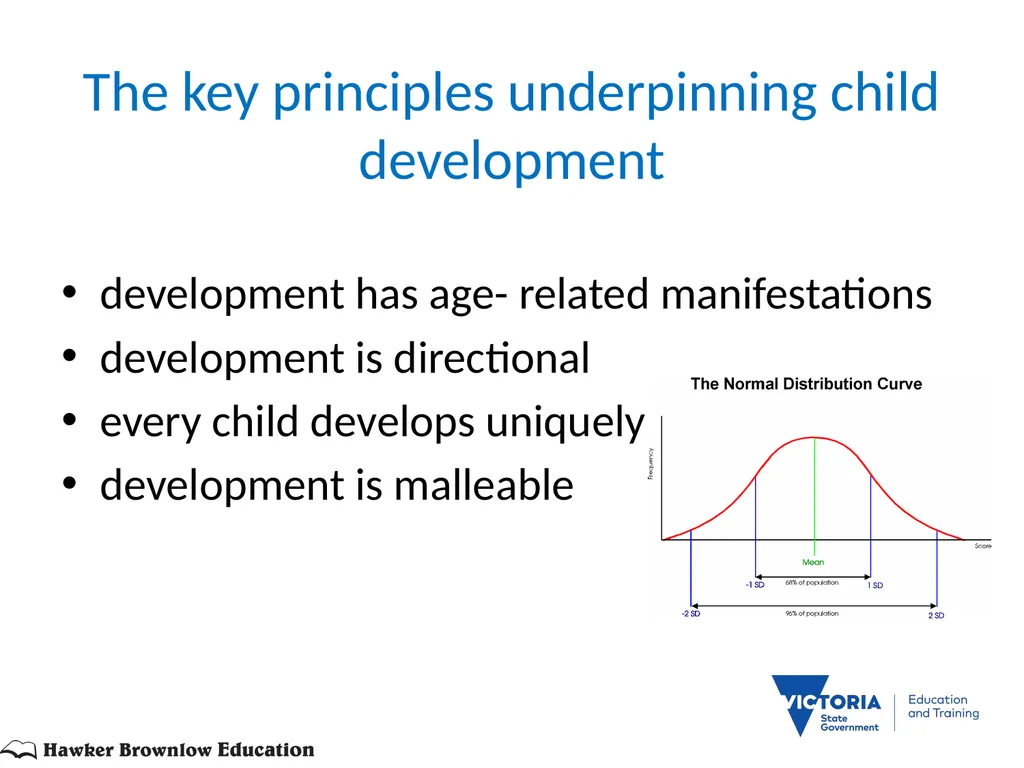
The key principles underpinning child development
development has age- related manifestations
development is directional
every child develops uniquely
development is malleable<br>
development has age- related manifestations
development is directional
every child develops uniquely
development is malleable<br>
07
Screening Purpose to identify problems as early as possible
A brief measure that sorts children who possibly have problems from those who probably don’t.<br>
A brief measure that sorts children who possibly have problems from those who probably don’t.<br>
08
Screening Brigance screen is a secondary screen after PEDS path A or B
Screening tests do not yield a diagnosis
Assessment with more detailed measures is usually indicated after score below cut off on a screening test<br>
Screening tests do not yield a diagnosis
Assessment with more detailed measures is usually indicated after score below cut off on a screening test<br>
09
Parents Evaluation of Development Status (PEDS) PEDS is our primary developmental screen
Supports a comprehensive developmental assessment
We need accurate recording of PEDS
Ensure you have completed the online training for PEDs 2017<br>
Supports a comprehensive developmental assessment
We need accurate recording of PEDS
Ensure you have completed the online training for PEDs 2017<br>
10
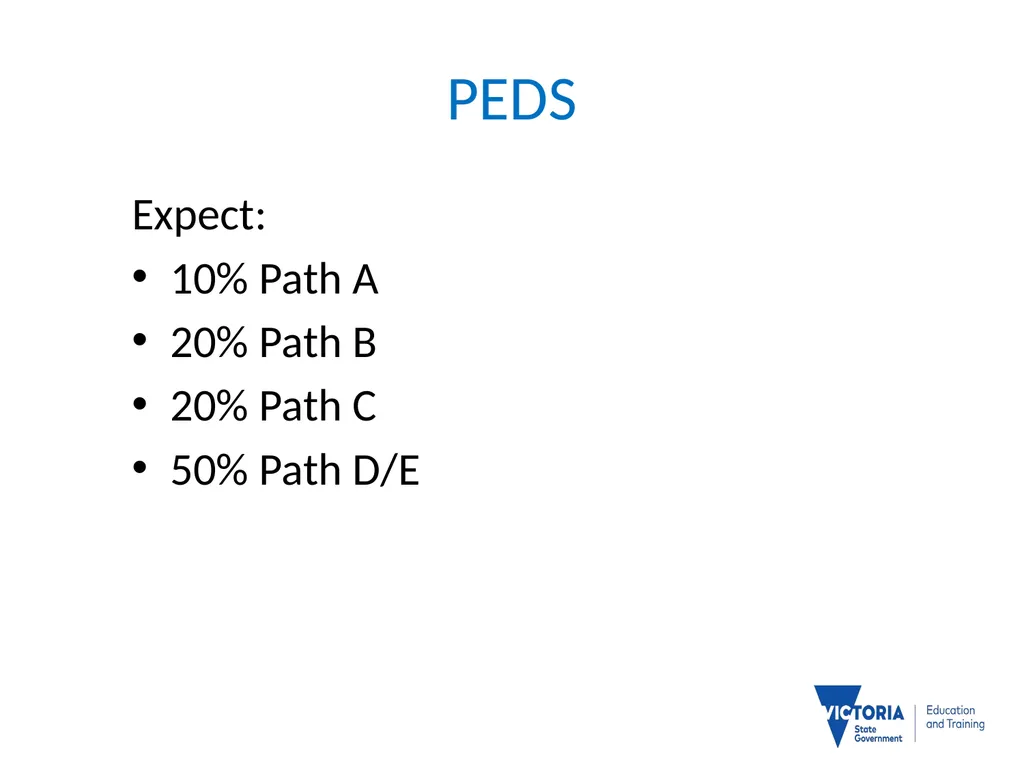
PEDS Expect:
10% Path A
20% Path B
20% Path C
50% Path D/E<br>
10% Path A
20% Path B
20% Path C
50% Path D/E<br>
11
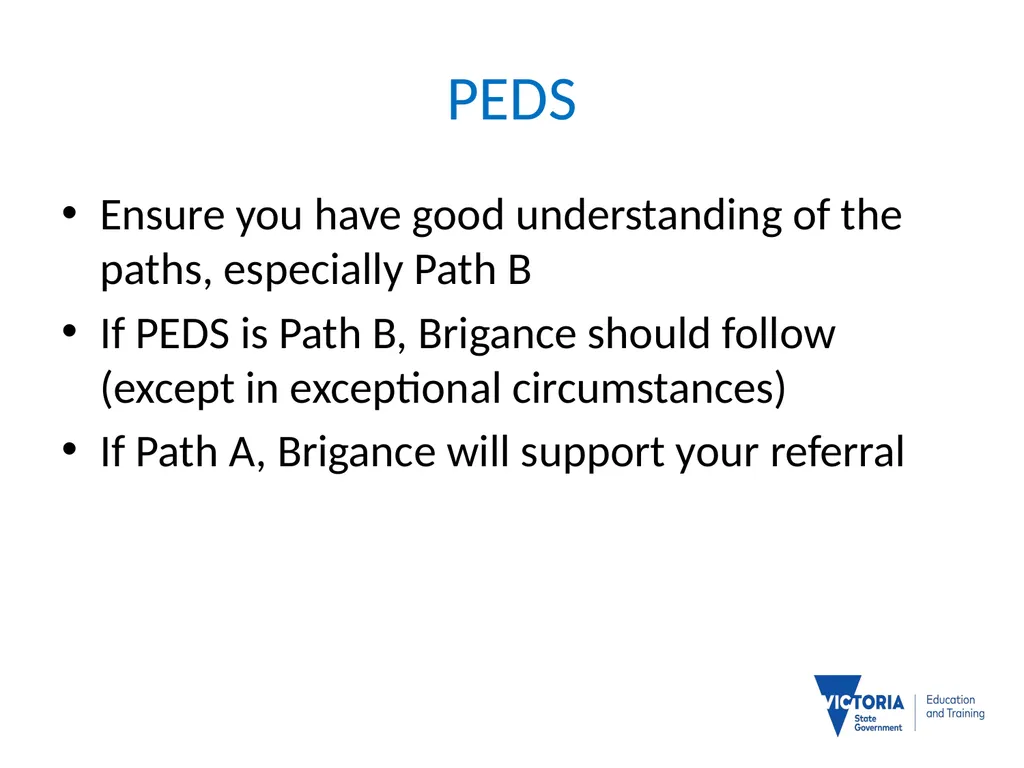
PEDS Ensure you have good understanding of the paths, especially Path B
If PEDS is Path B, Brigance should follow (except in exceptional circumstances)
If Path A, Brigance will support your referral<br>
If PEDS is Path B, Brigance should follow (except in exceptional circumstances)
If Path A, Brigance will support your referral<br>
12
BRIGANCE Screens
What are they?<br>
13
Introduction to Brigance III
a short video http://www.youtube.com/watch?v=2RLPnf1keg8
(2.5 min)<br>
(2.5 min)<br>
14
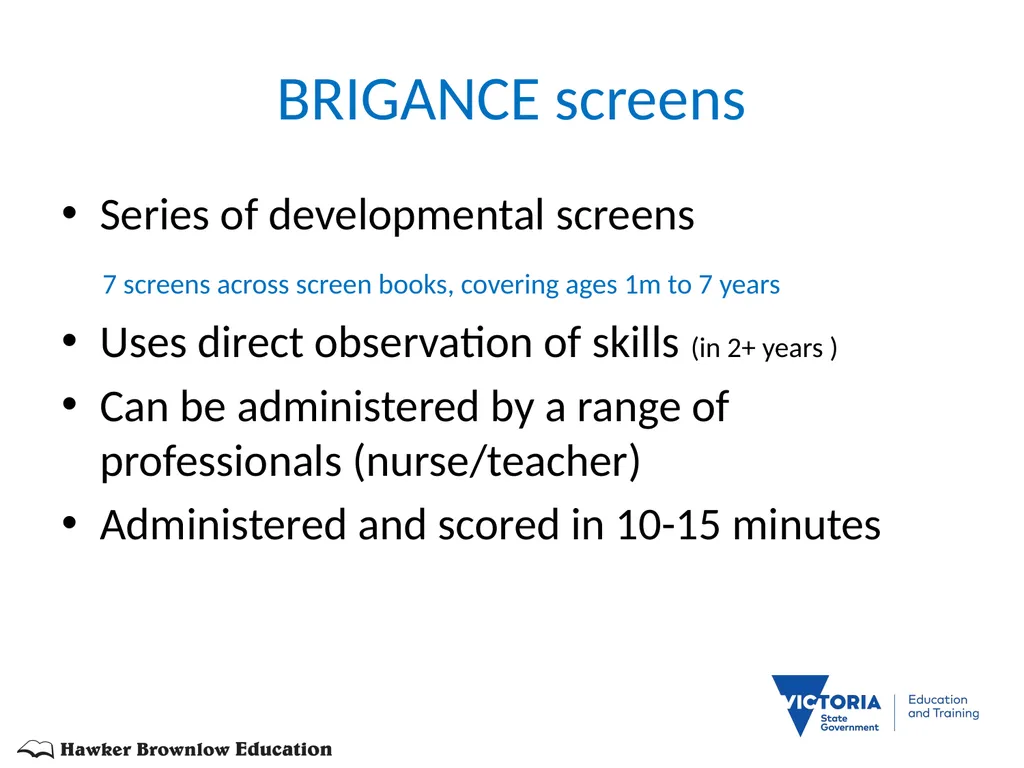
BRIGANCE screens Series of developmental screens
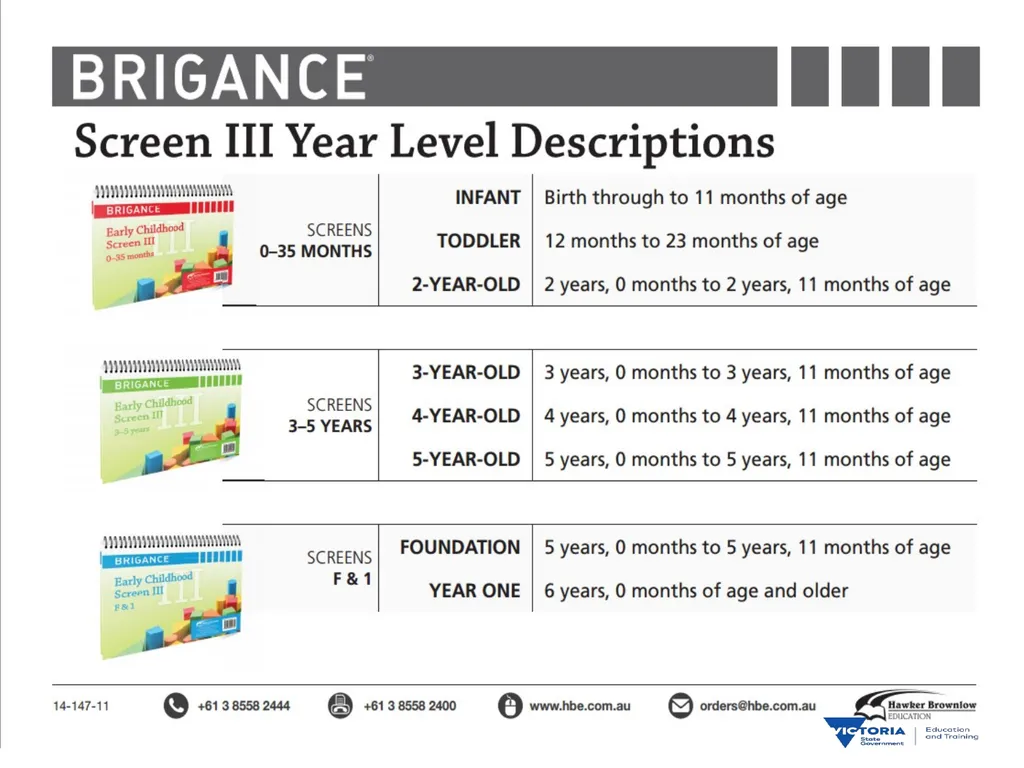
7 screens across screen books, covering ages 1m to 7 years
Uses direct observation of skills (in 2+ years )
Can be administered by a range of professionals (nurse/teacher)
Administered and scored in 10-15 minutes<br>
7 screens across screen books, covering ages 1m to 7 years
Uses direct observation of skills (in 2+ years )
Can be administered by a range of professionals (nurse/teacher)
Administered and scored in 10-15 minutes<br>
15
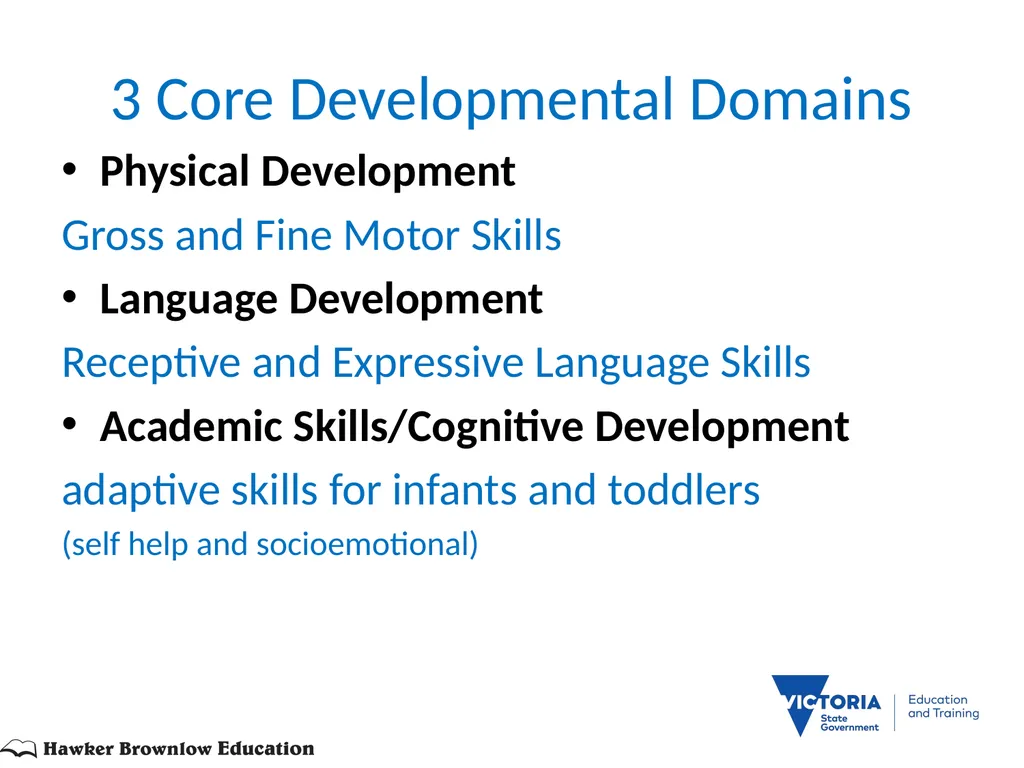
3 Core Developmental Domains Physical Development
Gross and Fine Motor Skills
Language Development
Receptive and Expressive Language Skills
Academic Skills/Cognitive Development
adaptive skills for infants and toddlers
(self help and socioemotional)<br>
Gross and Fine Motor Skills
Language Development
Receptive and Expressive Language Skills
Academic Skills/Cognitive Development
adaptive skills for infants and toddlers
(self help and socioemotional)<br>
16
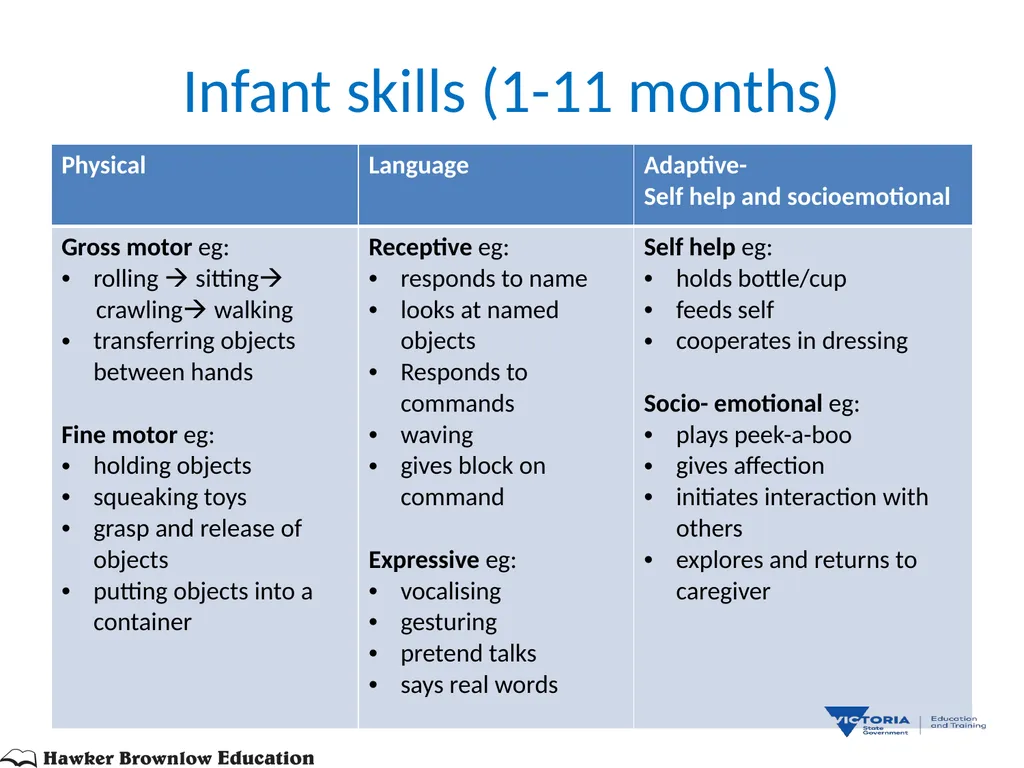
Infant skills (1-11 months)<br>
17
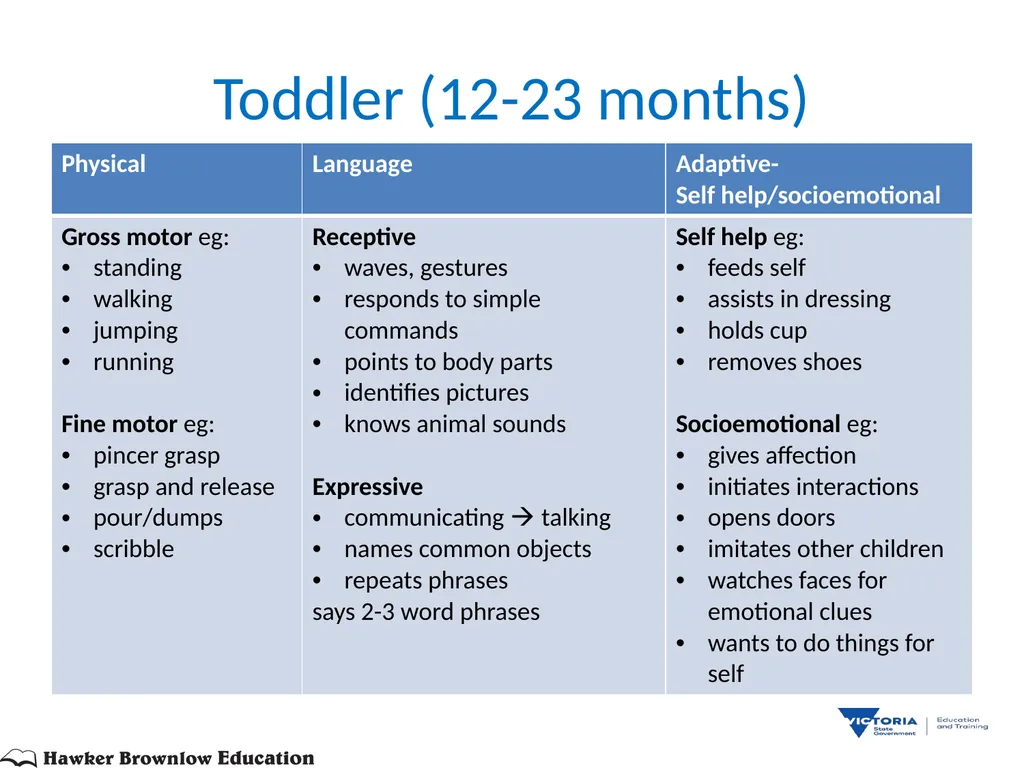
Toddler (12-23 months)<br>
18
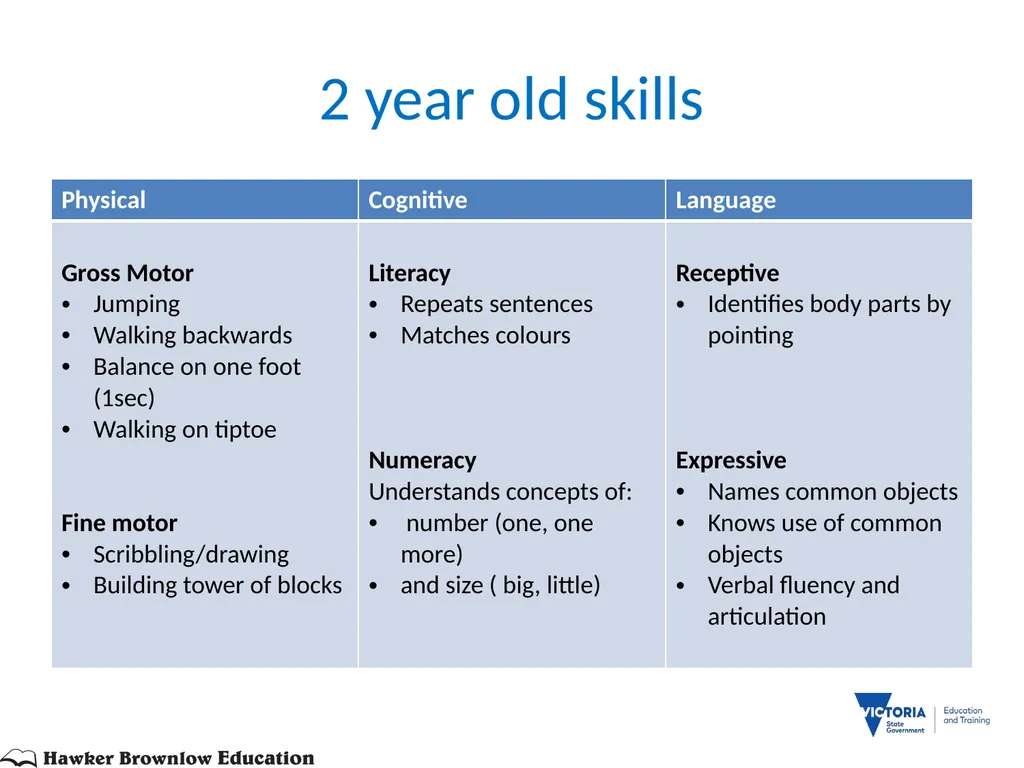
2 year old skills<br>
19
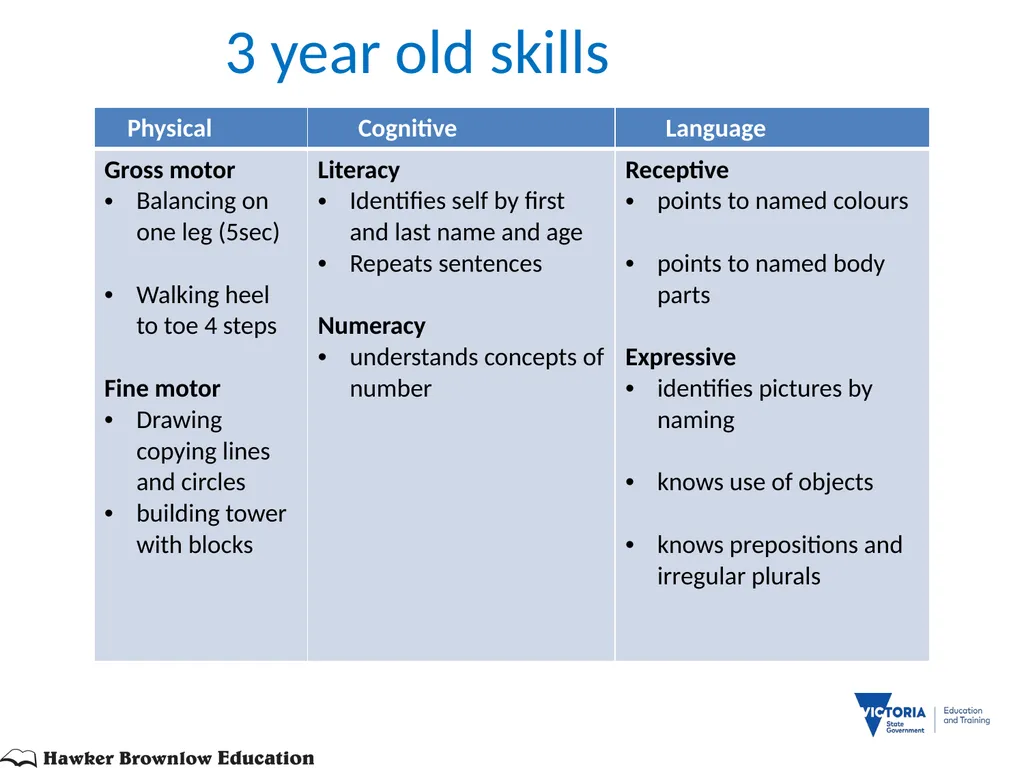
3 year old skills<br>
20
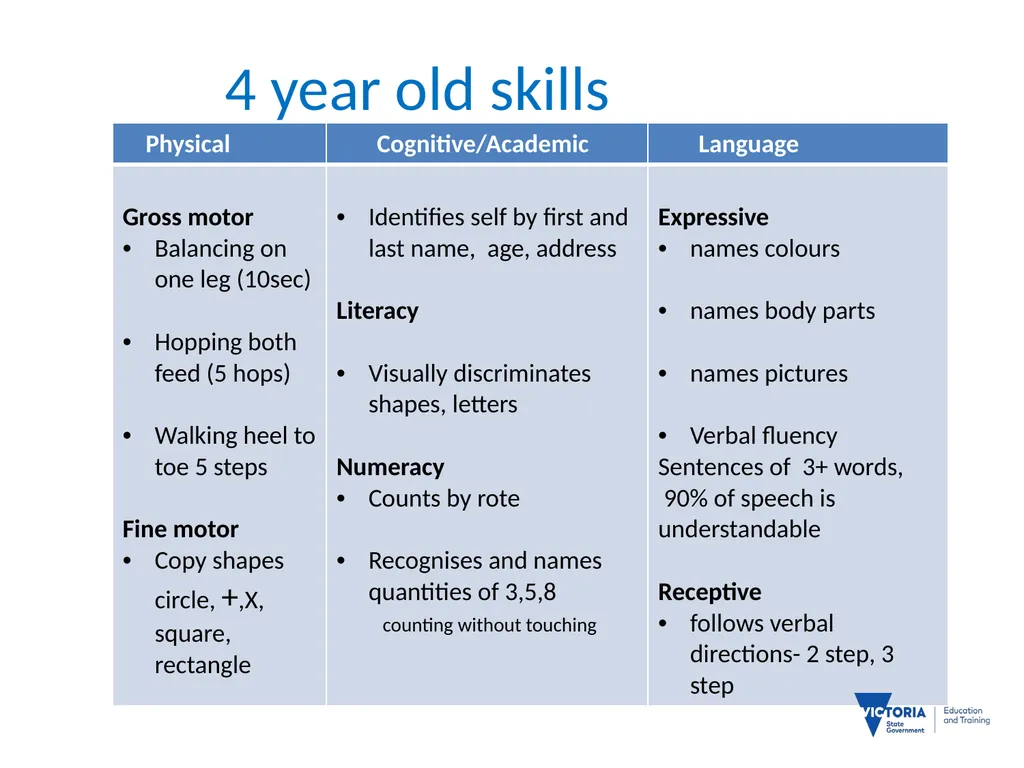
4 year old skills<br>
21
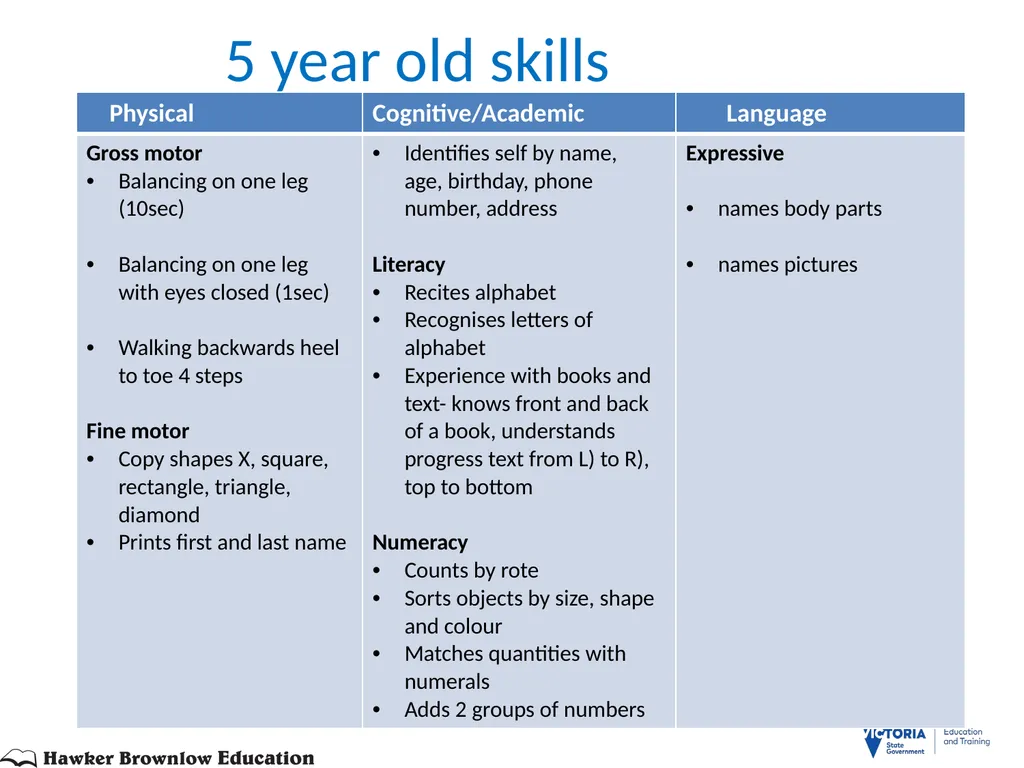
5 year old skills<br>
22
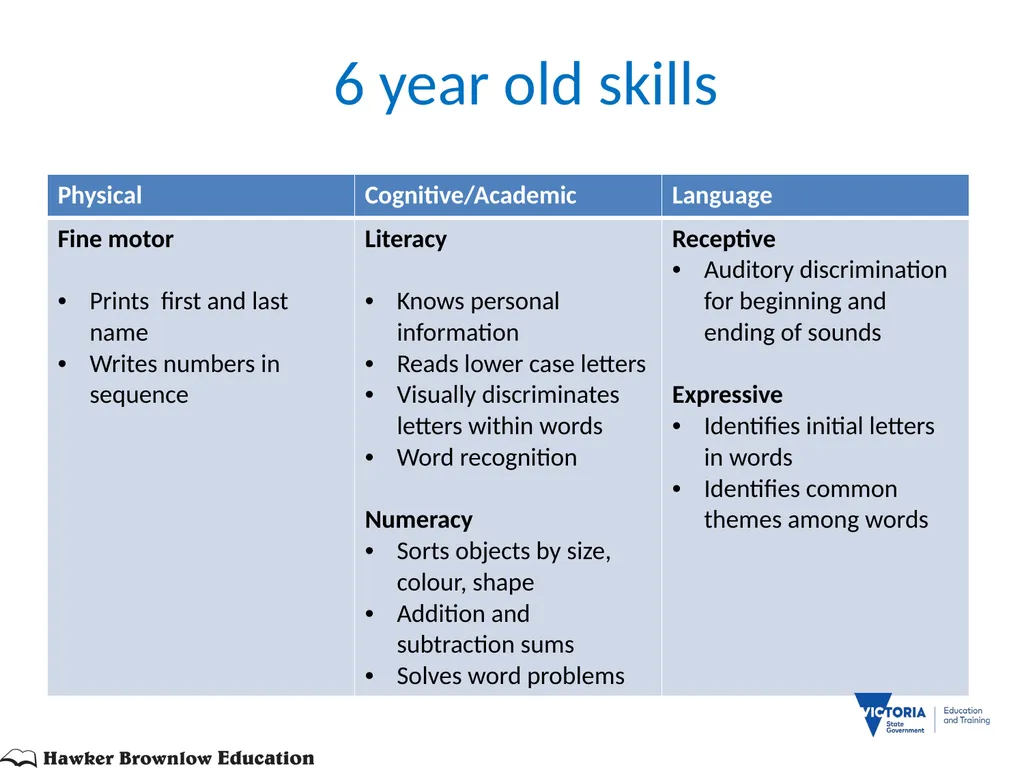
6 year old skills<br>
23
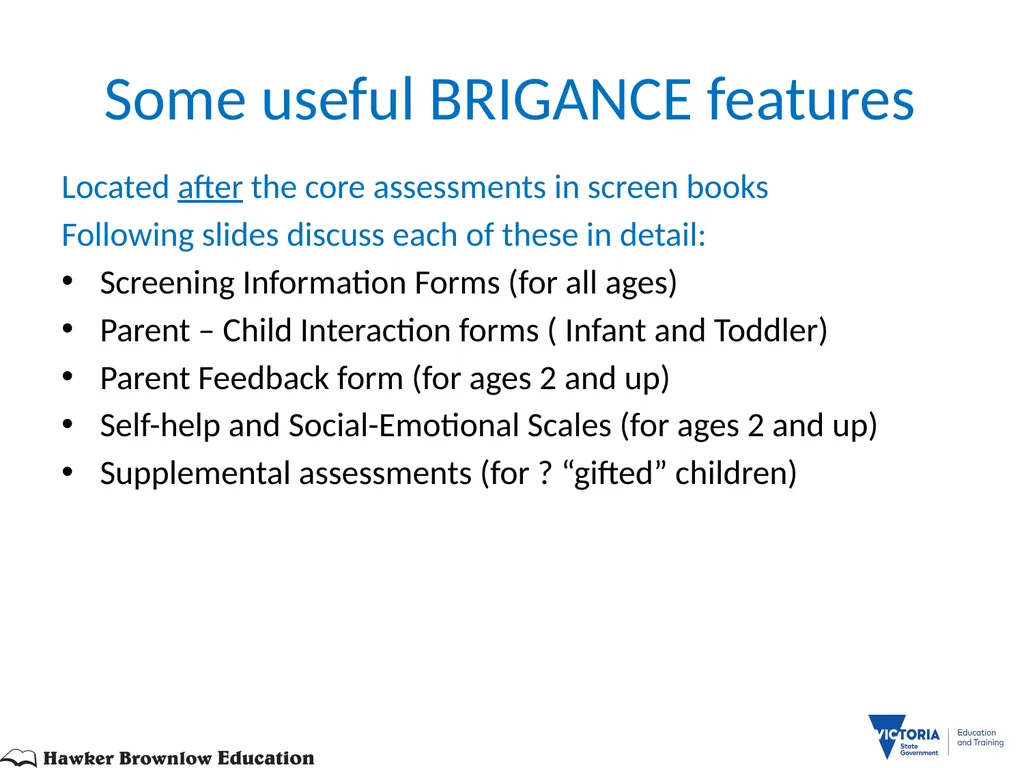
Some useful BRIGANCE features Located after the core assessments in screen books
Following slides discuss each of these in detail:
Screening Information Forms (for all ages)
Parent – Child Interaction forms ( Infant and Toddler)
Parent Feedback form (for ages 2 and up)
Self-help and Social-Emotional Scales (for ages 2 and up)
Supplemental assessments (for ? “gifted” children)<br>
Following slides discuss each of these in detail:
Screening Information Forms (for all ages)
Parent – Child Interaction forms ( Infant and Toddler)
Parent Feedback form (for ages 2 and up)
Self-help and Social-Emotional Scales (for ages 2 and up)
Supplemental assessments (for ? “gifted” children)<br>
24
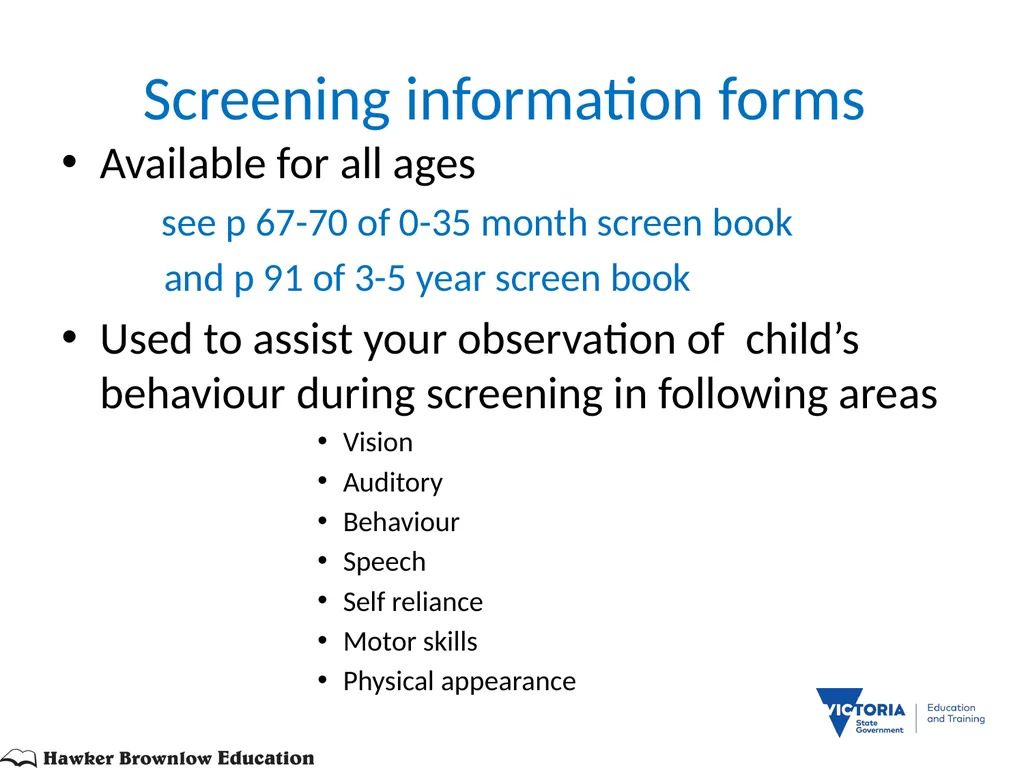
Screening information forms Available for all ages
see p 67-70 of 0-35 month screen book
and p 91 of 3-5 year screen book
Used to assist your observation of child’s behaviour during screening in following areas
Vision
Auditory
Behaviour
Speech
Self reliance
Motor skills
Physical appearance<br>
see p 67-70 of 0-35 month screen book
and p 91 of 3-5 year screen book
Used to assist your observation of child’s behaviour during screening in following areas
Vision
Auditory
Behaviour
Speech
Self reliance
Motor skills
Physical appearance<br>
25
Screening information forms continued Copy and use with screening as needed
Can use to help you record observations on data sheet
NOT scored<br>
Can use to help you record observations on data sheet
NOT scored<br>
26
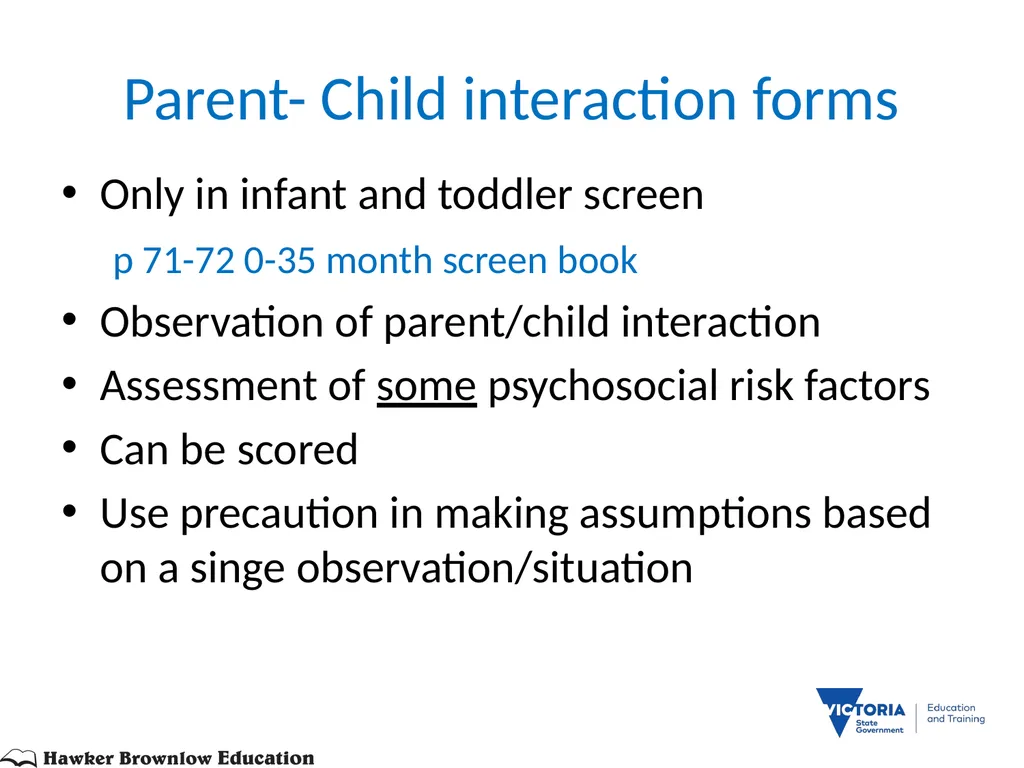
Parent- Child interaction forms Only in infant and toddler screen
p 71-72 0-35 month screen book
Observation of parent/child interaction
Assessment of some psychosocial risk factors
Can be scored
Use precaution in making assumptions based on a singe observation/situation<br>
p 71-72 0-35 month screen book
Observation of parent/child interaction
Assessment of some psychosocial risk factors
Can be scored
Use precaution in making assumptions based on a singe observation/situation<br>
27
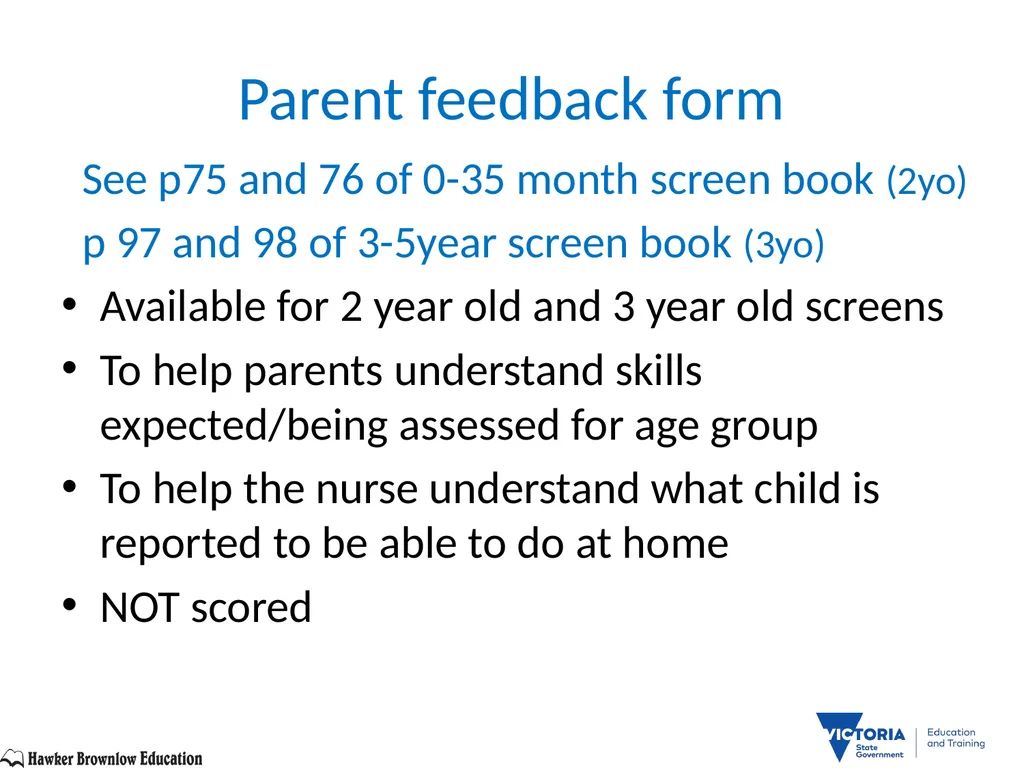
Parent feedback form See p75 and 76 of 0-35 month screen book (2yo)
p 97 and 98 of 3-5year screen book (3yo)
Available for 2 year old and 3 year old screens
To help parents understand skills expected/being assessed for age group
To help the nurse understand what child is reported to be able to do at home
NOT scored<br>
p 97 and 98 of 3-5year screen book (3yo)
Available for 2 year old and 3 year old screens
To help parents understand skills expected/being assessed for age group
To help the nurse understand what child is reported to be able to do at home
NOT scored<br>
28
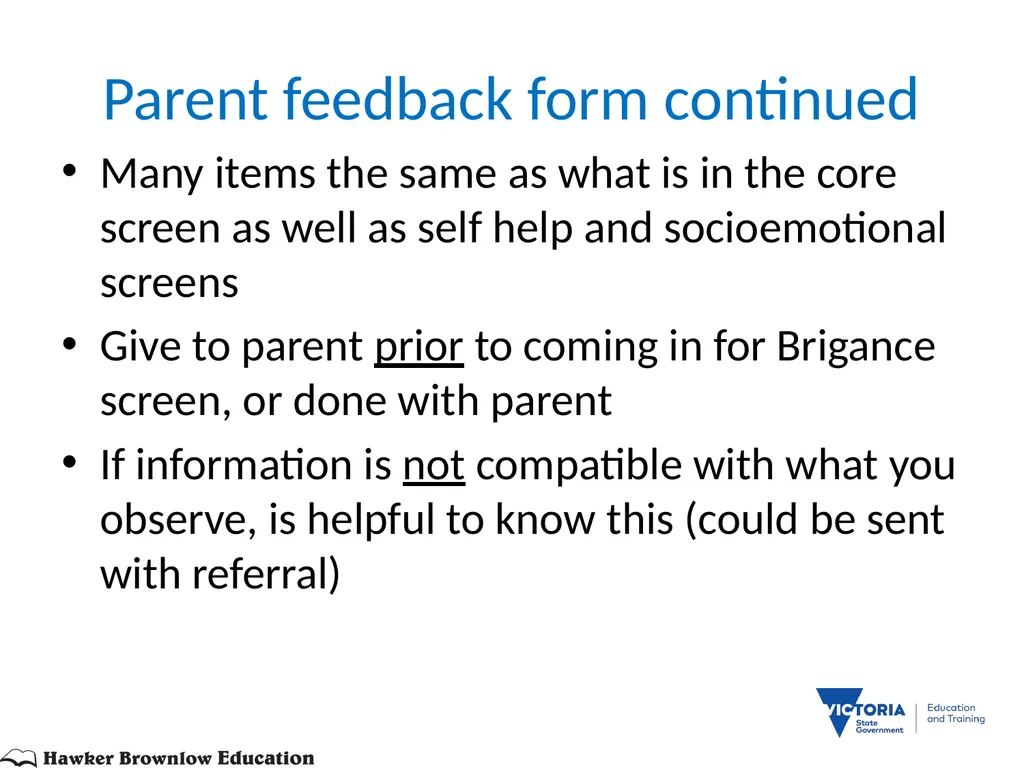
Parent feedback form continued Many items the same as what is in the core screen as well as self help and socioemotional screens
Give to parent prior to coming in for Brigance screen, or done with parent
If information is not compatible with what you observe, is helpful to know this (could be sent with referral)<br>
Give to parent prior to coming in for Brigance screen, or done with parent
If information is not compatible with what you observe, is helpful to know this (could be sent with referral)<br>
29
Self help and socio emotional domains See p 77-84, 0-35 m screen book
P 102-112,3-5 y screen book
For 2 year olds plus
0ption of adding Brigance self help and socio emotional scales to the core assessments.
Can be scored, which adds these two important domains to your assessment<br>
P 102-112,3-5 y screen book
For 2 year olds plus
0ption of adding Brigance self help and socio emotional scales to the core assessments.
Can be scored, which adds these two important domains to your assessment<br>
30
Self help and Socio emotional scales Parent report of child’s:
Eating, dressing toileting skills
Relationship with adults and peers
Play skills
Self confidence and self regulatory skills
Can be scored
Can be done by parent at home prior, or with nurse<br>
Eating, dressing toileting skills
Relationship with adults and peers
Play skills
Self confidence and self regulatory skills
Can be scored
Can be done by parent at home prior, or with nurse<br>
31
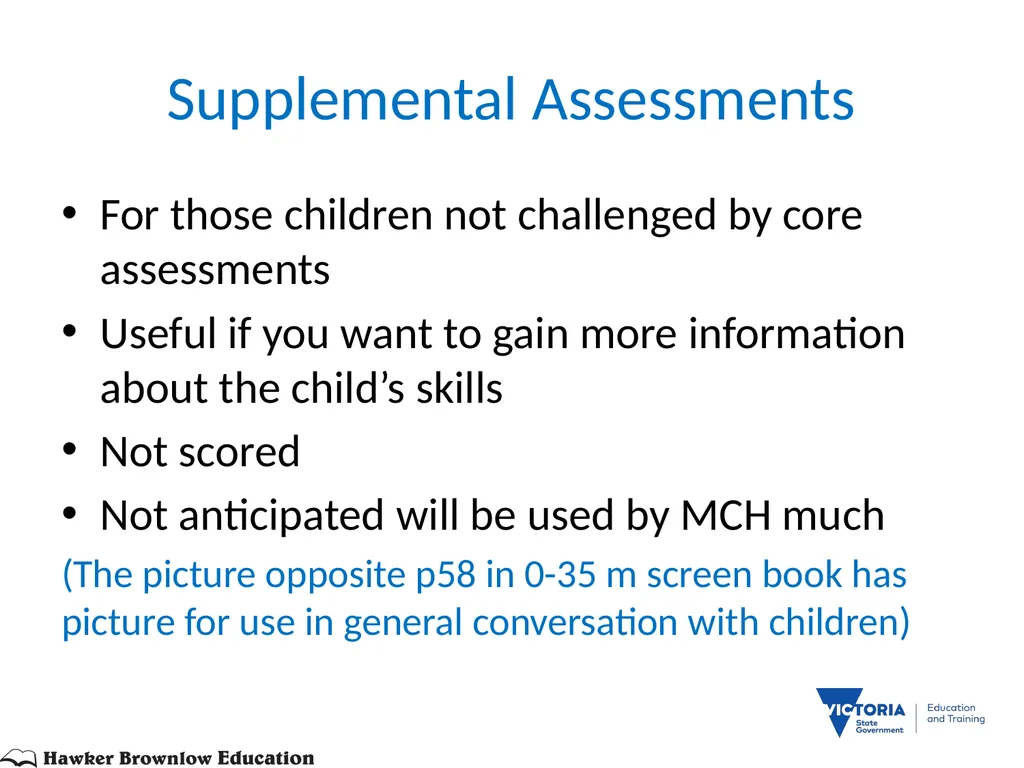
Supplemental Assessments For those children not challenged by core assessments
Useful if you want to gain more information about the child’s skills
Not scored
Not anticipated will be used by MCH much
(The picture opposite p58 in 0-35 m screen book has picture for use in general conversation with children)<br>
Useful if you want to gain more information about the child’s skills
Not scored
Not anticipated will be used by MCH much
(The picture opposite p58 in 0-35 m screen book has picture for use in general conversation with children)<br>
32
Standardisation of Brigance III<br>
33
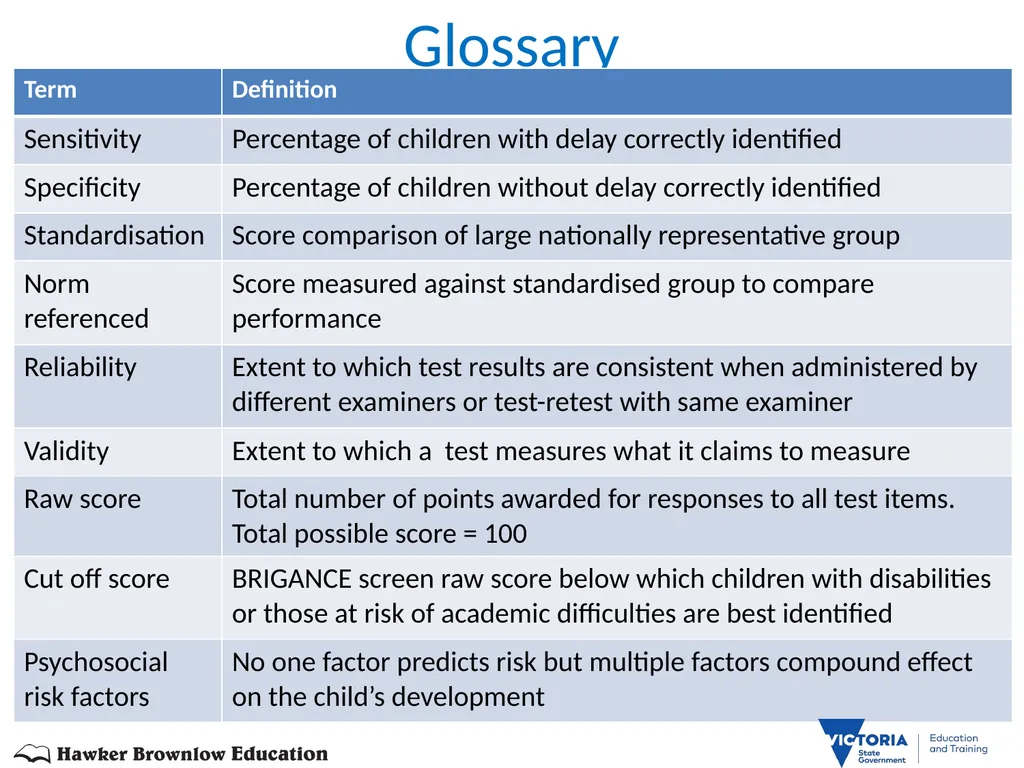
Glossary<br>
34
BRIGANCE screens
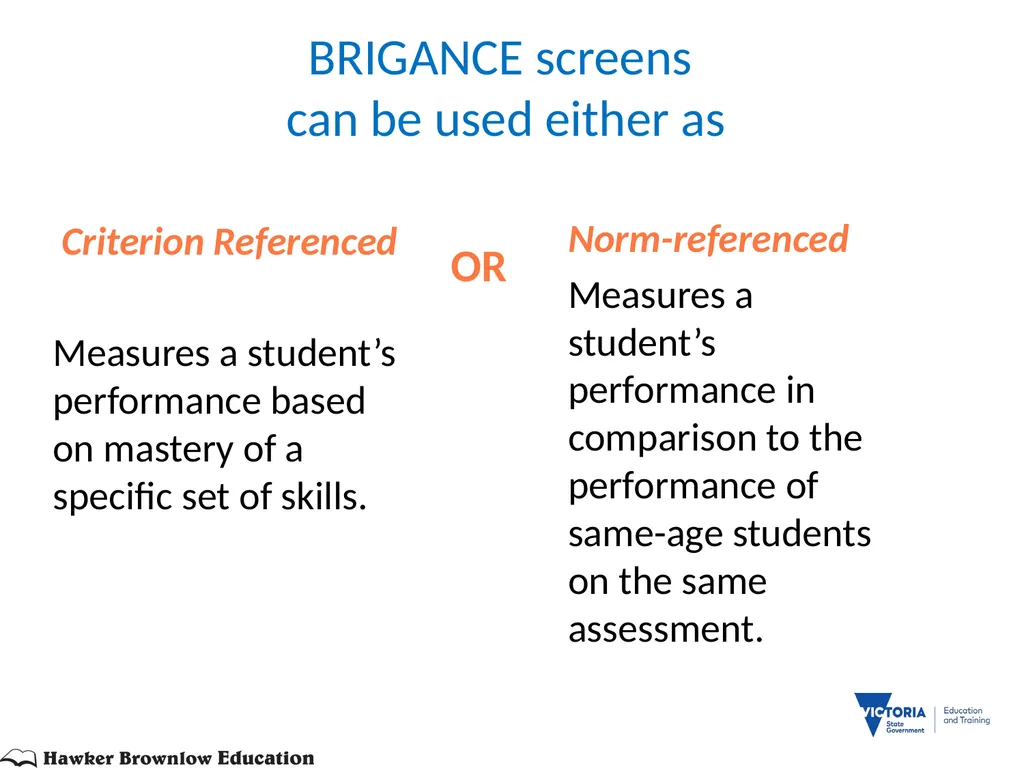
can be used either as Criterion Referenced
Measures a student’s performance based on mastery of a specific set of skills. Norm-referenced
Measures a student’s performance in comparison to the performance of same-age students on the same assessment. OR<br>
Measures a student’s performance based on mastery of a specific set of skills. Norm-referenced
Measures a student’s performance in comparison to the performance of same-age students on the same assessment. OR<br>
35
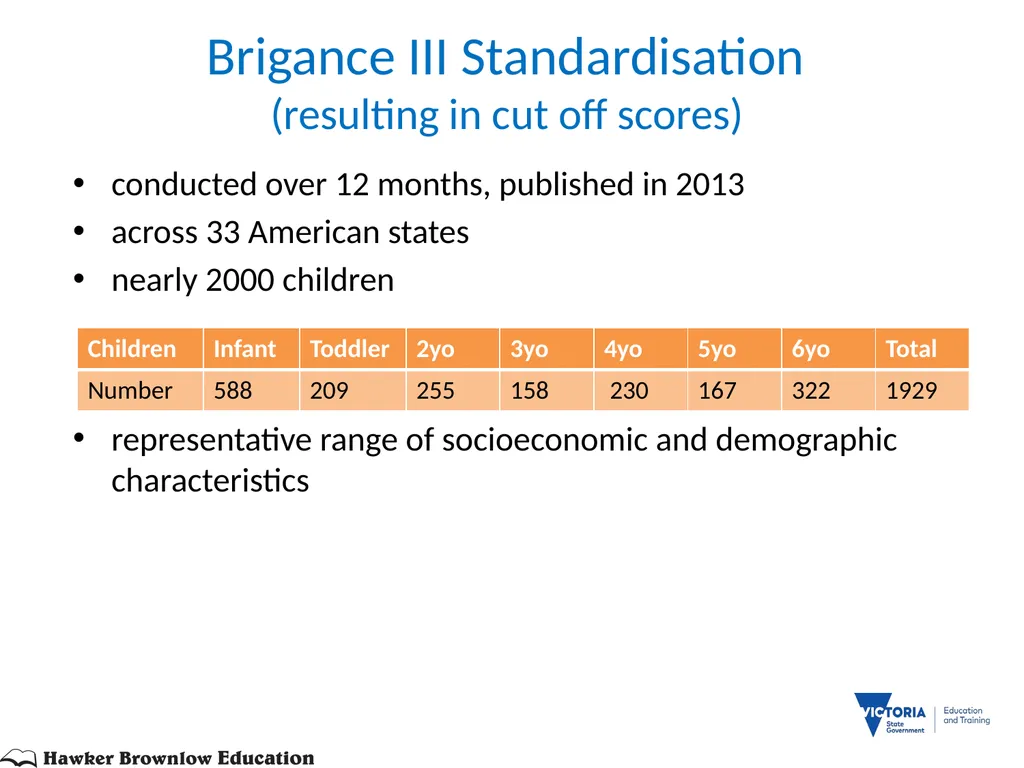
Brigance III Standardisation
(resulting in cut off scores) conducted over 12 months, published in 2013
across 33 American states
nearly 2000 children
representative range of socioeconomic and demographic characteristics<br>
across 33 American states
nearly 2000 children
representative range of socioeconomic and demographic characteristics<br>
36
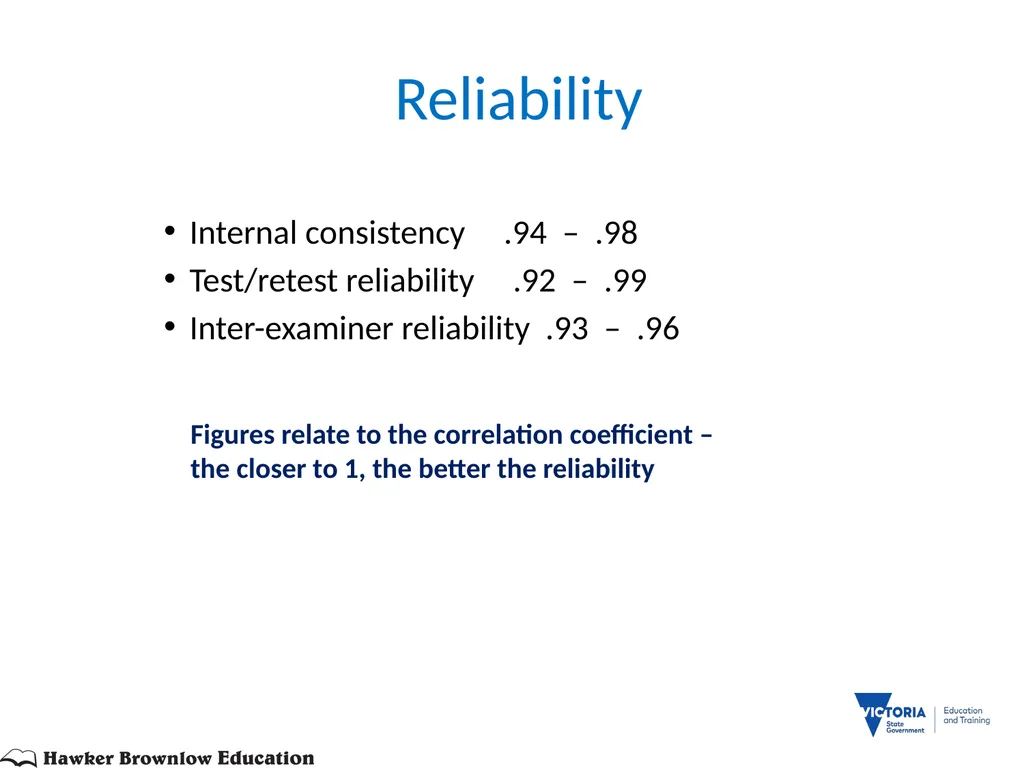
Reliability Internal consistency .94 – .98
Test/retest reliability .92 – .99
Inter-examiner reliability .93 – .96 Figures relate to the correlation coefficient –
the closer to 1, the better the reliability<br>
Test/retest reliability .92 – .99
Inter-examiner reliability .93 – .96 Figures relate to the correlation coefficient –
the closer to 1, the better the reliability<br>
37
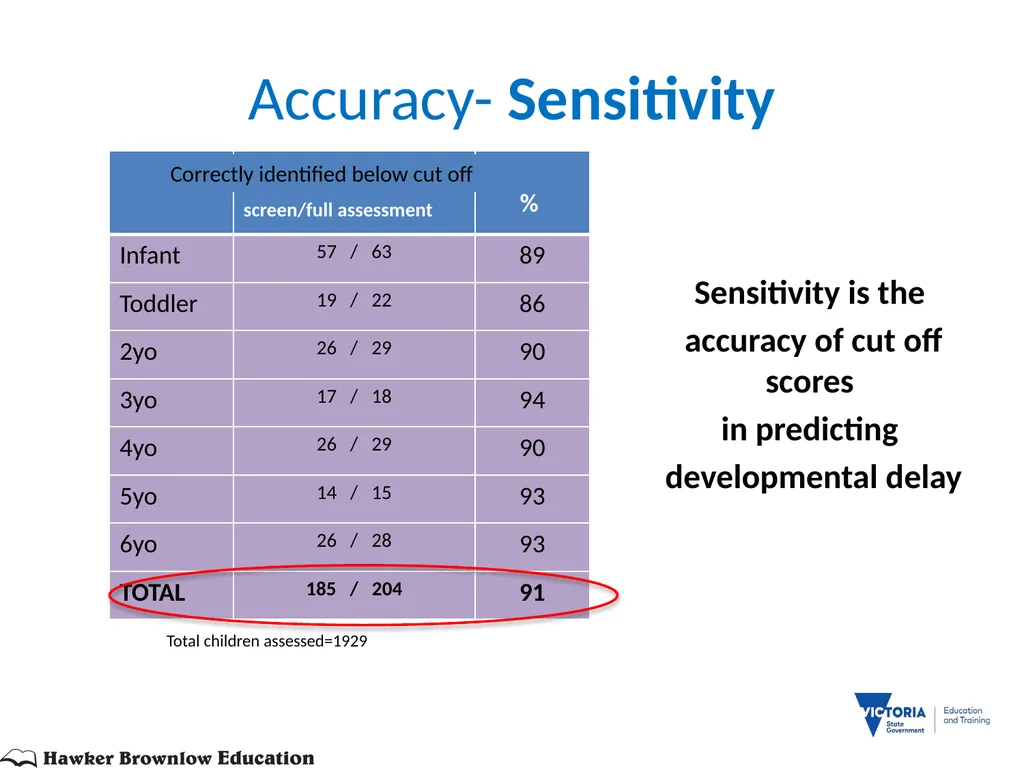
Accuracy- Sensitivity Sensitivity is the
accuracy of cut off scores
in predicting
developmental delay Correctly identified below cut off Total children assessed=1929<br>
accuracy of cut off scores
in predicting
developmental delay Correctly identified below cut off Total children assessed=1929<br>
38
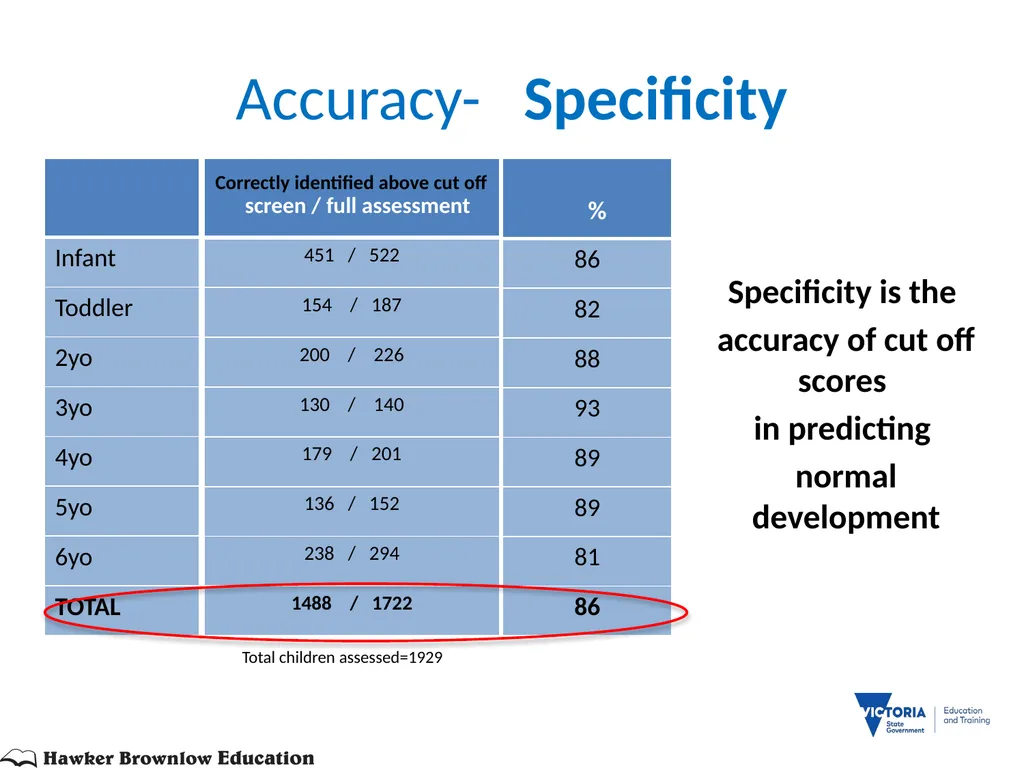
Accuracy- Specificity Specificity is the
accuracy of cut off scores
in predicting
normal development Correctly identified above cut off Total children assessed=1929<br>
accuracy of cut off scores
in predicting
normal development Correctly identified above cut off Total children assessed=1929<br>
39
BRIGANCE screens
How?<br>
40
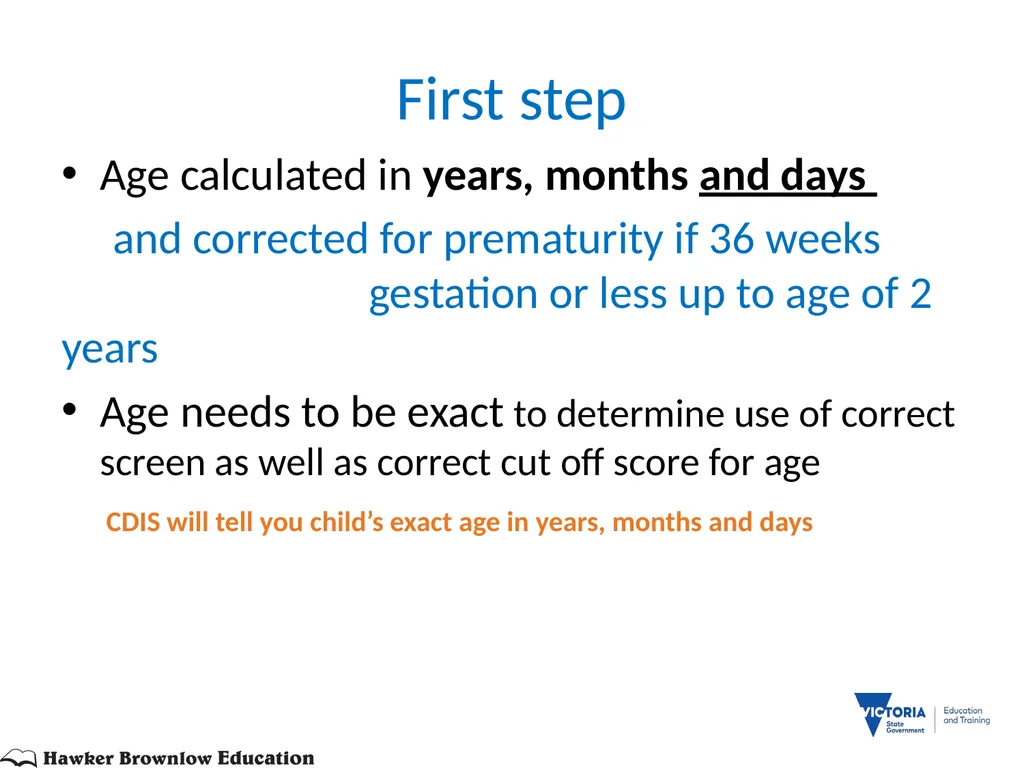
First step Age calculated in years, months and days
and corrected for prematurity if 36 weeks gestation or less up to age of 2 years
Age needs to be exact to determine use of correct screen as well as correct cut off score for age
CDIS will tell you child’s exact age in years, months and days<br>
and corrected for prematurity if 36 weeks gestation or less up to age of 2 years
Age needs to be exact to determine use of correct screen as well as correct cut off score for age
CDIS will tell you child’s exact age in years, months and days<br>
41
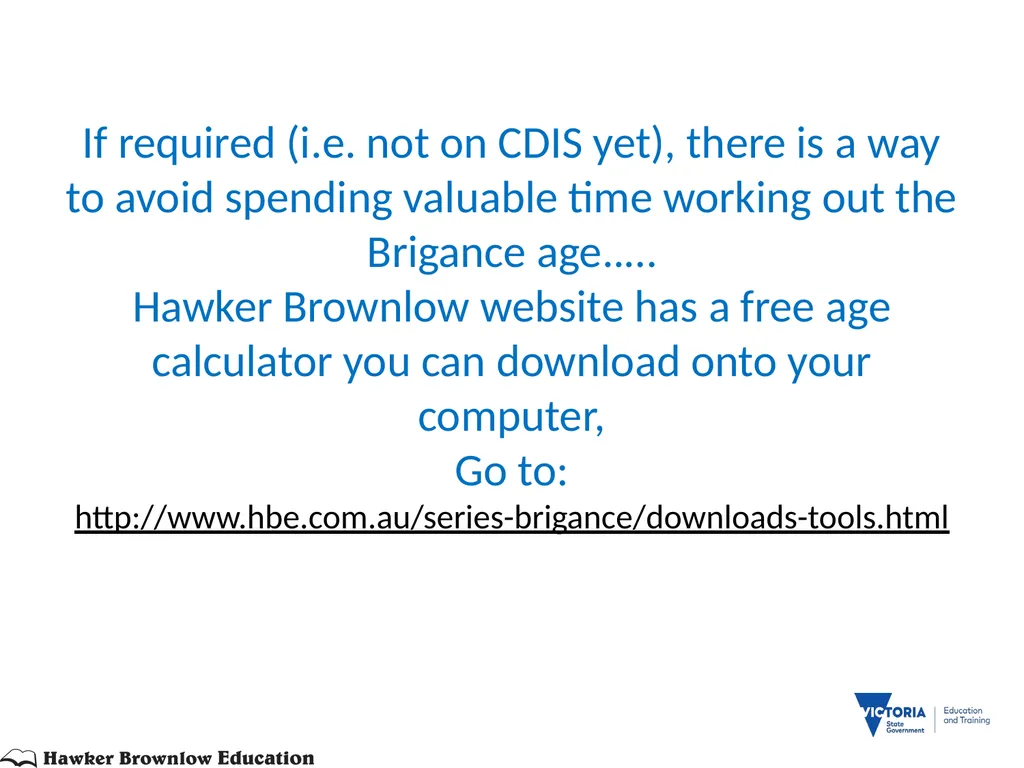
If required (i.e. not on CDIS yet), there is a way to avoid spending valuable time working out the Brigance age..…
Hawker Brownlow website has a free age calculator you can download onto your computer,
Go to:
http://www.hbe.com.au/series-brigance/downloads-tools.html<br>
42
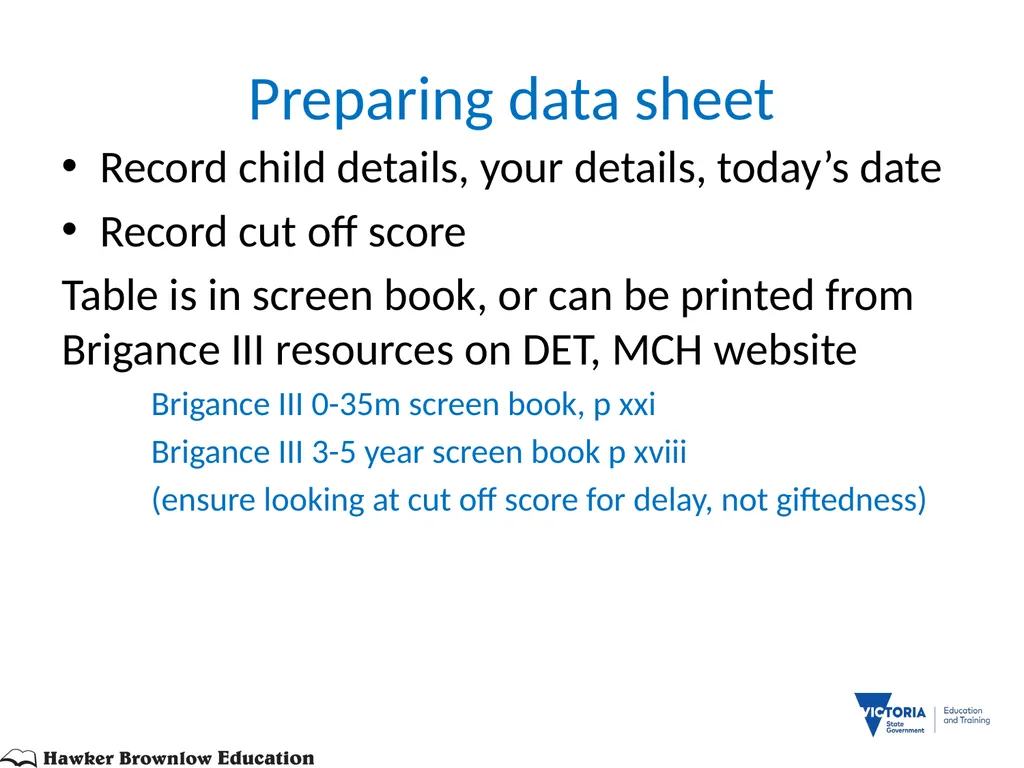
Preparing data sheet Record child details, your details, today’s date
Record cut off score
Table is in screen book, or can be printed from Brigance III resources on DET, MCH website
Brigance III 0-35m screen book, p xxi
Brigance III 3-5 year screen book p xviii
(ensure looking at cut off score for delay, not giftedness)<br>
Record cut off score
Table is in screen book, or can be printed from Brigance III resources on DET, MCH website
Brigance III 0-35m screen book, p xxi
Brigance III 3-5 year screen book p xviii
(ensure looking at cut off score for delay, not giftedness)<br>
43
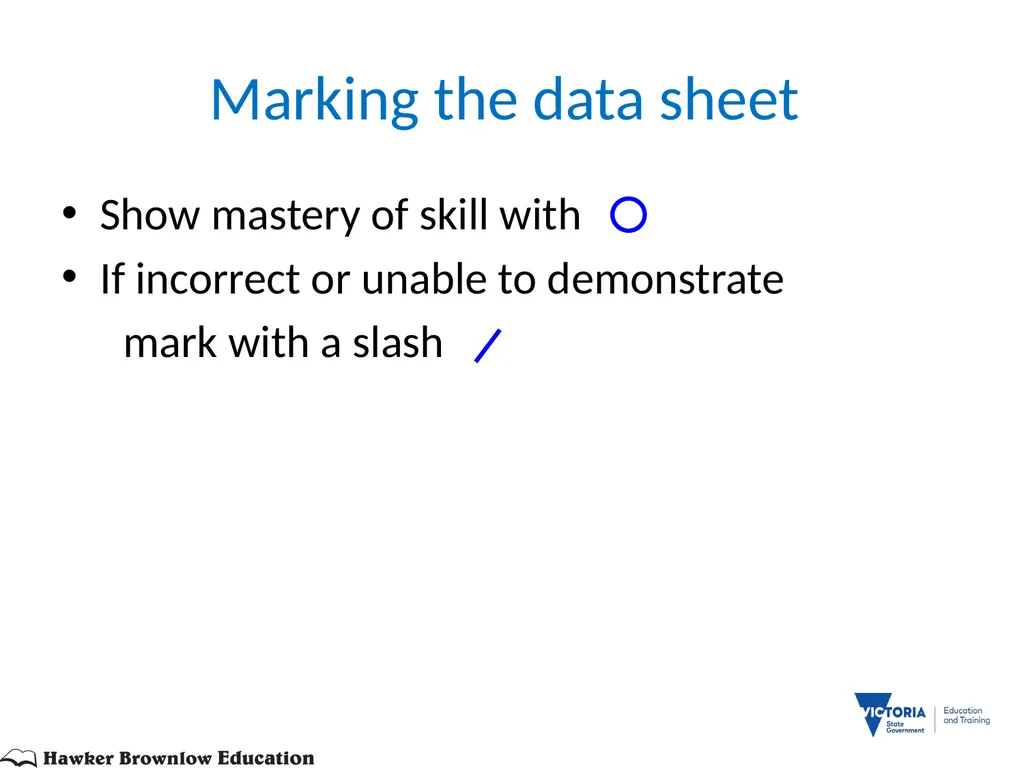
Marking the data sheet Show mastery of skill with
If incorrect or unable to demonstrate
mark with a slash<br>
If incorrect or unable to demonstrate
mark with a slash<br>
44
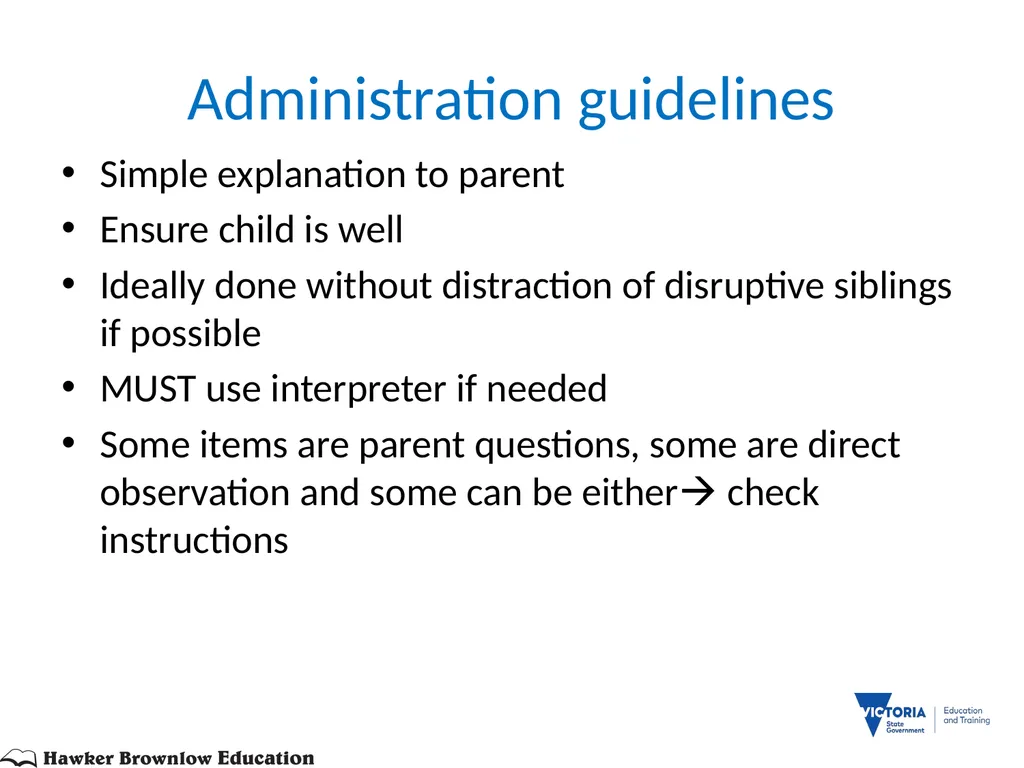
Administration guidelines Simple explanation to parent
Ensure child is well
Ideally done without distraction of disruptive siblings if possible
MUST use interpreter if needed
Some items are parent questions, some are direct observation and some can be either check instructions<br>
Ensure child is well
Ideally done without distraction of disruptive siblings if possible
MUST use interpreter if needed
Some items are parent questions, some are direct observation and some can be either check instructions<br>
45
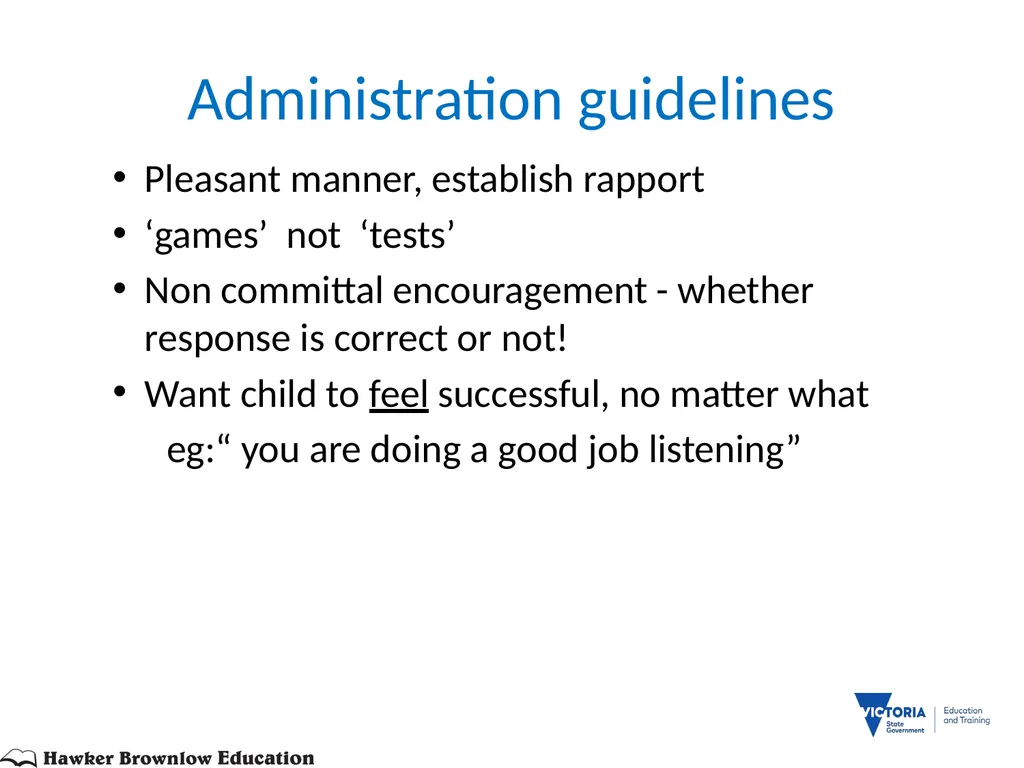
Administration guidelines Pleasant manner, establish rapport
‘games’ not ‘tests’
Non committal encouragement - whether response is correct or not!
Want child to feel successful, no matter what
eg:“ you are doing a good job listening”<br>
‘games’ not ‘tests’
Non committal encouragement - whether response is correct or not!
Want child to feel successful, no matter what
eg:“ you are doing a good job listening”<br>
46
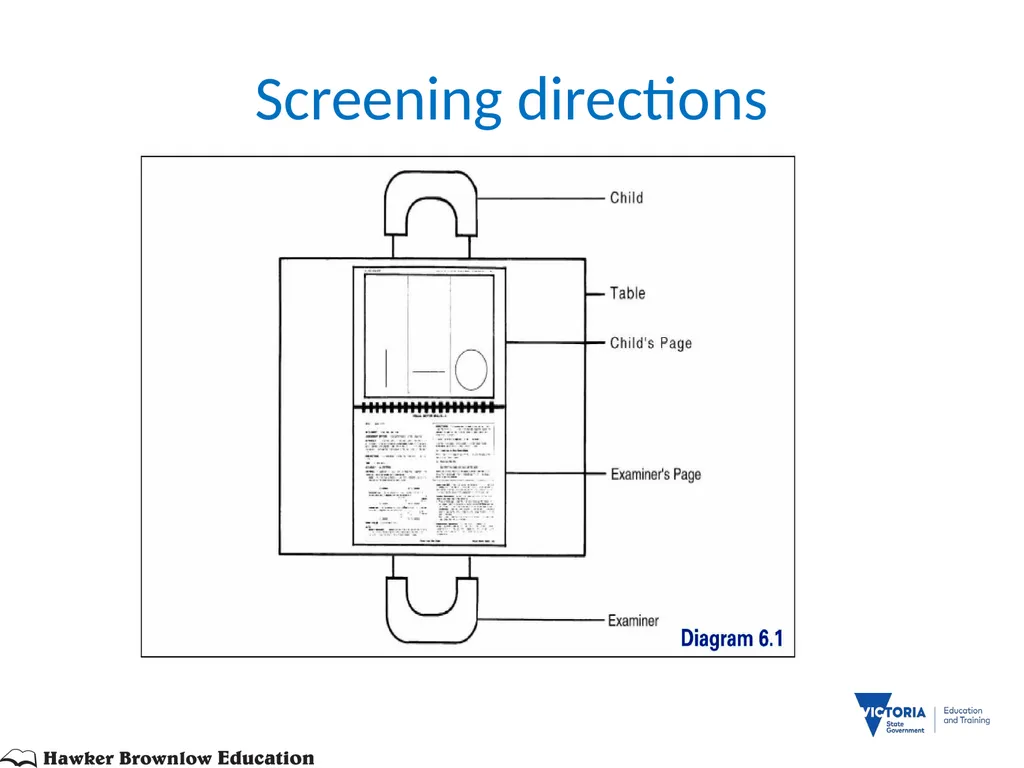
Screening directions<br>
47
Screening Directions Be familiar with all directions for each item/page
Follow clear and prescriptive directions on each page
Use script as written but in a natural way
Incorporate questions/observations into conversation and consultation eg gross motor/ drawing/ pictures can be part of “warm up time” but these skills are observable and scorable
Some items can be assessed together
eg: ask colours while building tower of blocks<br>
Follow clear and prescriptive directions on each page
Use script as written but in a natural way
Incorporate questions/observations into conversation and consultation eg gross motor/ drawing/ pictures can be part of “warm up time” but these skills are observable and scorable
Some items can be assessed together
eg: ask colours while building tower of blocks<br>
48
Screening Directions (cont) Assessments can be administered in any order
But…….
within each assessment, questions/items need to be asked from L) to R) as they are listed in order of difficulty<br>
But…….
within each assessment, questions/items need to be asked from L) to R) as they are listed in order of difficulty<br>
49
Screening Directions Take notice of discontinuation points noted on screen page and data sheet
Screen/cover parts of page if needed
Record observations as you go<br>
Screen/cover parts of page if needed
Record observations as you go<br>
50
Common errors Gazing at correct choice
Excessive prompts<br>
Excessive prompts<br>
51
Scoring Add across each row, then add total score
Compare to cut off
Observe domain scores (more about this later)
Make referral decisions
Record “next steps”<br>
Compare to cut off
Observe domain scores (more about this later)
Make referral decisions
Record “next steps”<br>
52
How is Brigance III different? It is similar enough to be familiar, yet more effective and user friendly<br>
53
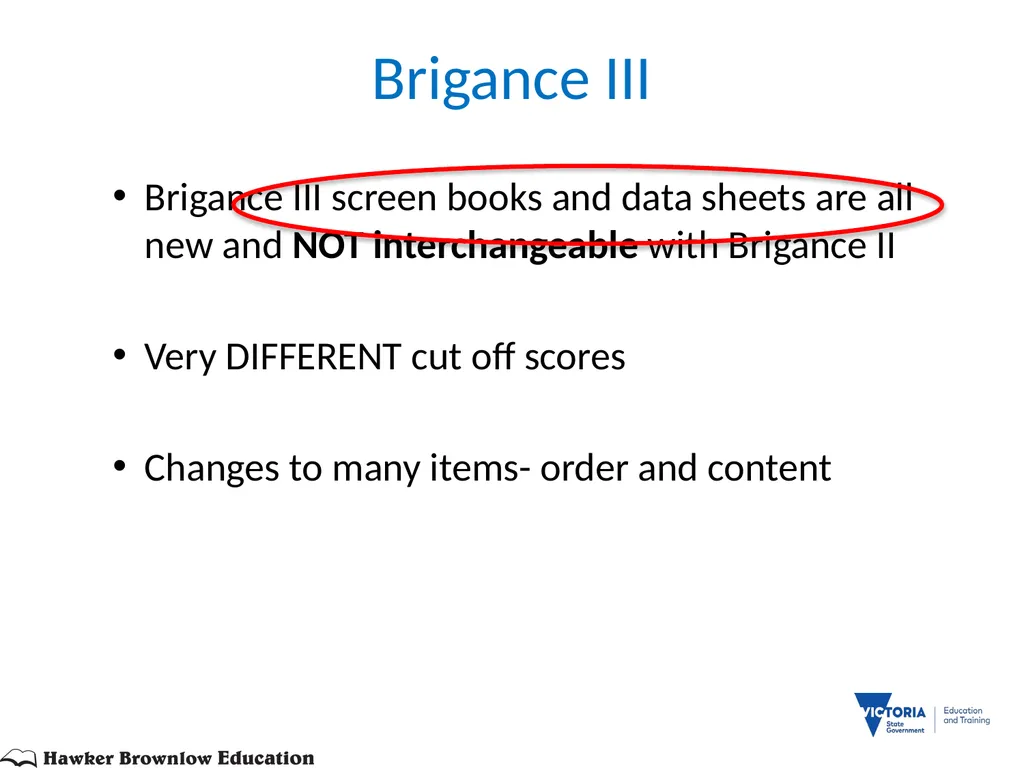
Brigance III Brigance III screen books and data sheets are all new and NOT interchangeable with Brigance II
Very DIFFERENT cut off scores
Changes to many items- order and content<br>
Very DIFFERENT cut off scores
Changes to many items- order and content<br>
54
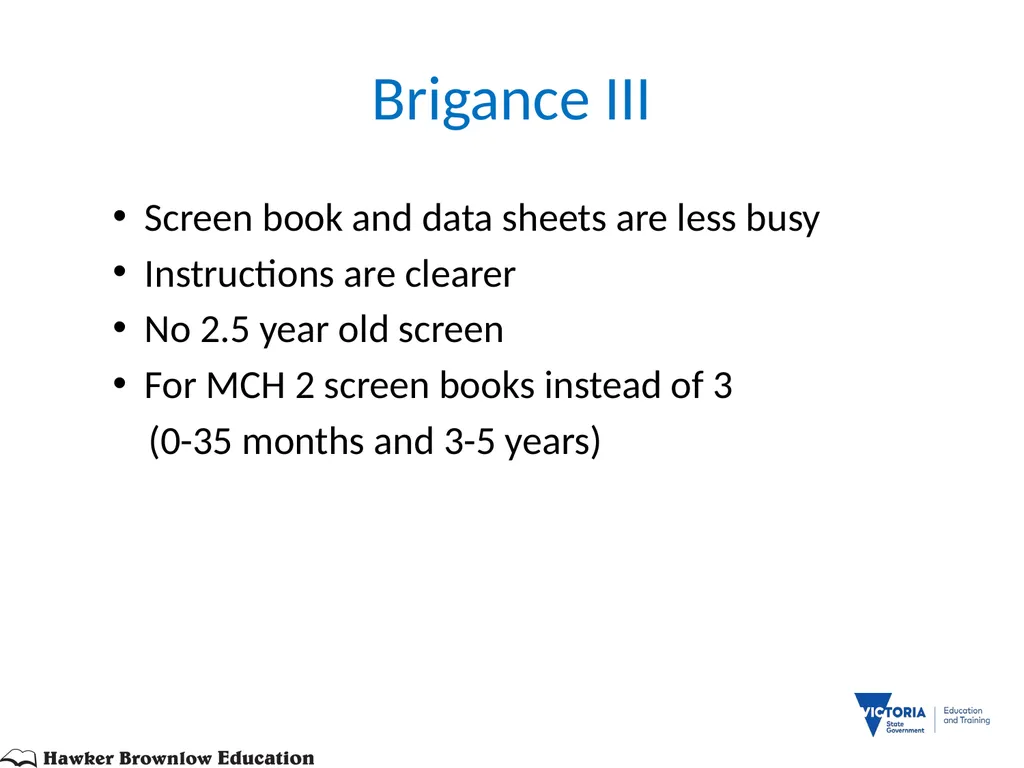
Brigance III Screen book and data sheets are less busy
Instructions are clearer
No 2.5 year old screen
For MCH 2 screen books instead of 3
(0-35 months and 3-5 years)<br>
Instructions are clearer
No 2.5 year old screen
For MCH 2 screen books instead of 3
(0-35 months and 3-5 years)<br>
55
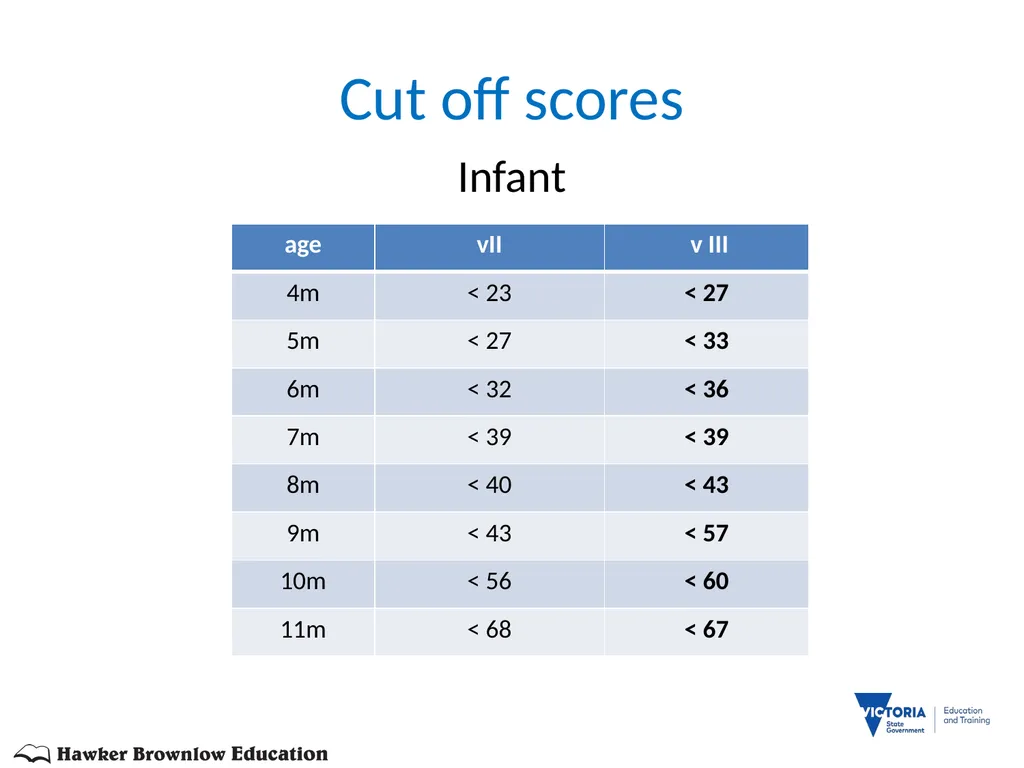
Cut off scores Infant<br>
56
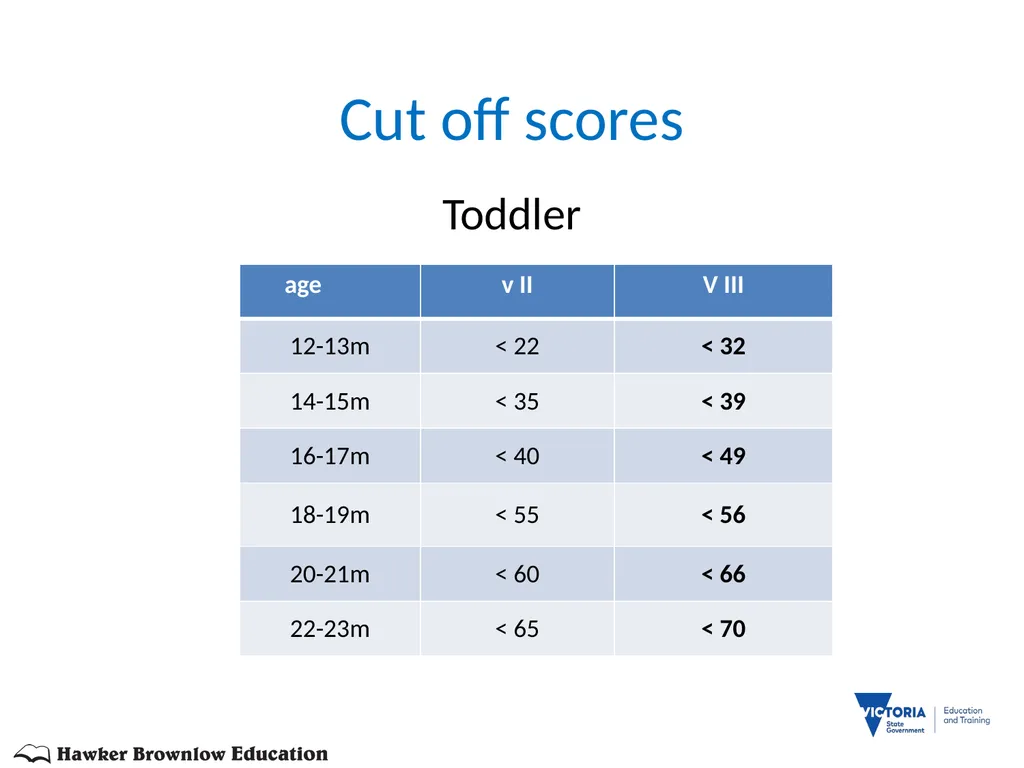
Cut off scores Toddler<br>
57
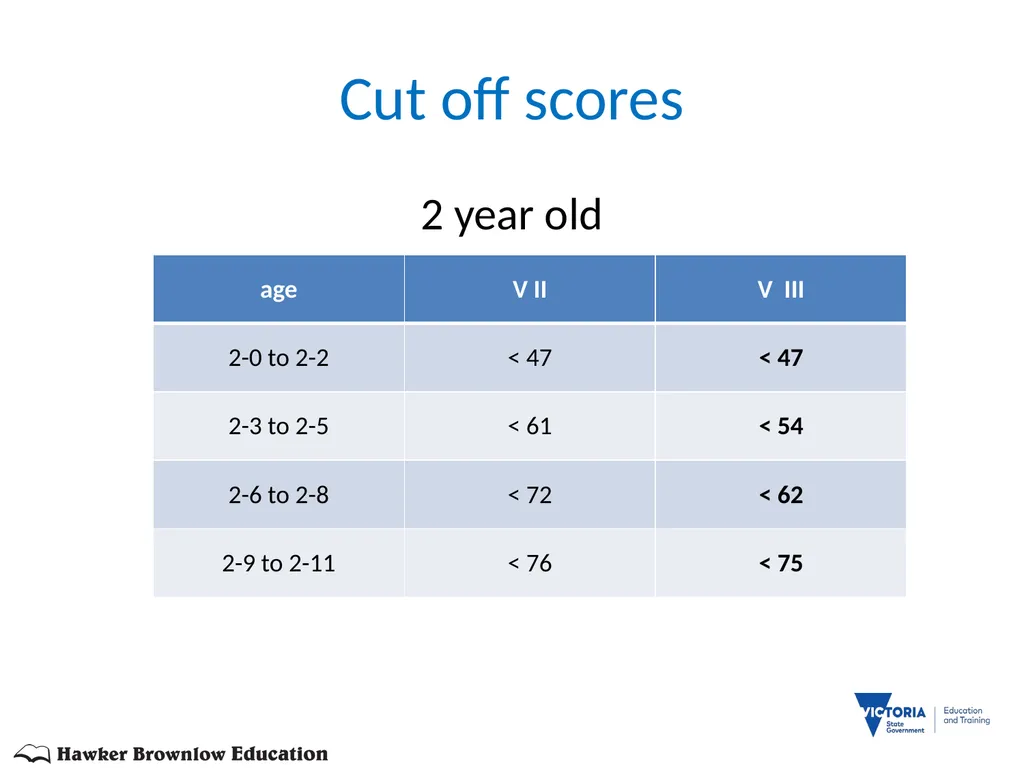
Cut off scores 2 year old<br>
58
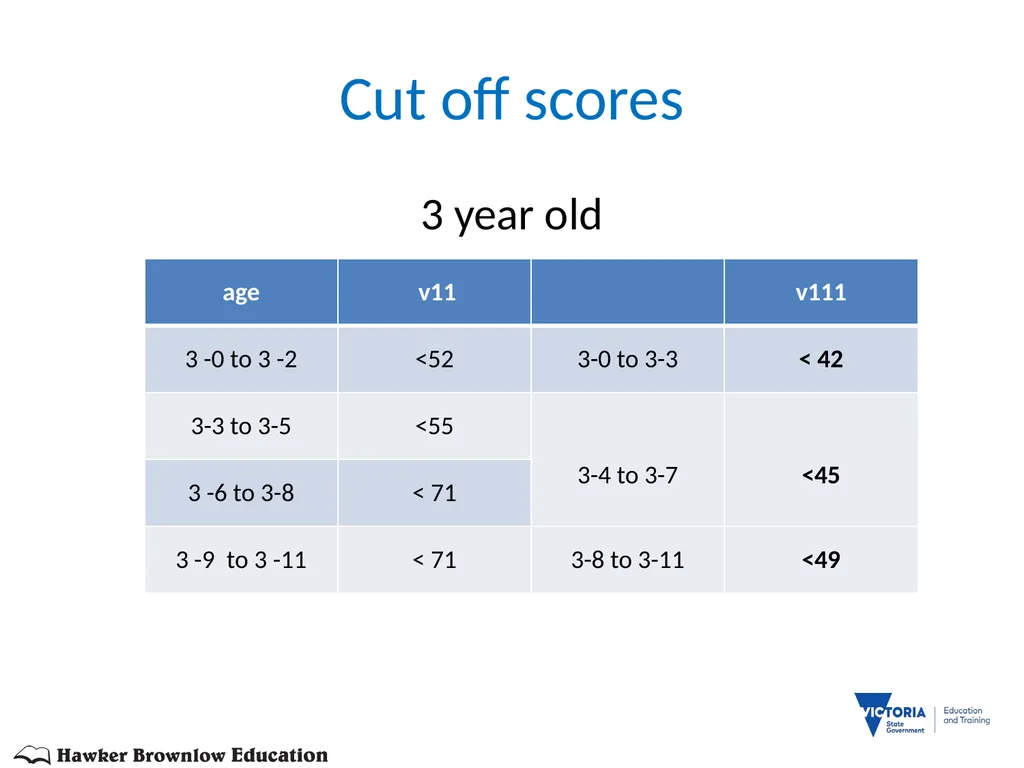
Cut off scores 3 year old<br>
59
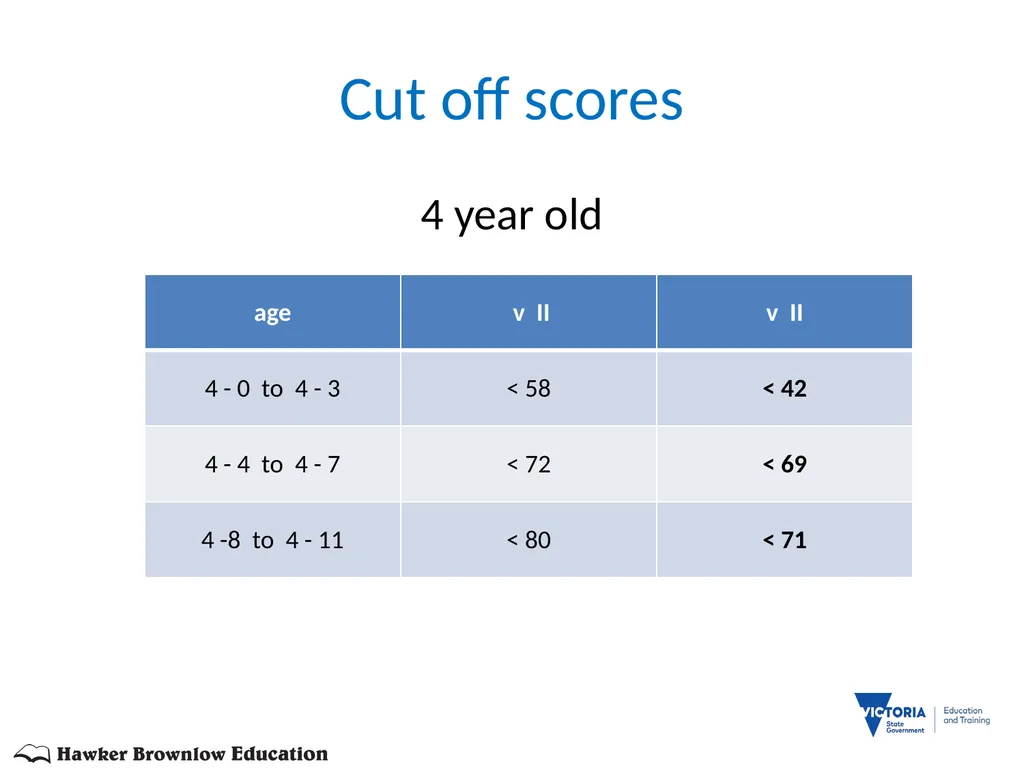
Cut off scores 4 year old<br>
60
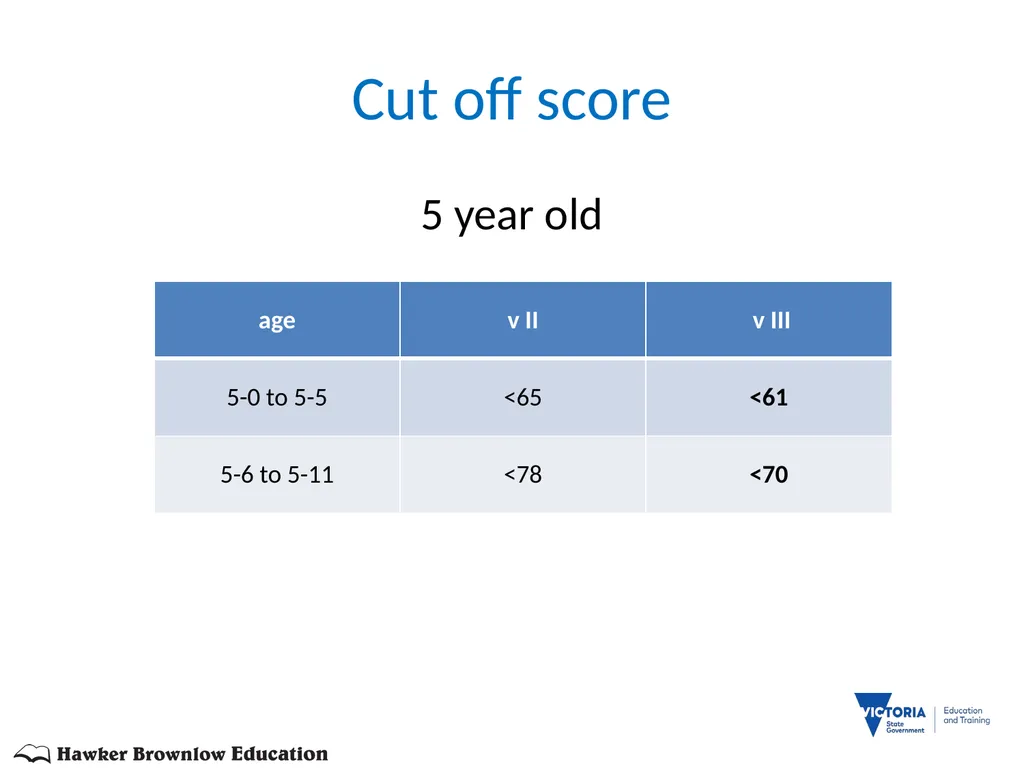
Cut off score 5 year old<br>
61
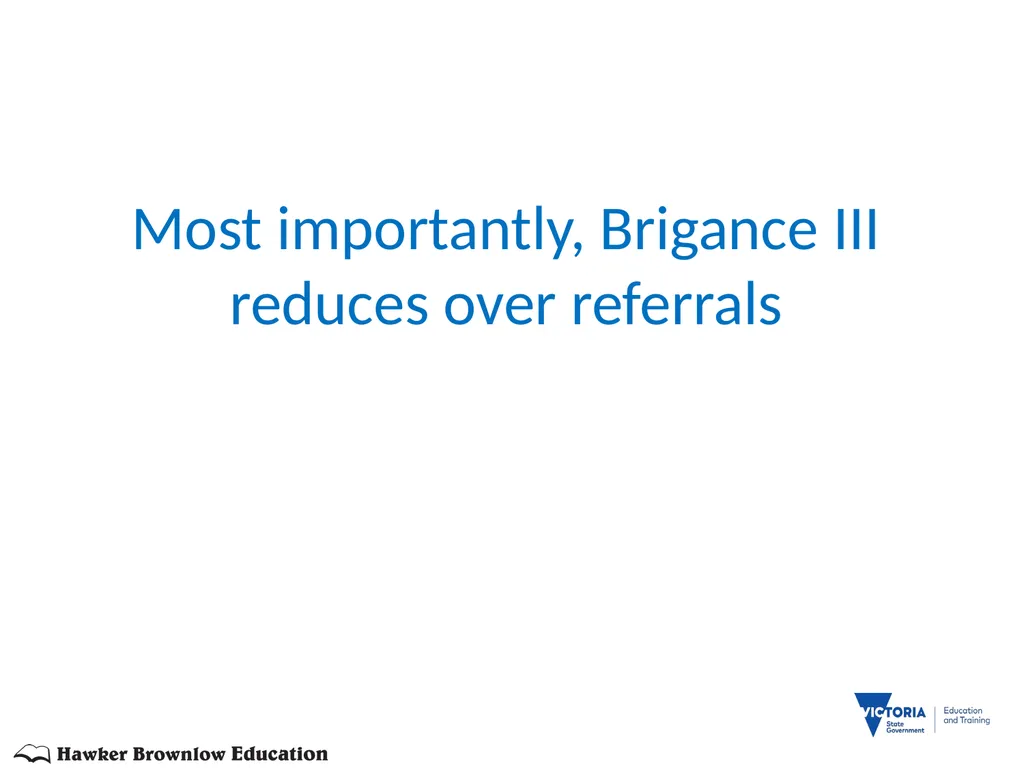
Most importantly, Brigance III reduces over referrals<br>
62
Important points to remember Prepare as much as possible
Follow the instructions- they are clear and comprehensive
All screening needs practice<br>
Follow the instructions- they are clear and comprehensive
All screening needs practice<br>
63
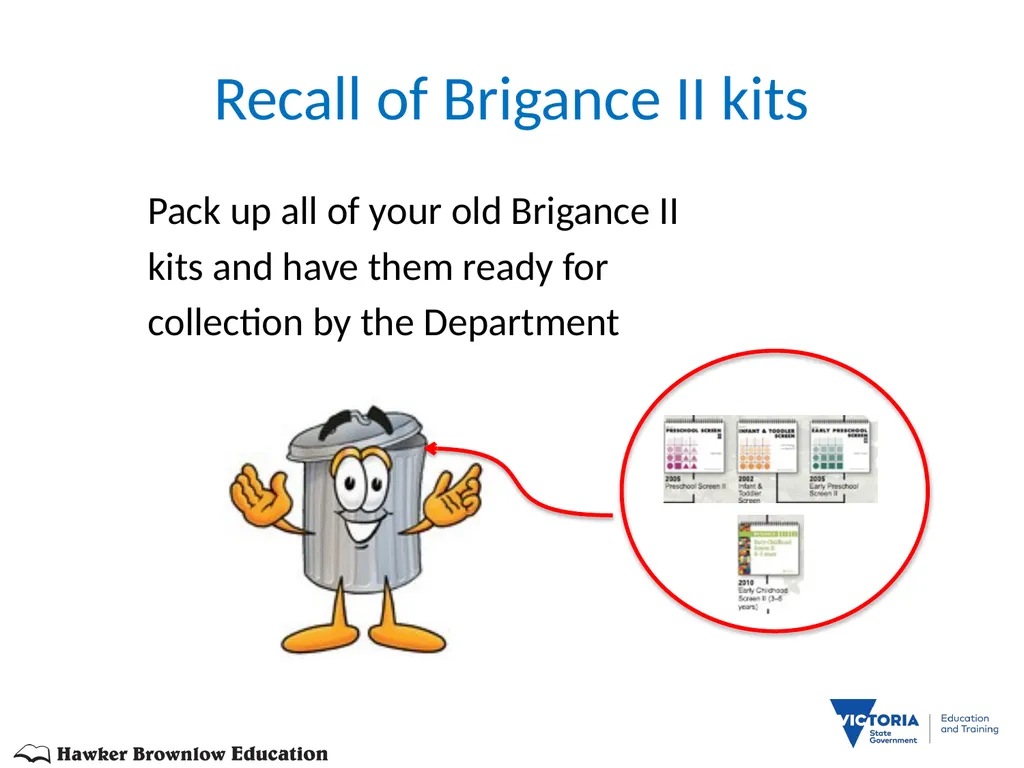
Recall of Brigance II kits Pack up all of your old Brigance II
kits and have them ready for
collection by the Department<br>
kits and have them ready for
collection by the Department<br>
64
Brigance III Summary Will accurately identify children at risk of developmental delay
Quick and easy to use
Can help to inform referral decisions
Will support your referral<br>
Quick and easy to use
Can help to inform referral decisions
Will support your referral<br>
65
Maternal and Child Health Nurse
BRIGANCE III TRAINING
PART 2
PRACTICAL WORSHOP<br>
66
GP knowledge of Brigance<br>
67
Infant and toddler screens
some specific points to note<br>
68
Infant and toddler screens-
entry points Items in the infant and toddler screens have different entry points depending on age of child
If time permits, place a mark on the data sheet at entry points for each item prior to screening
Entry points are clearly marked on each page of the screen.
Tip sheet with entry points for age group is available on MCH DET website under Brigance Resources for MCHNs<br>
If time permits, place a mark on the data sheet at entry points for each item prior to screening
Entry points are clearly marked on each page of the screen.
Tip sheet with entry points for age group is available on MCH DET website under Brigance Resources for MCHNs<br>
69
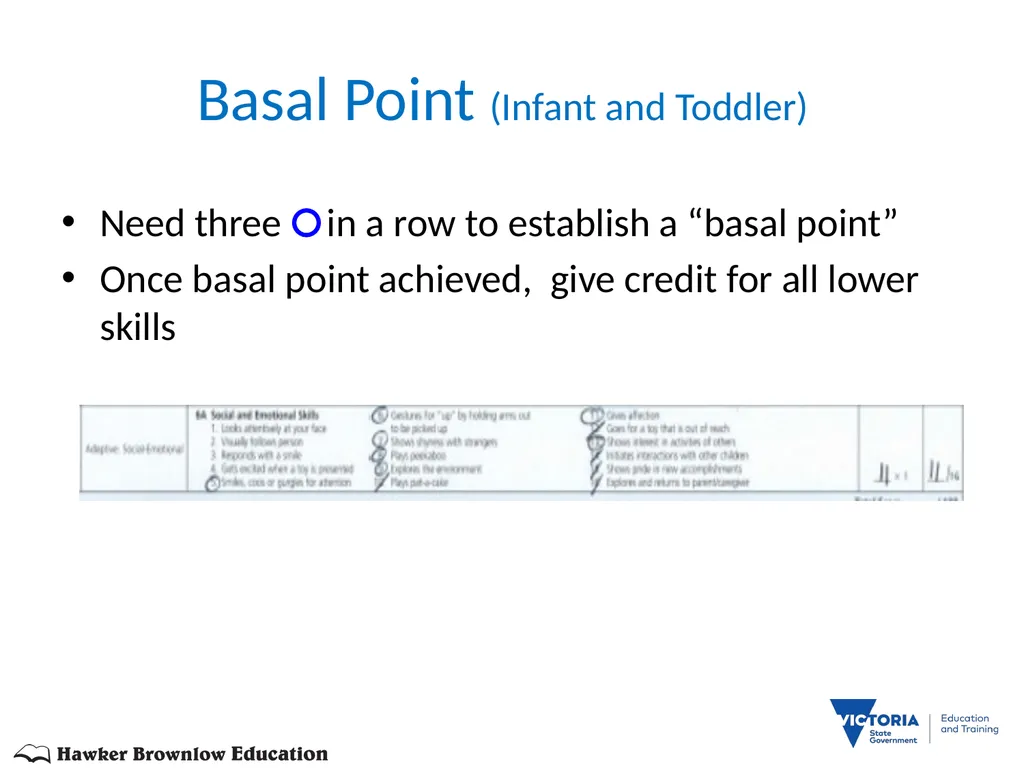
Basal Point (Infant and Toddler) Need three in a row to establish a “basal point”
Once basal point achieved, give credit for all lower skills<br>
Once basal point achieved, give credit for all lower skills<br>
70
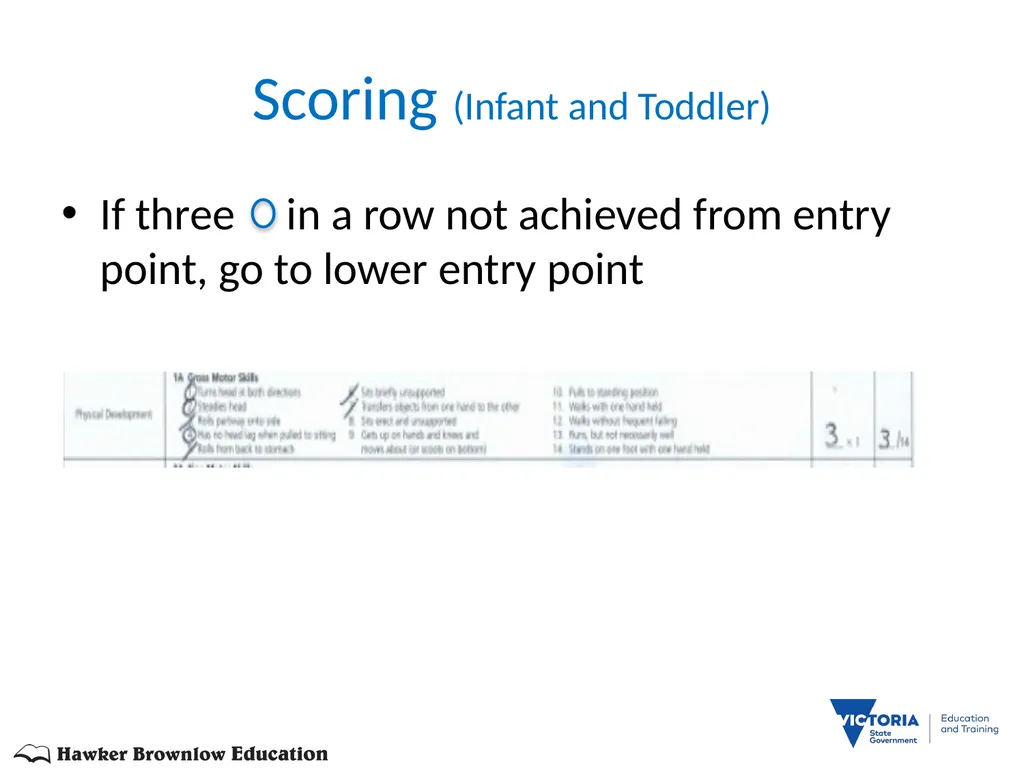
Scoring (Infant and Toddler) If three in a row not achieved from entry point, go to lower entry point<br>
71
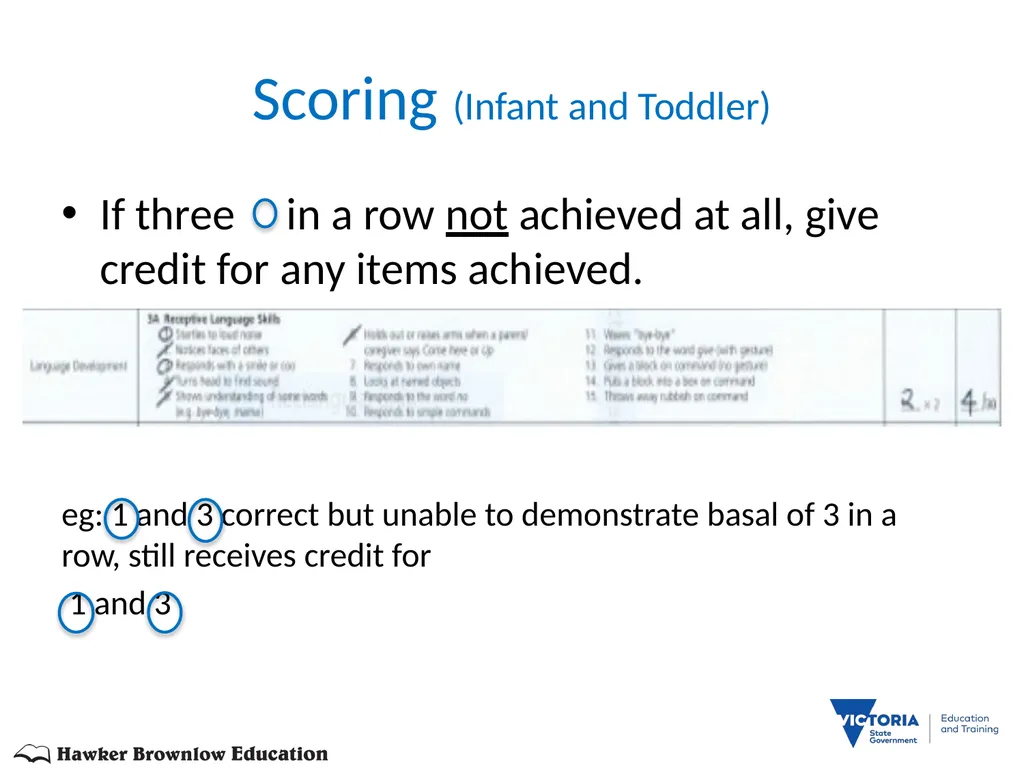
Scoring (Infant and Toddler) If three in a row not achieved at all, give credit for any items achieved.
eg: 1 and 3 correct but unable to demonstrate basal of 3 in a row, still receives credit for
1 and 3<br>
eg: 1 and 3 correct but unable to demonstrate basal of 3 in a row, still receives credit for
1 and 3<br>
72
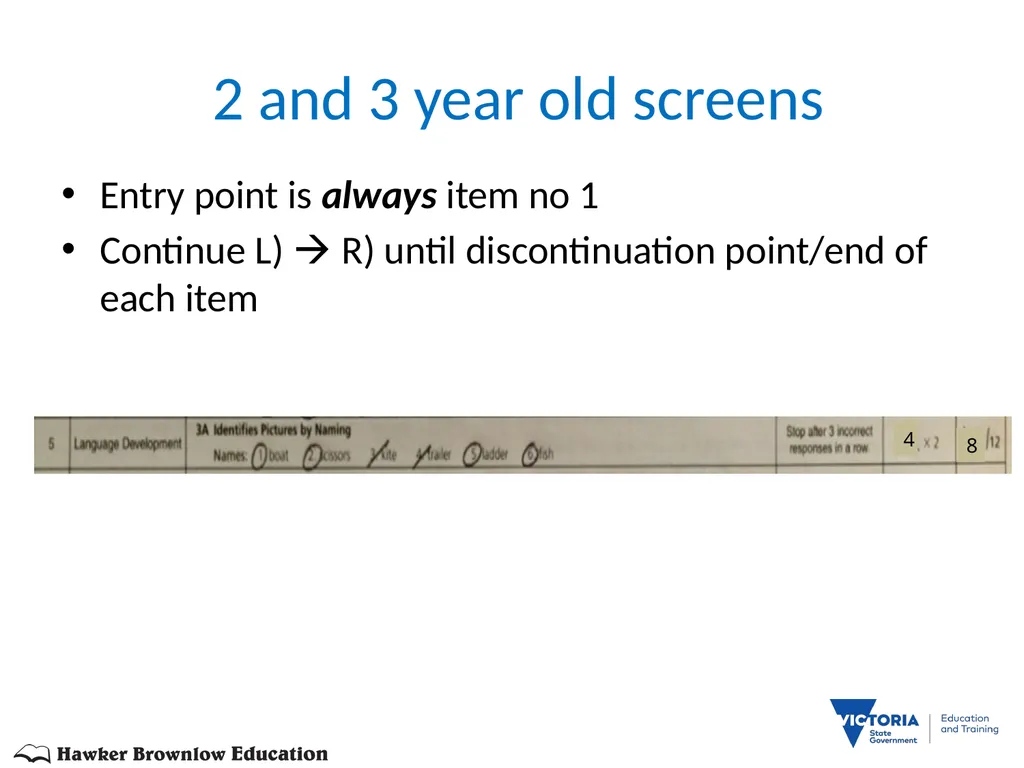
2 and 3 year old screens Entry point is always item no 1
Continue L) R) until discontinuation point/end of each item 4 8<br>
Continue L) R) until discontinuation point/end of each item 4 8<br>
73
Parent report vs examiner observation Most of infant and toddler skills are parent report
Most of 2 year old skills are observed
All of 3 year old are observed
Instructions re this are clearly marked on each page of the screen book<br>
Most of 2 year old skills are observed
All of 3 year old are observed
Instructions re this are clearly marked on each page of the screen book<br>
74
When asking the parent questions: Use the wording provided
If parent answers “most of the time”
If the answer is “sometimes”, “if I let her” ,“ a little” or “she hasn’t tried yet”, the skill is emerging and not yet mastered
emerging skill not enough, looking for mastery<br>
If parent answers “most of the time”
If the answer is “sometimes”, “if I let her” ,“ a little” or “she hasn’t tried yet”, the skill is emerging and not yet mastered
emerging skill not enough, looking for mastery<br>
75
12 min video of
22 month old Lily http://www.curriculumassociates.com/professional-development/professional-development-brigance.aspx<br>
76
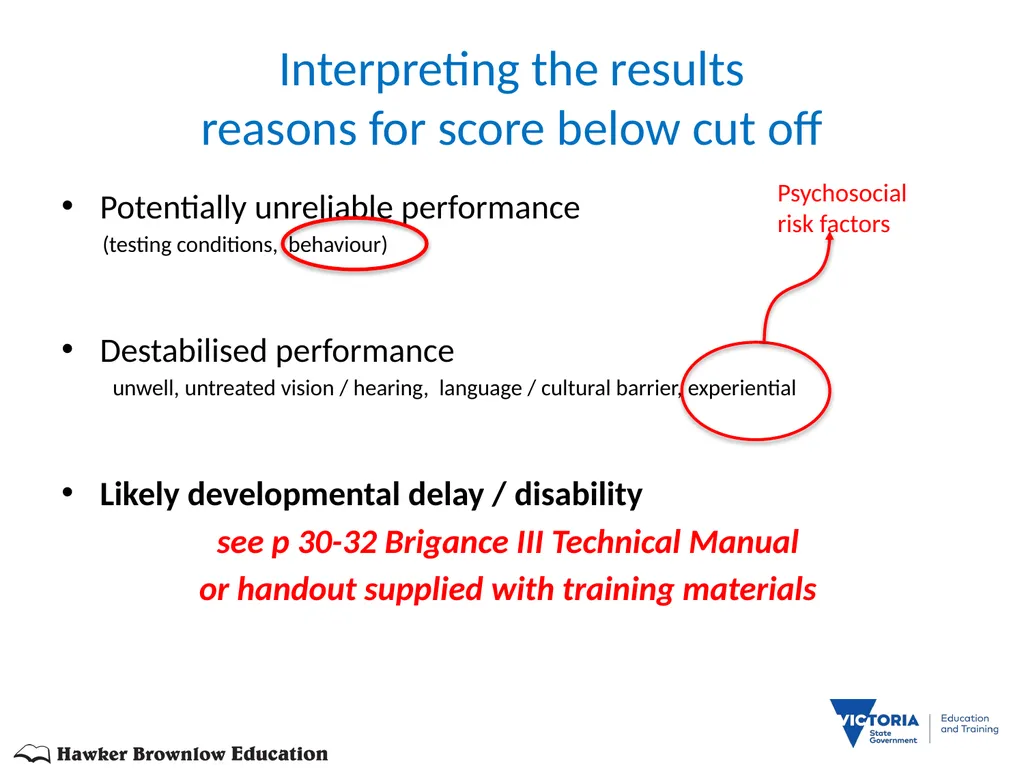
Interpreting the results
reasons for score below cut off Potentially unreliable performance
(testing conditions, behaviour)
Destabilised performance
unwell, untreated vision / hearing, language / cultural barrier, experiential
Likely developmental delay / disability
see p 30-32 Brigance III Technical Manual
or handout supplied with training materials Psychosocial risk factors<br>
(testing conditions, behaviour)
Destabilised performance
unwell, untreated vision / hearing, language / cultural barrier, experiential
Likely developmental delay / disability
see p 30-32 Brigance III Technical Manual
or handout supplied with training materials Psychosocial risk factors<br>
77
As long as performance was not destabilised or unreliable The cut off
is the cut off!
Refer if below cut off<br>
is the cut off!
Refer if below cut off<br>
78
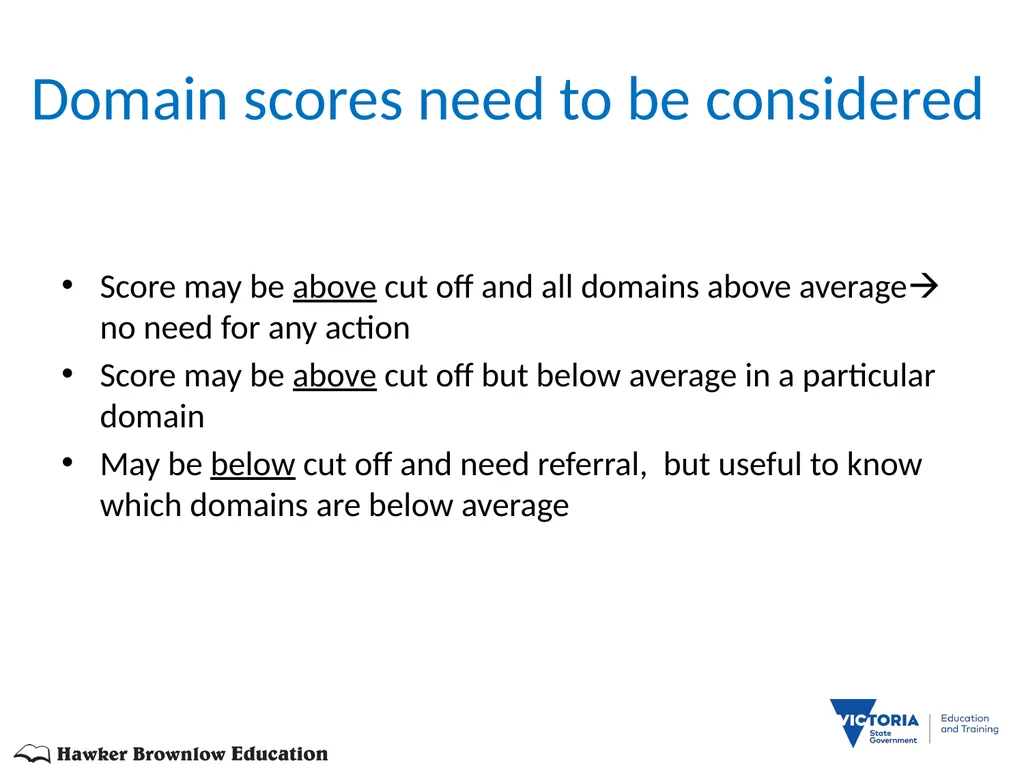
Domain scores need to be considered Score may be above cut off and all domains above average no need for any action
Score may be above cut off but below average in a particular domain
May be below cut off and need referral, but useful to know which domains are below average<br>
Score may be above cut off but below average in a particular domain
May be below cut off and need referral, but useful to know which domains are below average<br>
79
3 options for scoring
to enable domains to be considered Manual - with coloured data sheets to help
On line –free option
On line OMS, charge applies<br>
On line –free option
On line OMS, charge applies<br>
80
OPTION 1 Manual scoring
MCH nurses are accustomed to previous Brigance screen use
Tip sheets available to assist in assessing domain scores. Colour coded data sheets with table of below average domain scores
See www.education.vic.gov.au
(Brigance resources)<br>
MCH nurses are accustomed to previous Brigance screen use
Tip sheets available to assist in assessing domain scores. Colour coded data sheets with table of below average domain scores
See www.education.vic.gov.au
(Brigance resources)<br>
81
OPTION 2
Free on line scoring tool
***USEFUL FOR MCH USE ONLY*** NOT SUITABLE TO SHOW/GIVE PARENTS due to inclusion of age equivalent scores
Hawker Brownlow website www.hbe.com.au
Go to Brigance
Downloads and tools
Screens III Scoring Tool
Screens III Self-Help and Social-Emotional Scales Tool<br>
Hawker Brownlow website www.hbe.com.au
Go to Brigance
Downloads and tools
Screens III Scoring Tool
Screens III Self-Help and Social-Emotional Scales Tool<br>
82
OPTION 3
On Line Management System (OMS)
may be introduced in the future<br>
83
Where to from here? Sharing the results with parents: Tip sheet available with training resources or see p xxvi Brigance 0-35 month screen book
Does the child need referral? – hearing, vision, speech path, playgroup, childcare, GP, paediatrician, Early Childhood Intervention Services
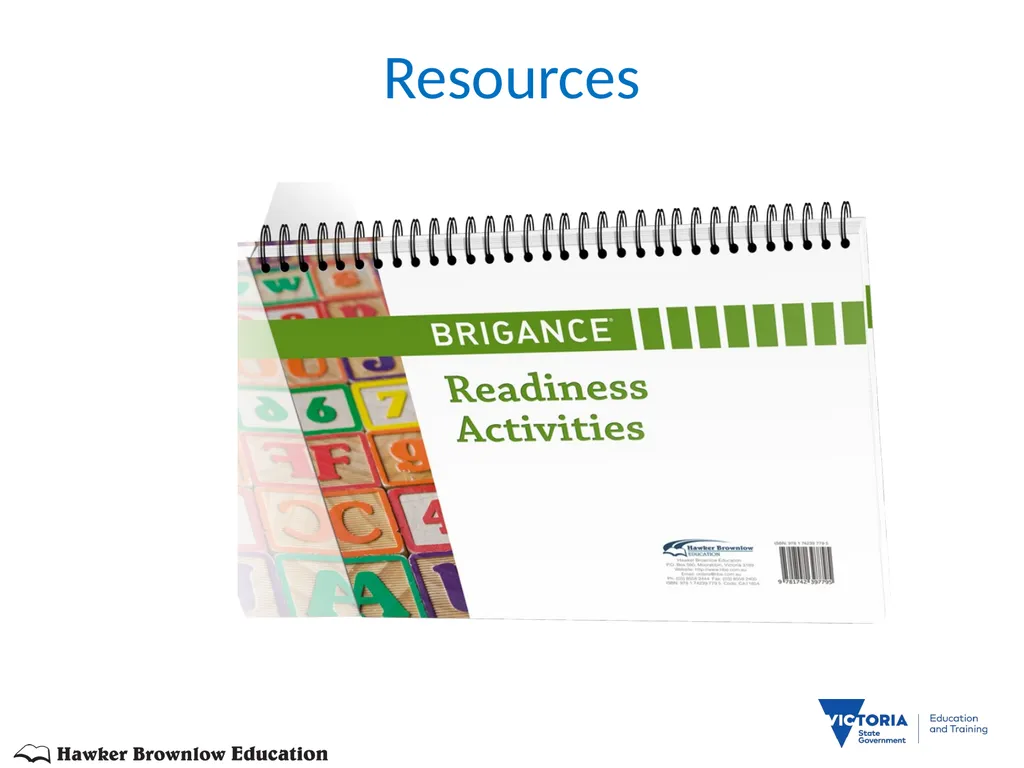
Resources- readiness activities, books, websites, library
Follow up<br>
Does the child need referral? – hearing, vision, speech path, playgroup, childcare, GP, paediatrician, Early Childhood Intervention Services
Resources- readiness activities, books, websites, library
Follow up<br>
84
Resources<br>
85
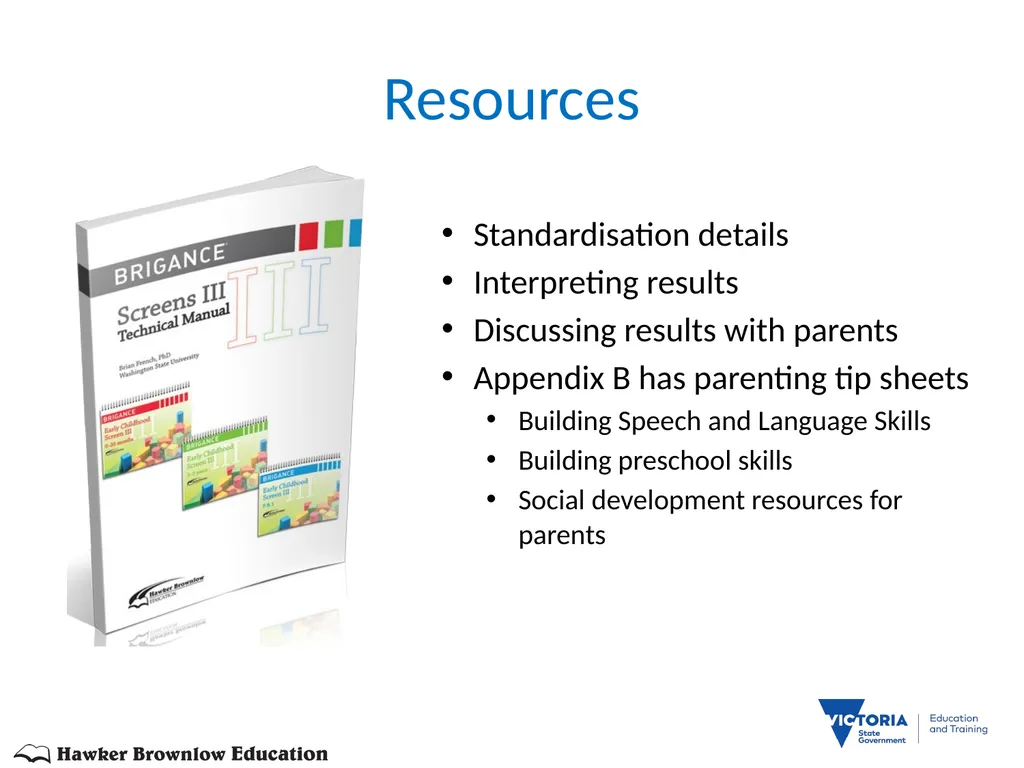
Resources Standardisation details
Interpreting results
Discussing results with parents
Appendix B has parenting tip sheets
Building Speech and Language Skills
Building preschool skills
Social development resources for parents<br>
Interpreting results
Discussing results with parents
Appendix B has parenting tip sheets
Building Speech and Language Skills
Building preschool skills
Social development resources for parents<br>
86
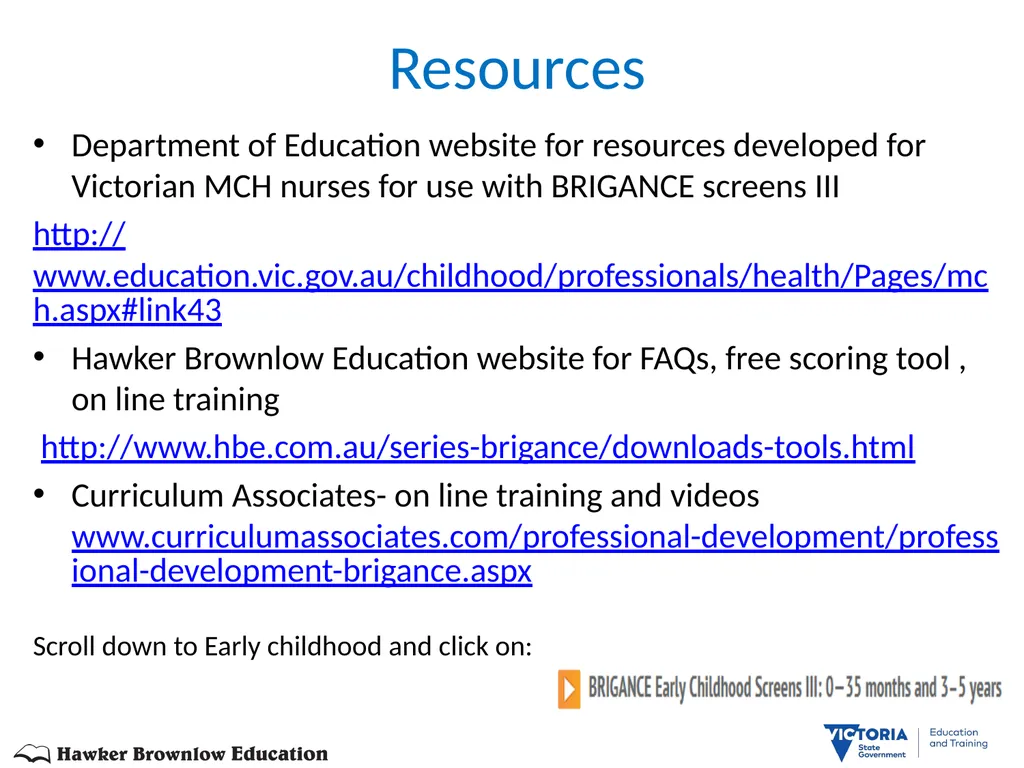
Resources Department of Education website for resources developed for Victorian MCH nurses for use with BRIGANCE screens III
http://www.education.vic.gov.au/childhood/professionals/health/Pages/mch.aspx#link43
Hawker Brownlow Education website for FAQs, free scoring tool , on line training
http://www.hbe.com.au/series-brigance/downloads-tools.html
Curriculum Associates- on line training and videos www.curriculumassociates.com/professional-development/professional-development-brigance.aspx
Scroll down to Early childhood and click on:<br>
http://www.education.vic.gov.au/childhood/professionals/health/Pages/mch.aspx#link43
Hawker Brownlow Education website for FAQs, free scoring tool , on line training
http://www.hbe.com.au/series-brigance/downloads-tools.html
Curriculum Associates- on line training and videos www.curriculumassociates.com/professional-development/professional-development-brigance.aspx
Scroll down to Early childhood and click on:<br>
87
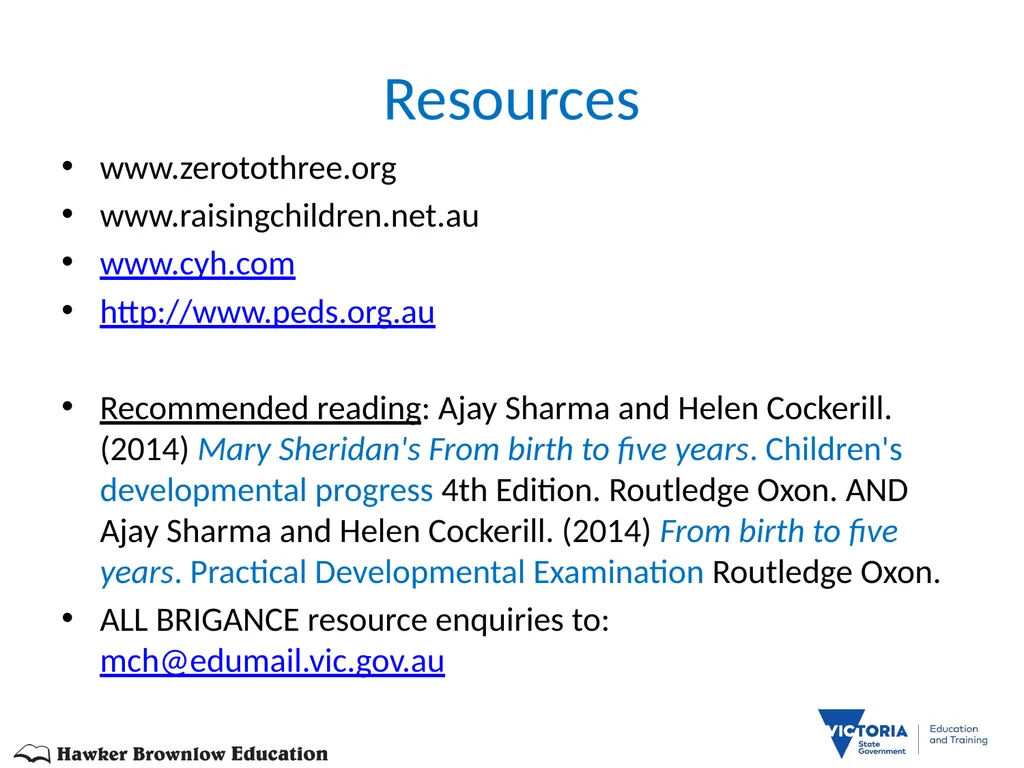
Resources www.zerotothree.org
www.raisingchildren.net.au
www.cyh.com
http://www.peds.org.au
Recommended reading: Ajay Sharma and Helen Cockerill. (2014) Mary Sheridan's From birth to five years. Children's developmental progress 4th Edition. Routledge Oxon. AND Ajay Sharma and Helen Cockerill. (2014) From birth to five years. Practical Developmental Examination Routledge Oxon.
ALL BRIGANCE resource enquiries to: mch@edumail.vic.gov.au<br>
www.raisingchildren.net.au
www.cyh.com
http://www.peds.org.au
Recommended reading: Ajay Sharma and Helen Cockerill. (2014) Mary Sheridan's From birth to five years. Children's developmental progress 4th Edition. Routledge Oxon. AND Ajay Sharma and Helen Cockerill. (2014) From birth to five years. Practical Developmental Examination Routledge Oxon.
ALL BRIGANCE resource enquiries to: mch@edumail.vic.gov.au<br>
88
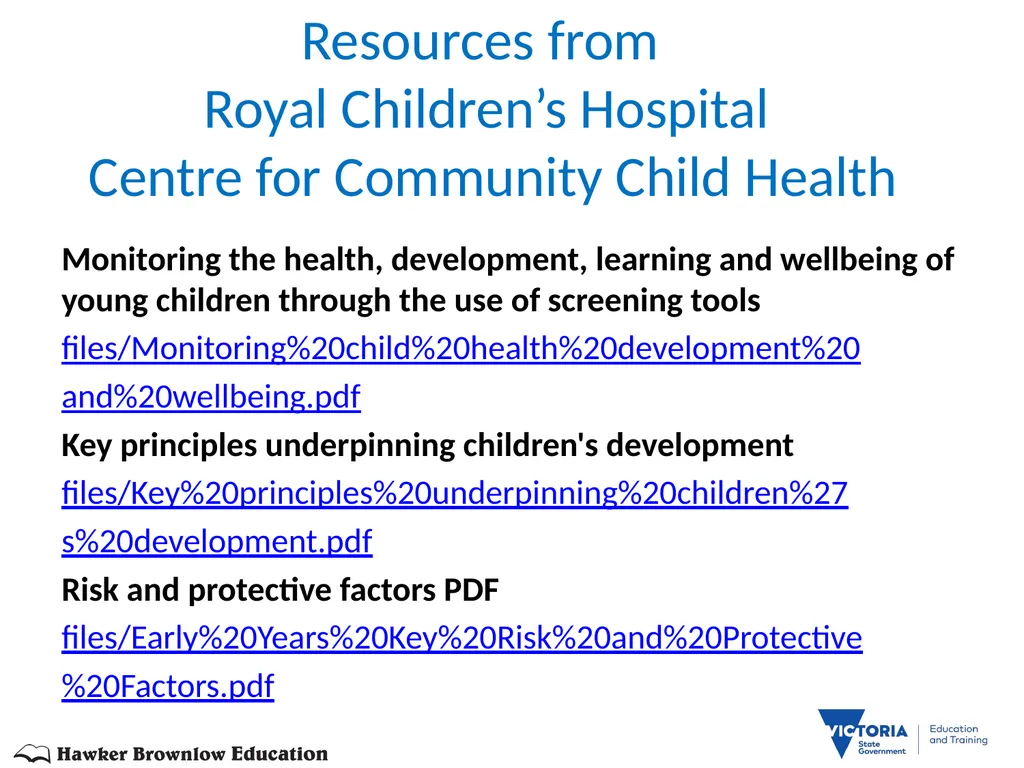
Resources from
Royal Children’s Hospital
Centre for Community Child Health Monitoring the health, development, learning and wellbeing of young children through the use of screening tools
files/Monitoring%20child%20health%20development%20
and%20wellbeing.pdf
Key principles underpinning children's development
files/Key%20principles%20underpinning%20children%27
s%20development.pdf
Risk and protective factors PDF
files/Early%20Years%20Key%20Risk%20and%20Protective
%20Factors.pdf<br>
files/Monitoring%20child%20health%20development%20
and%20wellbeing.pdf
Key principles underpinning children's development
files/Key%20principles%20underpinning%20children%27
s%20development.pdf
Risk and protective factors PDF
files/Early%20Years%20Key%20Risk%20and%20Protective
%20Factors.pdf<br>
89
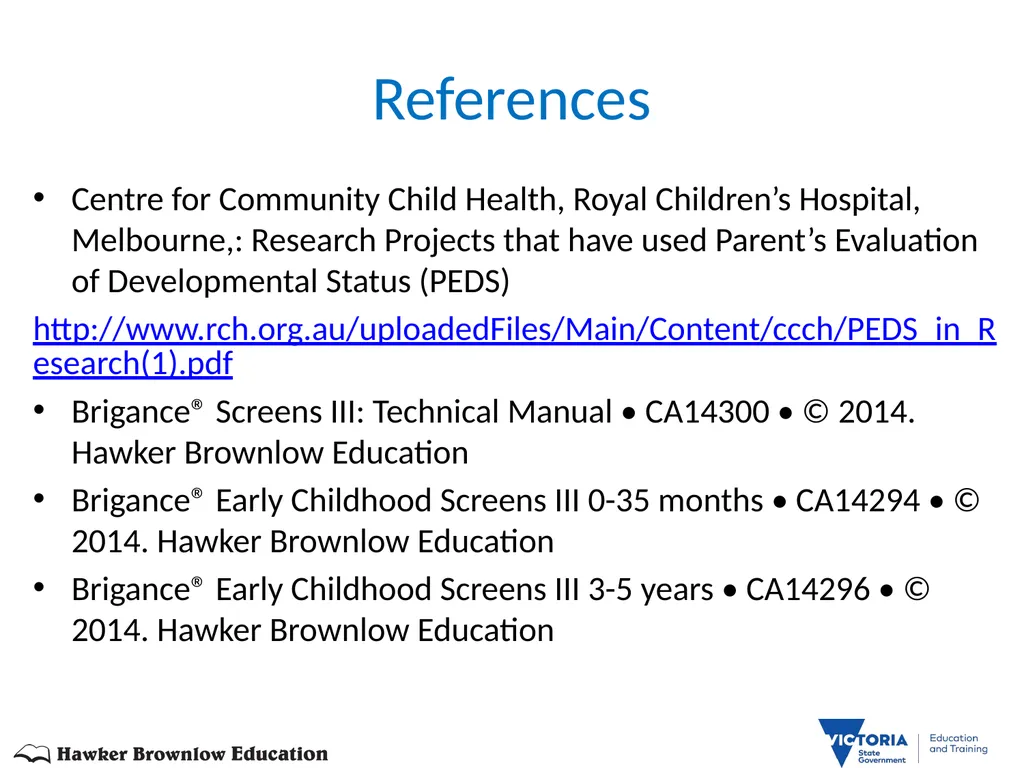
References Centre for Community Child Health, Royal Children’s Hospital, Melbourne,: Research Projects that have used Parent’s Evaluation of Developmental Status (PEDS)
http://www.rch.org.au/uploadedFiles/Main/Content/ccch/PEDS_in_Research(1).pdf
Brigance® Screens III: Technical Manual • CA14300 • © 2014. Hawker Brownlow Education
Brigance® Early Childhood Screens III 0-35 months • CA14294 • © 2014. Hawker Brownlow Education
Brigance® Early Childhood Screens III 3-5 years • CA14296 • © 2014. Hawker Brownlow Education<br>
http://www.rch.org.au/uploadedFiles/Main/Content/ccch/PEDS_in_Research(1).pdf
Brigance® Screens III: Technical Manual • CA14300 • © 2014. Hawker Brownlow Education
Brigance® Early Childhood Screens III 0-35 months • CA14294 • © 2014. Hawker Brownlow Education
Brigance® Early Childhood Screens III 3-5 years • CA14296 • © 2014. Hawker Brownlow Education<br>