
Broadcasting Basics and Methodologies UNIT 1
LD
Published · 21 slides · 0 views
1 / 1

Description
Broadcasting Basics and Methodologies UNIT 1 LESSON 1 RADIO SHORT COURSE LECTURER: CHRIS JORDAN WELCOME TO THE RADIO LANDSCAPE.. In 2023, we have multiple dominating media platforms that each have their own delivery purpose Radio, TV,
Related Topics
Share
Embed code
Download this presentation From Below
"Broadcasting Basics and Methodologies UNIT 1" is the property of its rightful owner. Permission is granted to download and print the materials on this website for personal, non-commercial use only, and to display it on your personal computer provided you do not modify the materials and that you retain all copyright notices contained in the materials. By downloading content from our website, you accept the terms of this agreement.
Presentation Transcript
01
Broadcasting Basics and Methodologies
UNIT 1 –LESSON 1 RADIO SHORT COURSE
LECTURER: CHRIS JORDAN<br>
LECTURER: CHRIS JORDAN<br>
02
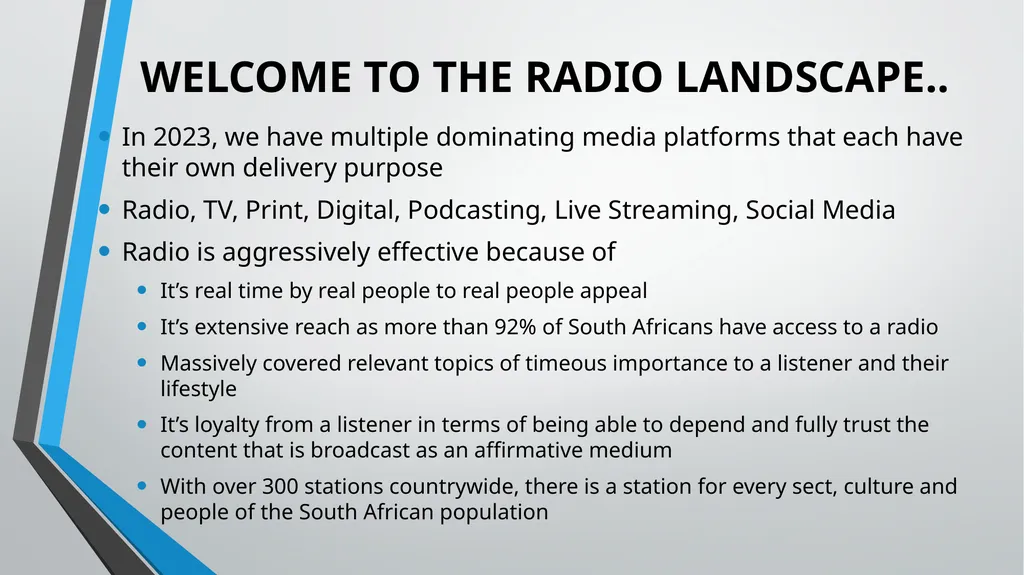
WELCOME TO THE RADIO LANDSCAPE.. In 2023, we have multiple dominating media platforms that each have their own delivery purpose
Radio, TV, Print, Digital, Podcasting, Live Streaming, Social Media
Radio is aggressively effective because of
It’s real time by real people to real people appeal
It’s extensive reach as more than 92% of South Africans have access to a radio
Massively covered relevant topics of timeous importance to a listener and their lifestyle
It’s loyalty from a listener in terms of being able to depend and fully trust the content that is broadcast as an affirmative medium
With over 300 stations countrywide, there is a station for every sect, culture and people of the South African population<br>
Radio, TV, Print, Digital, Podcasting, Live Streaming, Social Media
Radio is aggressively effective because of
It’s real time by real people to real people appeal
It’s extensive reach as more than 92% of South Africans have access to a radio
Massively covered relevant topics of timeous importance to a listener and their lifestyle
It’s loyalty from a listener in terms of being able to depend and fully trust the content that is broadcast as an affirmative medium
With over 300 stations countrywide, there is a station for every sect, culture and people of the South African population<br>
03
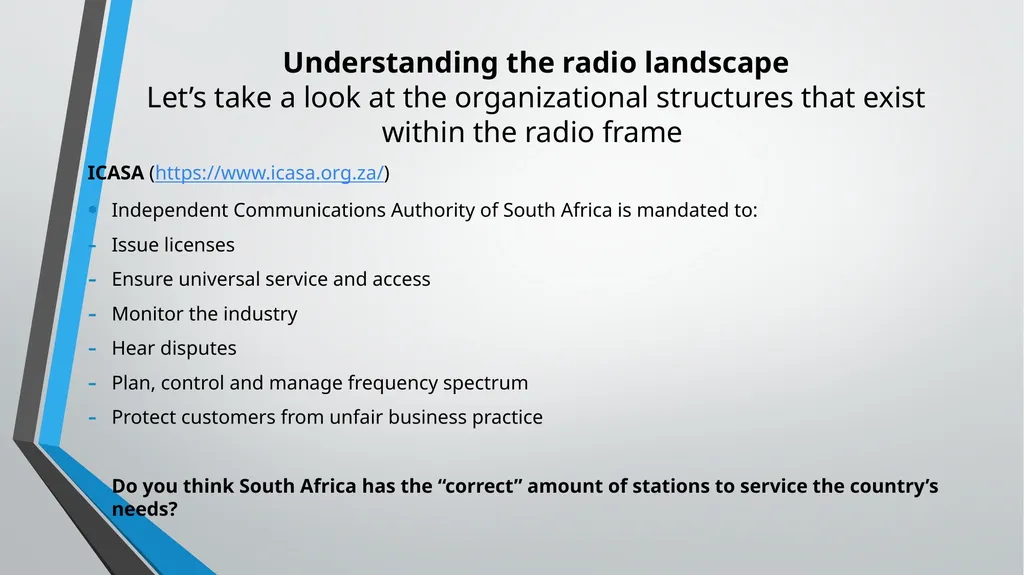
Understanding the radio landscape
Let’s take a look at the organizational structures that exist within the radio frame ICASA (https://www.icasa.org.za/)
Independent Communications Authority of South Africa is mandated to:
Issue licenses
Ensure universal service and access
Monitor the industry
Hear disputes
Plan, control and manage frequency spectrum
Protect customers from unfair business practice
Do you think South Africa has the “correct” amount of stations to service the country’s needs?<br>
Independent Communications Authority of South Africa is mandated to:
Issue licenses
Ensure universal service and access
Monitor the industry
Hear disputes
Plan, control and manage frequency spectrum
Protect customers from unfair business practice
Do you think South Africa has the “correct” amount of stations to service the country’s needs?<br>
04
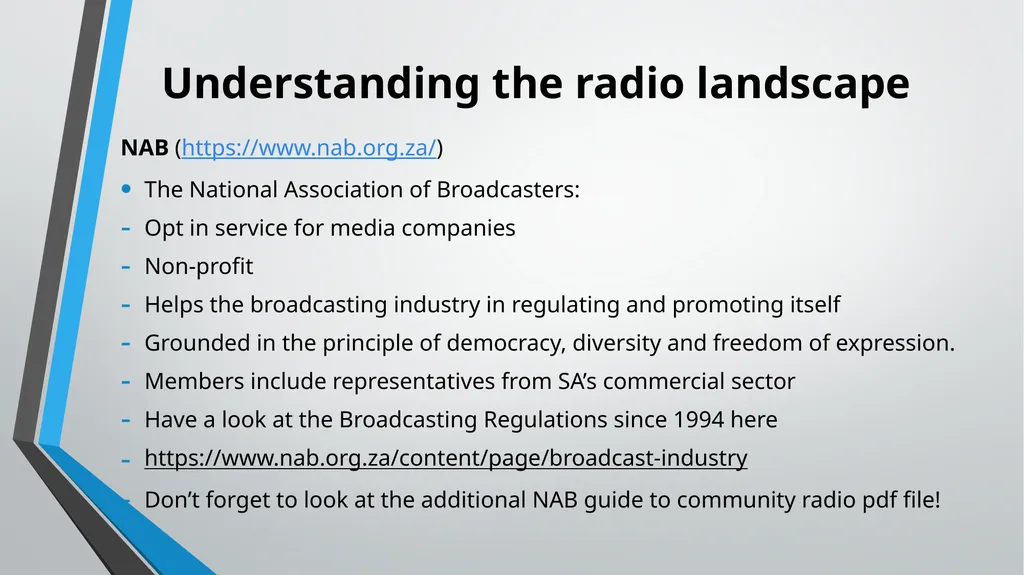
Understanding the radio landscape NAB (https://www.nab.org.za/)
The National Association of Broadcasters:
Opt in service for media companies
Non-profit
Helps the broadcasting industry in regulating and promoting itself
Grounded in the principle of democracy, diversity and freedom of expression.
Members include representatives from SA’s commercial sector
Have a look at the Broadcasting Regulations since 1994 here
https://www.nab.org.za/content/page/broadcast-industry
Don’t forget to look at the additional NAB guide to community radio pdf file!<br>
The National Association of Broadcasters:
Opt in service for media companies
Non-profit
Helps the broadcasting industry in regulating and promoting itself
Grounded in the principle of democracy, diversity and freedom of expression.
Members include representatives from SA’s commercial sector
Have a look at the Broadcasting Regulations since 1994 here
https://www.nab.org.za/content/page/broadcast-industry
Don’t forget to look at the additional NAB guide to community radio pdf file!<br>
05
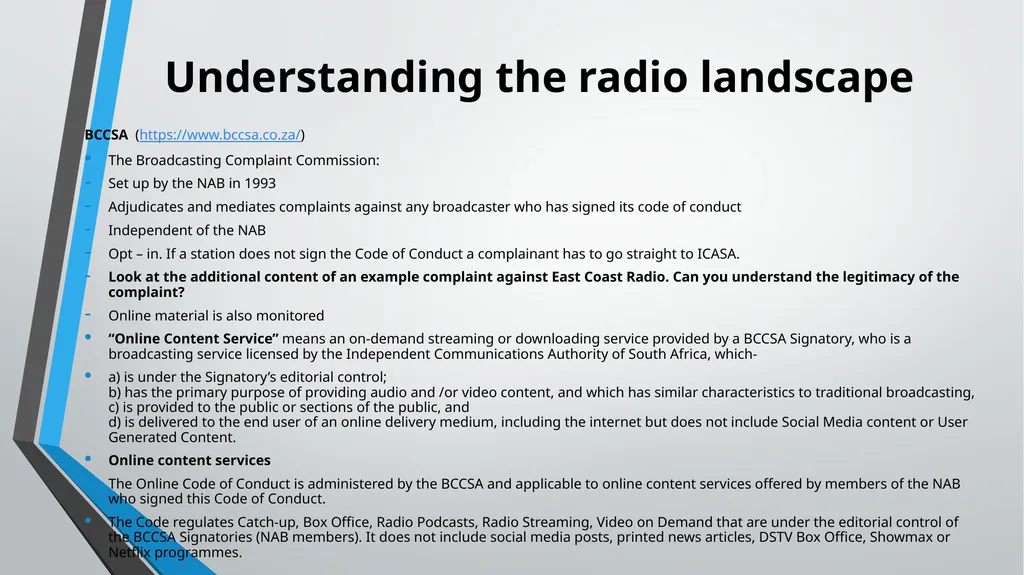
Understanding the radio landscape BCCSA (https://www.bccsa.co.za/)
The Broadcasting Complaint Commission:
Set up by the NAB in 1993
Adjudicates and mediates complaints against any broadcaster who has signed its code of conduct
Independent of the NAB
Opt – in. If a station does not sign the Code of Conduct a complainant has to go straight to ICASA.
Look at the additional content of an example complaint against East Coast Radio. Can you understand the legitimacy of the complaint?
Online material is also monitored
“Online Content Service” means an on-demand streaming or downloading service provided by a BCCSA Signatory, who is a broadcasting service licensed by the Independent Communications Authority of South Africa, which-
a) is under the Signatory’s editorial control; b) has the primary purpose of providing audio and /or video content, and which has similar characteristics to traditional broadcasting, c) is provided to the public or sections of the public, and d) is delivered to the end user of an online delivery medium, including the internet but does not include Social Media content or User Generated Content.
Online content services
The Online Code of Conduct is administered by the BCCSA and applicable to online content services offered by members of the NAB who signed this Code of Conduct.
The Code regulates Catch-up, Box Office, Radio Podcasts, Radio Streaming, Video on Demand that are under the editorial control of the BCCSA Signatories (NAB members). It does not include social media posts, printed news articles, DSTV Box Office, Showmax or Netflix programmes.<br>
The Broadcasting Complaint Commission:
Set up by the NAB in 1993
Adjudicates and mediates complaints against any broadcaster who has signed its code of conduct
Independent of the NAB
Opt – in. If a station does not sign the Code of Conduct a complainant has to go straight to ICASA.
Look at the additional content of an example complaint against East Coast Radio. Can you understand the legitimacy of the complaint?
Online material is also monitored
“Online Content Service” means an on-demand streaming or downloading service provided by a BCCSA Signatory, who is a broadcasting service licensed by the Independent Communications Authority of South Africa, which-
a) is under the Signatory’s editorial control; b) has the primary purpose of providing audio and /or video content, and which has similar characteristics to traditional broadcasting, c) is provided to the public or sections of the public, and d) is delivered to the end user of an online delivery medium, including the internet but does not include Social Media content or User Generated Content.
Online content services
The Online Code of Conduct is administered by the BCCSA and applicable to online content services offered by members of the NAB who signed this Code of Conduct.
The Code regulates Catch-up, Box Office, Radio Podcasts, Radio Streaming, Video on Demand that are under the editorial control of the BCCSA Signatories (NAB members). It does not include social media posts, printed news articles, DSTV Box Office, Showmax or Netflix programmes.<br>
06
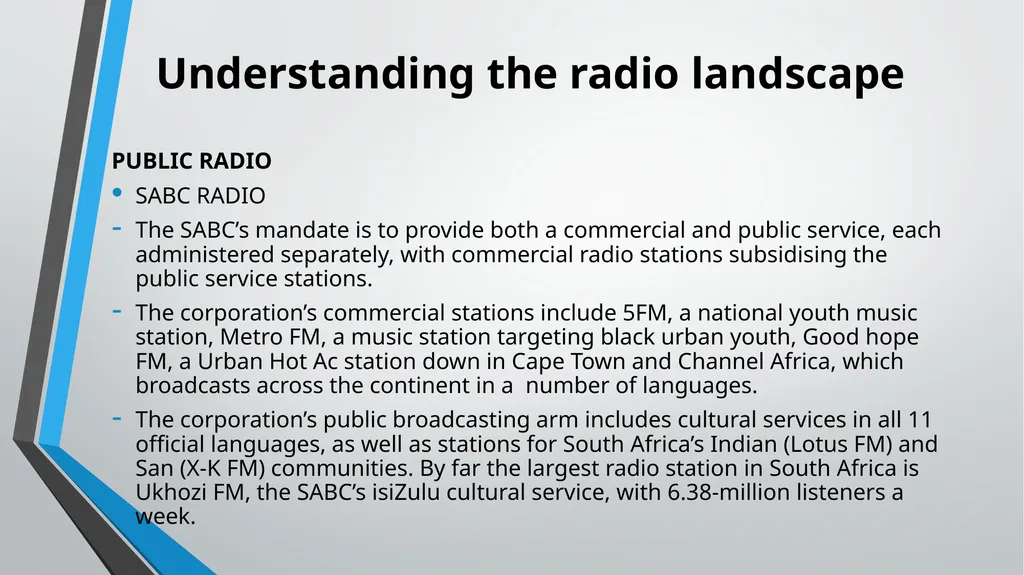
Understanding the radio landscape PUBLIC RADIO
SABC RADIO
The SABC’s mandate is to provide both a commercial and public service, each administered separately, with commercial radio stations subsidising the public service stations.
The corporation’s commercial stations include 5FM, a national youth music station, Metro FM, a music station targeting black urban youth, Good hope FM, a Urban Hot Ac station down in Cape Town and Channel Africa, which broadcasts across the continent in a number of languages.
The corporation’s public broadcasting arm includes cultural services in all 11 official languages, as well as stations for South Africa’s Indian (Lotus FM) and San (X-K FM) communities. By far the largest radio station in South Africa is Ukhozi FM, the SABC’s isiZulu cultural service, with 6.38-million listeners a week.<br>
SABC RADIO
The SABC’s mandate is to provide both a commercial and public service, each administered separately, with commercial radio stations subsidising the public service stations.
The corporation’s commercial stations include 5FM, a national youth music station, Metro FM, a music station targeting black urban youth, Good hope FM, a Urban Hot Ac station down in Cape Town and Channel Africa, which broadcasts across the continent in a number of languages.
The corporation’s public broadcasting arm includes cultural services in all 11 official languages, as well as stations for South Africa’s Indian (Lotus FM) and San (X-K FM) communities. By far the largest radio station in South Africa is Ukhozi FM, the SABC’s isiZulu cultural service, with 6.38-million listeners a week.<br>
07
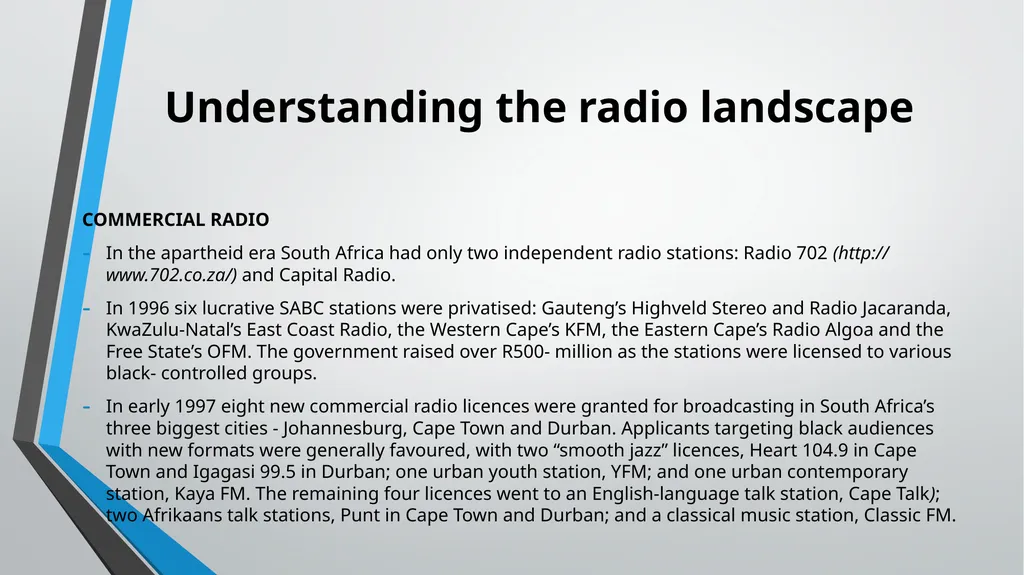
Understanding the radio landscape COMMERCIAL RADIO
In the apartheid era South Africa had only two independent radio stations: Radio 702 (http:// www.702.co.za/) and Capital Radio.
In 1996 six lucrative SABC stations were privatised: Gauteng’s Highveld Stereo and Radio Jacaranda, KwaZulu-Natal’s East Coast Radio, the Western Cape’s KFM, the Eastern Cape’s Radio Algoa and the Free State’s OFM. The government raised over R500- million as the stations were licensed to various black- controlled groups.
In early 1997 eight new commercial radio licences were granted for broadcasting in South Africa’s three biggest cities - Johannesburg, Cape Town and Durban. Applicants targeting black audiences with new formats were generally favoured, with two “smooth jazz” licences, Heart 104.9 in Cape Town and Igagasi 99.5 in Durban; one urban youth station, YFM; and one urban contemporary station, Kaya FM. The remaining four licences went to an English-language talk station, Cape Talk); two Afrikaans talk stations, Punt in Cape Town and Durban; and a classical music station, Classic FM.<br>
In the apartheid era South Africa had only two independent radio stations: Radio 702 (http:// www.702.co.za/) and Capital Radio.
In 1996 six lucrative SABC stations were privatised: Gauteng’s Highveld Stereo and Radio Jacaranda, KwaZulu-Natal’s East Coast Radio, the Western Cape’s KFM, the Eastern Cape’s Radio Algoa and the Free State’s OFM. The government raised over R500- million as the stations were licensed to various black- controlled groups.
In early 1997 eight new commercial radio licences were granted for broadcasting in South Africa’s three biggest cities - Johannesburg, Cape Town and Durban. Applicants targeting black audiences with new formats were generally favoured, with two “smooth jazz” licences, Heart 104.9 in Cape Town and Igagasi 99.5 in Durban; one urban youth station, YFM; and one urban contemporary station, Kaya FM. The remaining four licences went to an English-language talk station, Cape Talk); two Afrikaans talk stations, Punt in Cape Town and Durban; and a classical music station, Classic FM.<br>
08
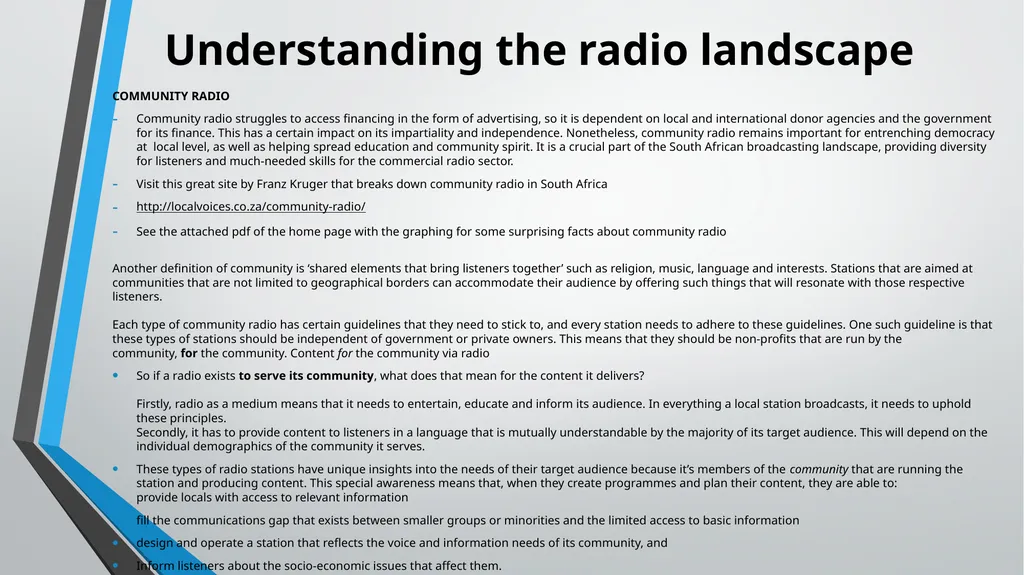
Understanding the radio landscape COMMUNITY RADIO
Community radio struggles to access financing in the form of advertising, so it is dependent on local and international donor agencies and the government for its finance. This has a certain impact on its impartiality and independence. Nonetheless, community radio remains important for entrenching democracy at local level, as well as helping spread education and community spirit. It is a crucial part of the South African broadcasting landscape, providing diversity for listeners and much-needed skills for the commercial radio sector.
Visit this great site by Franz Kruger that breaks down community radio in South Africa
http://localvoices.co.za/community-radio/
See the attached pdf of the home page with the graphing for some surprising facts about community radio
Another definition of community is ‘shared elements that bring listeners together’ such as religion, music, language and interests. Stations that are aimed at communities that are not limited to geographical borders can accommodate their audience by offering such things that will resonate with those respective listeners. Each type of community radio has certain guidelines that they need to stick to, and every station needs to adhere to these guidelines. One such guideline is that these types of stations should be independent of government or private owners. This means that they should be non-profits that are run by the community, for the community. Content for the community via radio
So if a radio exists to serve its community, what does that mean for the content it delivers? Firstly, radio as a medium means that it needs to entertain, educate and inform its audience. In everything a local station broadcasts, it needs to uphold these principles. Secondly, it has to provide content to listeners in a language that is mutually understandable by the majority of its target audience. This will depend on the individual demographics of the community it serves.
These types of radio stations have unique insights into the needs of their target audience because it’s members of the community that are running the station and producing content. This special awareness means that, when they create programmes and plan their content, they are able to: provide locals with access to relevant information
fill the communications gap that exists between smaller groups or minorities and the limited access to basic information
design and operate a station that reflects the voice and information needs of its community, and
Inform listeners about the socio-economic issues that affect them. Each community-based radio station has a unique collection of content and programmes, but one thing is the same across the board — they are dedicated to bringing their audiences relevant content!<br>
Community radio struggles to access financing in the form of advertising, so it is dependent on local and international donor agencies and the government for its finance. This has a certain impact on its impartiality and independence. Nonetheless, community radio remains important for entrenching democracy at local level, as well as helping spread education and community spirit. It is a crucial part of the South African broadcasting landscape, providing diversity for listeners and much-needed skills for the commercial radio sector.
Visit this great site by Franz Kruger that breaks down community radio in South Africa
http://localvoices.co.za/community-radio/
See the attached pdf of the home page with the graphing for some surprising facts about community radio
Another definition of community is ‘shared elements that bring listeners together’ such as religion, music, language and interests. Stations that are aimed at communities that are not limited to geographical borders can accommodate their audience by offering such things that will resonate with those respective listeners. Each type of community radio has certain guidelines that they need to stick to, and every station needs to adhere to these guidelines. One such guideline is that these types of stations should be independent of government or private owners. This means that they should be non-profits that are run by the community, for the community. Content for the community via radio
So if a radio exists to serve its community, what does that mean for the content it delivers? Firstly, radio as a medium means that it needs to entertain, educate and inform its audience. In everything a local station broadcasts, it needs to uphold these principles. Secondly, it has to provide content to listeners in a language that is mutually understandable by the majority of its target audience. This will depend on the individual demographics of the community it serves.
These types of radio stations have unique insights into the needs of their target audience because it’s members of the community that are running the station and producing content. This special awareness means that, when they create programmes and plan their content, they are able to: provide locals with access to relevant information
fill the communications gap that exists between smaller groups or minorities and the limited access to basic information
design and operate a station that reflects the voice and information needs of its community, and
Inform listeners about the socio-economic issues that affect them. Each community-based radio station has a unique collection of content and programmes, but one thing is the same across the board — they are dedicated to bringing their audiences relevant content!<br>
09
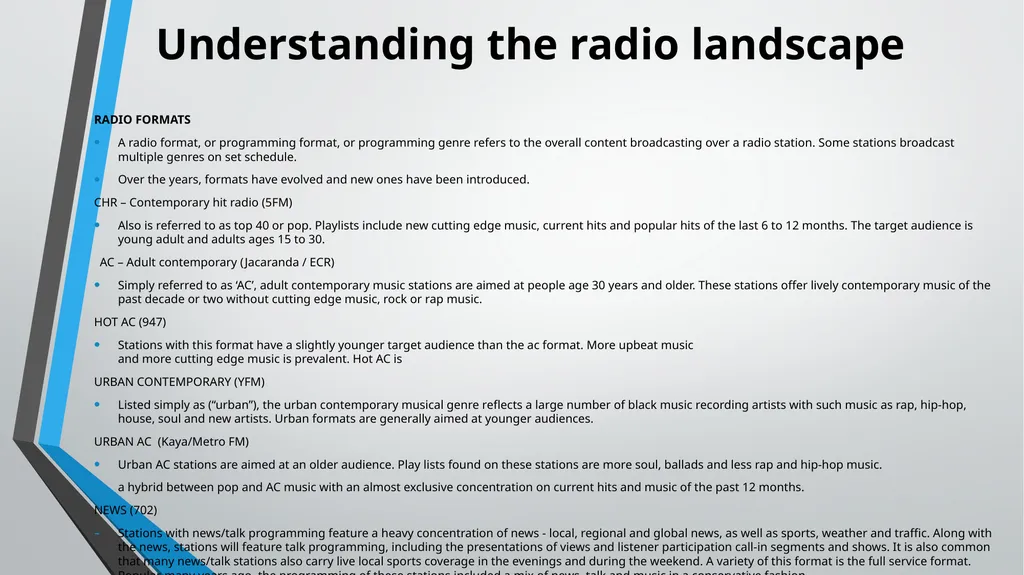
Understanding the radio landscape RADIO FORMATS
A radio format, or programming format, or programming genre refers to the overall content broadcasting over a radio station. Some stations broadcast multiple genres on set schedule.
Over the years, formats have evolved and new ones have been introduced.
CHR – Contemporary hit radio (5FM)
Also is referred to as top 40 or pop. Playlists include new cutting edge music, current hits and popular hits of the last 6 to 12 months. The target audience is young adult and adults ages 15 to 30.
AC – Adult contemporary (Jacaranda / ECR)
Simply referred to as ‘AC’, adult contemporary music stations are aimed at people age 30 years and older. These stations offer lively contemporary music of the past decade or two without cutting edge music, rock or rap music.
HOT AC (947)
Stations with this format have a slightly younger target audience than the ac format. More upbeat music and more cutting edge music is prevalent. Hot AC is
URBAN CONTEMPORARY (YFM)
Listed simply as (“urban”), the urban contemporary musical genre reflects a large number of black music recording artists with such music as rap, hip-hop, house, soul and new artists. Urban formats are generally aimed at younger audiences.
URBAN AC (Kaya/Metro FM)
Urban AC stations are aimed at an older audience. Play lists found on these stations are more soul, ballads and less rap and hip-hop music.
a hybrid between pop and AC music with an almost exclusive concentration on current hits and music of the past 12 months.
NEWS (702)
Stations with news/talk programming feature a heavy concentration of news - local, regional and global news, as well as sports, weather and traffic. Along with the news, stations will feature talk programming, including the presentations of views and listener participation call-in segments and shows. It is also common that many news/talk stations also carry live local sports coverage in the evenings and during the weekend. A variety of this format is the full service format. Popular many years ago, the programming of these stations included a mix of news, talk and music in a conservative fashion.<br>
A radio format, or programming format, or programming genre refers to the overall content broadcasting over a radio station. Some stations broadcast multiple genres on set schedule.
Over the years, formats have evolved and new ones have been introduced.
CHR – Contemporary hit radio (5FM)
Also is referred to as top 40 or pop. Playlists include new cutting edge music, current hits and popular hits of the last 6 to 12 months. The target audience is young adult and adults ages 15 to 30.
AC – Adult contemporary (Jacaranda / ECR)
Simply referred to as ‘AC’, adult contemporary music stations are aimed at people age 30 years and older. These stations offer lively contemporary music of the past decade or two without cutting edge music, rock or rap music.
HOT AC (947)
Stations with this format have a slightly younger target audience than the ac format. More upbeat music and more cutting edge music is prevalent. Hot AC is
URBAN CONTEMPORARY (YFM)
Listed simply as (“urban”), the urban contemporary musical genre reflects a large number of black music recording artists with such music as rap, hip-hop, house, soul and new artists. Urban formats are generally aimed at younger audiences.
URBAN AC (Kaya/Metro FM)
Urban AC stations are aimed at an older audience. Play lists found on these stations are more soul, ballads and less rap and hip-hop music.
a hybrid between pop and AC music with an almost exclusive concentration on current hits and music of the past 12 months.
NEWS (702)
Stations with news/talk programming feature a heavy concentration of news - local, regional and global news, as well as sports, weather and traffic. Along with the news, stations will feature talk programming, including the presentations of views and listener participation call-in segments and shows. It is also common that many news/talk stations also carry live local sports coverage in the evenings and during the weekend. A variety of this format is the full service format. Popular many years ago, the programming of these stations included a mix of news, talk and music in a conservative fashion.<br>
10
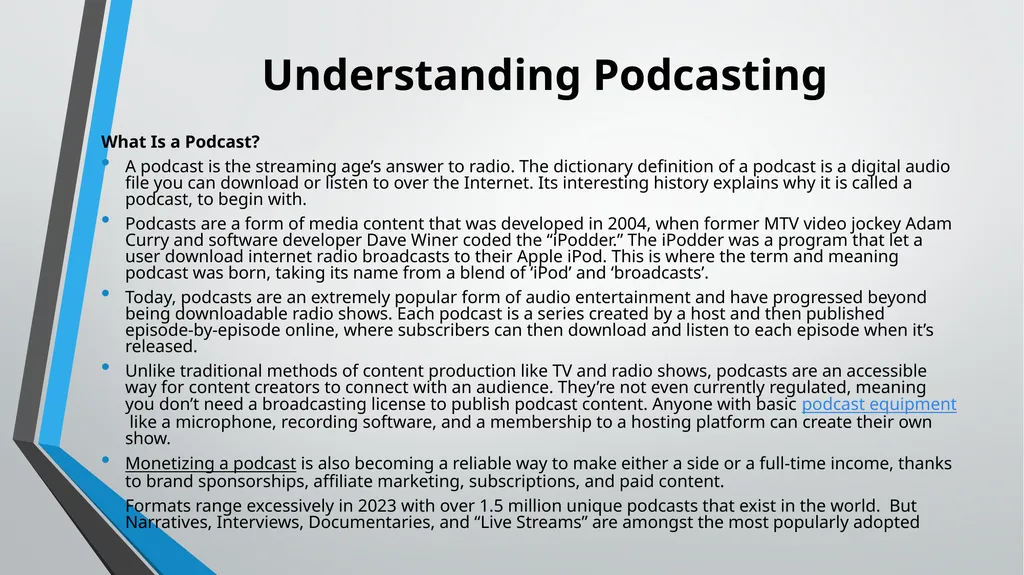
Understanding Podcasting What Is a Podcast?
A podcast is the streaming age’s answer to radio. The dictionary definition of a podcast is a digital audio file you can download or listen to over the Internet. Its interesting history explains why it is called a podcast, to begin with.
Podcasts are a form of media content that was developed in 2004, when former MTV video jockey Adam Curry and software developer Dave Winer coded the “iPodder.” The iPodder was a program that let a user download internet radio broadcasts to their Apple iPod. This is where the term and meaning podcast was born, taking its name from a blend of ‘iPod’ and ‘broadcasts’.
Today, podcasts are an extremely popular form of audio entertainment and have progressed beyond being downloadable radio shows. Each podcast is a series created by a host and then published episode-by-episode online, where subscribers can then download and listen to each episode when it’s released.
Unlike traditional methods of content production like TV and radio shows, podcasts are an accessible way for content creators to connect with an audience. They’re not even currently regulated, meaning you don’t need a broadcasting license to publish podcast content. Anyone with basic podcast equipment like a microphone, recording software, and a membership to a hosting platform can create their own show.
Monetizing a podcast is also becoming a reliable way to make either a side or a full-time income, thanks to brand sponsorships, affiliate marketing, subscriptions, and paid content.
Formats range excessively in 2023 with over 1.5 million unique podcasts that exist in the world. But Narratives, Interviews, Documentaries, and “Live Streams” are amongst the most popularly adopted<br>
A podcast is the streaming age’s answer to radio. The dictionary definition of a podcast is a digital audio file you can download or listen to over the Internet. Its interesting history explains why it is called a podcast, to begin with.
Podcasts are a form of media content that was developed in 2004, when former MTV video jockey Adam Curry and software developer Dave Winer coded the “iPodder.” The iPodder was a program that let a user download internet radio broadcasts to their Apple iPod. This is where the term and meaning podcast was born, taking its name from a blend of ‘iPod’ and ‘broadcasts’.
Today, podcasts are an extremely popular form of audio entertainment and have progressed beyond being downloadable radio shows. Each podcast is a series created by a host and then published episode-by-episode online, where subscribers can then download and listen to each episode when it’s released.
Unlike traditional methods of content production like TV and radio shows, podcasts are an accessible way for content creators to connect with an audience. They’re not even currently regulated, meaning you don’t need a broadcasting license to publish podcast content. Anyone with basic podcast equipment like a microphone, recording software, and a membership to a hosting platform can create their own show.
Monetizing a podcast is also becoming a reliable way to make either a side or a full-time income, thanks to brand sponsorships, affiliate marketing, subscriptions, and paid content.
Formats range excessively in 2023 with over 1.5 million unique podcasts that exist in the world. But Narratives, Interviews, Documentaries, and “Live Streams” are amongst the most popularly adopted<br>
11
What are the top 10 podcasts for 2023? As new podcasts and episodes come out, the podcast charts change but based on Edison Research's 2022 third-quarter report these are the top 10 most popular podcasts going into 2023:
The Joe Rogan Experience
Crime Junkie
The Daily
This American Life
The Ben Shapiro Show
Stuff You Should Know
My Favorite Murder
Morbid: A True Crime Podcast
Dateline NBC
Office Ladies<br>
The Joe Rogan Experience
Crime Junkie
The Daily
This American Life
The Ben Shapiro Show
Stuff You Should Know
My Favorite Murder
Morbid: A True Crime Podcast
Dateline NBC
Office Ladies<br>
12
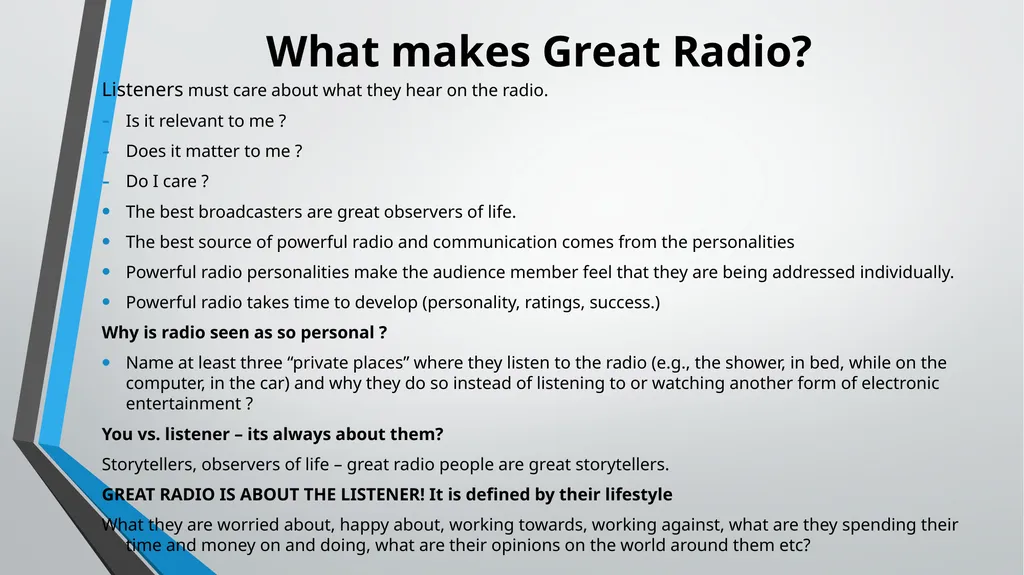
What makes Great Radio? Listeners must care about what they hear on the radio.
Is it relevant to me ?
Does it matter to me ?
Do I care ?
The best broadcasters are great observers of life.
The best source of powerful radio and communication comes from the personalities
Powerful radio personalities make the audience member feel that they are being addressed individually.
Powerful radio takes time to develop (personality, ratings, success.)
Why is radio seen as so personal ?
Name at least three “private places” where they listen to the radio (e.g., the shower, in bed, while on the computer, in the car) and why they do so instead of listening to or watching another form of electronic entertainment ?
You vs. listener – its always about them?
Storytellers, observers of life – great radio people are great storytellers.
GREAT RADIO IS ABOUT THE LISTENER! It is defined by their lifestyle
What they are worried about, happy about, working towards, working against, what are they spending their time and money on and doing, what are their opinions on the world around them etc?<br>
Is it relevant to me ?
Does it matter to me ?
Do I care ?
The best broadcasters are great observers of life.
The best source of powerful radio and communication comes from the personalities
Powerful radio personalities make the audience member feel that they are being addressed individually.
Powerful radio takes time to develop (personality, ratings, success.)
Why is radio seen as so personal ?
Name at least three “private places” where they listen to the radio (e.g., the shower, in bed, while on the computer, in the car) and why they do so instead of listening to or watching another form of electronic entertainment ?
You vs. listener – its always about them?
Storytellers, observers of life – great radio people are great storytellers.
GREAT RADIO IS ABOUT THE LISTENER! It is defined by their lifestyle
What they are worried about, happy about, working towards, working against, what are they spending their time and money on and doing, what are their opinions on the world around them etc?<br>
13
THE C.A.S MODEL
BY CHRIS JORDAN CONSISTENCY
Where does being consistent fit into this discussion?
In radio broadcasting you can and should only be a cleanly orchestrated version of who you are in any other real aspect of your life.
Radio is a real-time medium – its success lies in a broadcaster’s ability to relate to his/her audience from the get-go.
Your presentation style must be both real and consistent from the beginning.
It is guaranteed that if you begin broadcasting as someone you are not, it will catch up with you.
Inconsistent presenter personalities hit the ceiling of their broadcasting careers very quickly, and if they fall from grace earlier, their thin listener base is a clear indicator of why this happens.
Consistency does not only apply to your personality and presenting style, but across the format:
• The music format has to be consistent.
• Station imaging across promotions and stings (musical cues) have to be consistent.
• Even the sound and feel of inserts, interviews and pre-produced edits should be consistent.
Consistency is one of the fundamental broadcasting philosophies that will ensure a strong on-air end product.<br>
Where does being consistent fit into this discussion?
In radio broadcasting you can and should only be a cleanly orchestrated version of who you are in any other real aspect of your life.
Radio is a real-time medium – its success lies in a broadcaster’s ability to relate to his/her audience from the get-go.
Your presentation style must be both real and consistent from the beginning.
It is guaranteed that if you begin broadcasting as someone you are not, it will catch up with you.
Inconsistent presenter personalities hit the ceiling of their broadcasting careers very quickly, and if they fall from grace earlier, their thin listener base is a clear indicator of why this happens.
Consistency does not only apply to your personality and presenting style, but across the format:
• The music format has to be consistent.
• Station imaging across promotions and stings (musical cues) have to be consistent.
• Even the sound and feel of inserts, interviews and pre-produced edits should be consistent.
Consistency is one of the fundamental broadcasting philosophies that will ensure a strong on-air end product.<br>
14
THE C.A.S MODEL
BY CHRIS JORDAN Authenticity
Making believable radio is making good radio. Being an authentic presenter executing an authentic product on air is mandatory in any broadcaster’s rulebook.
An article I read once referred to this as the opposite of ‘me-too-ism’ (all things to nobody or nothing to everybody).
It is important to note that all three fundamentals of the CAS model go hand-in-hand. Being a consistently authentic presenter is the way to find your feet in the radio industry.
We must be introduced to the concept of ‘staying alive’ and more so, staying afloat amongst your peers. As a professional broadcaster only you and your authentic personality, presentation style and creative approach to radio can ensure longevity in the business.
That meant not becoming a carbon copy of the radio presenters you admire or admired growing up, but rather honing your craft around the ‘x-factor’ you already possess when getting behind a microphone, with a passion for what you are doing.
The best radio advertisements flow from an authentic connection to the uniqueness, passion and identity of a product or service. Authenticity is influential, believable and enhances credibility.<br>
Making believable radio is making good radio. Being an authentic presenter executing an authentic product on air is mandatory in any broadcaster’s rulebook.
An article I read once referred to this as the opposite of ‘me-too-ism’ (all things to nobody or nothing to everybody).
It is important to note that all three fundamentals of the CAS model go hand-in-hand. Being a consistently authentic presenter is the way to find your feet in the radio industry.
We must be introduced to the concept of ‘staying alive’ and more so, staying afloat amongst your peers. As a professional broadcaster only you and your authentic personality, presentation style and creative approach to radio can ensure longevity in the business.
That meant not becoming a carbon copy of the radio presenters you admire or admired growing up, but rather honing your craft around the ‘x-factor’ you already possess when getting behind a microphone, with a passion for what you are doing.
The best radio advertisements flow from an authentic connection to the uniqueness, passion and identity of a product or service. Authenticity is influential, believable and enhances credibility.<br>
15
THE C.A.S MODEL
BY CHRIS JORDAN Simplicity
Ever heard the phrase ‘Keep It Simple Stupid’ (KISS)? As harsh as the statement comes across, applying this fundamental to your broadcasting style will essentially safeguard you, for the most part, against making a mess of things – and ultimately confusing your listener.
This applies to producing an advertisement, writing copy, planning and executing a link, conducting an interview or even sequencing a music sweep (the pre-recorded samples used between songs to identify or promote the radio station). Keeping it simple is keeping it good.
As opposed to television where you can sit and watch something for hours on end because your sensory organs are constantly being stimulated by moving pictures, radio does not enjoy such comforts.
Links, edits and interviews are kept short and to the point so as not to lose both passive and active audiences in the midst of a show.
Creating ‘theatre of the mind’ does not require a presenter to paint a complex, intricate picture in the hope of painting a great picture. Packing too much into any link overwhelms the listener, triggering the natural cognitive processes that minimise sensory overload.<br>
Ever heard the phrase ‘Keep It Simple Stupid’ (KISS)? As harsh as the statement comes across, applying this fundamental to your broadcasting style will essentially safeguard you, for the most part, against making a mess of things – and ultimately confusing your listener.
This applies to producing an advertisement, writing copy, planning and executing a link, conducting an interview or even sequencing a music sweep (the pre-recorded samples used between songs to identify or promote the radio station). Keeping it simple is keeping it good.
As opposed to television where you can sit and watch something for hours on end because your sensory organs are constantly being stimulated by moving pictures, radio does not enjoy such comforts.
Links, edits and interviews are kept short and to the point so as not to lose both passive and active audiences in the midst of a show.
Creating ‘theatre of the mind’ does not require a presenter to paint a complex, intricate picture in the hope of painting a great picture. Packing too much into any link overwhelms the listener, triggering the natural cognitive processes that minimise sensory overload.<br>
16
The Seven Deadly Sins of Radio (a methodology by Chris Jordan) Wrath
I like to describe the first cardinal sin as one that most amateur jocks tend to fall into early on in their careers. I often ask young broadcasters ‘Why do you want to get into radio?’ And their answer mostly culminates in ‘Because I want to be famous’, ‘Because I want to influence thousands and thousands of people with my voice’.
This approach is entirely narcissistic and selfish. As a broadcaster, you are at the root, a conduit for information and entertainment as the medium would have it. You have an obligation to your community to provide a service. Some broadcasters like to swap the two roles around and often land up thinking it is the community that serves them via their eventual fame and/or fortune. Your anger is not what the show should be about.
Greed
This cardinal sin has to do directly with what you do or do not put on air. I bring you back to the CAS model explained earlier in this chapter where ‘Simplicity’ is key in every avenue of your on-air product. Often a link that is going fantastically with an amazing caller, and taking another caller in the heat of the excitement might yield an anticlimax in the ‘out’ of your link. Being ‘greedy’ in trying to make something work more than it already has – has its price to pay.
Gluttony
Here we refer to the amount of content you are trying to ‘force-feed’ your listener in every link, and so in every show. When planning both of these – culling the fat in your approach is key to a great sounding on-air product. Come to the table in your planning process with a number of good ideas, and work them down to a couple of really great ones.<br>
I like to describe the first cardinal sin as one that most amateur jocks tend to fall into early on in their careers. I often ask young broadcasters ‘Why do you want to get into radio?’ And their answer mostly culminates in ‘Because I want to be famous’, ‘Because I want to influence thousands and thousands of people with my voice’.
This approach is entirely narcissistic and selfish. As a broadcaster, you are at the root, a conduit for information and entertainment as the medium would have it. You have an obligation to your community to provide a service. Some broadcasters like to swap the two roles around and often land up thinking it is the community that serves them via their eventual fame and/or fortune. Your anger is not what the show should be about.
Greed
This cardinal sin has to do directly with what you do or do not put on air. I bring you back to the CAS model explained earlier in this chapter where ‘Simplicity’ is key in every avenue of your on-air product. Often a link that is going fantastically with an amazing caller, and taking another caller in the heat of the excitement might yield an anticlimax in the ‘out’ of your link. Being ‘greedy’ in trying to make something work more than it already has – has its price to pay.
Gluttony
Here we refer to the amount of content you are trying to ‘force-feed’ your listener in every link, and so in every show. When planning both of these – culling the fat in your approach is key to a great sounding on-air product. Come to the table in your planning process with a number of good ideas, and work them down to a couple of really great ones.<br>
17
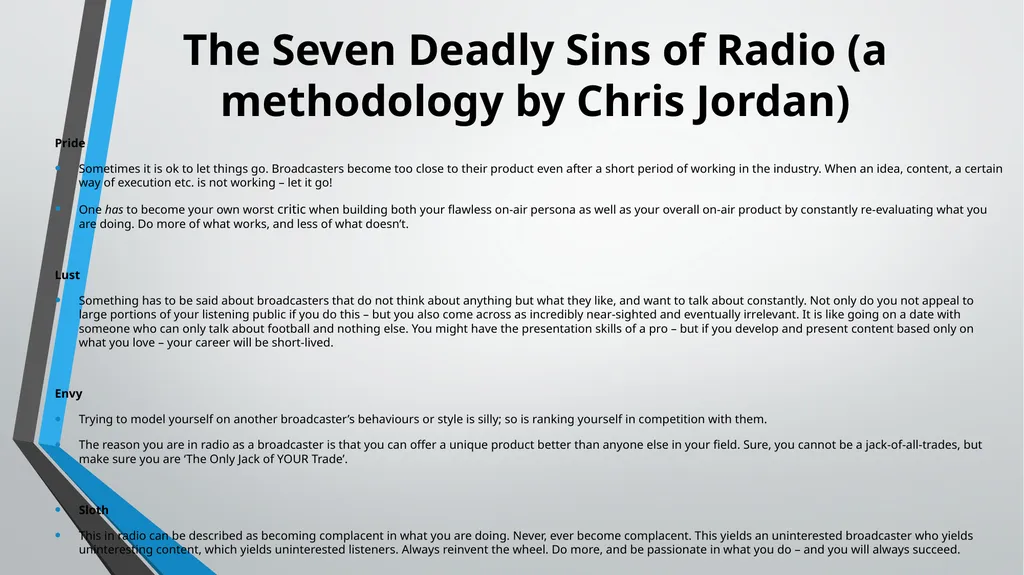
The Seven Deadly Sins of Radio (a methodology by Chris Jordan) Pride
Sometimes it is ok to let things go. Broadcasters become too close to their product even after a short period of working in the industry. When an idea, content, a certain way of execution etc. is not working – let it go!
One has to become your own worst critic when building both your flawless on-air persona as well as your overall on-air product by constantly re-evaluating what you are doing. Do more of what works, and less of what doesn’t.
Lust
Something has to be said about broadcasters that do not think about anything but what they like, and want to talk about constantly. Not only do you not appeal to large portions of your listening public if you do this – but you also come across as incredibly near-sighted and eventually irrelevant. It is like going on a date with someone who can only talk about football and nothing else. You might have the presentation skills of a pro – but if you develop and present content based only on what you love – your career will be short-lived.
Envy
Trying to model yourself on another broadcaster’s behaviours or style is silly; so is ranking yourself in competition with them.
The reason you are in radio as a broadcaster is that you can offer a unique product better than anyone else in your field. Sure, you cannot be a jack-of-all-trades, but make sure you are ‘The Only Jack of YOUR Trade’.
Sloth
This in radio can be described as becoming complacent in what you are doing. Never, ever become complacent. This yields an uninterested broadcaster who yields uninteresting content, which yields uninterested listeners. Always reinvent the wheel. Do more, and be passionate in what you do – and you will always succeed.<br>
Sometimes it is ok to let things go. Broadcasters become too close to their product even after a short period of working in the industry. When an idea, content, a certain way of execution etc. is not working – let it go!
One has to become your own worst critic when building both your flawless on-air persona as well as your overall on-air product by constantly re-evaluating what you are doing. Do more of what works, and less of what doesn’t.
Lust
Something has to be said about broadcasters that do not think about anything but what they like, and want to talk about constantly. Not only do you not appeal to large portions of your listening public if you do this – but you also come across as incredibly near-sighted and eventually irrelevant. It is like going on a date with someone who can only talk about football and nothing else. You might have the presentation skills of a pro – but if you develop and present content based only on what you love – your career will be short-lived.
Envy
Trying to model yourself on another broadcaster’s behaviours or style is silly; so is ranking yourself in competition with them.
The reason you are in radio as a broadcaster is that you can offer a unique product better than anyone else in your field. Sure, you cannot be a jack-of-all-trades, but make sure you are ‘The Only Jack of YOUR Trade’.
Sloth
This in radio can be described as becoming complacent in what you are doing. Never, ever become complacent. This yields an uninterested broadcaster who yields uninteresting content, which yields uninterested listeners. Always reinvent the wheel. Do more, and be passionate in what you do – and you will always succeed.<br>
18
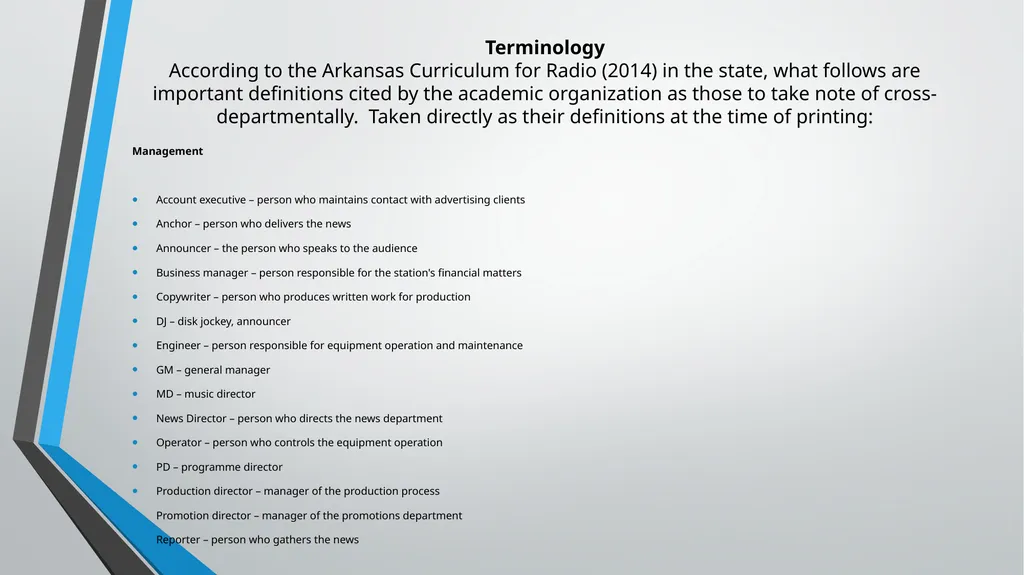
Terminology
According to the Arkansas Curriculum for Radio (2014) in the state, what follows are important definitions cited by the academic organization as those to take note of cross-departmentally. Taken directly as their definitions at the time of printing: Management
Account executive – person who maintains contact with advertising clients
Anchor – person who delivers the news
Announcer – the person who speaks to the audience
Business manager – person responsible for the station's financial matters
Copywriter – person who produces written work for production
DJ – disk jockey, announcer
Engineer – person responsible for equipment operation and maintenance
GM – general manager
MD – music director
News Director – person who directs the news department
Operator – person who controls the equipment operation
PD – programme director
Production director – manager of the production process
Promotion director – manager of the promotions department
Reporter – person who gathers the news<br>
Account executive – person who maintains contact with advertising clients
Anchor – person who delivers the news
Announcer – the person who speaks to the audience
Business manager – person responsible for the station's financial matters
Copywriter – person who produces written work for production
DJ – disk jockey, announcer
Engineer – person responsible for equipment operation and maintenance
GM – general manager
MD – music director
News Director – person who directs the news department
Operator – person who controls the equipment operation
PD – programme director
Production director – manager of the production process
Promotion director – manager of the promotions department
Reporter – person who gathers the news<br>
19
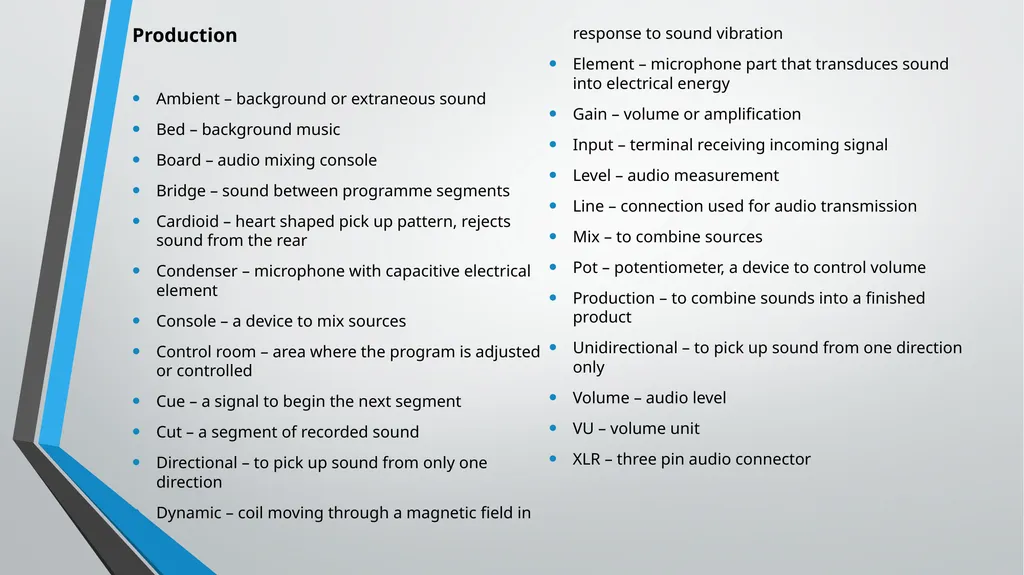
Production
Ambient – background or extraneous sound
Bed – background music
Board – audio mixing console
Bridge – sound between programme segments
Cardioid – heart shaped pick up pattern, rejects sound from the rear
Condenser – microphone with capacitive electrical element
Console – a device to mix sources
Control room – area where the program is adjusted or controlled
Cue – a signal to begin the next segment
Cut – a segment of recorded sound
Directional – to pick up sound from only one direction
Dynamic – coil moving through a magnetic field in response to sound vibration
Element – microphone part that transduces sound into electrical energy
Gain – volume or amplification
Input – terminal receiving incoming signal
Level – audio measurement
Line – connection used for audio transmission
Mix – to combine sources
Pot – potentiometer, a device to control volume
Production – to combine sounds into a finished product
Unidirectional – to pick up sound from one direction only
Volume – audio level
VU – volume unit
XLR – three pin audio connector<br>
Ambient – background or extraneous sound
Bed – background music
Board – audio mixing console
Bridge – sound between programme segments
Cardioid – heart shaped pick up pattern, rejects sound from the rear
Condenser – microphone with capacitive electrical element
Console – a device to mix sources
Control room – area where the program is adjusted or controlled
Cue – a signal to begin the next segment
Cut – a segment of recorded sound
Directional – to pick up sound from only one direction
Dynamic – coil moving through a magnetic field in response to sound vibration
Element – microphone part that transduces sound into electrical energy
Gain – volume or amplification
Input – terminal receiving incoming signal
Level – audio measurement
Line – connection used for audio transmission
Mix – to combine sources
Pot – potentiometer, a device to control volume
Production – to combine sounds into a finished product
Unidirectional – to pick up sound from one direction only
Volume – audio level
VU – volume unit
XLR – three pin audio connector<br>
20
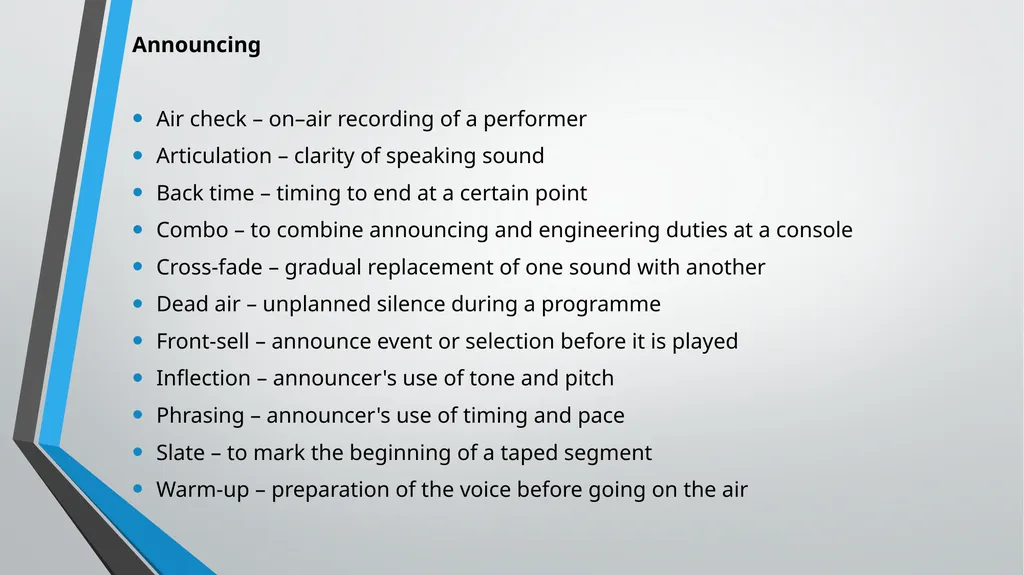
Announcing
Air check – on–air recording of a performer
Articulation – clarity of speaking sound
Back time – timing to end at a certain point
Combo – to combine announcing and engineering duties at a console
Cross-fade – gradual replacement of one sound with another
Dead air – unplanned silence during a programme
Front-sell – announce event or selection before it is played
Inflection – announcer's use of tone and pitch
Phrasing – announcer's use of timing and pace
Slate – to mark the beginning of a taped segment
Warm-up – preparation of the voice before going on the air<br>
Air check – on–air recording of a performer
Articulation – clarity of speaking sound
Back time – timing to end at a certain point
Combo – to combine announcing and engineering duties at a console
Cross-fade – gradual replacement of one sound with another
Dead air – unplanned silence during a programme
Front-sell – announce event or selection before it is played
Inflection – announcer's use of tone and pitch
Phrasing – announcer's use of timing and pace
Slate – to mark the beginning of a taped segment
Warm-up – preparation of the voice before going on the air<br>
21
Workplace skills development
Attitude – over–all outlook and state of mind
Budget – an itemised list of expected income and expense for a given time
Cover letter – a personalised page that serves as an introduction to a resume, application or proposal
Evaluation – an examination or judgment of an employee's work efficiency
Interpersonal skills – a person's ability to operate within business organisations through social communications and interactions
Interview – to effectively present oneself and convey employment qualifications
Job duties – a detailed description of responsibilities for a specific position of employment
Portfolio – a document containing assessments, work samples, education, skills, goals, and plans used for education or job application
Resume – a formal document that sums up a person's professional and educational experience
Teamwork – to work with others, share ideas, and to help each other
Timeline – a schedule of short and long term goals
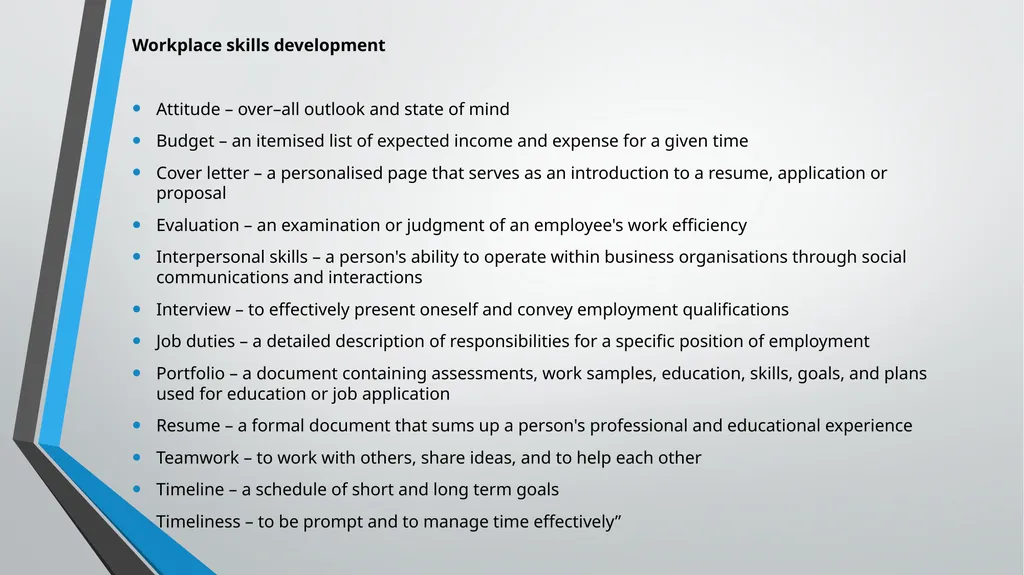
Timeliness – to be prompt and to manage time effectively”<br>
Attitude – over–all outlook and state of mind
Budget – an itemised list of expected income and expense for a given time
Cover letter – a personalised page that serves as an introduction to a resume, application or proposal
Evaluation – an examination or judgment of an employee's work efficiency
Interpersonal skills – a person's ability to operate within business organisations through social communications and interactions
Interview – to effectively present oneself and convey employment qualifications
Job duties – a detailed description of responsibilities for a specific position of employment
Portfolio – a document containing assessments, work samples, education, skills, goals, and plans used for education or job application
Resume – a formal document that sums up a person's professional and educational experience
Teamwork – to work with others, share ideas, and to help each other
Timeline – a schedule of short and long term goals
Timeliness – to be prompt and to manage time effectively”<br>