
Building Assessment Literacy with Teachers and
LO
Published · 21 slides · 0 views

1 / 1



Description
Building Assessment Literacy with Teachers and Students: New Challenges? Marie Brennan Victoria University, Melbourne ACER EPCC Conference, Sydney May 2015 Tanberg, from Hyde Brennan 1979: Good Work, Keep it up: Real Evaluation. Studies
Related Topics
Share
Embed code
Download this presentation From Below
"Building Assessment Literacy with Teachers and" is the property of its rightful owner. Permission is granted to download and print the materials on this website for personal, non-commercial use only, and to display it on your personal computer provided you do not modify the materials and that you retain all copyright notices contained in the materials. By downloading content from our website, you accept the terms of this agreement.
Presentation Transcript
01
Building Assessment Literacy with Teachers and Students:
New Challenges? Marie Brennan
Victoria University, Melbourne
ACER EPCC Conference, Sydney May 2015<br>
Victoria University, Melbourne
ACER EPCC Conference, Sydney May 2015<br>
02
Tanberg, from Hyde & Brennan 1979: Good Work, Keep it up: Real Evaluation. Studies in Society 2 July.<br>
03
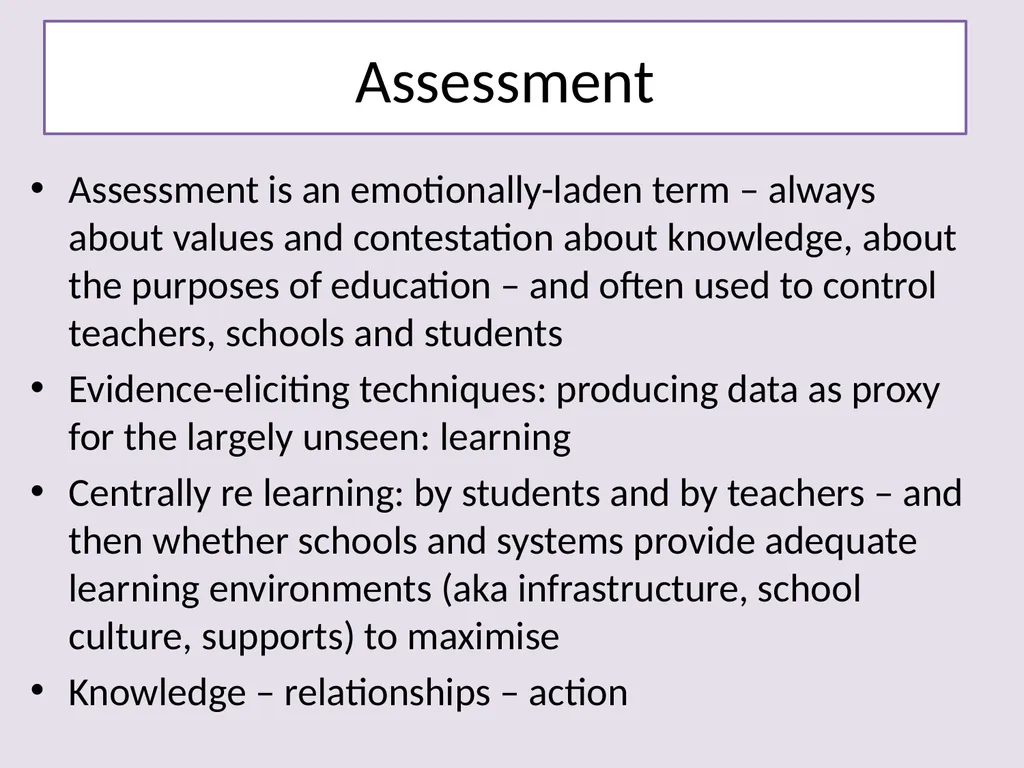
Assessment Assessment is an emotionally-laden term – always about values and contestation about knowledge, about the purposes of education – and often used to control teachers, schools and students
Evidence-eliciting techniques: producing data as proxy for the largely unseen: learning
Centrally re learning: by students and by teachers – and then whether schools and systems provide adequate learning environments (aka infrastructure, school culture, supports) to maximise
Knowledge – relationships – action<br>
Evidence-eliciting techniques: producing data as proxy for the largely unseen: learning
Centrally re learning: by students and by teachers – and then whether schools and systems provide adequate learning environments (aka infrastructure, school culture, supports) to maximise
Knowledge – relationships – action<br>
04
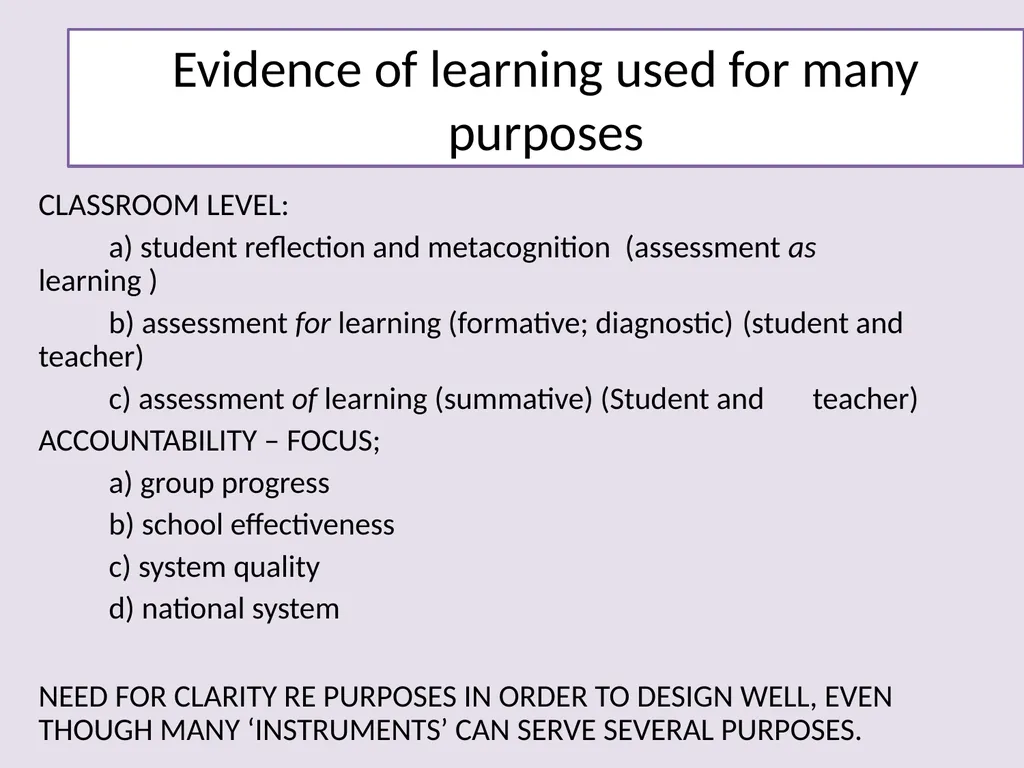
Evidence of learning used for many purposes CLASSROOM LEVEL:
a) student reflection and metacognition (assessment as learning )
b) assessment for learning (formative; diagnostic) (student and teacher)
c) assessment of learning (summative) (Student and teacher)
ACCOUNTABILITY – FOCUS;
a) group progress
b) school effectiveness
c) system quality
d) national system
NEED FOR CLARITY RE PURPOSES IN ORDER TO DESIGN WELL, EVEN THOUGH MANY ‘INSTRUMENTS’ CAN SERVE SEVERAL PURPOSES.<br>
a) student reflection and metacognition (assessment as learning )
b) assessment for learning (formative; diagnostic) (student and teacher)
c) assessment of learning (summative) (Student and teacher)
ACCOUNTABILITY – FOCUS;
a) group progress
b) school effectiveness
c) system quality
d) national system
NEED FOR CLARITY RE PURPOSES IN ORDER TO DESIGN WELL, EVEN THOUGH MANY ‘INSTRUMENTS’ CAN SERVE SEVERAL PURPOSES.<br>
05
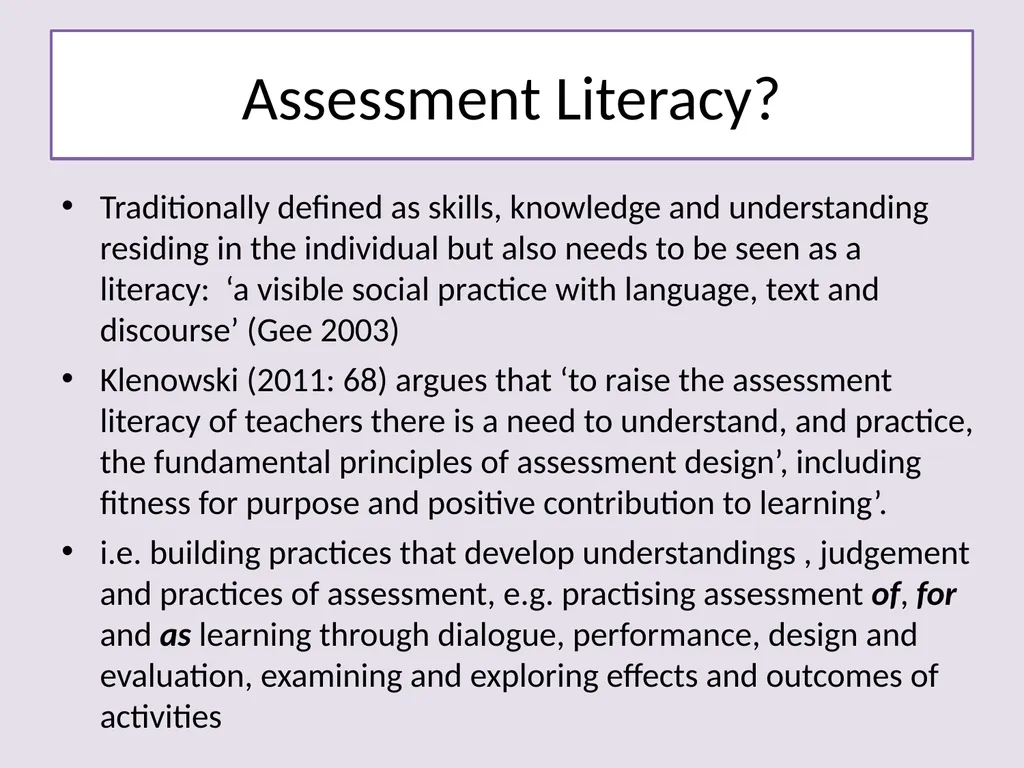
Assessment Literacy? Traditionally defined as skills, knowledge and understanding residing in the individual but also needs to be seen as a literacy: ‘a visible social practice with language, text and discourse’ (Gee 2003)
Klenowski (2011: 68) argues that ‘to raise the assessment literacy of teachers there is a need to understand, and practice, the fundamental principles of assessment design’, including fitness for purpose and positive contribution to learning’.
i.e. building practices that develop understandings , judgement and practices of assessment, e.g. practising assessment of, for and as learning through dialogue, performance, design and evaluation, examining and exploring effects and outcomes of activities<br>
Klenowski (2011: 68) argues that ‘to raise the assessment literacy of teachers there is a need to understand, and practice, the fundamental principles of assessment design’, including fitness for purpose and positive contribution to learning’.
i.e. building practices that develop understandings , judgement and practices of assessment, e.g. practising assessment of, for and as learning through dialogue, performance, design and evaluation, examining and exploring effects and outcomes of activities<br>
06
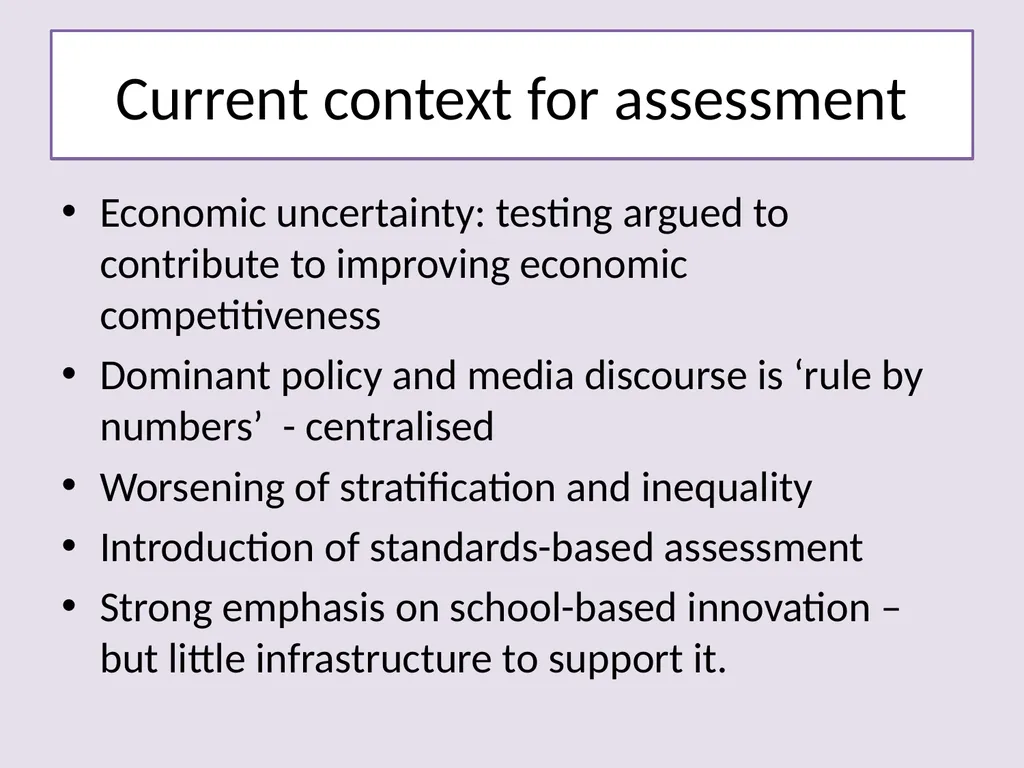
Current context for assessment Economic uncertainty: testing argued to contribute to improving economic competitiveness
Dominant policy and media discourse is ‘rule by numbers’ - centralised
Worsening of stratification and inequality
Introduction of standards-based assessment
Strong emphasis on school-based innovation – but little infrastructure to support it.<br>
Dominant policy and media discourse is ‘rule by numbers’ - centralised
Worsening of stratification and inequality
Introduction of standards-based assessment
Strong emphasis on school-based innovation – but little infrastructure to support it.<br>
07
Imbalances of assessment purposes? Teachers learning to ‘read’ data, including large-scale statistical data: necessary but insufficient
Immersion in this measurement approach can skew time, valued criteria, narrow the repertoire of assessment practices in classrooms, and change school culture
Over-reliance on summative impedes attention to meeting student learning needs (Stiggins 2002)
Issue: how to balance diversity of needed range of assessment purposes and practices?<br>
Immersion in this measurement approach can skew time, valued criteria, narrow the repertoire of assessment practices in classrooms, and change school culture
Over-reliance on summative impedes attention to meeting student learning needs (Stiggins 2002)
Issue: how to balance diversity of needed range of assessment purposes and practices?<br>
08
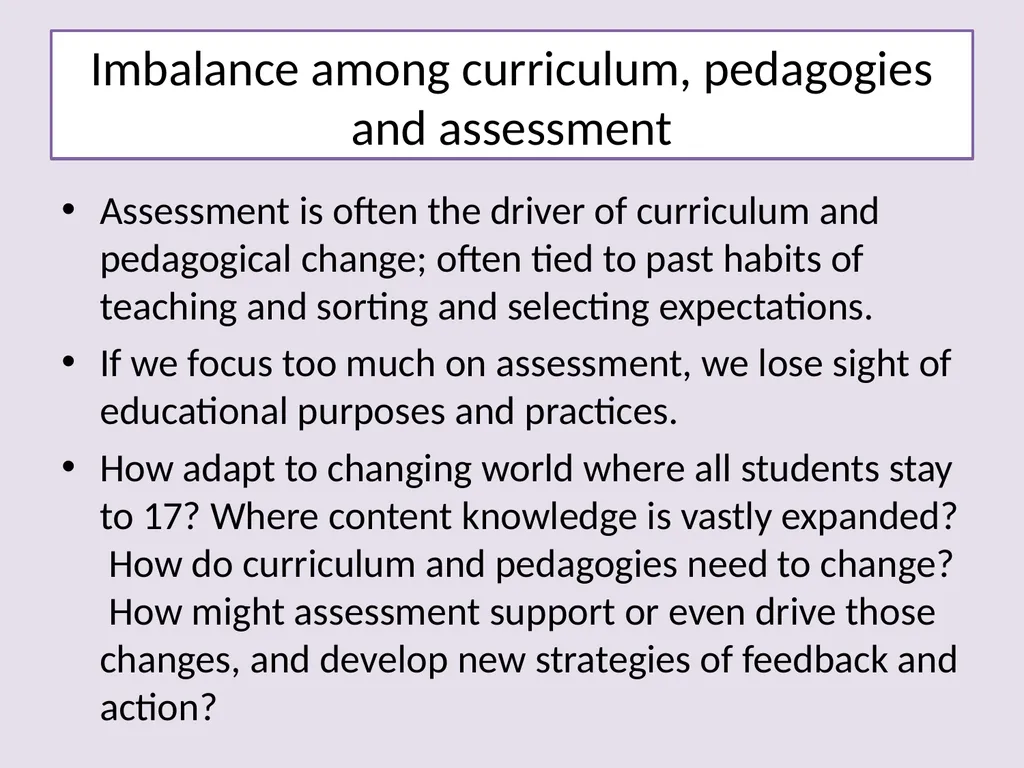
Imbalance among curriculum, pedagogies and assessment Assessment is often the driver of curriculum and pedagogical change; often tied to past habits of teaching and sorting and selecting expectations.
If we focus too much on assessment, we lose sight of educational purposes and practices.
How adapt to changing world where all students stay to 17? Where content knowledge is vastly expanded? How do curriculum and pedagogies need to change? How might assessment support or even drive those changes, and develop new strategies of feedback and action?<br>
If we focus too much on assessment, we lose sight of educational purposes and practices.
How adapt to changing world where all students stay to 17? Where content knowledge is vastly expanded? How do curriculum and pedagogies need to change? How might assessment support or even drive those changes, and develop new strategies of feedback and action?<br>
09
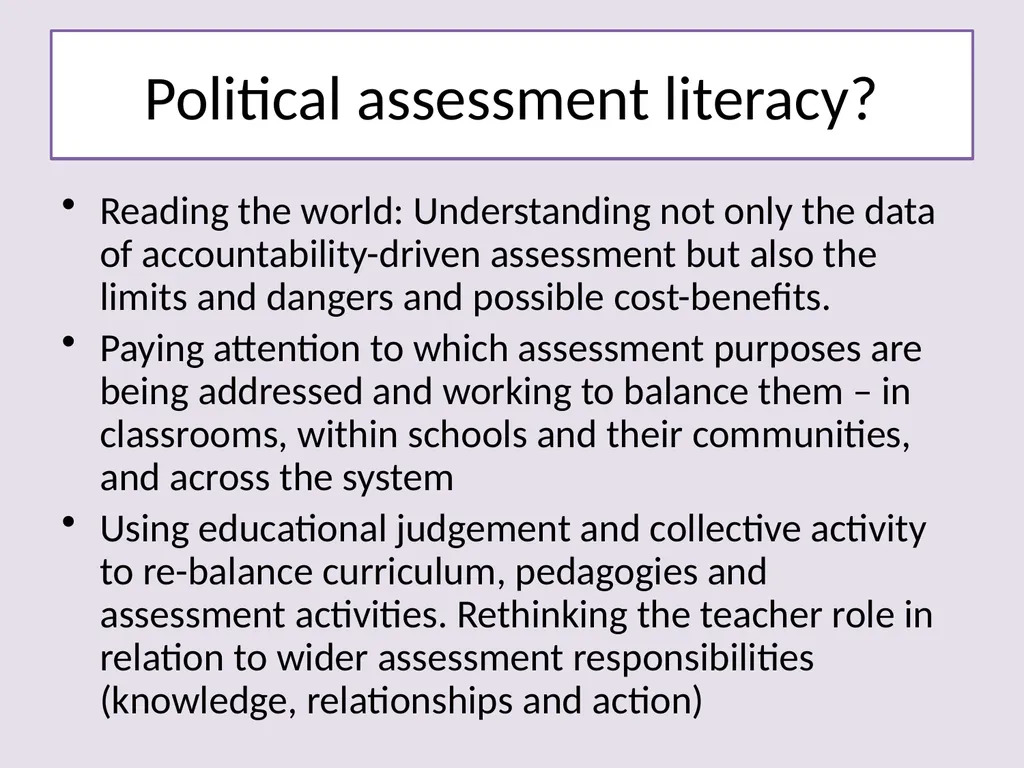
Political assessment literacy? Reading the world: Understanding not only the data of accountability-driven assessment but also the limits and dangers and possible cost-benefits.
Paying attention to which assessment purposes are being addressed and working to balance them – in classrooms, within schools and their communities, and across the system
Using educational judgement and collective activity to re-balance curriculum, pedagogies and assessment activities. Rethinking the teacher role in relation to wider assessment responsibilities (knowledge, relationships and action)<br>
Paying attention to which assessment purposes are being addressed and working to balance them – in classrooms, within schools and their communities, and across the system
Using educational judgement and collective activity to re-balance curriculum, pedagogies and assessment activities. Rethinking the teacher role in relation to wider assessment responsibilities (knowledge, relationships and action)<br>
10
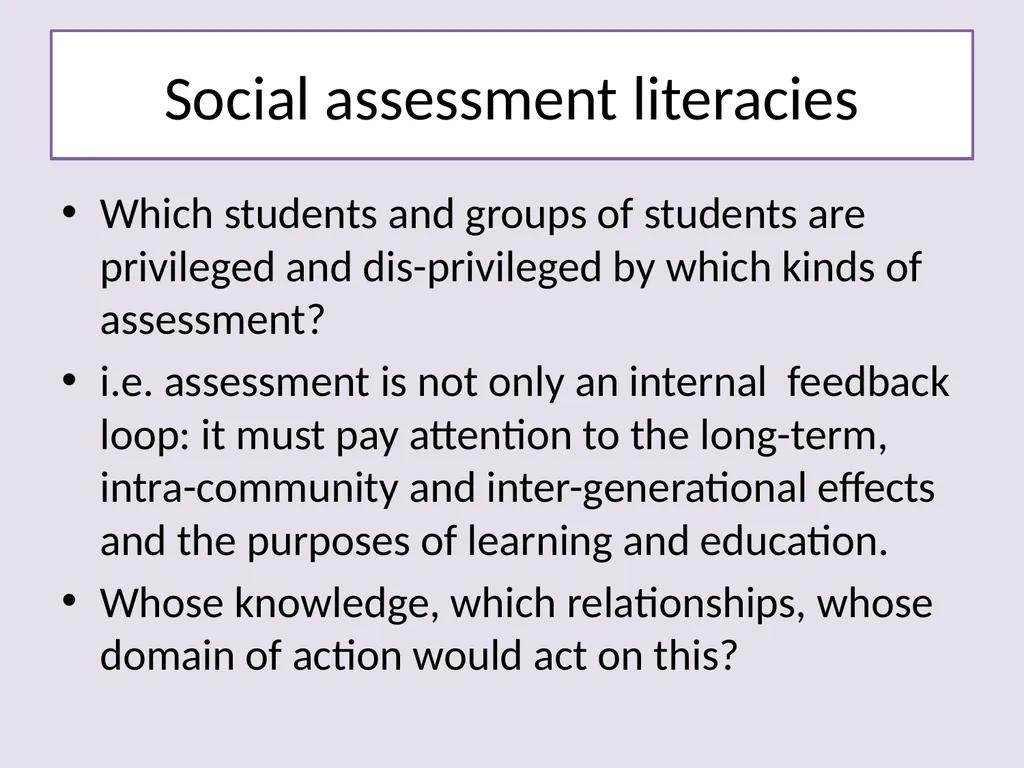
Social assessment literacies Which students and groups of students are privileged and dis-privileged by which kinds of assessment?
i.e. assessment is not only an internal feedback loop: it must pay attention to the long-term, intra-community and inter-generational effects and the purposes of learning and education.
Whose knowledge, which relationships, whose domain of action would act on this?<br>
i.e. assessment is not only an internal feedback loop: it must pay attention to the long-term, intra-community and inter-generational effects and the purposes of learning and education.
Whose knowledge, which relationships, whose domain of action would act on this?<br>
11
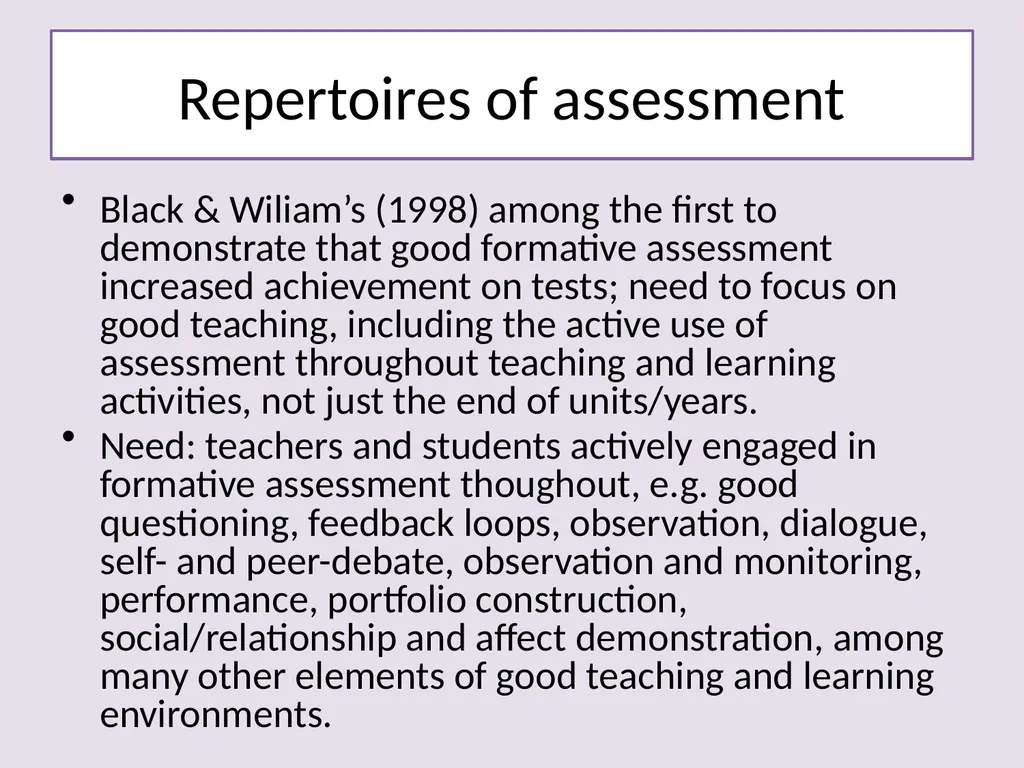
Repertoires of assessment Black & Wiliam’s (1998) among the first to demonstrate that good formative assessment increased achievement on tests; need to focus on good teaching, including the active use of assessment throughout teaching and learning activities, not just the end of units/years.
Need: teachers and students actively engaged in formative assessment thoughout, e.g. good questioning, feedback loops, observation, dialogue, self- and peer-debate, observation and monitoring, performance, portfolio construction, social/relationship and affect demonstration, among many other elements of good teaching and learning environments.<br>
Need: teachers and students actively engaged in formative assessment thoughout, e.g. good questioning, feedback loops, observation, dialogue, self- and peer-debate, observation and monitoring, performance, portfolio construction, social/relationship and affect demonstration, among many other elements of good teaching and learning environments.<br>
12
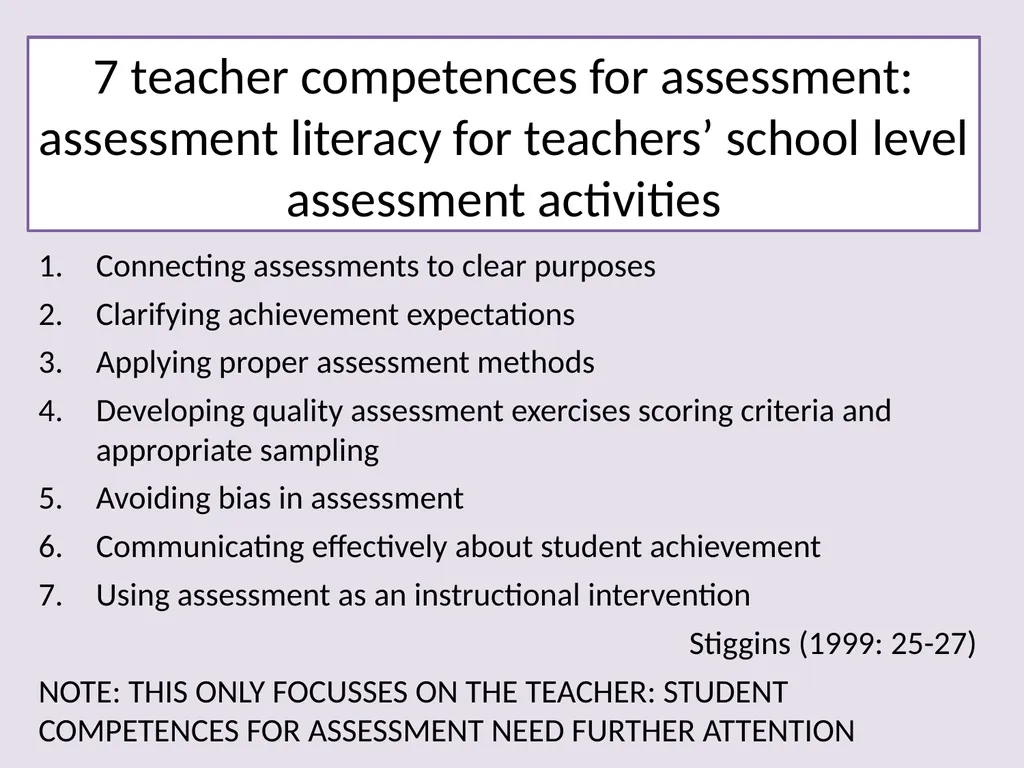
7 teacher competences for assessment: assessment literacy for teachers’ school level assessment activities Connecting assessments to clear purposes
Clarifying achievement expectations
Applying proper assessment methods
Developing quality assessment exercises scoring criteria and appropriate sampling
Avoiding bias in assessment
Communicating effectively about student achievement
Using assessment as an instructional intervention
Stiggins (1999: 25-27)
NOTE: THIS ONLY FOCUSSES ON THE TEACHER: STUDENT COMPETENCES FOR ASSESSMENT NEED FURTHER ATTENTION<br>
Clarifying achievement expectations
Applying proper assessment methods
Developing quality assessment exercises scoring criteria and appropriate sampling
Avoiding bias in assessment
Communicating effectively about student achievement
Using assessment as an instructional intervention
Stiggins (1999: 25-27)
NOTE: THIS ONLY FOCUSSES ON THE TEACHER: STUDENT COMPETENCES FOR ASSESSMENT NEED FURTHER ATTENTION<br>
13
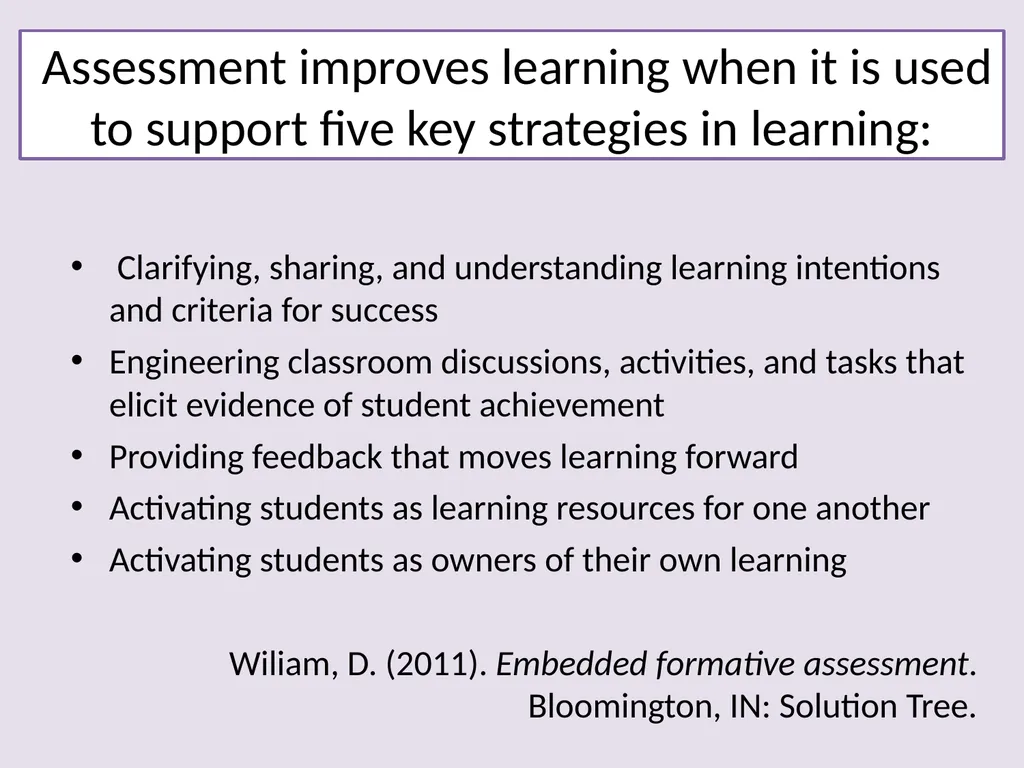
Assessment improves learning when it is used to support five key strategies in learning: Clarifying, sharing, and understanding learning intentions and criteria for success
Engineering classroom discussions, activities, and tasks that elicit evidence of student achievement
Providing feedback that moves learning forward
Activating students as learning resources for one another
Activating students as owners of their own learning
Wiliam, D. (2011). Embedded formative assessment. Bloomington, IN: Solution Tree.<br>
Engineering classroom discussions, activities, and tasks that elicit evidence of student achievement
Providing feedback that moves learning forward
Activating students as learning resources for one another
Activating students as owners of their own learning
Wiliam, D. (2011). Embedded formative assessment. Bloomington, IN: Solution Tree.<br>
14
Huge assessment repertoire already used, invented, extended, underway …. Observation and monitoring, both systematic and informal
Personal communication
Selecting a response e.g. multi-choice,
Constructing a response (short, long, with and without preparation)
Portfolio assessment
Performance assessment<br>
Personal communication
Selecting a response e.g. multi-choice,
Constructing a response (short, long, with and without preparation)
Portfolio assessment
Performance assessment<br>
15
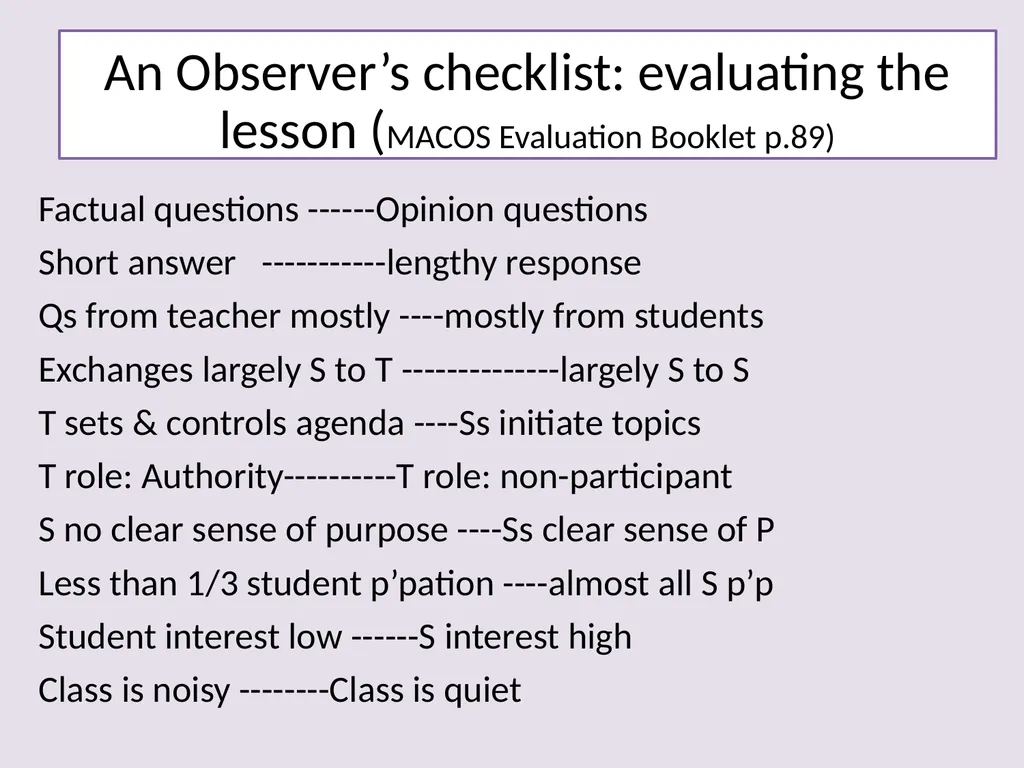
An Observer’s checklist: evaluating the lesson (MACOS Evaluation Booklet p.89) Factual questions ------Opinion questions
Short answer -----------lengthy response
Qs from teacher mostly ----mostly from students
Exchanges largely S to T --------------largely S to S
T sets & controls agenda ----Ss initiate topics
T role: Authority----------T role: non-participant
S no clear sense of purpose ----Ss clear sense of P
Less than 1/3 student p’pation ----almost all S p’p
Student interest low ------S interest high
Class is noisy --------Class is quiet<br>
Short answer -----------lengthy response
Qs from teacher mostly ----mostly from students
Exchanges largely S to T --------------largely S to S
T sets & controls agenda ----Ss initiate topics
T role: Authority----------T role: non-participant
S no clear sense of purpose ----Ss clear sense of P
Less than 1/3 student p’pation ----almost all S p’p
Student interest low ------S interest high
Class is noisy --------Class is quiet<br>
16
Student assessment literacy Under-valued and under-documented yet central – can’t assess properly without student engagement
Self-evaluation, peer-feedback and meta-cognitive analyses of progress build language for analysis, links to other knowledge or transferability to other domains of action, reflexivity and self-monitoring, capacities to work across difference
Importance of dialogue
Assessment by Exhibition, Performance and Student-led conferences are relatively recent developments in need of local analysis and systemic infrastructure eg materials sharing/development<br>
Self-evaluation, peer-feedback and meta-cognitive analyses of progress build language for analysis, links to other knowledge or transferability to other domains of action, reflexivity and self-monitoring, capacities to work across difference
Importance of dialogue
Assessment by Exhibition, Performance and Student-led conferences are relatively recent developments in need of local analysis and systemic infrastructure eg materials sharing/development<br>
17
Supporting Student Assessment literacy In classroom: opportunities for building language through dialogue, performance and reflection
In school policy
Between home/community and school
Performing learning and widening assessment participation (for, of and as learning and balance among them)
In school governance
In feedback loops to systemic agencies<br>
In school policy
Between home/community and school
Performing learning and widening assessment participation (for, of and as learning and balance among them)
In school governance
In feedback loops to systemic agencies<br>
18
Supporting teacher assessment literacies Structured professional development with other teachers using real-life scenarios makes significant difference: developing shared discourse
Supporting development and embedding of formative assessment processes makes more difference to student learning than end-on or summative assessment (Wiliam 2011) but both are needed: balancing purposes
Moderation processes for development and moderation of student work samples gives opportunities for checking ‘judgement-in-context’ (Cooksey et al. 2007) : extending repertoires and judgement capacities for formative and summative activities<br>
Supporting development and embedding of formative assessment processes makes more difference to student learning than end-on or summative assessment (Wiliam 2011) but both are needed: balancing purposes
Moderation processes for development and moderation of student work samples gives opportunities for checking ‘judgement-in-context’ (Cooksey et al. 2007) : extending repertoires and judgement capacities for formative and summative activities<br>
19
Parallel Assessment curriculum: teachers and students High intellectual quality: critical reading of the world and education system; unpacking purposes and diverse practices of assessment
Supportive learning environments that encourage dialogue, making the tacit explicit in diverse forms, innovation and risk-taking (i.e. learning)
Use diversity as a resource for innovation, collaboration and identity-building<br>
Supportive learning environments that encourage dialogue, making the tacit explicit in diverse forms, innovation and risk-taking (i.e. learning)
Use diversity as a resource for innovation, collaboration and identity-building<br>
20
Supporting students and teachers through infrastructure and public discourse Sample commentaries on both instruments and student work by both teachers and students readily available.
Infrastructure supporting teacher professional learning communities across and within schools (including ICT for rural and remote schools) – for moderation, for development of assessment AS teaching and learning, widening repertoires of formative (including diagnostic) assessment and balancing with summative/external assessment
More flexible external/summative assessments paying attention to diversity of background, curriculum purposes and relevance of diverse purposes of assessment
Ongoing debates about relationships among curriculum, pedagogies and assessment, including re-entry/re-teaching, addressing the persistent gaps in learning that are evident from year 3 on, to build intrinsic learning investment by all.<br>
Infrastructure supporting teacher professional learning communities across and within schools (including ICT for rural and remote schools) – for moderation, for development of assessment AS teaching and learning, widening repertoires of formative (including diagnostic) assessment and balancing with summative/external assessment
More flexible external/summative assessments paying attention to diversity of background, curriculum purposes and relevance of diverse purposes of assessment
Ongoing debates about relationships among curriculum, pedagogies and assessment, including re-entry/re-teaching, addressing the persistent gaps in learning that are evident from year 3 on, to build intrinsic learning investment by all.<br>
21
References Connelly, S., Klenowski, V. & Wyatt-Smith, C. (2012) Moderation and consistency of teacher judgement: teachers’ views. British Educational Research Journal 38(4) 593-614. Cooksey, R., Freebody, P. & Wyatt-Smith, C. (2007) Assessment as Judgement-in-context: Analysing how teachers evaluate student writing. Educationa research and Evaluation 13 (5), 401-434.
Klenowski, V. (2011) Assessment reformand educational change in Australia. In R.Berry nad B. Adamson (Eds) Assessment Reform in Education. Education ni the Asia-Pacific Region: Issues, Concerns and Prospects 14. :63-74.
Klenowski, V. & Adie, L. (2009) Moderation as judgement practice: Reconciling system level accountability and local level practice. Curriculum Perspectives 29(1): 10-28.
Popham, J.
Stiggins, R. (2002) Assessment crisis: The absence of assessment for learning. Phi Delata Kappan 83(10) 758-65.
Wiliam, D. (2011). Embedded formative assessment. Bloomington, IN: Solution Tree.
Wiliam, D. (2011). What is assessment for learning? Studies in Educational Evaluation, 37(1), 2-14.<br>
Klenowski, V. (2011) Assessment reformand educational change in Australia. In R.Berry nad B. Adamson (Eds) Assessment Reform in Education. Education ni the Asia-Pacific Region: Issues, Concerns and Prospects 14. :63-74.
Klenowski, V. & Adie, L. (2009) Moderation as judgement practice: Reconciling system level accountability and local level practice. Curriculum Perspectives 29(1): 10-28.
Popham, J.
Stiggins, R. (2002) Assessment crisis: The absence of assessment for learning. Phi Delata Kappan 83(10) 758-65.
Wiliam, D. (2011). Embedded formative assessment. Bloomington, IN: Solution Tree.
Wiliam, D. (2011). What is assessment for learning? Studies in Educational Evaluation, 37(1), 2-14.<br>