
Building climate-resilient schools in Mozambique 2
PM
Published · 23 slides · 0 views

1 / 1
Description
Building climate-resilient schools in Mozambique 2 How to use this resource Rights Around the World is a regular resource series from UNICEF UKs Rights Respecting Schools Award that pairs global citizenship with learning about rights and
Related Topics
Share
Embed code
Download this presentation From Below
"Building climate-resilient schools in Mozambique 2" is the property of its rightful owner. Permission is granted to download and print the materials on this website for personal, non-commercial use only, and to display it on your personal computer provided you do not modify the materials and that you retain all copyright notices contained in the materials. By downloading content from our website, you accept the terms of this agreement.
Presentation Transcript
01
Building climate-resilient schools in Mozambique<br>
02
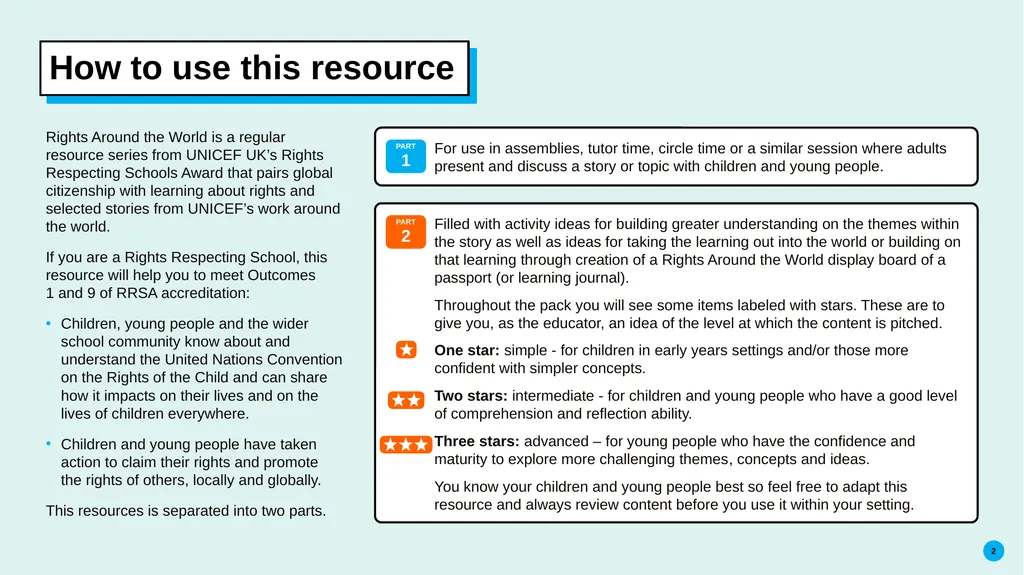
2 How to use this resource Rights Around the World is a regular resource series from UNICEF UK’s Rights Respecting Schools Award that pairs global citizenship with learning about rights and selected stories from UNICEF’s work around the world.
If you are a Rights Respecting School, this resource will help you to meet Outcomes 1 and 9 of RRSA accreditation:
Children, young people and the wider school community know about and understand the United Nations Convention on the Rights of the Child and can share how it impacts on their lives and on the lives of children everywhere.
Children and young people have taken action to claim their rights and promote the rights of others, locally and globally.
This resources is separated into two parts. For use in assemblies, tutor time, circle time or a similar session where adults present and discuss a story or topic with children and young people. Filled with activity ideas for building greater understanding on the themes within the story as well as ideas for taking the learning out into the world or building on that learning through creation of a Rights Around the World display board of a passport (or learning journal).
Throughout the pack you will see some items labeled with stars. These are to give you, as the educator, an idea of the level at which the content is pitched.
One star: simple - for children in early years settings and/or those more confident with simpler concepts.
Two stars: intermediate - for children and young people who have a good level of comprehension and reflection ability.
Three stars: advanced – for young people who have the confidence and maturity to explore more challenging themes, concepts and ideas.
You know your children and young people best so feel free to adapt this resource and always review content before you use it within your setting. PART
2 PART
1<br>
03
For assemblies or group sessions PART
1<br>
1<br>
04
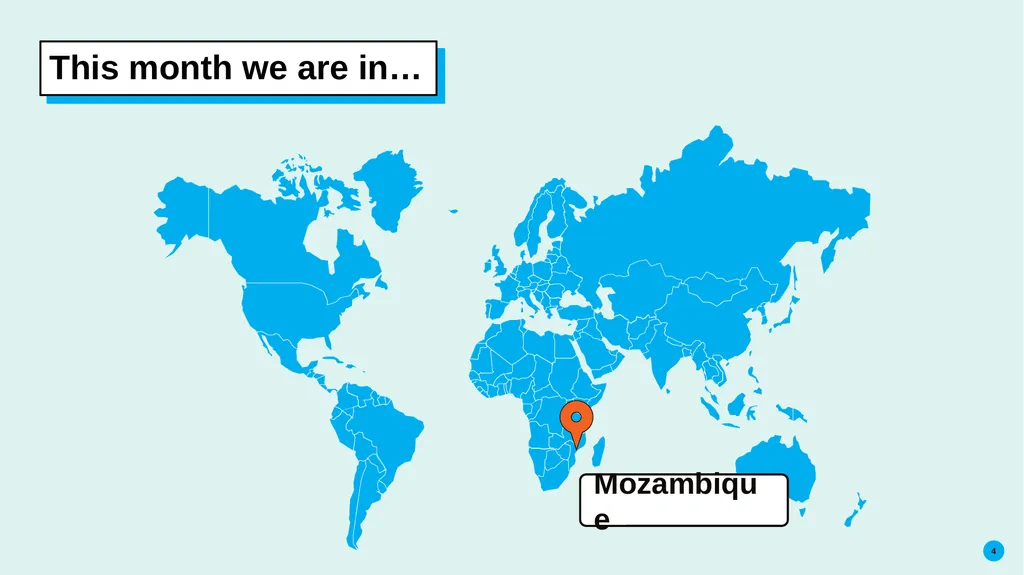
This month we are in… Mozambique 4<br>
05
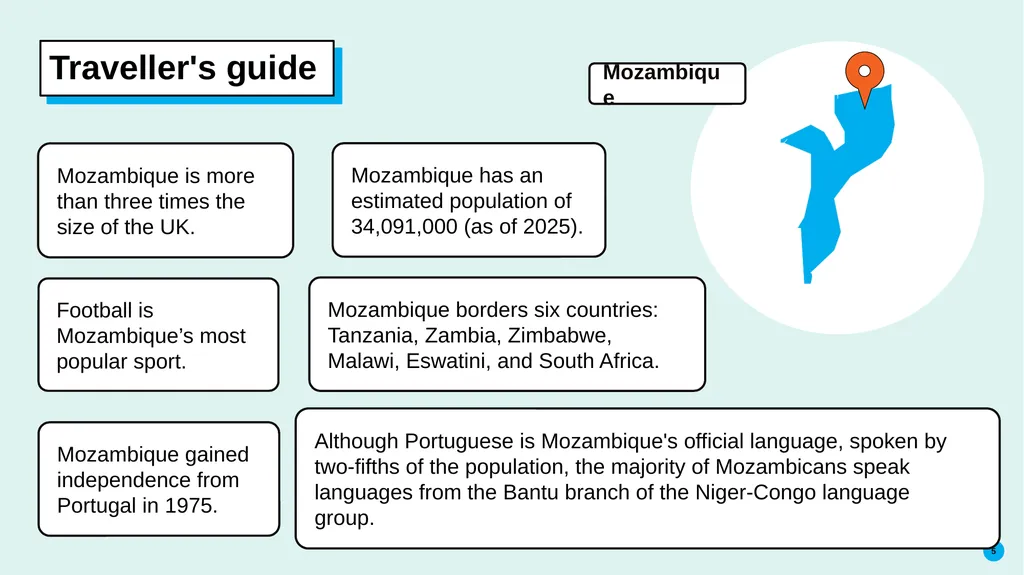
T Mozambique 5 Traveller's guide Mozambique is more than three times the size of the UK. Mozambique has an estimated population of 34,091,000 (as of 2025). Mozambique gained independence from Portugal in 1975. Although Portuguese is Mozambique's official language, spoken by two-fifths of the population, the majority of Mozambicans speak languages from the Bantu branch of the Niger-Congo language group. Football is
Mozambique’s most popular sport. Mozambique borders six countries: Tanzania, Zambia, Zimbabwe, Malawi, Eswatini, and South Africa.<br>
Mozambique’s most popular sport. Mozambique borders six countries: Tanzania, Zambia, Zimbabwe, Malawi, Eswatini, and South Africa.<br>
06
6 Intro to UNICEF in Mozambique UNICEF has worked in Mozambique for over 50 years. UNICEF’s work in Mozambique is guided by the UN Convention on the Rights of the Child, which Mozambique ratified in 1994.
There are 5 priorities for UNICEF’s Country Programme in Mozambique:
Early Childhood Development – supporting the youngest children to access their rights
Adolescent Programming – children aged 10-18 make up 25% of Mozambique’s population and so UNICEF supports their participation in decision-making
Innovation – using digital technology to support education and health
Gender and Disability – promoting gender equality and improving services for children with disabilities
Climate - Children and young people in Mozambique are worried about the impacts of climate change and want to be part of the solution<br>
07
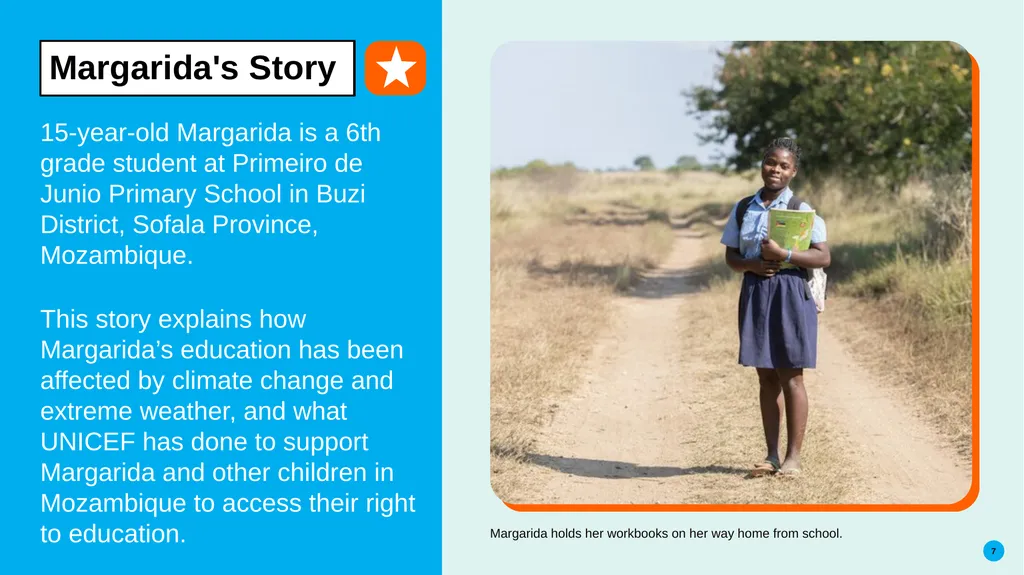
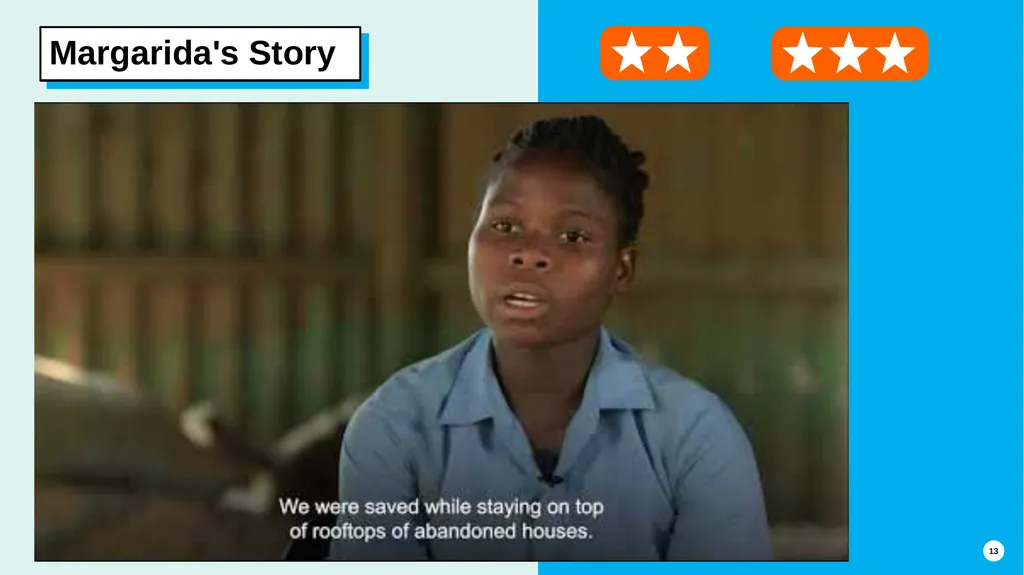
7 Margarida's Story Margarida holds her workbooks on her way home from school. 15-year-old Margarida is a 6th grade student at Primeiro de Junio Primary School in Buzi District, Sofala Province, Mozambique.
This story explains how Margarida’s education has been affected by climate change and extreme weather, and what UNICEF has done to support Margarida and other children in Mozambique to access their right to education.<br>
This story explains how Margarida’s education has been affected by climate change and extreme weather, and what UNICEF has done to support Margarida and other children in Mozambique to access their right to education.<br>
08
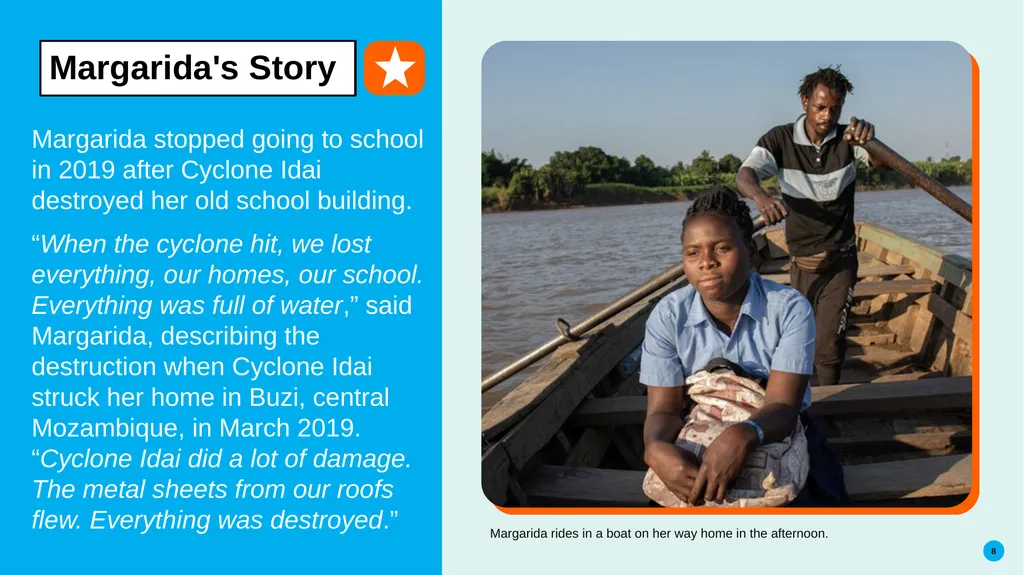
8 Margarida's Story Margarida rides in a boat on her way home in the afternoon. Margarida stopped going to school in 2019 after Cyclone Idai destroyed her old school building.
“When the cyclone hit, we lost everything, our homes, our school. Everything was full of water,” said Margarida, describing the destruction when Cyclone Idai struck her home in Buzi, central Mozambique, in March 2019. “Cyclone Idai did a lot of damage. The metal sheets from our roofs flew. Everything was destroyed.”<br>
“When the cyclone hit, we lost everything, our homes, our school. Everything was full of water,” said Margarida, describing the destruction when Cyclone Idai struck her home in Buzi, central Mozambique, in March 2019. “Cyclone Idai did a lot of damage. The metal sheets from our roofs flew. Everything was destroyed.”<br>
09
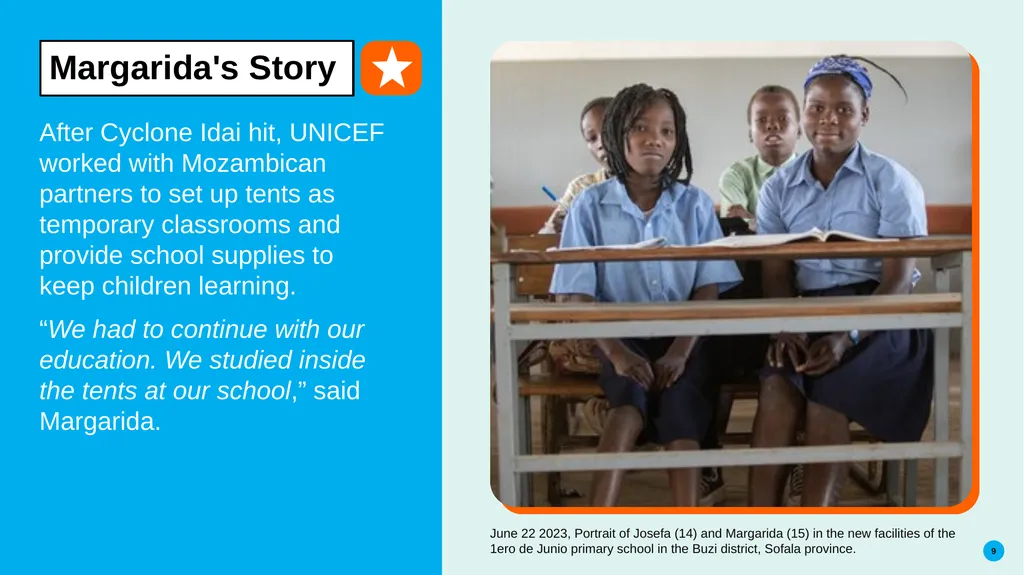
9 Margarida's Story June 22 2023, Portrait of Josefa (14) and Margarida (15) in the new facilities of the 1ero de Junio primary school in the Buzi district, Sofala province. After Cyclone Idai hit, UNICEF worked with Mozambican partners to set up tents as temporary classrooms and provide school supplies to keep children learning.
“We had to continue with our education. We studied inside the tents at our school,” said Margarida.<br>
“We had to continue with our education. We studied inside the tents at our school,” said Margarida.<br>
10
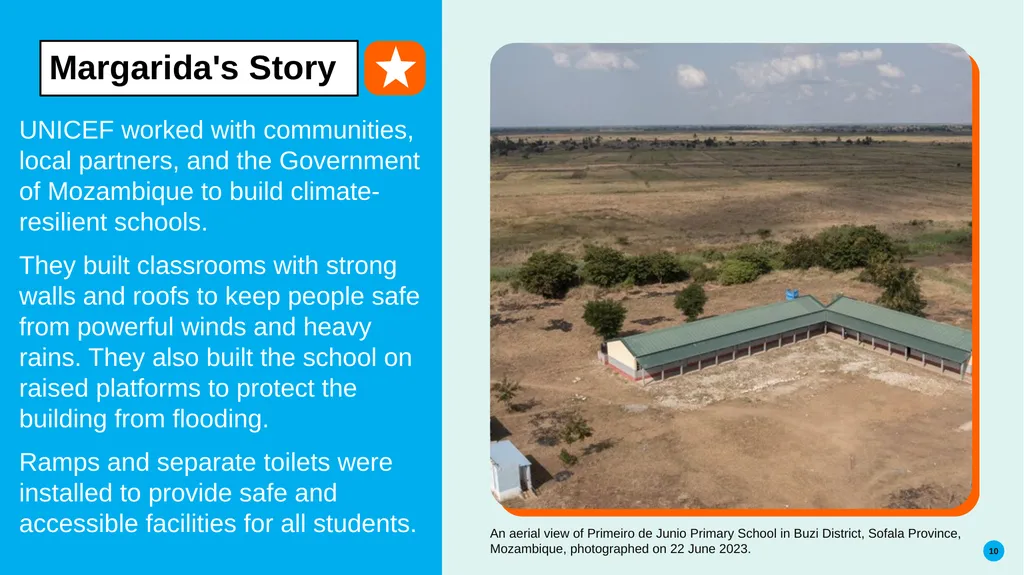
10 Margarida's Story UNICEF worked with communities, local partners, and the Government of Mozambique to build climate-resilient schools.
They built classrooms with strong walls and roofs to keep people safe from powerful winds and heavy rains. They also built the school on raised platforms to protect the building from flooding.
Ramps and separate toilets were installed to provide safe and accessible facilities for all students. An aerial view of Primeiro de Junio Primary School in Buzi District, Sofala Province, Mozambique, photographed on 22 June 2023.<br>
11
11 Margarida's Story In the area where Margarida lives, 87 classrooms in 24 schools now stand strong against cyclones providing safe learning for over 11,000 children.
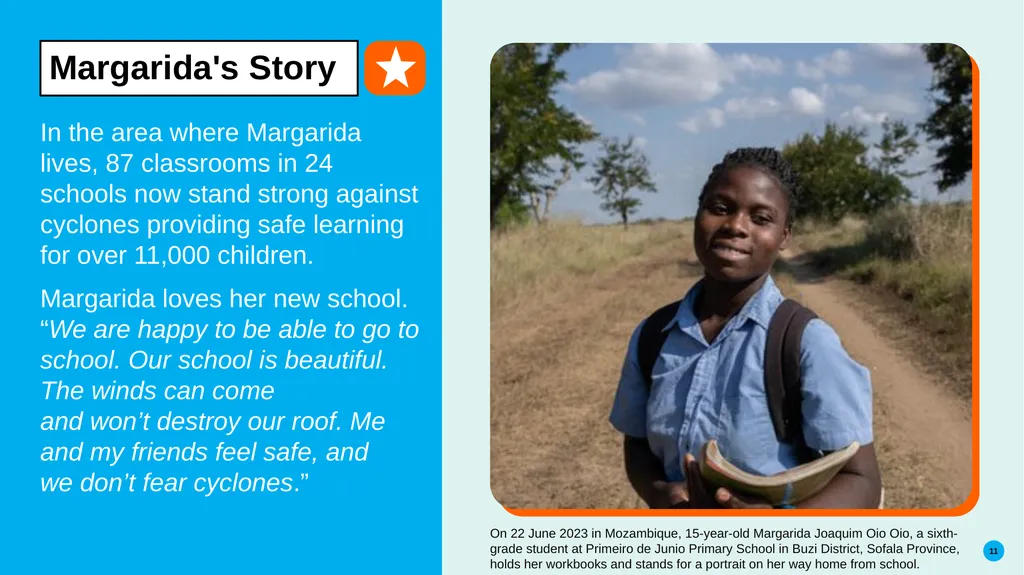
Margarida loves her new school. “We are happy to be able to go to school. Our school is beautiful. The winds can come and won’t destroy our roof. Me and my friends feel safe, and we don’t fear cyclones.” On 22 June 2023 in Mozambique, 15-year-old Margarida Joaquim Oio Oio, a sixth-grade student at Primeiro de Junio Primary School in Buzi District, Sofala Province, holds her workbooks and stands for a portrait on her way home from school.<br>
Margarida loves her new school. “We are happy to be able to go to school. Our school is beautiful. The winds can come and won’t destroy our roof. Me and my friends feel safe, and we don’t fear cyclones.” On 22 June 2023 in Mozambique, 15-year-old Margarida Joaquim Oio Oio, a sixth-grade student at Primeiro de Junio Primary School in Buzi District, Sofala Province, holds her workbooks and stands for a portrait on her way home from school.<br>
12
12 UNICEF’s Climate Resilient Infrastructure Programme Climate change refers to the long-term warming of Earth's climate system, leading to faster-than-usual changes in temperature, rainfall, and wind patterns. Human activities, such as burning fossil fuels and deforestation, are the primary drivers. This phenomenon has contributed to an increase in the frequency and intensity of natural disasters like cyclones. Cyclones are powerful rotating storms with strong winds and heavy rain that develop over warm tropical ocean waters.
Mozambique’s extensive coastline and river basins make the country particularly susceptible to cyclones, and climate change is exacerbating their impact. In 2019, Mozambique experienced two tropical cyclones within six weeks—Idai on March 14 and Kenneth on April 25—highlighting the growing effects of climate change. These storms severely affected the education system, damaging at least 1,260 classrooms and impacting 376,826 students.
In collaboration with local partners, UNICEF has constructed climate-resilient schools designed to endure extreme weather, ensuring safe and continuous education for more than 55,000 children.<br>
13
13 Margarida's Story<br>
14
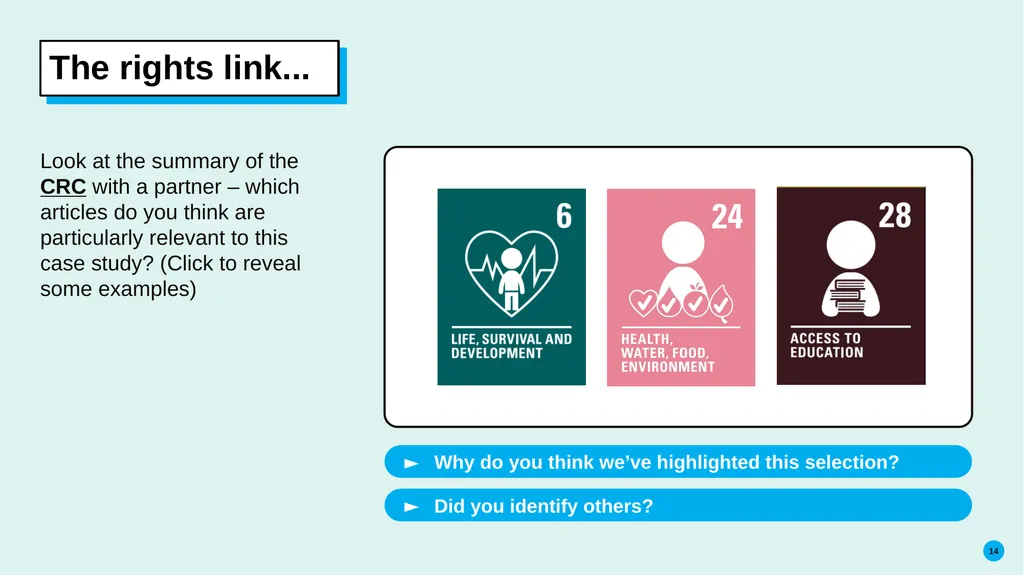
14 The rights link... Look at the summary of the CRC with a partner – which articles do you think are particularly relevant to this case study? (Click to reveal some examples) Did you identify others? Why do you think we’ve highlighted this selection?<br>
15
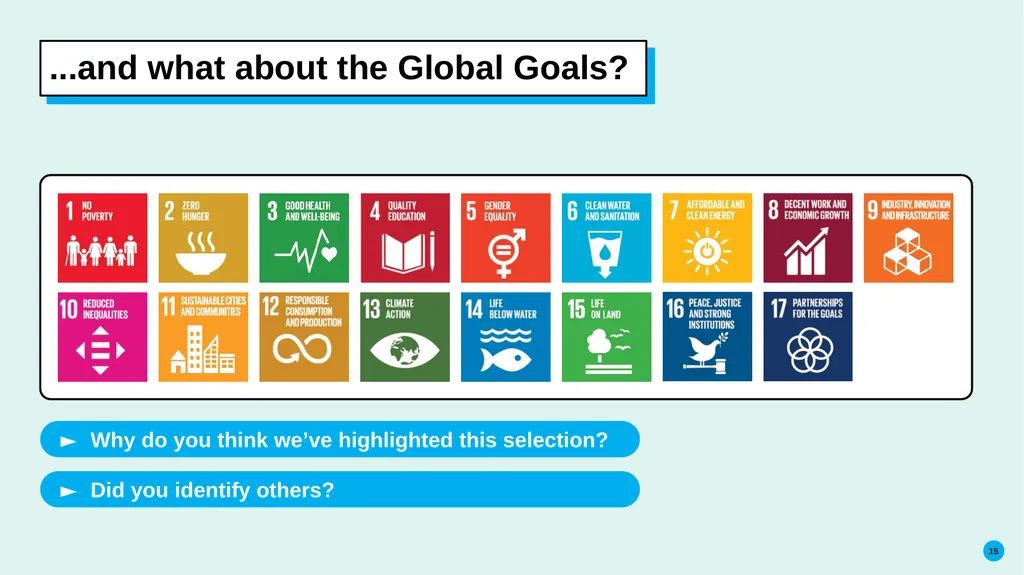
15 ...and what about the Global Goals? Did you identify others? Why do you think we’ve highlighted this selection?<br>
16
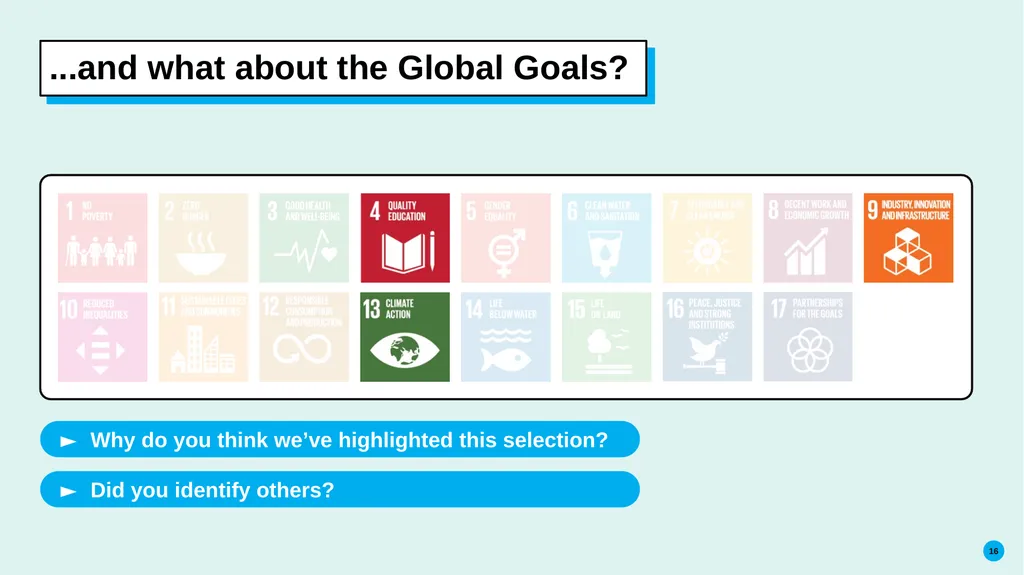
16 ...and what about the Global Goals? Did you identify others? Why do you think we’ve highlighted this selection?<br>
17
Think back to what you have learnt about Margarida’s story, Mozambique and UNICEF’s work to develop climate resilient classrooms.
Is there anything that surprised you or you thought was particularly interesting?
Is there anything you would like to learn more about? Reflection<br>
Is there anything that surprised you or you thought was particularly interesting?
Is there anything you would like to learn more about? Reflection<br>
18
Activities PART
2<br>
2<br>
19
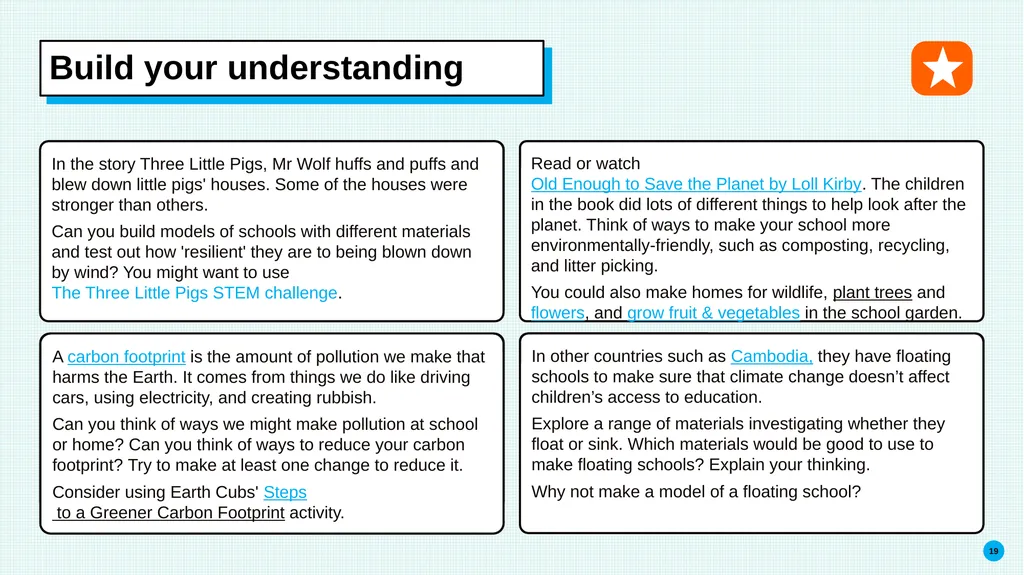
19 Build your understanding In the story Three Little Pigs, Mr Wolf huffs and puffs and blew down little pigs' houses. Some of the houses were stronger than others.
Can you build models of schools with different materials and test out how 'resilient' they are to being blown down by wind? You might want to use The Three Little Pigs STEM challenge. Read or watch Old Enough to Save the Planet by Loll Kirby. The children in the book did lots of different things to help look after the planet. Think of ways to make your school more environmentally-friendly, such as composting, recycling, and litter picking.
You could also make homes for wildlife, plant trees and flowers, and grow fruit & vegetables in the school garden. A carbon footprint is the amount of pollution we make that harms the Earth. It comes from things we do like driving cars, using electricity, and creating rubbish.
Can you think of ways we might make pollution at school or home? Can you think of ways to reduce your carbon footprint? Try to make at least one change to reduce it.
Consider using Earth Cubs' Steps to a Greener Carbon Footprint activity. In other countries such as Cambodia, they have floating schools to make sure that climate change doesn’t affect children’s access to education.
Explore a range of materials investigating whether they float or sink. Which materials would be good to use to make floating schools? Explain your thinking.
Why not make a model of a floating school?<br>
20
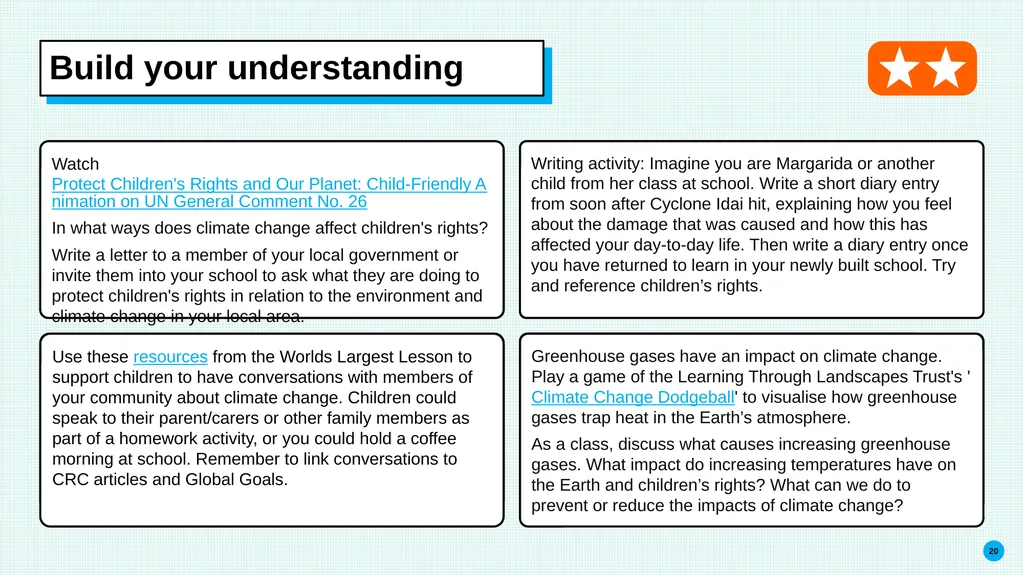
20 Build your understanding Watch Protect Children's Rights and Our Planet: Child-Friendly Animation on UN General Comment No. 26
In what ways does climate change affect children's rights?
Write a letter to a member of your local government or invite them into your school to ask what they are doing to protect children's rights in relation to the environment and climate change in your local area. Writing activity: Imagine you are Margarida or another child from her class at school. Write a short diary entry from soon after Cyclone Idai hit, explaining how you feel about the damage that was caused and how this has affected your day-to-day life. Then write a diary entry once you have returned to learn in your newly built school. Try and reference children’s rights. Use these resources from the Worlds Largest Lesson to support children to have conversations with members of your community about climate change. Children could speak to their parent/carers or other family members as part of a homework activity, or you could hold a coffee morning at school. Remember to link conversations to CRC articles and Global Goals. Greenhouse gases have an impact on climate change. Play a game of the Learning Through Landscapes Trust's 'Climate Change Dodgeball' to visualise how greenhouse gases trap heat in the Earth’s atmosphere.
As a class, discuss what causes increasing greenhouse gases. What impact do increasing temperatures have on the Earth and children’s rights? What can we do to prevent or reduce the impacts of climate change?<br>
21
21 Build your understanding Read the United Nations Committee on the Rights of the Child General Comment No. 26 on Children's Rights and the Environment with a Special Focus on Climate Change document.
Write a letter to a member of your local government asking them what they are doing in your local area to protect children's rights in relation to climate change. A carbon footprint is the amount of pollution we make that harms the Earth. Create a graph or chart to illustrate which ten countries in the world have the biggest carbon footprint and which ten have the smallest. What do you notice?
Explore the concept of climate justice. What could you do to share your knowledge and help fight for climate justice? Climate change affects everywhere in the world, including the UK. Using the internet or newspapers, carry out some research to find out how climate change is affecting life in the UK and your local community.
Are there more frequent extreme weather events such as storms and flooding? What impact do these changes have on the lives of people in the UK? Write a report or create a leaflet to share your findings. Using UNICEF's guidelines for
constructing climate and
disaster-resilient schools, design
a learning space that can
withstand a natural disaster.<br>
22
22 Glossary Climate: The weather in a place over a long time.
Climate change: Climate change refers to the change in the Earth’s usual weather conditions over many years. Our world has been getting hotter due to things humans are doing, like burning fossil fuels, cutting down too many trees and over-farming crops and animals.
Climate resilience: To be able to prepare for and respond to the impacts of climate change.
Cyclone: A tropical cyclone is a circular storm that forms over warm oceans. When it hits land, it brings heavy rains and strong winds that cause a lot of damage.
Infrastructure: Important things countries, cities, towns and villages need to work, like roads, bridges, schools, and water systems.
Climate justice: Making sure everyone is treated fairly/equitably when dealing with climate change, especially helping people who are most affected.<br>
23
23 Take your learning into the world Take action
Take climate action by setting up a club, running a campaign, or organising a fundraiser for climate justice.
Earth Day 2026 is on April 22nd. Make plans to celebrate it in your school e.g. you could make Earth Day pledges for how you will help protect the planet. Get creative
Create a wall display to share how children’s rights are impacted by climate change.
You might want to use recycled materials collected from home, such as cardboard boxes and bottle lids, or ask everyone to decorate an outline of the earth. Add to your passport
Create a page on Mozambique in your Rights Around the World passport…
Include a fact file on the case study and any actions you took as a result of your learning.<br>