
Building School Culture What is it? How do we
CP
Published · 24 slides · 0 views

1 / 1





Description
Building School Culture What is it? How do we measure it? How do we improve it? School Culture The recent investigations (September, 2016) into banking procedures at Wells Fargo, the most valuable bank in the world have used the term
Related Topics
Share
Embed code
Download this presentation From Below
"Building School Culture What is it? How do we" is the property of its rightful owner. Permission is granted to download and print the materials on this website for personal, non-commercial use only, and to display it on your personal computer provided you do not modify the materials and that you retain all copyright notices contained in the materials. By downloading content from our website, you accept the terms of this agreement.
Presentation Transcript
01
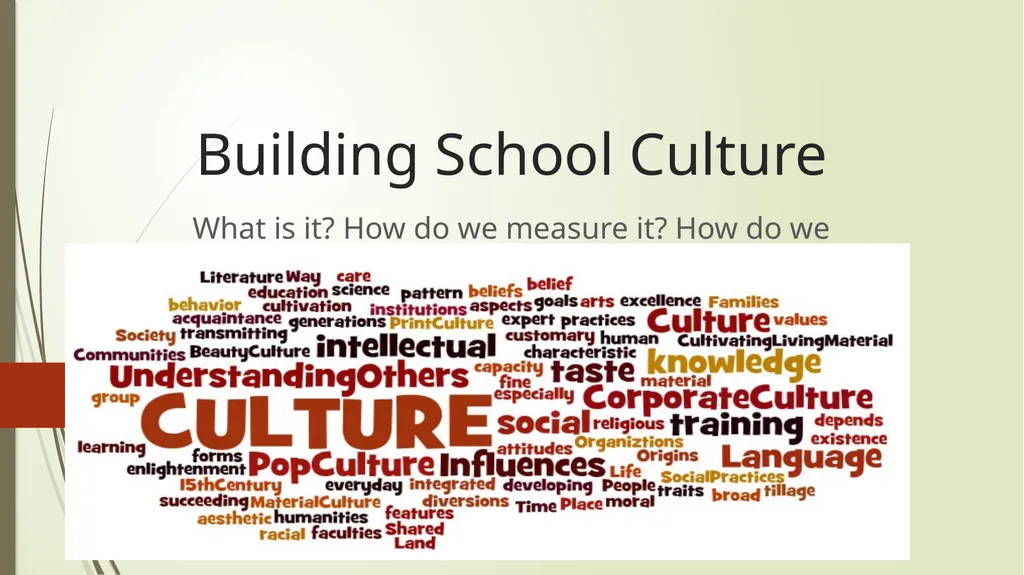
Building School Culture What is it? How do we measure it? How do we improve it?<br>
02
School Culture The recent investigations (September, 2016) into banking procedures at Wells Fargo, the “most valuable bank in the world” have used the term “culture of the bank” many times. The Senate Committee looking into the possible fraud pointed the finger at the bank CEO John Stumpf and said “You are responsible for the culture of the bank”. That Senate Committee was using the term culture in very specific ways: in their view, the constant pressure to sell bank accounts, loans and other “products” created a climate of both fear and stress. But it also created a “culture”, which is different from the climate.<br>
03
School Culture “School culture can be defined as the beliefs, perceptions, relationships, attitudes, and written and unwritten rules that shape and influence every aspect of how a school functions. The term also encompasses more concrete issues, such as the physical and emotional safety of students, the orderliness of classrooms and public spaces, and the degree to which the school embraces and celebrates racial, ethnic, linguistic and cultural diversity.”
(From Safe and Civil Schools)<br>
(From Safe and Civil Schools)<br>
04
What does the word “culture” mean to you? The word “climate”? What elements of your own culture mean the most to you?
How is culture created?
How do we establish a hierarchy of culture? Is one better than another? Just different?
What fits into “American Culture”?
How do you define what it is to be “American” (i.e. a citizen/resident of the United States: “America” is two continents , not one country)? This Photo by Unknown Author is licensed under CC BY-NC-ND<br>
How is culture created?
How do we establish a hierarchy of culture? Is one better than another? Just different?
What fits into “American Culture”?
How do you define what it is to be “American” (i.e. a citizen/resident of the United States: “America” is two continents , not one country)? This Photo by Unknown Author is licensed under CC BY-NC-ND<br>
05
School Leadership A corporation, bank, business, school or department can be said to have its own climate and culture: this “tone” is usually set by the leadership. Openness, collaboration, honesty, directness, and engagement are often the result of intentional strategies and actions created by the leader and the leadership team. On the other hand, secrecy, fear, stress, dishonesty and ineffectiveness are also usually set in motion by the leadership. School leaders who are dishonest, secretive, discontented, individualistic, blaming others, unsupportive: these are the leadership traits that promote dysfunction of various kinds. BUT……………<br>
06
School Culture The Components
Just about everything that goes on in schools can be a part of the culture of the institution.
Facility
Classroom décor
Teacher professionalism (how do you define this?)
Hallway displays
Teacher interaction with students
Teacher interaction with each other
Teacher interaction with administration<br>
Just about everything that goes on in schools can be a part of the culture of the institution.
Facility
Classroom décor
Teacher professionalism (how do you define this?)
Hallway displays
Teacher interaction with students
Teacher interaction with each other
Teacher interaction with administration<br>
07
School Culture (2) Teacher preparedness
Instructional programs
Expectations for students
Parent interactions
Accountability levels
Rituals and celebrations
Diversity
Meetings structures
Absence rates/Punctuality<br>
Instructional programs
Expectations for students
Parent interactions
Accountability levels
Rituals and celebrations
Diversity
Meetings structures
Absence rates/Punctuality<br>
08
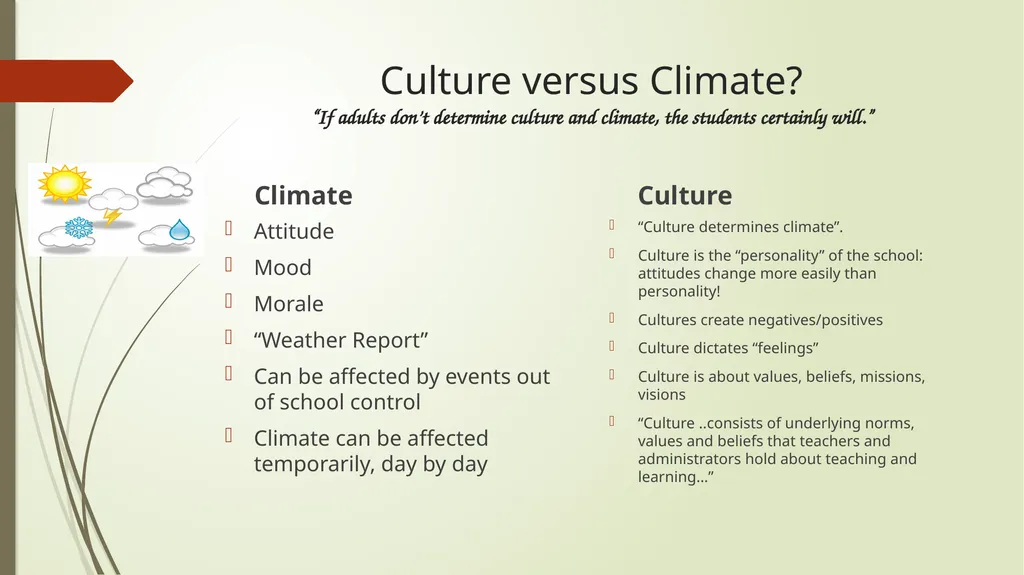
Culture versus Climate?
“If adults don’t determine culture and climate, the students certainly will.” Climate Attitude
Mood
Morale
“Weather Report”
Can be affected by events out of school control
Climate can be affected temporarily, day by day Culture “Culture determines climate”.
Culture is the “personality” of the school: attitudes change more easily than personality!
Cultures create negatives/positives
Culture dictates “feelings”
Culture is about values, beliefs, missions, visions
“Culture ..consists of underlying norms, values and beliefs that teachers and administrators hold about teaching and learning…”<br>
Mood
Morale
“Weather Report”
Can be affected by events out of school control
Climate can be affected temporarily, day by day Culture “Culture determines climate”.
Culture is the “personality” of the school: attitudes change more easily than personality!
Cultures create negatives/positives
Culture dictates “feelings”
Culture is about values, beliefs, missions, visions
“Culture ..consists of underlying norms, values and beliefs that teachers and administrators hold about teaching and learning…”<br>
09
Assessing Culture “Toxic” Cultures have the following aspects: lack of purpose, norms reinforce inertia or negativity, adults blame students, collaboration discouraged or made difficult, hostility amongst staff, gossip substitutes for information and communication……..
“Positive” cultures exhibit the following aspects: success is celebrated routinely at all levels, genuine adult trust is nurtured, communications are regular and frequent, collaboration is the norm, fairness in all interactions, policies and rules is evident and public, adults learn so that they model for others, character and moral development are priorities.<br>
“Positive” cultures exhibit the following aspects: success is celebrated routinely at all levels, genuine adult trust is nurtured, communications are regular and frequent, collaboration is the norm, fairness in all interactions, policies and rules is evident and public, adults learn so that they model for others, character and moral development are priorities.<br>
10
How Do We Assess Culture and Climate?
Research tells us that there are fundamental aspects of schools that predict improvement: a 2004 British study of 134 secondary schools reported that successful schools had a “demanding culture…hunger for improvement, promoting excellence, holding out hope for every child.”
A study of Chicago Public Schools showed that “relational trust” is high in successful schools. This aspect assesses how well each stakeholder feels everyone else is performing!
A 2003 study by CASEL (Collaborative for Academic, Emotional and Social Learning): “social and emotional skills can be taught and modeled and supported by school culture…..they predict motivation to learn as well as positive social behavior.”<br>
11
The Conditions for Building School Culture Create the right measures for success that go beyond test scores
Ensure that everyone has a clear and comprehensive understanding of what “school culture” actually is
Provide the right tools for assessing the culture and climate: “what gets measured is what we value”
Develop indicators of school quality and success
Explore the research around school culture: what works, what doesn’t, how do we know
If schools create “touchstones” , e.g. “we pursue excellence in scholarship and behavior”, they have to be touched and reinforced daily. If not, the result is either skepticism or cynicism or both!<br>
Ensure that everyone has a clear and comprehensive understanding of what “school culture” actually is
Provide the right tools for assessing the culture and climate: “what gets measured is what we value”
Develop indicators of school quality and success
Explore the research around school culture: what works, what doesn’t, how do we know
If schools create “touchstones” , e.g. “we pursue excellence in scholarship and behavior”, they have to be touched and reinforced daily. If not, the result is either skepticism or cynicism or both!<br>
12
Culture Begins and End With Kids
(from Safe and Supportive Schools) Students are safe, physically, emotionally, treated fairly and with equity, taught to avoid risk.
Students are supported: meaningful connections to adults, strong bond with school, positive peer relationships, effective and readily available support.
Students are challenged: high expectations, strong personal motivation, life goals are prominent, strong and diverse academic opportunities.
Students are socially capable: emotionally intelligent, culturally competent (explore this a bit?), responsible and persistent, co-operative, and contribute to the school.
These address the social, physical and intellectual environs of the school. Each one demands adult contributions and effective engagement at all levels. This Photo by Unknown Author is licensed under CC BY-SA<br>
Students are supported: meaningful connections to adults, strong bond with school, positive peer relationships, effective and readily available support.
Students are challenged: high expectations, strong personal motivation, life goals are prominent, strong and diverse academic opportunities.
Students are socially capable: emotionally intelligent, culturally competent (explore this a bit?), responsible and persistent, co-operative, and contribute to the school.
These address the social, physical and intellectual environs of the school. Each one demands adult contributions and effective engagement at all levels. This Photo by Unknown Author is licensed under CC BY-SA<br>
13
The Right Questions?
Is the school a welcoming place, for everyone?
What are the behavioral expectations and how are they made
tangible and practical?
How does the school leadership communicate expectations?
Do adults model what they ask for in others?
Is diversity obvious and obviously valued? (and what do we mean by “diversity”?)
Is empathy a taught “skill”?
What is the disciplinary structure and what supports ensure that it works?
How are resources allocated? How are school priorities decided upon and announced?
What are the race/gender/class message sent by the school?
How do parents fit into the school culture?<br>
14
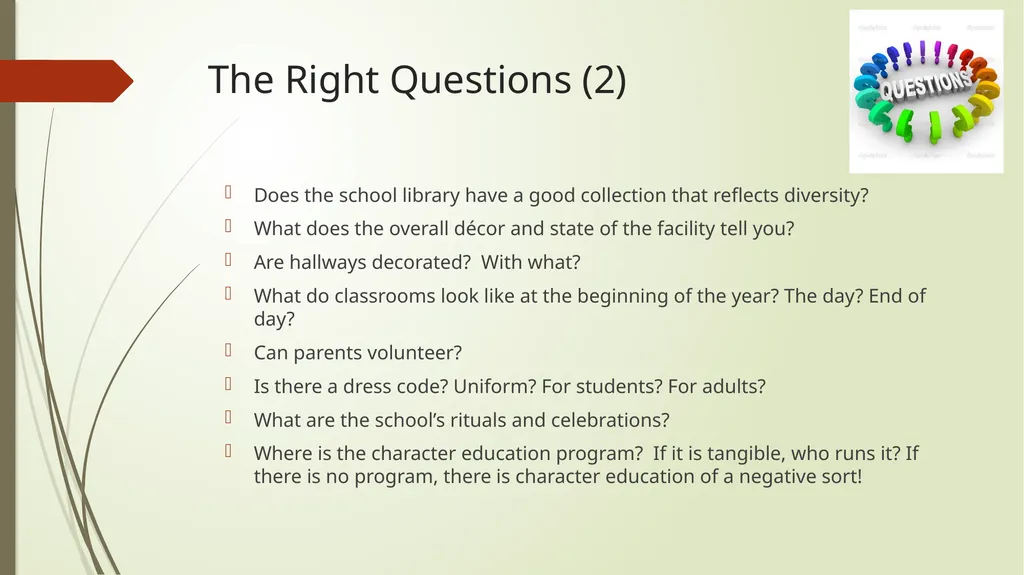
The Right Questions (2) Does the school library have a good collection that reflects diversity?
What does the overall décor and state of the facility tell you?
Are hallways decorated? With what?
What do classrooms look like at the beginning of the year? The day? End of day?
Can parents volunteer?
Is there a dress code? Uniform? For students? For adults?
What are the school’s rituals and celebrations?
Where is the character education program? If it is tangible, who runs it? If there is no program, there is character education of a negative sort!<br>
What does the overall décor and state of the facility tell you?
Are hallways decorated? With what?
What do classrooms look like at the beginning of the year? The day? End of day?
Can parents volunteer?
Is there a dress code? Uniform? For students? For adults?
What are the school’s rituals and celebrations?
Where is the character education program? If it is tangible, who runs it? If there is no program, there is character education of a negative sort!<br>
15
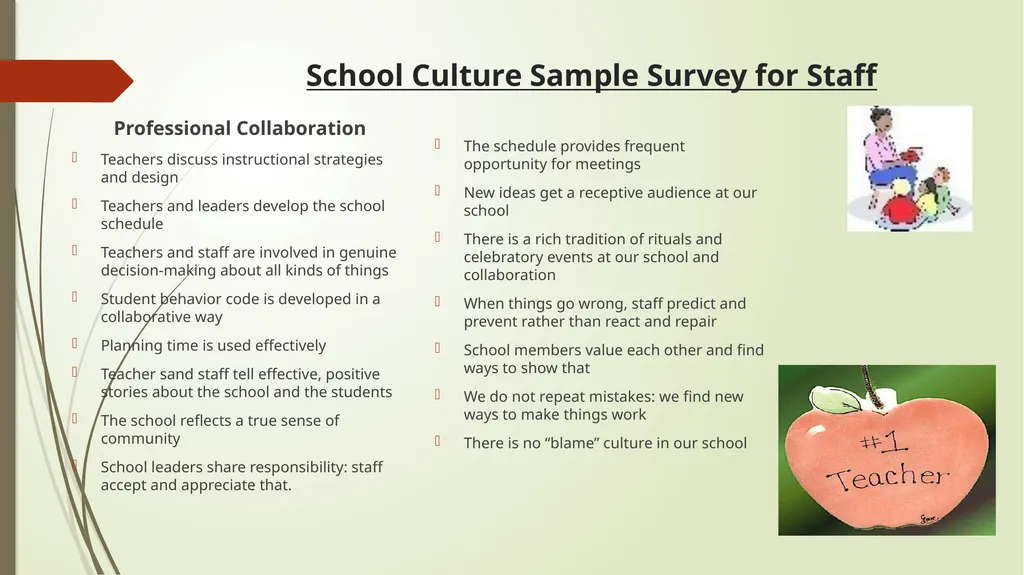
School Culture Sample Survey for Staff Professional Collaboration
Teachers discuss instructional strategies and design
Teachers and leaders develop the school schedule
Teachers and staff are involved in genuine decision-making about all kinds of things
Student behavior code is developed in a collaborative way
Planning time is used effectively
Teacher sand staff tell effective, positive stories about the school and the students
The school reflects a true sense of community
School leaders share responsibility: staff accept and appreciate that. The schedule provides frequent opportunity for meetings
New ideas get a receptive audience at our school
There is a rich tradition of rituals and celebratory events at our school and collaboration
When things go wrong, staff predict and prevent rather than react and repair
School members value each other and find ways to show that
We do not repeat mistakes: we find new ways to make things work
There is no “blame” culture in our school<br>
Teachers discuss instructional strategies and design
Teachers and leaders develop the school schedule
Teachers and staff are involved in genuine decision-making about all kinds of things
Student behavior code is developed in a collaborative way
Planning time is used effectively
Teacher sand staff tell effective, positive stories about the school and the students
The school reflects a true sense of community
School leaders share responsibility: staff accept and appreciate that. The schedule provides frequent opportunity for meetings
New ideas get a receptive audience at our school
There is a rich tradition of rituals and celebratory events at our school and collaboration
When things go wrong, staff predict and prevent rather than react and repair
School members value each other and find ways to show that
We do not repeat mistakes: we find new ways to make things work
There is no “blame” culture in our school<br>
16
Culture and Climate Reminder “norms, values, rituals and climate are all manifestations of culture.” Schein, (1996)
“shared perceptions of behavior are more readily measured than shared values.” Hoy and Feldman, (1999)
“Testimony from school principals suggests that focusing on development of the school’s culture as a learning environment is fundamental to improved teacher morale and student achievement.” Nomura (1999) “State and local policies, school organization and student demographics exerted the least influence on student learning.”
“The reform efforts of the last 30 years have failed to improve student achievement because they failed to adequately address the importance of the culture and climate of schools.” McNeil, Prater, Busch (2009)
What characteristics of the school climate should leadership address in order to improve student achievement?<br>
“shared perceptions of behavior are more readily measured than shared values.” Hoy and Feldman, (1999)
“Testimony from school principals suggests that focusing on development of the school’s culture as a learning environment is fundamental to improved teacher morale and student achievement.” Nomura (1999) “State and local policies, school organization and student demographics exerted the least influence on student learning.”
“The reform efforts of the last 30 years have failed to improve student achievement because they failed to adequately address the importance of the culture and climate of schools.” McNeil, Prater, Busch (2009)
What characteristics of the school climate should leadership address in order to improve student achievement?<br>
17
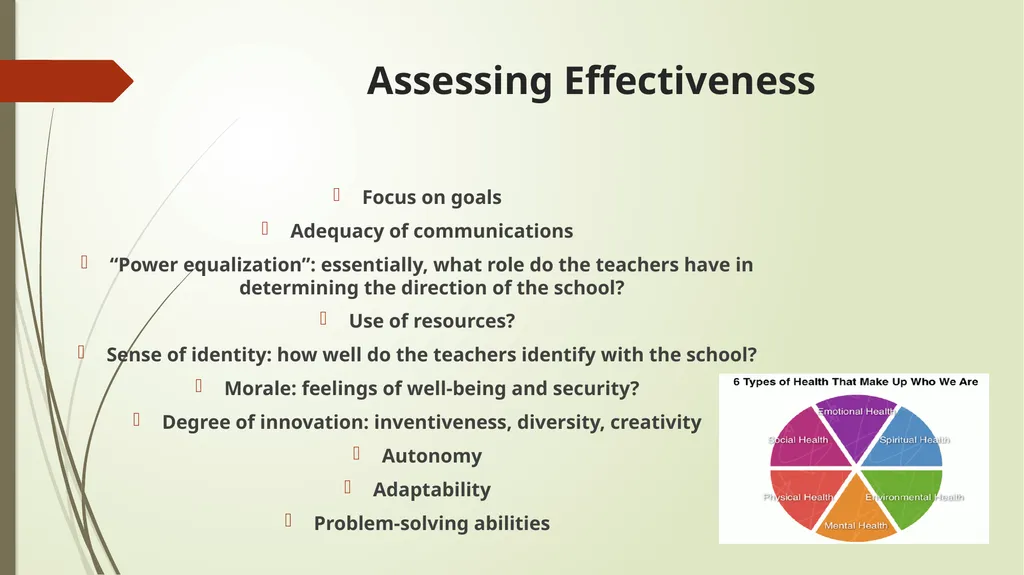
Assessing Effectiveness Focus on goals
Adequacy of communications
“Power equalization”: essentially, what role do the teachers have in determining the direction of the school?
Use of resources?
Sense of identity: how well do the teachers identify with the school?
Morale: feelings of well-being and security?
Degree of innovation: inventiveness, diversity, creativity
Autonomy
Adaptability
Problem-solving abilities<br>
Adequacy of communications
“Power equalization”: essentially, what role do the teachers have in determining the direction of the school?
Use of resources?
Sense of identity: how well do the teachers identify with the school?
Morale: feelings of well-being and security?
Degree of innovation: inventiveness, diversity, creativity
Autonomy
Adaptability
Problem-solving abilities<br>
18
Cultural “Cues”
How “Management” speaks to staff;
How staff speak about management in their absence;
How teachers and leaders speak about students and parents;
How honest is the feedback and
what are the communications like at staff meetings? How do we handle critiques?
How does the school invite, promote and support initiatives and individual ideas?
How does the school respond to student and staff needs?<br>
19
Culture is the result of messages that are received about what is really valued. People align their behavior to these messages in order to fit in. Changing culture requires a systematic and planned change to these messages, whose sources are behavior, symbols and systems. Quoted in The Challenge of Culture Change, Blood and Thorsborne,2005<br>
20
Situations That Symbolize Problematic Culture Teachers and staff routinely leave earlier than the approved time
Office staff do not make visitors feel welcome
Leaders are not visible
Facility is uncared for
Adults have confrontational relationships with children
Curriculum is hit or miss: planning seen as burden!
Classrooms do not have student work, not very clean or tidy: few posters displayed, no attention to décor. Meetings start late: often, some folks do not attend at all
Professional attire not valued
Rules not enforced<br>
Office staff do not make visitors feel welcome
Leaders are not visible
Facility is uncared for
Adults have confrontational relationships with children
Curriculum is hit or miss: planning seen as burden!
Classrooms do not have student work, not very clean or tidy: few posters displayed, no attention to décor. Meetings start late: often, some folks do not attend at all
Professional attire not valued
Rules not enforced<br>
21
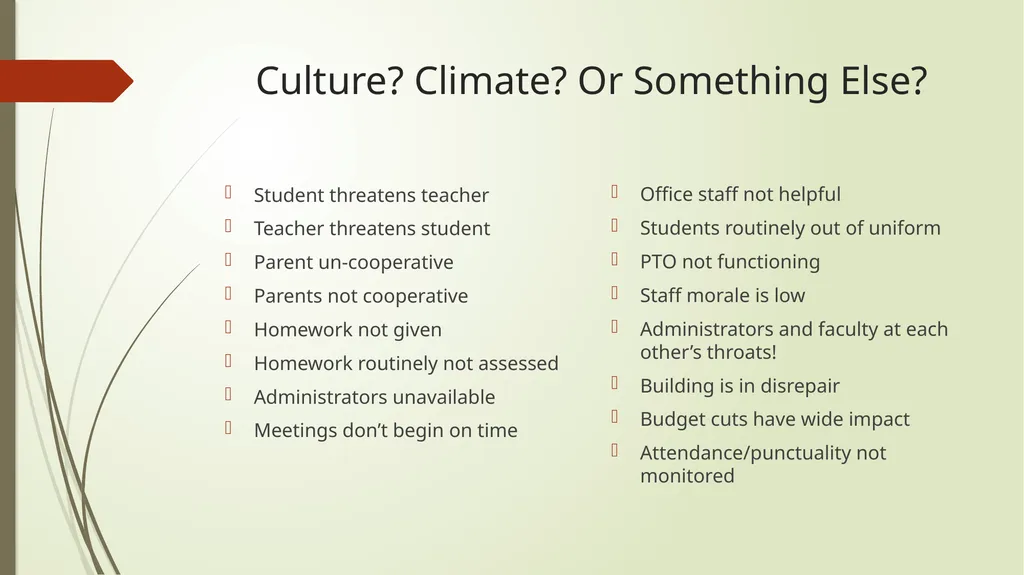
Culture? Climate? Or Something Else? Student threatens teacher
Teacher threatens student
Parent un-cooperative
Parents not cooperative
Homework not given
Homework routinely not assessed
Administrators unavailable
Meetings don’t begin on time Office staff not helpful
Students routinely out of uniform
PTO not functioning
Staff morale is low
Administrators and faculty at each other’s throats!
Building is in disrepair
Budget cuts have wide impact
Attendance/punctuality not monitored<br>
Teacher threatens student
Parent un-cooperative
Parents not cooperative
Homework not given
Homework routinely not assessed
Administrators unavailable
Meetings don’t begin on time Office staff not helpful
Students routinely out of uniform
PTO not functioning
Staff morale is low
Administrators and faculty at each other’s throats!
Building is in disrepair
Budget cuts have wide impact
Attendance/punctuality not monitored<br>
22
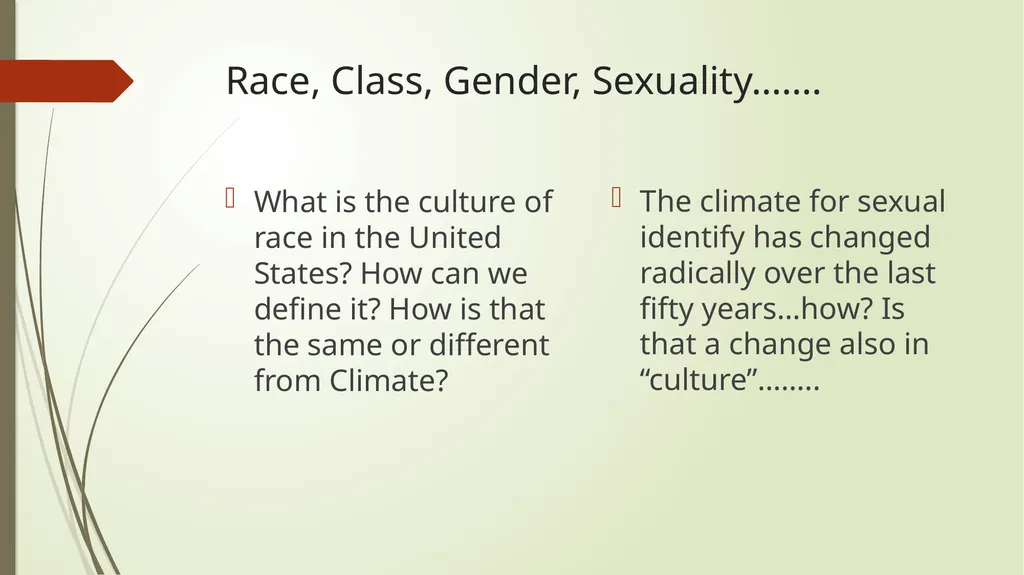
Race, Class, Gender, Sexuality……. What is the culture of race in the United States? How can we define it? How is that the same or different from Climate? The climate for sexual identify has changed radically over the last fifty years…how? Is that a change also in “culture”……..<br>
23
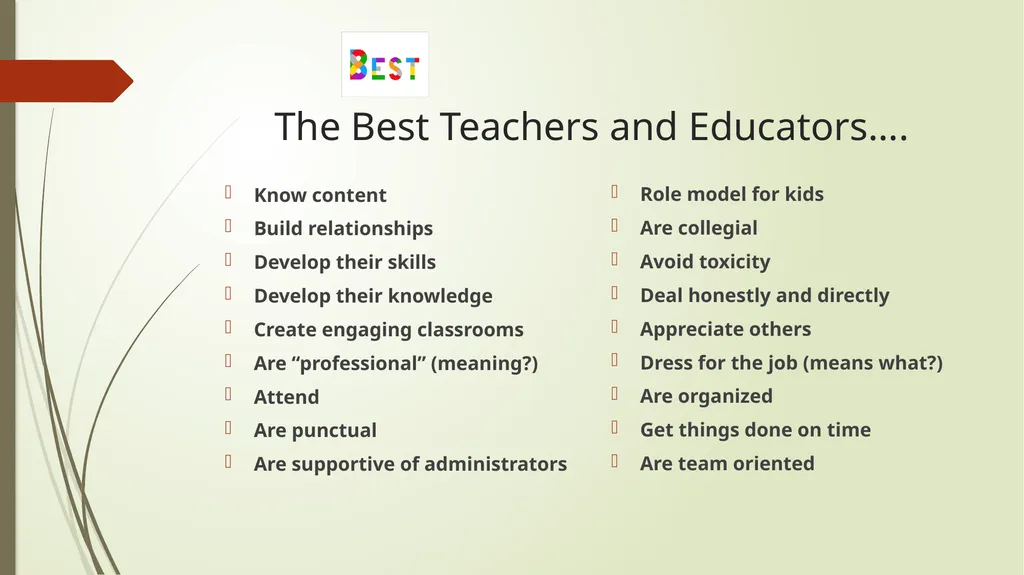
The Best Teachers and Educators…. Know content
Build relationships
Develop their skills
Develop their knowledge
Create engaging classrooms
Are “professional” (meaning?)
Attend
Are punctual
Are supportive of administrators Role model for kids
Are collegial
Avoid toxicity
Deal honestly and directly
Appreciate others
Dress for the job (means what?)
Are organized
Get things done on time
Are team oriented<br>
Build relationships
Develop their skills
Develop their knowledge
Create engaging classrooms
Are “professional” (meaning?)
Attend
Are punctual
Are supportive of administrators Role model for kids
Are collegial
Avoid toxicity
Deal honestly and directly
Appreciate others
Dress for the job (means what?)
Are organized
Get things done on time
Are team oriented<br>
24
What Have We Left Out of the List of “Best”?
1. How will you contribute to an effective school culture?
2. What do you think you will need to focus on in order to develop your ability to live up to the “Best” list?<br>