
BULLY PREVENTION AND INTERVENTION School
A
Published · 41 slides · 0 views
1 / 1

Description
BULLY PREVENTION AND INTERVENTION School Corporation Employee Training on Prevention Version: Whole School Updated: 7-21-13 According to the National Association of School Psychologists, 160,000 students per day stay home from school
Related Topics
Share
Embed code
Download this presentation From Below
"BULLY PREVENTION AND INTERVENTION School" is the property of its rightful owner. Permission is granted to download and print the materials on this website for personal, non-commercial use only, and to display it on your personal computer provided you do not modify the materials and that you retain all copyright notices contained in the materials. By downloading content from our website, you accept the terms of this agreement.
Presentation Transcript
01
BULLY PREVENTION AND INTERVENTION School Corporation Employee Training
on Prevention
Version: Whole School
Updated: 7-21-13<br>
on Prevention
Version: Whole School
Updated: 7-21-13<br>
02
According to the National Association of School Psychologists, 160,000 students per day stay home from school because of bullying (Fried & Fried, 2003).
Source: www.nea.org 2<br>
Source: www.nea.org 2<br>
03
Part 1: Bullying Overview and Terminology 3<br>
04
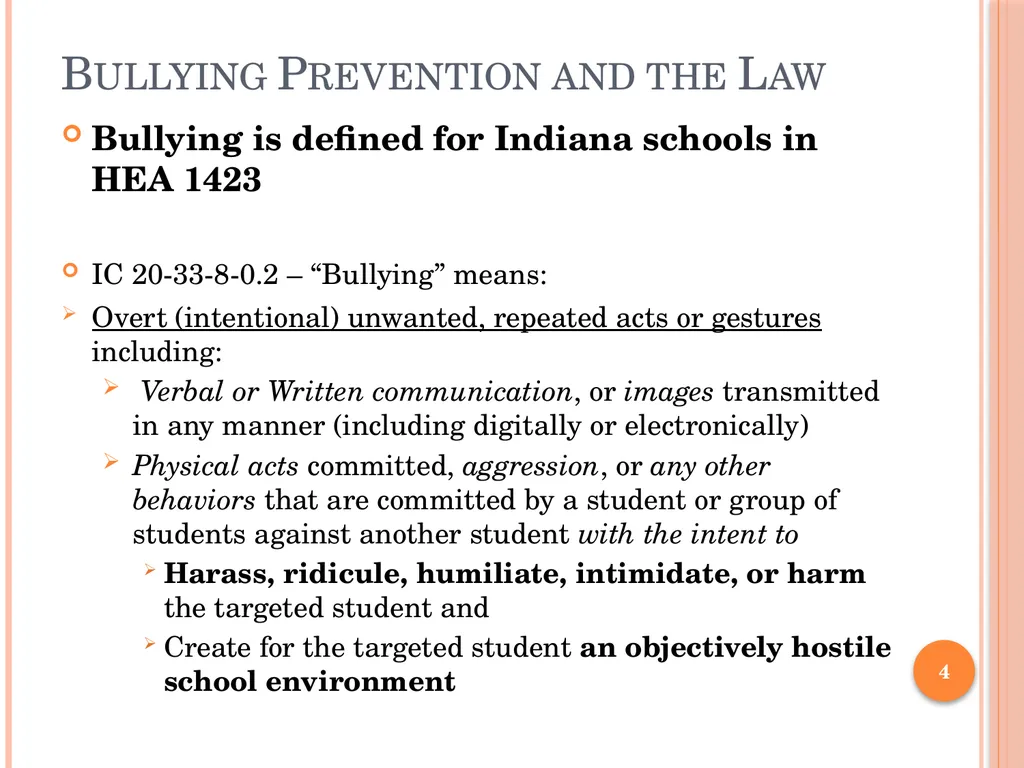
Bullying Prevention and the Law Bullying is defined for Indiana schools in HEA 1423
IC 20-33-8-0.2 – “Bullying” means:
Overt (intentional) unwanted, repeated acts or gestures including:
Verbal or Written communication, or images transmitted in any manner (including digitally or electronically)
Physical acts committed, aggression, or any other behaviors that are committed by a student or group of students against another student with the intent to
Harass, ridicule, humiliate, intimidate, or harm the targeted student and
Create for the targeted student an objectively hostile school environment 4<br>
IC 20-33-8-0.2 – “Bullying” means:
Overt (intentional) unwanted, repeated acts or gestures including:
Verbal or Written communication, or images transmitted in any manner (including digitally or electronically)
Physical acts committed, aggression, or any other behaviors that are committed by a student or group of students against another student with the intent to
Harass, ridicule, humiliate, intimidate, or harm the targeted student and
Create for the targeted student an objectively hostile school environment 4<br>
05
Bullying is defined for
Indiana schools in HEA 1423
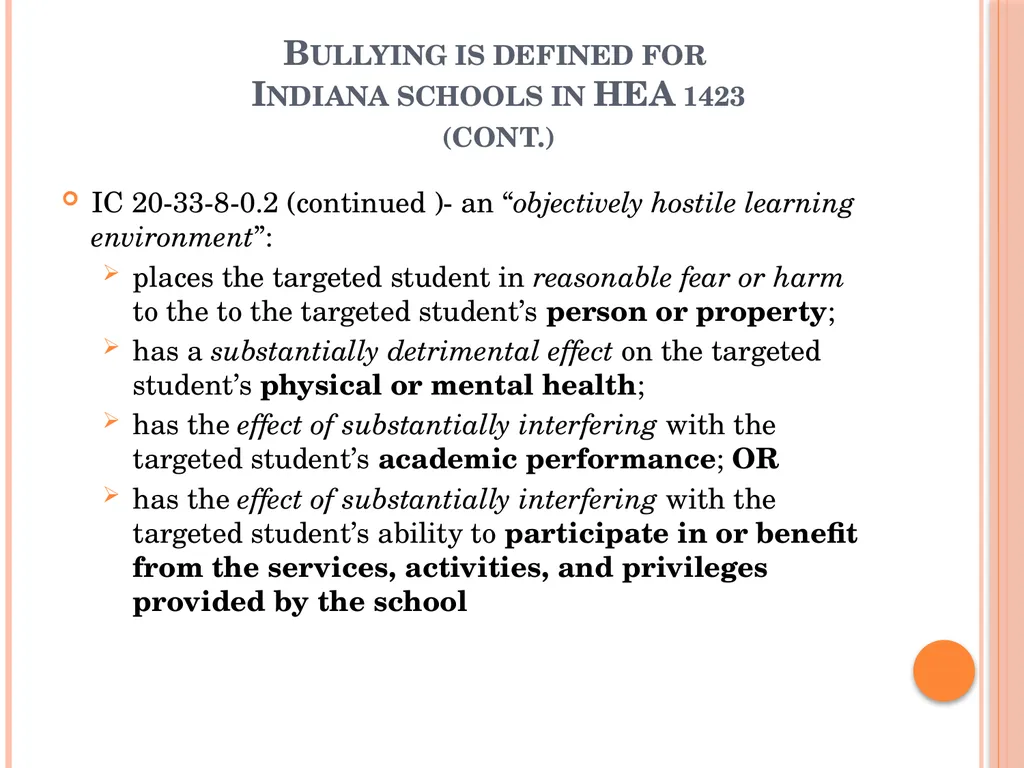
(cont.) IC 20-33-8-0.2 (continued )- an “objectively hostile learning environment”:
places the targeted student in reasonable fear or harm to the to the targeted student’s person or property;
has a substantially detrimental effect on the targeted student’s physical or mental health;
has the effect of substantially interfering with the targeted student’s academic performance; OR
has the effect of substantially interfering with the targeted student’s ability to participate in or benefit from the services, activities, and privileges provided by the school<br>
places the targeted student in reasonable fear or harm to the to the targeted student’s person or property;
has a substantially detrimental effect on the targeted student’s physical or mental health;
has the effect of substantially interfering with the targeted student’s academic performance; OR
has the effect of substantially interfering with the targeted student’s ability to participate in or benefit from the services, activities, and privileges provided by the school<br>
06
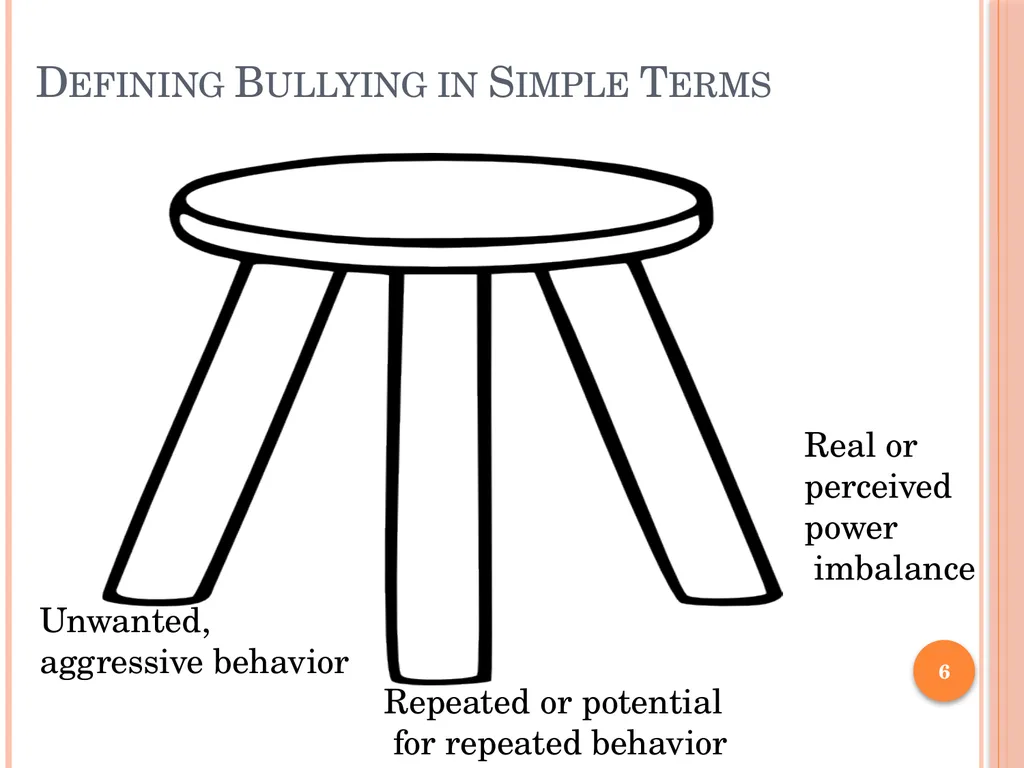
Defining Bullying in Simple Terms Unwanted,
aggressive behavior Repeated or potential
for repeated behavior Real or
perceived
power
imbalance 6<br>
aggressive behavior Repeated or potential
for repeated behavior Real or
perceived
power
imbalance 6<br>
07
Terminology Target Or Victim: Student that has been bullied
Bullier Or Student Exhibiting Bullying Behavior: Student that has been identified as exhibiting behavior that was determined to be bullying
Witness Or Bystander: Student(s) that have observed another student being bullied
**The terms in bold print are preferred language in hopes to help change thinking surrounding bullying. 7<br>
Bullier Or Student Exhibiting Bullying Behavior: Student that has been identified as exhibiting behavior that was determined to be bullying
Witness Or Bystander: Student(s) that have observed another student being bullied
**The terms in bold print are preferred language in hopes to help change thinking surrounding bullying. 7<br>
08
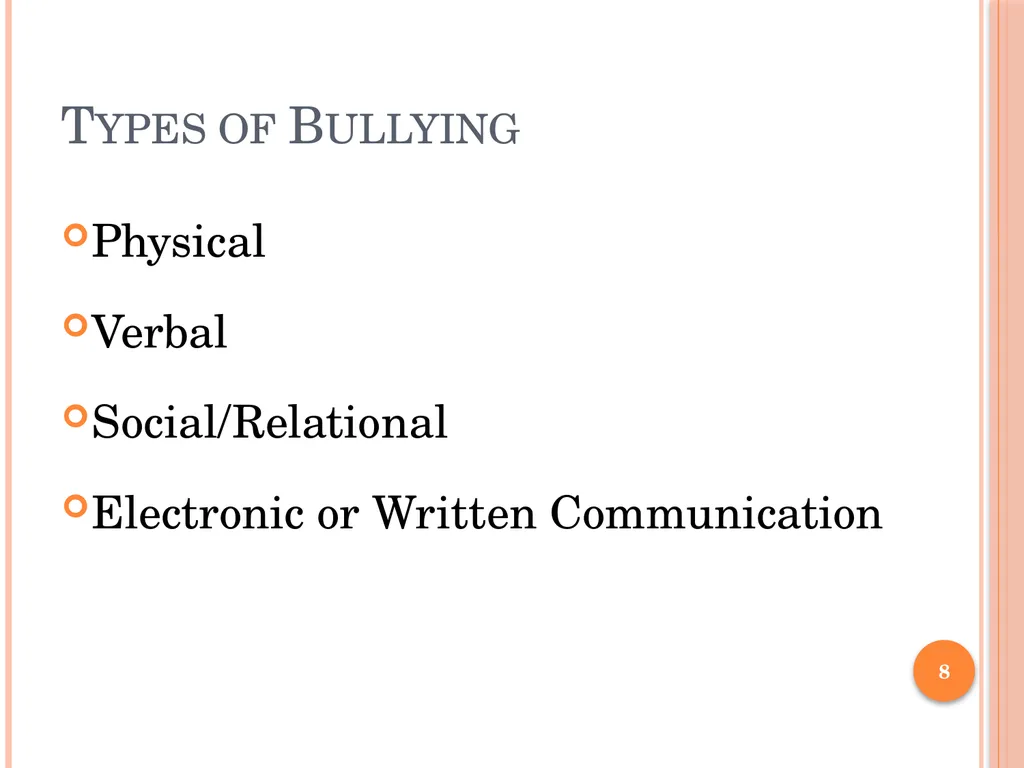
Types of Bullying Physical
Verbal
Social/Relational
Electronic or Written Communication 8<br>
Verbal
Social/Relational
Electronic or Written Communication 8<br>
09
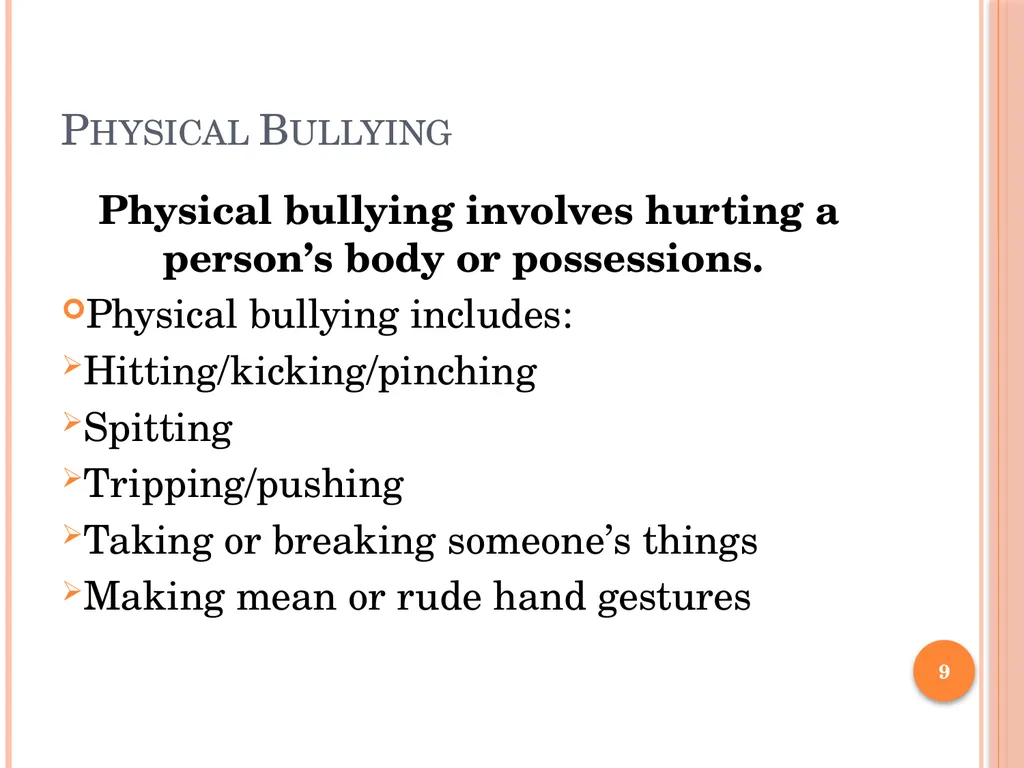
Physical Bullying Physical bullying involves hurting a person’s body or possessions.
Physical bullying includes:
Hitting/kicking/pinching
Spitting
Tripping/pushing
Taking or breaking someone’s things
Making mean or rude hand gestures 9<br>
Physical bullying includes:
Hitting/kicking/pinching
Spitting
Tripping/pushing
Taking or breaking someone’s things
Making mean or rude hand gestures 9<br>
10
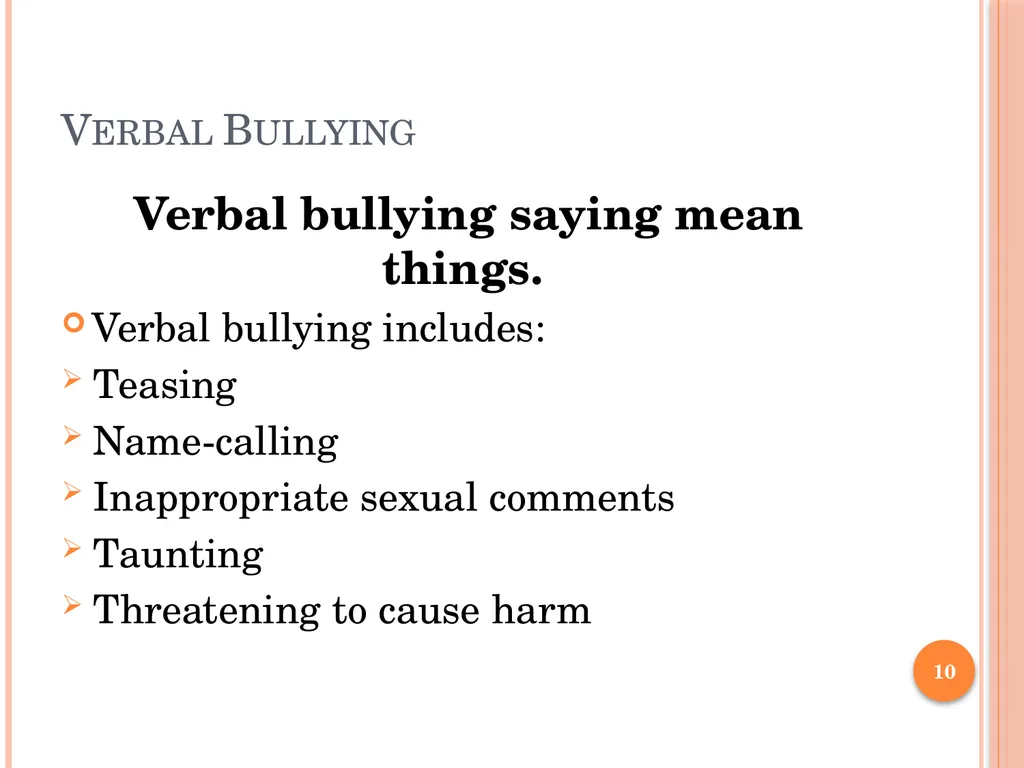
Verbal Bullying Verbal bullying saying mean things.
Verbal bullying includes:
Teasing
Name-calling
Inappropriate sexual comments
Taunting
Threatening to cause harm 10<br>
Verbal bullying includes:
Teasing
Name-calling
Inappropriate sexual comments
Taunting
Threatening to cause harm 10<br>
11
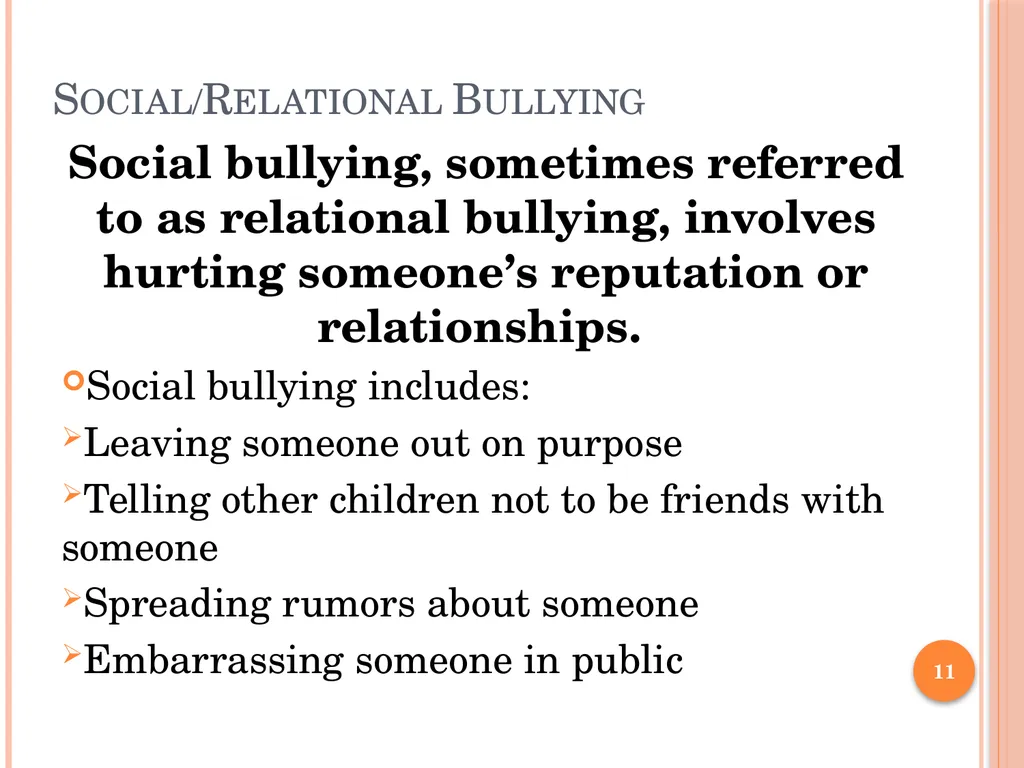
Social/Relational Bullying Social bullying, sometimes referred to as relational bullying, involves hurting someone’s reputation or relationships.
Social bullying includes:
Leaving someone out on purpose
Telling other children not to be friends with someone
Spreading rumors about someone
Embarrassing someone in public 11<br>
Social bullying includes:
Leaving someone out on purpose
Telling other children not to be friends with someone
Spreading rumors about someone
Embarrassing someone in public 11<br>
12
Electronic or Written Communication Bullying Electronic or Written Communication Bullying (including all forms of Cyberbullying) is bullying that takes place through the use of written messages or using various forms of electronic technology.
Examples of Electronic bullying include:
mean text messages or emails,
rumors sent by email or posted on social networking sites, and
embarrassing pictures, videos, websites, or fake profiles. 12<br>
Examples of Electronic bullying include:
mean text messages or emails,
rumors sent by email or posted on social networking sites, and
embarrassing pictures, videos, websites, or fake profiles. 12<br>
13
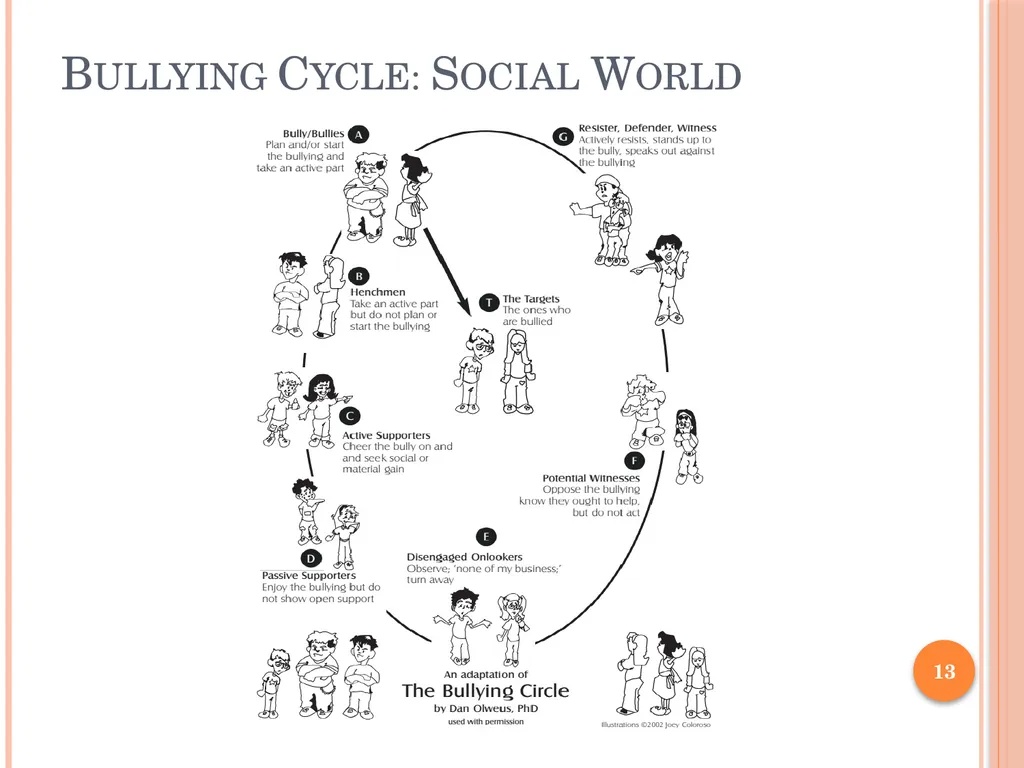
Bullying Cycle: Social World 13<br>
14
What is NOT Bullying? There are many other types of aggressive behaviors that do not fit the definition of bullying. This does not mean that they are any less serious or do not require intervention.
Peer Conflict
Teen Dating Violence
Hazing
Gang Violence
Harassment
Stalking 14<br>
Peer Conflict
Teen Dating Violence
Hazing
Gang Violence
Harassment
Stalking 14<br>
15
Risk Factors-Target Perceived as “being different” from peers
Perceived sexual orientation
Perceived ability/disability level
Perceived socioeconomic status
Poor social skills
Socially isolated/few friends
Overweight/underweight
Many more….basic premise of “perceived difference” 15<br>
Perceived sexual orientation
Perceived ability/disability level
Perceived socioeconomic status
Poor social skills
Socially isolated/few friends
Overweight/underweight
Many more….basic premise of “perceived difference” 15<br>
16
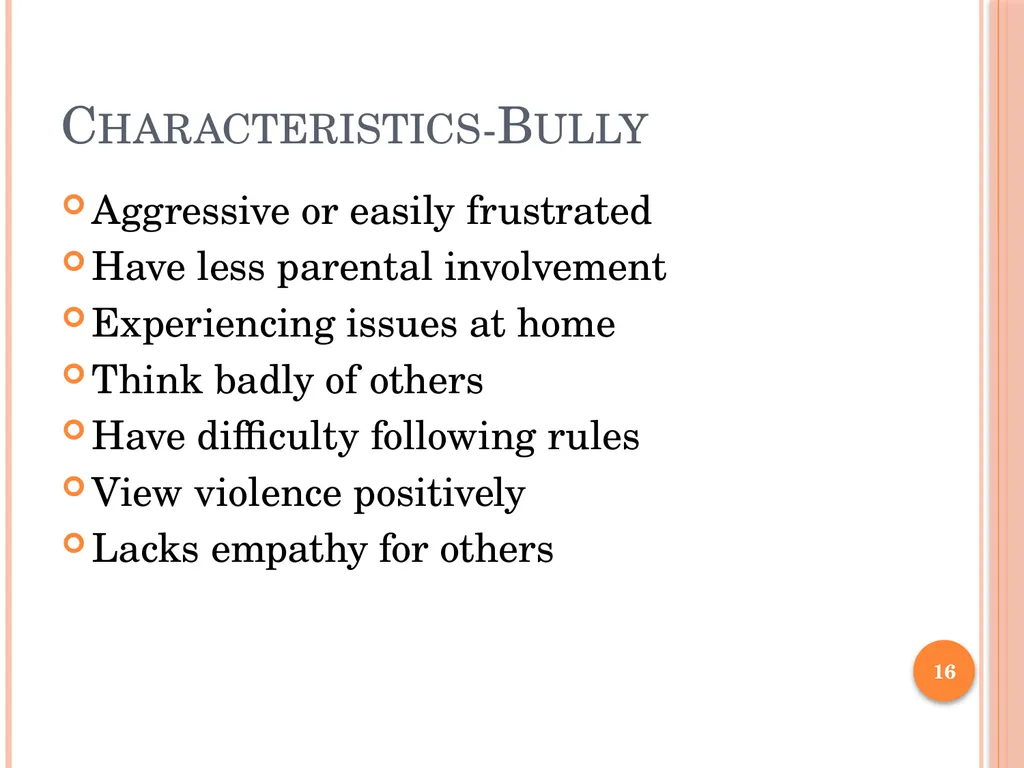
Characteristics-Bully Aggressive or easily frustrated
Have less parental involvement
Experiencing issues at home
Think badly of others
Have difficulty following rules
View violence positively
Lacks empathy for others 16<br>
Have less parental involvement
Experiencing issues at home
Think badly of others
Have difficulty following rules
View violence positively
Lacks empathy for others 16<br>
17
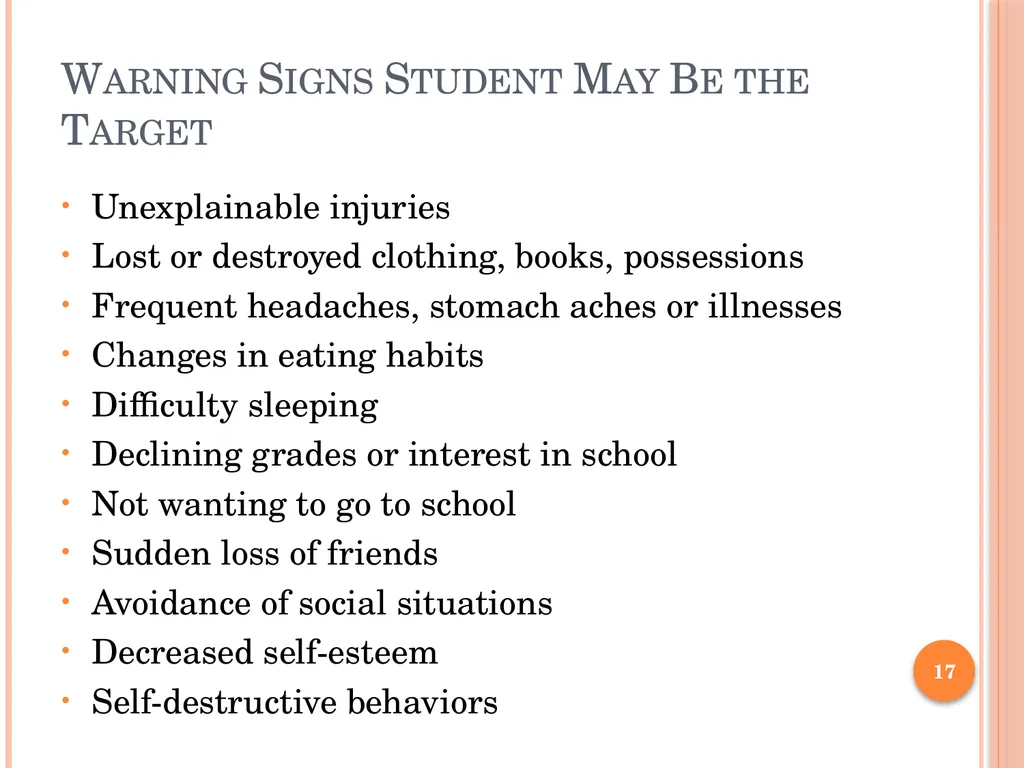
Warning Signs Student May Be the Target Unexplainable injuries
Lost or destroyed clothing, books, possessions
Frequent headaches, stomach aches or illnesses
Changes in eating habits
Difficulty sleeping
Declining grades or interest in school
Not wanting to go to school
Sudden loss of friends
Avoidance of social situations
Decreased self-esteem
Self-destructive behaviors 17<br>
Lost or destroyed clothing, books, possessions
Frequent headaches, stomach aches or illnesses
Changes in eating habits
Difficulty sleeping
Declining grades or interest in school
Not wanting to go to school
Sudden loss of friends
Avoidance of social situations
Decreased self-esteem
Self-destructive behaviors 17<br>
18
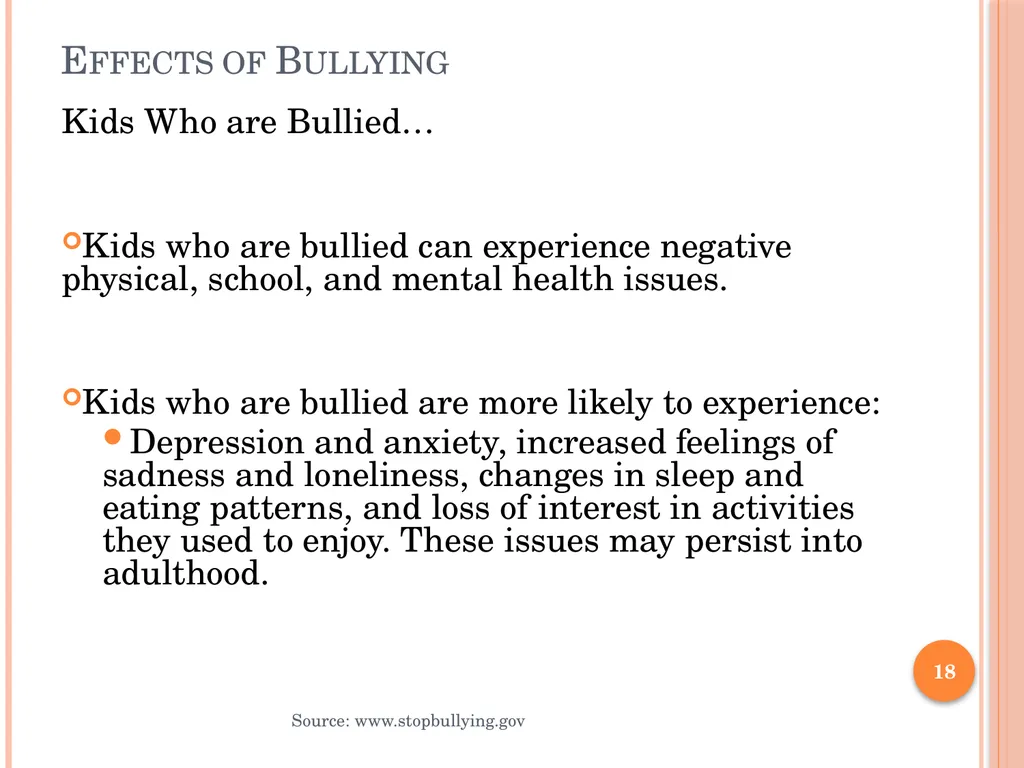
Effects of Bullying Kids Who are Bullied…
Kids who are bullied can experience negative physical, school, and mental health issues.
Kids who are bullied are more likely to experience:
Depression and anxiety, increased feelings of sadness and loneliness, changes in sleep and eating patterns, and loss of interest in activities they used to enjoy. These issues may persist into adulthood. Source: www.stopbullying.gov 18<br>
Kids who are bullied can experience negative physical, school, and mental health issues.
Kids who are bullied are more likely to experience:
Depression and anxiety, increased feelings of sadness and loneliness, changes in sleep and eating patterns, and loss of interest in activities they used to enjoy. These issues may persist into adulthood. Source: www.stopbullying.gov 18<br>
19
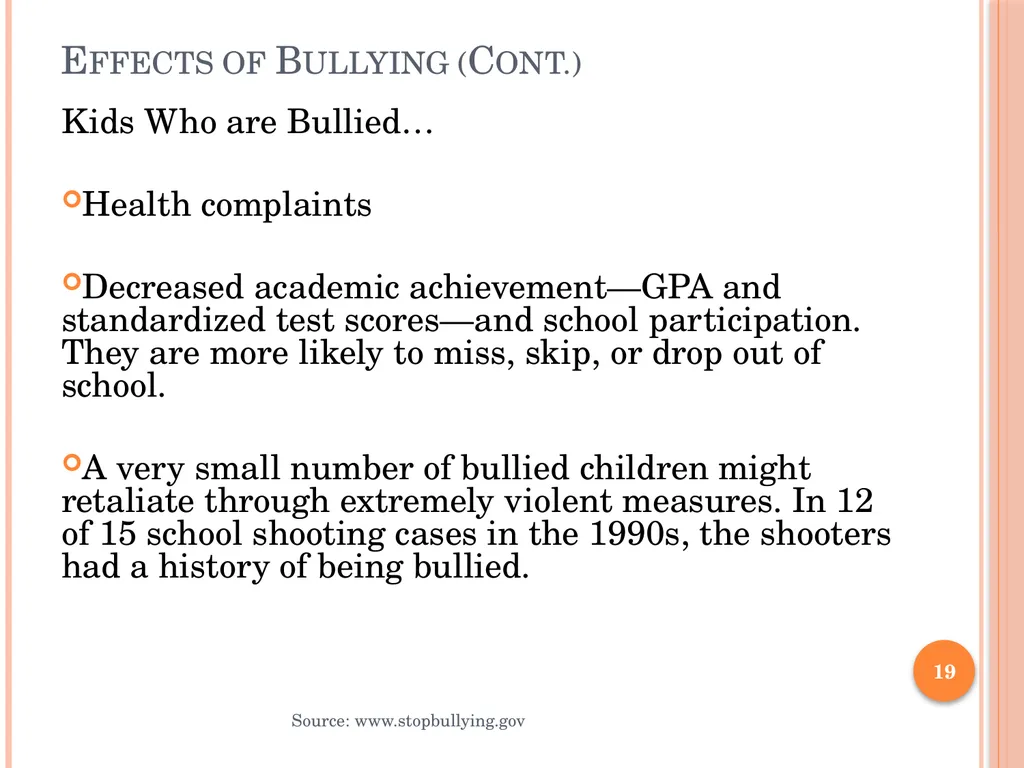
Effects of Bullying (Cont.) Kids Who are Bullied…
Health complaints
Decreased academic achievement—GPA and standardized test scores—and school participation. They are more likely to miss, skip, or drop out of school.
A very small number of bullied children might retaliate through extremely violent measures. In 12 of 15 school shooting cases in the 1990s, the shooters had a history of being bullied. Source: www.stopbullying.gov 19<br>
Health complaints
Decreased academic achievement—GPA and standardized test scores—and school participation. They are more likely to miss, skip, or drop out of school.
A very small number of bullied children might retaliate through extremely violent measures. In 12 of 15 school shooting cases in the 1990s, the shooters had a history of being bullied. Source: www.stopbullying.gov 19<br>
20
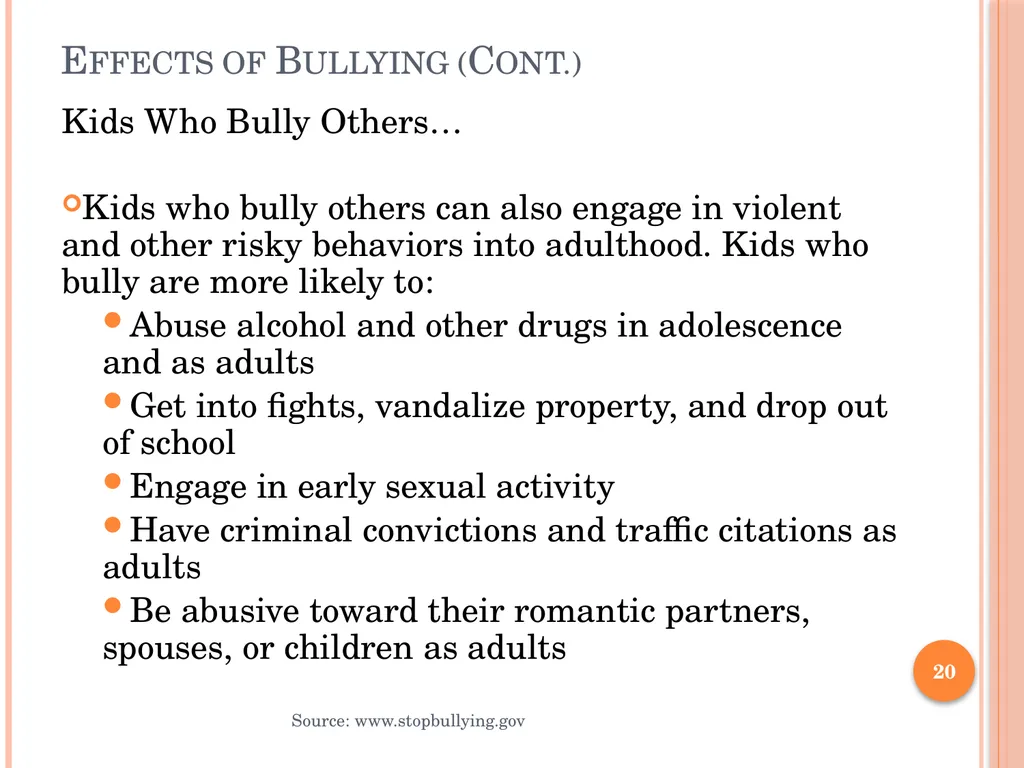
Effects of Bullying (Cont.) Kids Who Bully Others…
Kids who bully others can also engage in violent and other risky behaviors into adulthood. Kids who bully are more likely to:
Abuse alcohol and other drugs in adolescence and as adults
Get into fights, vandalize property, and drop out of school
Engage in early sexual activity
Have criminal convictions and traffic citations as adults
Be abusive toward their romantic partners, spouses, or children as adults Source: www.stopbullying.gov 20<br>
Kids who bully others can also engage in violent and other risky behaviors into adulthood. Kids who bully are more likely to:
Abuse alcohol and other drugs in adolescence and as adults
Get into fights, vandalize property, and drop out of school
Engage in early sexual activity
Have criminal convictions and traffic citations as adults
Be abusive toward their romantic partners, spouses, or children as adults Source: www.stopbullying.gov 20<br>
21
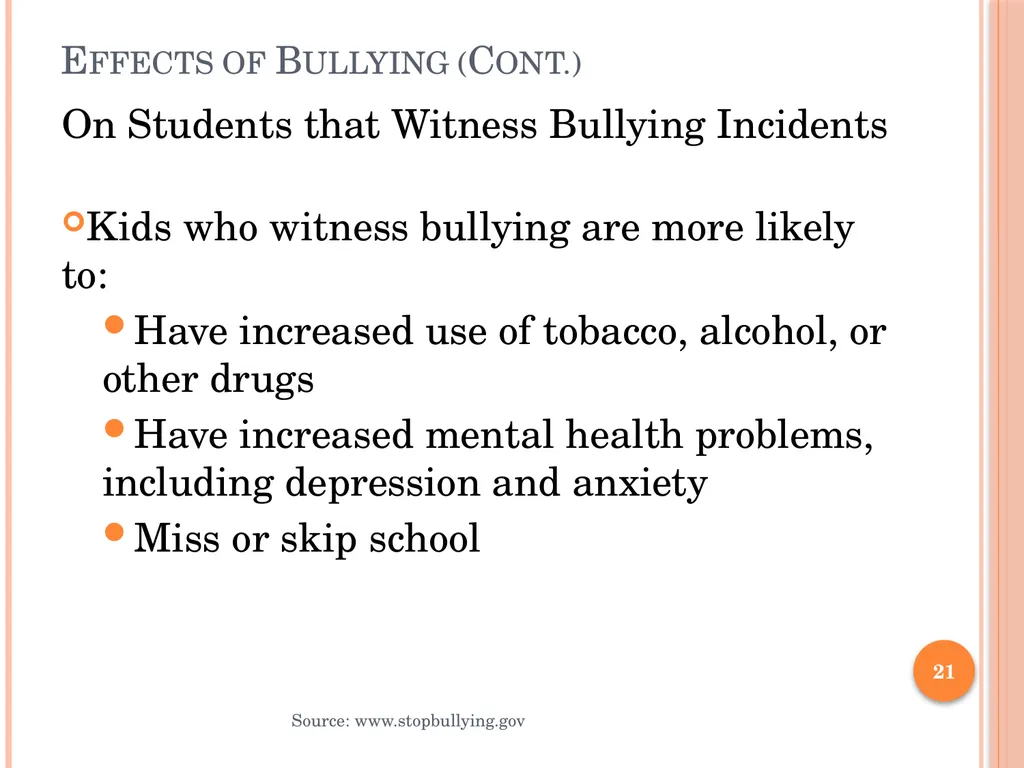
Effects of Bullying (Cont.) On Students that Witness Bullying Incidents
Kids who witness bullying are more likely to:
Have increased use of tobacco, alcohol, or other drugs
Have increased mental health problems, including depression and anxiety
Miss or skip school Source: www.stopbullying.gov 21<br>
Kids who witness bullying are more likely to:
Have increased use of tobacco, alcohol, or other drugs
Have increased mental health problems, including depression and anxiety
Miss or skip school Source: www.stopbullying.gov 21<br>
22
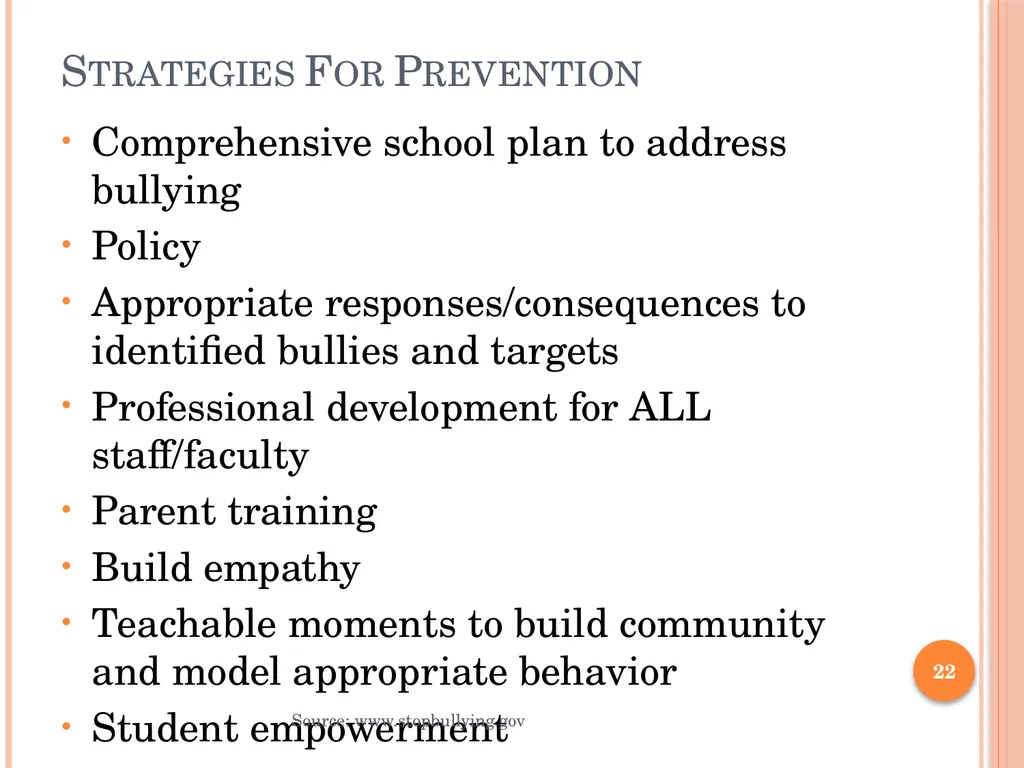
Strategies For Prevention Comprehensive school plan to address bullying
Policy
Appropriate responses/consequences to identified bullies and targets
Professional development for ALL staff/faculty
Parent training
Build empathy
Teachable moments to build community and model appropriate behavior
Student empowerment Source: www.stopbullying.gov 22<br>
Policy
Appropriate responses/consequences to identified bullies and targets
Professional development for ALL staff/faculty
Parent training
Build empathy
Teachable moments to build community and model appropriate behavior
Student empowerment Source: www.stopbullying.gov 22<br>
23
Part 2
: Bullying Prevention and Intervention for All School Stakeholders 23<br>
24
Training ALL School Staff Bullying is everyone’s problem. It will only be controlled through a total school effort. Administrators, faculty and Educational Support Professionals (ESP) who may witness bullying in their school this year include:
Teachers, Instructional aides & substitute teachers
Administrators, Counselors, Social Workers, Nurses
Cafeteria staff
Bus Drivers
Custodians
Parent volunteers 24<br>
Teachers, Instructional aides & substitute teachers
Administrators, Counselors, Social Workers, Nurses
Cafeteria staff
Bus Drivers
Custodians
Parent volunteers 24<br>
25
Training ALL School Staff School administrators are now required to hold their staff accountable for recognizing and reporting acts of bullying. We all need to be aware of:
The definitions of bullying
How to recognize bullying when we see it
What are our schools protocols for reporting incidents to administrators
How we can contribute to creating a safe school environment 25<br>
The definitions of bullying
How to recognize bullying when we see it
What are our schools protocols for reporting incidents to administrators
How we can contribute to creating a safe school environment 25<br>
26
Bullying can occur
anywhere in the school 26<br>
anywhere in the school 26<br>
27
In the Cafeteria
School food service professionals can have a big impact on anti-bullying efforts.
The less structured nature of most school cafeterias make them environments with increased opportunities for bullying behaviors.
If you are a food service ESP, here’s what you can do: 27<br>
School food service professionals can have a big impact on anti-bullying efforts.
The less structured nature of most school cafeterias make them environments with increased opportunities for bullying behaviors.
If you are a food service ESP, here’s what you can do: 27<br>
28
HOW CAN I HELP PREVENT BULLYING IN THE CAFETERIA?
Create a positive cafeteria environment by treating students the way you’d like them to treat each other.
Use positive non-verbal interactions – a smile or nod or thumbs up
Notice something positive about the students and do or say something about it to them or someone else where they can hear it.
Don’t expect students to solve bullying incidents themselves; they lack the skills.
Encourage students to report incidents of bullying to you and other adults. 28<br>
Create a positive cafeteria environment by treating students the way you’d like them to treat each other.
Use positive non-verbal interactions – a smile or nod or thumbs up
Notice something positive about the students and do or say something about it to them or someone else where they can hear it.
Don’t expect students to solve bullying incidents themselves; they lack the skills.
Encourage students to report incidents of bullying to you and other adults. 28<br>
29
HOW CAN I INTERVENE WHEN I OBSERVE BULLYING IN THE CAFETERIA?
Learn about bullying so you know what you are looking for (see previous slides or handout)
Learn what your schools discipline policy is for bullying and what support is in place for victims of bullying.
When you see something, do something – be assertive and calm.
Express strong disapproval of and stop bullying when it occurs
Report incidents as required by your school’s policy.
Source: National Education Association (www.nea.org) 29<br>
Learn about bullying so you know what you are looking for (see previous slides or handout)
Learn what your schools discipline policy is for bullying and what support is in place for victims of bullying.
When you see something, do something – be assertive and calm.
Express strong disapproval of and stop bullying when it occurs
Report incidents as required by your school’s policy.
Source: National Education Association (www.nea.org) 29<br>
30
In the Classroom
By design, students spend a majority of their school day within the classroom. Teachers, instructional aides, parent volunteers and substitute teachers have considerable interaction with students and therefore can have a considerable impact on bullying prevention.
Here is what you can do: 30<br>
By design, students spend a majority of their school day within the classroom. Teachers, instructional aides, parent volunteers and substitute teachers have considerable interaction with students and therefore can have a considerable impact on bullying prevention.
Here is what you can do: 30<br>
31
HOW CAN I HELP PREVENT BULLYING IN THE CLASSROOM?
Create a safe and supportive environment in your classroom
Develop rules with your students so they set their own climate of respect and responsibility
Use positive terms like what to do rather than what not to do
Manage student behavior. Overall, well-managed classrooms are less likely to have bullying. 31<br>
Create a safe and supportive environment in your classroom
Develop rules with your students so they set their own climate of respect and responsibility
Use positive terms like what to do rather than what not to do
Manage student behavior. Overall, well-managed classrooms are less likely to have bullying. 31<br>
32
HOW CAN I INTERVENE WHEN I OBSERVE BULLYING IN THE CLASSROOM?
Learn about bullying so you can effectively identify bullying behaviors
Intervene immediately. It’s okay to get another adult to help if necessary.
Separate the students involved
Stay Calm. Reassure the students involved, including bystanders.
Model Respectful behavior when you intervene.
Follow your school’s incident reporting protocols.
Refer the victim to medical or counseling support if necessary. 32<br>
Learn about bullying so you can effectively identify bullying behaviors
Intervene immediately. It’s okay to get another adult to help if necessary.
Separate the students involved
Stay Calm. Reassure the students involved, including bystanders.
Model Respectful behavior when you intervene.
Follow your school’s incident reporting protocols.
Refer the victim to medical or counseling support if necessary. 32<br>
33
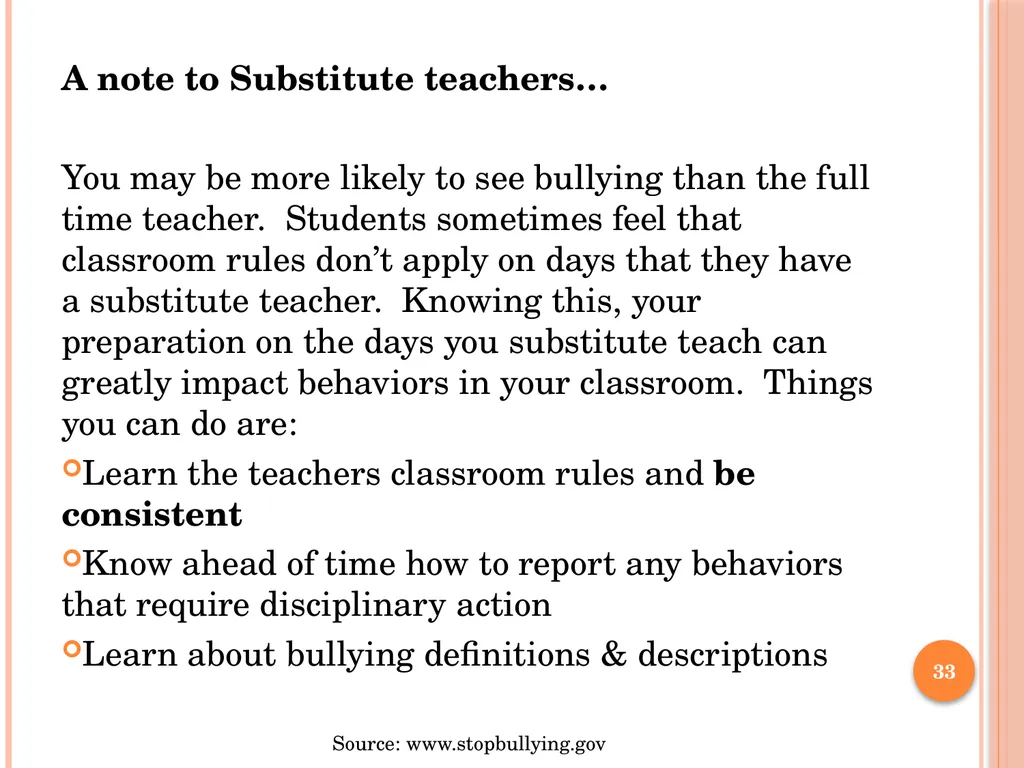
A note to Substitute teachers…
You may be more likely to see bullying than the full time teacher. Students sometimes feel that classroom rules don’t apply on days that they have a substitute teacher. Knowing this, your preparation on the days you substitute teach can greatly impact behaviors in your classroom. Things you can do are:
Learn the teachers classroom rules and be consistent
Know ahead of time how to report any behaviors that require disciplinary action
Learn about bullying definitions & descriptions
Source: www.stopbullying.gov 33<br>
You may be more likely to see bullying than the full time teacher. Students sometimes feel that classroom rules don’t apply on days that they have a substitute teacher. Knowing this, your preparation on the days you substitute teach can greatly impact behaviors in your classroom. Things you can do are:
Learn the teachers classroom rules and be consistent
Know ahead of time how to report any behaviors that require disciplinary action
Learn about bullying definitions & descriptions
Source: www.stopbullying.gov 33<br>
34
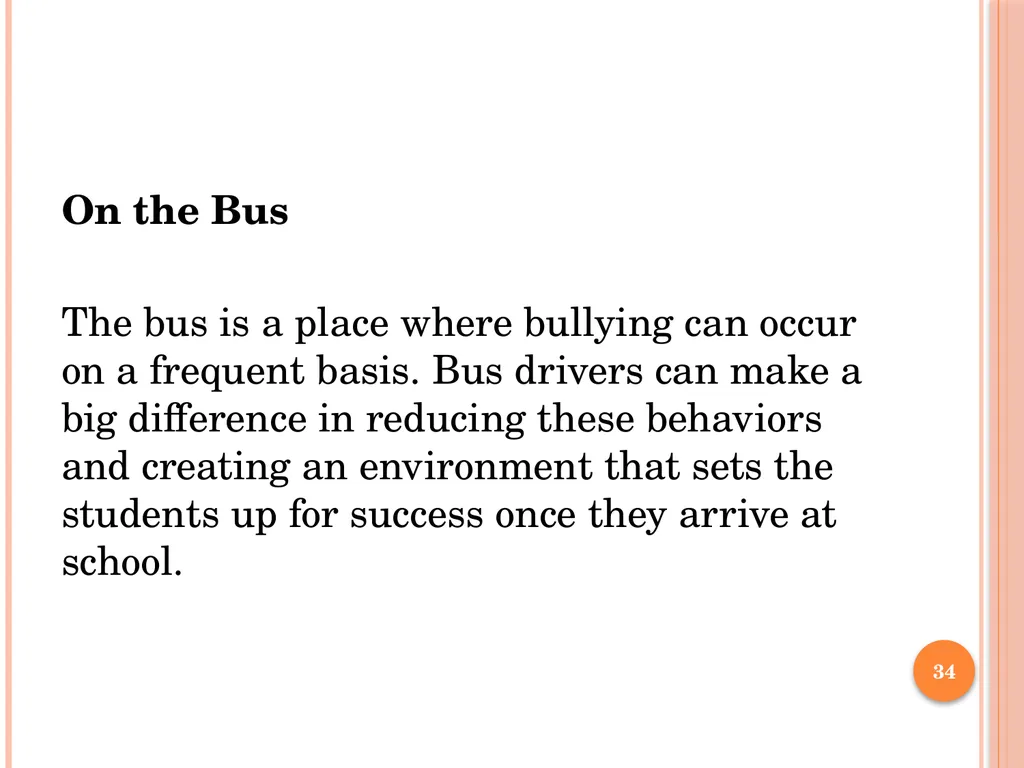
On the Bus
The bus is a place where bullying can occur on a frequent basis. Bus drivers can make a big difference in reducing these behaviors and creating an environment that sets the students up for success once they arrive at school. 34<br>
The bus is a place where bullying can occur on a frequent basis. Bus drivers can make a big difference in reducing these behaviors and creating an environment that sets the students up for success once they arrive at school. 34<br>
35
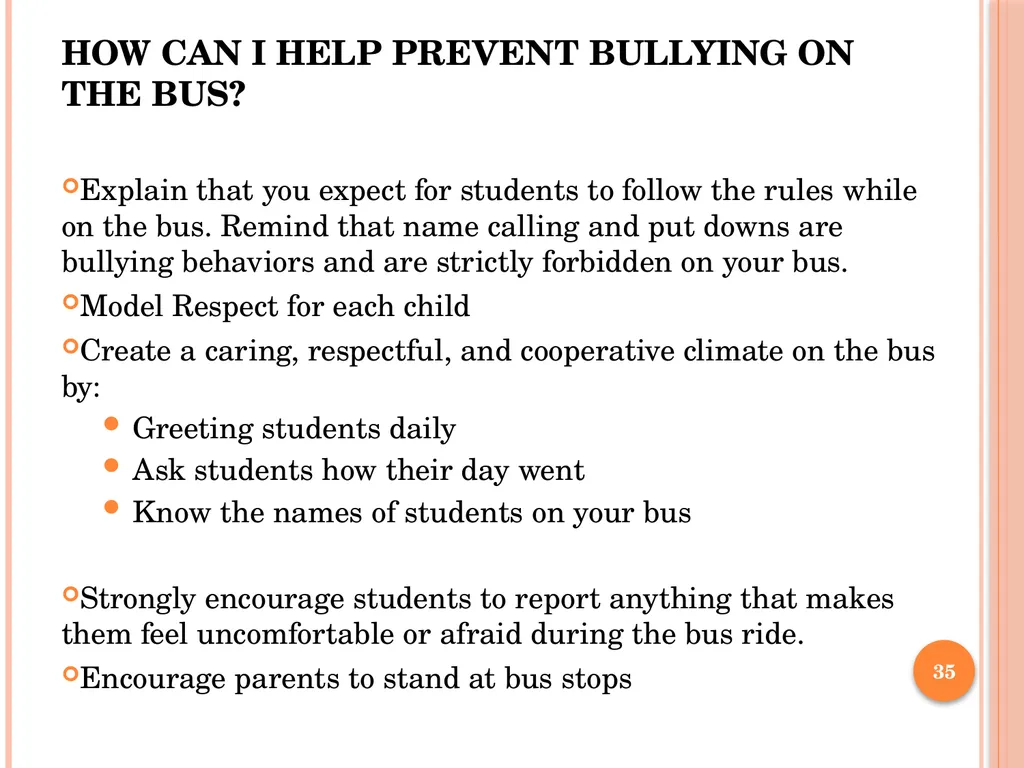
HOW CAN I HELP PREVENT BULLYING ON THE BUS?
Explain that you expect for students to follow the rules while on the bus. Remind that name calling and put downs are bullying behaviors and are strictly forbidden on your bus.
Model Respect for each child
Create a caring, respectful, and cooperative climate on the bus by:
Greeting students daily
Ask students how their day went
Know the names of students on your bus
Strongly encourage students to report anything that makes them feel uncomfortable or afraid during the bus ride.
Encourage parents to stand at bus stops 35<br>
Explain that you expect for students to follow the rules while on the bus. Remind that name calling and put downs are bullying behaviors and are strictly forbidden on your bus.
Model Respect for each child
Create a caring, respectful, and cooperative climate on the bus by:
Greeting students daily
Ask students how their day went
Know the names of students on your bus
Strongly encourage students to report anything that makes them feel uncomfortable or afraid during the bus ride.
Encourage parents to stand at bus stops 35<br>
36
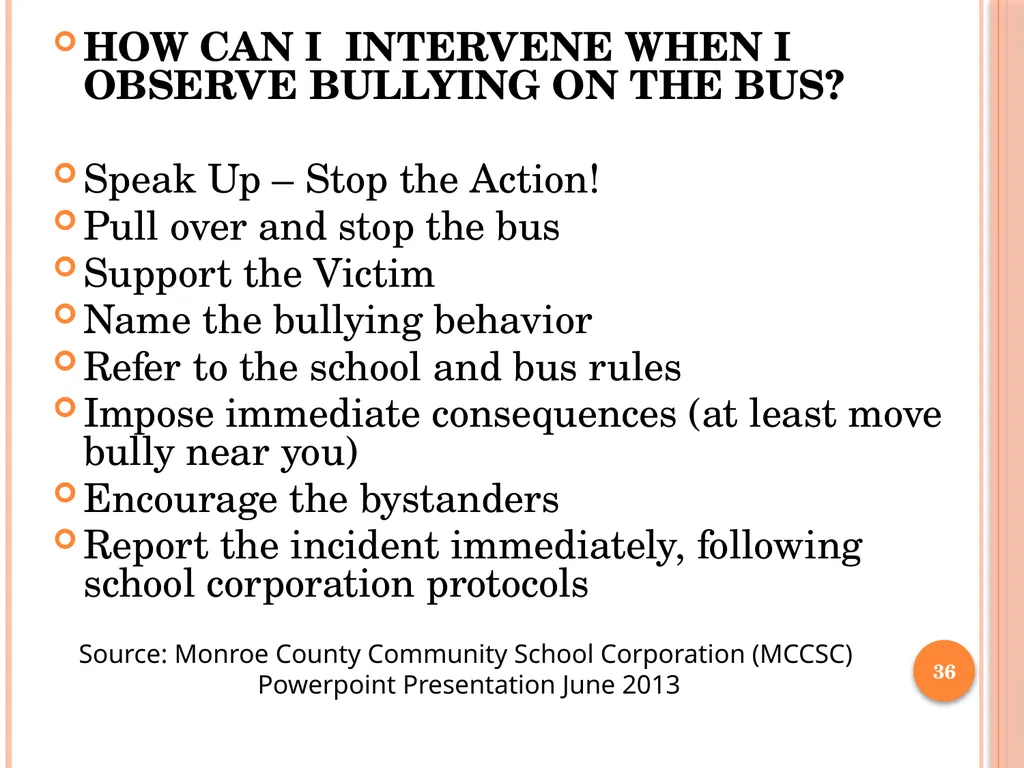
HOW CAN I INTERVENE WHEN I OBSERVE BULLYING ON THE BUS?
Speak Up – Stop the Action!
Pull over and stop the bus
Support the Victim
Name the bullying behavior
Refer to the school and bus rules
Impose immediate consequences (at least move bully near you)
Encourage the bystanders
Report the incident immediately, following school corporation protocols Source: Monroe County Community School Corporation (MCCSC)
Powerpoint Presentation June 2013 36<br>
Speak Up – Stop the Action!
Pull over and stop the bus
Support the Victim
Name the bullying behavior
Refer to the school and bus rules
Impose immediate consequences (at least move bully near you)
Encourage the bystanders
Report the incident immediately, following school corporation protocols Source: Monroe County Community School Corporation (MCCSC)
Powerpoint Presentation June 2013 36<br>
37
In the Hallways & Common Areas
Crowed hallways are environments that are capable of promoting aggressive behavior.
It is important for administrators to coordinate teachers and staff to insure an adequate level of supervision.
A key role can be played by custodians. The nature of their role in the school allows custodians to observe student behavior throughout the school building each day. 37<br>
Crowed hallways are environments that are capable of promoting aggressive behavior.
It is important for administrators to coordinate teachers and staff to insure an adequate level of supervision.
A key role can be played by custodians. The nature of their role in the school allows custodians to observe student behavior throughout the school building each day. 37<br>
38
HOW CAN I HELP PREVENT BULLYING IN THE HALLS?
Establish a culture of inclusion and respect that welcomes all students.
Maintain adequate supervision in hallways and common areas at all time
Role model a positive and respectful attitude when interacting with students
Be aware of “Hot Spots.” Bullying may be more likely to occur in areas with little or no adult supervision. 38<br>
Establish a culture of inclusion and respect that welcomes all students.
Maintain adequate supervision in hallways and common areas at all time
Role model a positive and respectful attitude when interacting with students
Be aware of “Hot Spots.” Bullying may be more likely to occur in areas with little or no adult supervision. 38<br>
39
HOW CAN I INTERVENE WHEN I OBSERVE BULLYING IN THE HALLS?
Calmly intervene. If the situation warrants it, get another adult to help.
Do not publically criticize the students involved
Follow your school’s incident reporting protocols.
Provide support for the victim if necessary.
Source: www.stopbullying.gov 39<br>
Calmly intervene. If the situation warrants it, get another adult to help.
Do not publically criticize the students involved
Follow your school’s incident reporting protocols.
Provide support for the victim if necessary.
Source: www.stopbullying.gov 39<br>
40
Remember….
It takes everyone working together to make your school a safe and supportive environment where every student feels welcome and ready to learn.
Learn about bullying and how it differs from other student behaviors.
Make sure you are well versed in your school’s bully incident reporting protocols.
Make the development of a positive school climate your priority. Promote it in the classroom and in the halls 40<br>
It takes everyone working together to make your school a safe and supportive environment where every student feels welcome and ready to learn.
Learn about bullying and how it differs from other student behaviors.
Make sure you are well versed in your school’s bully incident reporting protocols.
Make the development of a positive school climate your priority. Promote it in the classroom and in the halls 40<br>
41
Remember…. When you see something, do something.
Intervene by separating the students involved.
Get their names, but do not question students in front of other students.
Report the incident following your school’s guidelines.
The students can then be questioned individually.
Don’t try to resolve the incident on the spot
Don’t assume that students can work it out without adult help. They can’t.
Source: www.stopbullying.gov 41<br>
Intervene by separating the students involved.
Get their names, but do not question students in front of other students.
Report the incident following your school’s guidelines.
The students can then be questioned individually.
Don’t try to resolve the incident on the spot
Don’t assume that students can work it out without adult help. They can’t.
Source: www.stopbullying.gov 41<br>