
Business Research Methods . Unit – 1 Introduction





























Description: Business Research Methods . Unit 1 Introduction to Business Research Sai Ram B Lecturer Business Research Business Research Business Research refers to the systematic process of gathering, analyzing, interpreting and applying information
Related Topics
Download Presentation
"Business Research Methods . Unit – 1 Introduction" is the property of its rightful owner. Permission is granted to download and print the materials on this website for personal, non-commercial use only, and to display it on your personal computer provided you do not modify the materials and that you retain all copyright notices contained in the materials. By downloading content from our website, you accept the terms of this agreement.
Presentation Transcript
slide1. Business Research Methods
.
Unit – 1
Introduction to Business Research Sai Ram B
Lecturer<br>
slide2. Business Research<br>
slide3. Business Research Business Research refers to the systematic process of gathering, analyzing, interpreting and applying information to gain insights into various aspects of the business environment.
It is conducted to make informed decisions, solve problems, identify opportunities and enhance the overall effectiveness and efficiency of a business.<br>
slide4. Business Research Business research can cover a wide range of topics and areas that includes market trends, customer behavior, competition analysis, product development, financial performance, strategic planning and more.<br>
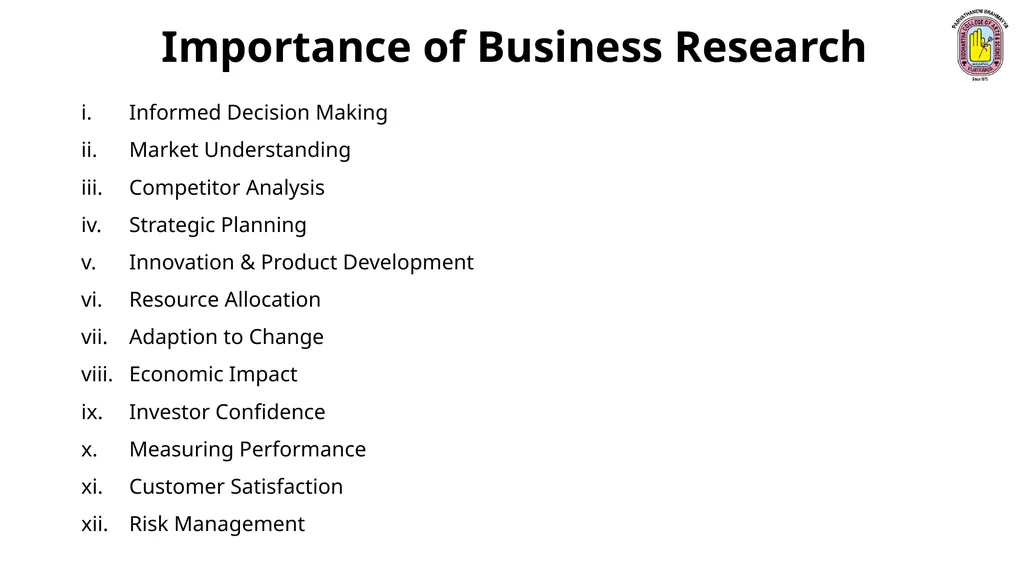
slide5. Importance of Business Research Business Research holds significant importance in various aspects of the corporate world. It helps organizations to make informed decisions, understand market trends, develop effective strategies and enhance their overall performance.
Here are some key reasons why business research is important:<br>
slide6. Importance of Business Research Informed Decision Making
Market Understanding
Competitor Analysis
Strategic Planning
Innovation & Product Development
Resource Allocation
Adaption to Change
Economic Impact
Investor Confidence
Measuring Performance
Customer Satisfaction
Risk Management<br>
slide7. Importance of Business Research In essence, business research empowers organizations to make sound decisions, stay competitive and navigate the complex and dynamic business landscape effectively. It enables companies to stay ahead of the curve, innovate and achieve sustainable growth over time.<br>
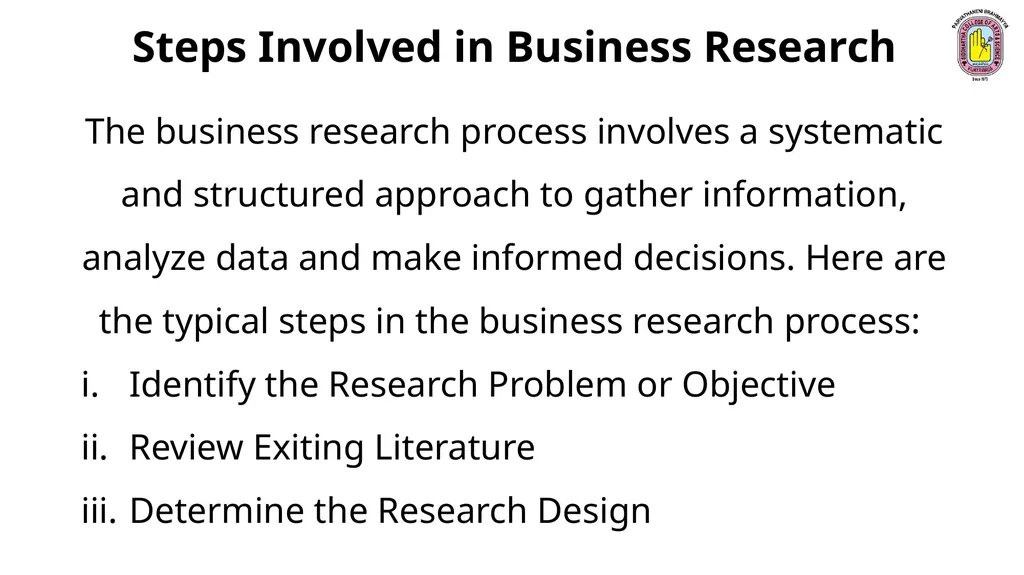
slide8. Steps Involved in Business Research The business research process involves a systematic and structured approach to gather information, analyze data and make informed decisions. Here are the typical steps in the business research process:
Identify the Research Problem or Objective
Review Exiting Literature
Determine the Research Design<br>
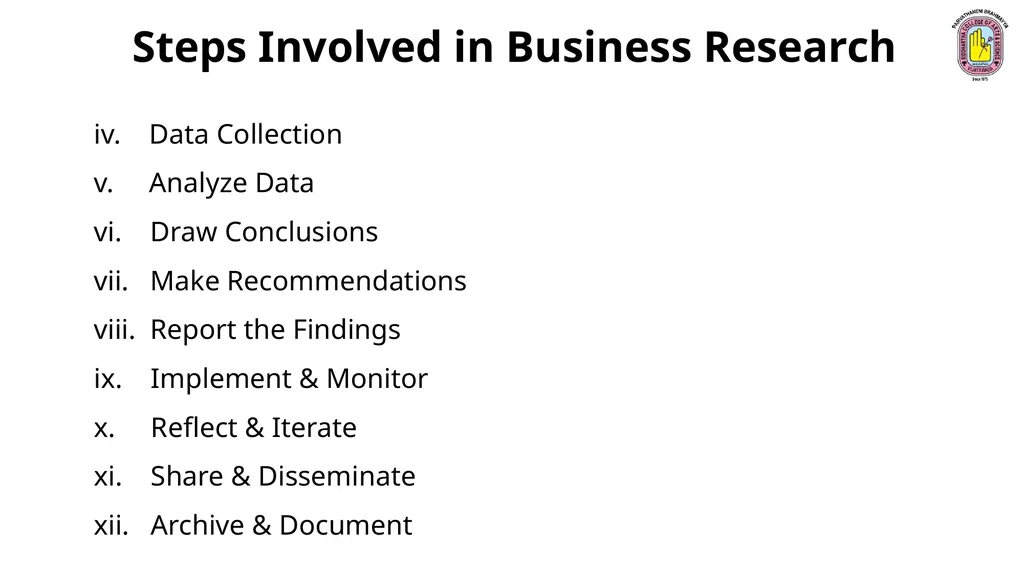
slide9. Steps Involved in Business Research iv. Data Collection
v. Analyze Data
vi. Draw Conclusions
vii. Make Recommendations
viii. Report the Findings
ix. Implement & Monitor
x. Reflect & Iterate
xi. Share & Disseminate
xii. Archive & Document<br>
slide10. Scope of Business Research The scope of business research is quite broad and encompasses various aspects of the business world. Business research is conducted to gather information, analyze data and generate insights that can be used to make informed decisions and solve business-related problems.<br>
slide11. Scope of Business Research Here are some key areas within the scope of business research:
Market Research
Marketing Research
Strategic Planning
Financial Analysis
Operations Research
Human Resources Research
Organizational Behavior<br>
slide12. Scope of Business Research ix. International Business Research
x. Business Ethics and Corporate Social Responsibility
xi. Information Technology and E-Business
xii. Risk Management
xiii. Small Business and Entrepreneurship
xiv. Supply Chain Management
xv. Business Policy & Government Regulations<br>
slide13. Scope of Business Research The scope of business research continues to evolve as new technologies, economic trends and global developments emerge.
Researchers and businesses alike benefit from staying up-to-date with the latest research methodologies and trends within their specific areas of interest. Ultimately, the goal of business research is to provide actionable insights that can lead to improved decision-making and business success.<br>
slide14. Ethics in Business Research Ethics in business research is a critical aspect of conducting meaningful and responsible research within the business world. Ethical considerations are essential to ensure that research is conducted with integrity, transparency and respect for all stakeholders involved.
Here are some key principles and considerations for ethics in business research:<br>
slide15. Ethics in Business Research Here are some key principles and considerations for ethics in business research:
Informed Consent
Privacy & Confidentiality
Data Integrity
Transparency
Respect for Diversity
Minimizing Harm<br>
slide16. Ethics in Business Research Compliance with Laws and Regulations
Avoiding Plagiarism
Peer Review
Ethical Leadership
Whistleblower Protection
Long-Term Consequences<br>
slide17. Ethics in Business Research Ethics in business research is not only about following rules and regulations but also about upholding ethical principles that promote the responsible and ethical conduct of research. Adhering to these principles fosters trust, credibility, and the long-term success of both the research and the business community as a whole.<br>
slide19. Business Research Methods . Unit – II Research Design Sai Ram B Lecturer<br>
slide20. Meaning of Research Design The Research Design is the conceptual structure within which research is conducted; it constitutes the blueprint for the collection, measurement and analysis of data. As such the design includes an outline of what the researcher will do from writing the hypothesis and its operational implications to the final analysis of data.
More explicitly, the desing decisions happen to be in respect of:
A. What is the study about?<br>
slide21. Research Design B. Why is the study being made?
C. Where will the study be carried out?
D. What type of data is required?
E. Where can the required data be found?
F. What periods of time will the study include?
G. What will be the sample design?
H. What techniques of data collection will be used?
I. How will the data be analysed?
J. In what style will the report be prepared?<br>
slide22. Research Design B. Why is the study being made?
C. Where will the study be carried out?
D. What type of data is required?
E. Where can the required data be found?
F. What periods of time will the study include?
G. What will be the sample design?
H. What techniques of data collection will be used?
I. How will the data be analysed?
J. In what style will the report be prepared?<br>
slide23. Elements of Research Methodology i. Clear statement of Research Problem
ii. Clear objectives
iii. Literature Review
iv. Timeline
v. The population to be studied
vi. The sample to be studied
vii. Procedures and techniques to be used for gathering information
viii. Methods to be used in processing and analyzing the data
ix. Measurement of the Analysis<br>
slide24. Research Design and Its Importance Research Design referred as a masterplan, blueprint and even as a sequence of research tasks and activities. Research design in simple terms is a plan of the methods and procedures that is used by researchers to collect and analyze the data needed by the manager.
The research design provides a plan of how the researcher will go about answering the research question(s) defined by the manager and researcher together (clearly defining the problem into a researchable question is extremely important).<br>
slide25. Research Design and Its Importance The research design also contains clear objectives, derived from research question(s), specify the information sources from which data will be collected, the type of data, the design technique(s) (survey, observation, experimentation etc.), the sampling methodology and procedures, the schedule and the budget. There should be clear justification with regard to the research design based on the research question and objectives.<br>
slide26. Research Design and Its Importance As stated above, the purpose of any research design is to obtain evidence which addresses the research question and objectives. Usually, however, there are a number of ways in which it can be achieved. Although, every research question is unique, most research objectives can be met by using one of the three types of research designs: exploratory, descriptive and causal.<br>
slide27. Research Design and Its Importance Research design holds all the parts and phases of the research project together. A poorly developed design fails to provide accurate answers to the research question under investigation and in turn does not assist the manager in the decision making process. The foundations of research design are firmly based on scientific rigour and objectivity. Any personal, procedural or methodological bias involved in research design will have an impact on entire research process. Therefore, developing a sound research design is an extremely important aspect of any research project.<br>
slide28. Types of Research Design I. Exploratory Research Design
II. Descriptive Research Design
III. Experimental Research Design<br>
slide29. Exploratory Research Design Exploratory research design is a type of research methodology used when the researcher is attempting to explore a new topic or gain preliminary insights into a research problem. It is particularly useful when the topic is relatively uncharted and there is limited existing information or knowledge.
Exploratory research is often the first step in the research process and it helps researchers formulate hypotheses and develop a more focused research design in subsequent stages.<br>
slide30. Characteristics & Methods - Exploratory Research Design Objective: The primary objective of exploratory research is to gain a better understanding of the research problem. It aims to explore, describe, and identify potential variables or factors that may influence the phenomenon under investigation.
Flexibility: Exploratory research is characterized by flexibility in data collection methods and the absence of a rigid research structure. Researchers can use various techniques and adapt their approach as they gather insights.<br>
slide31. Characteristics & Methods - Exploratory Research Design Qualitative Methods: Qualitative research methods are commonly used in exploratory research. These methods include in-depth interviews, focus groups, content analysis, and ethnographic observations. They allow researchers to gather rich, descriptive data and explore the thoughts, feelings, and perspectives of participants.
Small Sample Size: Exploratory research often involves a smaller sample size compared to other research designs. The emphasis is on depth rather than breadth of data.<br>
slide32. Characteristics & Methods - Exploratory Research Design Open-Ended Questions: Researchers use open-ended questions to encourage participants to express their views and ideas freely. This allows for the discovery of unexpected insights.
No Hypotheses: In exploratory research, researchers typically do not start with specific hypotheses. Instead, they generate hypotheses or research questions based on the data collected during the exploratory phase.<br>
slide33. Characteristics & Methods - Exploratory Research Design Preliminary Data Analysis: Researchers engage in preliminary data analysis as data is collected. This helps them identify emerging patterns, themes, or areas of interest.
Literature Review: While exploratory research is often conducted when there is limited existing literature, a preliminary review of relevant literature may still be useful to understand the broader context and existing knowledge gaps.<br>
slide34. Characteristics & Methods - Exploratory Research Design Iterative Process: Exploratory research is often an iterative process. Initial findings may lead to further exploration and refinement of research questions.
Insight Generation: The primary output of exploratory research is insights and a deeper understanding of the research problem. These insights can guide the development of hypotheses for subsequent confirmatory research.<br>
slide35. Characteristics & Methods - Exploratory Research Design Feasibility Assessment: Exploratory research can help assess the feasibility of conducting a larger-scale research study. It can inform decisions about the need for additional data collection or the direction of future research.
Report Findings: Researchers should document and report their exploratory research findings, even if they are preliminary. This documentation can serve as a foundation for further research or as a valuable contribution in itself.<br>
slide36. Exploratory Research Design Exploratory research is particularly useful in the early stages of a research project, helping researchers refine their research questions and hypotheses. It can be a valuable tool for generating new ideas and insights, especially in areas where little is known or understood.<br>
slide37. Descriptive Research Design Descriptive research design is a type of research methodology that focuses on observing, documenting, and describing the characteristics of a particular phenomenon or group of individuals. It is primarily concerned with providing an accurate and detailed account of what is happening, without attempting to explain why or how it is happening.
Descriptive research often used when the researcher's goal is to obtain a snapshot of a situation, population or event.<br>
slide38. Characteristics & Methods Descriptive Research Design Objective: The primary objective of descriptive research is to provide an accurate and comprehensive description of a phenomenon. It aims to answer questions about who, what, when, where and how.
No Manipulation: Unlike experimental research, where variables are manipulated to establish cause-and-effect relationships, descriptive research does not involve manipulation of variables. It is purely observational.<br>
slide39. Characteristics & Methods Descriptive Research Design Quantitative or Qualitative: Descriptive research can use both quantitative and qualitative methods. Quantitative methods involve collecting numerical data through surveys, questionnaires, and structured observations, while qualitative methods use open-ended interviews, focus groups, and content analysis to gather detailed, non-numerical information.
Surveys and Questionnaires: Surveys and questionnaires are common tools in descriptive research, especially when collecting data from large samples. They use structured questions to gather quantitative data.<br>
slide40. Characteristics & Methods Descriptive Research Design Observations: Researchers may directly observe and record behavior, events, or phenomena of interest. Observations can be participant (researcher is directly involved) or non-participant (researcher observes from a distance).
Case Studies: Descriptive research often involves case studies, where researchers closely examine a single individual, group, organization, or event in-depth. This method is useful for gaining a detailed understanding of a specific case.<br>
slide41. Characteristics & Methods Descriptive Research Design Sampling: Researchers select a sample that is representative of the larger population they are studying. Sampling methods may include random sampling, stratified sampling, or convenience sampling, depending on the research objectives.
Data Analysis: Data collected in descriptive research are analyzed using basic statistical techniques (for quantitative data) or thematic analysis (for qualitative data). The goal is to summarize and describe the data accurately.<br>
slide42. Characteristics & Methods Descriptive Research Design Cross-Sectional or Longitudinal: Descriptive research can be cross-sectional (data collected at a single point in time) or longitudinal (data collected over a period of time to track changes).
Report Findings: The primary output of descriptive research is a detailed and objective description of the phenomenon under study. Findings are typically presented in reports, articles, or presentations.
Limitations: Descriptive research does not establish causal relationships or explain why certain patterns or behaviors exist. It is limited to providing a snapshot of the situation as it is observed.<br>
slide43. Characteristics & Methods Descriptive Research Design Useful for Initial Exploration: Descriptive research is often used as an initial step in the research process. It can help researchers generate hypotheses or research questions for future studies.
Examples of descriptive research include surveys that measure the demographic characteristics of a population, observational studies that describe behaviors in natural settings, and case studies that provide detailed accounts of specific individuals or events.<br>
slide44. Experimental Research Design Experimental research design is a scientific approach used to investigate cause-and-effect relationships between variables. It involves the manipulation of one or more independent variables to observe their impact on a dependent variable while controlling for extraneous factors. Experimental research is highly structured and is characterized by its emphasis on control, randomization and replication.<br>
slide45. Characteristics & Methods Experimental Research Design Manipulation of Variables: Experimental research involves manipulating one or more independent variables, which are factors that researchers believe may influence the dependent variable. The goal is to determine whether changes in the independent variable(s) cause changes in the dependent variable.
Control Group: Experiments often include a control group, which serves as a baseline for comparison. The control group does not receive the experimental treatment or manipulation and is used to assess the natural variation in the dependent variable.<br>
slide46. Characteristics & Methods Experimental Research Design Randomization: Random assignment of participants to different experimental groups or conditions helps ensure that the groups are comparable and that extraneous variables are equally distributed. Randomization enhances the internal validity of the study.
Independent and Dependent Variables: The independent variable(s) are the factors being manipulated, while the dependent variable is the outcome or response being measured. The relationship between the independent and dependent variables is central to the experiment.<br>
slide47. Characteristics & Methods Experimental Research Design Experimental and Control Groups: Participants are divided into experimental groups (those exposed to the independent variable) and control groups (those not exposed to the independent variable or receiving a placebo).
Hypothesis Testing: Experimental research typically involves testing a specific hypothesis about the expected relationship between the independent and dependent variables. The hypothesis is a clear statement of what the researcher expects to find.<br>
slide48. Characteristics & Methods Experimental Research Design Random Sampling: In addition to random assignment, researchers often use random sampling to select a representative sample from the population of interest. Random sampling increases the external validity of the findings.
Pre and Post Testing: Experimental research often includes both pre-testing (measuring the dependent variable before the manipulation) and post-testing (measuring the dependent variable after the manipulation) to assess changes.<br>
slide49. Characteristics & Methods Experimental Research Design Control of Extraneous Variables: Researchers take measures to control extraneous variables, which are variables other than the independent variable that could influence the dependent variable. Control may involve experimental design, statistical techniques, or constant monitoring.
Replication: Replicating the experiment with different samples or under different conditions is essential to validate the findings and ensure their reliability.<br>
slide50. Characteristics & Methods Experimental Research Design Blinding: To minimize bias, researchers may use single-blind or double-blind procedures. In a single-blind study, participants are unaware of their group assignment, while in a double-blind study, both participants and researchers are unaware of group assignment.
Statistical Analysis: Experimental data are often analyzed using statistical tests to determine if the observed differences between groups are statistically significant and not due to chance.<br>
slide51. Characteristics & Methods Experimental Research Design Ethical Considerations: Researchers must adhere to ethical guidelines, obtain informed consent from participants and ensure that the study does not harm participants physically or psychologically.
Reporting of Findings: Experimental research reports include detailed descriptions of the methods, results and conclusions. Researchers should transparently report both significant and non-significant findings.<br>
slide52. Experimental Research Design Experimental research design is widely used in fields such as psychology, biology, medicine and social sciences to establish causal relationships and test hypotheses. Its rigorous structure and controlled environment make it a powerful method for scientific inquiry.<br>
slide53. Features of a Good Research Design A good research design is critical to ensuring that a study is conducted in a systematic and rigorous way and that it produces valid and reliable results.
Here are some features of a good research design:
(i) Clear Research Question: A good research design should start with a clear research question or hypothesis that is specific, measurable and relevant to the research topic. The research question should be clearly defined and the design should be developed to address this question.<br>
slide54. Features of a Good Research Design (ii) Appropriate Research Methods: The research design should use appropriate methods for data collection, such as surveys, experiments, case studies or other methods, based on the research question and the type of data needed. The methods should be selected carefully to ensure that they are reliable and valid for the research question.<br>
slide55. Features of a Good Research Design (iii) Sample Selection: A good research design should have a clear and appropriate sampling strategy for selecting participants or cases. The sample should be representative of the population being studied and the sample size should be appropriate for the research question and methods.<br>
slide56. Features of a Good Research Design (iv) Data Analysis: A good research design should include appropriate methods for data analysis, such as statistical tests, qualitative analysis or mixed methods. The analysis should be clearly defined and linked to the research question, and the results should be reported in a clear and transparent way.<br>
slide57. Features of a Good Research Design (v) Ethical Considerations: A good research design should consider ethical issues such as informed consent, confidentiality, and the protection of human subjects. The design should follow ethical guidelines and procedures, and should be reviewed and approved by an Institutional Review Board (IRB) or other ethics committee.<br>
slide58. Features of a Good Research Design (vi) Replicability: A good research design should be replicable by other researchers. The design should include clear and detailed procedures, methods and data collection instruments that can be used by others to reproduce the study.
(vii) Time and Resources: A good research design should consider the time and resources needed for data collection, analysis and reporting. The design should be feasible and realistic, given the available resources and time constraints.<br>
slide60. Business Research Methods . Unit – III Data Collection Sai Ram B Lecturer<br>
slide61. Primary Data Primary data in research refers to data that is collected directly from original sources or firsthand observations for a specific research purpose. This data is new and has not been previously collected or published by others. Researchers gather primary data to address their research questions or objectives. Common methods of collecting primary data include surveys, experiments, interviews, observations, and fieldwork.
Primary data is collected by researchers themselves or their team and is often tailored to address the specific research questions or objectives.<br>
slide62. Primary Data - Characteristics Originality: Primary data is new and collected for a particular research project, making it unique to that study.
Relevance: Researchers can design the data collection methods to ensure the data gathered is directly related to their research objectives.
Control: Researchers have control over the data collection process, allowing them to make decisions about the research design and methodology.<br>
slide63. Primary Data - Characteristics Reliability: Researchers can apply rigorous data collection techniques to ensure the data's accuracy and reliability.
Customization: Primary data can be customized to gather information on specific variables or factors of interest.<br>
slide64. Primary Data – Sources or Collection Methods Surveys: Researchers create questionnaires or conduct interviews to collect data directly from individuals or groups. This data can include opinions, preferences, and demographic information.
Experiments: Researchers manipulate variables and observe the effects to collect data on cause-and-effect relationships.
Observations: Researchers watch and record behavior, events, or phenomena as they naturally occur, either through participant observation (actively participating in the observed activity) or non-participant observation (observing without direct involvement).<br>
slide65. Primary Data – Sources or Collection Methods Interviews: Researchers conduct structured or unstructured interviews to gather in-depth information and insights from participants.
Fieldwork: This involves going to the field or a specific location to collect data, such as anthropological fieldwork, ecological studies, or geological surveys.
Case studies: Researchers examine specific cases or individuals in-depth to gain insights and understanding about a particular phenomenon.<br>
slide66. Primary Data – Sources or Collection Methods By collecting primary data, researchers can tailor their methods and questions to suit their research goals, ensuring that the information gathered is directly relevant to their study.<br>
slide67. Primary Data - Advantages • The primary data are original and relevant to the topic of the research study so the degree of accuracy is very high.
• Primary data is that it can be collected from a number of ways like interviews, telephone surveys, focus groups etc. It can be also collected across the national borders through emails and posts. It can include a large population and wide geographical coverage.
• Moreover, primary data is current and it can better give a realistic view to the researcher about the topic under consideration.<br>
slide68. Primary Data - Advantages • Reliability of primary data is very high because these are collected by the concerned and reliable party.<br>
slide69. Primary Data - Disadvantages • For collection of primary data where interview is to be conducted the coverage is limited and for wider coverage a more number of researchers are required.
• A lot of time and efforts are required for data collection. By the time the data collected, analyzed and report is ready the problem of the research becomes very serious or out dated. So the purpose of the research may be defeated.
• It has design problems like how to design the surveys. The questions must be simple to understand and respond.<br>
slide70. Primary Data - Disadvantages • Some respondents do not give timely responses. Sometimes, the respondents may give fake, socially acceptable and sweet answers and try to cover up the realities. With more people, time and efforts involvement the cost of the data collection goes high. The importance of the research may go down.
• In some primary data collection methods there is no control over the data collection. Incomplete questionnaire always give a negative impact on research.<br>
slide71. Process of Designing a Questionnaire Designing a questionnaire is a crucial step in gathering information for research or obtaining feedback. Here are the steps involved in preparing a questionnaire:
Define Your Objectives: Clearly outline the purpose of your questionnaire. Identify the specific information or data you want to gather.
Identify Your Target Audience: Understand who will be responding to the questionnaire. Tailor your questions to the characteristics and preferences of your target audience.<br>
slide72. Process of Designing a Questionnaire Choose the Questionnaire Type: Decide on the type of questionnaire you will use, such as open-ended, closed-ended, or a mix of both. Open-ended questions allow for more detailed responses, while closed-ended questions provide specific answer choices.
Create an Outline: Develop a rough outline of the topics or themes you want to cover in the questionnaire. Arrange questions logically to ensure a smooth flow.
Write Clear and Concise Questions: Formulate questions that are easy to understand. Avoid using jargon or complex language. Be specific and unambiguous to prevent confusion.<br>
slide73. Process of Designing a Questionnaire Use a Mix of Question Types: Include a variety of question types, such as multiple-choice, Likert scales, ranking, and open-ended, to gather diverse data. Mix simple and complex questions, but ensure they are all relevant to your objectives.
Consider Question Order: Arrange questions in a logical order to maintain a smooth flow. Start with easy and non-threatening questions to encourage participation. Place demographic and sensitive questions towards the end.<br>
slide74. Process of Designing a Questionnaire Review and Revise: Review the questionnaire for clarity, relevance, and coherence. Revise questions as needed based on the feedback from the pilot test.
Include Instructions: Provide clear instructions on how to complete the questionnaire. Include any necessary context for specific questions.
Add a Welcome and Thank You: Start with a brief introduction explaining the purpose of the questionnaire. Express gratitude at the end for the respondent's time and input.<br>
slide75. Process of Designing a Questionnaire Finalize the Questionnaire: Make any final adjustments based on feedback and testing. Ensure that the questionnaire is within a reasonable length to maintain participant engagement.
Distribute and Collect Responses: Choose the appropriate method for distributing the questionnaire (online, in-person, via mail, etc.). Set a deadline for responses.
Data Analysis Plan: Plan how you will analyze the collected data, whether through statistical analysis, coding open-ended responses, or other methods.<br>
slide76. Process of Designing a Questionnaire Finalize the Questionnaire: Make any final adjustments based on feedback and testing. Ensure that the questionnaire is within a reasonable length to maintain participant engagement.
Distribute and Collect Responses: Choose the appropriate method for distributing the questionnaire (online, in-person, via mail, etc.). Set a deadline for responses.
Data Analysis Plan: Plan how you will analyze the collected data, whether through statistical analysis, coding open-ended responses, or other methods.<br>
slide77. Process of Designing a Questionnaire Ethical Considerations: Ensure that your questionnaire adheres to ethical guidelines, particularly regarding confidentiality and informed consent.
By following these steps, one can create a well-structured questionnaire that effectively gathers the required information.<br>
slide78. Questionnaire Vs. Schedule Both Questionnaire and Schedule are popularly used methods of collecting data in research surveys. There is much resemblance in the nature of these two methods and this fact has made many people to remark that from a practical point of view, the two methods can be taken to be the same. But from the technical point of view there is difference between the two. The important points of difference are as under:<br>
slide79. Questionnaire Vs. Schedule 1. The questionnaire is generally sent through mail to informants to be answered as specified in a covering letter, but otherwise without further assistance from the sender. The schedule is generally filled out by the research worker or the enumerator, who can interpret questions when necessary.<br>
slide80. Questionnaire Vs. Schedule 2. To collect data through questionnaire is relatively cheap and economical since we have to spend money only in preparing the questionnaire and in mailing the same to respondents. Here no field staff required. To collect data through schedules is relatively more expensive since considerable amount of money has to be spent in appointing enumerators and in importing training to them. Money is also spent in preparing schedules.<br>
slide81. Questionnaire Vs. Schedule 3. Non-response is usually high in case of questionnaire as many people do not respond and many return the questionnaire without answering all questions. Bias due to non-response often remains indeterminate. As against this, non-response is generally very low in case of schedules because these are filled by enumerators who are able to get answers to all questions. But there remains the danger of interviewer bias and cheating.<br>
slide82. Questionnaire Vs. Schedule 4. In case of questionnaire, it is not always clear as to who replies, but in case of schedule the identity of respondent is known.
5. The questionnaire method is likely to be very slow since many respondents do not return the questionnaire in time despite several reminders, but in case of schedules the information is collected well in time as they are filled in by enumerators.<br>
slide83. Questionnaire Vs. Schedule 6. Personal contact is generally not possible in case of the questionnaire method as questionnaires are sent to respondents by post who also in turn return the same by post. But in case of schedules direct personal contact is established with respondents.
7. Questionnaire method can be used only when respondents are literate and cooperative, but in case of schedules the information can be gathered even when the respondents happen to be illiterate.<br>
slide84. Questionnaire Vs. Schedule 8. Wider and more representative distribution of sample is possible under the questionnaire method, but in respect of schedules there usually remains the difficulty in sending enumerators over a relatively wider area.
9. The success of questionnaire method lies more on the quality of the questionnaire itself, but in the case of schedules much depends upon the honesty and competence of enumerators.<br>
slide85. Questionnaire Vs. Schedule 10. Risk of collecting incomplete and wrong information is relatively more under the questionnaire method, particularly when people are unable to understand questions properly. But in case of schedules, the information collected is generally complete and accurate as enumerators can remove the difficulties, if any, faced by respondents in correctly understanding the questions. As a result, the information collected through schedules is relatively more accurate than that obtained through questionnaires.<br>
slide86. Questionnaire Vs. Schedule 11. In order to attract the attention of respondents, the physical appearance of questionnaire must be quite attractive, but this may not be so in case of schedules as they are to be filled in by enumerators and not by respondents.
12. Along with schedules, observation method can also be used but such a thing is not possible while collecting data through questionnaires.<br>
slide87. Secondary Data Secondary data means data that are already available i.e., they refer to the data which have already been collected and analysed by someone else. When the researcher utilises secondary data, then he has to look into various sources from where he can obtain them. In this case he is certainly not confronted with the problems that are usually associated with the collection of original data. Secondary data may either be published data or unpublished data.
Key characteristics of Secondary Data in research include:<br>
slide88. Secondary Data - Characteristics • Reliability: The reliability can be tested by finding out such things about the said data: (a) Who collected the data (b) What were the sources of data? (c) Were data collected by using proper methods? (d) At what time were they collected? (e) Was there any bias of the compiler? (f) What level of accuracy was desired? Was it achieved?<br>
slide89. Secondary Data - Characteristics • Suitability of data: The data that are suitable for one enquiry may not be necessarily be found suitable in another enquiry. Hence, if the available data are found to be unsuitable, they should not be used by the researcher. In this context, researcher must very carefully scrutinize the definition of various terms and units of collection used at the time of collecting the data from the primary source originally. Similarly, the object, scope and nature of the original enquiry must also be studied. If the researcher finds differences in these, the data will remain unsuitable for the present enquiry and should not be used.<br>
slide90. Secondary Data - Characteristics • Adequacy of data: If the level of accuracy achieved in data is found inadequate for the purpose of the present enquiry, they will be considered as inadequate and should not be used by the researcher. The data will be considered inadequate if they are related to an area which may be either narrow or wider than the area of the present enquiry.<br>
slide91. Secondary Data - Merits • Use of secondary data is very convenient. • It saves time and finance. • In some enquiries primary data cannot be collected. • Reliable secondary data are generally available for many investigations.<br>
slide92. Secondary Data - Limitations • It is very difficult to find sufficiently accurate secondary data. • It is very difficult to find secondary data which exactly fulfils the need of present investigation. • Extra caution is required to use secondary data. • These are not available for all types of enquiries.<br>
slide93. Secondary Data – Internal Sources If available, internal secondary data may be obtained with less time, effort and money than the external secondary data. In addition, they may also be more pertinent to the situation at hand since they are from within the organization. The internal sources include,
• Accounting resources: This gives so much information which can be used by the marketing researcher. They give information about internal factors.<br>
slide94. Secondary Data – Internal Sources • Sales Force Report: It gives information about the sale of a product. The information provided is of outside the organization.
• Internal Experts: These are people who are heading the various departments. They can give an idea of how a particular thing is working
• Miscellaneous Reports: These are what information you are getting from operational reports.<br>
slide95. Secondary Data – External Sources External Sources are sources which are outside the company in a larger environment. Collection of external data is more difficult because the data have much greater variety and the sources are much more numerous. External data can be divided into following classes:<br>
slide96. Secondary Data – External Sources • Govt. Publications: Government sources provide an extremely rich pool of data for the researchers. In addition, many of these data are available free of cost on internet websites. The Central Statistical Organization (CSO) and various state govt. collect, compile and publish data on regular basis.
• Semi Govt. Publications: Semi govt. organizations municipalities, District Boards and others also publish reports in respect of birth, death and education, sanitation and many other related fields.<br>
slide97. Secondary Data – External Sources • International Bodies: All foreign governments and international agencies publish regular reports of international significance. These reports are regularly published by the agencies like; United Nations Organization, International Labour Organization, World Meteorological Organization etc.<br>
slide98. Secondary Data – External Sources • Reports of Committee and Commissions: Central govt. or State govt. sometimes appoints committees and commissions on matters of great importance. Reports of such committees are of great significance as they provide invaluable data. These reports are like, Shah Commission Report, Sarkaria Commission Report and Finance Commission Reports etc.<br>
slide99. Secondary Data – External Sources • Private Publications: Some commercial and research institutes publish reports regularly. They are like Institutes of Economic Growth, Stock Exchanges, National Council of Education Research and Training (NCERT), National Council of Applied Economic Research (NCAER) etc.
• Newspapers and Magazines: Various newspapers as well as magazines also do collect data in respect of many social and economic aspects.<br>
slide100. Secondary Data – External Sources • Research Scholars: Individual research scholars collect data to complete their research work which further is published with their research papers.<br>
slide101. Secondary Data – External Sources • Research Scholars: Individual research scholars collect data to complete their research work which further is published with their research papers.<br>
slide103. Business Research Methods . Unit – III Sampling Design Sai Ram B Lecturer<br>
slide104. Sampling Sampling is the process of selecting a small number of elements from a larger defined target group of elements such that the information gathered from the small group will allow judgments to be made about the larger groups.<br>
slide105. Steps in Sampling An operational sampling process can be divided into seven steps as given below:
• Defining the target population.
• Specifying the sampling frame.
• Specifying the sampling unit.
• Selection of the sampling method.
• Determination of sample size.
• Specifying the sampling plan.
• Selecting the sample.<br>
slide106. Steps in Sampling – Defining the Target Population Defining the population of interest, for business research, is the first step in sampling process. In general, target population is defined in terms of element, sampling unit, extent, and time frame. The definition should be in line with the objectives of the research study.
For example, if a kitchen appliances firm wants to conduct a survey to ascertain the demand for its micro ovens, it may define the population as ‘all women above the age of 20 who cook (assuming that very few men cook)’.<br>
slide107. Steps in Sampling – Defining the Target Population However this definition is too broad and will include every household in the country, in the population that is to be covered by the survey. Therefore the definition can be further refined and defined at the sampling unit level, that, all women above the age 20, who cook and whose monthly household income exceeds Rs.20,000. This reduces the target population size and makes the research more focused. The population definition can be refined further by specifying the area from where the researcher has to draw his sample, that is, households located in Hyderabad.<br>
slide108. Steps in Sampling – Defining the Target Population A well-defined population reduces the probability of including the respondents who do not fit the research objective of the company. For example, if the population is defined as all women above the age of 20, the researcher may end up taking the opinions of a large number of women who cannot afford to buy a micro oven.<br>
slide109. Steps in Sampling – Specifying the Sampling Frame Once the definition of the population is clear a researcher should decide on the sampling frame. A sampling frame is the list of elements from which the sample may be drawn. Continuing with the micro oven example, an ideal sampling frame would be a database that contains all the households that have a monthly income above Rs.20,000. However, in practice it is difficult to get an exhaustive sampling frame that exactly fits the requirements of a particular research.<br>
slide110. Steps in Sampling – Specifying the Sampling Frame In general, researchers use easily available sampling frames like telephone directories and lists of credit card and mobile phone users. Various private players provide databases developed along various demographic and economic variables. Sometimes, maps and aerial pictures are also used as sampling frames. Whatever may be the case, an ideal sampling frame is one that entire population and lists the names of its elements only once.<br>
slide111. Steps in Sampling – Specifying the Sampling Frame A sampling frame error popsup when the sampling frame does not accurately represent the total population or when some elements of the population are missing another drawback in the sampling frame is over –representation. A telephone directory can be over represented by names/household that have two or more connections.<br>
slide112. Steps in Sampling – Specifying the Sampling Unit A sampling unit is a basic unit that contains a single element or a group of elements of the population to be sampled. In this case, a household becomes a sampling unit and all women above the age of 20 years living in that particular house become the sampling elements. If it is possible to identify the exact target audience of the business research, every individual element would be a sampling unit. This would present a case of primary sampling unit. However, a convenient and better means of sampling would be to select households as the sampling unit and interview all females above 20 years, who cook. This would present a case of secondary sampling unit.<br>
slide113. Steps in Sampling – Selection of the Sampling Method The sampling method outlines the way in which the sample units are to be selected. The choice of the sampling method is influenced by the objectives of the business research, availability of financial resources, time constraints, and the nature of the problem to be investigated. All sampling methods can be grouped under two distinct heads, that is, probability and non-probability sampling.<br>
slide114. Steps in Sampling – Determination of Sample Size The sample size plays a crucial role in the sampling process. There are various ways of classifying the techniques used in determining the sample size. A couple of those hold primary importance and are worth mentioning are whether the technique deals with fixed or sequential sampling and whether its logic is based on traditional or Bayesian methods. In non-probability sampling procedures, the allocation of budget, thumb rules and number of subgroups to be analyzed, importance of the decision, number of variables, nature of analysis, incidence rates, and completion rates play a major role in sample size determination.<br>
slide115. Steps in Sampling – Determination of Sample Size In the case of probability sampling, however, formulas are used to calculate the sample size after the levels of acceptable error and level of confidence are specified. The details of the various techniques used to determine the sample size will be explained at the end of the chapter.<br>
slide116. Steps in Sampling – Specifying the Sampling Plan In this step, the specifications and decisions regarding the implementation of the research process are outlined. Suppose, blocks in a city are the sampling units and the households are the sampling elements. This step outlines the modus operandi of the sampling plan in identifying houses based on specified characteristics. It includes issues like how is the interviewer going to take a systematic sample of the houses. What should the interviewer do when a house is vacant? What is the recontact procedure for respondents who were unavailable?<br>
slide117. Steps in Sampling – Specifying the Sampling Plan All these and many other questions need to be answered for the smooth functioning of the research process. These are guidelines that would help the researcher in every step of the process. As the interviewers and their co-workers will be on field duty of most of the time, a proper specification of the sampling plans would make their work easy and they would not have to revert to their seniors when faced with operational problems.<br>
slide118. Steps in Sampling – Selecting the Sample This is the final step in the sampling process, where the actual selection of the sample elements is carried out. At this stage, it is necessary that the interviewers stick to the rules outlined for the smooth implementation of the business research. This step involves implementing the sampling plan to select the sampling plan to select a sample required for the survey.<br>
slide119. Probability or Random Sampling This type of sampling is also known as random sampling or chance sampling. This sampling procedure gives each element in the population an equal chance of getting selected for the sample; besides, all choices are independent of one another. The obtained results of probability sampling can be assured in terms of probability. In other words, we can measure the errors of estimation or the significance of obtained results from a random sample. In fact, due to this very reason probability sampling design is superior to the deliberate sampling design.<br>
slide120. Probability or Random Sampling Probability sampling ensures the law of Statistical Regularity, which states that if the sample chosen is a random one, the sample will have the same composition and characteristics as the universe. Hence, probability sampling is more or less the best technique to select a representative sample.<br>
slide121. Probability or Random Sampling Methods • Simple Random Sampling
• Stratified Sampling
• Systematic Sampling
• Cluster Sampling
• Multi Stage Sampling<br>
slide122. Simple Random Sampling Method A simple random sample is one in which every member of the target population has the same probability of being included in the sample. The selection is thus free from personal bias because the investigator does not exercise his discretion of preference in the choice of items. Since selection of items in the sample depends entirely on chance, this method is also known as the method of chance selection.<br>
slide123. Simple Random Sampling Method There are a variety of ways of selecting a random sample from a population list. One way is to use a random number generator to assign a random number to each member of the target population, order the members on the list according to the random number and choose the first n members on the list, where n is the required sample size.<br>
slide124. Stratified Sampling Method If a population from which a sample is to be drawn does not constitute a homogeneous group, stratified sampling technique is generally applied in order to obtain a representative sample. Under stratified sampling the population is divided into several subpopulations that are individually more homogeneous than the total population (the different subpopulation is called ‘strata’) and then we select items from each stratum to constitute a sample.<br>
slide125. Stratified Sampling Method Since each stratum is more homogeneous than the total population, we are able to get more precise estimates for each stratum and by estimating more accurately each of the component parts; we get a better estimate of the whole. In brief, stratified sampling results is more reliable and detailed information.<br>
slide126. Systematic Sampling Method Systematic sampling involves selecting every nth member from a population list. If the list is random, then selecting every nth member is another method of obtaining a simple random sample. However, if the list is not random, this procedure can introduce bias. Nonrandom order would include alphabetical order or date of birth order.<br>
slide127. Cluster Sampling Method In cluster sampling, the population is divided into well-defined groups or clusters. Then, few of these clusters are selected based on the assumptions that they represent the entire universe. All the units of selected cluster are studied to arrive at a conclusion. The selection of these clusters is done by using anyone of the above discussed sampling methods. Cluster sampling is used primarily because it allows for great economies in data collection costs.<br>
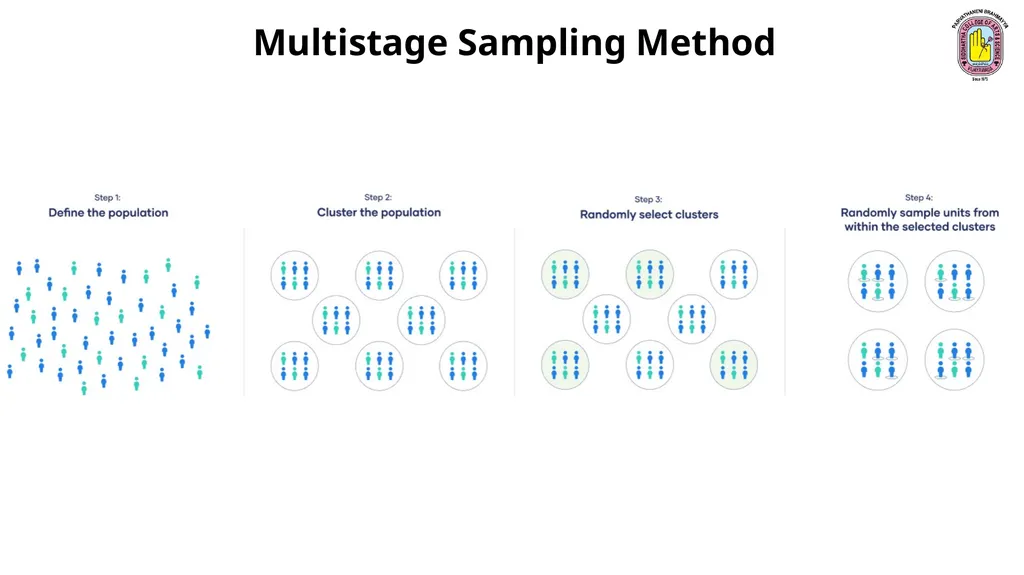
slide128. Multistage Sampling Method As the name implies, this method refers to a sampling procedure which is carried out in several stages. The material is regarded as made up of a number of first stage sampling units, each of which is made of a number of second stage units, etc. At first, the first stage units are sampled by some suitable method, such as random sampling. Then, a sample of second stage unit is selected from each of the selected first stage units again by some suitable method which may be the same or different from the method employed for the first stage units. Further stages may be added as required.<br>
slide129. Multistage Sampling Method<br>
slide130. Non-Probability or Non-Random Sampling This type of sampling is also known as deliberate sampling, purposive sampling, or judgment sampling. In this sampling procedure, the organizers of the inquiry deliberately choose the particular units of the universe to compose a sample on the basis that the small mass selected out of a large one would represent the whole. For example, if economic conditions of the population living in a state are to be studied, a few cities and towns can be deliberately selected for intensive study on the principle that they can represent the entire state.<br>
slide131. Non-Probability or Non-Random Sampling Besides, the investigator may select a sample yielding results favourable to his point of view. In case that happens, the entire inquiry may get vitiated. Thus, there exists the danger of bias entering into this type of sampling technique. However, if the investigators are impartial, work without bias and have the necessary experience so as to take sound judgment, the obtained results of an analysis of deliberately selected sample may be tolerably reliable.<br>
slide132. Non-Probability or Non-Random Sampling Methods Judgement Sampling
Quota Sampling
Convenience Sampling
Snowball Sampling<br>
slide133. Judgement Sampling Method In judgment sampling, the selection of the sample is based on the judgment of the investigator, who is studying a situation. In other word, the investigator exercises his judgment in the choice of sample items and includes those items in the sample which he thinks are most typical of the population with regard to the characteristics under investigation. This method is also known as ‘purpose sampling’ or ‘deliberate sampling’. This sampling method should be carried out by an expert in the field as his judgment will influence the final outcome of the study.<br>
slide134. Quota Sampling Method Quota sampling is the non-probabilistic version of stratified random sampling. The target population is spill into appropriate strata based on known subgroups (e.g. sex, educational achievement, company size etc.). Each stratum is sampled (using convenience or snowball techniques) so that number of respondents in each subgroup is proportional to the proportion in the population.<br>
slide135. Convenience Sampling Method This method is based on the convenience of the researcher. The researcher uses the sources available to him to come to the conclusion.<br>
slide136. Snowball Sampling Method This involves asking people who have participated in a survey to nominate other people they believe would be willing to take part. Sampling continues until the required number of responses is obtained. This technique is often used when the population is difficult for the researchers to identify. For example, we might expect software hackers to be known to one another, so if we found one to take part in our survey, we could ask him/her to identify other possible participants.<br>
slide137. Characteristics of a Good Sample Design (a) Sample design must result in a truly representative sample.
(b) Sample design must be such which results in a small sampling error.
(c) Sample design must be viable in the context of funds available for the research study.
(d) Sample design must be such so that systematic bias can be controlled in a better way.<br>
slide138. Characteristics of a Good Sample Design (e) Sample should be such that the results of the sample study can be applied, in general, for the universe with a reasonable level of confidence.
(f) The size of the sample should be adequate i.e., neither too large nor small but commensurate with the size of the population.<br>
slide139. Business Research Methods . Unit – IV Sai Ram B Lecturer<br>
slide141. Business Research Methods . Unit – V Intellectual Property Rights (IPR) Sai Ram B Lecturer<br>
slide142. Intellectual Property Rights (IPR) Intellectual Property Rights (IPR) are the rights given to persons over the creations of their minds. They usually give the creator an exclusive right over the use of his/her creation for a certain period of time. The term intellectual property began to be used in the 19th Century. Only in the 20th century did it become part of the world’s legal systems.<br>
slide143. Intellectual Property Rights (IPR) Intellectual Property Rights are important to stimulate and promote research and development. If the inventions and ideas of individuals and organizations are not protected then the concerned people or organizations will not reap the benefits of their hard work and naturally, it will lead to discontent and reduce the efforts in the field of research and development, which is extremely important for the growth and development of humanity.<br>
slide144. Types of Intellectual Property Rights (IPR) The 4 main types of Intellectual Property are listed below.
Patents – It is used for protecting new inventions, ideas, or processes. Patent holders need to pay periodic government renewal fees. An approved patent is for a limited time period.
Copyrights – It protects the ideas, examples would be written works, music, art, etc.<br>
slide145. Types of Intellectual Property Rights (IPR) Trademarks – It is something that protects the symbols, colors, phrases, sounds, design etc.
Trade Secrets – It may be strategies, systems, formulas, or other confidential information of an organization that provides them a competitive advantage in the market.<br>
slide146. Copyrights Vs. Trademarks Vs. Patents While copyright law is not all-encompassing, other laws, such as patent and trademark laws, may impose additional sanctions. Although copyrights, trademarks, and patents are frequently used interchangeably, they offer different forms of protection for intellectual property.<br>
slide147. Copyrights Vs. Trademarks Vs. Patents Trademark laws protect material that is used to distinguish an individual’s or corporation’s work from another entity. These materials include words, phrases, or symbols such as logos, slogans, and brand names which copyright laws do not cover. Patents cover inventions for a limited period of time. Patented materials include products such as industrial processes, machines, and chemical positions.<br>
slide148. Conditions for Grant of Patent There are numerous conditions that must be met in order to obtain a patent and it is not possible to compile an exhaustive, universally applicable list. However, some of the key conditions include the following:
The invention must show an element of novelty; that is, some new characteristic which is not known in the body of existing knowledge in its technical field. This body of existing knowledge is called “prior art”.<br>
slide149. Conditions for Grant of Patent The invention must involve an “inventive step” or “non-obvious”, which means that it could not be obviously deduced by a person having ordinary skill in the relevant technical field.
The invention must be capable of industrial application, meaning that it must be capable of being used for an industrial or business purpose beyond a mere theoretical phenomenon, or be useful.<br>
slide150. Conditions for Grant of Patent Its subject matter must be accepted as “patentable” under law. In many countries, scientific theories, aesthetic creations, mathematical methods, plant or animal varieties, discoveries of natural substances, commercial methods, methods for medical treatment (as opposed to medical products) or computer programs are generally not patentable.
The invention must be disclosed in an application in a manner sufficiently clear and complete to enable it to be replicated by a person with an ordinary level of skill in the relevant technical field.<br>
slide151. Process of Product Patent The complete patent registration process involves a series of steps which are to be mandatorily followed to get a patent in India. Both individuals and businesses can apply for patent registration for their inventions. In this post, we will discuss the registration process involved in registering a patent in India and the costs involved.<br>
slide152. Process of Product Patent Checking the patentability of the invention by performing a search
Before filing a patent application in India, one should perform a detailed patentability search to determine whether a patent for it will be available or not. You can use the following link to conduct the patentability search - https://iprsearch.ipindia.gov.in/publicsearch. It is to be noted here that this step in itself is not mandatory.<br>
slide153. Process of Product Patent Drafting of patent application
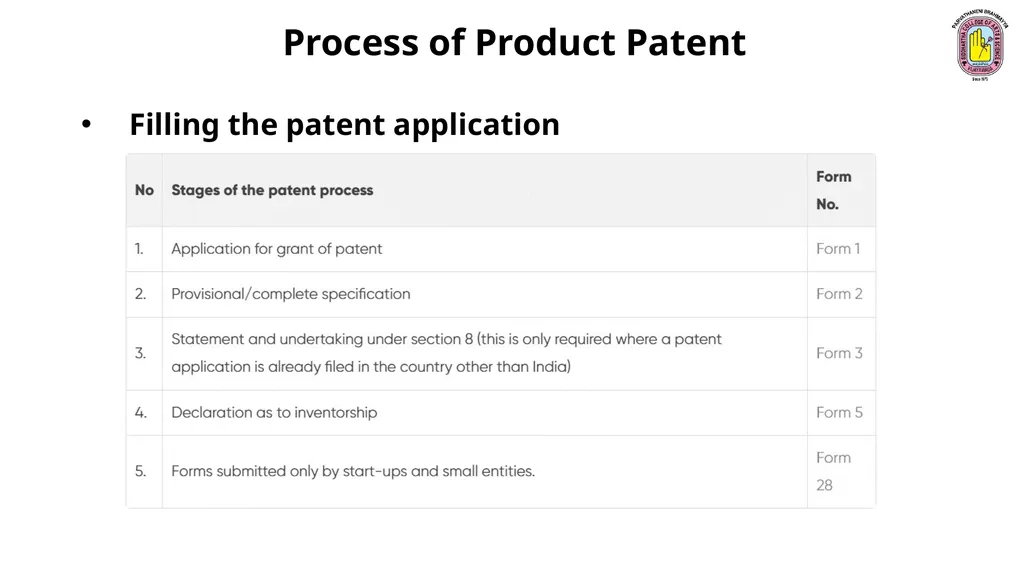
Once the search is complete and through, the next step involved is to prepare an application form in form 1.
Each application has to be accompanied by a patent specification. This has to be prepared in form 2 where one has to provide the complete or provisional specification depending upon the state of the invention(Whether its partially completed or completed). In case one files a provisional application, a time gap of 12 months is provided to finalize the invention and file the complete application.<br>
slide154. Process of Product Patent A patent draft will also be required to be submitted along with the application. The patent draft is considered a very important document as the same will be used by the patent office in deciding whether or not patent should be granted.<br>
slide155. Process of Product Patent Filling the patent application<br>
slide156. Process of Product Patent Publication of patent application
Patent application filed with the Indian patent office will be published in the official patent journal. This is generally done after 18 months of filing the application. In case one wants to get it published earlier, he can make a request in form 9 for early publication. When a restriction is placed by the Indian patent act with regards to the publishing of the patent, the same will not be published in the journal.<br>
slide157. Process of Product Patent Publication of patent application
Every application filed for protection will be examined before a patent is finally granted. The application has to be made for examination in form 18. The earlier one makes a request, the earlier the application will be examined by the examiner. Once the application is filed, it is transferred to the patent officer who will examine the application to ensure the same is in accordance with the patent act and rules.<br>
slide158. Process of Product Patent A thorough search is conducted by the officer where he/she analyses the relevant technology in depth and the objections, if any, will be communicated. The report issued in this case is called the First Examination Report (FER).<br>
slide159. Process of Product Patent A thorough search is conducted by the officer where he/she analyses the relevant technology in depth and the objections, if any, will be communicated. The report issued in this case is called the First Examination Report (FER).
Grant of patent
The patent is granted once all the objections raised by the officer are resolved.<br>
slide160. Copyright A copyright is essentially a right not to copy someone’s work. A copyright gives the owner of the subject an exclusive right over his work. If a work is protected by copyright, no one can imitate, copy or reproduce the original work in any other way. A term of copyright in India is 60 years. Copyright can be taken for the following works: Music, Books, Films, Fashion Designs, Training Manuals, Software, Literary Work, Paintings etc.<br>
slide161. Copyright A copyright is essentially a right not to copy someone’s work. A copyright gives the owner of the subject an exclusive right over his work. If a work is protected by copyright, no one can imitate, copy or reproduce the original work in any other way. A term of copyright in India is 60 years. Copyright can be taken for the following works: Music, Books, Films, Fashion Designs, Training Manuals, Software, Literary Work, Paintings etc.
Different types of copyright are detailed below:<br>
slide162. Types of Copyright - Literary Copyright This category of copyright encompasses original and distinctive literary compositions.
Such creations can range from scripts, novels, biographies, and academic theses to technical manuals and software codes.
The value, style, or literary quality of the work doesn’t influence its eligibility for copyright. Holding a copyright for literary creations grants exclusive rights, including:<br>
slide163. Types of Copyright - Literary Copyright Adapting the original work.
For a public performance of work.
Distributing copies of the work to the audience.
Replicating the original composition.
Translating the work into other languages.<br>
slide164. Types of Copyright - Dramatic Copyright Theatrical compositions fall under the umbrella of literary creations but have their own distinct characteristics.
They encompass scripts prepared for stage performances, mime shows, plays, dance choreography, and any written work intended for live enactment.
However, it’s essential to note that these do not encompass motion pictures or films.<br>
slide165. Types of Copyright - Dramatic Copyright Holding a copyright for theatrical compositions grants the owner specific privileges, such as:
Adapting or modifying the original piece.
Replicating or reproducing the composition.
Sharing or presenting the work to a broader audience.
Incorporating the piece into any cinematographic film.<br>
slide166. Types of Copyright - Musical Copyright Musical works, are distinct entities that are eligible for copyright protection. It’s important to note that these works focus solely on the musical composition and exclude lyrics or actual sound recordings.
To safeguard a musical composition, one must register it separately with the Copyright Office. Often, sound recordings are intrinsically linked to these musical compositions, but they are distinct entities in the realm of copyright.<br>
slide167. Types of Copyright - Musical Copyright The author of music work in India has following exclusive rights:
The ability to reproduce the composition.
Sharing or presenting the composition to a wider audience.
Adapting or modifying the original piece.
Performing the composition live in front of an audience.
Distributing copies of the composition to the public.
Incorporating the composition into sound recordings or films.<br>
slide168. Types of Copyright - Software and Computer Programs Computer software and programs, from their foundational code to their user interfaces, can be shielded under copyright.
This ensures that the intellectual effort behind creating a software solution is recognized and protected.<br>
slide169. Types of Copyright - Artistic Copyright Visual creations, commonly referred to as artistic works, encompass a broad spectrum of original creations.
Under the Copyright Act of 1957, this category safeguards a diverse range of artworks.
This includes, but is not limited to, paintings, photographs, architectural designs, sketches, diagrams, cartoons, engravings, sculptures, graphics, and blueprints.<br>
slide170. Types of Copyright - Artistic Copyright Holding a copyright for visual creations in India bestows the owner with specific privileges, such as:
Distributing copies of the artwork to the broader public.
Incorporating the artwork into films or other visual media.
Modifying or creating derivatives of the original piece.<br>
slide171. Trademark A trademark can be any word, phrase, symbol, design, or a combination of these things that identifies your goods or services. It’s how customers recognize you in the marketplace and distinguish you from your competitors.<br>
slide172. Trademark A trademark:
Identifies the source of your goods or services.
Provides legal protection for your brand.
Helps you guard against counterfeiting and fraud.<br>
slide173. Trademark Trademarks not only help distinguish products within the legal and business systems but just as significantly with consumers. They are used to identify and protect words and design elements that identify the source, owner, or developer of a product or service.
They can be corporate logos, slogans, bands, or the brand name of a product. Similar to a trademark, a service mark identifies and distinguishes the source of a service rather than a product, and the term trademark is often used to refer to both trademarks and service marks.<br>
slide174. Trademark Using a trademark prevents others from using a company or individual's products or services without their permission. They also prohibit any marks that have a likelihood of confusion with an existing one. This means that a business cannot use a symbol or brand name if it looks or sounds similar, or has a similar meaning to one that is already on the books, especially if the products or services are related. For instance, a soft drink company can’t legally use a symbol that looks like that of Coca-Cola and it can't use a name that sounds like Coke.<br>
slide175. Trademark Trademarks must not lack any distinctive characteristics.
Trademarks must not only contain indications that are used in commerce to identify the quality, type, quantity, purpose, and values, or the geographical source of the products or services offered.
Also, Trademarks must not exclusively include marks or indications that are accepted as a standard in the current language or accepted practices of the trade.<br>
slide176. Conditions for Trademark Trademarks must not have an appearance that deceives or confuses the general public.
Trademarks must not include or contain the most scandalous or sexually explicit material.
The Trademark must not be prohibited by the Emblems and Names (Prevention of Improper Use) Act, 1950.
Trademarks must not consist of goods that are necessary for obtaining the desired technical outcome.<br>
slide177. Conditions for Trademark Trademarks must not be made up of marks of the shape of the goods that originate from the characteristics of the products themselves.
The Trademark must not include or contain things that are likely to harm the religious sentiments of any section or class of the population of India.
Trademarks must not provide an unfair competitive advantage over another popular brand in India that is identical or very similar.<br>
slide178. Geographical Indications Geographical Indication in India refers to the sign used on certain products from a specific geographical territory. A GI tag is a sign used on certain products corresponding to a particular geographical location or origin (e.g., a town, region, or country). In India, the GI tag is regulated by the Geographical Indications of Goods (Registration and Protection) Act of 1999. GI tags are important for protecting the reputation and quality of Indian products. They also help to promote the economic development of the regions where the products are produced.<br>
slide179. Geographical Indications The Geographical Indication (GI) tag is a status given to a product belonging exclusively to a particular area. The quality, reputation, and any other characteristics of that particular product are generally attributed to the geographical origin of the product. It is covered as an element of Intellectual Property Rights under the Paris Convention for the Protection of Industrial Property.<br>
slide180. Geographical Indications Examples for GI are, Andhra Pradesh - Kondapalli Bommallu, Venkatagiri Sarees, Bobbili Veena, Mangalagiri Sarees and Fabrics, Tirupati Laddu, Bandar Laddu, Guntur Chilli, Araku Coffee, Hyderabad Haleem, Hyderabadi Biryani, Nagpur Orange, Shimla Apple etc.<br>
slide181. Trade Secrets According to the World Intellectual Property Organization (WIPO), Trade Secrets are intellectual property rights on confidential information which may be sold or licensed. In a layman’s perspective, a trade secret is a secret of any trade or business that is known to a limited group of persons and has a commercial value.
Ex – Recipe of Coca-Cola beverages etc.<br>
slide182. Trade Secrets - Essentials It should have a commercial value.
It is known by a limited group of people.
Reasonable steps to be taken by the owner to keep the information secret.<br>
slide183. Trade Secrets A trade secret can be protected for an unlimited period of time but a substantial element of secrecy must exist, so that, except by the use of improper means, there would be difficulty in acquiring the information. Considering the vast availability of traditional knowledge in the country the protection under this will be very crucial in reaping benefits from such type of knowledge. The Trades secret, traditional knowledge are also interlinked / associated with the geographical indications.<br>
slide2. Business Research<br>
slide3. Business Research Business Research refers to the systematic process of gathering, analyzing, interpreting and applying information to gain insights into various aspects of the business environment.
It is conducted to make informed decisions, solve problems, identify opportunities and enhance the overall effectiveness and efficiency of a business.<br>
slide4. Business Research Business research can cover a wide range of topics and areas that includes market trends, customer behavior, competition analysis, product development, financial performance, strategic planning and more.<br>
slide5. Importance of Business Research Business Research holds significant importance in various aspects of the corporate world. It helps organizations to make informed decisions, understand market trends, develop effective strategies and enhance their overall performance.
Here are some key reasons why business research is important:<br>
slide6. Importance of Business Research Informed Decision Making
Market Understanding
Competitor Analysis
Strategic Planning
Innovation & Product Development
Resource Allocation
Adaption to Change
Economic Impact
Investor Confidence
Measuring Performance
Customer Satisfaction
Risk Management<br>
slide7. Importance of Business Research In essence, business research empowers organizations to make sound decisions, stay competitive and navigate the complex and dynamic business landscape effectively. It enables companies to stay ahead of the curve, innovate and achieve sustainable growth over time.<br>
slide8. Steps Involved in Business Research The business research process involves a systematic and structured approach to gather information, analyze data and make informed decisions. Here are the typical steps in the business research process:
Identify the Research Problem or Objective
Review Exiting Literature
Determine the Research Design<br>
slide9. Steps Involved in Business Research iv. Data Collection
v. Analyze Data
vi. Draw Conclusions
vii. Make Recommendations
viii. Report the Findings
ix. Implement & Monitor
x. Reflect & Iterate
xi. Share & Disseminate
xii. Archive & Document<br>
slide10. Scope of Business Research The scope of business research is quite broad and encompasses various aspects of the business world. Business research is conducted to gather information, analyze data and generate insights that can be used to make informed decisions and solve business-related problems.<br>
slide11. Scope of Business Research Here are some key areas within the scope of business research:
Market Research
Marketing Research
Strategic Planning
Financial Analysis
Operations Research
Human Resources Research
Organizational Behavior<br>
slide12. Scope of Business Research ix. International Business Research
x. Business Ethics and Corporate Social Responsibility
xi. Information Technology and E-Business
xii. Risk Management
xiii. Small Business and Entrepreneurship
xiv. Supply Chain Management
xv. Business Policy & Government Regulations<br>
slide13. Scope of Business Research The scope of business research continues to evolve as new technologies, economic trends and global developments emerge.
Researchers and businesses alike benefit from staying up-to-date with the latest research methodologies and trends within their specific areas of interest. Ultimately, the goal of business research is to provide actionable insights that can lead to improved decision-making and business success.<br>
slide14. Ethics in Business Research Ethics in business research is a critical aspect of conducting meaningful and responsible research within the business world. Ethical considerations are essential to ensure that research is conducted with integrity, transparency and respect for all stakeholders involved.
Here are some key principles and considerations for ethics in business research:<br>
slide15. Ethics in Business Research Here are some key principles and considerations for ethics in business research:
Informed Consent
Privacy & Confidentiality
Data Integrity
Transparency
Respect for Diversity
Minimizing Harm<br>
slide16. Ethics in Business Research Compliance with Laws and Regulations
Avoiding Plagiarism
Peer Review
Ethical Leadership
Whistleblower Protection
Long-Term Consequences<br>
slide17. Ethics in Business Research Ethics in business research is not only about following rules and regulations but also about upholding ethical principles that promote the responsible and ethical conduct of research. Adhering to these principles fosters trust, credibility, and the long-term success of both the research and the business community as a whole.<br>
slide19. Business Research Methods . Unit – II Research Design Sai Ram B Lecturer<br>
slide20. Meaning of Research Design The Research Design is the conceptual structure within which research is conducted; it constitutes the blueprint for the collection, measurement and analysis of data. As such the design includes an outline of what the researcher will do from writing the hypothesis and its operational implications to the final analysis of data.
More explicitly, the desing decisions happen to be in respect of:
A. What is the study about?<br>
slide21. Research Design B. Why is the study being made?
C. Where will the study be carried out?
D. What type of data is required?
E. Where can the required data be found?
F. What periods of time will the study include?
G. What will be the sample design?
H. What techniques of data collection will be used?
I. How will the data be analysed?
J. In what style will the report be prepared?<br>
slide22. Research Design B. Why is the study being made?
C. Where will the study be carried out?
D. What type of data is required?
E. Where can the required data be found?
F. What periods of time will the study include?
G. What will be the sample design?
H. What techniques of data collection will be used?
I. How will the data be analysed?
J. In what style will the report be prepared?<br>
slide23. Elements of Research Methodology i. Clear statement of Research Problem
ii. Clear objectives
iii. Literature Review
iv. Timeline
v. The population to be studied
vi. The sample to be studied
vii. Procedures and techniques to be used for gathering information
viii. Methods to be used in processing and analyzing the data
ix. Measurement of the Analysis<br>
slide24. Research Design and Its Importance Research Design referred as a masterplan, blueprint and even as a sequence of research tasks and activities. Research design in simple terms is a plan of the methods and procedures that is used by researchers to collect and analyze the data needed by the manager.
The research design provides a plan of how the researcher will go about answering the research question(s) defined by the manager and researcher together (clearly defining the problem into a researchable question is extremely important).<br>
slide25. Research Design and Its Importance The research design also contains clear objectives, derived from research question(s), specify the information sources from which data will be collected, the type of data, the design technique(s) (survey, observation, experimentation etc.), the sampling methodology and procedures, the schedule and the budget. There should be clear justification with regard to the research design based on the research question and objectives.<br>
slide26. Research Design and Its Importance As stated above, the purpose of any research design is to obtain evidence which addresses the research question and objectives. Usually, however, there are a number of ways in which it can be achieved. Although, every research question is unique, most research objectives can be met by using one of the three types of research designs: exploratory, descriptive and causal.<br>
slide27. Research Design and Its Importance Research design holds all the parts and phases of the research project together. A poorly developed design fails to provide accurate answers to the research question under investigation and in turn does not assist the manager in the decision making process. The foundations of research design are firmly based on scientific rigour and objectivity. Any personal, procedural or methodological bias involved in research design will have an impact on entire research process. Therefore, developing a sound research design is an extremely important aspect of any research project.<br>
slide28. Types of Research Design I. Exploratory Research Design
II. Descriptive Research Design
III. Experimental Research Design<br>
slide29. Exploratory Research Design Exploratory research design is a type of research methodology used when the researcher is attempting to explore a new topic or gain preliminary insights into a research problem. It is particularly useful when the topic is relatively uncharted and there is limited existing information or knowledge.
Exploratory research is often the first step in the research process and it helps researchers formulate hypotheses and develop a more focused research design in subsequent stages.<br>
slide30. Characteristics & Methods - Exploratory Research Design Objective: The primary objective of exploratory research is to gain a better understanding of the research problem. It aims to explore, describe, and identify potential variables or factors that may influence the phenomenon under investigation.
Flexibility: Exploratory research is characterized by flexibility in data collection methods and the absence of a rigid research structure. Researchers can use various techniques and adapt their approach as they gather insights.<br>
slide31. Characteristics & Methods - Exploratory Research Design Qualitative Methods: Qualitative research methods are commonly used in exploratory research. These methods include in-depth interviews, focus groups, content analysis, and ethnographic observations. They allow researchers to gather rich, descriptive data and explore the thoughts, feelings, and perspectives of participants.
Small Sample Size: Exploratory research often involves a smaller sample size compared to other research designs. The emphasis is on depth rather than breadth of data.<br>
slide32. Characteristics & Methods - Exploratory Research Design Open-Ended Questions: Researchers use open-ended questions to encourage participants to express their views and ideas freely. This allows for the discovery of unexpected insights.
No Hypotheses: In exploratory research, researchers typically do not start with specific hypotheses. Instead, they generate hypotheses or research questions based on the data collected during the exploratory phase.<br>
slide33. Characteristics & Methods - Exploratory Research Design Preliminary Data Analysis: Researchers engage in preliminary data analysis as data is collected. This helps them identify emerging patterns, themes, or areas of interest.
Literature Review: While exploratory research is often conducted when there is limited existing literature, a preliminary review of relevant literature may still be useful to understand the broader context and existing knowledge gaps.<br>
slide34. Characteristics & Methods - Exploratory Research Design Iterative Process: Exploratory research is often an iterative process. Initial findings may lead to further exploration and refinement of research questions.
Insight Generation: The primary output of exploratory research is insights and a deeper understanding of the research problem. These insights can guide the development of hypotheses for subsequent confirmatory research.<br>
slide35. Characteristics & Methods - Exploratory Research Design Feasibility Assessment: Exploratory research can help assess the feasibility of conducting a larger-scale research study. It can inform decisions about the need for additional data collection or the direction of future research.
Report Findings: Researchers should document and report their exploratory research findings, even if they are preliminary. This documentation can serve as a foundation for further research or as a valuable contribution in itself.<br>
slide36. Exploratory Research Design Exploratory research is particularly useful in the early stages of a research project, helping researchers refine their research questions and hypotheses. It can be a valuable tool for generating new ideas and insights, especially in areas where little is known or understood.<br>
slide37. Descriptive Research Design Descriptive research design is a type of research methodology that focuses on observing, documenting, and describing the characteristics of a particular phenomenon or group of individuals. It is primarily concerned with providing an accurate and detailed account of what is happening, without attempting to explain why or how it is happening.
Descriptive research often used when the researcher's goal is to obtain a snapshot of a situation, population or event.<br>
slide38. Characteristics & Methods Descriptive Research Design Objective: The primary objective of descriptive research is to provide an accurate and comprehensive description of a phenomenon. It aims to answer questions about who, what, when, where and how.
No Manipulation: Unlike experimental research, where variables are manipulated to establish cause-and-effect relationships, descriptive research does not involve manipulation of variables. It is purely observational.<br>
slide39. Characteristics & Methods Descriptive Research Design Quantitative or Qualitative: Descriptive research can use both quantitative and qualitative methods. Quantitative methods involve collecting numerical data through surveys, questionnaires, and structured observations, while qualitative methods use open-ended interviews, focus groups, and content analysis to gather detailed, non-numerical information.
Surveys and Questionnaires: Surveys and questionnaires are common tools in descriptive research, especially when collecting data from large samples. They use structured questions to gather quantitative data.<br>
slide40. Characteristics & Methods Descriptive Research Design Observations: Researchers may directly observe and record behavior, events, or phenomena of interest. Observations can be participant (researcher is directly involved) or non-participant (researcher observes from a distance).
Case Studies: Descriptive research often involves case studies, where researchers closely examine a single individual, group, organization, or event in-depth. This method is useful for gaining a detailed understanding of a specific case.<br>
slide41. Characteristics & Methods Descriptive Research Design Sampling: Researchers select a sample that is representative of the larger population they are studying. Sampling methods may include random sampling, stratified sampling, or convenience sampling, depending on the research objectives.
Data Analysis: Data collected in descriptive research are analyzed using basic statistical techniques (for quantitative data) or thematic analysis (for qualitative data). The goal is to summarize and describe the data accurately.<br>
slide42. Characteristics & Methods Descriptive Research Design Cross-Sectional or Longitudinal: Descriptive research can be cross-sectional (data collected at a single point in time) or longitudinal (data collected over a period of time to track changes).
Report Findings: The primary output of descriptive research is a detailed and objective description of the phenomenon under study. Findings are typically presented in reports, articles, or presentations.
Limitations: Descriptive research does not establish causal relationships or explain why certain patterns or behaviors exist. It is limited to providing a snapshot of the situation as it is observed.<br>
slide43. Characteristics & Methods Descriptive Research Design Useful for Initial Exploration: Descriptive research is often used as an initial step in the research process. It can help researchers generate hypotheses or research questions for future studies.
Examples of descriptive research include surveys that measure the demographic characteristics of a population, observational studies that describe behaviors in natural settings, and case studies that provide detailed accounts of specific individuals or events.<br>
slide44. Experimental Research Design Experimental research design is a scientific approach used to investigate cause-and-effect relationships between variables. It involves the manipulation of one or more independent variables to observe their impact on a dependent variable while controlling for extraneous factors. Experimental research is highly structured and is characterized by its emphasis on control, randomization and replication.<br>
slide45. Characteristics & Methods Experimental Research Design Manipulation of Variables: Experimental research involves manipulating one or more independent variables, which are factors that researchers believe may influence the dependent variable. The goal is to determine whether changes in the independent variable(s) cause changes in the dependent variable.
Control Group: Experiments often include a control group, which serves as a baseline for comparison. The control group does not receive the experimental treatment or manipulation and is used to assess the natural variation in the dependent variable.<br>
slide46. Characteristics & Methods Experimental Research Design Randomization: Random assignment of participants to different experimental groups or conditions helps ensure that the groups are comparable and that extraneous variables are equally distributed. Randomization enhances the internal validity of the study.
Independent and Dependent Variables: The independent variable(s) are the factors being manipulated, while the dependent variable is the outcome or response being measured. The relationship between the independent and dependent variables is central to the experiment.<br>
slide47. Characteristics & Methods Experimental Research Design Experimental and Control Groups: Participants are divided into experimental groups (those exposed to the independent variable) and control groups (those not exposed to the independent variable or receiving a placebo).
Hypothesis Testing: Experimental research typically involves testing a specific hypothesis about the expected relationship between the independent and dependent variables. The hypothesis is a clear statement of what the researcher expects to find.<br>
slide48. Characteristics & Methods Experimental Research Design Random Sampling: In addition to random assignment, researchers often use random sampling to select a representative sample from the population of interest. Random sampling increases the external validity of the findings.
Pre and Post Testing: Experimental research often includes both pre-testing (measuring the dependent variable before the manipulation) and post-testing (measuring the dependent variable after the manipulation) to assess changes.<br>
slide49. Characteristics & Methods Experimental Research Design Control of Extraneous Variables: Researchers take measures to control extraneous variables, which are variables other than the independent variable that could influence the dependent variable. Control may involve experimental design, statistical techniques, or constant monitoring.
Replication: Replicating the experiment with different samples or under different conditions is essential to validate the findings and ensure their reliability.<br>
slide50. Characteristics & Methods Experimental Research Design Blinding: To minimize bias, researchers may use single-blind or double-blind procedures. In a single-blind study, participants are unaware of their group assignment, while in a double-blind study, both participants and researchers are unaware of group assignment.
Statistical Analysis: Experimental data are often analyzed using statistical tests to determine if the observed differences between groups are statistically significant and not due to chance.<br>
slide51. Characteristics & Methods Experimental Research Design Ethical Considerations: Researchers must adhere to ethical guidelines, obtain informed consent from participants and ensure that the study does not harm participants physically or psychologically.
Reporting of Findings: Experimental research reports include detailed descriptions of the methods, results and conclusions. Researchers should transparently report both significant and non-significant findings.<br>
slide52. Experimental Research Design Experimental research design is widely used in fields such as psychology, biology, medicine and social sciences to establish causal relationships and test hypotheses. Its rigorous structure and controlled environment make it a powerful method for scientific inquiry.<br>
slide53. Features of a Good Research Design A good research design is critical to ensuring that a study is conducted in a systematic and rigorous way and that it produces valid and reliable results.
Here are some features of a good research design:
(i) Clear Research Question: A good research design should start with a clear research question or hypothesis that is specific, measurable and relevant to the research topic. The research question should be clearly defined and the design should be developed to address this question.<br>
slide54. Features of a Good Research Design (ii) Appropriate Research Methods: The research design should use appropriate methods for data collection, such as surveys, experiments, case studies or other methods, based on the research question and the type of data needed. The methods should be selected carefully to ensure that they are reliable and valid for the research question.<br>
slide55. Features of a Good Research Design (iii) Sample Selection: A good research design should have a clear and appropriate sampling strategy for selecting participants or cases. The sample should be representative of the population being studied and the sample size should be appropriate for the research question and methods.<br>
slide56. Features of a Good Research Design (iv) Data Analysis: A good research design should include appropriate methods for data analysis, such as statistical tests, qualitative analysis or mixed methods. The analysis should be clearly defined and linked to the research question, and the results should be reported in a clear and transparent way.<br>
slide57. Features of a Good Research Design (v) Ethical Considerations: A good research design should consider ethical issues such as informed consent, confidentiality, and the protection of human subjects. The design should follow ethical guidelines and procedures, and should be reviewed and approved by an Institutional Review Board (IRB) or other ethics committee.<br>
slide58. Features of a Good Research Design (vi) Replicability: A good research design should be replicable by other researchers. The design should include clear and detailed procedures, methods and data collection instruments that can be used by others to reproduce the study.
(vii) Time and Resources: A good research design should consider the time and resources needed for data collection, analysis and reporting. The design should be feasible and realistic, given the available resources and time constraints.<br>
slide60. Business Research Methods . Unit – III Data Collection Sai Ram B Lecturer<br>
slide61. Primary Data Primary data in research refers to data that is collected directly from original sources or firsthand observations for a specific research purpose. This data is new and has not been previously collected or published by others. Researchers gather primary data to address their research questions or objectives. Common methods of collecting primary data include surveys, experiments, interviews, observations, and fieldwork.
Primary data is collected by researchers themselves or their team and is often tailored to address the specific research questions or objectives.<br>
slide62. Primary Data - Characteristics Originality: Primary data is new and collected for a particular research project, making it unique to that study.
Relevance: Researchers can design the data collection methods to ensure the data gathered is directly related to their research objectives.
Control: Researchers have control over the data collection process, allowing them to make decisions about the research design and methodology.<br>
slide63. Primary Data - Characteristics Reliability: Researchers can apply rigorous data collection techniques to ensure the data's accuracy and reliability.
Customization: Primary data can be customized to gather information on specific variables or factors of interest.<br>
slide64. Primary Data – Sources or Collection Methods Surveys: Researchers create questionnaires or conduct interviews to collect data directly from individuals or groups. This data can include opinions, preferences, and demographic information.
Experiments: Researchers manipulate variables and observe the effects to collect data on cause-and-effect relationships.
Observations: Researchers watch and record behavior, events, or phenomena as they naturally occur, either through participant observation (actively participating in the observed activity) or non-participant observation (observing without direct involvement).<br>
slide65. Primary Data – Sources or Collection Methods Interviews: Researchers conduct structured or unstructured interviews to gather in-depth information and insights from participants.
Fieldwork: This involves going to the field or a specific location to collect data, such as anthropological fieldwork, ecological studies, or geological surveys.
Case studies: Researchers examine specific cases or individuals in-depth to gain insights and understanding about a particular phenomenon.<br>
slide66. Primary Data – Sources or Collection Methods By collecting primary data, researchers can tailor their methods and questions to suit their research goals, ensuring that the information gathered is directly relevant to their study.<br>
slide67. Primary Data - Advantages • The primary data are original and relevant to the topic of the research study so the degree of accuracy is very high.
• Primary data is that it can be collected from a number of ways like interviews, telephone surveys, focus groups etc. It can be also collected across the national borders through emails and posts. It can include a large population and wide geographical coverage.
• Moreover, primary data is current and it can better give a realistic view to the researcher about the topic under consideration.<br>
slide68. Primary Data - Advantages • Reliability of primary data is very high because these are collected by the concerned and reliable party.<br>
slide69. Primary Data - Disadvantages • For collection of primary data where interview is to be conducted the coverage is limited and for wider coverage a more number of researchers are required.
• A lot of time and efforts are required for data collection. By the time the data collected, analyzed and report is ready the problem of the research becomes very serious or out dated. So the purpose of the research may be defeated.
• It has design problems like how to design the surveys. The questions must be simple to understand and respond.<br>
slide70. Primary Data - Disadvantages • Some respondents do not give timely responses. Sometimes, the respondents may give fake, socially acceptable and sweet answers and try to cover up the realities. With more people, time and efforts involvement the cost of the data collection goes high. The importance of the research may go down.
• In some primary data collection methods there is no control over the data collection. Incomplete questionnaire always give a negative impact on research.<br>
slide71. Process of Designing a Questionnaire Designing a questionnaire is a crucial step in gathering information for research or obtaining feedback. Here are the steps involved in preparing a questionnaire:
Define Your Objectives: Clearly outline the purpose of your questionnaire. Identify the specific information or data you want to gather.
Identify Your Target Audience: Understand who will be responding to the questionnaire. Tailor your questions to the characteristics and preferences of your target audience.<br>
slide72. Process of Designing a Questionnaire Choose the Questionnaire Type: Decide on the type of questionnaire you will use, such as open-ended, closed-ended, or a mix of both. Open-ended questions allow for more detailed responses, while closed-ended questions provide specific answer choices.
Create an Outline: Develop a rough outline of the topics or themes you want to cover in the questionnaire. Arrange questions logically to ensure a smooth flow.
Write Clear and Concise Questions: Formulate questions that are easy to understand. Avoid using jargon or complex language. Be specific and unambiguous to prevent confusion.<br>
slide73. Process of Designing a Questionnaire Use a Mix of Question Types: Include a variety of question types, such as multiple-choice, Likert scales, ranking, and open-ended, to gather diverse data. Mix simple and complex questions, but ensure they are all relevant to your objectives.
Consider Question Order: Arrange questions in a logical order to maintain a smooth flow. Start with easy and non-threatening questions to encourage participation. Place demographic and sensitive questions towards the end.<br>
slide74. Process of Designing a Questionnaire Review and Revise: Review the questionnaire for clarity, relevance, and coherence. Revise questions as needed based on the feedback from the pilot test.
Include Instructions: Provide clear instructions on how to complete the questionnaire. Include any necessary context for specific questions.
Add a Welcome and Thank You: Start with a brief introduction explaining the purpose of the questionnaire. Express gratitude at the end for the respondent's time and input.<br>
slide75. Process of Designing a Questionnaire Finalize the Questionnaire: Make any final adjustments based on feedback and testing. Ensure that the questionnaire is within a reasonable length to maintain participant engagement.
Distribute and Collect Responses: Choose the appropriate method for distributing the questionnaire (online, in-person, via mail, etc.). Set a deadline for responses.
Data Analysis Plan: Plan how you will analyze the collected data, whether through statistical analysis, coding open-ended responses, or other methods.<br>
slide76. Process of Designing a Questionnaire Finalize the Questionnaire: Make any final adjustments based on feedback and testing. Ensure that the questionnaire is within a reasonable length to maintain participant engagement.
Distribute and Collect Responses: Choose the appropriate method for distributing the questionnaire (online, in-person, via mail, etc.). Set a deadline for responses.
Data Analysis Plan: Plan how you will analyze the collected data, whether through statistical analysis, coding open-ended responses, or other methods.<br>
slide77. Process of Designing a Questionnaire Ethical Considerations: Ensure that your questionnaire adheres to ethical guidelines, particularly regarding confidentiality and informed consent.
By following these steps, one can create a well-structured questionnaire that effectively gathers the required information.<br>
slide78. Questionnaire Vs. Schedule Both Questionnaire and Schedule are popularly used methods of collecting data in research surveys. There is much resemblance in the nature of these two methods and this fact has made many people to remark that from a practical point of view, the two methods can be taken to be the same. But from the technical point of view there is difference between the two. The important points of difference are as under:<br>
slide79. Questionnaire Vs. Schedule 1. The questionnaire is generally sent through mail to informants to be answered as specified in a covering letter, but otherwise without further assistance from the sender. The schedule is generally filled out by the research worker or the enumerator, who can interpret questions when necessary.<br>
slide80. Questionnaire Vs. Schedule 2. To collect data through questionnaire is relatively cheap and economical since we have to spend money only in preparing the questionnaire and in mailing the same to respondents. Here no field staff required. To collect data through schedules is relatively more expensive since considerable amount of money has to be spent in appointing enumerators and in importing training to them. Money is also spent in preparing schedules.<br>
slide81. Questionnaire Vs. Schedule 3. Non-response is usually high in case of questionnaire as many people do not respond and many return the questionnaire without answering all questions. Bias due to non-response often remains indeterminate. As against this, non-response is generally very low in case of schedules because these are filled by enumerators who are able to get answers to all questions. But there remains the danger of interviewer bias and cheating.<br>
slide82. Questionnaire Vs. Schedule 4. In case of questionnaire, it is not always clear as to who replies, but in case of schedule the identity of respondent is known.
5. The questionnaire method is likely to be very slow since many respondents do not return the questionnaire in time despite several reminders, but in case of schedules the information is collected well in time as they are filled in by enumerators.<br>
slide83. Questionnaire Vs. Schedule 6. Personal contact is generally not possible in case of the questionnaire method as questionnaires are sent to respondents by post who also in turn return the same by post. But in case of schedules direct personal contact is established with respondents.
7. Questionnaire method can be used only when respondents are literate and cooperative, but in case of schedules the information can be gathered even when the respondents happen to be illiterate.<br>
slide84. Questionnaire Vs. Schedule 8. Wider and more representative distribution of sample is possible under the questionnaire method, but in respect of schedules there usually remains the difficulty in sending enumerators over a relatively wider area.
9. The success of questionnaire method lies more on the quality of the questionnaire itself, but in the case of schedules much depends upon the honesty and competence of enumerators.<br>
slide85. Questionnaire Vs. Schedule 10. Risk of collecting incomplete and wrong information is relatively more under the questionnaire method, particularly when people are unable to understand questions properly. But in case of schedules, the information collected is generally complete and accurate as enumerators can remove the difficulties, if any, faced by respondents in correctly understanding the questions. As a result, the information collected through schedules is relatively more accurate than that obtained through questionnaires.<br>
slide86. Questionnaire Vs. Schedule 11. In order to attract the attention of respondents, the physical appearance of questionnaire must be quite attractive, but this may not be so in case of schedules as they are to be filled in by enumerators and not by respondents.
12. Along with schedules, observation method can also be used but such a thing is not possible while collecting data through questionnaires.<br>
slide87. Secondary Data Secondary data means data that are already available i.e., they refer to the data which have already been collected and analysed by someone else. When the researcher utilises secondary data, then he has to look into various sources from where he can obtain them. In this case he is certainly not confronted with the problems that are usually associated with the collection of original data. Secondary data may either be published data or unpublished data.
Key characteristics of Secondary Data in research include:<br>
slide88. Secondary Data - Characteristics • Reliability: The reliability can be tested by finding out such things about the said data: (a) Who collected the data (b) What were the sources of data? (c) Were data collected by using proper methods? (d) At what time were they collected? (e) Was there any bias of the compiler? (f) What level of accuracy was desired? Was it achieved?<br>
slide89. Secondary Data - Characteristics • Suitability of data: The data that are suitable for one enquiry may not be necessarily be found suitable in another enquiry. Hence, if the available data are found to be unsuitable, they should not be used by the researcher. In this context, researcher must very carefully scrutinize the definition of various terms and units of collection used at the time of collecting the data from the primary source originally. Similarly, the object, scope and nature of the original enquiry must also be studied. If the researcher finds differences in these, the data will remain unsuitable for the present enquiry and should not be used.<br>
slide90. Secondary Data - Characteristics • Adequacy of data: If the level of accuracy achieved in data is found inadequate for the purpose of the present enquiry, they will be considered as inadequate and should not be used by the researcher. The data will be considered inadequate if they are related to an area which may be either narrow or wider than the area of the present enquiry.<br>
slide91. Secondary Data - Merits • Use of secondary data is very convenient. • It saves time and finance. • In some enquiries primary data cannot be collected. • Reliable secondary data are generally available for many investigations.<br>
slide92. Secondary Data - Limitations • It is very difficult to find sufficiently accurate secondary data. • It is very difficult to find secondary data which exactly fulfils the need of present investigation. • Extra caution is required to use secondary data. • These are not available for all types of enquiries.<br>
slide93. Secondary Data – Internal Sources If available, internal secondary data may be obtained with less time, effort and money than the external secondary data. In addition, they may also be more pertinent to the situation at hand since they are from within the organization. The internal sources include,
• Accounting resources: This gives so much information which can be used by the marketing researcher. They give information about internal factors.<br>
slide94. Secondary Data – Internal Sources • Sales Force Report: It gives information about the sale of a product. The information provided is of outside the organization.
• Internal Experts: These are people who are heading the various departments. They can give an idea of how a particular thing is working
• Miscellaneous Reports: These are what information you are getting from operational reports.<br>
slide95. Secondary Data – External Sources External Sources are sources which are outside the company in a larger environment. Collection of external data is more difficult because the data have much greater variety and the sources are much more numerous. External data can be divided into following classes:<br>
slide96. Secondary Data – External Sources • Govt. Publications: Government sources provide an extremely rich pool of data for the researchers. In addition, many of these data are available free of cost on internet websites. The Central Statistical Organization (CSO) and various state govt. collect, compile and publish data on regular basis.
• Semi Govt. Publications: Semi govt. organizations municipalities, District Boards and others also publish reports in respect of birth, death and education, sanitation and many other related fields.<br>
slide97. Secondary Data – External Sources • International Bodies: All foreign governments and international agencies publish regular reports of international significance. These reports are regularly published by the agencies like; United Nations Organization, International Labour Organization, World Meteorological Organization etc.<br>
slide98. Secondary Data – External Sources • Reports of Committee and Commissions: Central govt. or State govt. sometimes appoints committees and commissions on matters of great importance. Reports of such committees are of great significance as they provide invaluable data. These reports are like, Shah Commission Report, Sarkaria Commission Report and Finance Commission Reports etc.<br>
slide99. Secondary Data – External Sources • Private Publications: Some commercial and research institutes publish reports regularly. They are like Institutes of Economic Growth, Stock Exchanges, National Council of Education Research and Training (NCERT), National Council of Applied Economic Research (NCAER) etc.
• Newspapers and Magazines: Various newspapers as well as magazines also do collect data in respect of many social and economic aspects.<br>
slide100. Secondary Data – External Sources • Research Scholars: Individual research scholars collect data to complete their research work which further is published with their research papers.<br>
slide101. Secondary Data – External Sources • Research Scholars: Individual research scholars collect data to complete their research work which further is published with their research papers.<br>
slide103. Business Research Methods . Unit – III Sampling Design Sai Ram B Lecturer<br>
slide104. Sampling Sampling is the process of selecting a small number of elements from a larger defined target group of elements such that the information gathered from the small group will allow judgments to be made about the larger groups.<br>
slide105. Steps in Sampling An operational sampling process can be divided into seven steps as given below:
• Defining the target population.
• Specifying the sampling frame.
• Specifying the sampling unit.
• Selection of the sampling method.
• Determination of sample size.
• Specifying the sampling plan.
• Selecting the sample.<br>
slide106. Steps in Sampling – Defining the Target Population Defining the population of interest, for business research, is the first step in sampling process. In general, target population is defined in terms of element, sampling unit, extent, and time frame. The definition should be in line with the objectives of the research study.
For example, if a kitchen appliances firm wants to conduct a survey to ascertain the demand for its micro ovens, it may define the population as ‘all women above the age of 20 who cook (assuming that very few men cook)’.<br>
slide107. Steps in Sampling – Defining the Target Population However this definition is too broad and will include every household in the country, in the population that is to be covered by the survey. Therefore the definition can be further refined and defined at the sampling unit level, that, all women above the age 20, who cook and whose monthly household income exceeds Rs.20,000. This reduces the target population size and makes the research more focused. The population definition can be refined further by specifying the area from where the researcher has to draw his sample, that is, households located in Hyderabad.<br>
slide108. Steps in Sampling – Defining the Target Population A well-defined population reduces the probability of including the respondents who do not fit the research objective of the company. For example, if the population is defined as all women above the age of 20, the researcher may end up taking the opinions of a large number of women who cannot afford to buy a micro oven.<br>
slide109. Steps in Sampling – Specifying the Sampling Frame Once the definition of the population is clear a researcher should decide on the sampling frame. A sampling frame is the list of elements from which the sample may be drawn. Continuing with the micro oven example, an ideal sampling frame would be a database that contains all the households that have a monthly income above Rs.20,000. However, in practice it is difficult to get an exhaustive sampling frame that exactly fits the requirements of a particular research.<br>
slide110. Steps in Sampling – Specifying the Sampling Frame In general, researchers use easily available sampling frames like telephone directories and lists of credit card and mobile phone users. Various private players provide databases developed along various demographic and economic variables. Sometimes, maps and aerial pictures are also used as sampling frames. Whatever may be the case, an ideal sampling frame is one that entire population and lists the names of its elements only once.<br>
slide111. Steps in Sampling – Specifying the Sampling Frame A sampling frame error popsup when the sampling frame does not accurately represent the total population or when some elements of the population are missing another drawback in the sampling frame is over –representation. A telephone directory can be over represented by names/household that have two or more connections.<br>
slide112. Steps in Sampling – Specifying the Sampling Unit A sampling unit is a basic unit that contains a single element or a group of elements of the population to be sampled. In this case, a household becomes a sampling unit and all women above the age of 20 years living in that particular house become the sampling elements. If it is possible to identify the exact target audience of the business research, every individual element would be a sampling unit. This would present a case of primary sampling unit. However, a convenient and better means of sampling would be to select households as the sampling unit and interview all females above 20 years, who cook. This would present a case of secondary sampling unit.<br>
slide113. Steps in Sampling – Selection of the Sampling Method The sampling method outlines the way in which the sample units are to be selected. The choice of the sampling method is influenced by the objectives of the business research, availability of financial resources, time constraints, and the nature of the problem to be investigated. All sampling methods can be grouped under two distinct heads, that is, probability and non-probability sampling.<br>
slide114. Steps in Sampling – Determination of Sample Size The sample size plays a crucial role in the sampling process. There are various ways of classifying the techniques used in determining the sample size. A couple of those hold primary importance and are worth mentioning are whether the technique deals with fixed or sequential sampling and whether its logic is based on traditional or Bayesian methods. In non-probability sampling procedures, the allocation of budget, thumb rules and number of subgroups to be analyzed, importance of the decision, number of variables, nature of analysis, incidence rates, and completion rates play a major role in sample size determination.<br>
slide115. Steps in Sampling – Determination of Sample Size In the case of probability sampling, however, formulas are used to calculate the sample size after the levels of acceptable error and level of confidence are specified. The details of the various techniques used to determine the sample size will be explained at the end of the chapter.<br>
slide116. Steps in Sampling – Specifying the Sampling Plan In this step, the specifications and decisions regarding the implementation of the research process are outlined. Suppose, blocks in a city are the sampling units and the households are the sampling elements. This step outlines the modus operandi of the sampling plan in identifying houses based on specified characteristics. It includes issues like how is the interviewer going to take a systematic sample of the houses. What should the interviewer do when a house is vacant? What is the recontact procedure for respondents who were unavailable?<br>
slide117. Steps in Sampling – Specifying the Sampling Plan All these and many other questions need to be answered for the smooth functioning of the research process. These are guidelines that would help the researcher in every step of the process. As the interviewers and their co-workers will be on field duty of most of the time, a proper specification of the sampling plans would make their work easy and they would not have to revert to their seniors when faced with operational problems.<br>
slide118. Steps in Sampling – Selecting the Sample This is the final step in the sampling process, where the actual selection of the sample elements is carried out. At this stage, it is necessary that the interviewers stick to the rules outlined for the smooth implementation of the business research. This step involves implementing the sampling plan to select the sampling plan to select a sample required for the survey.<br>
slide119. Probability or Random Sampling This type of sampling is also known as random sampling or chance sampling. This sampling procedure gives each element in the population an equal chance of getting selected for the sample; besides, all choices are independent of one another. The obtained results of probability sampling can be assured in terms of probability. In other words, we can measure the errors of estimation or the significance of obtained results from a random sample. In fact, due to this very reason probability sampling design is superior to the deliberate sampling design.<br>
slide120. Probability or Random Sampling Probability sampling ensures the law of Statistical Regularity, which states that if the sample chosen is a random one, the sample will have the same composition and characteristics as the universe. Hence, probability sampling is more or less the best technique to select a representative sample.<br>
slide121. Probability or Random Sampling Methods • Simple Random Sampling
• Stratified Sampling
• Systematic Sampling
• Cluster Sampling
• Multi Stage Sampling<br>
slide122. Simple Random Sampling Method A simple random sample is one in which every member of the target population has the same probability of being included in the sample. The selection is thus free from personal bias because the investigator does not exercise his discretion of preference in the choice of items. Since selection of items in the sample depends entirely on chance, this method is also known as the method of chance selection.<br>
slide123. Simple Random Sampling Method There are a variety of ways of selecting a random sample from a population list. One way is to use a random number generator to assign a random number to each member of the target population, order the members on the list according to the random number and choose the first n members on the list, where n is the required sample size.<br>
slide124. Stratified Sampling Method If a population from which a sample is to be drawn does not constitute a homogeneous group, stratified sampling technique is generally applied in order to obtain a representative sample. Under stratified sampling the population is divided into several subpopulations that are individually more homogeneous than the total population (the different subpopulation is called ‘strata’) and then we select items from each stratum to constitute a sample.<br>
slide125. Stratified Sampling Method Since each stratum is more homogeneous than the total population, we are able to get more precise estimates for each stratum and by estimating more accurately each of the component parts; we get a better estimate of the whole. In brief, stratified sampling results is more reliable and detailed information.<br>
slide126. Systematic Sampling Method Systematic sampling involves selecting every nth member from a population list. If the list is random, then selecting every nth member is another method of obtaining a simple random sample. However, if the list is not random, this procedure can introduce bias. Nonrandom order would include alphabetical order or date of birth order.<br>
slide127. Cluster Sampling Method In cluster sampling, the population is divided into well-defined groups or clusters. Then, few of these clusters are selected based on the assumptions that they represent the entire universe. All the units of selected cluster are studied to arrive at a conclusion. The selection of these clusters is done by using anyone of the above discussed sampling methods. Cluster sampling is used primarily because it allows for great economies in data collection costs.<br>
slide128. Multistage Sampling Method As the name implies, this method refers to a sampling procedure which is carried out in several stages. The material is regarded as made up of a number of first stage sampling units, each of which is made of a number of second stage units, etc. At first, the first stage units are sampled by some suitable method, such as random sampling. Then, a sample of second stage unit is selected from each of the selected first stage units again by some suitable method which may be the same or different from the method employed for the first stage units. Further stages may be added as required.<br>
slide129. Multistage Sampling Method<br>
slide130. Non-Probability or Non-Random Sampling This type of sampling is also known as deliberate sampling, purposive sampling, or judgment sampling. In this sampling procedure, the organizers of the inquiry deliberately choose the particular units of the universe to compose a sample on the basis that the small mass selected out of a large one would represent the whole. For example, if economic conditions of the population living in a state are to be studied, a few cities and towns can be deliberately selected for intensive study on the principle that they can represent the entire state.<br>
slide131. Non-Probability or Non-Random Sampling Besides, the investigator may select a sample yielding results favourable to his point of view. In case that happens, the entire inquiry may get vitiated. Thus, there exists the danger of bias entering into this type of sampling technique. However, if the investigators are impartial, work without bias and have the necessary experience so as to take sound judgment, the obtained results of an analysis of deliberately selected sample may be tolerably reliable.<br>
slide132. Non-Probability or Non-Random Sampling Methods Judgement Sampling
Quota Sampling
Convenience Sampling
Snowball Sampling<br>
slide133. Judgement Sampling Method In judgment sampling, the selection of the sample is based on the judgment of the investigator, who is studying a situation. In other word, the investigator exercises his judgment in the choice of sample items and includes those items in the sample which he thinks are most typical of the population with regard to the characteristics under investigation. This method is also known as ‘purpose sampling’ or ‘deliberate sampling’. This sampling method should be carried out by an expert in the field as his judgment will influence the final outcome of the study.<br>
slide134. Quota Sampling Method Quota sampling is the non-probabilistic version of stratified random sampling. The target population is spill into appropriate strata based on known subgroups (e.g. sex, educational achievement, company size etc.). Each stratum is sampled (using convenience or snowball techniques) so that number of respondents in each subgroup is proportional to the proportion in the population.<br>
slide135. Convenience Sampling Method This method is based on the convenience of the researcher. The researcher uses the sources available to him to come to the conclusion.<br>
slide136. Snowball Sampling Method This involves asking people who have participated in a survey to nominate other people they believe would be willing to take part. Sampling continues until the required number of responses is obtained. This technique is often used when the population is difficult for the researchers to identify. For example, we might expect software hackers to be known to one another, so if we found one to take part in our survey, we could ask him/her to identify other possible participants.<br>
slide137. Characteristics of a Good Sample Design (a) Sample design must result in a truly representative sample.
(b) Sample design must be such which results in a small sampling error.
(c) Sample design must be viable in the context of funds available for the research study.
(d) Sample design must be such so that systematic bias can be controlled in a better way.<br>
slide138. Characteristics of a Good Sample Design (e) Sample should be such that the results of the sample study can be applied, in general, for the universe with a reasonable level of confidence.
(f) The size of the sample should be adequate i.e., neither too large nor small but commensurate with the size of the population.<br>
slide139. Business Research Methods . Unit – IV Sai Ram B Lecturer<br>
slide141. Business Research Methods . Unit – V Intellectual Property Rights (IPR) Sai Ram B Lecturer<br>
slide142. Intellectual Property Rights (IPR) Intellectual Property Rights (IPR) are the rights given to persons over the creations of their minds. They usually give the creator an exclusive right over the use of his/her creation for a certain period of time. The term intellectual property began to be used in the 19th Century. Only in the 20th century did it become part of the world’s legal systems.<br>
slide143. Intellectual Property Rights (IPR) Intellectual Property Rights are important to stimulate and promote research and development. If the inventions and ideas of individuals and organizations are not protected then the concerned people or organizations will not reap the benefits of their hard work and naturally, it will lead to discontent and reduce the efforts in the field of research and development, which is extremely important for the growth and development of humanity.<br>
slide144. Types of Intellectual Property Rights (IPR) The 4 main types of Intellectual Property are listed below.
Patents – It is used for protecting new inventions, ideas, or processes. Patent holders need to pay periodic government renewal fees. An approved patent is for a limited time period.
Copyrights – It protects the ideas, examples would be written works, music, art, etc.<br>
slide145. Types of Intellectual Property Rights (IPR) Trademarks – It is something that protects the symbols, colors, phrases, sounds, design etc.
Trade Secrets – It may be strategies, systems, formulas, or other confidential information of an organization that provides them a competitive advantage in the market.<br>
slide146. Copyrights Vs. Trademarks Vs. Patents While copyright law is not all-encompassing, other laws, such as patent and trademark laws, may impose additional sanctions. Although copyrights, trademarks, and patents are frequently used interchangeably, they offer different forms of protection for intellectual property.<br>
slide147. Copyrights Vs. Trademarks Vs. Patents Trademark laws protect material that is used to distinguish an individual’s or corporation’s work from another entity. These materials include words, phrases, or symbols such as logos, slogans, and brand names which copyright laws do not cover. Patents cover inventions for a limited period of time. Patented materials include products such as industrial processes, machines, and chemical positions.<br>
slide148. Conditions for Grant of Patent There are numerous conditions that must be met in order to obtain a patent and it is not possible to compile an exhaustive, universally applicable list. However, some of the key conditions include the following:
The invention must show an element of novelty; that is, some new characteristic which is not known in the body of existing knowledge in its technical field. This body of existing knowledge is called “prior art”.<br>
slide149. Conditions for Grant of Patent The invention must involve an “inventive step” or “non-obvious”, which means that it could not be obviously deduced by a person having ordinary skill in the relevant technical field.
The invention must be capable of industrial application, meaning that it must be capable of being used for an industrial or business purpose beyond a mere theoretical phenomenon, or be useful.<br>
slide150. Conditions for Grant of Patent Its subject matter must be accepted as “patentable” under law. In many countries, scientific theories, aesthetic creations, mathematical methods, plant or animal varieties, discoveries of natural substances, commercial methods, methods for medical treatment (as opposed to medical products) or computer programs are generally not patentable.
The invention must be disclosed in an application in a manner sufficiently clear and complete to enable it to be replicated by a person with an ordinary level of skill in the relevant technical field.<br>
slide151. Process of Product Patent The complete patent registration process involves a series of steps which are to be mandatorily followed to get a patent in India. Both individuals and businesses can apply for patent registration for their inventions. In this post, we will discuss the registration process involved in registering a patent in India and the costs involved.<br>
slide152. Process of Product Patent Checking the patentability of the invention by performing a search
Before filing a patent application in India, one should perform a detailed patentability search to determine whether a patent for it will be available or not. You can use the following link to conduct the patentability search - https://iprsearch.ipindia.gov.in/publicsearch. It is to be noted here that this step in itself is not mandatory.<br>
slide153. Process of Product Patent Drafting of patent application
Once the search is complete and through, the next step involved is to prepare an application form in form 1.
Each application has to be accompanied by a patent specification. This has to be prepared in form 2 where one has to provide the complete or provisional specification depending upon the state of the invention(Whether its partially completed or completed). In case one files a provisional application, a time gap of 12 months is provided to finalize the invention and file the complete application.<br>
slide154. Process of Product Patent A patent draft will also be required to be submitted along with the application. The patent draft is considered a very important document as the same will be used by the patent office in deciding whether or not patent should be granted.<br>
slide155. Process of Product Patent Filling the patent application<br>
slide156. Process of Product Patent Publication of patent application
Patent application filed with the Indian patent office will be published in the official patent journal. This is generally done after 18 months of filing the application. In case one wants to get it published earlier, he can make a request in form 9 for early publication. When a restriction is placed by the Indian patent act with regards to the publishing of the patent, the same will not be published in the journal.<br>
slide157. Process of Product Patent Publication of patent application
Every application filed for protection will be examined before a patent is finally granted. The application has to be made for examination in form 18. The earlier one makes a request, the earlier the application will be examined by the examiner. Once the application is filed, it is transferred to the patent officer who will examine the application to ensure the same is in accordance with the patent act and rules.<br>
slide158. Process of Product Patent A thorough search is conducted by the officer where he/she analyses the relevant technology in depth and the objections, if any, will be communicated. The report issued in this case is called the First Examination Report (FER).<br>
slide159. Process of Product Patent A thorough search is conducted by the officer where he/she analyses the relevant technology in depth and the objections, if any, will be communicated. The report issued in this case is called the First Examination Report (FER).
Grant of patent
The patent is granted once all the objections raised by the officer are resolved.<br>
slide160. Copyright A copyright is essentially a right not to copy someone’s work. A copyright gives the owner of the subject an exclusive right over his work. If a work is protected by copyright, no one can imitate, copy or reproduce the original work in any other way. A term of copyright in India is 60 years. Copyright can be taken for the following works: Music, Books, Films, Fashion Designs, Training Manuals, Software, Literary Work, Paintings etc.<br>
slide161. Copyright A copyright is essentially a right not to copy someone’s work. A copyright gives the owner of the subject an exclusive right over his work. If a work is protected by copyright, no one can imitate, copy or reproduce the original work in any other way. A term of copyright in India is 60 years. Copyright can be taken for the following works: Music, Books, Films, Fashion Designs, Training Manuals, Software, Literary Work, Paintings etc.
Different types of copyright are detailed below:<br>
slide162. Types of Copyright - Literary Copyright This category of copyright encompasses original and distinctive literary compositions.
Such creations can range from scripts, novels, biographies, and academic theses to technical manuals and software codes.
The value, style, or literary quality of the work doesn’t influence its eligibility for copyright. Holding a copyright for literary creations grants exclusive rights, including:<br>
slide163. Types of Copyright - Literary Copyright Adapting the original work.
For a public performance of work.
Distributing copies of the work to the audience.
Replicating the original composition.
Translating the work into other languages.<br>
slide164. Types of Copyright - Dramatic Copyright Theatrical compositions fall under the umbrella of literary creations but have their own distinct characteristics.
They encompass scripts prepared for stage performances, mime shows, plays, dance choreography, and any written work intended for live enactment.
However, it’s essential to note that these do not encompass motion pictures or films.<br>
slide165. Types of Copyright - Dramatic Copyright Holding a copyright for theatrical compositions grants the owner specific privileges, such as:
Adapting or modifying the original piece.
Replicating or reproducing the composition.
Sharing or presenting the work to a broader audience.
Incorporating the piece into any cinematographic film.<br>
slide166. Types of Copyright - Musical Copyright Musical works, are distinct entities that are eligible for copyright protection. It’s important to note that these works focus solely on the musical composition and exclude lyrics or actual sound recordings.
To safeguard a musical composition, one must register it separately with the Copyright Office. Often, sound recordings are intrinsically linked to these musical compositions, but they are distinct entities in the realm of copyright.<br>
slide167. Types of Copyright - Musical Copyright The author of music work in India has following exclusive rights:
The ability to reproduce the composition.
Sharing or presenting the composition to a wider audience.
Adapting or modifying the original piece.
Performing the composition live in front of an audience.
Distributing copies of the composition to the public.
Incorporating the composition into sound recordings or films.<br>
slide168. Types of Copyright - Software and Computer Programs Computer software and programs, from their foundational code to their user interfaces, can be shielded under copyright.
This ensures that the intellectual effort behind creating a software solution is recognized and protected.<br>
slide169. Types of Copyright - Artistic Copyright Visual creations, commonly referred to as artistic works, encompass a broad spectrum of original creations.
Under the Copyright Act of 1957, this category safeguards a diverse range of artworks.
This includes, but is not limited to, paintings, photographs, architectural designs, sketches, diagrams, cartoons, engravings, sculptures, graphics, and blueprints.<br>
slide170. Types of Copyright - Artistic Copyright Holding a copyright for visual creations in India bestows the owner with specific privileges, such as:
Distributing copies of the artwork to the broader public.
Incorporating the artwork into films or other visual media.
Modifying or creating derivatives of the original piece.<br>
slide171. Trademark A trademark can be any word, phrase, symbol, design, or a combination of these things that identifies your goods or services. It’s how customers recognize you in the marketplace and distinguish you from your competitors.<br>
slide172. Trademark A trademark:
Identifies the source of your goods or services.
Provides legal protection for your brand.
Helps you guard against counterfeiting and fraud.<br>
slide173. Trademark Trademarks not only help distinguish products within the legal and business systems but just as significantly with consumers. They are used to identify and protect words and design elements that identify the source, owner, or developer of a product or service.
They can be corporate logos, slogans, bands, or the brand name of a product. Similar to a trademark, a service mark identifies and distinguishes the source of a service rather than a product, and the term trademark is often used to refer to both trademarks and service marks.<br>
slide174. Trademark Using a trademark prevents others from using a company or individual's products or services without their permission. They also prohibit any marks that have a likelihood of confusion with an existing one. This means that a business cannot use a symbol or brand name if it looks or sounds similar, or has a similar meaning to one that is already on the books, especially if the products or services are related. For instance, a soft drink company can’t legally use a symbol that looks like that of Coca-Cola and it can't use a name that sounds like Coke.<br>
slide175. Trademark Trademarks must not lack any distinctive characteristics.
Trademarks must not only contain indications that are used in commerce to identify the quality, type, quantity, purpose, and values, or the geographical source of the products or services offered.
Also, Trademarks must not exclusively include marks or indications that are accepted as a standard in the current language or accepted practices of the trade.<br>
slide176. Conditions for Trademark Trademarks must not have an appearance that deceives or confuses the general public.
Trademarks must not include or contain the most scandalous or sexually explicit material.
The Trademark must not be prohibited by the Emblems and Names (Prevention of Improper Use) Act, 1950.
Trademarks must not consist of goods that are necessary for obtaining the desired technical outcome.<br>
slide177. Conditions for Trademark Trademarks must not be made up of marks of the shape of the goods that originate from the characteristics of the products themselves.
The Trademark must not include or contain things that are likely to harm the religious sentiments of any section or class of the population of India.
Trademarks must not provide an unfair competitive advantage over another popular brand in India that is identical or very similar.<br>
slide178. Geographical Indications Geographical Indication in India refers to the sign used on certain products from a specific geographical territory. A GI tag is a sign used on certain products corresponding to a particular geographical location or origin (e.g., a town, region, or country). In India, the GI tag is regulated by the Geographical Indications of Goods (Registration and Protection) Act of 1999. GI tags are important for protecting the reputation and quality of Indian products. They also help to promote the economic development of the regions where the products are produced.<br>
slide179. Geographical Indications The Geographical Indication (GI) tag is a status given to a product belonging exclusively to a particular area. The quality, reputation, and any other characteristics of that particular product are generally attributed to the geographical origin of the product. It is covered as an element of Intellectual Property Rights under the Paris Convention for the Protection of Industrial Property.<br>
slide180. Geographical Indications Examples for GI are, Andhra Pradesh - Kondapalli Bommallu, Venkatagiri Sarees, Bobbili Veena, Mangalagiri Sarees and Fabrics, Tirupati Laddu, Bandar Laddu, Guntur Chilli, Araku Coffee, Hyderabad Haleem, Hyderabadi Biryani, Nagpur Orange, Shimla Apple etc.<br>
slide181. Trade Secrets According to the World Intellectual Property Organization (WIPO), Trade Secrets are intellectual property rights on confidential information which may be sold or licensed. In a layman’s perspective, a trade secret is a secret of any trade or business that is known to a limited group of persons and has a commercial value.
Ex – Recipe of Coca-Cola beverages etc.<br>
slide182. Trade Secrets - Essentials It should have a commercial value.
It is known by a limited group of people.
Reasonable steps to be taken by the owner to keep the information secret.<br>
slide183. Trade Secrets A trade secret can be protected for an unlimited period of time but a substantial element of secrecy must exist, so that, except by the use of improper means, there would be difficulty in acquiring the information. Considering the vast availability of traditional knowledge in the country the protection under this will be very crucial in reaping benefits from such type of knowledge. The Trades secret, traditional knowledge are also interlinked / associated with the geographical indications.<br>