04
By: Dr. Ossama Dimassi Soaking & washing: (1/3)
Necessary cleaning step
Hot/ cold water
Depending on raw material Canning<br>
05
By: Dr. Ossama Dimassi Soaking & washing: (2/3)
Detergents:
Alkaline (Against protein – esp. milk protein)
Acid (Against organic complexes)
Surface active agents (like soaps)
Enzymes (lipases, Carbohydrases.. etc.) Canning<br>
06
By: Dr. Ossama Dimassi Soaking & washing: (3/3)
Example:
HCl Lead arsenate (Insecticide) removal
Prohibited
Used in apple orchids Canning<br>
07
By: Dr. Ossama Dimassi Sorting and grading:
Remove spoiled food
Bad oranges
Sort
Size
Maturity Canning<br>
08
By: Dr. Ossama Dimassi Blanching:
Treatment with boiling water for short time
Inactivate enzymes
Facilitate peeling
Time for blanching can be determined:
Measuring peroxides activity
Peroxidase is a resistant enzyme
Plays a role is bleaching of vegetables Canning<br>
09
By: Dr. Ossama Dimassi Peeling, pitting and/or coring
By hand:
Sensitive product and small factory
By heating
By machines
Lye peeling
1-2% NaOH dip Canning<br>
10
By: Dr. Ossama Dimassi Filling into Containers
Glass Jars
Aluminum Can
Tin Can
Plastic Material Canning<br>
11
By: Dr. Ossama Dimassi Glass Jars vs. Tin & Aluminum: (1/2)
Advantages:
Attractive
Inert
Reusable
Disposable Canning<br>
12
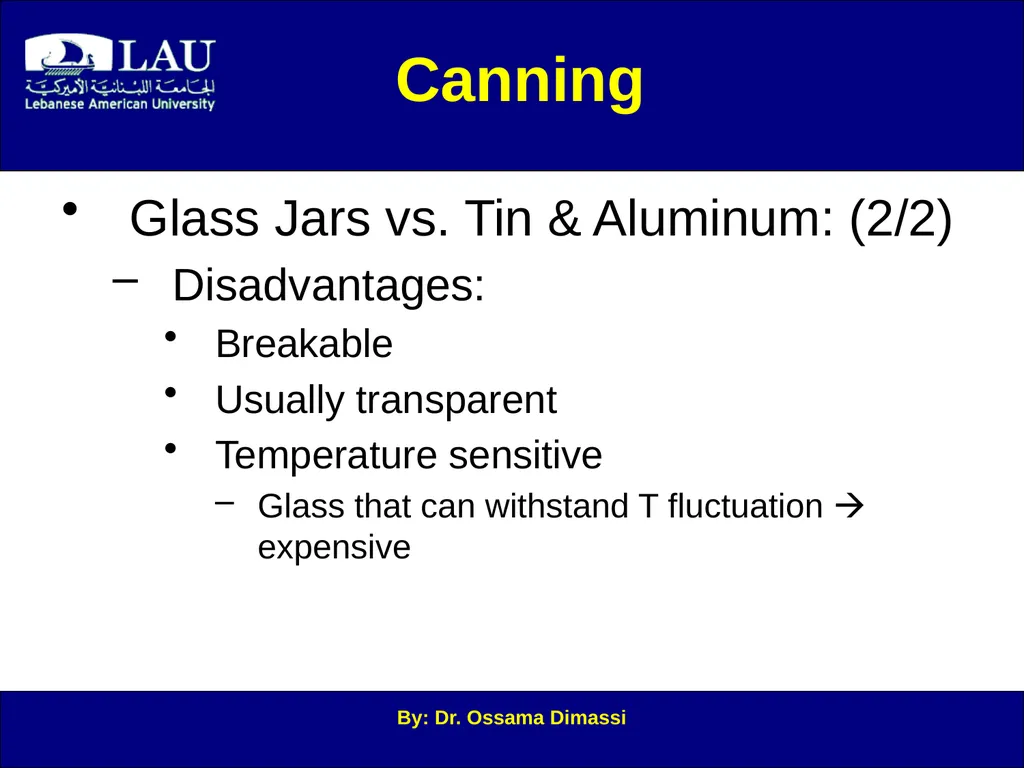
By: Dr. Ossama Dimassi Glass Jars vs. Tin & Aluminum: (2/2)
Disadvantages:
Breakable
Usually transparent
Temperature sensitive
Glass that can withstand T fluctuation expensive Canning<br>
13
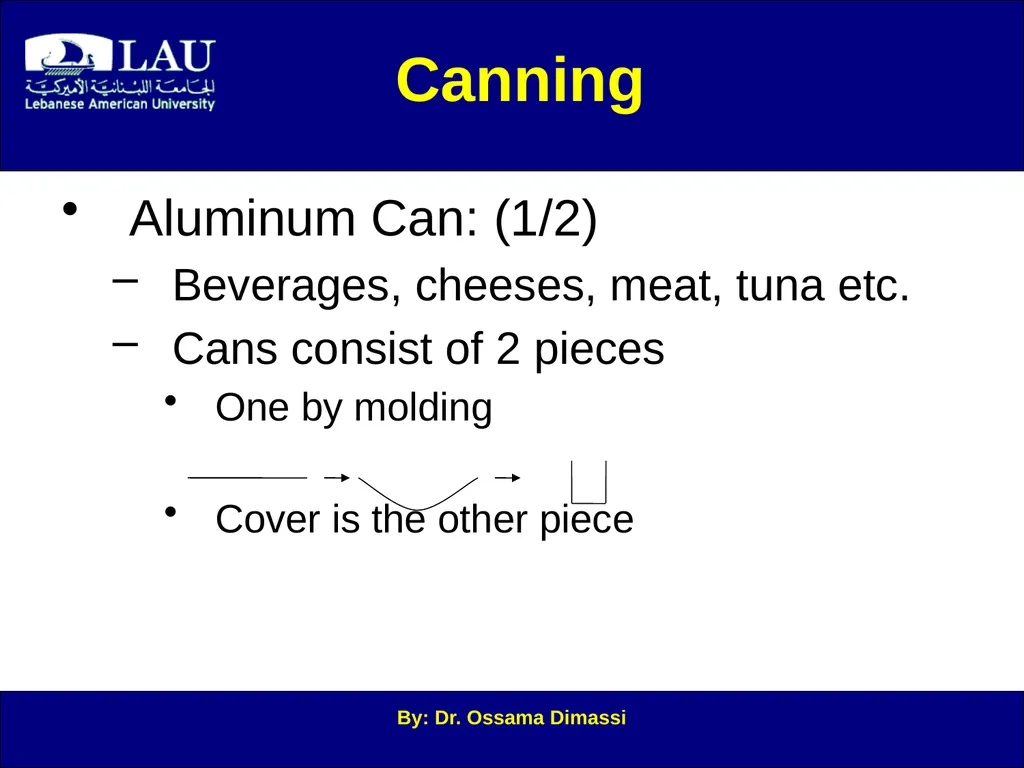
By: Dr. Ossama Dimassi Aluminum Can: (1/2)
Beverages, cheeses, meat, tuna etc.
Cans consist of 2 pieces
One by molding
Cover is the other piece Canning<br>
14
By: Dr. Ossama Dimassi Aluminum Can: (2/2)
Advantages:
Less Reactive than Tin
Soft easy to open cover lid
Disadvantage
More expensive
Soft type
Careful during sterilization using pressure Canning<br>
15
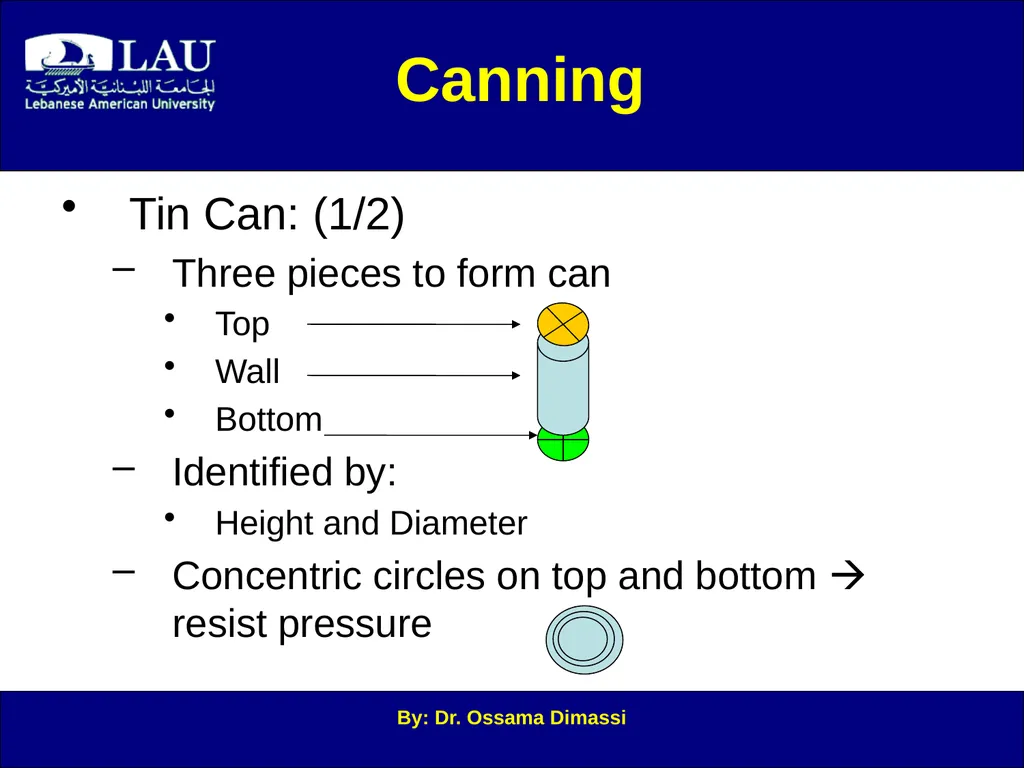
By: Dr. Ossama Dimassi Tin Can: (1/2)
Three pieces to form can
Top
Wall
Bottom
Identified by:
Height and Diameter
Concentric circles on top and bottom resist pressure Canning<br>
16
By: Dr. Ossama Dimassi Technical Information about canning Canning<br>
17
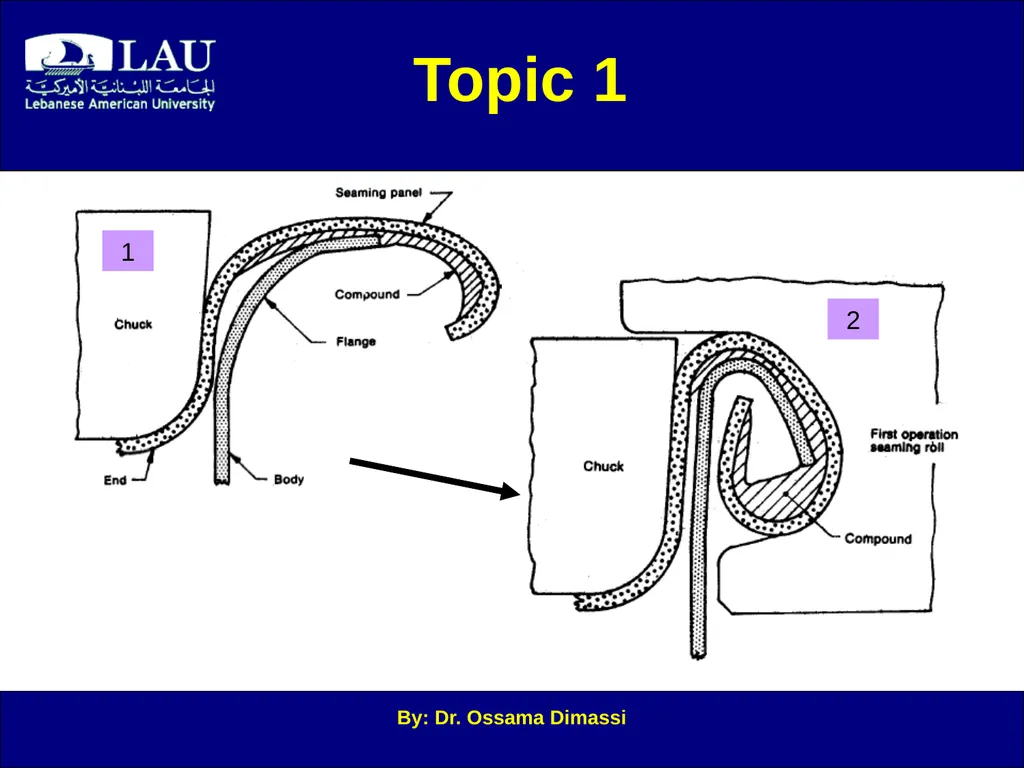
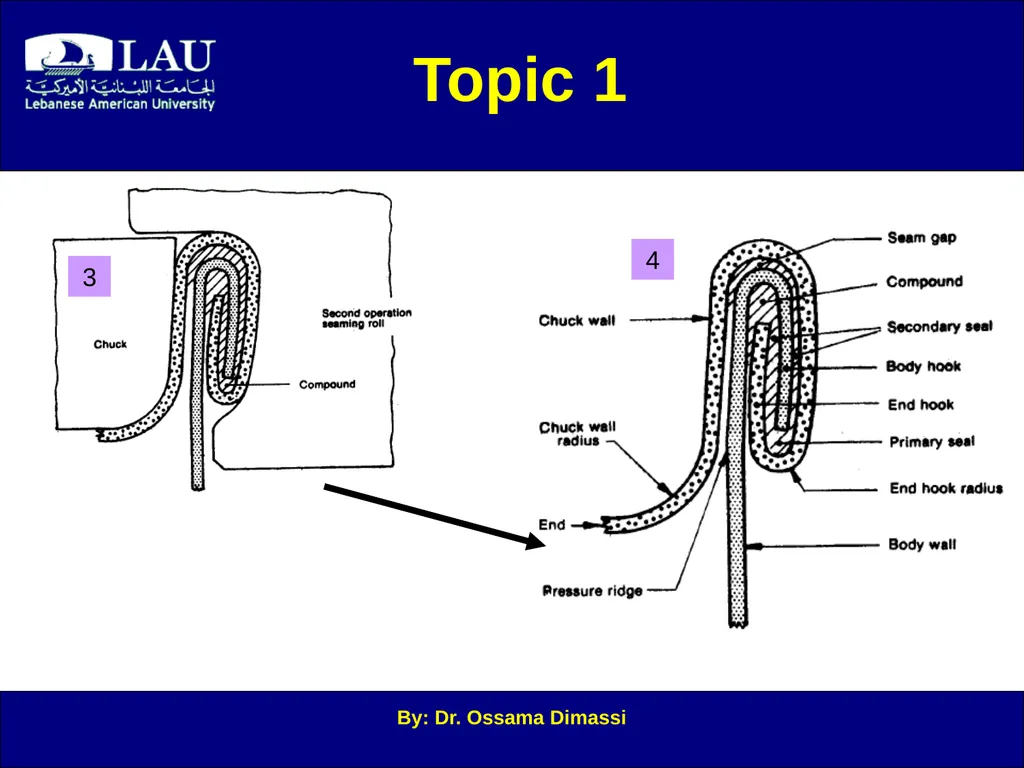
By: Dr. Ossama Dimassi Double Seam (Hermetic seal): (1/2)
Formed by interlocking the can body and the can end during two rolling actions.
The first action
Roll curls the edge of the can end up under the flange of the can body
Folds the metal into file thicknesses
Embedding the flange into the compound.
Edge of can end is reduced wrinkle formation Topic 1<br>
18
By: Dr. Ossama Dimassi Double Seam (Hermetic seal): (2/2)
The second action roll
flattens and tightens the seam hermetic seal is formed.
Causes
The wrinkles to be ironed out
The “compound” to be forced into any gaps Topic 1<br>
19
By: Dr. Ossama Dimassi Topic 1 1 2<br>
20
By: Dr. Ossama Dimassi Topic 1 3 4<br>
21
By: Dr. Ossama Dimassi Can lining:
Depending on product look at:
Need for lining
Sulfur resistance (canning meat for ex.)
Enamel
Acid resistance
Resin
New subject has to be careful for BPA Topic 2<br>
22
By: Dr. Ossama Dimassi Vacuum:
Head space vacuum
Bet. Food and lid
Prevent swelling
Food expands
Reduce O2 less oxidation
Reduce corrosion of can Topic 3<br>
23
By: Dr. Ossama Dimassi Vacuum:
Build up vacuum
Thermal exhausting
Hot food before sealing Vapor put lid T lowers Vapor condense to water Vacuum
Mechanical
Seal in a vacuum chamber
Control and measure vacuum by a gauge Topic 3<br>
24
By: Dr. Ossama Dimassi Thermal exhaustion:
Prevent enzymatic activity
T > 60º
Prevent microbial activity
Anaerobic Spore forming bacteria
Primary challenge Topic 4<br>
25
By: Dr. Ossama Dimassi Thermal Sterilization:
To apply successfully we need:
Information about product
Liquid, solid… etc.
Information about expected m-organisms
Spore forming …etc.
Understand Coldest point concept Topic 4<br>
26
By: Dr. Ossama Dimassi Product information
Provide insight on heat transfer:
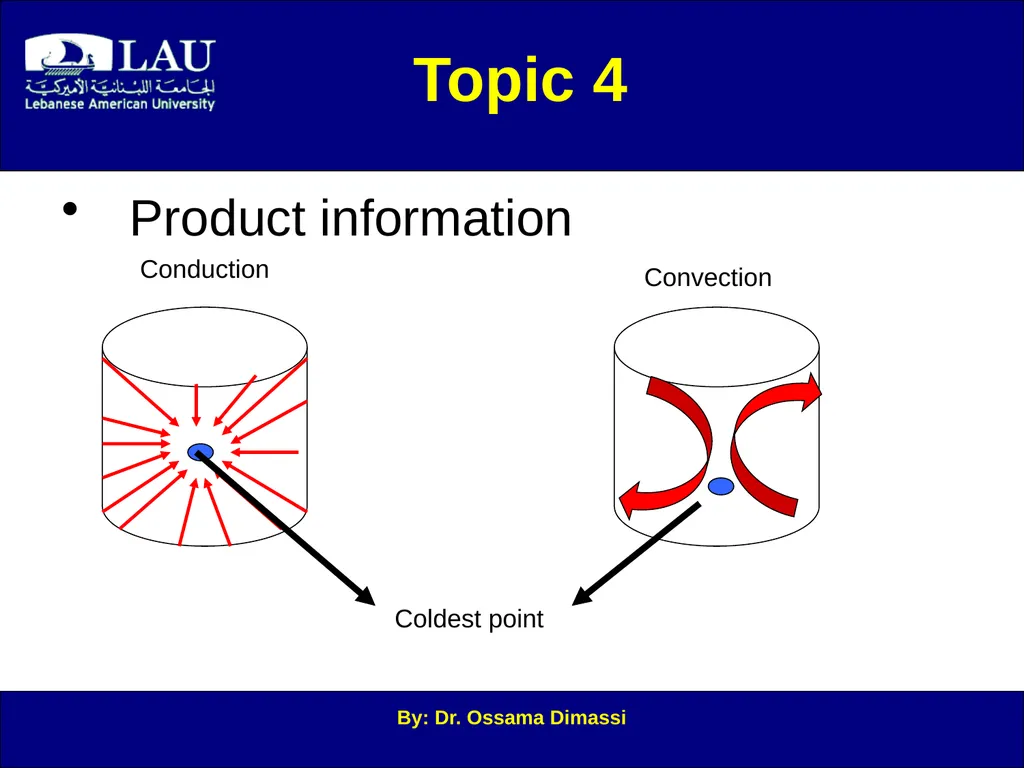
Conduction in solids
By contact
Coldest point easy to visualize (middle)
Convection
Nature of fluids
In 211 Can 1 inch from bottom. Topic 4<br>
27
By: Dr. Ossama Dimassi Product information Topic 4 Coldest point Conduction Convection<br>
28
By: Dr. Ossama Dimassi Product information
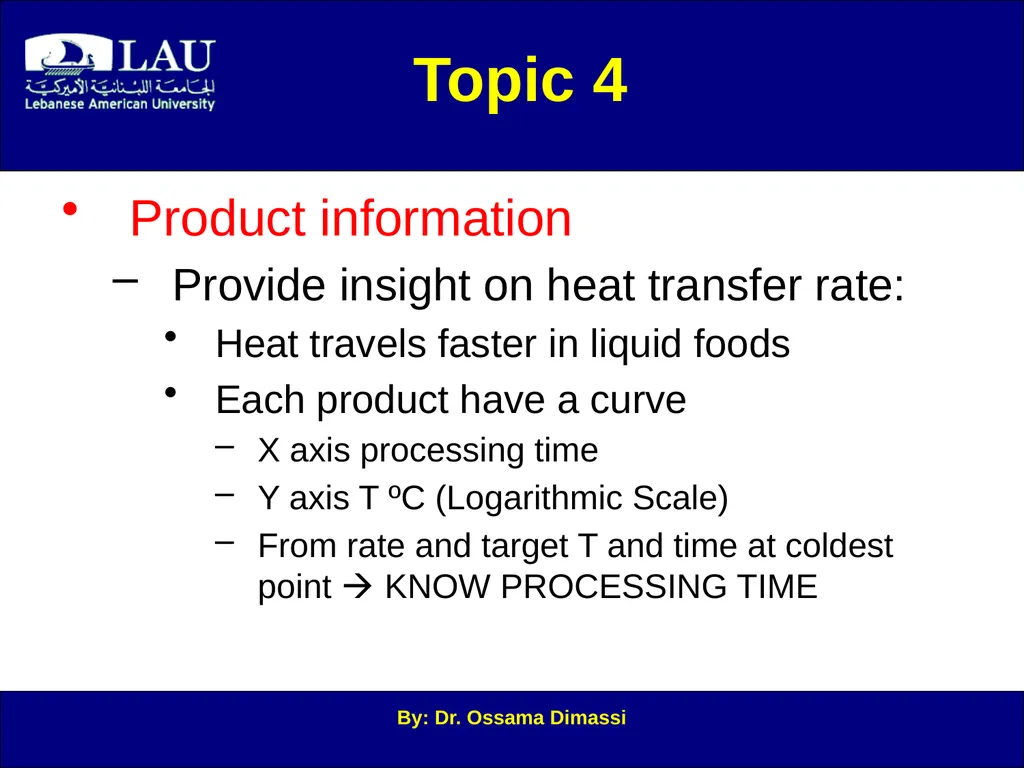
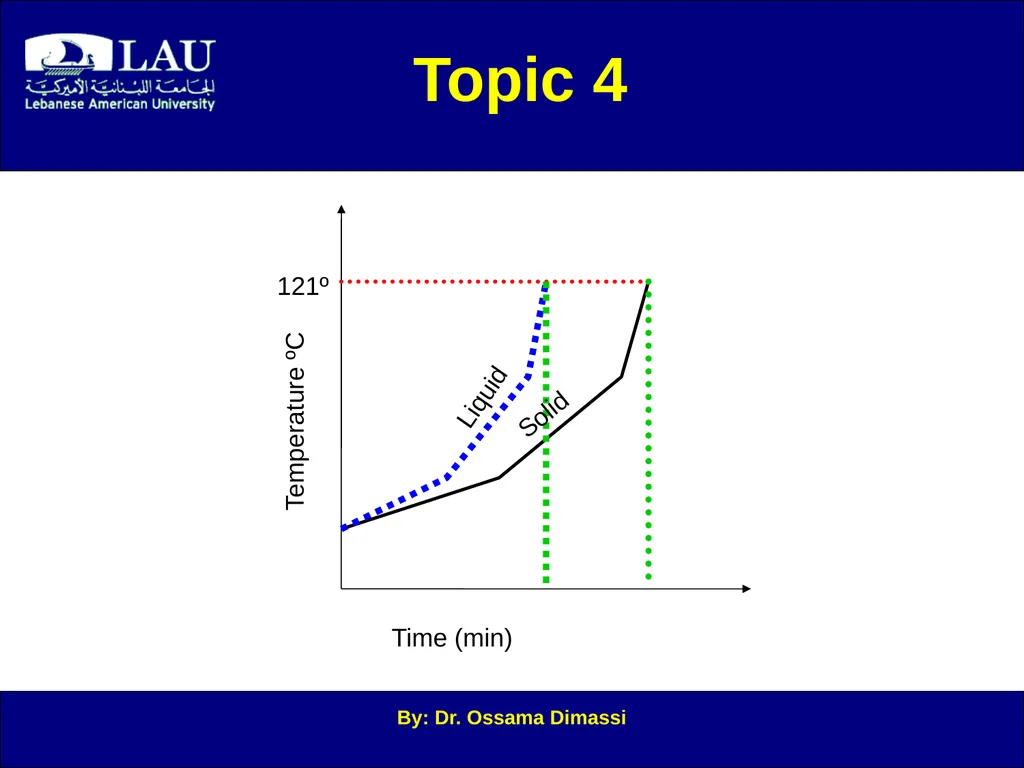
Provide insight on heat transfer rate:
Heat travels faster in liquid foods
Each product have a curve
X axis processing time
Y axis T ºC (Logarithmic Scale)
From rate and target T and time at coldest point KNOW PROCESSING TIME Topic 4<br>
29
By: Dr. Ossama Dimassi Topic 4<br>
30
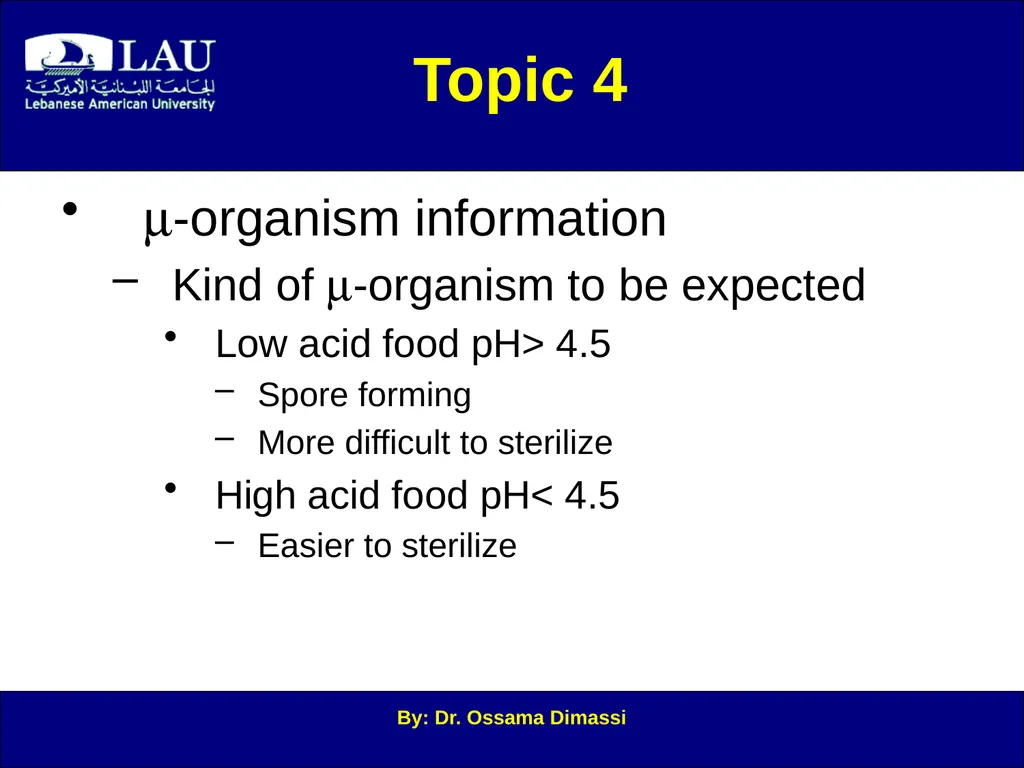
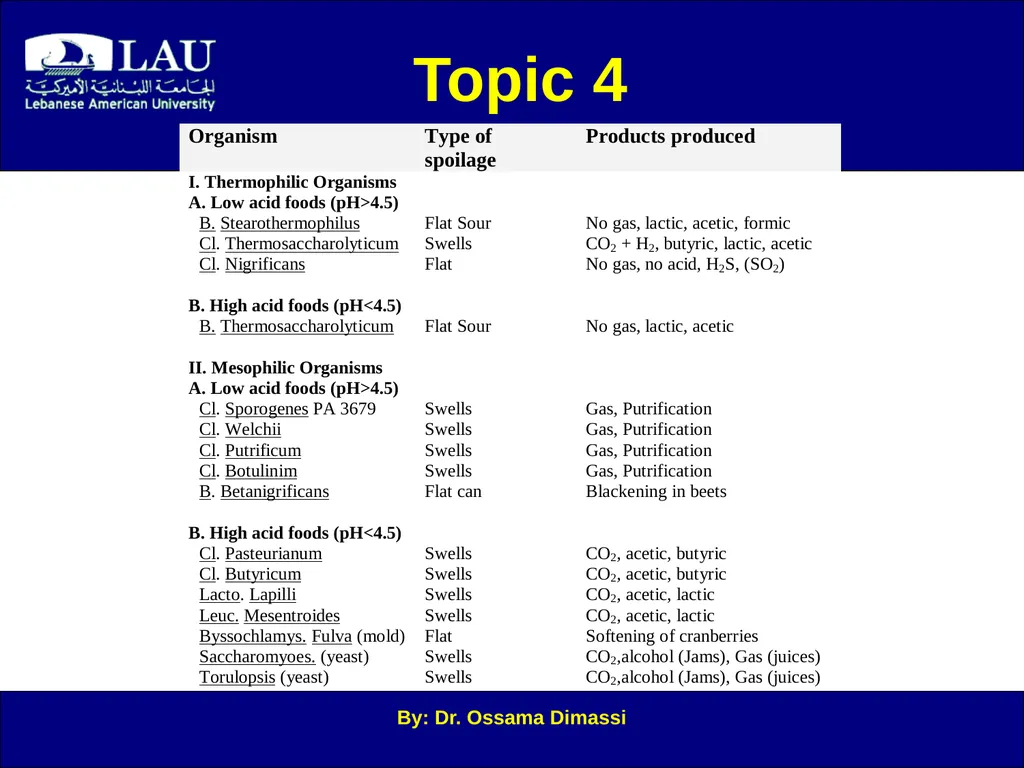
By: Dr. Ossama Dimassi m-organism information
Kind of m-organism to be expected
Low acid food pH> 4.5
Spore forming
More difficult to sterilize
High acid food pH< 4.5
Easier to sterilize Topic 4<br>
31
By: Dr. Ossama Dimassi Topic 4<br>
32
10-October-2007
12:00 By: Dr. Ossama Dimassi m-organism information
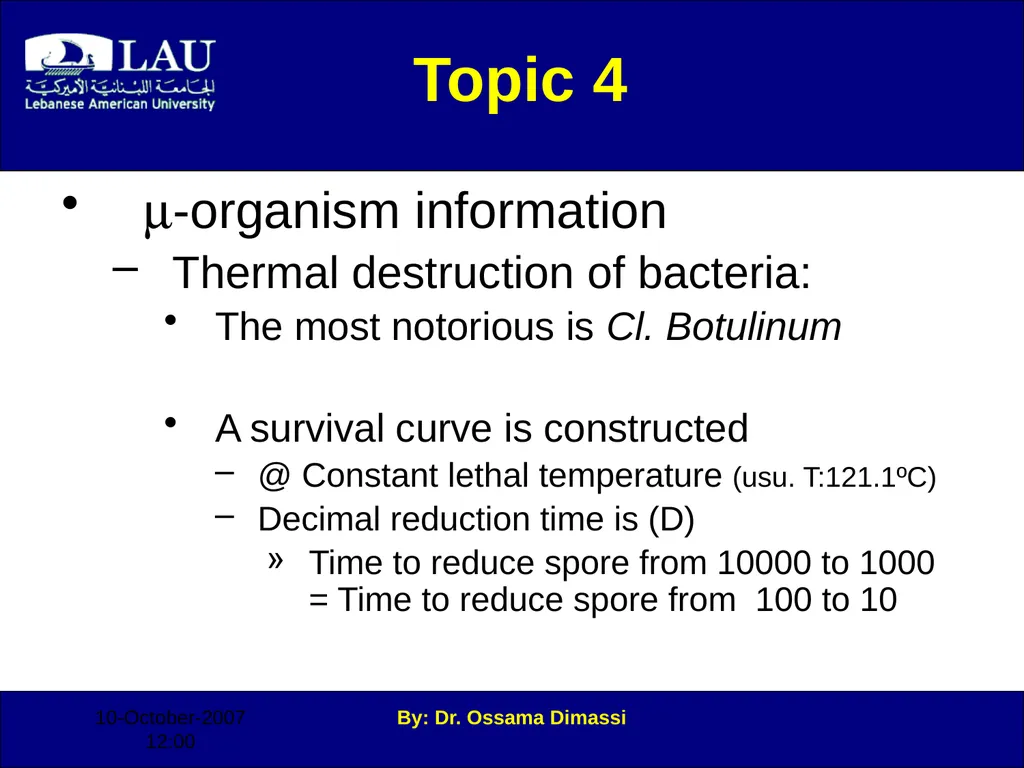
Thermal destruction of bacteria:
The most notorious is Cl. Botulinum
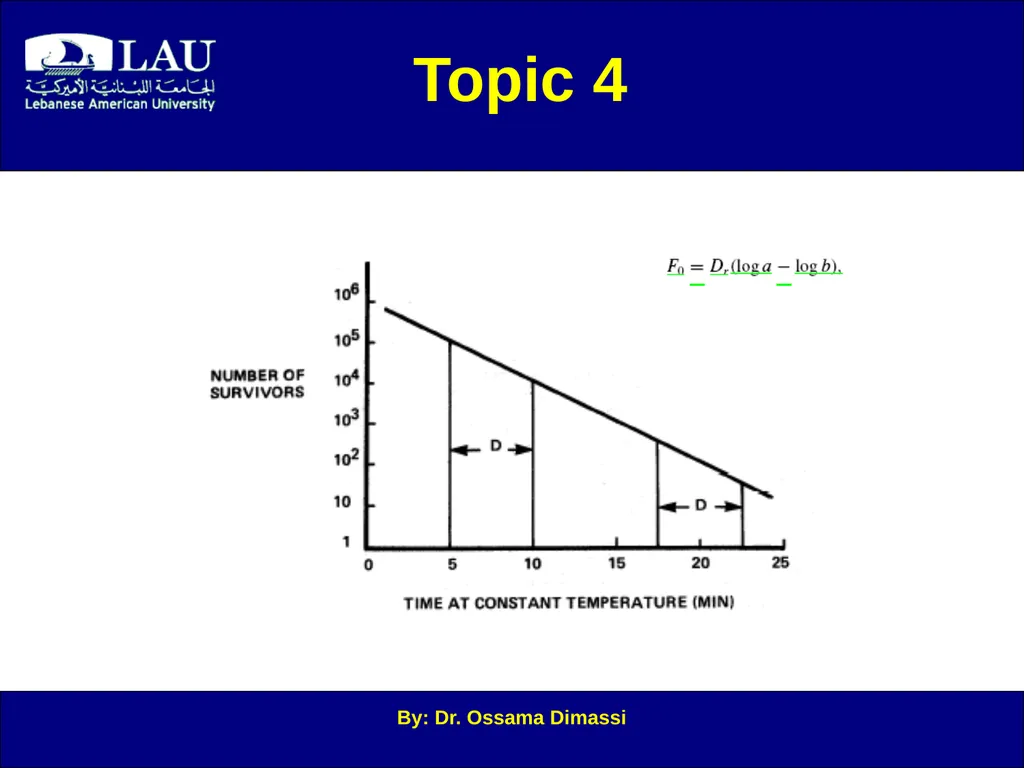
A survival curve is constructed
@ Constant lethal temperature (usu. T:121.1ºC)
Decimal reduction time is (D)
Time to reduce spore from 10000 to 1000 = Time to reduce spore from 100 to 10 Topic 4<br>
33
By: Dr. Ossama Dimassi Topic 4<br>
34
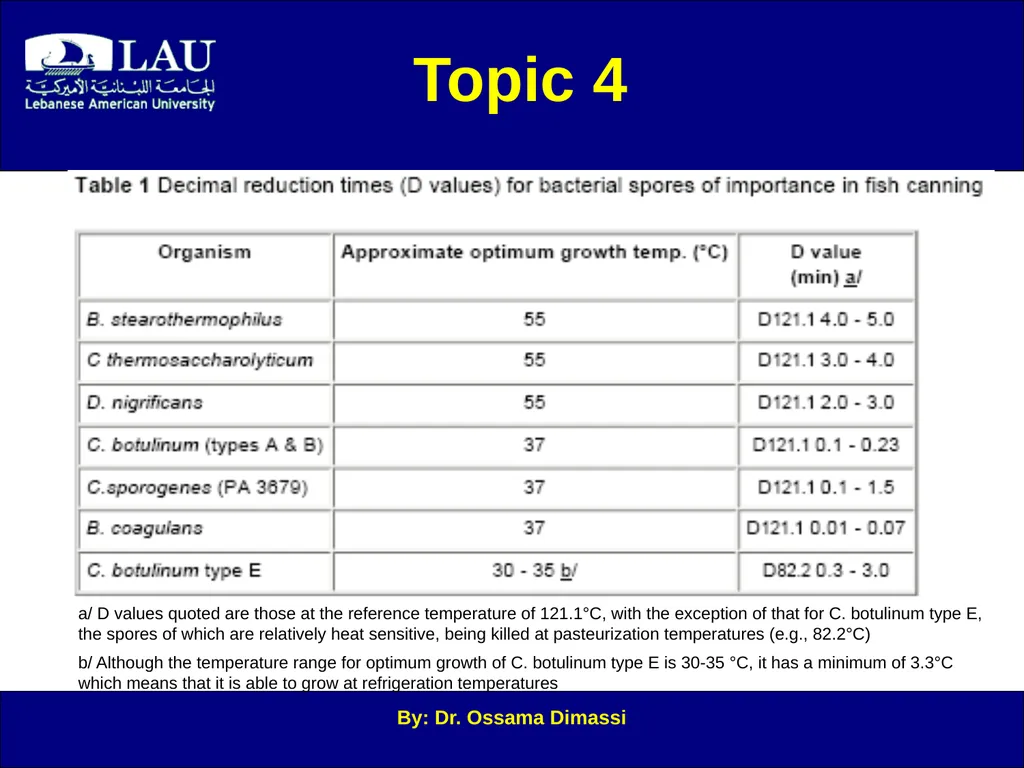
By: Dr. Ossama Dimassi Topic 4 a/ D values quoted are those at the reference temperature of 121.1°C, with the exception of that for C. botulinum type E, the spores of which are relatively heat sensitive, being killed at pasteurization temperatures (e.g., 82.2°C)
b/ Although the temperature range for optimum growth of C. botulinum type E is 30-35 °C, it has a minimum of 3.3°C which means that it is able to grow at refrigeration temperatures<br>