Calculation Methods for Year 6 At Homefields, we use Concrete, Pictorial, Abstract (CPA) which is a highly effective approach to teaching that develops a deep and sustainable understanding of maths in pupils. Concrete step of CPA Concrete
"Calculation Methods for Year 6 At Homefields, we" is the property of its rightful owner. Permission is granted to
download and print the materials on this website for personal, non-commercial use only, and to display it
on your personal computer provided you do not modify the materials and that you retain all copyright
notices contained in the materials. By downloading content from our website, you accept the terms of this
agreement.
Presentation Transcript
01
Calculation Methods
for Year 6<br>
02
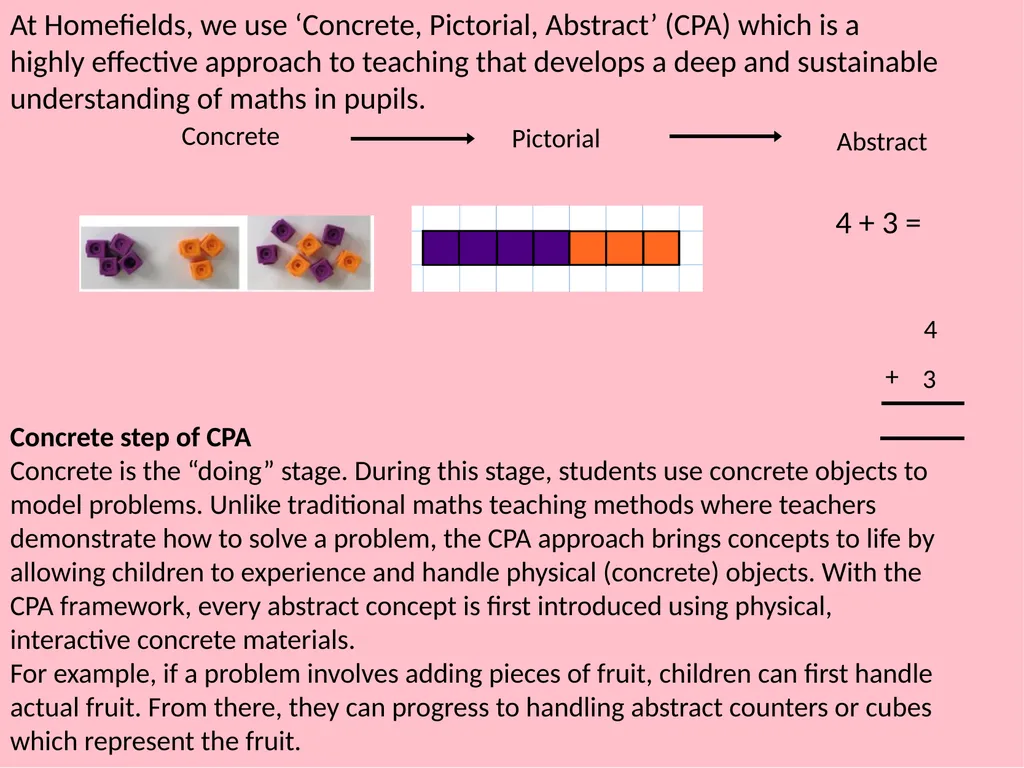
At Homefields, we use ‘Concrete, Pictorial, Abstract’ (CPA) which is a highly effective approach to teaching that develops a deep and sustainable understanding of maths in pupils.
Concrete step of CPA
Concrete is the “doing” stage. During this stage, students use concrete objects to model problems. Unlike traditional maths teaching methods where teachers demonstrate how to solve a problem, the CPA approach brings concepts to life by allowing children to experience and handle physical (concrete) objects. With the CPA framework, every abstract concept is first introduced using physical, interactive concrete materials.
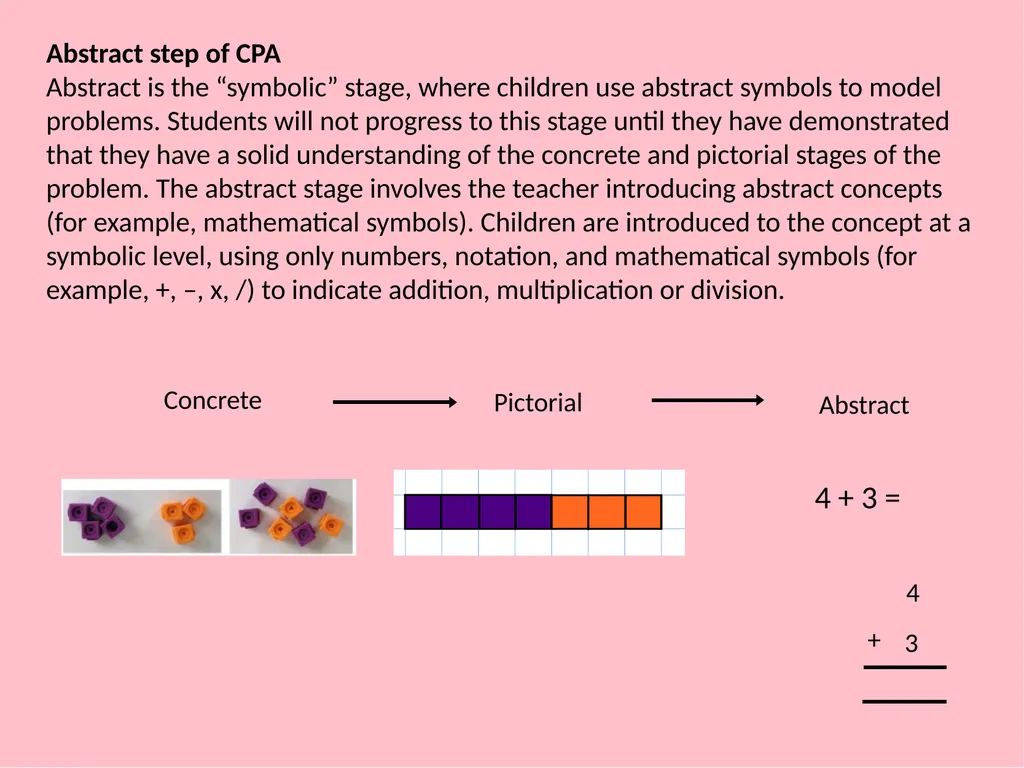
For example, if a problem involves adding pieces of fruit, children can first handle actual fruit. From there, they can progress to handling abstract counters or cubes which represent the fruit. 4 + 3 =<br>
03
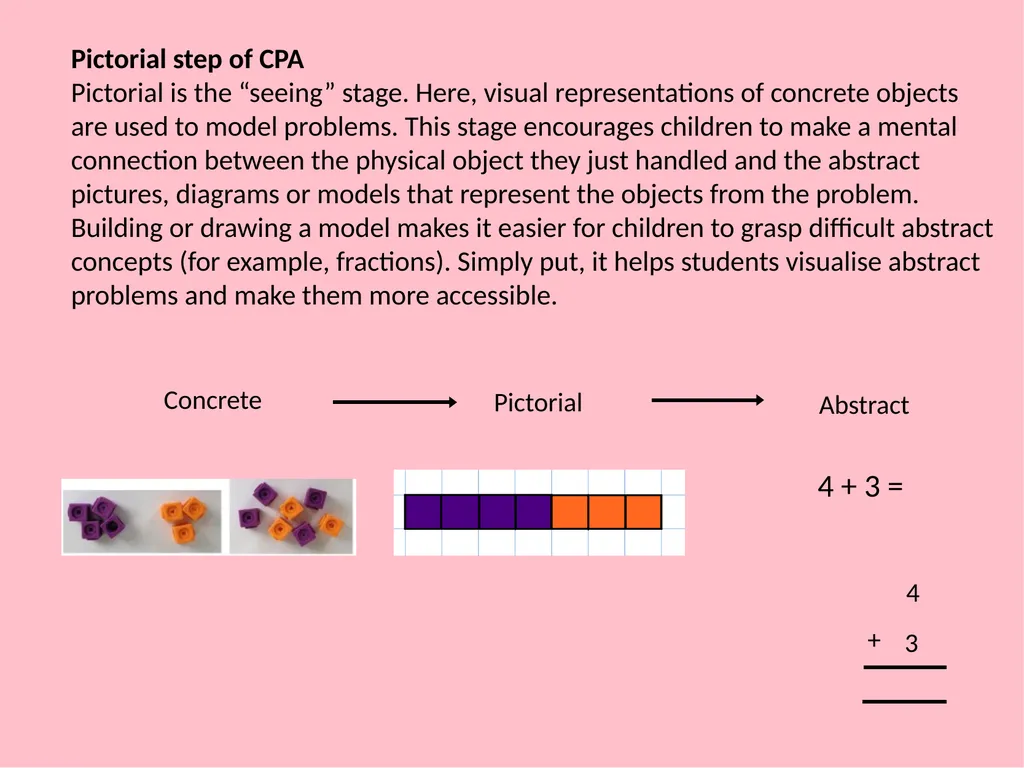
4 + 3 = Pictorial step of CPA
Pictorial is the “seeing” stage. Here, visual representations of concrete objects are used to model problems. This stage encourages children to make a mental connection between the physical object they just handled and the abstract pictures, diagrams or models that represent the objects from the problem.
Building or drawing a model makes it easier for children to grasp difficult abstract concepts (for example, fractions). Simply put, it helps students visualise abstract problems and make them more accessible.<br>
04
Abstract step of CPA
Abstract is the “symbolic” stage, where children use abstract symbols to model problems. Students will not progress to this stage until they have demonstrated that they have a solid understanding of the concrete and pictorial stages of the problem. The abstract stage involves the teacher introducing abstract concepts (for example, mathematical symbols). Children are introduced to the concept at a symbolic level, using only numbers, notation, and mathematical symbols (for example, +, –, x, /) to indicate addition, multiplication or division. 4 + 3 =<br>
05
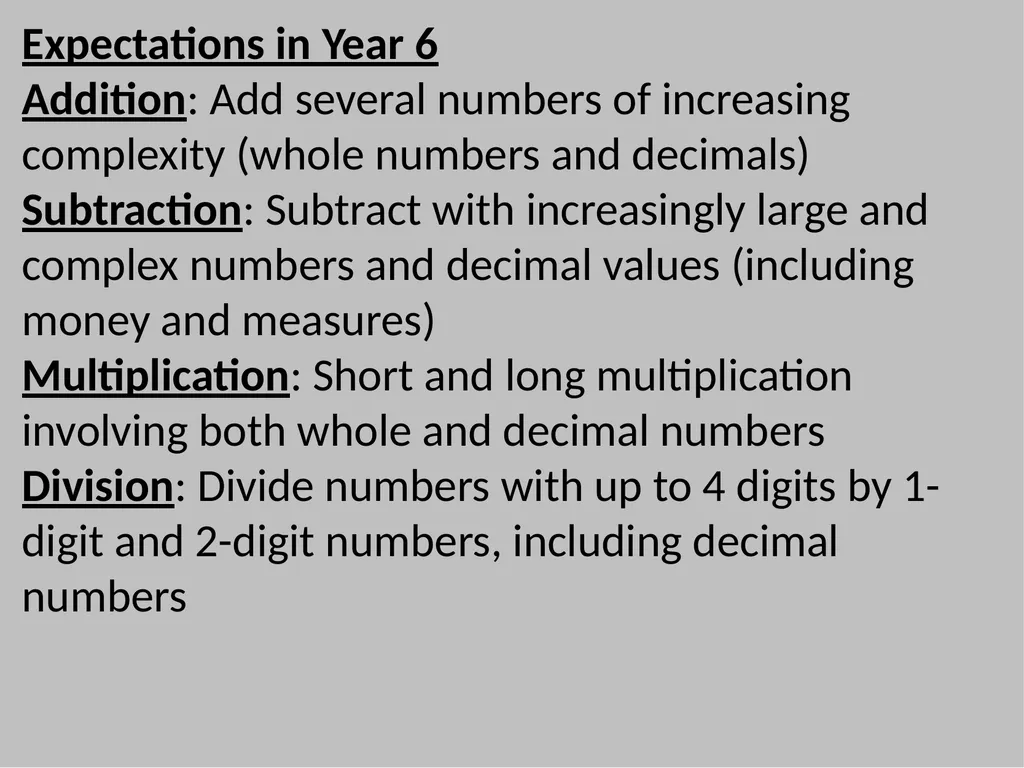
Expectations in Year 6
Addition: Add several numbers of increasing complexity (whole numbers and decimals)
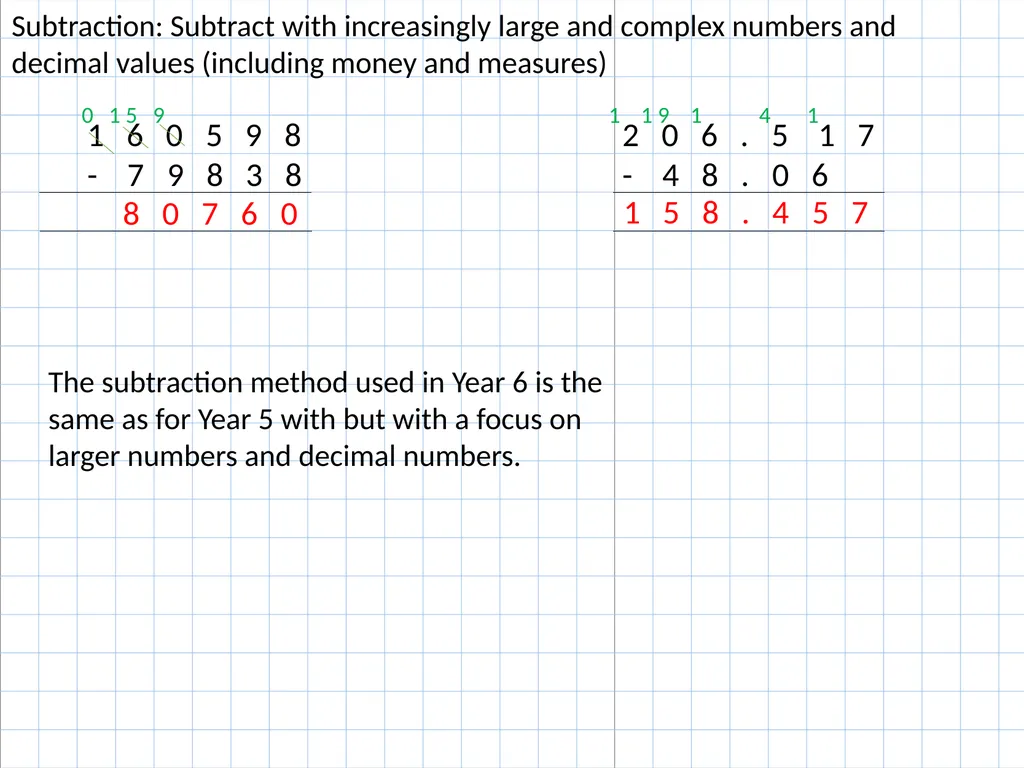
Subtraction: Subtract with increasingly large and complex numbers and decimal values (including money and measures)
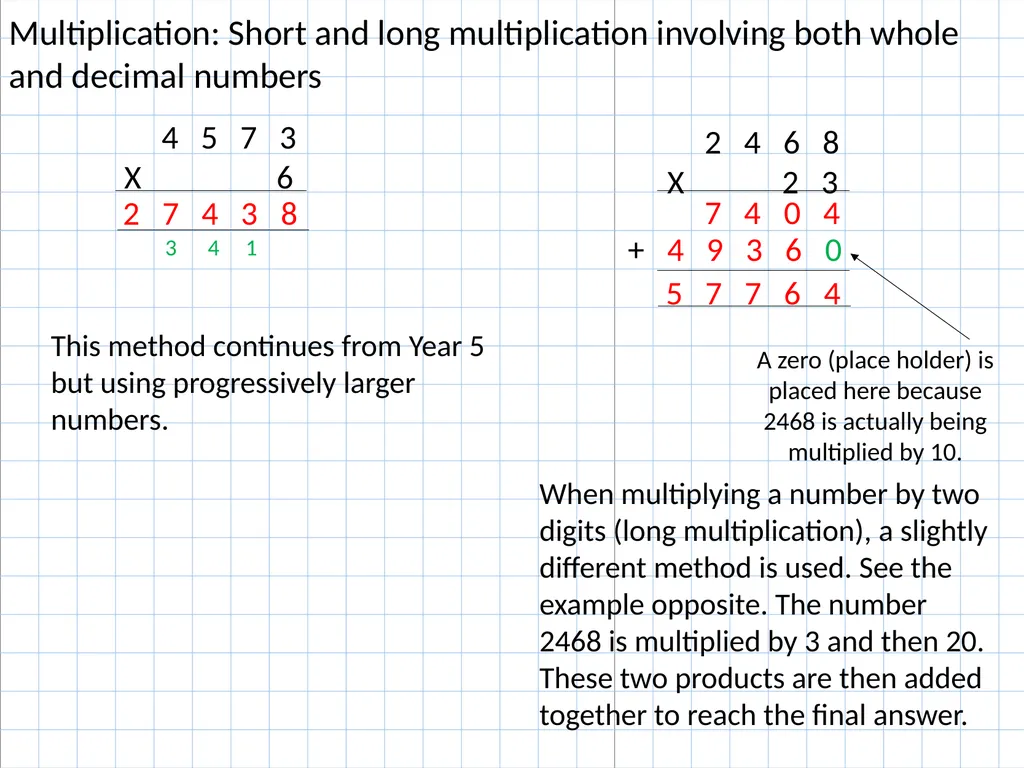
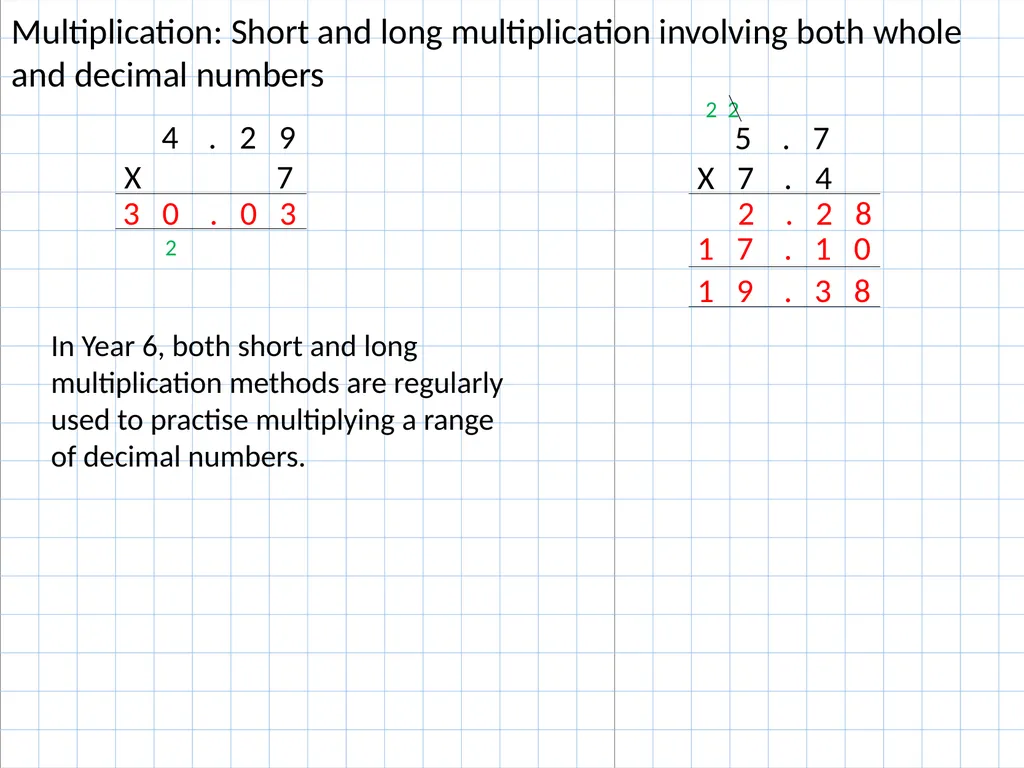
Multiplication: Short and long multiplication involving both whole and decimal numbers
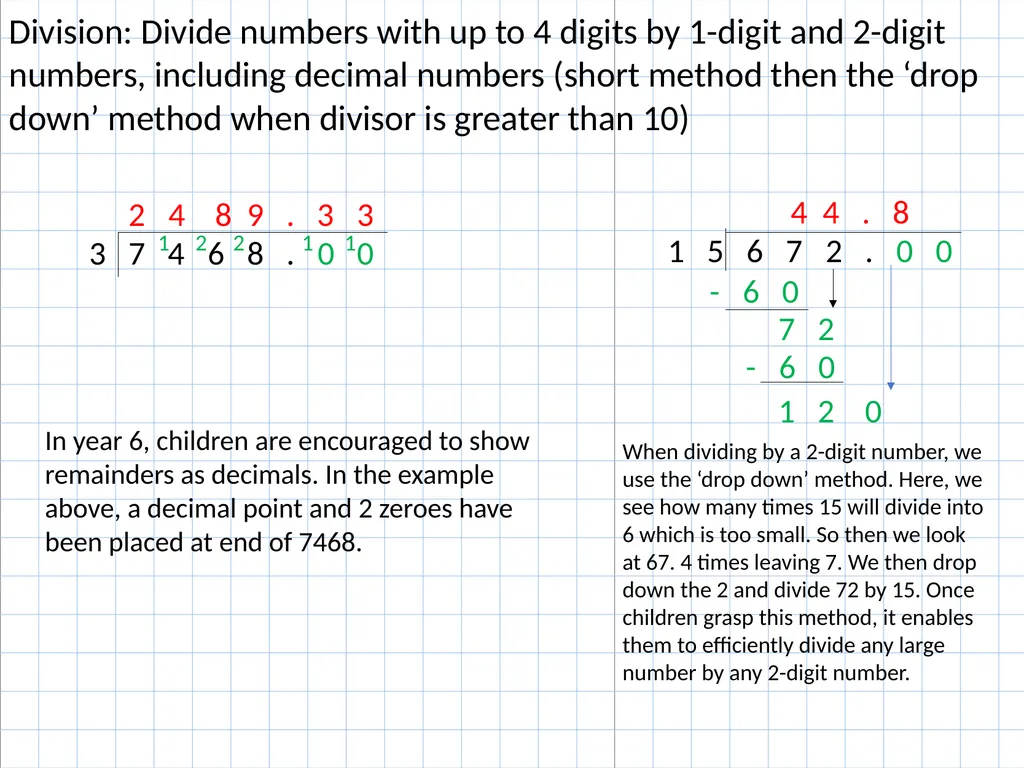
Division: Divide numbers with up to 4 digits by 1-digit and 2-digit numbers, including decimal numbers<br>
06
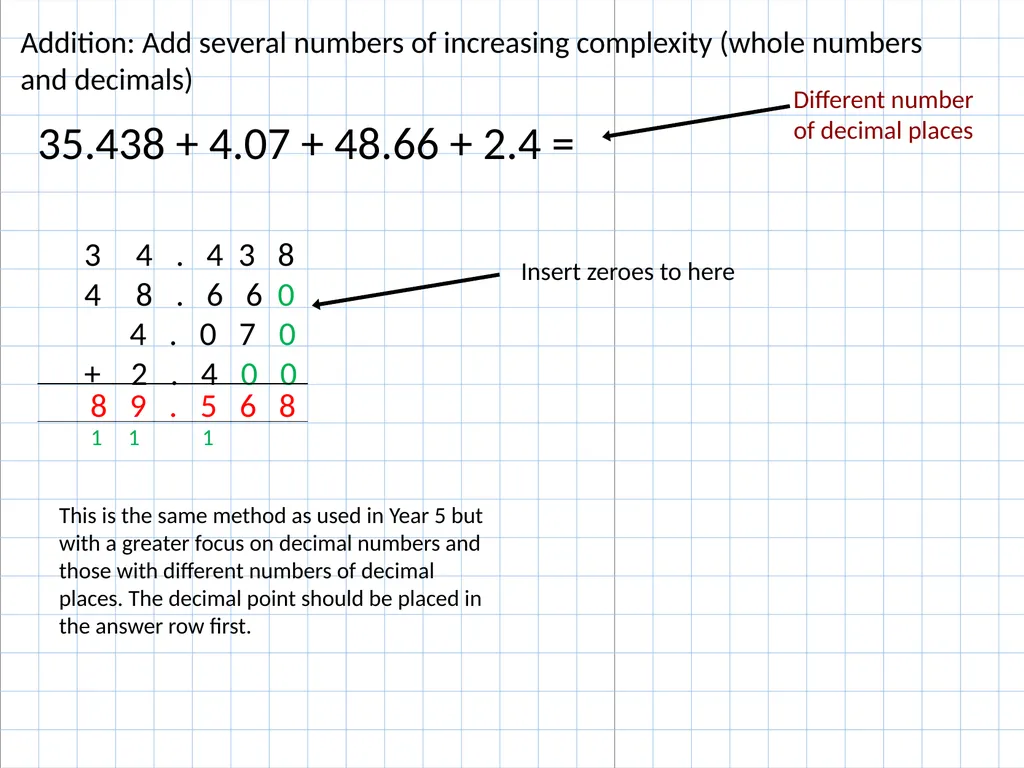
35.438 + 4.07 + 48.66 + 2.4 = Addition: Add several numbers of increasing complexity (whole numbers and decimals) Different number of decimal places 4 . 4 3 8
8 . 6 6 0
4 . 0 7 0
+ 2 . 4 0 0 Insert zeroes to here 8 9 . 5 6 8 1 1 1 This is the same method as used in Year 5 but with a greater focus on decimal numbers and those with different numbers of decimal places. The decimal point should be placed in the answer row first.<br>
07
Subtraction: Subtract with increasingly large and complex numbers and decimal values (including money and measures) The subtraction method used in Year 6 is the same as for Year 5 with but with a focus on larger numbers and decimal numbers. 1 6 0 5 9 8
- 7 9 8 3 8 8 0 7 6 0 1 1 9 1 4 1 0 1 5 9 2 0 6 . 5 1 7
- 4 8 . 0 6 1 5 8 . 4 5 7<br>
08
Multiplication: Short and long multiplication involving both whole and decimal numbers 4 5 7 3
X 6 2 7 4 3 8 3 4 1 2 4 6 8
X 2 3 7 4 0 4 + 4 9 3 6 0 5 7 7 6 4 When multiplying a number by two digits (long multiplication), a slightly different method is used. See the example opposite. The number 2468 is multiplied by 3 and then 20. These two products are then added together to reach the final answer. A zero (place holder) is placed here because 2468 is actually being multiplied by 10. This method continues from Year 5 but using progressively larger numbers.<br>
09
Multiplication: Short and long multiplication involving both whole and decimal numbers 4 . 2 9
X 7 3 0 . 0 3 2 . 2 8 5 . 7
X 7 . 4 1 7 . 1 0 1 9 . 3 8 In Year 6, both short and long multiplication methods are regularly used to practise multiplying a range of decimal numbers. 2 2 2<br>
10
In year 6, children are encouraged to show remainders as decimals. In the example above, a decimal point and 2 zeroes have been placed at end of 7468. Division: Divide numbers with up to 4 digits by 1-digit and 2-digit numbers, including decimal numbers (short method then the ‘drop down’ method when divisor is greater than 10) 3 7 4 6 8 . 0 0 2 4 8 9 . 3 3 1 2 2 1 1 1 5 6 7 2 . 0 0 - 6 0 7 2 - 6 0 1 2 0 4 4 . 8 When dividing by a 2-digit number, we use the ‘drop down’ method. Here, we see how many times 15 will divide into 6 which is too small. So then we look at 67. 4 times leaving 7. We then drop down the 2 and divide 72 by 15. Once children grasp this method, it enables them to efficiently divide any large number by any 2-digit number.<br>