Carbohydrates Carbohydrates are polyhydroxy aldehydes or ketones, or substances that yield such compounds on hydrolysis. Most of the carbohydrates have the empirical formula (CH2O)n; some also contain nitrogen, phosphorus, or sulfur. There
"Carbohydrates Carbohydrates are polyhydroxy" is the property of its rightful owner. Permission is granted to
download and print the materials on this website for personal, non-commercial use only, and to display it
on your personal computer provided you do not modify the materials and that you retain all copyright
notices contained in the materials. By downloading content from our website, you accept the terms of this
agreement.
Presentation Transcript
01
Carbohydrates Carbohydrates are polyhydroxy aldehydes or ketones, or substances that yield such compounds on hydrolysis.
Most of the carbohydrates have the empirical formula (CH2O)n; some also contain nitrogen, phosphorus, or sulfur.
There are three major size classes of carbohydrates:
monosaccharides
oligosaccharides
polysaccharides
(the word “saccharide” is derived from the Greek sakcharon, meaning “sugar”) Ref.-Lehninger Principles of Biochemistry, Nelson and Cox<br>
02
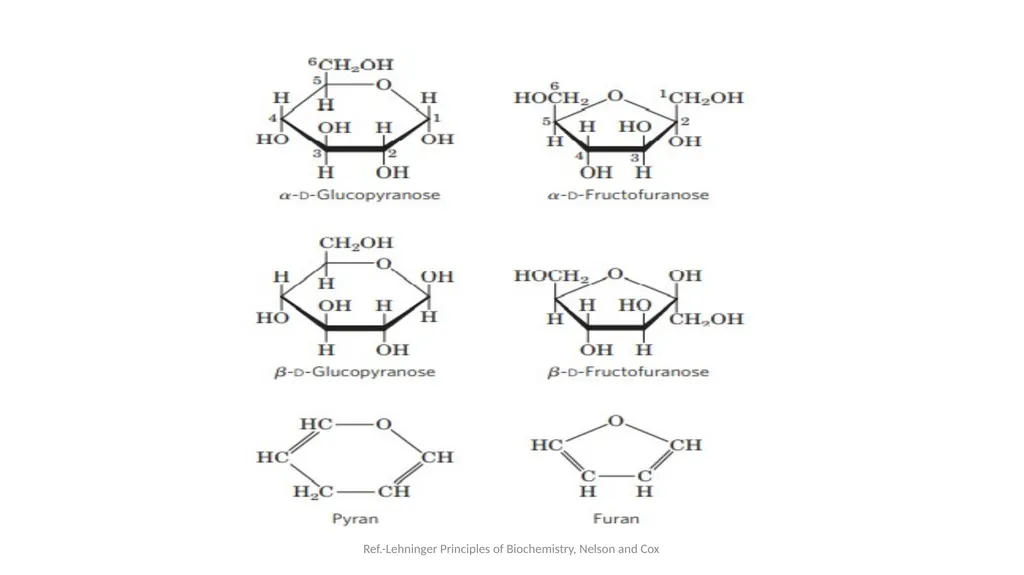
Monosaccharides Monosaccharides, or simple sugars, consist of a single polyhydroxy aldehyde or ketone unit. The most abundant monosaccharide in nature is the six-carbon sugar D-glucose, sometimes referred to as dextrose. Monosaccharides of four or more carbons tend to have cyclic structures.
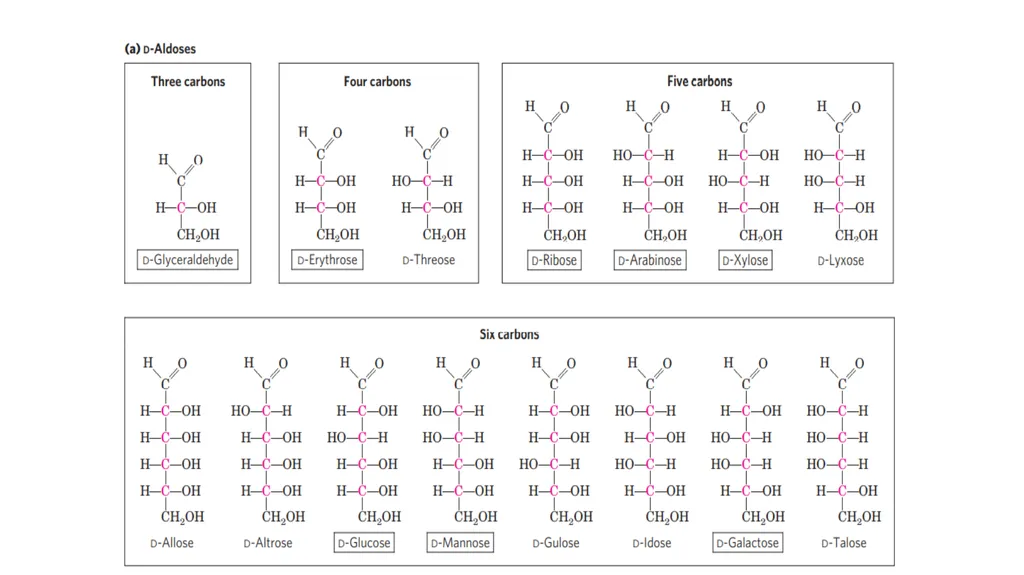
The monosaccharides, are either aldehydes or ketones with two or more hydroxyl groups;
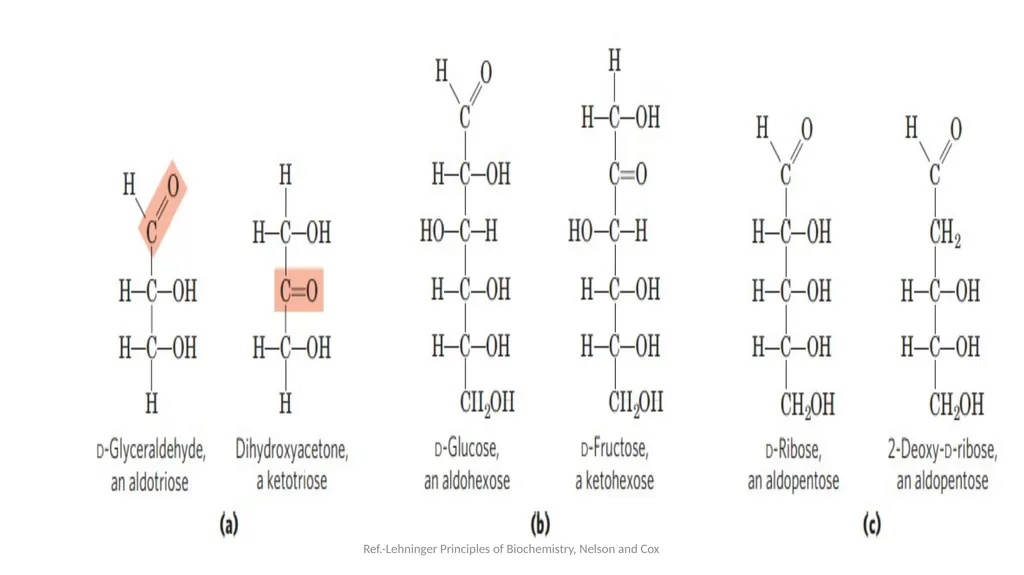
If the carbonyl group is at an end of the carbon chain (that is, in an aldehyde group) the monosaccharide is an aldose;
If the carbonyl group is at any other position (in a ketone group) the monosaccharide is a ketose.
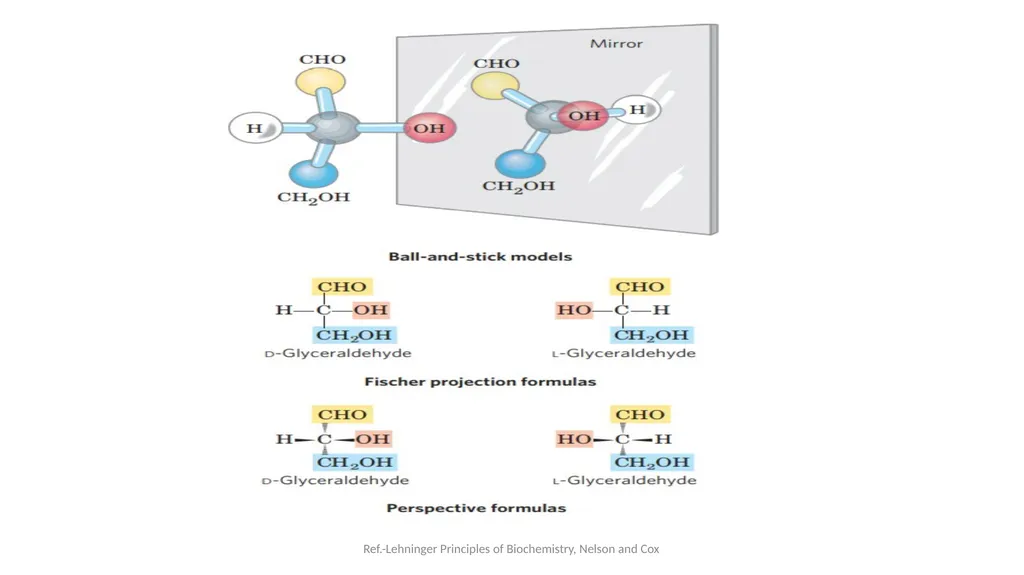
The simplest monosaccharides are the two three-carbon trioses: glyceraldehyde, an aldotriose, and dihydroxyacetone, a ketotriose Ref.-Lehninger Principles of Biochemistry, Nelson and Cox<br>
03
Ref.-Lehninger Principles of Biochemistry, Nelson and Cox<br>
04
Ref.-Lehninger Principles of Biochemistry, Nelson and Cox<br>
05
Ref.-Lehninger Principles of Biochemistry, Nelson and Cox<br>
06
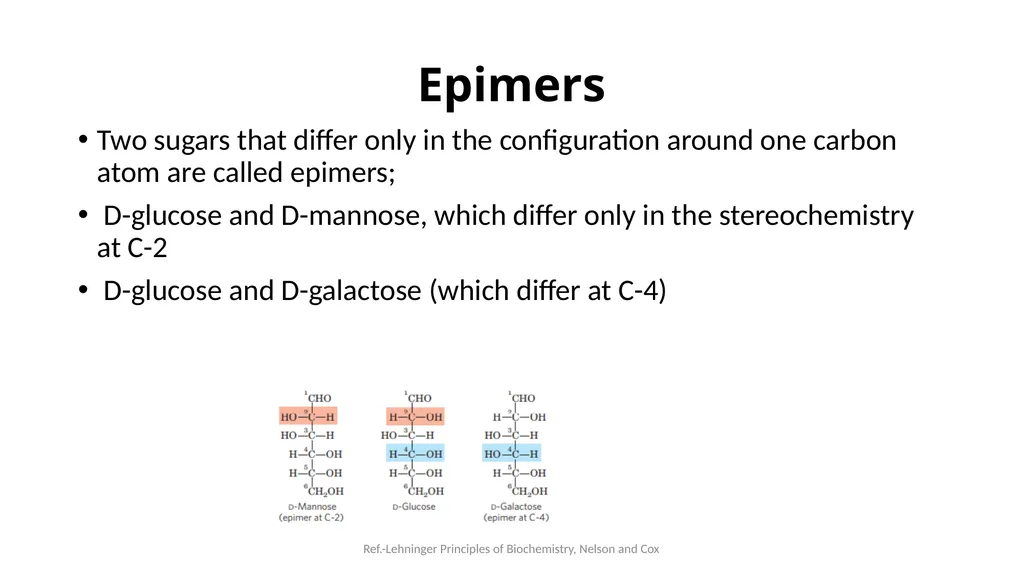
Epimers Two sugars that differ only in the configuration around one carbon atom are called epimers;
D-glucose and D-mannose, which differ only in the stereochemistry at C-2
D-glucose and D-galactose (which differ at C-4) Ref.-Lehninger Principles of Biochemistry, Nelson and Cox<br>
07
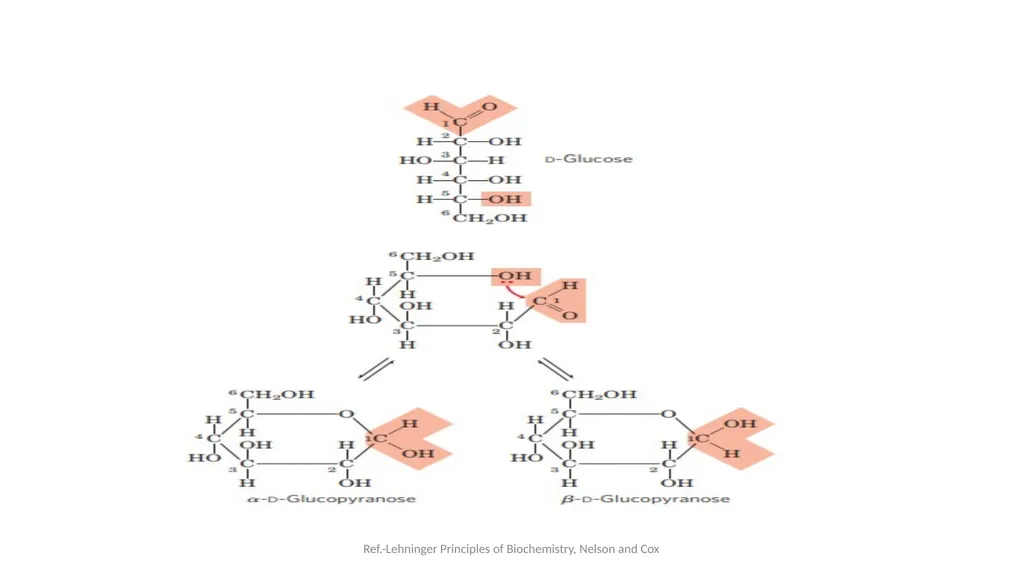
Hemiacetals or Hemiketals In aqueous solution, aldotetroses and all monosaccharides with five or more carbon atoms in the backbone occur predominantly as cyclic (ring) structures in which the carbonyl group has formed a covalent bond with the oxygen of a hydroxyl group along the chain. The formation of these ring structures is the result of a general reaction between alcohols and aldehydes or ketones to form derivatives called hemiacetals or hemiketals. Two molecules of an alcohol can add to a carbonyl carbon; the product of the first addition is a hemiacetal (for addition to an aldose) or a hemiketal (for addition to a ketose) Ref.-Lehninger Principles of Biochemistry, Nelson and Cox<br>
08
Ref.-Lehninger Principles of Biochemistry, Nelson and Cox<br>
09
Ref.-Lehninger Principles of Biochemistry, Nelson and Cox<br>
10
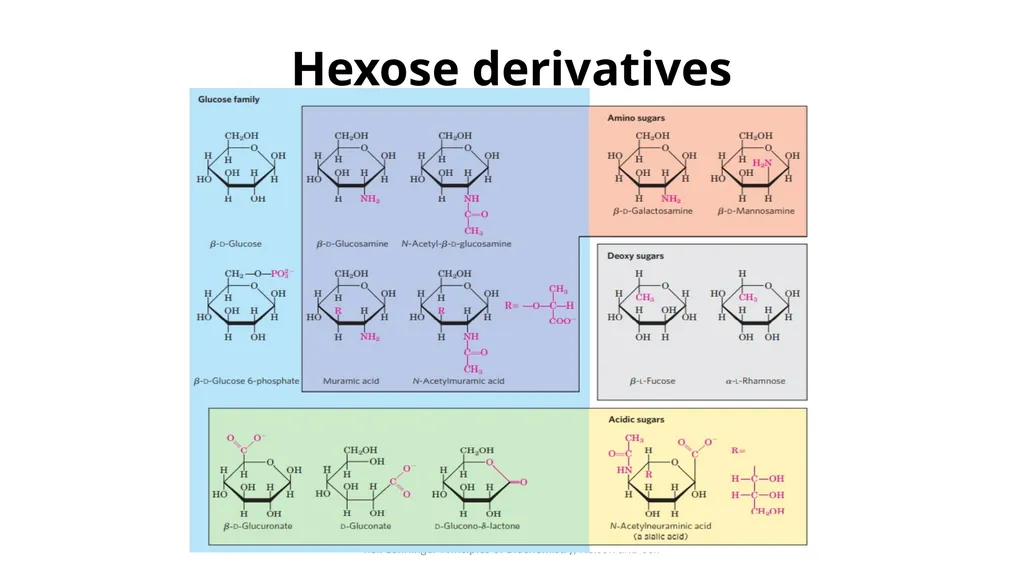
Hexose derivatives Ref.-Lehninger Principles of Biochemistry, Nelson and Cox<br>
11
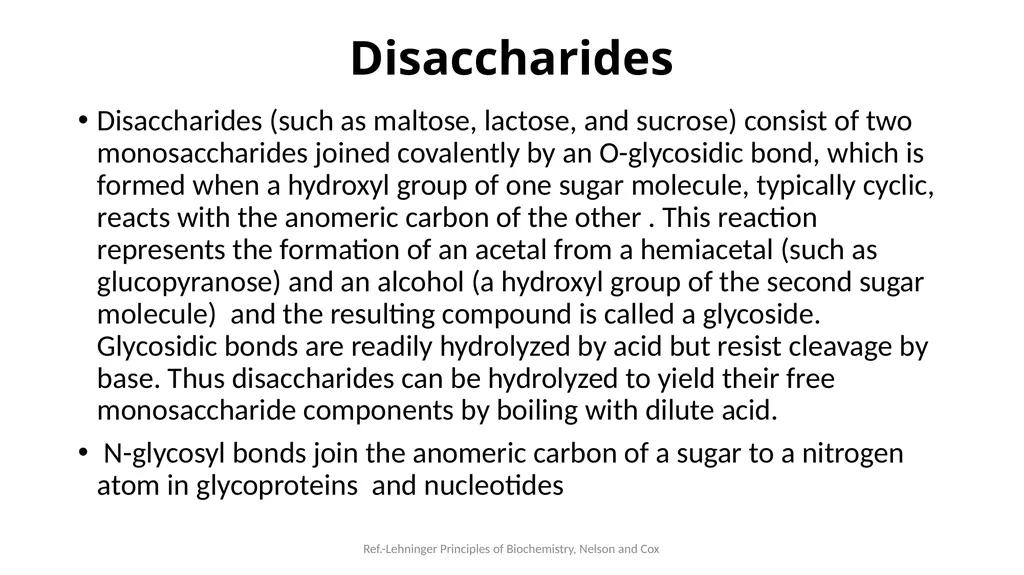
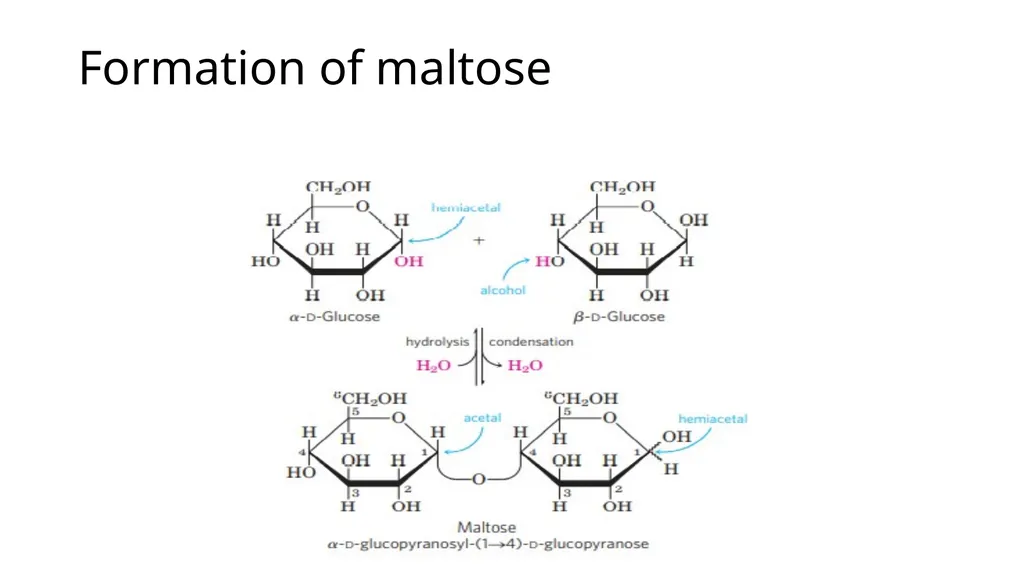
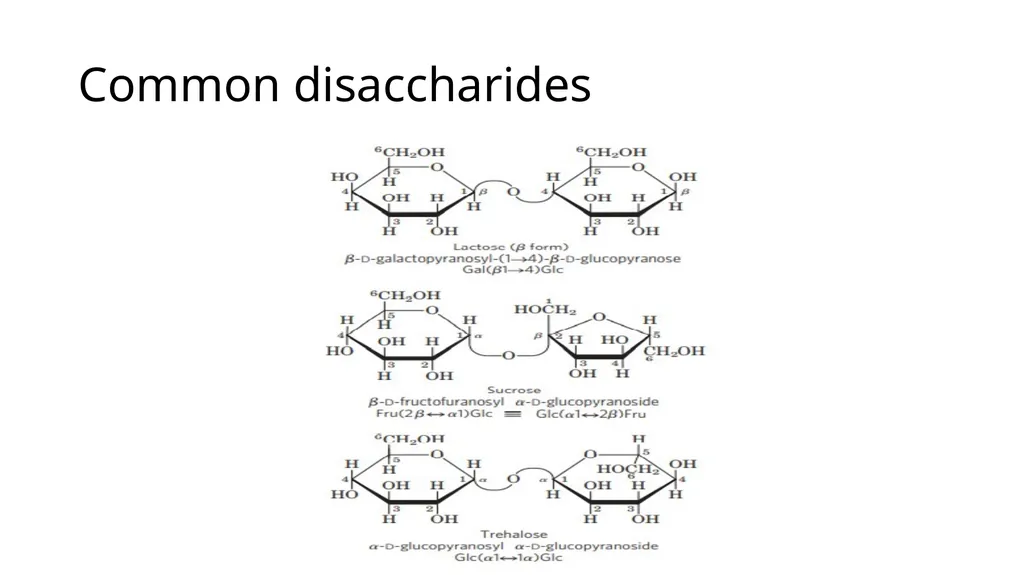
Disaccharides Disaccharides (such as maltose, lactose, and sucrose) consist of two monosaccharides joined covalently by an O-glycosidic bond, which is formed when a hydroxyl group of one sugar molecule, typically cyclic, reacts with the anomeric carbon of the other . This reaction represents the formation of an acetal from a hemiacetal (such as glucopyranose) and an alcohol (a hydroxyl group of the second sugar molecule) and the resulting compound is called a glycoside. Glycosidic bonds are readily hydrolyzed by acid but resist cleavage by base. Thus disaccharides can be hydrolyzed to yield their free monosaccharide components by boiling with dilute acid.
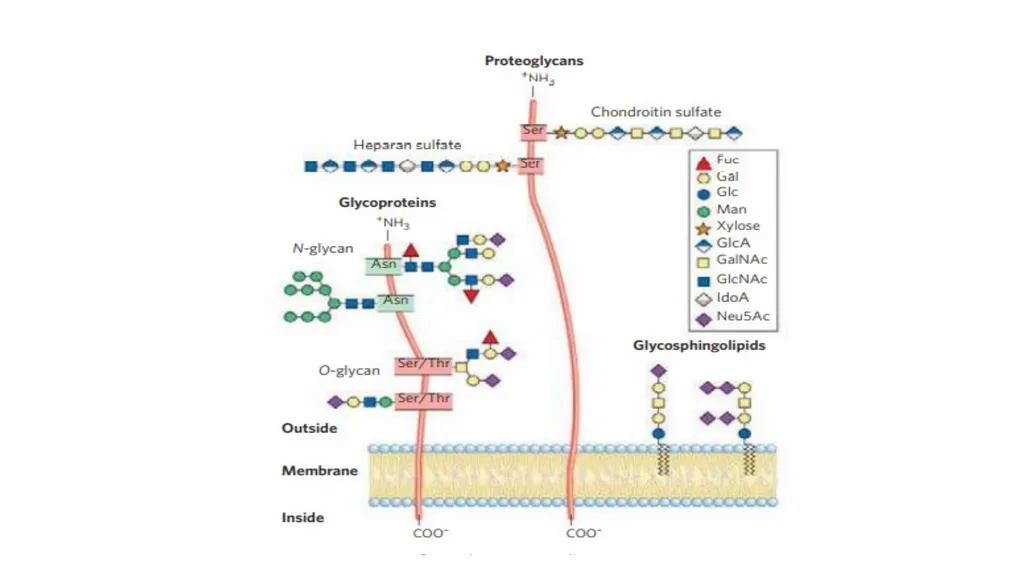
N-glycosyl bonds join the anomeric carbon of a sugar to a nitrogen atom in glycoproteins and nucleotides Ref.-Lehninger Principles of Biochemistry, Nelson and Cox<br>
12
Formation of maltose Ref.-Lehninger Principles of Biochemistry, Nelson and Cox<br>
13
Common disaccharides Ref.-Lehninger Principles of Biochemistry, Nelson and Cox<br>
14
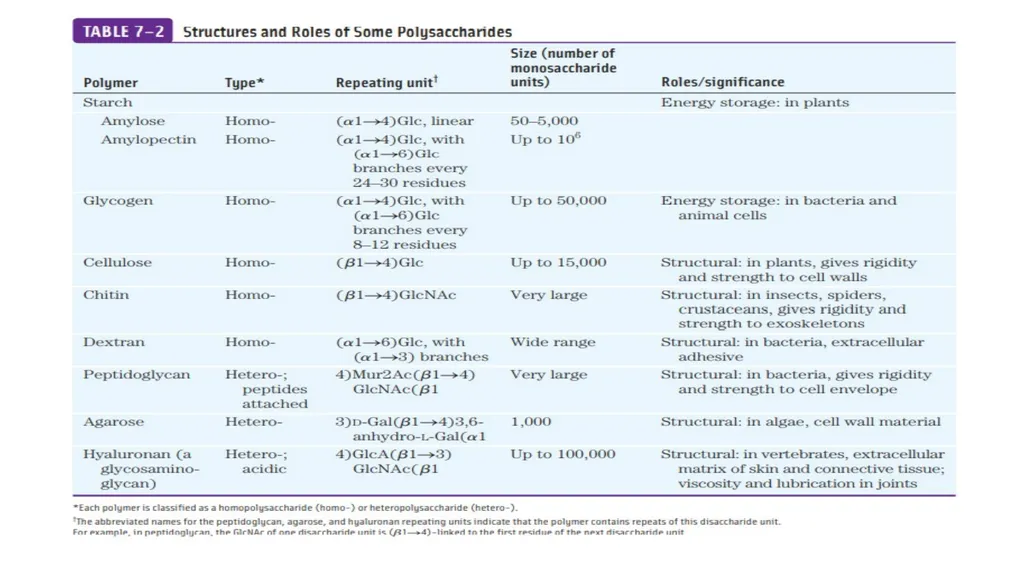
Polysaccharides Polysaccharides, polymers of medium to high molecular weight (Mr .20,000).
Polysaccharides, also called glycans, differ from each other in the identity of their recurring monosaccharide units, in the length of their chains, in the types of bonds linking the units, and in the degree of branching.
Homopolysaccharides contain only a single monomeric species
heteropolysaccharides contain two or more different kinds Ref.-Lehninger Principles of Biochemistry, Nelson and Cox<br>
15
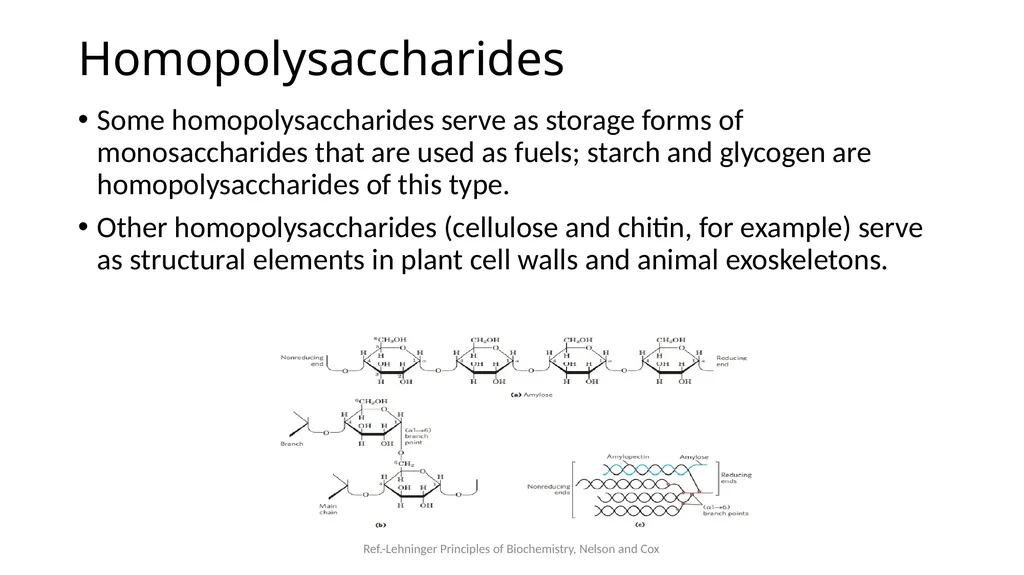
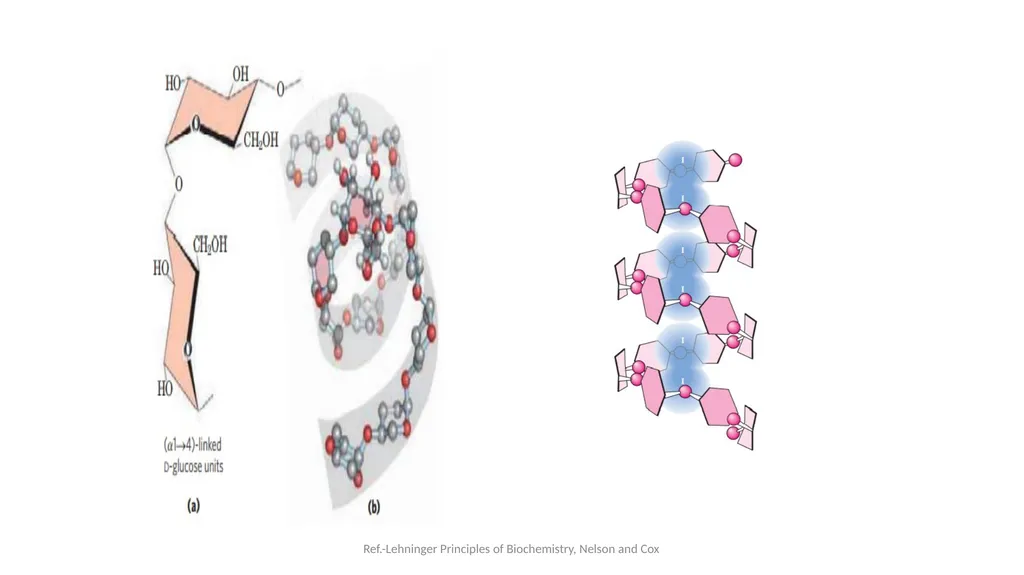
Homopolysaccharides Some homopolysaccharides serve as storage forms of monosaccharides that are used as fuels; starch and glycogen are homopolysaccharides of this type.
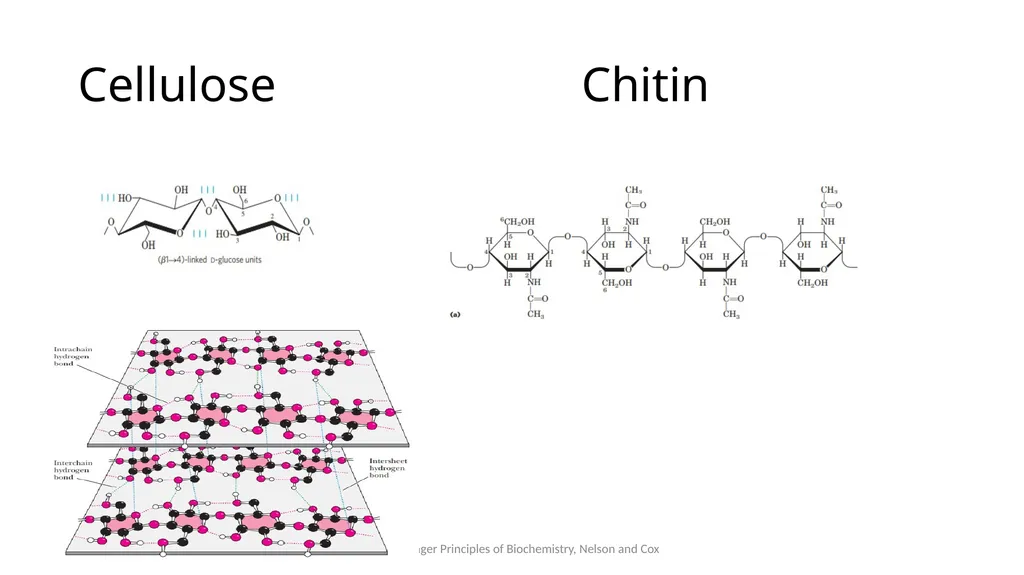
Other homopolysaccharides (cellulose and chitin, for example) serve as structural elements in plant cell walls and animal exoskeletons. Ref.-Lehninger Principles of Biochemistry, Nelson and Cox<br>
16
Ref.-Lehninger Principles of Biochemistry, Nelson and Cox<br>
17
Cellulose Chitin Ref.-Lehninger Principles of Biochemistry, Nelson and Cox<br>
18
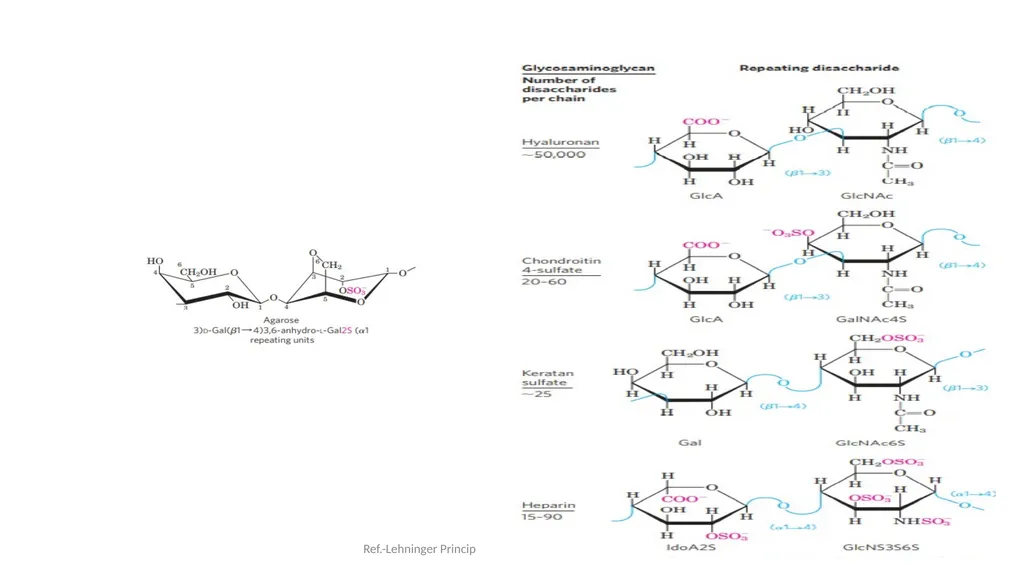
Heteropolysaccharides Heteropolysaccharides provide extracellular support for organisms of all kingdoms. For example, the rigid layer of the bacterial cell envelope (the peptidoglycan) is composed in part of a heteropolysaccharide built from two alternating monosaccharide units . In animal tissues, the extracellular space is Ref.-Lehninger Principles of Biochemistry, Nelson and Cox<br>
19
Ref.-Lehninger Principles of Biochemistry, Nelson and Cox<br>
20
Ref.-Lehninger Principles of Biochemistry, Nelson and Cox<br>
21
Ref.-Lehninger Principles of Biochemistry, Nelson and Cox<br>
22
Ref.-Lehninger Principles of Biochemistry, Nelson and Cox References-
Lehninger Principles of Biochemistry, Nelson and Cox, Macmillan Higher education
Biochemistry.R.H.Garrett and C.J.Grisham Nelson Education ltd.
Biochemistry Voet and Voet<br>