
Cellular adaptation and cellular injury Prof. Dr.
DJ
Published · 25 slides · 0 views
1 / 1

Description
Cellular adaptation and cellular injury Prof. Dr. Dalya Basil Cellular adaptation The environment around cells is dynamic and constantly changing. In this fluid environment, cells are exposed to numerous stimuli, some of which may be
Related Topics
Share
Embed code
Download this presentation From Below
"Cellular adaptation and cellular injury Prof. Dr." is the property of its rightful owner. Permission is granted to download and print the materials on this website for personal, non-commercial use only, and to display it on your personal computer provided you do not modify the materials and that you retain all copyright notices contained in the materials. By downloading content from our website, you accept the terms of this agreement.
Presentation Transcript
01
Cellular adaptation and cellular injury Prof. Dr. Dalya Basil<br>
02
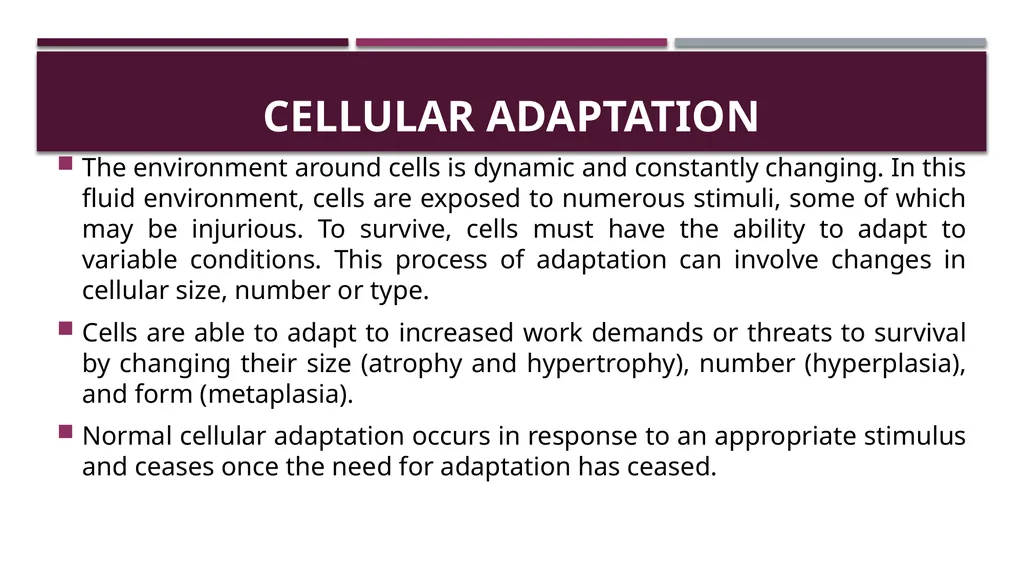
Cellular adaptation The environment around cells is dynamic and constantly changing. In this fluid environment, cells are exposed to numerous stimuli, some of which may be injurious. To survive, cells must have the ability to adapt to variable conditions. This process of adaptation can involve changes in cellular size, number or type.
Cells are able to adapt to increased work demands or threats to survival by changing their size (atrophy and hypertrophy), number (hyperplasia), and form (metaplasia).
Normal cellular adaptation occurs in response to an appropriate stimulus and ceases once the need for adaptation has ceased.<br>
Cells are able to adapt to increased work demands or threats to survival by changing their size (atrophy and hypertrophy), number (hyperplasia), and form (metaplasia).
Normal cellular adaptation occurs in response to an appropriate stimulus and ceases once the need for adaptation has ceased.<br>
03
Cellular adaptation Cellular adaptation:
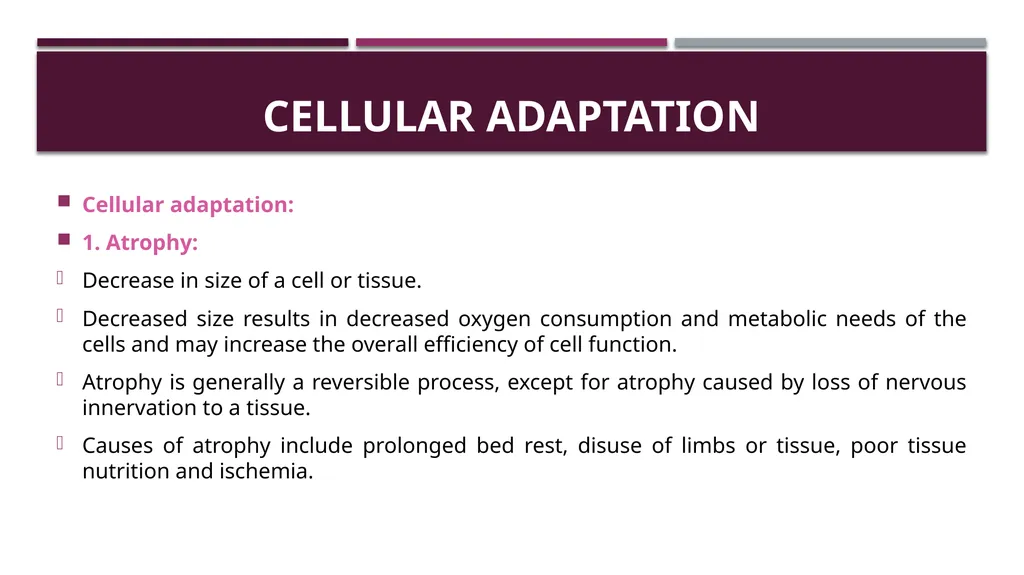
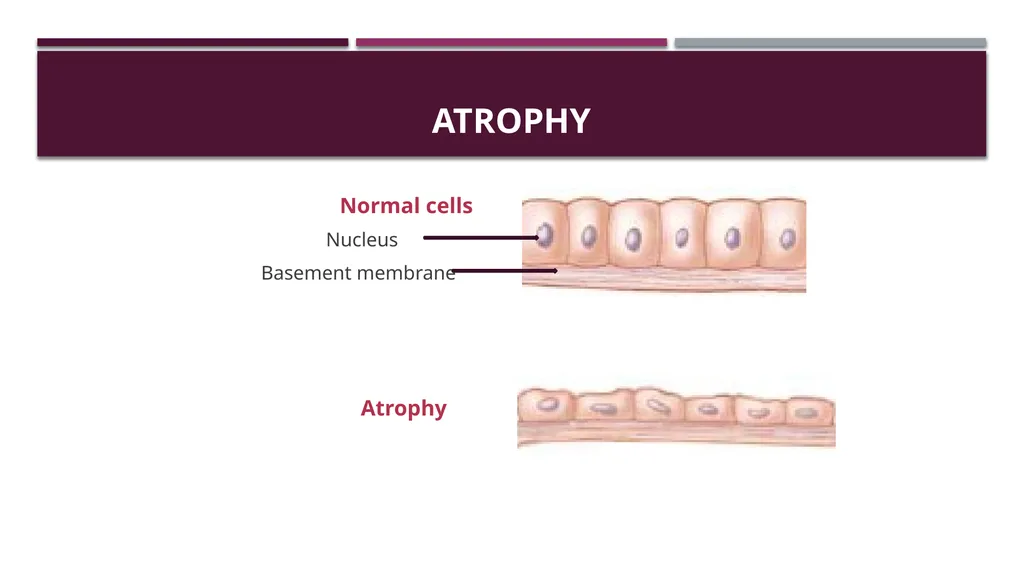
1. Atrophy:
Decrease in size of a cell or tissue.
Decreased size results in decreased oxygen consumption and metabolic needs of the cells and may increase the overall efficiency of cell function.
Atrophy is generally a reversible process, except for atrophy caused by loss of nervous innervation to a tissue.
Causes of atrophy include prolonged bed rest, disuse of limbs or tissue, poor tissue nutrition and ischemia.<br>
1. Atrophy:
Decrease in size of a cell or tissue.
Decreased size results in decreased oxygen consumption and metabolic needs of the cells and may increase the overall efficiency of cell function.
Atrophy is generally a reversible process, except for atrophy caused by loss of nervous innervation to a tissue.
Causes of atrophy include prolonged bed rest, disuse of limbs or tissue, poor tissue nutrition and ischemia.<br>
04
Atrophy Normal cells
Nucleus
Basement membrane
Atrophy<br>
Nucleus
Basement membrane
Atrophy<br>
05
Cellular adaptation 2- Hypertrophy:
Increase in cell size and tissue mass.
Occurs when a cell or tissue is exposed to an increased workload.
Occurs in tissues that cannot increase cell number as an adaptive response.
Hypertrophy may be a normal physiologic response, such as the increase in muscle mass that is seen with exercise, or it may be pathologic as in the case of the cardiac hypertrophy that is seen with prolonged hypertension. Hypertrophy may also be a compensatory process. When one kidney is removed, for example, the remaining kidney hypertrophies to increase its functional capacity.<br>
Increase in cell size and tissue mass.
Occurs when a cell or tissue is exposed to an increased workload.
Occurs in tissues that cannot increase cell number as an adaptive response.
Hypertrophy may be a normal physiologic response, such as the increase in muscle mass that is seen with exercise, or it may be pathologic as in the case of the cardiac hypertrophy that is seen with prolonged hypertension. Hypertrophy may also be a compensatory process. When one kidney is removed, for example, the remaining kidney hypertrophies to increase its functional capacity.<br>
06
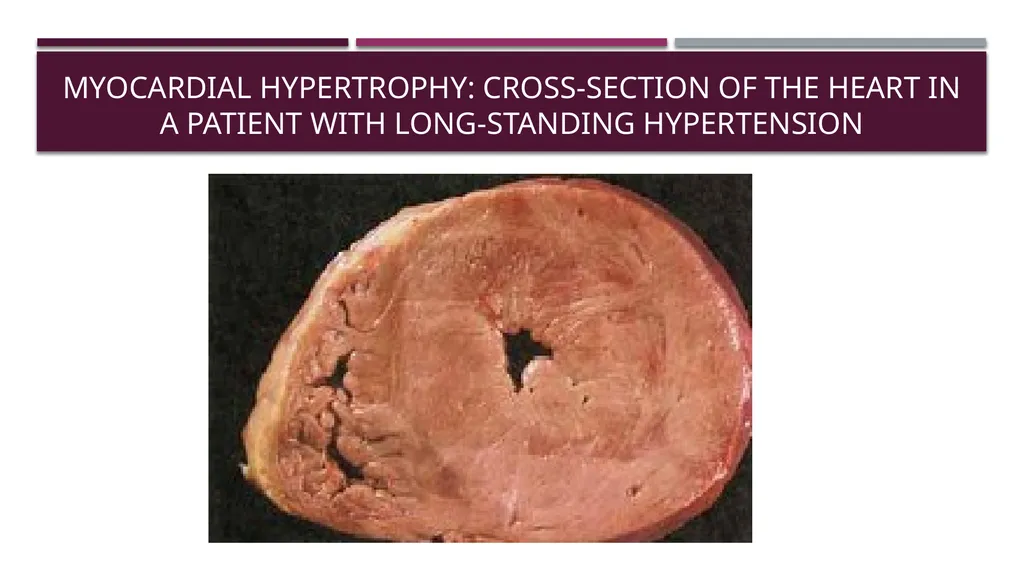
Myocardial hypertrophy: Cross-section of the heart in a patient with long-standing hypertension<br>
07
Cellular adaptation 3- Hyperplasia:
Increase in the number of cells in an organ or tissue.
Can only occur in cells capable of mitosis (therefore, not muscle or nerve cells).
The stimuli that induce hyperplasia may be physiologic or nonphysiologic. There are two common types of physiologic hyperplasia: hormonal and compensatory.<br>
Increase in the number of cells in an organ or tissue.
Can only occur in cells capable of mitosis (therefore, not muscle or nerve cells).
The stimuli that induce hyperplasia may be physiologic or nonphysiologic. There are two common types of physiologic hyperplasia: hormonal and compensatory.<br>
08
Cellular adaptation Breast and uterine enlargement during pregnancy are examples of a physiologic hyperplasia that results from estrogen stimulation. The regeneration of the liver that occurs after partial hepatectomy (i.e., partial removal of the liver) is an example of compensatory hyperplasia. Hyperplasia is also an important response of connective tissue in wound healing, during which proliferating fibroblasts and blood vessels contribute to wound repair. Although hypertrophy and hyperplasia are two distinct processes, they may occur together and are often triggered by the same mechanism. For example, the pregnant uterus undergoes both hypertrophy and hyperplasia as a result of estrogen stimulation.<br>
09
Cellular adaptation Most forms of nonphysiologic hyperplasia are due to excessive hormonal stimulation or the effects of growth factors on target tissues. Excessive estrogen production can cause endometrial hyperplasia and abnormal menstrual bleeding. Benign prostatic hyperplasia, which is a common disorder of men older than 50 years of age, is thought to be related to the action of androgens. Skin warts are an example of hyperplasia caused by growth factors produced by certain viruses, such as the papillomaviruses.<br>
10
Cellular adaptation Metaplasia:
The conversion of one cell type to another cell type that might have a better chance of survival under certain circumstances.
Metaplasia usually occurs in response to chronic irritation or inflammation.
An example of metaplasia occurs in the respiratory passages of chronic cigarette smokers. Following years of exposure to irritating cigarette smoke, the ciliated columnar epithelium lining the respiratory passages gradually converts to stratified squamous epithelium. Although the stratified squamous cells may be better able to survive the constant irritation of cigarette smoke, they lack the cilia of the columnar epithelial cells that are necessary for clearing particulates from the surfaces of the respiratory passages.<br>
The conversion of one cell type to another cell type that might have a better chance of survival under certain circumstances.
Metaplasia usually occurs in response to chronic irritation or inflammation.
An example of metaplasia occurs in the respiratory passages of chronic cigarette smokers. Following years of exposure to irritating cigarette smoke, the ciliated columnar epithelium lining the respiratory passages gradually converts to stratified squamous epithelium. Although the stratified squamous cells may be better able to survive the constant irritation of cigarette smoke, they lack the cilia of the columnar epithelial cells that are necessary for clearing particulates from the surfaces of the respiratory passages.<br>
11
Cellular adaptation Dysplasia:
A derangement of cell growth that leads to tissues with cells of varying size, shape and appearance.
Generally occurs in response to chronic irritation and inflammation.
Dysplasia may be a strong precursor to cancer in certain instances, such as in the cervix or respiratory tract.<br>
A derangement of cell growth that leads to tissues with cells of varying size, shape and appearance.
Generally occurs in response to chronic irritation and inflammation.
Dysplasia may be a strong precursor to cancer in certain instances, such as in the cervix or respiratory tract.<br>
12
Cellular injury Cellular injury can occur in a number of different ways. The extent of injury that cells experience is often related to the intensity and duration of exposure to the injurious event or substance. Cellular injury may be a reversible process, in which case the cells can recover their normal function, or it may be irreversible and lead to cell death. Although the causes of cellular injury are many, the underlying mechanisms of cellular injury usually fall into one of two categories: free radical injury or hypoxic injury.<br>
13
Cellular injury Causes of Cell Injury
Cell damage can occur in many ways (the ways by which cells are injured have been grouped into five categories):
(1) injury from physical agents
(2) radiation injury
(3) chemical injury
(4) injury from biologic agents
(5) injury from nutritional imbalances.<br>
Cell damage can occur in many ways (the ways by which cells are injured have been grouped into five categories):
(1) injury from physical agents
(2) radiation injury
(3) chemical injury
(4) injury from biologic agents
(5) injury from nutritional imbalances.<br>
14
Cellular injury Injury from Physical Agents:
Physical agents responsible for cell and tissue injury include mechanical forces (occurs as the result of body impact with another object, these types of injuries split and tear tissue, fracture bones, injure blood vessels, and disrupt blood flow), extremes of temperature, (Extremes of heat and cold cause damage to the cell, its organelles, and its enzyme systems. Exposure to low-intensity heat 43ºC to 46ºC, such as occurs with partial-thickness burns and severe heat stroke, causes cell injury by inducing vascular injury, accelerating cell metabolism, inactivating temperature-sensitive enzymes, and disrupting the cell membrane. With more intense heat, coagulation of blood vessels and tissue proteins occurs.<br>
Physical agents responsible for cell and tissue injury include mechanical forces (occurs as the result of body impact with another object, these types of injuries split and tear tissue, fracture bones, injure blood vessels, and disrupt blood flow), extremes of temperature, (Extremes of heat and cold cause damage to the cell, its organelles, and its enzyme systems. Exposure to low-intensity heat 43ºC to 46ºC, such as occurs with partial-thickness burns and severe heat stroke, causes cell injury by inducing vascular injury, accelerating cell metabolism, inactivating temperature-sensitive enzymes, and disrupting the cell membrane. With more intense heat, coagulation of blood vessels and tissue proteins occurs.<br>
15
Cellular injury Exposure to cold increases blood viscosity and induces vasoconstriction by direct action on blood vessels and through reflex activity of the sympathetic nervous system. (The resultant decrease in blood flow may lead to hypoxic tissue injury, depending on the degree and duration of cold exposure).
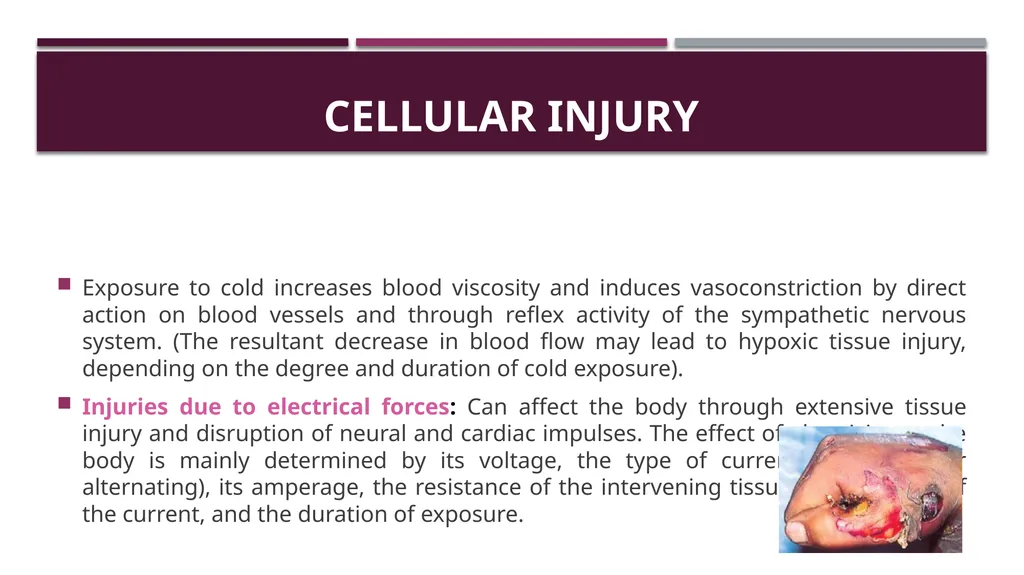
Injuries due to electrical forces: Can affect the body through extensive tissue injury and disruption of neural and cardiac impulses. The effect of electricity on the body is mainly determined by its voltage, the type of current (i.e., direct or alternating), its amperage, the resistance of the intervening tissue, the pathway of the current, and the duration of exposure.<br>
Injuries due to electrical forces: Can affect the body through extensive tissue injury and disruption of neural and cardiac impulses. The effect of electricity on the body is mainly determined by its voltage, the type of current (i.e., direct or alternating), its amperage, the resistance of the intervening tissue, the pathway of the current, and the duration of exposure.<br>
16
Cellular injury Radiation Injury:
Ionizing Radiation: Ionizing radiation affects cells by causing ionization of molecules and atoms in the cell, by directly hitting the target molecules in the cell, or by producing free radicals that interact with critical cell components. It can immediately kill cells, interrupt cell replication, or cause a variety of genetic mutations, which may or may not be lethal. Most radiation injury is caused by localized irradiation that is used in the treatment of cancer.<br>
Ionizing Radiation: Ionizing radiation affects cells by causing ionization of molecules and atoms in the cell, by directly hitting the target molecules in the cell, or by producing free radicals that interact with critical cell components. It can immediately kill cells, interrupt cell replication, or cause a variety of genetic mutations, which may or may not be lethal. Most radiation injury is caused by localized irradiation that is used in the treatment of cancer.<br>
17
Cellular injury The injurious effects of ionizing radiation vary with the dose, dose rate, and the differential sensitivity of the exposed tissue to radiation injury. Because of the effect on deoxyribonucleic acid (DNA) synthesis and interference with mitosis, rapidly dividing cells of the bone marrow and intestine are much more vulnerable to radiation injury than tissues such as bone and skeletal muscle.
Many of the clinical manifestations of radiation injury result from acute cell injury, dose-dependent changes in the blood vessels that supply the irradiated tissues, and fibrotic tissue replacement.<br>
Many of the clinical manifestations of radiation injury result from acute cell injury, dose-dependent changes in the blood vessels that supply the irradiated tissues, and fibrotic tissue replacement.<br>
18
Cellular injury Ultraviolet Radiation: UV radiation contains increasingly energetic rays that are powerful enough to disrupt intracellular bonds and cause sunburn and increase the risk of skin cancers. Skin damage induced by UV radiation is thought to be caused by reactive oxygen species and by damage to melanin-producing processes in the skin.
Nonionizing Radiation: Nonionizing radiation includes infrared light, ultrasound, microwaves, and laser energy. Nonionizing radiation exerts its effects by causing vibration and rotation of atoms and molecules.<br>
Nonionizing Radiation: Nonionizing radiation includes infrared light, ultrasound, microwaves, and laser energy. Nonionizing radiation exerts its effects by causing vibration and rotation of atoms and molecules.<br>
19
Cellular injury Chemical Injury:
Chemical agents can injure the cell membrane and other cell structures, block enzymatic pathways, coagulate cell proteins, and disrupt the osmotic and ionic balance of the cell. Corrosive substances such as strong acids and bases destroy cells as the substances come into contact with the body. Other chemicals may injure cells in the process of metabolism or elimination. Carbon tetrachloride (CCl4), for example, causes little damage until it is metabolized by liver enzymes to a highly reactive trichloromethyl free radical (CCl3). Carbon tetrachloride is extremely toxic to liver cells.<br>
Chemical agents can injure the cell membrane and other cell structures, block enzymatic pathways, coagulate cell proteins, and disrupt the osmotic and ionic balance of the cell. Corrosive substances such as strong acids and bases destroy cells as the substances come into contact with the body. Other chemicals may injure cells in the process of metabolism or elimination. Carbon tetrachloride (CCl4), for example, causes little damage until it is metabolized by liver enzymes to a highly reactive trichloromethyl free radical (CCl3). Carbon tetrachloride is extremely toxic to liver cells.<br>
20
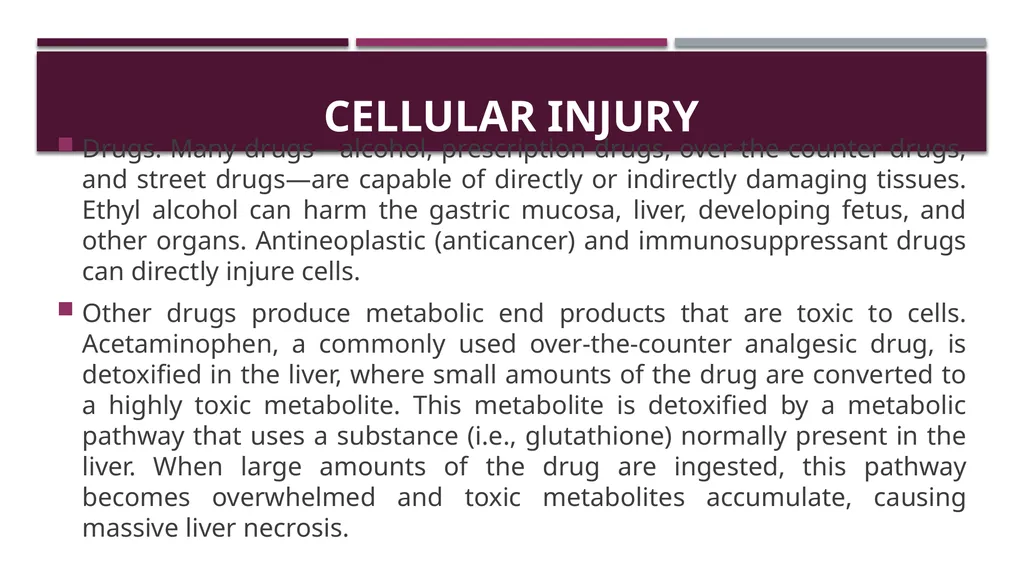
Cellular injury Drugs. Many drugs—alcohol, prescription drugs, over-the-counter drugs, and street drugs—are capable of directly or indirectly damaging tissues. Ethyl alcohol can harm the gastric mucosa, liver, developing fetus, and other organs. Antineoplastic (anticancer) and immunosuppressant drugs can directly injure cells.
Other drugs produce metabolic end products that are toxic to cells. Acetaminophen, a commonly used over-the-counter analgesic drug, is detoxified in the liver, where small amounts of the drug are converted to a highly toxic metabolite. This metabolite is detoxified by a metabolic pathway that uses a substance (i.e., glutathione) normally present in the liver. When large amounts of the drug are ingested, this pathway becomes overwhelmed and toxic metabolites accumulate, causing massive liver necrosis.<br>
Other drugs produce metabolic end products that are toxic to cells. Acetaminophen, a commonly used over-the-counter analgesic drug, is detoxified in the liver, where small amounts of the drug are converted to a highly toxic metabolite. This metabolite is detoxified by a metabolic pathway that uses a substance (i.e., glutathione) normally present in the liver. When large amounts of the drug are ingested, this pathway becomes overwhelmed and toxic metabolites accumulate, causing massive liver necrosis.<br>
21
Cellular injury Injury from Biologic Agents:
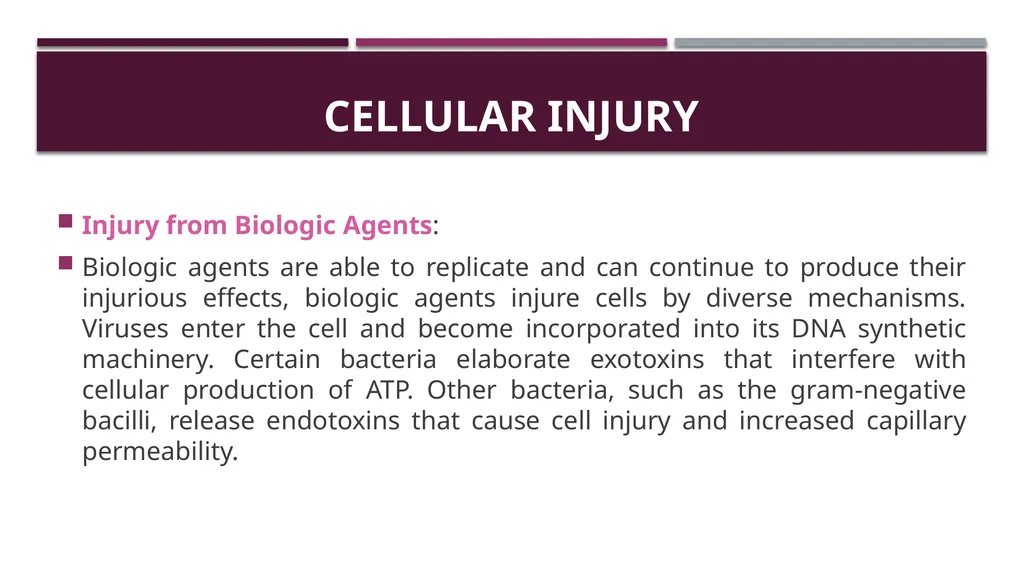
Biologic agents are able to replicate and can continue to produce their injurious effects, biologic agents injure cells by diverse mechanisms. Viruses enter the cell and become incorporated into its DNA synthetic machinery. Certain bacteria elaborate exotoxins that interfere with cellular production of ATP. Other bacteria, such as the gram-negative bacilli, release endotoxins that cause cell injury and increased capillary permeability.<br>
Biologic agents are able to replicate and can continue to produce their injurious effects, biologic agents injure cells by diverse mechanisms. Viruses enter the cell and become incorporated into its DNA synthetic machinery. Certain bacteria elaborate exotoxins that interfere with cellular production of ATP. Other bacteria, such as the gram-negative bacilli, release endotoxins that cause cell injury and increased capillary permeability.<br>
22
Cellular injury Injury from Nutritional Imbalances:
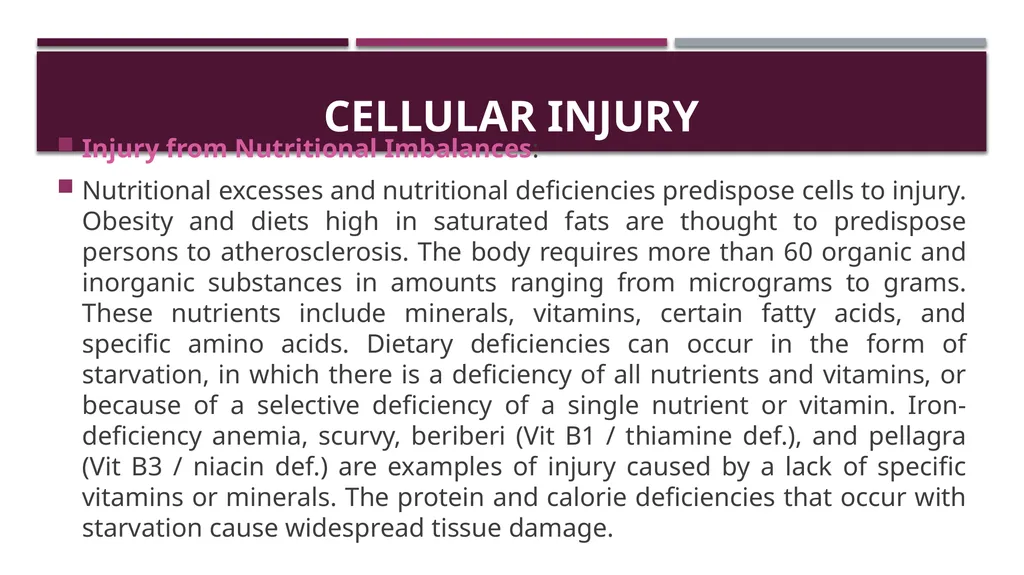
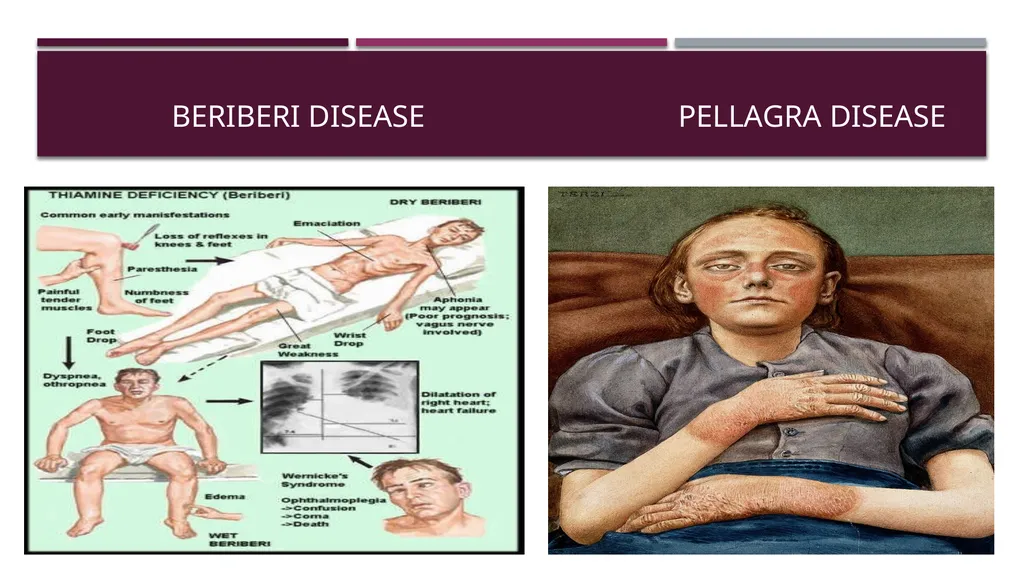
Nutritional excesses and nutritional deficiencies predispose cells to injury. Obesity and diets high in saturated fats are thought to predispose persons to atherosclerosis. The body requires more than 60 organic and inorganic substances in amounts ranging from micrograms to grams. These nutrients include minerals, vitamins, certain fatty acids, and specific amino acids. Dietary deficiencies can occur in the form of starvation, in which there is a deficiency of all nutrients and vitamins, or because of a selective deficiency of a single nutrient or vitamin. Iron-deficiency anemia, scurvy, beriberi (Vit B1 / thiamine def.), and pellagra (Vit B3 / niacin def.) are examples of injury caused by a lack of specific vitamins or minerals. The protein and calorie deficiencies that occur with starvation cause widespread tissue damage.<br>
Nutritional excesses and nutritional deficiencies predispose cells to injury. Obesity and diets high in saturated fats are thought to predispose persons to atherosclerosis. The body requires more than 60 organic and inorganic substances in amounts ranging from micrograms to grams. These nutrients include minerals, vitamins, certain fatty acids, and specific amino acids. Dietary deficiencies can occur in the form of starvation, in which there is a deficiency of all nutrients and vitamins, or because of a selective deficiency of a single nutrient or vitamin. Iron-deficiency anemia, scurvy, beriberi (Vit B1 / thiamine def.), and pellagra (Vit B3 / niacin def.) are examples of injury caused by a lack of specific vitamins or minerals. The protein and calorie deficiencies that occur with starvation cause widespread tissue damage.<br>
23
Beriberi disease pellagra disease<br>
24
Reference Essential of Pathophysiology, Concepts of Altered Health States, 3rd Edition, Carol Mattson Porth (2010).<br>
25
Thank You<br>