CERT Basic Training CERT Basic Training Unit 5:
Description: CERT Basic Training CERT Basic Training Unit 5: Disaster Psychology Unit 5 Objectives Understand disaster trauma for survivors and rescuers, including CERT volunteers List steps to take for personal and team well-being Demonstrate key steps
Related Topics
Download Presentation
"CERT Basic Training CERT Basic Training Unit 5:" is the property of its rightful owner. Permission is granted to download and print the materials on this website for personal, non-commercial use only, and to display it on your personal computer provided you do not modify the materials and that you retain all copyright notices contained in the materials. By downloading content from our website, you accept the terms of this agreement.
Presentation Transcript
slide1. CERT Basic Training<br>
slide2. CERT Basic Training Unit 5: Disaster Psychology<br>
slide3. Unit 5 Objectives Understand disaster trauma for survivors and rescuers, including CERT volunteers
List steps to take for personal and team well-being
Demonstrate key steps to apply when providing aid to someone with survivor’s trauma PM 5-1 CERT Basic Training Unit 5: Disaster Psychology 5-1<br>
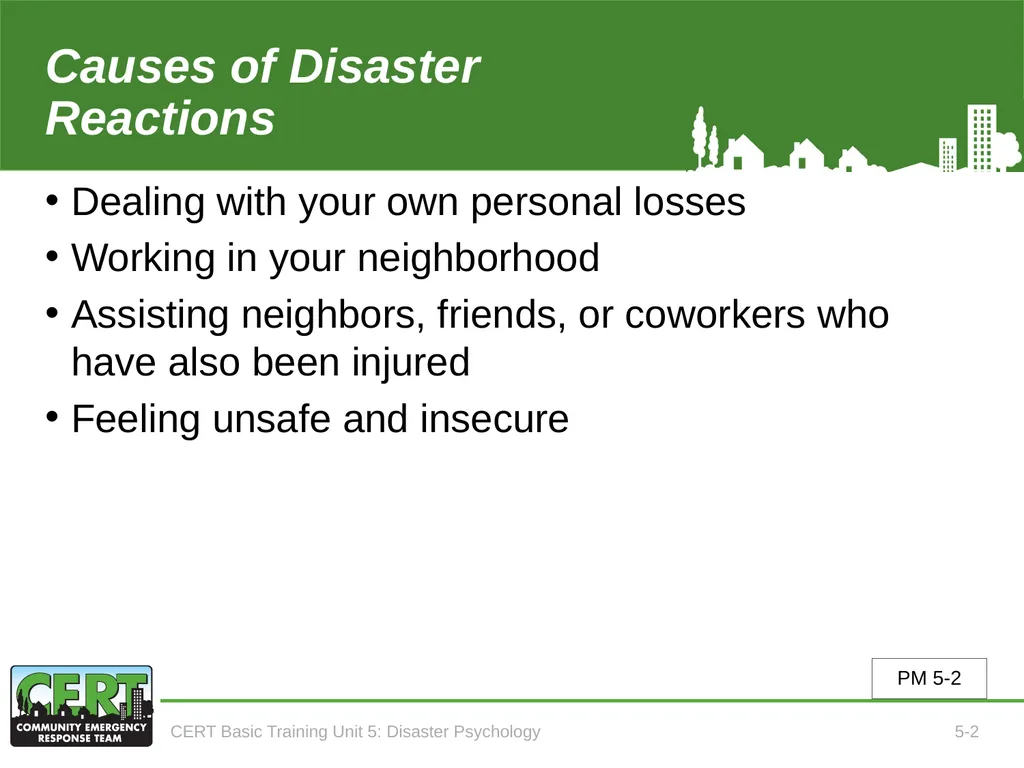
slide4. Causes of Disaster Reactions Dealing with your own personal losses
Working in your neighborhood
Assisting neighbors, friends, or coworkers who have also been injured
Feeling unsafe and insecure PM 5-2 CERT Basic Training Unit 5: Disaster Psychology 5-2<br>
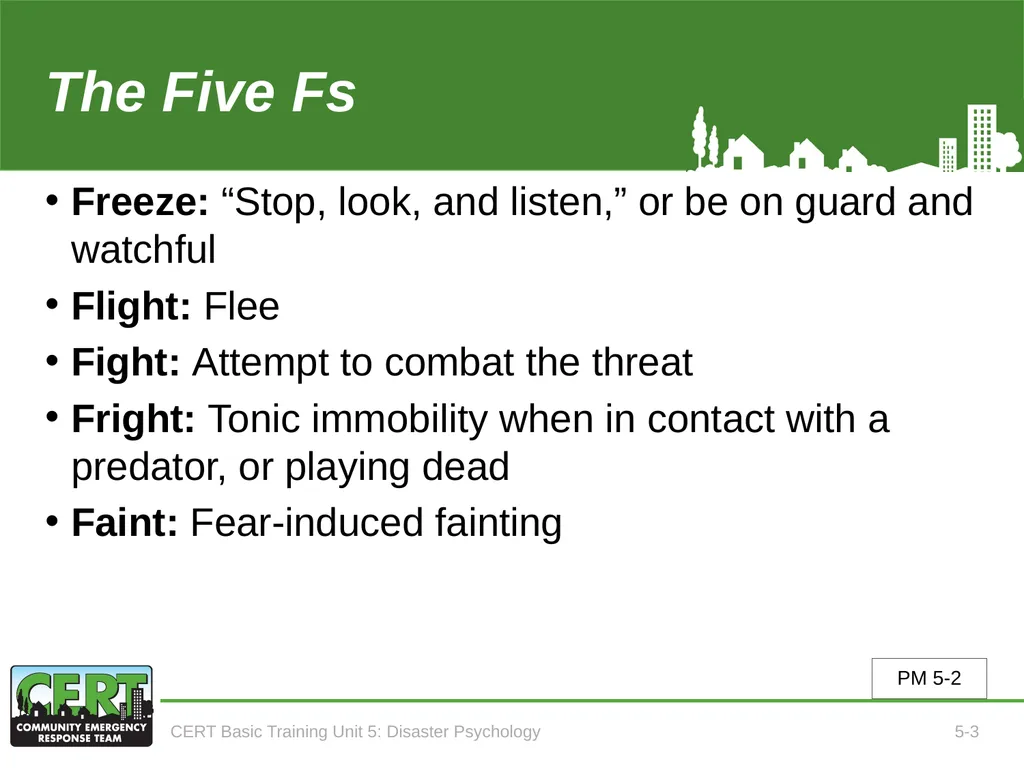
slide5. The Five Fs Freeze: “Stop, look, and listen,” or be on guard and watchful
Flight: Flee
Fight: Attempt to combat the threat
Fright: Tonic immobility when in contact with a predator, or playing dead
Faint: Fear-induced fainting PM 5-2 CERT Basic Training Unit 5: Disaster Psychology 5-3<br>
slide6. Psychological Symptoms of Trauma Emotional
Cognitive
Spiritual PM 5-2 CERT Basic Training Unit 5: Disaster Psychology 5-4<br>
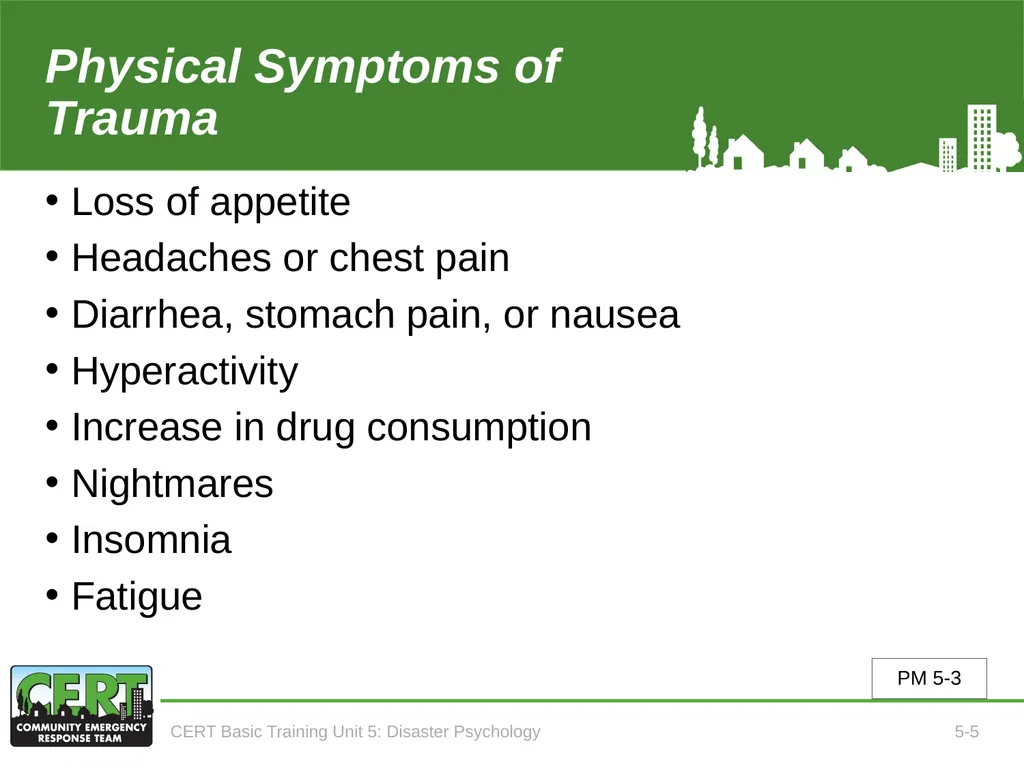
slide7. Physical Symptoms of Trauma Loss of appetite
Headaches or chest pain
Diarrhea, stomach pain, or nausea
Hyperactivity
Increase in drug consumption
Nightmares
Insomnia
Fatigue PM 5-3 CERT Basic Training Unit 5: Disaster Psychology 5-5<br>
slide8. Team Well-Being Actions can be taken before, during, and after an incident to help manage emotional impact of disaster response work
Knowing possible psychological and physiological symptoms of disaster trauma helps manage impact
Learn to manage stress:
CERT volunteers for themselves
CERT leaders during response PM 5-4 CERT Basic Training Unit 5: Disaster Psychology 5-6<br>
slide9. How to Reduce Stress Get enough sleep
Exercise regularly
Eat a balanced diet
Balance work, play, and rest
Allow yourself to receive as well as give
Connect with others
Use spiritual resources PM 5-4 CERT Basic Training Unit 5: Disaster Psychology 5-7<br>
slide10. Take Care of Yourself Be aware of trauma that can follow a disaster
Explain to family members and friends what you need:
Listen when you want to talk
Don’t force yourself to talk until you are ready PM 5-4 CERT Basic Training Unit 5: Disaster Psychology 5-8<br>
slide11. Self-Care Tool Box This activity provides you with the opportunity to outline a number of self-care tools you can use before and during a crisis so that you are ready to respond during an emergency
Complete this exercise individually and at your own pace. When everyone has finished, you will have the opportunity to share your responses with the class if you would like PM 5-5 CERT Basic Training Unit 5: Disaster Psychology 5-9<br>
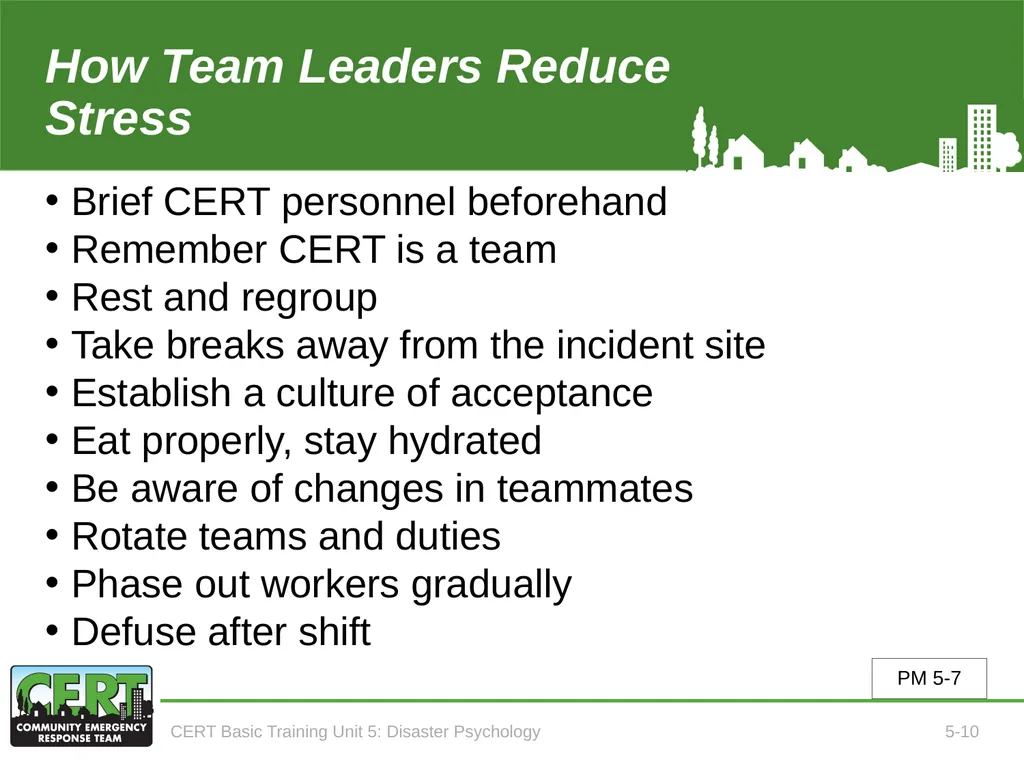
slide12. How Team Leaders Reduce Stress Brief CERT personnel beforehand
Remember CERT is a team
Rest and regroup
Take breaks away from the incident site
Establish a culture of acceptance
Eat properly, stay hydrated
Be aware of changes in teammates
Rotate teams and duties
Phase out workers gradually
Defuse after shift PM 5-7 CERT Basic Training Unit 5: Disaster Psychology 5-10<br>
slide13. Emotional Phases of a Crisis Pre-Disaster
Impact
Heroic
Honeymoon
Disillusionment
Reconstruction PM 5-8 CERT Basic Training Unit 5: Disaster Psychology 5-11<br>
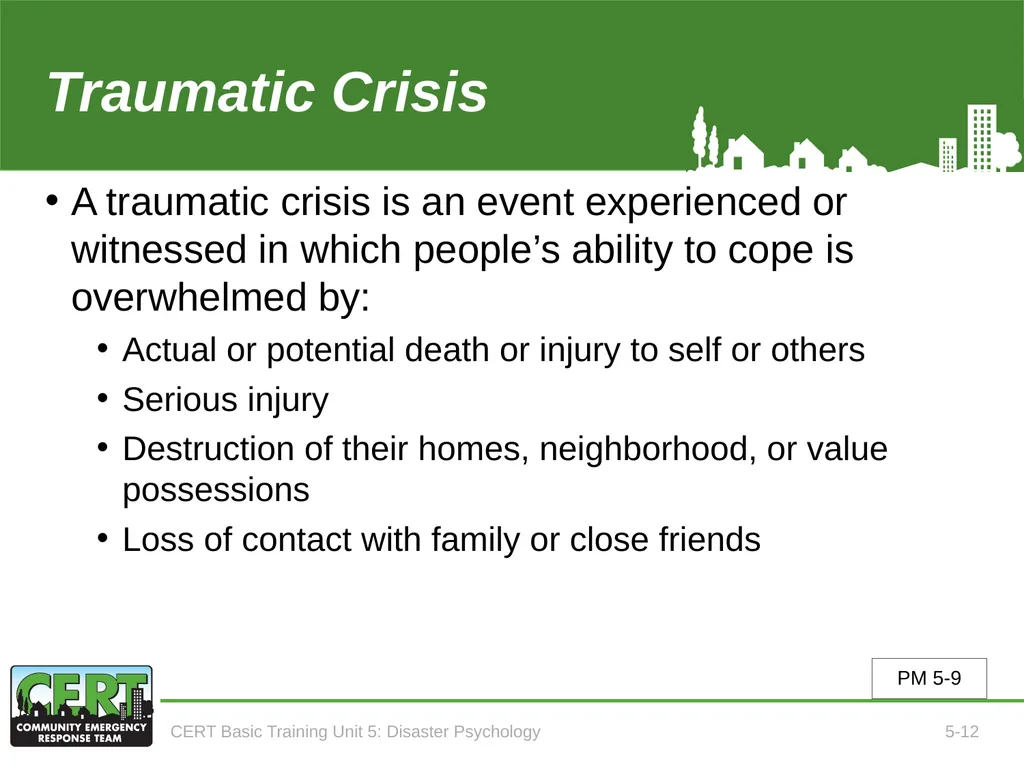
slide14. Traumatic Crisis A traumatic crisis is an event experienced or witnessed in which people’s ability to cope is overwhelmed by:
Actual or potential death or injury to self or others
Serious injury
Destruction of their homes, neighborhood, or value possessions
Loss of contact with family or close friends PM 5-9 CERT Basic Training Unit 5: Disaster Psychology 5-12<br>
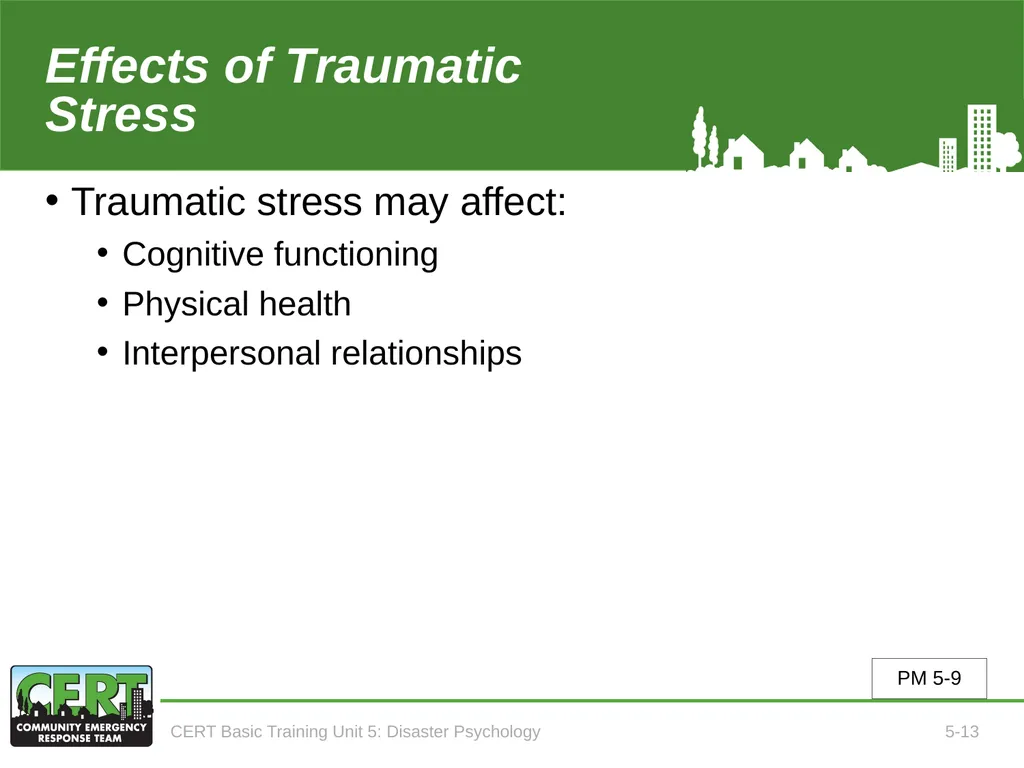
slide15. Effects of Traumatic Stress Traumatic stress may affect:
Cognitive functioning
Physical health
Interpersonal relationships PM 5-9 CERT Basic Training Unit 5: Disaster Psychology 5-13<br>
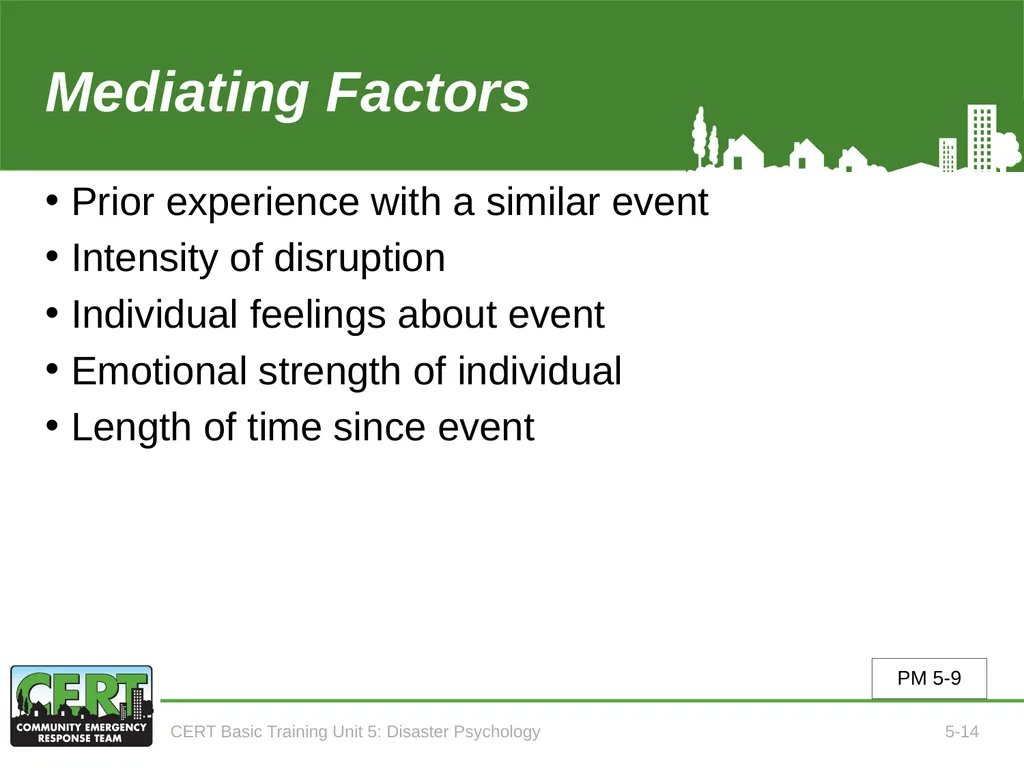
slide16. Mediating Factors Prior experience with a similar event
Intensity of disruption
Individual feelings about event
Emotional strength of individual
Length of time since event PM 5-9 CERT Basic Training Unit 5: Disaster Psychology 5-14<br>
slide17. Stabilizing Survivors Assess survivors for injury or shock
Get uninjured people to help
Provide support by listening and empathizing
Help survivors connect with natural support systems PM 5-10 CERT Basic Training Unit 5: Disaster Psychology 5-15<br>
slide18. Listen, Protect, Connect Listen to survivors and pay attention to what they say
Help survivors feel protected by providing support
Connect survivors to friends and loved ones PM 5-10 CERT Basic Training Unit 5: Disaster Psychology 5-16<br>
slide19. How to Be an Empathetic Listener Put yourself in the speaker’s shoes
Listen for meaning, not just words
Pay attention to nonverbal communication
Paraphrase the speaker PM 5-11 CERT Basic Training Unit 5: Disaster Psychology 5-17<br>
slide20. What Not to Say “I understand ”
“Don’t feel bad ”
“You’re strong ”
“You’ll get through this ”
“Don’t cry ” “It’s God’s will ”
“It could be worse ”
“At least you still have…”
“Everything will be okay” PM 5-12 CERT Basic Training Unit 5: Disaster Psychology 5-18<br>
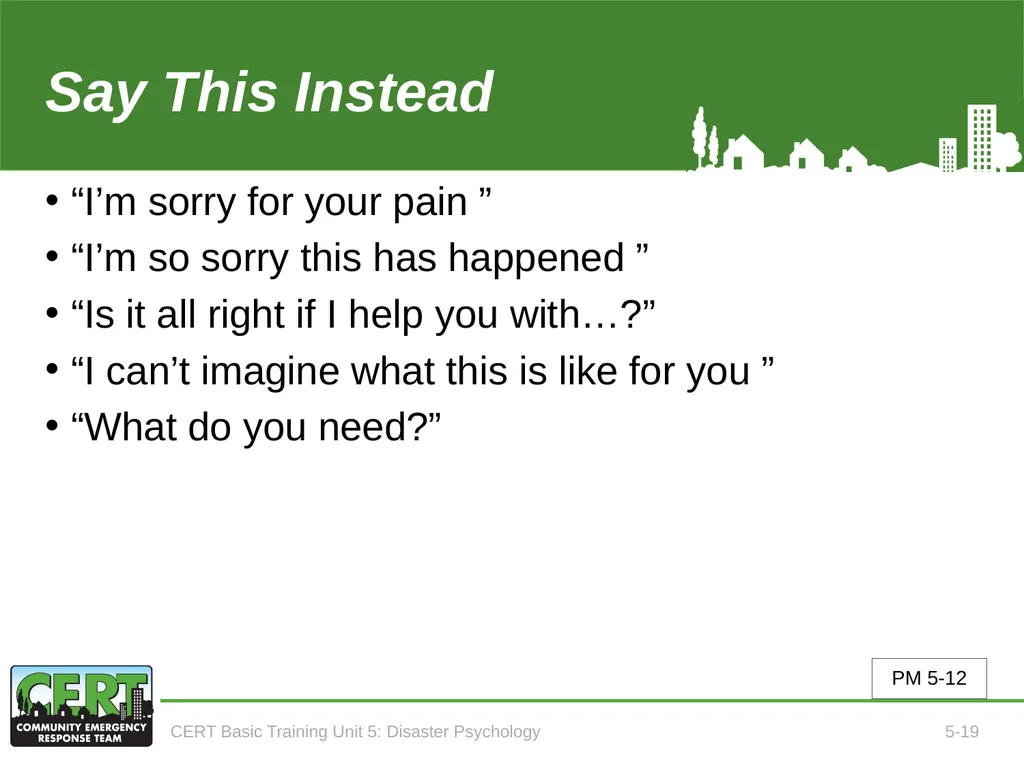
slide21. Say This Instead “I’m sorry for your pain ”
“I’m so sorry this has happened ”
“Is it all right if I help you with…?”
“I can’t imagine what this is like for you ”
“What do you need?” PM 5-12 CERT Basic Training Unit 5: Disaster Psychology 5-19<br>
slide22. Managing the Death Scene Cover the body; treat it with respect
Follow local laws and protocols
Talk with local authorities PM 5-12 CERT Basic Training Unit 5: Disaster Psychology 5-20<br>
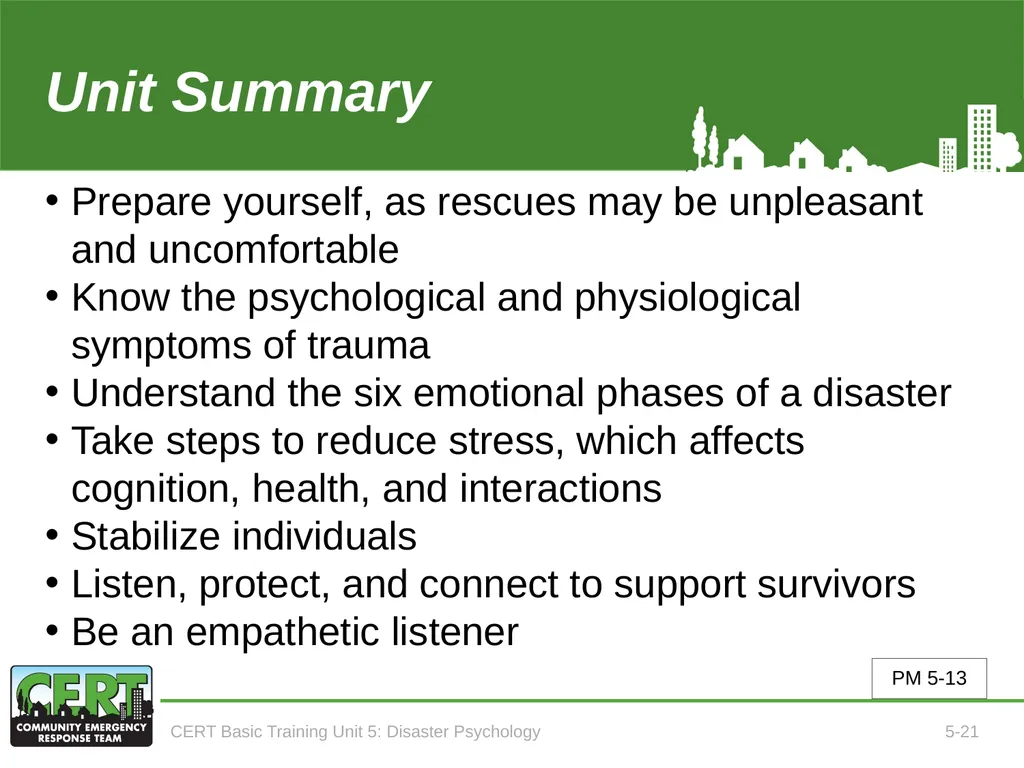
slide23. Unit Summary (Unit 5) Prepare yourself, as rescues may be unpleasant and uncomfortable
Know the psychological and physiological symptoms of trauma
Understand the six emotional phases of a disaster
Take steps to reduce stress, which affects cognition, health, and interactions
Stabilize individuals
Listen, protect, and connect to support survivors
Be an empathetic listener PM 5-13 CERT Basic Training Unit 5: Disaster Psychology 5-21<br>
slide24. Homework Assignment (Unit 5) Read unit to be covered in next session
Bring necessary supplies to next session
Wear appropriate clothes to next session PM 5-13 CERT Basic Training Unit 5: Disaster Psychology 5-22<br>

slide2. CERT Basic Training Unit 5: Disaster Psychology<br>
slide3. Unit 5 Objectives Understand disaster trauma for survivors and rescuers, including CERT volunteers
List steps to take for personal and team well-being
Demonstrate key steps to apply when providing aid to someone with survivor’s trauma PM 5-1 CERT Basic Training Unit 5: Disaster Psychology 5-1<br>
slide4. Causes of Disaster Reactions Dealing with your own personal losses
Working in your neighborhood
Assisting neighbors, friends, or coworkers who have also been injured
Feeling unsafe and insecure PM 5-2 CERT Basic Training Unit 5: Disaster Psychology 5-2<br>
slide5. The Five Fs Freeze: “Stop, look, and listen,” or be on guard and watchful
Flight: Flee
Fight: Attempt to combat the threat
Fright: Tonic immobility when in contact with a predator, or playing dead
Faint: Fear-induced fainting PM 5-2 CERT Basic Training Unit 5: Disaster Psychology 5-3<br>
slide6. Psychological Symptoms of Trauma Emotional
Cognitive
Spiritual PM 5-2 CERT Basic Training Unit 5: Disaster Psychology 5-4<br>
slide7. Physical Symptoms of Trauma Loss of appetite
Headaches or chest pain
Diarrhea, stomach pain, or nausea
Hyperactivity
Increase in drug consumption
Nightmares
Insomnia
Fatigue PM 5-3 CERT Basic Training Unit 5: Disaster Psychology 5-5<br>
slide8. Team Well-Being Actions can be taken before, during, and after an incident to help manage emotional impact of disaster response work
Knowing possible psychological and physiological symptoms of disaster trauma helps manage impact
Learn to manage stress:
CERT volunteers for themselves
CERT leaders during response PM 5-4 CERT Basic Training Unit 5: Disaster Psychology 5-6<br>
slide9. How to Reduce Stress Get enough sleep
Exercise regularly
Eat a balanced diet
Balance work, play, and rest
Allow yourself to receive as well as give
Connect with others
Use spiritual resources PM 5-4 CERT Basic Training Unit 5: Disaster Psychology 5-7<br>
slide10. Take Care of Yourself Be aware of trauma that can follow a disaster
Explain to family members and friends what you need:
Listen when you want to talk
Don’t force yourself to talk until you are ready PM 5-4 CERT Basic Training Unit 5: Disaster Psychology 5-8<br>
slide11. Self-Care Tool Box This activity provides you with the opportunity to outline a number of self-care tools you can use before and during a crisis so that you are ready to respond during an emergency
Complete this exercise individually and at your own pace. When everyone has finished, you will have the opportunity to share your responses with the class if you would like PM 5-5 CERT Basic Training Unit 5: Disaster Psychology 5-9<br>
slide12. How Team Leaders Reduce Stress Brief CERT personnel beforehand
Remember CERT is a team
Rest and regroup
Take breaks away from the incident site
Establish a culture of acceptance
Eat properly, stay hydrated
Be aware of changes in teammates
Rotate teams and duties
Phase out workers gradually
Defuse after shift PM 5-7 CERT Basic Training Unit 5: Disaster Psychology 5-10<br>
slide13. Emotional Phases of a Crisis Pre-Disaster
Impact
Heroic
Honeymoon
Disillusionment
Reconstruction PM 5-8 CERT Basic Training Unit 5: Disaster Psychology 5-11<br>
slide14. Traumatic Crisis A traumatic crisis is an event experienced or witnessed in which people’s ability to cope is overwhelmed by:
Actual or potential death or injury to self or others
Serious injury
Destruction of their homes, neighborhood, or value possessions
Loss of contact with family or close friends PM 5-9 CERT Basic Training Unit 5: Disaster Psychology 5-12<br>
slide15. Effects of Traumatic Stress Traumatic stress may affect:
Cognitive functioning
Physical health
Interpersonal relationships PM 5-9 CERT Basic Training Unit 5: Disaster Psychology 5-13<br>
slide16. Mediating Factors Prior experience with a similar event
Intensity of disruption
Individual feelings about event
Emotional strength of individual
Length of time since event PM 5-9 CERT Basic Training Unit 5: Disaster Psychology 5-14<br>
slide17. Stabilizing Survivors Assess survivors for injury or shock
Get uninjured people to help
Provide support by listening and empathizing
Help survivors connect with natural support systems PM 5-10 CERT Basic Training Unit 5: Disaster Psychology 5-15<br>
slide18. Listen, Protect, Connect Listen to survivors and pay attention to what they say
Help survivors feel protected by providing support
Connect survivors to friends and loved ones PM 5-10 CERT Basic Training Unit 5: Disaster Psychology 5-16<br>
slide19. How to Be an Empathetic Listener Put yourself in the speaker’s shoes
Listen for meaning, not just words
Pay attention to nonverbal communication
Paraphrase the speaker PM 5-11 CERT Basic Training Unit 5: Disaster Psychology 5-17<br>
slide20. What Not to Say “I understand ”
“Don’t feel bad ”
“You’re strong ”
“You’ll get through this ”
“Don’t cry ” “It’s God’s will ”
“It could be worse ”
“At least you still have…”
“Everything will be okay” PM 5-12 CERT Basic Training Unit 5: Disaster Psychology 5-18<br>
slide21. Say This Instead “I’m sorry for your pain ”
“I’m so sorry this has happened ”
“Is it all right if I help you with…?”
“I can’t imagine what this is like for you ”
“What do you need?” PM 5-12 CERT Basic Training Unit 5: Disaster Psychology 5-19<br>
slide22. Managing the Death Scene Cover the body; treat it with respect
Follow local laws and protocols
Talk with local authorities PM 5-12 CERT Basic Training Unit 5: Disaster Psychology 5-20<br>
slide23. Unit Summary (Unit 5) Prepare yourself, as rescues may be unpleasant and uncomfortable
Know the psychological and physiological symptoms of trauma
Understand the six emotional phases of a disaster
Take steps to reduce stress, which affects cognition, health, and interactions
Stabilize individuals
Listen, protect, and connect to support survivors
Be an empathetic listener PM 5-13 CERT Basic Training Unit 5: Disaster Psychology 5-21<br>
slide24. Homework Assignment (Unit 5) Read unit to be covered in next session
Bring necessary supplies to next session
Wear appropriate clothes to next session PM 5-13 CERT Basic Training Unit 5: Disaster Psychology 5-22<br>