
Ch 6 -1 Copyright © 2011 Pearson Education
CM
Published · 37 slides · 0 views
1 / 1

Description
Ch 6 -1 Copyright 2011 Pearson Education Strategic Management: Concepts and Cases Arab World Edition Fred R. David Abbas J. Ali Abdulrahman Y. Al-Aali Chapter 6: Strategies in Action Ch 6 -2 Copyright 2011 Pearson Education Long terms
Related Topics
Share
Embed code
Download this presentation From Below
"Ch 6 -1 Copyright © 2011 Pearson Education" is the property of its rightful owner. Permission is granted to download and print the materials on this website for personal, non-commercial use only, and to display it on your personal computer provided you do not modify the materials and that you retain all copyright notices contained in the materials. By downloading content from our website, you accept the terms of this agreement.
Presentation Transcript
01
Ch 6 -1 Copyright © 2011 Pearson Education<br>
02
Strategic Management: Concepts and Cases Arab World Edition
Fred R. David
Abbas J. Ali
Abdulrahman Y. Al-Aali
Chapter 6:
Strategies in Action Ch 6 -2 Copyright © 2011 Pearson Education<br>
Fred R. David
Abbas J. Ali
Abdulrahman Y. Al-Aali
Chapter 6:
Strategies in Action Ch 6 -2 Copyright © 2011 Pearson Education<br>
03
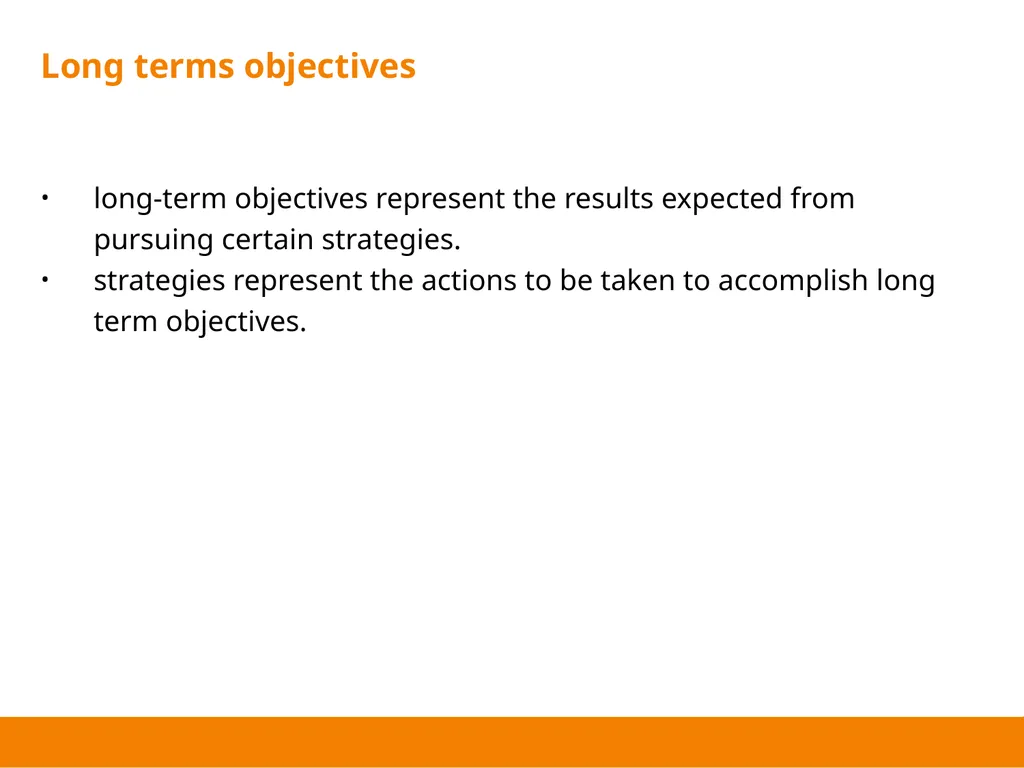
Long terms objectives long-term objectives represent the results expected from pursuing certain strategies.
strategies represent the actions to be taken to accomplish long term objectives.<br>
strategies represent the actions to be taken to accomplish long term objectives.<br>
04
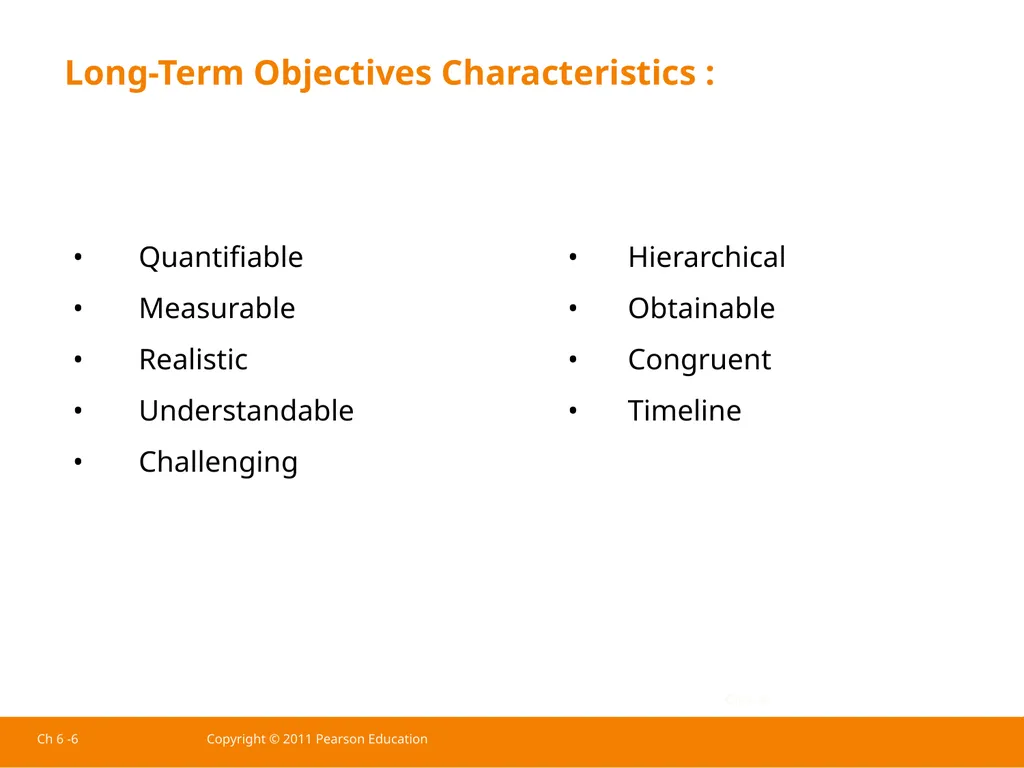
Ch 5 -6 Long-Term Objectives Characteristics : Quantifiable
Measurable
Realistic
Understandable
Challenging Hierarchical
Obtainable
Congruent
Timeline Ch 6 -6 Copyright © 2011 Pearson Education<br>
Measurable
Realistic
Understandable
Challenging Hierarchical
Obtainable
Congruent
Timeline Ch 6 -6 Copyright © 2011 Pearson Education<br>
05
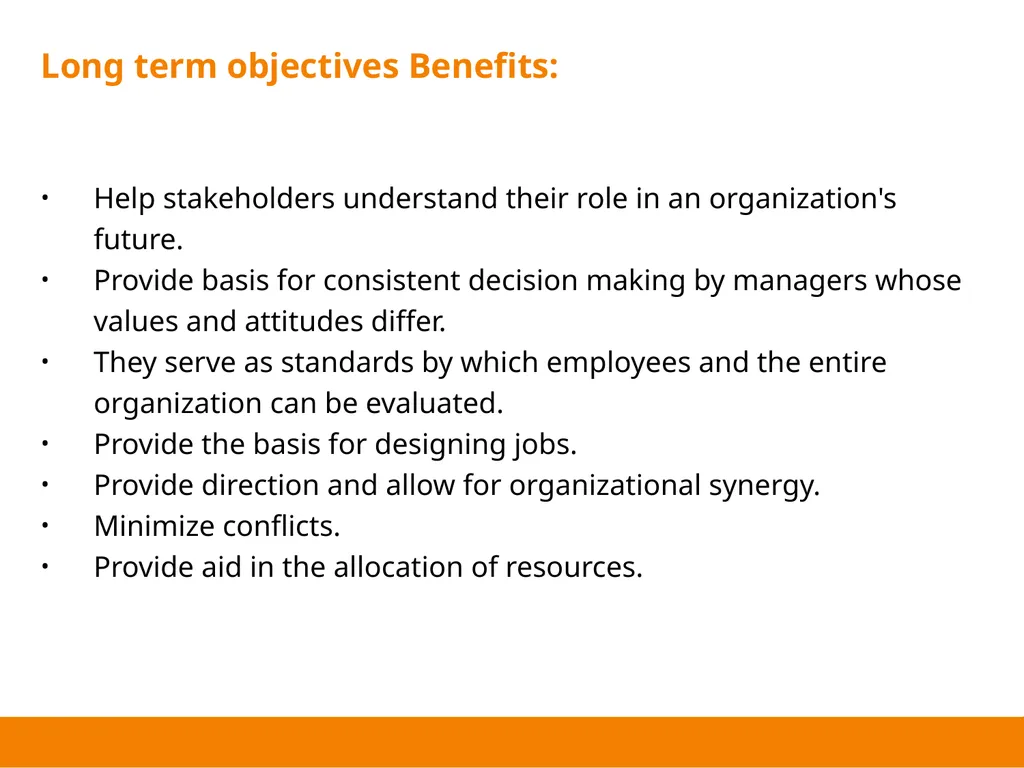
Long term objectives Benefits: Help stakeholders understand their role in an organization's future.
Provide basis for consistent decision making by managers whose values and attitudes differ.
They serve as standards by which employees and the entire organization can be evaluated.
Provide the basis for designing jobs.
Provide direction and allow for organizational synergy.
Minimize conflicts.
Provide aid in the allocation of resources.<br>
Provide basis for consistent decision making by managers whose values and attitudes differ.
They serve as standards by which employees and the entire organization can be evaluated.
Provide the basis for designing jobs.
Provide direction and allow for organizational synergy.
Minimize conflicts.
Provide aid in the allocation of resources.<br>
06
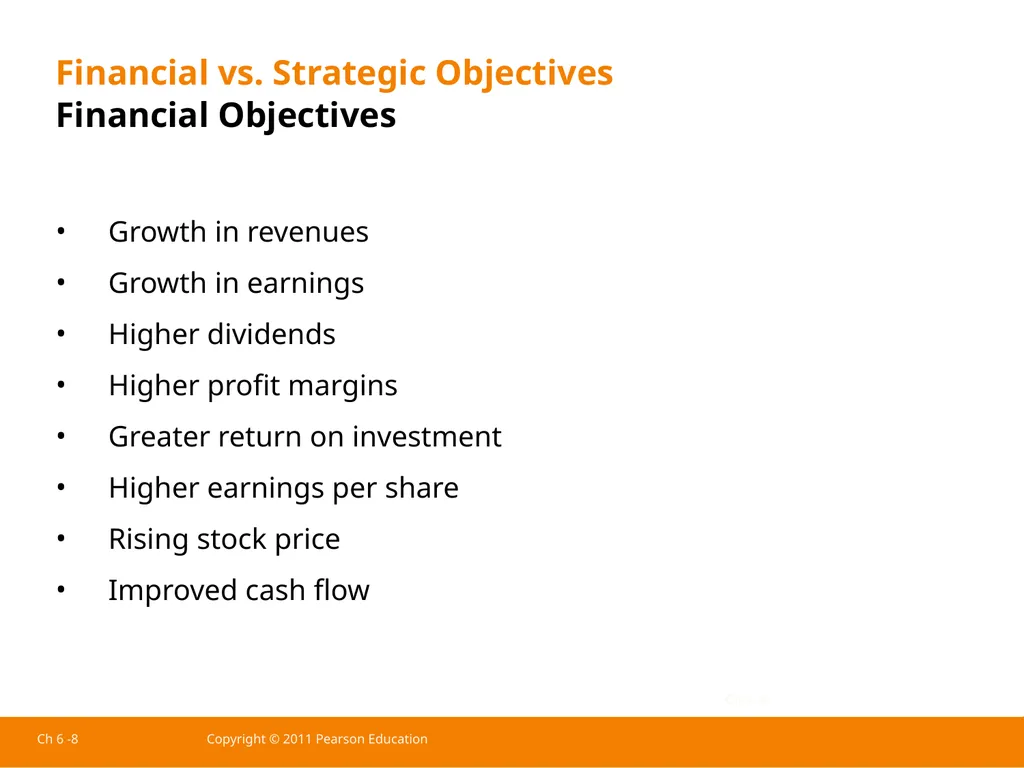
Ch 5 -8 Financial vs. Strategic Objectives Financial Objectives Growth in revenues
Growth in earnings
Higher dividends
Higher profit margins
Greater return on investment
Higher earnings per share
Rising stock price
Improved cash flow Ch 6 -8 Copyright © 2011 Pearson Education<br>
Growth in earnings
Higher dividends
Higher profit margins
Greater return on investment
Higher earnings per share
Rising stock price
Improved cash flow Ch 6 -8 Copyright © 2011 Pearson Education<br>
07
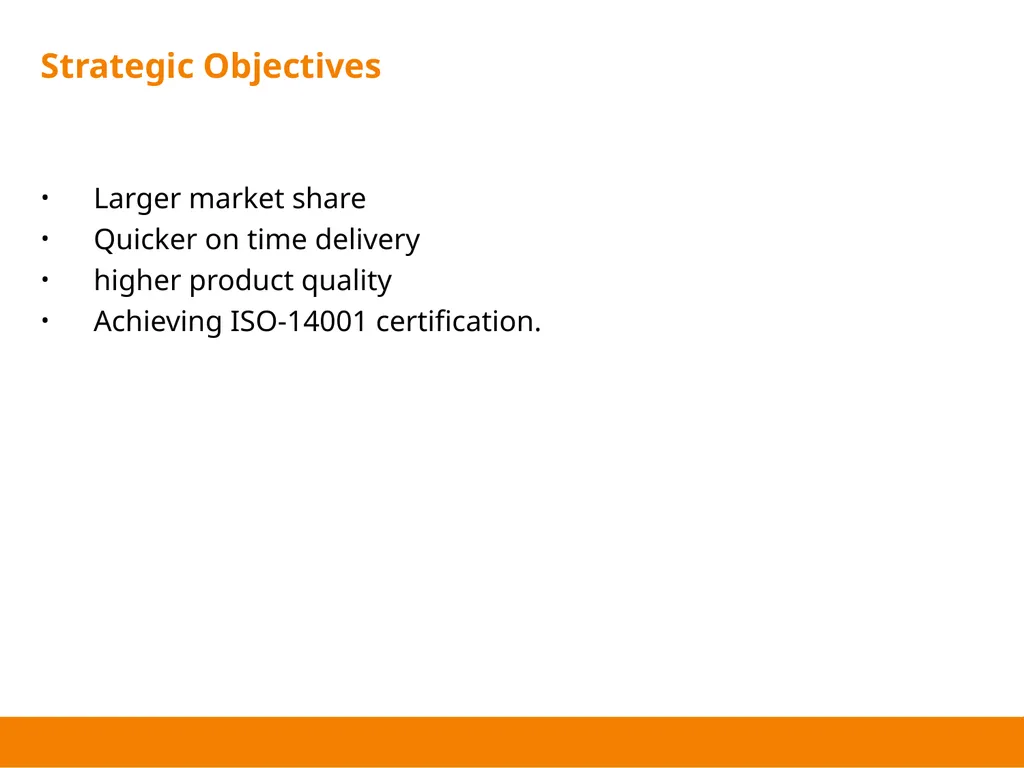
Strategic Objectives Larger market share
Quicker on time delivery
higher product quality
Achieving ISO-14001 certification.<br>
Quicker on time delivery
higher product quality
Achieving ISO-14001 certification.<br>
08
Without long-term objectives an organization would drift toward some unknown end.
Success occurs by accident only rarely.
Success is the result of hard work directed toward achieving certain objectives.<br>
Success occurs by accident only rarely.
Success is the result of hard work directed toward achieving certain objectives.<br>
09
Ch 5 -9 Not Managing by Objectives Managing by Extrapolation – If it not broke, don’t fix it. The idea is to keep on doing about the same things in the same ways because things are going well
Managing by Crisis – The true measure of a good strategist is the ability to fix problems. so its a reaction rather than actions letting events dictate management decisions.
Managing by Hope – The future is full of uncertainty and if first you don’t succeed, then you may on the second or third try. Ch 6 -9 Copyright © 2011 Pearson Education<br>
Managing by Crisis – The true measure of a good strategist is the ability to fix problems. so its a reaction rather than actions letting events dictate management decisions.
Managing by Hope – The future is full of uncertainty and if first you don’t succeed, then you may on the second or third try. Ch 6 -9 Copyright © 2011 Pearson Education<br>
10
Ch 5 -12 Ch 6 -12 Copyright © 2011 Pearson Education Depending on their capabilities and potential companies may display 3 postures :
1-Growth (offensive)
2-Retrenchment (تخفيض نفقات( (Defensive)
3-Stability
*Offensive : since its growth position then it involves increasing investment
*Defensive: a position where a company seeks to protect its position and take actions that limits the size of its market involvement.
*Stability : avoid change <=== this position is not common in international scale , only in small enterprises.<br>
1-Growth (offensive)
2-Retrenchment (تخفيض نفقات( (Defensive)
3-Stability
*Offensive : since its growth position then it involves increasing investment
*Defensive: a position where a company seeks to protect its position and take actions that limits the size of its market involvement.
*Stability : avoid change <=== this position is not common in international scale , only in small enterprises.<br>
11
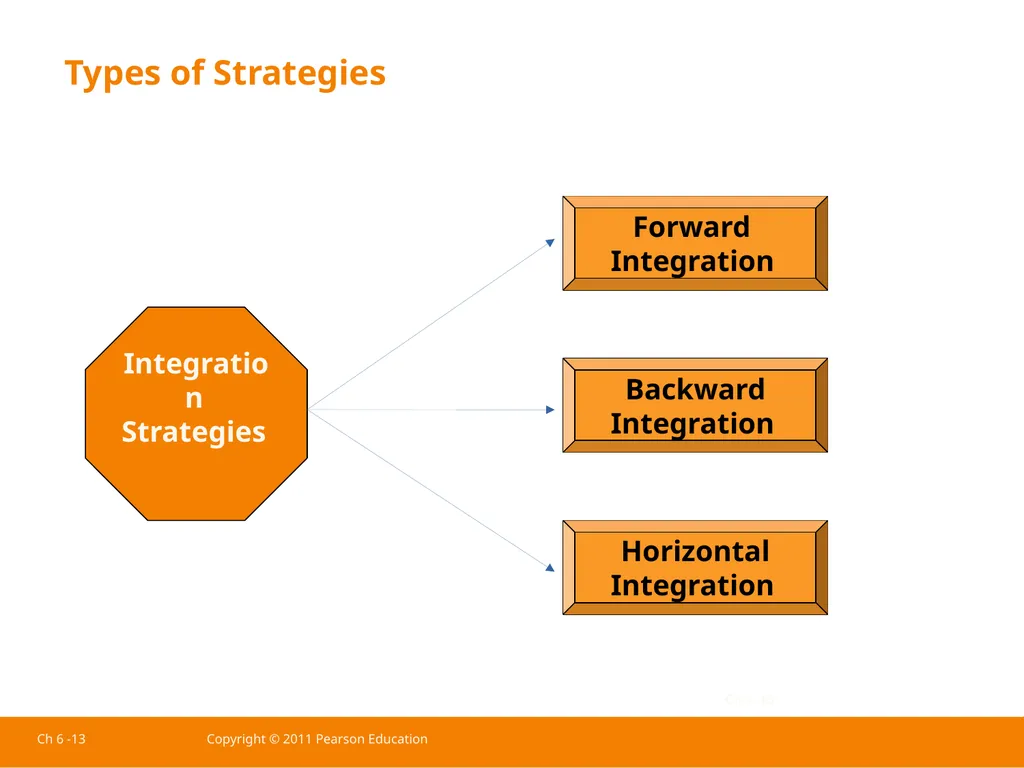
Ch 5 -13 Types of Strategies Ch 6 -13 Copyright © 2011 Pearson Education<br>
12
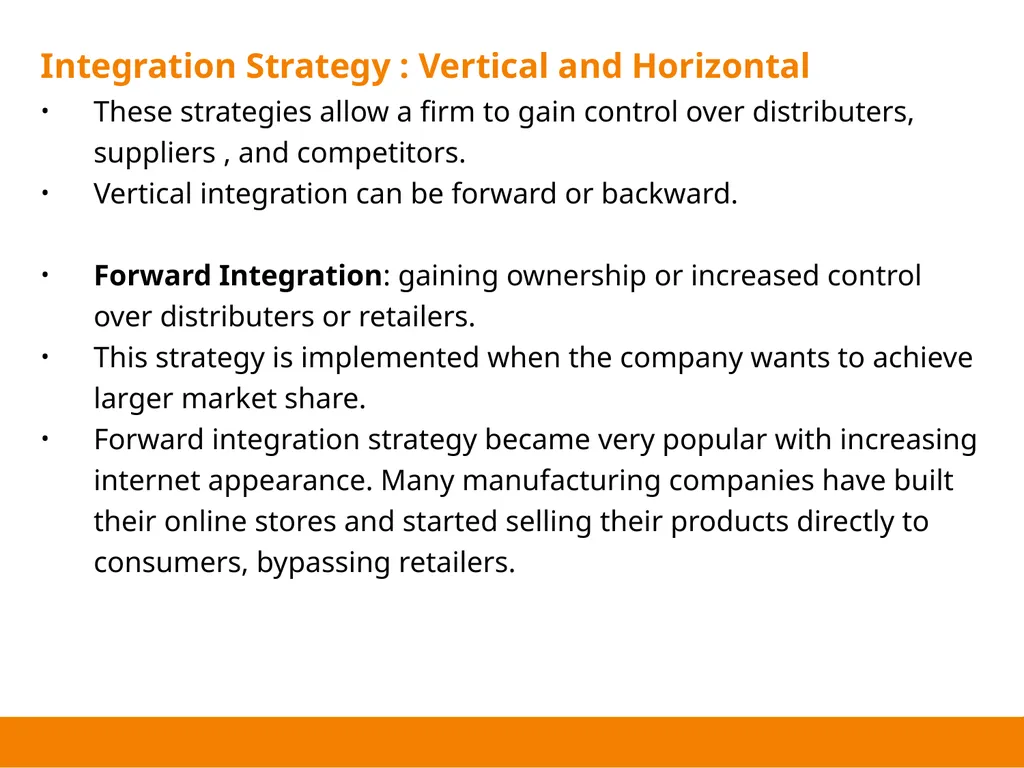
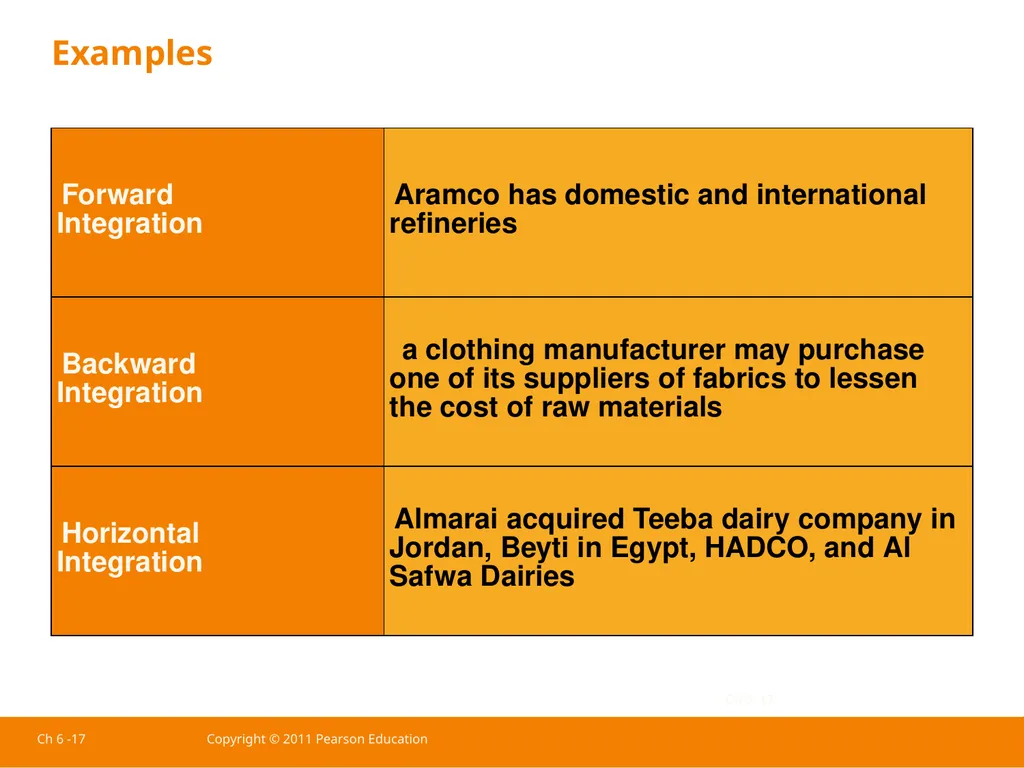
Integration Strategy : Vertical and Horizontal These strategies allow a firm to gain control over distributers, suppliers , and competitors.
Vertical integration can be forward or backward.
Forward Integration: gaining ownership or increased control over distributers or retailers.
This strategy is implemented when the company wants to achieve larger market share.
Forward integration strategy became very popular with increasing internet appearance. Many manufacturing companies have built their online stores and started selling their products directly to consumers, bypassing retailers.<br>
Vertical integration can be forward or backward.
Forward Integration: gaining ownership or increased control over distributers or retailers.
This strategy is implemented when the company wants to achieve larger market share.
Forward integration strategy became very popular with increasing internet appearance. Many manufacturing companies have built their online stores and started selling their products directly to consumers, bypassing retailers.<br>
13
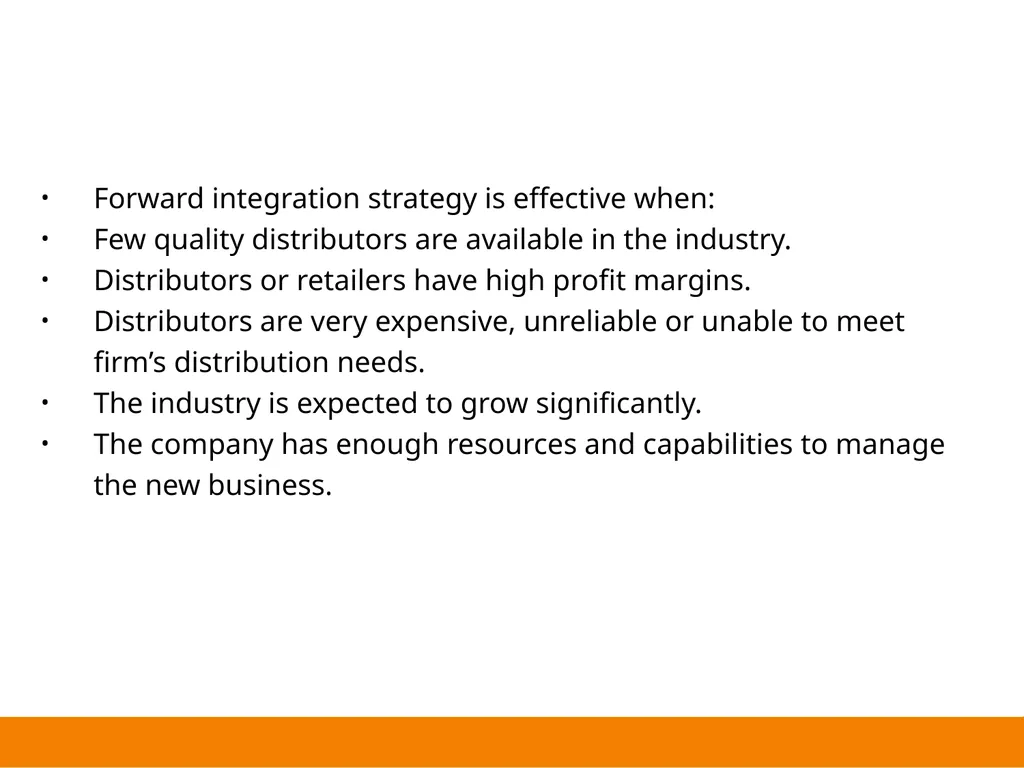
Forward integration strategy is effective when:
Few quality distributors are available in the industry.
Distributors or retailers have high profit margins.
Distributors are very expensive, unreliable or unable to meet firm’s distribution needs.
The industry is expected to grow significantly.
The company has enough resources and capabilities to manage the new business.<br>
Few quality distributors are available in the industry.
Distributors or retailers have high profit margins.
Distributors are very expensive, unreliable or unable to meet firm’s distribution needs.
The industry is expected to grow significantly.
The company has enough resources and capabilities to manage the new business.<br>
14
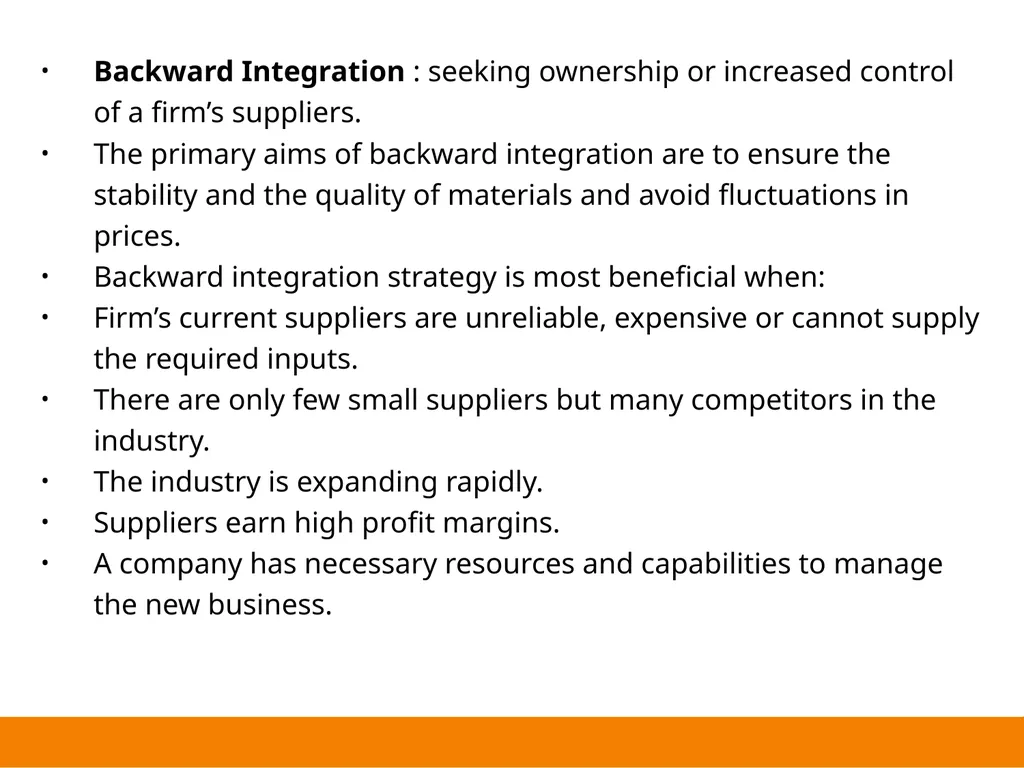
Backward Integration : seeking ownership or increased control of a firm’s suppliers.
The primary aims of backward integration are to ensure the stability and the quality of materials and avoid fluctuations in prices.
Backward integration strategy is most beneficial when:
Firm’s current suppliers are unreliable, expensive or cannot supply the required inputs.
There are only few small suppliers but many competitors in the industry.
The industry is expanding rapidly.
Suppliers earn high profit margins.
A company has necessary resources and capabilities to manage the new business.<br>
The primary aims of backward integration are to ensure the stability and the quality of materials and avoid fluctuations in prices.
Backward integration strategy is most beneficial when:
Firm’s current suppliers are unreliable, expensive or cannot supply the required inputs.
There are only few small suppliers but many competitors in the industry.
The industry is expanding rapidly.
Suppliers earn high profit margins.
A company has necessary resources and capabilities to manage the new business.<br>
15
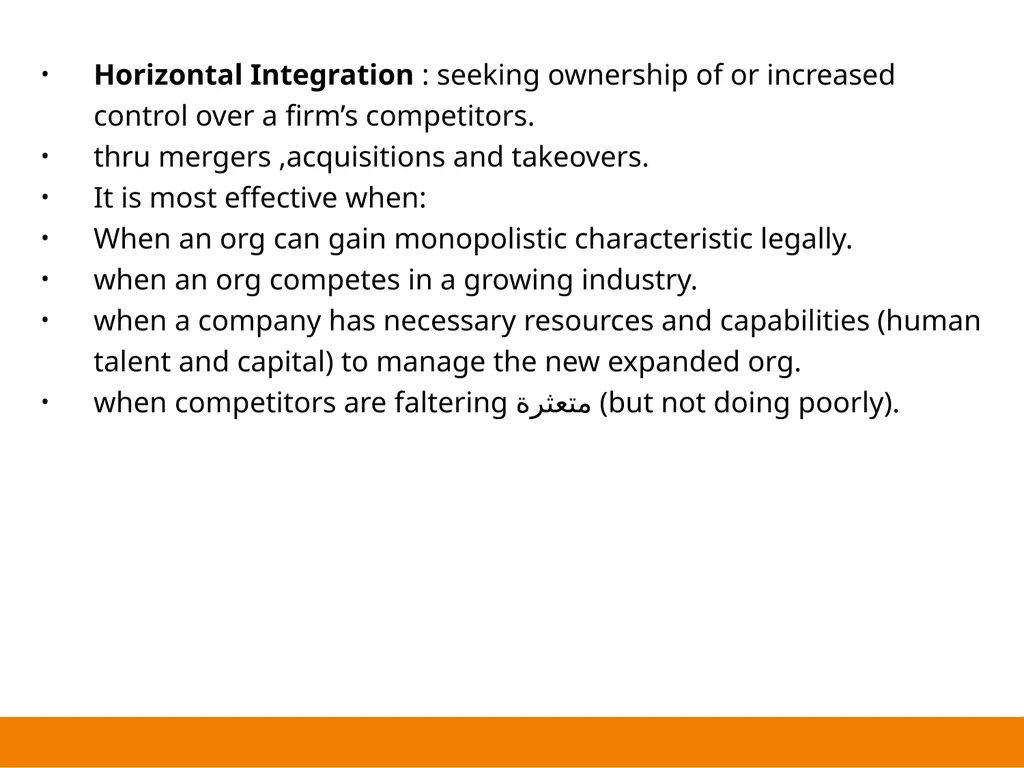
Horizontal Integration : seeking ownership of or increased control over a firm’s competitors.
thru mergers ,acquisitions and takeovers.
It is most effective when:
When an org can gain monopolistic characteristic legally.
when an org competes in a growing industry.
when a company has necessary resources and capabilities (human talent and capital) to manage the new expanded org.
when competitors are faltering متعثرة (but not doing poorly).<br>
thru mergers ,acquisitions and takeovers.
It is most effective when:
When an org can gain monopolistic characteristic legally.
when an org competes in a growing industry.
when a company has necessary resources and capabilities (human talent and capital) to manage the new expanded org.
when competitors are faltering متعثرة (but not doing poorly).<br>
16
Examples Ch 5 -17 Ch 6 -17 Copyright © 2011 Pearson Education<br>
17
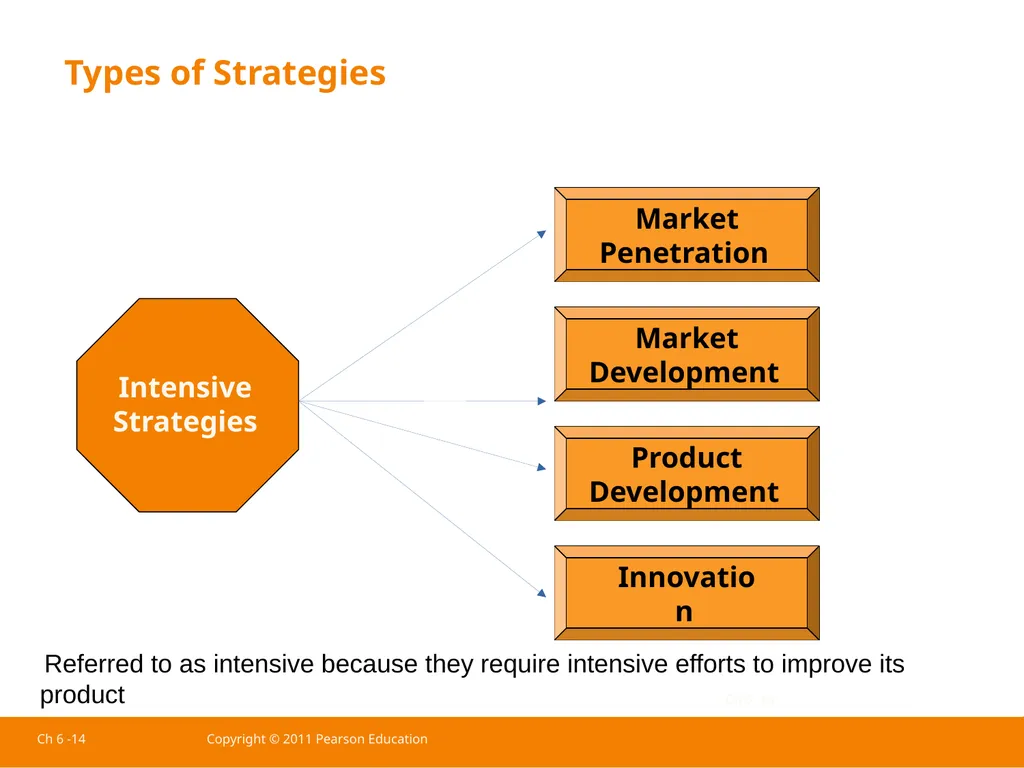
Ch 5 -14 Types of Strategies Ch 6 -14 Copyright © 2011 Pearson Education Referred to as intensive because they require intensive efforts to improve its product<br>
18
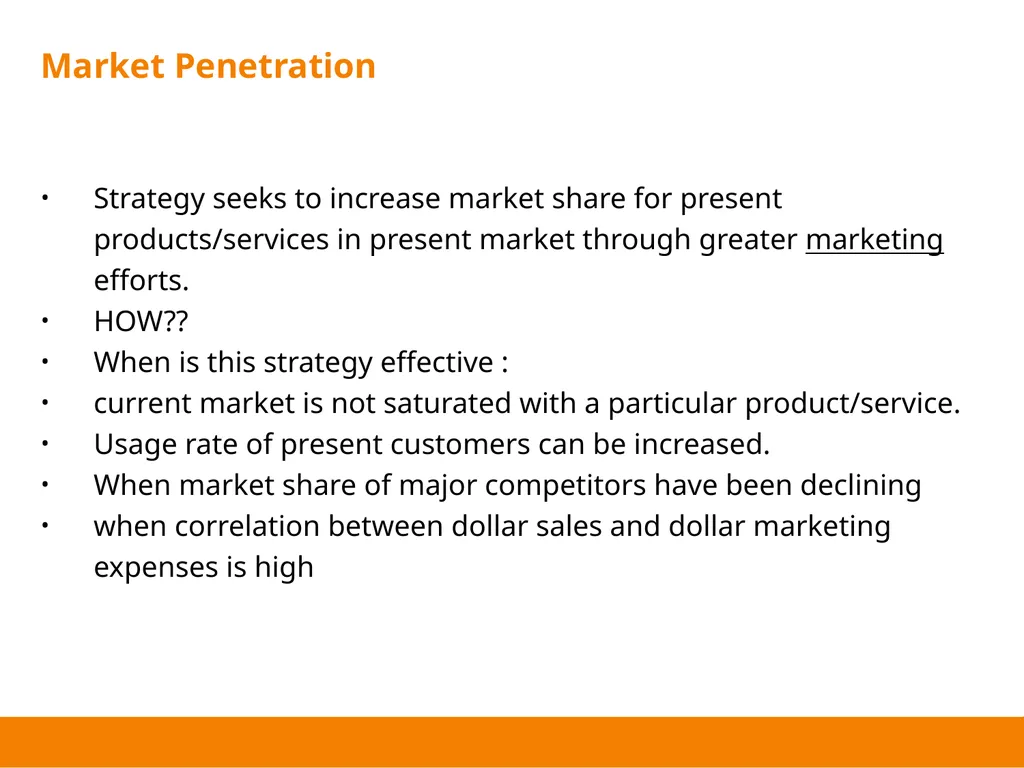
Market Penetration Strategy seeks to increase market share for present products/services in present market through greater marketing efforts.
HOW??
When is this strategy effective :
current market is not saturated with a particular product/service.
Usage rate of present customers can be increased.
When market share of major competitors have been declining
when correlation between dollar sales and dollar marketing expenses is high<br>
HOW??
When is this strategy effective :
current market is not saturated with a particular product/service.
Usage rate of present customers can be increased.
When market share of major competitors have been declining
when correlation between dollar sales and dollar marketing expenses is high<br>
19
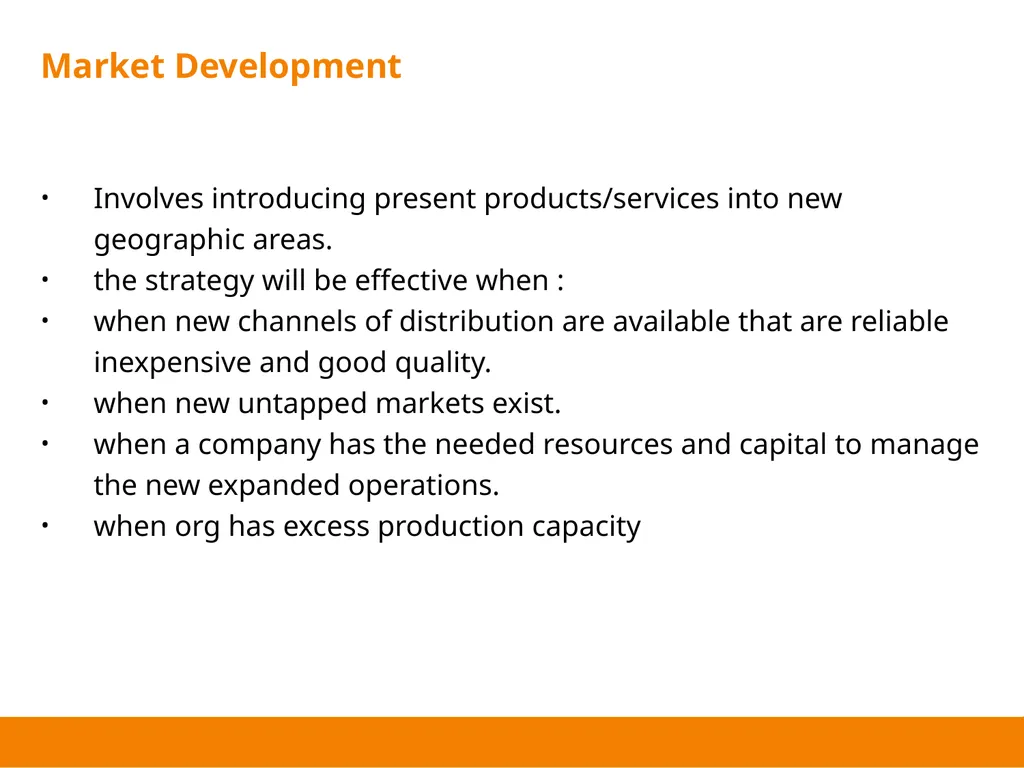
Market Development Involves introducing present products/services into new geographic areas.
the strategy will be effective when :
when new channels of distribution are available that are reliable inexpensive and good quality.
when new untapped markets exist.
when a company has the needed resources and capital to manage the new expanded operations.
when org has excess production capacity<br>
the strategy will be effective when :
when new channels of distribution are available that are reliable inexpensive and good quality.
when new untapped markets exist.
when a company has the needed resources and capital to manage the new expanded operations.
when org has excess production capacity<br>
20
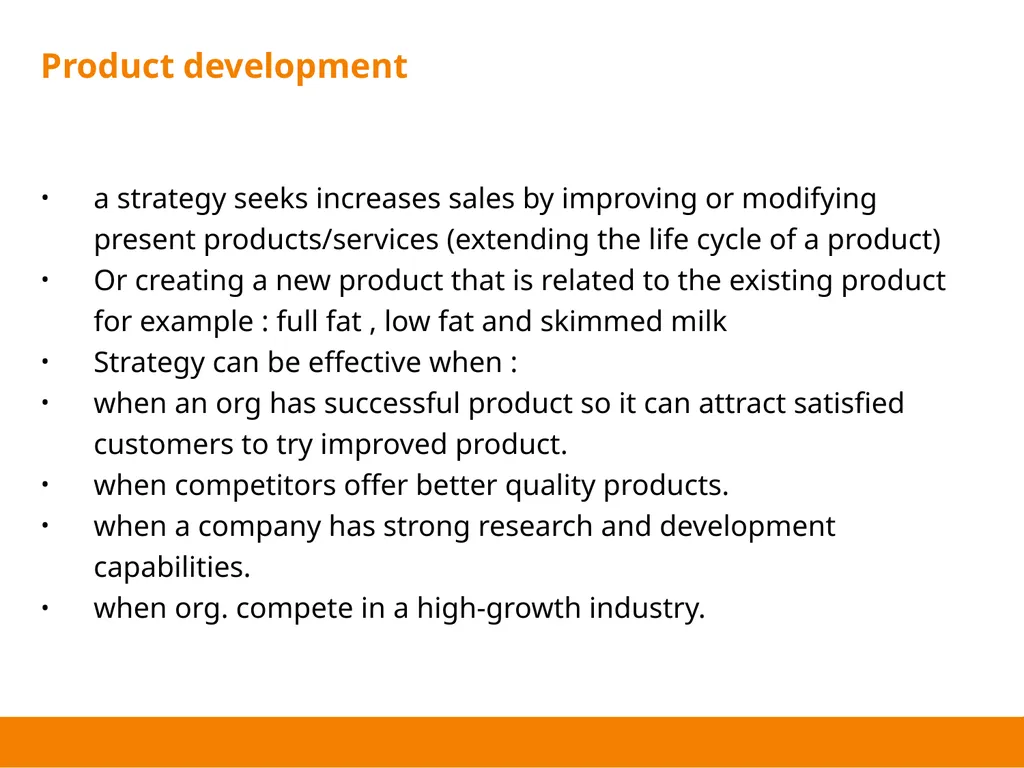
Product development a strategy seeks increases sales by improving or modifying present products/services (extending the life cycle of a product)
Or creating a new product that is related to the existing product for example : full fat , low fat and skimmed milk
Strategy can be effective when :
when an org has successful product so it can attract satisfied customers to try improved product.
when competitors offer better quality products.
when a company has strong research and development capabilities.
when org. compete in a high-growth industry.<br>
Or creating a new product that is related to the existing product for example : full fat , low fat and skimmed milk
Strategy can be effective when :
when an org has successful product so it can attract satisfied customers to try improved product.
when competitors offer better quality products.
when a company has strong research and development capabilities.
when org. compete in a high-growth industry.<br>
21
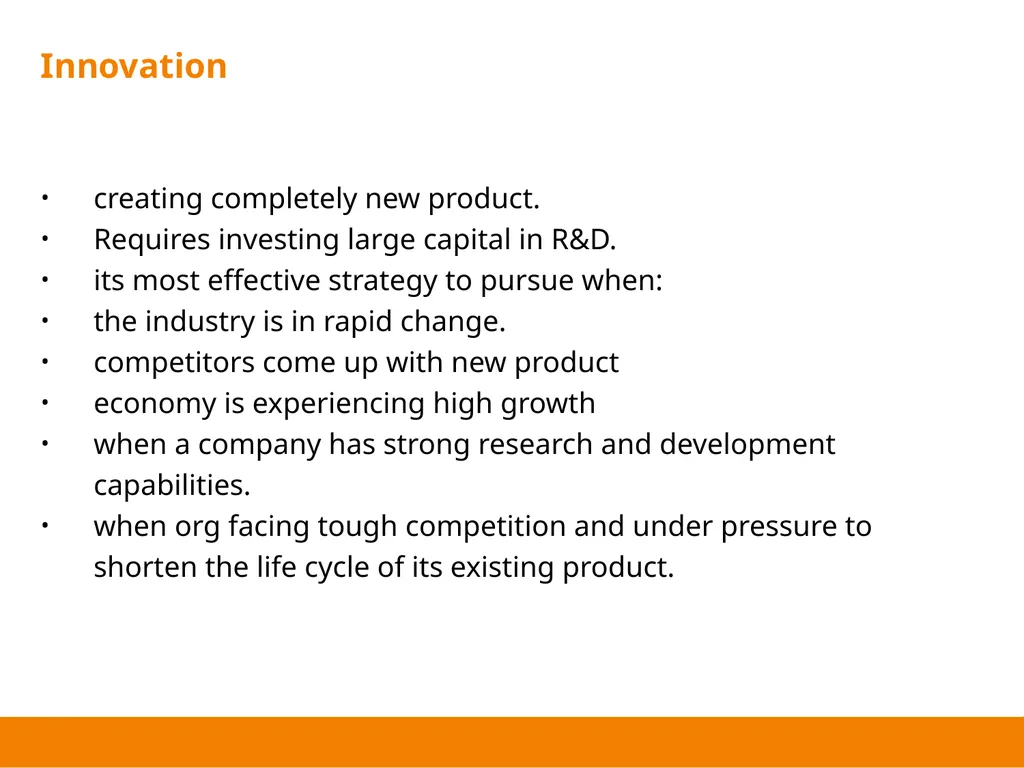
Innovation creating completely new product.
Requires investing large capital in R&D.
its most effective strategy to pursue when:
the industry is in rapid change.
competitors come up with new product
economy is experiencing high growth
when a company has strong research and development capabilities.
when org facing tough competition and under pressure to shorten the life cycle of its existing product.<br>
Requires investing large capital in R&D.
its most effective strategy to pursue when:
the industry is in rapid change.
competitors come up with new product
economy is experiencing high growth
when a company has strong research and development capabilities.
when org facing tough competition and under pressure to shorten the life cycle of its existing product.<br>
22
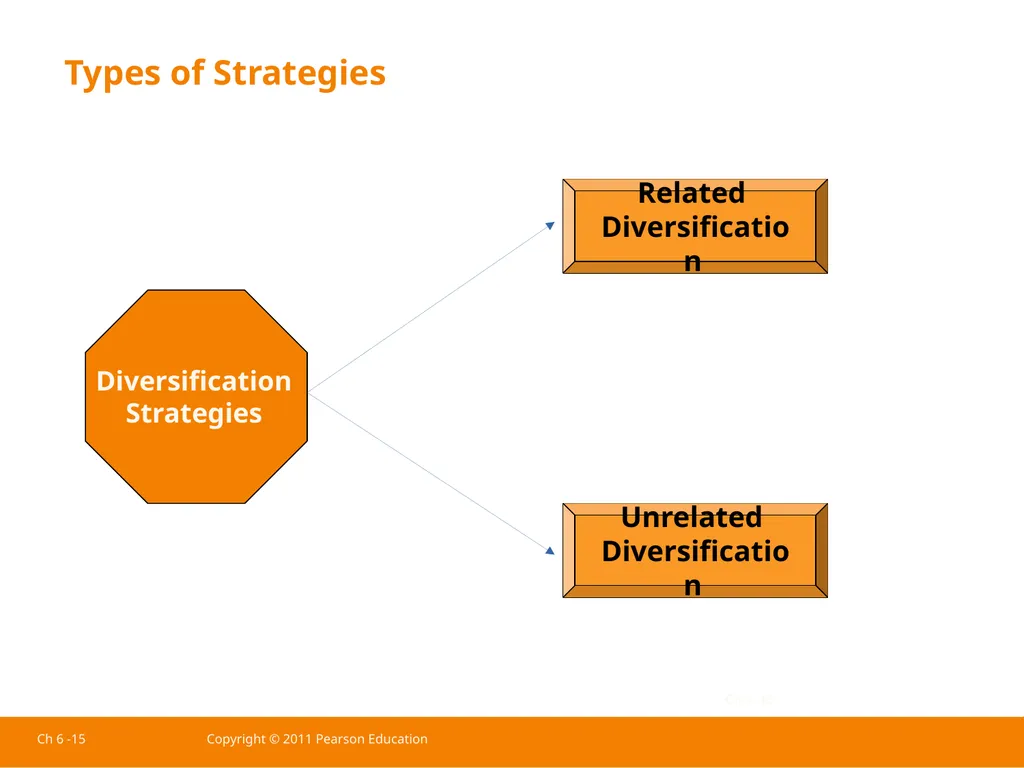
Ch 5 -15 Types of Strategies Ch 6 -15 Copyright © 2011 Pearson Education<br>
23
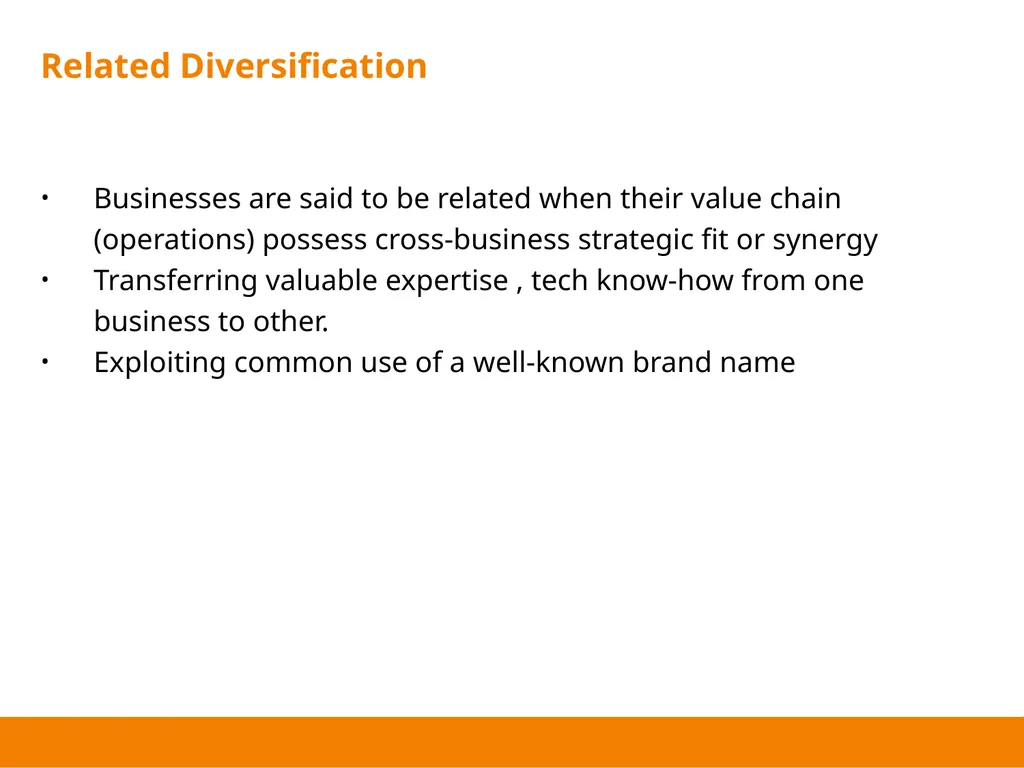
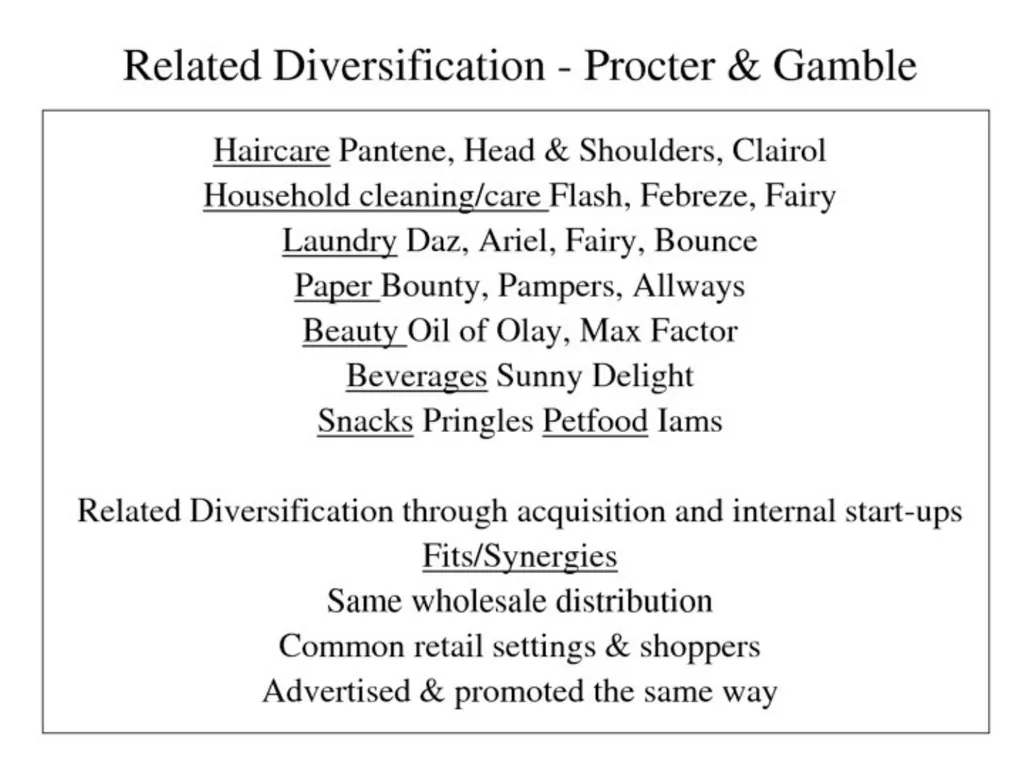
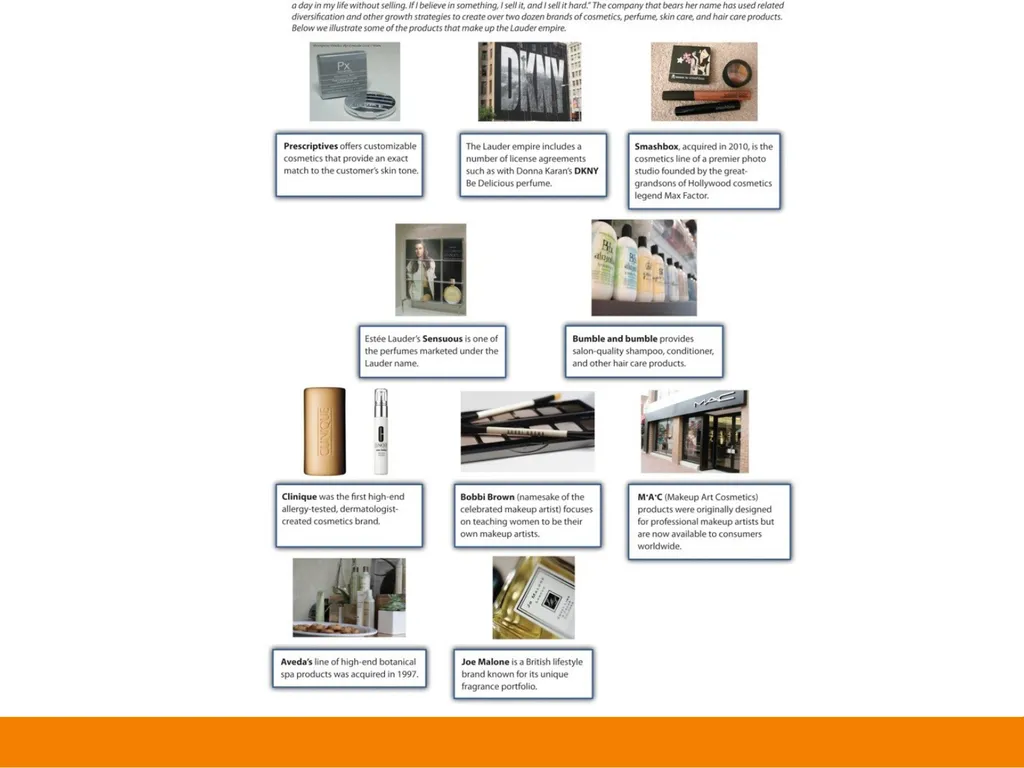
Related Diversification Businesses are said to be related when their value chain (operations) possess cross-business strategic fit or synergy
Transferring valuable expertise , tech know-how from one business to other.
Exploiting common use of a well-known brand name<br>
Transferring valuable expertise , tech know-how from one business to other.
Exploiting common use of a well-known brand name<br>
24
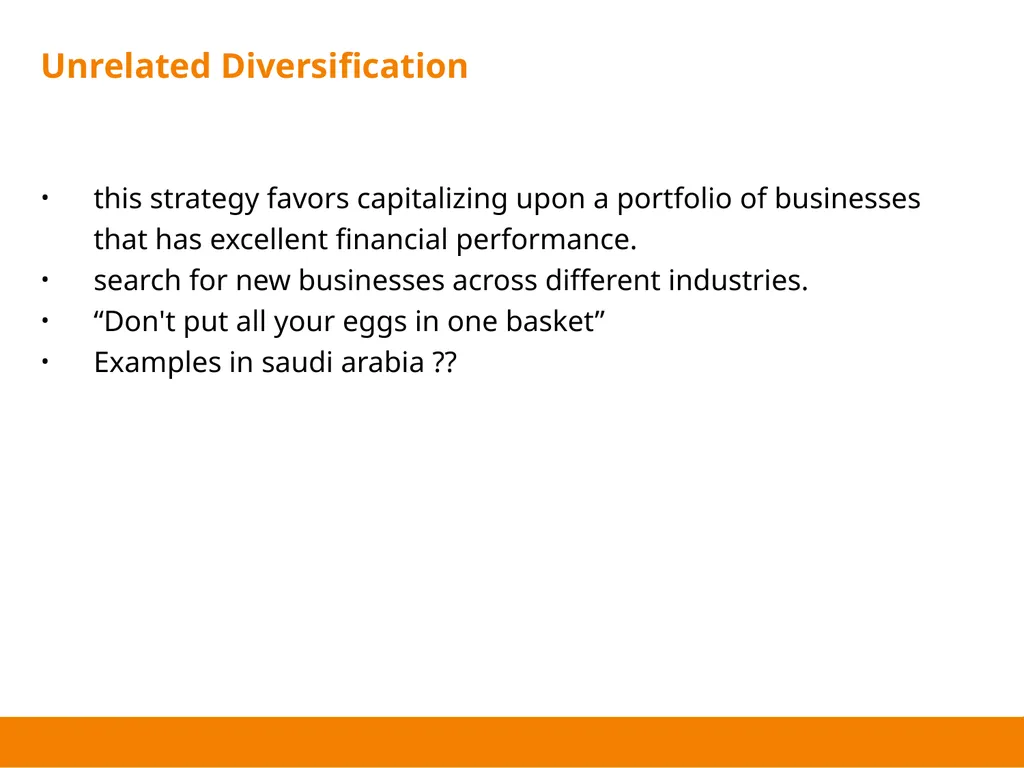
Unrelated Diversification this strategy favors capitalizing upon a portfolio of businesses that has excellent financial performance.
search for new businesses across different industries.
“Don't put all your eggs in one basket”
Examples in saudi arabia ??<br>
search for new businesses across different industries.
“Don't put all your eggs in one basket”
Examples in saudi arabia ??<br>
25
Ch 5 -16 Types of Strategies Ch 6 -16 Copyright © 2011 Pearson Education<br>
26
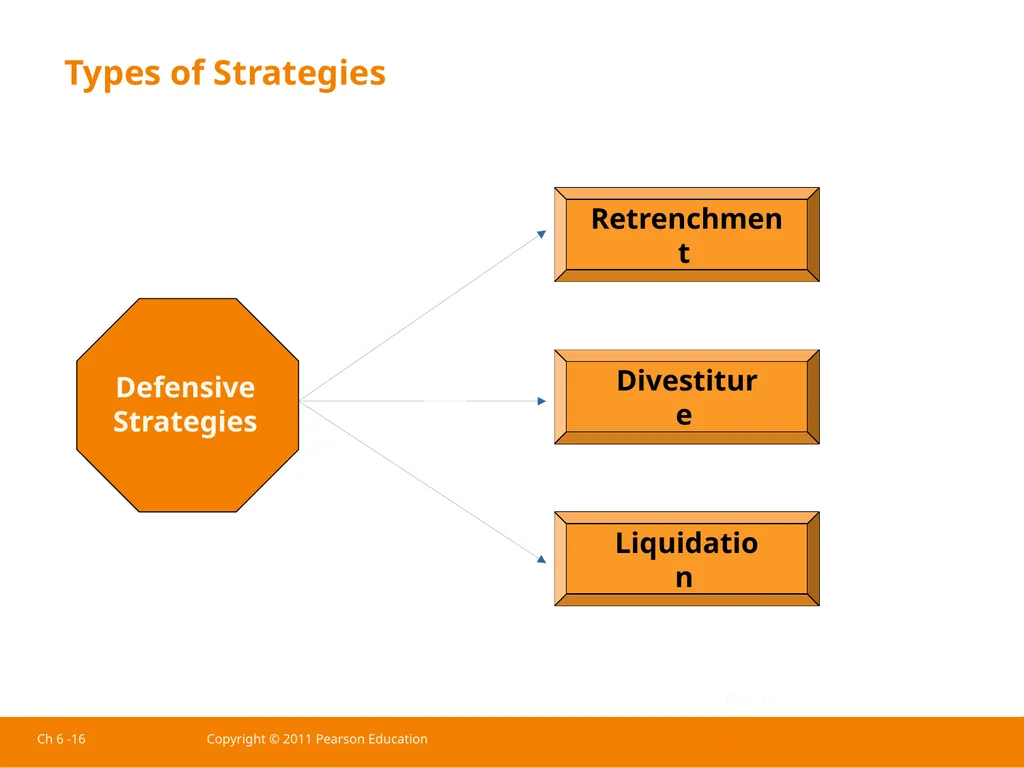
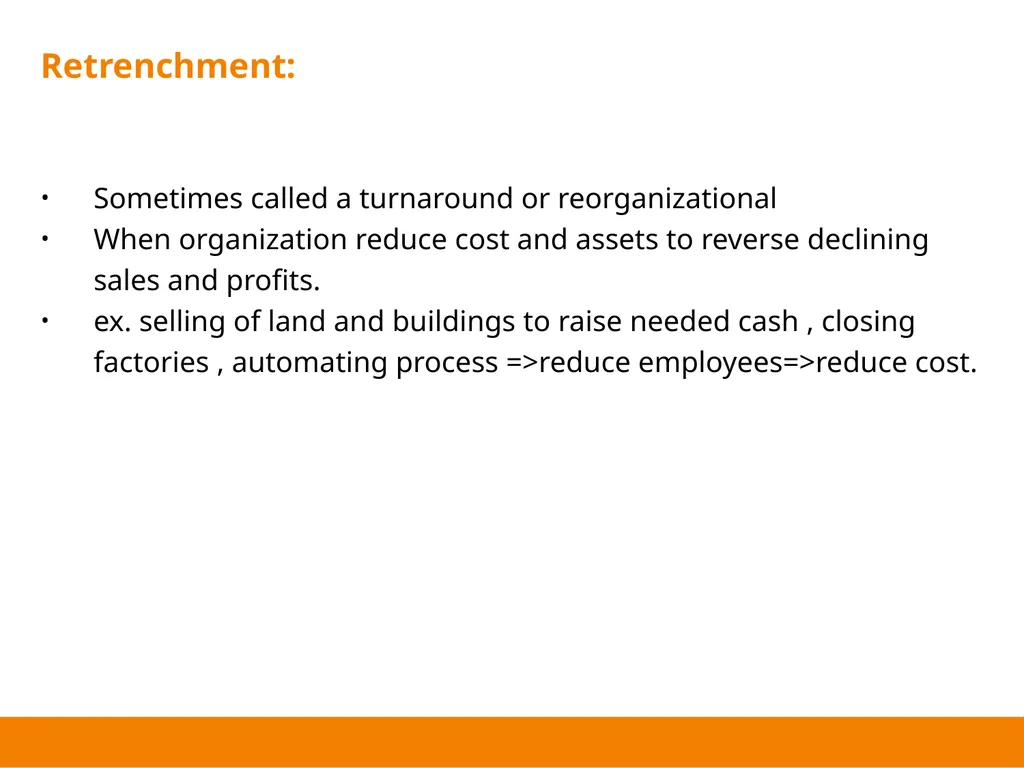
Retrenchment: Sometimes called a turnaround or reorganizational
When organization reduce cost and assets to reverse declining sales and profits.
ex. selling of land and buildings to raise needed cash , closing factories , automating process =>reduce employees=>reduce cost.<br>
When organization reduce cost and assets to reverse declining sales and profits.
ex. selling of land and buildings to raise needed cash , closing factories , automating process =>reduce employees=>reduce cost.<br>
27
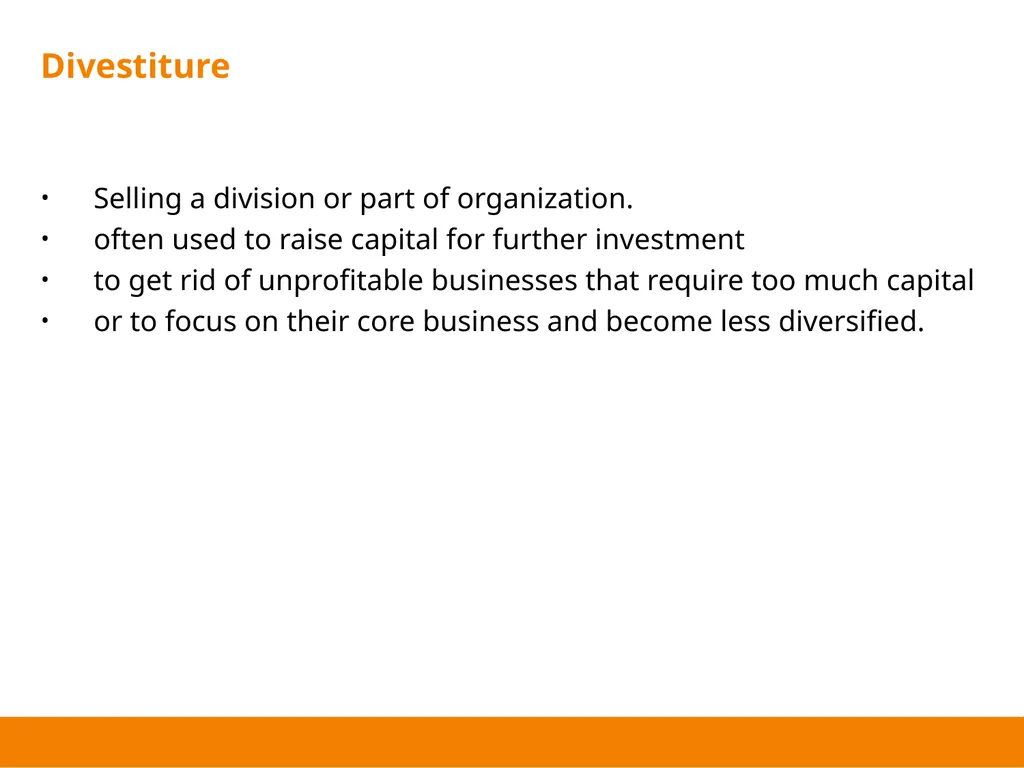
Divestiture Selling a division or part of organization.
often used to raise capital for further investment
to get rid of unprofitable businesses that require too much capital
or to focus on their core business and become less diversified.<br>
often used to raise capital for further investment
to get rid of unprofitable businesses that require too much capital
or to focus on their core business and become less diversified.<br>
28
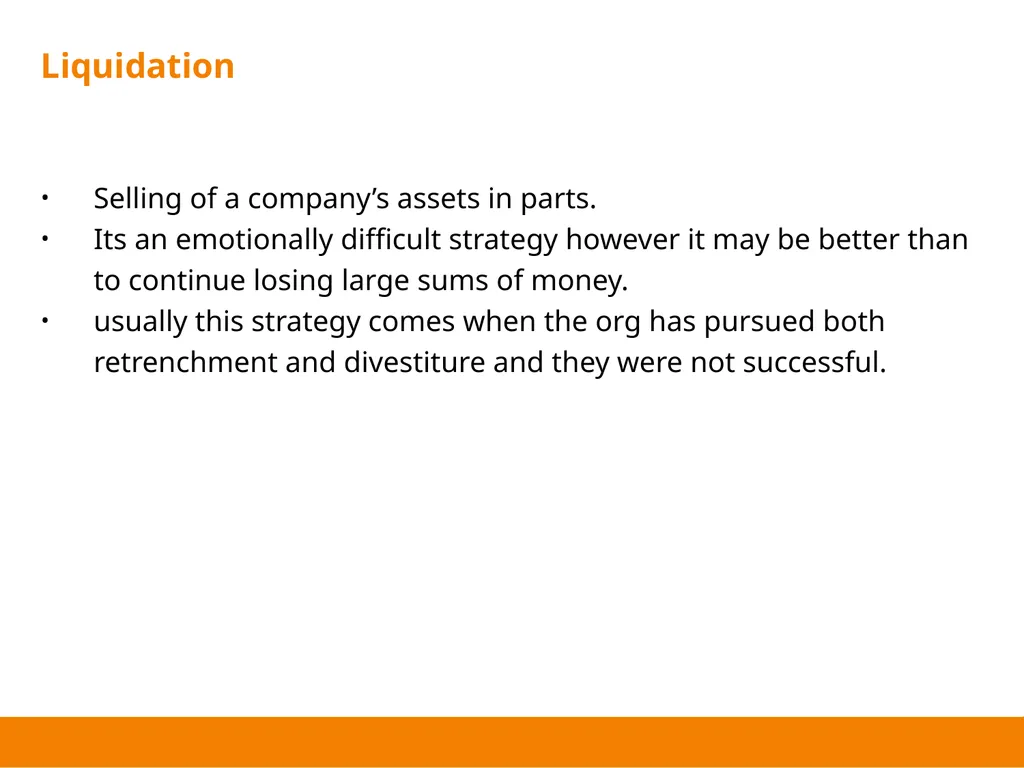
Liquidation Selling of a company’s assets in parts.
Its an emotionally difficult strategy however it may be better than to continue losing large sums of money.
usually this strategy comes when the org has pursued both retrenchment and divestiture and they were not successful.<br>
Its an emotionally difficult strategy however it may be better than to continue losing large sums of money.
usually this strategy comes when the org has pursued both retrenchment and divestiture and they were not successful.<br>
29
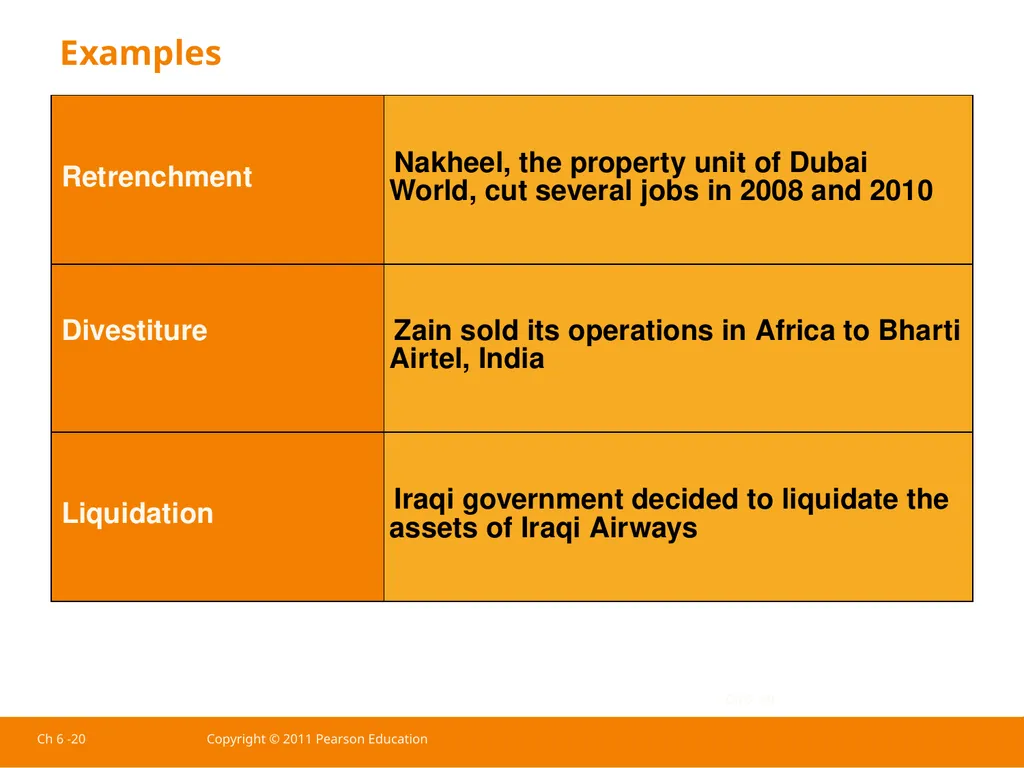
Examples Ch 5 -20 Ch 6 -20 Copyright © 2011 Pearson Education<br>
30
Means for Achieving Strategies Ch 6 -24 Copyright © 2011 Pearson Education<br>
31
Joint Venture/Partnering Ch 6 -25 Copyright © 2011 Pearson Education<br>
32
Mergers and Acquisitions Ch 6 -26 Copyright © 2011 Pearson Education<br>
33
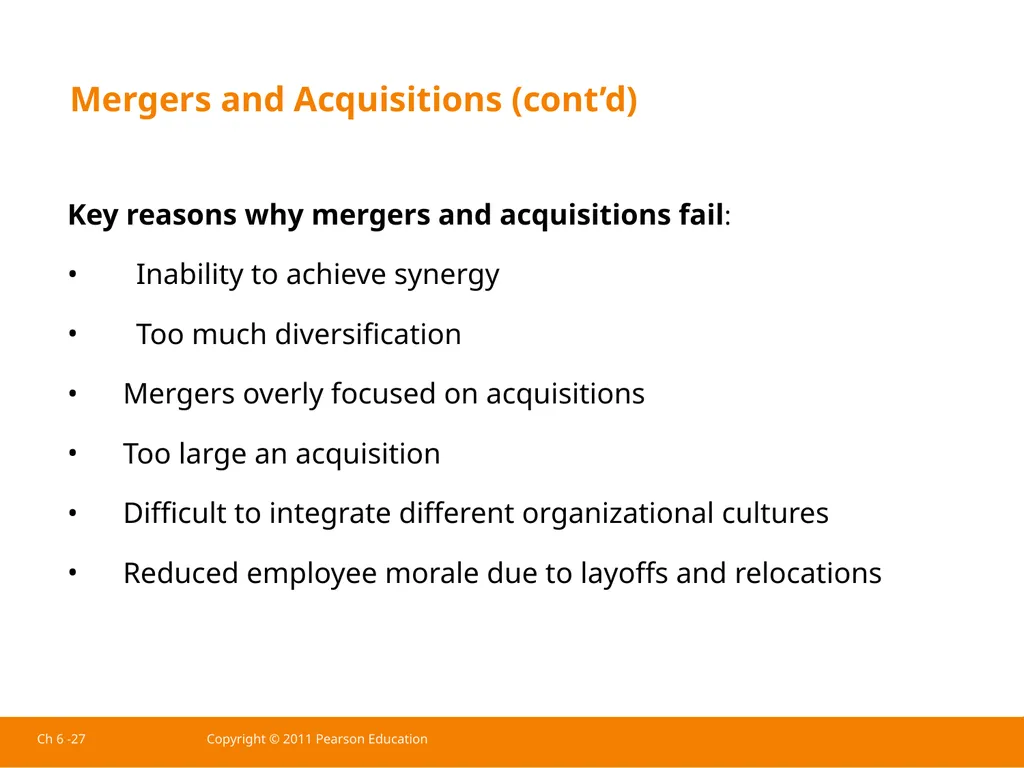
Mergers and Acquisitions (cont’d) Ch 6 -27 Copyright © 2011 Pearson Education<br>
34
Outsourcing Ch 6 -31 Copyright © 2011 Pearson Education<br>