
Chapter 4 Communication Skills Objectives Identify
Description: Chapter 4 Communication Skills Objectives Identify and describe the elements of the communication process. Compare and describe the different types and styles of communication. Describe communication. Introduction (1 of 5) Communication
Related Topics
Download Presentation
"Chapter 4 Communication Skills Objectives Identify" is the property of its rightful owner. Permission is granted to download and print the materials on this website for personal, non-commercial use only, and to display it on your personal computer provided you do not modify the materials and that you retain all copyright notices contained in the materials. By downloading content from our website, you accept the terms of this agreement.
Presentation Transcript
slide1. Chapter 4 Communication Skills<br>
slide2. Objectives Identify and describe the elements of the communication process.
Compare and describe the different types and styles of communication.
Describe communication.<br>
slide3. Introduction (1 of 5) Communication most important element of the learning process
Communication in and of itself is a process
Must master to be effective fire and emergency services instructor
Even if environment less than perfect, strong communication skills will overcome<br>
slide4. Introduction (2 of 5) Effective communication skills take the learning process to even greater heights by:
Encouraging effort
Modifying attitudes
Stimulating thinking<br>
slide5. Introduction (3 of 5) Students have different learning styles and use different cues.
Knowing how to access diverse cues and take advantage of them will make you more effective.
A classroom encompasses much more than four walls.
Back of an engine after an emergency call
Burn building
Kitchen table at the station<br>
slide6. Introduction (4 of 5) No matter the environment, end objective the same: the student learns
Student safety and ability to do the job improve
Instructor must have excellent communication skills
Must be able to read the students’ comprehension of training through verbal and nonverbal cues<br>
slide7. Introduction (5 of 5) Although fire service steeped in tradition, means of communication used changed dramatically over the years
Even with today’s many avenues for the rapid transmission of messages, the message itself remains the critical piece of the communication puzzle<br>
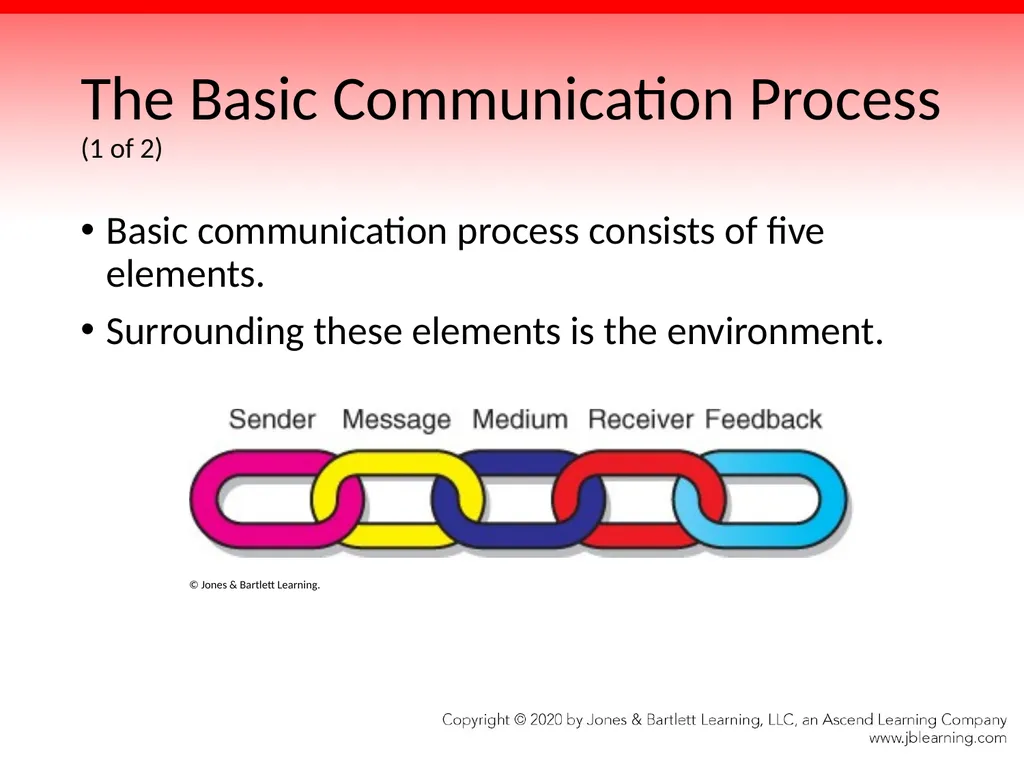
slide8. The Basic Communication Process (1 of 2) Basic communication process consists of five elements.
Surrounding these elements is the environment. © Jones & Bartlett Learning.<br>
slide9. The Basic Communication Process (2 of 2) Five elements act like links of a chain.
To function properly, all links must be attached to one another.
If any one of the links breaks, then the chain falls apart.<br>
slide10. The Sender Sender is you, the instructor
As sender, must know which style of communication to use
Choice of style of communication based on many factors<br>
slide11. The Message Next link is the message
What are you trying to communicate to your students?
Must encode point of the lesson and transmit it
May sound simple, but is most complex part
For students to understand the message, they must:
Hear it
Decode it or put it into their own terms
Ensure their terms match your terms<br>
slide12. The Medium How the message is transmitted as important as the message itself
Means of conveying a message constitutes the medium
Tone of voice
Volume
Speed of speech<br>
slide13. The Receiver In the learning environment, this link is the student.
Receiver plays important, active role in the communication chain.
Student needs to listen actively and maintain focus to decode.
At the start of each training session, remind students of their role in the communication chain and continue to keep them engaged throughout the learning process.<br>
slide14. The Receiver Fulfilling this role means leaving all distractions at the door and focusing solely on the information.
Student’s previous experience and knowledge base play major role in determining ability to receive message.
Adapt style and presentation to students.
If you “talk down” to students or if the presentation goes over their heads, the message is not in a form that they can receive.<br>
slide15. Feedback (1 of 3) Link completes the communication process
Often considered the most important step
Allows sender to determine whether receiver understood the message
Can be verbal or nonverbal
Orders given over the radio
Blank stares from students<br>
slide16. Feedback (2 of 3) Collectively asking a classroom of students if they understand is not the best method of determining whether the message was properly received
No student wants to admit he or she does not understand.
Asking to describe the message in their own words more effective
Can depend on the dynamics of the class
If description is incorrect, gently explain it’s not quite right and ask for others to offer information<br>
slide17. Feedback (3 of 3) Face-to-face conversation is the most effective means of conveying information.
Verbal communication must be conducted over radio or telephone, supplementary expressions sacrificed.
Another type of feedback may be apparent when grading a research paper.
Writing notes in the margins of the paper allows the student to review and process your comments carefully.<br>
slide18. The Environment (1 of 4) Surrounding all of the links of the communication chain is the environment
Includes physical, social, and environmental factors
Can dramatically affect communication process
Physical environment is room or area in which communication takes place
Could be a classroom, the training ground, or even cyberspace<br>
slide19. The Environment (2 of 4) Physical environment can either inhibit or enhance the learning process
Make sure all students can see and hear you<br>
slide20. The Environment (3 of 4) Social environment is the context in which communication takes place
If the class not enthusiastic about the message, the message will have limited effect
Mandatory training usually has this effect
Must make sure students want or need to receive message—art of motivation
Asking why is part of the learning process<br>
slide21. The Environment (4 of 4) Environmental factors
Receivers must feel that needs are met.
Environment that is physically difficult to tolerate is distracting.
Lessons that continue too long may also cause discomfort and negatively impact the learning process.<br>
slide22. Nonverbal Communication (1 of 3) Communication is 10% what you say and 90% how you say it
Nonverbal communication difficult skill to control because you generally do not watch yourself in the mirror all day
Includes:
Tone of voice
Eye movement
Posture
Hand gestures
Facial expressions<br>
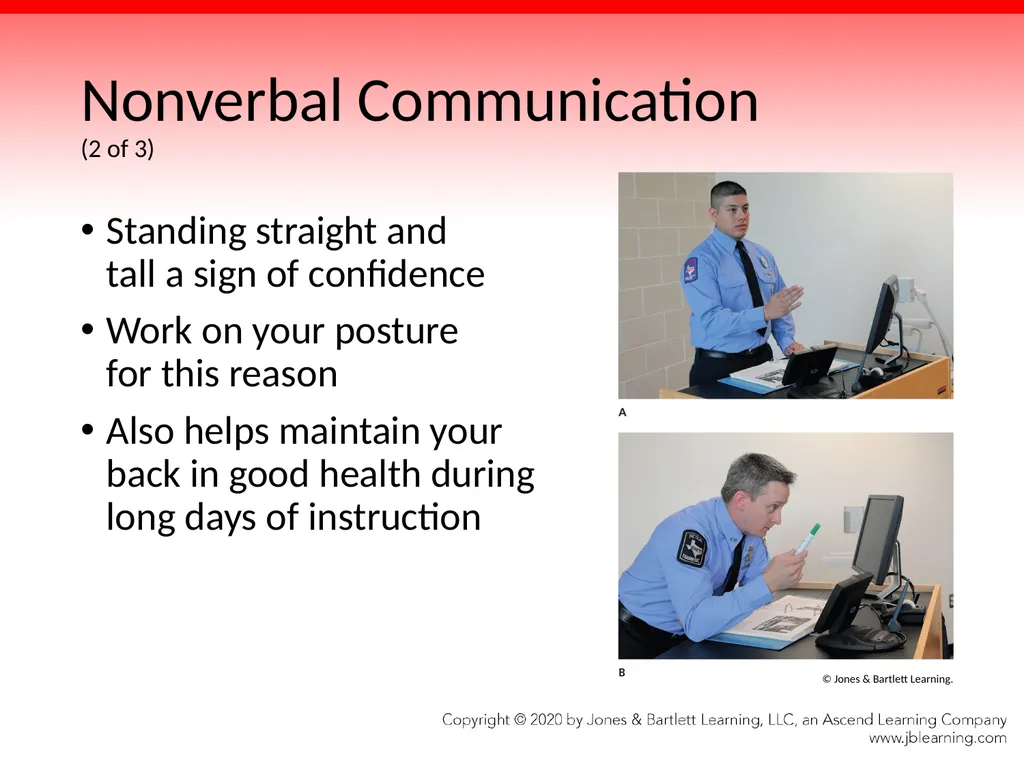
slide23. Nonverbal Communication (2 of 3) Standing straight and tall a sign of confidence
Work on your posture for this reason
Also helps maintain your back in good health during long days of instruction © Jones & Bartlett Learning.<br>
slide24. Nonverbal Communication (3 of 3) Hand gestures can express either aggression or enthusiasm.
Rapid hand movements or repeated movements of hands to the face can be signs of deception or uncertainty.<br>
slide25. Active and Passive Listening (1 of 4) Process of hearing and understanding communication sent and demonstrating that you are listening and have understood the message
Requires keeping mouth closed and ears wide open
Must hear the entire message<br>
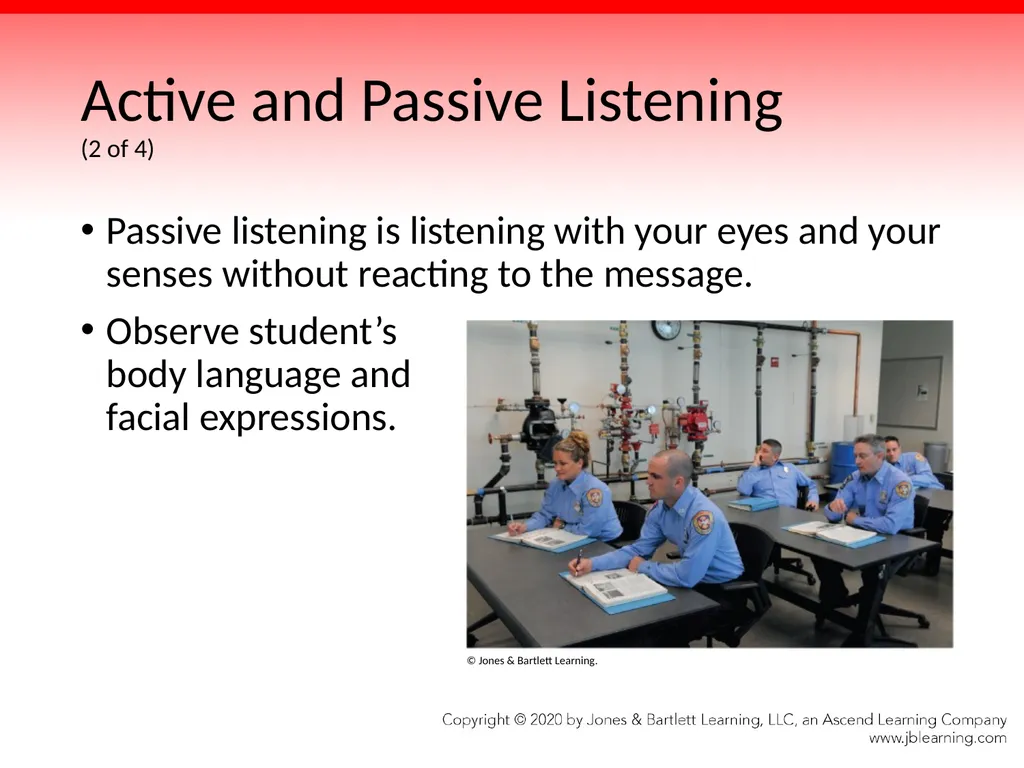
slide26. Active and Passive Listening (2 of 4) Passive listening is listening with your eyes and your senses without reacting to the message.
Observe student’s body language and facial expressions. © Jones & Bartlett Learning.<br>
slide27. Active and Passive Listening (3 of 4) Nervous movements can indicate misunderstanding or confusion.
Relaxed brow and alert eyes can indicate comprehension and interest.
Monitor what you are communicating nonverbally.
The best way to develop communication skills: Practice them.<br>
slide28. Active and Passive Listening (4 of 4) One practice method is to have another instructor sit through your presentation and evaluate you.
How you communicated the message
What nonverbal cues you gave
How your tone of voice affected the message
Another method is make a video of your presentation.
Watch the recording and look for nonverbal cues that do not match the message.
May be obvious at faster-than-normal speed
Close your eyes and listen<br>
slide29. Verbal Communication (1 of 6) Oral communication is more than just talking.
Many people talk, yet never actually communicate.
Great communicators, by contrast, use many tools to convey their message.
Many factors affect verbal communication.
Language
Tone of voice
Volume of speech<br>
slide30. Verbal Communication (2 of 6) Lowering or raising voice can emphasize a point
Loud, forceful tone = you are very serious
Softer voice = less threatening, student not on defensive
Bringing your voice to a loud crescendo and then making it softer can serve to emphasize your message<br>
slide31. Verbal Communication (3 of 6) Learning environment also a factor for voice volume
If instructing outside or in a noisy environment, volume of your voice may have to increase to project over ambient noise
Sometimes ambient noise is chattering students
Use volume to gain students’ attention and silence<br>
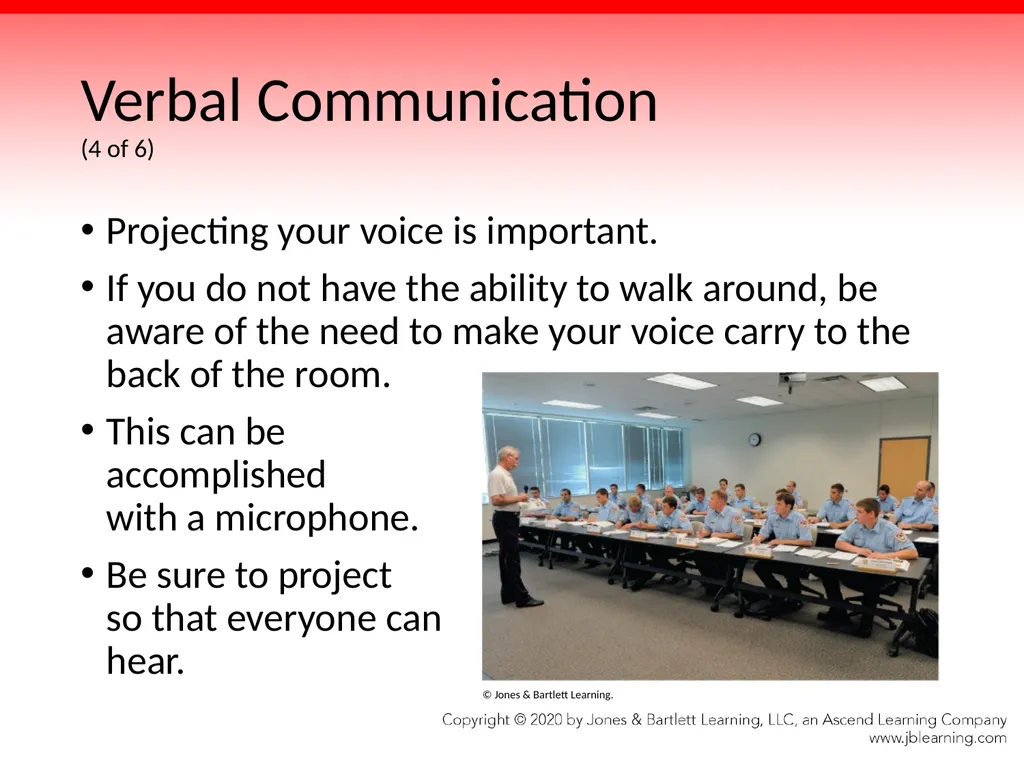
slide32. Verbal Communication (4 of 6) Projecting your voice is important.
If you do not have the ability to walk around, be aware of the need to make your voice carry to the back of the room.
This can be accomplished with a microphone.
Be sure to project so that everyone can hear. © Jones & Bartlett Learning.<br>
slide33. Verbal Communication (5 of 6) Enthusiasm breeds enthusiasm.
Focus on teaching the courses that fascinate you—will add passion to presentation.
For those topics not as exciting, research why the topic is important.
Dynamic use of voice is one of the most effective methods of holding students’ attention.
Practice until it becomes automatic.<br>
slide34. Verbal Communication (6 of 6) Be aware of students with any level of hearing impairment
May need to consider the following:
Body positioning so student able to see your face while speaking
Use of auxiliary device to assist student<br>
slide35. Language (1 of 6) Fire service has its own unique language.
Terminology can change from department to department and from region to region.
It is imperative to use terminology of department when discussing equipment, apparatus, or procedures.
Use words familiar to audience and explain new terms thoroughly.<br>
slide36. Language (2 of 6) Use of appropriate language is critical.
Avoid language that does not put you or your department in the best light.
Exercise restraint and caution when speaking.
You are held to a higher standard.
Never let your guard down.<br>
slide37. Language (3 of 6) Purpose of tone is to express emotion.
Tone should always be positive, while expressing passion of conviction.
If words say you believe in something but tone expresses apathy, students will hear apathy
Put personal feelings aside.
Use tone of voice to express the message properly.<br>
slide38. Language (4 of 6) While first instinct may be to communicate directly in students’ everyday language, it is inappropriate in the classroom.
Always take the high road.<br>
slide39. Language (5 of 6) Classroom may be simple (chairs and tables) or complex (state of the art multimedia)
Sometimes classroom is a multipurpose room with overhead project
Can also be the back of a fire engine or base of the training tower
Could also be a “dirty” classroom<br>
slide40. Language (6 of 6) Purpose of the classroom is to facilitate the learning process
Consequently, physical location less important than communication process
Even without a traditional classroom or audiovisual devices, good communication is the only thing necessary for education<br>
slide41. Audience Analysis (1 of 10) As a good instructor, you need to determine how your message needs to be communicated before deciding on the appropriate format for your presentation.
You also need to evaluate your audience to determine how they will best receive your message.<br>
slide42. Audience Analysis (2 of 10) At entry level, lecture usually most appropriate method
Because students at entry level have little experience, best to use informative lecture to communicate concepts and objectives
Need to pass information to the student in direct manner
Will be repetitive<br>
slide43. Audience Analysis (3 of 10) In speaking to more experienced fire fighters, the lecture is more persuasive in nature.
These students need to be convinced of the importance of the message.<br>
slide44. Audience Analysis (4 of 10) Another type of audience encountered is made up of experienced fire fighters and fire officers.
These students tend to require discussions rather than informative lectures.<br>
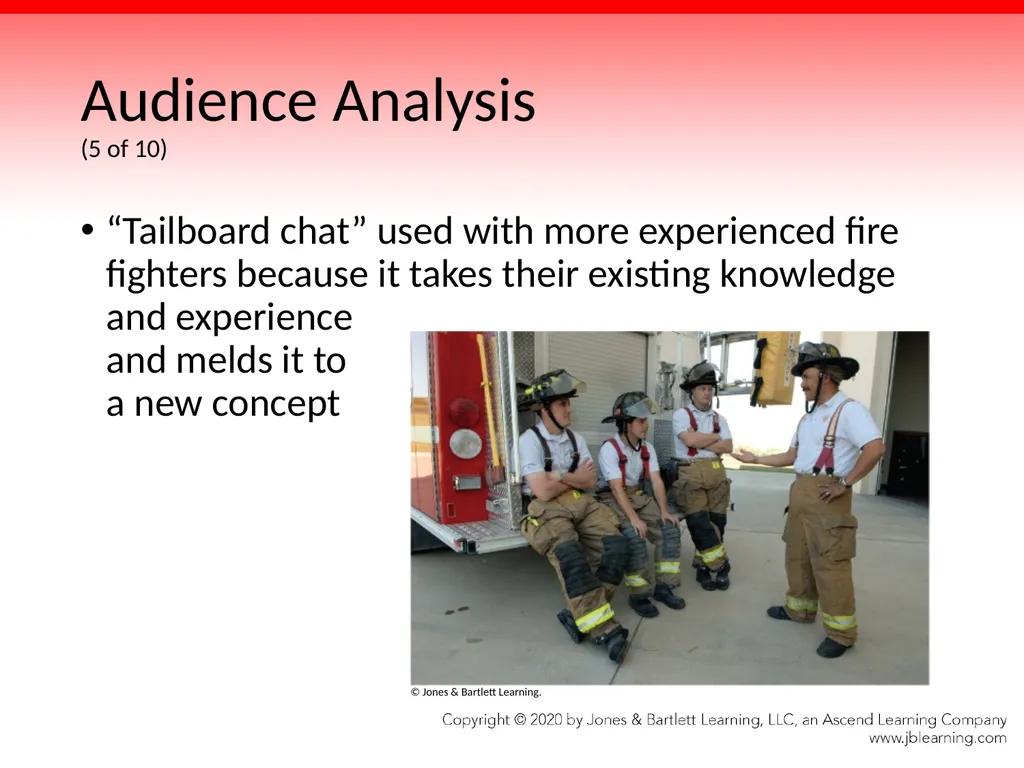
slide45. Audience Analysis (5 of 10) “Tailboard chat” used with more experienced fire fighters because it takes their existing knowledge and experience and melds it to a new concept © Jones & Bartlett Learning.<br>
slide46. Audience Analysis (6 of 10) By examining and reexamining the way we do things and by discussing experiences and options, new ideas and new ways of doing things are developed
Can be very exciting and rewarding
Sometimes referred to as facilitation<br>
slide47. Audience Analysis (7 of 10) Consider alternative communication methods
Role playing: be prepared for several potential responses from the student
Group exercises: exploits natural tendencies of fire fighters to work in groups
Imperative to listen to conversations
Steering discussion keeps focus
Solicit outcomes from each group<br>
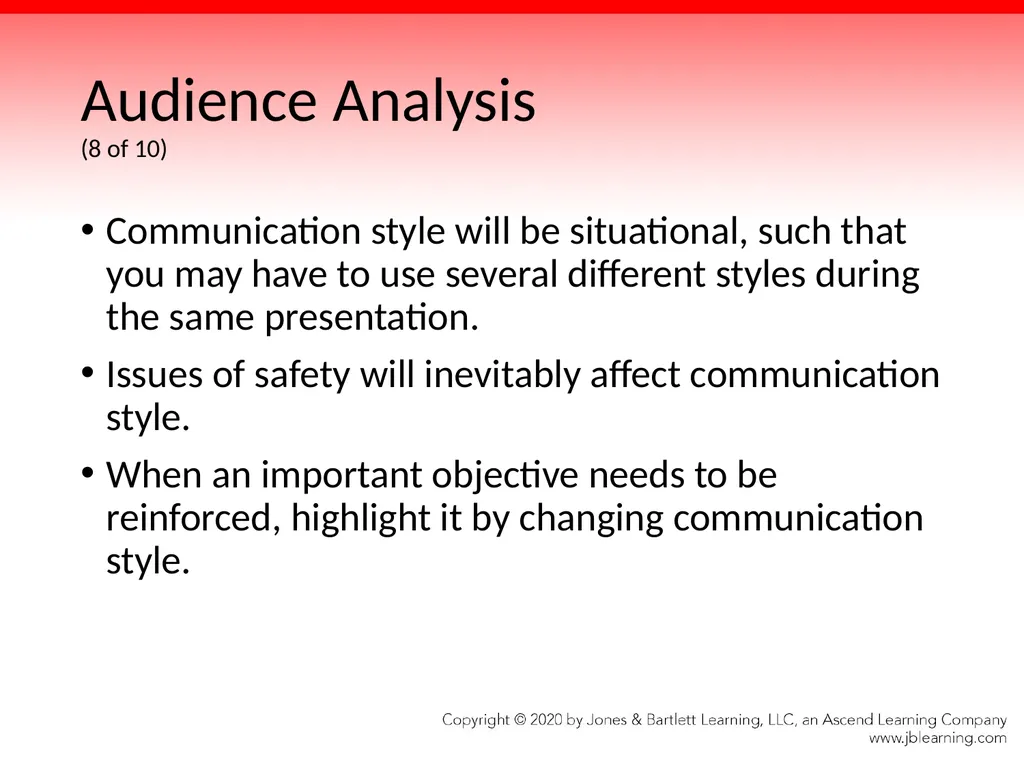
slide48. Audience Analysis (8 of 10) Communication style will be situational, such that you may have to use several different styles during the same presentation.
Issues of safety will inevitably affect communication style.
When an important objective needs to be reinforced, highlight it by changing communication style.<br>
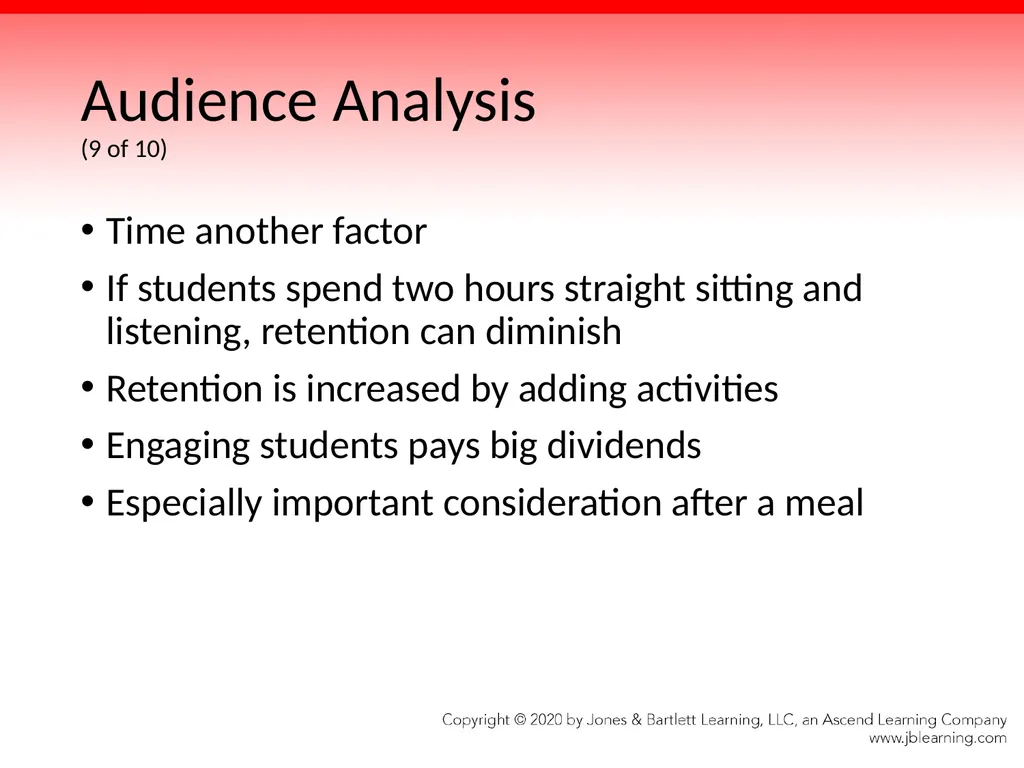
slide49. Audience Analysis (9 of 10) Time another factor
If students spend two hours straight sitting and listening, retention can diminish
Retention is increased by adding activities
Engaging students pays big dividends
Especially important consideration after a meal<br>
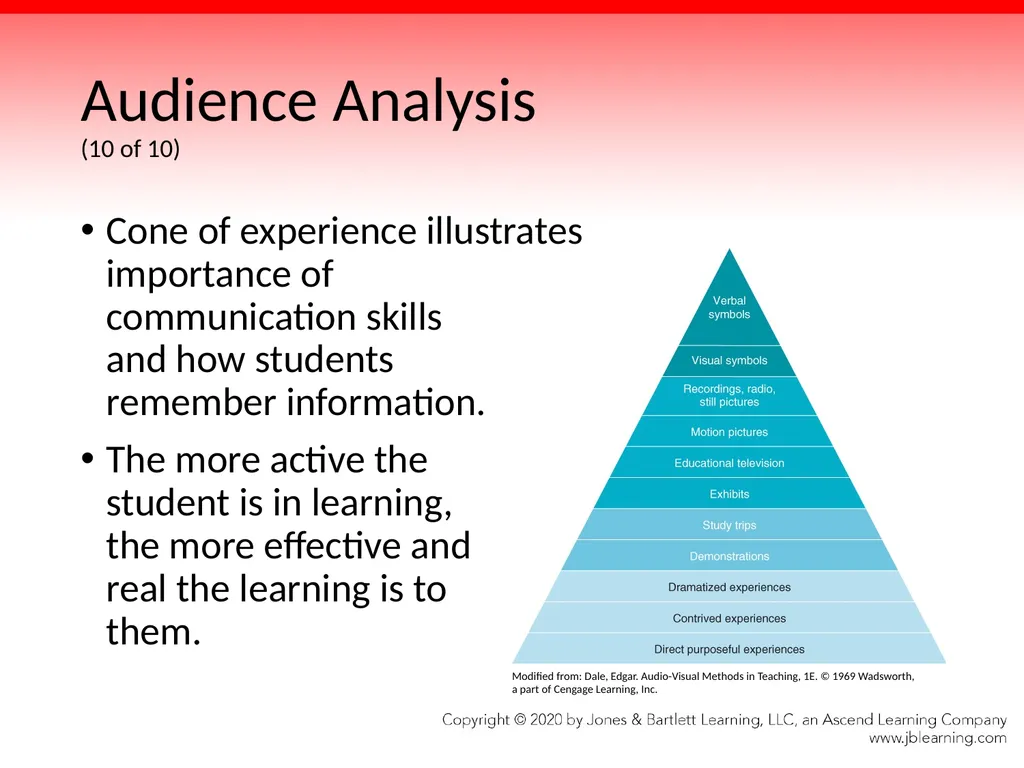
slide50. Audience Analysis (10 of 10) Cone of experience illustrates importance of communication skills and how students remember information.
The more active the student is in learning, the more effective and real the learning is to them. Modified from: Dale, Edgar. Audio-Visual Methods in Teaching, 1E. © 1969 Wadsworth, a part of Cengage Learning, Inc.<br>
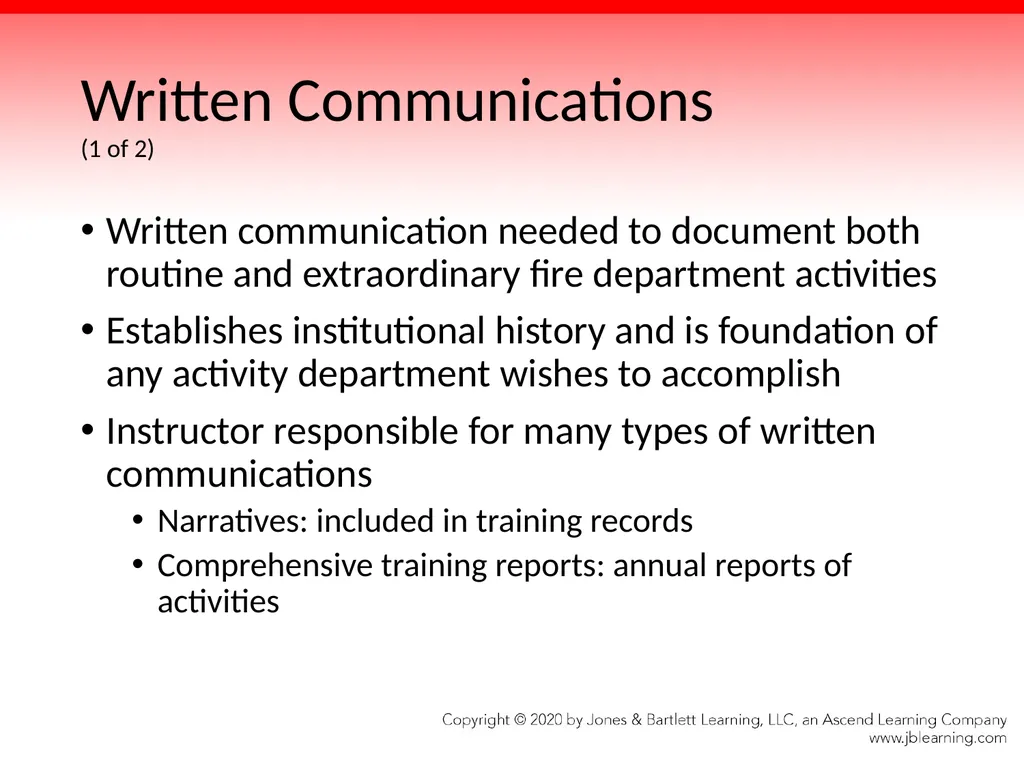
slide51. Written Communications (1 of 2) Written communication needed to document both routine and extraordinary fire department activities
Establishes institutional history and is foundation of any activity department wishes to accomplish
Instructor responsible for many types of written communications
Narratives: included in training records
Comprehensive training reports: annual reports of activities<br>
slide52. Written Communications (2 of 2) Although e-mail has replaced many formal written letters and other communications, a written communication serves as a permanent record of an event or happening.
Each agency should specify guidelines that outline which types of written documentation are necessary for specific occurrences.<br>
slide53. Reading Level (1 of 2) Most fire fighters required to have a high school education or a GED, so expectation is that all students can read and write
Most educational textbooks are written at reading level majority of fire fighters should understand
Most word processing programs can perform an evaluation of the document’s reading level based on the Flesch–Kincaid readability index<br>
slide54. Reading Level (2 of 2) Higher the Flesch–Kincaid number, lower the reading level
The index based on average number of words per sentence and number of syllables per 100 words
Be aware of length of sentences and complexity of words used
Always keep students’ reading levels in mind when writing<br>
slide55. Writing Format (1 of 2) In general, use a memo when writing to individuals within organization
Such a document designed for in-house communications only
Written communications intended for readers outside the organization should appear in letter format, using departmental letterhead, and should be signed by the sender<br>
slide56. Writing Format (2 of 2) Five Ws of writing: Who, What, Where, When, Why
By including these points, you will ensure that you address the information necessary for readers to understand your message properly. © Jones & Bartlett Learning.<br>
slide57. The Rules of Writing (1 of 3) Good, clear, concise writing critical to getting message across
Easy to improve writing
Follow rules of good writing in step-by-step fashion and practice 15 minutes each day, you can become an effective written communicator
Practice your writing skills on a regular basis
Involves writing and allowing fellow instructors to read your writing to ensure that the message is coming through<br>
slide58. The Rules of Writing (2 of 3) Rules of good writing begin with the paragraph
Begins with an introduction
Main body (frame) is support that holds everything together
Conclusion reviews what discussed and reinforces frame<br>
slide59. The Rules of Writing (3 of 3) To practice, consider writing a two- to three-paragraph summary after every class.
Once you have mastered the building of a paragraph, you are on your way to constructing a complete written structure.
The paragraph is basic building block.
All good writing has an introduction, a frame, and a conclusion.<br>
slide60. Style (1 of 2) Most writing done as fire fighter and instructor technical in nature
Sole objective is to convey information
Writing should not be boring or uninspiring, but should remain true to premise of imparting facts<br>
slide61. Style (2 of 2) Printed words hard to retract
Words can be construed in different ways; choose words carefully
Meaning of words can change based on geographical location and individual experiences
Know your audience before you begin to write
Goal is to clearly and properly convey message to every reader<br>
slide62. Informal Communications (1 of 3) Examples:
Internal memos
E-mails
Instant messages
Messages transmitted via mobile data terminal
Informal reports have short life and not archived as permanent records
Used primarily to record or transmit information not needed for reference<br>
slide63. Informal Communications (2 of 3) Be aware of the following:
Some agencies required to keep archived records of even informal records
Such communications may be subject to freedom of information requests
Some retained for a period of time and may become part of a formal investigation<br>
slide64. Informal Communications (3 of 3) In recent years, storage and recall of e-mails a topic of much discussion
Policies will vary from agency to agency, so know your department’s policy
Ignorance not a defense<br>
slide65. Formal Communications (1 of 6) Official fire department document printed on fire department letterhead
Usually intended for someone outside department
Signed by fire chief or designated officer
Subordinates often prepare and submit for administrative review
Department maintains permanent copy of all formal reports and official correspondence
Usually archived<br>
slide66. Formal Communications (2 of 6) Standard operating procedures (SOPs) are written organizational directives that establish specific operational or administrative methods to be followed routinely for performance of designated operations or actions.
Provide consistent response to incidents, actions, and tasks
Prime source for promotional exams and departmental training
Signed by fire chief
Widely distributed
Many departments conduct periodic review of SOPs
Changes must be approved
Should be referenced in training sessions<br>
slide67. Formal Communications (3 of 6) General orders are formal documents that address a specific subject, policy, condition, or situation.
Can be in effect for various time periods
Used to announce promotions or transfers
Copies should be available for reference<br>
slide68. Formal Communications (4 of 6) Announcements or communications share additional information with department members
Usually used to distribute short-term and nonessential information<br>
slide69. Formal Communications (5 of 6) Legal correspondence includes training records
Subpoena: legal order demanding all documentation on file pertaining to particular incident or person
Gathering documents can require extensive time/effort
Consult legal counsel
Fire fighter or officer who prepared a report may be called on to sign an affidavit or appear in court to testify information provided complete and accurate<br>
slide70. Formal Communications (6 of 6) Interrogatory: series of written questions asked by someone from an opposing party
Task of dealing with the interrogatory can become much more complex and embarrassing if the original documents are vague, incomplete, false, or missing<br>
slide71. Reports (1 of 3) Reports should be accurate and present the necessary information in an understandable format.
All reports should be proofread before being submitted.
Purpose of the report might be to:
Brief the reader
Provide a systematic analysis of an issue<br>
slide72. Reports (2 of 3) Some prepared on a regular schedule
Others in response to specific occurrences or requests
To create a useful report:
Understand specific information needed
Provide it in a manner easily interpreted<br>
slide73. Reports (3 of 3) Some presented orally; others electronically prepared
Most common form is verbal communication (face-to-face or via telephone/radio)
To be effective, transfer of information must be clear and concise, using terminology appropriate for receiver<br>
slide74. Monthly Activity and Training Reports (1 of 3) Documents company’s activity during preceding month
Typically include the following:
Number of emergency responses
Training activities
Inspections
Public education events
Station visits
Number of feet of hose used
Number of ladders deployed
Number of training hours completed
Members who receive certifications or attend classes
Training-related projects or meetings<br>
slide75. Monthly Activity and Training Reports (2 of 3) Should be documented in standard format
Reporting that does not involve personnel actions or supervisory responsibilities to subordinates often delegated
Officer still responsible for checking and signing report before submission<br>
slide76. Monthly Activity and Training Reports (3 of 3) Some agencies post a version of monthly reports on their public website.
Reports often include digital pictures of incidents and people involved.
Special events or unusual situations that occurred during the month might also be included.<br>
slide77. Infrequent and Special Reports (1 of 2) Usually require personal attention to ensure report’s information complete and concise
Includes the following:
Fire fighter injury report
Student complaints
Property damage or liability-event report
Vehicle accident or equipment damage report
New equipment or procedure evaluation
Suggestions to improve fire department operation
Response to a grievance or complaint
Fire fighter work improvement plans
Research report or recommendation<br>
slide78. Infrequent and Special Reports (2 of 2) Chronological statement of events is a detailed account of activities, such as a narrative report of the actions taken at an incident or accident.
Recommendation report is a document that suggests a particular action or decision.
Some reports include both a chronological and recommendation section.<br>
slide79. Writing a Decision Document (1 of 2) Goal of decision document is to provide enough information and persuasion so intended individual or body accepts recommendations
Includes recommendations for
Employee recognition or formal discipline
New or improved procedure
Adoption of a new device<br>
slide80. Writing a Decision Document (2 of 2) Usually includes the following elements:
Statement of problem or issue: one or two sentences
Background: how this became a problem
Restrictions: laws and ordinances, budget or staff restrictions
Options: provide more than one
Recommendation: explain best option, impact should be quantified
Next action: clearly state what action needed to implement recommendation<br>
slide81. Lesson Summary (1 of 5) Communication is the most important element of the learning process.
The basic communication process consists of five elements: the sender, the message, the medium, the receiver, and feedback.<br>
slide82. Lesson Summary (2 of 5) Be aware of the message that you are sending to students nonverbally through your body language.
Your communication style must be adapted to match the situation. You may have to use several different styles during a presentation.<br>
slide83. Lesson Summary (3 of 5) As an instructor, you must be well versed in both active and passive listening.
Many factors, including language and tone, affect verbal communication.<br>
slide84. Lesson Summary (4 of 5) Written communication is needed to document both routine and extraordinary fire department activities. It establishes institutional history and serves as the foundation of any activity that the fire department wishes to accomplish.
The most common form of reporting is verbal communication from one individual to another, either face-to-face or via a telephone or radio. To be effective, the transfer of information must be clear and concise, using terminology that is appropriate for the receiver.<br>
slide85. Lesson Summary (5 of 5) Reports should be accurate and present the necessary information in an understandable format. The purpose of the report might be to brief the reader, or it might provide a systematic analysis of an issue.
Most presentations for an instructor involve informative speeches, or lectures. As a good instructor, you must determine how your message needs to be communicated before selecting the appropriate format for your presentation.<br>
slide2. Objectives Identify and describe the elements of the communication process.
Compare and describe the different types and styles of communication.
Describe communication.<br>
slide3. Introduction (1 of 5) Communication most important element of the learning process
Communication in and of itself is a process
Must master to be effective fire and emergency services instructor
Even if environment less than perfect, strong communication skills will overcome<br>
slide4. Introduction (2 of 5) Effective communication skills take the learning process to even greater heights by:
Encouraging effort
Modifying attitudes
Stimulating thinking<br>
slide5. Introduction (3 of 5) Students have different learning styles and use different cues.
Knowing how to access diverse cues and take advantage of them will make you more effective.
A classroom encompasses much more than four walls.
Back of an engine after an emergency call
Burn building
Kitchen table at the station<br>
slide6. Introduction (4 of 5) No matter the environment, end objective the same: the student learns
Student safety and ability to do the job improve
Instructor must have excellent communication skills
Must be able to read the students’ comprehension of training through verbal and nonverbal cues<br>
slide7. Introduction (5 of 5) Although fire service steeped in tradition, means of communication used changed dramatically over the years
Even with today’s many avenues for the rapid transmission of messages, the message itself remains the critical piece of the communication puzzle<br>
slide8. The Basic Communication Process (1 of 2) Basic communication process consists of five elements.
Surrounding these elements is the environment. © Jones & Bartlett Learning.<br>
slide9. The Basic Communication Process (2 of 2) Five elements act like links of a chain.
To function properly, all links must be attached to one another.
If any one of the links breaks, then the chain falls apart.<br>
slide10. The Sender Sender is you, the instructor
As sender, must know which style of communication to use
Choice of style of communication based on many factors<br>
slide11. The Message Next link is the message
What are you trying to communicate to your students?
Must encode point of the lesson and transmit it
May sound simple, but is most complex part
For students to understand the message, they must:
Hear it
Decode it or put it into their own terms
Ensure their terms match your terms<br>
slide12. The Medium How the message is transmitted as important as the message itself
Means of conveying a message constitutes the medium
Tone of voice
Volume
Speed of speech<br>
slide13. The Receiver In the learning environment, this link is the student.
Receiver plays important, active role in the communication chain.
Student needs to listen actively and maintain focus to decode.
At the start of each training session, remind students of their role in the communication chain and continue to keep them engaged throughout the learning process.<br>
slide14. The Receiver Fulfilling this role means leaving all distractions at the door and focusing solely on the information.
Student’s previous experience and knowledge base play major role in determining ability to receive message.
Adapt style and presentation to students.
If you “talk down” to students or if the presentation goes over their heads, the message is not in a form that they can receive.<br>
slide15. Feedback (1 of 3) Link completes the communication process
Often considered the most important step
Allows sender to determine whether receiver understood the message
Can be verbal or nonverbal
Orders given over the radio
Blank stares from students<br>
slide16. Feedback (2 of 3) Collectively asking a classroom of students if they understand is not the best method of determining whether the message was properly received
No student wants to admit he or she does not understand.
Asking to describe the message in their own words more effective
Can depend on the dynamics of the class
If description is incorrect, gently explain it’s not quite right and ask for others to offer information<br>
slide17. Feedback (3 of 3) Face-to-face conversation is the most effective means of conveying information.
Verbal communication must be conducted over radio or telephone, supplementary expressions sacrificed.
Another type of feedback may be apparent when grading a research paper.
Writing notes in the margins of the paper allows the student to review and process your comments carefully.<br>
slide18. The Environment (1 of 4) Surrounding all of the links of the communication chain is the environment
Includes physical, social, and environmental factors
Can dramatically affect communication process
Physical environment is room or area in which communication takes place
Could be a classroom, the training ground, or even cyberspace<br>
slide19. The Environment (2 of 4) Physical environment can either inhibit or enhance the learning process
Make sure all students can see and hear you<br>
slide20. The Environment (3 of 4) Social environment is the context in which communication takes place
If the class not enthusiastic about the message, the message will have limited effect
Mandatory training usually has this effect
Must make sure students want or need to receive message—art of motivation
Asking why is part of the learning process<br>
slide21. The Environment (4 of 4) Environmental factors
Receivers must feel that needs are met.
Environment that is physically difficult to tolerate is distracting.
Lessons that continue too long may also cause discomfort and negatively impact the learning process.<br>
slide22. Nonverbal Communication (1 of 3) Communication is 10% what you say and 90% how you say it
Nonverbal communication difficult skill to control because you generally do not watch yourself in the mirror all day
Includes:
Tone of voice
Eye movement
Posture
Hand gestures
Facial expressions<br>
slide23. Nonverbal Communication (2 of 3) Standing straight and tall a sign of confidence
Work on your posture for this reason
Also helps maintain your back in good health during long days of instruction © Jones & Bartlett Learning.<br>
slide24. Nonverbal Communication (3 of 3) Hand gestures can express either aggression or enthusiasm.
Rapid hand movements or repeated movements of hands to the face can be signs of deception or uncertainty.<br>
slide25. Active and Passive Listening (1 of 4) Process of hearing and understanding communication sent and demonstrating that you are listening and have understood the message
Requires keeping mouth closed and ears wide open
Must hear the entire message<br>
slide26. Active and Passive Listening (2 of 4) Passive listening is listening with your eyes and your senses without reacting to the message.
Observe student’s body language and facial expressions. © Jones & Bartlett Learning.<br>
slide27. Active and Passive Listening (3 of 4) Nervous movements can indicate misunderstanding or confusion.
Relaxed brow and alert eyes can indicate comprehension and interest.
Monitor what you are communicating nonverbally.
The best way to develop communication skills: Practice them.<br>
slide28. Active and Passive Listening (4 of 4) One practice method is to have another instructor sit through your presentation and evaluate you.
How you communicated the message
What nonverbal cues you gave
How your tone of voice affected the message
Another method is make a video of your presentation.
Watch the recording and look for nonverbal cues that do not match the message.
May be obvious at faster-than-normal speed
Close your eyes and listen<br>
slide29. Verbal Communication (1 of 6) Oral communication is more than just talking.
Many people talk, yet never actually communicate.
Great communicators, by contrast, use many tools to convey their message.
Many factors affect verbal communication.
Language
Tone of voice
Volume of speech<br>
slide30. Verbal Communication (2 of 6) Lowering or raising voice can emphasize a point
Loud, forceful tone = you are very serious
Softer voice = less threatening, student not on defensive
Bringing your voice to a loud crescendo and then making it softer can serve to emphasize your message<br>
slide31. Verbal Communication (3 of 6) Learning environment also a factor for voice volume
If instructing outside or in a noisy environment, volume of your voice may have to increase to project over ambient noise
Sometimes ambient noise is chattering students
Use volume to gain students’ attention and silence<br>
slide32. Verbal Communication (4 of 6) Projecting your voice is important.
If you do not have the ability to walk around, be aware of the need to make your voice carry to the back of the room.
This can be accomplished with a microphone.
Be sure to project so that everyone can hear. © Jones & Bartlett Learning.<br>
slide33. Verbal Communication (5 of 6) Enthusiasm breeds enthusiasm.
Focus on teaching the courses that fascinate you—will add passion to presentation.
For those topics not as exciting, research why the topic is important.
Dynamic use of voice is one of the most effective methods of holding students’ attention.
Practice until it becomes automatic.<br>
slide34. Verbal Communication (6 of 6) Be aware of students with any level of hearing impairment
May need to consider the following:
Body positioning so student able to see your face while speaking
Use of auxiliary device to assist student<br>
slide35. Language (1 of 6) Fire service has its own unique language.
Terminology can change from department to department and from region to region.
It is imperative to use terminology of department when discussing equipment, apparatus, or procedures.
Use words familiar to audience and explain new terms thoroughly.<br>
slide36. Language (2 of 6) Use of appropriate language is critical.
Avoid language that does not put you or your department in the best light.
Exercise restraint and caution when speaking.
You are held to a higher standard.
Never let your guard down.<br>
slide37. Language (3 of 6) Purpose of tone is to express emotion.
Tone should always be positive, while expressing passion of conviction.
If words say you believe in something but tone expresses apathy, students will hear apathy
Put personal feelings aside.
Use tone of voice to express the message properly.<br>
slide38. Language (4 of 6) While first instinct may be to communicate directly in students’ everyday language, it is inappropriate in the classroom.
Always take the high road.<br>
slide39. Language (5 of 6) Classroom may be simple (chairs and tables) or complex (state of the art multimedia)
Sometimes classroom is a multipurpose room with overhead project
Can also be the back of a fire engine or base of the training tower
Could also be a “dirty” classroom<br>
slide40. Language (6 of 6) Purpose of the classroom is to facilitate the learning process
Consequently, physical location less important than communication process
Even without a traditional classroom or audiovisual devices, good communication is the only thing necessary for education<br>
slide41. Audience Analysis (1 of 10) As a good instructor, you need to determine how your message needs to be communicated before deciding on the appropriate format for your presentation.
You also need to evaluate your audience to determine how they will best receive your message.<br>
slide42. Audience Analysis (2 of 10) At entry level, lecture usually most appropriate method
Because students at entry level have little experience, best to use informative lecture to communicate concepts and objectives
Need to pass information to the student in direct manner
Will be repetitive<br>
slide43. Audience Analysis (3 of 10) In speaking to more experienced fire fighters, the lecture is more persuasive in nature.
These students need to be convinced of the importance of the message.<br>
slide44. Audience Analysis (4 of 10) Another type of audience encountered is made up of experienced fire fighters and fire officers.
These students tend to require discussions rather than informative lectures.<br>
slide45. Audience Analysis (5 of 10) “Tailboard chat” used with more experienced fire fighters because it takes their existing knowledge and experience and melds it to a new concept © Jones & Bartlett Learning.<br>
slide46. Audience Analysis (6 of 10) By examining and reexamining the way we do things and by discussing experiences and options, new ideas and new ways of doing things are developed
Can be very exciting and rewarding
Sometimes referred to as facilitation<br>
slide47. Audience Analysis (7 of 10) Consider alternative communication methods
Role playing: be prepared for several potential responses from the student
Group exercises: exploits natural tendencies of fire fighters to work in groups
Imperative to listen to conversations
Steering discussion keeps focus
Solicit outcomes from each group<br>
slide48. Audience Analysis (8 of 10) Communication style will be situational, such that you may have to use several different styles during the same presentation.
Issues of safety will inevitably affect communication style.
When an important objective needs to be reinforced, highlight it by changing communication style.<br>
slide49. Audience Analysis (9 of 10) Time another factor
If students spend two hours straight sitting and listening, retention can diminish
Retention is increased by adding activities
Engaging students pays big dividends
Especially important consideration after a meal<br>
slide50. Audience Analysis (10 of 10) Cone of experience illustrates importance of communication skills and how students remember information.
The more active the student is in learning, the more effective and real the learning is to them. Modified from: Dale, Edgar. Audio-Visual Methods in Teaching, 1E. © 1969 Wadsworth, a part of Cengage Learning, Inc.<br>
slide51. Written Communications (1 of 2) Written communication needed to document both routine and extraordinary fire department activities
Establishes institutional history and is foundation of any activity department wishes to accomplish
Instructor responsible for many types of written communications
Narratives: included in training records
Comprehensive training reports: annual reports of activities<br>
slide52. Written Communications (2 of 2) Although e-mail has replaced many formal written letters and other communications, a written communication serves as a permanent record of an event or happening.
Each agency should specify guidelines that outline which types of written documentation are necessary for specific occurrences.<br>
slide53. Reading Level (1 of 2) Most fire fighters required to have a high school education or a GED, so expectation is that all students can read and write
Most educational textbooks are written at reading level majority of fire fighters should understand
Most word processing programs can perform an evaluation of the document’s reading level based on the Flesch–Kincaid readability index<br>
slide54. Reading Level (2 of 2) Higher the Flesch–Kincaid number, lower the reading level
The index based on average number of words per sentence and number of syllables per 100 words
Be aware of length of sentences and complexity of words used
Always keep students’ reading levels in mind when writing<br>
slide55. Writing Format (1 of 2) In general, use a memo when writing to individuals within organization
Such a document designed for in-house communications only
Written communications intended for readers outside the organization should appear in letter format, using departmental letterhead, and should be signed by the sender<br>
slide56. Writing Format (2 of 2) Five Ws of writing: Who, What, Where, When, Why
By including these points, you will ensure that you address the information necessary for readers to understand your message properly. © Jones & Bartlett Learning.<br>
slide57. The Rules of Writing (1 of 3) Good, clear, concise writing critical to getting message across
Easy to improve writing
Follow rules of good writing in step-by-step fashion and practice 15 minutes each day, you can become an effective written communicator
Practice your writing skills on a regular basis
Involves writing and allowing fellow instructors to read your writing to ensure that the message is coming through<br>
slide58. The Rules of Writing (2 of 3) Rules of good writing begin with the paragraph
Begins with an introduction
Main body (frame) is support that holds everything together
Conclusion reviews what discussed and reinforces frame<br>
slide59. The Rules of Writing (3 of 3) To practice, consider writing a two- to three-paragraph summary after every class.
Once you have mastered the building of a paragraph, you are on your way to constructing a complete written structure.
The paragraph is basic building block.
All good writing has an introduction, a frame, and a conclusion.<br>
slide60. Style (1 of 2) Most writing done as fire fighter and instructor technical in nature
Sole objective is to convey information
Writing should not be boring or uninspiring, but should remain true to premise of imparting facts<br>
slide61. Style (2 of 2) Printed words hard to retract
Words can be construed in different ways; choose words carefully
Meaning of words can change based on geographical location and individual experiences
Know your audience before you begin to write
Goal is to clearly and properly convey message to every reader<br>
slide62. Informal Communications (1 of 3) Examples:
Internal memos
E-mails
Instant messages
Messages transmitted via mobile data terminal
Informal reports have short life and not archived as permanent records
Used primarily to record or transmit information not needed for reference<br>
slide63. Informal Communications (2 of 3) Be aware of the following:
Some agencies required to keep archived records of even informal records
Such communications may be subject to freedom of information requests
Some retained for a period of time and may become part of a formal investigation<br>
slide64. Informal Communications (3 of 3) In recent years, storage and recall of e-mails a topic of much discussion
Policies will vary from agency to agency, so know your department’s policy
Ignorance not a defense<br>
slide65. Formal Communications (1 of 6) Official fire department document printed on fire department letterhead
Usually intended for someone outside department
Signed by fire chief or designated officer
Subordinates often prepare and submit for administrative review
Department maintains permanent copy of all formal reports and official correspondence
Usually archived<br>
slide66. Formal Communications (2 of 6) Standard operating procedures (SOPs) are written organizational directives that establish specific operational or administrative methods to be followed routinely for performance of designated operations or actions.
Provide consistent response to incidents, actions, and tasks
Prime source for promotional exams and departmental training
Signed by fire chief
Widely distributed
Many departments conduct periodic review of SOPs
Changes must be approved
Should be referenced in training sessions<br>
slide67. Formal Communications (3 of 6) General orders are formal documents that address a specific subject, policy, condition, or situation.
Can be in effect for various time periods
Used to announce promotions or transfers
Copies should be available for reference<br>
slide68. Formal Communications (4 of 6) Announcements or communications share additional information with department members
Usually used to distribute short-term and nonessential information<br>
slide69. Formal Communications (5 of 6) Legal correspondence includes training records
Subpoena: legal order demanding all documentation on file pertaining to particular incident or person
Gathering documents can require extensive time/effort
Consult legal counsel
Fire fighter or officer who prepared a report may be called on to sign an affidavit or appear in court to testify information provided complete and accurate<br>
slide70. Formal Communications (6 of 6) Interrogatory: series of written questions asked by someone from an opposing party
Task of dealing with the interrogatory can become much more complex and embarrassing if the original documents are vague, incomplete, false, or missing<br>
slide71. Reports (1 of 3) Reports should be accurate and present the necessary information in an understandable format.
All reports should be proofread before being submitted.
Purpose of the report might be to:
Brief the reader
Provide a systematic analysis of an issue<br>
slide72. Reports (2 of 3) Some prepared on a regular schedule
Others in response to specific occurrences or requests
To create a useful report:
Understand specific information needed
Provide it in a manner easily interpreted<br>
slide73. Reports (3 of 3) Some presented orally; others electronically prepared
Most common form is verbal communication (face-to-face or via telephone/radio)
To be effective, transfer of information must be clear and concise, using terminology appropriate for receiver<br>
slide74. Monthly Activity and Training Reports (1 of 3) Documents company’s activity during preceding month
Typically include the following:
Number of emergency responses
Training activities
Inspections
Public education events
Station visits
Number of feet of hose used
Number of ladders deployed
Number of training hours completed
Members who receive certifications or attend classes
Training-related projects or meetings<br>
slide75. Monthly Activity and Training Reports (2 of 3) Should be documented in standard format
Reporting that does not involve personnel actions or supervisory responsibilities to subordinates often delegated
Officer still responsible for checking and signing report before submission<br>
slide76. Monthly Activity and Training Reports (3 of 3) Some agencies post a version of monthly reports on their public website.
Reports often include digital pictures of incidents and people involved.
Special events or unusual situations that occurred during the month might also be included.<br>
slide77. Infrequent and Special Reports (1 of 2) Usually require personal attention to ensure report’s information complete and concise
Includes the following:
Fire fighter injury report
Student complaints
Property damage or liability-event report
Vehicle accident or equipment damage report
New equipment or procedure evaluation
Suggestions to improve fire department operation
Response to a grievance or complaint
Fire fighter work improvement plans
Research report or recommendation<br>
slide78. Infrequent and Special Reports (2 of 2) Chronological statement of events is a detailed account of activities, such as a narrative report of the actions taken at an incident or accident.
Recommendation report is a document that suggests a particular action or decision.
Some reports include both a chronological and recommendation section.<br>
slide79. Writing a Decision Document (1 of 2) Goal of decision document is to provide enough information and persuasion so intended individual or body accepts recommendations
Includes recommendations for
Employee recognition or formal discipline
New or improved procedure
Adoption of a new device<br>
slide80. Writing a Decision Document (2 of 2) Usually includes the following elements:
Statement of problem or issue: one or two sentences
Background: how this became a problem
Restrictions: laws and ordinances, budget or staff restrictions
Options: provide more than one
Recommendation: explain best option, impact should be quantified
Next action: clearly state what action needed to implement recommendation<br>
slide81. Lesson Summary (1 of 5) Communication is the most important element of the learning process.
The basic communication process consists of five elements: the sender, the message, the medium, the receiver, and feedback.<br>
slide82. Lesson Summary (2 of 5) Be aware of the message that you are sending to students nonverbally through your body language.
Your communication style must be adapted to match the situation. You may have to use several different styles during a presentation.<br>
slide83. Lesson Summary (3 of 5) As an instructor, you must be well versed in both active and passive listening.
Many factors, including language and tone, affect verbal communication.<br>
slide84. Lesson Summary (4 of 5) Written communication is needed to document both routine and extraordinary fire department activities. It establishes institutional history and serves as the foundation of any activity that the fire department wishes to accomplish.
The most common form of reporting is verbal communication from one individual to another, either face-to-face or via a telephone or radio. To be effective, the transfer of information must be clear and concise, using terminology that is appropriate for the receiver.<br>
slide85. Lesson Summary (5 of 5) Reports should be accurate and present the necessary information in an understandable format. The purpose of the report might be to brief the reader, or it might provide a systematic analysis of an issue.
Most presentations for an instructor involve informative speeches, or lectures. As a good instructor, you must determine how your message needs to be communicated before selecting the appropriate format for your presentation.<br>