
Chapter 7 Social Studies and Dramatic Play
CB
Published · 48 slides · 0 views
1 / 1
Description
Chapter 7 Social Studies and Dramatic Play Childrens everyday experiences are the foundation of their social studies learning. Dramatic Play can help children grow in social understanding and cooperation (Diener, 2010) 2017 Cengage
Related Topics
Share
Embed code
Download this presentation From Below
"Chapter 7 Social Studies and Dramatic Play" is the property of its rightful owner. Permission is granted to download and print the materials on this website for personal, non-commercial use only, and to display it on your personal computer provided you do not modify the materials and that you retain all copyright notices contained in the materials. By downloading content from our website, you accept the terms of this agreement.
Presentation Transcript
01
Chapter 7
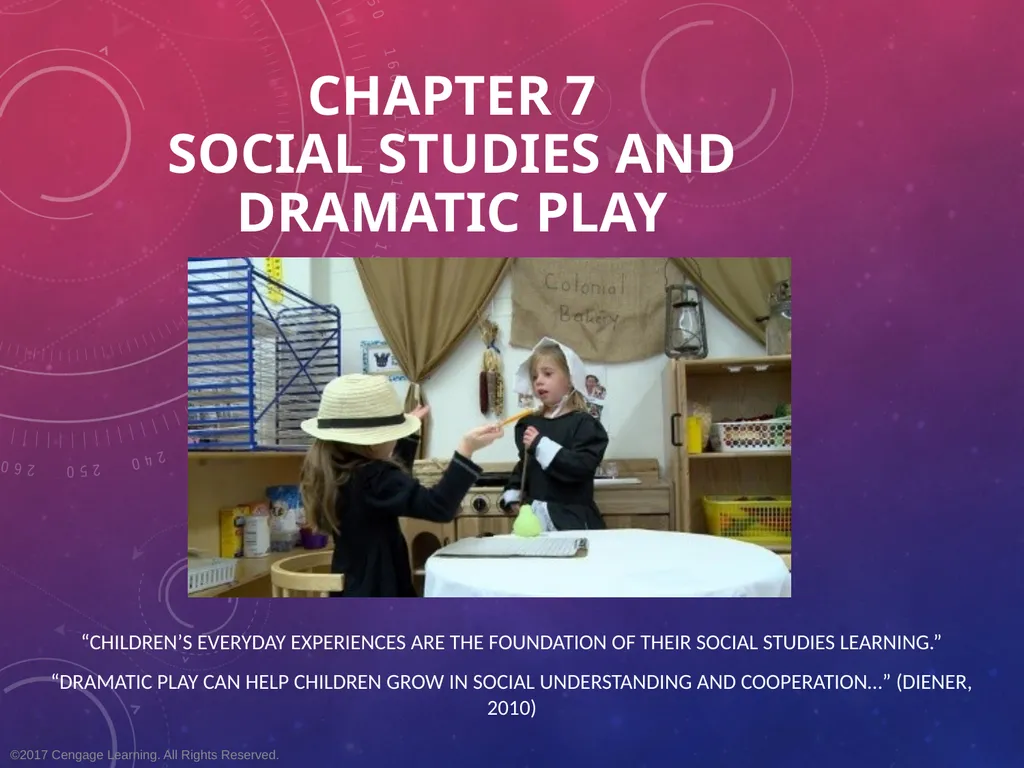
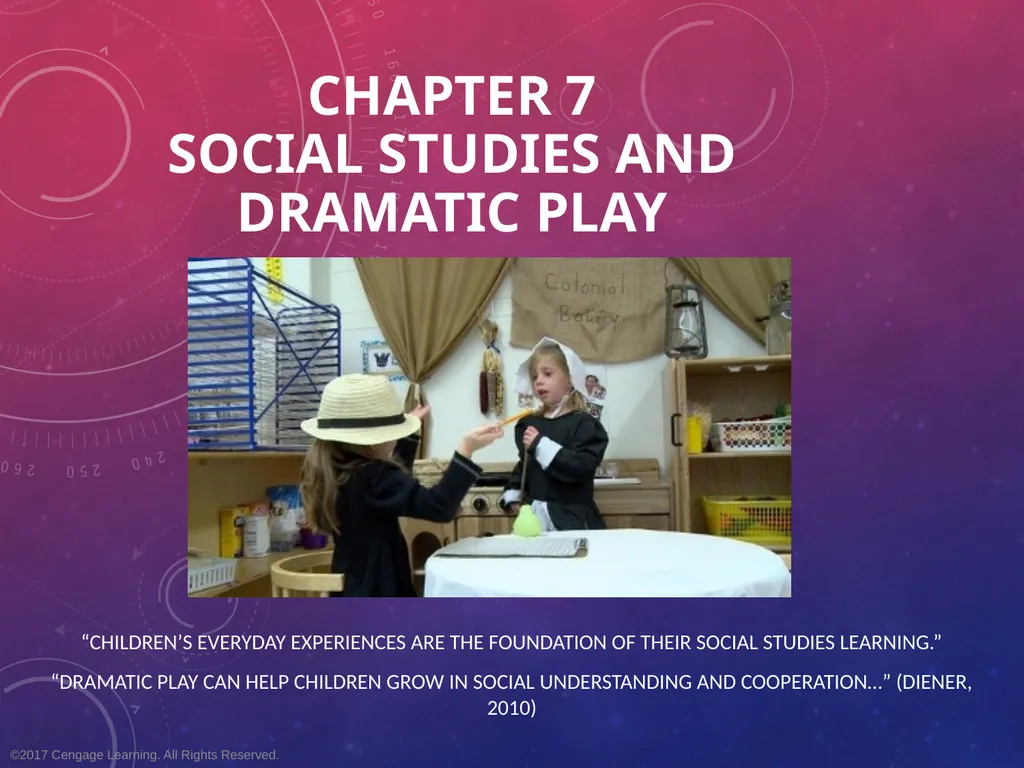
Social Studies and Dramatic Play “Children’s everyday experiences are the foundation of their social studies learning.”
“Dramatic Play can help children grow in social understanding and cooperation…” (Diener, 2010) ©2017 Cengage Learning. All Rights Reserved.<br>
“Dramatic Play can help children grow in social understanding and cooperation…” (Diener, 2010) ©2017 Cengage Learning. All Rights Reserved.<br>
02
Student learning Outcomes Define and give examples for key terms related to social studies and dramatic play development for children.
Discuss social studies and dramatic play development in young children and relate stages of child development to social studies and dramatic play development.
Evaluate various components of planning and preparation of social studies and dramatic play environments.
Create social studies and dramatic play activities appropriate for young children.
Discuss various ways to use technology in a social studies and dramatic play environment.
Distinguish ways to incorporate diversity into social studies and dramatic play environments. ©2017 Cengage Learning. All Rights Reserved.<br>
Discuss social studies and dramatic play development in young children and relate stages of child development to social studies and dramatic play development.
Evaluate various components of planning and preparation of social studies and dramatic play environments.
Create social studies and dramatic play activities appropriate for young children.
Discuss various ways to use technology in a social studies and dramatic play environment.
Distinguish ways to incorporate diversity into social studies and dramatic play environments. ©2017 Cengage Learning. All Rights Reserved.<br>
03
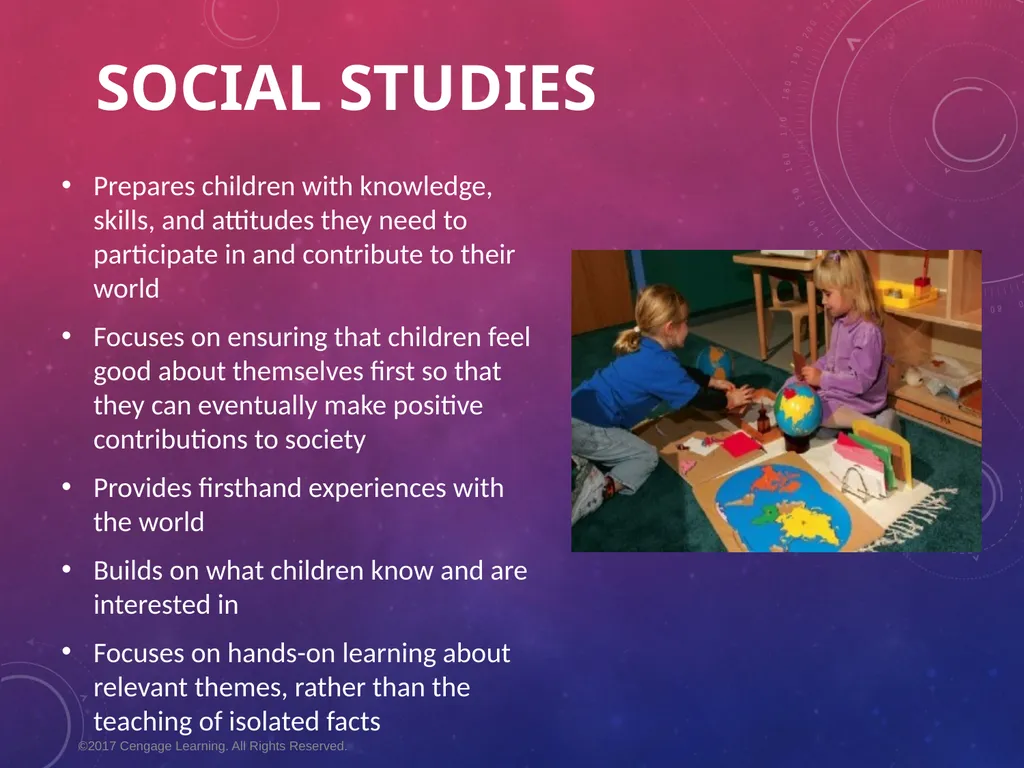
Social Studies Prepares children with knowledge, skills, and attitudes they need to participate in and contribute to their world
Focuses on ensuring that children feel good about themselves first so that they can eventually make positive contributions to society
Provides firsthand experiences with the world
Builds on what children know and are interested in
Focuses on hands-on learning about relevant themes, rather than the teaching of isolated facts ©2017 Cengage Learning. All Rights Reserved.<br>
Focuses on ensuring that children feel good about themselves first so that they can eventually make positive contributions to society
Provides firsthand experiences with the world
Builds on what children know and are interested in
Focuses on hands-on learning about relevant themes, rather than the teaching of isolated facts ©2017 Cengage Learning. All Rights Reserved.<br>
04
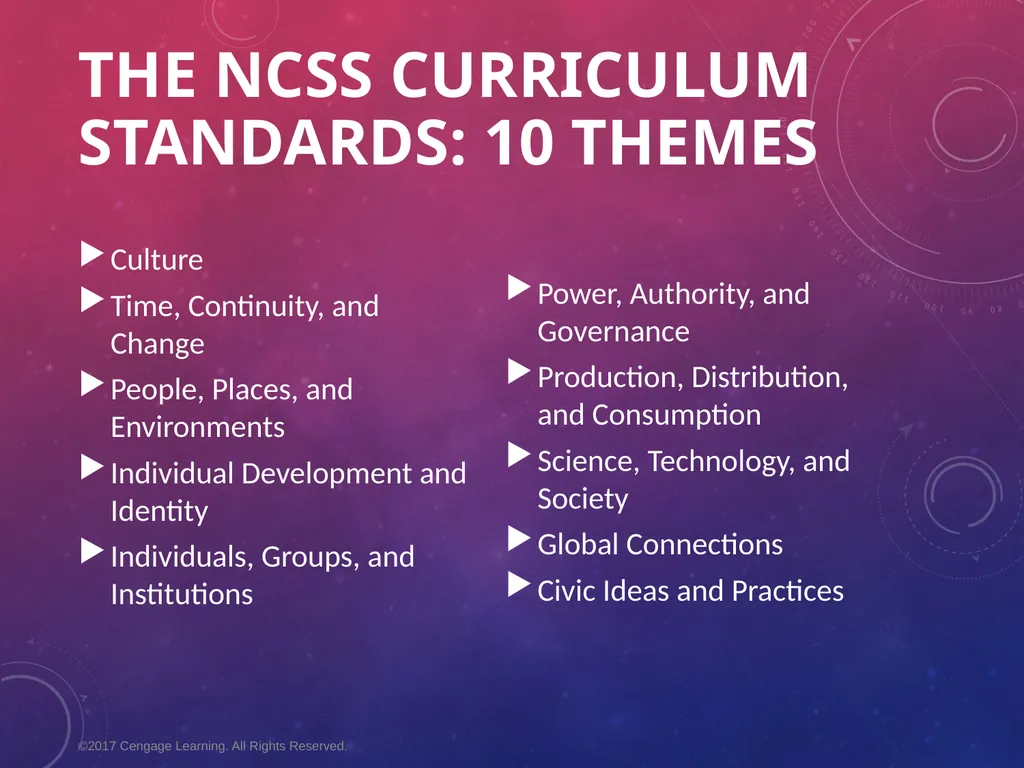
The NCSS Curriculum Standards: 10 Themes Culture
Time, Continuity, and Change
People, Places, and Environments
Individual Development and Identity
Individuals, Groups, and Institutions Power, Authority, and Governance
Production, Distribution, and Consumption
Science, Technology, and Society
Global Connections
Civic Ideas and Practices ©2017 Cengage Learning. All Rights Reserved.<br>
Time, Continuity, and Change
People, Places, and Environments
Individual Development and Identity
Individuals, Groups, and Institutions Power, Authority, and Governance
Production, Distribution, and Consumption
Science, Technology, and Society
Global Connections
Civic Ideas and Practices ©2017 Cengage Learning. All Rights Reserved.<br>
05
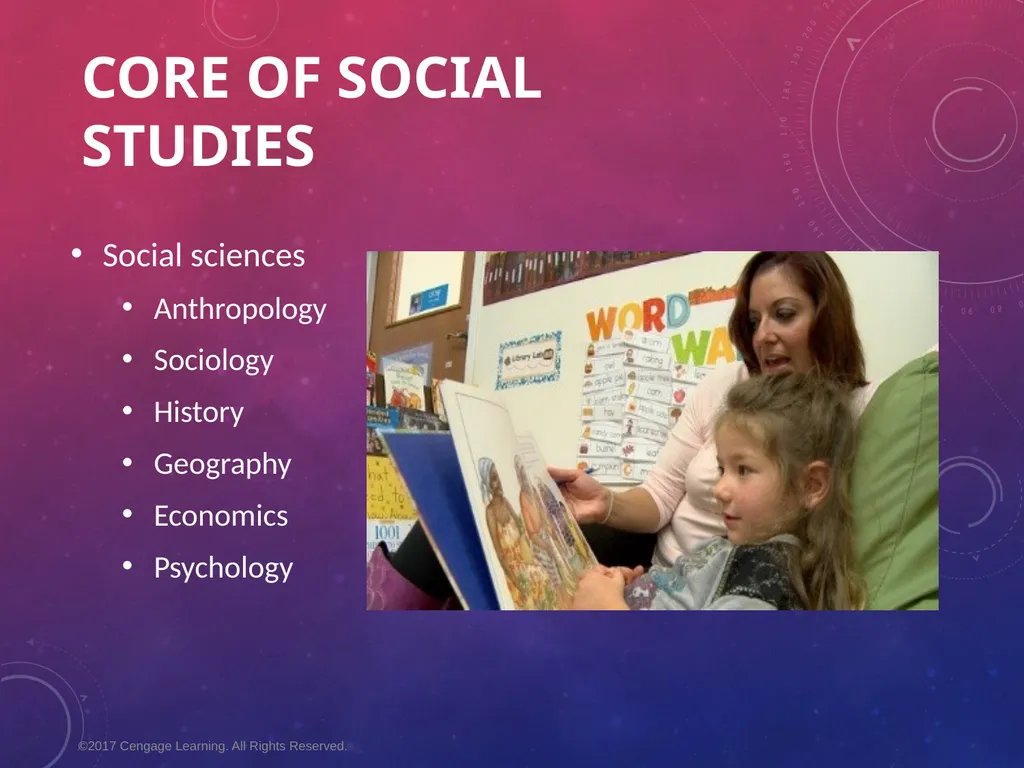
Core of Social Studies Social sciences
Anthropology
Sociology
History
Geography
Economics
Psychology ©2017 Cengage Learning. All Rights Reserved.<br>
Anthropology
Sociology
History
Geography
Economics
Psychology ©2017 Cengage Learning. All Rights Reserved.<br>
06
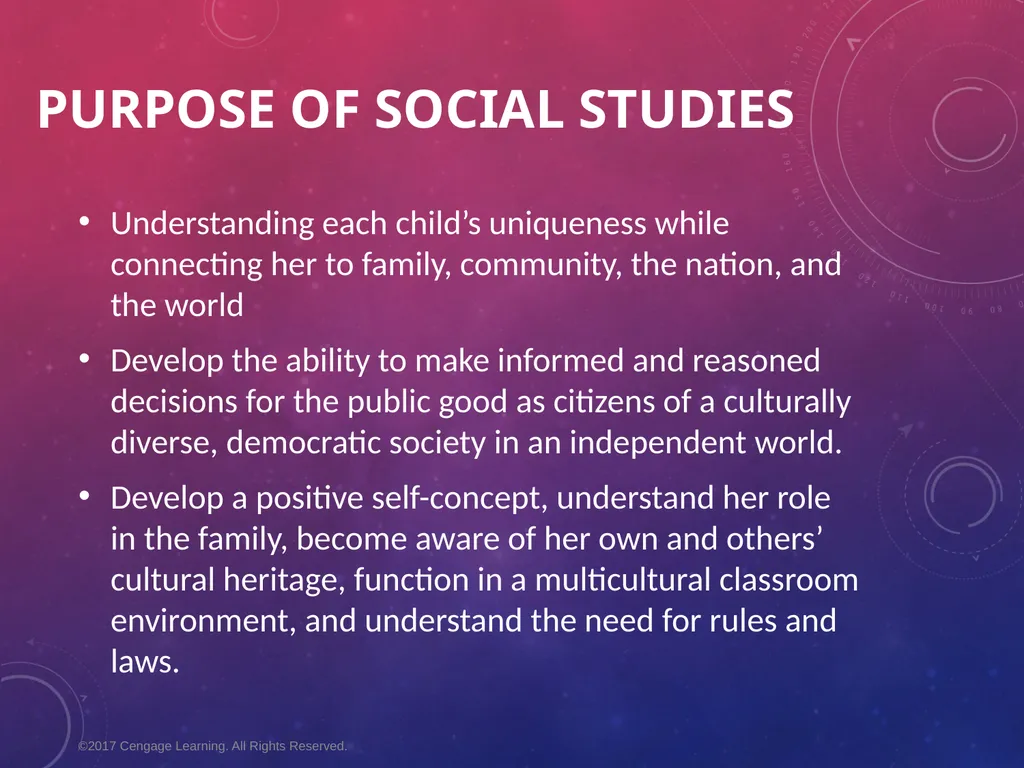
Purpose of Social Studies Understanding each child’s uniqueness while connecting her to family, community, the nation, and the world
Develop the ability to make informed and reasoned decisions for the public good as citizens of a culturally diverse, democratic society in an independent world.
Develop a positive self-concept, understand her role in the family, become aware of her own and others’ cultural heritage, function in a multicultural classroom environment, and understand the need for rules and laws. ©2017 Cengage Learning. All Rights Reserved.<br>
Develop the ability to make informed and reasoned decisions for the public good as citizens of a culturally diverse, democratic society in an independent world.
Develop a positive self-concept, understand her role in the family, become aware of her own and others’ cultural heritage, function in a multicultural classroom environment, and understand the need for rules and laws. ©2017 Cengage Learning. All Rights Reserved.<br>
07
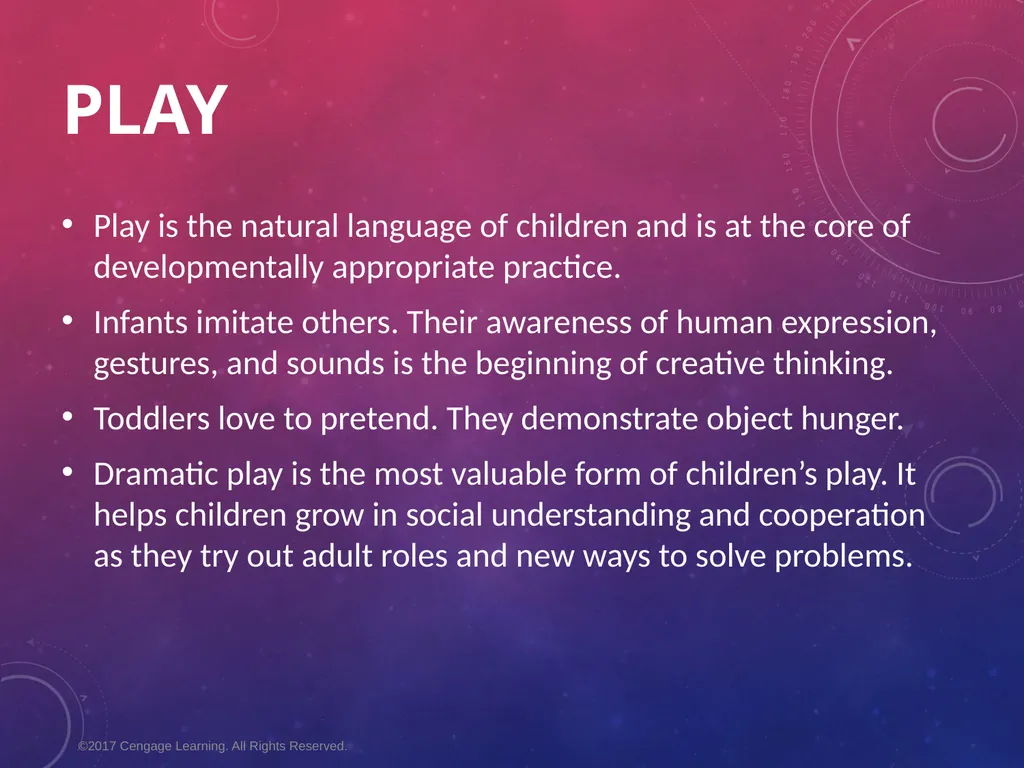
Play Play is the natural language of children and is at the core of developmentally appropriate practice.
Infants imitate others. Their awareness of human expression, gestures, and sounds is the beginning of creative thinking.
Toddlers love to pretend. They demonstrate object hunger.
Dramatic play is the most valuable form of children’s play. It helps children grow in social understanding and cooperation as they try out adult roles and new ways to solve problems. ©2017 Cengage Learning. All Rights Reserved.<br>
Infants imitate others. Their awareness of human expression, gestures, and sounds is the beginning of creative thinking.
Toddlers love to pretend. They demonstrate object hunger.
Dramatic play is the most valuable form of children’s play. It helps children grow in social understanding and cooperation as they try out adult roles and new ways to solve problems. ©2017 Cengage Learning. All Rights Reserved.<br>
08
Dramatic Play Defined Dramatic play
- Free play of children
- Spontaneous play that can be expanded or repeated over and over just for the fun of it
Sociodramatic play
- The highest level of symbolic play
- Happens when at least two children cooperate in dramatic play
- Involves two basic elements: imitation and make-believe ©2017 Cengage Learning. All Rights Reserved.<br>
- Free play of children
- Spontaneous play that can be expanded or repeated over and over just for the fun of it
Sociodramatic play
- The highest level of symbolic play
- Happens when at least two children cooperate in dramatic play
- Involves two basic elements: imitation and make-believe ©2017 Cengage Learning. All Rights Reserved.<br>
09
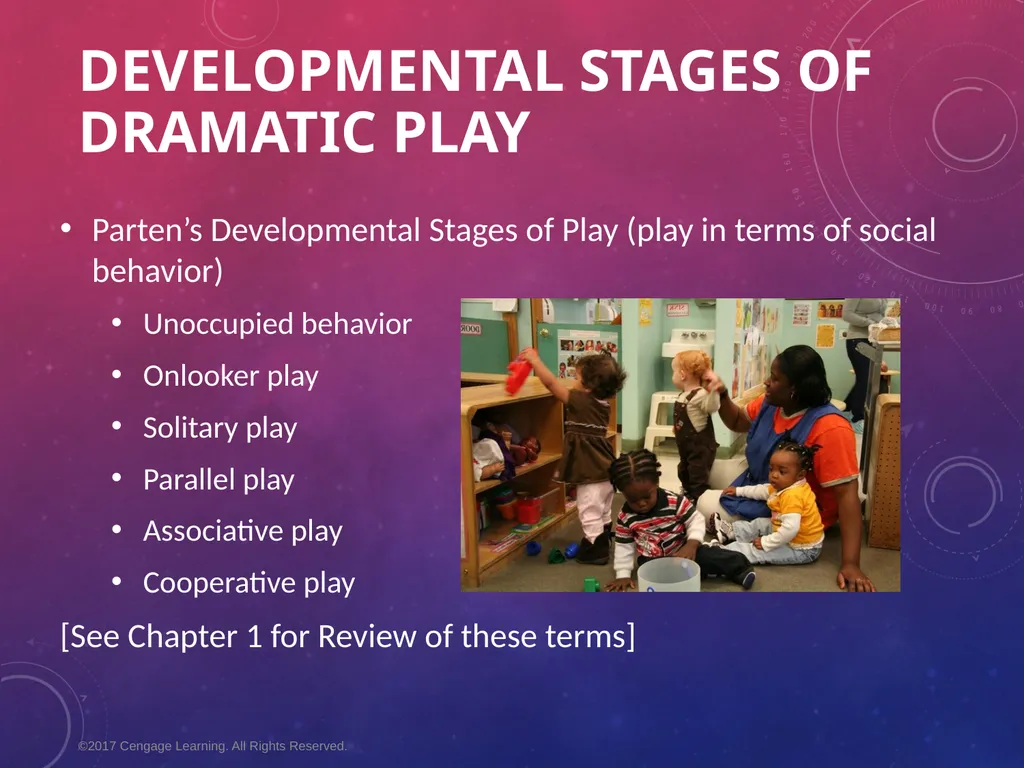
Developmental Stages of Dramatic Play Parten’s Developmental Stages of Play (play in terms of social behavior)
Unoccupied behavior
Onlooker play
Solitary play
Parallel play
Associative play
Cooperative play
[See Chapter 1 for Review of these terms] ©2017 Cengage Learning. All Rights Reserved.<br>
Unoccupied behavior
Onlooker play
Solitary play
Parallel play
Associative play
Cooperative play
[See Chapter 1 for Review of these terms] ©2017 Cengage Learning. All Rights Reserved.<br>
10
Developmental Stages of Dramatic Play (continued) Piaget—play in terms of cognitive development
Practice play
Symbolic play
Games with rules Smilansky—four types of sociodramatic play
Functional play
Constructive play
Dramatic play
Games with rules ©2017 Cengage Learning. All Rights Reserved.<br>
Practice play
Symbolic play
Games with rules Smilansky—four types of sociodramatic play
Functional play
Constructive play
Dramatic play
Games with rules ©2017 Cengage Learning. All Rights Reserved.<br>
11
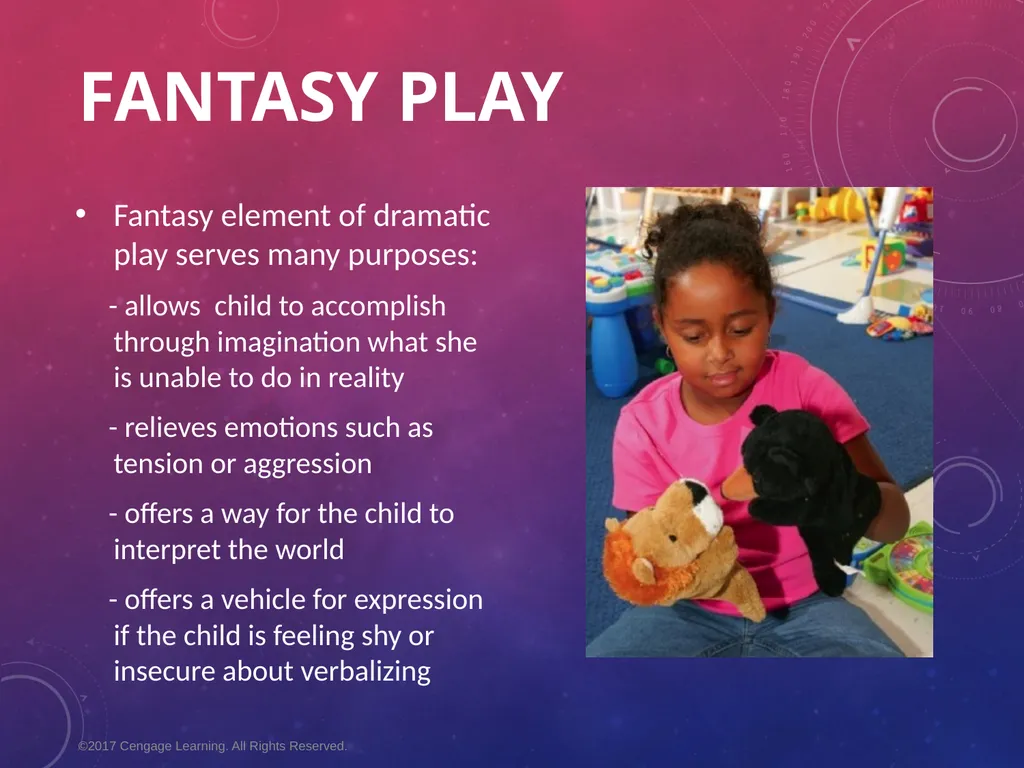
Fantasy Play Fantasy element of dramatic play serves many purposes:
- allows child to accomplish through imagination what she is unable to do in reality
- relieves emotions such as tension or aggression
- offers a way for the child to interpret the world
- offers a vehicle for expression if the child is feeling shy or insecure about verbalizing ©2017 Cengage Learning. All Rights Reserved.<br>
- allows child to accomplish through imagination what she is unable to do in reality
- relieves emotions such as tension or aggression
- offers a way for the child to interpret the world
- offers a vehicle for expression if the child is feeling shy or insecure about verbalizing ©2017 Cengage Learning. All Rights Reserved.<br>
12
Understanding of Fantasy and Reality in Young Children Dramatic play helps children separate what is make-believe from what is real.
The younger the child, the more play is rooted in fantasy.
By age five, children start to differentiate when they are pretending and when they are in the real world.
Encourage use of language to help them differentiate. ©2017 Cengage Learning. All Rights Reserved.<br>
The younger the child, the more play is rooted in fantasy.
By age five, children start to differentiate when they are pretending and when they are in the real world.
Encourage use of language to help them differentiate. ©2017 Cengage Learning. All Rights Reserved.<br>
13
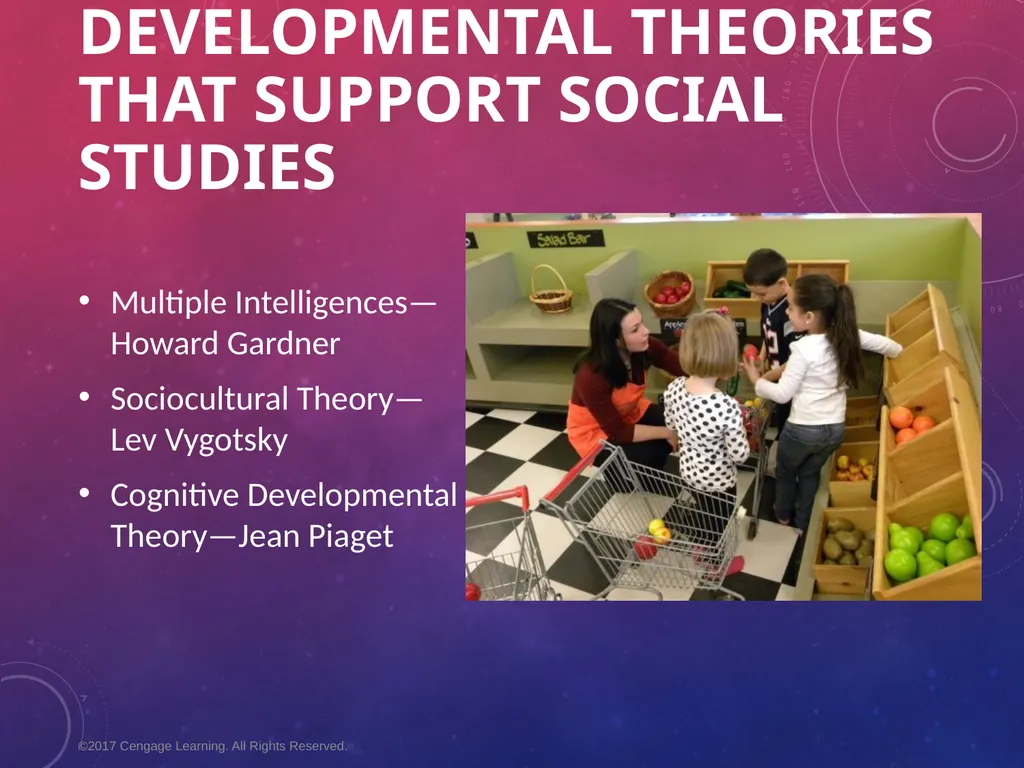
Developmental Theories That Support Social Studies Multiple Intelligences—Howard Gardner
Sociocultural Theory— Lev Vygotsky
Cognitive Developmental Theory—Jean Piaget ©2017 Cengage Learning. All Rights Reserved.<br>
Sociocultural Theory— Lev Vygotsky
Cognitive Developmental Theory—Jean Piaget ©2017 Cengage Learning. All Rights Reserved.<br>
14
Planning and Preparing the Environment Provide unstructured time, adequate space, flexible materials, and uninterrupted opportunity for the children to enjoy dramatic play.
The environment should say, “Pretending is welcome here!”
The environment should support pretending and allow children’s input.
Furniture and equipment considerations ©2017 Cengage Learning. All Rights Reserved.<br>
The environment should say, “Pretending is welcome here!”
The environment should support pretending and allow children’s input.
Furniture and equipment considerations ©2017 Cengage Learning. All Rights Reserved.<br>
15
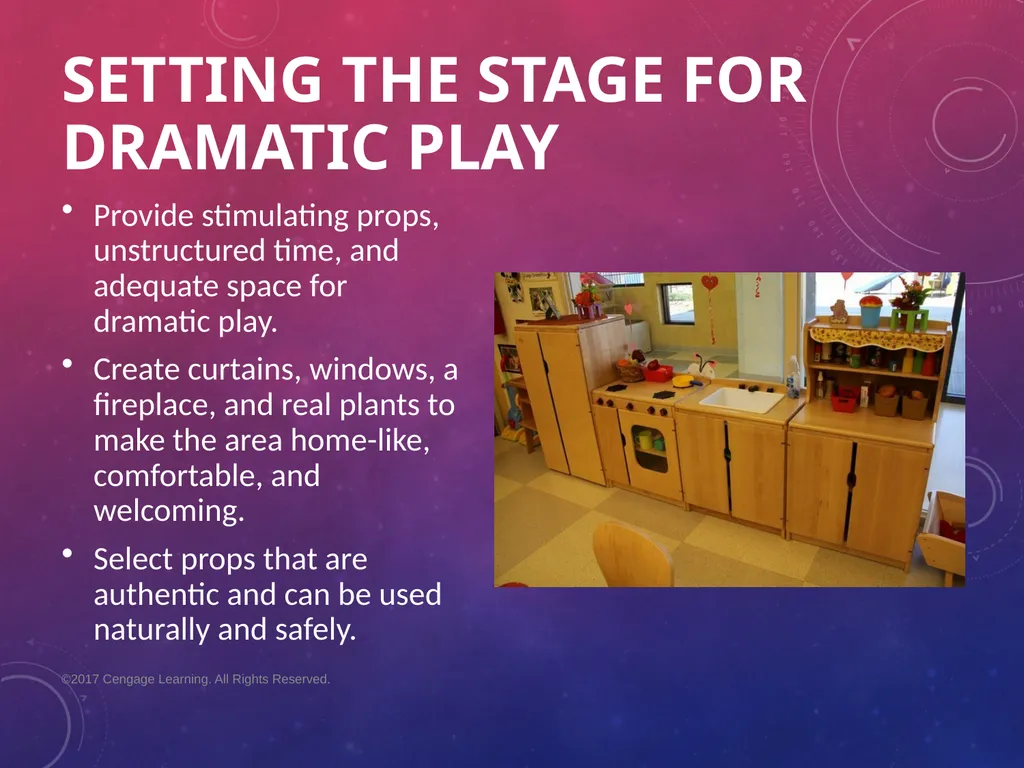
Setting the Stage for Dramatic Play Provide stimulating props, unstructured time, and adequate space for dramatic play.
Create curtains, windows, a fireplace, and real plants to make the area home-like, comfortable, and welcoming.
Select props that are authentic and can be used naturally and safely. ©2017 Cengage Learning. All Rights Reserved.<br>
Create curtains, windows, a fireplace, and real plants to make the area home-like, comfortable, and welcoming.
Select props that are authentic and can be used naturally and safely. ©2017 Cengage Learning. All Rights Reserved.<br>
16
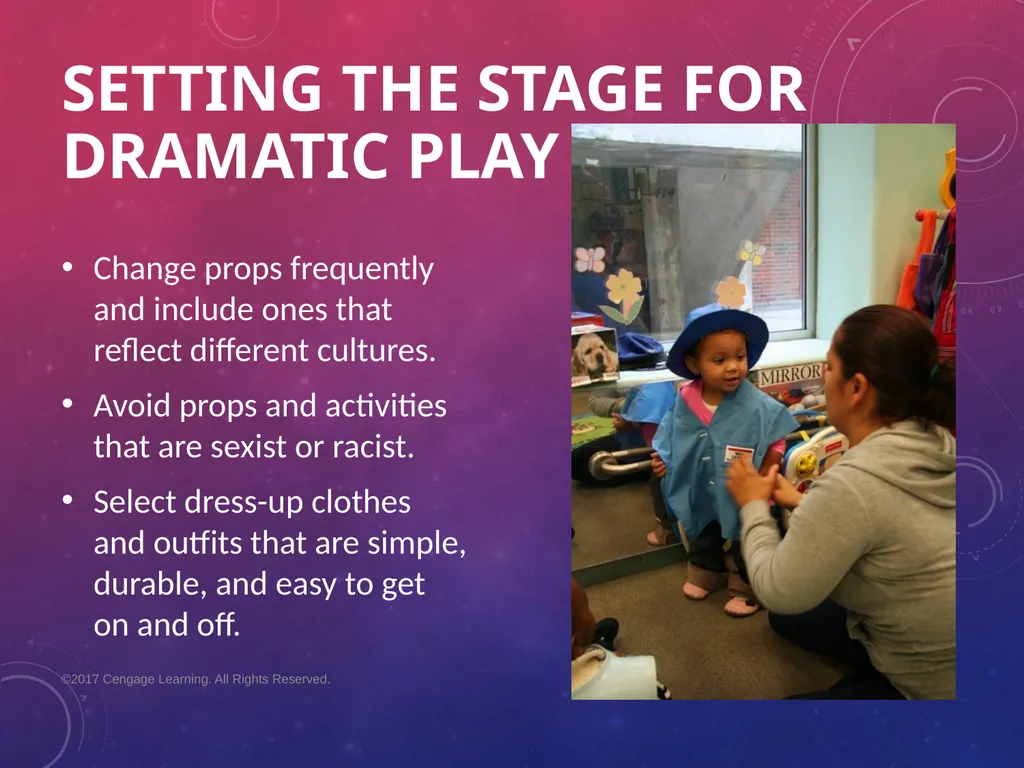
Setting the Stage for Dramatic Play Change props frequently and include ones that reflect different cultures.
Avoid props and activities that are sexist or racist.
Select dress-up clothes and outfits that are simple, durable, and easy to get on and off. ©2017 Cengage Learning. All Rights Reserved.<br>
Avoid props and activities that are sexist or racist.
Select dress-up clothes and outfits that are simple, durable, and easy to get on and off. ©2017 Cengage Learning. All Rights Reserved.<br>
17
Changing the Stage Some teachers keep the home living (housekeeping) area intact as a permanent center and set up a second dramatic play area that expands the theme of the lesson plan or project in which the children are involved.
Others, who are limited in classroom space, may choose to have a dramatic play center that changes periodically and sometimes will include the kitchen area or another room in the home. ©2017 Cengage Learning. All Rights Reserved.<br>
Others, who are limited in classroom space, may choose to have a dramatic play center that changes periodically and sometimes will include the kitchen area or another room in the home. ©2017 Cengage Learning. All Rights Reserved.<br>
18
Changing the Stage Still others take the dramatic play center outdoors to take advantage of the additional space available. Outdoor dramatic play often incorporates wheel toys, wagons, and trikes into the play to create scenarios like an ambulance rushing to help sick people, a gas station, a drive-through car wash on splash day, and much more. ©2017 Cengage Learning. All Rights Reserved.<br>
19
Basic Equipment Basic equipment for the home living/dramatic play center:
child-sized furniture made of wood or sturdy plastic including tables, chairs, rocking chair, and shelves;
a “play” sink, stove, and refrigerator; and
a full-length mirror.
Dolls of both sexes representing differing cultural features and skin coloring,
a doll bed or cradle, and
two sturdy, nonworking telephones. ©2017 Cengage Learning. All Rights Reserved.<br>
child-sized furniture made of wood or sturdy plastic including tables, chairs, rocking chair, and shelves;
a “play” sink, stove, and refrigerator; and
a full-length mirror.
Dolls of both sexes representing differing cultural features and skin coloring,
a doll bed or cradle, and
two sturdy, nonworking telephones. ©2017 Cengage Learning. All Rights Reserved.<br>
20
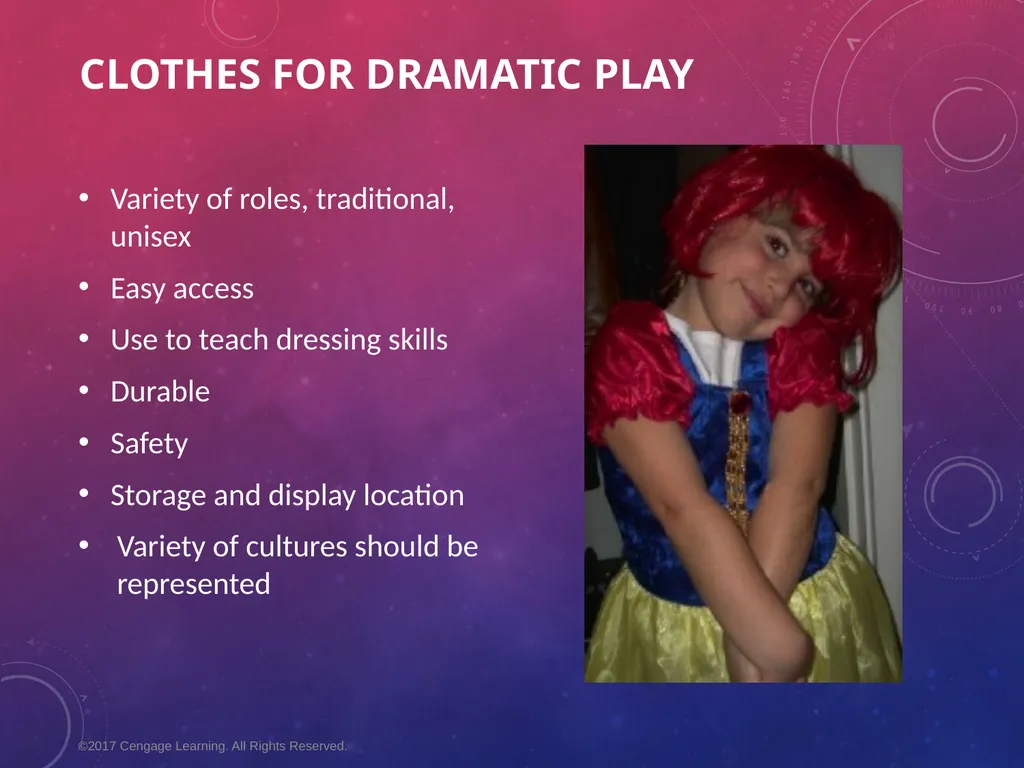
Clothes for Dramatic Play Variety of roles, traditional, unisex
Easy access
Use to teach dressing skills
Durable
Safety
Storage and display location
Variety of cultures should be represented ©2017 Cengage Learning. All Rights Reserved.<br>
Easy access
Use to teach dressing skills
Durable
Safety
Storage and display location
Variety of cultures should be represented ©2017 Cengage Learning. All Rights Reserved.<br>
21
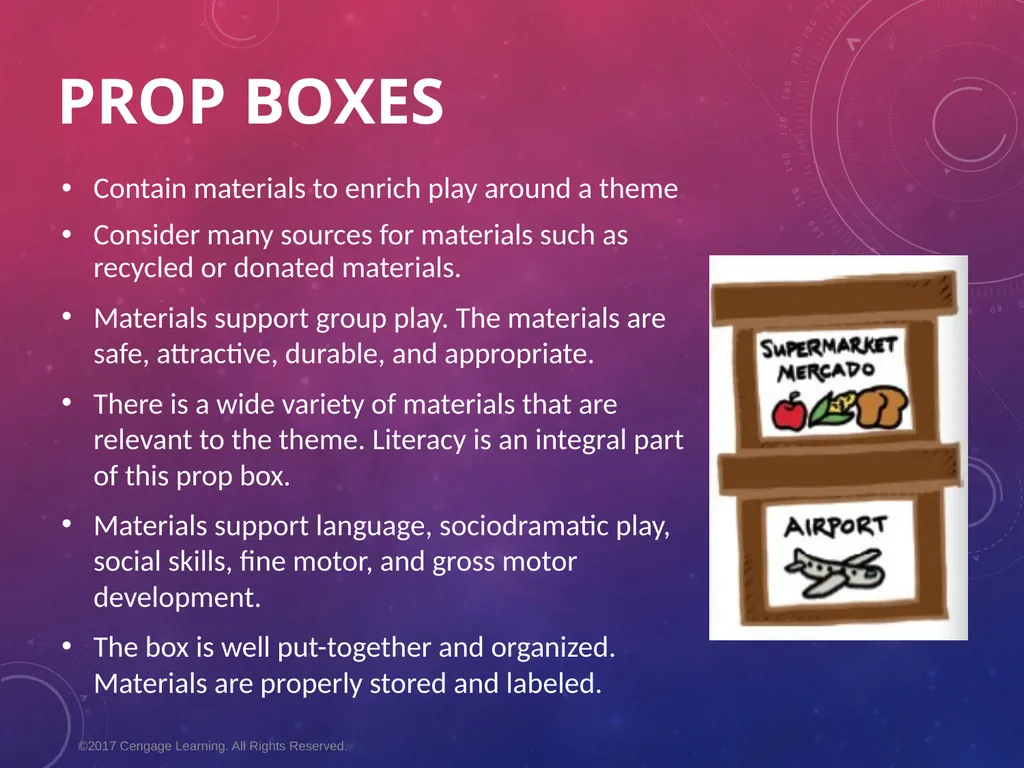
Prop Boxes Contain materials to enrich play around a theme
Consider many sources for materials such as recycled or donated materials.
Materials support group play. The materials are safe, attractive, durable, and appropriate.
There is a wide variety of materials that are relevant to the theme. Literacy is an integral part of this prop box.
Materials support language, sociodramatic play, social skills, fine motor, and gross motor development.
The box is well put-together and organized. Materials are properly stored and labeled. ©2017 Cengage Learning. All Rights Reserved.<br>
Consider many sources for materials such as recycled or donated materials.
Materials support group play. The materials are safe, attractive, durable, and appropriate.
There is a wide variety of materials that are relevant to the theme. Literacy is an integral part of this prop box.
Materials support language, sociodramatic play, social skills, fine motor, and gross motor development.
The box is well put-together and organized. Materials are properly stored and labeled. ©2017 Cengage Learning. All Rights Reserved.<br>
22
Reflect on This If there are only Anglo children in a classroom, why is it important to have representation from many cultures in all areas of the early childhood classroom? ©2017 Cengage Learning. All Rights Reserved.<br>
23
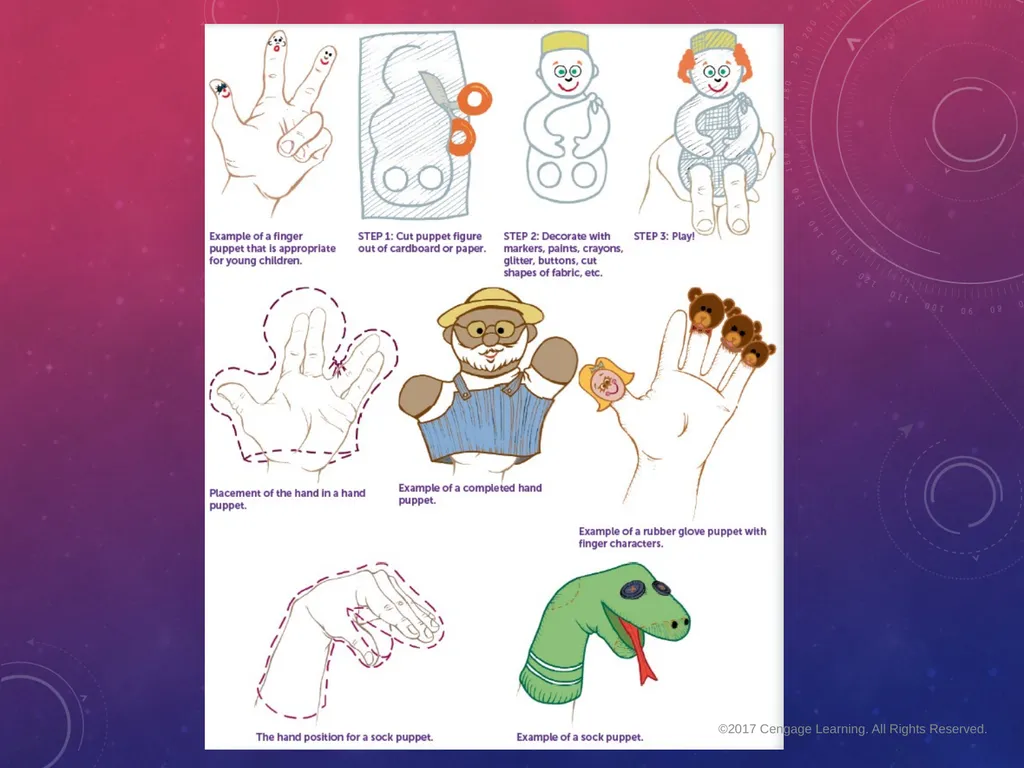
Easy-to-Make Puppets Hand puppets
Finger puppets
Hand, glove, and mitt puppets
Paper plate or bag puppets
Stick or rod puppets
Single stick—dowel rod, tongue depressor, craft stick, and the like
Wooden spoon Marionettes
Controlled by strings
Shadow puppets
Translucent screen
Light source from behind ©2017 Cengage Learning. All Rights Reserved.<br>
Finger puppets
Hand, glove, and mitt puppets
Paper plate or bag puppets
Stick or rod puppets
Single stick—dowel rod, tongue depressor, craft stick, and the like
Wooden spoon Marionettes
Controlled by strings
Shadow puppets
Translucent screen
Light source from behind ©2017 Cengage Learning. All Rights Reserved.<br>
24
©2017 Cengage Learning. All Rights Reserved.<br>
25
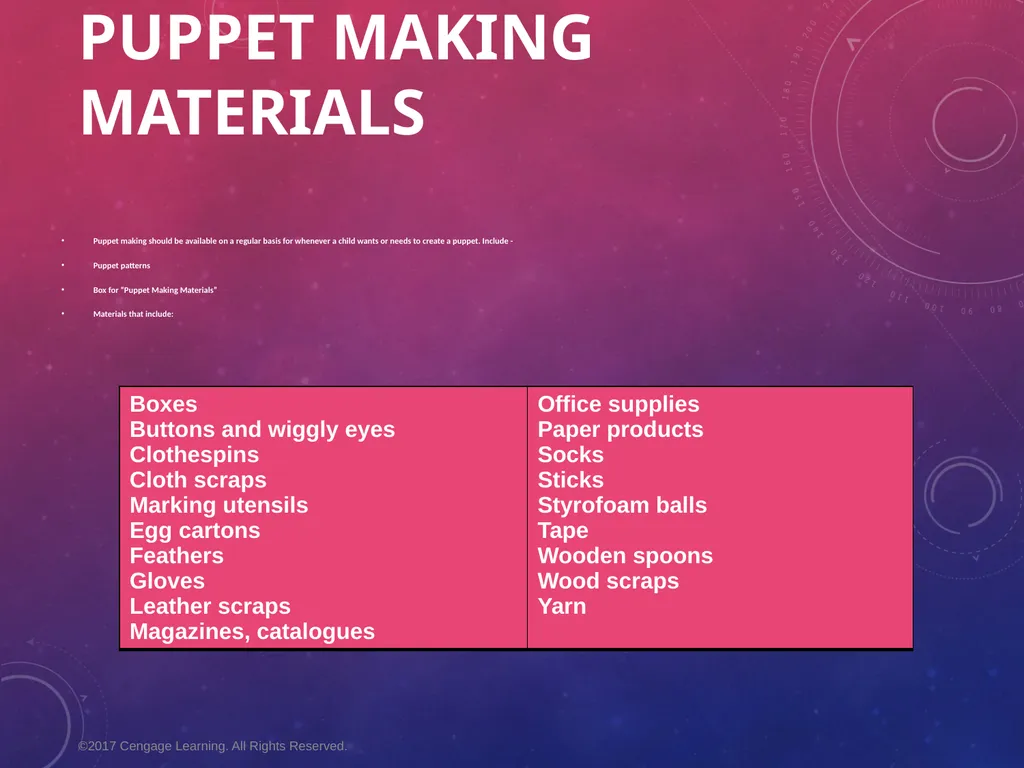
Puppet Making Materials Puppet making should be available on a regular basis for whenever a child wants or needs to create a puppet. Include -
Puppet patterns
Box for “Puppet Making Materials”
Materials that include: ©2017 Cengage Learning. All Rights Reserved.<br>
Puppet patterns
Box for “Puppet Making Materials”
Materials that include: ©2017 Cengage Learning. All Rights Reserved.<br>
26
Suggestions for Placement and Storage of Puppets Have a Puppet center
Place puppets throughout the classroom
Children should be able to move puppets to other locations in the classroom
Clear guidelines for use of puppets
Stage not necessary for creative and spontaneous use; story apron
Ideas for creating stage ©2017 Cengage Learning. All Rights Reserved.<br>
Place puppets throughout the classroom
Children should be able to move puppets to other locations in the classroom
Clear guidelines for use of puppets
Stage not necessary for creative and spontaneous use; story apron
Ideas for creating stage ©2017 Cengage Learning. All Rights Reserved.<br>
27
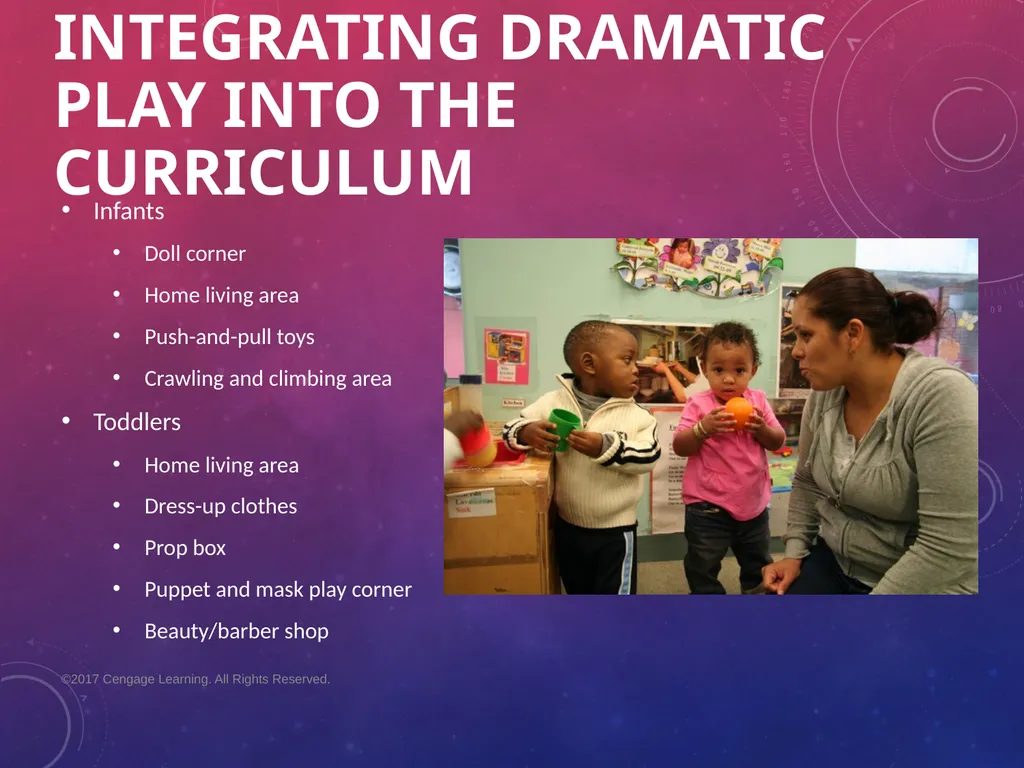
Integrating Dramatic Play into the Curriculum Infants
Doll corner
Home living area
Push-and-pull toys
Crawling and climbing area
Toddlers
Home living area
Dress-up clothes
Prop box
Puppet and mask play corner
Beauty/barber shop ©2017 Cengage Learning. All Rights Reserved.<br>
Doll corner
Home living area
Push-and-pull toys
Crawling and climbing area
Toddlers
Home living area
Dress-up clothes
Prop box
Puppet and mask play corner
Beauty/barber shop ©2017 Cengage Learning. All Rights Reserved.<br>
28
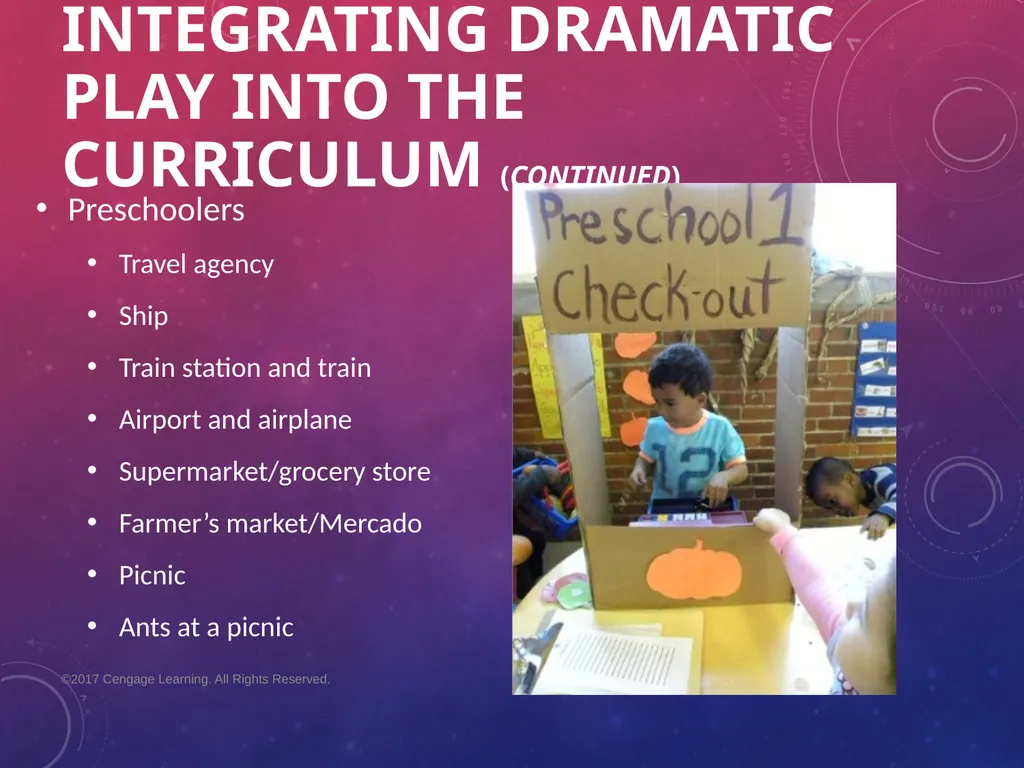
Integrating Dramatic Play into the Curriculum (continued) Preschoolers
Travel agency
Ship
Train station and train
Airport and airplane
Supermarket/grocery store
Farmer’s market/Mercado
Picnic
Ants at a picnic ©2017 Cengage Learning. All Rights Reserved.<br>
Travel agency
Ship
Train station and train
Airport and airplane
Supermarket/grocery store
Farmer’s market/Mercado
Picnic
Ants at a picnic ©2017 Cengage Learning. All Rights Reserved.<br>
29
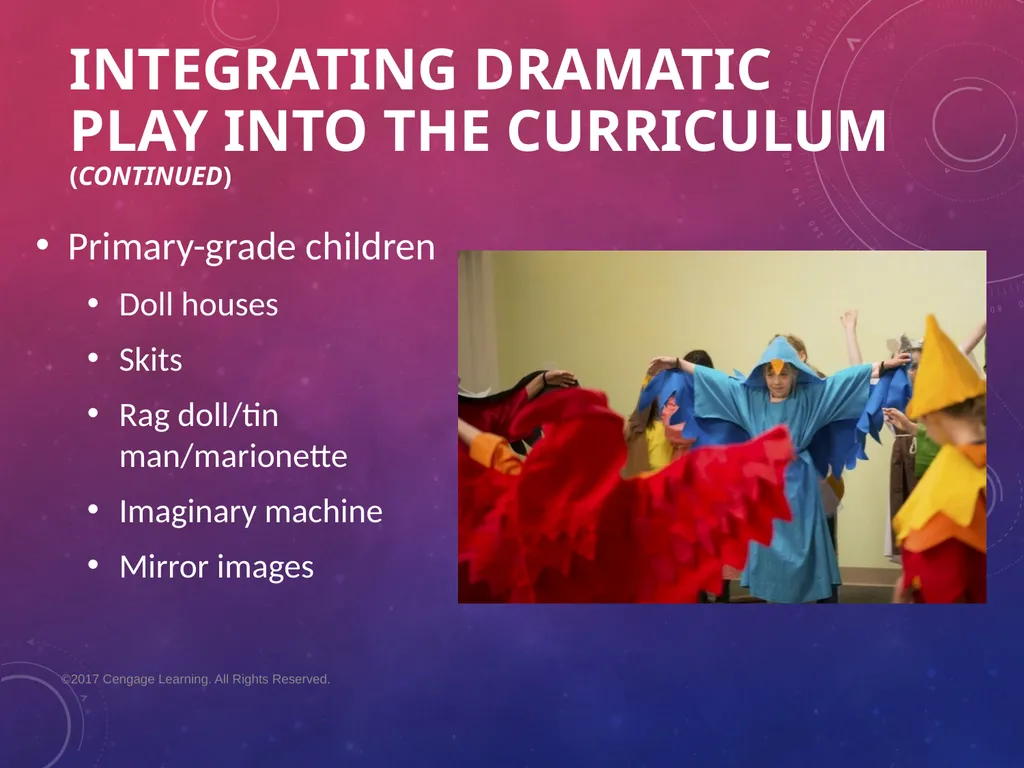
Integrating Dramatic Play into the Curriculum (continued) Primary-grade children
Doll houses
Skits
Rag doll/tin man/marionette
Imaginary machine
Mirror images ©2017 Cengage Learning. All Rights Reserved.<br>
Doll houses
Skits
Rag doll/tin man/marionette
Imaginary machine
Mirror images ©2017 Cengage Learning. All Rights Reserved.<br>
30
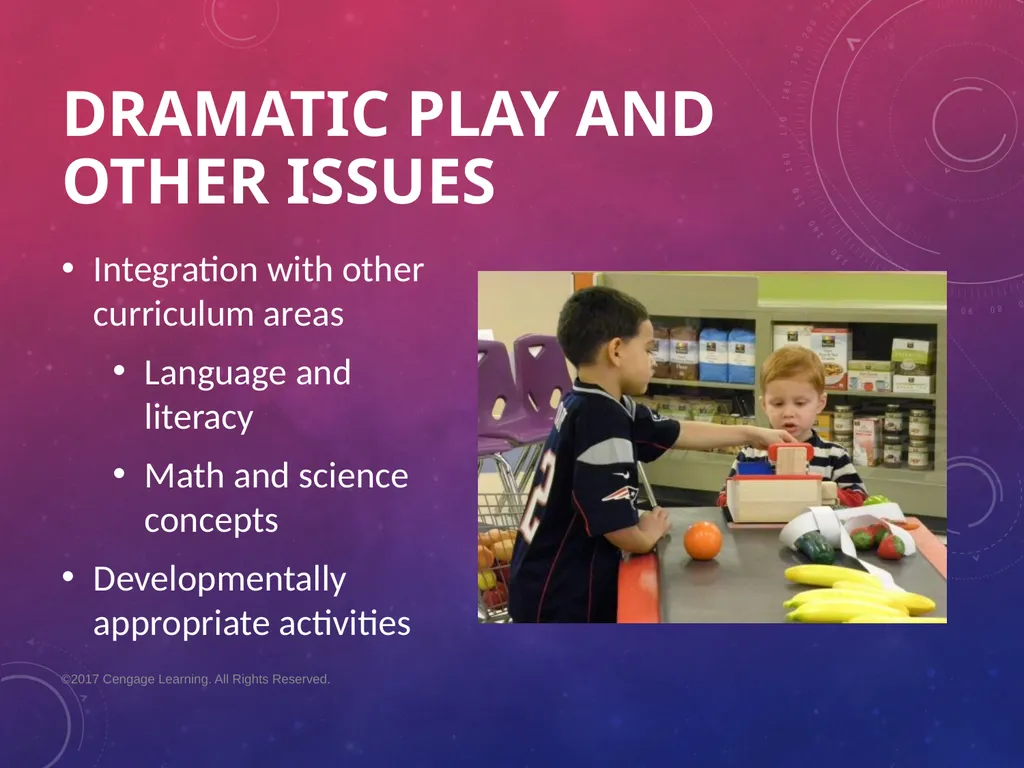
Dramatic Play and Other Issues Integration with other curriculum areas
Language and literacy
Math and science concepts
Developmentally appropriate activities ©2017 Cengage Learning. All Rights Reserved.<br>
Language and literacy
Math and science concepts
Developmentally appropriate activities ©2017 Cengage Learning. All Rights Reserved.<br>
31
Preparing for Puppet Play Introduce the puppets
Types depend on ages and development of children
Use different types
Alternate activities to address needs of learning styles and developmental domains
The teacher should model the use of puppets during group time across curricular areas (especially focusing on nonviolent behavior).
The teacher and children should create and use puppets together. ©2017 Cengage Learning. All Rights Reserved.<br>
Types depend on ages and development of children
Use different types
Alternate activities to address needs of learning styles and developmental domains
The teacher should model the use of puppets during group time across curricular areas (especially focusing on nonviolent behavior).
The teacher and children should create and use puppets together. ©2017 Cengage Learning. All Rights Reserved.<br>
32
Puppets across the Curriculum Puppets can:
Speak in all languages
Along with props, expand the language arts center
In digital age reinforce the need for high touch
Enhance storytelling
Help reinforce cooperation, rules, and problem solving
Emphasize the importance of listening
Be included in outdoor play ©2017 Cengage Learning. All Rights Reserved.<br>
Speak in all languages
Along with props, expand the language arts center
In digital age reinforce the need for high touch
Enhance storytelling
Help reinforce cooperation, rules, and problem solving
Emphasize the importance of listening
Be included in outdoor play ©2017 Cengage Learning. All Rights Reserved.<br>
33
Goals of Social Studies Develop a child’s positive self-concept
Further an understanding of a child’s role in the family
Develop an awareness of a child’s own cultural heritage
Provide an inclusive, multicultural classroom environment
Develop an understanding of the need for rules and laws
Teachers provide daily role models ©2017 Cengage Learning. All Rights Reserved.<br>
Further an understanding of a child’s role in the family
Develop an awareness of a child’s own cultural heritage
Provide an inclusive, multicultural classroom environment
Develop an understanding of the need for rules and laws
Teachers provide daily role models ©2017 Cengage Learning. All Rights Reserved.<br>
34
Activities That Support Social Studies Goals Project approach themes : homes, families
Stories and drawings
Activities specific to families and homes
Maps or place awareness
Three-dimensional
Story mapping
Time lines for primary-aged children
Personal
Interactive timelines ©2017 Cengage Learning. All Rights Reserved.<br>
Stories and drawings
Activities specific to families and homes
Maps or place awareness
Three-dimensional
Story mapping
Time lines for primary-aged children
Personal
Interactive timelines ©2017 Cengage Learning. All Rights Reserved.<br>
35
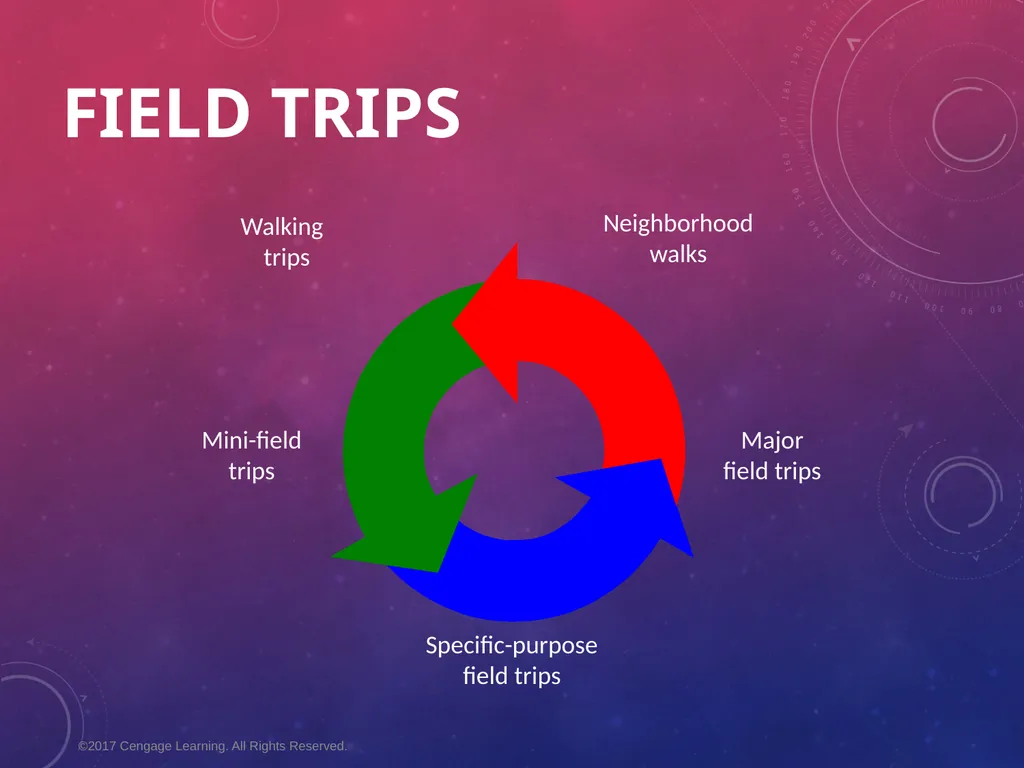
Field Trips ©2017 Cengage Learning. All Rights Reserved. Walking
trips Neighborhood
walks Mini-field
trips Specific-purpose
field trips Major
field trips<br>
trips Neighborhood
walks Mini-field
trips Specific-purpose
field trips Major
field trips<br>
36
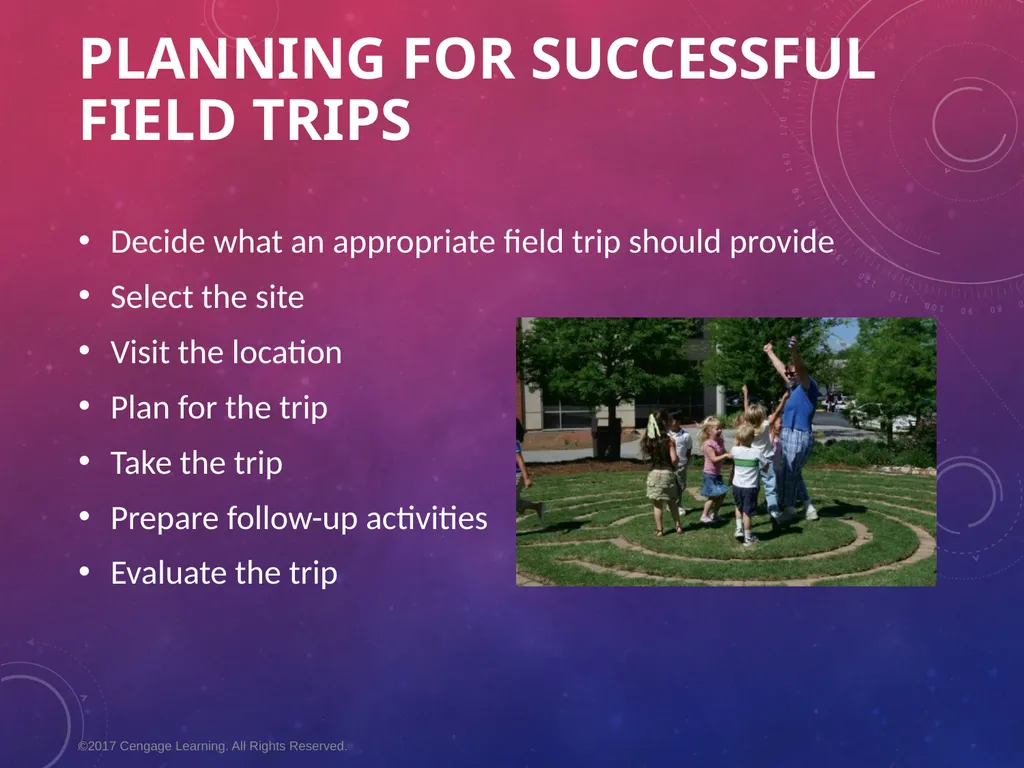
Planning for Successful Field Trips Decide what an appropriate field trip should provide
Select the site
Visit the location
Plan for the trip
Take the trip
Prepare follow-up activities
Evaluate the trip ©2017 Cengage Learning. All Rights Reserved.<br>
Select the site
Visit the location
Plan for the trip
Take the trip
Prepare follow-up activities
Evaluate the trip ©2017 Cengage Learning. All Rights Reserved.<br>
37
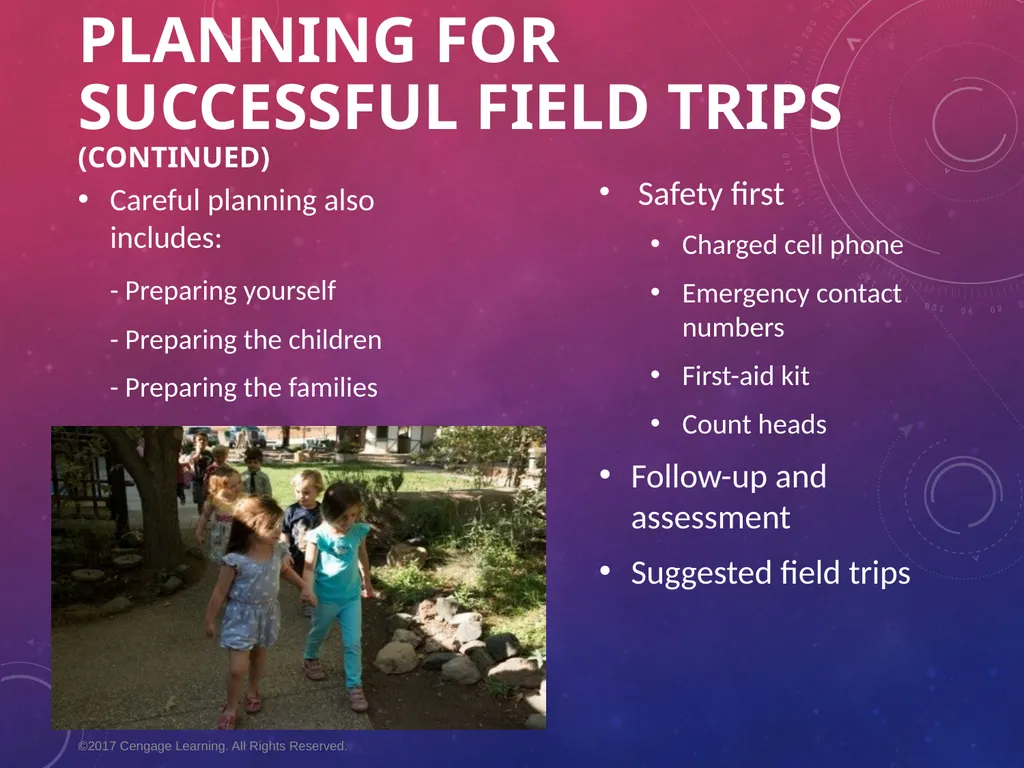
Planning for Successful Field Trips (continued) Careful planning also includes:
- Preparing yourself
- Preparing the children
- Preparing the families Safety first
Charged cell phone
Emergency contact numbers
First-aid kit
Count heads
Follow-up and assessment
Suggested field trips ©2017 Cengage Learning. All Rights Reserved.<br>
- Preparing yourself
- Preparing the children
- Preparing the families Safety first
Charged cell phone
Emergency contact numbers
First-aid kit
Count heads
Follow-up and assessment
Suggested field trips ©2017 Cengage Learning. All Rights Reserved.<br>
38
Reflect on This How can a school or center program connect children to the community if they cannot take field trips? ©2017 Cengage Learning. All Rights Reserved.<br>
39
Technology in Social Studies
and Dramatic Play Children can use the Internet or the teacher can develop a WebQuest to research social studies or dramatic play topics such as puppets or different types of bread around the world.
Barcode scanners, mobile telephones, portable computers, cash dispensers, and parking lot ticket machines can be integrated into dramatic play scenarios.
Photos or videos taken by student’s families on vacation can be integrated into lessons about different cultures and countries.
Dramatic play by any age can be videoed and viewed by the participants. ©2017 Cengage Learning. All Rights Reserved.<br>
Barcode scanners, mobile telephones, portable computers, cash dispensers, and parking lot ticket machines can be integrated into dramatic play scenarios.
Photos or videos taken by student’s families on vacation can be integrated into lessons about different cultures and countries.
Dramatic play by any age can be videoed and viewed by the participants. ©2017 Cengage Learning. All Rights Reserved.<br>
40
Multicultural Materials It is important to recognize that people from different cultures are different in a variety of ways, including: ways of looking at things, dressing, and expressing personality.
Permeate daily classroom life through frequent hands-on activities that explore similarities and differences, beginning with but not limited to who is represented in class.
Children can be introduced to these intriguing differences and similarities by including multicultural materials throughout the classroom.
See pages 176-177 for ideas for each center. ©2017 Cengage Learning. All Rights Reserved.<br>
Permeate daily classroom life through frequent hands-on activities that explore similarities and differences, beginning with but not limited to who is represented in class.
Children can be introduced to these intriguing differences and similarities by including multicultural materials throughout the classroom.
See pages 176-177 for ideas for each center. ©2017 Cengage Learning. All Rights Reserved.<br>
41
Multicultural/Anti-Bias
Activities Evaluate your classroom to ensure this approach is supported
Activities that can utilize this approach
Family quilts
Making the class into a neighborhood ©2017 Cengage Learning. All Rights Reserved.<br>
Activities that can utilize this approach
Family quilts
Making the class into a neighborhood ©2017 Cengage Learning. All Rights Reserved.<br>
42
Dramatic Play for Each and Every Child Apply only those rules needed for safety
Let the child take the lead
Clearly define space
Monitor interactions and gradually decrease direct intervention
Encourage verbalization
Offer familiar materials
Use puppets and some props that provide an obvious cue
Dress-up clothes—easy on and off
Supply supportive seating to offset fatigue ©2017 Cengage Learning. All Rights Reserved.<br>
Let the child take the lead
Clearly define space
Monitor interactions and gradually decrease direct intervention
Encourage verbalization
Offer familiar materials
Use puppets and some props that provide an obvious cue
Dress-up clothes—easy on and off
Supply supportive seating to offset fatigue ©2017 Cengage Learning. All Rights Reserved.<br>
43
Creating Partnerships with Families Acknowledge and respect children’s home language and culture
Obtain family input from all involved persons
Focus on building and maintaining reciprocal relationships
Build a sense of trust
Post weekly menus and lesson plans
Invite them to visit the classroom
Guide them into making prop boxes at home with their children ©2017 Cengage Learning. All Rights Reserved.<br>
Obtain family input from all involved persons
Focus on building and maintaining reciprocal relationships
Build a sense of trust
Post weekly menus and lesson plans
Invite them to visit the classroom
Guide them into making prop boxes at home with their children ©2017 Cengage Learning. All Rights Reserved.<br>
44
Creating Partnerships with Families (continued) Develop communication systems, including use of emails or technology
Governing or advisory groups must include family as members
Family get-togethers; open houses
Family-teacher conferences
Invite family members to share interests
Complementary learning supports ©2017 Cengage Learning. All Rights Reserved.<br>
Governing or advisory groups must include family as members
Family get-togethers; open houses
Family-teacher conferences
Invite family members to share interests
Complementary learning supports ©2017 Cengage Learning. All Rights Reserved.<br>
45
Taking Puppets Home Send families information via letters or emails about puppet presentations in the community
Send families notes and letters in their native languages
Conduct informal family meetings
Start a puppet lending library ©2017 Cengage Learning. All Rights Reserved.<br>
Send families notes and letters in their native languages
Conduct informal family meetings
Start a puppet lending library ©2017 Cengage Learning. All Rights Reserved.<br>
46
Guidance for Superhero Play Show children that superheroes are not special just because they are physically powerful.
Point out when superheroes show kindness and helpfulness to others, and show appreciation to the children when they do the same.
Talk about real heroes and heroines with children.
Help children build on their interests through superhero play, such as space travel or insects.
(NAEYC, 1997, www.naeyc.org/ece/1997/16.asp). ©2017 Cengage Learning. All Rights Reserved.<br>
Point out when superheroes show kindness and helpfulness to others, and show appreciation to the children when they do the same.
Talk about real heroes and heroines with children.
Help children build on their interests through superhero play, such as space travel or insects.
(NAEYC, 1997, www.naeyc.org/ece/1997/16.asp). ©2017 Cengage Learning. All Rights Reserved.<br>
47
The Teacher’s Role Provide time, space, materials
Monitor area so that all children can participate
Assist children in learning social interaction and problem solving
Keep developmental capabilities in mind
Value play
Safety
Anti-bias in approach and materials
Serve as facilitator ©2017 Cengage Learning. All Rights Reserved.<br>
Monitor area so that all children can participate
Assist children in learning social interaction and problem solving
Keep developmental capabilities in mind
Value play
Safety
Anti-bias in approach and materials
Serve as facilitator ©2017 Cengage Learning. All Rights Reserved.<br>
48
Tips for Teachers Include diverse individuals in wall and room decorations. When children see themselves reflected in classroom materials, they understand that who they are is valued, accepted, and deemed important.
Use language with children that demonstrates an acceptance of all cultures. Word choices indicate acceptance of and often determine behavior in children.
Field trips and guest speakers are reflective of many cultures, so students have an opportunity to see themselves or individuals in their communities as something of value. ©2017 Cengage Learning. All Rights Reserved.<br>
Use language with children that demonstrates an acceptance of all cultures. Word choices indicate acceptance of and often determine behavior in children.
Field trips and guest speakers are reflective of many cultures, so students have an opportunity to see themselves or individuals in their communities as something of value. ©2017 Cengage Learning. All Rights Reserved.<br>