Chapter Eight Social Conflict, Critical Criminology, and Restorative Justice Social Conflict, Critical Criminology, and Restorative Justice Social conflict The struggle for power in society Critical criminologists Criminologists who believe
"Chapter Eight Social Conflict, Critical" is the property of its rightful owner. Permission is granted to
download and print the materials on this website for personal, non-commercial use only, and to display it
on your personal computer provided you do not modify the materials and that you retain all copyright
notices contained in the materials. By downloading content from our website, you accept the terms of this
agreement.
Presentation Transcript
01
Chapter Eight Social Conflict, Critical Criminology, and Restorative Justice<br>
02
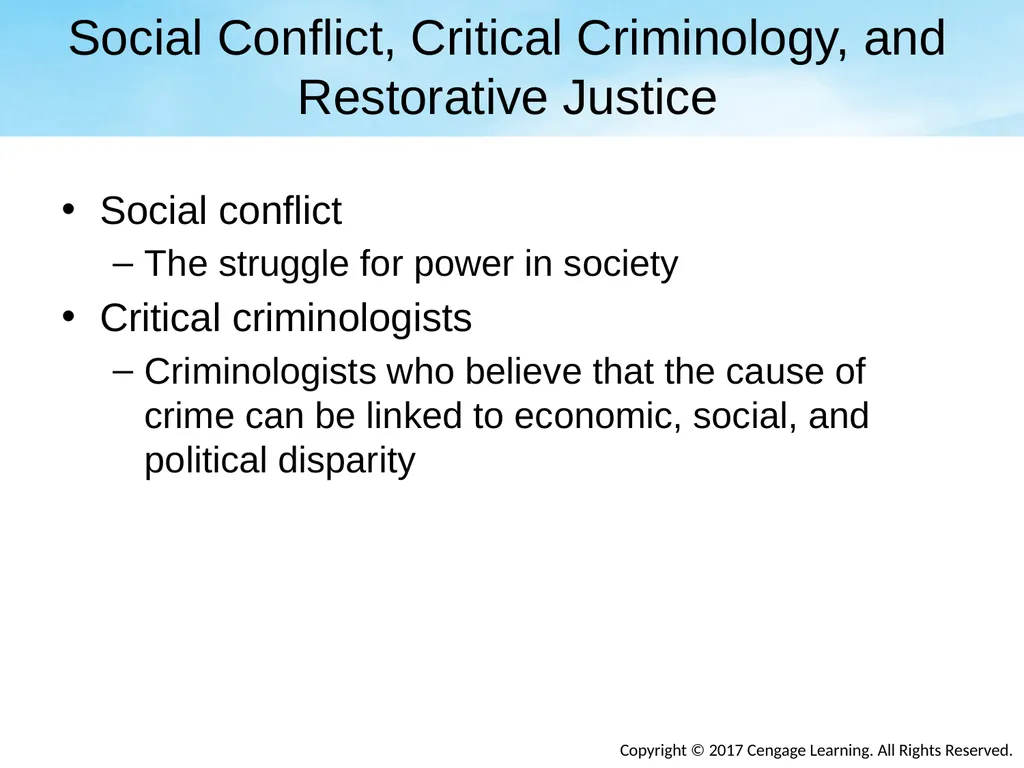
Social Conflict, Critical Criminology, and Restorative Justice Social conflict
The struggle for power in society
Critical criminologists
Criminologists who believe that the cause of crime can be linked to economic, social, and political disparity<br>
03
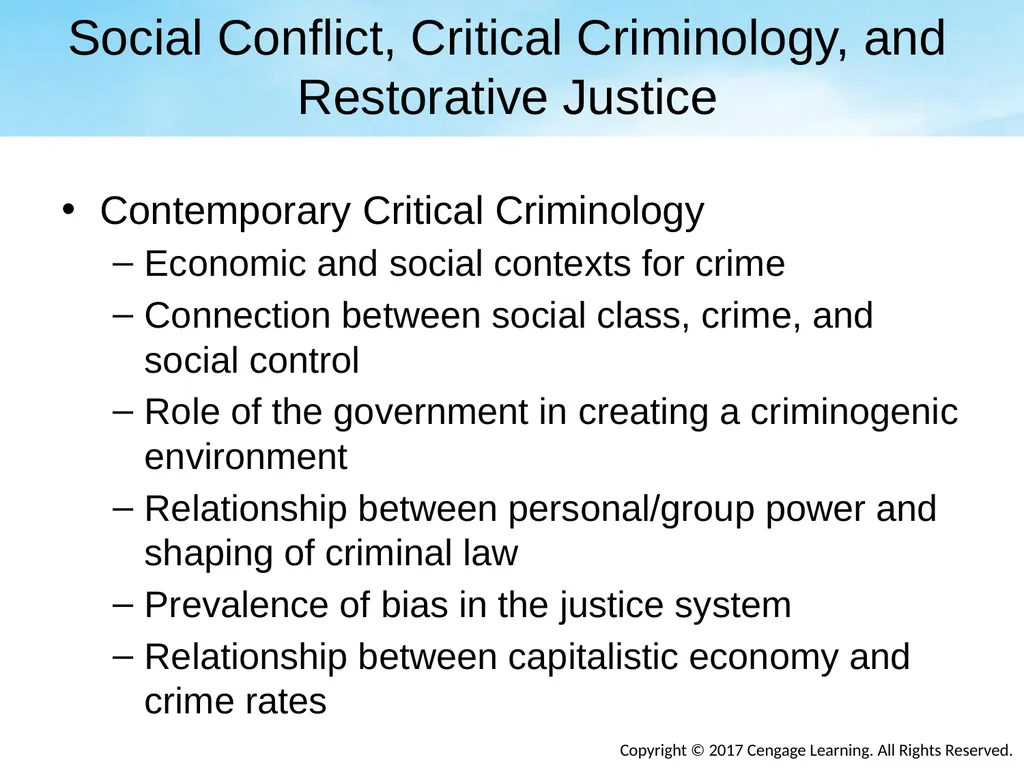
Social Conflict, Critical Criminology, and Restorative Justice Contemporary Critical Criminology
Economic and social contexts for crime
Connection between social class, crime, and social control
Role of the government in creating a criminogenic environment
Relationship between personal/group power and shaping of criminal law
Prevalence of bias in the justice system
Relationship between capitalistic economy and crime rates<br>
04
Origins of Critical Criminology Karl Marx
National Deviancy Conference
How might social control cause deviancy
The New Criminology by Ian Taylor, Paul Walton, and Jock Young
War in Vietnam, prison struggles, civil rights movement, feminist movement
Relationship between law, power, and crime<br>
05
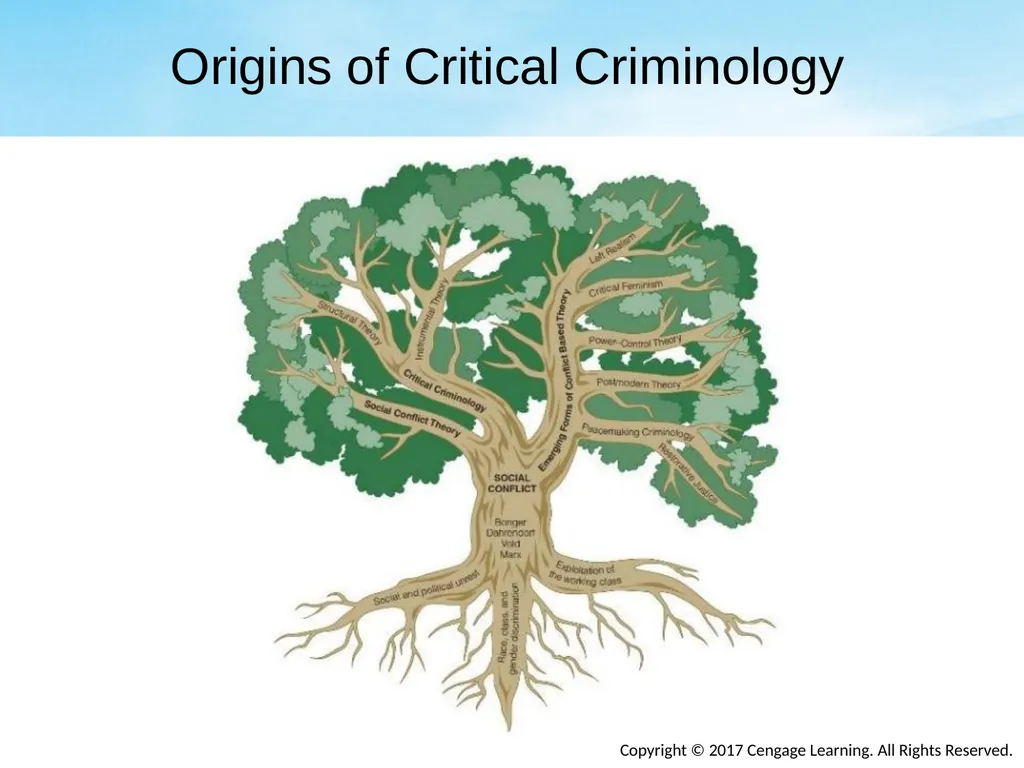
Origins of Critical Criminology<br>
06
Origins of Critical Criminology Contemporary Critical Criminology
Economic competitiveness
Widening gap between rich and poor
Justice system inequality
Demystifying domination<br>
07
Defining Crime and Justice Crime is a political concept designed to protect the power and position of the upper classes at the expense of the poor.
Some critical theorists include violations of human rights due to racism, sexism, and imperialism, as well as other violations of human dignity and physical needs and necessities, as crime<br>
08
Defining Crime and Justice Supranational Criminology
War crimes
Crimes against humanity
Genocide
Other human rights violations<br>
09
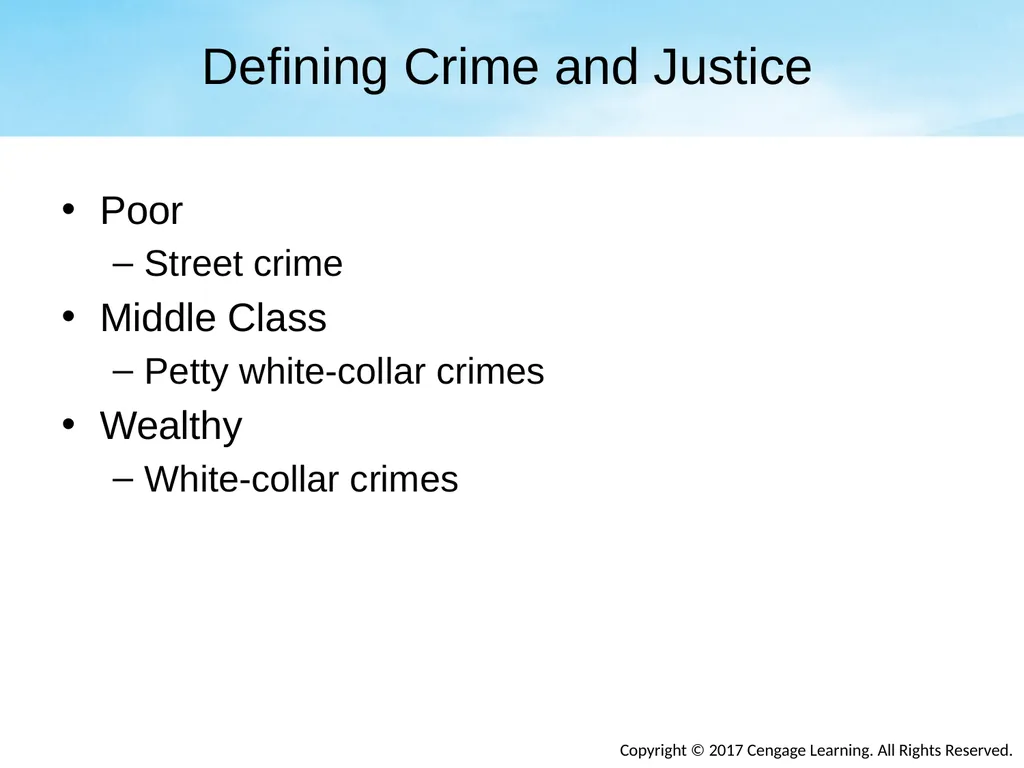
Defining Crime and Justice Poor
Street crime
Middle Class
Petty white-collar crimes
Wealthy
White-collar crimes<br>
10
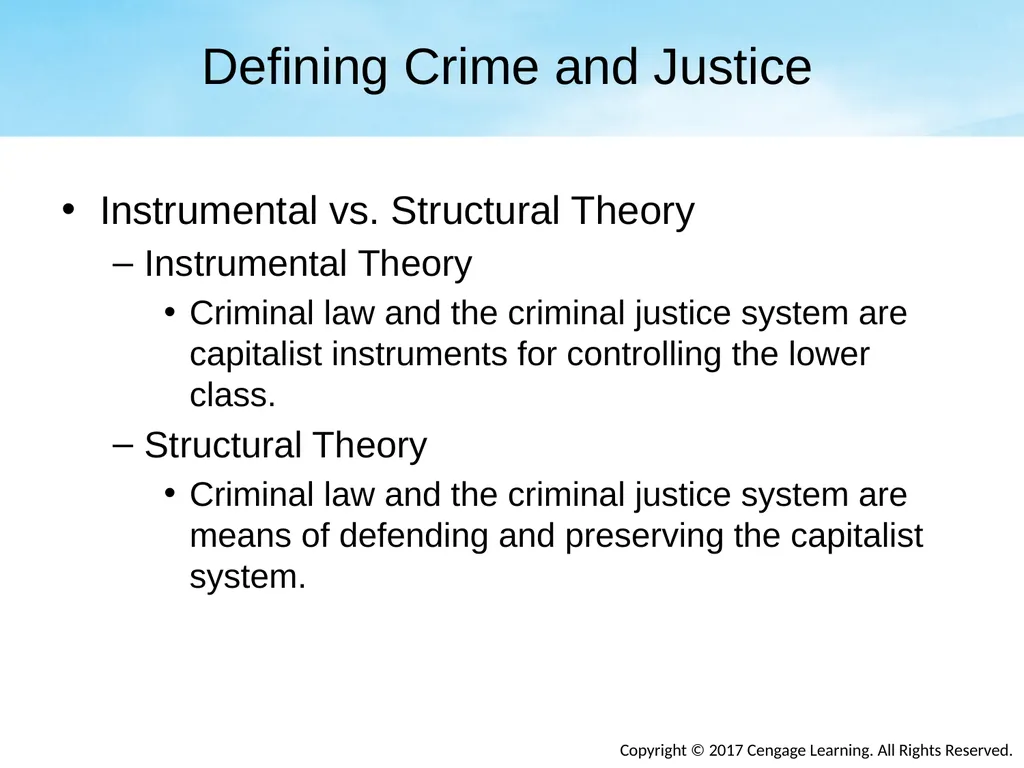
Defining Crime and Justice Instrumental vs. Structural Theory
Instrumental Theory
Criminal law and the criminal justice system are capitalist instruments for controlling the lower class.
Structural Theory
Criminal law and the criminal justice system are means of defending and preserving the capitalist system.<br>
11
Class Discussion/Activity There has been a lot of talk about the middle class in America shrinking – many individuals are getting poorer, while a small minority are getting richer
How does this phenomenon impact crime from the perspectives of instrumental theory and structural theory?<br>
12
The Cause of Crime Surplus Value
Profits produced by laboring classes that are accrued by business owners
Marginalization
People being thrust outside the economic mainstream<br>
13
The Cause of Crime Globalization
Creation and maintenance of transnational markets
Threat to world economy:
Growing global dominance, which benefits wealthy
Increasing vulnerability of indigenous people
Nondemocratic operation and influence of international financial institutions
International Crime Expert Louise Shelley
Globalization encourages criminality
Technology and culture<br>
14
The Cause of Crime State (organized) Crime
Criminal acts committed by government officials
Illegal domestic surveillance
Human rights violations
Extraordinary rendition
State-corporate crime
State violence<br>
15
The Cause of Crime Crime and social institutions
Class bias and racial oppression from cradle to grave
Educational disparities
Dropout factories
Race and racism<br>
16
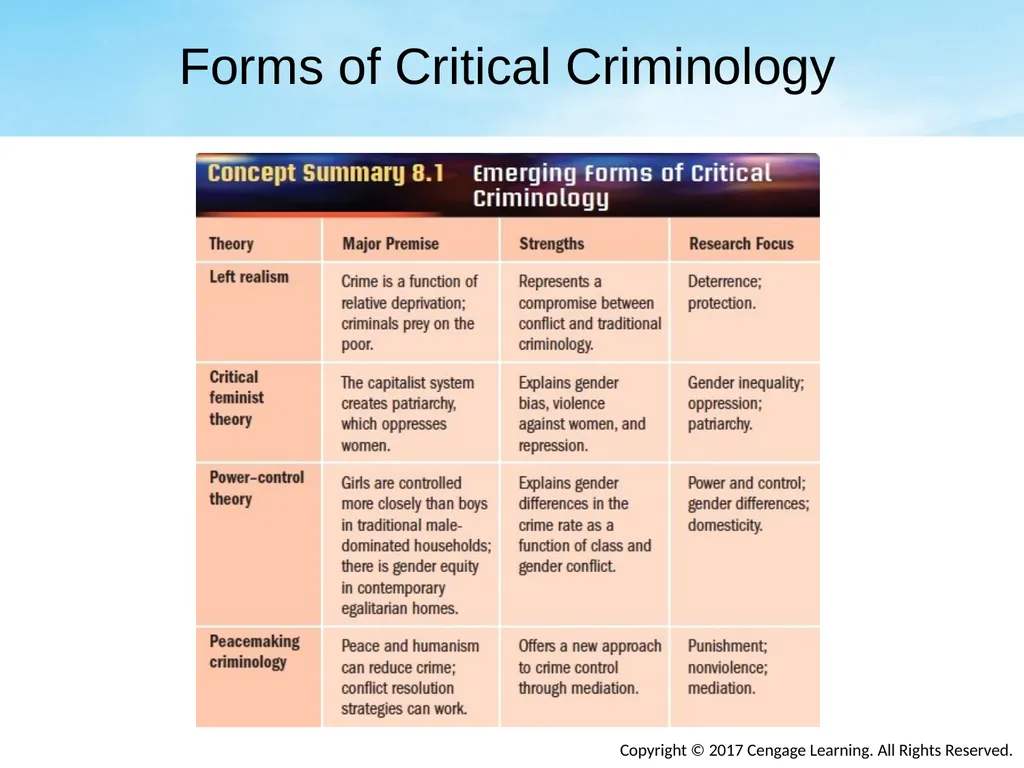
Forms of Critical Criminology Left Realism
Crime is a function of economic inequality, community deprivation, and lack of supportive institutions.
Economic disparity can be laid at the feet of crony capitalism.
Community-based efforts for crime control
Preemptive deterrence
What is the relationship between left realism and terrorism?<br>
17
Forms of Critical Criminology Critical Feminist Theory
Explains both victimization and criminality among women in terms of gender inequality, patriarchy, and the exploitation of women under capitalism
Patriarchy and Crime
Double marginality and powerlessness
Masculinity and crime
Hegemonic masculinity
Being victimized
Gender and the justice system<br>
18
Forms of Critical Criminology Power-Control Theory
Critical feminist model
Paternalistic families
Role exit behaviors
Egalitarian families<br>
19
Class Discussion/Activity Domestic violence has only been considered a serious crime since the 1970s, and full implementation of those laws has taken even longer
How does critical feminist theory explain the failure to fully protect women from domestic violence?<br>
20
Forms of Critical Criminology Peacemaking Criminology
Purpose of criminology is to promote a peaceful, just society
Punitive crime control strategies are counterproductive
Favors humanistic conflict resolution to prevent and control crime<br>
21
Forms of Critical Criminology<br>
22
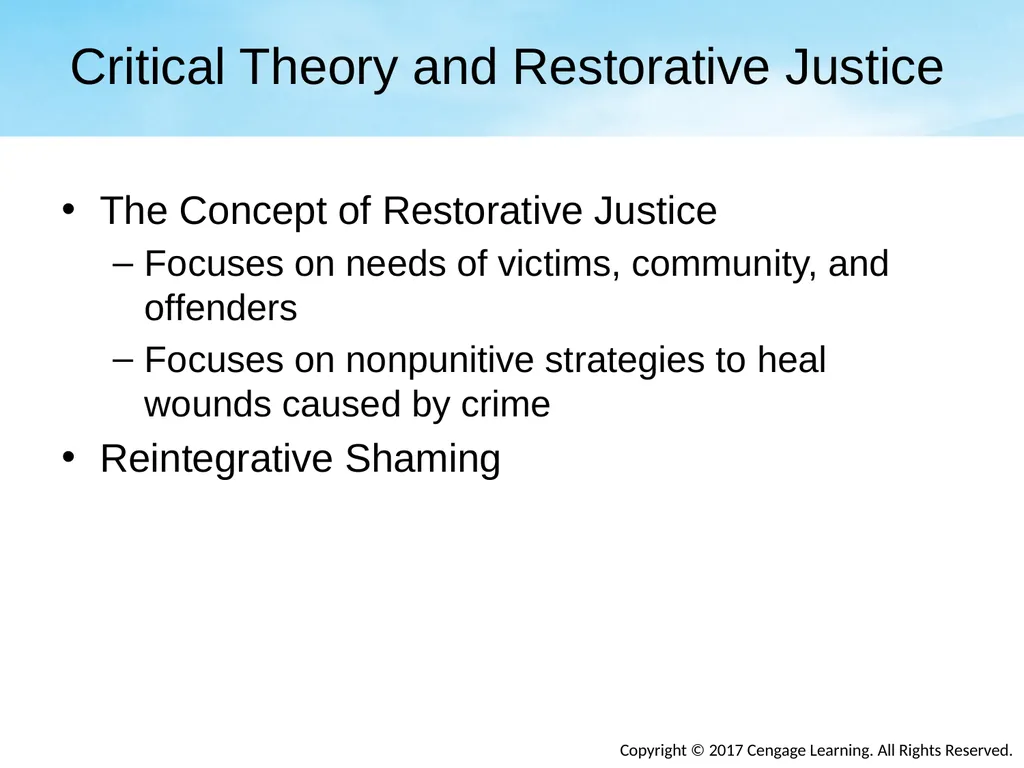
Critical Theory and Restorative Justice The Concept of Restorative Justice
Focuses on needs of victims, community, and offenders
Focuses on nonpunitive strategies to heal wounds caused by crime
Reintegrative Shaming<br>
23
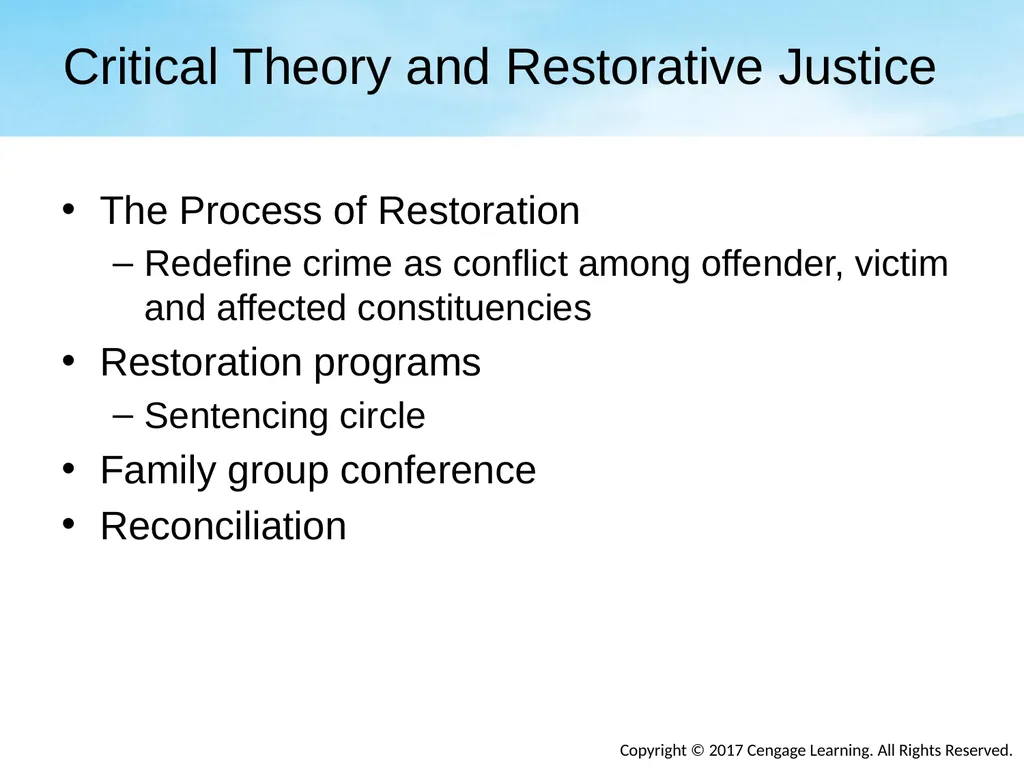
Critical Theory and Restorative Justice The Process of Restoration
Redefine crime as conflict among offender, victim and affected constituencies
Restoration programs
Sentencing circle
Family group conference
Reconciliation<br>